Last updated: October 2026 | Author: Team Guideflow | 12 min read
Your product roadmap says "real-time." Your current data model says "it depends."
The first version may work with a relational database. Then usage changes. Event volume climbs. Customers expect low-latency dashboards in more regions. Engineering starts discussing partitions, replicas, compaction, and write paths.
A wide-column database can handle that shape of workload - but only when your access patterns are clear before implementation. Apache Cassandra's official documentation describes it as a distributed NoSQL database implementing a partitioned wide-column storage model, and that framing applies to the whole category. The NoSQL market is projected to grow at a 17.8% CAGR through 2031, according to Mordor Intelligence (2026), which reflects how many teams are making this infrastructure shift right now.
The harder question is not whether a wide-column store fits your workload. It is which one fits your workload without becoming a maintenance project your team cannot staff.
What's inside
This guide is for product managers and technical leads validating data infrastructure for high-volume, low-latency product workloads. Items were selected based on four criteria:
- Wide-column model fit: Products must use a wide-column or direct Cassandra-compatible architecture
- Operational model breadth: The list covers open-source, self-managed, and fully managed deployment paths
- Verified pricing and ratings: Every figure traces to the vendor's live pricing page or a named review source
- PM-relevant framing: Each section speaks to opportunity cost, release cadence, and engineering ownership, not just feature checklists
No document databases or analytical warehouses appear in the list, even when they use "column" in their marketing.
TL;DR
- Best open-source baseline: Apache Cassandra for teams with platform engineers ready to own operations end to end
- Best for Cassandra-compatible performance workloads: ScyllaDB for high-throughput, latency-sensitive applications needing predictable tail latency
- Best for Hadoop-connected platforms: Apache HBase when your architecture already centers on the Hadoop ecosystem
- Best managed Bigtable-style option: Google Cloud Bigtable for low-latency serving, time-series, and operational analytics on Google Cloud
- Best managed Cassandra-compatible options: Amazon Keyspaces, Azure Cosmos DB for Apache Cassandra, and DataStax Astra DB - choose based on cloud strategy and how much database operation your team wants to own
What is a wide-column database?
A wide-column database is a distributed NoSQL database that stores data in rows organized into column families, allowing each row to contain a different set of columns and scale across many machines.
Unlike relational databases, wide-column systems are designed around known query paths. You model the data to match the queries that drive the user experience, not the other way around. Each row is located through a partition key or row key. Related columns are grouped into a column family. Empty fields do not consume storage across every row because sparse data is a first-class pattern.
Wide-column databases favor denormalization. If your product needs to read "all events for this account in the past 30 days," you build a table optimized for exactly that read path rather than joining three normalized tables at query time.
Key characteristics of wide-column databases
- Partitioned data distribution across nodes
- Column families and sparse rows
- Query-first data modeling approach
- High write throughput at scale
- Horizontal scaling across commodity hardware
- Replication across availability zones or regions
- Tunable consistency in many systems (strongly configurable in some, eventually consistent by default in others)
- Time-ordered clustering keys for event and time-series workloads
How a wide-column data model works
| Concept | Plain-English explanation | Product example |
|---|---|---|
| Partition key | Determines which node stores the data | customer_id |
| Clustering key | Orders related records within a partition | event_timestamp |
| Column family | Groups a query-specific dataset | customer_events |
| Sparse columns | Supports attributes that differ by record | Optional device metadata |
| Replication | Copies data for resilience and regional locality | Multi-region product traffic |
Wide-column versus relational databases
Relational databases optimize for normalized models, joins, and transactions across tables. Wide-column databases optimize for distributed scale and known, repeated access patterns. Use a relational database when complex relationships and ad hoc querying drive the product. Reach for a wide-column store when a small set of high-volume read and write paths must stay fast as data volumes grow.
Wide-column versus document databases
Document databases store flexible nested records and suit evolving entities with rich object-shaped data. Wide-column systems organize data around partitions and column families, which suits workloads where predictable access patterns and distributed throughput matter more than ad hoc document queries.
Wide-column versus columnar databases
This distinction matters. A wide-column database is an operational serving database: It handles real-time reads and writes for your running product. A columnar database stores values by column for analytical scanning and aggregation at warehouse scale. Many product architectures use both: A wide-column store for operational events, then a warehouse for BI and reporting.
| Use this when | Wide-column database | Columnar warehouse |
|---|---|---|
| Write volume is high and continuous | Yes | No |
| Queries are predictable and repeated | Yes | Partial |
| Ad hoc aggregations across the full dataset | No | Yes |
| Low-latency serving to end users | Yes | No |
When to use a wide-column database
Serve time-series and event data at product speed
Wide-column databases excel at telemetry, audit trails, clickstreams, payment events, and user activity histories. The data model should reflect the primary query: "events for this account during this time window." Partition by account, cluster by timestamp, and reads stay fast regardless of how many total records exist.
Support globally distributed, write-heavy applications
Products requiring continuous writes across regions, and resilience to zone failures, fit the wide-column model well. Multi-datacenter replication and tunable consistency give teams control over which writes must be acknowledged by multiple nodes. Architecture design, consistency settings, and cloud configuration all determine real-world behavior - these systems do not configure themselves.
Keep operational data separate from analytical reporting
Use a wide-column store for low-latency product workflows and a separate warehouse for broad historical analysis. A streaming or ETL layer connects the two. Mixing both jobs in a single system creates capacity planning conflicts and makes it harder to instrument and measure each path independently.
Architecture decision checklist:
- Do your top read paths query by a known entity key and time range?
- Will write volume exceed what a single-node relational database handles without sharding?
- Do you need regional replicas for latency or resilience?
- Can your team name the five queries that power the product today?
- Is someone on the team accountable for compaction, repair, backups, upgrades, and observability?
Wide-column database comparison
The right choice depends on your existing cloud platform, whether you need Cassandra compatibility, your tolerance for infrastructure ownership, and your latency and throughput targets. The table below gives a workload-oriented view. G2 ratings reflect verified listings as of October 2026; open-source Apache projects have limited review coverage on G2.
| # | Product | Best for | Key differentiator | Pricing | G2 rating |
|---|---|---|---|---|---|
| 1 | Apache Cassandra | Self-managed global workloads | Open-source partitioned wide-column model | Free software, infrastructure costs vary | 4.1/5 |
| 2 | ScyllaDB | High-throughput Cassandra-compatible workloads | Shard-per-core engine with CQL and DynamoDB API compatibility | Usage-based cloud pricing, 30-day free trial | 4.5/5 |
| 3 | Apache HBase | Hadoop-centered big-data platforms | Bigtable-inspired store with HDFS integration | Free software, infrastructure costs vary | 4.2/5 |
| 4 | Google Cloud Bigtable | Google Cloud time-series and operational analytics | Fully managed wide-column service, from $0.65/node-hour | From $0.65/node-hour plus storage and network | 4.4/5 |
| 5 | Amazon Keyspaces | AWS-native Cassandra compatibility | Serverless managed CQL service, on-demand capacity | Consumption-based reads, writes, and storage | 4.6/5 |
| 6 | Azure Cosmos DB for Apache Cassandra | Azure-native global applications | Cassandra API on Cosmos DB with global distribution | Provisioned or serverless throughput plus storage | 4.2/5 |
| 7 | DataStax Astra DB | Managed Cassandra with developer workflow support | Serverless multi-cloud Cassandra, from $0.25/GB/month storage | Free tier; Standard from $0.25/GB/month storage | N/A |
Pricing and ratings verified October 2026 from each vendor's pricing page and G2 listing.
Best 7 wide-column database technologies for 2026
1. Apache Cassandra
Apache Cassandra is an open-source distributed NoSQL database that implements a partitioned wide-column storage model, as described in the official Cassandra documentation. Its masterless architecture means no single node is a point of failure, and the system scales horizontally by adding nodes without downtime. Cassandra Query Language (CQL) provides a familiar SQL-like interface for teams coming from relational backgrounds.
Best for: Teams with strong platform engineering capacity that need direct control over a multi-region, write-heavy database.
Key features
- Partitioned wide-column storage model
- Masterless distributed architecture
- Cassandra Query Language (CQL) support
- Multi-datacenter replication
- Tunable consistency settings
- Storage-Attached Indexes and vector search
Why choose Apache Cassandra: Choose Cassandra when the roadmap prioritizes control, portability, and ecosystem maturity over reduced operational overhead. It fits teams that can invest in schema design, capacity planning, repair cycles, monitoring, and incident ownership.
Apache Cassandra pricing: The software is free and open source under the Apache License. Budget separately for compute, storage, observability tooling, backups, support contracts, and the engineering hours to operate the cluster.
G2 rating: 4.1/5 (verified October 2026)
2. ScyllaDB
ScyllaDB is a Cassandra-compatible wide-column database built on a shard-per-core architecture that automatically assigns workloads to CPU threads without a global lock. It supports both CQL and Amazon DynamoDB-compatible APIs, which matters for teams already invested in either API surface. ScyllaDB Cloud offers managed deployment across major clouds, with Standard, Professional, and Premium tiers.
Best for: Engineering teams with high-throughput, latency-sensitive workloads where predictable tail latency and infrastructure behavior directly affect user-facing product metrics.
Key features
- Shard-per-core architecture with automatic resource optimization
- CQL and DynamoDB-compatible APIs
- Vector Search and Full-Text Search
- Change Data Capture, backup and restore, and automatic repair
- High-availability multi-region active-active replication
Why choose ScyllaDB: ScyllaDB fits product experiences where tail latency at the 99th percentile shows up in activation metrics. A customer data platform or real-time feature pipeline is the sort of workload where the operational predictability ScyllaDB focuses on translates into measurable product outcomes.
ScyllaDB pricing: ScyllaDB Cloud is resource-based and configured through a pricing calculator. A 30-day Developer Free Trial and a 48-hour Production Evaluation are both available. Actual cluster costs depend on node type, region, and contract structure.
G2 rating: 4.5/5 (verified October 2026)
3. Apache HBase
Apache HBase is an open-source distributed and scalable NoSQL data store modeled after Google's original Bigtable paper. It runs on HDFS and integrates tightly with the broader Hadoop ecosystem. Apache's own project materials position HBase for logs, security analytics, research datasets, and large sparse data sets where random read-write access to billions of rows is required.
Best for: Organizations already running Hadoop-compatible infrastructure that need a wide-column store for large-scale batch or operational workloads.
Key features
- Bigtable-inspired data model with column families
- Hadoop and HDFS integration
- Strongly consistent reads and writes
- Automatic sharding and RegionServer failover
- Java, REST, and Thrift API access
- Block cache and Bloom filters for read optimization
Why choose Apache HBase: HBase makes sense when the company already runs or plans to run an Apache Hadoop-centric platform and needs a wide-column store within that stack. For teams without an existing Hadoop investment, the operational surface area is higher than the managed alternatives on this list.
Apache HBase pricing: The software is free and open source under the Apache License. Running it requires cluster infrastructure, HDFS storage, ongoing operations, monitoring tooling, and engineering ownership.
G2 rating: 4.2/5 (verified October 2026)
4. Google Cloud Bigtable
Google Cloud Bigtable is a fully managed wide-column database service. Google Cloud's own product documentation positions it for low-latency applications, time-series data, and operational analytics, making it a natural choice for teams building data-intensive products on Google Cloud. It supports Apache Cassandra and HBase compatibility, autoscaling without downtime, SQL queries, and continuous materialized views.
Best for: Google Cloud teams that need managed wide-column infrastructure for user-facing applications, IoT telemetry, event logging, or operational analytics at scale.
Key features
- Fully managed wide-column database service
- Low-latency, high-throughput data access
- Autoscaling and cluster resizing without downtime
- SQL queries and continuous materialized views
- Apache Cassandra and HBase compatibility
- Multi-cluster replication and tiered storage
Why choose Google Cloud Bigtable: Bigtable shifts database operations into the cloud service model. It is a strong route when cloud alignment matters and your team's capacity planning maps directly to product growth forecasts. Bigtable is not a data warehouse; treat it as your operational serving layer. For broader data analysis, pair it with a separate analytical tool from your best data visualization tools stack.
Google Cloud Bigtable pricing: Enterprise Edition capacity starts from $0.65 per node per hour in selected U.S. regions; Enterprise Plus Edition starts from $0.85 per node per hour. Additional charges apply for storage, backups, and network usage. A 10-day free trial instance is available, with an option to extend to 90 days.
G2 rating: 4.4/5 (verified October 2026)
5. Amazon Keyspaces
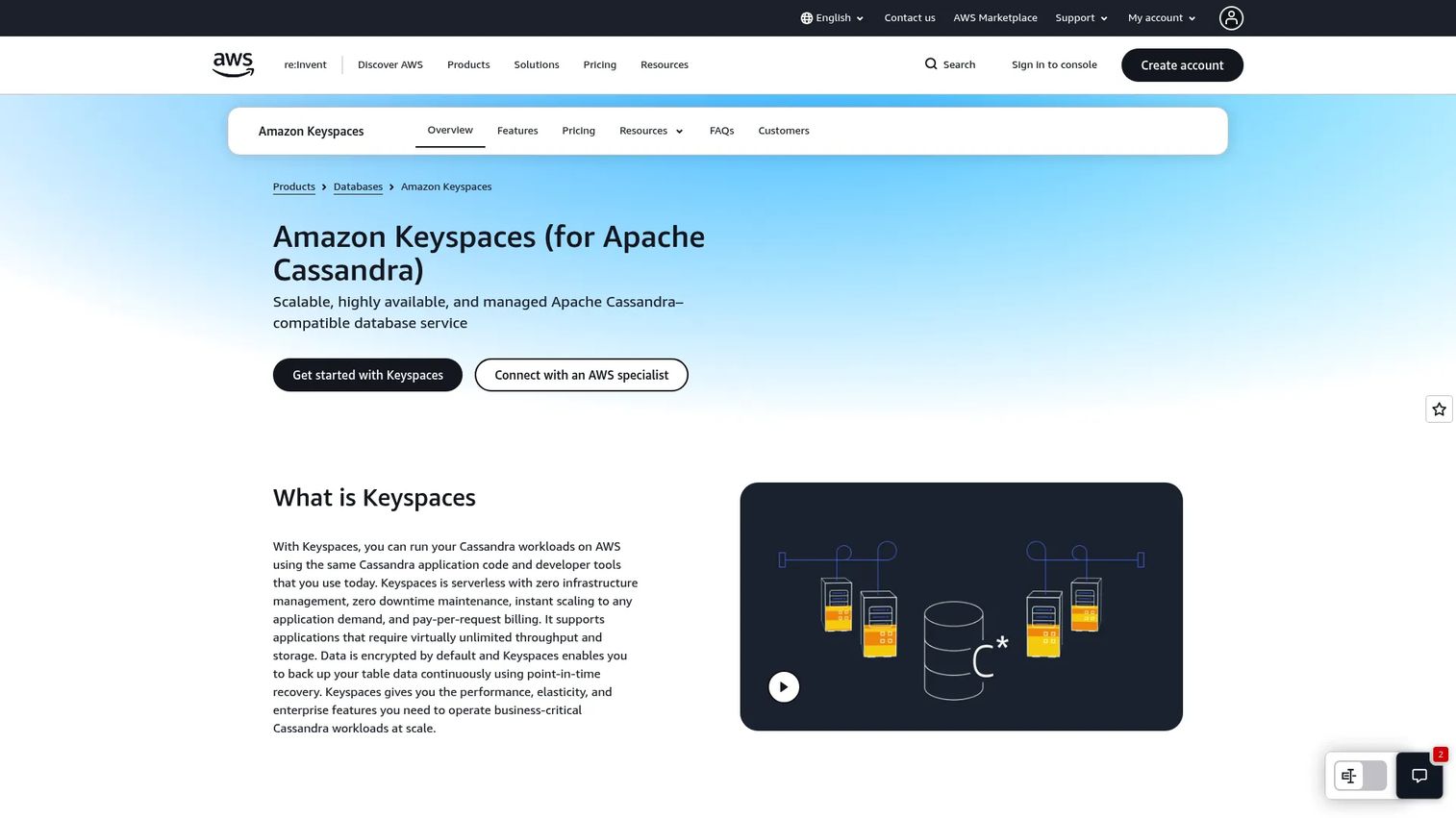
Amazon Keyspaces is a serverless managed Apache Cassandra-compatible database service on AWS. It supports the Cassandra Query Language and existing Cassandra drivers, so teams can migrate applications without rewriting queries. AWS operates the underlying infrastructure: Provisioning, patching, and replication are all managed by the service.
Best for: AWS-native teams that need Cassandra API compatibility without managing cluster operations, upgrades, or repair cycles.
Key features
- Apache Cassandra and CQL compatibility
- Serverless on-demand and provisioned capacity modes
- Multi-region replication
- Point-in-time recovery
- Change data capture via Keyspaces Streams
- Encryption at rest and in transit with IAM access management
Why choose Amazon Keyspaces: Keyspaces makes sense when AWS is the primary cloud and the team wants to run Cassandra-compatible workloads without a dedicated database operations practice. AWS Savings Plans are available for eligible usage, which matters when modeling the cost of a high-volume product launch against a b2b contact database software or event tracking workload.
Amazon Keyspaces pricing: Charges are consumption-based, covering read request units, write request units, storage, replication, and related AWS services. On-demand and provisioned capacity modes are both available. The AWS Free Tier includes 30 million on-demand write request units, 30 million on-demand read request units, and 1 GB of storage monthly for the first three months.
G2 rating: 4.6/5 (verified October 2026)
6. Azure Cosmos DB for Apache Cassandra
Azure Cosmos DB for Apache Cassandra is Azure Cosmos DB accessed through the Apache Cassandra API. It suits organizations that want Cassandra-compatible development patterns combined with Cosmos DB's global distribution, elastic scaling, and Azure-native governance. The service supports standard provisioned throughput, autoscale provisioned throughput, and serverless capacity modes.
Best for: Azure-native teams building globally distributed applications that prefer the Cassandra API and want Azure identity, networking, and cost management built in.
Key features
- Apache Cassandra API on Azure Cosmos DB
- Global data distribution and replication across Azure regions
- Elastic scaling of throughput and storage
- Serverless and provisioned throughput pricing models
- Multiple consistency models and enterprise security
Why choose Azure Cosmos DB for Apache Cassandra: This option fits companies that already rely on Azure for identity, procurement, and compliance governance. Portability is worth evaluating before committing: Workloads on the Cosmos DB Cassandra API are tied to Azure, which affects long-term cloud data security software and vendor strategy decisions.
Azure Cosmos DB for Apache Cassandra pricing: Costs depend on throughput mode, storage, backup, network usage, and regional configuration. The Azure free tier includes 1,000 RU/s and 25 GB of storage for eligible accounts. Microsoft recommends using the Cosmos DB cost estimator and monitoring tools to model workload costs before committing to a production configuration.
G2 rating: 4.2/5 (verified October 2026, for Azure Cosmos DB)
7. DataStax Astra DB
DataStax Astra DB is a serverless, multi-cloud database service built on Apache Cassandra, oriented toward real-time applications and AI workloads. It supports Cassandra Query Language, a Data API, a CLI, and a DevOps API, so developers can interact with the database through the interface that fits their workflow. The platform handles infrastructure provisioning, scaling, and maintenance automatically.
Best for: Product teams that need Cassandra-compatible data models but want a managed deployment path with developer-friendly tooling and no cluster operations overhead.
Key features
- Serverless auto-scaling with consumption-based billing
- CQL, Data API, CLI, and DevOps API access
- Vector and non-vector database support for generative AI workloads
- Real-time vector search with hybrid search and metadata filtering
- Encryption, role-based access control, and compliance certifications
Why choose DataStax Astra DB: Astra DB suits teams that want to shorten the time between architecture decision and deployed service. If your roadmap treats the database as infrastructure supporting product delivery rather than a project in itself, buying down the operational burden through a managed service is a concrete reduction in auto scaling software complexity and engineering opportunity cost.
DataStax Astra DB pricing: A free tier is available with fixed monthly credits. Standard pricing is metered: $0.62 per 1 million write request units, $0.37 per 1 million read request units, and $0.25 per GB per month for storage. Enterprise support is priced as a percentage of monthly Astra usage and requires a sales conversation.
Considerations when choosing a wide-column database
Start with access patterns, not entities
Wide-column modeling works best when your team can name the queries that power the product before selecting a system. Ask engineering to document the top reads, expected write volume, partition size assumptions, and time-window queries. A wide-column database built around the wrong access pattern is hard to fix after data accumulates.
Decide who owns operations
Open-source software reduces license cost; it does not remove operational work. Someone must own backups, upgrades, schema governance, observability, repair, capacity planning, and incident response. A change data capture software pipeline adds another operational layer on top. Managed services shift much of this to the provider but introduce a different set of constraints around portability and cost predictability.
Model regional reliability before committing to it
Multi-region architecture changes cost and complexity in ways that affect your release cadence. Define which user actions require strong consistency, which can tolerate asynchronous replication, and what behavior the product should exhibit during a regional disruption. Promising sub-100ms latency across three continents is a product decision with infrastructure cost attached.
Separate serving data from analytical data
Avoid using one database for every job. Product-serving workloads need predictable low latency. Analytics teams need broad scans, flexible aggregation, and low-cost historical storage. Review best data visualization tools and best business intelligence software separately from your serving-layer decision.
Test with a representative workload
A clean synthetic benchmark understates the challenge. Run your proof of concept with your expected partition distribution, hot keys, retention policy, payload size, write bursts, failure scenarios, and the queries customers will feel directly. Infrastructure that performs well in clean tests can behave unexpectedly under production-shaped data. Pair this with an honest review of best product analytics software tools to instrument the workload properly before and after migration.
Conclusion
Each of these seven wide-column databases serves a distinct combination of operating model and workload.
Apache Cassandra remains the strongest baseline for teams ready to own a distributed open-source database from top to bottom. ScyllaDB fits Cassandra-compatible workloads where tail latency and throughput predictability directly affect user experience. Apache HBase is the right call when Hadoop is already foundational to the platform.
Google Cloud Bigtable handles the managed Bigtable path on Google Cloud, covering time-series, event logging, and operational analytics without cluster operations. Amazon Keyspaces and Azure Cosmos DB for Apache Cassandra each fit cloud-native teams choosing managed Cassandra compatibility within their respective cloud ecosystems. DataStax Astra DB gives teams a serverless Cassandra-compatible path that minimizes infrastructure ownership and supports modern AI workloads.
The decision framework is straightforward: Start with your access patterns, reliability requirements, and a clear view of who owns what in production. Then run a focused proof of concept against the two options that best match your cloud alignment and team capacity. A choice that fits your current engineering team is more durable than a technically superior option nobody has the bandwidth to operate.
For teams evaluating adjacent infrastructure decisions, the guides on cloud file storage software and ai model deployment software cover complementary parts of the data platform stack.
Start your journey with Guideflow today!
FAQs
A wide-column database is a distributed NoSQL database that organizes data into rows and column families, where each row can contain a different set of columns. It is located via a partition key or row key, and sparse data is stored without wasting space on empty fields. Wide-column stores are designed for operational workloads at scale, not analytical aggregation, which distinguishes them from columnar data warehouses.
Relational databases use normalized tables, enforce schemas across rows, and support joins across tables. Wide-column databases use denormalized, query-specific models that avoid joins entirely. Relational databases remain the better choice for complex transactional workflows with many relationships and ad hoc reporting needs; wide-column stores fit workloads with a small, stable set of high-volume access patterns.
Document databases center on flexible nested records, which suits evolving entities and rich object-shaped data. Wide-column systems center on partitions and column families built around planned query paths. A document store fits a product catalog where each item has different attributes; a wide-column store fits a user activity history where every query asks for events by user ID and time range.
Yes. Apache Cassandra's official documentation describes it as a distributed NoSQL database implementing a partitioned wide-column storage model. It stores data in tables with partition keys and clustering keys, supports multi-datacenter replication, and offers configurable consistency behavior across reads and writes.
Yes. Google Cloud Bigtable is a fully managed wide-column service. Google Cloud positions it for low-latency applications, time-series data, and operational analytics, not for analytical warehouse queries. It is not a substitute for BigQuery or similar analytical systems.
Use a wide-column store when your application writes large volumes of ordered events and reads them by entity and time range: Device readings by sensor ID and timestamp, user events by account ID and event time, or payment records by customer ID and transaction date. Partition design matters more than the choice of system. Poor key design creates hotspots where one partition receives a disproportionate share of writes, which degrades performance across the cluster.
No, and the two systems are not competing for the same job. Wide-column databases serve operational applications that need fast, predictable reads and writes during product execution. Data warehouses support analytical scans and aggregations across large historical datasets for reporting and BI. Many product architectures use both: A wide-column store as the operational layer and a warehouse for analysis, connected by a streaming or ETL pipeline. Review best statistical analysis software options separately from your operational database evaluation.
Managed services shift specific infrastructure tasks to the provider: Provisioning, patching, backups, and parts of scaling. Your team retains ownership of data modeling, capacity assumptions, access control, cost monitoring, and application behavior. The operational surface area is smaller, but it is not zero. The right question for a PM is not whether managed is easier in absolute terms; it is whether the time saved on infrastructure maps to measurable engineering capacity returned to the roadmap.
Tunable consistency means you can configure, per query or globally, how many replicas must acknowledge a read or write before the operation succeeds. A write to all replicas provides stronger consistency but adds latency. A write to one replica is faster but risks stale reads if a node fails before replication completes. For most product workloads, you tune writes to a quorum and reads to a quorum, which balances safety and performance. Strong consistency for every operation in a multi-region setup is expensive; knowing which user actions require it is a product decision, not just a database setting.