Your rep just burned a touch on a bounced email. The next contact left the company 14 months ago. The one after that has the wrong title. That is the quiet tax bad data puts on every stage of your funnel, and the reason the right b2b contact database software is one of the highest-leverage purchases a sales org makes.
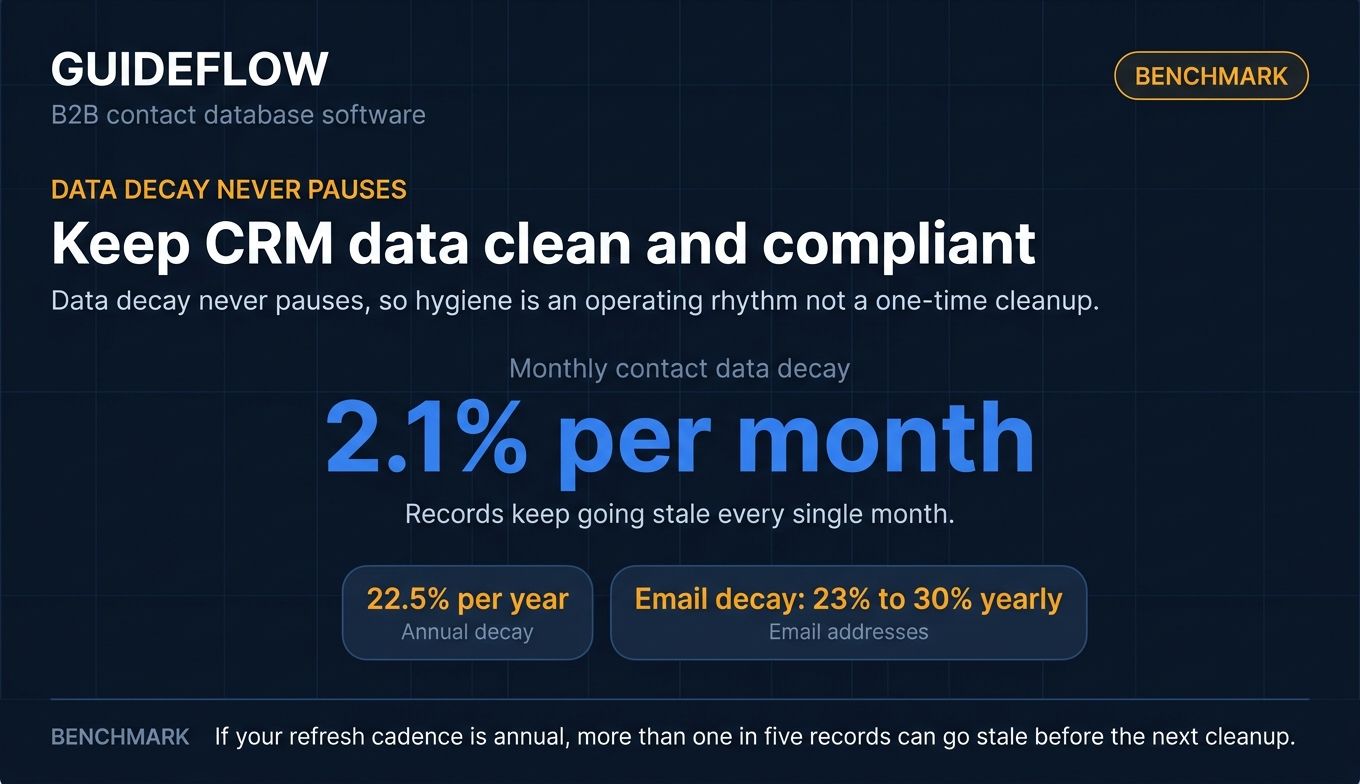
Here is the part most teams underestimate: contact data does not sit still. According to Landbase (2024), b2b contact data decays at roughly 2.1% per month, or 22.5% per year. More than one in five records in your CRM goes bad annually without anyone touching it. Email addresses alone decay 23% to 30% per year, and phone numbers follow a similar curve.
That decay rate is why a b2b contact database is not a one-time list purchase. It is a living layer that an entire sales team depends on. SDRs build outbound lists from it. AEs verify the right stakeholder mid-deal. RevOps enriches and dedupes the CRM against it. Demand gen pulls from the same well for campaigns. When the data is fresh and verified, every one of those motions gets sharper. When it is stale, the rot spreads to deliverability, forecast accuracy, and rep trust in the system.
The trouble is that every b2b data provider claims accuracy, coverage, and compliance. Few make it easy to compare what you actually get for the price. This guide does the comparison work for you, ranked by the four things buyers care about most.
What's inside
This guide is for sales teams evaluating a shared b2b contact database, from the SDR building lists to the AE verifying decision-makers to the RevOps lead governing CRM hygiene and the demand gen marketer pulling segments. One data layer, multiple roles.
We ranked 11 contact data providers on four criteria that matter when several teams touch the same system:
- Data accuracy and verification (bounce rates, refresh cadence)
- Coverage and database size (records, mobile depth, region fit)
- Pricing and credit model transparency (cost per usable record)
- CRM and workflow fit plus compliance (native sync, GDPR/CCPA, suppression)
Pricing and ratings were verified against live vendor pages and G2 listings. Confirm pricing before you buy, since it changes often.
TL;DR
- Best for enterprise data governance: ZoomInfo, with the deepest US coverage, intent data, and org charts.
- Best for budget and free tier: Apollo.io, with a free-forever plan and a large database paired with outreach.
- Best for EMEA and GDPR coverage: Cognism, with phone-verified Diamond Data and compliance-first sourcing.
- Best for outbound SDR teams: Lead411, with verified emails, direct dials, and intent triggers at transparent prices.
- Best for HubSpot-centric enrichment: Clearbit / Breeze Intelligence, native to HubSpot's Smart CRM.
- Best for source-of-truth research: LinkedIn Sales Navigator, for relationship-led prospecting straight from the network.
Background: what b2b contact database software is
B2B contact database software is a tool that aggregates, verifies, and continuously refreshes business contact and company records (emails, direct dials, titles, firmographics) so sales and marketing teams can find and reach decision-makers.
Think of it as the data layer underneath your entire go-to-market motion. A business contact database stores who works where, what they do, how to reach them, and increasingly, signals about when they are likely to buy. The best b2b contact database providers do not just store records. They re-verify them on a cycle, because a static contacts database starts decaying the day it is built.
Most platforms in this category share a common set of capabilities. The strongest contact data providers combine all of them in one place:
- Contact and company search: Find people and accounts by name, role, or firmographic attributes.
- Verification and bounce-checking: Validate emails and phones before you export, to protect deliverability.
- Advanced filters: Narrow by title, seniority, industry, geography, company size, and tech stack.
- Enrichment: Fill gaps in existing CRM records and append missing fields automatically.
- Intent data: Surface accounts showing buying signals based on web and content activity. See our roundup of the best buyer intent data providers for tools that specialize here.
- CRM sync: Push verified records directly into Salesforce, HubSpot, or your sequencer. Compare options in our guide to the best CRM software.
- Credits and exports: Govern how much data each seat can pull, with caps that vary by plan.
- Compliance controls: Honor GDPR, CCPA, suppression lists, and do-not-call requests.
The difference between a mediocre and a strong b2b data provider usually comes down to two things buried in the fine print: how often records get re-verified, and how the credit model affects your true cost per usable contact. A database that looks cheap per seat can get expensive fast if half the exports bounce.
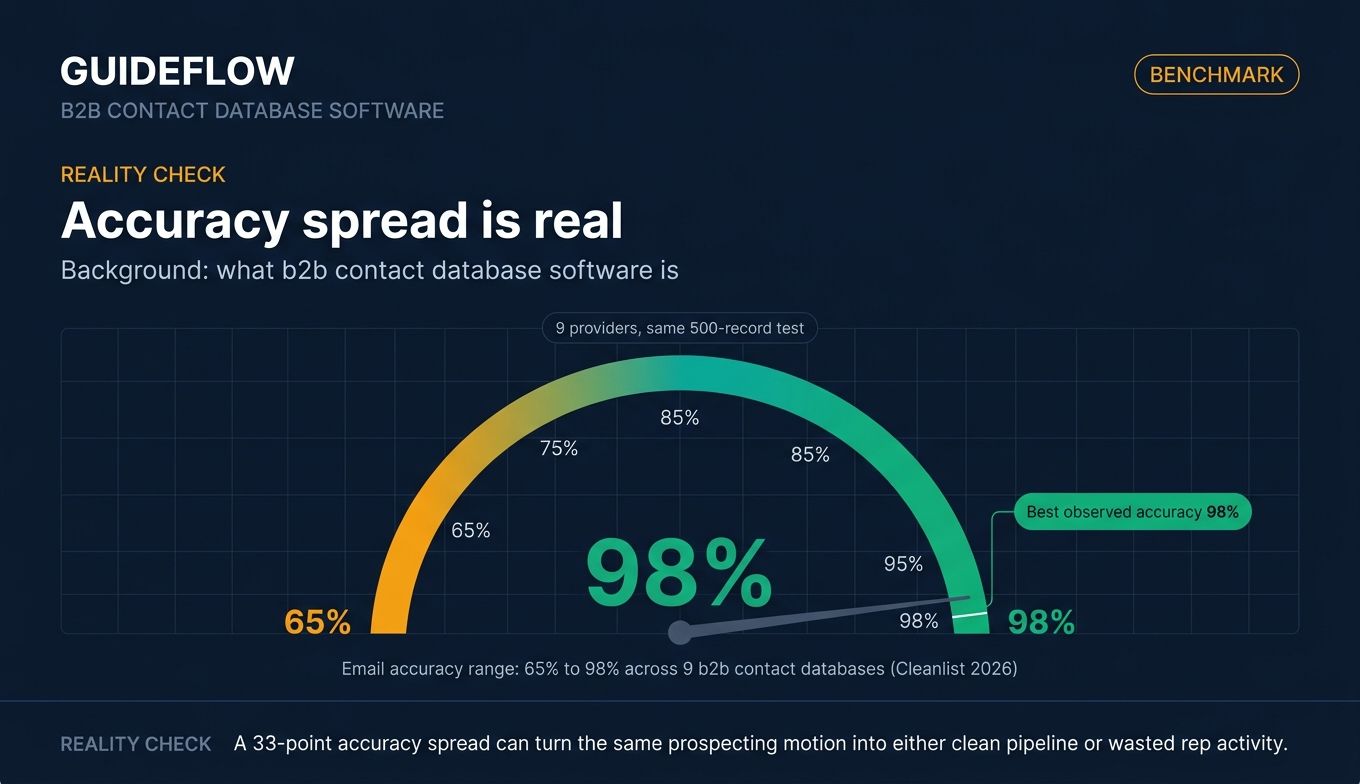
A useful reality check on quality: in a 2026 benchmark, Cleanlist tested 9 b2b contact databases on the same 500-record sample and found email accuracy ranging from 65% to 98%. That spread is the whole reason to evaluate carefully before committing budget.
When to use a contact database (and what comes after the data)
A b2b contact database earns its keep across several distinct moments in the sales cycle. Here is how each role tends to use it.
Build targeted outbound lists at volume
SDRs live in the filters. They define an ICP by title, seniority, industry, geography, and company size, then pull a clean list to feed sequences. The payoff here is precision plus volume: fewer wasted touches because the contacts actually match the profile, and enough records to keep the pipeline filling. Verification matters most at this stage, because a high bounce rate poisons sender reputation fast. Teams scaling this motion often pair their data with the best outreach software to turn clean lists into sequences.
Verify and enrich records mid-deal
AEs use the database differently. Mid-deal, they confirm they are talking to the right stakeholder, find the additional buying committee members they need to multi-thread, and pull a direct dial when an email goes quiet. RevOps runs enrichment in the background, filling gaps in CRM records and keeping firmographics current so routing and scoring stay accurate. For routing logic, our list of the best lead scoring software is a useful companion.
Keep CRM data clean and compliant
The ongoing job is hygiene. Records decay roughly 2.1% per month, so a one-time cleanse is not enough. Teams set a refresh cadence, apply suppression and do-not-call lists, and enforce GDPR and CCPA rules at the data layer so compliance is not an afterthought bolted on later.
Sourcing accurate contacts is step one, not the finish line. Once the right people are identified, the reply often comes down to what you put in front of them, which is why many teams pair a strong data layer with interactive demos so a first touch shows the product instead of just describing it. You can share these demos directly in a first-touch email to give prospects a reason to reply.
Comparison table
Here are all 11 tools side by side, sorted by relevance to the keyword with data-first providers near the top. Pricing reflects publicly listed figures at the time of writing. Several enterprise vendors publish no public price and quote based on seats, credits, and features.
| # | Product | Intent | Key use case | Pricing | G2 rating |
|---|---|---|---|---|---|
| 1 | ZoomInfo | Enterprise GTM intelligence | Deep US coverage, intent, org charts | Custom (credit/contract) | 4.5/5 |
| 2 | Apollo.io | All-in-one data + engagement | Budget outbound with free tier | Free forever; custom paid | 4.7/5 |
| 3 | Cognism | Compliance-first EMEA data | GDPR-ready verified mobiles | Talk to sales | 4.5/5 |
| 4 | Lead411 | Outbound SDR data | Verified emails, dials, intent | From $49/month | 4.5/5 |
| 5 | RocketReach | Broad contact lookup | Email/phone discovery at scale | See pricing page | 4.4/5 |
| 6 | LeadIQ | Capture-to-CRM workflow | Sales Navigator to sequencer | Free; Pro $200/month | 4.2/5 |
| 7 | Seamless.AI | Real-time search prospecting | High-volume list building | Free; Pro/Enterprise custom | 4.4/5 |
| 8 | Lusha | Fast self-serve lookup | Browser-extension prospecting | Free; Scale custom | 4.3/5 |
| 9 | Clearbit / Breeze Intelligence | HubSpot-native enrichment | CRM enrichment and routing | Included in paid HubSpot plans | 4.4/5 |
| 10 | LinkedIn Sales Navigator | Source-network research | Account research, decision-maker engagement | From $119.99/month | 4.4/5 |
| 11 | GetProspect | Budget email finder | Affordable list building + CRM | Free; from $49/month | 4.0/5 |
1. ZoomInfo
ZoomInfo is the enterprise standard in this category, an AI-powered go-to-market intelligence platform that combines company and contact data with buying intent signals and workflow automation. In a 2026 comparison, it was still described as the "800-pound gorilla" in B2B data, with some of the deepest US contact coverage available. If you need scale, intent, and org charts in one platform, this is the benchmark others get measured against.
Best for: Enterprise sales, marketing, and RevOps teams that need prospecting data, buying signals, and GTM workflow automation in one place.
Key strengths
- Deep US coverage with verified contacts: A b2b contact database with direct-dial phone numbers and verified emails at enterprise scale.
- Buyer intent and fit scoring: Intent signals, web activity, and a Chrome extension that surface accounts in-market now.
- Enrichment and workflow automation: Lead enrichment, signal-driven workflows, and integrations with CRM and sales engagement tools.
Why choose ZoomInfo: ZoomInfo fits teams that have outgrown lighter tools and need governed data across a large org. The trade-off is cost and commitment. Pricing is contract-based and credit-driven, typically annual, with no public price tag, so plan for a sales-led buying process and a real budget conversation.
ZoomInfo pricing: ZoomInfo states that pricing depends on features, the number of licenses, and credit usage. No public numeric price or plan tier is listed on its pricing page. A free trial is available, but there is no free tier. Confirm current terms directly with ZoomInfo before signing.
2. Apollo.io
Apollo.io is a sales intelligence and engagement platform that pairs a large b2b contact data set with outbound tooling in one subscription. It is the tool most often named best free database in benchmark roundups, thanks to a generous free-forever plan. For SMB and mid-market teams that want data and sequencing without buying two products, Apollo is the default starting point.
Best for: Sales and marketing teams that need B2B prospecting data, enrichment, lead scoring, and outbound engagement on a budget.
Key strengths
- Large contact database with deep filtering: A b2b lead database of 230M+ contacts with 65+ filters to build precise lists.
- Enrichment across CRM, CSV, and API: Keep records current automatically wherever they live.
- Lead and account scoring: Prioritize outreach using demographic and behavioral data, then engage in the same platform.
Why choose Apollo: Apollo wins on cost-to-value for teams scaling outbound without enterprise budget. The honest trade-off is data accuracy at the volume end. Independent testing has placed Apollo's email accuracy in the 70% to 80% range, lower than pricier single-source providers, so verify before you export at scale.
Apollo pricing: Apollo offers a free-forever Starter plan, which is a genuine draw for budget-conscious teams and the answer to the free-tier question. Paid plans and a Custom enterprise tier exist, with credits, email campaigns, and integrations, though paid plan prices are not openly displayed on the pricing table. Check the live pricing page for current paid tiers.
3. Cognism
Cognism is a compliance-first b2b contact database provider built around verified, GDPR-aligned data, with a strong reputation for European coverage. Its phone-verified mobile numbers, branded Diamond Data, are the headline differentiator. If your motion touches EMEA or sits in a compliance-sensitive industry, Cognism is built for exactly that constraint.
Best for: Revenue teams that need compliant B2B prospecting data, especially for EMEA coverage, CRM enrichment, and account prioritization.
Key strengths
- Verified contact and company data: Emails, mobiles, job titles, work history, revenue, headcount, HQ, and technology usage in one record.
- Targeted list building with AI: Firmographic, technographic, and signal-based filters plus AI company research and persona building.
- Enrichment and delivery options: CRM enrichment, CSV enrichment, API access, bulk data delivery, and on-demand mobile verification.
Why choose Cognism: Cognism fits teams that treat compliance as a hard requirement, not a nice-to-have. In benchmark testing it posted strong email accuracy near 87%, and its Diamond-verified phones are designed to lift connect rates. The trade-off is pricing access. Cognism does not publish numeric prices, and plans tend to start higher than SMB-focused tools.
Cognism pricing: Sales Prospecting is offered in Standard and Pro packages, each including 5 seats, with CRM Enrichment and Data-as-a-Service available as add-ons. The pricing page directs you to talk to sales for a personalized quote rather than listing public prices. No explicit free tier is shown.
4. Lead411
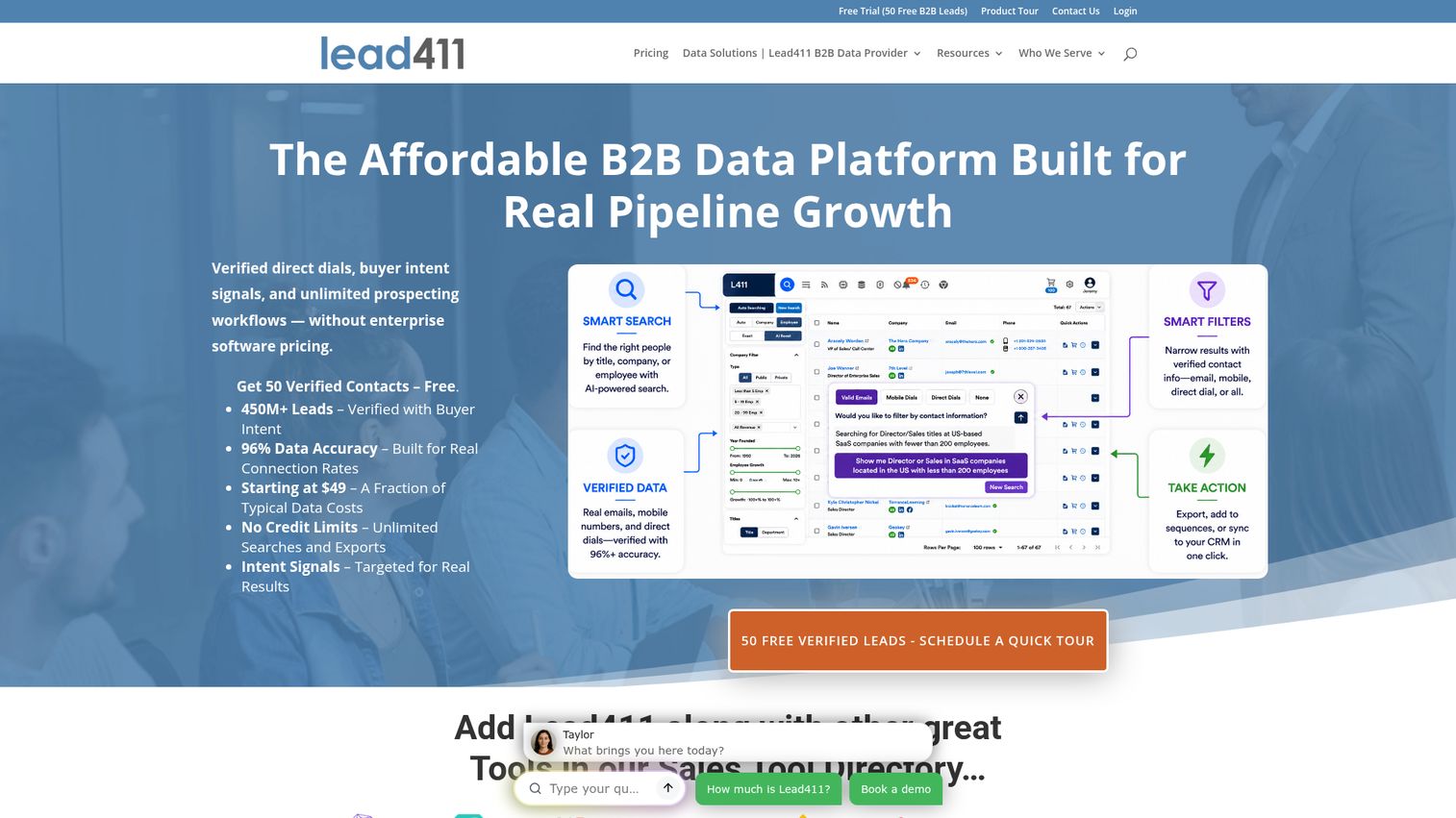
Lead411 is a B2B sales intelligence and lead generation platform focused on verified contacts and intent-driven prospecting. It is a strong fit for outbound SDR teams that want verified emails and direct dials alongside buyer intent signals, with transparent published pricing that many competitors avoid. For teams tired of opaque enterprise quotes, that transparency is a real advantage.
Best for: SDR teams, B2B marketers, and outbound sales organizations that need verified contact data and intent-driven prospecting workflows.
Key strengths
- Verified emails and direct dials: Reach decision-makers with contact data built for outbound volume.
- Buyer and growth intent data: Intent and company-growth triggers help time outreach to in-market accounts.
- CRM and outreach integrations: Push verified records into your CRM and sequencer without manual handoff.
Why choose Lead411: Lead411 fits SDR teams that want predictable, published pricing and verified data without a heavy enterprise contract. The trade-off is scale and breadth: its database and global coverage are narrower than ZoomInfo or Cognism, so EMEA-heavy teams should test coverage on a real sample first.
Lead411 pricing: Lead411 lists Spark at $49/month or $490/year and Ignite at $150/month or $1,500/year, with a custom Blaze plan quoted on request. A 7-day Pilot Light free trial includes 50 free exports, though there is no permanent free tier. That published entry price makes Lead411 one of the more transparent options on this list.
5. RocketReach
RocketReach is a lead intelligence and contact data platform built for finding business emails, phone numbers, and company or contact lists. Its large contact graph and browser extension make it a practical pick for individual reps and lightweight prospecting where you need a fast lookup without a heavy platform commitment.
Best for: Sales, recruiting, and marketing teams that need quick B2B contact discovery and outreach data.
Key strengths
- Broad email and phone lookup: Find contact details across a large contact graph from a single search.
- Browser extension: Pull contact information while you work, without switching tabs.
- Cross-team usefulness: Equally suited to sales prospecting, recruiting, and marketing list building.
Why choose RocketReach: RocketReach fits individual reps and small teams that want fast lookups over a full GTM platform. In benchmark testing its email accuracy landed around 83%, competitive with mid-tier providers. The trade-off is depth: it is a lookup tool more than a workflow platform, so teams wanting deep CRM automation may outgrow it.
RocketReach pricing: RocketReach publishes plans on its pricing page, but specific numeric tiers were not readable at the time of writing. Review the live pricing page for current plan details and any free or trial allowances before committing.
6. LeadIQ
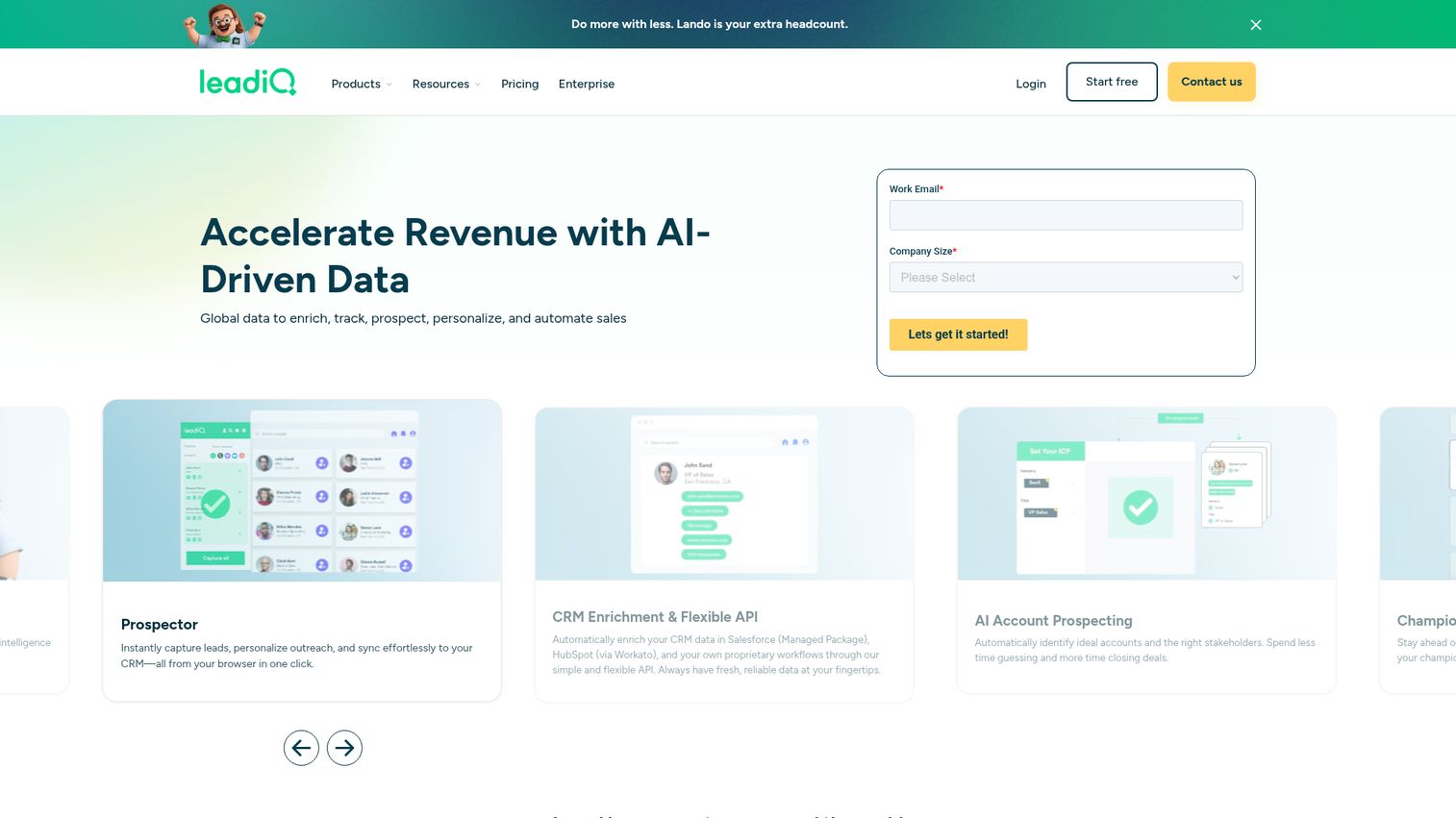
LeadIQ is a B2B prospecting platform built around capturing contacts, tracking sales triggers, enriching CRM data, and generating outbound emails with AI. Its strength is workflow speed: capture a prospect from LinkedIn Sales Navigator and push a clean record straight into your CRM and sequencer. For SDR teams that prize list-to-sequence velocity, that loop is the whole point.
Best for: Sales and revenue teams that need contact data, CRM enrichment, trigger tracking, and AI-assisted prospecting workflows.
Key strengths
- People Search for emails and mobiles: Find verified contact details fast during active prospecting.
- Champion job-change tracking: Get alerted when a known contact moves, opening a warm new opportunity.
- CRM enrichment and integrations: Keep records current and push captures cleanly into your stack.
Why choose LeadIQ: LeadIQ fits SDR teams whose workflow centers on Sales Navigator and a sequencer, where capture-to-CRM speed matters more than raw database size. The trade-off shows in its 4.2/5 G2 rating, the lowest of the data-first tools here, with some reviewers citing credit limits and data depth versus larger providers.
LeadIQ pricing: LeadIQ offers a Free plan with 1 user and 50 credits, a Pro plan at $200/month for 200 credits, and a contact-us Enterprise tier on annual terms that adds governance controls, CSV enrichment, and advanced admin features. The free plan and clear Pro price make it easy to trial before scaling.
7. Seamless.AI
Seamless.AI is an AI sales platform built around a real-time search engine model for finding verified prospects and automating outreach. Its approach generates contacts on demand rather than serving them from a static file, which appeals to teams doing high-volume prospecting. It is widely adopted, with a free entry plan that lowers the barrier to testing. If you are exploring AI-driven prospecting more broadly, our list of the best AI sales tools is worth a look.
Best for: Sales and go-to-market teams that need B2B prospecting data, lead lists, enrichment, and outbound engagement at volume.
Key strengths
- Real-time contact search: Find emails, cell phones, and direct dials with 100+ filters generated as you search.
- Email Finder and Verifier: AI-verified, real-time-validated emails to protect deliverability.
- Signals and outreach in one place: Buyer intent, job changes, enrichment, API, and outbound via Connect.
Why choose Seamless.AI: Seamless.AI fits teams that prize raw volume and a real-time model over a curated static database. The honest trade-off: reviewers frequently mention data accuracy variability and strict credit limits, so test on a real sample and watch your credit burn before committing to a larger annual package.
Seamless.AI pricing: Seamless.AI lists a Free plan with 1 user and 50 credits. Pro adds annual credit packages and premium products, while Enterprise covers large teams with unlimited users and custom packages. Both paid tiers require contacting sales, with no public dollar amount shown, so request a quote tied to your expected usage.
8. Lusha
Lusha is a sales intelligence platform for building prospect lists with B2B company and contact data, enrichment, and buyer intent. Its browser extension is a standout for fast, self-serve prospecting directly on LinkedIn and company websites. For reps who want a quick reveal without leaving the page, Lusha is purpose-built.
Best for: GTM, sales, marketing, recruiting, and RevOps teams that need verified B2B contacts, enrichment, and fast prospecting.
Key strengths
- AI-powered Workspace: List building and enrichment with buying signals built in.
- Prospect Search: Find people and companies and reveal phone numbers and email addresses on demand.
- Browser extension: Reveal contact details on LinkedIn, Sales Navigator, and company websites without switching tools.
Why choose Lusha: Lusha fits reps who want speed and a clean self-serve experience over a heavy platform setup. In benchmark testing its email accuracy landed around 82%, solid for self-serve prospecting. The trade-off is its credit model: a verified email reveal costs 1 credit while a phone reveal costs 10, so phone-heavy teams should map costs carefully.
Lusha pricing: Lusha offers a Free plan with up to 40 credits per month and a customizable Scale plan that requires contacting sales. The free plan answers the free-tier question for light users. Watch the credit math, since phone reveals consume credits ten times faster than email reveals.
9. Clearbit / Breeze Intelligence (HubSpot)
Clearbit / Breeze Intelligence is HubSpot's data enrichment capability, built to enrich company and contact records natively inside HubSpot's Smart CRM. For teams already standardized on HubSpot, it removes the seams between enrichment and the rest of the GTM stack. The data lives where your marketing and RevOps work already happens.
Best for: HubSpot users who want native CRM data enrichment for lead qualification, routing, and personalized outreach.
Key strengths
- Company and contact enrichment: Append firmographic and contact detail to records automatically.
- Automatic CRM enrichment: Enrich records and form submissions inside HubSpot with no manual export.
- Form shortening and personalization: Shorten forms and personalize outreach using enriched data.
Why choose Clearbit / Breeze Intelligence: This is the right pick when HubSpot is your system of record and you want enrichment without bolting on another vendor. The trade-off is portability. Its value is tightly coupled to HubSpot, so teams on Salesforce or a multi-CRM setup will get less from it than a standalone b2b data provider.
Clearbit / Breeze Intelligence pricing: HubSpot states that data enrichment is included in all paid Smart CRM plans at no additional cost. There is no standalone published price for the enrichment SKU itself. HubSpot's paid customer platform tiers start at $10/month per seat for Starter, with Professional at $1,450/month and Enterprise at $4,700/month. Confirm current inclusions on HubSpot's pricing page.
10. LinkedIn Sales Navigator
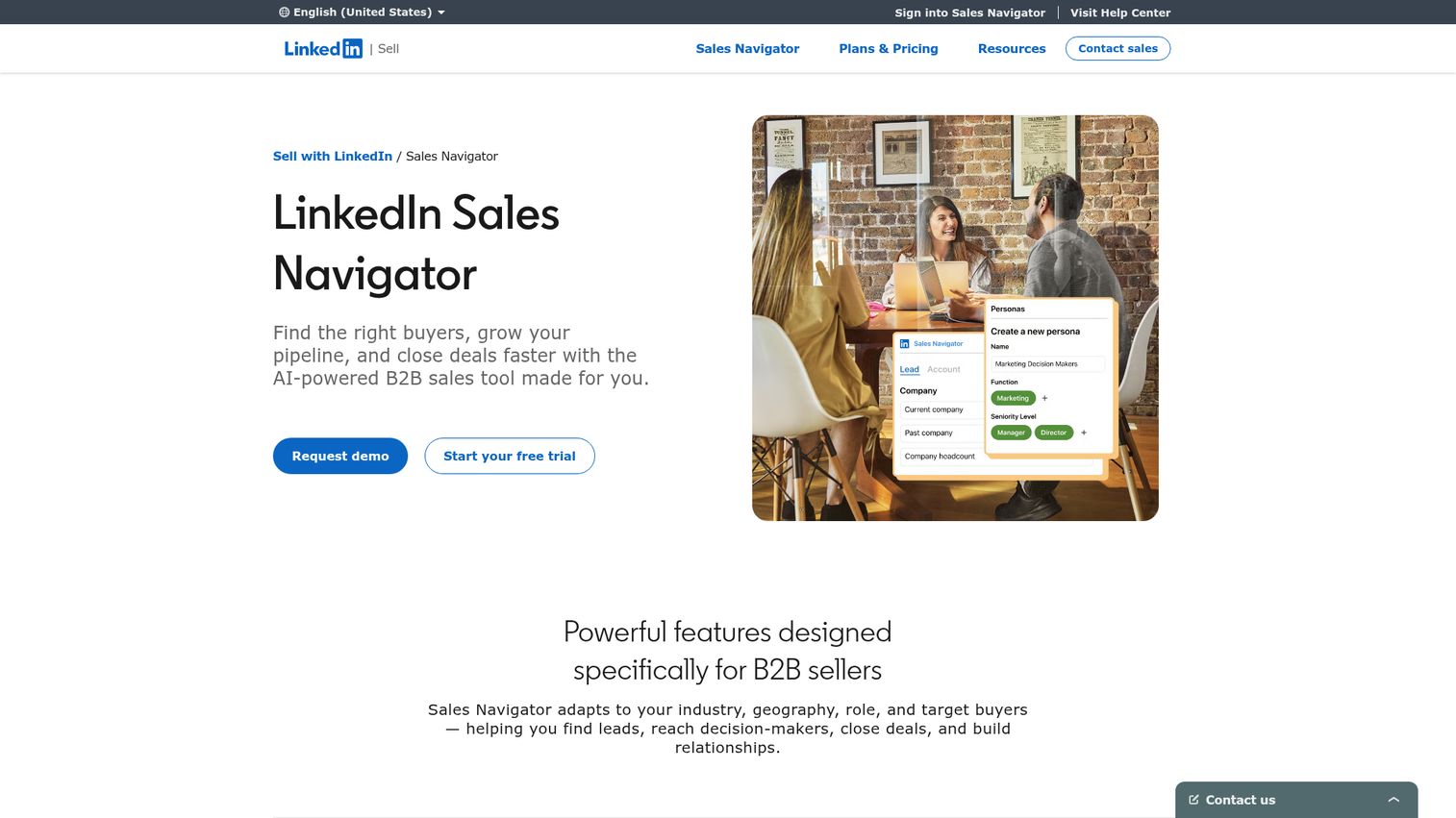
LinkedIn Sales Navigator is LinkedIn's B2B sales tool for finding, understanding, and connecting with buyers, drawing data straight from LinkedIn's own network. The freshness advantage is structural: professionals update their own profiles, so the source data stays current in a way a third-party file cannot. For relationship-led, research-heavy reps, that is hard to beat.
Best for: B2B sales teams and individual sellers prospecting, researching accounts, and engaging decision-makers on LinkedIn.
Key strengths
- 50+ advanced search filters: Build precise account and lead lists from the network itself.
- InMail outreach: Reach prospects directly even without a prior connection.
- CRM integrations: Connect with Salesforce, HubSpot, Microsoft Dynamics, Oracle, and more.
Why choose LinkedIn Sales Navigator: Sales Navigator fits reps whose motion is relationship-led and research-heavy, where data freshness from the source network is the priority. The trade-off is exports. It is not built as a bulk-export database, so teams that need lists pushed into a sequencer at scale often pair it with another tool, subject to LinkedIn's policies.
LinkedIn Sales Navigator pricing: Core starts at US$119.99 per month or US$1,079.88 per year per license, best for individual sellers. Advanced runs US$159.99 per month or US$1,799.88 per year and adds AI research and collaboration tools for teams. Advanced Plus uses customized pricing and requires a demo. A free trial is offered, but there is no free tier.
11. GetProspect
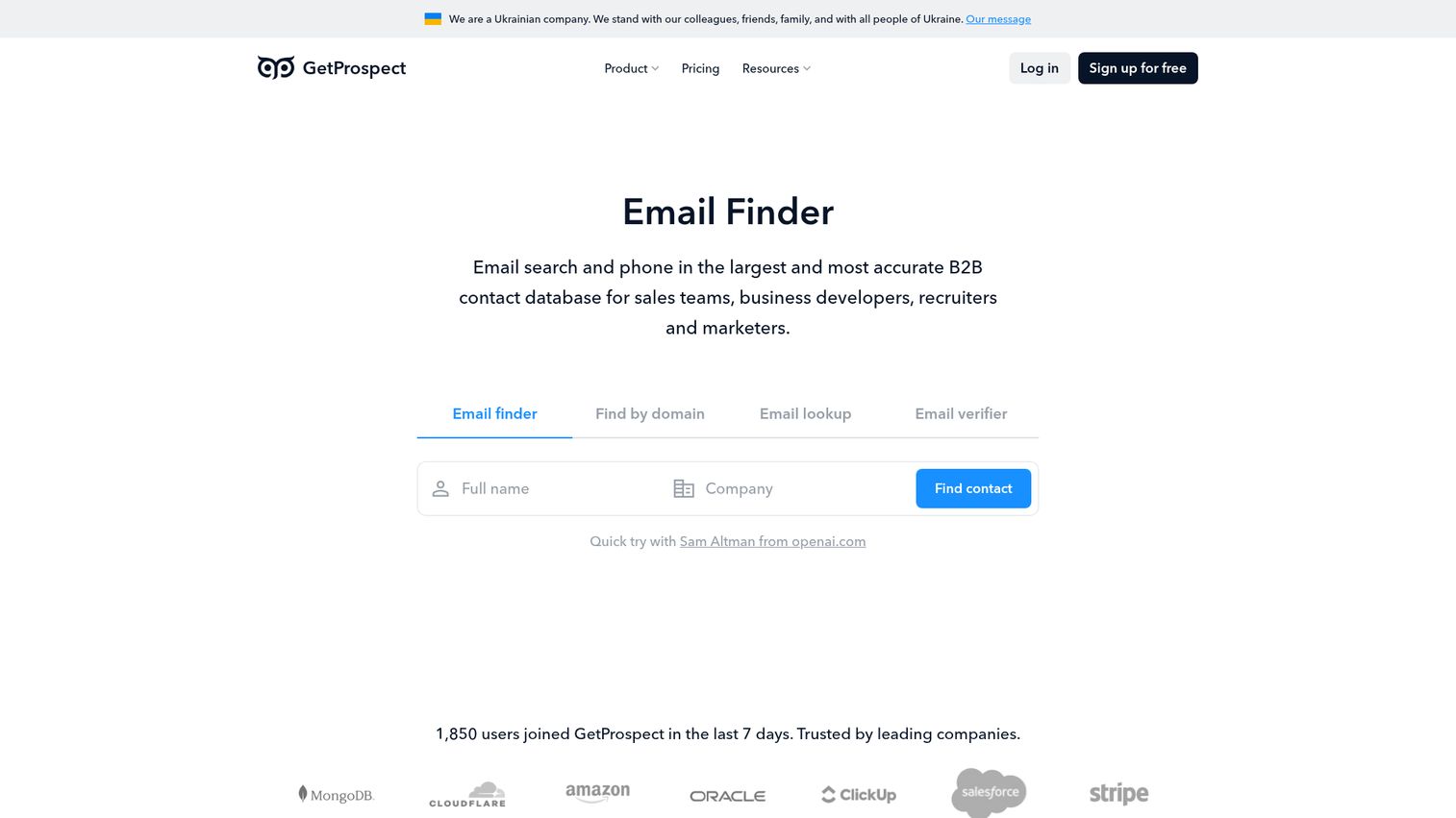
GetProspect is an email finder and B2B contact database platform built for sales, recruiting, and marketing teams that need to find, verify, enrich, and export prospect data. Its appeal is affordability paired with a usable free starting tier, making it a sensible pick for budget-conscious teams testing the waters.
Best for: Sales, recruiting, and marketing teams that need to find, verify, enrich, and export B2B prospect contact data on a budget.
Key strengths
- Email finder with B2B filters: Search contacts and companies, then surface valid business emails.
- LinkedIn Email Finder extension: Export and enrich leads directly from LinkedIn.
- Bulk tools and exports: Bulk email finding, verification, CRM integrations, CSV/XLSX export, Google Sheets, and API access.
Why choose GetProspect: GetProspect fits teams that want a low-priced email finder and a free starting tier before scaling. The trade-off is reflected in its 4.0/5 G2 rating, the lowest on this list, so test coverage and accuracy on your actual ICP before relying on it as a primary source.
GetProspect pricing: A Free plan includes 50 valid emails and 100 verifications per month. Paid plans start with Starter at $49/month (1,000 valid emails, 2,000 verifications, 5 phone numbers), then Growth tiers at $99, $199, and $399/month for higher volumes. That free tier and low entry price make it one of the most accessible options here.
Considerations: how to choose your b2b contact database
Picking a b2b contact database is less about the longest feature list and more about fit with how your team actually works. Run any shortlist through these five lenses.
Data accuracy and verification
Accuracy is the whole game. Ask how often records are re-verified and what bounce rate the provider commits to. Benchmark testing has shown email accuracy ranging from 65% to 98% across tools, so test each finalist on a real sample of your own ICP before you sign. A cheap database with a 30% bounce rate is not cheap.
Coverage and region
Total record count is a headline number, but depth matters more. Check mobile and direct-dial coverage for the roles you actually call, and confirm the provider's strength in your regions. North America depth differs sharply from EMEA or APAC, and a tool strong in one can be thin in another.
Pricing and credit model
Credits versus unlimited views, export caps, and per-reveal costs all change your true cost per usable record. A low seat price means little if exports are capped or phone reveals burn credits ten times faster than emails. Model your expected monthly volume against each pricing structure, not just the sticker price.
CRM and workflow fit
Native Salesforce or HubSpot sync, sequencer push to Outreach or Salesloft, and dedupe behavior decide whether the tool replaces work or just adds another tab. The best fit lives inside the systems your team already opens every day, so verify the specific integrations your stack depends on. If outbound engagement is your focus, our roundup of the best sales engagement tools covers the sequencers that pair well here.
Compliance and governance
GDPR and CCPA posture, do-not-call and suppression support, and data-sourcing transparency are not optional, especially in EMEA or regulated industries. Confirm the provider can pass your security review and document where its data comes from before procurement gets involved.
Conclusion
The right b2b contact database depends on your motion, not a single best-overall verdict. For enterprise teams that need depth, intent, and governance, ZoomInfo sets the benchmark. For budget-conscious outbound, Apollo.io and GetProspect both offer real free tiers and low entry prices. For EMEA and compliance-sensitive teams, Cognism's verified mobiles and GDPR-first sourcing are purpose-built. For SDR teams wanting transparent pricing with verified data and intent, Lead411 is a clean pick.
The smart next move is not to commit on a demo alone. Shortlist two or three tools that match your region and workflow, then run each against the same sample of your real ICP. Compare bounce rates, mobile coverage, and credit burn on records you actually care about. The accuracy spread between providers is wide enough that a 30-minute test will tell you more than any feature page.
One last thing worth remembering: clean data is the input, not the outcome. Even the best b2b contact data decays around 2.1% per month, so the teams that win treat the database as a living system. Pick the tool that fits, then build the CRM hygiene discipline that keeps it valuable. And once you reach the right people, turning that first touch into a reply often comes down to showing the product, which is where a live demo earns its place in your outreach.
What is a b2b contact database?
A b2b contact database is a tool that stores and continuously refreshes business contact and company records, including verified emails, direct-dial and mobile phone numbers, job titles, and firmographics. Sales, marketing, and RevOps teams use it to find decision-makers, build outbound lists, verify contacts mid-deal, and keep CRM records current. The best ones re-verify data on a regular cycle to fight decay.
How do I choose the right b2b contact database software?
Evaluate against four criteria: data accuracy and verification cadence, coverage and regional depth, pricing and credit model transparency, and CRM and compliance fit. Then test your top two or three finalists on a real sample of your own ICP. Accuracy varies widely between providers, so a hands-on test on records you care about beats any marketing claim.
How much does b2b contact database software cost?
Pricing follows two main models: credit-based (you pay per record viewed or exported) and flat or seat-based. SMB-focused tools can start around $49/month, while enterprise platforms like ZoomInfo and Cognism use custom, often annual, contracts with no public price. The number that matters most is true cost per usable record, since a cheap plan with high bounce rates or tight export caps gets expensive fast. Confirm pricing live before buying.
Is there a free b2b contact database?
Yes, several tools on this list offer free plans, though with limits. Apollo.io has a free-forever Starter plan, LeadIQ offers a Free plan with 50 credits, Seamless.AI includes a free tier with 1 user and 50 credits, Lusha gives up to 40 credits per month, and GetProspect's free plan includes 50 valid emails monthly. A free business contacts database is great for testing accuracy, but volume teams will outgrow the credit caps quickly.
How accurate is b2b contact data, and how do I know my database is out of date?
According to Landbase (2024), b2b contact data decays at roughly 2.1% per month, or 22.5% per year, with email addresses decaying 23% to 30% annually. Rising bounce rates, climbing "no longer at company" replies, and falling connect rates are your warning signs. The fix is a regular re-verification cadence rather than a one-time cleanse, since the rot resumes the moment you stop refreshing.
Are b2b contact databases GDPR and CCPA compliant?
Compliance varies by provider, so it is not safe to assume. Reputable providers operate under legitimate interest, honor opt-out and suppression requests, and maintain do-not-call lists, with regional differences in how each rule applies. Providers like Cognism build compliance-first sourcing into the product. Always confirm a vendor's GDPR and CCPA posture and data-sourcing transparency before purchase, especially for EMEA or regulated industries.
How do b2b contact databases integrate with my CRM?
Most leading b2b contact databases offer native syncs with Salesforce and HubSpot, plus pushes to sales engagement tools like Outreach and Salesloft. Common capabilities include automatic enrichment of existing records, sequencer push for new contacts, and dedupe checks to prevent duplicate entries. Verify the specific integrations your stack depends on, since depth differs by tool and the gap between "supported" and "deeply integrated" is real.
How do I find verified B2B contacts for cold outreach?
Start by filtering a contact database to your ICP using title, seniority, industry, geography, and company size. Verify emails and phones before you export, to protect deliverability and avoid burning sender reputation. Then warm the first touch with relevance instead of a generic pitch, so the contact has a reason to reply rather than another cold email to ignore.