Your finance committee asks for a cash forecast. Your CFO opens three spreadsheets, adjusts a formula that only one person understands, and explains which columns reflect actuals versus projections. Forty minutes later, the board has a number. Nobody is quite sure it is right.
That scenario plays out regularly at schools, education nonprofits, and higher education institutions running generic accounting tools or disconnected finance files. The problem is not the people. Generic software breaks when an organization needs fund tracking, restricted grants, multi-entity reporting, purchase approval workflows, or connections to student and HR systems.
The global education finance software market reached $5.63 billion in 2025, according to Market.us (2026), driven by the shift toward cloud accounting and the pressure to produce audit-ready reporting without a dedicated IT department. Yet most finance leaders still spend their month-end close rebuilding reports rather than reading them.
This guide gives you a current shortlist of 12 tools, organized by institution type, so you can move from "we need something better" to a real shortlist in one read.
What's inside
- 12 platforms covered: Fund accounting specialists, K-12 ERPs, higher education platforms, open-source options, and accessible cloud accounting
- Who this is for: Finance directors, CFOs, controllers, and operator leaders at K-12 districts, education nonprofits, academy groups, private schools, and higher education institutions
- How tools were selected: Finance depth (fund accounting, budgeting, and reporting), integration fit with student and HR systems, implementation practicality, and pricing transparency
- What to expect: A comparison table, per-tool profiles with verified pricing, and a buyer's checklist for narrowing your shortlist
TL;DR
- Best for fund accounting and education nonprofits: Blackbaud Financial Edge NXT handles restricted funds, grants, and nonprofit reporting in one system
- Best for public-sector fund accounting depth: MIP Fund Accounting gives granular multi-fund control for compliance-heavy organizations
- Best for K-12 district operations: PowerSchool ERP and Tyler School ERP Pro connect finance to payroll, HR, and district administration
- Best for higher education: Ellucian Banner Finance, Jenzabar One, Oracle Fusion Cloud ERP, and Workday Student serve campus-wide operations at different scales
- Best open-source option: OpenEduCat offers a free edition and modular enterprise modules from $79/year per module for institutions that want configurable architecture
- Best lightweight starting point: QuickBooks Online works for smaller organizations with straightforward books, but has real limits when fund accounting complexity grows
What is education finance software?
Education finance software is a financial management system designed to help schools, districts, academies, education nonprofits, and higher education institutions manage accounting, budgets, purchasing, payments, reporting, and financial controls.
What education finance software typically includes
- General ledger and accounts payable
- Budgeting, forecasting, and scenario planning
- Fund, grant, or restricted-revenue tracking
- Purchase orders, requisitions, and invoice approvals
- Bank reconciliation and payment workflows
- Financial reports, dashboards, and board-ready outputs
- Audit trails, role permissions, and security controls
- Integrations with student information, HR, payroll, and ERP systems
Education finance software versus generic accounting software
Generic accounting products can work for small, straightforward entities. They usually become a poor fit when an organization needs complex funds, multi-school consolidation, public-sector reporting, approval workflows, or student-system connections. The moment you start building fund logic in spreadsheet tabs alongside your accounting tool, you have outgrown it.
Education finance software versus education ERP
An education ERP may combine finance with HR, procurement, facilities, planning, and student administration. The decision comes down to whether you need a dedicated finance system or a broader institutional operating platform. Many institutions run a finance-first system for several years before expanding into a full ERP.
| Dimension | Generic accounting | Education finance software | Education ERP |
|---|---|---|---|
| Fund and grant tracking | Limited | Core capability | Included or modular |
| Multi-entity reporting | Manual | Supported | Supported |
| Student system integration | Rare | Available | Native |
| Implementation overhead | Low | Moderate | High |
| Fit for complex institutions | Poor | Strong | Strong |
When to use education finance software
Replace spreadsheet-led budgeting and reporting
Finance teams that spend every month rebuilding reports and reconciling versions before a board meeting need a system, not a better spreadsheet. The first benefit of purpose-built education finance software is reliable visibility, not a larger feature list. When your finance leader can answer a board question without a manual export, you have a repeatable system.
Control purchasing before money leaves the account
Schools with decentralized purchasing and weak visibility into budget commitments see budget overruns that only show up at month-end. Requisition workflows, purchase orders, invoice matching, and encumbrance tracking give finance teams real-time spend visibility before commitments hit the general ledger.
Manage complex funds, grants, and multiple entities
Districts, education nonprofits, academy groups, and higher education institutions typically run multiple funding sources with different reporting obligations. Separating restricted funding, departmental budgets, grant spending, and consolidated reporting across entities requires fund accounting, not general bookkeeping. When your funding mix includes public money, donor-restricted grants, or federal programs, that distinction is not optional.
Education finance software comparison
The right shortlist starts with institution type and finance complexity. A K-12 district, a nonprofit school network, and a mid-sized university do not need the same system, and the comparison below reflects those differences.
Pricing and G2 ratings verified October 2026 from vendor pricing pages and current G2 listings.
| # | Product | Best for | Key differentiator | Pricing | G2 rating |
|---|---|---|---|---|---|
| 1 | Blackbaud Financial Edge NXT | Education nonprofits and private institutions | Purpose-built fund accounting and nonprofit reporting | Custom pricing | 4.1/5 |
| 2 | MIP Fund Accounting | Fund-heavy nonprofits and public-sector organizations | Granular multi-fund accounting and compliance reporting | Custom pricing | 3.8/5 |
| 3 | PowerSchool ERP | K-12 districts needing connected operations | Finance, HR, payroll, and purchasing in one K-12 system | Custom pricing | 4.1/5 |
| 4 | Tyler School ERP Pro | Public K-12 districts | District finance, HR, payroll, and reporting workflows | Custom pricing | 3.9/5 |
| 5 | Ellucian Banner Finance | Higher education institutions | Higher education ERP with student-system alignment | Custom pricing | Not verified |
| 6 | Jenzabar One | Colleges seeking a unified campus platform | Connected finance, student, enrollment, and HR systems | Custom pricing | 4.0/5 |
| 7 | Oracle Fusion Cloud ERP for Higher Education | Large universities with enterprise governance needs | Enterprise finance, planning, procurement, and analytics | From $600/month per user (minimum 10 users) | Not verified |
| 8 | Workday Student | Institutions consolidating enterprise operations | Unified HCM, finance, planning, and student systems | Custom pricing | 4.0/5 |
| 9 | IRIS Financials | Schools and academy trusts (primarily UK) | Education-specific accounting, budgeting, and procurement | Custom pricing | Not verified |
| 10 | Access Education Finance | Schools, academies, and MATs (primarily UK) | School finance, reporting, purchasing, and compliance | Custom pricing | Not verified |
| 11 | OpenEduCat | Institutions wanting open-source ERP architecture | Free edition plus modular enterprise modules from $79/year | Free / from $79/year per module | 4.6/5 |
| 12 | QuickBooks Online | Smaller education organizations with simpler books | Cloud accounting with broad accountant ecosystem | From $19/month (promotional) | Not verified |
Best 12 education finance software tools for 2026
1. Blackbaud Financial Edge NXT
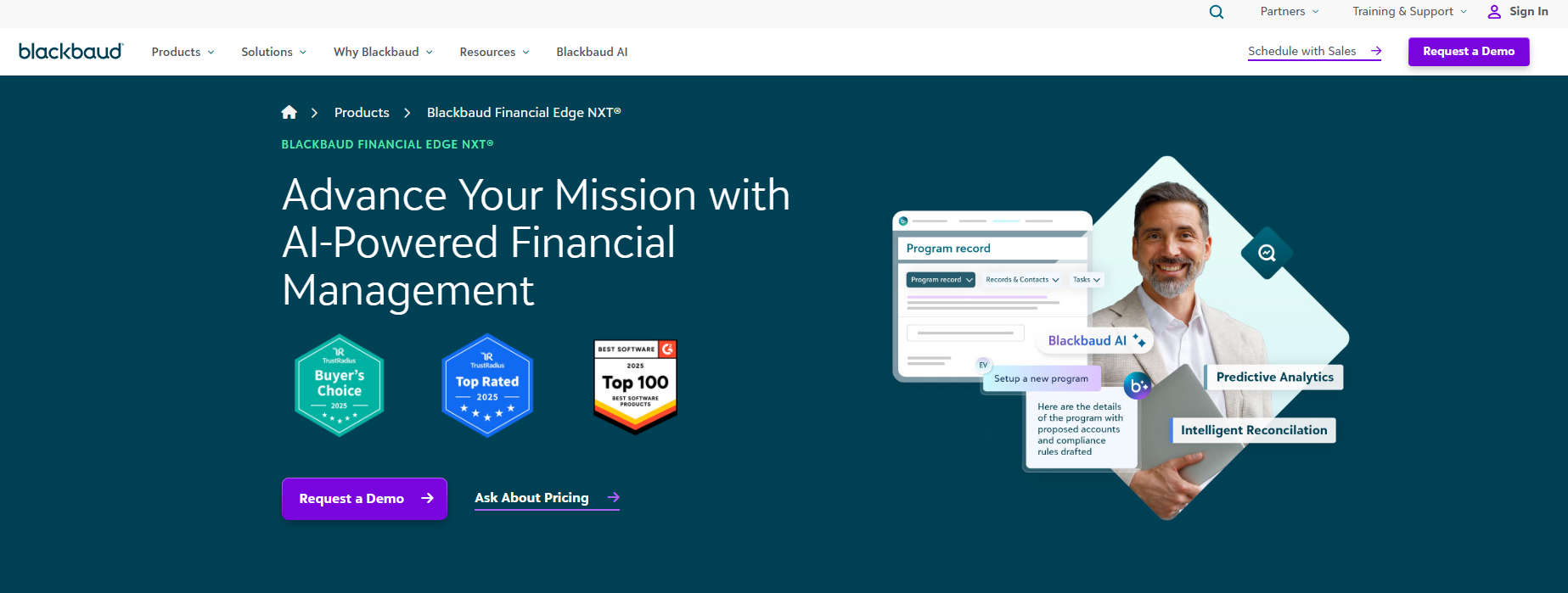
Blackbaud Financial Edge NXT is a cloud-based fund accounting and financial management platform built specifically for nonprofit organizations, including private schools, education nonprofits, and mission-driven institutions. It handles restricted funds, grants, endowments, and project-level expense tracking alongside standard accounting functions. For finance teams that need audit-ready reporting across multiple fund types without building the logic in spreadsheets, Financial Edge NXT is a purpose-built starting point.
Best for: Education nonprofits, private schools, and institutions managing restricted funds, grants, or complex reporting requirements.
Key features
- Fund accounting with restricted-fund and endowment tracking
- Customizable dashboards and real-time financial reporting
- Automated reconciliation, invoice capture, and payment workflows
- Role-based access controls and audit trails
- Integration with Blackbaud Raiser's Edge NXT for connected fundraising data
Why choose Blackbaud Financial Edge NXT: If your organization tracks donor-restricted funds alongside operating budgets and needs board-ready reporting without manual export work, Financial Edge NXT is built for that specific job. It makes the most sense when finance complexity justifies a dedicated nonprofit accounting platform rather than a general-purpose tool.
Blackbaud Financial Edge NXT pricing: Blackbaud provides personalized quotes rather than posting plan prices. Contact Blackbaud directly to get a figure that reflects your organization size, modules, and implementation scope.
G2 rating: 4.1/5
2. MIP Fund Accounting
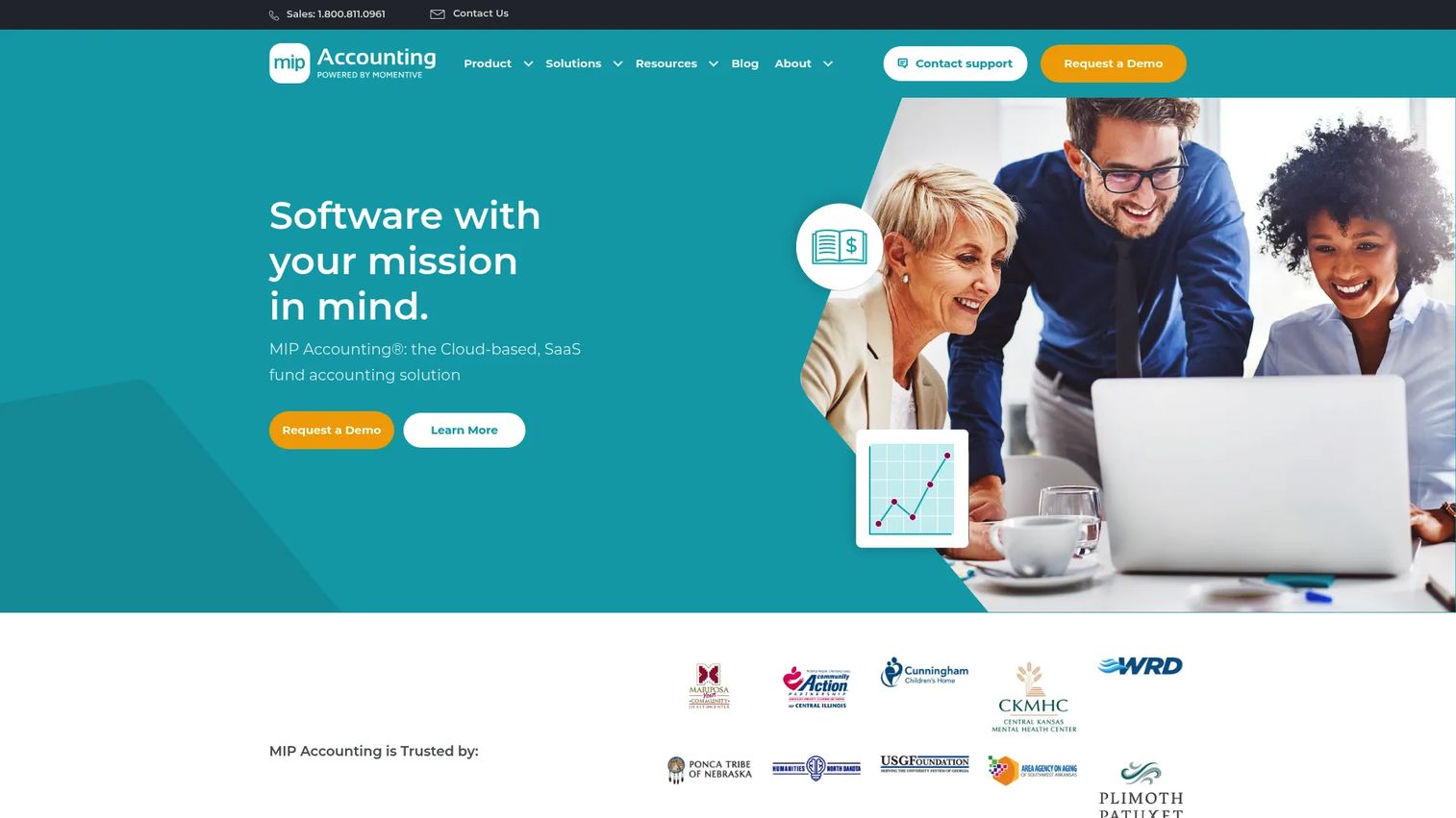
MIP Fund Accounting is a cloud-based finance platform for nonprofits, schools, healthcare organizations, and government entities that need configurable multi-fund accounting with strong compliance reporting. Its chart-of-accounts structure supports granular fund segmentation, grant tracking, encumbrance controls, and allocation across departments or programs. For finance teams where the fund structure itself drives daily decisions, MIP offers more configuration depth than most general-purpose tools.
Best for: Finance teams at nonprofits and public-sector organizations that need granular fund accounting, grant tracking, and compliance reporting controls.
Key features
- Multi-fund general ledger with customizable chart of accounts
- Budget planning, forecasting, and encumbrance controls
- Grant and allocation tracking with compliance reporting
- Accounts payable, accounts receivable, and bank reconciliation
- Fixed asset tracking, depreciation, HR, and payroll modules
Why choose MIP Fund Accounting: MIP fits organizations where the chart-of-accounts design and reporting structure determine how finance operates daily. It is stronger than lighter accounting tools when your funding mix includes restricted grants, public money, or program-level reporting obligations. Consider it when your current tool creates manual workarounds at month-end.
MIP Fund Accounting pricing: MIP prices by module and requires a quote from MIP or an authorized business partner. Reach out directly for a figure based on your user count, module selection, and implementation needs.
G2 rating: 3.8/5
3. PowerSchool ERP
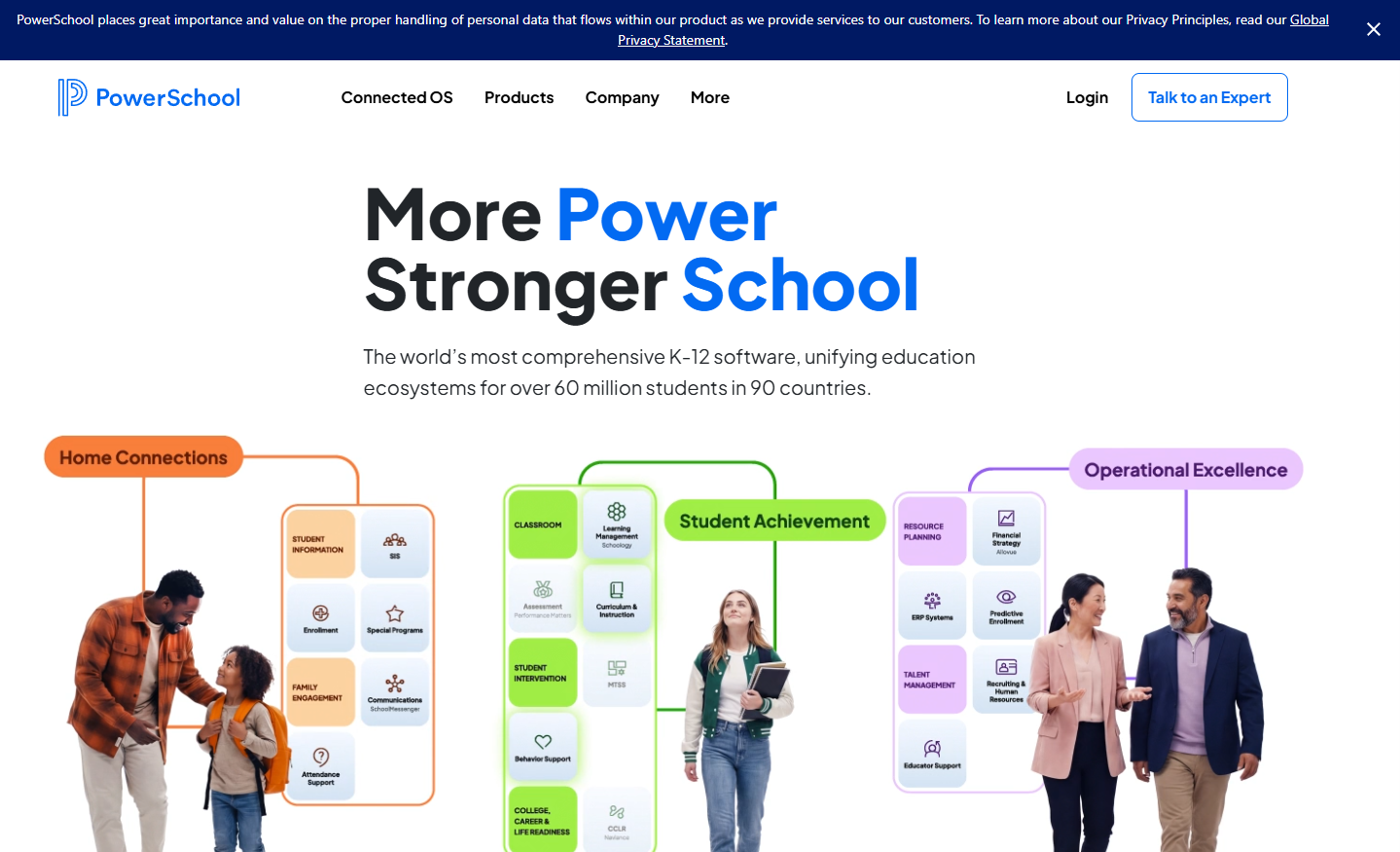
PowerSchool ERP is a K-12 enterprise resource planning platform that connects finance, HR, payroll, purchasing, and operational analytics within a single administrative environment. Built for school districts, it handles budgeting, general ledger, accounts payable, position budgeting, benefits management, and state-specific payroll alongside purchasing workflows and real-time dashboards.
Best for: K-12 districts and school networks that need finance, HR, payroll, and purchasing connected to wider school administration.
Key features
- Finance management: Accounting, budgeting, general ledger, and fixed assets
- K-12 payroll with state-specific tax tables and deferred contract pay
- HR and employee management including position control and benefits
- Purchasing workflows with requisition entry, approvals, and receiving
- Real-time dashboards, reporting, and analytics
Why choose PowerSchool ERP: The strongest case for PowerSchool ERP is when operational data needs to flow across finance, HR, payroll, and broader K-12 administration without manual exports between systems. Evaluate integration depth carefully during the sales process, and confirm how student-system connections work in your state before committing.
PowerSchool ERP pricing: PowerSchool does not post pricing. Contact the team for a quote based on district size, modules, and implementation scope.
G2 rating: 4.1/5
4. Tyler School ERP Pro
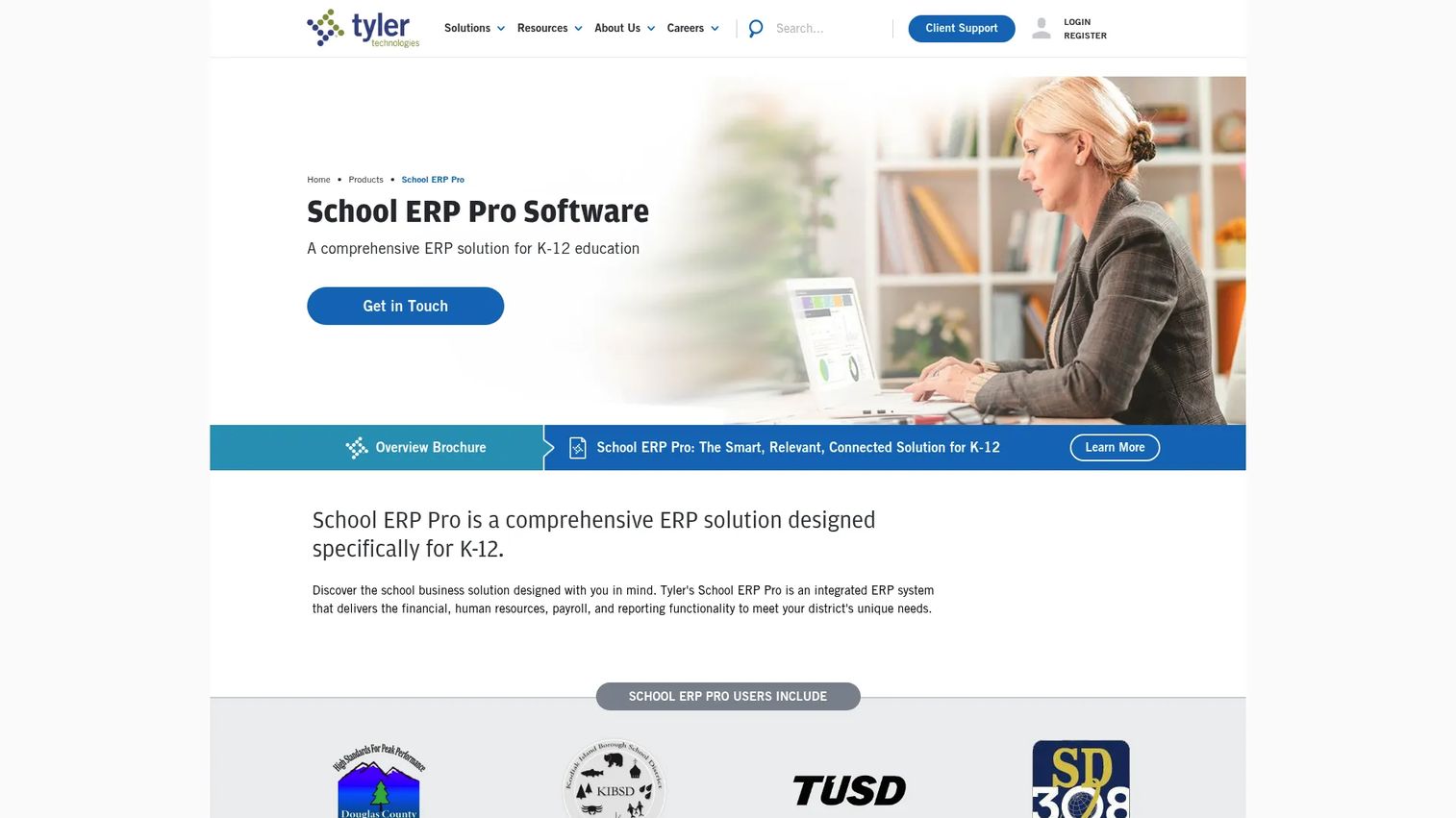
Tyler School ERP Pro is an integrated ERP for K-12 school districts, covering financial management, HR, payroll, purchasing, and reporting within a modular, scalable architecture. It includes persona-based dashboards, proactive alerts, workflow approvals, and mobile access, with a global search that gives finance and district teams fast access to data across modules.
Best for: Public K-12 districts that need district finance, HR, payroll, and administrative workflows under one governance structure.
Key features
- Financial management: General ledger, accounts payable, and budget monitoring
- HR administration and payroll with proactive alerts
- Purchasing and procurement workflows
- Persona-based dashboards and mobile access
- Reporting, audit controls, and modular architecture
Why choose Tyler School ERP Pro: Tyler suits buyers whose primary concern is disciplined district finance and public-sector governance. If your district has state-specific reporting requirements, confirm compatibility during the evaluation. Implementation scope varies by district size, so validate that with Tyler's team before signing.
Tyler School ERP Pro pricing: Tyler prices by district and module configuration. Request a quote directly from Tyler Technologies.
G2 rating: 3.9/5
5. Ellucian Banner Finance
Ellucian Banner Finance is a higher education financial management system covering budgeting, accounting, procurement, grant management, assets, endowments, and compliance reporting for colleges and universities. It is part of Ellucian's broader Banner ERP suite, which means finance operates alongside student, HR, and academic administration in a connected institutional environment.
Best for: Higher education institutions using or evaluating a connected campus ERP where finance cannot be separated from student and administrative systems.
Key features
- Higher education general ledger and accounts payable
- Budgeting and forecasting by department and program
- Grant management from proposal through federal reporting
- Procurement and spend analysis
- Real-time financial data access and dashboards
Why choose Ellucian Banner Finance: Banner Finance is compelling when finance evaluation is inseparable from the institution's broader student and administrative systems. Validate implementation capacity and integration ownership carefully before selecting it, and assign an internal project sponsor with authority over both finance and IT decisions.
Ellucian Banner Finance pricing: Ellucian does not post plan prices. Contact the team for a quote that reflects your institution size, modules, and implementation requirements.
6. Jenzabar One
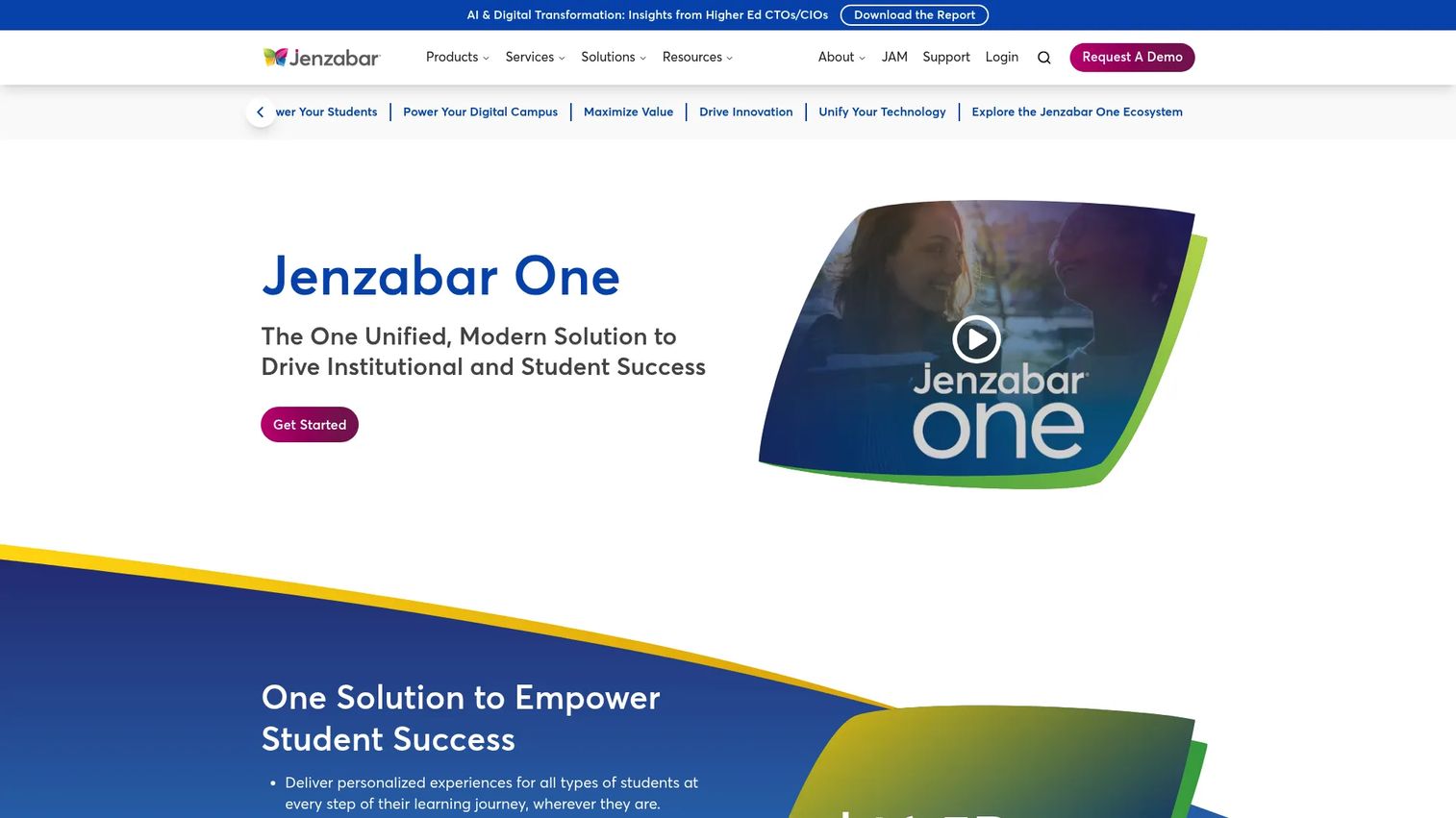
Jenzabar One is a unified cloud ERP and student information system for higher education, connecting finance, student engagement, enrollment, financial aid, HR, advancement, analytics, and eLearning in one platform. It is built for colleges that want to reduce system fragmentation across administrative functions rather than run separate point solutions for each department.
Best for: Colleges and mid-sized universities seeking a unified campus platform with finance included in the operating model.
Key features
- Integrated student and finance records
- Financial aid and enrollment connections
- Finance and administrative reporting with configurable workflows
- Jenzabar One API and Unity Platform for integrations
- HR, advancement, and eLearning modules
Why choose Jenzabar One: The main case for Jenzabar One is operational consolidation. It fits institutions ready to evaluate the platform as a broader administrative system rather than a standalone finance replacement. If your college currently runs five disconnected administrative tools, Jenzabar One may reduce that fragmentation.
Jenzabar One pricing: Jenzabar does not post pricing. Contact the team for a quote based on institution size, module selection, and implementation scope.
G2 rating: 4.0/5
7. Oracle Fusion Cloud ERP for Higher Education

Oracle Fusion Cloud ERP for Higher Education is an enterprise cloud platform covering financial management, procurement, planning, analytics, and HR for large institutions with complex governance requirements. It includes multi-entity consolidation, scenario modeling, supplier management, and advanced controls built for organizations where finance operates across multiple campuses, funding sources, or administrative divisions.
Best for: Large universities and complex education groups with mature IT, procurement, and finance operations that need enterprise-grade governance.
Key features
- Enterprise financial management and multi-entity consolidation
- Procurement and supplier management
- Financial planning, budgeting, and scenario modeling
- Advanced analytics and reporting
- Unified finance and HR processes
Why choose Oracle Fusion Cloud ERP for Higher Education: Oracle becomes relevant when institutional complexity is structural, not temporary. The buyer should have a dedicated implementation team, executive sponsorship from the provost or CFO level, and a data-governance plan ready before engaging Oracle. It is not the right fit for a school of 200 students.
Oracle Fusion Cloud ERP for Higher Education pricing: Oracle Fusion Financials Cloud Service starts at $600/month per hosted named user, with a minimum of 10 users, based on Oracle's published price list (verified October 2026). Complete higher education implementation costs depend on modules, user count, and professional services.
8. Workday Student
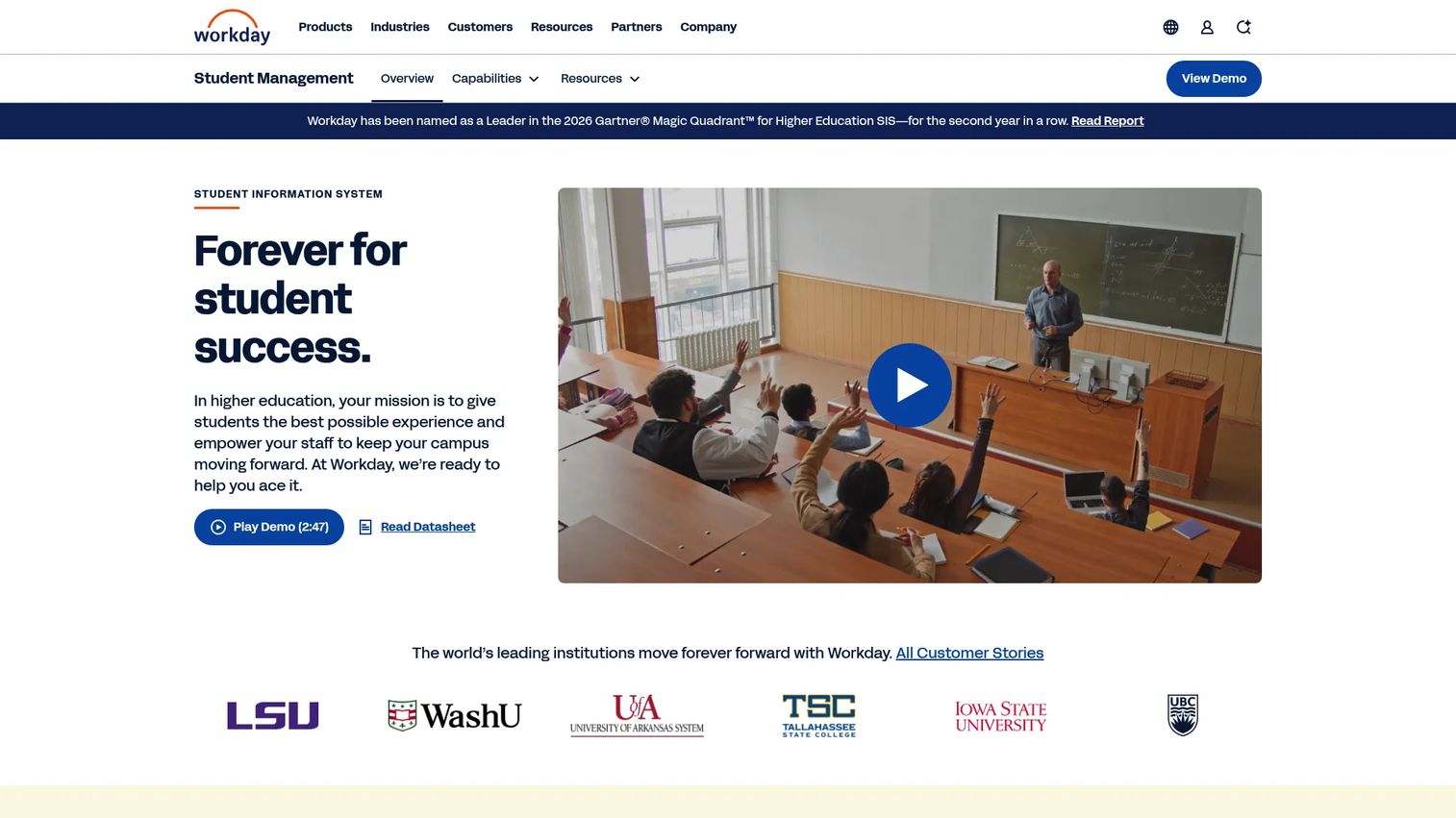
Workday Student is an AI-enabled higher education platform that unifies student administration, academics, finance, financial aid, HCM, payroll, and planning. It is designed for institutions standardizing enterprise operations across student and workforce systems rather than teams looking for a standalone finance tool.
Best for: Higher education institutions consolidating enterprise finance, workforce, planning, and student systems on one platform.
Key features
- Student lifecycle administration: Recruitment, admissions, and academic records
- Student finance and financial aid workflows
- Connected HCM, payroll, and enterprise planning
- Real-time analytics and AI-powered guidance
- Self-service access and mobile experience
Why choose Workday Student: Assess Workday Student at the operating-model level, not the finance-feature level. It can reduce system fragmentation across student and workforce operations, but implementation readiness and change management discipline determine whether the transition creates value or a multi-year distraction. Assign executive ownership before entering contract discussions.
Workday Student pricing: Workday does not post pricing. Contact Workday for a quote that reflects your institution size, suite configuration, and implementation plan.
G2 rating: 4.0/5
9. IRIS Financials
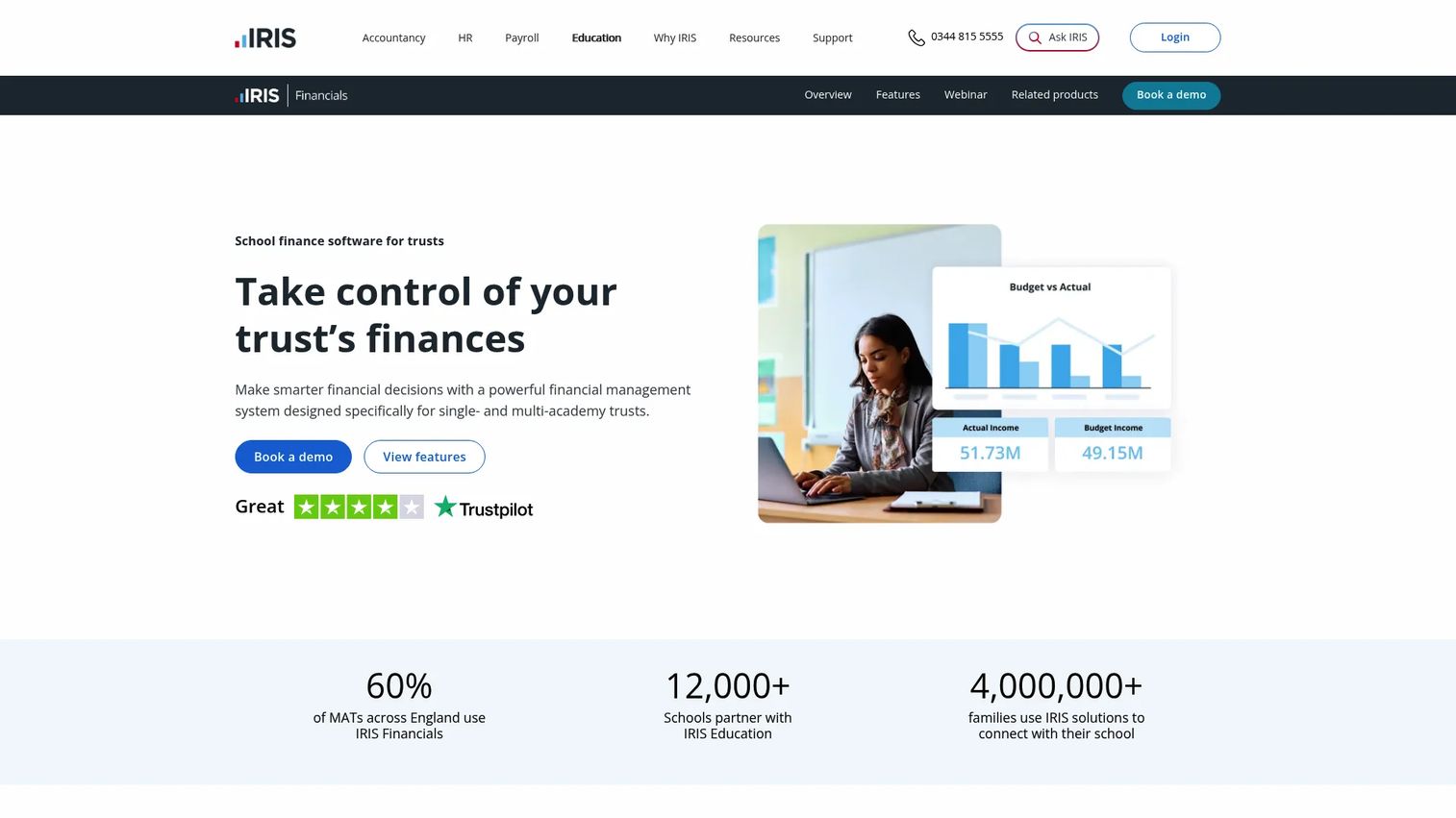
IRIS Financials is a cloud-based financial management platform built for single- and multi-academy trusts, covering unified ledger accounting, budget planning, procurement, automated bank reconciliations, and statutory reporting. Its workflow automation handles approval chains, e-procurement integrations, and trust-wide financial consolidation.
Best for: Schools and academy trusts needing education-focused budgeting, procurement, and trust-wide finance reporting.
Key features
- Unified ledger and real-time trust-wide financial reporting
- Automated statutory returns and bank reconciliations
- Purchasing with approval workflows and e-procurement integrations
- Budget management and financial planning
- Cloud-hosted access for distributed school teams
Why choose IRIS Financials: IRIS Financials is primarily designed for the UK academy trust market, where it handles DfE and ESFA reporting requirements. US-based buyers should confirm regional reporting compatibility and support coverage before adding IRIS to a shortlist. For UK academy groups, it offers tight statutory reporting alignment that generic tools cannot replicate.
IRIS Financials pricing: IRIS does not post pricing. Contact IRIS directly for a quote based on your trust size, school count, and module requirements.
10. Access Education Finance
Access Education Finance is an online accounting system for schools, academies, and Multi Academy Trusts, covering web-based accounting, budget management, purchase requisitions and orders, bank reconciliation, and statutory reporting. It integrates with Access Education Budgets for connected planning and produces reports that support DfE and ESFA compliance requirements.
Best for: Education organizations that need connected school finance and purchasing processes with regulatory reporting built in.
Key features
- Web-based accounting and budget management
- Purchase requisitions, orders, and invoice approval workflows
- Bank reconciliation and payment processing
- DfE and ESFA statutory reporting support (CFR and SOFA returns)
- Integration with Access Education Budgets
Why choose Access Education Finance: Access Education Finance fits when a school or trust wants to reduce manual purchasing and reconciliation work alongside core accounting in one education-oriented system. Like IRIS Financials, it is built for the UK market. US buyers should verify regional compliance coverage before including it in a shortlist.
Access Education Finance pricing: Access does not post pricing. Contact the Access Group team for a quote based on your school count, user requirements, and regional deployment.
11. OpenEduCat
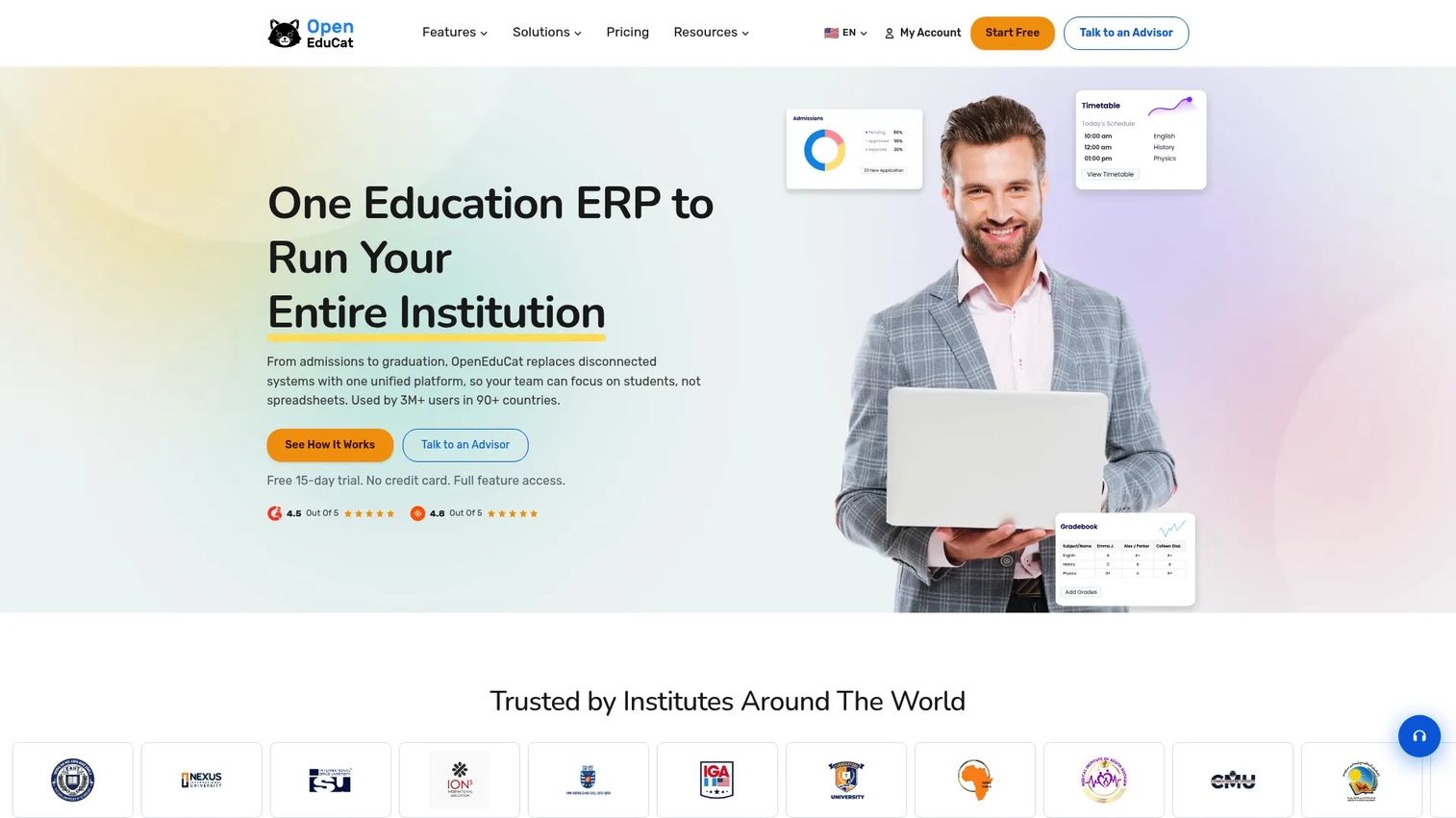
OpenEduCat is an open-source education ERP and learning management platform covering admissions, student information, attendance, fees, course management, library, HR, payroll, finance, and multi-campus administration. It is modular by design, allowing institutions to deploy only the components they need, and it offers both cloud-hosted and on-premises deployment options.
Best for: Institutions with technical resources that want a configurable education ERP rather than a fixed finance suite.
Key features
- Modular ERP: Finance, HR, payroll, and student administration
- Admissions, enrollment, examinations, and grading
- Library, hostel, transportation, and parent portals
- Multi-campus management, API, LTI, SSO, and integrations
- Cloud-hosted and on-premises deployment options
Why choose OpenEduCat: Configurability creates real value when institutional processes differ from standard school workflows. The trade-off is that flexibility increases implementation discipline requirements. Institutions choosing OpenEduCat need ownership over chart-of-accounts design, workflow configuration, documentation, and ongoing support planning. The free edition is a genuine starting point; enterprise modules scale from there.
OpenEduCat pricing: The Free Edition is completely free. Enterprise modules start at $79/year each. User packs range from $349/year for 500 users to $2,739/year for 10,000 users. A 15-day free trial is available (pricing verified October 2026 from OpenEduCat's pricing page).
G2 rating: 4.6/5
12. QuickBooks Online

QuickBooks Online is a cloud-based accounting platform for managing income, expenses, invoicing, bank feeds, and financial reporting. It has a large accountant ecosystem, broad app integrations, and a low barrier to entry, making it a practical baseline for smaller education organizations that need reliable books without a dedicated finance system.
Best for: Smaller education organizations, tutoring businesses, and early-stage operators with straightforward accounting and limited fund complexity.
Key features
- Cloud general ledger with bank transaction syncing
- Invoicing and expense tracking
- Standard financial reports
- Bank feeds and reconciliation
- Broad accountant and app ecosystem access
Why choose QuickBooks Online: QuickBooks Online works before finance complexity rises. The value is familiarity, fast setup, and accountant accessibility. The boundary to know: It was not designed for fund accounting, and it will create manual workarounds when restricted grants, multi-entity consolidation, encumbrance tracking, or detailed approval workflows become operational requirements. Use it as a starting point, not a permanent solution for complex education finance.
QuickBooks Online pricing: Plans start at $19/month for Simple Start (currently 50% off for 3 months at time of publication), with Essentials at $42.50/month, Plus at $70/month, and Advanced at $170/month. A free plan is also available with limited features (pricing verified October 2026 from QuickBooks' pricing page).
Considerations when choosing education finance software
Match the system to your institution type
A small private school, a public district, an education nonprofit, and a university operate under different financial rules. Map your funding model, reporting obligations, entity structure, and operational complexity before evaluating any tool. A fund-heavy nonprofit should not evaluate the same shortlist as a single private school with straightforward books.
Test reporting before signing
Ask each vendor to produce five reports your finance leader and board need today. Do not accept a generic dashboard demonstration. Confirm who owns each report, how long configuration changes take, and whether the output format matches what your board or auditors actually require.
Evaluate integrations as operating dependencies
List every system finance depends on: Student information, HR, payroll, procurement, tuition billing, bank feeds, and data warehouse tools. For each connection, confirm whether it is native, requires a partner, or involves manual export work. An integration that requires a third-party connector adds cost and a failure point. See also our guide to approval workflow software for more on managing multi-step purchase controls.
Treat implementation as a finance project
The migration depends on chart-of-accounts design, historical data quality, role permissions, approval workflows, and staff readiness. Assign a finance owner and an executive sponsor before software selection, not after. A system that arrives without internal ownership is the most common source of implementation delays.
Price the whole operating model
Compare total cost: Subscription, implementation, data migration, integrations, training, support, added modules, and internal staff time. For budgeting and forecasting software and finance systems alike, the lowest subscription price often becomes the highest total cost when manual processes remain because of incomplete configuration.
Conclusion
There is no single winner across education finance software. The right system depends on institution type, funding complexity, and how much implementation capacity you can commit.
Blackbaud Financial Edge NXT and MIP Fund Accounting fit fund-heavy organizations managing restricted grants and nonprofit reporting. PowerSchool ERP and Tyler School ERP Pro fit K-12 districts that need finance connected to HR, payroll, and purchasing. Ellucian Banner Finance, Jenzabar One, Oracle, and Workday serve higher education and enterprise operating models at different scales. IRIS Financials and Access Education Finance fit UK academy and school environments where DfE and ESFA reporting requirements drive the finance workflow. OpenEduCat suits institutions that want modular, configurable ERP architecture with a genuinely free starting point. QuickBooks Online works for simpler operations, but should not carry the weight of complex fund accounting without supplementary tools.
The practical next step: Create a shortlist of three tools that match your institution type. Schedule workflow-based demonstrations using your current month-end close process as the test case. Ask each vendor to show you a fund report, a purchase approval workflow, and a budget variance report before making any commitment.
Start your journey with Guideflow today!
FAQs about education finance software
Education finance software is a financial management system designed for schools, districts, academies, education nonprofits, and higher education institutions. It supports accounting, budgeting, reporting, procurement, fund tracking, payments, audit controls, and often integrations with student information and HR systems. It differs from generic accounting tools primarily in its ability to handle fund accounting, restricted-revenue tracking, and education-specific compliance reporting.
School accounting software focuses on financial operations: General ledger, accounts payable, budgeting, and reporting. Education ERP platforms combine finance with HR, payroll, procurement, student administration, facilities, planning, and broader institutional workflows. Some institutions start with dedicated finance software and expand into ERP later; others evaluate the full ERP from the start because operational data needs to flow across departments.
Fund accounting becomes important when an organization must track restricted funding, grants, donor or program funds, public money, or separate financial purposes in parallel. A small school with a single operating budget and straightforward books may not need it immediately. The signal that you do: When you build fund logic in spreadsheet tabs alongside your accounting tool, or when your auditors flag inadequate fund separation.
Start with the workflows your finance team runs daily: General ledger, budget monitoring, approval workflows, bank reconciliation, and audit trails. Add reporting capabilities that match your board and regulatory requirements. Then evaluate procurement and purchase order controls, role-based permissions, and integration with the systems that supply your financial data. See also our coverage of accounts payable software for more on managing invoice workflows.
Yes, for smaller institutions with straightforward accounting. It handles income, expenses, invoicing, and standard reporting without complexity. The limitations appear when restricted funds, multi-entity consolidation, encumbrance tracking, or detailed approval workflows become operational requirements. Many schools start on QuickBooks Online and migrate to purpose-built education finance software as their financial complexity grows.
The price varies widely depending on institution size, number of users, modules selected, implementation scope, data migration, support tier, and integration requirements. Most enterprise platforms in this category price by quote. QuickBooks Online starts at $19/month per plan (with promotional pricing). OpenEduCat enterprise modules start at $79/year each. For all other platforms in this guide, contact the vendor directly for a figure based on your specific situation. Compare total operating cost, not subscription cost alone.
Implementation timelines depend on data quality, chart-of-accounts redesign, number of entities, integrations required, historical data migration, and staff training readiness. Lightweight tools like QuickBooks Online can be live within days for a simple organization. Fund accounting platforms and education ERPs typically take several months to over a year for a full deployment at a complex institution. A phased plan with defined acceptance criteria for each stage reduces the risk of a project that runs indefinitely.
Ask the vendor to show you a real monthly close process, produce a board-ready fund report, walk through a purchase approval workflow from requisition to payment, reconcile a bank statement, change a budget line, review audit history for a transaction, and demonstrate how student or payroll data reaches the finance system. Generic capability demonstrations are not sufficient. Test the workflows your team runs every month.
Standard accounting tracks income, expenses, assets, and liabilities for a single entity. Fund accounting maintains separate tracking for multiple funds simultaneously, each with its own balance, reporting, and spending restrictions. Education organizations often manage restricted grants, donor funds, public appropriations, and operating budgets in parallel, which requires fund accounting structure to maintain separation and produce accurate compliance reports.