


You're running campaigns. Leads are coming in. Your CRM looks busy. But when you pull up the pipeline report, the numbers don't match the effort. CAC is climbing. Sales is rejecting half the MQLs you send over. And your VP just asked, for the third time this quarter, why marketing can't produce more pipeline.
Here's the pattern most B2B teams are stuck in: they've built a lead generation program and called it demand generation. They gate everything, score every download, and hand contacts to sales before those contacts have any real buying intent. The result is a bloated funnel with low conversion at every stage and a sales team that doesn't trust marketing's numbers.
The problem isn't effort. It's architecture.
According to Gartner, over 70% of the B2B buying journey now happens before a prospect talks to sales. Buyers are doing their own research, evaluating products on their own terms, and forming opinions long before they fill out a form. If your demand gen program isn't built around that reality, you're optimizing for a buyer that no longer exists.
This guide covers how to build a B2B demand generation program for 2026: one that creates genuine buying intent, captures it at the right moment, and converts it into pipeline your sales team actually wants.
What you'll learn
- What B2B demand generation actually means (and how it differs from lead gen)
- Why demand gen matters more in 2026 than any prior year
- The four stages of the demand generation funnel and what to do at each
- A step-by-step process for building your demand generation strategy from scratch
- 12 specific B2B demand generation strategies with tactical guidance for each
- A measurement framework with benchmarks so you know what "good" looks like
- The most common demand gen mistakes and how to fix them
TL;DR
- B2B demand generation is a system, not a campaign. It spans the full buyer journey from awareness through pipeline creation, and it requires coordinated content, channels, and measurement.
- Lead gen is a tactic within demand gen, not a replacement for it. Gating everything and measuring MQLs without tracking downstream conversion is the most common failure pattern.
- Self-serve product experiences (interactive demos, sandboxes, demo centers) compress evaluation timelines and capture higher-intent signals than gated PDFs. Tools like Guideflow let prospects experience your product before talking to sales.
- Attribution is hard. Do it anyway. Combine multi-touch attribution with self-reported attribution ("how did you hear about us?") for the most complete picture.
- Start with one program, measure by stage, and iterate. The best demand gen teams run fewer, better programs rather than spreading thin across every channel.
What is B2B demand generation
B2B demand generation is the strategic process of creating awareness and interest in a product or service among business buyers, with the goal of building a qualified pipeline that converts into revenue.
That definition sounds simple. The execution isn't.
Demand generation b2b marketing isn't a single tactic or a single team's responsibility. It's a coordinated system that spans content creation, channel strategy, data infrastructure, and sales alignment. It covers the entire journey from "never heard of you" to "ready to evaluate," and increasingly extends into the buying process itself as buyers self-educate deeper into the funnel before engaging with sales.
There are two distinct motions within any demand generation strategy b2b teams need to understand:
Demand creation is the work of building awareness and interest where none existed. Your target buyers don't know they have the problem you solve, or they don't know you exist as an option. Content marketing, thought leadership, community participation, and brand advertising all fall here.
Demand capture is the work of converting existing buying intent into pipeline. Your target buyers are already in-market, actively researching, and comparing options. SEO for buyer-intent keywords, interactive demos, comparison pages, and retargeting campaigns all fall here.
Most B2B demand generation programs over-invest in one and under-invest in the other. The strongest programs balance both.
B2B demand generation vs. lead generation
This is the most commonly confused distinction in B2B marketing. Here's the short version: lead generation is a tactic within demand generation, not a competing approach.
| Dimension | Demand generation | Lead generation |
|---|---|---|
| Goal | Create buying intent | Capture contact information |
| Timeframe | Long-term, compounding | Short-term, campaign-based |
| Primary metric | Pipeline influenced, revenue | MQLs, form fills |
| Content approach | Ungated, value-first | Gated, exchange-based |
| Funnel stage | Full funnel | Top and mid funnel |
| Buyer experience | Education and self-service | Form fills and follow-up |
Lead gen focuses on getting contact information. Demand gen focuses on creating the conditions where a buyer wants to give you their contact information because they're genuinely interested in your product.
The practical difference: a lead gen program gates a whitepaper, captures an email, scores the download, and sends it to an SDR. A demand gen program publishes that whitepaper ungated, builds brand preference through repeated exposure, and captures the prospect when they visit the pricing page or request an interactive demo, signals that indicate real buying intent.
Neither approach is wrong. But treating lead gen as your entire demand gen strategy is how you end up with 10,000 MQLs and 200 pipeline opportunities.
Why B2B demand generation matters in 2026
The market conditions in 2026 make structured demand gen more important than at any point in the past decade. Here's what's changed:
Buyers control the process. Over 70% of the B2B buying journey happens before a prospect engages with sales (Forrester research on B2B buyer self-directed purchasing). Buyers are researching, comparing, and forming shortlists independently. If you're not part of that self-directed research phase, you're not on the shortlist.
CPMs are rising and creative fatigue is real. Paid channels alone can't sustain pipeline growth when costs increase quarter over quarter and ad engagement declines. B2B demand generation marketing needs organic and owned channels that compound over time.
Buying committees have expanded. The average B2B purchase now involves 8 to 12 stakeholders, each doing independent research on their own schedule. Your demand gen program needs to reach and educate multiple personas, not just one champion.
Self-serve evaluation is the default expectation. Buyers expect to explore your product, compare options, and build a business case before booking a call. According to Gartner, 73% of Chief Sales Officers now prioritize growth from existing customers over net-new acquisition, partly because self-educated buyers convert more predictably.
| Metric | Without structured demand gen | With structured demand gen |
|---|---|---|
| CAC | Higher, channel-dependent | Lower, compounding over time |
| Pipeline quality | Volume-driven, low conversion | Intent-driven, higher conversion |
| Sales cycle | Longer (cold outreach) | Shorter (warmed, educated buyers) |
| Forecast accuracy | Unpredictable | More consistent quarter over quarter |
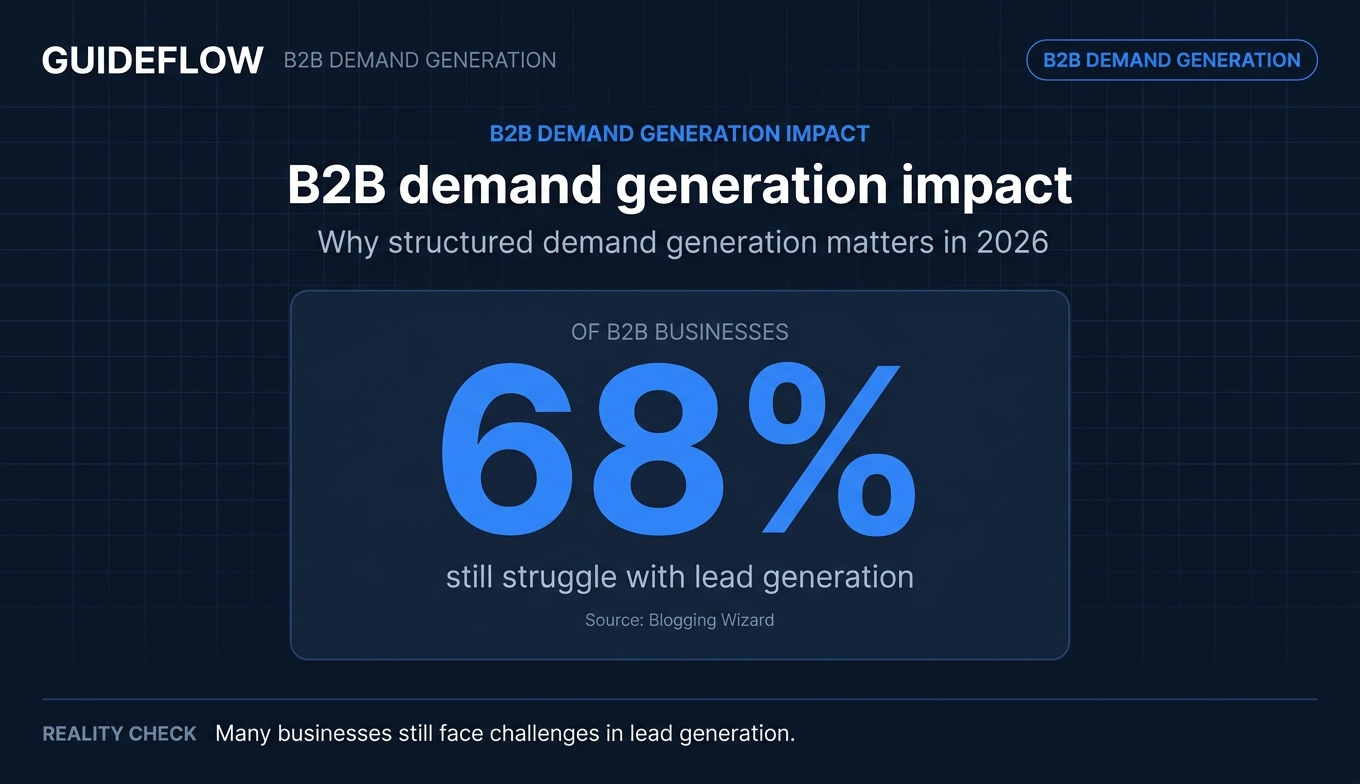
The business case is straightforward: 68% of B2B businesses still struggle with lead generation (Blogging Wizard). Structured demand gen, the kind that creates intent before capturing it, is how you stop struggling and start building a repeatable pipeline engine.
The B2B demand generation funnel
Every demand gen program needs a framework for how buyers move from unaware to pipeline. Here's a four-stage model with specific channels, metrics, and tactics at each stage.
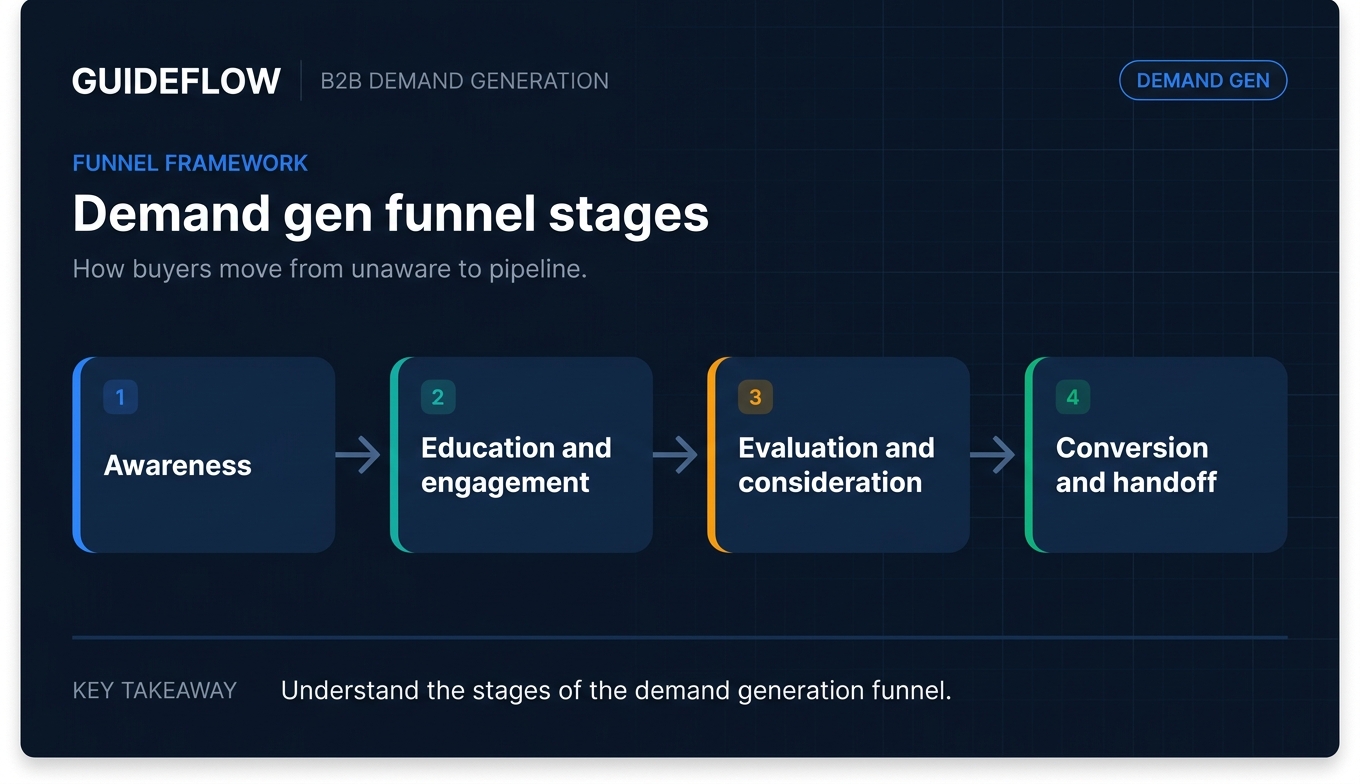
Stage 1: Awareness (demand creation)
At this stage, your goal is to make your target buyers aware that you exist and associate your brand with a problem they care about.
What happens: Prospects discover your brand through content, social, events, or peer recommendations. They don't know your product yet. They're just starting to notice you.
Channels that work here: SEO for educational keywords, organic social (especially LinkedIn), podcast appearances, community participation, thought leadership content, and paid awareness campaigns.
Key metric: Branded search volume (aim for 10 to 20% quarter-over-quarter growth), organic traffic, social reach, and impressions.
Tactical example: Publish original research based on a survey of 200+ customers. Slice the findings into a report, 10 blog posts, 20 social posts, and a webinar. The research becomes a citation source that builds backlinks and brand association over months.
Stage 2: Education and engagement (demand nurture)
At this stage, your goal is to deepen the relationship. Prospects are consuming your content and starting to understand your point of view.
What happens: Prospects read your blog, subscribe to your newsletter, attend a webinar, or follow you on LinkedIn. They're learning from you and beginning to trust your perspective.
Channels that work here: Blog content, email newsletters, webinars, social engagement, retargeting with educational content, and community-driven content.
Key metric: Email open rate (25 to 35% for B2B is a solid benchmark), email subscribers, content engagement rate, and time on site.
Tactical example: Build a 6-email nurture sequence that teaches a framework relevant to your buyer's job. The first four emails are pure education. Only the last two reference your product. This builds trust before asking for anything.
Stage 3: Evaluation and consideration (demand capture)
At this stage, your goal is to convert existing buying intent into pipeline. Prospects are actively comparing options.
What happens: Prospects with active buying intent evaluate your product against alternatives. They visit your pricing page, explore interactive demos, read comparison content, and look at case studies.
Channels that work here: Comparison pages, interactive demos, product tours, case studies, demo centers, free trials, and pricing pages.
Key metric: Demo requests, trial signups, interactive demo completions (40 to 65% completion rate is a strong benchmark), and SQLs.
Tactical example: Embed an interactive demo on your highest-traffic landing page so prospects can experience your product without scheduling a call. Interactive demos perform best when prospects want to evaluate on their own terms, which is exactly what 2026 buyers expect.
Stage 4: Conversion and handoff
At this stage, your goal is to convert marketing-qualified demand into sales-accepted pipeline.
What happens: Prospects who've demonstrated real buying intent (demo requests, interactive demo engagement, trial activity) are handed to sales with context.
Channels that work here: Sales handoff, SDR follow-up, personalized outreach informed by engagement data.
Key metric: MQL-to-SQL conversion rate (20 to 30% is a solid benchmark), pipeline created, and sales acceptance rate.
Tactical example: Use interactive demo engagement data, specifically which features a prospect explored, time spent, and completion rate, to personalize the first sales conversation. A rep who knows the prospect spent 8 minutes on the integration configuration flow can skip the generic pitch and address what actually matters. Guideflow's analytics capabilities make this level of insight accessible to any team.
How to build a B2B demand generation strategy
Here's a five-step process for building a demand gen strategy from scratch or restructuring an existing one. Each step produces a specific artifact you can use immediately.
Step 1: Define your ICP and buying committee
Start with who you're targeting, not what you're saying. Map the buying committee at your target accounts: decision-maker, champion, influencers, and blockers. Segment by company size, industry, and use case.
Interview your sales team: "Who are the easiest deals to close? What do those companies have in common?" The answers will sharpen your ICP faster than any firmographic database.
Output: A documented ICP with named personas and their primary concerns, formatted as a one-page reference your entire team can use.
Step 2: Map the buyer journey for your market
Interview 10 to 15 recent customers and ask: "How did you find us? What did you evaluate? What convinced you to buy? What almost stopped you?"
The patterns in those answers reveal where your demand gen program needs to focus. You'll discover which channels actually drove awareness, which content influenced the decision, and which friction points nearly killed the deal.
Output: A buyer journey map with content and channel needs at each stage, based on real customer data rather than assumptions.
Step 3: Build your content and channel plan
Match content formats to funnel stages. Awareness needs thought leadership and educational content. Consideration needs comparisons, interactive demos, and case studies. Decision needs ROI calculators, security documentation, and customer proof.
Prioritize 2 to 3 channels where your ICP already spends time. For most B2B SaaS companies in 2026, that's some combination of SEO, LinkedIn, email, and a self-serve product experience.
Output: A quarterly content calendar with channel assignments and funnel-stage mapping for each piece.
Step 4: Set up measurement and attribution
Define your demand gen metrics by funnel stage (see the measurement section below). Implement UTM tracking, event tracking, and CRM pipeline stages.
Choose an attribution model. For most teams, the best approach is combining multi-touch attribution (for channel-level insights) with self-reported attribution ("how did you hear about us?" on the demo request form). Self-reported attribution is surprisingly effective and catches the dark social, podcast, and word-of-mouth signals that model-based attribution misses entirely. You can also explore dedicated attribution software tools to automate this process.
Output: A measurement dashboard with weekly review cadence and clearly defined metrics by stage.
Step 5: Launch, measure, and iterate
Start with one campaign or program, not ten. Run it for a full cycle (typically 4 to 8 weeks for B2B) before judging results. Use weekly check-ins to spot early signals like engagement and traffic changes, not just conversion events.
Document what you learn. What worked? What didn't? What would you change? This experiment log becomes the foundation of your demand gen playbook.
Output: A documented experiment log with hypotheses, results, and next actions that your team can reference for future campaigns.
12 B2B demand generation strategies that drive pipeline
These are the B2B demand generation tactics that produce measurable pipeline impact. Each includes what it is, why it works, and specific actions you can take this quarter.
| # | Strategy | Funnel stage | Key metric |
|---|---|---|---|
| 1 | Original research | Awareness | Backlinks, branded search |
| 2 | Ungated content | Awareness | Organic traffic, time on site |
| 3 | SEO for buying intent | Awareness/Capture | Organic traffic, demo requests |
| 4 | Intent-based paid campaigns | Awareness/Capture | CPL, pipeline influenced |
| 5 | Educational email nurture | Engagement | Open rate, click rate |
| 6 | Substantive webinars | Engagement | Registrations, attendee-to-SQL rate |
| 7 | Interactive demos | Evaluation | Completion rate, demo requests |
| 8 | Demo center | Evaluation | Engagement depth, multi-stakeholder access |
| 9 | Account-based marketing | Full funnel | Pipeline per account, engagement score |
| 10 | Partner and co-marketing | Awareness | Co-sourced pipeline, audience reach |
| 11 | Customer proof | Full funnel | Case study views, influenced pipeline |
| 12 | Stage-based retargeting | Capture | Return visits, conversion rate |
1. Publish original research and proprietary data
Commission or analyze your own data to create content competitors can't replicate. Original research earns backlinks, gets cited by industry peers, and positions your brand as a primary source rather than a curator of other people's findings.
How to do it: Run a survey of 200+ customers or prospects. Publish the findings as a report. Slice the data into 10+ derivative content pieces: blog posts, social graphics, webinar presentations, and email snippets. One research project fuels 3 to 6 months of content.
Example: A Series B SaaS company surveyed 300 marketing leaders about their demand gen priorities. The report generated 47 backlinks in the first 90 days and became the most-cited piece on their blog for the year.
2. Build an ungated content engine
Stop gating everything. Gated content trains buyers to give fake emails, not to trust you. When 96% of B2B marketers are using AI to produce content (Demand Gen Report, 2026), the volume of gated assets has exploded. Buyers are drowning in it.
How to do it: Ungate your top 5 performing whitepapers and measure the impact on organic traffic and branded search over 90 days. Keep gating only for high-value, bottom-funnel assets where the exchange feels fair (detailed ROI calculators, exclusive benchmark reports). Pair your content marketing tools with this ungated strategy for maximum reach.
What to watch: Organic traffic should increase. Branded search should grow. The total number of form fills may drop, but the quality of the remaining form fills (demo requests, trial signups) should improve.
3. Use SEO to capture existing demand
Target keywords with buying intent, not just volume. "Best project management software for remote teams" is a buying-intent keyword. "What is project management" is not.
How to do it: Identify 10 "best [category]" and "how to [use case]" keywords where your ICP searches during evaluation. Build topic clusters around your product's core use cases. Prioritize pages that can rank in 3 to 6 months based on your current domain authority. The right SEO tools can accelerate this process significantly.
Metric that matters: Organic traffic to comparison and use-case pages, and the downstream conversion rate from those pages to demo requests.
4. Run targeted paid campaigns with intent signals
Layer intent data on top of firmographic targeting to reach in-market buyers. Broad targeting wastes budget on people who aren't in a buying cycle. Intent signals tell you who's actively researching your category right now.
How to do it: Build a LinkedIn campaign targeting companies showing intent signals for your category. Use educational content (not product pitches) as the ad creative. ABM programs that use intent data generate 2.6x more pipeline per dollar than broad demand gen campaigns (ABM Leadership Alliance, 2026).
What to watch: CPL matters less than pipeline influenced. A campaign with a $200 CPL that produces $500K in pipeline is better than a $30 CPL campaign that produces nothing downstream.
5. Build email nurture sequences that educate, not pitch
Design sequences around the buyer's questions at each stage, not your product's features. The goal is to become a trusted resource, not another vendor in their inbox.
How to do it: Create a 6-email sequence where the first 4 emails are pure education and only the last 2 mention your product. Each email should help the reader do their job better, whether or not they buy from you. 80% of B2B marketers say email is their most effective demand gen channel (Content Marketing Institute), so the investment here compounds. Choosing the right email marketing software is critical for executing this well.
Metric that matters: Reply rate and click-through rate matter more than open rate. A sequence that generates replies is building relationships. One that only gets opens is building vanity metrics.
6. Host webinars and virtual events with real substance
73% of B2B marketers say webinars are their best channel for generating high-quality leads (GoTo). But most webinars are 30-minute product demos disguised as educational content. Buyers can tell.
How to do it: Co-host with customers, partners, or industry experts to add credibility. Run a quarterly "state of [your category]" webinar with a customer panel, followed by live Q&A. Record it, slice it into clips, and distribute across channels for weeks afterward. Explore webinar platforms that support interactive formats and on-demand replay.
What to avoid: Don't pitch your product for the first 25 minutes and then "take questions." Teach something genuinely useful. Let the product mention be brief and contextual.
7. Embed interactive demos across your demand gen funnel
Let prospects experience your product without scheduling a call or creating an account. Interactive demos deliver materially higher engagement than static content like PDFs, slide decks, or recorded videos because buyers interact with real product flows rather than reading about them.
How to do it: Embed a product walkthrough on your highest-traffic landing page and measure completion rate, time spent, and downstream conversion to demo request. Then expand: add interactive demos to email sequences, comparison pages, and ad campaigns.
Why this works: In a market where buyers complete 70%+ of their journey before talking to sales, interactive demos let them evaluate on their own terms. The engagement data (which features they explored, how long they spent, where they dropped off) gives your sales team specific context for the first conversation.
Metric that matters: Interactive demo completion rate and the conversion rate from demo completion to sales conversation.
8. Create a demo center for self-serve evaluation
Centralize all your product demos, walkthroughs, and use-case-specific experiences in a single branded hub. A demo center lets prospects browse by persona, use case, or product area.
How to do it: Organize your demo center by buyer persona (marketer, sales leader, ops manager) with curated playlists for each. Include interactive demos, video walkthroughs, and case studies in a single destination.
Why this works: Demo centers perform best when multiple stakeholders need to evaluate independently, on their own schedules. With 8 to 12 people on the average buying committee, a centralized demo hub means your champion can share one link instead of coordinating 8 separate demo calls.
Metric that matters: Unique visitors, engagement depth across demos, and the number of distinct stakeholders from the same account accessing the center.
9. Use account-based marketing for high-value targets
Focus demand gen resources on a defined list of target accounts. ABM generates 2.6x more pipeline per dollar than broad demand gen, with 41% higher win rates and 33% larger deal sizes (ABM Leadership Alliance/Demandbase, 2026).
How to do it: Select 50 target accounts. Create personalized landing pages for each. Run LinkedIn ads targeting the buying committee at those accounts. Layer intent data to prioritize accounts showing active research signals. The right account-based marketing software can help you orchestrate these multi-channel campaigns effectively.
What to watch: Pipeline per target account, not total leads generated. ABM is about depth, not breadth.
10. Build a partner and co-marketing program
Partner with complementary products to reach overlapping audiences. Co-created content reaches buyers who trust your partner's brand but haven't discovered yours yet.
How to do it: Identify 3 to 5 partners whose customers would benefit from your product. Co-produce a joint research report, webinar series, or integration guide. Cross-promote to each other's customer bases and email lists.
Metric that matters: Co-sourced pipeline (deals where the partner was involved in the lead source) and new audience reach from partner channels.
11. Turn customers into demand gen assets
Customer stories, case studies, and reviews are the most credible B2B demand generation content you can produce. Prospects trust peer experiences more than vendor claims.
How to do it: Create a "customer story sprint" where you interview 5 customers in one week. Produce 5 case studies, 10 social clips, and 3 blog posts from the material. Build a systematic quarterly cadence so your library grows consistently.
What to watch: Case study page views and their influence on downstream pipeline. Track which case studies get shared most by sales and which appear in closed-won deal paths.
12. Use retargeting to re-engage warm audiences
Retarget website visitors, content consumers, and email engagers with stage-appropriate content. The key word is "stage-appropriate." Serving the same ad to everyone wastes budget and annoys prospects.
How to do it: Create three retargeting audiences: visited blog only (serve educational content), visited pricing page (serve case studies and interactive demos), and started but didn't complete a demo (serve a direct CTA to continue). Each audience gets different creative matched to their engagement level.
Metric that matters: Return visit rate and conversion rate from retargeted visitors, segmented by audience tier.
How to measure B2B demand generation
This is where most guides get vague. Here's a specific measurement framework with benchmarks so you know what "good" looks like.
Metrics by funnel stage
| Funnel stage | Metric | What it measures | Benchmark (SaaS) |
|---|---|---|---|
| Awareness | Branded search volume | Market awareness growth | 10 to 20% QoQ growth |
| Awareness | Organic traffic | Content reach | Varies by domain authority |
| Engagement | Email open rate | Audience interest | 25 to 35% for B2B |
| Engagement | Content engagement rate | Content quality | 2 to 5% for social |
| Evaluation | Interactive demo completions | Product interest depth | 40 to 65% completion |
| Evaluation | Demo requests | Active buying intent | Varies by traffic volume |
| Conversion | MQL-to-SQL rate | Lead quality | 20 to 30% |
| Conversion | SQL-to-opportunity rate | Sales alignment | 40 to 60% |
| Pipeline | Pipeline influenced | Revenue impact | Track by channel/program |
| Pipeline | CAC by channel | Efficiency | Varies by segment |
Interactive demo completion rates are a strong engagement signal because they indicate a prospect invested meaningful time exploring your product, not just skimming a page.
Choosing an attribution model
Attribution in B2B demand gen is genuinely hard. Here's an honest assessment of your options:
First-touch attribution credits the first interaction. Good for understanding which awareness channels bring new prospects into your orbit. Bad for understanding what actually closes deals.
Last-touch attribution credits the final interaction before conversion. Good for understanding which channels drive the last step. Bad for understanding the full journey.
Multi-touch attribution distributes credit across touchpoints. Most accurate but hardest to implement. Requires clean data, consistent tracking, and a willingness to accept that the model is still an approximation.
Self-reported attribution asks prospects "how did you hear about us?" on the demo request form. This is surprisingly effective and consistently underused. It catches the podcast episode, the LinkedIn post, the peer recommendation, and the conference conversation that no tracking pixel will ever see.
Our recommendation: Use self-reported attribution alongside multi-touch for the most complete picture. Neither is perfect alone. Together, they cover each other's blind spots. Dedicated marketing analytics software can help you implement and manage these models at scale.
Building a demand gen dashboard
Your dashboard should answer three questions at a glance: Is awareness growing? Is engagement deepening? Is pipeline being created?
What to include: Pipeline by source, CAC by channel, conversion rates by stage, content performance by funnel position, and self-reported attribution trends.
Review cadence: Weekly for leading indicators (traffic, engagement, demo completions). Monthly for lagging indicators (pipeline created, CAC, conversion rates). Quarterly for strategic adjustments (channel mix, budget allocation, program priorities).
Be honest with yourself about what the data shows. A channel that looks great on engagement metrics but produces zero pipeline after 6 months needs to be questioned, not defended.
B2B demand generation best practices
Align sales and marketing on pipeline definitions
Agree on what counts as an MQL, SQL, and opportunity. Hold a weekly pipeline review with both teams present. Share attribution data openly. When marketing and sales define "qualified" differently, every downstream metric becomes unreliable. Marketing-sales misalignment alone adds roughly 25% to sales cycle length.
Invest in content that compounds
Prioritize SEO content and evergreen resources over one-time campaigns. A blog post that ranks for a buying-intent keyword generates pipeline for years. A single LinkedIn ad campaign generates pipeline for weeks. Both matter, but the compounding asset should get more investment over time.
Let buyers self-serve before they talk to sales
Provide interactive demos, pricing information, and comparison content openly. Buyers who self-educate convert at higher rates and with shorter sales cycles because they arrive at the sales conversation already informed and already interested. Self-serve product experiences perform best when buyers want to evaluate on their own terms, which in 2026 is most of the time.
Test one variable at a time
Resist the urge to change everything simultaneously. Run structured experiments with clear hypotheses and measurement plans. "We changed the landing page, the email sequence, and the ad creative, and pipeline went up" tells you nothing about what actually worked.
Document what works into repeatable playbooks
When a campaign or tactic works, document the process so it can be repeated. Include the hypothesis, the setup, the results, and the specific conditions that made it work. The playbook is what turns a one-time win into a repeatable program.
Review and kill underperforming programs quarterly
Not every program will work. Cut the ones that aren't producing pipeline after a fair evaluation period. Reallocate budget to what's working, not what's comfortable. The best demand gen teams are disciplined about stopping things, not just starting them.
Common demand generation mistakes (and how to fix them)
Gating everything and measuring MQLs instead of pipeline
The mistake: Treating every content download as a "lead" and flooding sales with unqualified contacts. Your MQL number looks impressive. Your pipeline number doesn't.
What this looks like: 5,000 MQLs per quarter, 150 SQLs, 30 opportunities. That's a 0.6% MQL-to-opportunity rate. You're spending most of your budget generating contacts who will never buy.
The fix: Ungate most content. Use engagement depth and intent signals to identify real buying interest. Measure pipeline influenced rather than form fills. A smaller number of high-intent signals (demo requests, interactive demo completions, pricing page visits) will produce more pipeline than a large number of content downloads.
Running demand gen without sales alignment
The mistake: Marketing generates "leads" that sales ignores or rejects. The two teams blame each other quarterly.
What this looks like: Marketing reports 2,000 MQLs handed to sales. Sales reports 200 were worth contacting. Neither team trusts the other's numbers.
The fix: Co-define pipeline stages. Hold weekly reviews where both teams look at the same data. Build a feedback loop where sales reports on lead quality and marketing adjusts targeting. This takes 30 minutes per week and prevents months of wasted effort.
Optimizing for volume instead of quality
The mistake: Chasing more traffic, more leads, more MQLs without tracking downstream conversion.
What this looks like: A channel that produces 500 MQLs with a 2% SQL conversion rate (10 SQLs) gets more budget than a channel that produces 50 MQLs with a 25% SQL conversion rate (12.5 SQLs). The lower-volume channel actually produces more pipeline.
The fix: Measure conversion rates by stage and by channel. Optimize for pipeline created, not top-of-funnel volume. The math is straightforward once you track it.
Ignoring the middle of the funnel
The mistake: Investing heavily in awareness (top) and sales enablement (bottom) but neglecting the evaluation stage where buyers decide whether to engage.
What this looks like: Strong brand awareness and good sales materials, but a gap in the middle where prospects drop off because there's nothing to help them evaluate independently.
The fix: Build mid-funnel content and experiences that help buyers evaluate on their own. Interactive demos, comparison pages, and case studies perform best when buyers need to evaluate independently before committing to a sales conversation. This is often the highest-leverage investment a demand gen team can make.
Treating demand gen as a campaign instead of a system
The mistake: Running disconnected campaigns without a cohesive strategy or measurement framework. Each campaign has its own goals, its own metrics, and its own definition of success.
What this looks like: Q1 was a webinar push. Q2 was a content blitz. Q3 was an ABM pilot. None of them built on each other, and none of them produced compounding results.
The fix: Build demand gen as a system with connected stages, consistent measurement, and iterative improvement. Each program should feed the next. Awareness content feeds email subscribers. Email nurture feeds demo requests. Demo engagement feeds sales conversations. The system compounds. Disconnected campaigns don't.
Conclusion
B2B demand generation in 2026 is about creating genuine buying intent through education, self-serve experiences, and measurable programs. It's not about capturing contact information and hoping sales can convert it.
The companies winning at demand gen right now share three traits: they let buyers self-educate before engaging sales, they measure pipeline (not MQLs) as their primary metric, and they build systems that compound rather than campaigns that expire.
Pick one section of this guide that addresses your biggest current gap. Build the artifact. Measure the result. Iterate from there.
Start your journey with Guideflow today.
FAQs about B2B demand generation
B2B demand generation is the strategic process of creating awareness, interest, and buying intent among business buyers to build qualified pipeline. It covers the full buyer journey from initial brand discovery through evaluation and sales handoff. Unlike lead generation, which focuses on capturing contact information, demand generation focuses on creating the conditions where buyers actively want to engage with your product.
Demand generation creates buying intent across the full funnel, while lead generation focuses specifically on capturing contact information from interested prospects. For example, publishing an ungated industry report that builds brand preference is demand gen. Gating that report behind a form to collect emails is lead gen. Lead gen is a tactic within the broader demand gen strategy, not a replacement for it.
Measure B2B demand generation by tracking metrics at each funnel stage: branded search and organic traffic for awareness, engagement rates and email metrics for nurture, demo requests and interactive demo completions for evaluation, and pipeline influenced for revenue impact. Combine multi-touch attribution with self-reported attribution ("how did you hear about us?") for the most complete picture. Neither model is perfect alone.
The most effective B2B demand generation strategies combine ungated content, SEO for buying-intent keywords, targeted paid campaigns with intent data, educational email nurture, interactive product demos, and customer-driven proof points. The right mix depends on your ICP, your budget, and where your current funnel is weakest. Start with 2 to 3 strategies, measure pipeline impact, and expand from there.
Most B2B demand generation programs take 3 to 6 months to show measurable pipeline impact. Early engagement signals like traffic growth, email subscribers, and demo completions typically appear within 4 to 8 weeks. Paid channels produce faster initial results but don't compound. Organic channels (SEO, content, community) take longer to build but generate compounding returns. Plan for a 6-month evaluation window before making major strategic changes.
Content is the primary vehicle for demand generation for b2b companies. It serves as the mechanism through which you educate buyers, build brand preference, and create the conditions for a buying decision. This includes both static formats (blog posts, reports, case studies) and interactive formats (interactive demos, sandboxes, product tours). The most effective demand gen programs use content matched to each funnel stage: thought leadership for awareness, educational content for engagement, and product experiences for evaluation.
Inbound marketing is a methodology focused on attracting visitors through content and SEO. B2B demand generation is a broader strategic function that includes inbound tactics alongside outbound campaigns, paid advertising, partner programs, account-based marketing, and product-led approaches. Inbound is one input into your demand gen system. Demand gen is the system itself.
Yes. Small SaaS teams can run effective B2B demand gen by focusing on 2 to 3 high-impact channels, using automation to scale content distribution, and prioritizing self-serve product experiences that reduce the need for live sales conversations. A team of 2 to 3 marketers can build a functioning demand gen program by starting with SEO, email nurture, and interactive demos, then expanding as pipeline data reveals which channels produce the best returns. The key constraint isn't budget. It's focus. Small teams that try to do everything produce nothing. Small teams that do 3 things well build real pipeline.