Your business hours changed last Tuesday. Yelp still shows the old ones. A customer drove to your closed store on Saturday.
Now multiply that across 50+ directories and 10 locations. That's the problem local listing management software exists to solve: one dashboard to push accurate business data everywhere, detect duplicates, and measure the impact on local search traffic.
73% of consumers lose trust in a brand when online listings show incorrect information. (BrightLocal)
This guide covers 12 tools for 2026 with honest evaluations of features, pricing, and "best for" recommendations. It serves three audiences: single-location businesses tired of manual directory updates, multi-location brands scaling consistency, and agencies managing hundreds of client listings.
One structural insight makes this guide different from the rest. The distinction between direct API integrations and data aggregator distribution fundamentally affects how fast and reliably your updates reach directories. This guide will help you understand not just which listing management software to pick, but how local listing management actually works under the hood.
What's inside
This guide reviews 12 local listings management tools with feature breakdowns, pricing, and "best for" recommendations. Selection criteria include directory coverage, integration type (direct API vs. aggregator), duplicate detection, analytics, pricing transparency, and G2/Capterra ratings. You'll also find a full comparison table, a buying criteria checklist with a quick decision framework, and 8 FAQs covering the most common questions about the category.
TL;DR
- Local listing management software centralizes your business data across Google, Bing, Apple Maps, Yelp, Facebook, and dozens of directories to keep NAP data consistent and improve local SEO.
- Top picks by use case: Yext for enterprise scale, BrightLocal for agencies, Moz Local for simplicity, Semrush for all-in-one SEO integration.
- Pricing ranges from free (Google Business Profile) to $500+/month for enterprise multi-location platforms.
- The biggest technical differentiator: direct API integrations vs. data aggregator distribution. This determines whether your updates propagate in minutes or weeks.
- 2026 trend: AI-powered duplicate detection, automated review responses, and structured data optimization for AI search engines are becoming table-stakes features.
What is local listing management software?
Local listing management software is a platform that lets businesses create, update, and monitor their business information (name, address, phone number, hours, photos, categories, and attributes) across online directories, search engines, maps, and social platforms from a single dashboard.
This category of business listing management software handles several core capabilities:
- Centralized NAP data management across 50 to 200+ directories
- Automated update propagation to Google Business Profile, Bing Places, Apple Maps, Yelp, Facebook, and niche directories
- Duplicate listing detection and suppression
- Review monitoring and response management
- Local search rank tracking
- Analytics and reporting on listing performance
- Bulk editing for multi-location businesses
You'll see this category called "citation management software," "online listing management," or "directory listing management" depending on the vendor. The core function is the same: keeping your online listings accurate and consistent everywhere customers search.
When to use local listing management software
Multi-location brands scaling consistency
When you manage 10+ locations and manual directory updates consume 5+ hours per week, the ROI of a listing management platform is immediate. Consistent NAP data across directories correlates directly with higher local pack rankings. At this scale, you need direct API integrations (Yext, Uberall) or aggregator distribution (Moz Local, Semrush) to push updates simultaneously.
Agencies managing client listings
When you manage business listings for multiple clients, you need white-label reporting, bulk editing, and client-specific dashboards. Tools like BrightLocal, Vendasta, and Whitespark are built for this workflow. The key evaluation criteria: per-client pricing, white-label branding, and the ability to manage permissions across accounts.
Single-location businesses fixing data accuracy
When incorrect or duplicate listings are sending customers to the wrong address, but you only have 1 to 3 locations. A simpler, lower-cost tool (Moz Local, Synup) or even free Google Business Profile management may be sufficient. Don't overspend on enterprise capabilities you won't use.
After a rebrand, move, or acquisition
When business information has changed across the board and you need to push updates to every directory simultaneously. This is a one-time high-urgency use case where speed of propagation matters most. Direct API integrations will update directories in hours; aggregator-based tools may take weeks.
Local listing management software comparison table
Here's how all 12 tools compare on key differentiators, pricing, and user ratings.
| # | Product | Intent | Key Differentiation | Pricing | G2 Rating |
|---|---|---|---|---|---|
| 1 | Yext | Enterprise multi-location management | 200+ direct publisher integrations, AI search optimization | Custom (est. $499+/mo) | 4.4/5 |
| 2 | BrightLocal | Agency and SMB local SEO | Citation building + audit + rank tracking in one | From $39/mo | 4.6/5 |
| 3 | Moz Local | Simple listing distribution | Clean UI, automated distribution to major aggregators | From $14/mo | 4.5/5 |
| 4 | Semrush Listing Management | All-in-one SEO with listings | Integrated with Semrush SEO suite | From $40/mo (add-on) | 4.5/5 |
| 5 | Uberall | Enterprise location marketing | Listings + reviews + local pages in one platform | Custom pricing | 4.3/5 |
| 6 | Birdeye | Review-first listing management | Strongest review management + listings combo | Custom (est. $299+/mo) | 4.7/5 |
| 7 | SOCi | Multi-location social + listings | Social media + listings + reputation in one | Custom pricing | 4.5/5 |
| 8 | Whitespark | Local citation specialist | Citation building + local rank tracking | From $39/mo | 4.3/5 |
| 9 | Synup | SMB-focused listing management | Affordable multi-location management with social | From $34.99/mo | 4.5/5 |
| 10 | Vendasta | White-label agency platform | Resellable listing management for agencies | From $79/mo | 4.4/5 |
| 11 | Advice Local | Data aggregator-powered distribution | Submits to major data aggregators for broad coverage | From $60/mo | 4.2/5 |
| 12 | Google Business Profile | Single-location GBP management | Free, direct Google control, no third-party needed | Free | N/A |
"Custom pricing" typically means $300 to $1,000+/month depending on location count and feature modules. G2 ratings as of Q1 2026. Verify current ratings before purchasing.
12 best local listing management software tools reviewed
Below, each tool gets an honest breakdown: what it does well, what it costs, and when you should choose something else.
1. Yext
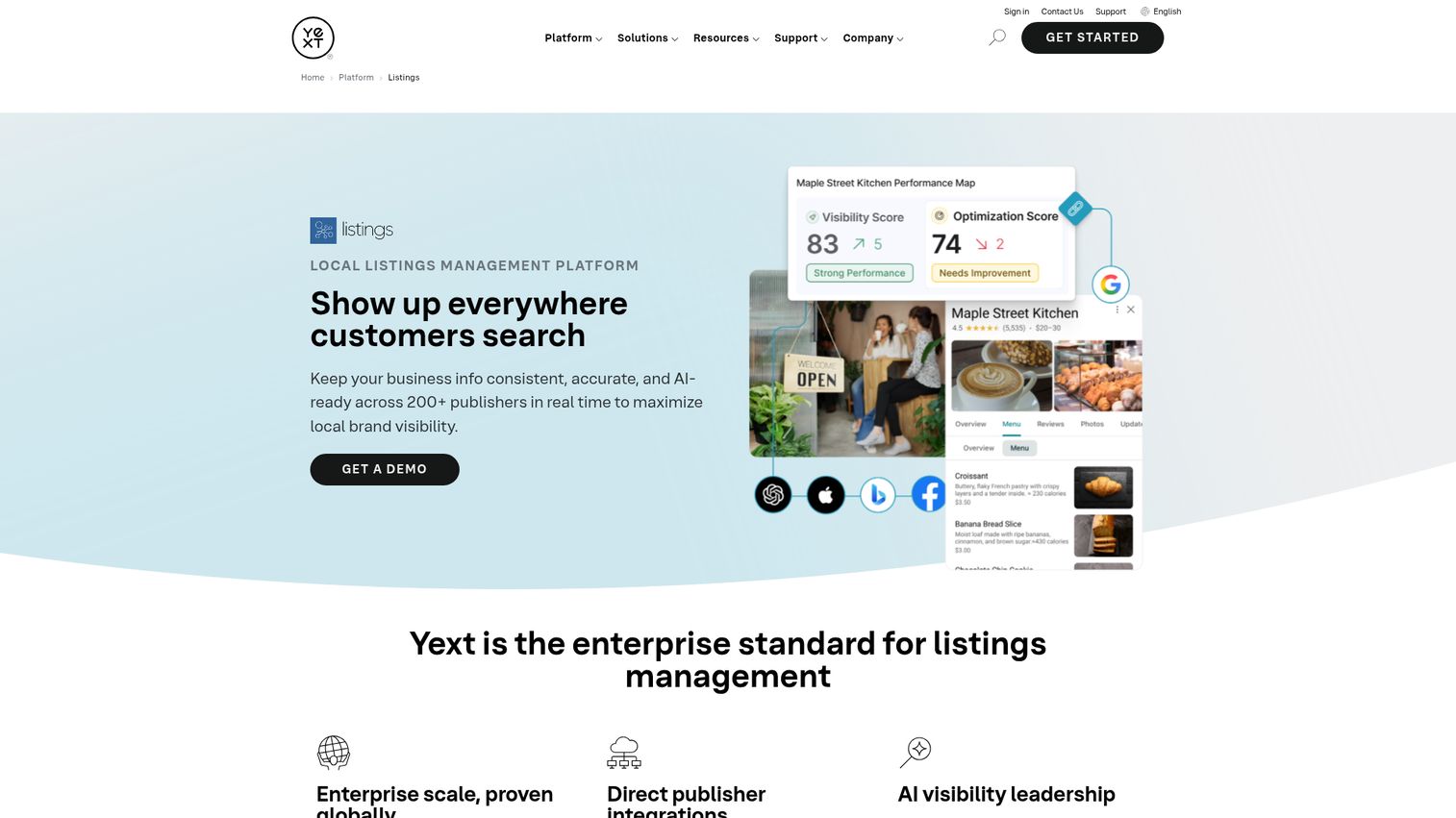
Yext is the enterprise standard for local listing management, built on direct API integrations with 200+ publishers.
What this means practically: when you update your hours in Yext, the change pushes directly to Google, Bing, Apple Maps, Yelp, and 200+ other directories via API. Not through a data aggregator middleman. Updates propagate in near-real-time (minutes to hours), not days or weeks. For enterprise teams managing time-sensitive changes across dozens of locations, this speed is the core value.
Yext has expanded into AI search optimization: structuring business data so it surfaces correctly in AI-powered search results like Google AI Overviews, Bing Copilot, and ChatGPT search. For teams planning for 2026 and beyond, this forward-looking capability is a genuine differentiator. The market backs this up: a 12-location restaurant chain saw a 34% surge in Google Business Profile views and a 28% increase in direction requests within six months of implementing better multi-location management (Netco Design, 2026).
Best for: Enterprise brands with 50+ locations that need direct publisher control and can justify premium pricing.
Key strengths
- 200+ direct API publisher integrations (not aggregator-dependent)
- AI-powered duplicate detection and suppression
- Structured data optimization for AI search engines
- Enterprise-grade permissions, compliance controls, and role-based access
- Analytics dashboard with ROI tracking and location-level performance
Pricing: Custom pricing based on location count. Expect $499+/month for mid-size deployments. Enterprise contracts are annual. No free tier.
When to choose something else: If you have fewer than 20 locations or a limited budget, Yext's pricing is hard to justify. The platform is powerful but complex. Smaller teams may not use 80% of its capabilities. If you're an agency managing clients, Yext's pricing model isn't built for reselling. High subscription costs of premium packages remain a barrier for small businesses (Verified Market Research, 2024).
2. BrightLocal
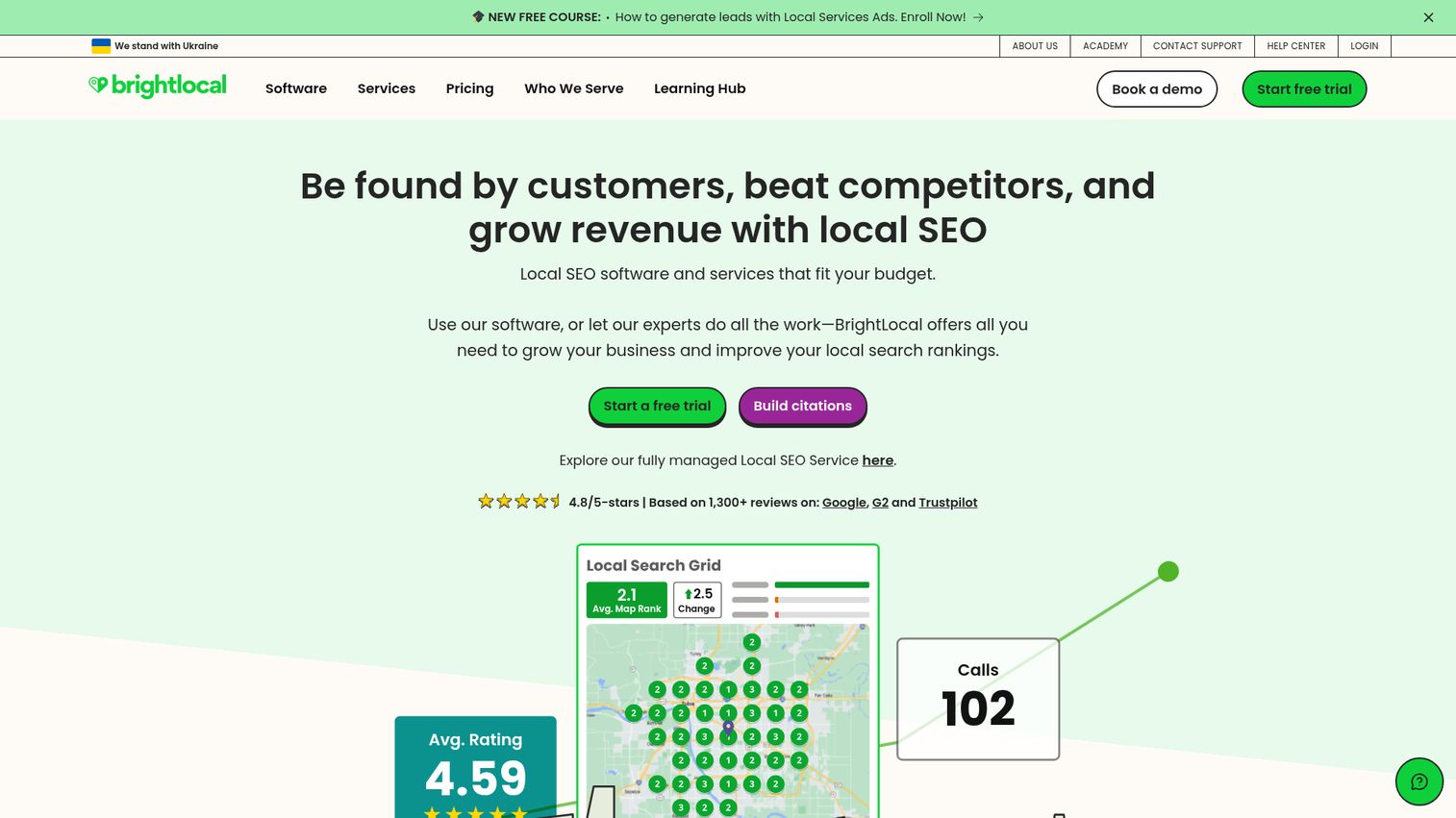
BrightLocal is the go-to for agencies and SMBs who need citation management, local rank tracking, and listing audits in one package.
The key differentiator: BrightLocal doesn't just manage listings. It audits your existing citations across 1,000+ directories, identifies inconsistencies, and provides a Citation Builder service to fix them manually. This combination of local listing services with local SEO reporting is what sets it apart. You can track local pack rankings, audit GBP performance, monitor reviews, and check citation health in one dashboard.
For agencies, the white-label reporting and client management features are the real draw. You can brand reports with your logo, give clients their own dashboard access, and manage permissions across accounts without juggling separate logins.
Best for: Agencies managing local SEO for multiple clients, and SMBs who want listing management bundled with local SEO tools.
Key strengths
- Citation Tracker audits existing listings across 1,000+ directories
- Citation Builder service for manual citation creation and cleanup
- Local rank tracking with Google Maps and organic results
- GBP audit and optimization recommendations
- White-label reports and client dashboard access
Pricing: From $39/month (Track plan). Citation Builder priced per citation. Multi-location and agency plans available.
When to choose something else: BrightLocal relies partly on data aggregators rather than direct API connections for listing distribution. If real-time update propagation is critical (during a crisis, rapid expansion, or time-sensitive changes), a direct-integration platform like Yext is more reliable. The Citation Builder service also adds cost on top of the subscription.
3. Moz Local
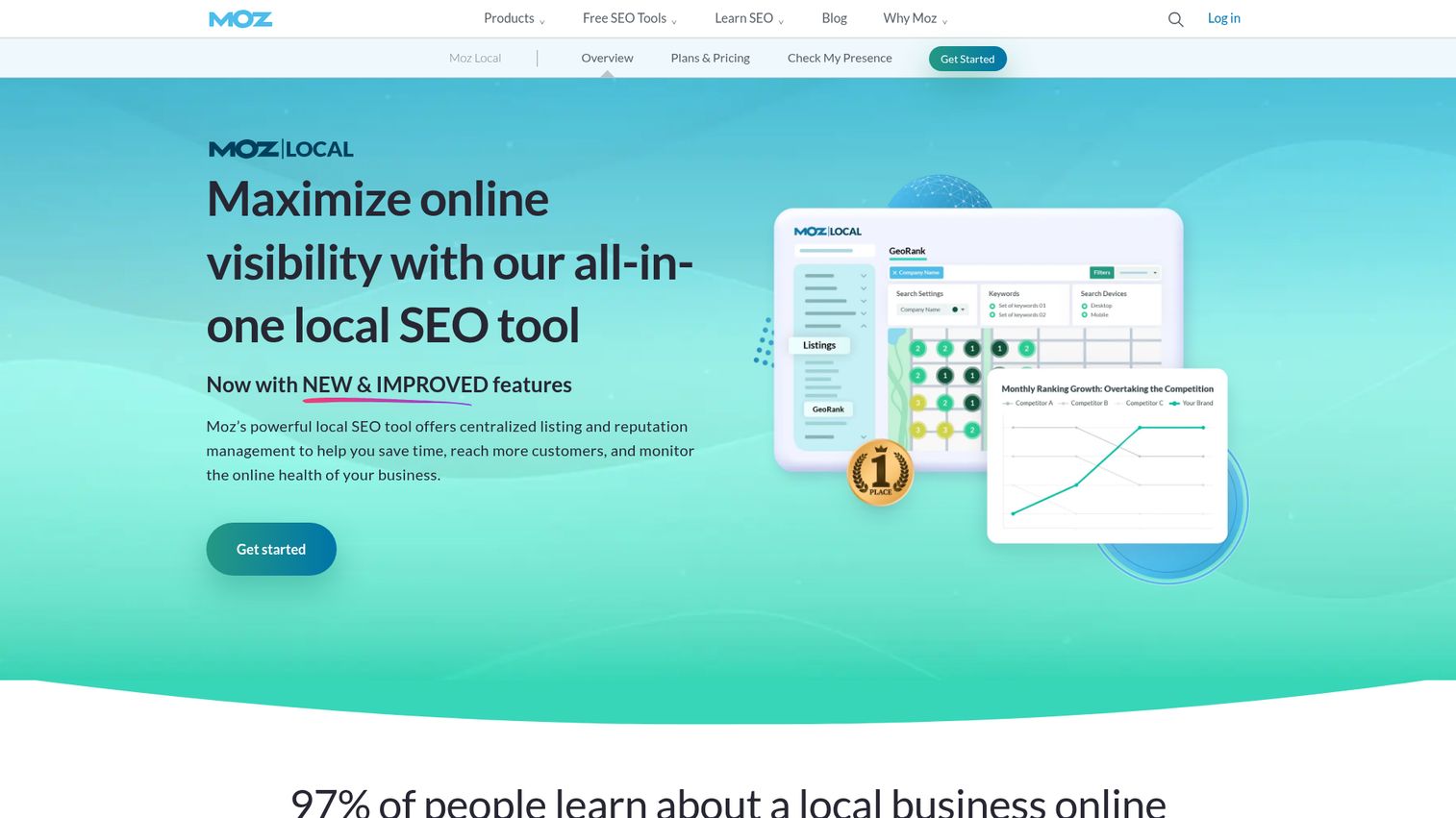
Moz Local is the simplest entry point for businesses that want listing distribution without complexity.
Here's how it works: Moz Local pushes your data to major data aggregators (Data Axle, Foursquare/Factual), which then distribute to downstream directories. The interface is clean. Setup takes minutes. Pricing is straightforward.
Secondary features include duplicate detection, review monitoring, and basic GBP posting. Moz Local is intentionally not the most feature-rich option. That's the point. If you want online listing management that works without a learning curve, this delivers. It's the contrast to Yext's direct API model: broader coverage through aggregators, simpler setup, lower cost, but slower propagation.
Best for: Small businesses and marketing teams that want reliable listing distribution without the complexity or cost of enterprise platforms.
Key strengths
- Automated distribution to major data aggregators
- One-click duplicate detection and deletion requests
- Review monitoring across major platforms
- GBP posting and profile optimization
- Clean, intuitive dashboard with minimal setup
Pricing: From $14/month per location (Lite plan). Standard plan from $20/month per location.
When to choose something else: Aggregator-based distribution means updates can take days or weeks to propagate to all directories. If you need direct publisher control or manage 50+ locations, you'll outgrow this tool. Limited analytics compared to BrightLocal or Yext.
4. Semrush Listing Management
Semrush Listing Management is the add-on for teams already using Semrush for SEO.
The value proposition is stack consolidation. If Semrush is already in your toolkit for keyword research, site audits, and competitive analysis, adding listing management keeps local SEO data in the same place. No new login. No new vendor relationship. This resonates directly with growth marketers dealing with too many tools and weak integrations.
Worth noting transparently: Semrush's listing distribution runs through a Yext partnership. You're getting Yext's distribution network to 150+ directories, integrated with Semrush's broader SEO tools. The local heatmap rankings and voice search readiness tracking are useful additions for teams who want the best software for local search visibility alongside their organic SEO workflow.
Best for: Growth marketers and SEO teams already using Semrush who want listings management software without adding another tool.
Key strengths
- Distribution to 150+ directories via Yext partnership
- Integrated with Semrush's SEO, PPC, and content tools
- Review monitoring and response from one dashboard
- Local heatmap rankings to visualize local pack performance
- Voice search readiness tracking
Pricing: Available as an add-on to Semrush subscriptions, from approximately $40/month per location.
When to choose something else: If you don't already use Semrush, buying a full subscription just for listing management is expensive overkill. The listing management module is solid but not as deep as dedicated platforms like Yext or BrightLocal. The Yext partnership means you're getting Yext's distribution at a markup without Yext's full feature set.
5. Uberall
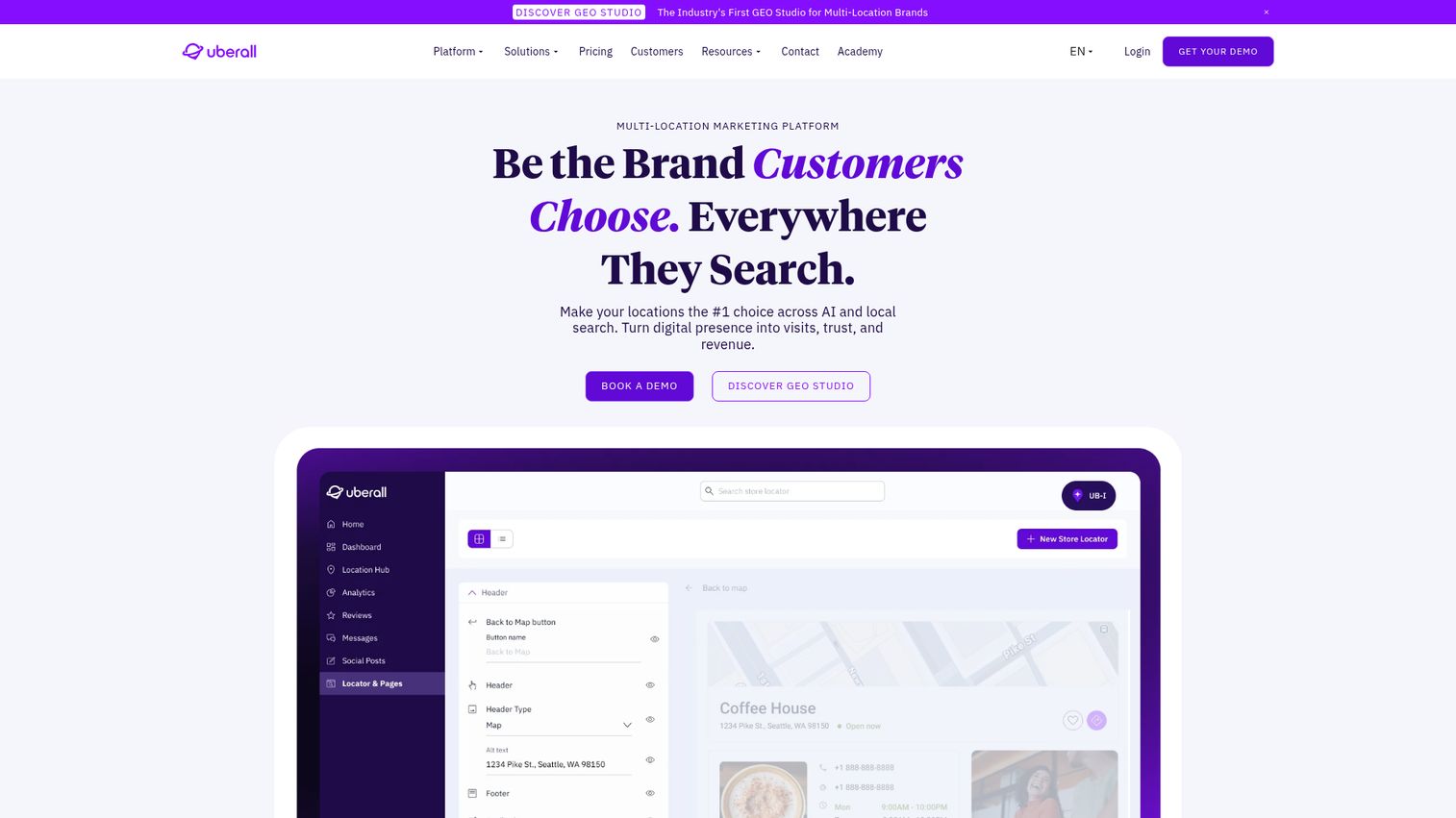
Uberall is an enterprise location marketing platform that goes beyond listings into reviews, local pages, and analytics.
The "location marketing cloud" positioning means it handles citation management, builds local landing pages for each location, manages review responses at scale, and provides location-level analytics including foot traffic attribution. For international brands, the multi-country and multi-language support is a genuine differentiator that most competitors don't match.
The analytics go deeper than most competitors. Foot traffic attribution and conversion tracking from listing views to store visits give enterprise teams the ROI data they need to justify the investment. This is business listing management software built for scale.
Best for: Enterprise and mid-market brands with international locations that need listings, reviews, and local pages in one platform.
Key strengths
- Direct integrations with major global directories
- Local landing page builder for each location
- Review management with AI-suggested responses
- Foot traffic and conversion analytics
- Multi-country, multi-language support
Pricing: Custom pricing based on location count and modules. Expect enterprise-level pricing ($500+/month).
When to choose something else: Uberall is built for scale. If you have fewer than 20 locations or don't need local pages and review management bundled in, you're paying for capabilities you won't use. The platform's complexity requires dedicated onboarding time.
6. Birdeye
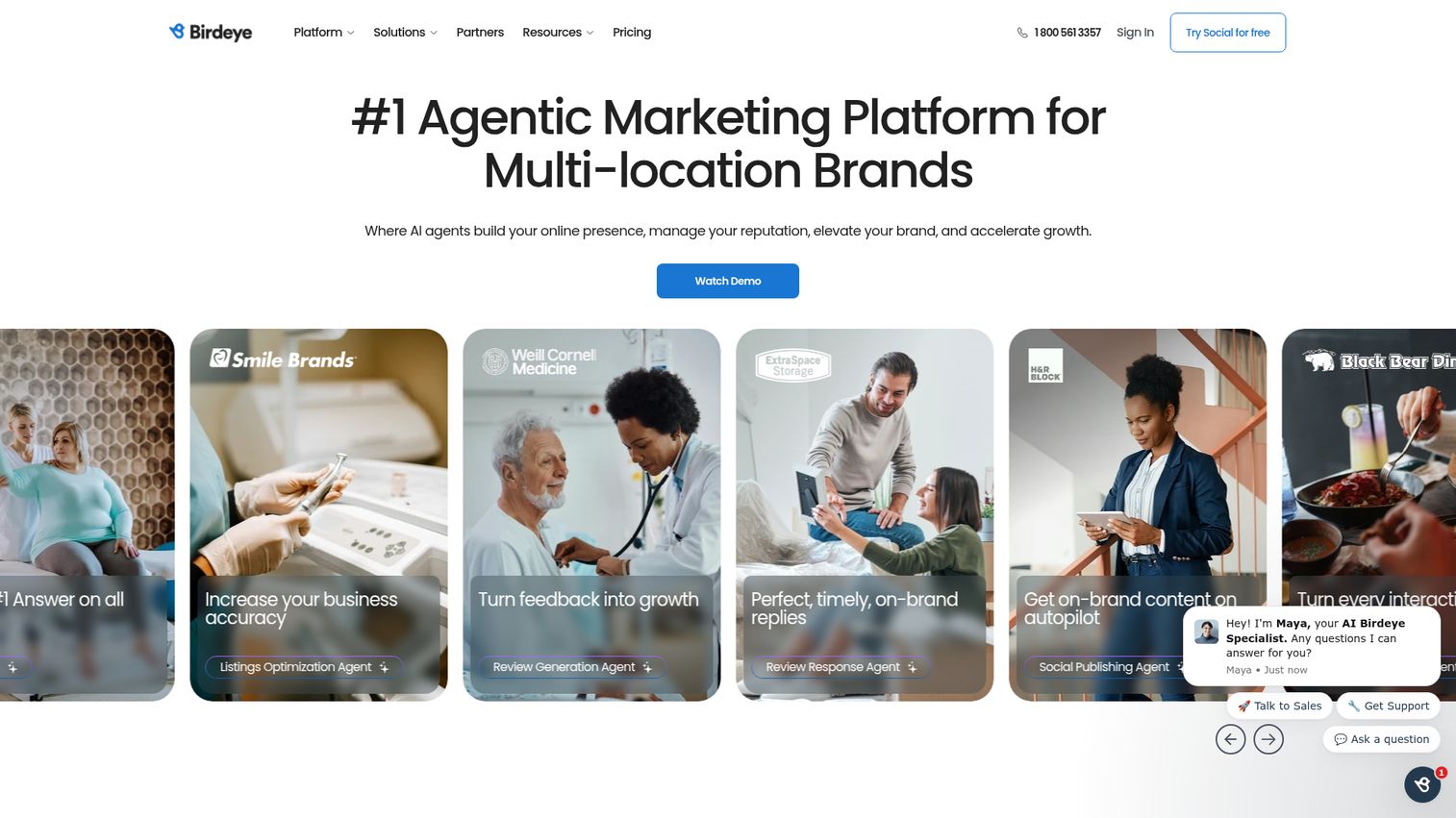
Birdeye is the platform where review management meets listing management.
Birdeye's core strength is reputation management: collecting reviews, responding at scale, and turning customer feedback into insights. Listing management (distribution to 150+ directories) is a strong secondary capability. The differentiator is the review-first approach. If your primary pain is managing reviews across Google, Yelp, Facebook, and industry-specific sites, and listing accuracy is a bundled need, Birdeye handles both without requiring two separate tools.
The review generation campaigns are where Birdeye stands out. Automated review requests via SMS and email, AI-powered response suggestions, and competitor benchmarking on reviews and ratings give you a full reputation management workflow alongside your listing distribution.
Best for: Businesses where online reputation and reviews are the primary concern, with listing management as a bundled need.
Key strengths
- Review generation campaigns (automated requests via SMS and email)
- AI-powered review response suggestions
- Listing distribution to 150+ directories
- Competitor benchmarking on reviews and ratings
- Customer survey and feedback tools
Pricing: Custom pricing. Estimates start around $299/month depending on location count and modules.
When to choose something else: If listing management is your primary need and reviews are secondary, Birdeye's pricing is hard to justify. Dedicated listing tools like BrightLocal or Moz Local cost significantly less for the citation management piece alone.
7. SOCi
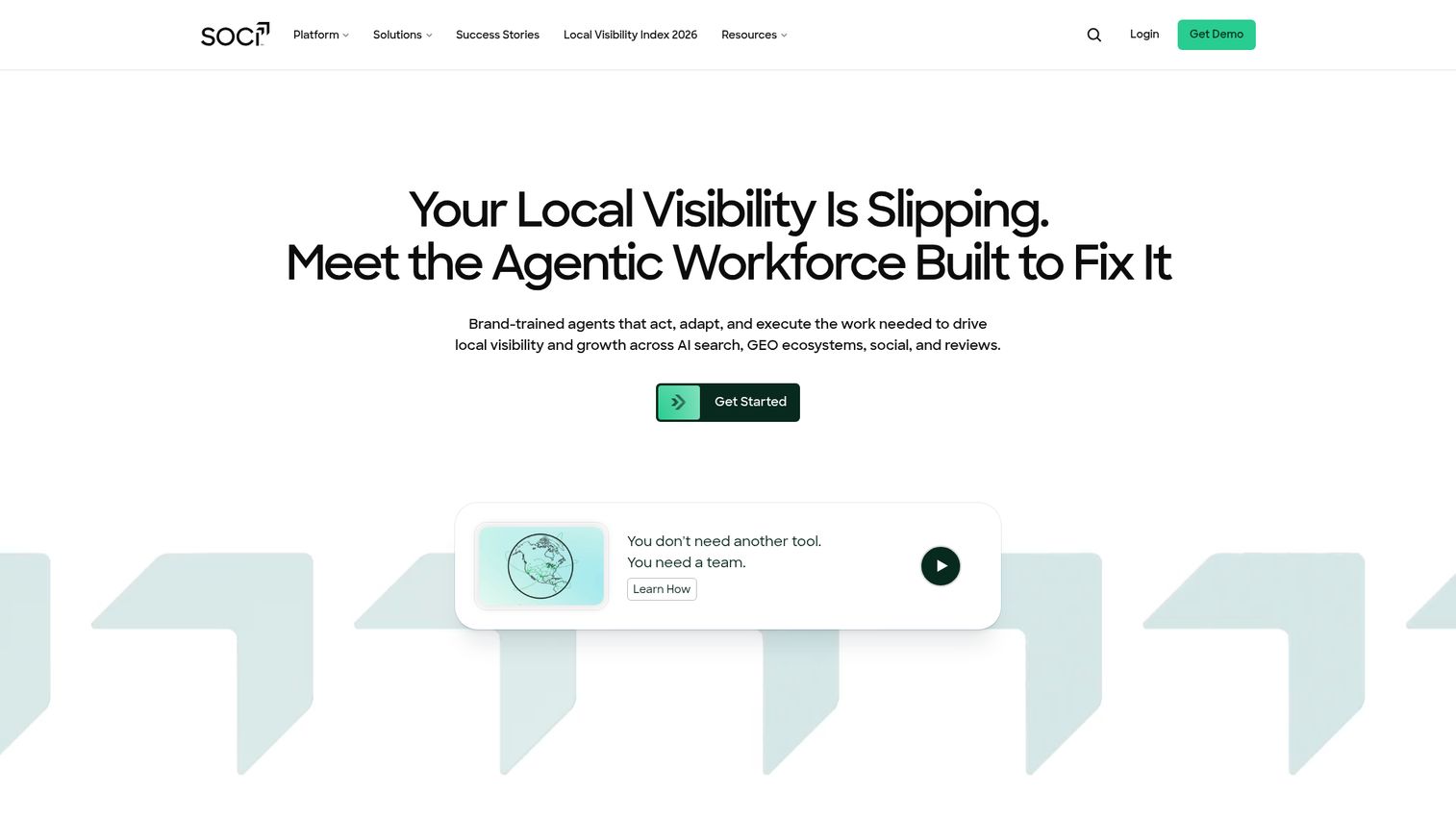
SOCi is a multi-location marketing platform combining social media management, listing management, and reputation management.
Built for franchise and multi-location brands, SOCi handles social posting, listing accuracy, and review responses across hundreds of locations from one platform. The key differentiator is the corporate-to-local governance model (CoMarketing Cloud): corporate teams set brand guidelines while local teams or franchisees customize content for their markets.
This governance model is the actual reason someone would choose SOCi over alternatives. For franchise operations where brand consistency and local relevance need to coexist, the ability to control what's published at the corporate level while allowing local customization is a genuine operational advantage.
Best for: Franchise brands and multi-location businesses that need social, listings, and reputation managed together with corporate-local governance.
Key strengths
- Unified social, listings, and reputation management
- Corporate-to-local content governance for franchises
- Localized social media posting and scheduling
- Review monitoring and response workflows
- Local search reporting and competitive insights
Pricing: Custom pricing. Enterprise-focused.
When to choose something else: If you only need listing management without social media capabilities, SOCi's bundled approach means you're paying for features you won't use. Single-location businesses should look elsewhere. The platform requires meaningful onboarding investment.
8. Whitespark
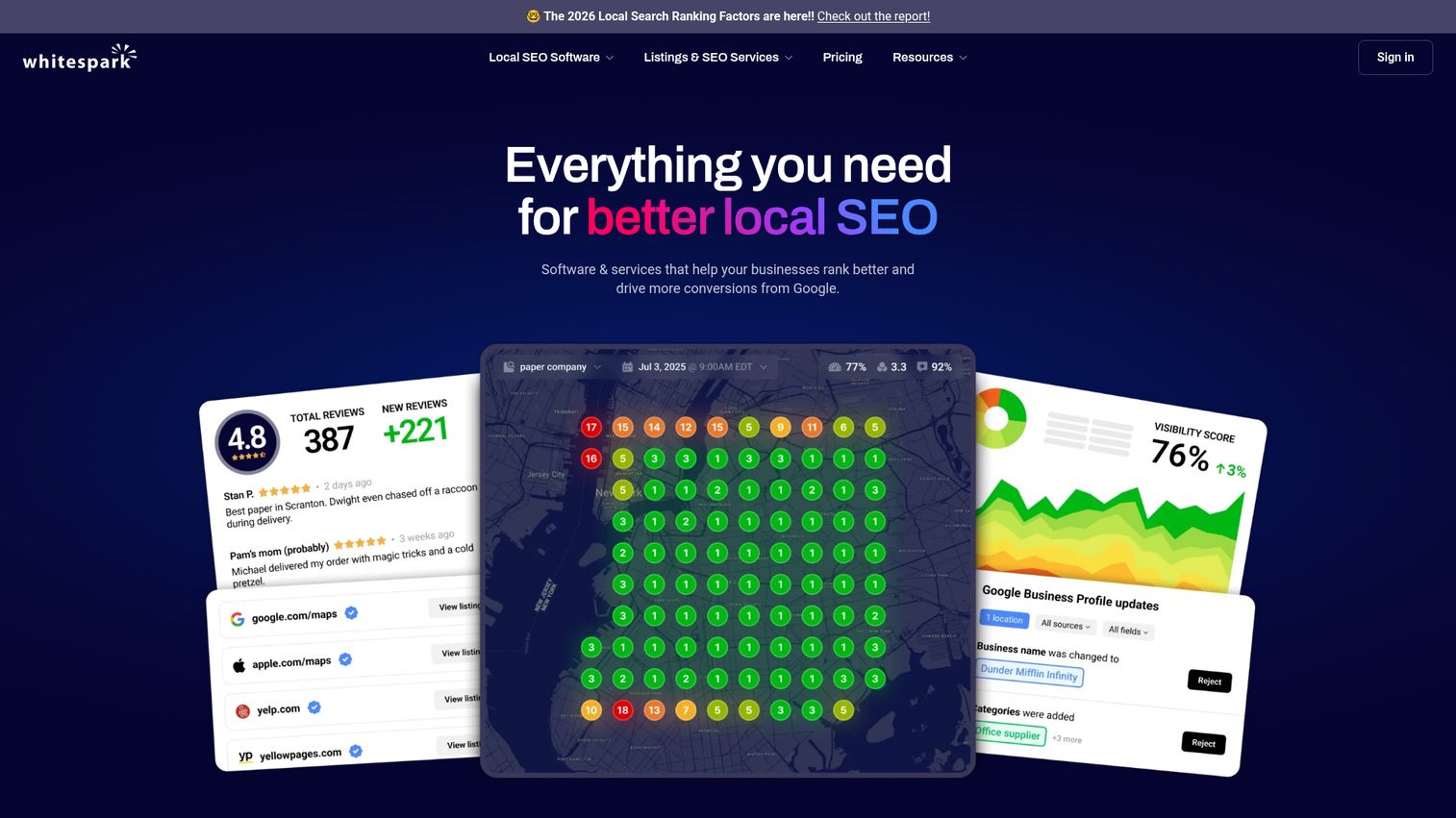
Whitespark is a specialist in local citation building and tracking.
Whitespark started as a citation finder tool and expanded into a full local SEO platform, but citations remain its core strength. The Local Citation Finder identifies where your business is (and isn't) listed across directories. The managed citation service handles building and cleaning up citations manually.
The manual citation building is what separates Whitespark from automated platforms. Their team manually builds and corrects citations, which can be more thorough than automated distribution through aggregators. This is especially valuable for businesses with years of inconsistent or duplicate listings that need deep cleanup, not just automated pushes. It's one of the more hands-on local listing services available.
Best for: Businesses and agencies that need deep citation audit and cleanup, especially for correcting years of inconsistent or duplicate listings.
Key strengths
- Local Citation Finder for comprehensive citation auditing
- Managed citation building and cleanup service
- Local rank tracker with Google Maps tracking
- Reputation management and review monitoring
- Google Business Profile audit tool
Pricing: From $39/month for software tools. Managed citation services priced per citation (typically $2 to $5 per citation).
When to choose something else: Whitespark's managed services are thorough but slower than automated platforms. If you need instant listing updates across 200+ directories, an API-integrated platform like Yext is faster. The per-citation pricing model can add up quickly for businesses with hundreds of needed citations.
9. Synup
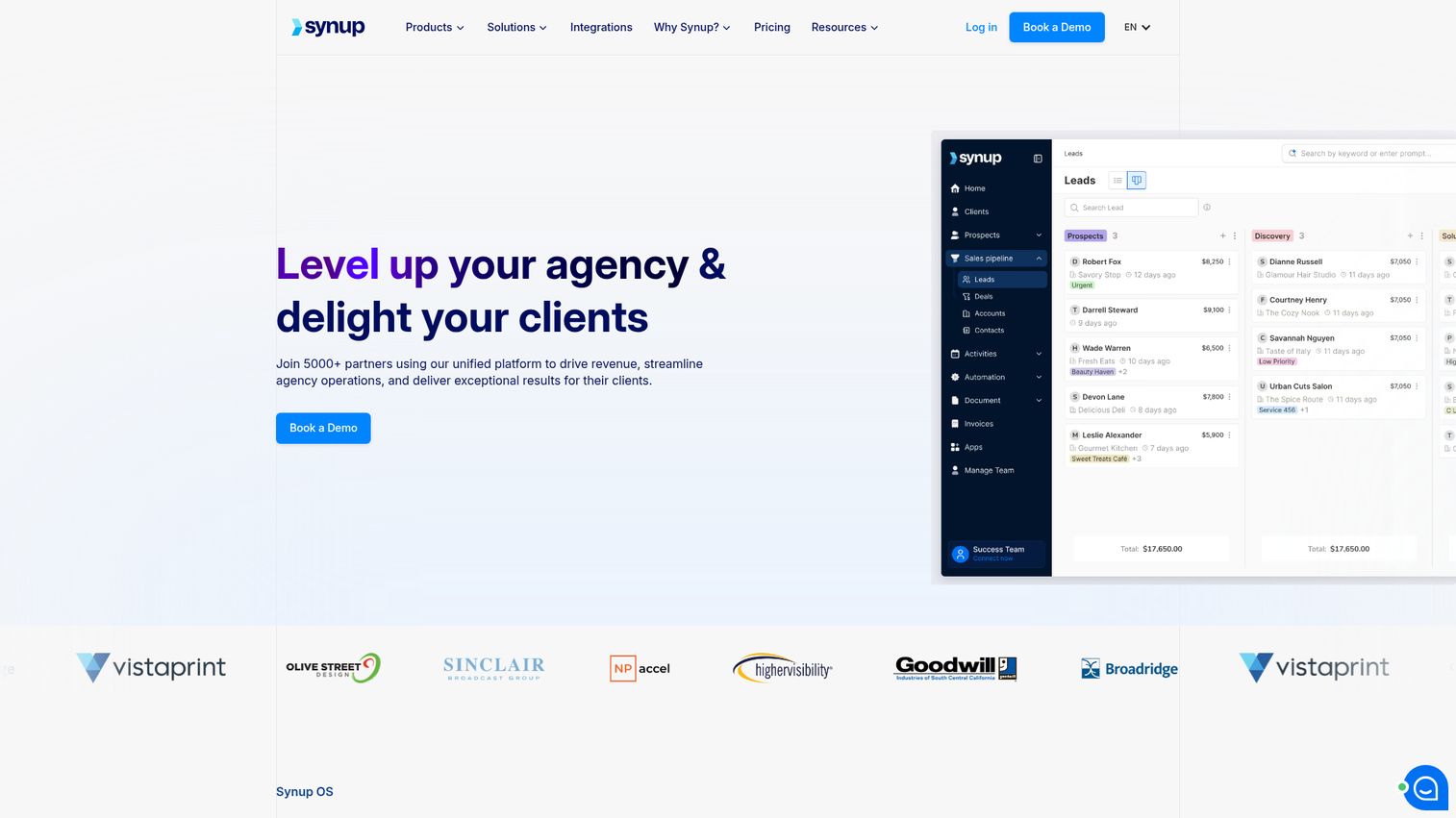
Synup is an affordable listing management platform built for SMBs and growing multi-location businesses.
Synup distributes to 60+ directories, includes social media management, and offers review monitoring at a lower price point than enterprise competitors. For small marketing teams that need to manage listings and social without dedicated headcount for each, the AI features are practical time-savers: AI-powered social post generation and review response suggestions handle the repetitive work.
The white-label options also make Synup a viable choice for smaller agencies that want to offer listing management to clients without enterprise-level platform costs.
Best for: SMBs and growing multi-location businesses that want listing management with social and review tools at an accessible price point.
Key strengths
- Listing distribution to 60+ directories
- Social media management and AI-powered post generation
- Review monitoring and AI response suggestions
- Affordable per-location pricing
- White-label options for agencies
Pricing: From $34.99/month per location.
When to choose something else: Synup's directory coverage (60+) is smaller than Yext (200+) or Semrush (150+). If comprehensive directory coverage is your priority, a platform with broader reach may be worth the premium. The social media features, while useful, aren't as deep as dedicated social tools.
10. Vendasta
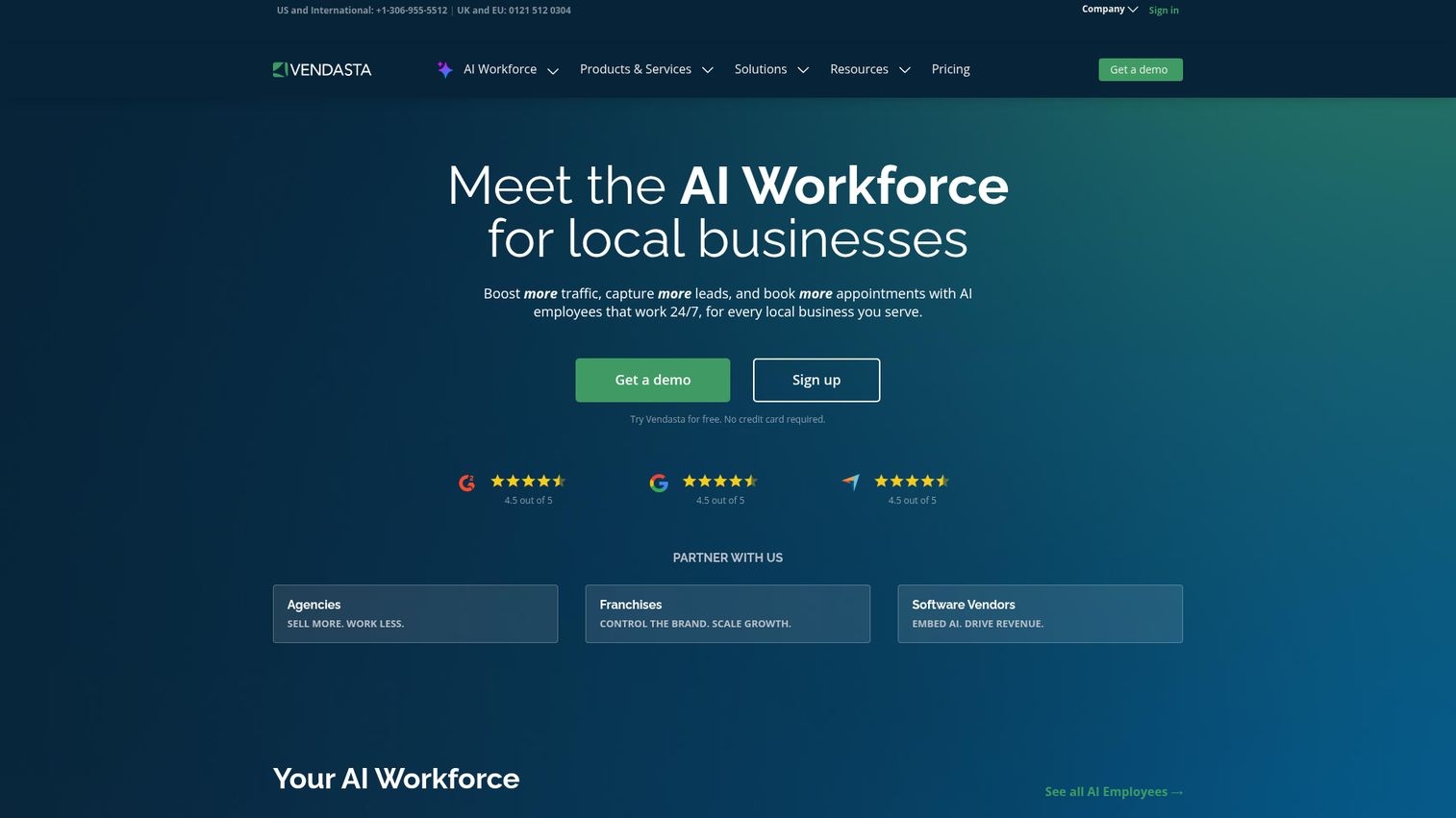
Vendasta is a white-label agency platform that includes listing management as part of a broader suite of resellable marketing tools.
The real value isn't the listing management module itself (which distributes to major directories and aggregators). It's the agency business model: resell listing management to clients with your branding, your pricing, and your dashboard. The marketplace of add-on products, CRM and sales pipeline tools for agency operations, and the client-facing dashboard make this an agency operations platform first, listing management tool second.
For agencies offering local listing services to clients, Vendasta provides the infrastructure to build a recurring revenue business around listing management without building the technology yourself.
Best for: Agencies and resellers that want to offer listing management as a white-label service alongside other marketing products.
Key strengths
- Full white-label platform with custom branding
- Resellable listing management, reputation, and social tools
- Marketplace of add-on products for agencies
- Client-facing dashboard and reporting
- CRM and sales pipeline tools for agency operations
Pricing: From $79/month (Essentials plan). Listing management module priced separately.
When to choose something else: Vendasta is an agency platform first, listing management tool second. If you're a brand managing your own locations (not reselling services), the platform's complexity and pricing structure won't make sense. The listing management capabilities alone don't justify the cost compared to dedicated tools.
11. Advice Local
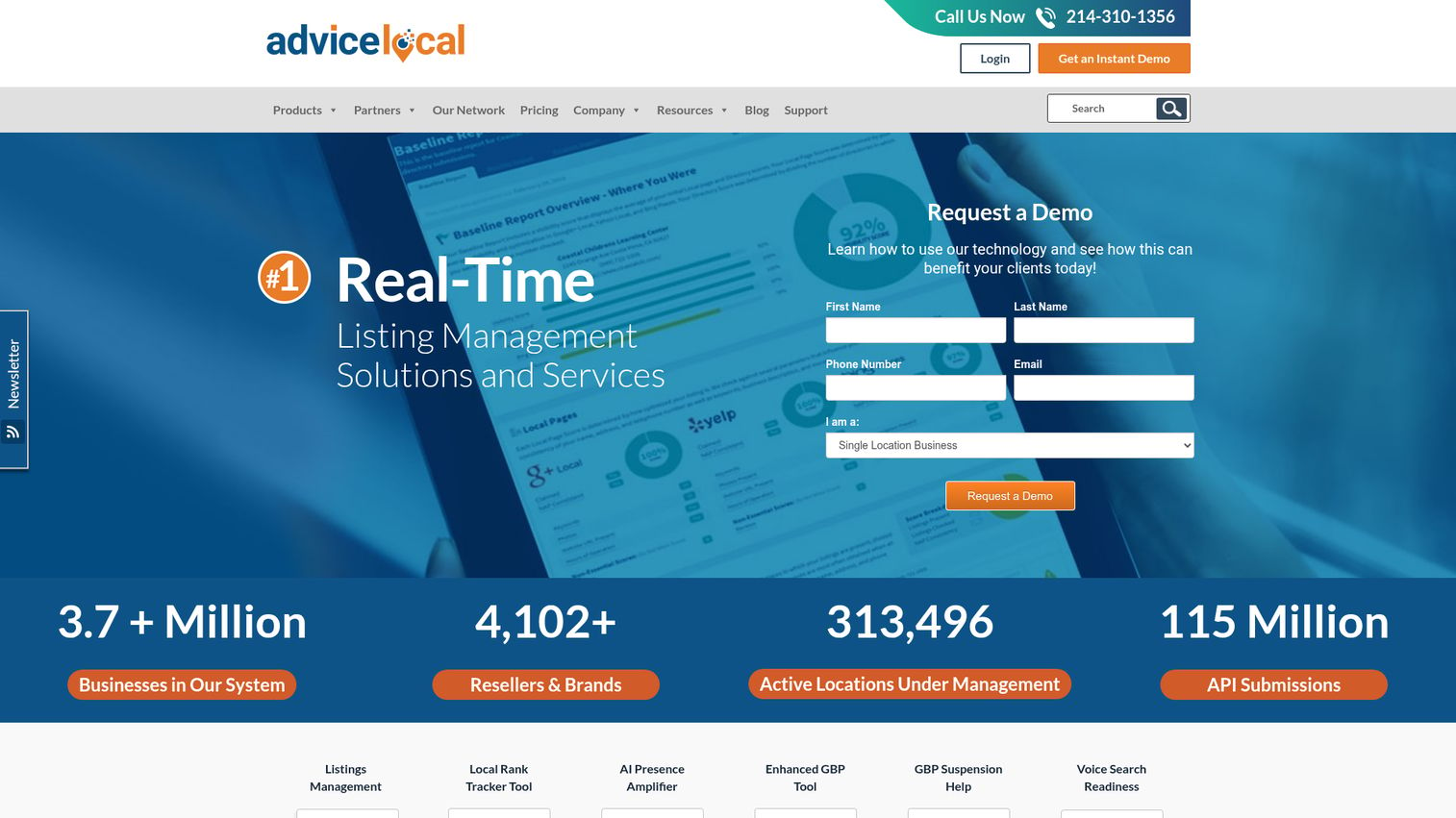
Advice Local is a listing management platform that submits business data to major data aggregators (Data Axle, Foursquare/Factual, Localeze) for broad downstream distribution.
Rather than connecting directly to each directory, Advice Local pushes data to the aggregators that feed hundreds of downstream sites. This is the same aggregator model as Moz Local, but with added features: a voice search readiness tool, Google Business Profile management, and a local presence dashboard. It's a solid mid-tier option for online business listing management without enterprise pricing.
The partner/reseller program also makes it viable for agencies that want directory listing management capabilities to offer clients.
Best for: Mid-size businesses that want aggregator-based listing distribution with voice search and GBP management included.
Key strengths
- Submission to major data aggregators for broad distribution
- Voice search readiness and optimization
- Google Business Profile management and optimization
- Local presence score and health dashboard
- Partner/reseller program for agencies
Pricing: From approximately $60/month per location.
When to choose something else: Aggregator-based distribution is slower than direct API integrations. If you need real-time updates or manage time-sensitive listing changes (holiday hours, temporary closures, crisis responses), a direct-integration platform gives you more control. The voice search features, while forward-looking, are hard to measure in terms of ROI.
12. Google Business Profile (free)
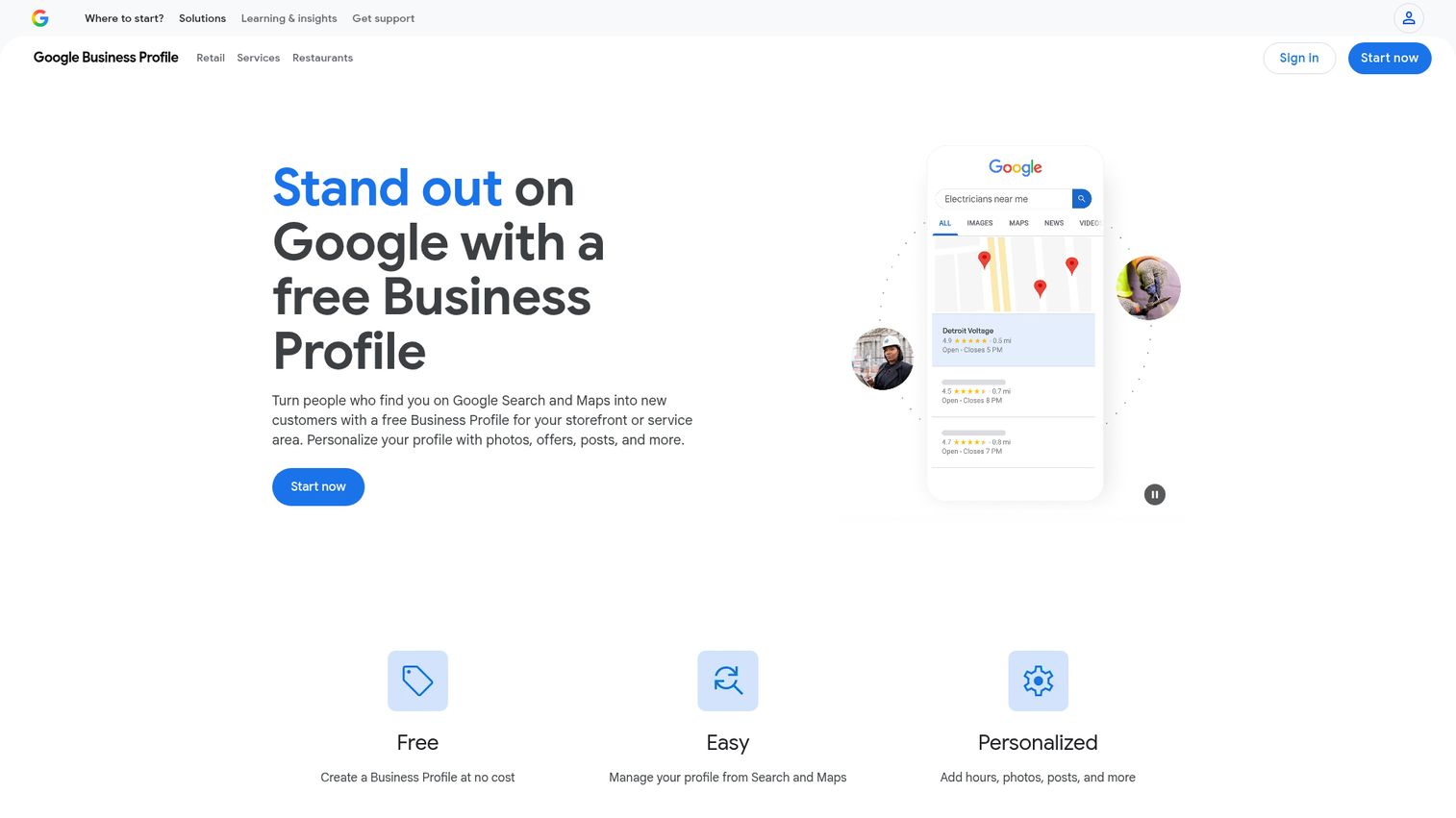
Google Business Profile is the free, essential starting point for every local business.
Be clear: GBP is not a listing management platform in the traditional sense. It only manages your Google presence. But given that Google dominates local search with 92%+ market share, optimizing your GBP is the single highest-impact action for local visibility. Every business should have a claimed and optimized GBP, regardless of whether they also use a paid listing management tool.
GBP lets you manage business info, post updates, respond to reviews, add photos, and track how customers find and interact with your listing. For GBP management and GMB management software needs, this is the direct source. No middleman, no subscription, no delay.
Best for: Every local business as a baseline. Single-location businesses that primarily care about Google visibility and don't need multi-directory management.
Key strengths
- Free to use with no location limits
- Direct control over your Google Search and Maps listing
- Review management and response
- Posts, photos, and product/service listings
- Performance insights (searches, views, calls, direction requests)
Pricing: Free.
When to choose something else: GBP only manages your Google listing. If you need to manage Bing, Apple Maps, Yelp, Facebook, and dozens of niche directories, you need a dedicated listing management platform in addition to GBP. GBP also lacks duplicate detection across other directories, bulk editing for multi-location businesses, and cross-directory analytics.
Key features to compare in local listing management software
Directory coverage and integration type
This is the most important differentiator. Direct API integrations (Yext, Uberall) push your data straight to each directory via API. Updates propagate in minutes to hours. More expensive. Data aggregator distribution (Moz Local, Advice Local) pushes to intermediary databases like Data Axle and Foursquare that feed downstream directories. Broader coverage, slower propagation, cheaper. The difference: hours vs. weeks for your updates to go live. This is the search engine listings manager distinction that matters most.
Duplicate detection and suppression
Duplicates confuse search engines, split review equity, and send customers to wrong listings. Tools scan directories for matching NAP data, flag potential duplicates, and either suppress them automatically (Yext) or provide manual suppression workflows. Automated suppression saves time at scale.
Review management
Some tools include review monitoring, response capabilities, and review generation campaigns. Others require a separate platform. Birdeye and SOCi lead here. Moz Local and Advice Local offer basic monitoring only.
Analytics and ROI measurement
Look for: listing views, clicks, calls, direction requests, local pack rankings, and attribution to foot traffic or conversions. Uberall and Yext offer the deepest analytics. Simpler tools provide basic impression and click data. If you're evaluating analytics capabilities across your broader marketing stack, our guide to the best marketing analytics software covers the category in depth.
Bulk editing and multi-location support
How the tool handles updates across 10, 100, or 1,000+ locations simultaneously matters at scale. Bulk editing capabilities, location grouping, and role-based permissions are the features that separate enterprise tools from SMB tools.
AI and automation capabilities
AI features becoming standard in 2026: automated review responses, AI-optimized business descriptions, structured data for AI search engines, and predictive analytics. Yext, Birdeye, and Synup are leading here. Others are catching up.
How to choose the right local listing management software
Define your scale: single location vs. multi-location vs. agency
Single-location businesses don't need Yext. Agencies need white-label capabilities. Multi-location brands need bulk editing and permissions. Match tool complexity and pricing to actual needs.
Evaluate integration type: direct API vs. data aggregator
Direct integrations are faster and more reliable but cost more. Aggregator-based tools are cheaper but updates take longer. If you manage time-sensitive changes (holiday hours, temporary closures, crisis responses), direct API matters more.
Check directory coverage for your industry
General directories (Google, Yelp, Facebook) matter for everyone. But healthcare businesses need Healthgrades, restaurants need TripAdvisor, legal firms need Avvo, home services need Houzz. Verify your industry-specific directories are covered before committing.
Assess your existing stack
If you already use Semrush for SEO, their listing add-on avoids tool sprawl. If you need social + listings + reviews, SOCi or Uberall consolidate. Don't add a tool; replace fragmentation. For teams evaluating their broader SEO toolkit, our roundup of the best SEO tools can help you assess what's already covered.
Calculate true cost per location
Some tools price per location, others per feature bundle. Calculate the actual per-location cost including all features you need, not just the base price. Factor in add-ons (BrightLocal's Citation Builder), implementation costs (Yext, Uberall), and contract length (annual vs. monthly).
Quick Decision Framework: - Under 5 locations, limited budget → Moz Local or Google Business Profile - 5 to 50 locations, need listings + SEO → BrightLocal or Semrush - 50+ locations, enterprise needs → Yext or Uberall - Agency managing clients → BrightLocal, Vendasta, or Whitespark - Reviews are primary concern → Birdeye - Franchise with social needs → SOCi
Conclusion
The right local listing management software depends on your scale, budget, and primary pain point. Enterprise multi-location brands tend to get the most from Yext and Uberall for direct integrations. Agencies find their workflow in BrightLocal and Vendasta for client management and white-label options. SMBs get solid coverage at accessible price points with Moz Local and Synup. Every business should start with a fully optimized Google Business Profile.
The common thread: consistent, accurate business data across every directory your customers use. Pick a tool, centralize your listings, and stop losing customers to outdated information.
If you're evaluating listing management tools for your team or clients and want to create interactive demos to streamline the decision process, Guideflow lets you build shareable walkthroughs in minutes. Capture any tool's interface, add your notes, and share a clickable walkthrough with stakeholders instead of scheduling another meeting.
Start creating interactive demos with Guideflow today.
FAQs
Local listing management software is a platform that lets businesses create, update, and monitor their business information across online directories, search engines, and maps from a single dashboard. The three core functions are pushing accurate NAP data to directories, detecting and suppressing duplicate listings, and monitoring listing performance. It's also called citation management software, business listing management software, or online listing management depending on the vendor.
Pricing ranges from free (Google Business Profile) to $500+/month for enterprise platforms like Yext and Uberall. Most SMB tools cost $14 to $60/month per location. "Custom pricing" typically means $300+/month and usually requires annual contracts. Per-citation services (Whitespark, BrightLocal) add $2 to $5 per citation on top of subscription costs.
Direct API integrations (used by Yext, Uberall) push your data straight to each directory, so updates appear in minutes to hours. Data aggregators (used by Moz Local, Advice Local) push to intermediary databases like Data Axle and Foursquare/Factual that feed downstream directories, so updates take days to weeks. Direct is faster and more reliable but costs more. Aggregator-based is cheaper but slower.
Yes, most tools integrate with GBP. But you should also maintain direct access to your GBP dashboard. Third-party tools add value through bulk management, analytics, and cross-directory consistency, but GBP remains the primary source of truth for your Google listing. If a third-party tool loses API access or has an outage, you need direct GBP access as a fallback.
Tools scan directories for listings matching your business name, address, or phone number (NAP data). They flag potential duplicates and either suppress them automatically (Yext's approach) or provide manual suppression workflows where you review and confirm. Duplicates matter because they split review equity, confuse search engines about which listing is authoritative, and can send customers to wrong locations.
Maybe not. Google Business Profile (free) handles the most important directory. If your business info is consistent across the few directories that matter (Google, Yelp, Facebook, Bing) and you're not dealing with duplicate issues, manual management may be sufficient. Local listing management software becomes clearly valuable at 3+ locations, when you're dealing with data accuracy problems across many directories, or after a move or rebrand where you need to update everything simultaneously.
It depends entirely on the tool's integration type. Direct API integrations (Yext, Uberall): minutes to hours. Data aggregator-based tools (Moz Local, Advice Local): days to weeks, sometimes months for smaller niche directories. Even with direct integrations, some directories have their own review and approval processes that add delay. The fastest path is always direct GBP management for Google-specific changes.
At minimum: Google Business Profile, Bing Places, Apple Maps, Yelp, Facebook, and the major data aggregators (Data Axle, Foursquare/Factual). Beyond that, industry-specific directories matter: Healthgrades for healthcare, TripAdvisor for hospitality, Avvo for legal, Houzz for home services, Cars.com for automotive. The total directory count matters less than whether the directories your customers actually use are included. Verify industry-specific coverage before committing to a tool.