

You own six deals. Your forecast call is Friday. Your champion on the biggest opportunity just went quiet, and the CISO on another deal wants a second security review. Meanwhile, your manager is asking for a confident commit number based on pipeline data you updated three days ago.
That's the account executive role in one sentence: you own the number, but not everything that affects it.
The account executive position is one of the most misunderstood roles in B2B sales. Job descriptions list responsibilities in clean bullet points. The daily reality is a mix of project management, stakeholder navigation, business case construction, and constant reprioritization across 8 to 15 active opportunities.
The average B2B buying committee now includes 6 to 10 stakeholders according to Gartner research, and 53% of SaaS companies report longer sales cycles year over year. The AE is the person responsible for navigating all of them to a yes.
This guide covers what the role actually looks like in modern SaaS, not just the textbook version.
What you'll learn
- What an account executive does and how the role differs from SDRs, account managers, and sales engineers
- How AE responsibilities change across SMB, mid-market, and enterprise segments
- What a realistic day looks like for a mid-market SaaS AE
- The specific skills, tools, and KPIs that separate good AEs from great ones
- How to become an account executive and what the compensation landscape looks like
- The biggest challenges AEs face and concrete ways to address them
TL;DR
- An account executive is the sales professional who owns the deal from qualified opportunity to closed-won revenue, serving as the primary relationship between company and prospect.
- The role differs significantly by segment: SMB AEs run 30 to 60+ deals per month with 1 to 2 decision-makers, while enterprise AEs manage 6 to 18 month cycles with 8 to 15+ stakeholders.
- The most important AE skills are champion coaching, multi-threading, business case co-creation, and deal process management.
- OTE ranges from $80K to $120K for SMB roles to $180K to $300K+ for enterprise AEs in the US.
- Modern AEs use tools like Guideflow to send self-serve product experiences to stakeholders, compressing evaluation timelines and tracking engagement to inform deal strategy.
What is an account executive?
An account executive (AE) is a sales professional who owns the full deal cycle, from qualified opportunity to closed-won revenue, serving as the primary relationship between a company and its prospects or customers.
Account executive definition: A sales role responsible for managing the complete deal cycle, including discovery, evaluation orchestration, stakeholder navigation, business case construction, negotiation, and close.
The account executive meaning in SaaS is specific. AEs sit in the mid-to-bottom of the sales funnel. They don't generate initial leads (that's the SDR/BDR). They don't manage post-sale relationships long-term (that's customer success or account management). They own the conversion.
The abbreviation "AE" is standard across SaaS and B2B sales. If you hear someone say "what is an AE," they're asking about this role.
The account executive position exists across industries: advertising, financial services, insurance, and technology. But the role has evolved most significantly in SaaS and B2B tech, where buying committees have grown larger, sales cycles have lengthened, and the evaluation process now includes security reviews, compliance gates, and multi-stakeholder alignment that didn't exist a decade ago.
This guide focuses on the SaaS and B2B tech version of the role, where the account executive job description looks nothing like the generic version you'll find on most career sites.
Why the account executive role matters
Account executives are the revenue conversion engine of B2B companies, directly responsible for turning pipeline into closed business.
Here's why that matters: without effective AEs, every dollar spent on marketing and every meeting booked by SDRs produces nothing. The pipeline just sits there.
| Function | What they produce | What happens without AEs |
|---|---|---|
| Marketing | Leads and awareness | No conversion to revenue |
| SDR/BDR | Qualified meetings | Meetings that go nowhere |
| AE | Closed-won revenue | Pipeline dies |
| CS/AM | Retention and expansion | No initial deal to retain |
The role has become harder and more important simultaneously. B2B buying committees now average 6 to 10 stakeholders, each with different priorities and evaluation criteria. Sales cycles in SaaS have lengthened measurably, with over half of SaaS companies reporting longer cycles compared to prior years.
AEs manage all of this complexity. They're the ones coordinating 8 to 12 people across two organizations toward a shared decision, while keeping their CRM updated, their forecast accurate, and their pipeline healthy enough to survive the deals that don't close.
The metrics leadership watches most closely (quota attainment, win rate, deal velocity, forecast accuracy) all flow through the AE. When those numbers are strong, the business grows predictably. When they're not, everything downstream suffers.
Account executive vs. related roles
The account executive role is frequently confused with adjacent sales positions, but the ownership boundaries are distinct.
Account executive vs. SDR/BDR
SDRs generate qualified meetings. AEs own everything that happens after.
The difference between a sales development representative and an account executive comes down to funnel ownership. SDRs work top-of-funnel: prospecting, outreach, and qualification. AEs work mid-to-bottom: discovery, evaluation, negotiation, and close.
| Dimension | SDR/BDR | Account executive |
|---|---|---|
| Focus area | Prospecting and outreach | Deal execution and close |
| Funnel stage | Top of funnel | Mid to bottom of funnel |
| Primary KPI | Meetings booked, pipeline generated | Revenue closed, win rate |
| Typical interaction | 5 to 15 minute qualification call | Multi-week relationship across stakeholders |
| Deal ownership | None (hands off to AE) | Full ownership through close |
In SaaS, SDR-to-AE is the most common career progression path. Most AEs spent 12 to 24 months as an SDR before moving into a closing role. Teams looking to optimize their SDR function often invest in AI SDR tools to improve prospecting quality before handing off to AEs.
Account executive vs. account manager
AEs close new business. Account managers grow and retain existing customers.
| Dimension | Account executive | Account manager |
|---|---|---|
| Revenue type | New business | Expansion and renewal |
| Relationship stage | Pre-sale | Post-sale |
| Primary metric | New ARR closed | Net revenue retention (NRR) |
| Typical engagement | Weeks to months before contract | Ongoing for the customer lifecycle |
In some organizations, AEs also handle expansion revenue for accounts they closed. In others, there's a clean handoff to an AM or CSM after the initial contract. The line between account executive roles and account management depends on company size and structure.
Account executive vs. sales engineer
AEs own the deal strategy and commercial outcome. SEs own the technical validation.
Sales engineers run product deep-dives, manage POC environments, and answer the technical questions that AEs can't. But the AE coordinates the SE, owns the timeline, manages stakeholder relationships, and drives the deal to close. Think of it as the AE running the project and the SE running the technical workstream within it. For teams looking to streamline the presales process, clearly defining the AE-SE collaboration model is critical.
What does an account executive do? Core responsibilities
An account executive's core responsibilities span the full deal cycle: qualifying opportunities, running discovery, orchestrating product evaluations, navigating buying committees, building business cases, and closing contracts.
Here's what each of those account executive duties actually looks like in practice.
1. Opportunity management and deal planning
The AE owns the deal plan: timeline, next steps, stakeholder map, and resource coordination.
In practice, this means maintaining a pipeline with 3 to 4x quota coverage, running weekly deal reviews with your manager, and updating CRM stages based on actual buyer actions (not hope). A deal in "evaluation" because the prospect said "this looks interesting" is not the same as a deal in evaluation because three stakeholders completed a technical review.
Good opportunity management is the difference between a forecast your VP trusts and one they question on every call.
2. Discovery and qualification
AE-level discovery goes deeper than SDR qualification. You're confirming pain, impact, urgency, stakeholders, budget process, and decision timeline.
The critical move is mapping the buying committee early. The AE who identifies all stakeholders in week one has a plan. The AE who discovers the CISO in week eight has a problem.
Most AEs use a qualification framework (MEDDIC sales qualification framework, BANT, SPICED, or a custom internal model) to structure discovery. The framework matters less than the discipline of using one consistently.
3. Solution alignment and value articulation
This is where you translate product capabilities into business outcomes the buyer cares about. Features don't close deals. Business impact closes deals.
Strong AEs build the ROI story with proof points, customer evidence, and competitive positioning. They co-create the business case with their champion using the champion's own numbers and language, not a polished PDF the champion can't edit or defend internally.
4. Demo and evaluation orchestration
AEs coordinate with SEs, product specialists, and leadership for key meetings. They manage the evaluation process: POCs, technical deep-dives, security reviews, and stakeholder alignment.
Modern AEs increasingly use self-serve product experiences like interactive demos to let stakeholders who missed live demos evaluate the product on their own schedule. When 8 people need to "see the product," interactive demos enable parallel evaluation instead of sequential scheduling over weeks. AEs get engagement analytics showing which features each stakeholder explored, informing follow-up strategy and deal prioritization.
5. Driving the buying process
Multi-threading stakeholders. Navigating procurement, security review, and legal. Maintaining momentum with mutual action plans (shared timelines with owners and dates on both sides).
The AE's job at this stage is often more project management than selling: coordinating 8 to 12 people across two organizations toward a shared deadline. Client relationship management across this many stakeholders requires structure, not just charisma. Adopting a buyer enablement mindset - giving buyers the resources they need to sell internally - is what separates modern AEs from traditional ones.
6. Negotiation and close
Handling objections, managing pricing and packaging, and closing while protecting margin.
In SaaS, "close" isn't the end. The best AEs are already thinking about year-two expansion and the CS handoff during negotiation. A deal that closes with unclear expectations creates a churn risk that shows up 12 months later.
The account executive role by segment: SMB vs. mid-market vs. enterprise
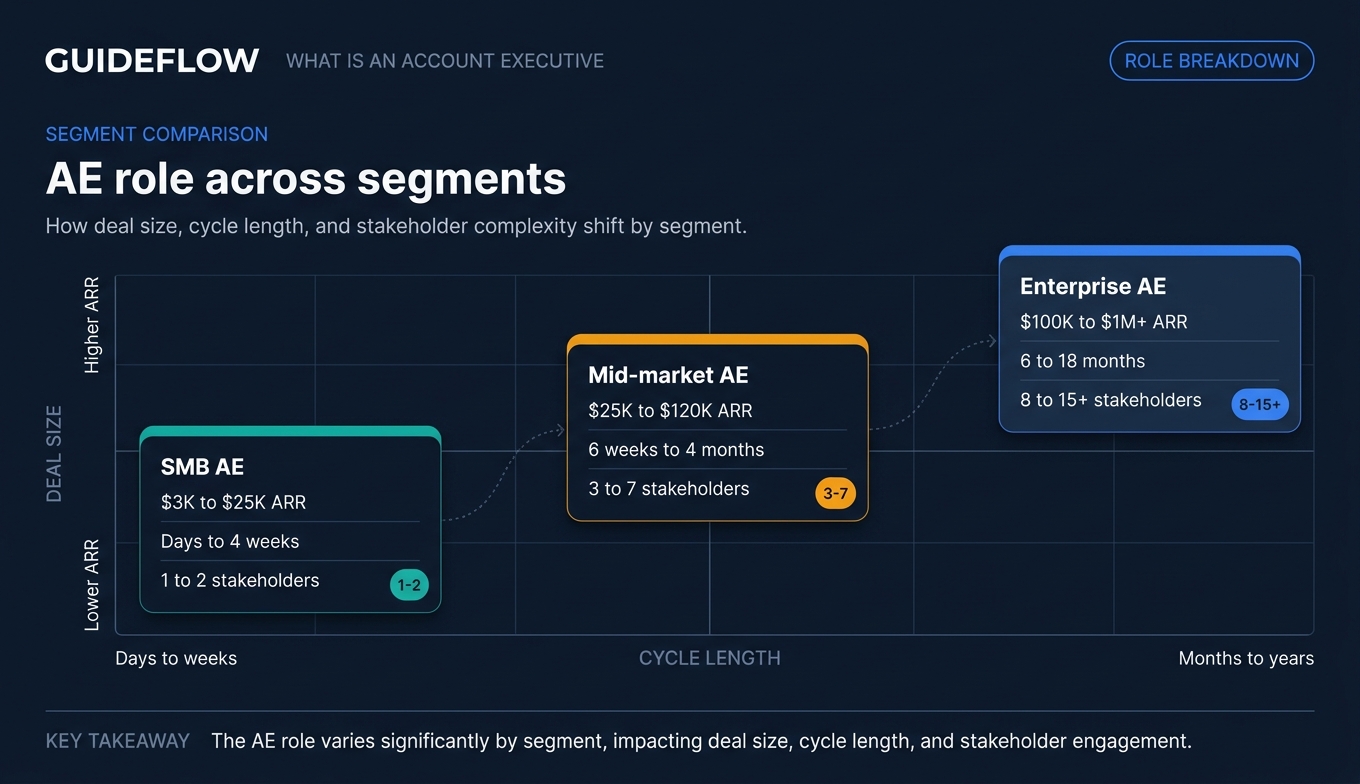
The title "account executive" covers dramatically different realities depending on the segment you sell into. No competitor guide covers this, but it's the single most important variable in understanding what the role actually involves.
SMB account executive
Typical deal size: $3K to $25K ARR. Cycle: days to 4 weeks. Volume: 30 to 60+ deals per month.
Speed is everything. SMB SaaS deals often start from a PLG or free trial motion, meaning the prospect has already touched the product before the AE gets involved. The AE's job is to convert intent into a paid contract before the moment passes.
Buying decisions land with a founder, team lead, or head of ops. Rarely more than two people. There's no procurement, no legal redline, and security review is usually a quick checkbox.
The real competition is inertia and the free plan. Objections sound like "can't we just stay on the free tier?" or "we already have something that does most of this." Tools that help SMB AEs move fast, log less, and follow up without dropping the ball have obvious daily impact.
Mid-market account executive
Typical deal size: $25K to $120K ARR. Cycle: 6 weeks to 4 months. Stakeholders: 3 to 7.
This is the most complex segment to operate in. These AEs sell into companies large enough to have real buying processes but small enough that those processes are inconsistent.
There's a champion (usually a team lead or VP), but they often need internal sign-off from IT, finance, or a CISO who wasn't in the original conversation. Security reviews are becoming standard. SaaS consolidation pressure on tool spend is real: procurement teams are auditing tool spend, so AEs must justify why this replaces something existing rather than adding to the stack.
Champion coaching matters here more than anywhere else. Helping the internal buyer sell upward is often what wins or loses the deal.
Enterprise account executive
Typical deal size: $100K to $1M+ ARR. Cycle: 6 to 18 months. Stakeholders: 8 to 15+.
Enterprise SaaS deals are long, multi-threaded, and heavily governed. SOC 2, ISO 27001, and GDPR compliance standards are standard gates. Legal redlines and MSA negotiations are expected. Procurement runs formal RFPs or vendor comparison processes.
The AE orchestrates a cast: SE, security team, legal, customer success (for the handoff story), and often an executive sponsor internally. Expansion is a first-class outcome: net revenue retention as a key SaaS metric matters, and the best enterprise AEs are already planning year-two upsell while closing year one.
| Dimension | SMB AE | Mid-market AE | Enterprise AE |
|---|---|---|---|
| Typical deal size | $3K to $25K ARR | $25K to $120K ARR | $100K to $1M+ ARR |
| Sales cycle | Days to 4 weeks | 6 weeks to 4 months | 6 to 18 months |
| Stakeholders | 1 to 2 | 3 to 7 | 8 to 15+ |
| Key challenge | Speed and volume | Champion coaching, business case | Multi-threading, governance |
| Primary competition | Inertia, free plan | Existing tools, budget scrutiny | Incumbents, formal RFPs |
A day in the life of an account executive
Here's what a realistic Tuesday looks like for a mid-market SaaS AE carrying a $600K annual quota with 12 active opportunities.
8:30 AM: Pipeline review and CRM updates before the team standup. Two deals need stage changes. One opportunity has been sitting in "evaluation" for 22 days with no buyer activity. You flag it for discussion.
9:15 AM: Discovery call with a new opportunity sourced by your SDR. The prospect describes a manual reporting process that takes their team 12 hours per week. You map the buying committee: the VP of Operations (champion), the CFO (economic buyer), and an IT director who'll need to approve the integration. You ask how they've bought software in this price range before. The answer reveals a 3-week security review you'll need to plan for.
10:30 AM: Follow-up from yesterday's demo. You send a personalized recap to each of the four stakeholders who attended, addressing their specific concerns. The VP gets the ROI summary. The technical lead gets the integration documentation. The end user gets a workflow-specific walkthrough.
11:30 AM: Champion coaching call with your strongest opportunity. Your champion has a meeting with their CFO on Thursday. You walk through the business case together, using their numbers, and rehearse the three questions the CFO is most likely to ask.
1:00 PM: Deal review with your manager. Two deals are stuck in security review. One champion went quiet after an internal reorg. You agree on next steps for each: escalate the security packet on deal one, multi-thread to a second contact on the quiet deal.
2:30 PM: Live demo with an SE for an enterprise prospect. Six stakeholders on the call, each with different priorities. You handle the business context and objections. Your SE handles the technical deep-dive.
3:45 PM: Three stakeholders from the enterprise prospect couldn't attend the live demo. You share a personalized interactive demo so they can evaluate the product on their own schedule. You'll check the engagement analytics tomorrow to see which features they explored.
4:30 PM: Mutual action plan update for the deal closest to close. You confirm the legal review timeline with procurement and send a calendar invite for the contract review meeting.
5:00 PM: Forecast prep. You review pipeline coverage (3.2x, slightly below target), identify the two deals most likely to slip, and prepare your commit and best-case numbers for Friday's call.
If you read that and thought "that's exactly my life," you're an AE.
Account executive skills: what separates good from great
The skills that make a strong account executive combine commercial instinct, process discipline, and the ability to manage complexity across multiple stakeholders simultaneously.
| Hard skills | Soft skills |
|---|---|
| CRM proficiency (Salesforce, HubSpot) | Active listening and empathy |
| Pipeline and forecast management | Resilience under quota pressure |
| Business case and ROI construction | Champion coaching and influence |
| Competitive positioning | Multi-stakeholder communication |
| Contract and negotiation mechanics | Time management across 10+ deals |
| Sales methodology fluency (MEDDIC, SPICED, Challenger) | Curiosity and genuine interest in the buyer's problem |
| Demo orchestration and product storytelling | Internal collaboration (SE, CS, legal) |
Beyond the table, four skills for account executives separate consistent quota attainment from occasional wins:
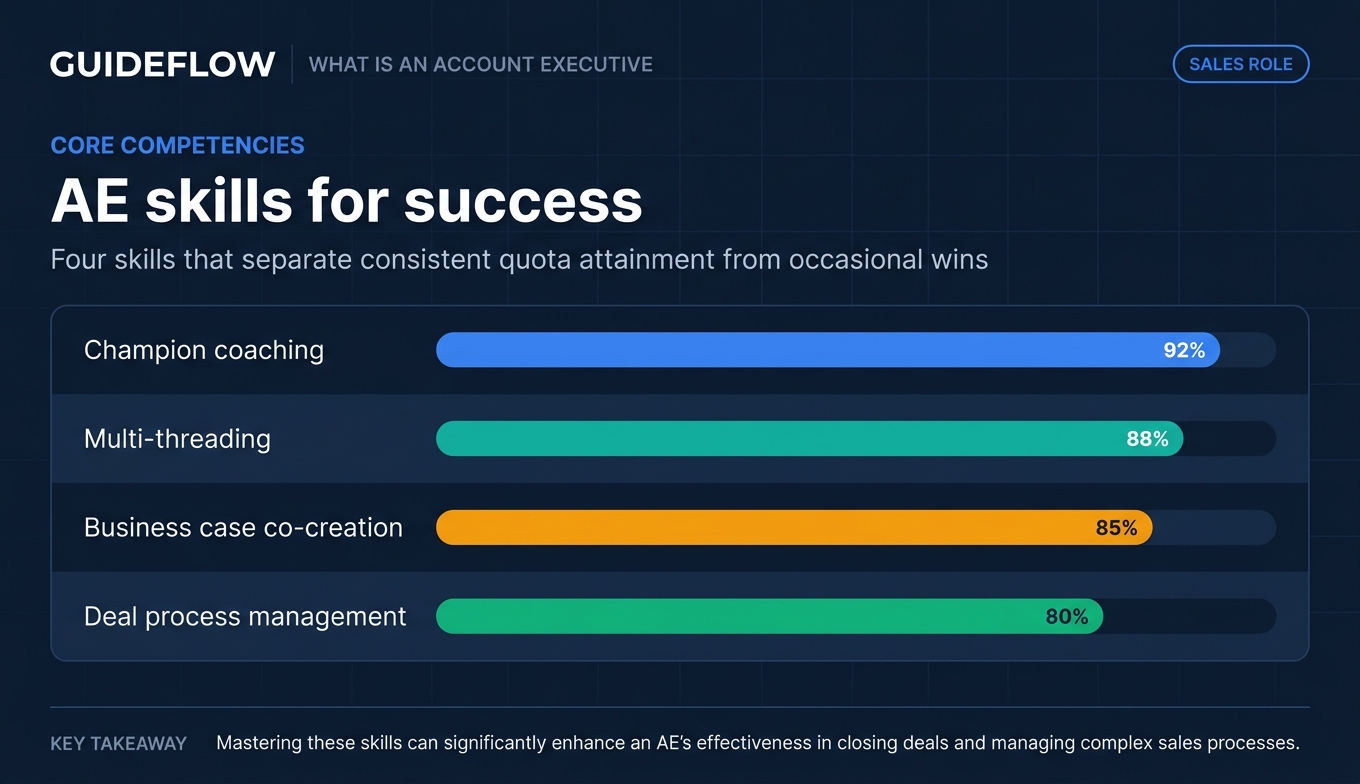
Champion coaching. The ability to help your internal buyer sell when you're not in the room. This is the single highest-value skill for mid-market and enterprise AEs. Your champion needs to articulate the business case in their company's language, handle internal objections, and navigate political dynamics you can't see. Your job is to equip them.
Multi-threading. Building relationships with 6 to 12 stakeholders, each with different priorities, and keeping all of them moving toward the same decision. Single-threaded deals have a dramatically higher loss rate of ending in "no decision."
Business case co-creation. Using the buyer's own numbers and language to build an ROI narrative that survives internal scrutiny. A Google Doc they can edit is worth more than a polished PDF they can't.
Deal process management. Treating complex deals like projects: milestones, owners, dates, dependencies. The AEs who run mutual action plans consistently close faster because blockers surface in week two instead of week eight.
Account executive tools and technology stack
Modern account executives operate across a stack of 6 to 10 tools daily, and the right combination directly impacts quota attainment and deal velocity.
| Category | What it does for AEs | Examples |
|---|---|---|
| CRM | System of record for deals, contacts, forecasts | Salesforce, HubSpot |
| Sales engagement | Email sequences, call cadences, multi-channel outreach | Outreach, Salesloft |
| AI assistants and note-taking | Post-call summaries, CRM auto-updates, follow-up drafts | Gong, Otter.ai |
| Conversation intelligence | Call recording, deal review, coaching signals | Gong, Chorus |
| Demo automation | Interactive demos, sandboxes, and demo centers for self-serve product evaluation | Guideflow |
| Meeting scheduling | Calendar booking, routing, no-show reduction | Calendly, Chili Piper |
| Proposal and contract | CPQ, e-signatures, contract management | PandaDoc, DocuSign |
| Forecasting and analytics | Pipeline health, deal risk scoring, forecast accuracy | Clari, BoostUp |
For a deeper look at the CRM category, see our roundup of the best CRM software tools. AEs evaluating their engagement platform can also explore the best sales engagement tools available today. And if AI-powered note-taking is a gap in your stack, we've compiled the best AI note-taking tools to streamline post-call workflows.
Demo automation deserves specific attention because it directly addresses the AE's biggest scheduling bottleneck. When 8 stakeholders need to evaluate the product, coordinating live demos for each one adds weeks to the cycle.
Interactive demos let buyers explore the product at their own pace through a guided path. Sandboxes give technical evaluators full freedom to test workflows hands-on. Demo centers organize all product experiences in one branded hub that AEs can share with the entire buying committee. AEs get engagement analytics showing who viewed what and which features held attention, informing follow-up strategy and deal prioritization.
The practical impact: five stakeholders can evaluate the product in the same week, on their own schedules, instead of sequentially over five weeks of calendar coordination.
How to become an account executive
Most account executives don't start as account executives. The most common path runs through SDR/BDR roles, though some enter from customer success, consulting, or other client-facing positions. Here's what the career in sales progression typically looks like.
Step 1: Build a foundation in a client-facing role
SDR/BDR is the most common entry point in SaaS. Customer success, support, or consulting also work. A bachelor's degree is typical but not always required. What matters more is demonstrated ability to communicate clearly, learn quickly, and handle rejection without losing momentum.
Step 2: Master the fundamentals of selling
Learn a sales methodology (MEDDIC, Challenger sales methodology, SPICED). Understand pipeline management, qualification frameworks, and CRM hygiene. Build skills in discovery, objection handling, and business case construction. These fundamentals apply regardless of segment or company. Many organizations accelerate this step with dedicated sales training software.
Step 3: Move from SDR to AE
Typical timeline: 12 to 24 months as an SDR before promotion to AE.
What gets you promoted: consistent quota attainment, quality of meetings booked (not just volume), and demonstrated ability to run a full conversation rather than just book and hand off. Some companies have formal promotion paths with clear criteria. Others require you to interview for the role.
Step 4: Specialize by segment
Most AEs start in SMB, then move to mid-market, then enterprise as they develop deal complexity skills. Each segment requires different strengths:
| Segment | What gets rewarded |
|---|---|
| SMB | Speed, volume, efficiency, fast follow-up |
| Mid-market | Champion coaching, business case construction, multi-threading |
| Enterprise | Patience, political navigation, executive presence, long-term planning |
Step 5: Decide your long-term path
IC track: Senior AE, Principal AE, Strategic AE. Higher deal values, named accounts, more complex sales.
Management track: Sales Manager, Director of Sales, VP of Sales. Shift from carrying a personal number to building a team that carries the number. Leaders on this track often evaluate sales management software to maintain visibility across their team's pipeline.
Adjacent moves: Sales Engineering, Customer Success, Revenue Operations, Product Marketing. Each of these paths uses skills developed as an AE but applies them differently.
If you're wondering how to prepare for an account executive interview, focus on demonstrating three things: your ability to run a structured deal process, your track record of consistent performance, and your understanding of the specific segment and market the company operates in.
Account executive salary and compensation
Account executive compensation in SaaS typically follows an on-target earnings (OTE) model that combines a base salary with variable commission tied to quota attainment.
| Segment | Base salary range | OTE range | Base/variable split |
|---|---|---|---|
| SMB AE | $50K to $70K | $80K to $120K | 60/40 to 50/50 |
| Mid-market AE | $70K to $100K | $120K to $180K | 50/50 |
| Enterprise AE | $100K to $150K | $180K to $300K+ | 50/50 to 55/45 |
These are US-based SaaS benchmarks. Ranges vary by geography, company stage, and product complexity.
OTE is not guaranteed. It's what you earn at 100% quota attainment. Top performers (120%+ attainment) can earn significantly more through accelerators, where commission rates increase above quota. Underperformance means earning closer to base only.
Enterprise AEs at late-stage public companies can earn $300K to $500K+ OTE, and equity or RSUs add further upside. Early-stage companies may offer lower base with higher equity potential.
These ranges are based on publicly available data from Glassdoor and RepVue, Levels.fyi, and industry compensation surveys. Check current benchmarks for your specific market and segment.
Account executive KPIs and success metrics
Account executives are measured on a specific set of KPIs that reflect both activity and outcomes, with quota attainment as the north star.
- Quota attainment: Percentage of revenue target achieved. The primary measure of AE performance and the number that follows you into every review.
- Win rate: Deals closed-won divided by total opportunities. Indicates deal quality and execution skill. Typical SaaS win rate benchmark of 15 to 25% overall, higher for well-qualified pipeline.
- Sales cycle length: Average days from opportunity creation to closed-won. Shorter cycles mean more capacity and less deal risk.
- Pipeline coverage: Ratio of pipeline value to quota (typically pipeline coverage ratio of 3 to 4x quota). Indicates whether you have enough at-bats to hit the number even if some deals slip.
- Average deal size: Revenue per closed deal. Growing deal size signals stronger value articulation and better qualification.
- Forecast accuracy: How closely your commit matches actual closed revenue. This is the metric that builds or erodes trust with leadership.
- Activity-to-outcome ratios: Meetings to opportunities to wins. Reveals efficiency and where the funnel breaks.
Different segments weight these differently. SMB AEs are measured more on volume and velocity. Enterprise AEs are measured more on deal size and win rate.
Challenges account executives face (and how to address them)
The account executive role carries a specific kind of pressure: you own the number, but not everything that affects it. Pipeline quality depends on SDRs. Demo quality depends on SEs. Legal delays, champion turnover, and budget freezes are all outside your control, but all show up in your attainment.
Deal stalls and "no decision" outcomes
Challenge: Deals lose momentum between stages. Champions go quiet. "Internal alignment" delays stretch weeks into months. Most "no decisions" aren't decisions at all. They're deals that lost energy.
Fix: Use mutual action plans with specific owners and dates on both sides. Surface blockers in week two, not week eight. Multi-thread early so the deal doesn't depend on one person's availability or motivation.
Multi-stakeholder complexity
Challenge: 6 to 12 people in the buying process, each with different priorities. The CISO cares about security. The CFO cares about ROI. The end user cares about daily workflow. Sending the same generic follow-up to all three wastes everyone's time.
Fix: Map the buying committee in the first two calls. Tailor follow-up to each stakeholder's specific concern. Use self-serve product experiences like interactive demos and sandboxes so stakeholders can evaluate on their own schedule without requiring a separate live demo for each person. AEs get engagement analytics showing which features each stakeholder explored, enabling targeted follow-up based on actual buyer behavior.
Pipeline quality issues
Challenge: Too many weak opportunities inflating coverage numbers. Deals that sit in stage 2 for 90 days before dying.
Fix: Disqualify faster. If you can't answer four questions after discovery (What's the pain? Who owns the budget? What's the timeline? Who else needs to say yes?), the deal isn't qualified. Removing 20% of your pipeline that was never going to close can drop your average cycle by weeks overnight.
Admin overhead eating selling time
Challenge: CRM updates, meeting notes, follow-up emails, internal coordination. All necessary, none revenue-generating.
Fix: Use AI-powered note-taking and CRM automation tools. Batch admin work into specific time blocks. Set a rule: if a task doesn't move a deal forward, question whether it needs to happen today. The latest AI sales assistant software can automate much of this overhead.
Forecast pressure
Challenge: Leadership wants confidence. Data is messy. Forecast calls feel like being cross-examined with incomplete evidence.
Fix: Track deals by stage duration, not just stage name. A deal in "negotiation" for 45 days is not the same as one that entered negotiation yesterday. Use engagement signals (who's viewing your materials, who's gone quiet) to inform confidence levels rather than relying on champion sentiment alone.
How to succeed as an account executive
The AEs who consistently hit quota share a set of habits that compound over time. Here are six principles for how to succeed as an account executive.
1. Run discovery that surfaces the buying process, not just the pain. Understanding the prospect's problem is necessary. Understanding how they buy is what shortens the cycle. Ask: "Walk me through how your company has bought software like this before."
2. Multi-thread before you need to. Don't wait until your champion goes quiet. Build relationships with 3+ stakeholders by the third meeting. Frame it as helping your champion: "I want to make sure [VP of Engineering] has the technical depth they need without relying on secondhand information."
3. Build the business case with your champion, not for them. Use their numbers, their language, their format. A Google Doc they can edit is worth more than a polished PDF they can't defend in a budget meeting.
4. Set the next step before ending every conversation. "Let's find a time" is not a next step. "I'll send a calendar invite for Thursday at 2pm to review the security documentation with your CISO" is a next step. Deals without a defined next action are at risk, full stop.
5. Measure your cycle by stage, not just end to end. Total cycle length hides where deals actually slow down. Break it into stages (discovery, evaluation, security review, procurement) and find the bottleneck. If your median time in "security review" is 28 days but "evaluation" is only 14, your biggest improvement opportunity isn't better demos. It's a faster security packet.
6. Use self-serve product experiences to compress evaluation timelines. When 8 stakeholders need to "see the product," interactive demos let them evaluate in parallel instead of sequentially over weeks. You get engagement analytics showing who explored what, informing your follow-up strategy and helping you prioritize the stakeholders who are most engaged.
Conclusion
The account executive role is the revenue conversion engine of B2B companies, and the gap between the job description and the daily reality is where the real skill lives.
The role is harder than it's ever been. More stakeholders, longer cycles, more governance gates, and more competition for buyer attention. But the AEs who build repeatable processes, multi-thread early, co-create business cases with their champions, and use modern tools to compress evaluation timelines are the ones who consistently hit quota.
Whether you're exploring the AE path, benchmarking your skills against market standards, or looking for ways to run cleaner deals, the fundamentals haven't changed: own the process, know your buyer, and remove friction wherever you find it.
Start your journey with Guideflow today
FAQs about account executives
An account executive focuses on closing new business, while an account manager focuses on retaining and growing existing customer relationships. In SaaS, the AE hands off to an AM or CSM after the deal closes. Some organizations blur this line, especially at smaller companies where AEs also handle renewals and expansion.
Account executive OTE (on-target earnings) in SaaS ranges from $80K to $120K for SMB roles to $180K to $300K+ for enterprise roles in the US. Compensation is typically split 50/50 between base salary and variable commission tied to quota attainment. Top performers with accelerators can earn significantly more, and enterprise AEs at late-stage companies can exceed $500K with equity.
The most important skills for account executives are discovery and qualification, business case construction, multi-stakeholder communication, and deal process management. Technical skills include CRM proficiency, pipeline management, and sales methodology fluency. Soft skills include active listening, resilience under quota pressure, and the ability to coach internal champions.
Most account executives in SaaS spend 12 to 24 months in an SDR or BDR role before moving into an AE position. The timeline depends on consistent quota attainment, quality of meetings booked, and demonstrated ability to run full sales conversations beyond just booking and handing off.
A typical day for an account executive includes discovery calls, demo coordination, stakeholder follow-up, CRM updates, deal reviews with management, business case preparation, and forecast analysis. The balance shifts depending on segment: SMB AEs run more calls per day, while enterprise AEs spend more time on strategic planning and multi-stakeholder coordination.
Yes, the account executive role carries significant pressure because AEs own the revenue number but don't control everything that affects it. Pipeline quality, demo quality, legal delays, and champion turnover are all outside the AE's direct control but show up in their attainment. The best AEs manage this by building repeatable processes, maintaining strong pipeline coverage (3 to 4x quota), and multi-threading deals so no single point of failure can kill an opportunity.
SDRs (Sales Development Representatives) focus on top-of-funnel prospecting and booking qualified meetings. Account executives own the deal from qualified opportunity through close. SDRs are measured on meetings booked and pipeline generated. AEs are measured on revenue closed and win rate. The SDR role is the most common entry point to an AE career in SaaS.
Account executives use interactive demos to let stakeholders experience the product on their own schedule without requiring a live call for every person in the buying committee. This compresses evaluation timelines by enabling parallel evaluation across multiple stakeholders simultaneously. AEs get engagement analytics showing which features each stakeholder explored, enabling personalized follow-up based on actual buyer behavior rather than assumptions.