You shipped the positioning doc two weeks ago. Sales is still using last quarter's deck. The landing page says something different from both. And the PM just moved the launch date up by a week.
Sound familiar? This is what happens when a go-to-market strategy either doesn't exist or exists only as a slide deck nobody references after the kickoff meeting. The chaos isn't a people problem. It's a systems problem. And the person who feels it most acutely is the Product Marketing Manager, the one accountable for the launch outcome but without direct control over the people executing it.
A go-to-market strategy is the system that keeps everyone telling the same story, to the right people, through the right channels, at the right time. According to research from DevriX, 15.4% of companies still lack a defined GTM strategy, which helps explain why so many launches feel like a scramble instead of a coordinated motion.
This guide is written specifically for PMMs in SaaS. Not for a generic "business audience." Not for MBA students. For the person who owns the GTM motion but doesn't control the resources executing it. Every section reflects that structural tension. If you're looking for the best product marketing software tools to support your GTM execution, we've covered that separately.
What you'll learn
- Why a GTM strategy is not a marketing plan, and what breaks when teams confuse them
- The seven components that make a go-to-market strategy hold together (or fall apart)
- A step-by-step process for building a GTM strategy you can actually execute, not just present
- What's different about GTM strategy in SaaS, including PLG vs. sales-led motions and feature launch tiers
- How to measure GTM success with a stage-based framework that acknowledges messy attribution
- The six most common GTM mistakes PMMs make, and what to do instead
- Frameworks worth knowing that help you prioritize, position, and defend your GTM decisions
TL;DR
- A go-to-market strategy is cross-functional. It covers ICP, positioning, channels, sales motion, enablement, and launch execution. It is not a marketing plan.
- The PMM owns the GTM motion but not the people. The strategy is your alignment tool. Without it, every launch is a negotiation with no shared reference point.
- SaaS GTM has specific patterns. PLG vs. sales-led motions, feature launch tiers, and expansion GTM all require different approaches. Generic templates don't work.
- Measurement matters, but attribution is imperfect. Define success criteria before launch and track by stage: pre-launch readiness, launch metrics, and post-launch outcomes.
- The best GTM strategies are living systems. Build, measure, iterate. A static deck is not a strategy.
What is a go-to-market strategy?
A go-to-market strategy is the plan that defines who you're selling to, what you're telling them, how you're reaching them, and how you'll measure whether it's working. That's the plain-English version. What is GTM in practice? It's the connective tissue between product development and revenue.
Go-to-market strategy (GTM strategy): A cross-functional plan that aligns Product, Sales, Marketing, Customer Success, and enablement around a specific launch, market entry, or repositioning effort. It covers ICP definition, positioning and messaging, channel selection, pricing and packaging, sales motion design, enablement, and launch execution.
A GTM strategy is not one thing. It's a system of interconnected decisions. Change the ICP, and the messaging changes. Change the pricing, and the sales motion changes. Change the channel, and the enablement needs change. Every component pulls on every other component.
Here's what a go-to-market strategy is NOT:
- Not a marketing plan. A marketing plan is narrower. It covers demand gen, brand, content, and campaigns. A GTM strategy includes marketing as one component among several.
- Not a business plan. A business plan is broader. It covers financials, operations, hiring, and long-term vision. A GTM strategy is tied to a specific launch or market motion.
- Not a product roadmap. The roadmap defines what gets built. The GTM strategy defines how what's built reaches the market.
- Not a launch checklist. A checklist is a subset of the GTM plan. The strategy defines the "what and why" before the checklist defines the "how and when."
For PMMs specifically, the relationship to GTM strategy is defining. You typically own or co-own it. You're the translator between what Product built and what the market needs to hear. But you don't control Sales headcount, Product timelines, CS capacity, or marketing budgets. This tension shapes everything about how a GTM strategy gets built and executed.
When you need a go-to-market strategy:
- Launching a new product or product line
- Entering a new market segment or geography
- Repositioning an existing product against new competitors
- Shipping a major feature with revenue or competitive implications
- Changing pricing or packaging
- Responding to a significant competitive move
GTM strategy vs. marketing plan vs. marketing strategy
This comparison shows up in most GTM guides, but it's usually handled in a sentence or two. The distinction matters more than that, because when teams confuse these terms, the wrong people get left out of the conversation.
| Dimension | GTM strategy | Marketing strategy | Marketing plan |
|---|---|---|---|
| Scope | Cross-functional: Product, Sales, Marketing, CS, Enablement | Marketing-specific: demand gen, brand, content, campaigns | Tactical execution of the marketing strategy |
| Owner | PMM (or co-owned with Product/Sales leadership) | Head of Marketing or CMO | Marketing ops or demand gen lead |
| Timeframe | Time-bound, tied to a specific launch or market entry | Ongoing, evolving quarterly or annually | Campaign-level, weeks to months |
| Cross-functional? | Yes, by definition | No, marketing-focused | No, marketing-focused |
| Example output | GTM brief with ICP, positioning, channels, enablement, and launch plan | Annual marketing strategy doc with goals, audiences, and themes | Campaign calendar with channels, budgets, and timelines |
The confusion happens because in many orgs, these terms get used interchangeably. The problem is real: when "GTM strategy" gets reduced to "marketing plan," Sales, Product, and CS get left out of the conversation. The launch happens, and nobody outside marketing knows the story. Then Sales improvises. CS is caught off guard. And the PMM spends the next two weeks doing damage control.
GTM strategy vs. go-to-market plan
The strategy is the "what and why." The go-to-market plan is the "how and when."
A GTM strategy defines your ICP, positioning, channel approach, and sales motion. A GTM plan turns that into a timeline with owners, deliverables, and milestones. The strategy says "we're targeting mid-market fintech companies with a product-led motion and content-driven inbound." The plan says "week 1: finalize landing page copy (owner: PMM). Week 2: launch paid campaign (owner: demand gen). Week 3: enablement session for Sales (owner: PMM)."
In practice, many PMMs build both in the same document. That's fine. The distinction matters most when you're communicating with leadership (they care about strategy) vs. coordinating execution (the team needs the plan).
Key components of a go-to-market strategy
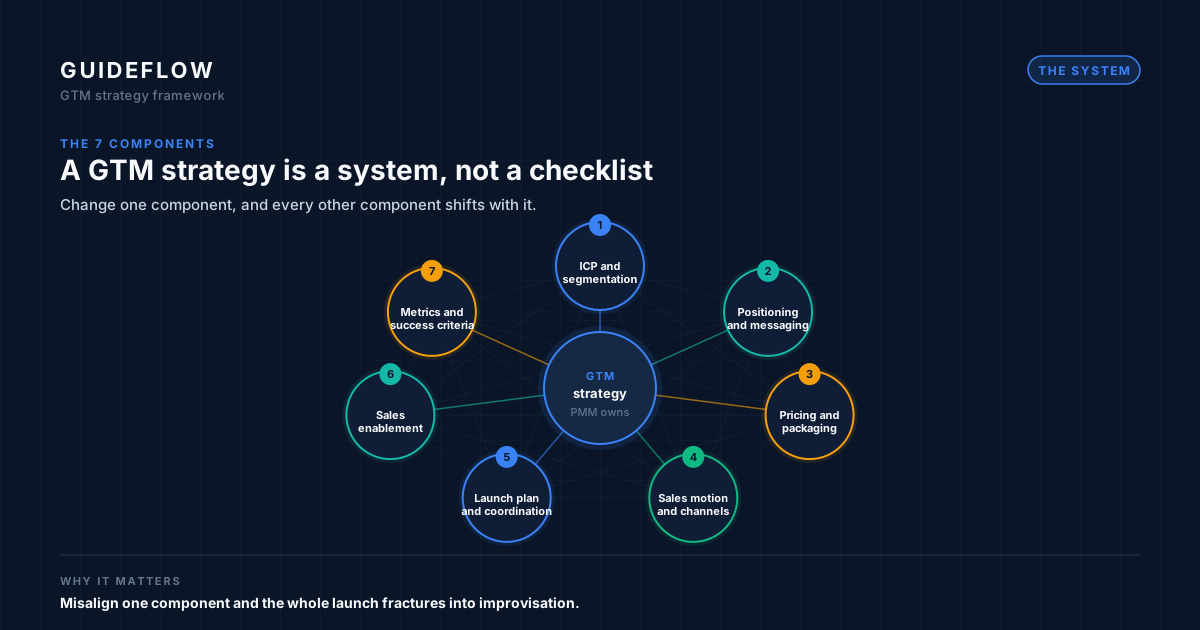
A go-to-market strategy has seven interconnected components. The word "interconnected" is doing real work here. These aren't a checklist you complete in order. They're a system that needs to reinforce itself. If your ICP says "mid-market" but your pricing says "enterprise" and your channels say "PLG," the strategy is broken before launch.
1. Ideal customer profile (ICP) and segmentation
Your ICP is the description of the company and buyer who gets the most value from your product and is most likely to buy. It sounds simple. In practice, it's one of the most politically loaded activities a PMM does.
Sales wants enterprise because the deal sizes are bigger. Product is building for mid-market because that's where the usage data points. Leadership wants a new vertical because a board member mentioned it. The PMM has to synthesize these conflicting inputs with incomplete data and produce something the org can align around.
ICP is not a one-time exercise. It shifts as the product evolves, as you enter new segments, and as competitive dynamics change.
Key ICP dimensions:
- Firmographic: Company size, industry, geography, revenue, tech stack
- Behavioral: How they buy, how they evaluate, what triggers a purchase
- Psychographic/need-based: What problem they're trying to solve, what outcome they care about, what "done well" looks like for them
- Negative ICP: Who you're explicitly not targeting (and why), which is just as important for alignment
2. Positioning and messaging
Positioning answers "why us, why now, for whom." Messaging translates positioning into the specific language used across channels.
The PMM pain here is message drift. You write the positioning doc. Sales adapts it. The website team interprets it. Ads simplify it. Within weeks, the story is inconsistent across every touchpoint. A GTM strategy needs a messaging framework that is specific enough to be useful but flexible enough to adapt to different channels and audiences.
Strong positioning includes proof points (not just claims), competitive differentiation (not just features), and a "why now" urgency that gives the buyer a reason to act. Without all three, the messaging sounds like every other product in the category.
3. Pricing and packaging
Pricing is part of GTM strategy because it signals positioning, affects channel viability, and shapes the sales motion. A $15/month product and a $150K/year product require fundamentally different GTM approaches, even if they solve similar problems. Dedicated pricing software can help teams model and test different packaging strategies before launch.
The PMM's role in pricing is to ensure it aligns with positioning and ICP expectations. The decisions often involve Product, Finance, and Sales leadership. But if pricing sends a different signal than the positioning, the market gets confused.
Packaging is a GTM lever too. How you bundle features affects which segments you attract and which sales motion works. A free tier changes the GTM motion entirely.
4. Sales motion and channel strategy
The sales motion defines how you sell: product-led growth (PLG), sales-led, hybrid, partner-led, or community-led. This choice shapes everything downstream.
| Dimension | PLG | Sales-led | Hybrid |
|---|---|---|---|
| Typical deal size | $0 to $25K ARR | $50K to $500K+ ARR | Varies by segment |
| Buyer journey | Self-serve signup, in-product conversion | Outbound/inbound, demo, evaluation, procurement | PLG for SMB, sales-assisted for mid-market and up |
| PMM focus areas | Onboarding, activation, in-product messaging, upgrade triggers | Enablement, battlecards, demo scripts, competitive positioning | Both, segmented by motion |
| Key channels | Product, content, community, paid acquisition | Direct sales, events, outbound, partnerships | All of the above, tiered |
The sales motion must match the ICP and pricing. Mismatches here are one of the most common GTM failures. A PLG motion targeting enterprise buyers with complex procurement processes will stall. A sales-led motion for a $10/month product will burn cash.
5. Launch plan and cross-functional coordination
The launch plan is the execution layer. It defines tiers (not every launch is a big launch), timelines, owners, and deliverables. Teams looking for purpose-built tools to orchestrate this process should explore product launch software options.
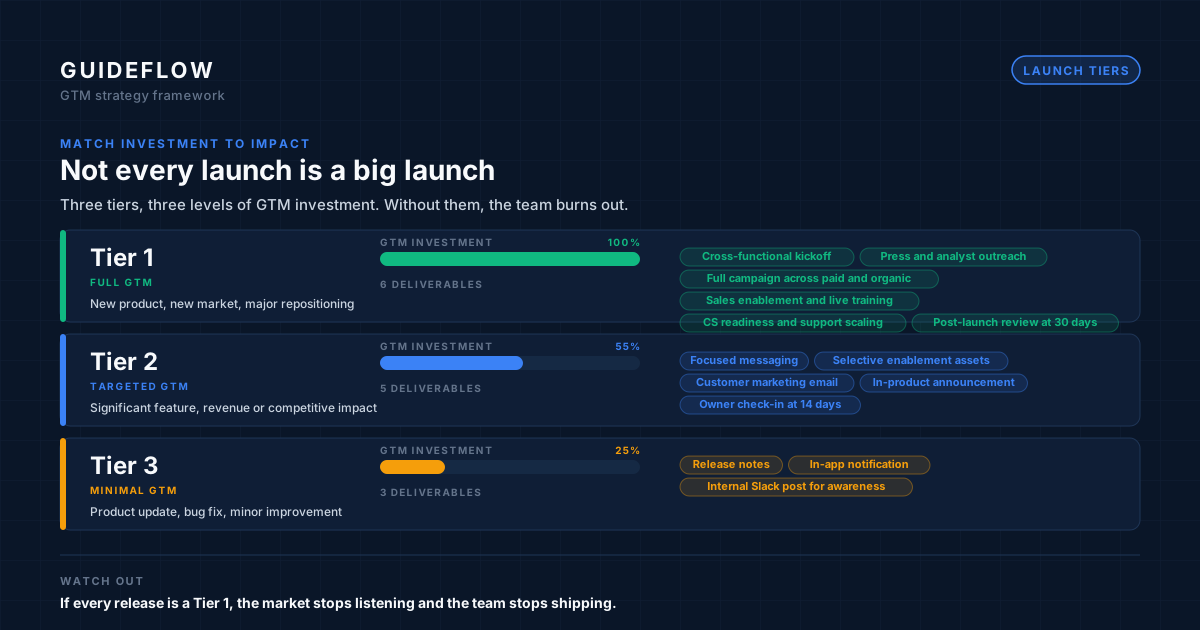
Launch tiers matter because without them, the team treats every release the same. Tier 1 is a major launch with a full campaign, press, and enablement. Tier 2 is targeted, with focused messaging and selective outreach. Tier 3 is a product update with minimal GTM investment.
The PMM's coordination challenge is structural: you need Product, Sales, CS, Marketing, Design, and sometimes Legal aligned. You don't manage any of these teams. The launch plan is the alignment artifact that gives everyone a shared reference point.
6. Sales enablement and competitive positioning
Enablement is how the GTM strategy reaches the field. If Sales doesn't know the story, the strategy is theoretical.
This means battlecards, talk tracks, one-pagers, demo scripts, and objection handling guides. But here's the PMM pain: Sales often doesn't use what PMM creates. The GTM strategy should define not just what enablement assets exist, but how they'll be distributed, trained on, and updated.
Competitive positioning is part of enablement. The GTM strategy should include a clear view of how you win against specific competitors, not just how you position in the abstract. Win/loss data, competitive messaging analysis, and specific counter-positioning for the top 3 to 5 competitors. Competitive intelligence tools can streamline the process of gathering and maintaining this intel.
7. Metrics and success criteria
Define what success looks like before launch, not after. The GTM strategy should specify which metrics matter at each stage.
Example metrics by stage:
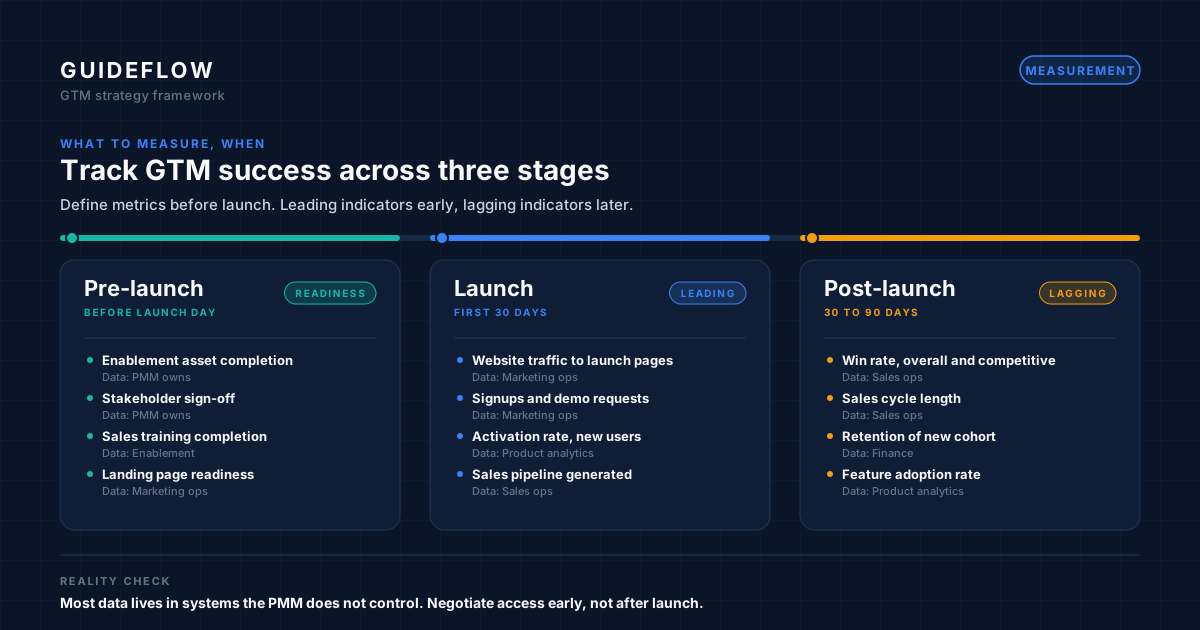
- Pre-launch: Enablement completion rate, stakeholder sign-off, asset readiness, internal alignment score
- Launch (first 30 days): Traffic, signups, demo requests, activation rate, pipeline generated
- Post-launch (30 to 90 days): Win rate, competitive win rate, sales cycle length, retention of new cohort, feature adoption
The measurement reality for PMMs: attribution is messy. "Influenced revenue" is a negotiated number. The goal is to define metrics that are credible and defensible, not perfect. Leading indicators (demo requests, activation) matter more early on. Lagging indicators (win rate, retention) confirm whether the strategy is working over time. For deeper visibility into what's driving results, marketing analytics software and attribution software can help PMMs build a more defensible measurement story.
How to build a go-to-market strategy: step by step
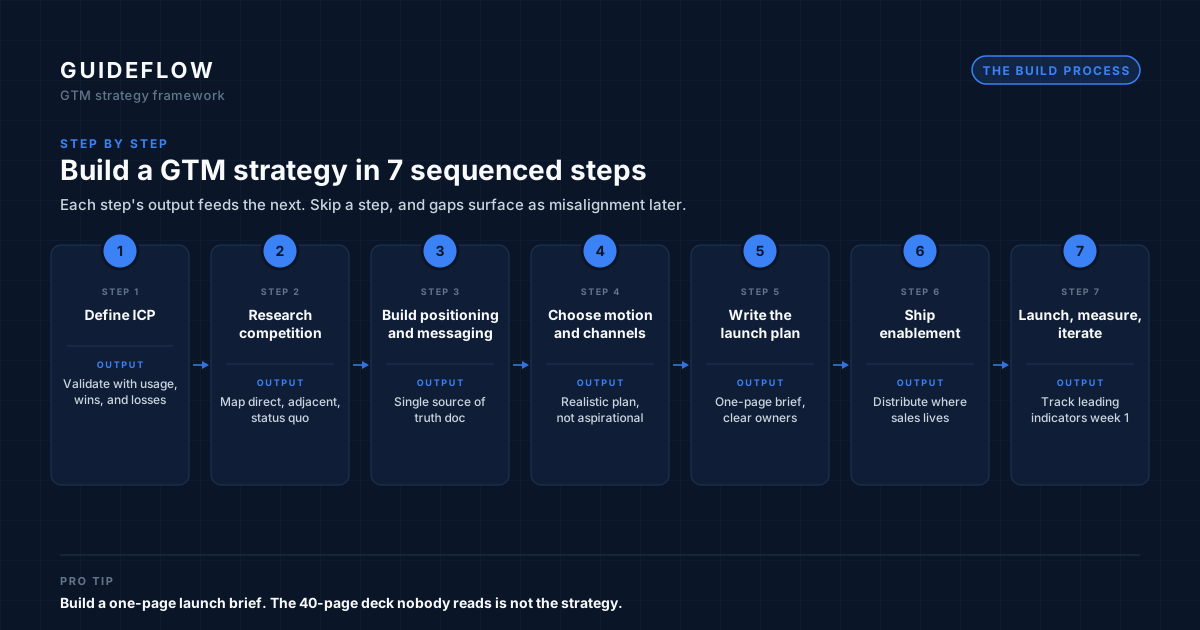
This is a sequential process, but in reality, steps overlap and iterate. For a first pass, this sequence works. The output of each step feeds the next. Skipping steps creates gaps that surface later as misalignment, missed targets, or launch chaos.
Step 1. Define your ICP and validate with data
Start with existing customer data. Who are your best customers today? What do they have in common? Look at firmographics, usage patterns, deal velocity, retention, and expansion behavior.
Cross-reference with Sales input (who do they love selling to?), Product vision (who are we building for?), and market opportunity (where is the whitespace?). Acknowledge the tension between these inputs. They will conflict.
Run win/loss analysis as a validation tool. Wins tell you who resonates with your story. Losses tell you where the story breaks down, or where the ICP doesn't fit.
Output: A documented ICP with firmographic, behavioral, and need-based criteria. Shared with Sales and Product for alignment before you move to messaging.
Step 2. Research the competitive landscape
Map competitors by category: direct competitors (same category, same buyer), adjacent competitors (different category, overlapping buyer), and the status quo (doing nothing, using spreadsheets, building internally).
Analyze their positioning, messaging, pricing, and channel strategy. Where are they strong? Where are the gaps? What story are they telling, and where does that story break down?
Output: A competitive matrix and initial differentiation hypotheses. This feeds directly into positioning.
Competitive research is ongoing, not a one-time exercise. The landscape shifts. Competitors reposition. New entrants appear. Build a lightweight process for updating competitive intel quarterly.
Step 3. Build your positioning and messaging framework
Use the competitive research and ICP work to build positioning: what category you're in, how you're different, what value you deliver, what proof you have, and why now matters.
Translate positioning into messaging: headlines, taglines, elevator pitch, and channel-specific variations. The messaging framework should be the single source of truth that every team references.
Example messaging framework structure:
- Category: What space do you play in?
- For [ICP]: Who is this for?
- Who [pain/need]: What problem do they face?
- Our product [differentiation]: What do we do differently?
- Unlike [competitor/status quo]: What's the alternative?
- We [proof]: What evidence backs this up?
Test messaging before it ships. Customer interviews, prospect surveys, A/B tests on landing pages. Messaging that sounds good internally often falls flat with the market. Validate early.
Output: A messaging framework document that serves as the single source of truth for all GTM communications.
Step 4. Choose your sales motion and channels
Based on ICP, pricing, and product complexity, define the primary sales motion. PLG, sales-led, hybrid, partner-led, or some combination.
Select channels: where does your ICP discover, evaluate, and buy? Map channels to funnel stages. Content and SEO might drive awareness. Product trials might drive evaluation. Direct sales might drive closing.
Output: A channel plan with primary and secondary channels, expected contribution, and ownership. This plan should be realistic about what your team can actually execute, not aspirational.
Step 5. Build the launch plan with owners and timelines
Assign a launch tier. Define the deliverables, owners, and timeline for each workstream: product readiness, marketing campaigns, sales enablement, CS preparation, documentation, and support.
The PMM's role here is coordinator, not executor of every workstream. The launch plan is the alignment artifact. A one-page launch brief that every stakeholder can reference is worth more than a 40-page document nobody reads.
Output: A launch brief with tier, timeline, workstream owners, key deliverables, and dependencies. Shared in a format and location the team actually checks.
Step 6. Create and distribute enablement
Build the assets Sales, CS, and partners need to tell the story: battlecards, demo scripts, talk tracks, one-pagers, email templates, and objection handling guides.
Distribution matters as much as creation. Put enablement in channels Sales actually uses (CRM, Slack, enablement platform). Don't just upload to a shared drive and hope. Train the team. A 30-minute enablement session before launch is worth more than a perfect document nobody reads.
For launches where showing the product is more effective than describing it, interactive demos on landing pages or in sales outreach can increase engagement and conversion. They give prospects a way to experience value before committing to a live call, which is particularly useful for PLG and hybrid GTM motions.
Output: Enablement assets distributed through channels the field team uses, with a training session scheduled before launch.
Step 7. Launch, measure, and iterate
Launch is not the end. It's the beginning of the measurement cycle.
Track the metrics defined in the strategy. Compare against success criteria. Don't wait 90 days for a full picture. Look at leading indicators in the first week: are people visiting the page? Signing up? Requesting demos? Are Sales conversations happening?
Run a post-launch review within 2 to 4 weeks. What worked? What didn't? What needs to change? Iterate on messaging, adjust channels, refine enablement based on real data from the field.
The best go-to-market strategies are living documents, not static decks. The first version is a hypothesis. The data tells you what to keep and what to change.
GTM strategy for SaaS: what's different
Most GTM guides are written generically. They apply equally to consumer goods, professional services, and software. That's the problem. SaaS has specific GTM dynamics that change how you build and execute the strategy.
Product-led vs. sales-led motions. SaaS companies must choose (or blend) between PLG and sales-led GTM. This choice shapes pricing, content, team structure, and metrics. A PLG motion optimizes for self-serve signup, activation, and in-product conversion. A sales-led motion optimizes for pipeline generation, demo quality, and deal progression. The PMM's role is different in each: in PLG, you're focused on onboarding flow software and in-product messaging. In sales-led, you're focused on enablement and competitive positioning.
Feature launches vs. new product launches. SaaS companies launch constantly. Not every feature needs a full GTM strategy. The distinction matters:
- Tier 1 (full GTM): New product, new market entry, major repositioning. Full cross-functional coordination.
- Tier 2 (targeted GTM): Significant feature with revenue or competitive impact. Focused messaging, selective enablement.
- Tier 3 (minimal GTM): Product update, bug fix, minor improvement. Release notes and in-app notification.
Without tiers, the team burns out treating every release like a major launch. Quality drops. The market stops paying attention.
Expansion GTM. In SaaS, GTM doesn't stop at acquisition. Expansion revenue (upsell, cross-sell, seat expansion) is a GTM motion with its own ICP, messaging, and channels. Many PMMs underinvest here. The expansion ICP is often different from the acquisition ICP: you're selling to an existing user or champion, not a cold prospect. The messaging shifts from "why us" to "why more."
Self-serve and the buyer's expectation to try before buying. SaaS buyers increasingly expect to experience the product before talking to Sales. This affects channel strategy and content needs. Product tours, free trials, interactive demos, and sandbox environments are all part of the GTM toolkit now, not nice-to-haves.
These SaaS-specific dynamics are why a generic GTM template from a business school course doesn't work for your job.
Go-to-market strategy examples
Slack: bottom-up PLG with an enterprise layer
Slack's GTM strategy is one of the most studied PLG motions in SaaS. The context: entering a crowded communication market dominated by email and legacy tools like HipChat.
The GTM approach: a freemium model that let individual teams adopt Slack without procurement approval. The ICP started narrow (tech teams, startups) and expanded as adoption grew. Positioning focused on "replacing internal email" rather than competing in the "chat tool" category. The channel strategy was almost entirely product-led: word-of-mouth, organic growth within organizations, and a free tier that removed the adoption barrier.
The sales layer came later. Once Slack had thousands of free teams inside large organizations, they built an enterprise sales motion to convert those organic users into paid contracts. The GTM motion for enterprise was different: security compliance, admin controls, and IT buyer messaging.
The outcome: Slack reached $100M ARR faster than almost any SaaS company at the time. The lesson for PMMs: the GTM strategy wasn't one motion. It was two motions (PLG for adoption, sales-led for monetization) running in sequence.
HubSpot CRM: repositioning from marketing tool to platform
HubSpot's CRM launch is a go-to-market strategy example of repositioning. The context: HubSpot was known as a marketing automation tool. They launched a free CRM to reposition as a full-stack growth platform.
The GTM approach: free pricing removed the barrier to entry and attacked Salesforce's complexity narrative. The ICP was SMB and mid-market companies already using HubSpot for marketing, plus new prospects who found CRM software too expensive or complicated. Messaging focused on "free, easy, and integrated" rather than feature parity with Salesforce.
The channel strategy combined inbound (HubSpot's core strength) with product-led adoption. Sales enablement focused on the "land with CRM, expand with Marketing Hub and Sales Hub" motion.
The outcome: HubSpot's CRM became the entry point for the entire platform, driving expansion revenue across product lines. The lesson for PMMs: pricing and packaging are GTM levers, not just finance decisions.
How to measure GTM strategy success
No competitor in the current SERP provides a concrete measurement framework. This section fills that gap.
Pre-launch readiness metrics:
- Enablement asset completion rate
- Stakeholder sign-off on messaging and positioning
- Sales training completion
- Landing page and campaign readiness
Launch metrics (first 30 days):
- Website traffic to launch pages
- Signups, demo requests, or trial starts
- Activation rate for new users
- Sales pipeline generated (new opportunities)
- Initial media/social coverage (if applicable)
Post-launch metrics (30 to 90 days):
- Win rate (overall and competitive)
- Sales cycle length for launch-related deals
- Retention/churn of the new cohort
- Feature adoption rate
- Customer feedback themes
Long-term GTM health:
- Net revenue retention
- CAC payback period
- Pipeline coverage ratio
| Stage | Metric | Who owns the data | PMM's role |
|---|---|---|---|
| Pre-launch | Enablement completion | PMM / Enablement | Direct owner |
| Pre-launch | Stakeholder alignment | PMM | Coordinator |
| Launch | Traffic and signups | Marketing ops | Monitors and reports |
| Launch | Pipeline generated | Sales ops / RevOps | Tracks and attributes |
| Post-launch | Win rate | Sales ops / RevOps | Analyzes and iterates |
| Post-launch | Feature adoption | Product analytics | Identifies gaps |
| Long-term | Net revenue retention | Finance / RevOps | Connects to GTM impact |
The PMM measurement reality: most of these metrics require data from systems you don't control (CRM, product analytics, billing). The goal is to define what matters, negotiate access, and build a reporting cadence, not to pretend the data is clean or that attribution is solved. Product analytics software can help bridge the gap between product usage data and GTM performance tracking.
Common GTM strategy mistakes (and how to avoid them)
You've seen the framework. Now here's what goes wrong.
1. Skipping ICP validation and launching to "everyone."
What it looks like: Messaging is generic. Sales complains about lead quality. Conversion is low across the board. The landing page tries to speak to startups, mid-market, and enterprise simultaneously and resonates with none of them.
What to do instead: Validate ICP with data before building messaging. Start narrow. You can expand later. A focused ICP with strong conversion beats a broad ICP with weak conversion every time.
2. Treating GTM as a marketing plan.
What it looks like: Sales, CS, and Product are not involved in GTM planning. Marketing builds a campaign. Launch day arrives. Sales doesn't know the story. CS isn't prepared for the support volume. Product shipped a different version than what marketing described.
What to do instead: Cross-functional GTM planning from day one. Include Sales, CS, and Product in the strategy development, not just the launch execution.
3. Building enablement nobody uses.
What it looks like: Beautiful battlecards sit in a Google Drive folder with 3 views. Sales uses their own slides. The talk track you spent two weeks on has never been opened.
What to do instead: Distribute through channels Sales already uses. Train in person (or on video). Collect feedback. Ask Sales what format they actually need before you build. A scrappy one-pager that gets used beats a polished deck that doesn't.
4. No launch tiers (everything is a "big launch").
What it looks like: The team is burned out. Quality drops. Every launch feels the same to the market. Customers stop paying attention because there's no signal about what actually matters.
What to do instead: Define tiers and match investment to impact. Not every feature deserves a blog post, a webinar, and a press release. Reserve full GTM investment for Tier 1 launches.
5. Measuring too late or not at all.
What it looks like: Leadership asks "did the launch work?" and the PMM doesn't have an answer. Or worse, the answer is "we think so" with no data to back it up.
What to do instead: Define success criteria before launch. Set up tracking before launch day. Report on leading indicators in the first week. Don't wait for lagging indicators to tell you what you already could have known.
6. Ignoring post-launch iteration.
What it looks like: The launch happens. The team moves on to the next thing. Nobody updates messaging based on field feedback. Nobody adjusts channels based on performance data. The enablement from launch day is still the enablement six months later.
What to do instead: Schedule a post-launch review at 2 to 4 weeks. Make iteration part of the process, not an afterthought. The first version of any GTM strategy is a hypothesis. Treat it that way.
GTM strategy frameworks worth knowing
You don't need to memorize frameworks. But knowing these three helps you prioritize, position, and defend your GTM decisions.
Crossing the Chasm (Geoffrey Moore). The technology adoption lifecycle describes how products move from early adopters to mainstream market. The "chasm" is the gap between visionaries (who buy based on potential) and pragmatists (who buy based on proof and peer adoption). For PMMs, this framework is useful when your product has traction with early adopters but struggles to break into the mainstream. The GTM strategy for crossing the chasm focuses on a narrow beachhead segment, overwhelming proof points, and a "whole product" story.
Jobs to Be Done framework (JTBD). This framework focuses on what customers are trying to accomplish, not who they are. Instead of "mid-market fintech companies," JTBD asks "what job is the buyer hiring this product to do?" Useful for ICP definition and messaging because it grounds both in customer motivation rather than demographics. When your messaging feels feature-heavy and outcome-light, JTBD helps reframe.
RICE prioritization framework (Reach, Impact, Confidence, Effort) isn't a GTM framework per se, but it's useful for prioritizing which segments, channels, or launches to invest in when resources are limited. For a PMM juggling three launches and limited design support, RICE helps you make the case for where to focus. Product management tools often include built-in prioritization frameworks like RICE to help teams align on what to build and launch next.
Conclusion
A go-to-market strategy is the system that keeps Product, Sales, Marketing, and CS telling the same story to the right people. Without it, every launch is a scramble. With it, you have a shared reference point that turns cross-functional chaos into coordinated execution.
The PMM's structural challenge doesn't go away: you own the GTM motion but not the people executing it. The strategy is your alignment tool. It's how you coordinate without authority, how you create accountability without hierarchy, and how you measure impact in a world where attribution is imperfect.
Build it. Measure it. Iterate on it. The best GTM strategies are living systems, not static documents.
If showing your product is part of your GTM motion, interactive demos can help prospects and stakeholders experience value before a live call. Start your journey with Guideflow today!
FAQ about go-to-market strategy
GTM stands for “go to market.” It refers to the strategy and process a company uses to bring a product or service to its target customers. In SaaS, GTM typically covers ICP definition, positioning, channel strategy, sales motion, enablement, and launch execution. The GTM meaning is the same whether you see it as “GTM,” “go-to-market,” or “go to market.”
A GTM strategy is cross-functional and tied to a specific launch or market entry. It covers product, sales, marketing, CS, and enablement. A marketing strategy is ongoing and marketing-specific: brand, demand gen, content, campaigns. The GTM strategy includes marketing as one component, not the other way around. When teams treat them as the same thing, Sales and CS get left out of the planning.
In most SaaS companies, the Product Marketing Manager owns or co-owns the go-to-market strategy. Execution involves Product, Sales, Marketing, CS, and sometimes Legal and Finance. The PMM’s role is to coordinate alignment across these teams without having direct authority over them, which is why the strategy document itself becomes the primary alignment tool.
For a major product launch, expect 4 to 8 weeks for strategy development and 2 to 4 weeks for launch preparation. For a feature launch, the timeline is shorter: 1 to 3 weeks depending on tier. The real variable is cross-functional alignment, not document creation. Getting Sales, Product, and Marketing to agree on ICP and positioning takes longer than writing the brief.
Slack’s PLG motion is a well-known go-to-market strategy example. They used a freemium model targeting tech teams, with product-led adoption driving organic growth inside organizations, then layered an enterprise sales motion on top to monetize at scale. HubSpot’s free CRM launch is another example, using pricing as a GTM lever to reposition from marketing tool to full platform.
Not every feature launch needs a full GTM strategy. Use launch tiers: Tier 1 (major launch, full GTM), Tier 2 (targeted, partial GTM), Tier 3 (product update, minimal GTM). The decision depends on revenue impact, competitive significance, and customer visibility. A Tier 3 feature update needs release notes and maybe an in-app notification. A Tier 1 launch needs the full cross-functional motion.
Define success criteria before launch. Track pre-launch readiness (enablement completion, stakeholder alignment), launch metrics (traffic, signups, pipeline generated), and post-launch outcomes (win rate, adoption, retention). Attribution is imperfect in most SaaS orgs, and the goal is directional clarity, not perfect measurement. Leading indicators in the first week tell you more than lagging indicators at 90 days.
The GTM strategy defines the “what and why”: ICP, positioning, channels, sales motion. The GTM plan defines the “how and when”: timeline, deliverables, owners, milestones. In practice, many PMMs combine both into a single document, which works fine. The distinction matters most when communicating with leadership (strategy level) vs. coordinating execution with the team (plan level).