A demo engineer is a technical specialist who builds, maintains, and customizes product demonstration environments so sales, marketing, and customer success teams can show prospects exactly what the product does without relying on fragile live instances or engineering support. Unlike sales engineers who present to customers directly, demo engineers work behind the scenes to create the polished, personalized demo experiences that close deals.
This guide covers everything you need to know about the role: what demo engineers actually do day-to-day, the skills required, when to hire one, the tools they use, and how to build a career in demo engineering.
What's inside
- Definition: Learn what a demo engineer is and how the role differs from a sales engineer.
- Responsibilities and skills: Discover the core duties of a demo engineer and the technical and soft skills required to succeed.
- Hiring signals and tools: Understand when your company is ready to hire a demo engineer and the technology they use, including demo automation platforms.
- Career path: Explore common entry points, advancement opportunities, and the career trajectory for a demo engineer.
TL;DR
- Demo engineers are technical specialists who build, maintain, and customize product demonstration environments. Unlike sales engineers, they are typically not customer-facing.
- They act as a force multiplier, enabling sales, marketing, and customer success teams to deliver polished, personalized demos at scale.
- The role requires a blend of technical skills (APIs, front-end code, databases) and communication skills (storytelling, scriptwriting).
- Demo automation platforms are a core part of their toolkit. Solutions like Guideflow allow them to create high-fidelity interactive demos efficiently.
What is a demo engineer
A demo engineer is a technical role focused on building, maintaining, and customizing interactive product demonstration environments for go-to-market teams. They create tailored experiences that showcase a product's value in the most compelling way possible. The practice of creating high-impact demo experiences is known as "demo engineering."
Instead of presenting a generic product tour, demo engineers craft stable, data-rich, and personalized demo instances that speak directly to a prospect's specific use case. Think of them as the production crew behind a great sales performance: the audience never sees them, but the show falls apart without their work.
What does a demo engineer do
The day-to-day work spans environment management, customization, content creation, and cross-functional collaboration.
Creating and maintaining demo environments
A primary responsibility is setting up stable, up-to-date demo instances that the entire go-to-market team can rely on. This involves managing synthetic data to make the demo feel real, keeping environments current with the latest product releases, and performing quality assurance.
Demo engineers are the owners of the company's sandbox environments and other demonstration assets. When a sales rep walks into a call, they can trust the demo will work because a demo engineer has already tested it.
Customizing demos for specific prospects
Generic demos underperform because 71% of B2B buyers expect personalized interactions, and they fail to connect with the prospect's unique challenges. Demo engineers address this by tailoring demonstrations to a client's specific use case, industry, or even by incorporating their own data and branding.
They build a library of demo components and flows that allow for personalization at scale. The goal is for every prospect to feel like the product was built just for them.
Developing demo scripts and narratives
This role involves significant technical content creation. Demo engineers develop the scripts and narratives that sales teams use. They excel at translating complex technical features into clear business value, focusing on the "why" behind a feature, not just the "what."
Training sales teams on demo delivery
Demo engineers have a critical enablement function - teams with enablement programs achieve 49% win rates vs. 42.5% without. They don't just build the demos; they train sales staff on how to deliver them effectively. This includes providing detailed talk tracks, running training sessions on new demo flows, and sharing best practices.
Collaborating with product and marketing
This is a highly cross-functional role. Demo engineers work closely with product teams to understand the roadmap and integrate the latest features into demo environments. They also provide valuable UX feedback based on what resonates with prospects.
They partner with marketing teams to ensure demo narratives align with broader messaging and campaigns. This feedback loop is one of the most valuable, and often underutilized, aspects of the role.
Demo engineer vs sales engineer
While both roles are critical to the presales process, they have distinct functions. Demo engineers focus on the "how," building the technical demo environment and assets. Sales engineers focus on the "what," presenting the solution to customers and managing the technical aspects of the sales cycle.
| Aspect | Demo engineer | Sales engineer |
|---|---|---|
| Primary focus | Building demo environment and tech stack | Presenting solution to customers |
| Customer interaction | Rarely customer-facing | Regularly customer-facing |
| Core output | Demo environments, scripts, tooling | Discovery calls, technical presentations |
| Daily work | Updating data, creating configurations | Running demos, answering technical questions |
Skills required for demo engineering
Success in this role requires a specific blend of technical ability and communication skills.
Technical skills
- API knowledge: Essential for integrating different systems and populating demos with dynamic, realistic data.
- Front-end technologies (CSS, HTML, JavaScript): Crucial for customizing the look and feel of a demo, ensuring it is on-brand and visually polished.
- Database management: Needed to create and manage the synthetic data that makes a demo environment believable.
- Product architecture understanding: Allows them to build accurate demos and troubleshoot issues effectively.
Communication and storytelling skills
A great demo engineer can turn a list of technical features into a compelling business value narrative. This involves strong script writing to create clear user flows that guide a prospect from a problem to a solution.
Product knowledge
To create an accurate and compelling demo, a demo engineer knows the product inside and out, often better than anyone else in the company. This deep understanding of capabilities and limitations is fundamental to building demonstrations that are both powerful and truthful.
Why companies hire demo engineers
Several market forces are driving demand for this role.
- Product-led growth trends: All 50 fastest-growing software companies have a product-led motion, and the need for high-quality, interactive product experiences to drive conversion has become critical.
- Sales engineer bandwidth: A demo engineer prevents highly-paid sales engineers from getting bogged down with time-consuming, technical setup tasks.
- Demo quality consistency: A demo engineer ensures every prospect sees a polished, professional, and working demo.
- Scalability: One demo engineer can create and maintain demo assets that enable an entire presales team.
When to hire a demo engineer
Here are the most common signals that an organization is ready.
Your demo quality is inconsistent
If different sales reps are showing different versions of the product, or some demos are breaking mid-call, it's a clear signal. A demo engineer centralizes and standardizes demo creation.
Sales reps spend too much time on demo prep
A major red flag is when sales reps spend hours each week building custom demos from scratch or troubleshooting their demo environment instead of selling.
You have multiple products or complex use cases
For organizations with a portfolio of products, multiple buyer personas, or various industry verticals, a one-size-fits-all demo is ineffective. A demo engineer is needed to build and manage the library of tailored demo flows.
Deals stall because prospects cannot visualize value
If prospects say "I need to see it in action" but live demos are too risky or difficult to schedule, deals will stall. A demo engineer can create on-demand interactive demos that prospects can explore on their own time.
Key tools to get you started as a demo engineer
The right tech stack is essential for a demo engineer to be effective.
Demo automation: Guideflow
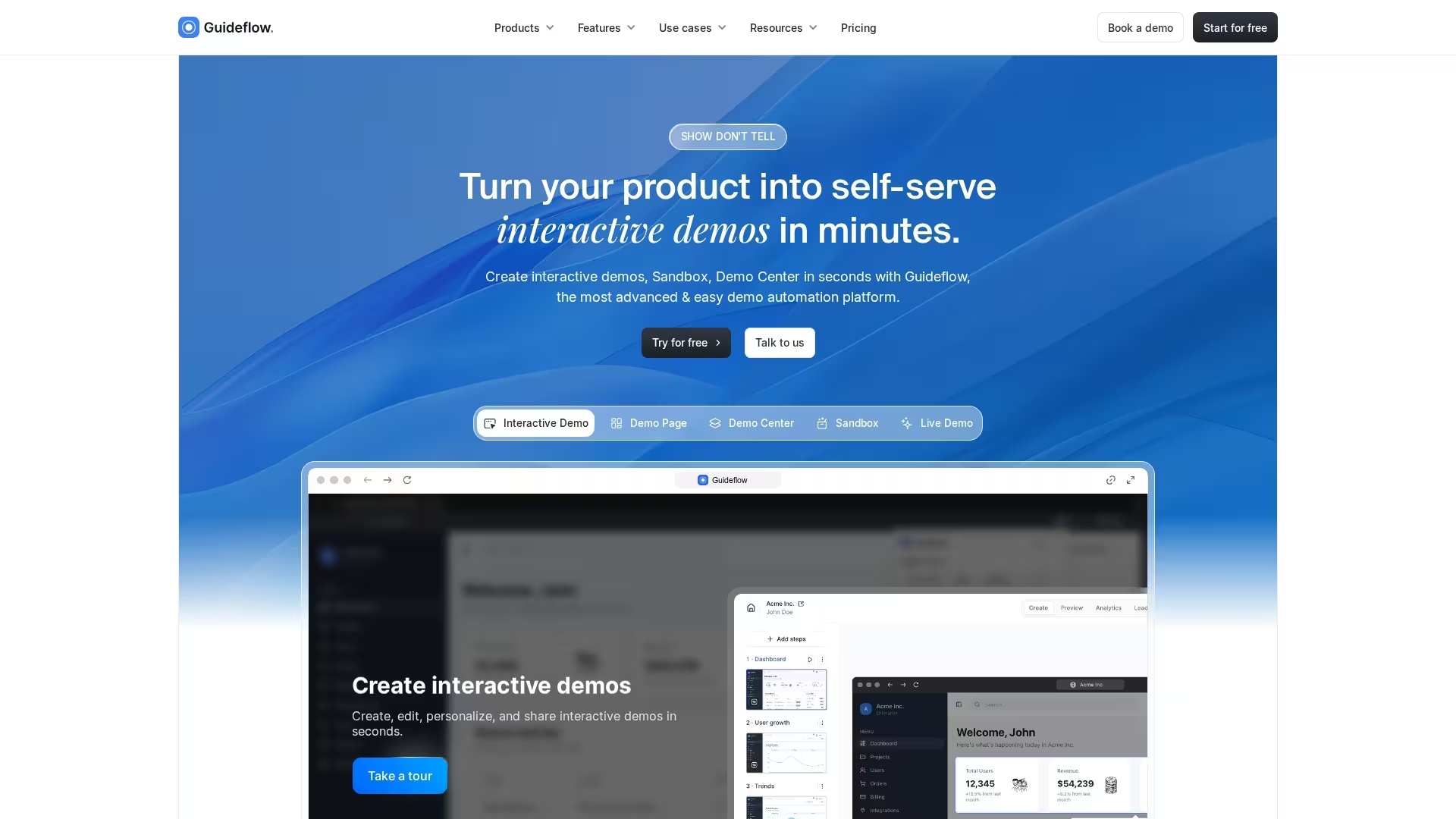
Demo automation platforms are software solutions that allow users to create high-fidelity, interactive product demos without extensive engineering resources. They are the core of a modern demo engineer's tech stack. Key capabilities include screen capture, no-code editing, personalization at scale, and engagement analytics. Guideflow is a leading example of a platform designed to empower demo engineers and presales teams.
Guideflow is the heart of any demo engineering stack, but any high-performing demo engineer will layer in a handful of other tools to handle scheduling, communication, call performance, visual planning and deal management. Here are the essentials to get you going.
CRM: HubSpot CRM
A demo engineer needs somewhere to track which demos were sent out, who actually engaged, and what happened afterwards. HubSpot CRM is a natural starting point - it's free to get set up, integrates with the majority of demo and analytics tools with ease, and gives you one place to see how prospects are interacting with your demo across the entire sales process. When the demo platform pushes engagement data into HubSpot, you get a clear picture of which flows are actually working and which ones need a tweak, without having to chase down sales team updates manually.
Best for: Demo engineers working with smaller to medium-sized sales teams who need a lightweight CRM to track demo activity without setting up a whole new system.
Pricing: Free plan on offer; paid tiers start at $9/user/month.
Scheduling: Calendly
Getting the right prospects into the right demo experience at the right time is half the battle. Calendly makes this happen by letting prospects book a time slot directly from a shareable link that syncs up in real time with your calendar. This is super useful for demo engineers who are managing a library of custom demo flows for different use cases - Calendly's intake questions help steer prospects to the right flow before they even have the meeting. Plus, it integrates with HubSpot and Salesforce so all that booking info flows into your CRM automatically.
Best for: Demo engineers coordinating demo sessions across multiple sales teams or personas who need reliable scheduling without any hassle.
Pricing: Free plan available; Teams plan at $16/user/month.
Async walkthroughs: Loom
Not every prospect explanation needs a live call - sometimes it's just a simple recorded screen walkthrough that will do. Loom lets demo engineers record video screen walkthroughs in minutes - complete with face, voice and click annotations. This is particularly useful for follow-up explanations after a live session, or for onboarding new sales reps on a new demo flow. Viewer analytics also give you a handle on who actually watched, how far they got, and whether they clicked through to the next step - all super useful signals for prioritizing follow-up.
Best for: Demo engineers who need to put together clear technical explanations or walkthrough recordings without having to schedule another meeting.
Pricing: Free plan (25 videos, up to 5 minutes); Business plan at $15/user/month.
Conversation intelligence: Fathom
A demo engineer gets some great product feedback from sales calls - but only if those calls are properly recording. Fathom records, transcribes and summarises calls on Zoom, Google Meet and Teams with speaker ID and searchable highlights. For a demo engineer this is gold - you can review which features generated the most questions, where you lost the room, and what objections keep surfacing - and then use those insights to improve your demo scripts and flows. It syncs with HubSpot and Salesforce automatically.
Best for: Demo engineers who want to close the feedback loop between live demo delivery and demo environment improvements without having to sit in on every single call.
Pricing: Free plan on offer; Team plan at $16/user/month.
Visual collaboration: Miro
Demo engineers are often trying to map out complex demo architectures, narrative flows or journey maps before they even start building anything. Miro provides an infinite collaborative canvas for this - think of it like a whiteboard where you plan the demo before you even start building it. It's super useful when working with multiple teams and functions to get everyone aligned on what stories the demo should tell and in what order. With 1,000+ templates and real-time collaboration, it replaces scattered slide decks and email threads.
Best for: Demo engineers working with multiple teams who need a shared visual workspace for planning demo flows, discovery maps and narrative structures.
Pricing: Free plan available; Starter from $8/user/month.
Proposals and document tracking: PandaDoc
Once a demo is done, the next bottleneck is usually the proposal. PandaDoc lets demo engineers and their sales counterparts put together, send and track branded proposals with CRM-linked data, built-in e-signatures and real-time engagement analytics. Knowing where in the proposal your prospect spent their time after seeing your demo helps you personalise follow-up and make the next conversation more effective. Approval workflows also mean that the right people are on board before anything goes out.
Best for: Demo engineering teams involved in deal support at the end stage who need visibility into how prospects are engaging with proposals after the demo.
Pricing: Free plan available; paid plans from $19/user/month.
Screen capture and recording tools
For creating quick video-based demos or capturing product flows to be used in interactive demos, screen capture and recording tools are essential for quick asset creation.
Best practices for engineering demo experiences
Building a great demo is a process. Here's a framework for before, during, and after.
Before the demo
- Research the prospect's industry, role, and pain points.
- Select the most relevant demo flow from your library.
- Pre-load the demo environment with data that reflects the prospect's world.
- Test the entire demo flow from start to finish.
During the demo
- Focus on business value and outcomes, not just features.
- Let the prospect interact with the demo whenever possible.
- Pay attention to their reactions and adjust the flow accordingly.
After the demo
- Analyze engagement data to see which features resonated.
- Gather feedback from the sales rep and, if possible, the prospect.
- Update the demo environment and scripts based on learnings.
How to build a demo engineering career
If this role sounds interesting, here's how to get started and where it can lead.
Entry points into demo engineering
Common paths into this role include a solutions or sales engineer who wants to specialize in building demo assets, a sales enablement professional with strong technical skills, or a member of the product team who enjoys the revenue-focused side of the business.
Skills to develop for advancement
- Deeper product and domain expertise.
- Advanced storytelling and narrative design skills.
- Cross-functional leadership and project management.
- Proficiency in major demo automation platforms.
Career paths and progression
Demo engineers are well-positioned for growth. Common career paths include advancing to a senior or principal demo engineer, managing a team as a demo engineering manager, or transitioning into roles like solutions engineering leadership or technical product marketing.
Demo engineer salary and compensation
Compensation for a demo engineer is highly competitive and often on par with that of a solutions engineer, with the BLS reporting a median salary of $116,950 for sales engineers. Salary is influenced by factors such as company size and stage, geographic location, industry, and the candidate's level of experience.
How demo automation is shaping this role
Modern demo automation platforms are transforming the demo engineer role. They are shifting the focus away from manual, time-consuming environment setup and maintenance toward more strategic work.
With platforms like Guideflow handling the heavy lifting of capture, cloning, and analytics, demo engineers can spend more of their time on high-value activities like narrative strategy, deep personalization, and optimizing demo performance based on engagement data.
Start your journey with Guideflow today!
FAQs about demo engineers
Most demo engineer roles require an understanding of front-end technologies like HTML, CSS, and JavaScript for customization, but no-code demo automation platforms are reducing the need for deep, day-to-day coding expertise.
Demo engineers commonly advance to senior demo engineering roles, move into demo engineering management, or transition to adjacent leadership positions in solutions engineering, sales enablement, or product marketing.
Demo engineers focus on building and maintaining the backend demo environments and tooling, while solutions engineers are customer-facing and use those tools to present solutions and handle technical discovery during the sales process.
B2B SaaS companies, particularly those with complex products or multiple use cases, hire demo engineers most often, though the role is expanding to any organization with a significant product-led or sales-led motion.
Demo automation platforms handle much of the technical creation and maintenance, but they don't replace demo engineers. Instead, they elevate the role, freeing engineers to focus on strategy, customization, and enablement.
While no formal, universal certifications exist specifically for demo engineering, relevant training includes certifications from demo automation platform vendors, presales certifications from organizations like the PreSales Collective, and courses in sales enablement.
Demo engineers typically track metrics like demo completion rates, prospect engagement with specific features, time saved for sales teams on demo prep, and their contribution to key business outcomes like pipeline velocity and win rates.
Larger organizations may have a dedicated demo engineering team with specialists for different products or regions, often reporting into a centralized presales, sales enablement, or revenue operations leadership structure.