A missed appointment costs you a full bay for the morning. A quote that took two days to send costs you the job. An invoice that sits unbilled for a week costs you cash flow you already earned. Run an auto glass shop long enough and you learn that the work is rarely the bottleneck. The coordination around the work is.
Most shops still stitch that coordination together by hand. A whiteboard for the schedule. A paper pad for work orders. A separate app for texting customers. A shoebox of receipts for the accountant. Each handoff is a place where a job stalls, a detail drops, or a technician shows up to the wrong address. The global glass repair services market sat at roughly $62.83 billion in 2025 and is projected to reach $87.83 billion by 2032 according to 360iResearch, and the shops capturing that growth are the ones that stopped losing hours to manual admin.
The right glass repair software collapses those handoffs into one system. Booking flows into dispatch. Dispatch flows into the work order. The work order flows into the invoice. The invoice flows into the books. When scheduling, billing, mobile access, and claims all live in the same place, throughput goes up because nobody is retyping information or chasing status by phone. That is the real return, not a feature list.
This guide ranks seven auto glass software options for 2026 and, more importantly, tells you which operational bottleneck each one actually solves. Because the best glass shop software for a two-truck mobile operation is not the same tool a claims-heavy replacement shop needs.
What's inside
We built this list for auto glass shop owners, managers, and operators comparing glass software programs to run repair and replacement work with less manual coordination. We evaluated each tool on five things that matter in a real shop: appointment scheduling and reminders, invoicing and payments, mobile and cross-device access, workflow and technician visibility, and claims or NAGS support for insurer-driven work.
We focused on tools that handle actual auto glass operations, not generic field service software bolted onto a glass workflow. The list spans simple options for a single-location shop that mostly needs faster booking and billing, up to enterprise platforms built for claims volume, OEM procedures, and ADAS calibration workflows.
TL;DR
- Best for claims-heavy shops: Mitchell, for insurer workflows, NAGS data, and OEM repair procedures.
- Best all-in-one POS and shop management: Glas-Avenue by Mainstreet Computers, for point-of-sale plus scheduling, inventory, and billing.
- Best for scheduling and customer communication: EZnet Scheduler, for online booking, reminders, and calendar sync.
- Best CRM-lite option for glass shops: AutoGlassCRM, for lead tracking, VIN decoding, and quote support.
- Best for enterprise collision and glass operations: CCC ONE, for estimating and repair workflow across larger facilities.
- Best modern all-in-one repair platform: Tekmetric, for shop management, digital inspections, and payments.
What is glass repair software?
Glass repair software is a shop management system that helps auto glass businesses handle scheduling, work orders, invoicing, technician assignment, claims, and customer communication in one place. It replaces the whiteboard, the paper work order, and the disconnected billing app with a single record that moves a job from first call to paid invoice.
The category ranges from lightweight glass shop software for a single location to enterprise platforms built around insurer claims and OEM data. Most modern tools are cloud-based. Roughly 62.4% of revenue in the auto glass claims management software market comes from cloud deployment according to MarketIntelo, which tells you where the market is heading: browser and mobile access over locally installed software.
Good glass shop management software should cover the following:
- Appointment scheduling with online booking, reminders, rescheduling, and bay or capacity allocation.
- Work orders that capture the vehicle, glass part, and job scope in a structured record.
- Invoicing and payments including estimates, taxes, discounts, and payment collection.
- Technician assignment and dispatch so the right tech is routed to the right job.
- Mobile and cross-device access for field technicians updating status on-site.
- Repair and replacement workflows covering windshield repair, full replacement, and tinting.
- Claims and NAGS support for shops doing insurer-driven work, plus ADAS calibration where relevant.
- Reporting on revenue, job volume, technician output, and outstanding balances.
The difference between a tool that helps and one that gets abandoned usually comes down to how many of these live in one system versus how many still need a workaround.
When to use glass repair software
Not every shop needs every feature. Match the tool to the bottleneck that is actually costing you money.
When scheduling is the bottleneck
If your day starts with a whiteboard and ends with a voicemail about a missed slot, scheduling is your problem. Auto glass scheduling software with online self-booking, automated text reminders, and calendar sync cuts the phone tag and the no-shows. Bay and capacity tracking keeps you from double-booking a single install stall. This is where a scheduling-first tool earns its keep fast, often in the first week.
When billing and payments are slowing cash flow
If work gets done but invoices lag, you have a cash flow problem disguised as an admin problem. Auto glass billing software with fast estimates, payment links, tax handling, and custom invoice templates gets money moving. The goal is simple: finish the job, send the invoice before the tech leaves the driveway, and get paid without a follow-up call.
When field and mobile work needs better visibility
Mobile glass work lives or dies on visibility. If dispatch cannot see where a technician is or whether a job is done, you are running blind. Mobile field service software with technician assignment, cross-device access, and on-site status updates keeps the office and the field in sync. Techs update the job from the driveway and the invoice is ready before they pull away.
When claims, parts, or calibration create complexity
Insurer-driven work adds a layer. NAGS benchmark data, OEM repair procedures, ADAS calibration requirements, and claims management software all matter when your revenue depends on insurance approvals. If a meaningful share of your jobs run through claims, prioritize a platform built for that complexity over a lighter general tool.
Comparison table
Here is how the seven tools compare on intent, differentiation, pricing, and rating. Use it to shortlist two or three, then read the full sections below to match each one to your bottleneck.
| # | Product | Intent | Key differentiation | Pricing | G2 rating |
|---|---|---|---|---|---|
| 1 | Mitchell | Enterprise claims and repair data | Insurer claims, NAGS, OEM procedures, ADAS support | Custom, not publicly listed | Not listed |
| 2 | Glas-Avenue | All-in-one POS and operations | Glass-specific POS with scheduling and inventory | Custom, not publicly listed | Not listed |
| 3 | EZnet Scheduler | Scheduling and customer communication | Online self-scheduling, reminders, calendar sync | Free Starter; Basic $49.95/mo; Standard $69.95/mo | Not listed |
| 4 | AutoGlassCRM | CRM-lite shop management | VIN decoder, distributor part search, quoting | $34.99 per user/mo | Not listed |
| 5 | Auto Repair Boss | General repair workflow management | Locally installed shop system with accounting | From $25/mo | 3.5/5 |
| 6 | CCC ONE | Enterprise collision and glass operations | Estimating, parts network, shop workflows | Custom, not publicly listed | Not listed |
| 7 | Tekmetric | Broad auto repair workflow | Modern all-in-one shop management with payments | From $199/mo | 4.9/5 |
Pricing and ratings reflect what each vendor and G2 publicly listed at the time of writing. Verify current numbers with the vendor before you buy.
1. Mitchell
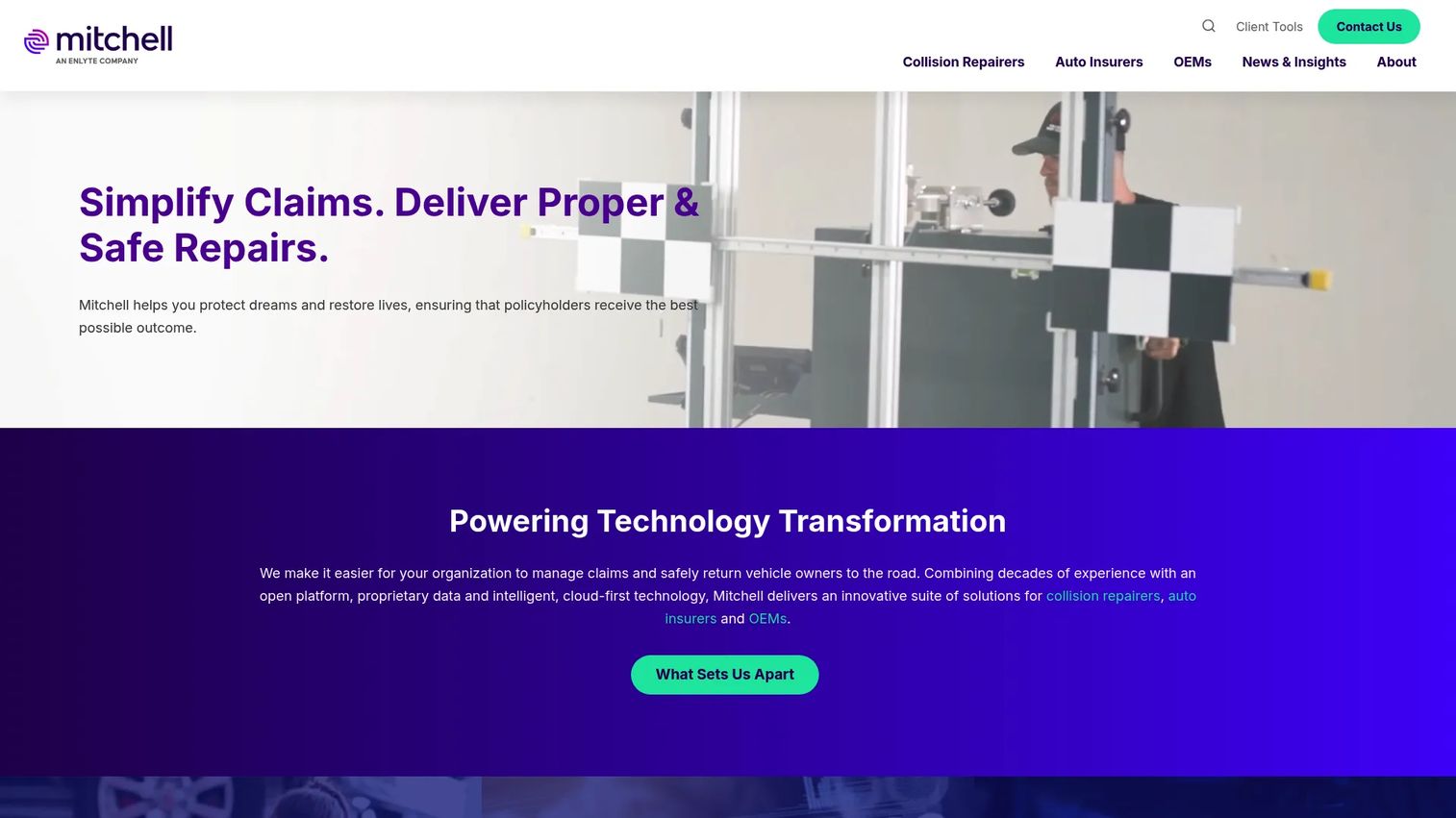
Mitchell builds auto physical damage, claims, and repair software for insurers, repairers, and OEMs, with workflows that reach into auto glass. If your shop lives inside the insurance claims process, this is the enterprise-grade end of the market. It is built around the data and procedures that insurer-driven glass work depends on, not around simple booking and billing.
Best for: Claims-heavy auto glass and repair operations that work closely with insurers and need NAGS and OEM data.
Key strengths
- Cloud-first claims and repair software: Runs the claim and repair workflow in one connected system so insurer-driven jobs move without manual re-entry.
- AI damage detection and assessment: Speeds up damage evaluation and helps standardize how jobs get quoted and approved.
- Integrated parts, pricing, and repair data: Connects parts, pricing, and repair procedures so estimates align with insurer expectations.
Why choose Mitchell: If a large share of your revenue depends on insurance approvals, the value is in standardized claims handling and access to the repair data insurers reference. This is glass replacement software built for the complexity of insurer workflows, OEM procedures, and calibration decisions, not for a shop that mostly takes cash jobs. It fits enterprise and claims-first operations best.
Mitchell pricing: Mitchell does not publish public pricing on its site. Plans are quoted based on your operation, so you will need to contact their team for a figure specific to your claims volume and workflow.
2. Glas-Avenue by Mainstreet Computers
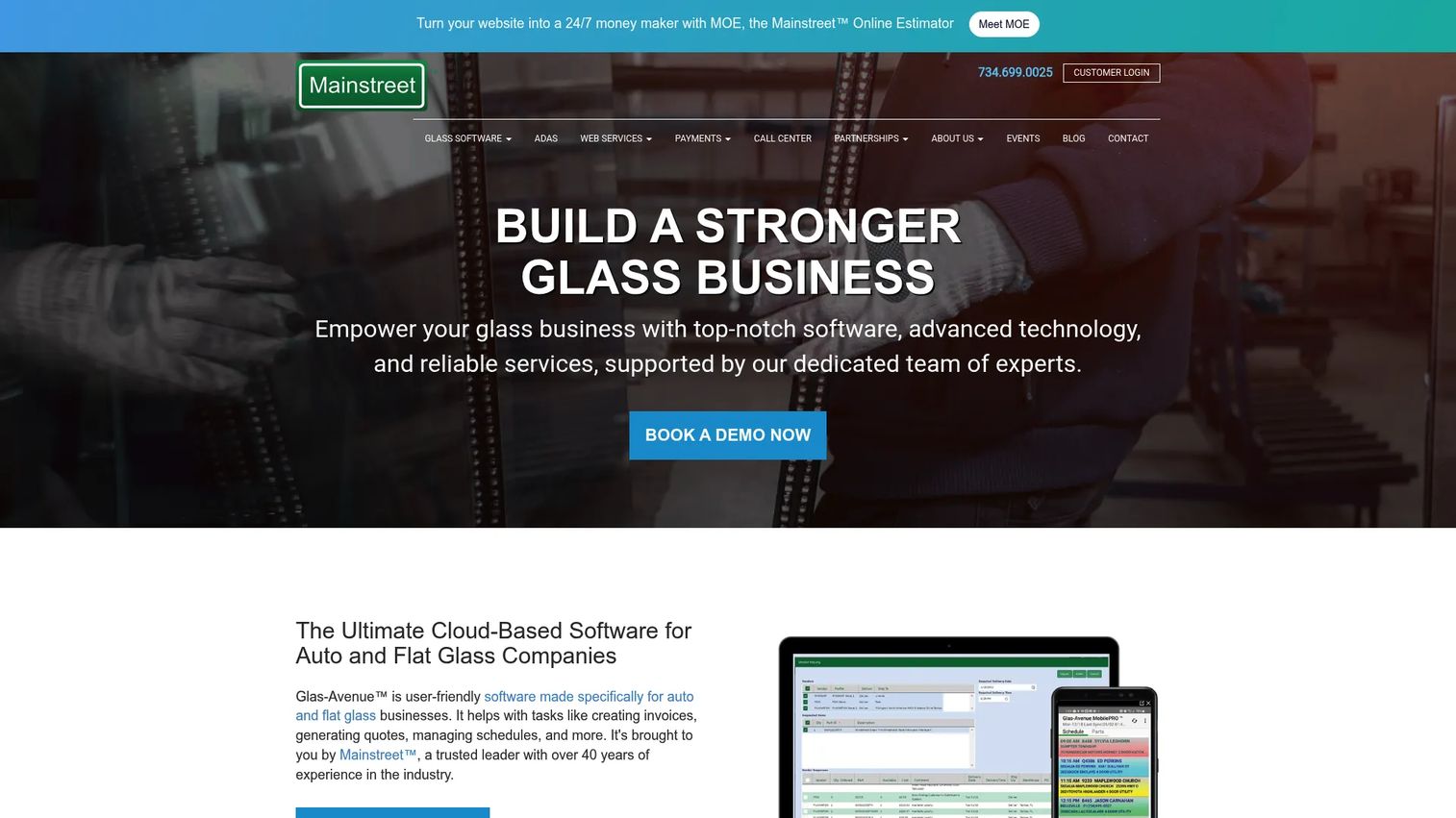
Glas-Avenue is a point-of-sale system built specifically for auto glass shops, with scheduling, inventory, and billing wrapped around the POS. If you want deeper operational control than a lightweight invoicing tool provides, this is the all-in-one glass shop management software end of the list. It is purpose-built for glass, not a generic POS repurposed for it.
Best for: Auto glass shops that want a glass-specific POS with scheduling, inventory, and billing in one system.
Key strengths
- Quote generation and billing control: Build quotes and manage billing inside the same POS that runs the counter.
- Inventory access: Track glass and parts inventory so quoting reflects what you actually have on hand.
- Scheduling and reputation management integration: Manage the calendar and connect reputation tools to keep review flow steady.
Why choose Glas-Avenue: For a shop that wants its counter, calendar, inventory, and billing under one roof, an all-in-one POS reduces the number of disconnected tools you maintain. It suits operators who want operational depth and are running enough volume to justify a full shop system rather than a single-purpose app.
Glas-Avenue pricing: Mainstreet Computers does not list public pricing for Glas-Avenue on its site. You will need to contact them for a quote based on your shop size and the modules you need.
3. EZnet Scheduler
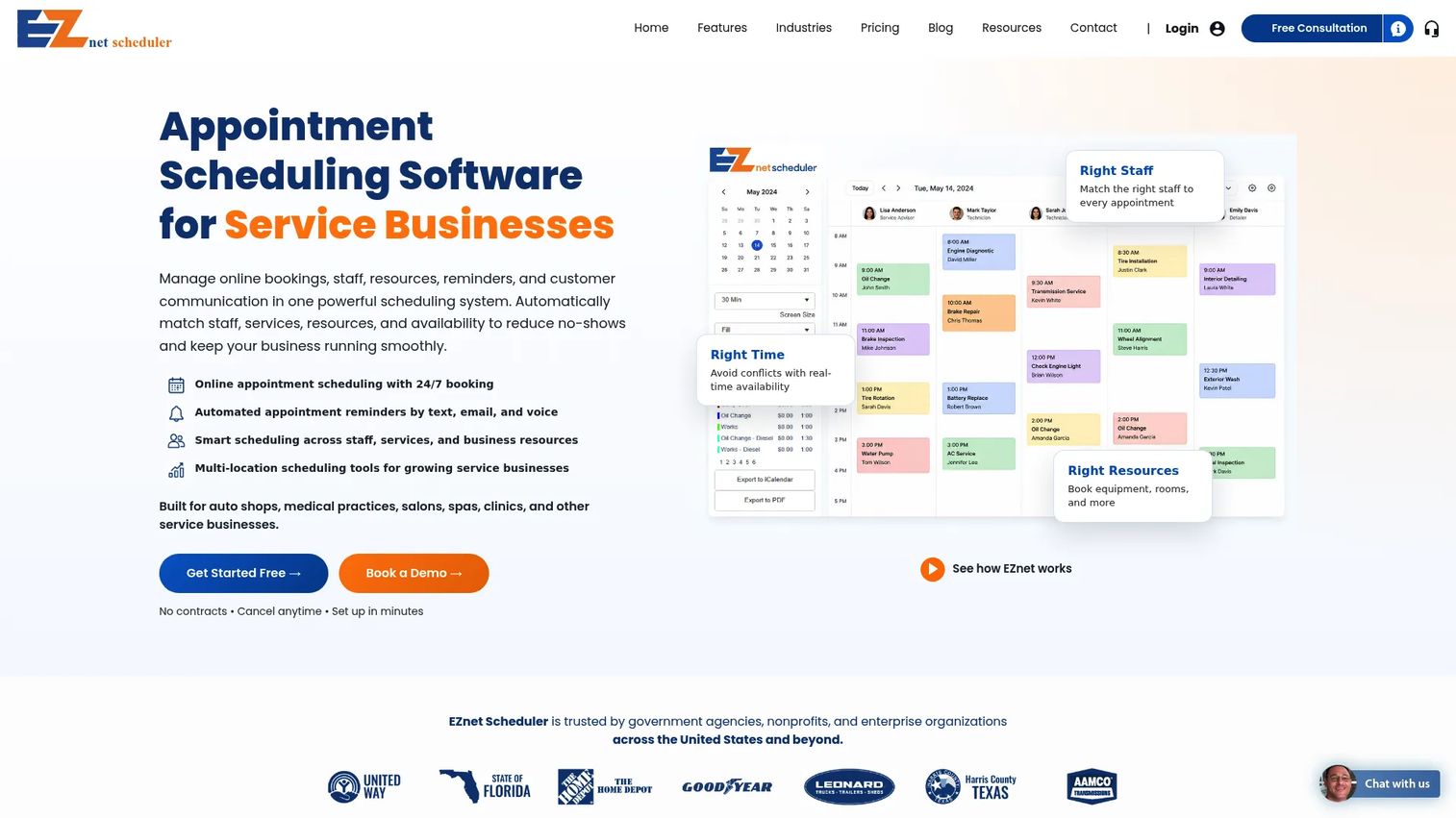
EZnet Scheduler is cloud-based appointment scheduling and task management software for service businesses, and it fits glass shops where booking and dispatch are the main pain. If your operation runs fine once a job is on the calendar but struggles to get jobs onto the calendar cleanly, this is glass scheduling software built for exactly that. It leans into booking, reminders, and status visibility.
Best for: Auto glass shops where appointment booking, reminders, and schedule management are the primary bottleneck.
Key strengths
- 24/7 online self-scheduling: Customers book their own slots around the clock, cutting inbound calls and phone tag.
- Automated reminders and notifications: Text and email reminders reduce no-shows and the follow-up calls that come with them.
- Broad calendar integrations: Connects with Google Calendar, Facebook, Shopify, Wix, and WordPress so booking meets customers where they are.
Why choose EZnet Scheduler: This is the tool to pick when the schedule itself is what is broken. It focuses on capacity management, customer communication, and status tracking rather than full shop accounting, so it pairs well with a separate billing system if you already have one you like. Booking-first shops get the most value here.
EZnet Scheduler pricing: There is a free Starter plan, a Basic plan at $49.95 per month, and a Standard plan at $69.95 per month, with a Power plan above that. Monthly and annual billing are both offered, with annual pricing available on the paid tiers.
4. AutoGlassCRM
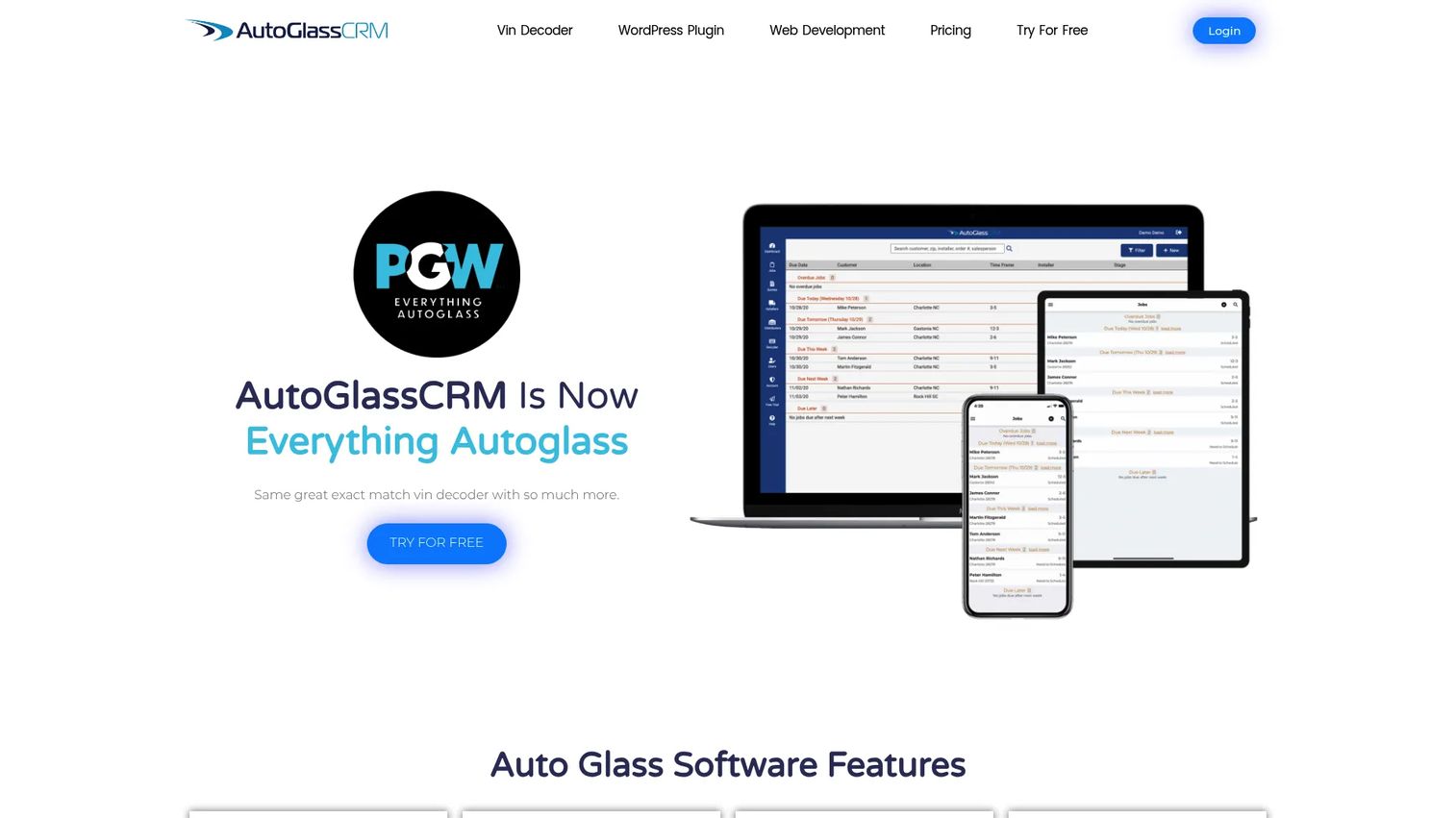
AutoGlassCRM is a CRM and quoting tool built specifically for auto glass shops, with VIN decoding and distributor pricing built in. If your gap is on the sales and customer side, tracking leads, following up, and turning quotes into booked jobs, this is the CRM-lite option on the list. It pairs customer management with the part-lookup and pricing tools glass shops actually use.
Best for: Auto glass shops that need tighter lead tracking and customer follow-up alongside VIN-based quoting.
Key strengths
- VIN decoder with feature filtering: Decode the vehicle and filter by glass features so you quote the right part the first time.
- Distributor part search: Look up parts across distributors without leaving the quoting flow.
- Auto glass pricing calculator: Build accurate quotes fast with a calculator built for glass pricing.
Why choose AutoGlassCRM: For teams that lose jobs in the gap between quote and booking, a CRM-oriented tool keeps follow-up from falling through the cracks. It combines that sales discipline with glass-specific quoting, which is a better fit than a generic CRM that knows nothing about VIN decoding or distributor pricing.
AutoGlassCRM pricing: The Premium Edition is listed at $34.99 per user per month, and the product page notes a 7-day free trial with no credit card required.
5. Auto Repair Boss
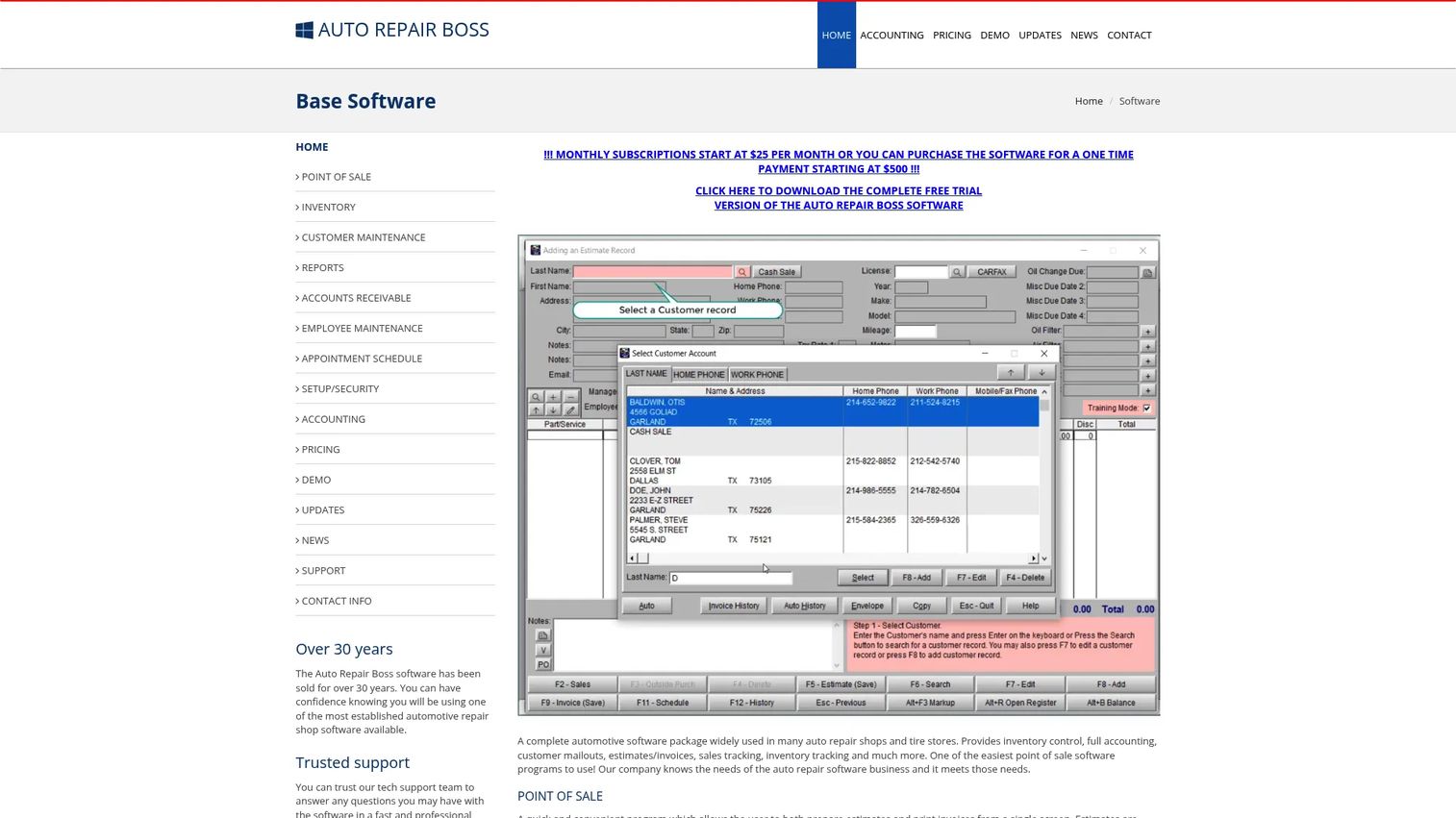
Auto Repair Boss is auto repair shop software covering inventory control, accounting, estimates, and invoicing, built as a locally installed system. It suits mixed-service repair businesses that also handle glass and want a lighter management stack they run on their own machines. If you prefer software that lives on your shop computer over a subscription cloud tool, this is a fit.
Best for: Small repair shops, including those doing some glass work, that want a locally installed shop management system.
Key strengths
- Inventory control and full accounting: Track parts and run the books inside the same system that handles jobs.
- Estimates and invoices: Build estimates and invoices without a separate tool.
- myCARFAX QuickVIN and vendor price sheet import: Pull vehicle data by VIN and import vendor pricing to keep quotes accurate.
Why choose Auto Repair Boss: The draw is a low monthly cost and a self-contained system that includes accounting and payroll modules. For a small mixed-service shop that handles glass among other repairs and wants a lighter stack without a big subscription, it is a straightforward option.
Auto Repair Boss pricing: Subscriptions start at $25 per month for Essentials, $35 per month for Pro, and $45 per month for Multi-User, with accounting, payroll, myCARFAX QuickVIN, program updates, and support included across plans. It holds a 3.5 out of 5 rating on G2.
6. CCC ONE
CCC ONE is collision repair estimating and shop management software built for repair facilities, with estimating, parts ordering, and shop workflows in one platform. It is relevant for larger collision environments that also handle glass and want that work inside the same system as their body repair operation. This is the enterprise collision end of the list.
Best for: Auto body and collision shops that need estimating, parts ordering, and shop management, including glass work, in one platform.
Key strengths
- Vehicle estimating and build sheets: Generate estimates and build sheets that standardize how jobs get quoted.
- Parts ordering and supplier network: Order parts through an integrated supplier network without leaving the workflow.
- Shop management workflows and invoicing: Run the shop floor and billing inside the same platform as estimating.
Why choose CCC ONE: If you already operate in the broader collision ecosystem, keeping glass work inside the same estimating and shop management platform avoids running a separate tool for it. It fits larger repair facilities where glass is one service among many rather than the whole business.
CCC ONE pricing: CCC does not publish public pricing on its site. You will need to contact their team for a quote based on your facility and workflow needs.
7. Tekmetric
Tekmetric is a modern auto repair shop management platform with scheduling, estimates, invoicing, digital inspections, and payments in one system. It is a broad shop management tool rather than a glass-only product, which makes it a strong fit for shops that do glass alongside other repair work and want current, well-rated software. Of the general repair platforms here, it carries the highest user rating.
Best for: Repair shops that want a modern all-in-one platform with strong workflow visibility, including teams handling related glass work.
Key strengths
- Shop management: Run scheduling, work orders, and job tracking in one connected workflow.
- Digital vehicle inspections: Capture inspections digitally and share them with customers to support approvals.
- Payments and invoicing: Handle estimates, invoicing, and payment collection inside the platform.
Why choose Tekmetric: The pull is a modern, well-rated system with strong operational coverage across the whole shop. For a business that does glass as part of a wider repair mix and wants one platform that handles the full workflow cleanly, it is a compelling choice. The tradeoff is that it is not glass-specific, so shops doing heavy claims or calibration work may still need dedicated tools alongside it.
Tekmetric pricing: Plans start at $199 per month for Start, $349 per month for Grow, and $439 per month for Scale, with a custom-priced Enterprise tier. Annual billing lowers those to $179, $309, and $409 per month respectively. It holds a 4.9 out of 5 rating on G2.
How to choose glass repair shop software
Before you commit, run each shortlisted tool through this checklist. The goal is not the longest feature list. It is the tool that removes your specific bottleneck without adding new ones.
Match it to your actual bottleneck
Name the thing that costs you the most hours right now. If it is booking and no-shows, weight scheduling. If it is unbilled work, weight invoicing and payments. If it is claims approvals, weight NAGS and OEM data. Buy for the bottleneck, not the brochure.
Check mobile and field access
If you run mobile technicians, confirm cross-device access, technician assignment, and on-site status updates before anything else. A tool that only works from the front desk will not serve a shop where the work happens in driveways.
Confirm claims and NAGS coverage if you need it
Insurer-driven work needs NAGS benchmark data, OEM procedures, and claims handling. If a meaningful share of your revenue runs through insurance, a lighter general tool will leave gaps. Verify this before you buy, not after.
Look at total setup and pricing clarity
Cloud tools with published pricing let you budget cleanly and start fast. Enterprise platforms with custom quotes often fit larger operations but take longer to stand up. Weigh time to first value against the depth you need.
Verify it fits how your team already works
The best glass management software is the one your team actually uses. Pick the tool that matches your current workflow closely enough that adoption is easy, so it earns its place in the shop within the first month.
Conclusion
The right pick comes down to the bottleneck you are solving, not the feature count. For claims-heavy shops that live inside insurer workflows, Mitchell and CCC ONE bring the NAGS, OEM, and estimating depth that work demands. When scheduling is what is broken, EZnet Scheduler focuses squarely on booking, reminders, and calendar sync.
For deeper operational control, Glas-Avenue delivers a glass-specific POS with scheduling and inventory, while AutoGlassCRM adds the sales and follow-up layer with VIN-based quoting. Auto Repair Boss suits a small mixed-service shop wanting a self-contained locally installed system, and Tekmetric is the modern all-in-one platform for shops running glass alongside broader repair work.
The next step is simple. Pick the two or three tools that map to your single biggest bottleneck, run them against a week of real jobs, and see which one removes the most manual coordination. That is the one worth buying.
FAQs
Glass repair software helps auto glass shops manage scheduling, work orders, invoicing, technicians, and customer communication in one system. Some tools focus on claims and repair data for insurer-driven work, while others focus on day-to-day operations like booking and billing. The best glass shop software for you depends on whether claims or operations is your main pain.
Prioritize scheduling, invoicing, mobile access, technician assignment, and status tracking, since those cover the core daily workflow. Add claims and NAGS support only if your shop handles insurer-driven work. Buying for your actual bottleneck beats buying for the longest feature list every time.
Yes, many auto glass scheduling software tools include online booking, calendar sync, and automated text or email reminders. Reminders and bay capacity tracking cut down on no-shows and the phone tag that comes with manual booking. For scheduling-first shops, this alone can pay for the tool.
Yes, most glass shop software includes invoicing, and many add estimates, payment links, tax handling, and custom invoice templates. The goal is to finish the job and send the invoice before the technician leaves, then collect payment without a follow-up call. Faster invoicing directly improves cash flow.
For shops doing repair and replacement work through insurers, yes. NAGS benchmark data and OEM procedures help standardize quoting and support calibration-related decisions, which keeps your estimates aligned with what insurers expect. Cash-only shops with little claims work can weight it lower.
Some do. Look for cross-device access, mobile apps, technician assignment, and on-site status updates as the key factors to verify before buying. Mobile field service software that keeps dispatch and the field in sync is essential if your work happens in driveways rather than a single bay.
Glass-specific tools usually handle replacement workflows, VIN-based glass quoting, claims, NAGS, and calibration better than general auto repair software. General platforms are broader and cover mixed-service shops well but may be less specialized for pure glass work. Shops doing heavy glass volume tend to prefer glass-specific tools.
Start with your current bottleneck, which is usually scheduling or invoicing. Small shops should favor easy setup, clear pricing, mobile access, and quick time to value over deep enterprise features. Test one or two glass software programs against a week of real jobs before you commit.