Your alumni data lives in six places. Contact records sit in the CRM. Event RSVPs sit in a spreadsheet. Mentoring sign-ups sit in a form nobody checks. Giving history sits with advancement. And when leadership asks how engagement is trending, you spend two days stitching numbers together instead of running the program.
That fragmentation is the real cost. Not the software line item, the wasted hours and the missed participation. Institutions running dedicated alumni engagement platforms report 34% higher alumni participation in annual giving and 47% higher virtual event attendance than teams relying on generic tools, according to Dataintelo's 2025 market analysis. The same report values the global alumni engagement platform market at $1.8 billion in 2025, projected to reach $5.2 billion by 2034 at a 12.5% CAGR. Money is flowing into this category because the manual approach stopped scaling.
The problem for a growth-minded advancement or alumni relations team is not awareness. You already know you need alumni management software. The hard part is choosing between platforms that all claim mentoring, events, giving, community, and analytics in one place. The differences are real, but vendors bury them under identical feature lists.
This guide cuts through that. Four platforms, ranked by where each one actually earns its keep, so you can shortlist without sitting through four discovery calls first.
What's inside
This is a ranked shortlist of four alumni engagement software platforms built for higher-education teams: PeopleGrove, e2s Connect, Hivebrite, and Gravyty. It is written for advancement, alumni relations, and growth marketers who own participation numbers and have to defend them to leadership.
We selected platforms on five criteria that separate an alumni engagement platform from a generic contact database: mentoring and career networking, giving and fundraising workflows, event and volunteer management, community and chapter tools, and analytics with clean CRM and SIS integration. Each section covers who the tool fits, its verified strengths, and what pricing information is publicly available.
TL;DR
- Best overall for higher-ed engagement plus reporting: PeopleGrove. The strongest fit if you want a broad alumni network platform with mentorship, experiential learning, and outcomes tracking in one place.
- Best all-in-one engagement system: e2s Connect. Built for institutions that want an alumni CRM-style hub with outreach, events, mentoring, and a mobile layer under one roof.
- Best branded alumni community platform: Hivebrite. The pick for teams building a private, white-label alumni portal with groups, chapters, events, jobs, and engagement scoring.
- Best AI-driven engagement and fundraising suite: Gravyty. Strongest for teams that want AI to draft communications across alumni, donor, and student audiences and reduce manual outreach.
What is alumni engagement software?
Alumni engagement software is a platform that helps educational institutions build relationships with graduates through mentoring, events, giving, community networking, and targeted communication, backed by reporting on participation and outcomes.
It sits on top of, or integrates with, the systems you already run. The point is to move alumni from a static contact list into an active alumni network platform where they mentor students, attend events, join affinity groups, and give.
Core capabilities most alumni management systems share:
- Mentorship and matching: connect alumni with students or younger alumni, with structured matching and messaging.
- Alumni giving and fundraising: donation flows, campaigns, and giving history that feed an alumni giving platform view.
- Events and volunteer workflows: registration, reminders, check-in, and volunteer sign-up for reunions and chapter events.
- Communities and chapters: groups organized by region, class year, industry, or affinity, often inside a branded portal.
- CRM and SIS integration: two-way sync with advancement CRMs and student information systems so records stay clean.
- Analytics and engagement scoring: participation dashboards, engagement scores, and CASE reporting alignment for leadership.
The category overlaps heavily with what buyers call alumni relations software and alumni community platform tools. The label matters less than the workflows the platform actually runs. What separates strong alumni software from a rebranded email tool is personalization and segmentation: the ability to reach the right cohort with the right ask, then prove the result.
When to use alumni engagement software
Not every institution needs a full platform on day one. Here is when the switch pays for itself.
Centralize alumni data and outreach
When your alumni records are split across a CRM, event tools, and spreadsheets, every campaign starts with data cleanup. An alumni management system that syncs with your advancement CRM and SIS gives you one profile per person, with activity, giving, and engagement in one view. That single source is the prerequisite for real segmentation. Without it, personalization is guesswork.
Increase participation in mentoring, events, and giving
If your engagement is one newsletter and one gala a year, a platform helps when the goal shifts to recurring participation. Alumni networking software with mentoring, chapters, and event workflows turns passive contacts into active participants. The recurring touchpoints, not the one-off blast, are what move giving and attendance numbers over time.
Prove ROI and report engagement to leadership
When your president or VP wants measurable outcomes, engagement scoring and dashboards stop being nice-to-haves. You need to show participation trends, event attendance, mentoring matches, and giving lift, ideally mapped to CASE reporting standards. A platform that produces that reporting without a two-day export exercise is worth the switch on its own.
Comparison table
Four platforms, sorted by overall fit for higher-ed alumni teams. Pricing for this category is almost always quote-based, so treat the pricing column as guidance and confirm current figures with each vendor.
| # | Product | Intent | Key differentiation | Pricing | G2 rating |
|---|---|---|---|---|---|
| 1 | PeopleGrove | Broad engagement plus outcomes | Mentorship, experiential learning, and career readiness in one platform | Quote-based | 4.5/5 |
| 2 | e2s Connect | All-in-one engagement hub | CRM-style engagement modules with a mobile layer | Not publicly listed | Not listed |
| 3 | Hivebrite | Branded alumni community | White-label private community with events, jobs, and directory | Quote-based | 4.3/5 |
| 4 | Gravyty | AI engagement and fundraising | AI-drafted communications across alumni, donor, and student audiences | Custom pricing | 4.4/5 |
1. PeopleGrove
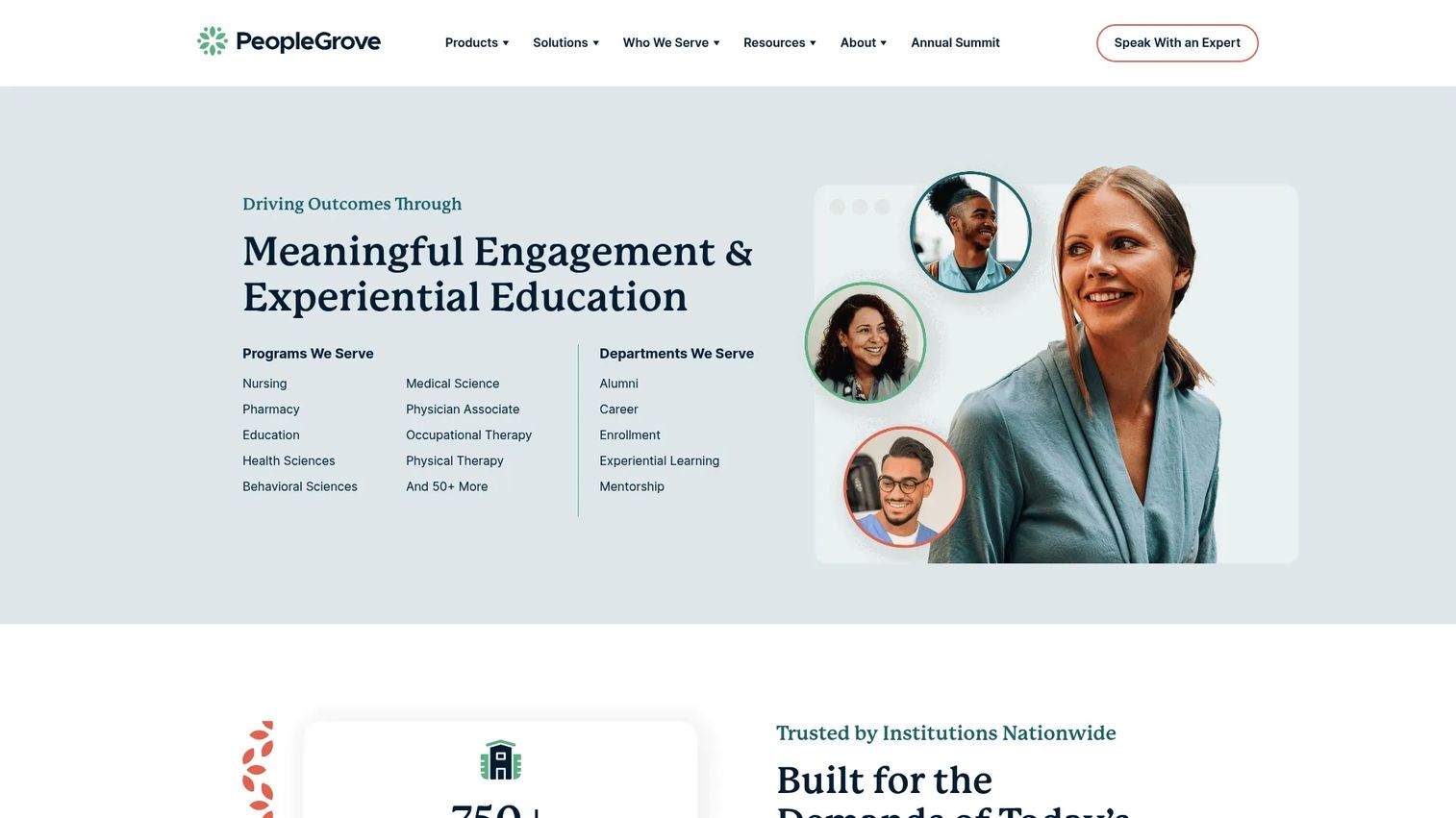
PeopleGrove is a higher-education engagement platform that connects alumni, students, and staff around mentorship, experiential learning, career readiness, and student success. It positions itself less as a pure alumni tool and more as a full learner-engagement layer, which is why it fits institutions that want alumni engagement and student outcomes running on the same rails. If your advancement and career-services teams are tired of working in separate systems, this is the platform that pulls them together.
The core strength is mentorship. PeopleGrove's matching and communication tools let alumni mentor current students and younger graduates at scale, with structured programs rather than ad-hoc introductions. Around that sits community building, experiential education tracking, and competency mapping, so engagement ties back to measurable readiness and success metrics. For teams that report against CASE reporting standards, having engagement and outcomes in one place shortens the path from activity to board-ready numbers.
Best for: Colleges and universities that want a unified learner-engagement and outcomes platform spanning alumni, mentoring, and career readiness.
Key strengths
- Mentorship at scale: structured matching and messaging that turns alumni goodwill into repeatable mentoring programs.
- Experiential education tracking: competency and outcomes tracking so engagement connects to student success, not just event counts.
- Community and engagement layer: affinity communities and alumni networking software that keep graduates active across class years and industries.
Why choose PeopleGrove
Choose PeopleGrove when engagement and outcomes need to live together. It is the strongest fit for institutions that treat alumni mentoring as part of the student success mission, not a separate marketing program. If your priority is proving that alumni involvement moves career and retention metrics, the unified data model does the heavy lifting that a standalone mentoring software cannot. The 4.5/5 G2 rating reflects that breadth resonating with higher-ed teams.
PeopleGrove pricing: PeopleGrove does not publish public pricing. The site invites institutions to speak with an expert for a tailored quote, and pricing terms appear only in individual order forms. Expect a quote-based model scoped to your institution size and module needs. Confirm current figures and included modules directly with their team before you budget.
2. e2s Connect
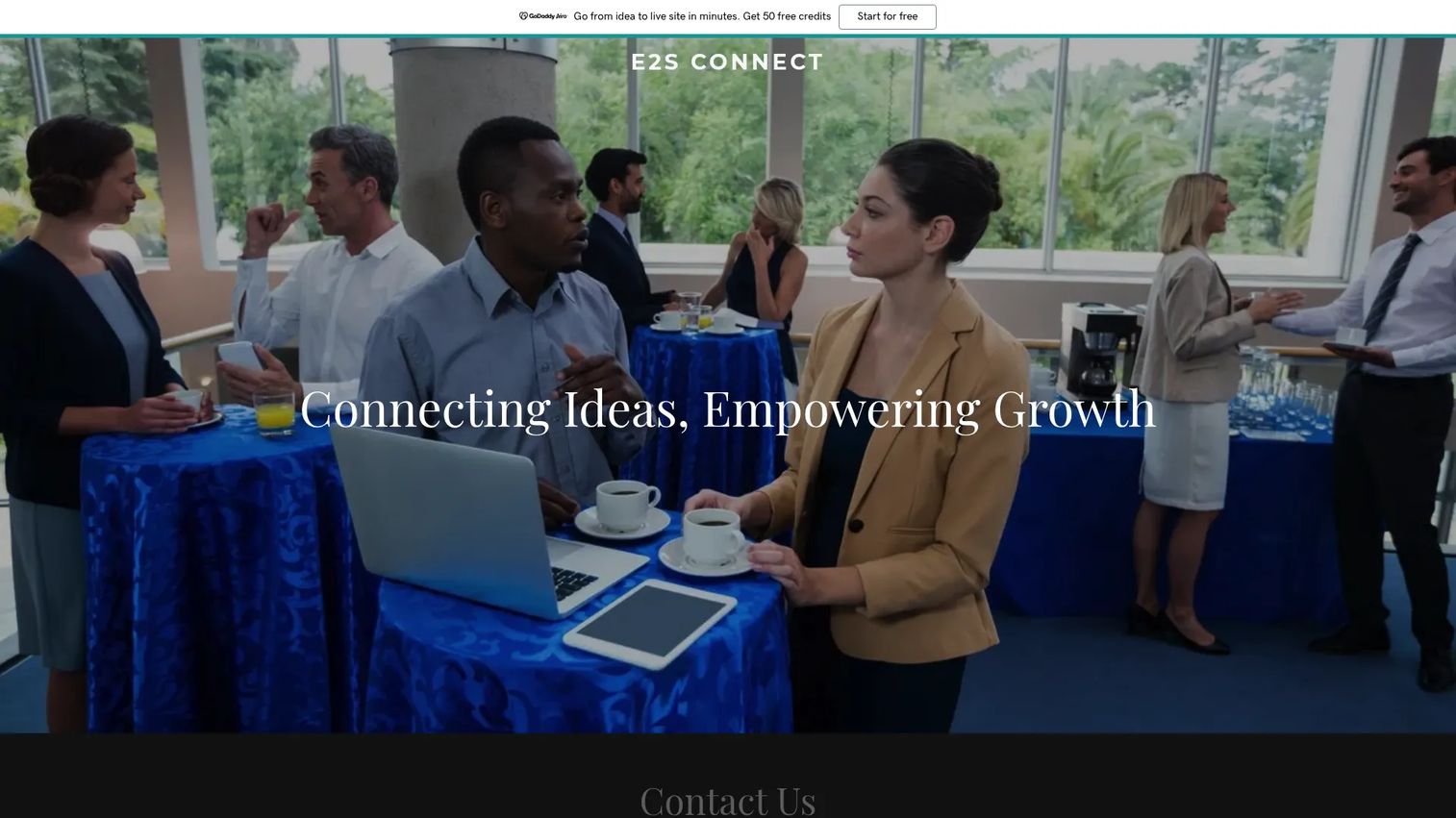
e2s Connect is positioned as an all-in-one alumni engagement platform that brings outreach, events, mentoring, giving, and community into a single CRM-style hub with a mobile layer on top. The pitch is consolidation: instead of running an alumni CRM, an event tool, a mentoring platform, and a separate app, you run one system where alumni profiles, communications, and activity live together. For lean alumni offices juggling five logins, that single-system framing is the draw.
The platform leans toward breadth. Engagement modules cover persona-based outreach, event registration and management, mentoring connections, and an alumni job board, with dashboards to track activity across them. A mobile app extends the experience so alumni can engage from their phones rather than only from a desktop portal. That mobile-first layer matters when younger alumni are the cohort you are trying to activate, since they rarely open a browser-based portal.
Best for: Institutions that want broad alumni engagement, outreach, events, mentoring, and giving in one CRM-style system with a mobile layer.
Key strengths
- All-in-one modules: outreach, events, mentoring, giving, and community in a single hub rather than a patchwork of tools.
- Mobile-first engagement: a companion app that meets younger alumni where they actually spend time.
- Persona-based outreach: segmentation that targets the right cohort with the right message instead of one blast to everyone.
Why choose e2s Connect
Choose e2s Connect when consolidation is the goal and you want fewer vendors, not more. It fits teams that would rather manage one engagement hub than integrate several point tools. Because independent review coverage for the product is still thin, treat your evaluation as a hands-on one: run a scoped pilot, test the CRM integration and mobile app with real alumni data, and confirm the modules you need are production-ready for your use case before committing.
e2s Connect pricing: Public pricing was not available at the time of writing, and independent rating data was limited. Request a scoped quote and a live walkthrough, and ask specifically about implementation timelines, data migration, and CRM and SIS integration support so there are no surprises after signature.
3. Hivebrite
Hivebrite is an all-in-one community management platform used widely for branded, private alumni communities. Where some tools bolt community onto a CRM, Hivebrite starts from the community itself: a white-label alumni portal you control, with your branding, your rules, and your data. That makes it a strong alumni community platform for institutions that want alumni to experience a destination that feels like theirs, not a generic vendor page.
The feature set is deep. You get groups and chapters organized by region, class year, or affinity, plus events, an alumni job board, mentoring, a member directory, and messaging. AI recommendations surface relevant connections and content, and analytics with engagement scoring show who is active and who is drifting. Memberships and payments run natively, so a community can support both free lifelong alumni access and paid tiers where that model fits. Governance and security controls make it workable for institutions with real compliance requirements.
Best for: Institutions building a branded, private alumni community with groups, chapters, events, jobs, and strong governance.
Key strengths
- White-label community: a branded private portal that alumni recognize as your institution, not a third-party tool.
- Full engagement stack: groups, chapters, events, jobs, directory, mentoring, and messaging in one alumni community platform.
- Engagement scoring and analytics: activity data and scoring so you can see participation trends and act on them.
Why choose Hivebrite
Choose Hivebrite when brand control and community depth are the priority. It is the pick for teams that want alumni engagement to happen inside a portal they own, with the governance and security to back it. The membership and payments capability also suits institutions that run tiered access or paid affinity groups. The 4.3/5 G2 rating reflects a mature platform that handles broad participation and multi-stakeholder programs, though the community-first breadth means you should scope which modules you will actually operate.
Hivebrite pricing: Hivebrite does not publish standard SaaS subscription pricing on its site. Publicly visible membership options on Hivebrite-hosted communities include free lifelong memberships, but vendor-level pricing for institutions is quote-based. Contact their team for a tailored quote and confirm what is included at your scale.
4. Gravyty
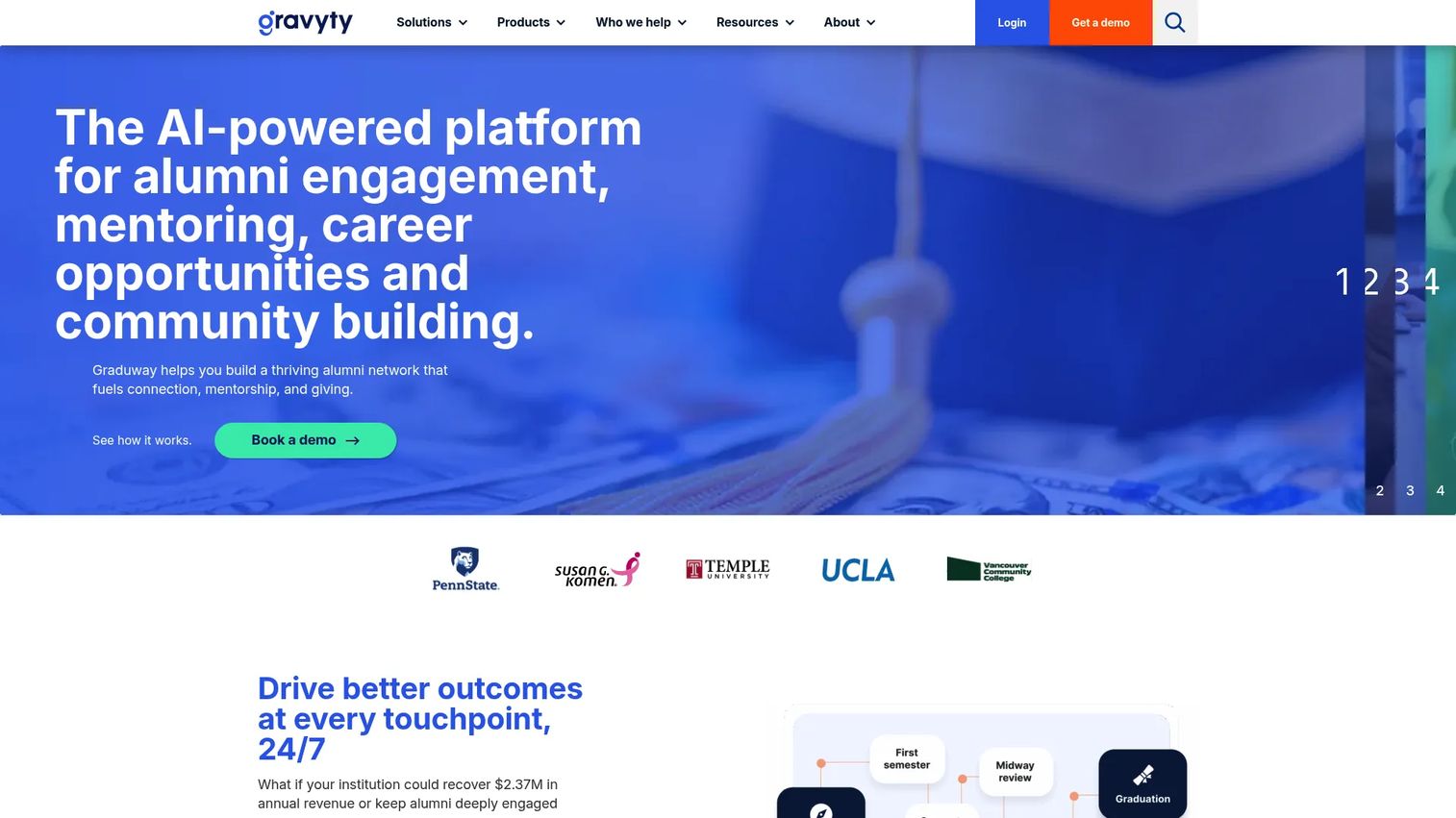
Gravyty is an AI-powered engagement and fundraising platform serving higher education, nonprofits, and K-12. Its differentiation is AI applied to the grunt work: drafting personalized communications across alumni, donor, and student audiences so advancement teams spend less time writing outreach and more time on relationships. If your team's bottleneck is the sheer volume of personalized messages you cannot physically write, Gravyty is built to attack exactly that.
Beyond AI-drafted communications, Gravyty offers alumni and donor engagement tools plus a no-code workflow builder, so teams can automate outreach sequences without engineering support. That combination makes it an alumni fundraising software option first and an engagement suite second. For institutions where giving is the priority metric and the advancement office is stretched thin, the AI drafting and automation can meaningfully cut manual load. Its own resources also make it a useful reference point when evaluating what an alumni engagement platform should cover.
Best for: Institutions that want an AI-driven engagement suite for student, alumni, and donor communications, with fundraising as a core focus.
Key strengths
- AI-powered communications: drafts personalized outreach across alumni, donor, and student audiences to cut manual writing time.
- Alumni and donor engagement: tools built around giving, making it a natural alumni giving platform for advancement teams.
- No-code workflow builder: automate outreach sequences and engagement journeys without waiting on IT.
Why choose Gravyty
Choose Gravyty when fundraising and outreach volume are the constraints. It fits advancement teams that need to send more personalized communication than headcount allows and want AI to close that gap. The multi-audience scope, alumni, donor, and student, suits institutions consolidating communications across offices. The 4.4/5 G2 rating reflects teams valuing the time saved on drafting and automation, which is often the difference between a campaign that ships and one that stalls.
Gravyty pricing: Gravyty states pricing is customized and requires contacting sales for a demo and quote. There is no public numeric pricing. Ask for a quote scoped to your audiences and volume, and clarify which AI and workflow features are included at your tier before you commit.
Considerations before you buy
The feature lists all look similar on a website. These are the criteria that actually decide whether a platform works for your team.
Implementation effort and data migration
Migrating years of alumni records is where projects stall. Ask each vendor how migration works, who owns data cleanup, and how long onboarding takes. A platform that looks great in a demo but needs six months to go live can miss an entire giving cycle.
CRM and SIS integration
Your platform has to talk to your advancement CRM and student information system, ideally with two-way sync. Confirm which systems are supported natively and which need custom work. Weak CRM integration or SIS integration reintroduces the exact data fragmentation you are trying to escape.
Customization and branding
Decide how much a white-label alumni portal matters. Some institutions need full brand control; others are fine with a lightly branded hub. Match the platform's customization depth to what your marketing and communications teams will actually maintain.
Reporting and engagement scoring
Reporting is what you show leadership. Check that dashboards, engagement scoring, and CASE reporting alignment produce the numbers your board expects without a manual export. If reporting is shallow, you will rebuild it in spreadsheets anyway.
User adoption
The best platform fails if alumni and staff do not use it. Weigh the alumni-facing experience, mobile access, and how easily your team can run campaigns. Adoption, not feature count, decides whether participation actually moves.
Conclusion
The right alumni engagement platform depends on which problem you are solving first, not on which feature list is longest.
If you want engagement and student outcomes on one platform with strong mentoring and reporting, PeopleGrove is the broadest fit. If consolidation into one CRM-style hub with a mobile layer is the goal, e2s Connect is built for that all-in-one approach. If a branded, private community you fully control is the priority, Hivebrite is the strongest alumni community platform of the four. And if fundraising and outreach volume are your constraints, Gravyty's AI-drafted communications directly attack that load.
For most teams, the honest next step is to shortlist one or two based on your top priority, whether that is mentoring, community, fundraising, or reporting, then book demos with real alumni data in front of you. Pressure-test the CRM and SIS integration, the reporting depth, and the alumni-facing experience before you sign. The best alumni management software is the one your team and your graduates will actually use, and that only shows up in a hands-on evaluation, not a sales deck.
FAQs
Alumni engagement software focuses on active relationships: mentoring, events, giving, community, and communication that drive participation. Alumni management software often emphasizes record-keeping and database management. In practice most modern platforms do both, so the labels overlap. What matters is whether the tool actually runs the engagement workflows you need, not which term the vendor uses.
Prioritize mentoring and matching, giving and fundraising workflows, event and volunteer management, community and chapter tools, and analytics with engagement scoring. Underneath all of that, CRM and SIS integration and strong personalization and segmentation are what separate a real platform from a glorified email tool. If a platform cannot segment and sync cleanly, the other features underperform.
It structures what used to be ad-hoc. Matching tools pair alumni with students or younger graduates based on industry, interests, or goals, then messaging and program tools keep those connections active. Alumni networking software with directories and affinity groups also lets graduates find each other, which drives organic career networking without staff running every introduction.
Yes, when giving is tied to engagement rather than treated as a standalone ask. Institutions using dedicated alumni engagement platforms report 34% higher alumni participation in annual giving than teams on generic tools, per Dataintelo's 2025 analysis. An alumni giving platform that connects participation data to campaigns lets you target the right donors with the right ask at the right time.
Look for native, two-way sync with your advancement CRM and student information system so records stay clean automatically. Common integration targets include major advancement CRMs and fundraising databases. Confirm whether integrations are prebuilt or require custom development, since custom work adds time and cost. Weak CRM integration or SIS integration reintroduces the data fragmentation you are trying to fix.
Track participation lift across mentoring matches, event attendance, community activity, and giving, then compare against your pre-platform baseline. Engagement scoring and dashboards make this measurable rather than anecdotal. For leadership, map results to CASE reporting standards so the numbers are comparable across cycles and defensible in a board meeting.
It depends on how much brand control matters to your institution. A white-label alumni portal makes the community feel like an extension of your campus, which can lift trust and adoption among graduates. If brand experience and data ownership are priorities, it is worth the investment. If you need to launch fast with minimal maintenance, a lighter branded hub may serve you better.
Smaller offices should weigh ease of use, fast implementation, and low ongoing maintenance more heavily than deep customization. A platform that one or two staff can run without IT support usually beats a feature-rich system that needs a dedicated admin. Larger institutions can prioritize governance, multi-stakeholder workflows, and advanced reporting because they have the headcount to operate them.