Your EDR agents cover the endpoints. Your SIEM ingests the logs. And yet an attacker who lands inside the perimeter can move laterally for weeks before anyone notices, because nothing is watching the wire between hosts. That blind spot is exactly where network detection and response software lives.
The pressure is not theoretical. The NDR software market is projected to grow from USD 4.12 billion in 2026 to USD 12.77 billion by 2035, a 13.4% CAGR, according to Business Research Insights (2026). Buyers are spending on this category because endpoint and log coverage alone leave gaps, and because encrypted, east-west traffic keeps growing as a hiding place for threats.
For presales teams and technical validators, the hard part is not knowing the category exists. It is choosing between vendors whose marketing pages all read the same. Every NDR vendor claims deep visibility, AI-assisted triage, and automated response. Very few pages tell you how the telemetry is collected, where the sensors sit, or how the tool actually fits into an existing SOC visibility stack.
This guide is built to help you run a real evaluation, not skim a leaderboard. If your work spans technical discovery, POC support, and stakeholder alignment, the same evaluation discipline shows up in how you build product tours and validation environments. Teams that live in that world often pair a guided interactive demo narrative with hands-on validation. If AI-driven detection is central to your buying criteria, our roundup of best ai cybersecurity solutions is a useful companion. We will keep the focus here on NDR architecture, response capability, telemetry coverage, and SOC integration.
What's inside
This is a buyer-oriented shortlist for security teams and technical validators evaluating network detection and response solutions in 2026. It is not a marketing roundup. We selected the nine tools based on four criteria that matter during real evaluations: telemetry model and coverage of north-south and east-west traffic, detection approach including behavioral analytics and anomaly detection, response workflow and automation depth, and how cleanly each fits into an existing SIEM, EDR, and XDR stack. Pricing across this category is quote-based, so we note that plainly rather than guessing. Use the comparison table to sort by architectural fit, then read the sections that match your environment.
TL;DR
- Best overall for evidence-rich investigations: Corelight, built on open Zeek telemetry that threat hunters can actually query.
- Best for performance plus security visibility: ExtraHop, which pairs real-time packet processing with network observability.
- Best for AI-driven, multi-surface detection: Vectra AI, covering network, identity, and cloud behavior in one platform.
- Best for autonomous response: Darktrace, using self-learning models to act on anomalies in real time.
- Best for existing Fortinet stacks: FortiNDR, which slots into the Security Fabric.
- Best for Cisco-heavy enterprises: Cisco Secure Network Analytics, using native Cisco telemetry across network and cloud.
- Best for stack consolidation: Rapid7 InsightIDR, Stellar Cyber, and Palo Alto Cortex XDR, when NDR is one signal inside a broader detection and response platform.
What is network detection and response software?
Network detection and response software is a security tool that continuously monitors network traffic to detect, investigate, and respond to threats that other controls miss. It analyzes packet data and metadata across traffic flows, builds a behavioral baseline of what normal looks like, and flags anomalies that signal compromise, lateral movement, or data exfiltration.
NDR sits in the SOC visibility stack alongside endpoint detection and response (EDR) and security information and event management (SIEM). EDR watches endpoints, SIEM aggregates logs, and NDR watches the network itself. Together they form the visibility triad that many security teams use as a reference model.
Core capabilities buyers expect from NDR cybersecurity tools:
- Traffic analysis: Deep inspection of packet and metadata across both north-south (perimeter) and east-west (internal, host-to-host) traffic.
- Behavioral analytics: Baselining and anomaly detection that surface threats without relying only on known signatures.
- Threat detection: A mix of behavioral heuristics, machine learning, and threat intel feeds to catch known and unknown attacks.
- Response: Automated or analyst-driven actions, incident aggregation, and AI-assisted triage to cut investigation time.
- Integration: Bidirectional workflows with SIEM, EDR, XDR, and SOAR so detections become action.
Common deployment models include on-prem sensors, cloud-delivered SaaS, and hybrid combinations. Cloud-based NDR held roughly 65% of software share in 2023, and large enterprises accounted for around 70%, according to Business Research Insights (2026).
When to use network detection and response tools
Detect lateral movement and insider threats
Once an attacker is inside, they pivot host to host across east-west traffic that never crosses the perimeter. EDR may miss it if the agent is evaded or absent, and logs may not capture it at all. NDR watches the internal network directly, so lateral movement, credential abuse, and insider misuse surface as behavioral anomalies rather than going unseen.
Add visibility where EDR and SIEM miss network behavior
Unmanaged devices, IoT, OT gear, and BYOD endpoints often cannot run an EDR agent. SIEM only sees what is logged. NDR captures traffic regardless of whether a device can be instrumented, which closes coverage gaps across the estate. This is why NDR is treated as the third leg of the SOC visibility triad rather than a nice-to-have.
Standardize response across hybrid, cloud, and on-prem environments
Modern estates span data centers, multiple clouds, and remote sites. Fragmented monitoring means fragmented response. NDR solutions that support hybrid deployment give you one detection and response model across north-south and east-west traffic, wherever it flows, so the SOC works from a consistent picture instead of stitching tools together per environment.
Comparison table
The table below sorts the nine tools by architectural intent and primary use case. Pricing across this category is quote-based, so contact each vendor for a figure tied to your deployment. G2 ratings reflect current listings where verified.
| # | Product | Intent | Key use case | Pricing | G2 rating |
|---|---|---|---|---|---|
| 1 | Corelight | Open, evidence-based NDR | Threat hunting on Zeek telemetry | Quote-based | 4.6/5 |
| 2 | ExtraHop | Wire-data analytics | Security plus network observability | Quote-based | 4.6/5 |
| 3 | Vectra AI | AI-driven detection | Network, identity, and cloud coverage | Quote-based | 4.3/5 |
| 4 | Darktrace | Autonomous response | Anomaly detection and SOC augmentation | Quote-based | Not listed |
| 5 | FortiNDR | Fabric-integrated NDR | IT/OT detection in Fortinet stacks | Quote-based | Not listed |
| 6 | Cisco Secure Network Analytics | Telemetry-based analytics | Enterprise Cisco environments | Quote-based | 4.4/5 |
| 7 | Rapid7 InsightIDR | SIEM/XDR with NTA | Consolidated detection and response | Quote-based | 4.4/5 |
| 8 | Stellar Cyber | Open XDR | Network, endpoint, and cloud correlation | Quote-based | 4.9/5 |
| 9 | Palo Alto Cortex XDR | XDR platform | Cross-signal detection at scale | Quote-based | 4.6/5 |
1. Corelight
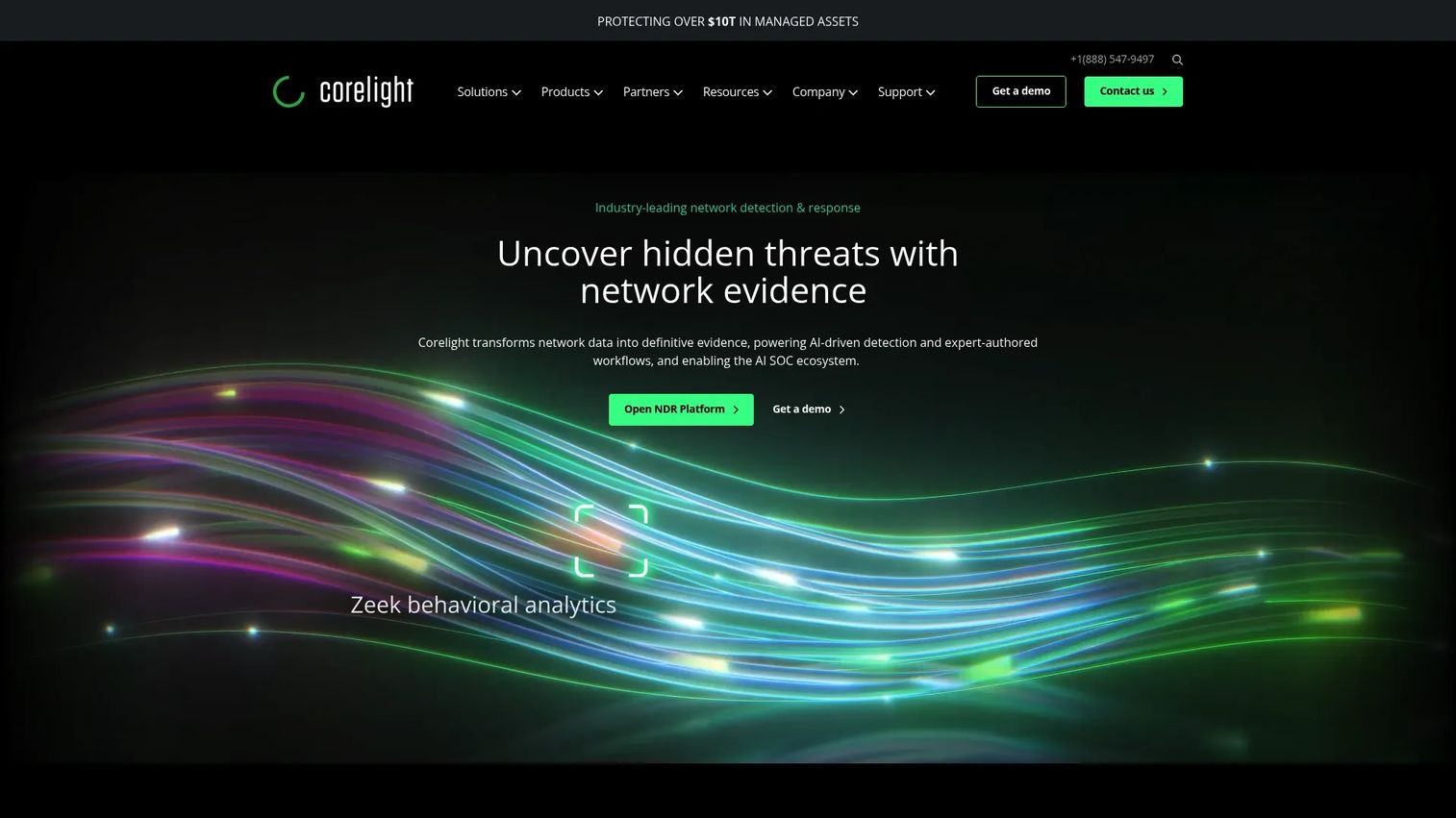
Corelight is an open NDR platform built for evidence-based network detection, investigation, and threat hunting. It generates rich network evidence from traffic, rooted in the open-source Zeek project, and turns it into structured data that analysts can query directly. For security teams that want to hunt rather than just receive alerts, that evidence trail is the differentiator.
Best for: Security teams that need network detection and response with evidence-rich investigations and hands-on threat hunting.
Key strengths
- Network visibility and evidence collection: Zeek-based telemetry produces detailed, queryable records of what happened on the wire.
- Threat detection and analytics: Behavioral analytics and detection logic layered on top of raw network evidence.
- Investigation and triage workflows: Structured data that plugs into SOC hunting and incident workflows.
Why choose Corelight: If your SOC has technical depth and wants to own its investigations, Corelight gives you the underlying evidence instead of a closed black box. Zeek familiarity is a real advantage here, which makes it a natural fit for larger, mature teams that value transparency in how detections are derived.
Corelight pricing: Corelight does not publish public plan prices. The site directs buyers to contact the company for a quote tied to sensor count and deployment scope. Corelight holds a 4.6/5 rating on G2.
2. ExtraHop
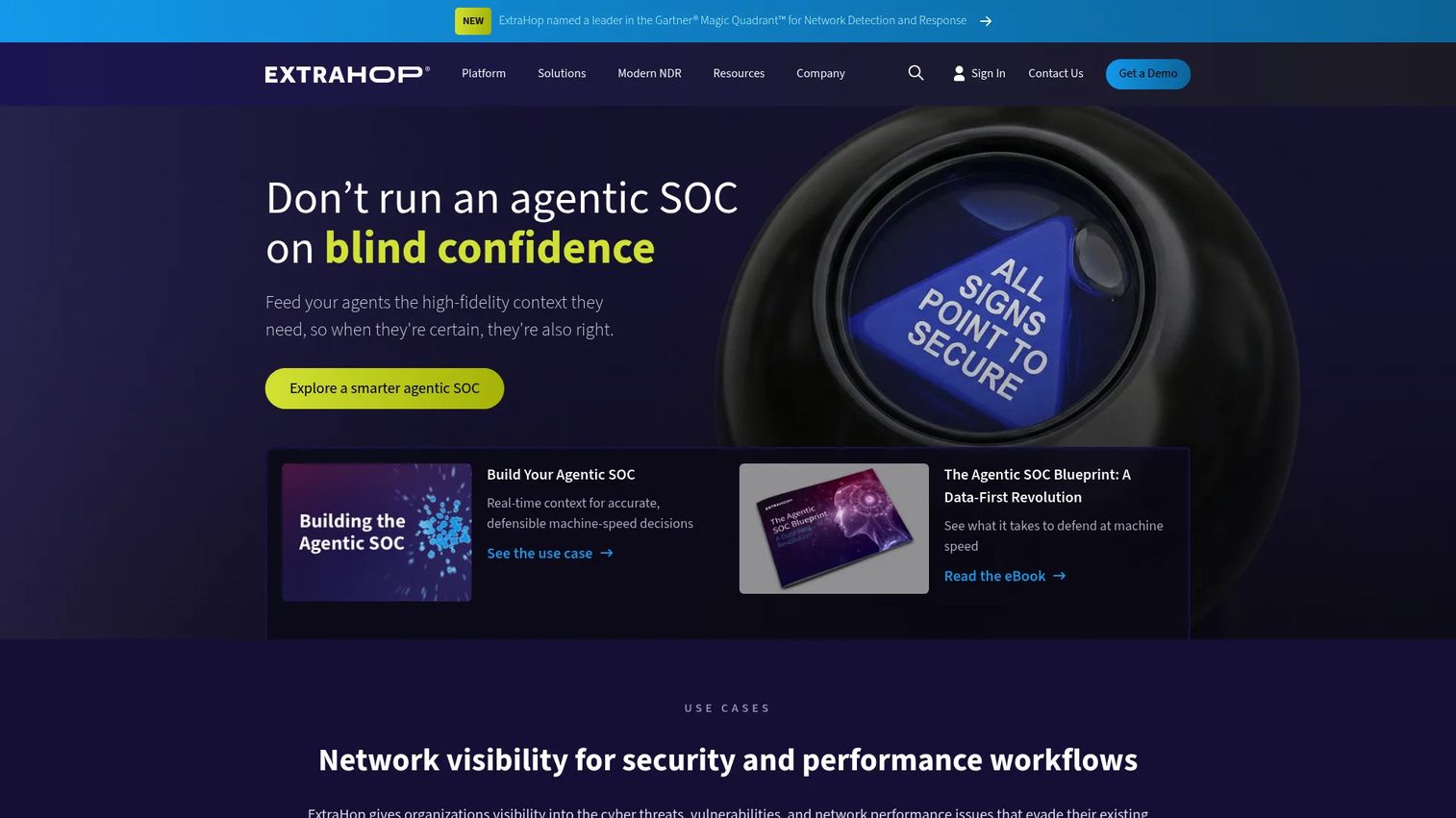
ExtraHop combines network detection and response with network performance monitoring in one platform. Its RevealX product processes wire data in real time to surface both security threats and operational issues, which appeals to teams that want security and network operations working from the same telemetry.
Best for: Enterprises that need network visibility for both security and performance operations from a single wire-data source.
Key strengths
- Network detection and response: Real-time analysis of network traffic for threat detection across north-south and east-west flows.
- Network performance monitoring: The same wire data drives operational visibility, not just security.
- Packet forensics: Deep packet-level investigation for high-fidelity incident analysis.
Why choose ExtraHop: ExtraHop fits teams that want detection precision plus performance context in one place. RevealX ships as SaaS-based RevealX 360 and on-premises RevealX Enterprise, so you can match the deployment to your environment rather than the other way around.
ExtraHop pricing: ExtraHop sells RevealX on a subscription basis and does not display a public price. Contact ExtraHop for a quote. The product holds a 4.6/5 rating on G2.
3. Vectra AI

Vectra AI is an AI-powered platform for detecting, investigating, and responding to attacks across network, identity, and cloud. Rather than treating the network in isolation, it correlates behavior across multiple attack surfaces, which is why it lands on so many enterprise shortlists where identity-based attacks are a top concern.
Best for: Midmarket and enterprise security teams that need AI-driven NDR and identity threat detection coverage in one platform.
Key strengths
- Unified visibility: Coverage spanning network, identity, cloud, SaaS, and IoT/OT in a single view.
- AI-driven detection and response: Behavioral analytics that prioritize real attacks and reduce alert noise.
- Posture improvement: Exposure reduction and attack-surface insight alongside detection.
Why choose Vectra AI: When attacks cross from network into identity and cloud, single-surface tools lose the thread. Vectra correlates those signals, which makes multi-surface attack detection its strongest argument in larger environments.
Vectra AI pricing: Vectra does not display public platform pricing and directs buyers to contact sales. A 45-day free trial is available for Vectra AI for Identity, though not the full platform. Vectra AI holds a 4.3/5 rating on G2.
4. Darktrace
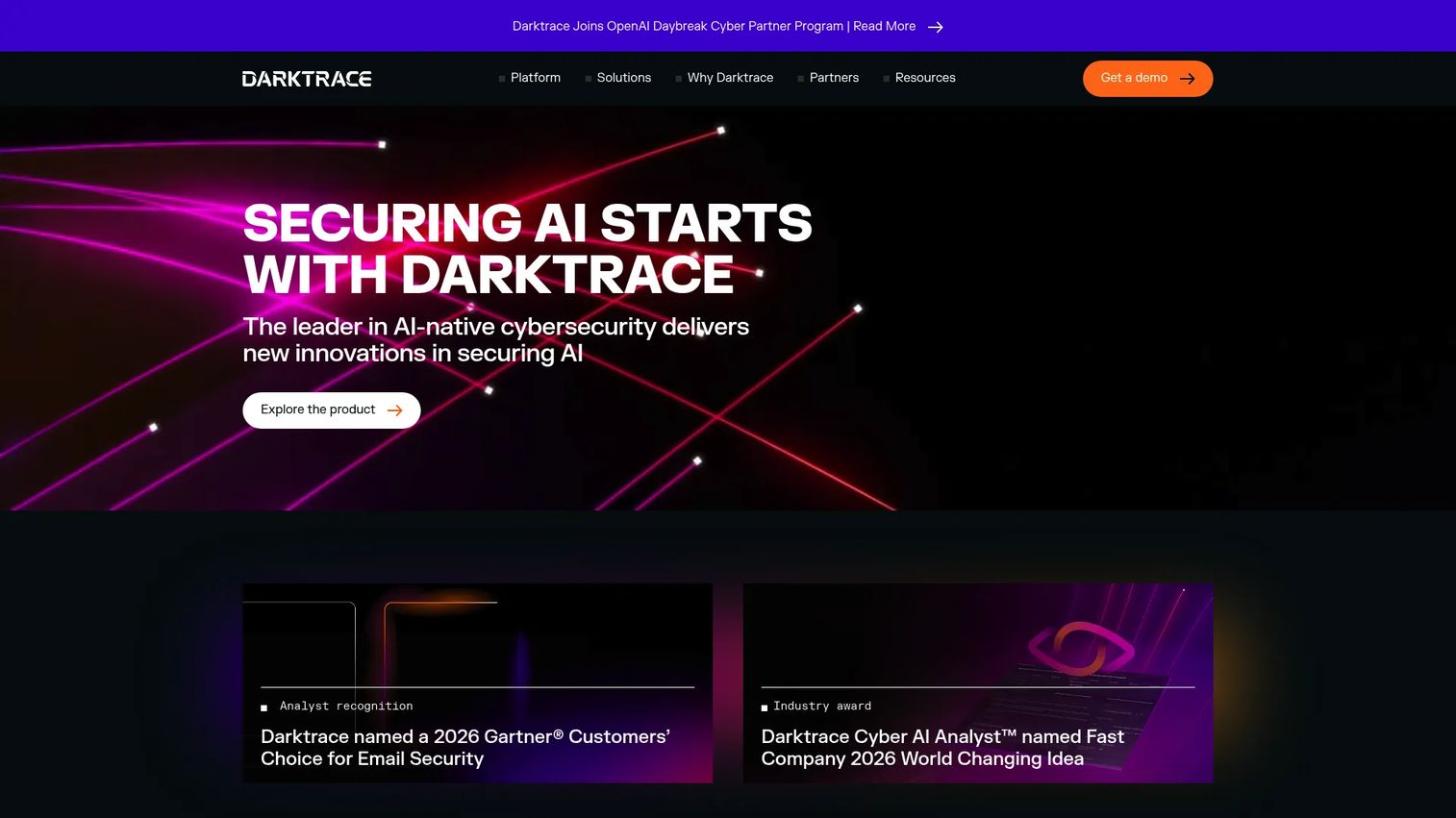
Darktrace is an AI-native platform for proactive detection and autonomous response across the enterprise. Its Self-Learning AI builds a model of normal behavior for every user and device, then flags and can act on deviations in real time. Buyers reach for it when they want the tool to contain threats without waiting on an analyst.
Best for: Mid-market and enterprise security teams that want AI-driven threat detection with autonomous response.
Key strengths
- Self-Learning AI: Learns normal behavior across the environment rather than relying only on predefined rules.
- Real-time detection and autonomous response: Can act on anomalies as they emerge to slow or stop an attack.
- Broad coverage: Spans email, network, cloud, OT, identity, endpoint, and AI systems.
Why choose Darktrace: For teams that use anomaly detection as their primary lens and want SOC augmentation through automated containment, Darktrace's autonomous response model is the draw. It suits environments where speed of response matters more than manual review of every alert.
Darktrace pricing: Darktrace does not publicly display pricing; it is quote-based and tied to environment scope. Contact Darktrace for a figure that matches your coverage needs.
5. FortiNDR
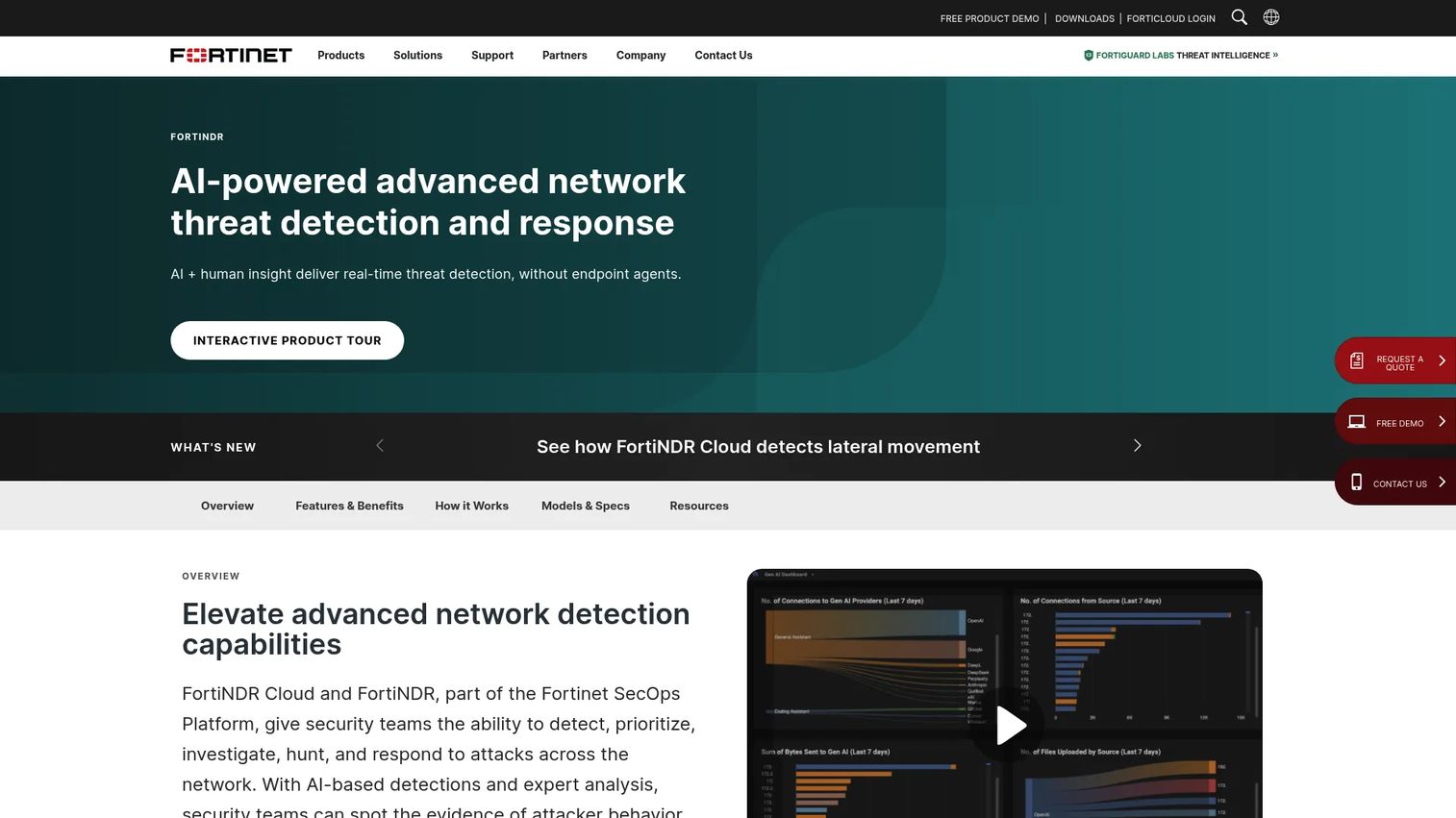
FortiNDR is Fortinet's network detection and response tool for detecting, investigating, hunting, and responding to threats across network traffic. Its main advantage for existing Fortinet customers is native integration with the Security Fabric, which turns detections into coordinated response across the wider stack.
Best for: Organizations that need NDR for IT and OT environments with strong on-prem or SaaS deployment options.
Key strengths
- AI/ML-based detection: Network anomaly and threat detection driven by machine learning.
- FortiGuard-updated detections: Coverage for weak ciphers, vulnerable protocols, JA3, botnets, and malicious web campaigns.
- Fabric integration: Works with the Fortinet Security Fabric and third-party tools for response automation.
Why choose FortiNDR: Teams standardizing on Fortinet often evaluate FortiNDR first because it reduces integration work and shares telemetry across the Fabric. If you are building a broader security stack around Fortinet, this is the path of least friction for adding network detection.
FortiNDR pricing: Fortinet does not publish public prices for FortiNDR; SKUs are quoted through its ordering process. Contact Fortinet or a partner for pricing tied to your deployment model.
6. Cisco Secure Network Analytics
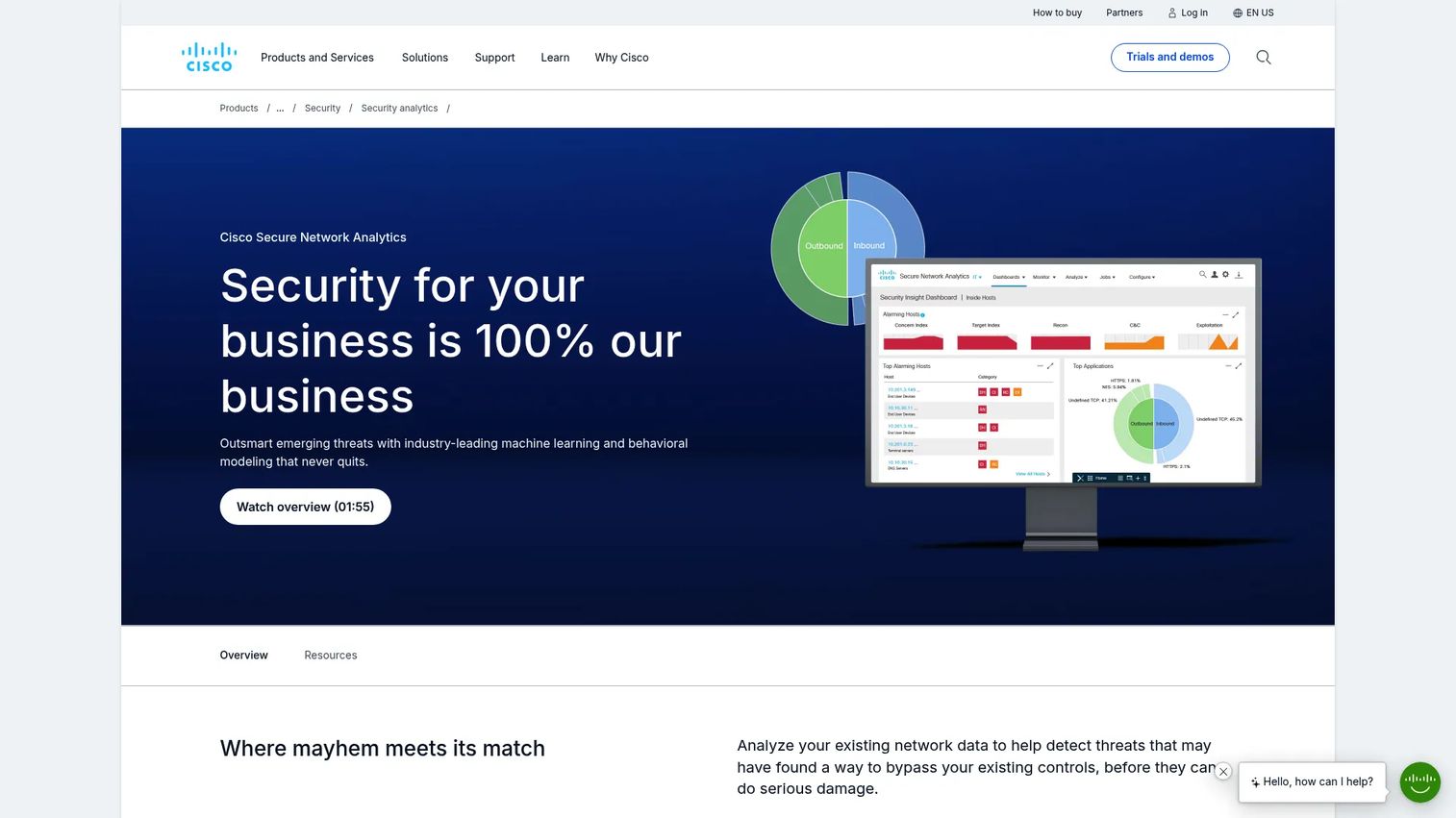
Cisco Secure Network Analytics is network threat detection and response software that continuously monitors network and cloud traffic to detect hidden threats. It leans on Cisco's native telemetry, which is a strong fit for organizations already running Cisco infrastructure and looking to extend it into detection.
Best for: Enterprises that need network detection and response with deep visibility across network and cloud traffic.
Key strengths
- Real-time attack detection: High-fidelity alerts with context to speed triage.
- Broad threat coverage: Detection of unknown malware, insider threats, and policy violations.
- Encrypted traffic analysis: Inspects encrypted traffic without compromising privacy or data integrity.
Why choose Cisco Secure Network Analytics: If your network is already Cisco, this tool consumes existing telemetry rather than requiring a parallel sensor build-out. That ecosystem fit lowers deployment effort and gives the SOC visibility across both network and cloud from familiar infrastructure.
Cisco Secure Network Analytics pricing: Cisco does not display public pricing for this product; it is quoted based on scope. Contact Cisco or a partner for a figure. The product holds a 4.4/5 rating on G2.
7. Rapid7 InsightIDR
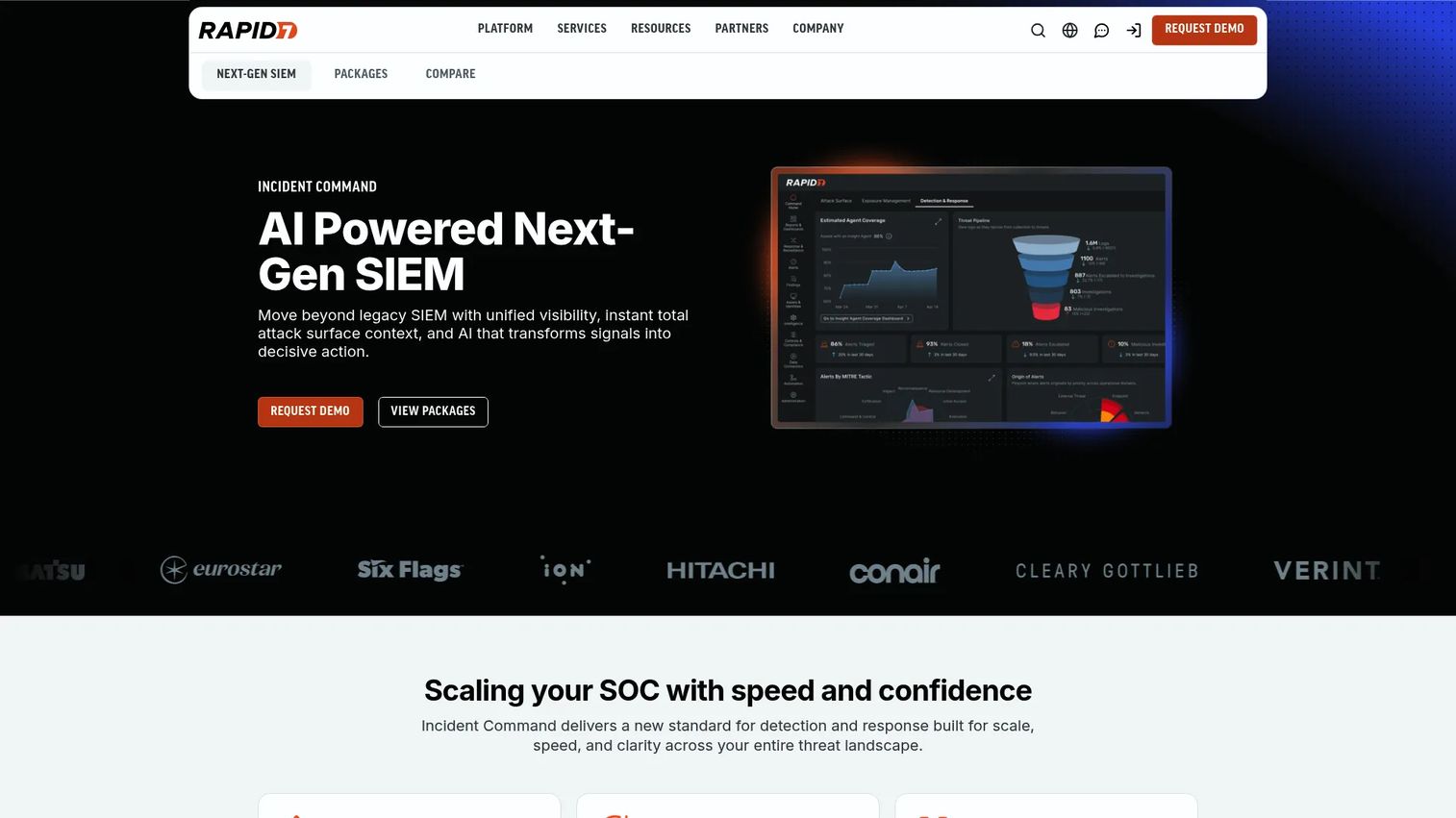
Rapid7 InsightIDR is a cloud-native SIEM and XDR platform with built-in threat detection, investigation, and response. It includes network traffic analysis as one component of a broader detection stack, which makes it relevant for buyers weighing consolidation rather than a standalone NDR purchase.
Best for: Security teams that need cloud SIEM and XDR with detection and response built in, including network traffic analysis.
Key strengths
- Extended detection and response (XDR): Correlates signals across sources for prioritized detection.
- User and entity behavior analytics (UEBA): Behavioral analytics to catch account and insider abuse.
- Network traffic analysis (NTA): Network-centric detection inside the wider platform.
Why choose Rapid7 InsightIDR: InsightIDR is often evaluated as part of a wider stack decision rather than a pure NDR bake-off. If you want SIEM-adjacent workflows, UEBA, and network traffic analysis under one roof, it consolidates several capabilities that would otherwise be separate tools.
Rapid7 InsightIDR pricing: Rapid7 lists InsightIDR within its Next-Gen SIEM offering and does not publish a public price; pricing is contact or demo based. The product holds a 4.4/5 rating on G2.
8. Stellar Cyber

Stellar Cyber is an AI-driven SecOps and Open XDR platform for unified threat detection, response, and analysis. It correlates network, endpoint, and cloud signals into a single console, which is why it appears on shortlists when teams want broad coverage with network detection and response as one part of it.
Best for: MSSPs and enterprises that need a unified security operations platform across multiple signal sources.
Key strengths
- AI-powered detection and correlation: Ties signals together across network, endpoint, and cloud.
- Automated incident response: Playbook-driven automation to speed containment.
- Multi-tenant management: A unified console suited to service providers and large teams.
Why choose Stellar Cyber: Its Open XDR positioning means NDR data feeds a larger correlation engine rather than living alone. For MSSPs and enterprises that want automated incident handling across many signal types and tenants, the consolidation is the point.
Stellar Cyber pricing: Stellar Cyber uses a single-license platform model and requests a quote rather than showing a public price. Contact the vendor for pricing. The Open XDR platform holds a 4.9/5 rating on G2.
9. Palo Alto Networks Cortex XDR

Palo Alto Networks Cortex XDR is an AI-driven endpoint security and XDR platform that detects, prevents, and responds to attacks across endpoint, network, cloud, identity, and email data. Network visibility here arrives through the broader XDR platform, correlating with endpoint and cloud signals rather than as a standalone NDR product.
Best for: Enterprises that want AI-driven endpoint protection with XDR and cross-signal response workflows.
Key strengths
- Cross-signal correlation: Connects endpoint, network, cloud, identity, and email data for detection and prioritization.
- Prevention modules: Defends against modern techniques including zero-day and fileless malware.
- Root-cause investigation: Native automation for response alongside deep investigation.
Why choose Palo Alto Cortex XDR: Buyers typically evaluate Cortex XDR when NDR is part of a larger detection strategy rather than the whole of it. If you want network signals correlated with endpoint and cloud inside one platform, this is the broader-platform choice, especially for teams already invested in Palo Alto.
Palo Alto Cortex XDR pricing: Palo Alto does not display public first-party pricing; product pages route to demo or sales contact. Contact Palo Alto for a quote. Cortex XDR holds a 4.6/5 rating on G2.
Considerations before you buy
Marketing pages converge on the same claims. These are the criteria that actually separate NDR vendors during a real evaluation.
Telemetry model and traffic coverage
Confirm how each tool collects data and what it sees. Ask whether it inspects both north-south and east-west traffic, whether it uses packet analysis, metadata analysis, or both, and how it handles encrypted flows. The telemetry source shapes everything downstream, so validate it before anything else.
Deployment fit for your environment
Match the deployment model to your estate. On-prem sensors, cloud-delivered SaaS, and hybrid options each suit different architectures. If you run a hybrid environment across data centers and multiple clouds, confirm the tool gives one consistent detection model rather than fragmented per-environment coverage.
Response workflow and automation
Detection without response is just more alerts. Evaluate whether the tool offers automated response, analyst-driven actions, or both, and how incident aggregation and AI-assisted triage reduce time to containment. Test how a detection becomes an action in your specific workflow.
SOC integration and stack fit
An NDR tool is only as useful as its integrations. Verify bidirectional workflows with your SIEM, EDR, XDR, and SOAR. Weak integration turns a strong detection engine into an island. Strong integration makes NDR the third leg of a working SOC visibility stack.
POC criteria and measurable outcomes
Define success before the trial starts. Set concrete criteria such as detection of a simulated lateral movement scenario, alert fidelity against a known baseline, and time from detection to response. Measure against those criteria, not vendor demos.
Conclusion
There is no single best NDR tool, only the best fit for your telemetry source, response needs, and SOC stack. Corelight rewards teams that want to hunt on open, evidence-rich Zeek data. ExtraHop suits organizations that want security and network observability from one wire-data source. Vectra AI and Darktrace lead on AI-driven detection, with Darktrace leaning into autonomous response. FortiNDR and Cisco Secure Network Analytics are natural fits inside Fortinet and Cisco estates. And Rapid7 InsightIDR, Stellar Cyber, and Palo Alto Cortex XDR make sense when NDR is one signal inside a broader detection and response platform.
Shortlist two or three based on your deployment model and stack, then run a structured POC against measurable criteria. The right choice is the one that closes your specific visibility gap, not the one with the loudest page.
Start your journey with Guideflow today!
FAQs
Network detection and response software monitors network traffic to detect, investigate, and respond to threats that endpoint and log tools miss. It uses behavioral analytics and anomaly detection on packet and metadata across north-south and east-west traffic, then supports automated or analyst-driven response. It is the third leg of the SOC visibility stack alongside EDR and SIEM.
SIEM aggregates and correlates logs from across your systems, so it only sees what is logged. NDR watches the network traffic itself, catching behavior that never generates a log entry, such as lateral movement between hosts. Most SOCs run both: NDR feeds high-fidelity network detections into the SIEM, which correlates them with everything else.
They cover different ground, so most teams run both. EDR watches processes and activity on managed endpoints, while NDR watches the network, including devices that cannot run an agent such as IoT, OT, and BYOD. Together with SIEM they form the visibility triad, closing gaps that any single control leaves open.
Strong NDR tools inspect both. North-south traffic crosses the perimeter between your network and the outside world. East-west traffic moves internally between hosts, and it is where lateral movement hides. Coverage of east-west traffic is often the deciding factor, since it is precisely what EDR and SIEM tend to miss.
Look for vendors with mature hybrid deployment models that give one detection picture across on-prem, cloud, and remote sites. ExtraHop offers both SaaS and on-premises deployment, Vectra AI spans network, identity, and cloud, and Cisco Secure Network Analytics covers network and cloud traffic. Confirm the tool delivers a consistent model rather than fragmented per-environment monitoring.
Define measurable success criteria before the trial. Run a simulated lateral movement or exfiltration scenario and check whether the tool detects it, measure alert fidelity against a known baseline, and time how long detection to response takes. Test the integrations into your SIEM, EDR, and SOAR under realistic conditions, not just the vendor's demo environment.
Yes. Modern NDR solutions use encrypted traffic analysis and metadata analysis to detect threats without decrypting payloads, preserving privacy. Behavioral signals such as connection patterns, timing, and volume reveal malicious activity even when the content is opaque. Cisco Secure Network Analytics, for example, analyzes encrypted traffic without compromising data integrity.
Push past the polished walkthrough and ask to see the telemetry model, how east-west traffic is captured, and how a detection becomes a response action in your stack. Ask for a hands-on evaluation against a realistic scenario rather than a scripted path. The vendors that let you validate architecture and integration directly, instead of only watching a presenter, tend to survive a rigorous technical evaluation.