
Invoices pile up in a shared inbox. Approvals stall because the one person who signs off is out. Finance spends its week chasing signatures instead of closing the books. And every manual touch is a chance for a duplicate payment, a missed discount, or a number that no longer matches the ERP. If you are scaling a company past 50 people, that friction is not just annoying. It is a control problem and a cash problem at the same time.
The market has responded. The global accounts payable software market is projected to grow from USD 1.67B in 2025 to USD 2.36B in 2029 at a 9.0% CAGR, according to The Business Research Company (2024). The broader accounts payable automation market is moving faster still, forecast to reach USD 7.01B by 2030 at a 12.8% CAGR per Grand View Research (2024). Translation: more finance teams are replacing manual invoice processing with software that captures, routes, matches, and pays.
For a founder, this is less about the daily grind of data entry and more about running a tighter business. Good accounts payable software cuts headcount pressure, gives you real-time visibility into cash, and builds an audit trail that survives board scrutiny and due diligence. It also reduces the number of things that route through you. If you are thinking about how automation shows up elsewhere in your stack, the same logic applies to marketing automation, contract lifecycle management, and audit management software: the goal is fewer bottlenecks and cleaner signal.
What's inside
This guide compares seven accounts payable platforms for founders and finance leaders who want to automate invoice processing, approvals, matching, and payments. The list mixes pure AP automation specialists with broader finance platforms, because the right pick depends on how complex your payables actually are.
We evaluated each tool against the criteria that matter most when you are scaling:
- Invoice capture quality: OCR accuracy and how much data extraction happens without human touch
- Workflow automation: approval routing, matching logic, and exception handling
- ERP integrations: how cleanly it syncs with your accounting or ERP stack
- Payment flexibility: supported payment methods and how payments actually execute
- Controls and visibility: audit trail, fraud prevention, and real-time reporting
Rankings reflect founder-fit: how much operational drag the tool removes, not just how many features it lists.
TL;DR
- Best overall for scale and supplier enablement: AvidXchange, with mature AP infrastructure and a large supplier payment network.
- Best for controls plus accounting ecosystem alignment: Sage, when finance wants structure, reporting, and a single-vendor platform.
- Best for collaborative invoice handling: Stampli, when the main bottleneck is back-and-forth around approvals.
- Best for AP plus broader finance workflows: BILL, when you want payables, receivables, and spend in one place.
- Best for high-volume and global payables: Tipalti, when AP complexity extends beyond domestic invoices.
- Best for end-to-end AP workflow management: MineralTree, when finance wants a clean invoice-to-pay loop inside the ERP.
What is accounts payable software?
Accounts payable software is a tool that automates how a business receives, approves, matches, and pays supplier invoices, while keeping a full audit trail of every step.
The core workflow runs in a predictable sequence:
- Invoice capture: invoices arrive by email, scan, upload, or EDI
- Data extraction and OCR: the software reads vendor, amount, date, and line items
- Approval routing: invoices move to the right approvers based on rules
- **PO matching:** the system compares invoices against purchase orders and receipts (two-way or three-way matching)
- Payment execution: approved invoices pay out via the chosen payment methods
- Reporting and audit trail: every action is logged for controls and close
Under the hood, most accounts payable solutions cluster around six core capabilities:
- Automation: less manual keying, faster invoice approvals
- Control: approval workflows, duplicate payment prevention, and fraud prevention
- Visibility: real-time tracking of what is owed and what is approved
- Payment options: ACH, card, check, wire, and virtual card
- Integrations: ERP integrations and accounting sync
- Multi-entity support: consolidated payables across subsidiaries or brands
This category matters now because manual AP does not scale. As invoice volume climbs, the cost of manual review, the risk of error, and the drag on close all rise together. Automation flattens that curve.
When to use accounts payable software
When invoice volume is outgrowing manual review
If your team is manually keying invoices and hand-routing approvals, the process starts to break somewhere between a few dozen and a few hundred invoices a month. Approvals stall, close slips, and finance spends its time chasing instead of analyzing. Accounts payable automation performs best exactly here: it absorbs volume without adding headcount and keeps the month-end close on schedule.
When controls matter more than speed alone
Speed is nice. Control is what survives an audit. When auditability, fraud prevention, and duplicate payment prevention become real buying criteria, usually because you are raising, being acquired, or just tired of surprises, AP software earns its place. Rule-based approvals, a complete audit trail, and matching logic mean payments only go out when they should.
When ERP sync is becoming a bottleneck
Manual handoffs between AP, your ERP, and your payment rails create reconciliation pain and stale numbers. When finance wants clean, automatic handoffs, ERP integrations become the deciding factor. The right accounts payable system keeps your general ledger and payables in lockstep, so the numbers you report are the numbers that are true.
Comparison table
The table below helps you separate AP automation specialists from broader finance platforms. Use the intent column to pinpoint whether a tool leans toward enterprise AP, SMB AP, ERP-fit, or payment-heavy use. Ratings and pricing reflect the most recent publicly available data; several vendors price through sales rather than a public page.
| # | Product | Intent | Key differentiation | Pricing | G2 rating |
|---|---|---|---|---|---|
| 1 | AvidXchange | Mid-market AP + supplier payments | AvidPay Network and managed AP infrastructure | Sales-led | 4.4/5 |
| 2 | Sage | Accounting ecosystem + controls | AP inside a full accounting/ERP platform | From $128.67/mo | Not listed |
| 3 | Stampli | Collaborative AP workflow | Communication layer around each invoice | Custom quote | 4.6/5 |
| 4 | BILL | SMB AP + AR + spend | Payables, receivables, and spend in one platform | Corporate $89/user/mo | 4.5/5 |
| 5 | Tipalti | High-volume + global payables | Mass payouts and tax compliance across countries | From $99/mo | 4.5/5 |
| 6 | MineralTree | End-to-end invoice-to-pay | ERP-embedded AP workflow and payments | Quote-based | 4.4/5 |
| 7 | Quadient AP Automation | Mid-market AP workflow | Invoice, expense, and PO handling in one flow | Request pricing | 4.4/5 |
1. AvidXchange
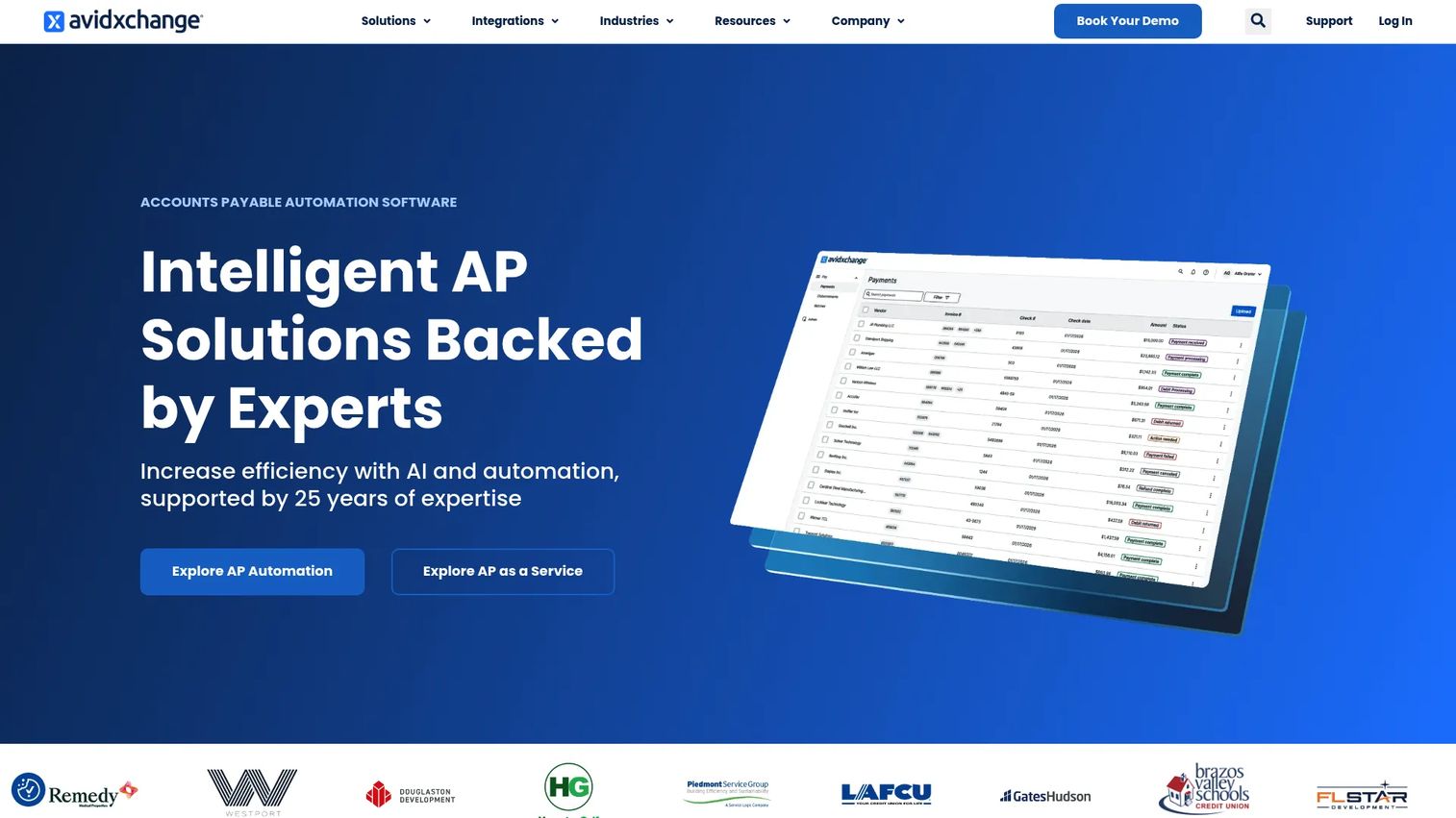
AvidXchange is one of the most established names in accounts payable automation, built for mid-market companies that want efficiency, visibility, and supplier enablement without running the whole operation in-house. It combines AP workflow orchestration across purchase, invoice, and pay stages with a large supplier payment network. If your team wants mature AP infrastructure and a lower-lift operational model, AvidXchange is the reference point.
The differentiator is the AvidPay Network and its managed approach. Payments route to suppliers through established rails, and the Supplier Hub gives vendors a place to manage their own payment preferences, which cuts down on the emails your team fields about payment status. AvidXchange also positions itself as AP as a Service, meaning more of the payment operations can be handled for you.
Best for: Mid-market finance teams that want mature AP and supplier payment infrastructure without heavy internal lift.
Key strengths
- AvidPay Network: A large supplier payment network that handles execution across multiple payment methods.
- Supplier Hub and enablement: Vendors self-manage payment details, reducing inbound payment-status questions.
- Accounting integrations: Connects with common accounting systems to keep AP and the ledger aligned.
Why choose AvidXchange: If you want AP that feels handled rather than built, AvidXchange is the strongest fit. The managed model suits founders who would rather buy mature infrastructure than staff up a payables operation. It fits companies where supplier enablement and payment execution are the real workload.
AvidXchange pricing: AvidXchange does not publish pricing. Plans are sales-led and quoted based on invoice and payment volume, so expect a scoping conversation rather than a public price. It holds a 4.4/5 rating on G2.
2. Sage
Sage is the decision-support pick for teams that want AP automation plus alignment with a broader accounting ecosystem. Rather than a standalone AP tool, Sage delivers payables inside a full financial management platform that also covers accounting, ERP, HR, and payroll. For founders who want fewer vendors and tighter integration between AP and the ledger, that consolidation is the point.
The strengths here are control and reporting. Sage brings data extraction, vendor management, real-time reporting, structured approval workflows, and built-in internal controls. Because AP lives inside the accounting system, the audit trail and the general ledger stay in sync without a separate reconciliation step. This also supports multi-entity AP and global scalability as you add subsidiaries.
Best for: Finance teams that want structure, controls, and AP living inside a single accounting and ERP platform.
Key strengths
- Cloud accounting and financial management: AP sits inside the same system as your ledger and reporting.
- ERP and business operations software: Room to grow into deeper finance operations as you scale.
- HR and payroll software: One vendor across finance and people operations.
Why choose Sage: Choose Sage when consolidation and control outweigh the appeal of a specialized AP tool. It suits founders who want structure and a platform that grows into ERP and multi-entity needs. The tradeoff is that a full platform carries more scope than a focused AP product.
Sage pricing: Sage 50 pricing starts at $128.67/mo for Pro Accounting, $182.50/mo for Premium Accounting, and $271.17/mo for Quantum Accounting, billed monthly with an annual option and a free trial. Exact packaging depends on which Sage product line fits your invoice processing and reporting needs.
3. Stampli
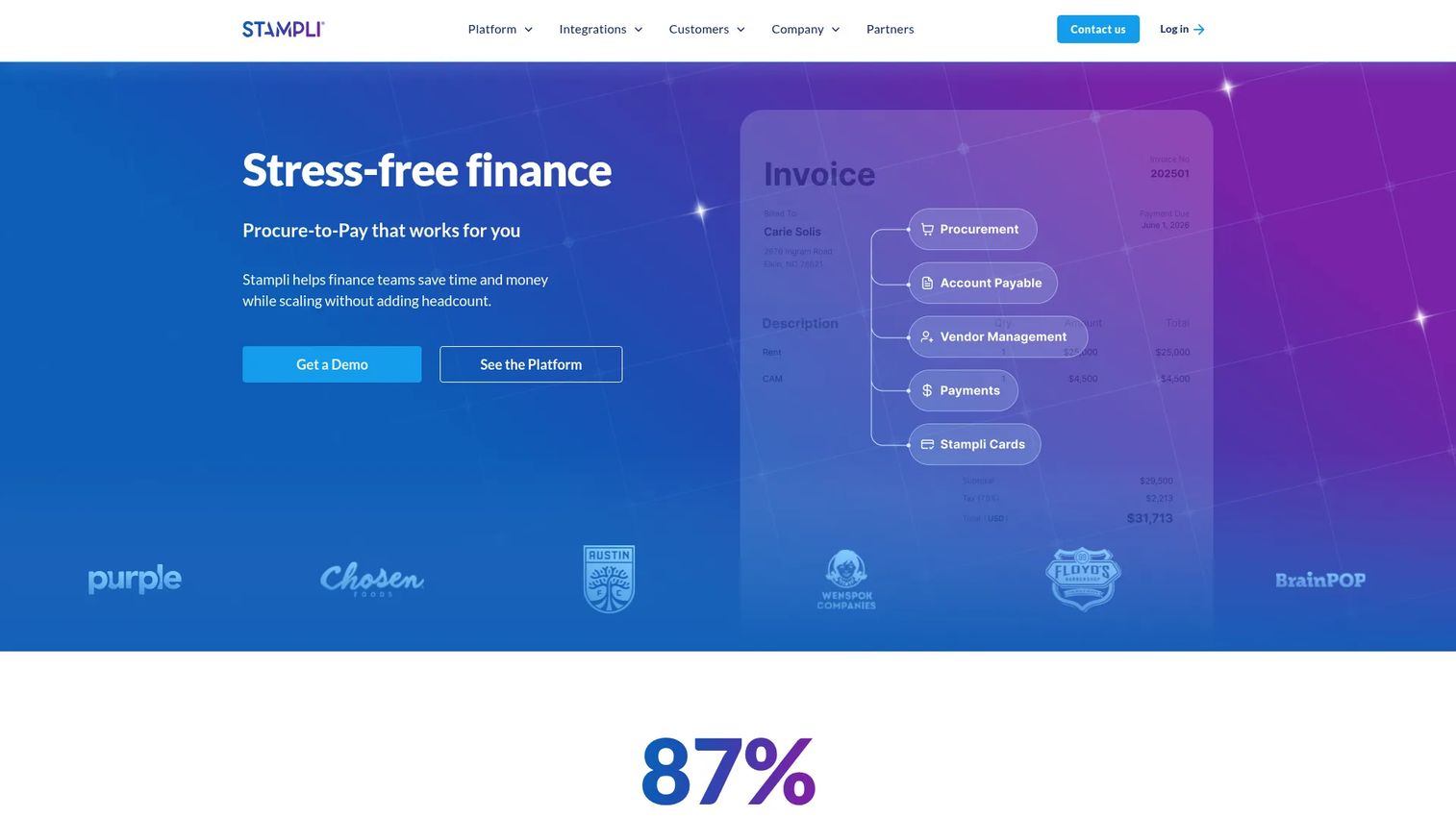
Stampli is the collaborative invoice handling choice. It builds a communication layer directly onto each invoice, so the questions, approvals, and context that usually scatter across email and Slack live where the invoice lives. If the real bottleneck in your AP workflow is the back-and-forth around who approved what and why, Stampli is built for exactly that.
The platform covers the full loop: invoice capture, coding, PO matching, and approval routing, all with an AI-driven procure-to-pay layer on top. Because every conversation attaches to the invoice, the audit trail captures not just the approval but the reasoning behind it. Stampli also handles vendor management and payment execution, so invoice processing and payment stay connected.
Best for: Finance teams where the main friction is invoice back-and-forth and approval coordination.
Key strengths
- AI-driven procure-to-pay: Automates capture, coding, matching, and routing across the workflow.
- Invoice-level collaboration: Approvals and context stay attached to each invoice, not scattered in inboxes.
- Vendor management and payments: Handles supplier records and payment execution in one place.
Why choose Stampli: Choose Stampli when approval speed and visibility into AP conversations matter most. It fits teams tired of reconstructing why a payment was approved after the fact. The communication layer is the differentiator that makes invoice approvals faster and cleaner.
Stampli pricing: Stampli uses custom, request-a-quote pricing and does not display a public starting price. It carries a 4.6/5 rating on G2, among the highest in this list.
4. BILL
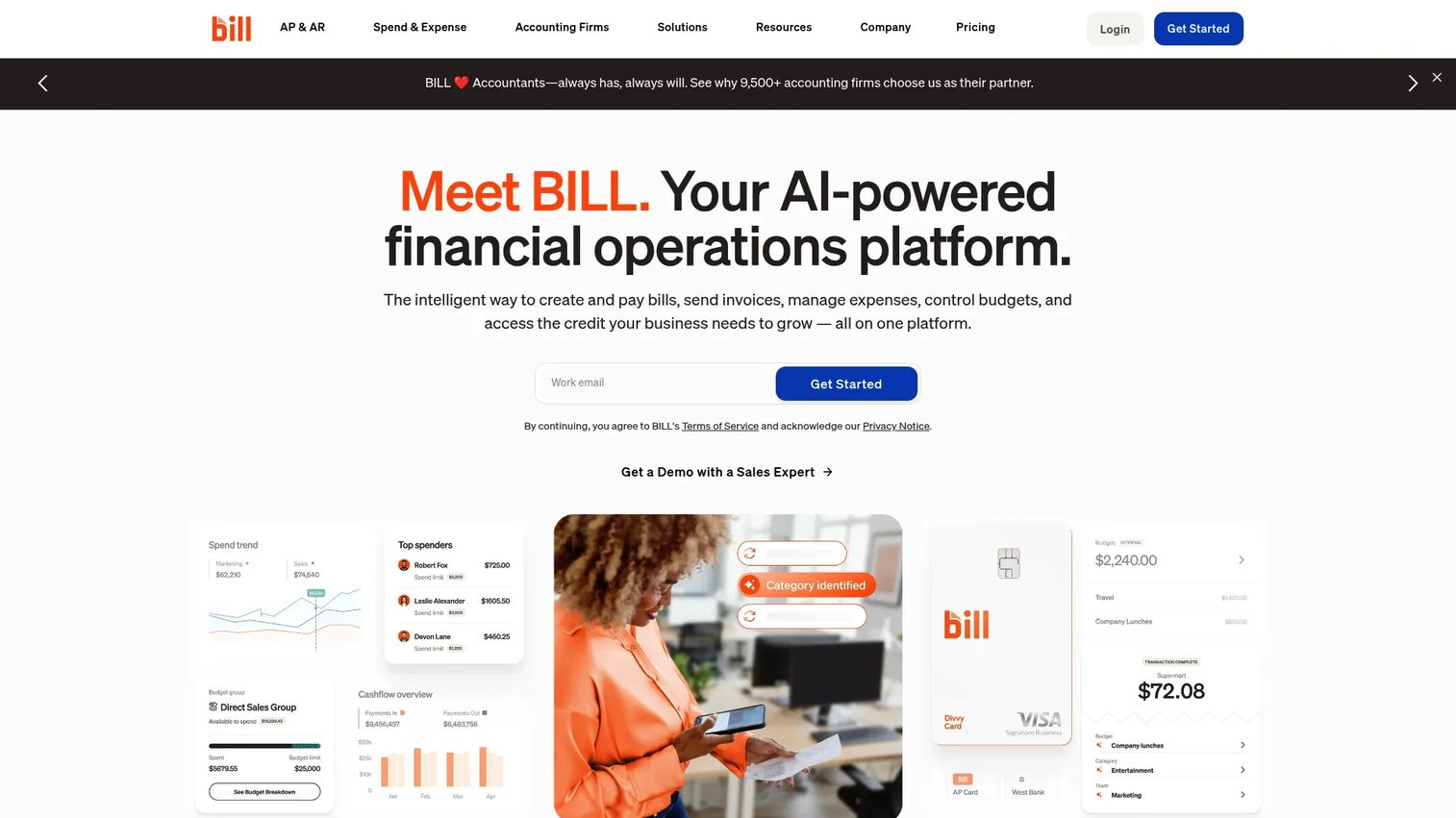
BILL is a flexible financial operations platform that combines AP with accounts receivable and spend management. For founders who would rather run payables, receivables, and expense control in one place than stitch three tools together, BILL is the consolidation play. Its AP side pairs AI invoice capture with strong approval workflows and broad payment execution.
The platform handles AI capture and routing, two-way and three-way matching, and a wide set of payment methods including ACH, card, check, and wire. It also supports multi-entity AP, which matters once you are running more than one legal entity or brand. Because BILL connects AP, AR, and spend, the visibility spans more of your cash flow than a pure invoice processing tool would.
Best for: SMBs and scaling teams that want payables, receivables, and spend control in a single platform.
Key strengths
- AI invoice capture and routing: Extracts invoice data and routes approvals with less manual keying.
- Payment flexibility: Pays via ACH, card, check, and wire, with supplier enablement built in.
- AP, AR, and spend in one place: Broader financial operations coverage than a standalone AP tool.
Why choose BILL: Choose BILL when you want AP plus broader finance workflows without adding separate tools. It suits founders consolidating their finance stack around one platform. Multi-entity AP support makes it a fit as you add subsidiaries.
BILL pricing: BILL prices AP and AR plans per user per month, with Essentials and Team as entry tiers, Corporate at $89/user/month, and Enterprise on custom pricing. BILL Spend & Expense has no per-user software fee. It holds a 4.5/5 rating on G2.
5. Tipalti
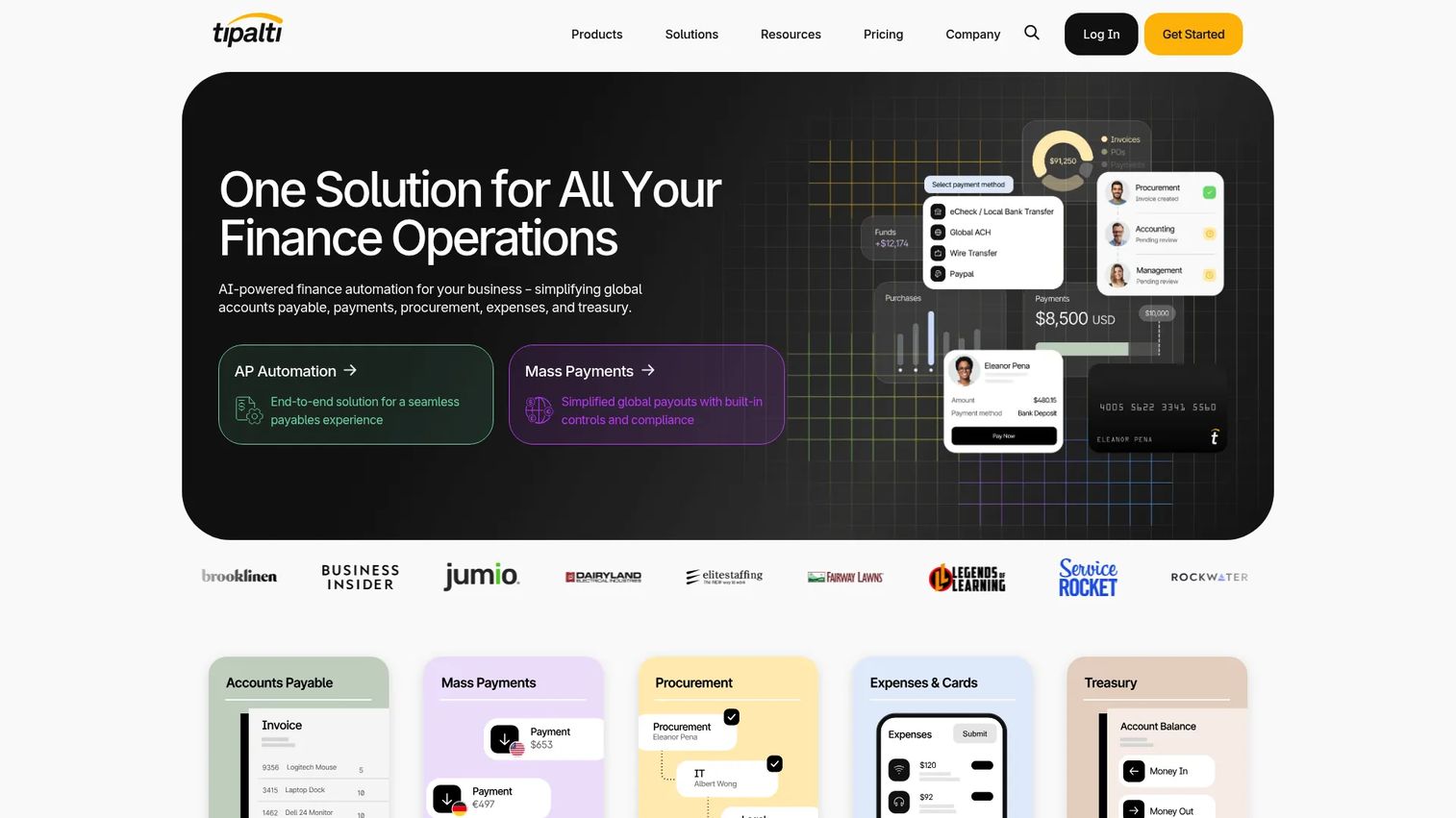
Tipalti is the stronger fit when your payables extend beyond domestic invoice handling. It is built for high-volume AP and global payments, covering mass payouts, cross-border payment execution, and tax compliance across many countries. If you are paying suppliers, partners, or contractors internationally, the compliance and payout complexity is exactly what Tipalti automates.
Beyond AP automation, Tipalti brings procurement, expense, and tax compliance into the same finance stack. Its controls and validation logic reduce the manual burden of managing tax rules and cross-border requirements at scale. For reporting and integration, it connects into common ERP and accounting systems so global payables still reconcile cleanly.
Best for: Mid-market and enterprise finance teams with high payout volume or international payments.
Key strengths
- Global payments and mass payouts: Pays across many countries and currencies from one system.
- Tax compliance automation: Applies tax rules and collects required documentation automatically.
- AP automation at scale: Handles high invoice and payout volume with rule-based controls.
Why choose Tipalti: Choose Tipalti when AP complexity is driven by scale and geography, not just volume. It fits founders whose payout operations span borders and currencies. The tax and compliance automation is what separates it from domestic-first tools.
Tipalti pricing: Tipalti Accounts Payable starts at $99/month and Tipalti Mass Payments at $249/month, with additional transaction-based fees and custom quotes for higher-complexity needs. It carries a 4.5/5 rating on G2.
6. MineralTree
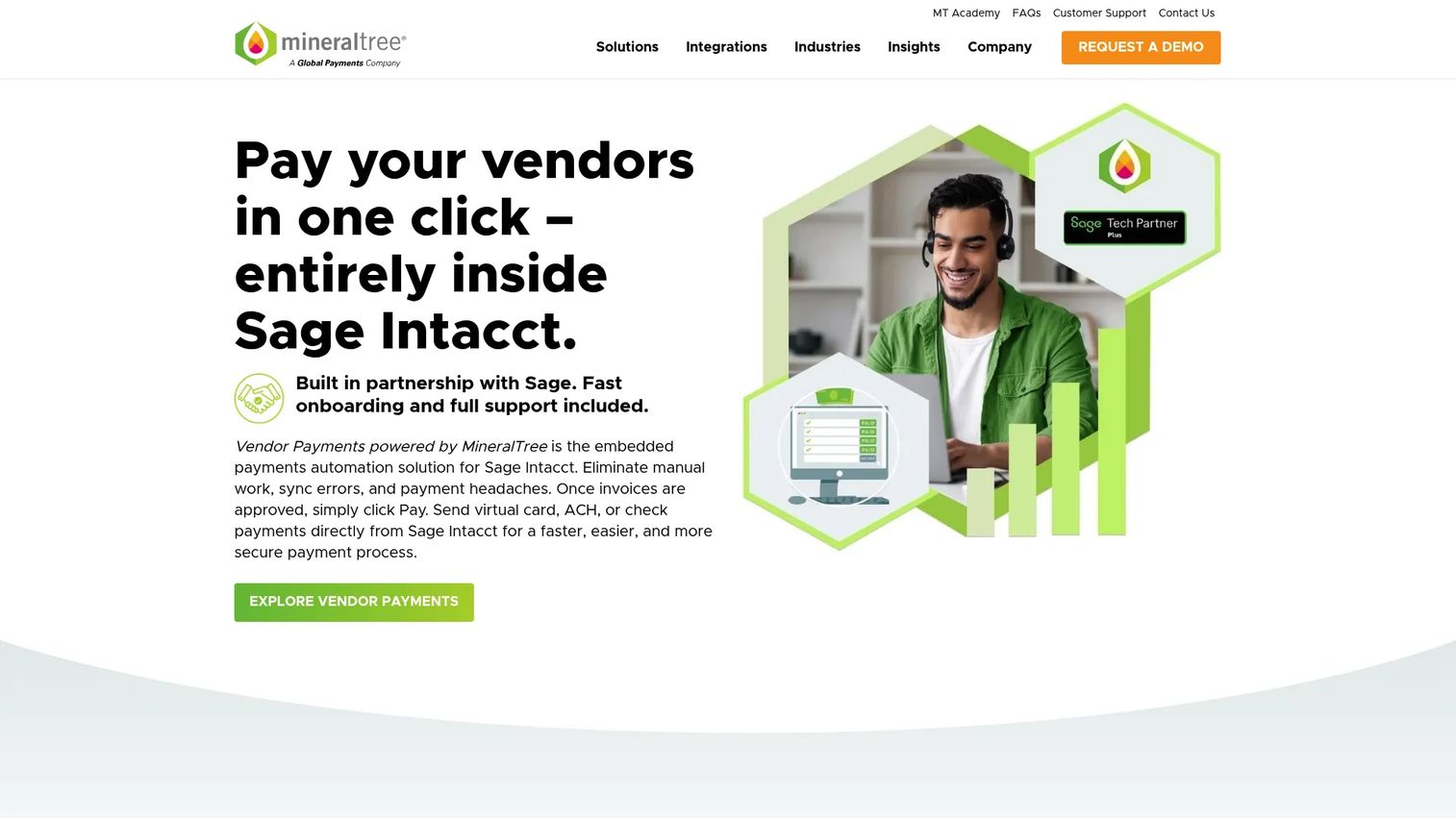
MineralTree is a finance workflow platform focused on end-to-end AP automation and payment management. It handles the full invoice-to-pay loop: invoice capture, approval workflow, matching, and payment execution, all designed to run inside your existing ERP. For teams that want to simplify AP without losing oversight, MineralTree keeps the workflow tight and the controls intact.
The platform covers invoice capture and approval automation, payment authorization and optimization, and ERP integrations with multi-entity support. Payment optimization means it can help route payments toward methods that improve working capital, such as virtual cards. Because it sits inside the ERP, the audit trail and reconciliation stay connected to your books.
Best for: Finance teams that want an end-to-end AP workflow and vendor payments managed inside the ERP.
Key strengths
- Invoice capture and approval automation: Reads invoices and routes them through structured approval workflows.
- Payment authorization and optimization: Controls who authorizes payments and how they execute.
- ERP integrations and multi-entity support: Keeps AP in sync with your books across entities.
Why choose MineralTree: Choose MineralTree when you want a clean, end-to-end invoice-to-pay process that lives inside your ERP. It suits founders who value oversight and reconciliation as much as automation. The payment optimization angle can turn AP into a lever for working capital.
MineralTree pricing: MineralTree uses quote-based pricing across its Invoice capture, Payments only, and Invoice to Pay options, with a one-time setup fee, an annual platform fee, and monthly usage fees. A third-party listing reports a starting point around $5,000 per year, though the company does not publish first-party numbers. It holds a 4.4/5 rating on G2.
7. Quadient AP Automation
Quadient AP Automation is the workflow automation option that spans invoice, expense, and payment handling in one flow. It captures invoices from email, scan, upload, or EDI, then runs automated validation, approvals, and PO matching before syncing with your finance system. For teams with established process complexity who want centralized workflow handling, Quadient keeps invoice control in one place.
The platform emphasizes controls and visibility: automated validation catches issues early, approval workflows enforce policy, and real-time tracking shows where every invoice stands. Because it syncs with ERP and finance systems, the handoffs between AP and your ledger stay clean. Quadient also breaks its offering into Purchase Orders, Invoices, and Expenses, so you can align the flow to how your finance operations actually run.
Best for: Mid-sized finance teams that want to automate AP workflows end to end with strong process controls.
Key strengths
- Multi-channel invoice capture: Ingests invoices from email, scan, upload, or EDI.
- Automated validation and PO matching: Runs validation, approvals, and matching before sync.
- ERP syncing and real-time tracking: Keeps AP and finance systems aligned with live status.
Why choose Quadient AP Automation: Choose Quadient when your finance operations already have process complexity and you want it centralized. It suits founders comparing AP automation against broader finance operations tools. The invoice, expense, and PO breakdown maps well to established workflows.
Quadient AP Automation pricing: Quadient uses request-only pricing across three plan areas: Purchase Orders, Invoices, and Expenses, each customized to your volume and process. It carries a 4.4/5 rating on G2.
How to choose the right accounts payable software
Three truths cut through the feature lists.
First, choose for workflow fit, not feature count. The tool that maps to how your invoices actually arrive, get approved, and get paid will beat the one with the longest spec sheet. A collaborative approval bottleneck points one direction; global payouts point another.
Second, prioritize controls and ERP sync over everything else. A strong audit trail, matching logic, and clean ERP integrations are what keep your numbers defensible and your close fast. Fraud prevention and duplicate payment prevention are not nice-to-haves once real money moves through the system.
Third, think about who owns the process after rollout. The best accounts payable system is the one your finance lead can run without routing everything through you. If a tool needs constant founder attention, it has not actually removed the bottleneck.
Your next step is simple: narrow this list to two tools based on current invoice volume, your payment methods, and your accounting stack. If multi-entity AP and consolidation matter, weight platforms that handle both natively. Then run a scoped trial or demo against your real invoices, not a canned dataset. The right accounts payable solutions prove themselves in the first month, not the first pitch.
FAQs
Accounts payable software automates how a business receives, approves, matches, and pays supplier invoices. It replaces manual invoice processing with capture, approval routing, PO matching, and payment execution, while logging every step in an audit trail. The goal is fewer manual touches, faster close, and cleaner control over cash going out.
The core features are OCR-based invoice capture, rule-based approval routing, ERP integrations, a complete audit trail, flexible payment methods, and PO matching (two-way or three-way). Together these reduce manual keying, keep your ledger in sync, and ensure payments only execute when they should. Reporting and real-time tracking round out the essentials.
Usually yes, once invoice volume starts eating real finance hours. Even a small team benefits from time savings, tighter controls, and avoiding process debt that gets expensive to unwind as headcount grows. The earlier you set up clean approval workflows and an audit trail, the less painful your next audit or fundraise diligence becomes.
It layers controls that manual processes lack. Rule-based approval workflows ensure the right people sign off, matching logic flags invoices that do not tie to a PO or receipt, and duplicate payment prevention catches invoices already paid. Centralized visibility and a full audit trail mean every payment is traceable, which is the backbone of fraud prevention.
Most platforms support ACH, check, wire, and card, and many add virtual cards for better control and working capital. Virtual cards and card rails can also generate rebates, turning AP into a small revenue lever. The specific mix depends on the vendor and your suppliers' accepted payment methods.
Weigh four things: ERP fit, payment flexibility, approval complexity, and reporting depth. Match the tool to how your invoices actually flow rather than to the longest feature list. Then test the top two against your real invoices, since the strongest accounts payable solutions prove their value in the first month of live use.
Usually not. AP software complements your accounting or ERP system by automating the invoice-to-pay workflow and then syncing the results back to your ledger. Some broader platforms bundle accounting and AP together, but in most stacks the two work side by side, with ERP integrations keeping payables and the general ledger aligned.