A customer walks in, finds the exact jacket they want, then hears the four words that end most retail sales: "We're out of that." Wrong size. Wrong color. Not carried in this location. They leave, and most of them do not come back to buy online later. They buy from whoever has it in stock right now.
That walkout is expensive. Retailers lose an estimated $500 billion a year to out-of-stock walkouts, according to Cloudshelf (2024). And the math on recovering even part of it is compelling: deployed endless aisle programs recover 15 to 22 percent of otherwise lost walkout sales, with typical payback periods under 90 days.
The fix is not more shelf space. It is software that surfaces your full inventory at the point of decision, whether that point is a kiosk, a store associate tablet, or a mobile POS. The endless aisle market in fashion alone was worth $2.5 billion in 2024 and is projected to hit $12.2 billion by 2033 at an 18.5 percent CAGR (Cloudshelf, 2024). The category is small relative to the problem it solves, which is exactly why choosing the right platform matters more than the feature checklist suggests.
Where the software choice breaks down is rarely the front-end demo. It is data freshness, integration depth, and whether store associates actually use the thing. This guide walks through seven platforms with those decision gates in mind.
What's inside
This guide compares seven endless aisle software platforms for retail teams evaluating omnichannel selling in 2026. We ranked and described each option based on the criteria that actually determine whether a rollout works on the store floor.
- Real-time inventory visibility: how fresh the stock data is across stores, warehouses, and online
- POS and ecommerce integration: how cleanly it connects to your existing commerce stack
- Fulfillment flexibility: support for ship-to-home, buy online pick up in store, and store transfers
- Device and UX quality: kiosk, tablet, handheld, and mobile POS experience for shoppers and associates
- Ease of rollout: how much operational lift it takes to get live across locations
TL;DR
- Best for enterprise omnichannel retail: Salesforce Retail Cloud, if you already run on Salesforce and want CRM-linked selling.
- Best for hardware-first deployment: Elo, when the physical kiosk and touchscreen layer is the priority.
- Best for smaller and mid-market stacks: Lightspeed Retail, for retailers wanting an all-in-one POS with public pricing.
- Best for enterprise checkout and OMS depth: Manhattan Active Point of Sale, for global inventory and unified checkout.
- Best for mobile-first store operations: NewStore, for brands modernizing the associate experience on handhelds.
- Best for Shopify-native retailers: Shopify POS, when online and in-store selling should live in one commerce stack.
- Best for large-chain retail transformation: Aptos, for broad unified commerce across many stores.
What is endless aisle software
Endless aisle software is a retail technology layer that lets shoppers and store associates browse and buy a retailer's full catalog inside the store, even when the physical item is not on the shelf, then fulfill it through ship-to-home, pickup, or transfer.
It sits between the store selling floor and the broader commerce stack. Instead of the store being limited to what fits on its racks, the endless aisle solution surfaces warehouse stock, other-store inventory, and online-only SKUs at the moment a customer is ready to decide.
Core functions of endless aisle technology:
- Surfaces full catalog inventory: exposes every SKU across the network, not just local shelf stock
- Connects store and online channels: unifies inventory management across physical and digital
- Supports flexible fulfillment: enables ship-to-home, buy online pick up in store, and store-to-store transfers
- Extends associate selling: gives staff tools to sell beyond what is physically present
- Preserves brand and search experience: keeps product catalog, search, and filtering consistent across devices
How it differs from ecommerce or POS alone
A POS records the transaction. An ecommerce site sells online. Neither, by itself, closes the gap when a customer is standing in your store and the item is not on the floor.
Endless aisle retail connects those systems so the sale happens anyway. The POS still rings it up. The ecommerce catalog still supplies the product data. But the endless aisle layer adds real-time inventory visibility across every location and a checkout flow that offers alternate fulfillment. That is the difference between logging a lost sale and recovering it.
When to use endless aisle software
Reduce stockouts without losing the sale
A customer wants the size 10 in navy. You have every size except 10, and only in black. Without endless aisle technology, that is a walkout. With it, the associate pulls up the size 10 navy from a nearby store or the warehouse, ships it to the customer's home, and rings the sale on the spot. Forrester data cited by Proactive Worldwide (2023) found retailers generate between 1 and 10 percent of a store's total revenue through these programs.
Unify store and ecommerce inventory
Most retailers already carry the item the customer wants. It just lives in a different bucket: a distribution center, another store, or an online-only assortment. Endless aisle software makes that online and network inventory useful inside the store, so associates stop treating the shelf as the boundary of what they can sell.
Improve associate-assisted selling
Tablets, kiosks, and mobile POS devices turn associates into guided-discovery partners. Instead of shrugging when something is out of stock, staff search the full catalog, filter by attributes, check real-time availability, and complete checkout with the customer. The store associate experience improves, and so does conversion.
Comparison table
Here is how the seven platforms stack up across the decision gates that matter for endless aisle retail. Pricing and G2 ratings reflect verified values at drafting time; several enterprise vendors use quote-based pricing.
| # | Product | Best for | Key differentiator | Pricing | G2 rating |
|---|---|---|---|---|---|
| 1 | Salesforce Retail Cloud | Enterprise omnichannel retail on Salesforce | CRM-linked selling with unified catalog and AI | Contact for pricing | 4.4/5 |
| 2 | Elo | Hardware-first in-store deployments | Configurable touchscreen and kiosk hardware | EloView from $10.50/device/mo | N/A |
| 3 | Lightspeed Retail | SMB and mid-market retail stacks | All-in-one POS with public pricing | From $89 USD/mo | 4.0/5 |
| 4 | Manhattan Active Point of Sale | Enterprise checkout and OMS depth | Cloud-native unified POS in one app | Contact for pricing | 5.0/5 |
| 5 | NewStore | Mobile-first store operations | Handheld-native omnichannel platform | Contact for pricing | 4.3/5 |
| 6 | Shopify POS | Shopify-native retailers | One commerce stack for online and store | POS Pro $89/mo per location | 4.4/5 |
| 7 | Aptos | Large-chain retail transformation | Broad unified commerce across stores | Contact for pricing | N/A |
1. Salesforce Retail Cloud
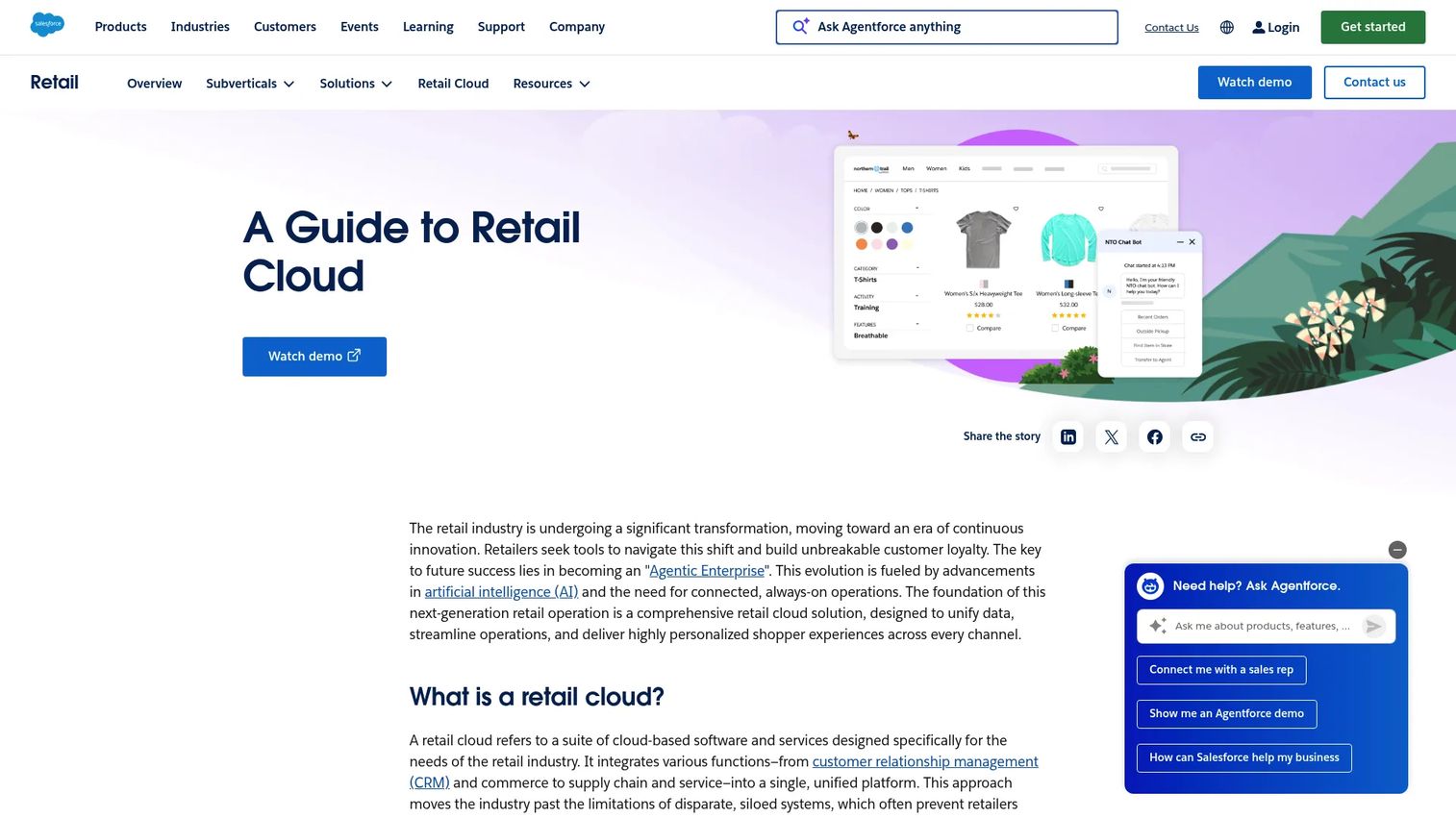
Salesforce Retail Cloud is Salesforce's retail platform for unified commerce, service, marketing, and AI-driven store operations. For an endless aisle solution, its strength is the CRM connection: associate-assisted selling backed by customer data, purchase history, and personalization, so the extended catalog is not just available but relevant. If your organization already runs on Salesforce, the endless aisle layer plugs into infrastructure your teams know.
Best for: Enterprise retailers that already run on Salesforce and want CRM-linked endless aisle selling tied to customer data.
Key strengths
- AI for Data 360 with agentic setup and AI-powered ingestion
- Personal shopping and clienteling tied to customer profiles
- Agentforce marketing and service console capabilities
- Unified product catalog with point of sale and B2C commerce
Why choose Salesforce Retail Cloud: The fit is strongest for large retail organizations that value CRM-linked personalization inside the store as much as raw inventory access. If Salesforce is already your system of record, the endless aisle experience inherits your customer data and store associate workflows without a separate integration project.
Salesforce Retail Cloud pricing: Salesforce lists two contact-sales models for Retail Cloud POS: GMV-based pricing and POS order-based pricing. No public numeric price is shown, so you will need a quote scoped to your volume.
2. Elo

Elo provides the physical interface layer that endless aisle experiences run on: touchscreen POS terminals, customer-facing displays, self-service kiosks, and price-checking stations. When the endless aisle kiosk is the centerpiece of your store-floor plan, Elo supplies the durable, retail-grade hardware and the EloView device management to keep it running across locations.
Best for: Retailers that need configurable, durable touchscreen hardware and kiosks for in-store endless aisle experiences.
Key strengths
- POS terminals and customer-facing displays
- Self-service kiosks and price-checking solutions
- Elo Edge Connect modular peripherals
- EloView remote device management
Why choose Elo: Endless aisle technology only works if the device on the floor is reliable and easy to manage. Elo fits retailers who want to pair a software platform with purpose-built hardware rather than repurposing consumer tablets that fail under store-floor conditions.
Elo pricing: EloView offers three tiers. Core is free for the duration of the device warranty. Connect is $10.50 per device per month for up to 10 devices, and Control is $14.50 per device per month for up to 10 devices. Retail hardware itself is quoted separately.
3. Lightspeed Retail
Lightspeed Retail is a cloud retail POS platform covering inventory, sales, ecommerce, payments, and multi-location operations. For endless aisle execution, its value is practicality: multi-location inventory with stock transfers, online store and BOPIS selling, and in-store sales workflows in one system, with pricing published openly rather than gated behind a sales call.
Best for: SMB and mid-market retailers wanting an all-in-one POS with inventory, ecommerce integration, and multi-store controls.
Key strengths
- Barcode scanning and in-store sales workflows
- Online store, marketplace, and BOPIS selling
- Multi-location inventory, stock transfers, and pricing
- Cloud POS with multi-location controls
Why choose Lightspeed Retail: For retailers who do not need enterprise-grade OMS depth, Lightspeed handles the core endless aisle job, selling across locations and channels, without a long implementation cycle. The public pricing also makes it easier to model cost before committing.
Lightspeed Retail pricing: Public monthly plans are Basic at $89 USD/mo, Core at $149 USD/mo, and Plus at $289 USD/mo. Enterprise and custom pricing is contact-sales. There is no free tier.
4. Manhattan Active Point of Sale
Manhattan Active Point of Sale is a cloud-native, unified POS built for enterprise retailers, combining product catalog access, inventory discovery, assisted selling, returns, and omnichannel checkout in a single app. For endless aisle retail at scale, its differentiator is order management depth and real-time inventory checks across a global network, backed by resilient, offline-capable operation.
Best for: Enterprise retailers needing a unified omnichannel POS with deep order management and global inventory support.
Key strengths
- Unified app for catalog, inventory discovery, assisted selling, clienteling, returns, and checkout
- Cloud-native, offline-capable POS
- Flexible payments including cards, digital wallets, and pay by link
- Back-office operations in the same app
Why choose Manhattan Active Point of Sale: When endless aisle complexity is the whole point, many stores, deep OMS requirements, real-time inventory across a global footprint, Manhattan consolidates selling, service, checkout, and back-office into one associate app. It fits retailers whose operational scale would overwhelm a lighter POS.
Manhattan Active Point of Sale pricing: Pricing is quote-based and not publicly listed, so plan on a scoped conversation with Manhattan to size it for your store count and volume.
5. NewStore

NewStore is a cloud-based omnichannel platform built mobile-first, running store operations, order management, inventory, clienteling, and payments from handheld devices. For endless aisle selling, that mobile orientation means associates carry the full catalog and real-time inventory visibility in their hand, moving with the customer instead of walking them to a fixed terminal.
Best for: Global retail brands modernizing the in-store experience around mobile, associate-led selling.
Key strengths
- Omnichannel order management and routing
- Real-time enterprise inventory visibility
- Clienteling and remote selling
- Mobile-first store operations on handhelds
Why choose NewStore: For retailers whose store strategy centers on the store associate tablet and handheld, NewStore is built around that motion rather than adapting a desktop POS to mobile. It fits brands that want associates selling the full assortment anywhere on the floor.
NewStore pricing: NewStore does not publish pricing; the site directs prospects to a demo and sales conversation, so pricing is scoped per engagement.
6. Shopify POS

Shopify POS is Shopify's point-of-sale system for selling in-store, online, and across channels from one commerce stack. For endless aisle, the advantage is unity: if your ecommerce runs on Shopify, in-store selling shares the same product catalog, inventory management, and order data, so store pickup and ship-to-home flows work without a separate integration layer.
Best for: Retailers already in the Shopify ecosystem who want one stack for online and in-store selling.
Key strengths
- Omnichannel selling across online and store
- Staff management
- Inventory management
- Store pickup and ship-to-home flows
Why choose Shopify POS: For Shopify-native retailers, the endless aisle experience comes largely from consolidation, one catalog, one inventory system, one order record across channels. That removes the reconciliation work that separate online and store systems create.
Shopify POS pricing: Shopify POS is included with Shopify, and Shopify advertises a free trial. POS Pro, the add-on for advanced retail features, is $89/mo per location.
7. Aptos
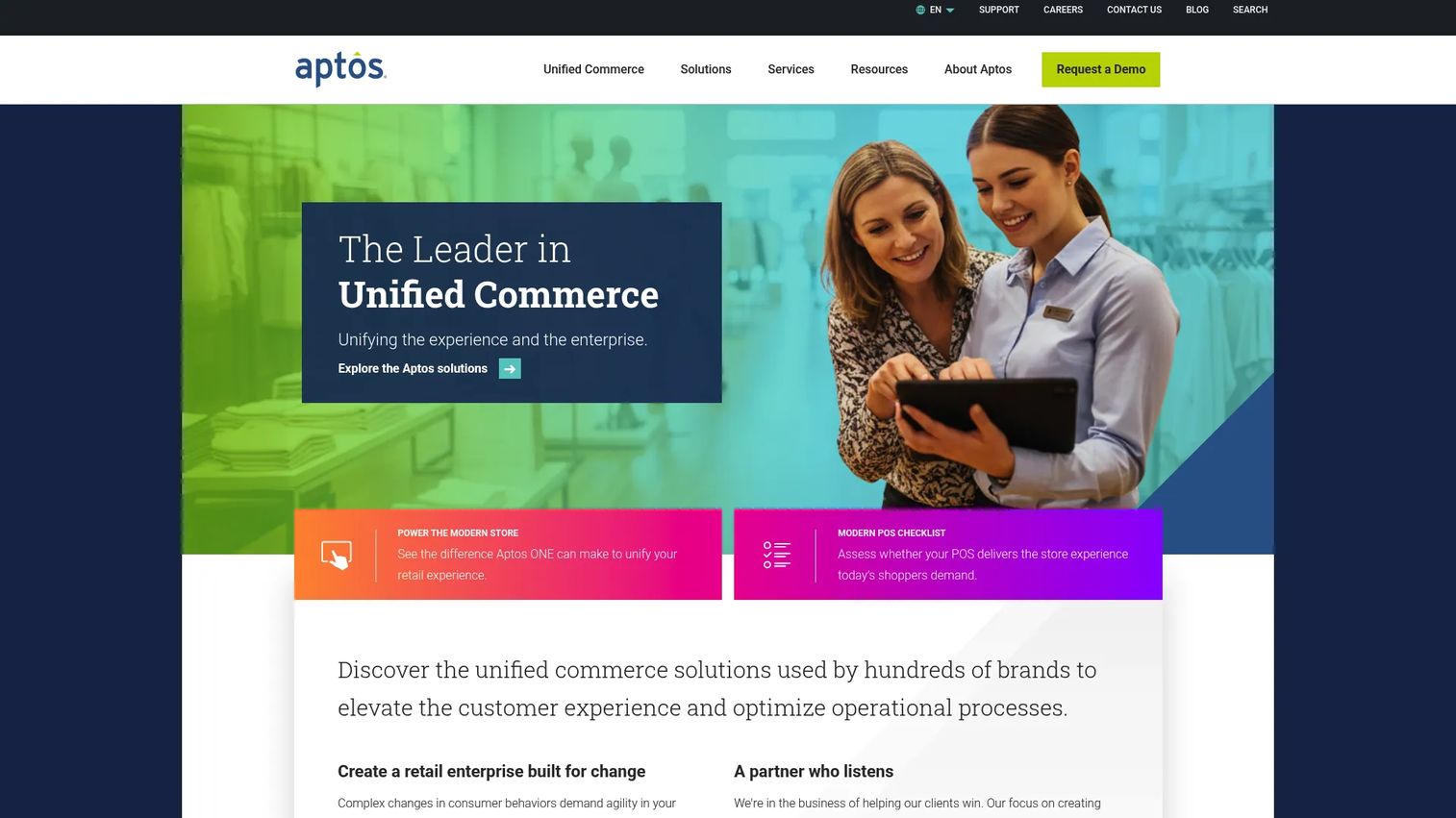
Aptos is a unified commerce provider covering POS, merchandising, order management, CRM, and store operations for larger retailers. For endless aisle retail, its scope is the draw: inventory visibility, store associate enablement, and omnichannel fulfillment sit inside a broader retail platform, which suits chains that want more than a standalone endless aisle solution.
Best for: Enterprise retailers and large chains seeking unified commerce and broad store operations software.
Key strengths
- Aptos ONE mobile-first modern POS
- Unified commerce with POS, inventory, OMS, promotions, and customer capabilities
- Retail merchandising, CRM, and store fulfillment
- Pricing and promotions management
Why choose Aptos: Aptos fits retailers whose needs extend past endless aisle into merchandising, pricing, and full store operations. If you want one vendor across the retail operations stack rather than assembling point tools, it consolidates the pieces.
Aptos pricing: Aptos does not publish pricing on its site and directs visitors to request a demo, so expect a quote scoped to your operation.
Considerations for choosing endless aisle software
The feature list rarely decides the outcome. These four gates do.
Inventory data freshness
Endless aisle retail lives or dies on real-time inventory visibility. If the stock count an associate sees is an hour old, they will promise items that are already gone, and inventory accuracy problems become customer trust problems. Ask how often inventory syncs across stores, warehouses, and online, and what happens when two channels sell the last unit at once.
Integration depth
The endless aisle solution has to connect to your existing POS integration, ecommerce integration, inventory management, and order management systems. Shallow connectors that only pass basic data create manual reconciliation work. Confirm which systems it integrates with natively and how order routing flows across them.
Shopper and associate UX
A slow, confusing endless aisle kiosk or associate tablet gets abandoned. Evaluate search, filtering, product catalog quality, and checkout speed from both sides: the shopper browsing and the store associate completing the sale. If associates find it faster to say "we're out," the rollout will stall regardless of the back-end capability.
Fulfillment flexibility
The recovered sale depends on giving the customer a fulfillment option they will accept. Check for ship-to-home, buy online pick up in store, and store-to-store transfer, and how clearly those choices and their delivery timelines appear at checkout.
Conclusion
The right endless aisle software depends on your size and operational maturity, not on who has the longest feature list. Enterprise retailers on Salesforce lean toward Salesforce Retail Cloud for CRM-linked selling; those needing deep OMS and global inventory look at Manhattan Active Point of Sale or Aptos for broad unified commerce. Hardware-first store plans favor Elo. SMB and mid-market teams get practical execution from Lightspeed Retail, while Shopify-native retailers benefit from keeping everything in Shopify POS. Brands rebuilding the store around mobile associates gravitate to NewStore.
Whichever you shortlist, judge it on inventory freshness, integration depth, and shopper UX before the feature checklist. Those three gates decide whether the store floor actually recovers lost sales or just adds another screen nobody uses. Start with a pilot in a handful of stores, measure recovered walkout revenue against the sub-90-day payback benchmark, and expand from what works.
When you are ready to show that experience to buyers or train associates on it, Start your journey with Guideflow today!
FAQs
Endless aisle in retail is the ability for shoppers and associates to browse and buy a retailer's full catalog in the store, even when the item is not physically on the shelf. The software layer behind it connects store selling to warehouse, other-store, and online inventory, then fulfills through shipping, pickup, or transfer.
It converts a would-be stockout into a completed sale by surfacing inventory the store does not physically hold. When the shelf is empty, the associate finds the item elsewhere in the network and offers ship-to-home or pickup, so the customer buys instead of walking out. Deployed programs recover 15 to 22 percent of otherwise lost walkout sales, per Cloudshelf (2024).
The core integrations are POS, ecommerce, inventory management, and order management (OMS). POS rings the sale, ecommerce supplies catalog data, inventory management provides real-time stock counts, and the OMS routes fulfillment. Weak integration in any of these creates inaccurate availability or manual reconciliation.
No. Enterprise platforms like Manhattan Active Point of Sale and Aptos suit large chains with deep OMS needs, but SMB and mid-market retailers are served well by all-in-one options such as Lightspeed Retail or Shopify POS. The right fit tracks to store count and operational complexity, not just company size.
Common devices include self-service kiosks, store associate tablets, handheld scanners, and mobile POS units. Kiosks support shopper self-service, while tablets and handhelds let associates search the catalog and complete checkout anywhere on the floor. The device choice shapes whether the experience is shopper-led or associate-assisted.
A good endless aisle experience combines fast, accurate search and filtering, real-time inventory accuracy, a quick checkout, and clear fulfillment choices with honest delivery timelines. If any of those breaks, whether it is slow search or stale stock data, both shoppers and associates lose confidence and abandon it.
Yes. Endless aisle reduces the frustration of a wasted store trip by giving customers a way to get the exact item they came for. Broader product access and flexible fulfillment turn a dead-end interaction into a completed purchase, which supports repeat visits and customer satisfaction.
A traditional POS records and processes the sale of items the store physically has. Endless aisle expands what can be sold by surfacing the full network catalog and offering alternate fulfillment. In practice they work together: the POS still completes the transaction, while endless aisle software widens the set of products that transaction can include.