
Your forecast call is Thursday. It's Tuesday. You already know two deals you committed last quarter are going to slip again, and you can't say exactly why.
That's the problem revenue forecasting software exists to solve. Only 7% of sales organizations hit 90% or better forecast accuracy, with the median landing somewhere between 50% and 70% (Parse Labs, 2026). Most teams are guessing, then defending the guess on a call.
The pressure is not going away. The digital revenue forecasting software market was valued at $2.5 billion in 2024 and is projected to reach $8.7 billion by 2033 (LinkedIn, 2024). Adoption of revenue intelligence tools jumped from 45% of B2B sales organizations in 2021 to 72% by the end of 2023 (Gitnux, 2023). Buyers want fewer surprises, cleaner pipeline visibility, and less time reconstructing what happened after the number misses.
This guide compares the tools that actually move forecast accuracy, not just the ones that report on it.
What's inside
This guide is for AEs, RevOps, and revenue leaders comparing a sales forecasting tool before they buy or standardize a stack. We picked tools based on the factors that decide whether a forecast holds up:
- Forecast accuracy and AI-driven prediction quality
- CRM integration and data normalization
- Scenario planning and multi-scenario modeling
- Collaboration and forecast submission workflows
- Security, adoption, and ease of use for reps who own the number
TL;DR
- Best overall for enterprise forecasting: Clari Forecast, for AI forecasting rigor and pipeline visibility at scale.
- Best for AI revenue signals and deal health: Gong Forecast, for deal risk detection tied to buyer behavior.
- Best for CRM-native teams: Salesforce, if your pipeline already lives in Sales Cloud.
- Best for revenue planning plus capacity: Revcast, for forecasting tied to plan and headcount.
- Best for mid-market teams wanting easy adoption: HubSpot Sales Hub.
- Best for broader revenue operations workflows: BoostUp or Aviso.
What is revenue forecasting software?
Revenue forecasting software predicts future revenue by analyzing pipeline data, historical performance, deal signals, and rep activity to produce a defensible forecast you can act on.
It differs from basic CRM reporting in one key way. CRM reporting shows you what reps entered. Revenue forecast software interprets that data, weights it against real signals, and flags where the number is at risk before the quarter closes.
Core capabilities most forecasting solutions share:
- Pipeline rollups: aggregate deals by rep, team, segment, and region into a single forecast view
- AI predictions: apply models to historical and current data to project likely outcomes
- Deal risk detection: surface stalled, single-threaded, or slipping deals early
- Scenario modeling: run best-case, worst-case, and commit scenarios for planning
- Collaboration and forecast submission: let reps, managers, and RevOps submit and adjust forecasts on a shared cadence
- Integrations and data normalization: pull clean, consistent data from CRM, email, calendar, and conversation tools
The best sales forecasting software turns messy pipeline data into a number leadership can defend and reps can trust.
When to use revenue forecasting software
Improve forecast calls
If your forecast calls are painful, a good tool flags risk earlier. Instead of a rep saying a deal is "still on track," the system shows no buyer activity in 14 days and a single stakeholder. That's the difference between a surprise miss and a managed one. AI revenue forecasting turns forecast reviews into conversations about signals, not opinions.
Align AEs, managers, and RevOps
Multiple people own the number, but they rarely see the same version of it. Shared pipeline visibility gives AEs, frontline managers, and RevOps one source of truth for what's committed, what's best-case, and what's at risk. Forecast submission workflows keep everyone honest on the same cadence.
Model upside and downside scenarios
Scenario planning matters most at quarter boundaries, board prep, and territory changes. Multi-scenario forecasting lets you model what happens if two enterprise deals slip, or if a new segment ramps faster than planned. You walk into planning with ranges, not a single fragile number.
Revenue forecasting software comparison
Here's how the eight tools compare on fit, differentiation, pricing, and G2 rating. Pricing and ratings reflect verified values at writing time. Sort your shortlist by how close each tool sits to your current stack and your biggest forecast pain.
| # | Product | Best for | Key differentiator | Pricing | G2 rating |
|---|---|---|---|---|---|
| 1 | Salesforce | CRM-native teams | Forecasting inside the CRM system of record | Free tier; paid from $25/user/mo | 4.4/5 |
| 2 | Gong Forecast | AI deal signals and risk | Forecasts tied to real buyer and rep activity | Custom pricing | 4.7/5 |
| 3 | Clari Forecast | Enterprise forecast rigor | AI forecasting and scenario modeling at scale | Custom pricing | 4.6/5 |
| 4 | Revcast | Planning plus capacity | Forecasting tied to revenue plan and headcount | From $7,000/yr | 5.0/5 |
| 5 | HubSpot Sales Hub | Mid-market adoption | Forecasting inside an all-in-one sales platform | Free tier; paid from $7/mo/seat | Not listed |
| 6 | BoostUp | RevOps process support | Forecasting plus deal inspection across systems | Custom pricing | Not listed |
| 7 | Aviso | Enterprise revenue teams | AI forecasting with deal nudges | Custom pricing | 4.4/5 |
| 8 | Oracle Fusion Sales | Oracle-native enterprises | Forecasting inside a full quote-to-cash suite | From $65/user/mo | 3.9/5 |
Best 8 revenue forecasting tools for 2026
1. Salesforce

Salesforce is the CRM system of record for a large share of B2B sales teams, and its Sales Cloud forecasting sits right on top of the pipeline data reps already manage. If your opportunities, stages, and close dates live in Salesforce, forecasting inside the same platform removes the sync problem before it starts. Built-in AI and Agentforce features layer prediction on top of your existing records.
The pull here is not depth of forecasting math. It's that the forecast reads from the same data reps update daily, so pipeline visibility and CRM integration are native rather than bolted on. For AEs, that means fewer places to update a deal and less reconstruction before a forecast call.
Best for: Teams already deep in Salesforce that want forecasting without a second system.
Key strengths
- Sales CRM and pipeline management in one platform
- Built-in AI and Agentforce forecasting features
- Customer service, marketing, analytics, and deep customization
Why choose Salesforce: It's the broadest option, a full CRM platform rather than a focused forecasting tool. Choose it when consolidating on one system of record matters more than best-in-class forecast modeling.
Salesforce pricing: Free Suite at $0/user/month. Starter Suite starts at $25/user/month, Pro Suite at $100/user/month billed annually, Enterprise at $175/user/month, and Unlimited at $350/user/month.
2. Gong Forecast

Gong Forecast builds its forecast on signals most tools never see: actual buyer behavior and rep activity captured from calls, emails, and meetings. Instead of trusting the stage a rep set, Gong weighs whether the buyer is actually engaged. That makes deal risk detection concrete rather than a gut feel.
For AEs and managers, the value shows up on the forecast call. Account boards and deal reviews surface which committed deals have gone quiet, which are single-threaded, and where the story a rep tells doesn't match the data. AI revenue forecasting here is grounded in what buyers do, not just what reps report.
Best for: Revenue teams that want forecasts driven by real deal health and buyer signals.
Key strengths
- AI-guided forecasts from buyer and rep activity
- Forecast submission and analytics on a set cadence
- Account boards and deal risk detection
Why choose Gong Forecast: Pick it when forecast accuracy depends on knowing which deals are truly alive. It's strongest for teams that already value conversation and activity data in their pipeline reviews.
Gong Forecast pricing: Gong uses custom pricing and asks teams to request a quote. No public numeric price is listed.
3. Clari Forecast

Clari Forecast is built for enterprise revenue teams that need forecast rigor across complex motions. Its AI-driven forecasting and automated roll-ups handle multiple segments, regions, and product lines without a spreadsheet holding everything together. For teams with mature RevOps functions, that structure is the point.
Scenario modeling is a core strength. You can run best-case, commit, and worst-case views, then see how a few slipped deals reshape the quarter. Combined with strong pipeline visibility, that makes Clari a serious layer for leaders who present the number to a board and need it to hold.
Best for: Larger revenue teams with heavy RevOps maturity and complex forecasting needs.
Key strengths
- AI-driven forecasting across complex motions
- Scenario modeling for planning and risk
- Automated forecast roll-ups by segment and region
Why choose Clari Forecast: Choose it when predictability at scale is the priority and you have the RevOps discipline to feed it clean data. It rewards teams that treat forecasting as a process, not a monthly scramble.
Clari Forecast pricing: Clari uses quote-based pricing. Contact the vendor for a price; no public figure is listed.
4. Revcast

Revcast approaches forecasting from the planning side. It ties revenue forecasts to capacity, headcount, and the annual plan, so you're not just projecting deals in flight. You're checking whether the plan is even reachable given ramp, hiring, and quota coverage. For RevOps and revenue leaders, that connection between plan and pipeline is the differentiator.
Scenario planning and what-if modeling let you test how hiring changes or ramp assumptions shift the forecast. Real-time monitoring keeps the plan and the pipeline in the same view instead of two disconnected spreadsheets.
Best for: B2B SaaS revenue teams that want forecasting tied to capacity and annual planning.
Key strengths
- Annual revenue planning and capacity modeling
- Scenario planning and what-if analysis
- Real-time monitoring and forecasting
Why choose Revcast: Pick it when your forecast pain is really a planning problem, not just a pipeline one. It fits teams that need to see whether the number is achievable before they commit to it.
Revcast pricing: G2 reports Revcast at $7,000 per year, scaling by sales team size. Subscription billing applies, with an optional free trial. Pricing is not fully published on the vendor site.
5. HubSpot Sales Hub
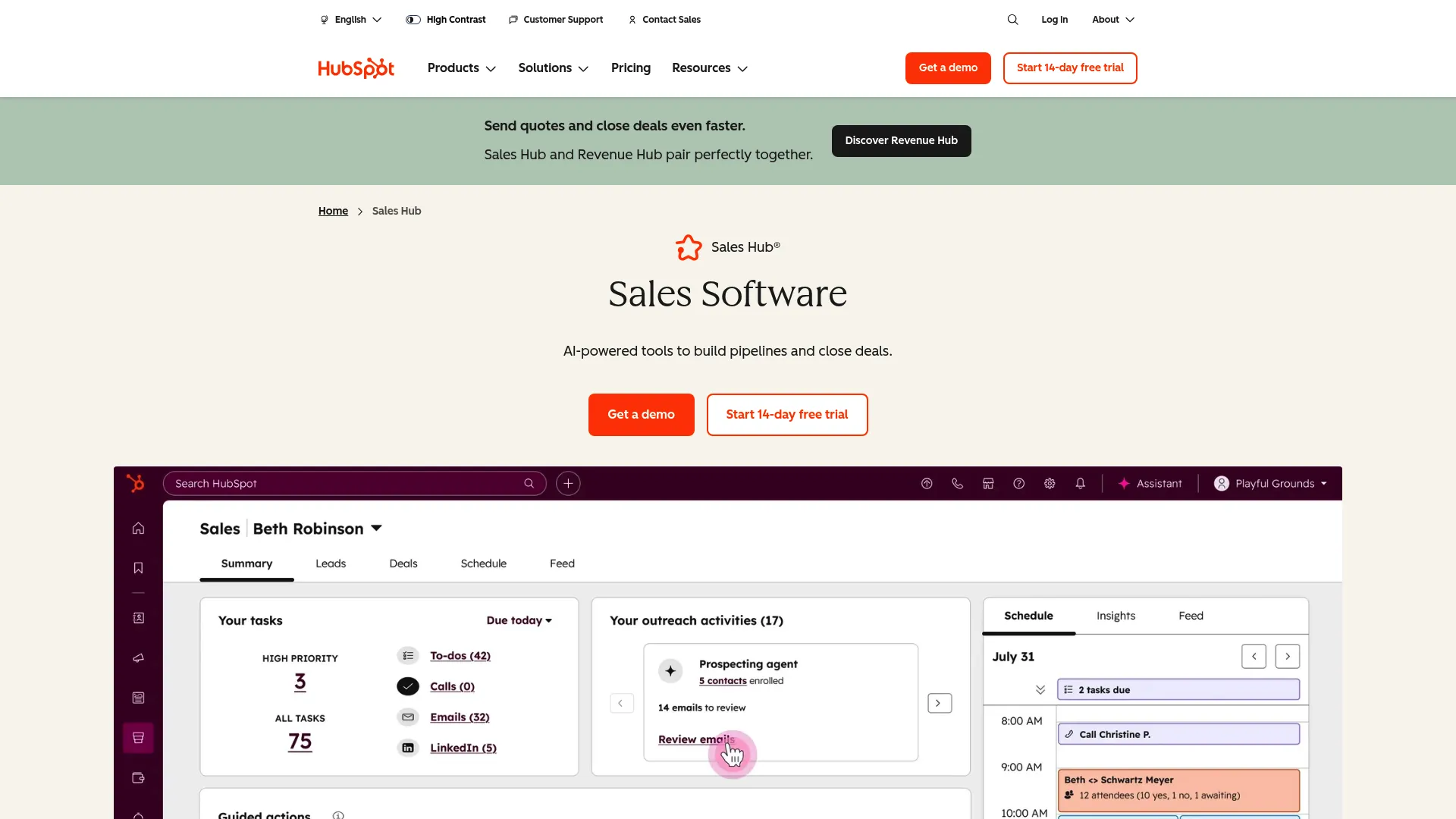
HubSpot Sales Hub fits SMB and mid-market teams that want forecasting inside a system reps will actually adopt. Deal and pipeline management, sales automation, and forecasting all live on HubSpot's Smart CRM, so there's no separate tool to learn. Ease of use is the whole pitch, and it lands for teams without a dedicated RevOps function.
Forecasting and advanced reporting arrive in the higher tiers, which suits teams that grow into the capability rather than buying it all at once. Because it sits inside a broader sales platform, pipeline visibility and CRM integration come standard.
Best for: SMB and mid-market teams that want a simpler system reps adopt quickly.
Key strengths
- Deal and pipeline management on Smart CRM
- Sales automation and sequences
- Meeting scheduling and live chat
Why choose HubSpot Sales Hub: Choose it when adoption and simplicity matter more than deep forecasting math. It's the practical pick for teams standardizing on HubSpot across sales and marketing.
HubSpot Sales Hub pricing: Free plan for up to 2 users. Starter starts at $7/month/seat, Professional at $90/month/seat, and Enterprise at $150/month/seat, with higher tiers adding forecasting and advanced reporting.
6. BoostUp

BoostUp is a revenue intelligence and forecasting platform aimed at enterprise teams that want forecasting hygiene across multiple systems. Machine forecasting, deal inspection, and conversation intelligence combine to give RevOps a process layer, not just a report. It pulls signals from across the stack to keep the forecast grounded in reality.
For teams that struggle with inconsistent pipeline data, the appeal is process support. Deal inspection surfaces gaps in real time, so managers coach against data rather than anecdote. The brand now operates under the Terret name.
Best for: Enterprise revenue teams needing forecasting, deal inspection, and conversation intelligence in one layer.
Key strengths
- Machine forecasting across systems
- Deal intelligence and inspection
- Conversation intelligence
Why choose BoostUp: Pick it when forecasting hygiene and RevOps process are the priority. It fits teams that want signals from calls and activity feeding a cleaner forecast.
BoostUp pricing: BoostUp does not expose public list pricing; the current site directs teams to contact sales for a quote.
7. Aviso

Aviso is an AI revenue platform built for forecasting, deal intelligence, and revenue operations at enterprise scale. Its AI-powered forecasting pairs with deal nudges that prompt reps toward the next best action, so the tool doesn't just predict the number, it helps move it. For sales leadership, that combination of forecast and execution is the draw.
Conversation intelligence and pipeline management round out the platform, giving leaders opportunity-level risk tracking alongside the top-line forecast. It positions as a serious forecasting layer for teams that want visibility and guidance together.
Best for: Enterprise revenue teams that want AI forecasting paired with deal execution guidance.
Key strengths
- AI-powered revenue forecasting
- Deal intelligence and nudges
- Conversation intelligence and pipeline management
Why choose Aviso: Choose it when you want forecasting and deal execution in the same platform. It suits leaders who track opportunity risk closely and want AI guidance built in.
Aviso pricing: Aviso uses quote-based pricing. The site asks visitors to request a tailored proposal; no public price is shown.
8. Oracle Fusion Sales

Oracle Fusion Sales fits large, complex organizations already running on Oracle. Forecasting sits inside a full quote-to-cash suite that spans sales automation, CPQ, quoting, billing, renewals, and compensation. For enterprises that want the forecast connected to the entire revenue motion, that breadth is the reason to choose it.
Guided workflows and AI insights support forecasting alongside the rest of the sales process. It's less a standalone forecasting tool and more the forecasting piece of a broader enterprise revenue stack, which is exactly what Oracle-native teams want.
Best for: Enterprise teams needing a connected, Oracle-native quote-to-cash platform with forecasting built in.
Key strengths
- Sales automation and guided workflows
- CPQ and quoting with AI insights
- Subscription, billing, renewals, and compensation
Why choose Oracle Fusion Sales: Choose it when you're standardizing on Oracle and want forecasting inside a single revenue suite. It fits complex enterprises more than lean, fast-moving teams.
Oracle Fusion Sales pricing: Professional Edition starts at $65/user/month, Standard at $100/user/month, Enterprise at $200/user/month, and Premium at $300/user/month.
Considerations before you buy
Before you shortlist, run each tool against the criteria that decide whether it survives contact with your actual pipeline.
Forecast accuracy and AI
Look for evidence the tool improves accuracy, not just reports on it. Ask how the AI weights deals, what signals it uses, and whether it explains its predictions. A forecast you can't defend on a call is not worth much.
CRM integration and data integrity
Your forecast is only as clean as the data feeding it. Check how deeply the tool integrates with your CRM, how it normalizes data across sources, and whether it reduces manual entry. Weak CRM integration means reps reconstructing pipeline before every forecast cadence.
Scenario planning depth
Confirm the tool supports multi-scenario forecasting: best-case, commit, worst-case, and custom what-ifs. Scenario planning is what turns a fragile single number into ranges you can plan around for board prep and territory changes.
Adoption and ease of use
If reps won't use it, the forecast stays wrong. Evaluate how the tool fits the existing workflow, how much admin it adds, and whether it lives inside the systems reps already open. Adoption is the difference between a tool that improves the number and one that sits idle.
Security and scale
For mid-market and enterprise, check SOC 2, data residency, and access controls early. These become late-stage gates that can stall a rollout if you skip them.
Conclusion
Forecast accuracy is a data and process problem, and the right tool depends on where your stack sits today.
If your pipeline lives in Salesforce, forecasting inside Salesforce keeps everything in one system of record. If you want forecasts grounded in real deal health, Gong Forecast reads buyer and rep signals most tools miss. And if you need enterprise forecast rigor with strong scenario planning, Clari Forecast is built for predictability at scale.
For mid-market teams, HubSpot Sales Hub wins on adoption. For planning tied to capacity, Revcast connects the forecast to the annual plan. And for broader revenue operations support, BoostUp and Aviso add process and AI guidance.
Shortlist two or three tools that match your current stack and your biggest forecast pain, then test them against your real pipeline data before you commit. The best sales forecasting software is the one your reps will actually keep updated.
FAQs
Revenue forecasting software predicts future revenue by analyzing pipeline data, deal signals, historical performance, and rep activity. Unlike a static spreadsheet, it weights deals against real signals and flags risk before the quarter closes, so leaders get a number they can defend.
CRM reporting shows what reps entered: stages, close dates, and amounts. Revenue forecast software interprets that data, applies AI or weighting, and surfaces deal risk and scenario ranges. Reporting tells you the current state; forecasting tells you the likely outcome and where it's fragile.
Clari Forecast is a strong enterprise pick for AI forecasting rigor and scenario modeling across complex motions. Aviso and BoostUp also fit enterprise revenue teams, and Oracle Fusion Sales suits organizations standardizing on Oracle's full quote-to-cash suite.
Prioritize forecast accuracy, deep CRM integration, multi-scenario forecasting, and forecast submission workflows. Data normalization and adoption matter just as much, since a forecast is only as reliable as the pipeline data behind it and the reps who keep it current.
AI revenue forecasting helps when it weights deals against real signals like buyer engagement and rep activity, not just the stage a rep set. The lift depends on data quality. Clean CRM integration and activity capture matter more than the model itself.
Yes. Most forecasting solutions integrate with Salesforce, and Salesforce itself offers native Sales Cloud forecasting. Tools like Gong, Clari, and Aviso are built to pull and normalize Salesforce pipeline data so the forecast reads from your system of record.
Forecasting tools focus on projecting and managing the number. Revenue intelligence tools like Gong and BoostUp focus on capturing activity and deal signals that improve pipeline visibility. If your forecast is wrong because your data is messy, start with intelligence; if your data is clean, start with forecasting.
An AE wants fewer surprises and less admin. Look for a tool that flags deal risk early, fits your existing workflow, and reduces manual pipeline updates before every forecast cadence. The best sales forecasting tool makes your commit defensible without hours of reconstruction.