Your emissions data lives in one spreadsheet. Permit renewals sit in a shared drive nobody checks until a deadline hits. Incident logs are trapped in email threads. When an auditor asks for a single defensible number, three people spend a week reconciling files that never agreed in the first place.
That fragmentation is the real cost of managing environmental performance without a system. And it is getting more expensive. The global environmental software market is projected to grow from USD 8.05 billion in 2021 to USD 24.56 billion by 2033, more than a 3x expansion, according to Cognitive Market Research (2024). Buyers are not adding tools for fun. They are consolidating scattered records into something that can actually support a decision.
The problem most teams are trying to solve is not storage. It is decision-making. Software should help you track obligations, monitor performance, and act on trends, not just file compliance records after the fact. That distinction shapes how you should evaluate every vendor below.
The picks in this guide were chosen for regulatory coverage, audit readiness, KPI depth, and how well they centralize environmental data across sites. If you also manage adjacent workflows, it helps to see how similar categories handle governance, such as audit management software and contract lifecycle management, since environmental programs rarely operate in isolation from the rest of your compliance stack.
What's inside
This guide covers environmental management software for compliance, monitoring, reporting, analytics, and operational improvement. It is written for product managers, EHS leads, and operations teams evaluating platforms that must support regulated work, auditability, and clean data across multiple sites.
We selected tools based on four criteria: regulatory and permit coverage, audit-ready data trails, depth of KPI and analytics reporting, and how well each platform centralizes environmental data for cross-functional teams. Every entry is judged as a decision system, not a recordkeeping archive. You will find a comparison table, individual breakdowns, a buyer's checklist, and FAQs.
TL;DR
- Best overall for balanced compliance and analytics: Cority, a converged EHS+ platform that pairs environmental workflows with AI-enabled risk automation.
- Best for SAP-native enterprises: SAP S/4HANA for EHS, with compliance obligation management and AI-assisted permit handling inside the SAP ecosystem.
- Best for modular EHS and ESG coverage: Quentic, which lets teams switch on environmental, safety, and sustainability modules as needs grow.
- Best for configurable EHSQ programs: Intelex, with public per-user pricing and strong incident, audit, and training workflows.
- Best for large multi-site enterprises: Enablon, built for sustainability, EHS, and operational risk across many jurisdictions.
- Best for integrated risk-driven reporting: Sphera and DNV Synergi Life, both strong for regulated, multi-site operations.
What is environmental management software?
Environmental management software (EMS software) is a platform that helps organizations track compliance obligations, capture environmental data, and report on performance across emissions, waste, water, and hazardous materials. It turns scattered records into a structured, auditable data layer that supports both regulatory reporting and operational decisions.
Strong environmental management system software shares a common set of capabilities. When you evaluate vendors, look for these building blocks:
- Compliance tracking: Centralized obligations, permit management, and deadline monitoring across regions and regulations, including ISO 14001 and ISO 50001 alignment.
- Environmental data capture: Structured intake for emissions, energy, water and wastewater, waste streams, and hazardous materials, often from field apps and connected sensors.
- Analytics and reporting: KPI dashboards, trend analysis, and environmental reporting that validates data before it reaches a regulator or the board.
- Operational workflows: Air emissions management, waste management tracking, spill and incident logging, and continuous improvement processes.
- Audit trails and decision support: Time-stamped records, version history, and audit-ready environmental data that hold up under scrutiny.
The distinction that matters most for buyers is scope. Some platforms lead with environmental compliance software strengths, others lead with environmental monitoring software and analytics depth, and enterprise suites fold both into broader EHS and ESG governance. The right fit depends on where your program is today and where it needs to be in two years.
When to use environmental management software
Not every team needs a full platform on day one. These three situations are the clearest signals that spreadsheets have run their course.
When compliance obligations spread across regions
Once you operate in more than one jurisdiction, permit conditions, reporting deadlines, and regulatory thresholds multiply fast. Centralized obligation and permit management replaces manual follow-up with automated tracking and alerts. That reduces the risk of a missed filing and gives auditors a single, defensible record instead of a scramble across folders.
When reporting has outgrown spreadsheets
Spreadsheets break quietly. A broken formula or an unvalidated entry can distort a KPI for months. EMS software adds validation rules, trend analysis, and structured KPI reporting so numbers are checked before they are trusted. The payoff is faster decisions and fewer data errors that surface at the worst possible moment.
When environmental work needs to connect to operations
Resource efficiency, waste reduction, and continuous improvement all depend on shared, current data. When environmental metrics live in the same system operations teams use, leadership gets visibility into performance and cross-functional teams can act on it. Environmental impact management stops being a reporting exercise and starts driving change.
Comparison table
The table below groups each tool by intent so you can quickly separate compliance-first platforms from analytics-first and enterprise-suite approaches. Use it to shortlist two or three, then read the full breakdowns.
| # | Product | Intent | Key differentiation | Pricing | G2 rating |
|---|---|---|---|---|---|
| 1 | Cority | Converged EHS+ suite | Unified environmental, safety, quality, and sustainability with AI risk automation | Custom / demo-based | Not verified |
| 2 | SAP S/4HANA for EHS | Enterprise SAP-native | Compliance obligation management with AI-assisted permit handling | Quote-based | Not verified |
| 3 | Quentic | Modular EHS/ESG | Switch-on modules for environmental, safety, and sustainability workflows | Contact for pricing | 4.0/5 |
| 4 | Intelex | Configurable EHSQ | Public per-user pricing with incident, audit, and training workflows | From $44/user/mo | 4.0/5 |
| 5 | Enablon | Enterprise sustainability | Sustainability, EHS, and operational risk at multi-site scale | Custom | 4.1/5 |
| 6 | Sphera | Risk-driven enterprise | Integrated sustainability, risk, and life cycle assessment data | Custom | 4.0/5 |
| 7 | DNV Synergi Life | Integrated QHSE | Configurable QHSE, risk, and sustainability across sectors | Custom | Not verified |
1. Cority
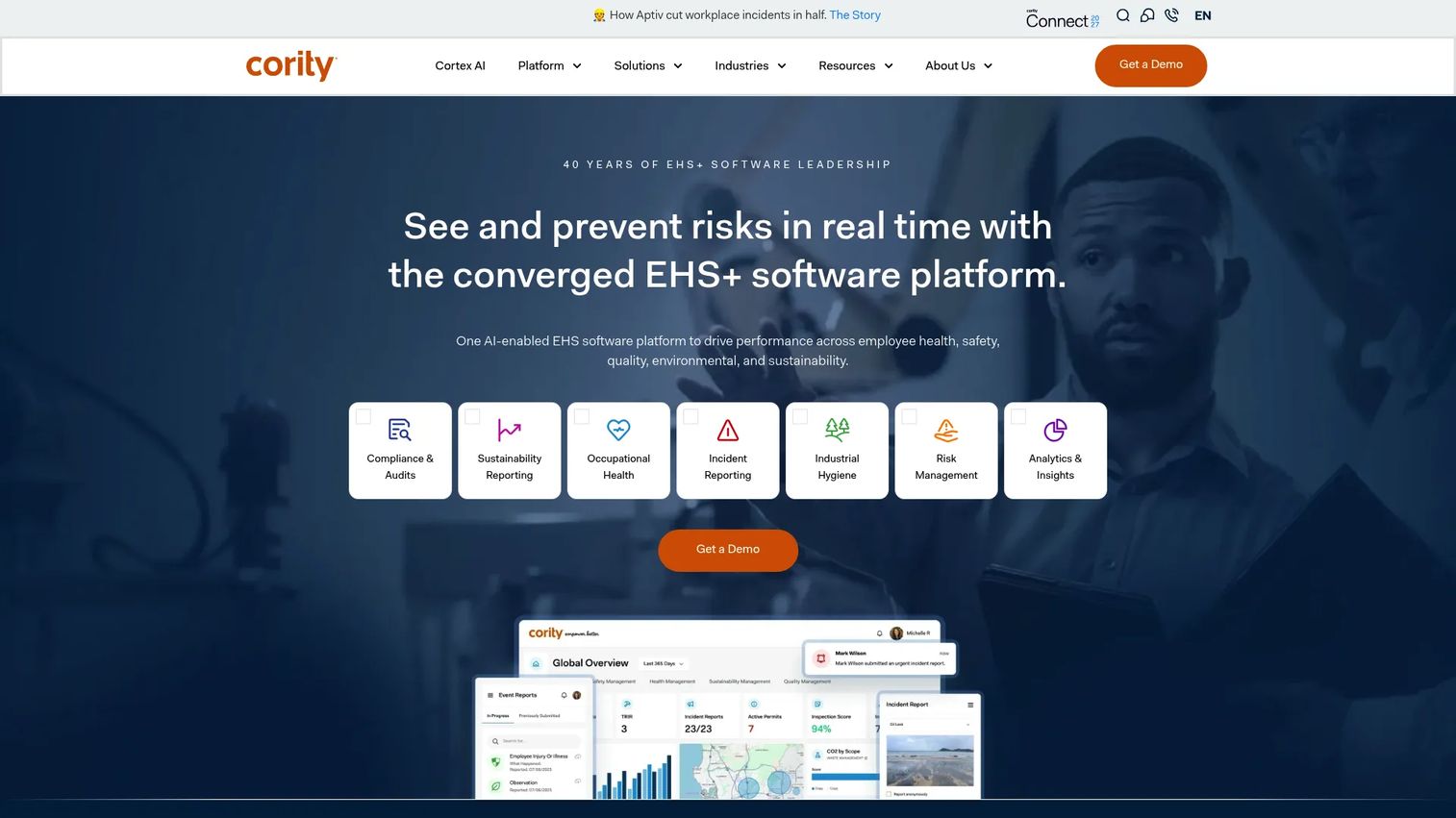
Cority is an enterprise EHS+ platform that unifies safety, health, environmental, quality, and sustainability management in one converged system. It is built for organizations that want more than checklist compliance: the platform pairs environmental workflows with historical data, risk assessment, and AI-enabled automation so environmental work becomes an input to decisions, not an afterthought.
For regulated organizations, Cority's strength is breadth without fragmentation. Environmental, health, safety, quality, and sustainability data live in the same converged platform, which makes it easier to spot trends across programs and defend numbers during an audit. The Cortex AI layer adds risk and workflow automation on top of that shared data.
Best for: Large organizations that need a single, unified EHS+ platform rather than a stack of disconnected point tools.
Key strengths
- Converged EHS+ platform: One system for environmental, safety, health, quality, and sustainability, reducing data silos across programs.
- AI-enabled risk automation: Cortex AI surfaces risk signals and automates repetitive workflow steps.
- Historical data and trend analysis: Long-run environmental data supports continuous improvement and audit readiness.
Why choose Cority: If your program spans multiple EHS disciplines and you are tired of reconciling separate tools, Cority's converged model is the argument. It fits teams that treat environmental data as part of a broader risk and performance picture rather than a standalone compliance task.
Cority pricing: Cority does not publish a numeric starting price. Pricing is demo and contact-sales driven, so you will need to request a quote scoped to your modules and user count. Budget for an enterprise-tier commitment given the platform's breadth.
2. SAP S/4HANA for EHS
SAP S/4HANA for EHS is SAP's environment, health, and safety suite for environmental management and workplace safety. It focuses on compliance, risk, and operational performance, and it is a natural fit for enterprises already running core processes inside the SAP ecosystem.
The suite leans into automation and governance. Compliance obligation management centralizes regulatory requirements, while automated data collection, calculation, and validation reduce manual handling of emissions and environmental figures. AI-assisted permit management and conversational incident recording lower the effort of keeping records current and audit-ready.
Best for: Enterprises that need SAP-native EHS compliance and safety management tied into existing SAP financial and operational data.
Key strengths
- Compliance obligation management: Centralizes regulatory obligations and ties them to responsible owners and deadlines.
- Automated data collection and validation: Captures, calculates, and validates environmental data to cut manual errors.
- AI-assisted permit management: Streamlines permit handling and conversational incident recording for faster reporting.
Why choose SAP S/4HANA for EHS: The integration argument is decisive here. If SAP is already your system of record, keeping environmental compliance inside the same governance and data model avoids yet another disconnected silo. It rewards enterprises that value native integration over best-of-breed independence.
SAP S/4HANA for EHS pricing: SAP uses quote-based pricing with no public numeric figure. Plans such as SAP S/4HANA Cloud for EHS workplace safety are priced on request, structured around records per year. Contact SAP for a tailored quote based on your record volume and modules.
3. Quentic
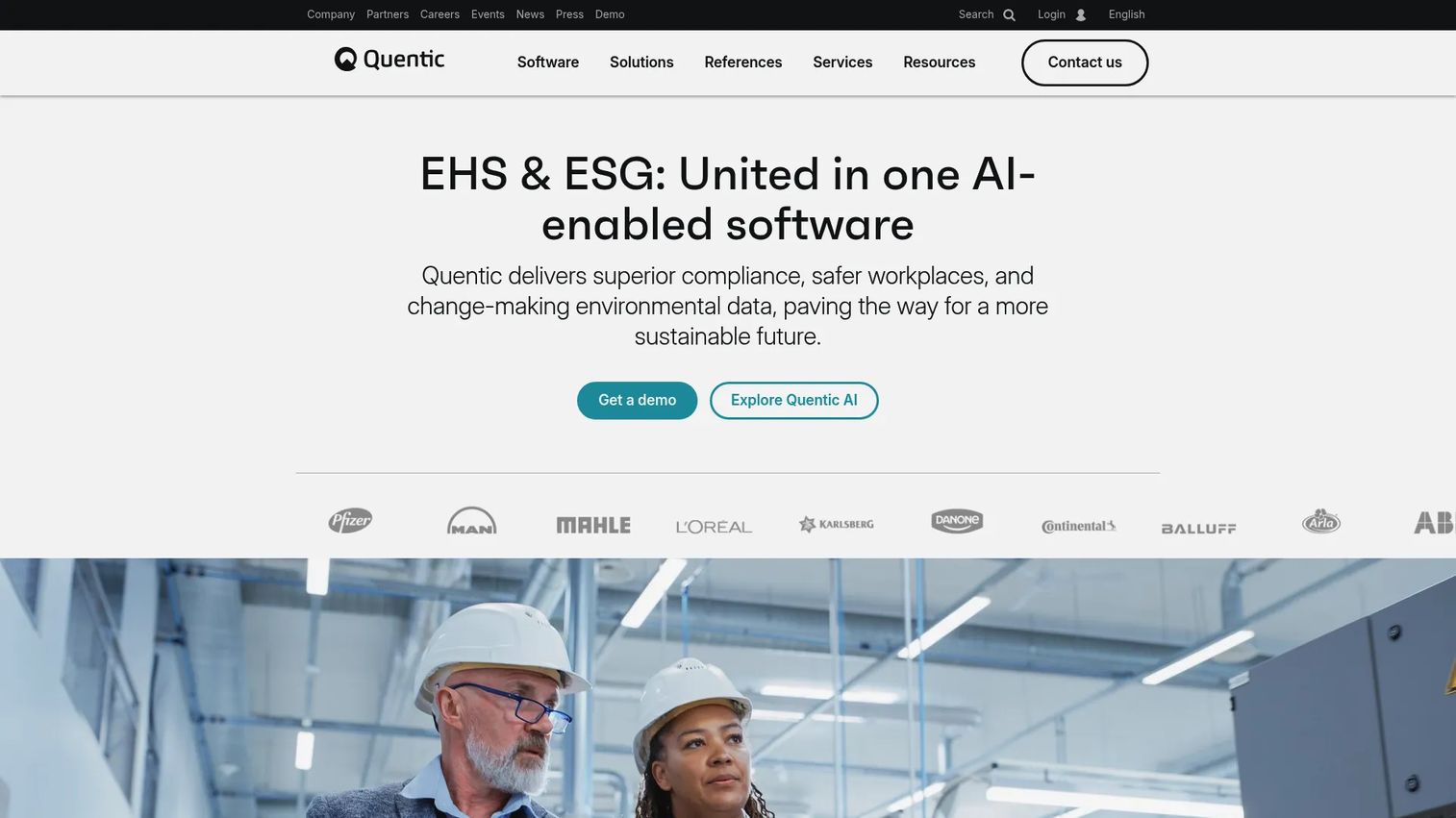
Quentic is cloud-based EHS and ESG software covering safety, compliance, environmental, quality, and sustainability management. Its modular design lets teams start with the environmental workflows they need today and switch on additional modules as the program matures, which makes it attractive to teams that want to grow into a platform rather than buy everything at once.
The platform combines the Quentic Platform for modular EHS and ESG setup, the Quentic App for on-the-go field use, and Quentic Analytics for dashboards and reports. That mix supports resource consumption monitoring, cost tracking, ISO alignment, and waste management within a single environment, so operational and reporting data stay connected.
Best for: Organizations that want modular EHS and ESG coverage they can expand over time.
Key strengths
- Modular EHS and ESG setup: Activate environmental, safety, and sustainability modules as needs evolve.
- Quentic App for field use: Capture data on-site and on the go, keeping records current.
- Quentic Analytics: Dashboards and reports for environmental indicators and KPI tracking.
Why choose Quentic: Quentic suits teams that value flexibility and want to avoid over-buying. If you expect your environmental program to expand into broader ESG reporting, the modular model lets you scale scope without switching platforms. Evaluate rollout scope carefully so modules match your reporting obligations.
Quentic pricing: Quentic uses monthly charges and does not publish public numeric pricing. The pricing page invites teams to contact Quentic for a tailored solution. On G2, Quentic holds a 4.0/5 rating.
4. Intelex
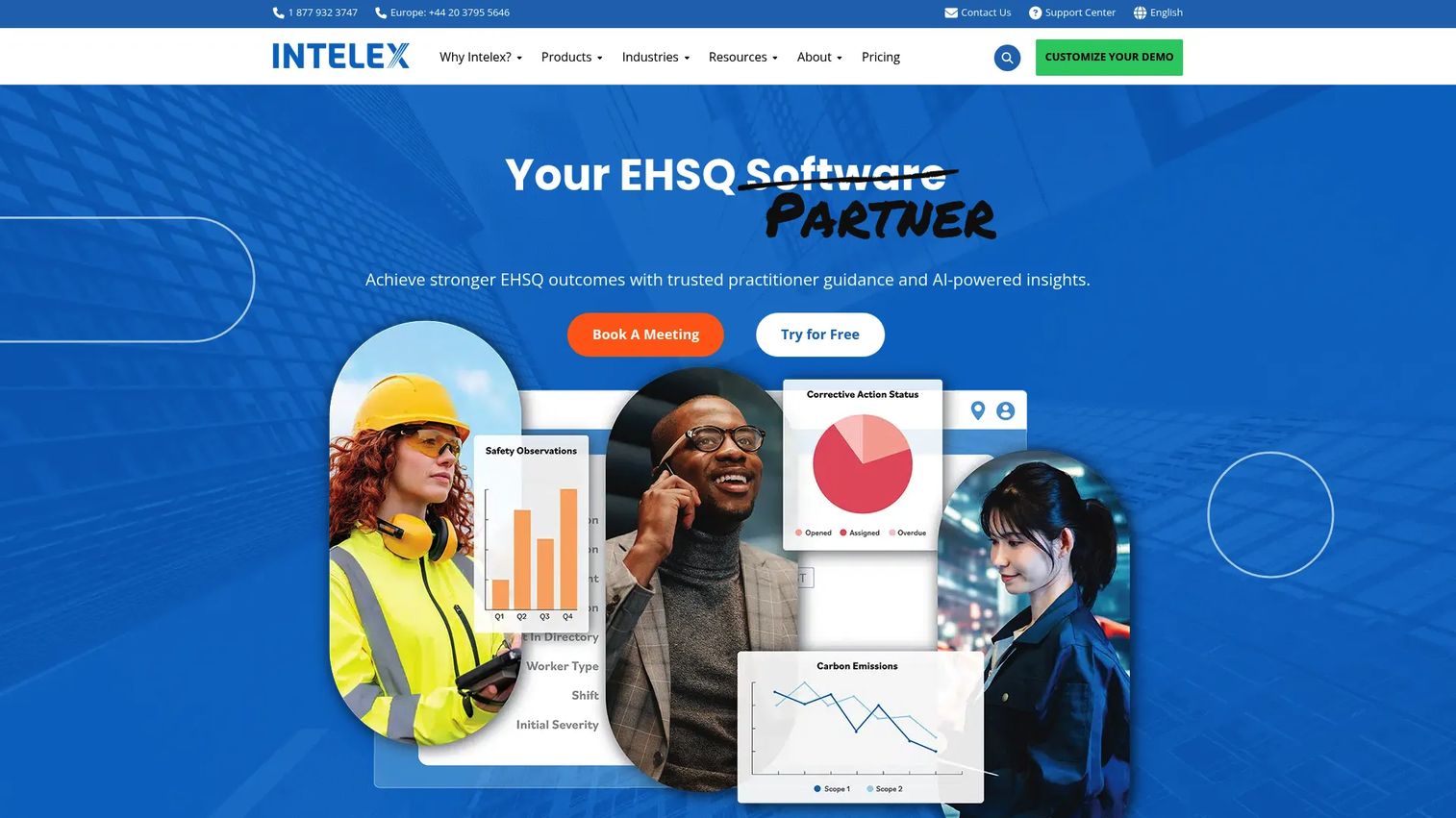
Intelex is EHSQ software spanning environmental, health, safety, quality, risk, ESG, and sustainability management. It is known for configurability, which makes it a strong option for larger EHS programs that need workflows shaped around their own processes rather than a fixed template.
The platform's environmental compliance workflows sit alongside incident management, audit management, and training management, giving teams a broad base for EHS process management. KPI reporting ties these workflows together so environmental performance is visible next to safety and quality metrics.
Best for: Mid-market and enterprise teams that need a configurable EHSQ platform across multiple programs.
Key strengths
- Incident management: Log, track, and analyze incidents with structured workflows.
- Audit management: Plan and run audits with audit-ready environmental data trails.
- Training management: Track certifications and training tied to compliance requirements.
Why choose Intelex: Configurability is the draw. If your organization has established EHS processes and wants software that bends to them, Intelex fits better than rigid, template-driven tools. It works well for teams managing broader EHS process management alongside environmental compliance.
Intelex pricing: Intelex publishes a Safety Essentials plan starting at $44 USD per user per month, billed annually, with a minimum of 25 users. Additional capabilities are custom and quote-based. There is no free tier. On G2, Intelex holds a 4.0/5 rating.
5. Enablon
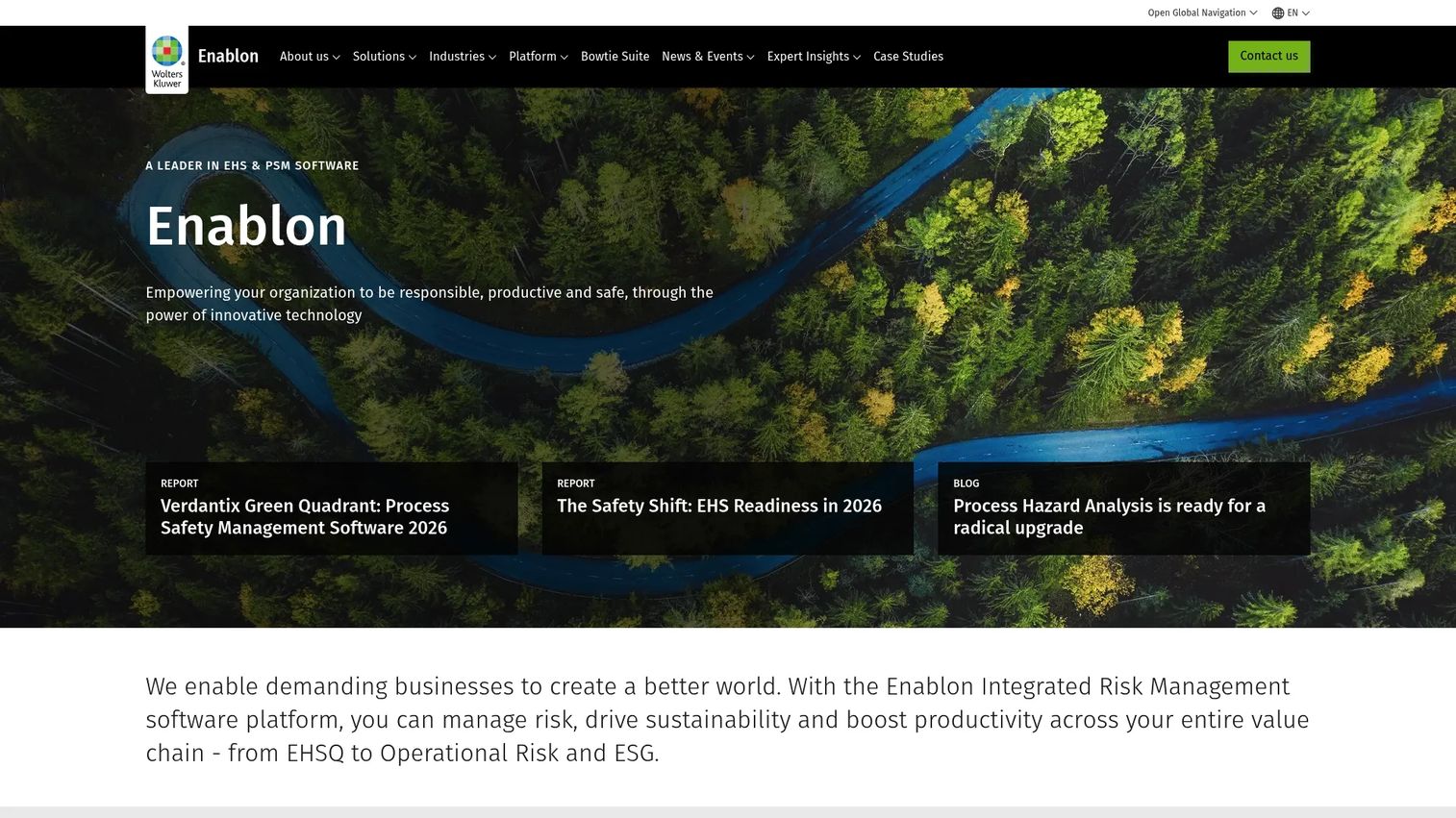
Enablon, a Wolters Kluwer business, is enterprise sustainability, EHS, and operational risk management software. It is built for large organizations managing environmental performance across many sites and jurisdictions, where centralized reporting and governance are non-negotiable.
The platform covers sustainability management and reporting, QEHS management, and operational risk management in one place. That combination handles emissions, waste, and compliance while rolling site-level data up into enterprise-wide reporting, which matters when leadership and regulators expect consistent numbers across a global footprint.
Best for: Large organizations managing sustainability and EHS across multiple sites and regulatory regimes.
Key strengths
- Sustainability management and reporting: Centralized environmental and ESG reporting across the enterprise.
- QEHS management: Combined quality, environmental, health, and safety workflows.
- Operational risk management: Enterprise risk visibility tied to environmental performance.
Why choose Enablon: Enablon is the pick when scale and governance dominate the requirements. Multi-site, multi-jurisdiction organizations get centralized reporting and consistent data standards that hold up to enterprise scrutiny. It suits teams that need environmental data to feed a broader operational risk picture.
Enablon pricing: Enablon does not publish public pricing on its site, and inquiries route to sales. Expect enterprise-tier, custom pricing scoped to your sites, modules, and users. On G2, Enablon holds a 4.1/5 rating.
6. Sphera
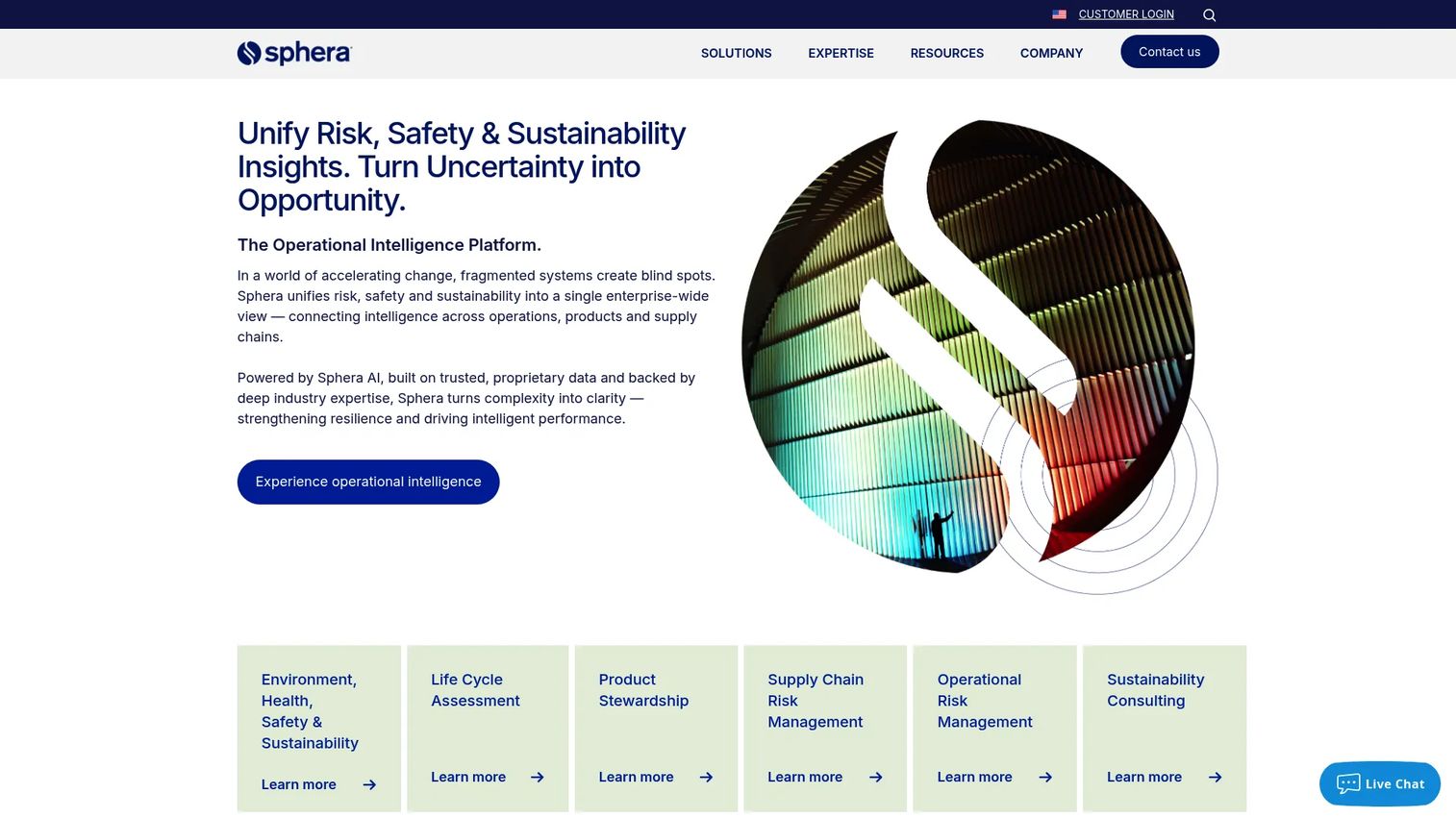
Sphera provides enterprise software, data, and consulting for sustainability, operational risk, product stewardship, and supply chain risk management. Its environmental performance management is strongest for large enterprises that treat compliance and sustainability as risk-driven disciplines backed by robust data.
Sphera pairs an integrated sustainability and operational risk platform with EHS&S solutions, product stewardship, and life cycle assessment data. That data depth, combined with Sphera AI and proprietary datasets, supports risk-driven reporting for regulated, multi-site operations where the underlying data quality matters as much as the workflow.
Best for: Large enterprises that need integrated sustainability, risk, and compliance software backed by strong data.
Key strengths
- Integrated sustainability and risk platform: Environmental performance and operational risk in one system.
- Life cycle assessment data: Proprietary LCA data and software for deeper environmental analysis.
- Sphera AI and proprietary data: Data-rich foundation for risk-driven environmental reporting.
Why choose Sphera: Sphera fits enterprises that want environmental and sustainability decisions grounded in serious data, not just workflow. Its product stewardship and supply chain risk coverage make it strong for organizations where environmental impact extends well beyond their own four walls.
Sphera pricing: Sphera does not publish a numeric price and routes pricing inquiries to contact forms. Expect enterprise, custom pricing scoped to your solutions and data needs. On G2, Sphera holds a 4.0/5 rating.
7. DNV Synergi Life
DNV Synergi Life is a modular HSE, quality, risk, and sustainability management software suite. It is aimed at enterprises that want integrated QHSE oversight, with configurable modules that adapt across sites and sectors, from energy to manufacturing.
The suite covers incident, risk, audit, and quality management alongside EHS and QHSE reporting workflows. AI-assisted risk management and sustainability modules extend that base, giving multinational teams a way to standardize environmental reporting and audit readiness across a distributed operation.
Best for: Enterprises needing configurable QHSE, risk, and ESG management across multiple sites or sectors.
Key strengths
- Integrated QHSE management: Incident, risk, audit, and quality workflows in one suite.
- EHS and QHSE reporting: Structured environmental and safety reporting across sites.
- AI-assisted risk and sustainability modules: Extend risk management and sustainability tracking as needs grow.
Why choose DNV Synergi Life: DNV Synergi Life is a strong fit for multinational operations that want integrated HSE oversight from a recognized name in risk and assurance. Its configurable, modular structure helps large teams standardize environmental and safety reporting across regions. Plan adoption around change management for distributed teams.
DNV Synergi Life pricing: DNV states pricing is customized based on users, modules, and customization needs, with enterprise-wide agreements available. No public numeric price is listed, so contact DNV for a scoped quote.
Considerations before you buy
The vendor is only half the decision. These criteria separate a platform that becomes a decision system from one that becomes another silo.
Regulatory and permit coverage
Confirm the platform tracks the specific regulations, permits, and reporting frameworks your sites face, including ISO 14001 and ISO 50001 where relevant. Coverage that looks broad in a demo can have gaps in your exact jurisdictions. Ask for evidence of support for your regions, not just a feature list.
Audit readiness and data integrity
Audit-ready environmental data depends on time-stamped records, version history, and validation rules. Test how the platform handles corrections and who can change what. A clean audit trail is worth more than a dashboard that looks impressive but cannot prove where a number came from.
Analytics and KPI depth
Look past static reports. Evaluate whether the tool supports trend analysis, environmental analytics, and KPI reporting that leadership will actually act on. If the platform only stores data, you have digitized a filing cabinet, not built a decision system. Similar buyer logic applies when you compare tools in adjacent categories such as application performance monitoring tools and best contract management software tools.
Centralized data and integrations
Centralized EHS data only works if it connects to the systems you already run. Check integration depth with your ERP, operations, and reporting stack. For product managers owning internal tooling, this is where opportunity cost lives: a poorly integrated platform creates ongoing maintenance load instead of removing it.
Rollout scope and maintainability
Match module scope to your real obligations, not an aspirational roadmap. Over-buying creates unused complexity, while under-scoping forces a painful migration later. Confirm how the platform handles change as regulations and your operations evolve.
Conclusion
The right environmental management software depends on which pressure dominates your program. If you need balanced compliance and analytics in one converged platform, Cority is the strongest all-round pick. SAP S/4HANA for EHS wins when SAP-native integration matters most. Quentic fits teams that want modular EHS and ESG coverage they can expand, and Intelex suits configurable EHSQ programs with transparent per-user pricing.
For large, multi-site enterprises, Enablon, Sphera, and DNV Synergi Life each bring enterprise governance and risk-driven reporting, with the choice coming down to whether you prioritize sustainability breadth, data depth, or integrated QHSE oversight.
Start by shortlisting two or three tools that match your intent, then pressure-test each against your actual regulations, audit needs, and integration stack in a scoped demo. The best platform is the one that turns scattered environmental records into decisions your team and your auditors can trust.
FAQs
Environmental management software centralizes compliance obligations, environmental data, and reporting across emissions, waste, water, and hazardous materials. It replaces spreadsheet sprawl with structured, audit-ready records and adds analytics so teams can track performance and act on trends, not just store results.
EMS software focuses on environmental compliance, monitoring, and reporting, while EHS software adds health and safety workflows such as incident and injury management. Many enterprise suites combine both, so the practical difference is scope: some tools lead with environmental depth, others fold it into broader EHS and quality governance.
Prioritize compliance and permit tracking, audit-ready data trails, environmental data capture, and KPI reporting with trend analysis. Integration with your existing operational systems matters just as much, since centralized data only delivers value when it connects to the tools your teams already use.
Manufacturing, energy and utilities, oil and gas, chemicals, mining, and construction are heavy users because they face significant emissions, waste, water, and hazardous materials obligations. Any multi-site, regulated operation with recurring permits and reporting deadlines benefits from a centralized platform.
Yes. Most platforms support ISO 14001 by structuring documentation, tracking objectives, managing audits, and maintaining the records an environmental management system standard requires. Several also align with ISO 50001 for energy management, which helps teams pursuing both certifications from one system.
Emissions tracking software is a core use case. These platforms capture activity data, apply calculation and validation rules, and generate audit-ready emissions reports. That reduces manual errors and gives teams defensible numbers for regulators, disclosures, and internal reduction targets.
Look for strong segmentation across sites, personas, and regulations, event-based data capture, low ongoing maintenance, and clean integrations with your data and analytics stack. Clear impact measurement and security or compliance controls matter for proving value without creating operational overhead across frequent releases.
Test how the platform rolls site-level data into consistent enterprise reporting, handles different regional regulations, and maintains data integrity across locations. Confirm audit trails hold up per site and that dashboards give leadership a single, trusted view rather than reconciled exports from disconnected records.