You opened a spreadsheet to run this year's merit cycle. Then another tab for benchmark data. Then a third for last cycle's exceptions, a fourth for manager comments, and a fifth that nobody can find anymore. By the time approvals start, three managers are working off stale ranges and one geography got skipped entirely.
That mess is exactly what compensation management software exists to remove. And the timing matters. The global compensation software market is estimated at USD 5.17 billion in 2026 and projected to reach USD 13.8 billion by 2035, growing at an 11.4% CAGR, according to Research Nester (2024). Cloud-based deployment is expected to capture over 59.8% of that market by 2035, which means most teams evaluating tools today are choosing SaaS, not spreadsheets.
The hard part is that "compensation software" covers very different jobs. Some tools live and die on benchmark quality. Others win on review-cycle workflow, approval governance, and how cleanly they connect to your HRIS and payroll. A few wrap compensation inside a full HCM suite. Pick on the wrong axis and you end up with great market data and a clumsy review cycle, or a slick workflow built on benchmarks you do not trust.
If your day job sits adjacent to this, the same evaluation lens applies to other operational stacks too. Enablement and ops leaders weighing tools often run parallel comparisons across categories like contract lifecycle management software and marketing resource management, where governance, integrations, and ease of maintenance decide the winner. The five things to judge here: planning speed, benchmark quality, governance, analytics, and integrations.
What's inside
This guide compares eight compensation management tools for teams that need to run pay reviews, benchmark salaries, manage pay ranges, and reduce spreadsheet dependence. It is built for HR leaders, Total Rewards and People Ops teams, and the finance-adjacent buyers who approve pay.
We selected platforms on five criteria: benchmarking depth, review-cycle workflow, pay equity support, integrations with HRIS, payroll, and performance systems, and ease of maintenance. Each tool is tied to the specific problem it solves best, so you can shortlist on the axis that matters to you, whether that is benchmark quality, workflow automation, enterprise governance, or suite consolidation.
TL;DR
- Best overall for enterprise comp workflows: beqom, for multi-country complexity and governance.
- Best for salary benchmarking depth: CompAnalyst by Salary.com, for market pricing and pay structures.
- Best for modern, data-driven comp teams: Ravio, for real-time, HRIS-integrated benchmarks.
- Best for fast-growing companies with structured pay bands: Pave, for current benchmarks and planning.
- Best for AI-assisted pay decisions: Compa, for live market data and defensible decisions.
- Best for workflow-heavy enterprise planning: Workday, for comp inside a unified HCM suite.
- Best for teams tied tightly to broader HCM workflows: Dayforce, for comp connected to payroll.
What is compensation management software?
Compensation management software helps HR and Finance plan, benchmark, approve, and communicate employee pay in one system instead of scattered spreadsheets. It centralizes the data, rules, and workflow behind every salary, merit increase, bonus, and pay range decision.
Most platforms cover some mix of these capability areas:
- Compensation review cycles: Run annual or semiannual merit cycles, bonus planning, and adjustments with manager input in one workflow.
- Salary benchmarking and market data: Price jobs against survey and market data to set competitive pay ranges.
- Pay equity and transparency analysis: Surface pay gaps, model corrections, and support pay transparency readiness.
- Salary bands and pay ranges: Build, apply, and maintain ranges consistently across roles, levels, and geographies.
- Budget planning and approval governance: Set budgets, enforce guidelines, and route approvals with a clear audit trail.
- Analytics, dashboards, and reporting: Track spend, distribution, compa-ratios, and exceptions in real time.
- Integrations: Sync with HRIS, payroll, performance management, and ATS systems so decisions and data stay aligned.
The distinction worth holding onto: compensation planning software helps you decide pay, while payroll software executes the payment. Some suites do both. Most specialist compensation tools focus on the decision, the benchmark, and the cycle.
When to use compensation management software
Run annual or semiannual compensation reviews
Spreadsheets work until more than one manager touches them. Add multiple geographies, currencies, merit plus bonus plus equity components, and the file becomes a liability. Compensation software gives every manager a controlled view, enforces budget guardrails, and keeps a single source of truth through the whole merit cycle. Approvals route automatically and nothing gets overwritten.
Build or refresh salary bands
Pay ranges drift the moment the market moves. These tools let you define bands from benchmark data, apply them consistently across roles and levels, and refresh them on a schedule instead of a scramble. When a manager proposes a number outside the range, the system flags it before it becomes an offer.
Prepare for pay equity and transparency work
Pay transparency rules keep expanding, and ad hoc analysis does not hold up to scrutiny. Compensation software helps you run pay gap analysis, document the rationale behind each decision, and keep an audit trail. That turns pay equity from a fire drill into a repeatable process you can defend.
Connect compensation decisions to broader HR systems
When approvals live in one tool, payroll in another, performance ratings in a third, and core HR data somewhere else, errors multiply. HRIS, payroll, and performance management integrations keep employee data, ratings, and final numbers in sync, so a merit decision flows cleanly into the next payroll run without manual re-keying.
Comparison table
Use this chart to shortlist fast. Scan the Intent column to find tools built for your primary job, then read the Key differentiation column to see what each one does better than the rest. Pricing for most enterprise comp tools is quote-based, so treat published ratings and differentiation as your first filter and book demos on the two that fit best.
| # | Product | Intent | Key differentiation | Pricing | G2 rating |
|---|---|---|---|---|---|
| 1 | beqom | Enterprise comp workflows | Global comp, pay equity, and performance in one suite | Quote-based | 4.4/5 |
| 2 | CompAnalyst by Salary.com | Benchmarking depth | Market pricing, salary structures, and analytics | Quote-based | 4.4/5 |
| 3 | Compport | Configurable comp operations | Planning, bonus, incentives, and rewards statements | Quote-based | 4.7/5 |
| 4 | Pave | Fast-growing comp teams | Real-time benchmarks across 9,000+ companies | Free tier, then quote-based | 4.7/5 |
| 5 | Ravio | Modern, data-driven teams | Real-time, HRIS-integrated benchmarks | From £5,000/year | 4.7/5 |
| 6 | Compa | AI-assisted pay decisions | Live market data plus AI comp agents | From $35,000/year | New listing |
| 7 | Workday | Enterprise HCM planning | Comp inside a unified HR and finance suite | Quote-based | 4.2/5 |
| 8 | Dayforce | Connected HCM workflows | Comp tied to global payroll and workforce | Quote-based | 4.2/5 |
1. beqom
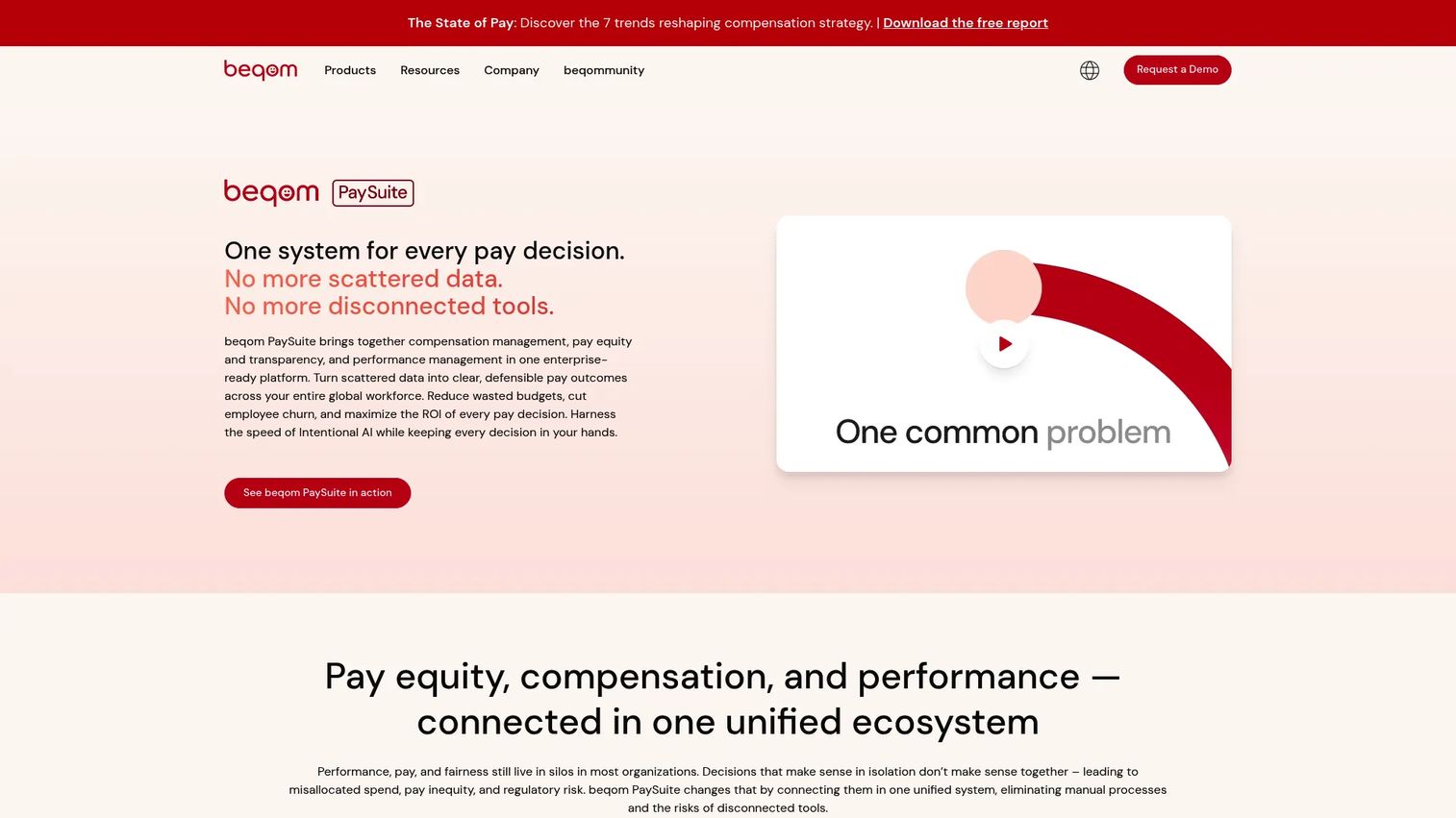
beqom is enterprise SaaS for compensation management, pay equity and transparency, and performance management. It is built for large organizations that run pay across multiple countries, currencies, and complex rule sets. When a comp cycle spans dozens of business units and a half-dozen pay components, beqom's strength is keeping all of it inside one governed workflow.
Best for: Large enterprises managing global compensation and pay equity processes.
Key strengths
- Compensation management: Run merit, bonus, and incentive cycles with budget guardrails and configurable approval routing.
- Pay transparency: Surface and document pay gaps to support compliance and transparency reporting.
- Performance management: Tie compensation outcomes to performance data inside the same platform.
Why choose beqom: If your pay process breaks down because of scale, not features, beqom is built for that exact problem. Multi-country complexity, layered approval chains, and audit demands are where it earns its place. Smaller teams may find it heavier than they need, but enterprises with global comp obligations choose it for governance and control.
beqom pricing: beqom does not publish public pricing. Its site directs buyers to a demo and a sales conversation, with packaging tailored to organization size and modules. Expect enterprise, quote-based pricing. On G2, beqom holds a 4.4/5 rating.
2. CompAnalyst by Salary.com
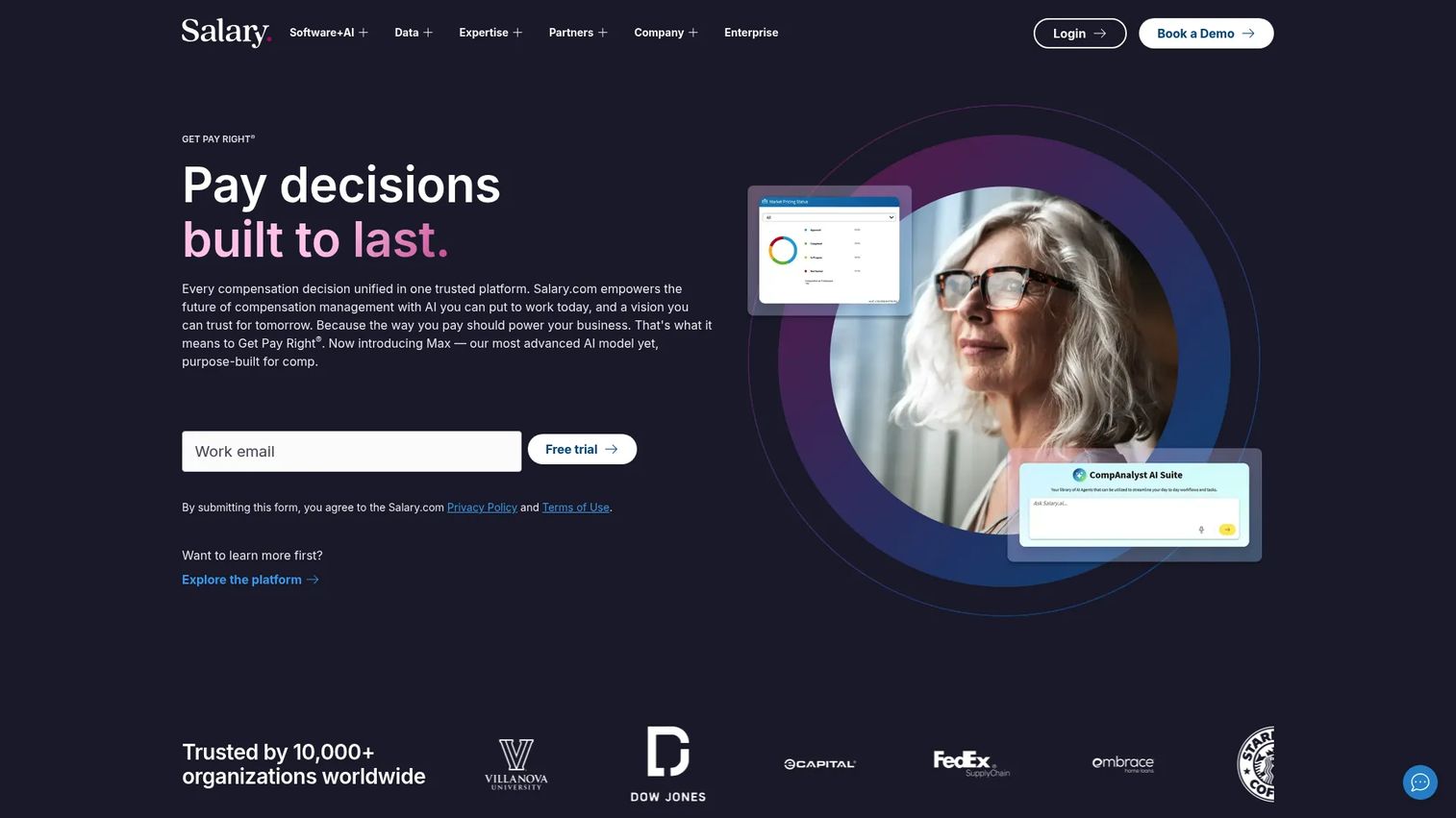
CompAnalyst by Salary.com is Salary.com's compensation management platform for market pricing, salary structures, and analytics. Its center of gravity is benchmark depth. If your biggest pain is trusting your market data and pricing jobs accurately, CompAnalyst is built around that job. Salary.com refreshes its data on different cadences across its survey sources, so teams pricing roles can work from current numbers.
Best for: HR and compensation teams managing job pricing and pay structures at scale.
Key strengths
- Market pricing and job matching: Price roles against a deep library of market and survey data.
- Salary structure modeling: Build and maintain salary bands and pay ranges from benchmark data.
- Compensation analytics and reporting: Analyze competitiveness, compa-ratios, and structure health.
Why choose CompAnalyst: This is a benchmarking-first pick. Teams that prioritize market intelligence and defensible pay range decisions over heavy review-cycle automation will get the most from it. If your review workflow is already solved and your gap is data quality, CompAnalyst fills it well.
CompAnalyst pricing: Salary.com does not expose a public numeric price. The platform directs buyers to a demo and sales conversation. On G2, the Salary.com seller profile holds a 4.4/5 rating.
3. Compport
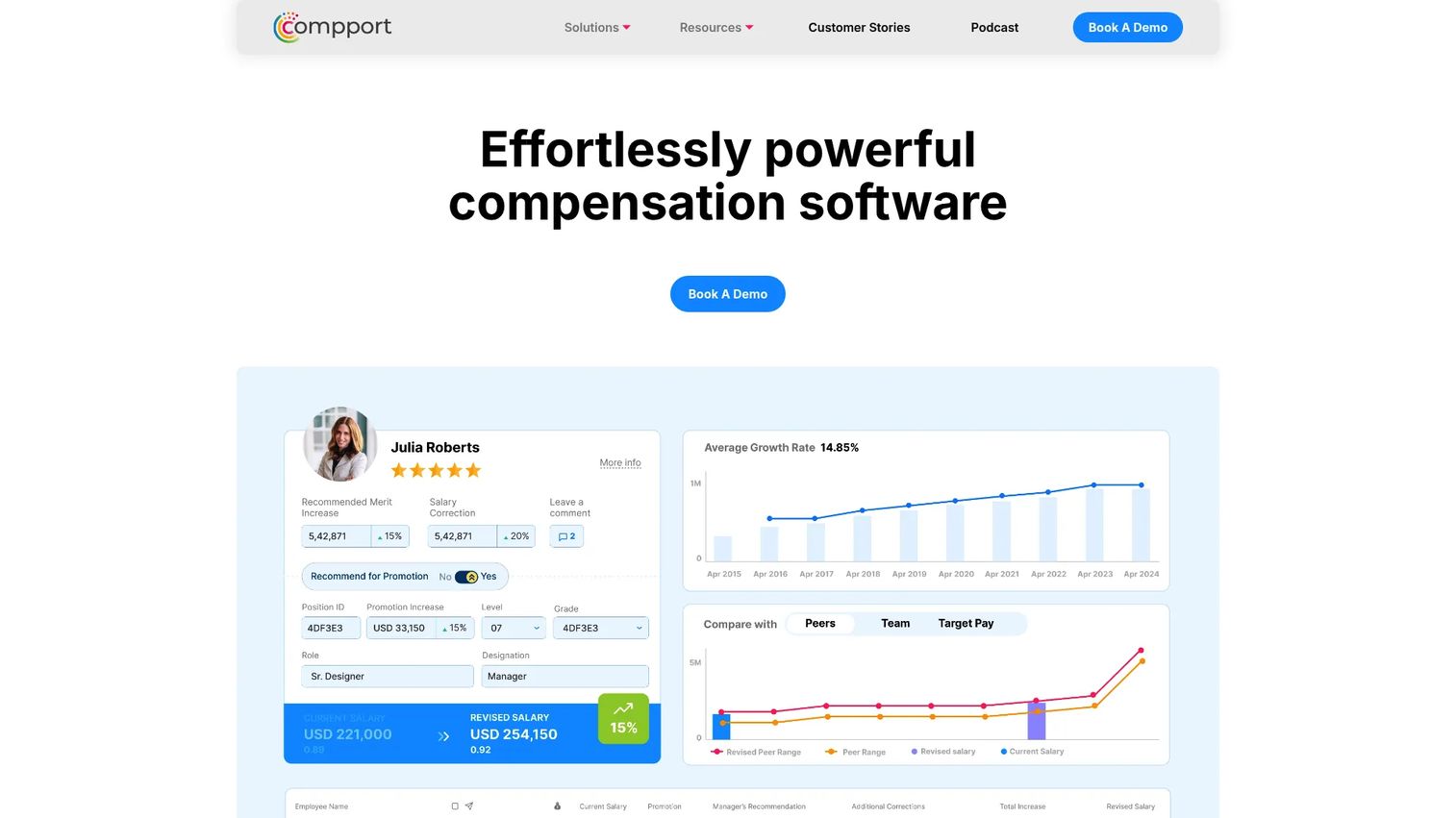
Compport is enterprise compensation management software covering planning, bonus, pay equity, incentives, rewards statements, offer letters, and HR analytics. It positions as a configurable, end-to-end compensation operations platform, with emphasis on workflow and governance. Compport reports use across more than 200 companies and over a million employees spanning 15-plus industries.
Best for: Large enterprises needing configurable compensation and rewards management.
Key strengths
- Compensation planning and merit cycles: Run structured review cycles with manager collaboration and approval governance.
- Bonus planning and sales incentives: Manage variable pay and incentive programs alongside base.
- Pay equity management and HR analytics: Surface gaps and report on compensation outcomes.
Why choose Compport: Compport suits teams that want one configurable platform spanning planning, variable pay, rewards statements, and offer letters, rather than stitching point tools together. Its breadth across the comp lifecycle, paired with manager collaboration and governance, makes it a strong fit for structured comp operations at scale.
Compport pricing: Compport does not show public pricing on its main site. Product pages indicate demo-based, tailored pricing. On G2, Compport holds a strong 4.7/5 rating.
4. Pave
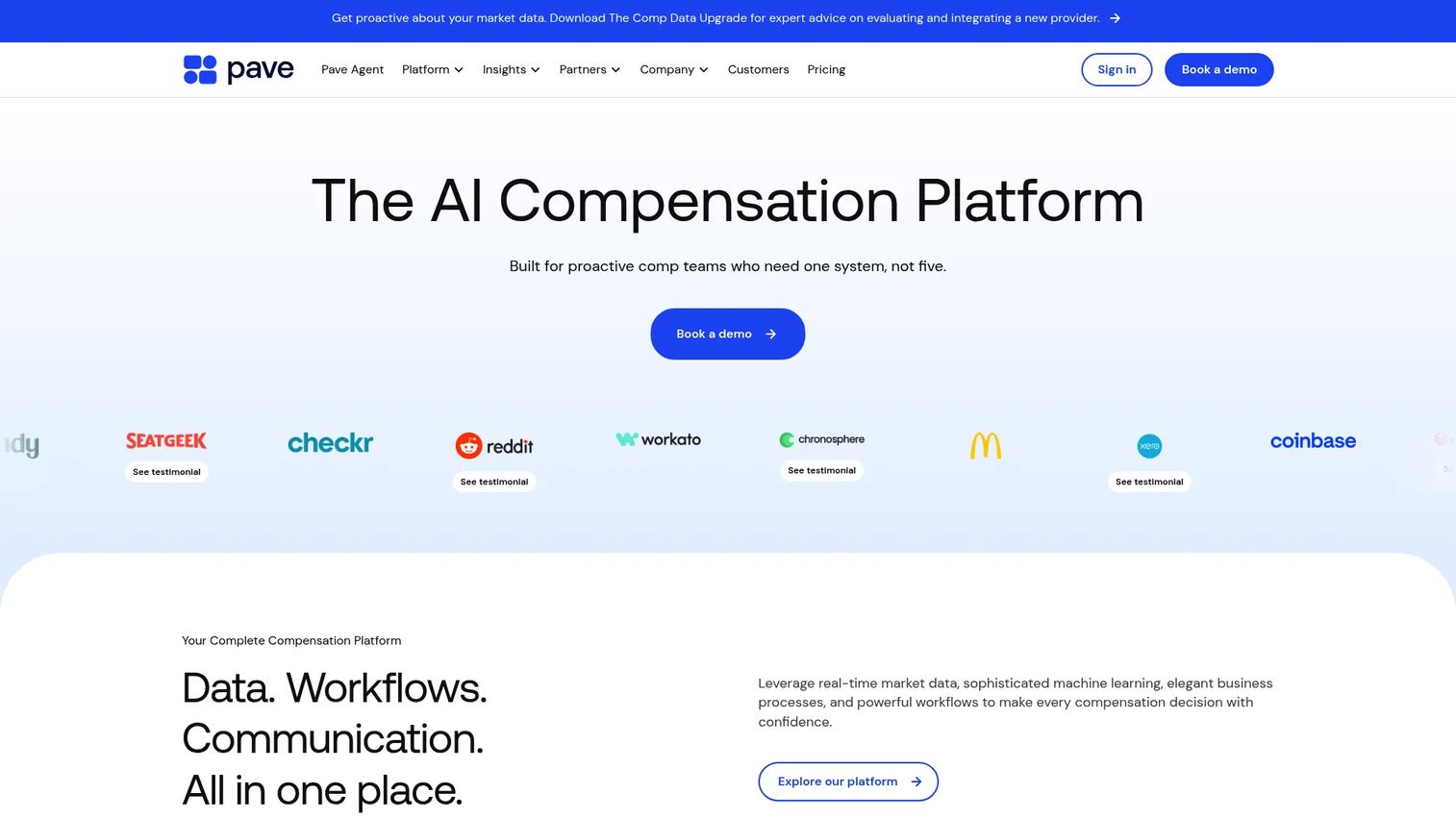
Pave is an AI compensation platform for compensation benchmarking, planning, and communication. It is the go-to for fast-growing tech companies that need to keep pay data and planning current as they scale. Pave's real-time benchmarks draw from more than 9,000 companies, and it offers a free Market Data Lite tier aimed at companies with 1 to 200 employees.
Best for: Compensation teams needing real-time benchmarking and planning workflows.
Key strengths
- Real-time compensation benchmarks: Pull current market data across more than 9,000 companies.
- Market Data Lite free access: Get started free for companies with 1 to 200 employees.
- Compensation planning and total rewards workflows: Run review cycles and communicate total rewards to employees.
Why choose Pave: Pave fits scaling companies that want fresh benchmarks, structured pay bands, and employee-facing total rewards context in one place. It is lighter to adopt than the deepest enterprise suites, which is exactly why fast-moving teams pick it. As headcount and complexity grow, some teams graduate to heavier platforms, but Pave keeps comp current during the climb.
Pave pricing: Pave offers a free Market Data Lite tier for companies with 1 to 200 employees, and a paid Market Data Pro tier available via demo. Public dollar amounts for paid plans are not published. On G2, Pave holds a 4.7/5 rating.
5. Ravio
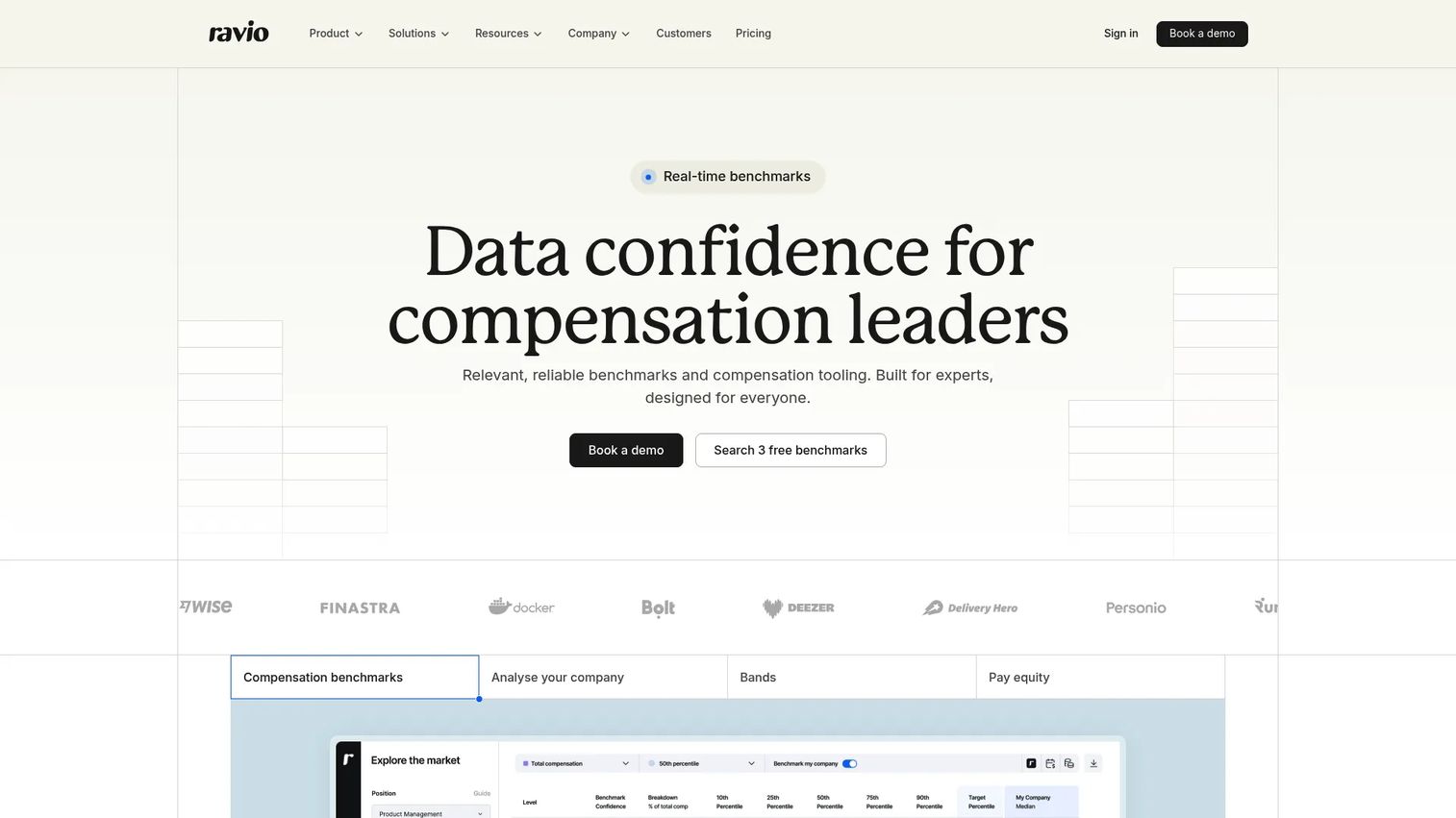
Ravio is compensation management software for tech companies, focused on real-time salary benchmarking, salary bands, and pay equity. Its appeal is fresher, more operational benchmark data, pulled live from connected HRIS systems rather than dated annual surveys. For scaling companies that want current market context, that immediacy is the draw.
Best for: Tech companies needing live compensation benchmarks and pay equity tooling.
Key strengths
- Real-time compensation benchmarking: Work from live, HRIS-integrated market data instead of stale surveys.
- Salary bands management: Build and maintain pay ranges that reflect current market conditions.
- Pay equity analysis: Identify and address pay gaps with current data behind the decision.
Why choose Ravio: Ravio is built for modern, data-driven comp teams that distrust annual survey lag. Because its data comes from integrated HRIS feeds, comp leaders can craft a story for business leaders about how the external compensation and benefits market is actually evolving. If real-time benchmark freshness is your priority, Ravio is a natural shortlist entry.
Ravio pricing: Ravio publishes a starting price of around £5,000/year for a 100-person company, with pricing scaling by employee count, modules, and markets. The site offers free benchmark searches to get started. On G2, Ravio holds a 4.7/5 rating.
6. Compa
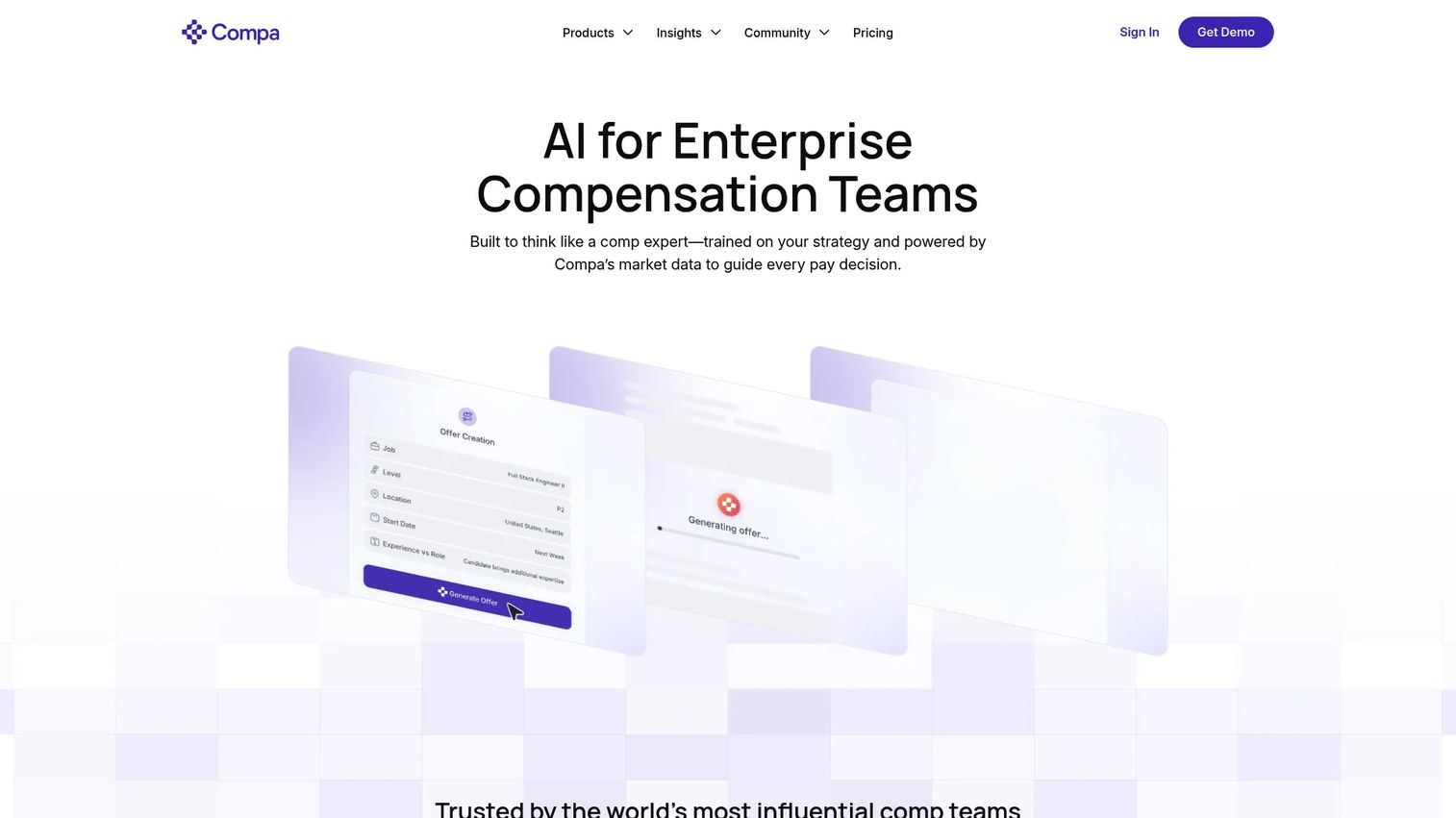
Compa is an enterprise compensation intelligence platform for live market data, benchmarking, and pay-decision automation. It pairs live data across offers, employees, stock, skills, and frontline roles with AI agents that help comp teams make and defend pay decisions. The pitch: agents eliminate manual analysis and recruiter requests, giving a 10-person team the reach of 100 without adding headcount.
Best for: Large compensation teams needing live market benchmarking and AI-assisted pay decisions.
Key strengths
- Live market data: Access current data across offers, employees, stock, skills, and frontline roles.
- AI agents for compensation analysis: Automate analysis and guide pay decisions trained on your strategy.
- Deep integrations: Connect with ATS and stock systems including Workday, Oracle, Greenhouse, Carta, and E*TRADE.
Why choose Compa: Compa fits teams that want defensible, consistent pay decisions across managers, backed by live data and AI assistance rather than manual spreadsheet analysis. If your comp team is small relative to its workload, the agent model is the differentiator. Compa is a newer entrant, so it does not yet carry an established G2 review base.
Compa pricing: Compa publishes pricing. Market Data starts at $35,000/year, and the Agents tier is priced via sales conversation. Multi-year discounts and pilot pricing are available on request. There is no free tier.
7. Workday
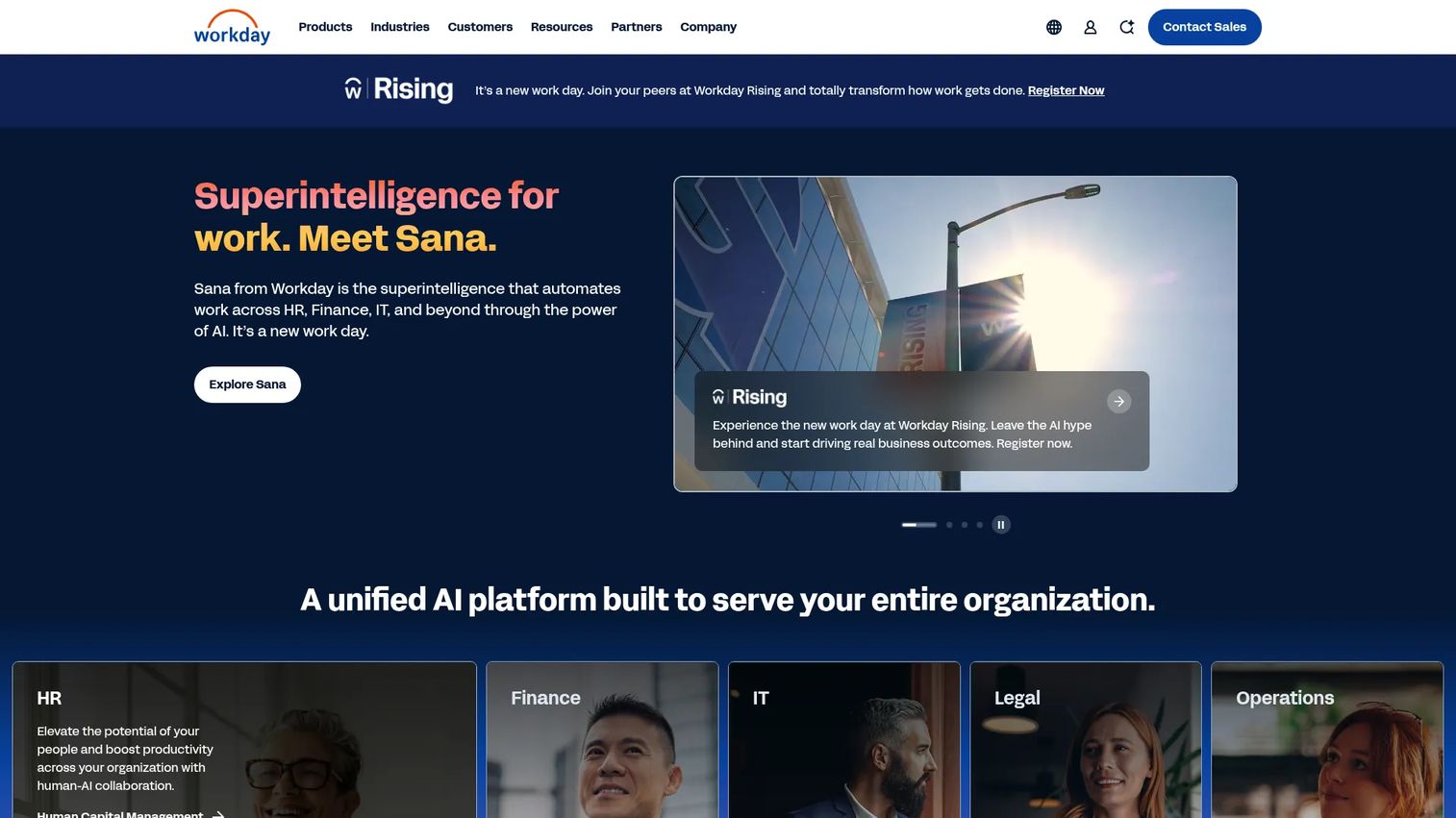
Workday is an enterprise AI platform for HR, finance, and IT, with compensation planning built into its broader HCM suite. Workday unifies pay data with AI-driven insights and real-time financial guardrails, and it can embed real-time market benchmarks directly into the compensation review process. Its strength is breadth: comp is one connected piece of a single system of record.
Best for: Large organizations needing unified HR, finance, and AI-driven workflow automation.
Key strengths
- Human Capital Management: Run compensation alongside core HR, talent, and workforce data.
- Financial Management: Tie comp budgets to real-time financial guardrails.
- AI agents and insights: Surface AI-driven guidance across HR and finance workflows.
Why choose Workday: Be honest about the fit. Workday is chosen for suite strength, not standalone comp depth. If your organization already runs on Workday for HCM and finance, keeping compensation planning inside the platform avoids integration overhead and keeps one source of truth. Companies looking for a best-of-breed comp specialist may want a dedicated tool, but for Workday-standardized enterprises, staying in-platform is the practical call.
Workday pricing: Workday's core platform pricing is quote-based. Workday Adaptive Planning offers a 30-day free trial, while core product pricing is shown as "pricing varies" or contact sales. Workday also publishes a usage-based AI pricing model called Flex Credits. On G2, Workday holds a 4.2/5 rating.
8. Dayforce
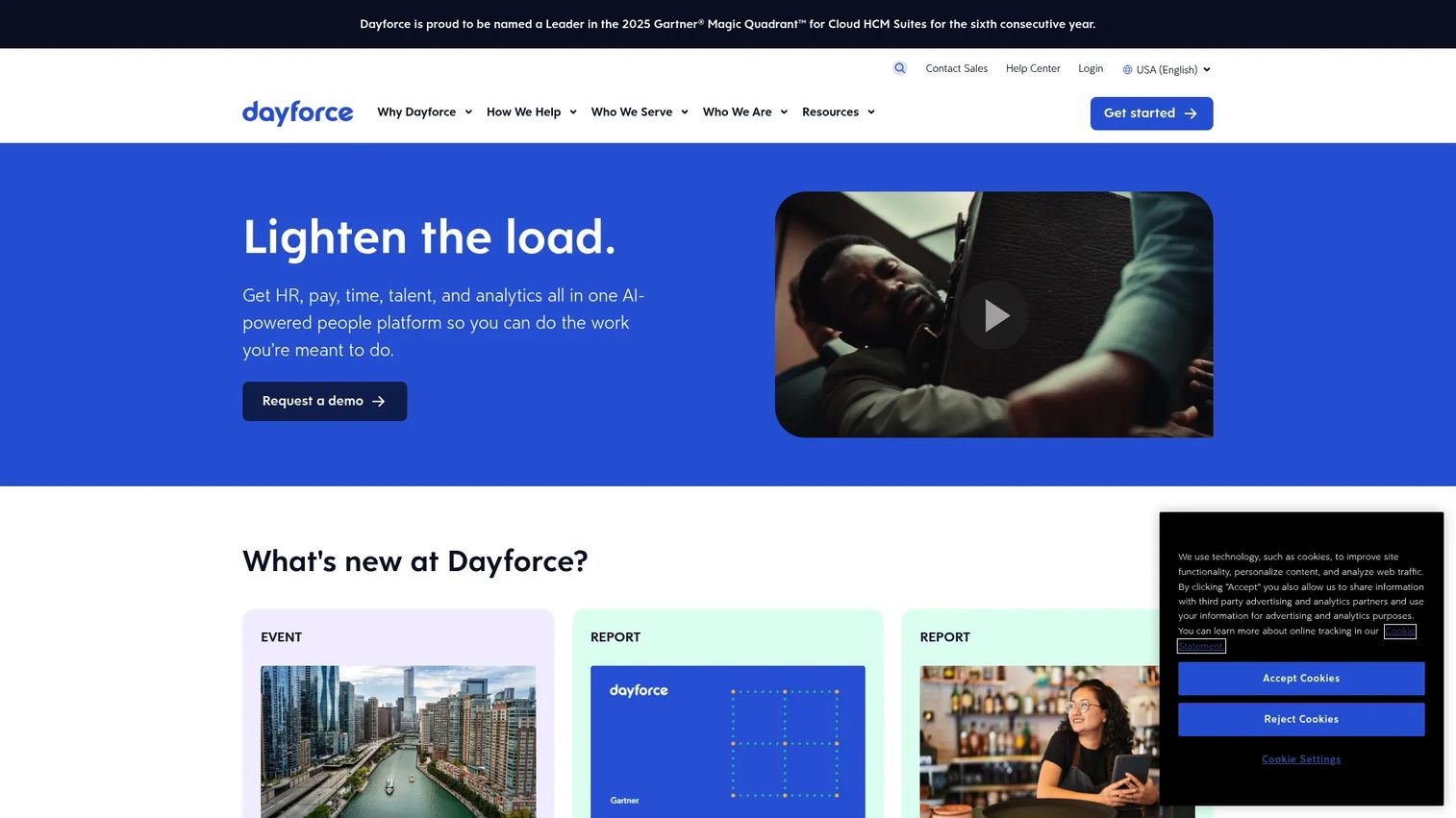
Dayforce is an AI-powered HCM platform spanning HR, payroll, workforce management, talent, and analytics, with compensation planning built in. With Dayforce, teams make fast, informed award decisions with instant access to relevant compensation data in one place. It uses your organization's guidelines to highlight increases that fall out of range, keeping manager decisions inside policy.
Best for: Mid-market to enterprise organizations needing unified HR and payroll operations.
Key strengths
- Unified HR, payroll, and talent: Run merit, bonus, and rules-based awards connected to payroll and workforce data.
- Global payroll and workforce management: Keep comp decisions aligned with the systems that pay people.
- Reporting and analytics: Track pay distribution and comp outcomes across the organization.
Why choose Dayforce: Dayforce is compelling when you want compensation inside a broader operational HCM environment rather than as a standalone specialty. Its strength comes from workflow connection, merit and bonus allocation flowing straight into payroll, more than from deep standalone comp features. For teams that value that connection, it removes the gap between deciding pay and paying it.
Dayforce pricing: Dayforce does not publish public pricing; the site directs buyers to product and demo pages. Packaging is quote-based and typically scales with modules and headcount. On G2, Dayforce holds a 4.2/5 rating.
Considerations before you buy
Before you commit, run each shortlisted tool against the criteria below. The right pick depends on which of these is your biggest pain.
Benchmarking depth and freshness
Ask where the data comes from and how often it refreshes. Survey-based sources update on set cadences; HRIS-integrated sources can update closer to real time. If competitive pay decisions are your top risk, weight this heavily and verify the source coverage for your roles and geographies.
Review-cycle workflow
Test the actual merit cycle. How do managers enter proposals, how do budget guardrails work, and how do approvals route? A tool with great data and a clumsy cycle will frustrate every manager who touches it. Run a pilot cycle before rollout.
Pay equity and governance
Confirm the platform can run pay gap analysis, model corrections, and keep an audit trail. As pay transparency rules expand, documentation and defensibility matter as much as the analysis itself.
Integrations and maintenance
Check fit with your HRIS, payroll, performance management, and ATS systems. Clean integrations prevent manual re-keying and keep data aligned. Then ask how the tool is maintained day to day, since ease of upkeep determines whether it stays accurate after launch.
Scale and complexity fit
Match the tool to your size. Fast-growing teams often want current benchmarks and light setup; global enterprises need multi-country complexity and heavy governance. Buying above or below your complexity wastes budget either way.
Conclusion
The right compensation management software depends entirely on which problem hurts most. If your pain is benchmark quality, look hard at CompAnalyst, Pave, Ravio, and Compa, each strong on market data with different freshness models. If your pain is running a clean review cycle across countries and approvals, beqom and Compport are built for that governance. If you want comp to live inside a broader HCM environment you already run, Workday and Dayforce keep planning connected to HR and payroll.
The practical next step is simple. Shortlist two tools, not five. Compare their benchmark sources directly against the roles and markets you actually hire for. Then run a real review-cycle workflow inside both before you commit, because the cycle is where most teams feel the difference between a tool they tolerate and one they trust. Decide on the axis that matters most to you, benchmarking depth, workflow automation, enterprise governance, or suite consolidation, and the shortlist narrows fast.
FAQs
Compensation management software helps HR and Finance plan, benchmark, approve, and communicate employee pay in one system. It centralizes salary bands, merit and bonus cycles, market data, and approval workflows so teams stop running pay decisions across scattered spreadsheets. The goal is consistent, defensible pay decisions with a clear audit trail.
Compensation planning software helps you decide pay: setting ranges, running merit cycles, modeling budgets, and approving increases. Payroll software executes the payment once decisions are final. Some HCM suites do both, but specialist compensation tools focus on the decision and the benchmark, then hand the final numbers to payroll.
The core set is salary benchmarking, review-cycle and approval workflows, pay equity analysis, salary bands and pay ranges, reporting and dashboards, and integrations. Which one matters most depends on your biggest pain. Benchmark-driven teams weight market data; teams drowning in cycle chaos weight workflow and governance.
Yes. Most platforms can surface pay gaps, model correction scenarios, document the rationale behind decisions, and maintain an audit trail. That turns pay equity and pay transparency work from a one-off analysis into a repeatable, defensible process, which matters as transparency regulations expand across regions.
Teams build pay ranges from benchmark data, apply them consistently across roles, levels, and geographies, and refresh them on a schedule as the market moves. When a manager proposes a number outside the range, the system flags the exception before it becomes an offer, and governance rules control who can approve it.
Look for HRIS, payroll, performance management, and ATS integrations at minimum, plus reporting and identity or single sign-on connections. These keep employee data, performance ratings, and final pay numbers in sync, so a merit decision flows cleanly into payroll without manual re-keying or version drift.
It becomes worth it when your comp cycles are messy enough to justify automation, usually when multiple managers, geographies, or pay components make spreadsheets error-prone. Smaller teams can start with lighter, benchmark-led tools, some with free tiers, and move to fuller platforms as headcount and complexity grow.
Neither wins outright; the best tool depends on your bigger pain. If you cannot trust your market data or price jobs confidently, prioritize benchmarking depth and freshness. If your data is fine but your review cycle is chaos, prioritize workflow automation and governance. Map your shortlist to whichever problem costs you more today.