Legal teams spend an average of 3.4 weeks negotiating a single contract, and most of that time goes to tasks that software can handle in minutes. Meanwhile, 71% of organizations report they can't find at least 10% of their contracts when they need them.
Contract lifecycle management software eliminates both problems by automating the entire process from drafting through renewal. This guide compares 11 CLM platforms, breaks down the features that actually matter, and gives you a practical framework for choosing the right one for your team.
What's inside
This guide compares 11 contract lifecycle management software options, explains the core features that matter, and gives you a practical framework for choosing the right platform. You'll find honest evaluations, a comparison table for quick reference, and selection criteria based on real implementation considerations.
TL;DR
- Contract lifecycle management software automates the entire contract process from drafting through renewal, reducing manual work and legal risk
- Legal, procurement, sales, and finance teams all benefit from CLM platforms, though priorities differ by role
- AI-powered contract analysis has become a key differentiator, with leading platforms offering clause extraction, risk scoring, and automated review
- Integration depth with your existing CRM and ERP systems often determines implementation success more than feature count
- Pricing varies dramatically from free tiers for basic needs to six-figure enterprise agreements
What is contract lifecycle management software
Contract lifecycle management software is a cloud-based solution that digitizes, automates, and streamlines the entire contract process from initiation and negotiation to execution, storage, and renewal. CLM platforms reduce contract friction, minimize legal risk, and improve efficiency across teams.
The contract lifecycle moves through five distinct stages:
Without CLM software, 49% of legal teams still manage contracts through scattered email threads, shared drives, and spreadsheets. This approach breaks down as contract volume grows, leading to missed renewals, compliance gaps, hours spent searching for specific clauses, and average contract value erosion of 8.6%.
Who uses CLM software
Legal operations and general counsel
Legal teams use CLM to reduce manual contract review time, enforce standardized clause libraries, and manage risk across the organization. A well-implemented CLM platform can cut contract review cycles significantly while ensuring compliance with approved language.
Procurement and vendor management
Procurement teams rely on CLM for vendor contract tracking, renewal management, and compliance monitoring. Seeing all supplier agreements in one place, with automated alerts for upcoming renewals, prevents costly auto-renewals and creates leverage for renegotiation.
Sales and revenue operations
Sales teams accelerate deal velocity by automating contract generation and approval workflows. Instead of waiting days for legal review on standard agreements, reps can generate compliant contracts in minutes and route only non-standard terms for approval.
Finance and compliance teams
Finance uses CLM for audit trails, financial controls, and regulatory compliance documentation. Quickly pulling all contracts with specific terms or obligations becomes critical during audits or when responding to regulatory inquiries.
CLM software comparison table
| No. | Product | Best for | Key differentiation | Pricing | G2 rating |
|---|---|---|---|---|---|
| 1 | Ironclad | Mid-market to enterprise legal teams | AI-powered drafting and Salesforce integration | Custom pricing | 4.5/5 |
| 2 | DocuSign CLM | Organizations in DocuSign ecosystem | End-to-end contract automation beyond e-signatures | Custom pricing | 4.2/5 |
| 3 | Icertis | Large enterprise procurement | Enterprise-grade scalability and compliance | Custom pricing | 4.4/5 |
| 4 | Agiloft | Teams needing flexible configuration | No-code workflow builder and customization | Custom pricing | 4.6/5 |
| 5 | Conga CLM | Salesforce-native organizations | Revenue lifecycle and quote-to-cash integration | Custom pricing | 4.3/5 |
| 6 | LinkSquares | Legal teams with large repositories | AI contract analysis and post-signature management | Custom pricing | 4.6/5 |
| 7 | Juro | High-growth companies | Browser-based collaborative editing | From $463/month | 4.7/5 |
| 8 | PandaDoc | SMBs and sales-led organizations | Proposal and contract combined | From $35/month | 4.7/5 |
| 9 | Concord | Growing companies seeking value | Unlimited e-signatures included | From $17/month | 4.5/5 |
| 10 | SpotDraft | Scaling startups | AI-first approach with modern UX | Custom pricing | 4.7/5 |
| 11 | ContractPodAi | Large legal departments | AI-powered clause library and matter management | Custom pricing | 4.3/5 |
11 best CLM tools and contract management solutions
The following tools were selected based on G2 ratings, feature depth, integration capabilities, and industry recognition. Each serves different organizational needs, from SMB-friendly options to enterprise-grade platforms.
1. Ironclad
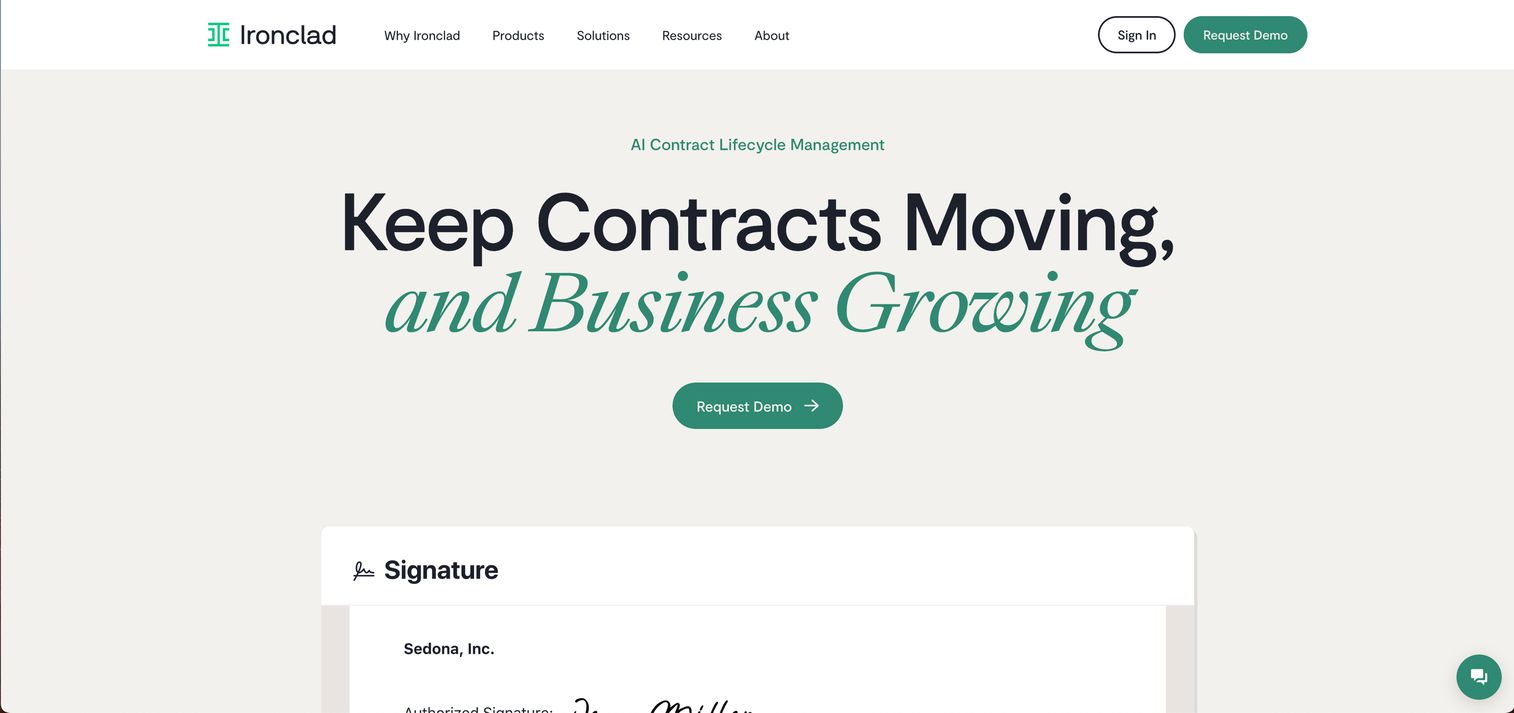
Ironclad has established itself as a leader in AI-powered contract lifecycle management, particularly for mid-market and enterprise legal teams. The platform combines intelligent contract creation with deep CRM integration, making it a strong choice for organizations that want to connect legal workflows directly to revenue operations.
Best for: Mid-market to enterprise legal teams that prioritize AI capabilities and Salesforce integration.
Key strengths
- AI assistant for contract drafting, review, and clause suggestions
- Native Salesforce integration that lets sales teams generate contracts without leaving their CRM
- Workflow automation engine with conditional routing based on contract type, value, or risk level
- Advanced analytics dashboard showing contract cycle times, bottlenecks, and team performance
Why pick Ironclad?
The platform excels when you want AI to handle routine contract work while maintaining tight control over non-standard terms.
Ironclad pricing
Custom pricing based on contract volume and feature requirements.
2. DocuSign CLM
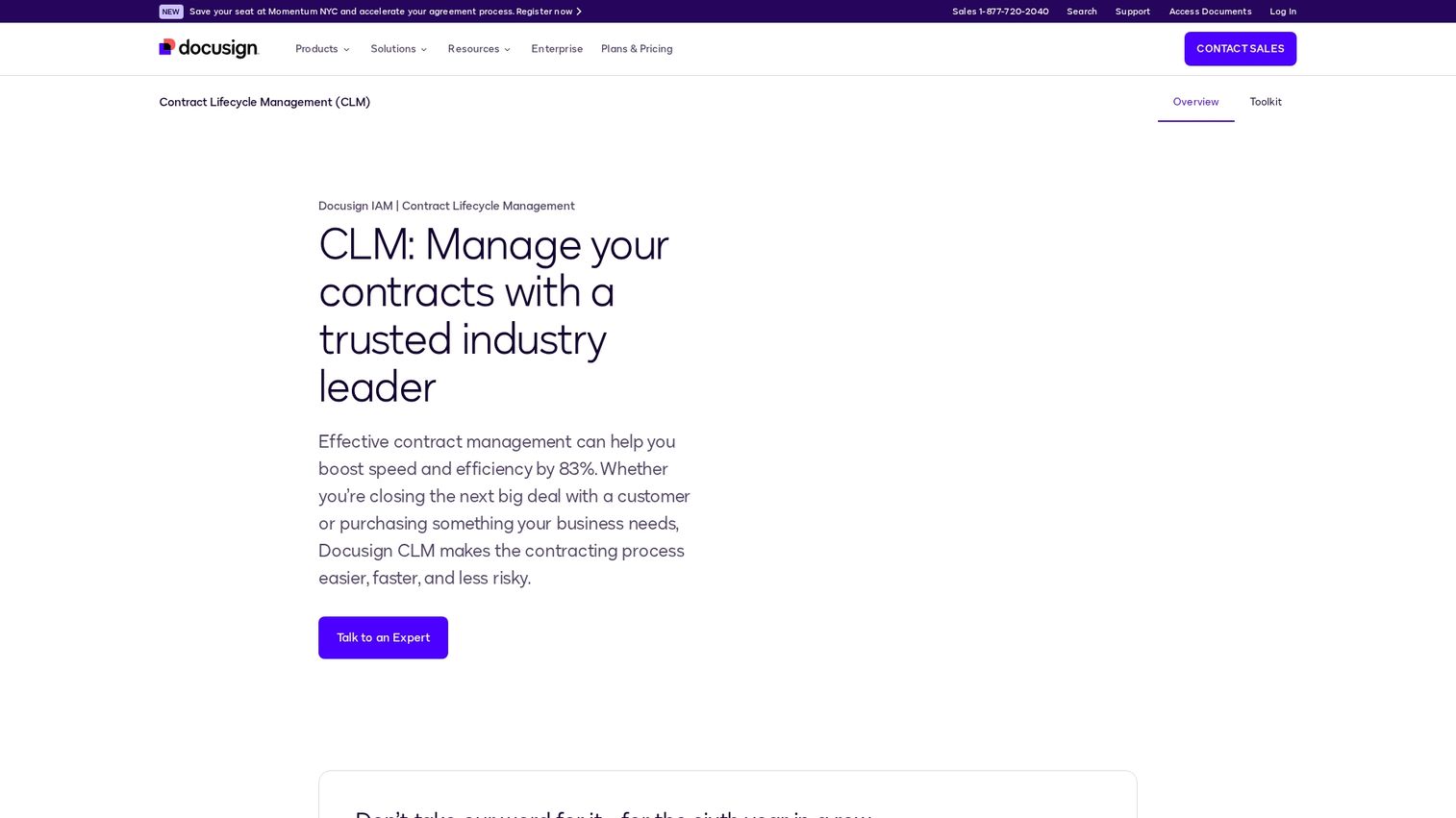
DocuSign CLM extends far beyond the e-signature capabilities most people associate with the DocuSign brand. The platform offers full contract lifecycle management with AI-powered analysis, workflow automation, and deep integration with enterprise systems.
Best for: Organizations already using DocuSign for e-signatures that want to expand into full contract management.
Key strengths
- End-to-end contract automation from request through renewal
- Pre-built integrations with Salesforce, SAP, and other enterprise platforms
- AI-powered contract analysis that identifies risks and extracts key terms
- Mobile-friendly interface for approvals and reviews on the go
Why pick DocuSign CLM?
If your organization already has DocuSign adoption for signatures, adding CLM creates a unified experience with a gentler learning curve.
DocuSign pricing
Custom pricing, positioned as an enterprise add-on to existing DocuSign agreements.
3. Icertis Contract Intelligence
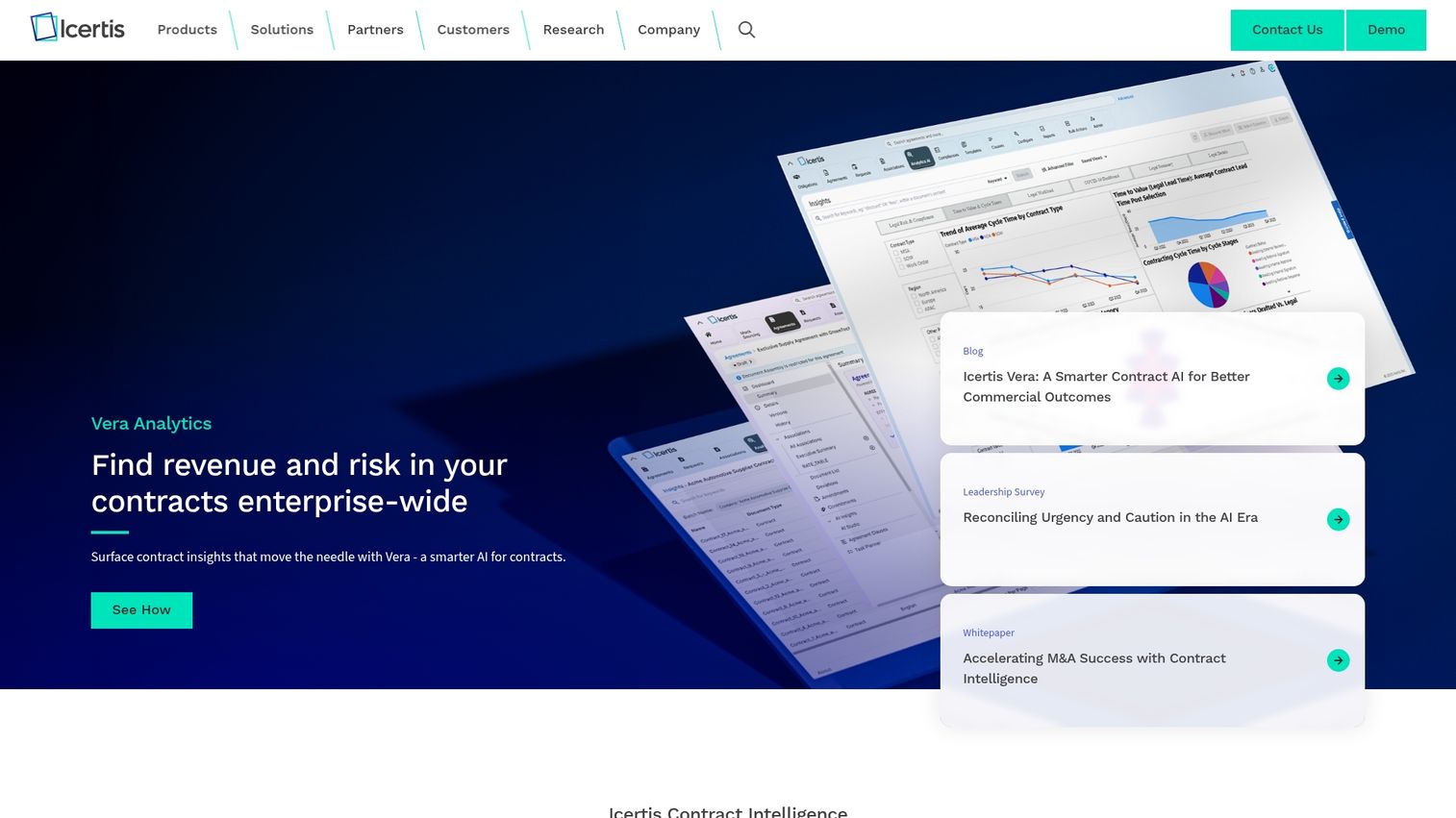
Icertis targets large enterprises with complex contract portfolios, particularly those with significant procurement and compliance requirements. The platform handles multi-language contracts, complex approval hierarchies, and regulatory requirements across jurisdictions.
Best for: Large enterprises with complex procurement needs and strict compliance requirements.
Key strengths
- Enterprise-grade scalability handling millions of contracts
- AI-driven risk and compliance monitoring across contract portfolios
- Deep ERP integrations with SAP, Oracle, and Microsoft Dynamics
- Multi-language support with AI-powered translation and localized templates
Why pick Icertis?
When contract complexity and volume exceed what mid-market tools can handle, Icertis provides the infrastructure for global organizations managing contracts across multiple legal jurisdictions.
Icertis pricing
Enterprise custom pricing with significant professional services investment.
4. Agiloft CLM platform
Agiloft differentiates through extreme configurability. The no-code platform lets teams build custom workflows, fields, and automations without developer resources, making it popular with organizations that have unique contract processes.
Best for: Organizations needing flexible configuration without developer resources.
Key strengths
- No-code workflow builder for custom approval processes
- Extensive customization options for fields, forms, and business rules
- Built-in AI clause extraction and contract analysis
- Strong partner ecosystem for implementation support
Why pick Agiloft?
When your contract processes don't fit standard templates, Agiloft lets you build exactly what you want. The tradeoff is a steeper initial configuration investment.
Agiloft pricing
Custom pricing based on users and configuration requirements.
5. Conga CLM
Conga provides comprehensive contract lifecycle management with particular strength in Salesforce environments. The platform connects contract management to the broader revenue lifecycle, from quote generation through contract execution and renewal.
Best for: Salesforce-native organizations wanting tight CRM integration.
Key strengths
- Revenue lifecycle management connecting quotes, contracts, and renewals
- Document generation automation for proposals and agreements
- Salesforce-native architecture with deep platform integration
- Quote-to-cash workflow automation
Why pick Conga?
Sales teams living in Salesforce can manage the entire deal process without context switching, reducing friction between sales and legal.
Conga pricing
Custom pricing, typically sold as part of broader Conga revenue operations suite.
6. LinkSquares
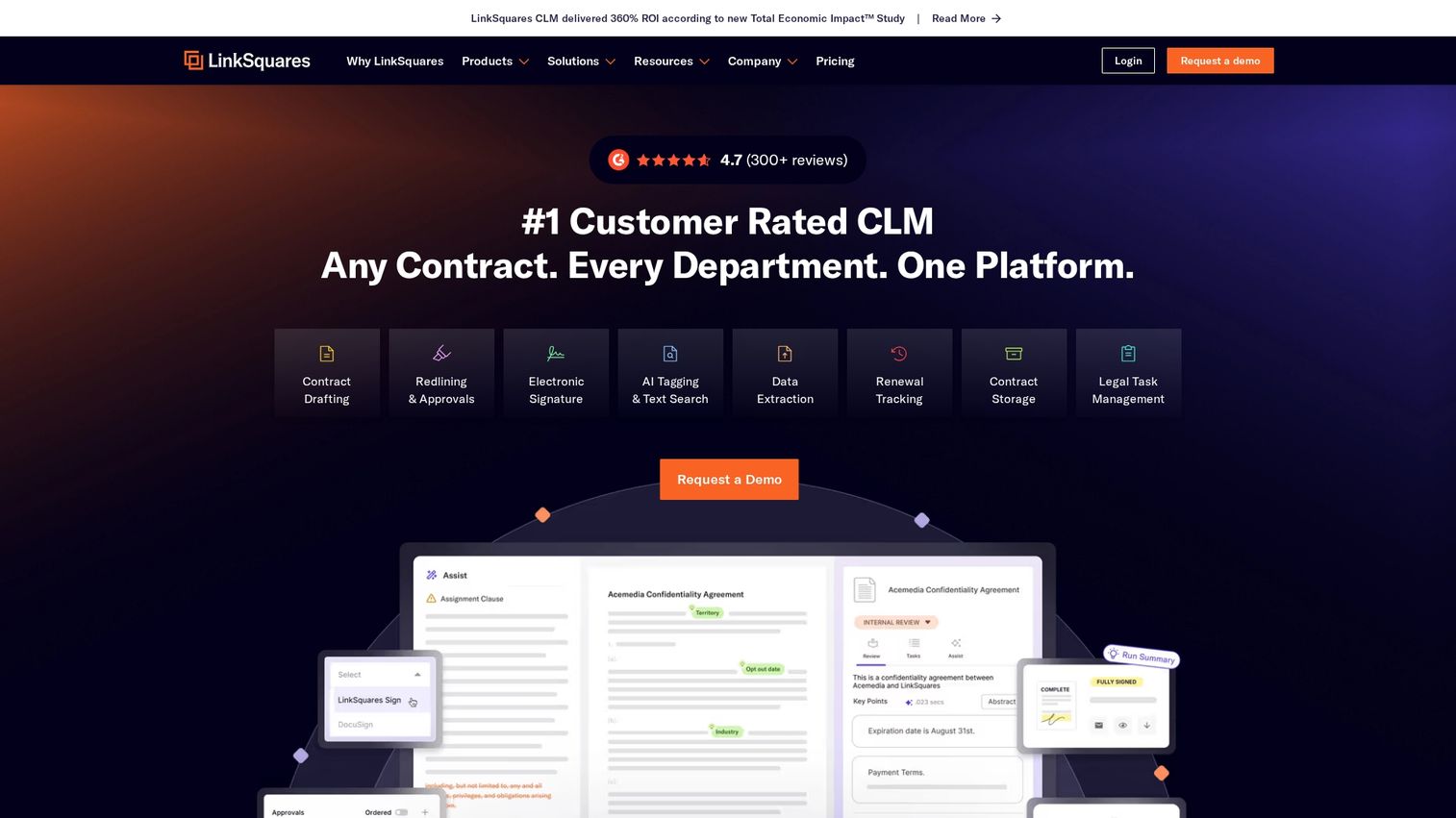
LinkSquares focuses on AI-powered contract analysis and post-signature management. The platform excels at extracting insights from existing contract repositories, making it valuable for organizations with large volumes of legacy agreements.
Best for: Legal teams managing large contract repositories who want better visibility into existing agreements.
Key strengths
- AI contract analysis that extracts key terms, dates, and obligations
- Smart search across entire contract repositories
- Obligation tracking with automated alerts
- Legal reporting dashboards for portfolio visibility
Why pick LinkSquares?
When your biggest problem is understanding what's already in your contracts rather than creating new ones, LinkSquares provides the analysis capabilities to surface risks and opportunities.
LinkSquares Pricing
Custom pricing based on contract volume and feature requirements.
7. Juro
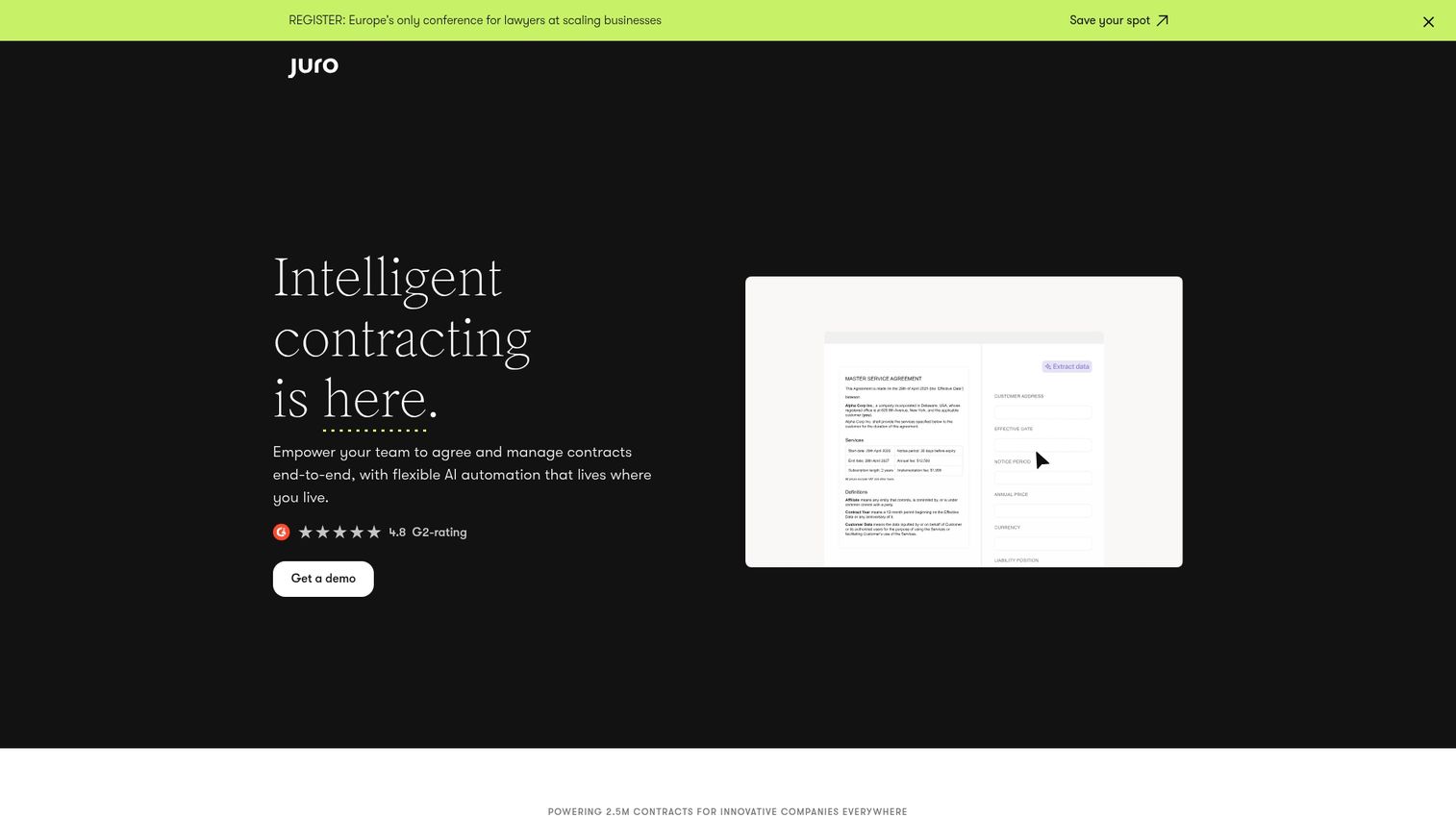
Juro positions itself as a modern, user-friendly CLM for high-growth companies. The browser-based platform emphasizes collaborative editing and fast implementation, making it accessible for teams without dedicated legal operations resources.
Best for: High-growth companies wanting fast implementation and intuitive user experience.
Key strengths
- In-browser contract editing with real-time collaboration
- Self-serve contract workflows for routine agreements
- Data-rich contract repository with custom fields and reporting
- Fast implementation measured in weeks rather than months
Why pick Juro?
When speed to value matters more than enterprise feature depth, Juro gets teams productive quickly with a modern interface that reduces training requirements.
Juro pricing
Starting from $463/month for the Essentials plan.
8. PandaDoc
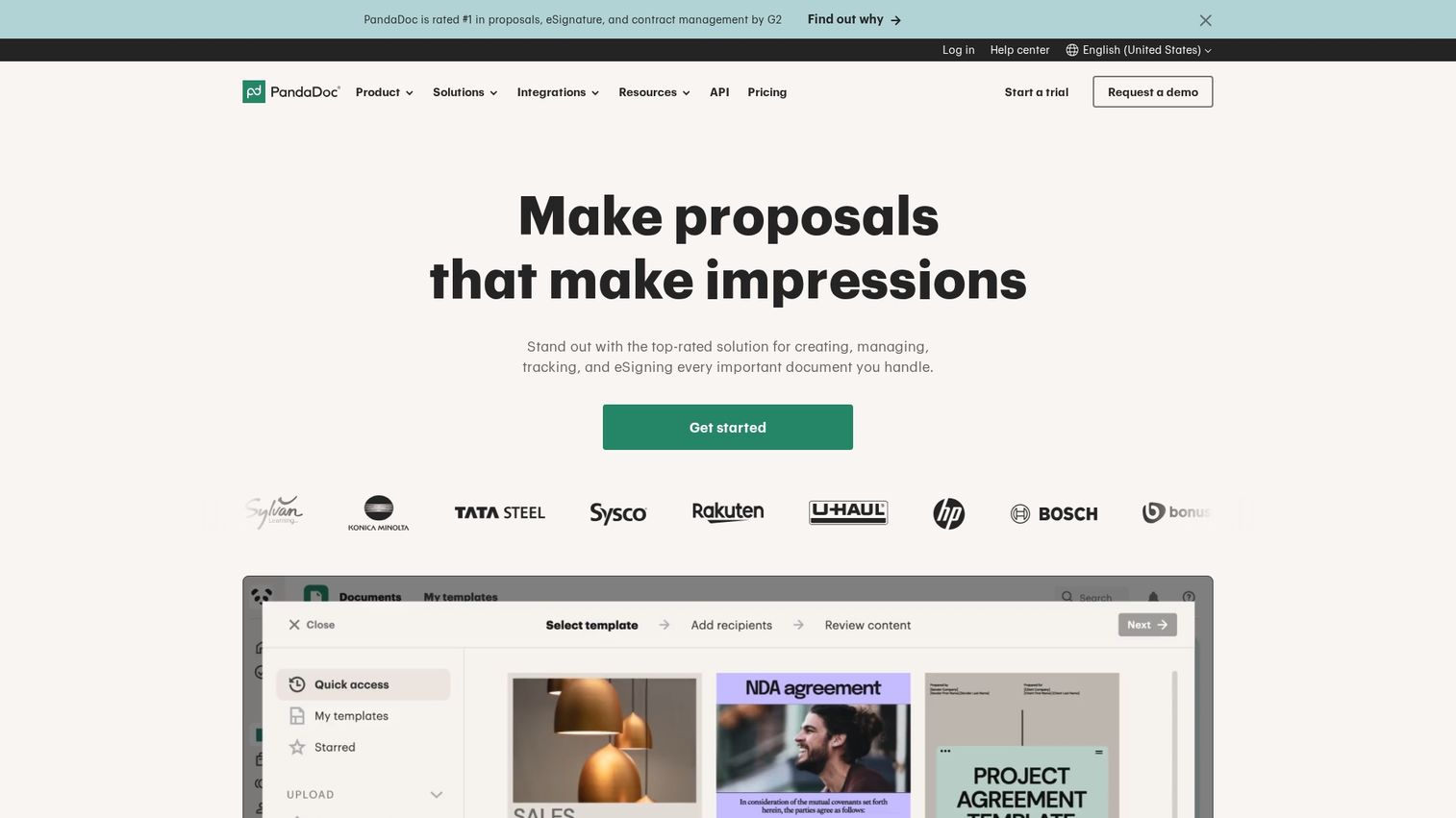
PandaDoc combines proposal, quote, and contract functionality in a single platform. This approach works particularly well for sales-led organizations where the line between proposals and contracts blurs.
Best for: SMBs and sales-led organizations wanting proposals and contracts in one tool.
Key strengths
- Proposal and contract creation in unified workflow
- E-signature built into the platform
- Template library with customizable content blocks
- CRM integrations with Salesforce, HubSpot, and others
Why pick PandaDoc?
Sales teams that create proposals and contracts as part of the same deal process benefit from having everything in one place, accessible without legal operations expertise.
PandaDoc pricing
Starting from $35/month per user for Business plan.
9. Concord
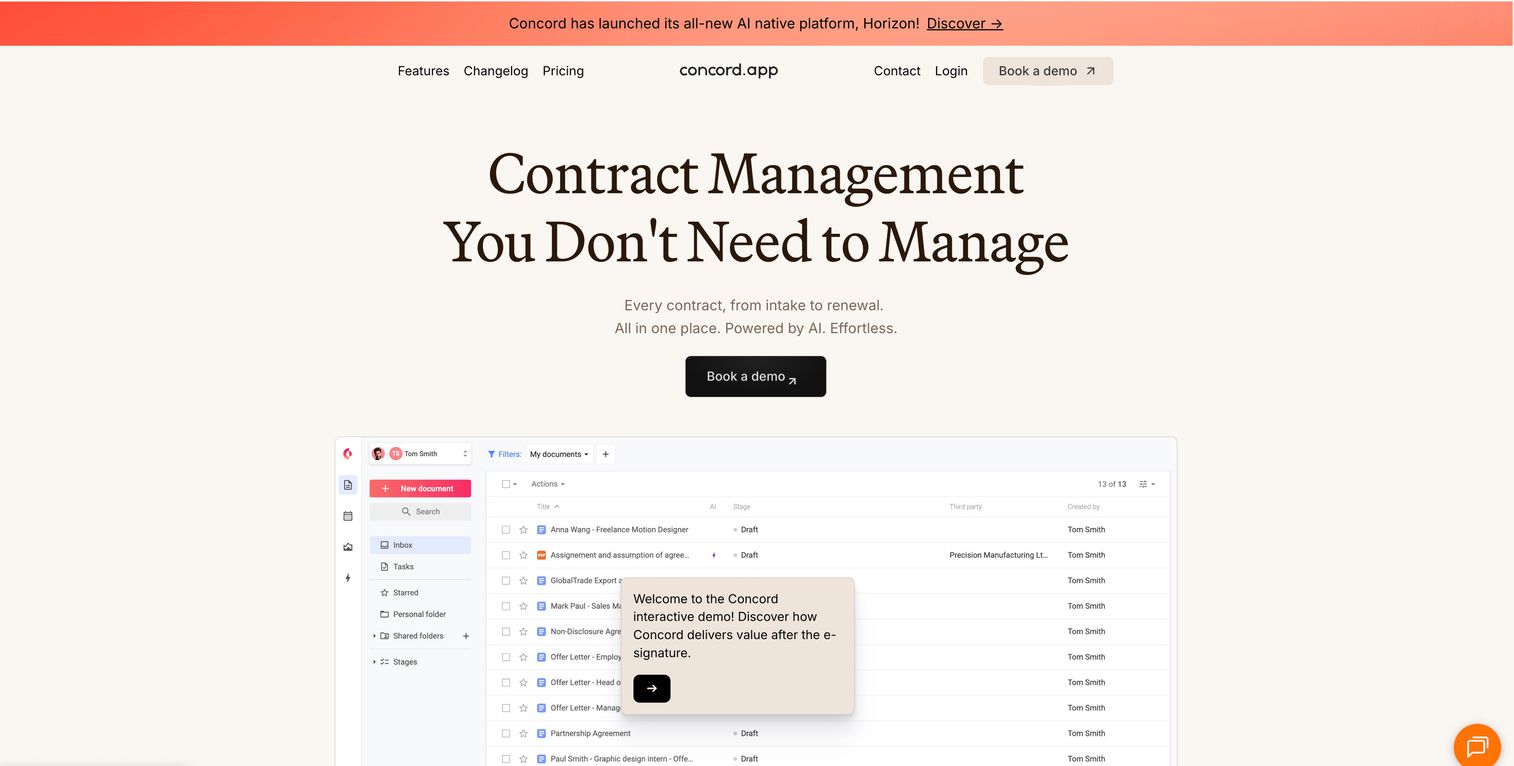
Concord offers straightforward contract management with unlimited e-signatures included in all plans. This pricing model makes it attractive for growing companies with high signature volumes but limited budgets.
Best for: Growing companies seeking affordable CLM with unlimited signatures.
Key strengths
- Unlimited e-signatures included in all pricing tiers
- Collaborative negotiation with internal and external parties
- Version tracking with full audit trail
- Searchable repository with custom metadata
Why pick Concord?
When e-signature costs are a concern and you want predictable pricing regardless of volume, Concord's model provides budget certainty.
Concord pricing
Starting from $17/month per user with free tier available.
10. SpotDraft
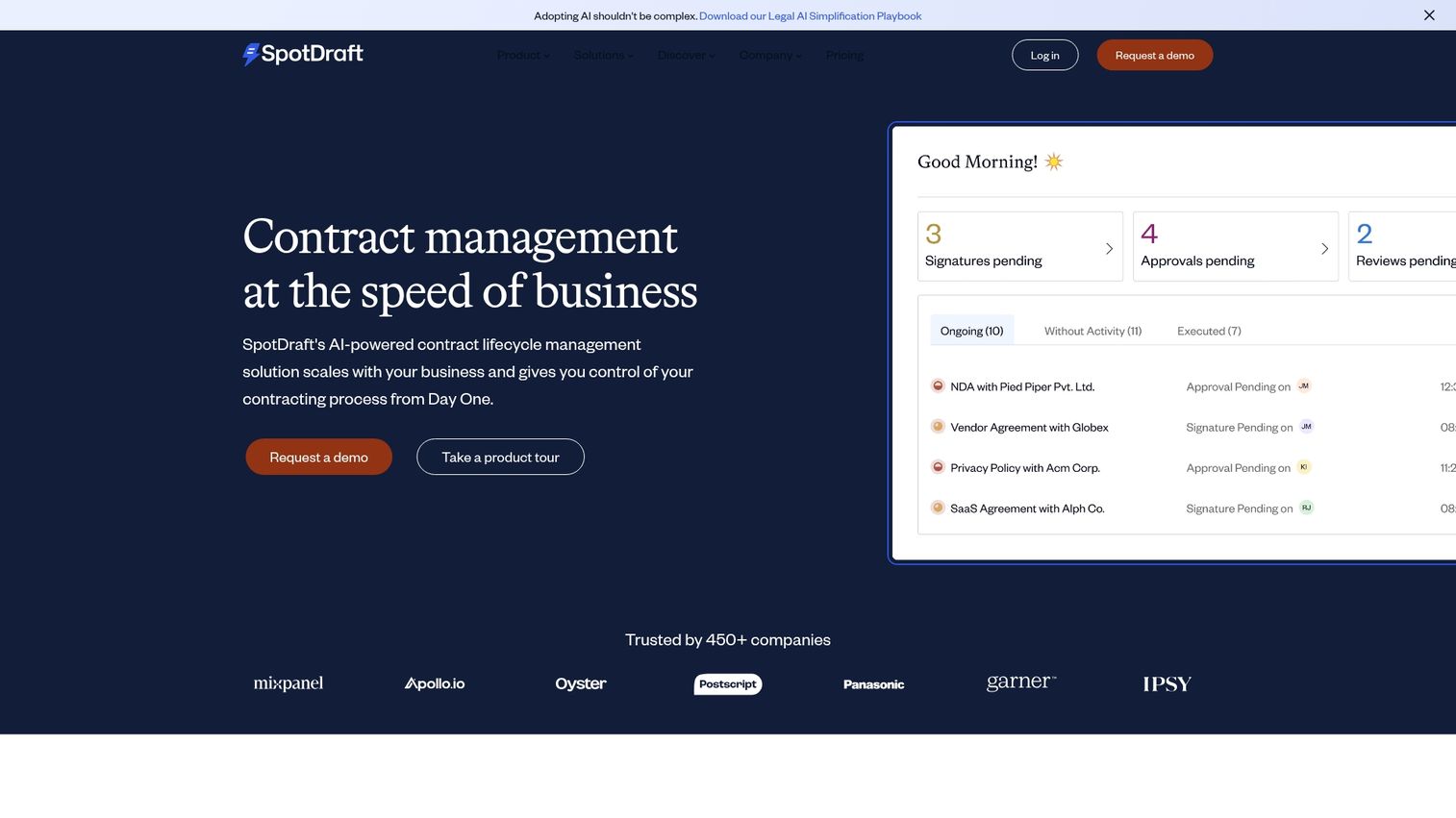
SpotDraft takes an AI-first approach to contract management, targeting legal teams at scaling startups. The platform emphasizes modern UX and integrations with tools that fast-growing companies already use.
Best for: Legal teams at scaling startups wanting modern, AI-powered CLM.
Key strengths
- AI contract review with risk identification
- Slack and email integrations for approvals and notifications
- Template automation with conditional logic
- Legal workflow tracking and analytics
Why pick SpotDraft?
Startups scaling their legal function benefit from a platform designed for their context rather than adapted from enterprise tools.
SpotDraft pricing
Custom pricing positioned for growth-stage companies.
11. ContractPodAi
ContractPodAi serves large legal departments with complex contract portfolios. The platform combines AI capabilities with matter management integration, connecting contract work to broader legal operations.
Best for: Large legal departments with complex contract portfolios and matter management needs.
Key strengths
- AI-powered clause library with smart suggestions
- Matter management integration for legal operations
- Enterprise security controls and compliance certifications
- Advanced obligation management and tracking
Why pick ContractPodAi?
Enterprise legal departments managing contracts alongside other legal work benefit from the integrated approach to legal operations.
ContractPodAi pricing
Enterprise custom pricing based on deployment requirements.
Essential CLM software features
Contract authoring and template libraries
Standardized templates and clause libraries reduce drafting time while ensuring consistency. Look for platforms that support dynamic document assembly, where contract sections populate based on deal parameters like value, geography, or product type.
Workflow automation and approval routing
Automated routing based on contract type, value, or risk level eliminates email bottlenecks. The best platforms let you define conditional logic so routine agreements flow quickly while high-risk contracts get appropriate review.
AI-powered contract analysis and risk detection
Modern CLM tools use AI to extract key terms, flag deviations from approved language, and score risk - AI contract review adoption rose 75% year-over-year. This capability becomes increasingly valuable as contract volume grows and manual review becomes impractical.
Central contract repository and search
Cloud-based storage with full-text search, metadata tagging, and folder organization solves the "where is that contract?" problem. Teams evaluating CLM platforms often use interactive demos to test search capabilities with realistic scenarios before purchasing.
E-signature integration
Built-in or tightly integrated electronic signature capabilities accelerate execution. Some platforms include native e-signature while others integrate with DocuSign, Adobe Sign, or similar tools.
Contract analytics and obligation tracking
Dashboards showing contract cycle times, renewal dates, and compliance status provide visibility that spreadsheets can't match. Automated alerts for upcoming milestones prevent missed deadlines.
CRM and ERP integrations
Integration with Salesforce, SAP, Microsoft, and other systems determines whether CLM becomes part of daily workflows or another siloed tool. Native integrations typically perform better than generic API connections.
How to choose the right contract management system
Assess your contract volume and complexity
Simple agreements between two parties require different capabilities than multi-party contracts with complex terms. Organizations handling fewer than 100 contracts annually may find enterprise CLM platforms excessive, while those managing thousands require scalability.
Map integration requirements to your tech stack
Inventory your existing CRM, ERP, and signature tools before evaluating CLM platforms. Native integrations with your current systems reduce implementation friction and improve adoption.
Calculate total cost of ownership
Licensing costs tell only part of the story. Factor in implementation services, training, ongoing support, and the internal time required for configuration and maintenance.
Evaluate user adoption and training needs
CLM success depends on adoption across legal, sales, and procurement teams. Consider ease of use, training requirements, and whether the platform fits how your teams already work.
Verify security certifications and compliance
SOC 2, GDPR, HIPAA, and industry-specific requirements matter for contract data. Enterprise buyers typically require detailed security documentation before procurement approval.
How to evaluate CLM vendors before you buy
Reviewing contract management software reviews on G2 and Gartner helps validate vendor claims, though direct testing with your own use cases provides the most reliable evaluation.
Which CLM platform fits your contract workflow
Choosing the right contract lifecycle management software depends on your specific situation:
The best approach is testing platforms with your actual contract workflows rather than relying solely on feature comparisons.
Start your journey with Guideflow today!
FAQs about contract lifecycle management software
CLM manages contracts through creation, negotiation, execution, and renewal while CRM manages customer relationships and sales pipelines. The two serve different functions but often integrate, with contracts generated from CRM opportunities and contract data feeding back into customer records.
Pricing varies from free tiers for basic needs to enterprise agreements starting at five figures annually. Factors include user count, contract volume, feature requirements, and integration complexity.
Implementation ranges from days for simple cloud-based platforms to several months for enterprise deployments with complex integrations and data migrations.
Most enterprise CLM tools support multi-language contracts with AI-powered translation and localized templates. Capabilities vary by vendor, so organizations with international operations can test language support during evaluation.
SMBs often benefit from affordable contract lifecycle management tools like PandaDoc or Concord that offer core features without enterprise complexity or pricing.
Modern CLM platforms offer no-code configuration and drag-and-drop workflow builders, reducing reliance on IT or developer resources. However, complex implementations with custom integrations may still require technical support during initial setup.
CLM software handles sales agreements, vendor contracts, NDAs, employment agreements, procurement contracts, and virtually any agreement requiring lifecycle management.
AI automates clause extraction, flags deviations from approved language, scores risk, suggests edits, and accelerates contract review by surfacing relevant information automatically.