A phone order comes in at 9:14 a.m. for a same-day delivery across town. Your walk-in customer is waiting at the counter. A driver texts asking which stop is next. And somewhere on a paper ticket, someone wrote the delivery address wrong.
That is a normal Tuesday in a flower shop. A florist point of sale system has to hold all of it together: phone orders, in-store checkout, card payments, delivery routing, production tickets, and the customer record that ties a Mother's Day order to the same buyer next Valentine's Day. Most shops do not fail because they lack demand. They lose money to re-entry, missed deliveries, and orders that slip between disconnected tools.
The florist POS system market was estimated at USD 6.64 billion in 2024 and is projected to reach USD 12.11 billion by 2035, a 5.61% CAGR, according to Market Research Future (2024). Growth is real, and so is the shift toward cloud deployment, which Research Nester (2024) projects will hold roughly 52% of the market by 2037. More options are arriving every year, which makes choosing harder, not easier.
Here is the thing generic retail POS gets wrong for florists. A standard register handles a barcode scan and a receipt. It does not understand a delivery with a card message, a recipient different from the buyer, a route with fifteen stops, or a wire order coming in from another shop. Florist-specific workflows are the whole job, and that is what separates a tool built for flowers from one that just processes payments.
What's inside
This guide is for retail florists and flower shop owners comparing florist POS software to replace paper tickets, spreadsheets, or a generic register that keeps getting in the way. We looked at tools built specifically for floral workflows, not repackaged general retail systems.
We ranked each option on four criteria that actually matter behind the counter: florist workflow fit (phone orders, production tickets, recipient records), delivery and payment strength (routing, driver apps, EMV and contactless), reporting and accounting support (sales, tax, product performance, QuickBooks sync), and commercial terms (pricing transparency, support model, free trial availability).
TL;DR
- Best overall for growing flower shops: FloristWare, for its depth across POS, delivery mapping, and website integration.
- Best all-in-one website plus POS: Floranext, when you want ordering, POS, and wedding proposals in one platform.
- Best florist-specific reporting and routing: IRIS, for POS, websites, and delivery routing that run online and offline.
- Best free-to-start single-location option: QuickFlora, with a low $99/month entry point for independents.
- Best broader commerce ecosystem: BloomNation, pairing a florist marketplace with shop software and marketing.
- Best modern proposals and event workflow: Curate, for florists doing weddings and events.
- Best wire-service and network connectivity: Flower Shop Network, for shops that live on florist-to-florist orders.
What is florist POS software?
Florist POS software is a point of sale system built specifically for flower shops to manage order entry, checkout, delivery routing, customer records, production printing, and reporting inside one connected workflow. Unlike a generic retail register, it treats a floral order as a delivery event with a recipient, a card message, and a route, not just a transaction.
The category exists because flower shops run a different operation than most retailers. A single order can involve a buyer, a separate recipient, a timed delivery window, custom arrangement notes, and a follow-up for the next occasion. Here is what a florist point of sale platform typically covers:
- Order entry and phone sales: capture walk-in, phone, and web orders in the same system, with recipient and card message fields built in.
- Delivery and driver workflows: route planning, driver assignment, delivery status updates, and mobile apps for stops and proof of delivery.
- Payment processing and EMV support: chip, swipe, and contactless payments including Apple Pay and Google Pay, with integrated card processing.
- Reports, accounting, and retention: sales, tax, delivery, and product-performance reporting, accounting sync, and customer records for repeat purchases.
- Florist-specific print layouts and production docs: enclosure cards, worksheets, delivery manifests, and production tickets formatted for a flower shop, not a supermarket.
Cloud-based versions add remote access, automatic backups, and updates without on-site IT. On-premise or hybrid setups still appeal to shops that need the register to keep working through an internet outage on a busy Valentine's Day.
When to use florist POS software
Not every shop needs to switch systems this quarter. Here is how to tell when the operational cost of your current setup has crossed the line.
Replace manual order tracking
If orders still live in spreadsheets, a shared inbox, or a spike of paper tickets, you are paying for it in errors and lost visibility. A wrong address, a missed card message, or a duplicate order re-keyed at the counter costs a delivery and sometimes a customer. Florist POS software gives you one record per order, from intake to delivery, so nothing gets re-entered and nothing quietly disappears. When your busiest days are also your most error-prone days, that is the signal.
Improve delivery coordination
Same-day deliveries, timed windows, and driver handoffs create bottlenecks the moment volume climbs. If you are hand-sorting stops, calling drivers for status, or fielding "where is my order" calls with no answer, routing tools pay for themselves. Look for software that plans routes, assigns stops to drivers, and pushes delivery status back to the customer. Delivery is where florist POS earns its keep, especially in the four peak weeks that carry the year.
Modernize checkout and customer follow-up
When a shop needs faster payment capture, gift cards, loyalty, or a clean way to prompt repeat orders, that is a checkout-and-retention problem. Flowers are a repeat-occasion purchase: the person who ordered for an anniversary this year will need something next year. A POS that stores customer records, supports gift cards, and surfaces occasion reminders turns a one-time sale into a recurring one, while cleaner reporting tells you which products and channels actually drive it.
Comparison table
Read this table as a starting shortlist, not a verdict. Pricing in this category is uneven: some vendors publish clear monthly rates, others gate pricing behind a conversation or quote by shop size and modules. Where a public price exists, it is shown; where it does not, treat "quote-based" as a prompt to ask. Ratings are pulled from G2 where a current listing was available.
| # | Product | Intent | Key differentiation | Pricing | G2 rating |
|---|---|---|---|---|---|
| 1 | FloristWare | Growing retail shops | Deep POS, delivery mapping, Shopify + FSN integration | $149/mo or $1,499/yr | 4.3/5 |
| 2 | Floranext | All-in-one website + POS | Website, POS, and wedding proposals in one | Start for free / pay-as-you-go | Not listed |
| 3 | IRIS | Reporting + routing | POS, websites, delivery routing, runs online and offline | Quote-based; support add-on $40/mo | 4.9/5 |
| 4 | QuickFlora | Budget single-location | Low entry price with website and inventory | From $99/mo | Not listed |
| 5 | BloomNation | Broader commerce ecosystem | Florist marketplace plus shop software and marketing | Reputation Mgmt from $99/mo | 4.7/5 |
| 6 | Curate | Weddings and events | Proposals, contracts, and event operations | Quote-based | 4.8/5 |
| 7 | Flower Shop Network | Wire-service and network | Florist-to-florist ordering and web tools | Annual membership (quote) | Not listed |
1. FloristWare
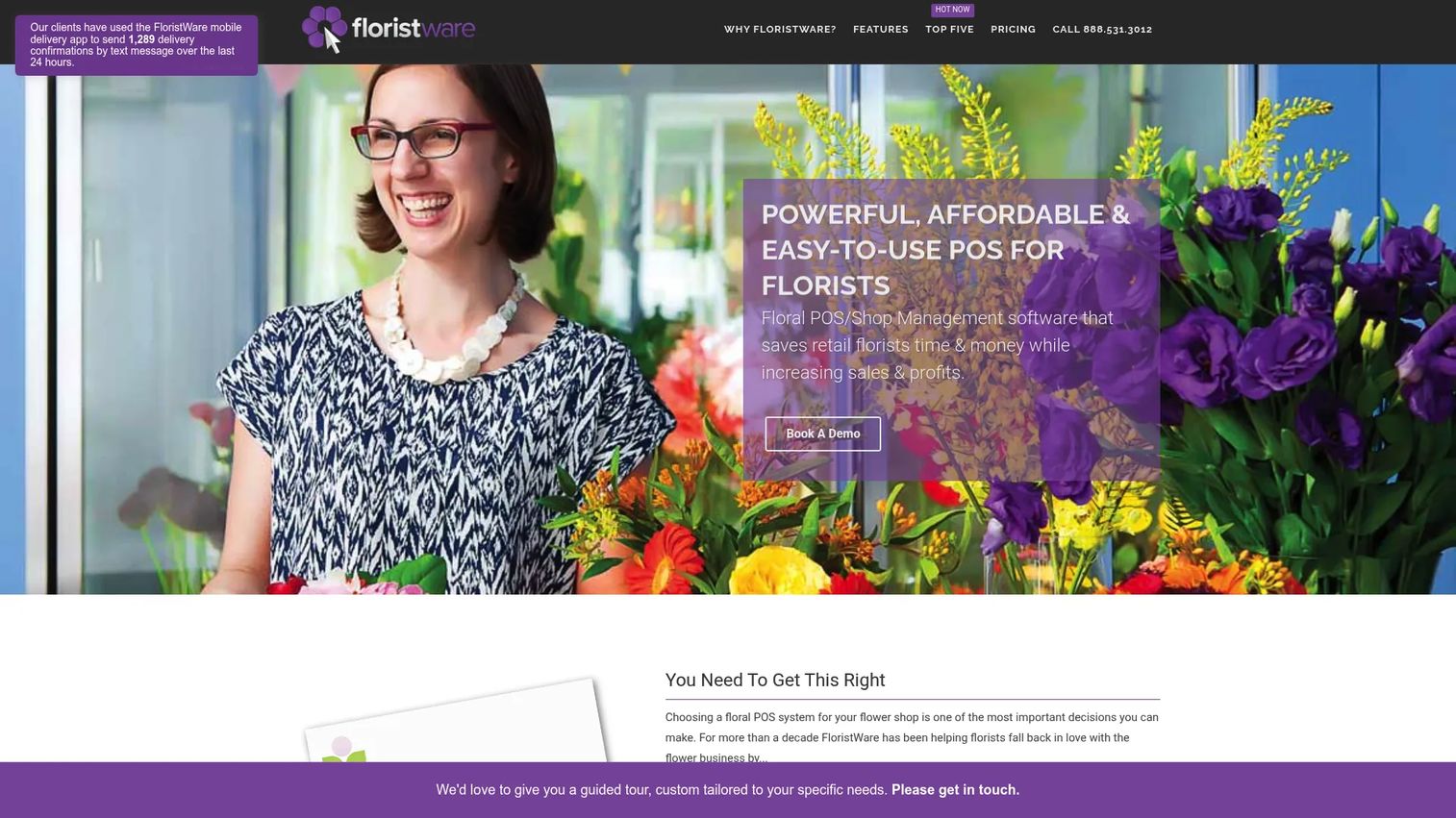
FloristWare is a POS and shop-management platform built for retail florists that have outgrown paper and a basic register. It handles the operational spine of a busy shop: order entry across walk-in and phone, delivery mapping and optimization, a mobile delivery app for drivers, and the reporting a growing shop needs to see what is working. If your bottleneck is coordinating more orders and more deliveries without adding chaos, this is the depth-first option.
Best for: Retail flower shops that need florist-specific POS, delivery, and website integrations in one system.
Key strengths
- Delivery mapping and mobile app: plan and optimize routes, then hand drivers a mobile app for stops and proof of delivery.
- Shopify website integration: connect a Shopify storefront so web orders flow into the same order pipeline as phone and counter sales.
- Flower Shop Network integration: send and receive wire orders through FSN without leaving your POS workflow.
Why choose FloristWare: Pick it when your shop is scaling and the manual coordination of orders, deliveries, and web sales has become the job instead of arranging flowers. It rewards shops that want operational control and are ready to commit to a florist-specific workflow rather than a general retail tool. Compared with the free-to-start options, it asks for a monthly commitment but gives more depth in return.
FloristWare pricing: FloristWare publishes simple, contract-free pricing. The Basic plan runs $149 per month billed monthly, or $1,499 per year billed annually, with no hidden fees and no long-term commitment. There is no free tier, so plan on the monthly rate from day one. On G2, FloristWare holds a 4.3 out of 5 rating.
2. Floranext
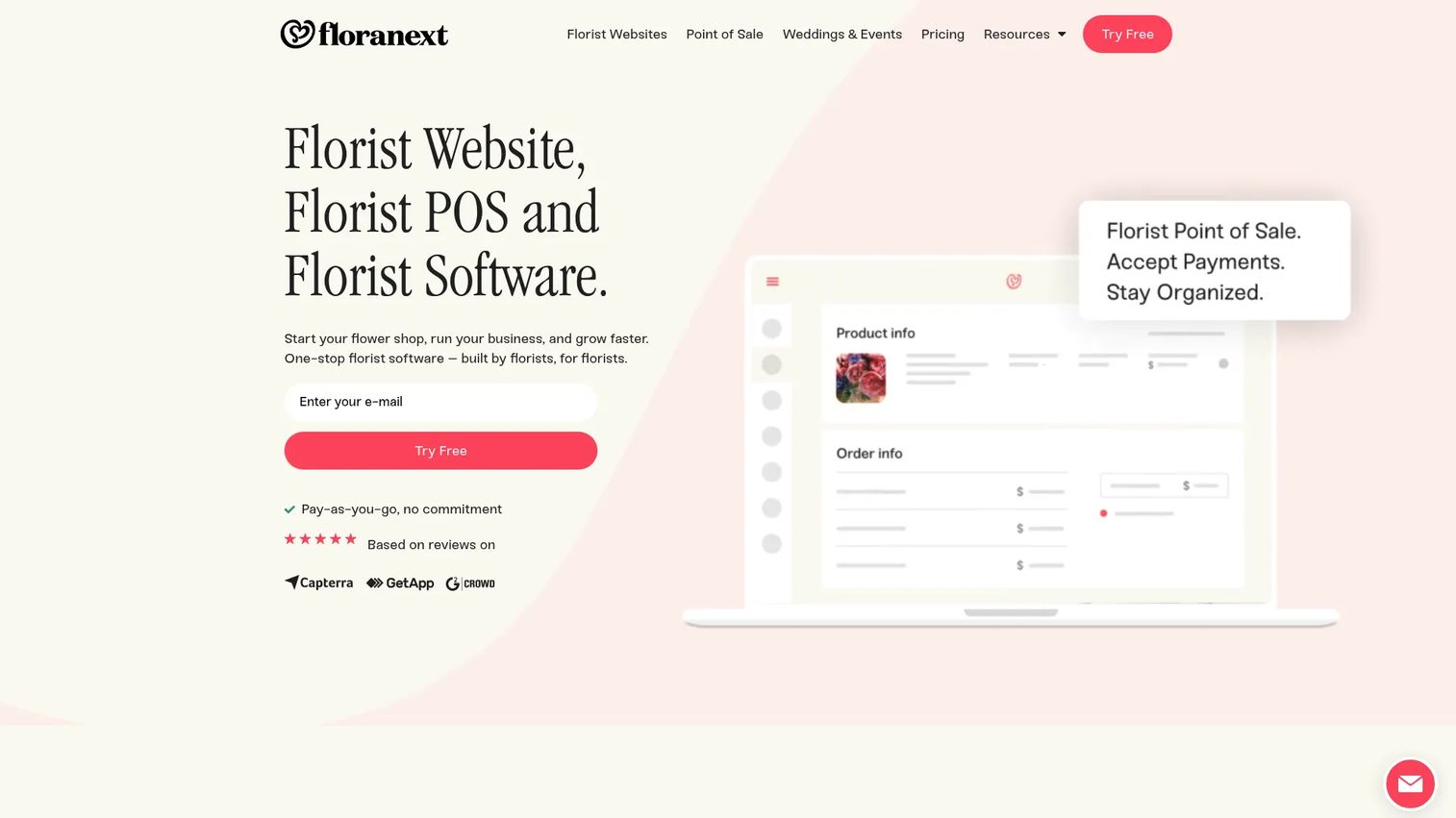
Floranext is a florist software suite that bundles a website with e-commerce, a POS for retail and phone orders, and a wedding and event proposal manager. The pitch is one platform instead of stitching a storefront, a register, and a proposals tool together. For a shop that wants ordering, delivery, and event workflows under one login, that consolidation is the draw.
Best for: Flower shops needing an all-in-one platform for online sales, POS, and wedding or event workflows.
Key strengths
- Florist website with e-commerce: take web orders on a florist-designed storefront that feeds the same system as your counter.
- Florist POS for retail and phone: ring up walk-ins and capture phone orders with recipient and delivery details built in.
- Wedding and event proposal management: build and manage event proposals in the same platform you use for daily sales.
Why choose Floranext: Choose it when you want fewer moving parts and a single vendor across your website, POS, and event work. It fits shops that do meaningful wedding and event business and do not want a separate proposals tool. The consolidation is the point: one platform, one support line, one set of order records.
Floranext pricing: Floranext lists a "start for free" and pay-as-you-go model across its Florist Website, Florist POS, Wedding Manager, and All in One products, but does not publish fixed dollar amounts on its pricing page. The company directs shops to the dashboard or a contact for current pricing, so confirm rates for your configuration before committing. A free start is available to test the fit.
3. IRIS
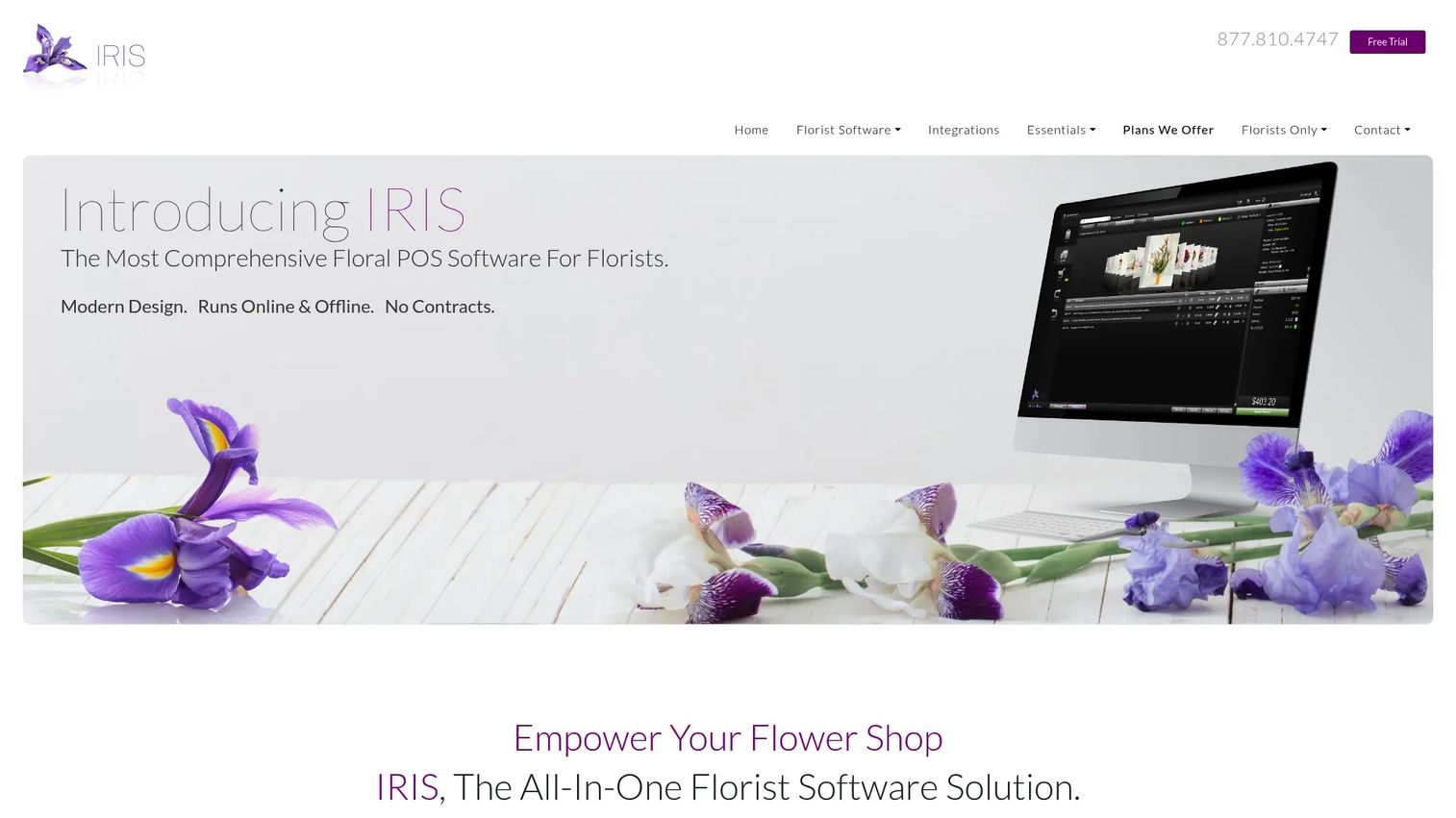
IRIS is florist software spanning point of sale, websites, and delivery routing, with a customer portal, inventory management, and a QuickBooks Online integration. A standout detail for peak-day operators: it runs both online and offline, so a spotty connection on Valentine's Day does not stop the register. If your two biggest pain points are reporting clarity and delivery routing, this is a strong match.
Best for: Florists that need POS, website, and delivery-routing software in one system.
Key strengths
- Delivery routing: plan and manage delivery routes directly inside the same system that captures orders.
- QuickBooks Online integration: sync sales and financial data to your accounting without manual re-entry.
- Runs online and offline: keep selling through an internet outage, which matters most on your busiest days.
Why choose IRIS: Pick it when uptime and routing are non-negotiable and you want accounting to stay clean without double entry. The offline capability alone earns its place for shops that cannot afford a dead register during a holiday rush. It suits operators who value control across POS, web, and delivery in one connected system.
IRIS pricing: IRIS lists its main software plans as Amethyst, Sapphire, Emerald, and Ruby, but does not publish a base price for them on its pricing page, so plan on a quote. Publicly visible add-ons include Premier Tech Support at $40 per month per computer and a Virtual Shop Assistant at $599 per month. A 14-day free trial is available with no credit card required. On G2, IRIS holds a 4.9 out of 5 rating.
4. QuickFlora
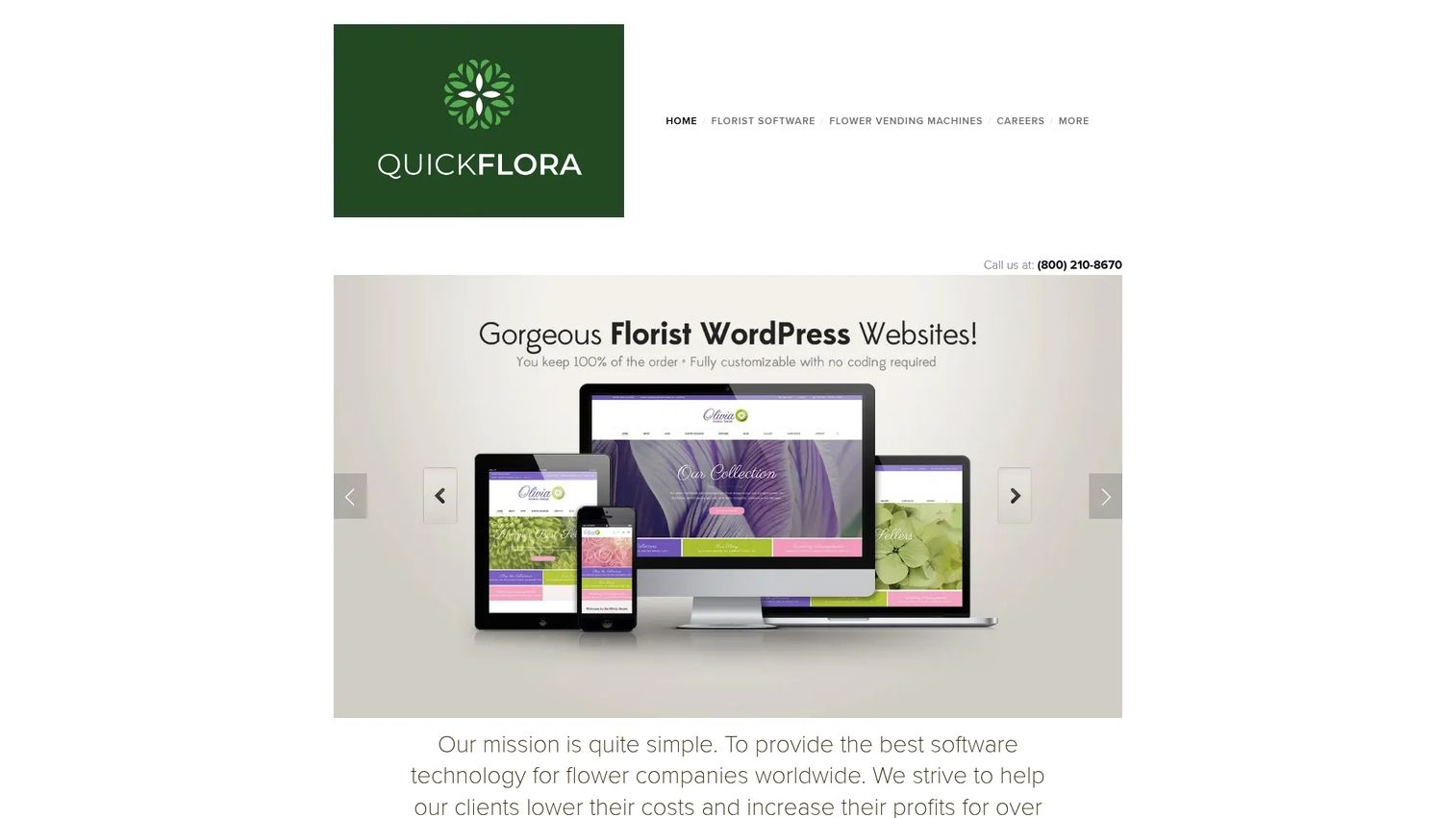
QuickFlora is a florist POS and software platform covering point of sale, integrated ecommerce and website options, and inventory and order management. Its clearest advantage is the entry price: an affordable start that lowers the barrier for independent shops moving off paper or a generic register for the first time.
Best for: Independent florists needing POS plus website and inventory tools without a large upfront commitment.
Key strengths
- Point of sale for florists: ring up counter and phone orders in a system built for floral workflows.
- Integrated ecommerce and website: add an online storefront that connects to the same order and inventory system.
- Inventory and order management: track stock and orders together so what you sell and what you have stay aligned.
Why choose QuickFlora: Choose it when budget is the deciding factor and you want a florist-specific system without a steep monthly rate. It fits a single-location shop taking its first step off manual tracking. Before committing, confirm the support model and which advanced features sit inside quoted add-on modules versus the base plan, since some items on the pricing page are quote-based.
QuickFlora pricing: The base POS plan starts at $99 per month. A one-time Data Import is listed at $299, and an Event Manager module adds $99 per month. Some additional items on the pricing page are quoted or marked "please call us," so budget for the base plus any modules your shop needs. There is no free tier, and a current G2 rating was not available at the time of writing.
5. BloomNation
BloomNation is an online flower marketplace paired with florist software and marketing tools. Alongside a cloud-based florist point of sale, it runs a marketplace for sending handcrafted bouquets from local florists and layers on marketing and reputation management. It functions less like a bare register and more like a commerce layer that helps a shop sell online and manage the orders that come in.
Best for: Florists looking for an online ordering marketplace plus shop software and marketing tools.
Key strengths
- Local florist marketplace: reach buyers through a marketplace built to send handcrafted bouquets from local florists.
- Cloud-based florist POS: manage orders through a point of sale accessible from anywhere.
- Marketing and reputation tools: run marketing and manage reviews to build repeat business and protect your shop's reputation.
Why choose BloomNation: Choose it when online demand and brand reputation matter as much as the register itself. It suits shops that want a networked way to capture orders and a marketing layer to keep customers coming back, rather than a POS in isolation. Treat it as a commerce ecosystem with POS inside, not only a checkout tool.
BloomNation pricing: BloomNation publishes a Reputation Management plan starting at $99 per month. Its other solutions appear to use tailored pricing or a request-a-consultation flow, so pricing for the full software and marketplace package is confirmed on a call. On G2, BloomNation holds a 4.7 out of 5 rating.
6. Curate
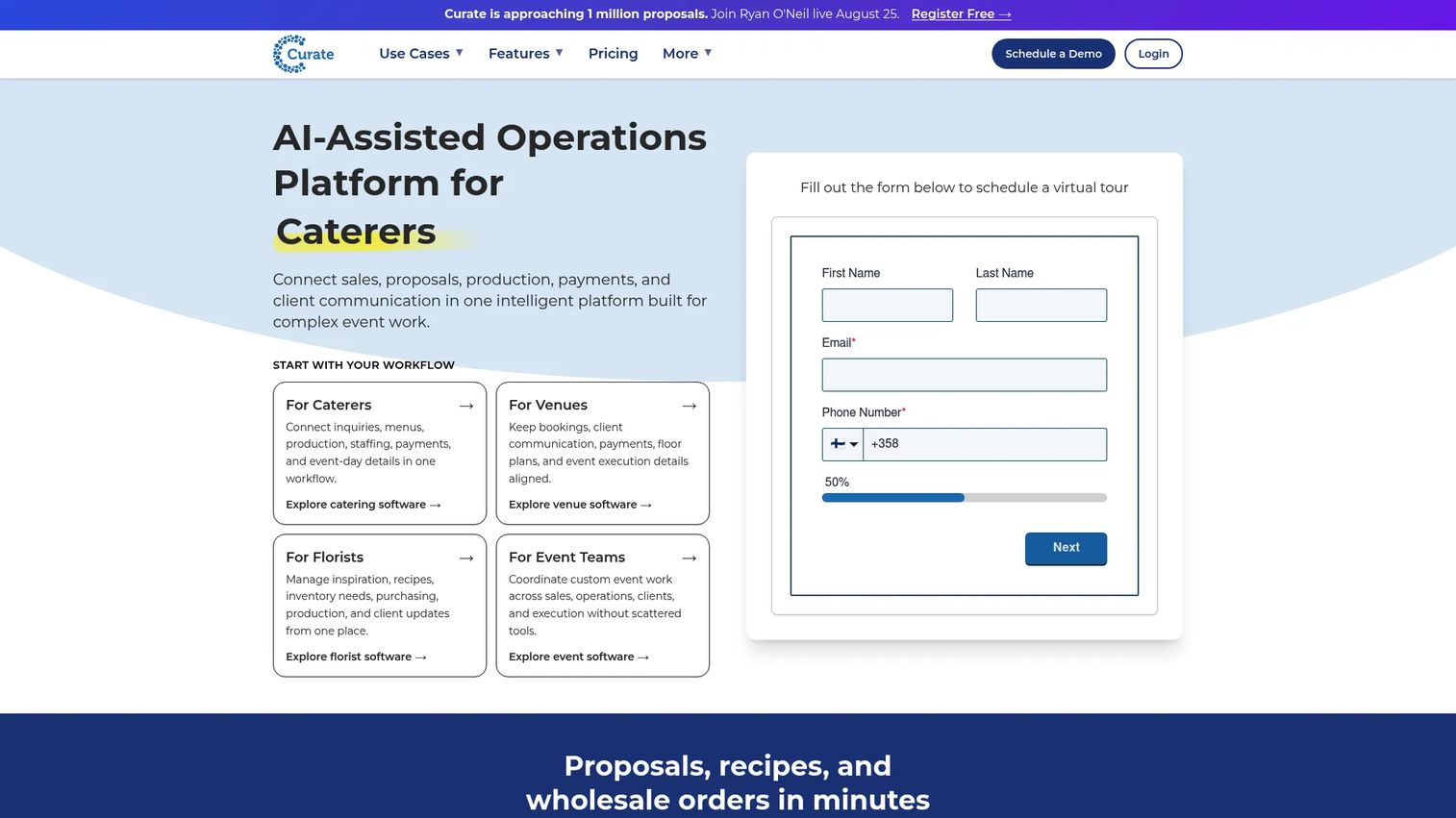
Curate is event management software for caterers, florists, venues, and other event businesses. It centers on the proposal-to-payment workflow: a proposal builder, a customer portal, contracts with e-signatures, plus recipes, rentals, staffing, and multi-location management. For florists whose revenue leans on weddings and events, this is the modern digital merchandising and ordering layer.
Best for: Event-focused florists that need proposals, payments, contracts, and operational workflow in one system.
Key strengths
- Proposal builder and customer portal: create polished proposals and give clients a portal to review and approve.
- Contracts and e-signatures: move from proposal to signed contract without paper or a separate signing tool.
- Recipes, rentals, staffing, multi-location: plan the operational side of events, from stems to staff to sites.
Why choose Curate: Choose it when weddings and events are a core part of your business and the proposal workflow is where deals stall. It shines for the event side of a floral operation. Be explicit about scope: it is built around event proposals and operations, so many shops pair it with a florist POS for daily counter and delivery work rather than replacing one.
Curate pricing: Curate lists plans named Basic, Growth, and Partnership as annual subscriptions, with an Enterprise tier that is contact-sales and priced per project. The pricing page does not display public dollar amounts for the non-Enterprise plans, so request a quote for your business size. On G2, Curate holds a 4.8 out of 5 rating.
7. Flower Shop Network
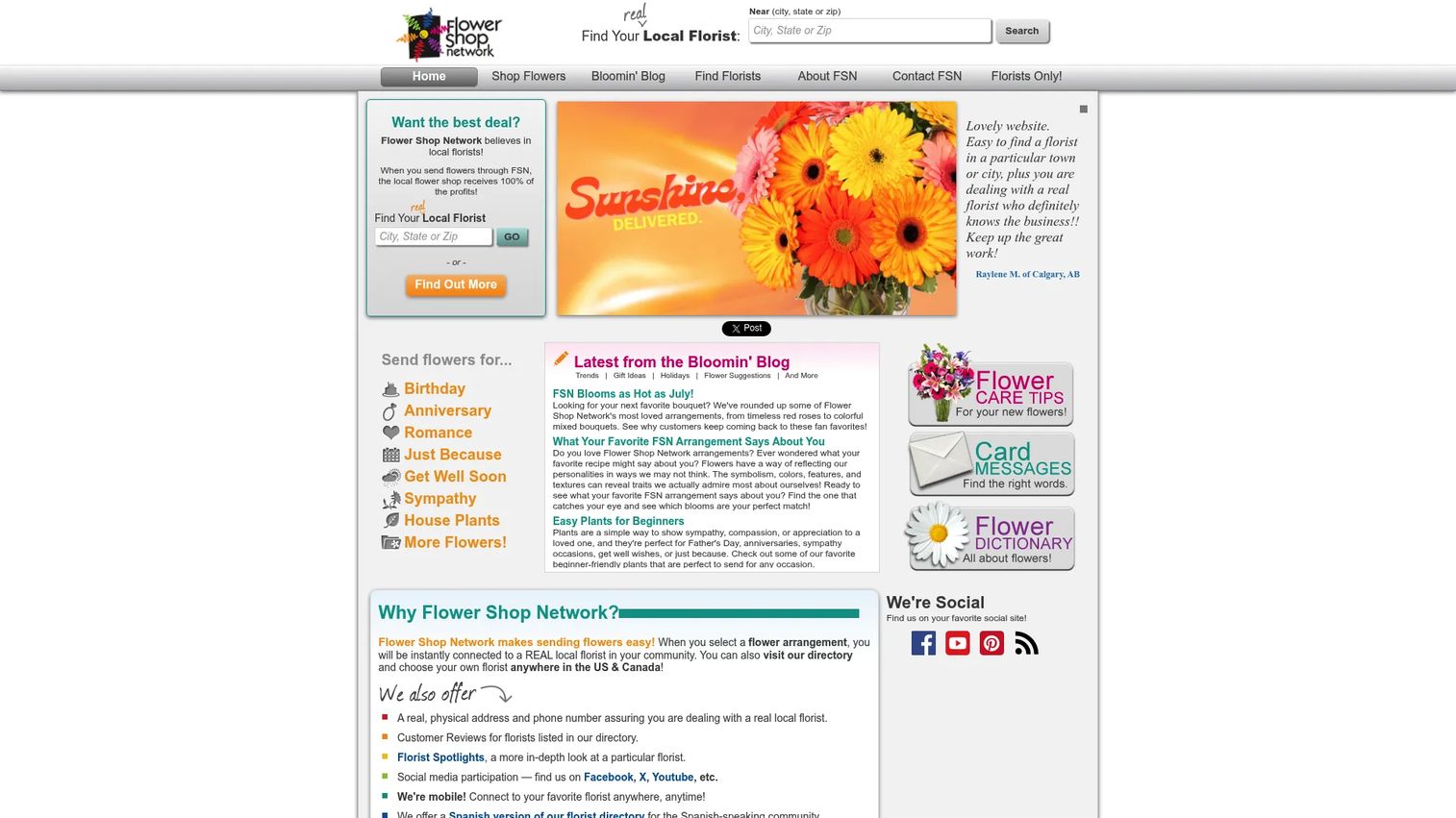
Flower Shop Network is a network and service platform that connects customers to local florists and gives member shops tools to send and receive orders florist-to-florist. It also provides florist websites and marketing tools. If a meaningful share of your volume comes from network and relay orders, this is the ecosystem-fit option.
Best for: Independent florists seeking network-based ordering and web and marketing tools.
Key strengths
- Florist-to-florist order sending and receiving: relay orders across a network of member shops in both directions.
- Local florist directory: get discovered by customers searching for a florist in your area.
- Florist websites and marketing: run a shop website and marketing tools alongside your network membership.
Why choose Flower Shop Network: Choose it when networked and relay orders are central to how you operate, not an afterthought. It matters most to shops that depend on distribution across a florist network and want web and marketing tools tied to that membership. The company states it has more than 7,000 florists, no monthly fees, and a low annual membership.
Flower Shop Network pricing: Flower Shop Network states there are no monthly fees and mentions a low annual membership fee, but does not publish a public dollar amount on its accessible membership pages. Contact them for the current annual rate. A current G2 rating was not available at the time of writing.
Considerations before you buy
Before you commit, run each shortlisted tool through the criteria that actually decide whether a florist POS earns its place behind your counter.
Delivery and routing fit
Map your real delivery reality first. How many stops on a peak day? Timed windows? Multiple drivers? Confirm the system plans routes, assigns stops, and pushes status back to customers. If delivery is your bottleneck, weight this criterion heaviest and test it with a realistic peak-day scenario.
Payment processing and hardware
Check which card processors the system supports and whether processing is integrated or bolted on. Confirm EMV chip, contactless, Apple Pay, and Google Pay. Ask about hardware: does it work with your current terminal and printers, or does switching mean buying new gear?
Reporting and accounting sync
You want sales, tax, delivery, and product-performance reports without exporting to a spreadsheet. If you use QuickBooks or another ledger, confirm a direct sync so daily takings flow to accounting without re-entry. Clean reporting is how you learn which products and channels actually pay.
Migration, support, and training
Ask the questions that hurt later if you skip them. How does your existing customer and order data move over? What does onboarding look like? Is support included or a paid add-on, and what are the hours? A florist POS you cannot get running before Valentine's Day is a liability, not a tool.
Conclusion
The right florist POS depends less on a feature checklist and more on where your shop actually loses time and money. Growing retail operations that need depth across orders, delivery, and web sales should start with FloristWare. Shops that want website, POS, and event proposals under one roof will find Floranext fits. If uptime and routing are the priority, IRIS earns a close look, while budget-conscious single-location shops can start with QuickFlora.
For shops where online demand and reputation drive the business, BloomNation adds a marketplace and marketing layer. Event-heavy florists should evaluate Curate for its proposal workflow, and shops built on relay orders belong with Flower Shop Network.
Here is the practical next step: shortlist two or three tools by your delivery needs and pricing model first, then book demos and run one realistic peak-day scenario through each. Bring your actual order volume, a multi-stop delivery, and a phone order with a separate recipient. The system that handles your hardest Tuesday without a workaround is the one that will still be working next Valentine's Day.
FAQs
For a small, single-location shop, prioritize simple setup and a low monthly cost over enterprise depth. QuickFlora starts at $99 per month, and Floranext offers a free start with pay-as-you-go pricing, both of which lower the barrier for independents. Match the tool to your actual workload: if deliveries are light, you need less routing muscle than a high-volume shop.
Yes, delivery routing is a core florist POS feature, unlike most generic retail systems. Good routing plans efficient stops, assigns them to drivers, and pushes delivery status back to the customer. FloristWare offers delivery mapping and optimization with a driver mobile app, and IRIS includes delivery routing in its florist software, so confirm the depth matches your peak-day stop counts.
Most modern florist POS systems support integrated card processing, including EMV chip, swipe, and contactless payments such as Apple Pay and Google Pay. Contactless matters at a flower counter where speed during a holiday rush is everything. Confirm which processor the system uses and whether processing is built in or requires a third-party terminal before you commit.
At minimum, look for sales, tax, delivery, and product-performance reporting. Sales and tax reports keep your books and filings clean, delivery reports show where routing time goes, and product-performance reports tell you which arrangements and price points actually drive revenue. A direct accounting sync, such as the QuickBooks Online integration IRIS offers, removes manual re-entry.
Many do, and retention features matter more for florists than most retail because flowers are a repeat-occasion purchase. The customer who orders for an anniversary this year will need something next year, so gift cards, stored customer records, and occasion reminders turn a one-time buyer into a recurring one. Confirm which retention tools sit in the base plan versus paid add-ons.
Focus on migration, support, training, and workflow fit. Ask how your existing customer and order data moves over, what onboarding looks like, and whether support is included or a paid add-on. Then test the workflow with a realistic peak-day scenario, because a system that handles your hardest Tuesday is the one worth switching to.
For a flower shop, yes, because florist-specific workflows are the whole job. A generic register handles a barcode and a receipt, but it does not natively manage a delivery with a separate recipient, a card message, a timed route, or an incoming wire order. Florist POS software builds those workflows in, which is where generic retail POS falls behind for floral operations.