You announced a company volunteer day. Then the work started. Sign-up sheets in three spreadsheets. Approval emails buried in inboxes. Hours logged on a form nobody checks. And when leadership asks how participation went, you stitch together a number you can't fully defend.
That gap between running a volunteer program and proving it scaled is exactly what corporate volunteering software exists to close. The category sits at the intersection of an employee volunteering platform, a CSR engagement layer, and an employee engagement software stack, and it has stopped being a nice-to-have. According to Benevity's 2026 State of Corporate Volunteering report, corporate volunteers logged 23.7 million approved hours in 2025, up 175% since 2019. Average program participation rose from 10.4% to 13.6% in a single year. That is real adoption growth, and manual tracking does not survive it.
For a founder evaluating this through a scale-and-efficiency lens, the question is not "does this help us do good." It is whether a volunteer management software platform reduces admin load, produces reporting a board will trust, and slots into your existing stack without adding fragmentation. The same logic applies when you evaluate any GTM tool: the format that lets people experience value without friction tends to win. If you build product, you already know an interactive demo converts better than a static deck for the same reason an interactive volunteer hub beats a spreadsheet, because participation rises when friction drops.
This guide breaks down seven platforms by what operational problem each one actually solves, so you can shortlist before you book a single sales call.
What's inside
This list is for people responsible for launching, running, or reporting on an employee volunteer program at a growing company. We focused on tools that handle real operational load, not just "impact" branding. Every platform here was assessed against four criteria:
- Workflow coverage: event creation, shift sign-ups, approvals, waivers, and recurring scheduling.
- Reporting depth: participation rates, volunteer hours tracking, dashboards, and exportable data feeds.
- Engagement features: campaigns, reminders, leaderboards, recognition, and rewards.
- Scale fit: integrations, governance, and support for multi-team or global programs.
We leaned on verified pricing, published G2 ratings, and first-party feature documentation wherever available.
TL;DR
- Best for enterprise CSR breadth: Benevity, which unifies giving, volunteering, grants, and reporting in one system.
- Best for volunteer grant automation: Double the Donation, for eligibility checks and automated workplace giving follow-up.
- Best for hands-on program delivery: Goodera, which curates and executes virtual, in-person, and hybrid volunteering experiences.
- Best for streamlined mid-market giving: Uncommon Giving, pairing giving wallets with volunteer management.
- Best for community engagement at scale: GivePulse, strong on scheduling, event management, and impact tracking.
- Best for grants and submission workflows: Submittable, when volunteering sits alongside applications and reviews.
- Best for CSR strategy and services: CSRconnect, for teams wanting guided CSR assessment and monitoring.
If you want the fastest path: clarify whether you need full program management, automation around incentives, or broad CSR coverage. That single decision narrows this list to two or three.
What is corporate volunteering software?
Corporate volunteering software is a platform that helps companies create, schedule, manage, and measure employee volunteer programs in one place. It replaces the spreadsheets, email threads, and disconnected forms that break down once participation grows beyond a handful of motivated employees.
At its core, this category overlaps heavily with the broader volunteer management software and CSR software markets, but it is purpose-built for the employer-employee relationship: getting staff to sign up, show up, log hours, and feel recognized.
A typical employee volunteer software platform includes:
- Event and opportunity creation for one-off, recurring, virtual, and in-person volunteering.
- Shift sign-ups and scheduling with capacity limits and waitlists.
- Approval workflows for time off, waivers, and manager sign-off.
- Volunteer tracking software that captures hours via registration, attendance, or self-reporting.
- Dashboards and impact reporting for participation rates, hours, and program ROI.
- Volunteer grant automation that converts logged hours into corporate donations.
- Engagement tools like reminders, campaigns, leaderboards, and recognition.
The market reflects this demand. The corporate volunteering platform segment was valued at US$997.44 million in 2023 and is projected to reach US$2.08 billion by 2031 at a 9.6% CAGR, according to The Insight Partners (2026). The broader volunteer management platforms market is growing even faster, projected from US$2.21 billion in 2026 to US$4.38 billion by 2030 at 18.7% CAGR, per Research and Markets (2026). Buyers are clearly moving off manual processes.
When to use corporate volunteering software
Not every company needs a dedicated platform on day one. Here is where it earns its place.
Centralize volunteer program administration
Spreadsheets work until two things happen: multiple teams run events at once, and someone needs an audit trail. When you are juggling shift sign-ups, liability waivers, recurring monthly events, and manager approvals across email, you lose hours and you lose data. A platform consolidates registration, approvals, and waivers so the program runs without a coordinator manually chasing every step. This is the same consolidation logic founders apply to their GTM stack, fewer tools, more signal.
Improve participation and employee engagement
Benevity's 2026 data shows employees contributing fewer than five hours a year now make up roughly 60% of all volunteers. Most of your participation comes from people who need a nudge, not your core enthusiasts. Reminders, campaign tools, leaderboards, and recognition mechanics are what move that long tail. This is where employee engagement software features overlap directly with employee advocacy and internal communication: visibility drives sign-ups.
Measure impact and prove ROI
Leadership does not want anecdotes about a beach cleanup. They want participation rate, total hours, dollar value of volunteer grants, and trend lines quarter over quarter. Reporting depth is what separates a program you can defend in a board meeting from a feel-good slide. Look for dashboards, exportable data, and feeds that push into your existing systems.
Comparison table
Here is how the seven platforms stack up. Read it by intent first: decide whether you need full program management, automation, broad CSR coverage, or community engagement, then compare differentiation and pricing. Ratings reflect published G2 scores where available.
| # | Product | Intent | Key differentiation | Pricing | G2 rating |
|---|---|---|---|---|---|
| 1 | CSRconnect | CSR strategy and services | CSR assessment, monitoring, and ESG guidance | Quote-based | Not published |
| 2 | Double the Donation | Volunteer grant automation | Automated matching and grant outreach | From $999/year | 4.6/5 |
| 3 | Benevity | Enterprise CSR breadth | Unified giving, volunteering, grants, reporting | Quote-based | 4.7/5 |
| 4 | Uncommon Giving | Mid-market giving + volunteering | Portable giving wallets plus volunteering | From $4,200/year | Not published |
| 5 | Goodera | Hands-on program delivery | Curated and executed volunteering experiences | From $1,000 (one-time) | 4.4/5 |
| 6 | Submittable | Grants + submission workflows | Forms, reviews, and CSR in one system | Quote-based | 4.5/5 |
| 7 | GivePulse | Community engagement | Scheduling, events, and impact tracking | From $20/mo | 3.7/5 |
1. CSRconnect
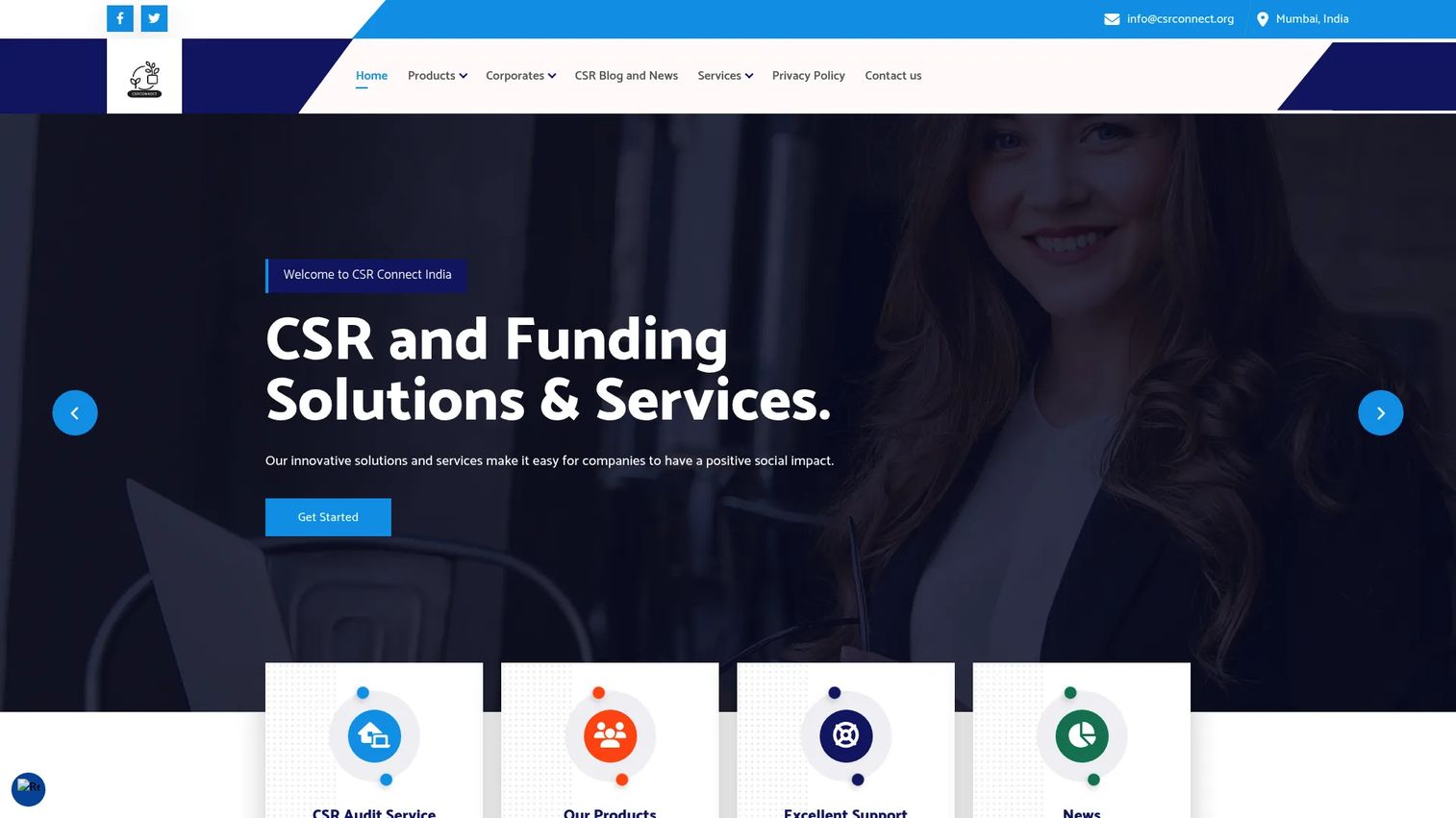
CSRconnect positions itself as a CSR and funding solutions provider rather than a pure volunteer scheduling tool. It covers CSR strategy, assessment, monitoring, ESG, and fundraising, with employee volunteering as one component inside a wider services-and-software approach. If your team is building a CSR function from scratch and wants guidance alongside tooling, this is the kind of partner that fits.
Best for: Companies or NGOs that want CSR services, fundraising support, and impact monitoring guidance, not just a volunteer sign-up form.
Key strengths
- CSR strategy and assessment: Helps frame where your program should focus and how to measure it.
- CSR monitoring and ESG: Tracks program activity and ties it into broader ESG reporting needs.
- Fundraising and NGO connections: Links companies with vetted NGOs and funding workflows.
Why choose CSRconnect: This is the right fit when you treat volunteering as one input into a larger CSR and ESG strategy, and you want advisory support rather than a self-serve product alone. Teams that already have a clear program and just need scheduling will find it broader than necessary, which is exactly its appeal for teams that need direction.
CSRconnect pricing: CSRconnect does not publish public pricing. The site directs visitors to request a quote, which is common for services-led CSR providers. Expect a scoped engagement based on your program size and the level of strategy and monitoring support you need. Confirm deliverables and reporting depth before signing.
2. Double the Donation
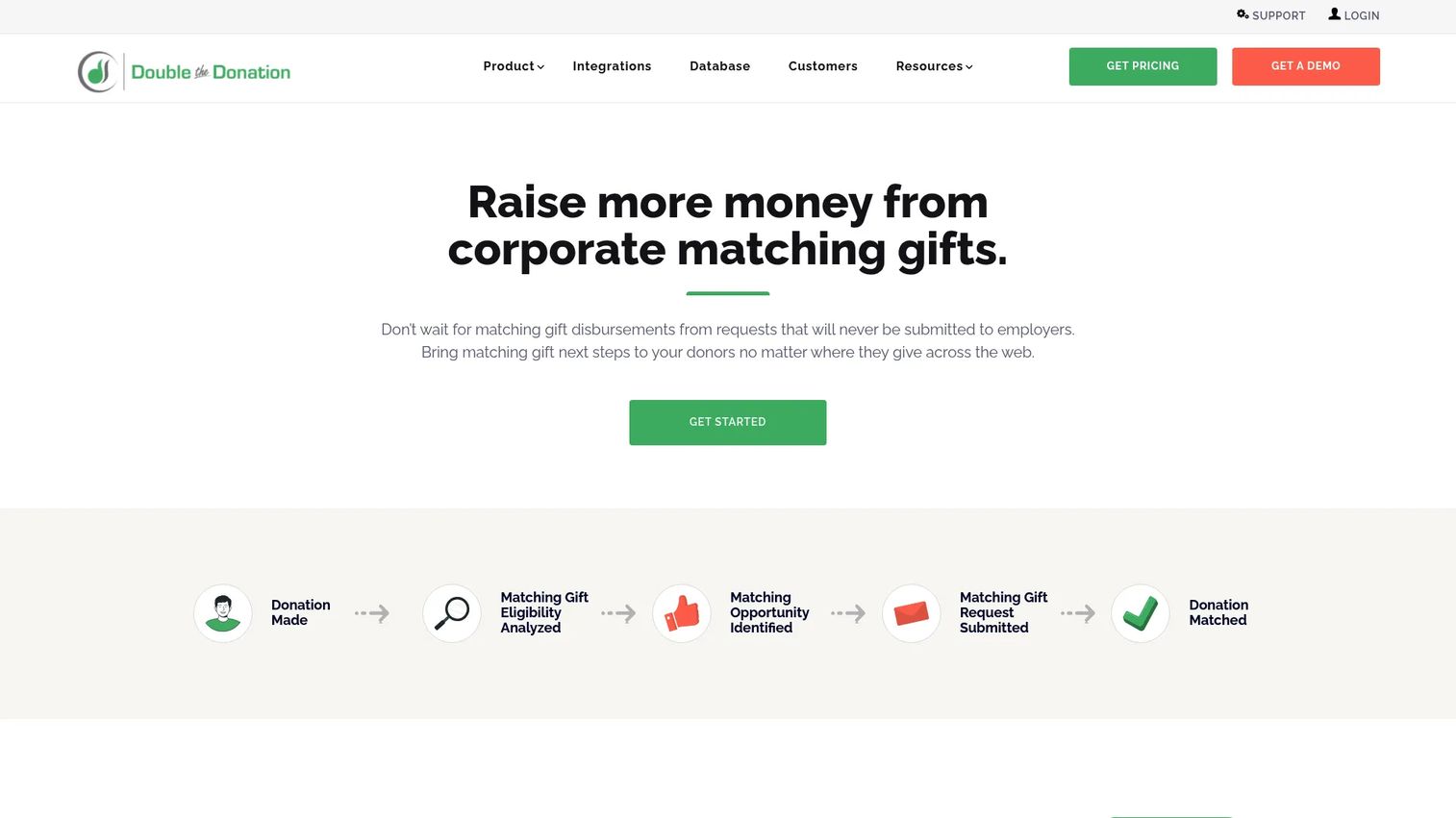
Double the Donation is the specialist for automation around volunteer incentives and workplace giving. It is best known for matching gifts, but its volunteer grant automation is where it earns a spot here: eligibility checks, employer search tools, and automated follow-up that turns logged hours into corporate donations without manual chasing. It plugs into donation forms and CRMs, so the incentive layer runs itself.
Best for: Nonprofits, schools, and corporate programs that want to automate matching gifts and volunteer grants with minimal manual work.
Key strengths
- Automated matching gift outreach: Triggers eligibility checks and follow-up emails automatically.
- Donation form and CRM integrations: Connects to existing fundraising and donor systems.
- Volunteer grants and payroll giving access: Surfaces grant eligibility and routes submissions.
Why choose Double the Donation: If your priority is converting volunteer hours into dollars without a coordinator manually verifying eligibility, this is the cleanest automation in the category. It is narrower than a full program management platform, which is precisely why it pairs well with another tool that handles scheduling and event ops.
Double the Donation pricing: Pricing is public. The Essentials plan is usage-based and starts free for the first year up to $2,000 in matched donations, scaling to $500 and $1,200 at higher tiers. The Standard plan starts at $999/year, and Enterprise starts at $30,000/year. There is no free tier beyond the first-year Essentials offer. It holds a 4.6/5 rating on G2.
3. Benevity
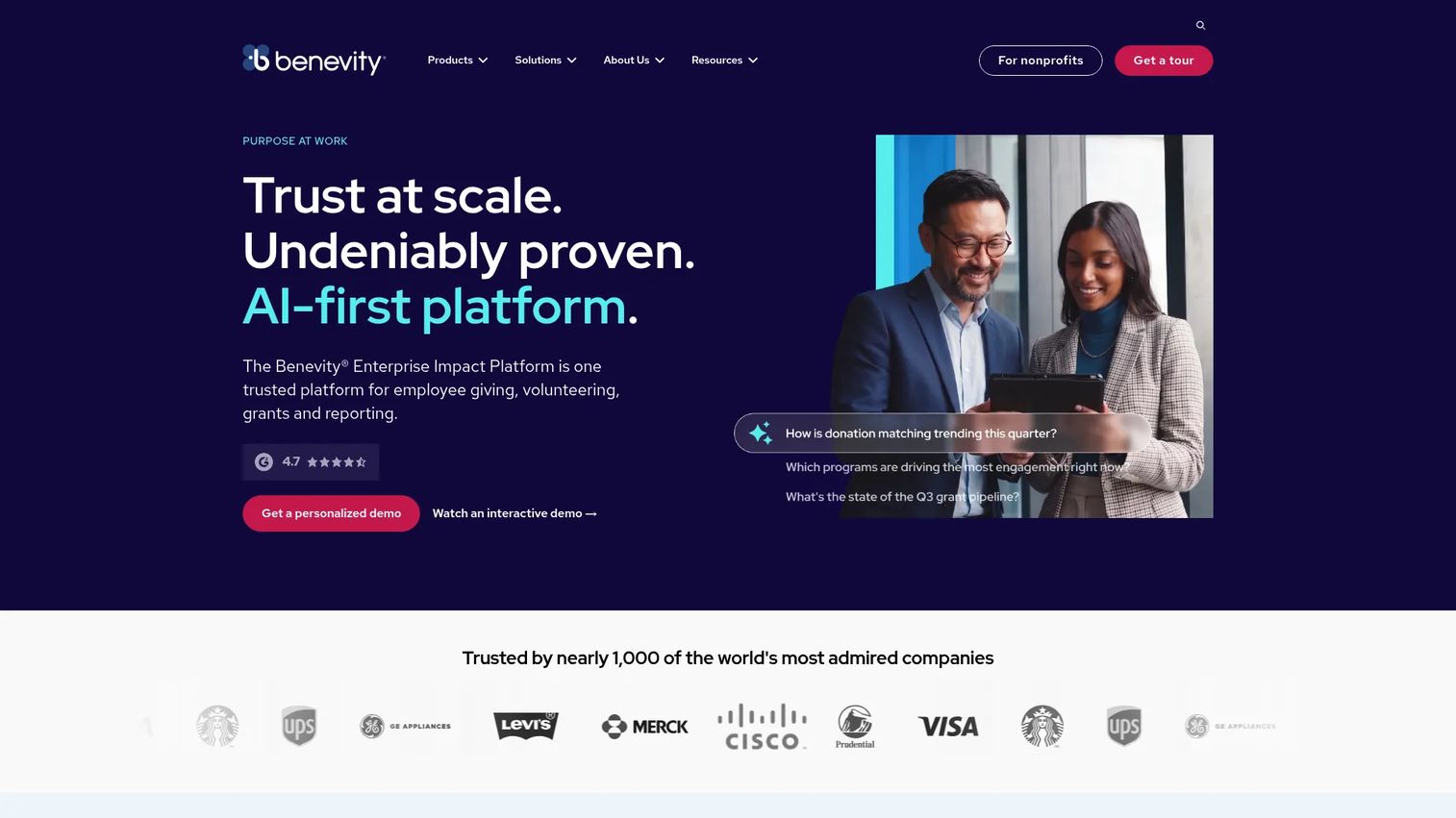
Benevity is the enterprise standard for connecting volunteering, giving, grants, and employee resource groups in one platform. It is the source of much of the market data in this article, which tells you something about its position. For large, global, or multi-team programs, the appeal is a single system of record across the entire CSR motion, with compliance controls and nonprofit validation built in.
Best for: Large enterprises running global CSR, giving, volunteering, and grants programs that need governance and unified reporting.
Key strengths
- Unified giving, volunteering, grants, and reporting: One platform across the full CSR program, not separate tools.
- Global money movement with compliance controls: Nonprofit validation and controls for cross-border programs.
- AI-native review tools: Match review and grant application summaries reduce manual review load.
Why choose Benevity: When your program spans countries, business units, and program types, the value is consolidation: volunteering does not live in a silo separate from giving and grants. That breadth suits enterprises with real governance requirements. Smaller teams may find the scope wider than they need today, which is the tradeoff with enterprise-grade volunteer tracking software.
Benevity pricing: Benevity does not publish public pricing. Pages direct visitors to request a demo, and the company offers a range of plans tied to program scope and scale. For enterprise CSR programs, expect a custom quote. It holds a 4.7/5 rating on G2, the highest among the platforms here.
4. Uncommon Giving
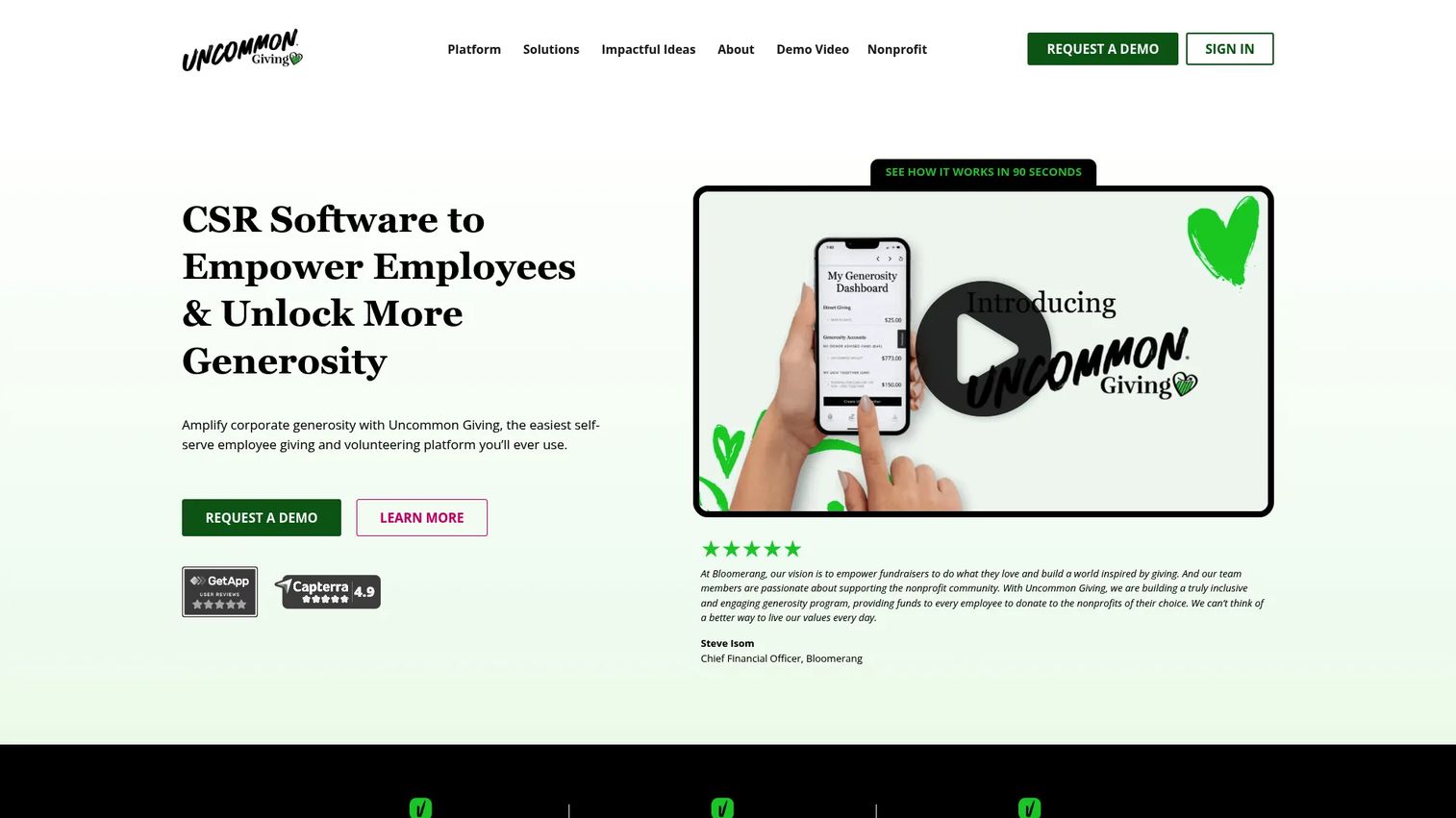
Uncommon Giving blends workplace giving and volunteering into one platform built around employee giving wallets. The angle is a more streamlined experience for small to mid-size companies that want both donation matching and volunteer management without enterprise overhead. Portable giving wallets, sometimes structured as donor-advised funds, are the differentiator.
Best for: Small to mid-size companies that want a workplace giving and volunteering platform with clear setup and reporting.
Key strengths
- Portable giving wallets and DAFs: Employees keep a giving balance that follows them.
- Payroll giving and donation matching: Automates matching alongside volunteer activity.
- Volunteer management and CSR reporting: Tracks participation and surfaces program metrics.
Why choose Uncommon Giving: This fits teams that want giving and volunteering in one place without standing up a heavy enterprise deployment. The combined wallet plus volunteering model is appealing when employee participation and workplace giving matter equally. Verify reporting depth against your board's expectations during evaluation.
Uncommon Giving pricing: Pricing is published but inconsistent across first-party pages. The official LLM info page states pricing starts at $4,200 per year with no implementation fees, while the FAQ references a $10,000 per year starting point. There is no free tier. Confirm the current figure and what each tier includes directly with the vendor before you commit.
5. Goodera
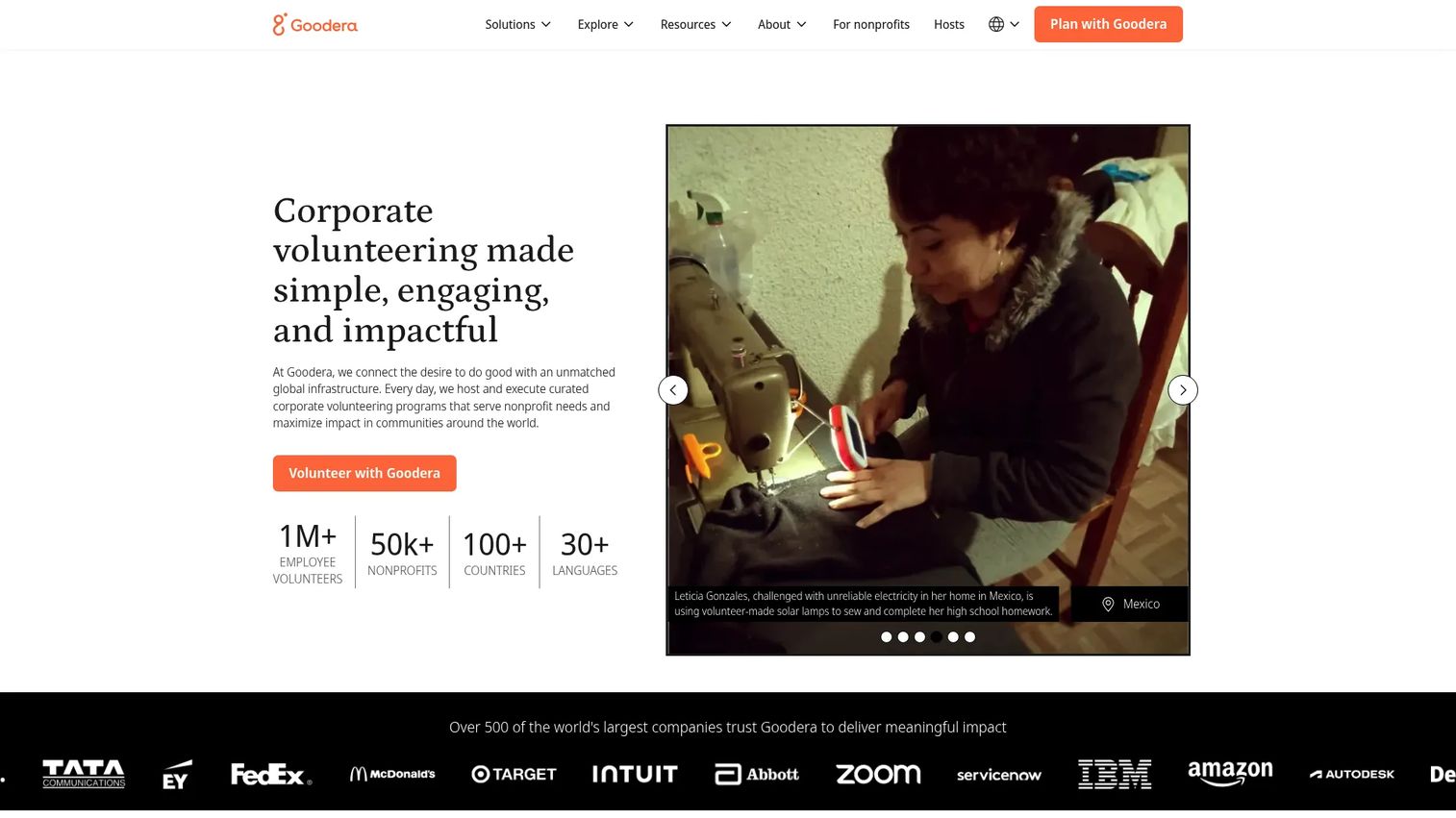
Goodera takes a different approach: it does not just give you a tool, it curates and executes volunteering experiences for your teams. Virtual, in-person, and hybrid events come with a global nonprofit network and event execution support, which removes the burden of sourcing and running activities yourself. For distributed or global workforces, that delivery model is the draw.
Best for: Companies running employee volunteering and CSR engagement programs that want curated experiences delivered, not just software to manage their own.
Key strengths
- Curated virtual, in-person, and hybrid experiences: Ready-to-run activities across formats.
- Global nonprofit network and execution support: Sourcing and running events handled for you.
- Volunteering metrics and reporting: Participation and impact data tied to each experience.
Why choose Goodera: If your team lacks the bandwidth to source nonprofits and coordinate logistics, Goodera's done-for-you model removes that work. It is strongest for global, distributed teams that want consistent experiences across regions. Companies that prefer to manage their own events end-to-end will weigh the curated model against fuller self-serve control.
Goodera pricing: Public package pricing appears on a Goodera partner page, with one-time options including a Single Event at $1,000, Basic at $2,000, and Pro at $5,000. Goodera also offers custom corporate volunteering programs through its sales team. There is no free tier. It holds a 4.4/5 rating on G2.
6. Submittable
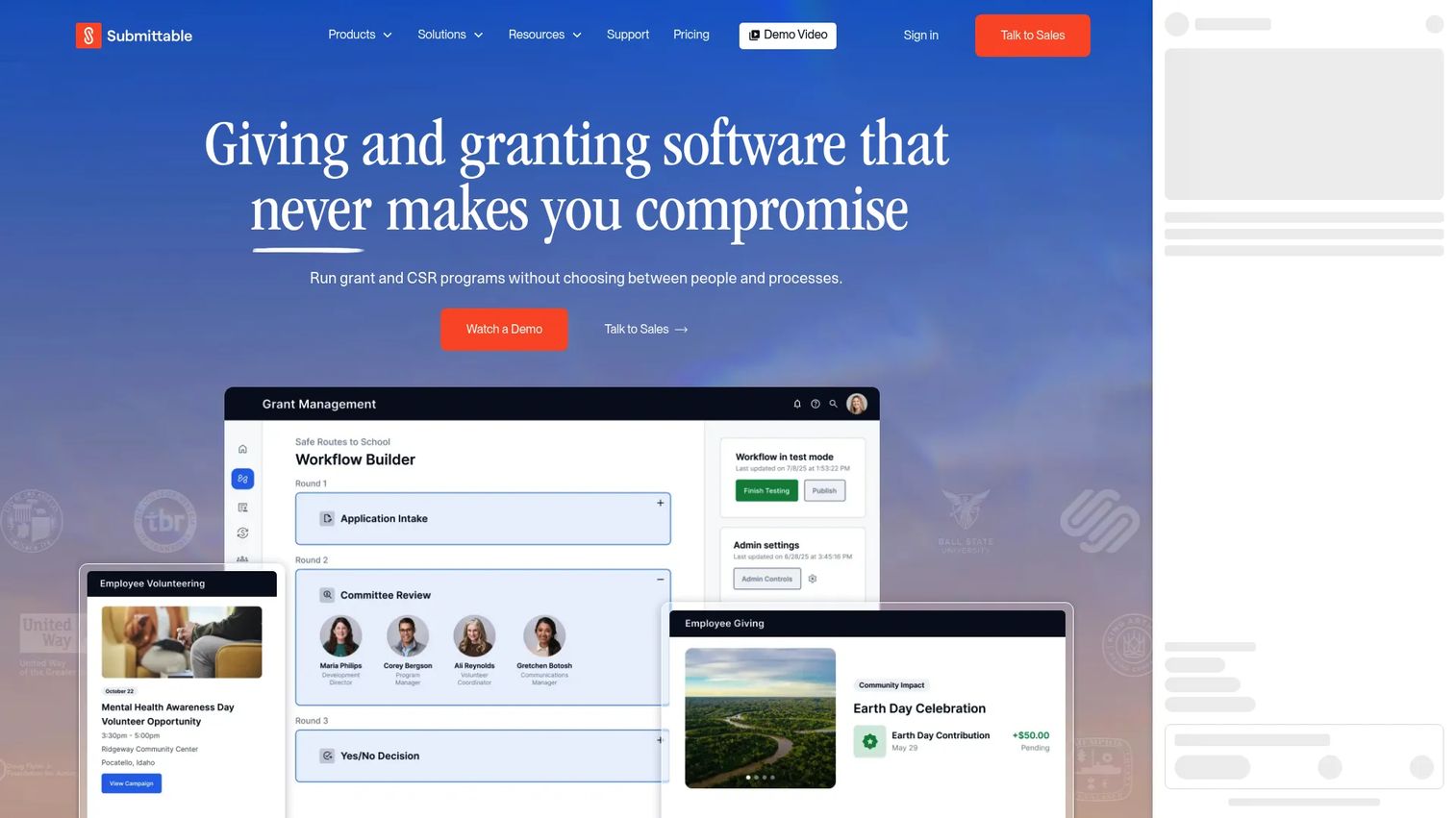
Submittable is built around submission and review workflows, with a CSR platform alongside grants, applications, and scholarships. It fits teams whose volunteering program sits next to grants management or other application-driven processes. The drag-and-drop form builder, multi-stage review tools, and financial tracking make it strong when approvals and routing matter as much as scheduling.
Best for: Organizations managing grants, applications, CSR, scholarships, or other submission and review workflows alongside volunteering.
Key strengths
- Drag-and-drop form builder and application portal: Build intake and sign-up flows without engineering.
- Automated and multi-stage review tools: Route approvals through structured review steps.
- Financial tracking and dynamic reporting: Fraud prevention and reporting across programs.
Why choose Submittable: If your CSR work already includes grants or scholarship review, consolidating volunteering into the same submission engine reduces tool sprawl. It is less of a dedicated employee volunteer software and more of a workflow platform that handles volunteering well, which suits operations-heavy teams.
Submittable pricing: Submittable does not publish plan prices. The pricing page uses book-a-meeting and contact-sales CTAs across its CSR, grant management, and enterprise product areas. Pricing scales with program complexity and volume. It holds a 4.5/5 rating on G2. Ask for a scoped quote that maps to your specific workflows.
7. GivePulse
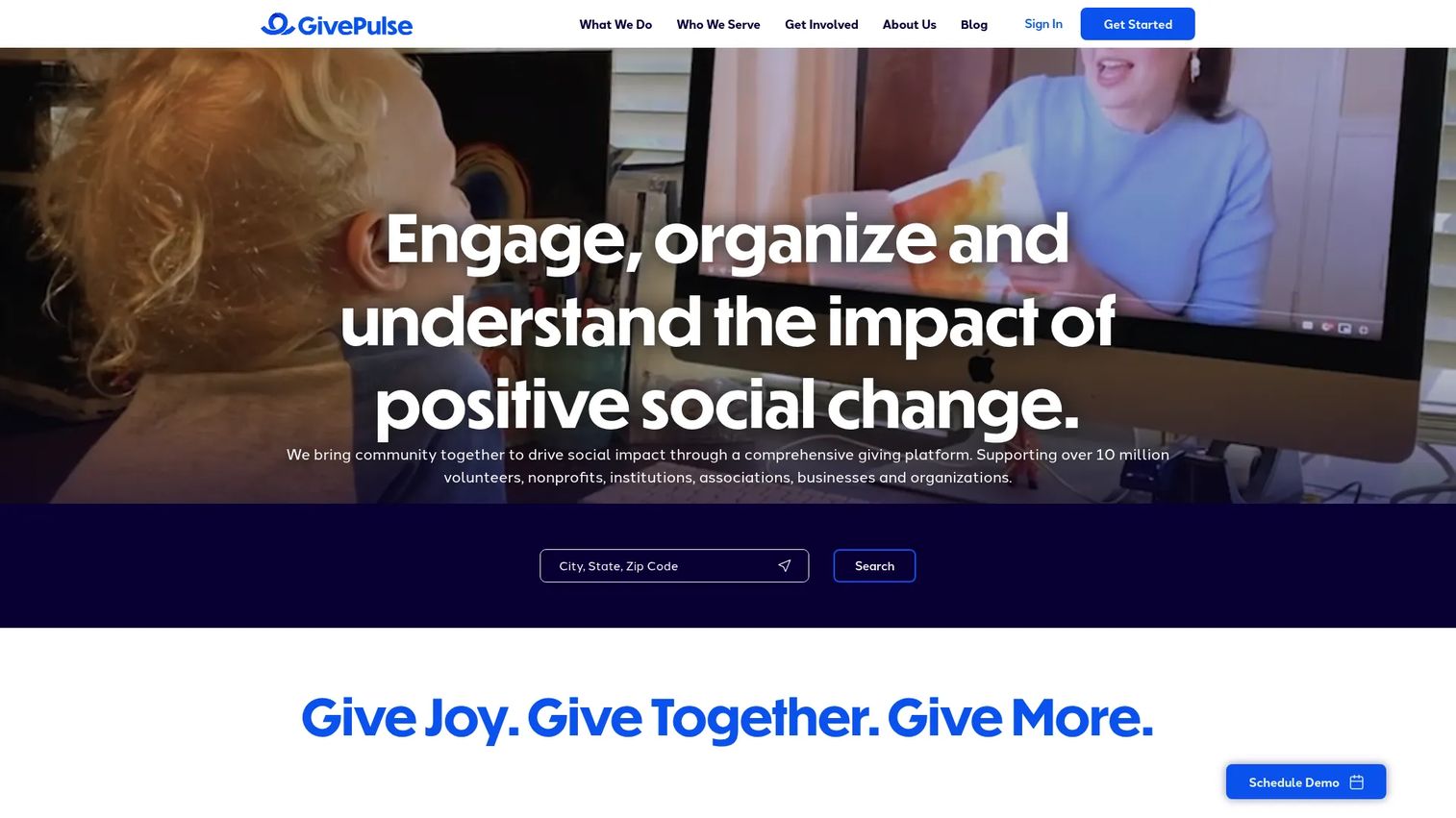
GivePulse focuses on volunteer and community engagement across nonprofits, higher education, and enterprises. The strength is coordination: volunteer scheduling, event management, impact tracking, and reporting in one place. Add white-labeling and integrations, and it works for organizations that prioritize community engagement and volunteer logistics over heavy giving-and-grants machinery.
Best for: Organizations that need volunteer, impact, and event management with nonprofit-friendly pricing.
Key strengths
- Volunteer and event management: Scheduling, sign-ups, and coordination in one view.
- Impact tracking and reporting: Captures hours and surfaces participation data.
- White-labeling and integrations: Brand the experience and connect to existing tools.
Why choose GivePulse: This fits teams that care most about volunteer coordination and community engagement rather than a full corporate giving suite. The flexible plan structure makes it accessible to smaller programs that still want real event and impact tooling. Review the analytics depth against your reporting needs.
GivePulse pricing: GivePulse publishes tiered pricing with a free option. Give Joy starts at $20/month billed annually, Give Together at $100/month, and Give More at $170/month. Enterprise-oriented Department, Platinum, Silver, and Gold tiers add custom and per-employee pricing. A 7-day trial is available with no credit card required. It holds a 3.7/5 rating on G2.
Considerations before you buy
The right corporate volunteering platform depends on your program's stage, scale, and reporting demands. Before you commit, verify the following:
- Reporting depth: Can you export participation rate, total hours, and grant dollar value, and does it feed your existing dashboards? Anecdotes do not survive board scrutiny, so confirm the data you will actually need.
- Approval and waiver flows: Map your real workflow, time-off approval, manager sign-off, liability waivers, and confirm the tool handles it without manual workarounds.
- Engagement mechanics: Reminders, campaigns, leaderboards, and recognition drive the long-tail participation that makes up most of your volunteers. Confirm these exist and are configurable.
- Volunteer grants and VTO support: If you offer volunteer time off or convert hours to donations, check eligibility logic, employer search, and automated follow-up. Depth here varies widely by vendor.
- Integrations and governance: Confirm it connects to your HRIS, CRM, and SSO, and supports multi-team or global rollout if that is on your roadmap. A tool that adds fragmentation defeats the point.
Treat this like any stack decision: define the gap first, then test whether the tool closes it in the first month, not the first year.
Conclusion
The seven platforms here solve different problems. Benevity is the enterprise standard for unifying giving, volunteering, grants, and reporting across a global program. Double the Donation owns automation around volunteer grants and matching. Goodera removes the logistics burden by curating and delivering experiences. Uncommon Giving blends giving wallets with volunteering for mid-market teams. GivePulse leads on community engagement and event coordination. Submittable fits where volunteering lives alongside grants and submissions. CSRconnect supports teams that want CSR strategy and monitoring guidance.
Your next step is simple: name the single biggest gap in your current program, full program management, incentive automation, or broad CSR coverage, then shortlist the two tools above that close it. Run a scoped trial focused on reporting and approvals, the two areas that break first at scale. The platform that produces clean participation data in week one is the one worth buying.
FAQs
It helps companies create, schedule, manage, and measure employee volunteer programs in one place. Core functions include event and shift sign-ups, approval and waiver workflows, hours tracking, and reporting on participation and impact. It replaces the spreadsheets and email threads that break down as participation grows.
At minimum: event creation, sign-ups and scheduling, approval workflows, communications, and reporting. Strong platforms add engagement tools like reminders, campaigns, and leaderboards, plus volunteer grant automation or VTO support if you offer those incentives. Match the feature depth to your program's stage and reporting needs.
The platform checks whether an employee's volunteer hours qualify for a corporate grant, usually via an employer search and eligibility rules. It then routes the submission and sends automated follow-up so logged hours convert into donations without manual chasing. Double the Donation specializes in this automation.
Many can, through event registrations, attendance confirmation, approval workflows, or employee self-reporting. The depth of automation varies: some capture hours the moment an event closes, others rely on manual logging. Confirm exactly how hours are captured and verified before you choose.
Corporate volunteering software focuses specifically on volunteer programs, scheduling, sign-ups, hours, and engagement. CSR software is broader and often includes workplace giving, matching gifts, grants management, and ESG reporting alongside volunteering. Platforms like Benevity span both, while others stay focused on volunteer coordination.
Look for platforms with strong governance, deep reporting, configurable approval flows, and global support. Benevity is built for enterprise-scale, multi-country CSR programs, and Submittable suits teams that also run grants and submissions. Prioritize integrations and exportable data so the program survives board-level scrutiny.
Yes, especially the ones with reminders, campaign tools, recognition, and leaderboards. Since employees contributing fewer than five hours a year make up roughly 60% of all volunteers, the engagement mechanics that nudge the long tail matter more than features aimed at your core enthusiasts.