

Your review cycle lives in a spreadsheet. Managers forget to fill it out. HR chases them for three weeks. By the time reviews close, the goals everyone set are stale, and nobody trusts the ratings.
That is the real problem employee performance software solves. Not "annual reviews," but the operating system underneath them: goals, feedback, one-on-ones, and coaching that actually happen on a schedule.
The shift is already underway. According to Econ Market Research (2026), 64% of HR leaders now rely on continuous feedback systems rather than annual reviews, and 78% of global enterprises had adopted digital performance tracking tools by 2024. The market itself is growing fast, projected to reach US$ 6.33B by 2030 at a 12.4% CAGR according to MarketsandMarkets (2025).
This matters more now because headcount grows in bursts, teams are distributed, and leadership wants people decisions backed by data instead of gut feel. The right performance management software replaces manual follow-up with review cycle automation, gives managers a consistent workflow, and turns scattered feedback into something you can report on.
What's inside
This guide compares seven employee performance software tools built for HR teams, managers, and people leaders. We ranked them by practical fit, not feature count.
We evaluated each tool on:
- Review workflow depth: annual, quarterly, and custom review cycles
- Goals and one-on-ones: goals and OKRs, recurring 1:1 agendas, and check-ins
- 360 feedback: self, peer, manager, and skip-level input
- Automation, reporting, and integrations: reminders, manager dashboards, and HRIS integration
The focus is operational: which tool your managers will actually use, and which one keeps HR out of the follow-up business.
TL;DR
- Best overall for SMB and mid-market: BambooHR, an all-in-one HR platform with clean performance, goals, and feedback built in.
- Best for broader HR suite buyers: ADP, when performance sits inside payroll, benefits, and workforce management.
- Best for continuous feedback and coaching: StaffCircle, with AI insights and competency frameworks for distributed teams.
- Best for structured reviews and manager workflows: PerformYard, for configurable review cycles without a bloated UX.
- Best for goals and development depth: Lattice, for people ops teams focused on manager effectiveness.
- Best for culture and engagement-centric management: Leapsome, pairing performance with learning and engagement.
- Best for lightweight manager check-ins: 15Five, for teams prioritizing weekly habits over heavy process.
What is employee performance software?
Employee performance software is a category of tools that help organizations set goals, collect feedback, run reviews, and track performance over time. It replaces manual spreadsheets and email chains with a structured system for continuous performance management.
Most platforms in this category share a common core:
- Goals and OKRs: set, align, and track individual and team objectives
- 360 feedback: gather input from self, peers, managers, and skip-levels
- Review cycles: run annual, quarterly, or custom performance appraisal cycles
- One-on-ones: structure recurring manager and report conversations
- Reporting and manager dashboards: surface completion rates, trends, and outcomes
- Notifications and automation: send reminders and move cycles forward without manual chasing
- Integrations: connect to HRIS, payroll, calendars, and collaboration tools
The category spans two ends of a spectrum. Narrow performance review software handles the review itself. Broader performance management software adds goals, 1:1s, real-time feedback, and coaching so the review becomes a checkpoint, not the whole system. Larger talent management suites fold performance into hiring, onboarding, learning, and compensation.
What features matter most
When you compare employee review software, weigh these first:
- Goals and OKRs: cascading alignment from company to individual
- 360-degree feedback: anonymity settings and multi-source input
- Review cycle automation: templates, scheduling, and reminders
- Reporting and manager dashboards: actionable insight, not just completion tracking
- HRIS and adjacent integrations: clean data flow across your people stack
- Role-based permissions: governance, approvals, and version control
When to use employee performance software
Standardize annual and quarterly reviews
Ad hoc feedback works for a five-person team. It breaks the moment you scale. A structured review cycle gives every manager the same template, the same cadence, and the same rating scale. That consistency is what makes performance data comparable across teams and defensible in promotion or compensation decisions.
Improve manager coaching and accountability
Recurring one-on-ones and automated reminders turn coaching from an intention into a habit. When 1:1 agendas, feedback, and goals live in one place, managers stop reconstructing context every week. The tool nudges behavior, and better manager behavior is where most performance gains actually come from.
Replace spreadsheets and manual follow-up
Spreadsheets create version chaos, broken formulas, and endless reminder emails. Review cycle automation removes the admin tax: the system tracks who has completed what, escalates stalled reviews, and keeps a clean audit trail. That lowers error risk and frees HR to work on the reviews themselves, not the logistics.
Comparison table
We sorted this table by practical fit for HR teams and managers, starting with the best all-around option for growing companies. Use it to narrow your shortlist before reading the full breakdowns.
| # | Product | Best for | Key use case | Pricing | G2 rating |
|---|---|---|---|---|---|
| 1 | BambooHR | SMB and mid-market all-in-one HR | Performance, goals, and feedback inside a full HR platform | From $10/employee/mo | Not listed |
| 2 | ADP | Broader HR suite buyers | Performance inside payroll, HR, and compliance | Quote-based | 4.4/5 |
| 3 | StaffCircle | Continuous feedback and coaching | AI insights, competencies, and 1:1s for distributed teams | From £3.85/employee/mo | 4.3/5 |
| 4 | PerformYard | Structured reviews and manager workflows | Configurable review cycles with add-on modules | $5-10/person/mo | 4.7/5 |
| 5 | Lattice | Goals and development depth | Integrated performance, goals, and engagement | From $4/seat/mo | 4.7/5 |
| 6 | Leapsome | Culture and engagement-centric management | Performance, learning, and engagement in one platform | From €199/mo | 4.8/5 |
| 7 | 15Five | Lightweight manager check-ins | Weekly check-ins, reviews, and manager coaching | From $4/user/mo | 4.6/5 |
Best 7 employee performance software tools for 2026
1. BambooHR
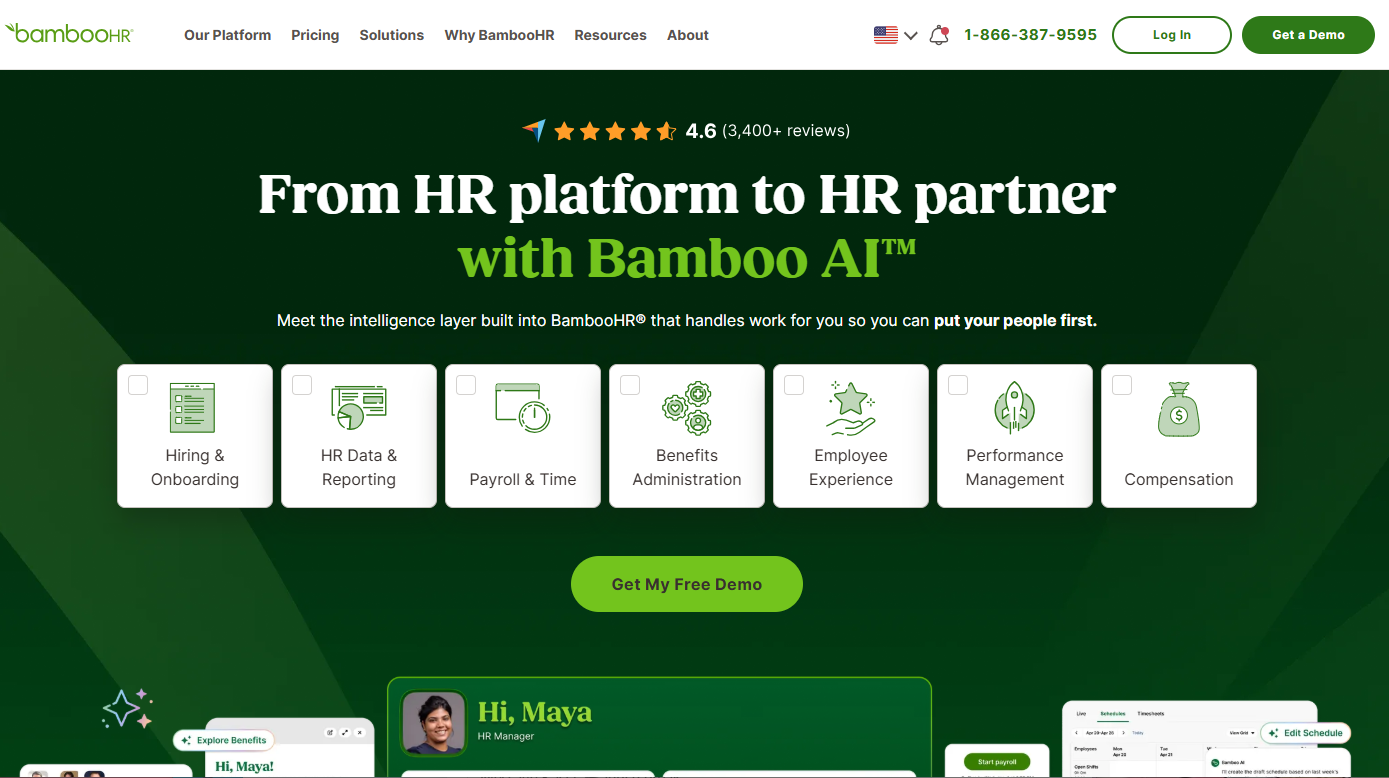
BambooHR is an all-in-one HR platform covering employee records, hiring, onboarding, payroll, benefits, and performance. It ranks first because performance management is not bolted on: reviews, goals, one-on-ones, and 360 feedback sit inside the same system that already holds your employee data. For a growing company, that removes the integration headache before it starts.
The performance tools stay deliberately simple. You run review cycles on annual or quarterly cadences, collect peer and manager feedback, and track goals without training managers on a complex UI. Because it shares one record with payroll and time tracking, HRIS integration is a non-issue, the data is already there.
Best for: Small to midsize businesses that want performance management inside a single HR platform.
Key strengths
- Employee records and HR data with reporting
- Applicant tracking and onboarding
- Payroll, benefits, time and attendance, and compensation
- Performance reviews, goals, and 360 feedback
- Clean, low-training manager experience
Why choose BambooHR: If you want one system of record for the whole employee lifecycle, and performance is one piece of that, BambooHR keeps everything under a single login and a single dataset. It fits teams that value simplicity over deep, standalone performance configuration.
BambooHR pricing: Core starts at $10 USD per employee per month, Pro at $17, and Elite at $25. Companies with 25 or fewer employees pay a flat rate starting at $250 USD per month. Volume discounts apply automatically.
2. ADP
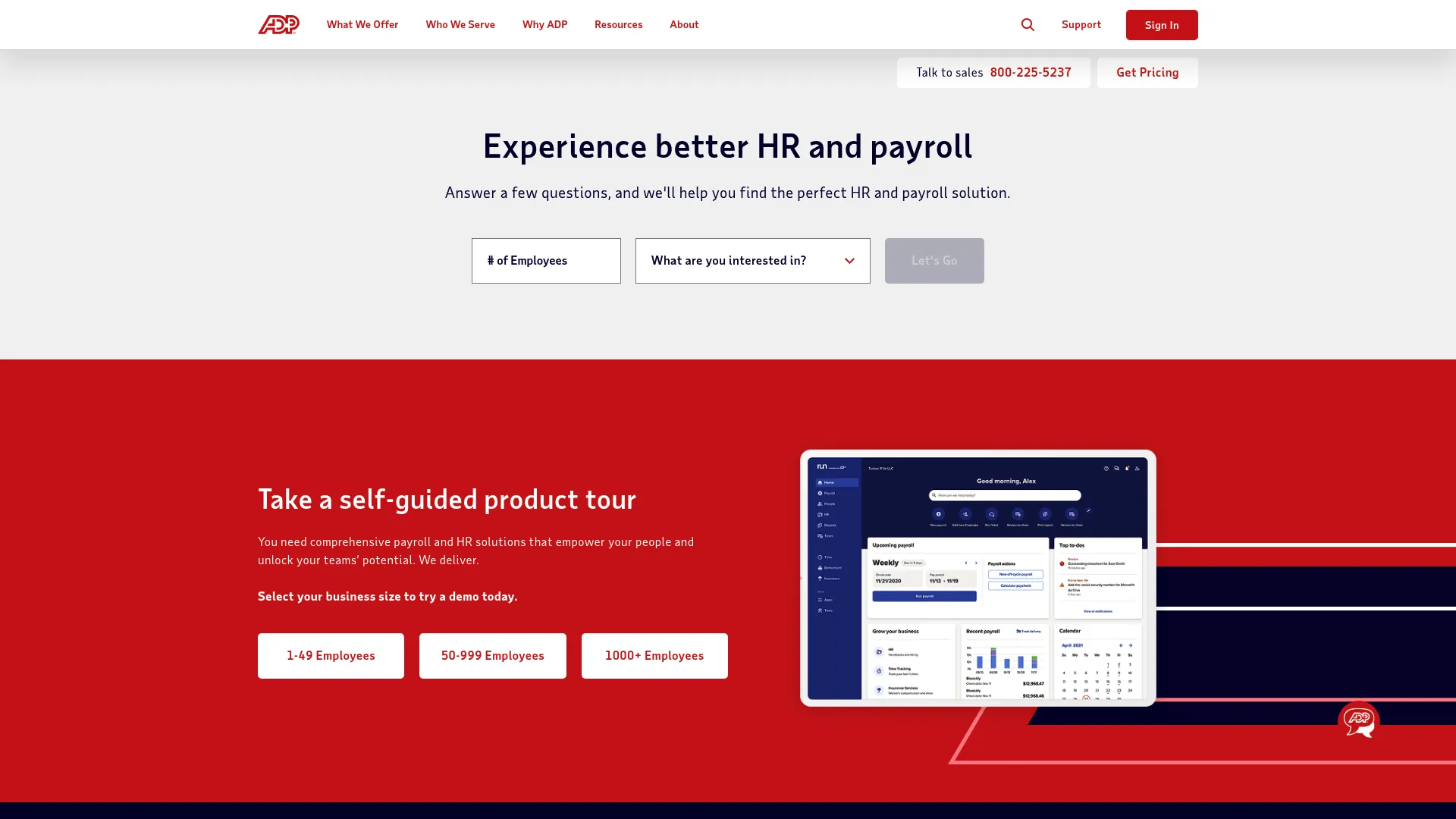
ADP is a global cloud HCM provider covering payroll, tax filing, benefits, time, and talent management. Performance lives inside a much larger system of record, which is exactly the point for organizations that want reviews, goals, and continuous feedback tied directly to payroll and compliance data.
ADP fits when performance management is one line item in a broader HR mandate. Lifecycle planning, role-based access, and manager dashboards are handled within the same platform that runs payroll for the whole company. For distributed or multi-entity organizations with real compliance requirements, that consolidation carries weight.
Best for: Businesses that need payroll, HR, and compliance support alongside performance, from small business to enterprise scale.
Key strengths
- Payroll and tax filing
- HR, talent, time, and benefits administration
- Mobile app and AI-assisted payroll and HR tools
- Role-based access across the employee lifecycle
- Performance management inside a full HCM system
Why choose ADP: Choose ADP when you want performance appraisal software that never leaves your payroll and compliance backbone. It suits organizations already committed to a system-of-record vendor and looking to standardize people processes on it.
ADP pricing: ADP uses quote-based pricing across its product packages. Pricing is provided through a quote flow rather than published rates, so request a quote for your headcount and module mix.
3. StaffCircle

StaffCircle is an AI-powered performance, engagement, and development platform built for mid-sized organizations. It leans hard into continuous performance management: reviews, objectives, and one-on-ones combine with AI insights and competency frameworks to give managers more structure than a basic review tool provides.
For distributed teams, StaffCircle's strength is keeping feedback flowing between formal cycles. Its Notetaker and AI-powered insights help managers capture and act on coaching moments, while competency frameworks give consistency to what "good" looks like across roles. Succession planning and development tools extend it beyond the review into growth.
Best for: Mid-sized teams that want one platform for performance, development, and engagement.
Key strengths
- Performance management with reviews, objectives, and 1:1s
- Employee development and succession planning
- AI-powered insights and Notetaker
- Competency frameworks for consistent evaluation
- Integrations across the people stack
Why choose StaffCircle: Pick StaffCircle if you want continuous feedback and coaching structure without buying separate tools for performance, development, and engagement. It fits managers who need scaffolding, not just a form to fill out.
StaffCircle pricing: Pricing starts from £3.85 per employee per month, billed annually in advance. Pricing is modular and scales by employee count, with a minimum annual charge.
4. PerformYard

PerformYard is performance management software focused on reviews, goals, feedback, engagement, meetings, and surveys. Its calling card is configurability: HR teams design review cycles that match their exact process, cadence, and rating scales, without wrestling a rigid template.
The reason it earns a spot is balance. You get flexibility in review workflows and reporting without overwhelming managers with a bloated interface. HR configures the complexity once; managers see a clean experience. Continuous feedback, goal management, and AI review summaries round out a platform that stays focused on performance rather than trying to be a full HR suite.
Best for: HR teams that want a configurable performance management platform with optional engagement and survey modules.
Key strengths
- Reviews and check-ins with custom cycles
- Goal management and continuous feedback
- Reporting and analytics
- Meetings, surveys, and employee engagement modules
- AI review assist and summaries
Why choose PerformYard: Choose PerformYard when you want deep review cycle flexibility without adopting a broad HR platform you do not need. It fits HR teams that own the process and want a dedicated performance tool that bends to it.
PerformYard pricing: Performance Management starts at $5-10 per person per month, billed annually. Optional add-ons include PerformYard AI (+$1-3), Employee Engagement ($1-3), Meetings (+$2-4), and Surveys (+$2-4) per person per month.
5. Lattice
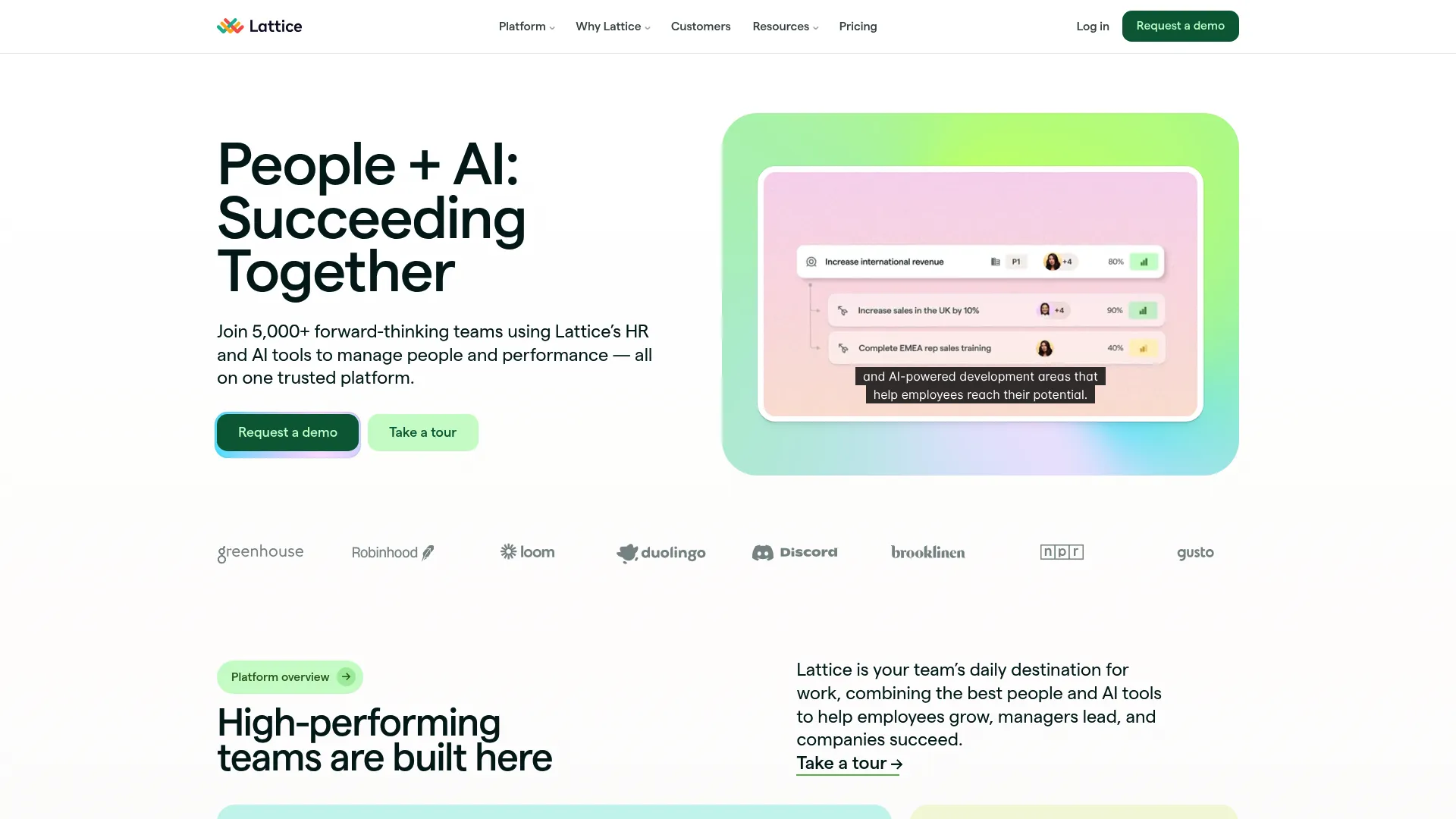
Lattice is a people management platform spanning performance, goals, engagement, compensation, and growth. It stands out for depth in goals and OKRs paired with reviews, 1:1s, and analytics, making it a strong fit for people ops teams focused on manager effectiveness and development.
Lattice connects the dots most tools leave separate. Goals link to reviews, reviews feed engagement data, and analytics tie it back to outcomes. That integrated view helps larger people ops teams answer leadership questions with data instead of anecdotes. The modular structure lets you buy Performance, Goals & OKRs, or Engagement independently and add Grow and Compensation as needed.
Best for: HR teams that need an integrated people management platform with strong goals and development.
Key strengths
- Performance reviews with goal tracking
- Goals and OKRs with cascading alignment
- Engagement surveys and analytics
- One-on-ones and continuous feedback
- Modular products you can buy separately
Why choose Lattice: Choose Lattice when goals and OKRs and people development are central, not an afterthought. It suits scaling people ops teams that want performance, engagement, and growth analytics connected in one platform.
Lattice pricing: Pricing starts at $4 per seat per month for Engagement. Performance is $10, Goals & OKRs is $8, and Foundations is $13 per seat per month, with Grow and Compensation add-ons. Lattice bills annually in USD with a $4,000 minimum annual agreement.
6. Leapsome

Leapsome is an AI-powered people platform combining performance, engagement, learning, compensation, and HRIS workflows. It appeals to culture-minded HR leaders who see performance and development as one continuous system rather than a once-a-year event.
The draw is breadth tied together. Performance reviews with goal and OKR tracking sit alongside engagement surveys, learning paths, and development planning. That makes Leapsome a natural fit for organizations building a growth culture, where continuous performance management and employee engagement reinforce each other. Its modular design lets you start with the pieces you need and expand.
Best for: Growing organizations wanting one connected platform for talent management and people development.
Key strengths
- Performance reviews with goal and OKR tracking
- Employee engagement surveys and analytics
- Learning, compensation, and feedback modules
- Meetings and HRIS workflows
- AI-powered insights across modules
Why choose Leapsome: Choose Leapsome when development, learning, and engagement matter as much as the review itself. It fits HR leaders building a culture where growth and feedback run continuously, not seasonally.
Leapsome pricing: Pricing starts at €199 per month, with modular plans billed on an annual contract. Modules can be bought individually or combined, with multi-module and volume discounts. A 14-day free trial is available with no credit card required.
7. 15Five
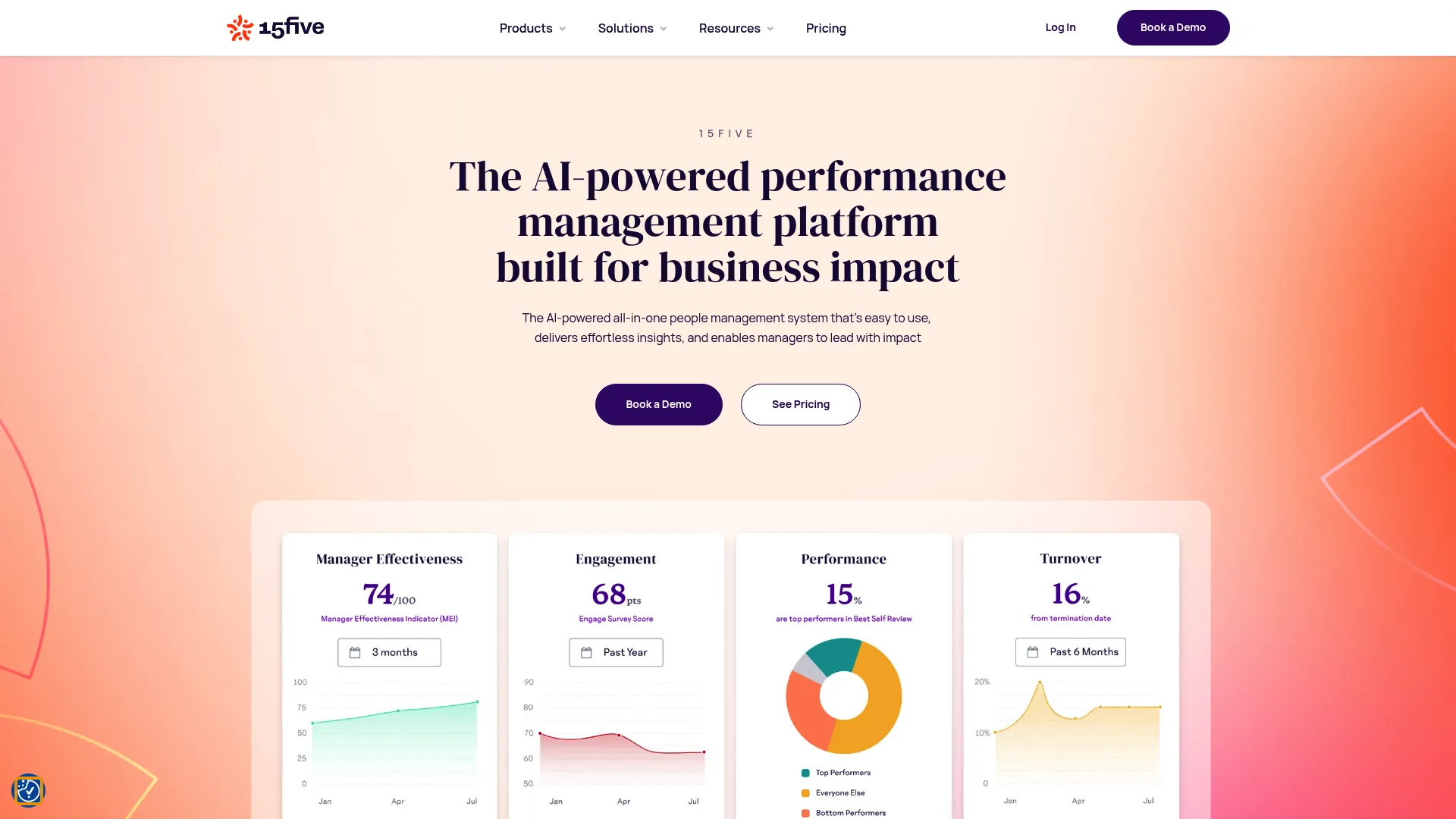
15Five is an AI-powered performance management platform built around engagement, reviews, goals, feedback, and manager effectiveness. Its signature is the lightweight weekly check-in: a short, recurring pulse that keeps managers and reports in sync without heavy process.
That habit-first approach is the whole pitch. Instead of front-loading everything into an annual review, 15Five builds ongoing performance conversations into the weekly rhythm. Goals, 1:1s, continuous feedback, and engagement surveys layer on top, and manager coaching products help frontline managers actually improve. For teams that care more about consistent manager habits than elaborate workflows, it fits cleanly.
Best for: Mid-market teams that want an all-in-one platform for engagement and performance management.
Key strengths
- Employee engagement surveys
- Performance reviews and continuous feedback
- Goals and OKRs plus one-on-ones
- Lightweight weekly check-ins
- Manager coaching and AI meeting assistant
Why choose 15Five: Choose 15Five when you want to build manager habits and real-time feedback into the weekly cadence rather than pile everything into review season. It fits teams prioritizing coaching consistency over process depth.
15Five pricing: Engage starts at $4 per user per month, Perform at $11, and Total Platform at $16, all billed annually. Add-ons include Manager Products, Kona AI, and Compensation packages starting at $9 per user per month.
Considerations
Review cycle flexibility
Check whether the tool supports annual, quarterly, and fully custom cadences. A five-person team may only need one yearly cycle. A scaling org running probation reviews, quarterly check-ins, and annual appraisals needs a tool that handles all three without workarounds. Rigid cycles force manual patches, which is exactly what you are trying to escape.
Manager adoption
The best workflow is worthless if managers ignore it. Look hard at the manager experience: how many clicks to complete a review, how reminders are designed, and whether 1:1 agendas and feedback live where managers already work. Adoption, not feature depth, determines whether you get consistent execution.
Integrations and HRIS fit
Verify compatibility with your payroll, HRIS, calendar, identity, and collaboration tools. Performance data is only useful when it flows cleanly into the rest of your people stack. Broken or manual data transfer reintroduces the errors and duplicate entry you bought software to remove.
Reporting and insights
Determine whether dashboards answer leadership questions or just track completion. Activity metrics tell you who filled out the form. Actionable insights tell you where performance is trending, which teams need coaching, and how goals connect to outcomes. Push vendors to show the second kind.
Governance and permissions
Check approval flows, role-based access, and version control. Reviews touch sensitive data and feed compensation and promotion decisions, so who sees what matters. Strong governance keeps the process consistent, auditable, and compliant as you scale.
Conclusion
The best fit comes down to how much structure you want and where performance should live. BambooHR wins for SMB and mid-market teams that want performance inside a full HR platform. ADP fits when performance must sit on your payroll and compliance backbone. StaffCircle and 15Five lead for continuous feedback and manager coaching, while PerformYard offers the most configurable review cycles without a heavy suite. For goals and development depth, Lattice connects performance to outcomes, and Leapsome pairs performance with learning and engagement for culture-focused teams.
Narrow your shortlist by three things: team size, how much automation you need, and how much process structure your managers will accept. Then take your two finalists and run them against your current review workflow before you commit.
Start your journey with Guideflow today!
FAQs
Employee performance software helps organizations set goals, run reviews, collect feedback, and coach employees over time. Its core functions are reviews, goals and OKRs, 360 feedback, and one-on-ones. It replaces manual spreadsheets with a structured, trackable performance management system.
Performance review software is narrower: it focuses on running the review itself, from templates to ratings to sign-off. Performance management software is broader, adding goals, one-on-ones, continuous feedback, and coaching so the review becomes one checkpoint in an ongoing process rather than the entire event.
Prioritize review cycle automation, goals and OKRs, 360 feedback, reporting, and integrations. These cover the daily workflow and the leadership reporting you will be asked for. Beyond features, weigh manager adoption and governance, because a tool nobody uses or nobody can control does not solve the problem.
For a small team, favor simplicity, transparent pricing, and low admin overhead. A heavy talent management suite adds cost and configuration you will not use early on. Look for a tool that runs a clean review cycle, tracks goals, and integrates with your existing HRIS without a long implementation.
A 360 feedback cycle collects input from multiple sources: the employee's self-assessment, peers, their manager, and sometimes skip-level leaders. The software assigns reviewers, sends reminders, and compiles responses into a single view. Automation keeps the cycle moving, and anonymity settings determine how candidly peers can respond.
Yes, for most growing teams. Employee performance tracking software removes the version chaos, broken formulas, and manual reminder emails that spreadsheets create. It automates review cycles, keeps a clean audit trail, and centralizes goals and feedback, which lowers error risk and frees HR from chasing status updates.
Start with completion rates, manager adoption, and review cycle time, which show whether the process is actually running. Then look downstream at employee engagement, retention, and goal attainment. Early signals of ROI are usually operational: more consistent reviews, less admin burden, and cleaner data for people decisions.