Your storefront is the bottleneck. Marketing wants a campaign landing page live this week. The roadmap calls for a mobile app, a kiosk experience, and a B2B portal that all share the same catalog. But every change routes through a monolithic platform where the frontend and backend are welded together, so a copy tweak waits behind an engineering sprint and a new channel means a new build from scratch.
That friction is why so many teams are evaluating a headless ecommerce platform right now. The global headless ecommerce system market reached USD 1.63 billion in 2026 and is projected to hit USD 4.08 billion by 2035, a 10.8% CAGR, according to Business Research Insights (2026). Gartner, cited in a Market Research Future e-commerce report (2024), projects that 60% of enterprise retailers will operate composable commerce stacks by 2028, up from under 20% in 2024.
The reason is structural, not hype. Decoupling the storefront from the commerce backend lets you ship frontend changes without touching order logic, serve multiple channels from one source of truth, and adopt modern frameworks without a full replatform. The hard part is choosing. The market spans SaaS, open source, and enterprise composable stacks, and each fits a different team shape, budget, and engineering reality. This guide is decision-first: it maps nine credible platforms to the team and architecture that actually fits.
If you spend a lot of time comparing infrastructure tooling, you may also find our roundups of the best customer data platform options and the best ai cybersecurity solutions useful as you build out the rest of your stack.
What's inside
This guide compares nine headless ecommerce platforms for 2026, chosen for architecture fit, API quality, ecosystem maturity, and implementation flexibility. The list deliberately mixes motions: SaaS platforms for teams that want managed convenience, open source projects for teams that want code-level control, and enterprise composable platforms for large, multi-stakeholder orgs.
We selected each platform on four criteria: the quality and breadth of its APIs, how cleanly the storefront decouples from the backend, the maturity of its ecosystem and integrations, and total cost of ownership over a realistic time horizon. Every entry includes who it fits, where it stands out, and what to verify before you commit.
TL;DR
- Best for enterprise composable commerce: commercetools and Adobe Commerce handle large catalogs, complex B2B, and multi-region scale.
- Best for open source control: Medusa, Vendure, and Saleor give engineering teams full code-level ownership and modern, API-first cores.
- Best for self-hosted flexibility: Spree Commerce pairs an open source REST API with B2B, multi-store, and marketplace capabilities.
- Best for fastest launch: Shopify (on Plus) and BigCommerce give you headless APIs without giving up managed SaaS convenience.
- Best for distributed, international commerce: Commerce Layer is built around multi-market, multi-currency selling through composable APIs.
- The honest takeaway: there is no single best platform. The right pick depends on engineering bandwidth, launch speed, and how much control over the stack your team actually wants.
What is headless ecommerce?
Headless ecommerce is an architecture that separates the customer-facing frontend (the "head") from the commerce backend, connecting the two through APIs so each can be built, changed, and scaled independently.
In a traditional ecommerce setup, the storefront, content management, cart, checkout, and order logic ship as one tightly coupled system. Change the frontend and you risk the backend. In a headless commerce platform, the backend exposes products, pricing, cart, and orders as API endpoints, and you build any frontend you want against them: a React storefront, a native mobile app, a smart-display experience, or a partner marketplace listing.
Core characteristics of a headless commerce platform:
- Frontend and backend decoupling: the storefront is a separate application that calls commerce APIs, so design and engineering iterate without backend risk.
- API-first ecommerce: REST or GraphQL APIs are the primary interface, not an afterthought bolted onto a templating engine.
- Omnichannel commerce delivery: one backend serves web, mobile, in-store, and emerging channels from a single source of truth.
- Headless ecommerce CMS separation: content and commerce live in distinct systems, so marketing can publish without waiting on a deploy.
- Composable commerce: you assemble best-of-breed services (search, payments, CMS, OMS) rather than accepting a single vendor's bundle.
The shift from traditional ecommerce vs headless comes down to control and speed. A monolith is faster to stand up and cheaper to run for a single, simple storefront. Headless ecommerce solutions earn their keep when you need multiple channels, faster time to market on the frontend, and the freedom to swap components as needs change. Composable commerce takes the same idea further, treating the entire stack as interchangeable modules.
When to use headless ecommerce
Headless is not the default answer for every store. It pays off in three recognizable situations.
When your current storefront blocks experimentation
If a landing page test waits two weeks for an engineering slot, or a checkout copy change risks breaking order logic, your monolith is taxing your roadmap velocity. Headless decouples the experiment surface from the system of record. Frontend teams ship A/B tests, redesigns, and new flows without queueing behind backend releases. Teams with frequent release cadences and a real experimentation culture benefit most here.
When you need multiple channels or markets
Omnichannel commerce is the clearest trigger. If you sell through a web storefront plus a mobile app, retail kiosks, social commerce, and partner marketplaces, a single API-first backend keeps catalog, pricing, and inventory consistent everywhere. The same logic applies to international expansion: multi-currency, multi-language, and region-specific pricing are far easier when one backend feeds many localized frontends.
When engineering and business teams need more release flexibility
In a monolith, marketing, product, and engineering share one deploy pipeline, so everyone's timeline collides. Headless lets content teams publish through a headless ecommerce CMS while engineering owns the backend on a separate cadence. For product managers, this is the real prize: fewer cross-team dependencies, cleaner ownership, and the ability to ship onboarding and conversion improvements without an engineering interrupt every time.
Comparison table
The table below summarizes intent, differentiation, pricing, and ratings across all nine platforms. Pricing and ratings reflect publicly available figures verified in June 2026; enterprise tiers are quote-based and noted as such. Use it as a shortlist filter, then read the sections that follow for fit detail.
| # | Product | Intent | Key differentiation | Pricing | G2 rating |
|---|---|---|---|---|---|
| 1 | Commerce Layer | Distributed, international commerce | API-first checkout for multi-market, multi-currency selling | Free tier available; pricing not public | Not rated |
| 2 | commercetools | Enterprise composable commerce | B2B, B2C, and B2X commerce primitives at scale | Custom (contact sales) | 4.6/5 |
| 3 | Spree Commerce | Self-hosted open source | REST APIs with B2B, multi-store, and marketplace support | Free Community Edition; Enterprise on request | 3.7/5 |
| 4 | BigCommerce | Hybrid SaaS plus headless | Strong built-in B2B and multi-channel selling | From $39/month | 4.2/5 |
| 5 | Shopify | Fast launch with ecosystem depth | Headless via Storefront APIs on a managed platform | From $29/month | 4.4/5 |
| 6 | Adobe Commerce | Enterprise B2B and B2C | Deep customization and composable storefront tooling | Custom (contact sales) | 4.0/5 |
| 7 | Saleor | GraphQL-first open source | GraphQL-native commerce API and catalog | Free sandbox; Select from $1,599/month | Not rated |
| 8 | Medusa | Modular open source | Modular backend with managed cloud option | From $29/month | Not rated |
| 9 | Vendure | TypeScript-first open source | Code-first NestJS/GraphQL backend with plugin model | Core free; Platform paid | 4.9/5 |
1. Commerce Layer
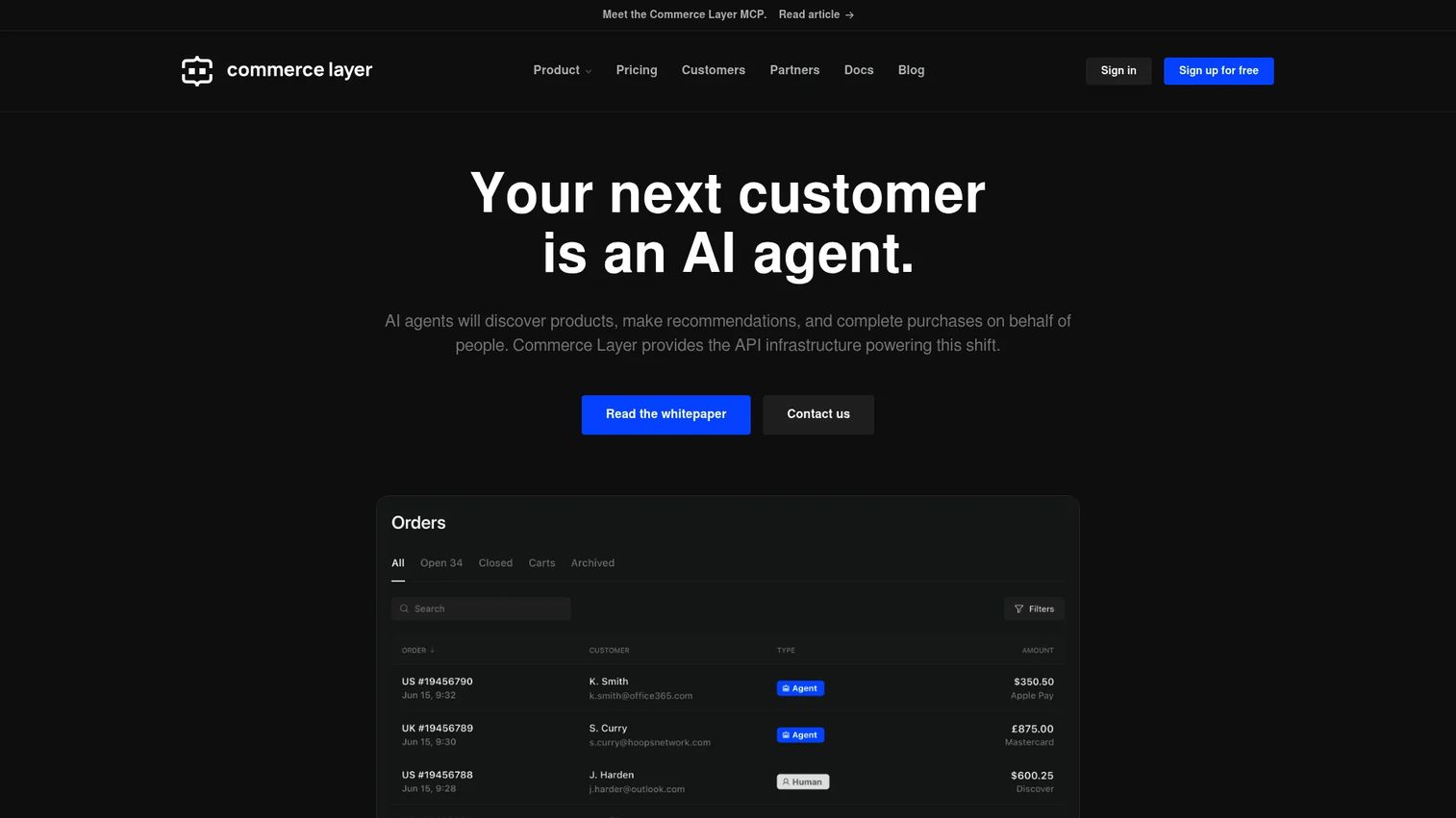
Commerce Layer is API-first commerce infrastructure built for shoppable experiences across channels, markets, and currencies. Rather than shipping a storefront, it provides the commerce backend (cart, checkout, pricing, orders) as a set of APIs you wire into any frontend. That positioning makes it a natural fit for teams whose central problem is distributed, international selling rather than standing up a single store quickly.
Best for: teams building composable, multi-market commerce experiences through APIs.
Key strengths
- Universal checkout: an API-first checkout that handles multiple markets and currencies from one backend, so a single integration serves many storefronts.
- Distributed OMS: real-time inventory and order lifecycle management across locations, useful when stock and fulfillment span regions.
- Promotion engine: a visual editor plus a JSON-based DSL for building promotions, giving both merchandisers and developers a way in.
Why choose Commerce Layer: if your roadmap is genuinely multi-region (different currencies, price lists, and inventory pools per market), Commerce Layer's architecture is purpose-built for that shape. It rewards teams that want commerce as composable infrastructure and have the engineering bandwidth to assemble the frontend layer themselves.
Commerce Layer pricing: Commerce Layer offers a "get started for free" path on its site. Specific plan figures are not published publicly, so budget conversations will need a direct quote. Treat the free entry point as a way to validate the API model before committing.
2. commercetools
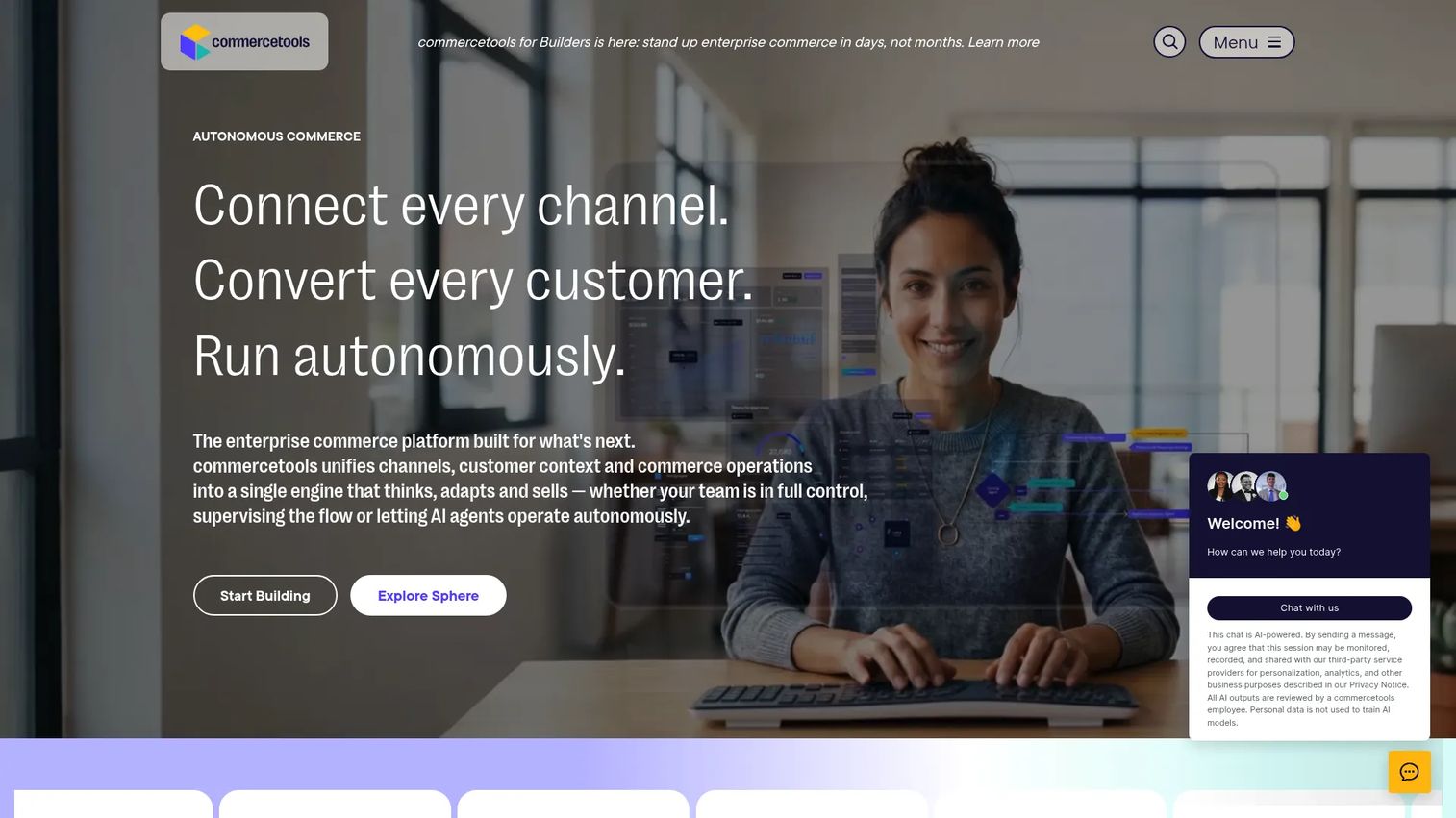
commercetools is an enterprise composable commerce platform built around API-first commerce primitives for B2B, B2C, and unified (B2X) selling. It is one of the names most associated with the composable commerce movement, and it targets large organizations that need to model complex catalogs, pricing, and order flows at scale without being boxed in by a monolith's assumptions.
Best for: large enterprises that need composable, API-first commerce across multiple business models.
Key strengths
- B2B commerce: native primitives for account hierarchies, quotes, and complex pricing that B2B sellers actually need.
- B2C commerce: high-scale catalog and checkout APIs designed for consumer traffic and large product sets.
- B2X commerce: a unified model so a single backend can serve B2B and B2C motions without separate stacks.
Why choose commercetools: it earns a 4.6/5 on G2, and enterprises pick it when scale, flexibility, and a true composable approach matter more than out-of-the-box speed. For a PM aligning engineering and GTM stakeholders, its strength is that it gives each team a clean API surface to build against on its own cadence.
commercetools pricing: pricing is not publicly disclosed; the pricing page directs buyers to contact sales. Expect an enterprise commitment and scope the cost against the developer time you save versus a custom build.
3. Spree Commerce
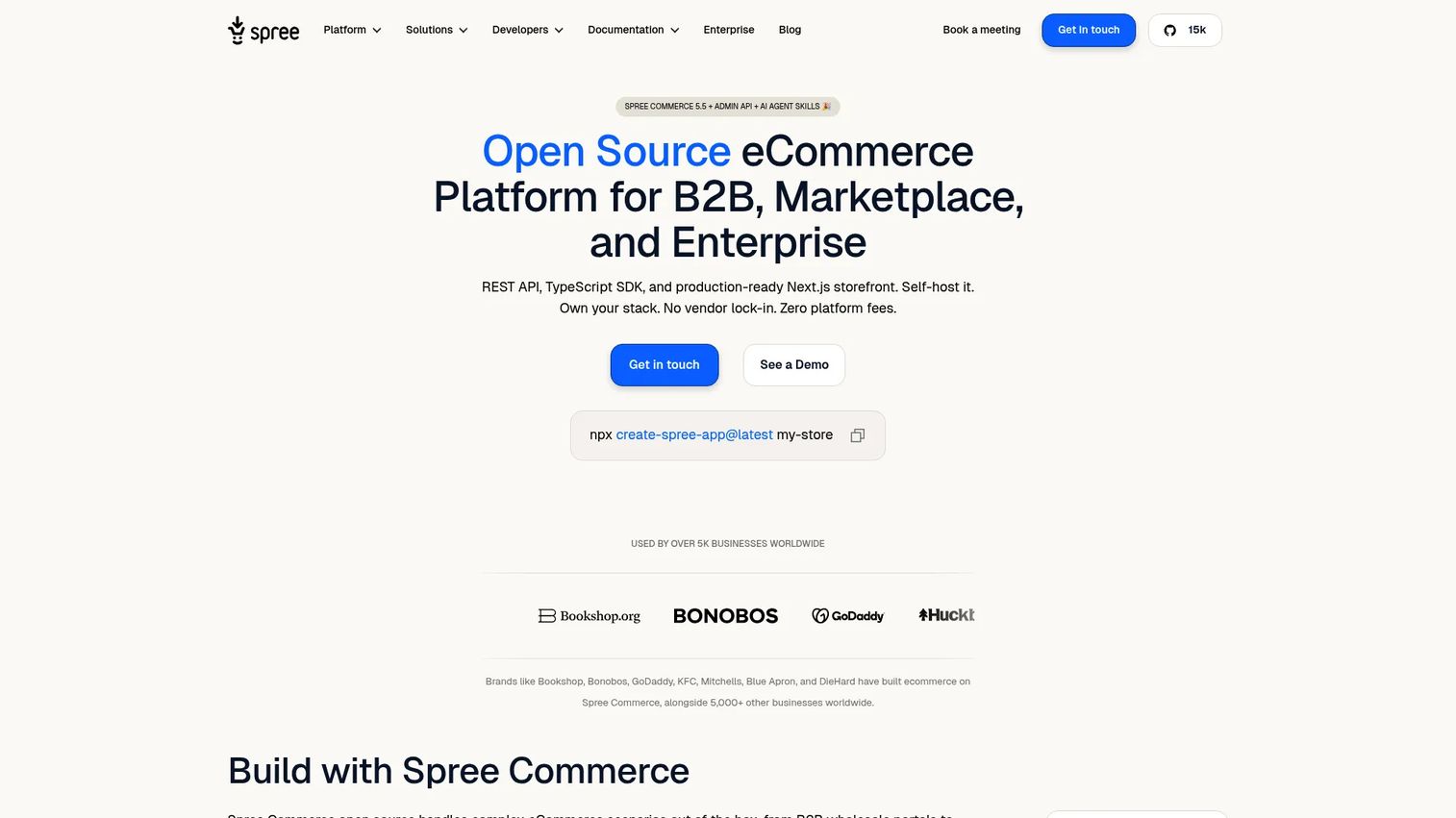
Spree Commerce is an API-first, open source ecommerce platform built for B2B, multi-store, multi-region, marketplace, and multi-tenant commerce. Because the Community Edition is open source and self-hosted, technical teams get full control over the codebase and deployment, which appeals to organizations that treat the commerce stack as something they want to own rather than rent.
Best for: teams that want a customizable, self-hosted ecommerce platform with API-first architecture and B2B or marketplace needs.
Key strengths
- Store and Admin REST APIs: separate APIs for storefront and operations, so frontends and back-office tools build against clean, documented endpoints.
- Flexible pricing engine: price lists, volume tiers, and customer-specific pricing, which matters for B2B and multi-tenant scenarios.
- Multi-store and multi-warehouse: sales channels with multi-store and multi-warehouse support, useful for marketplaces and regional operations.
Why choose Spree Commerce: with a 3.7/5 G2 rating and a genuinely open source core, Spree fits teams that have the engineering depth to self-host and want to avoid per-transaction platform fees. It is a strong candidate for multi-tenant ecommerce and marketplace builds where control over data and deployment is non-negotiable.
Spree Commerce pricing: the Community Edition is free and open source. The Enterprise Edition adds paid modules and dedicated support, with pricing based on modules and scale and quoted on request.
4. BigCommerce
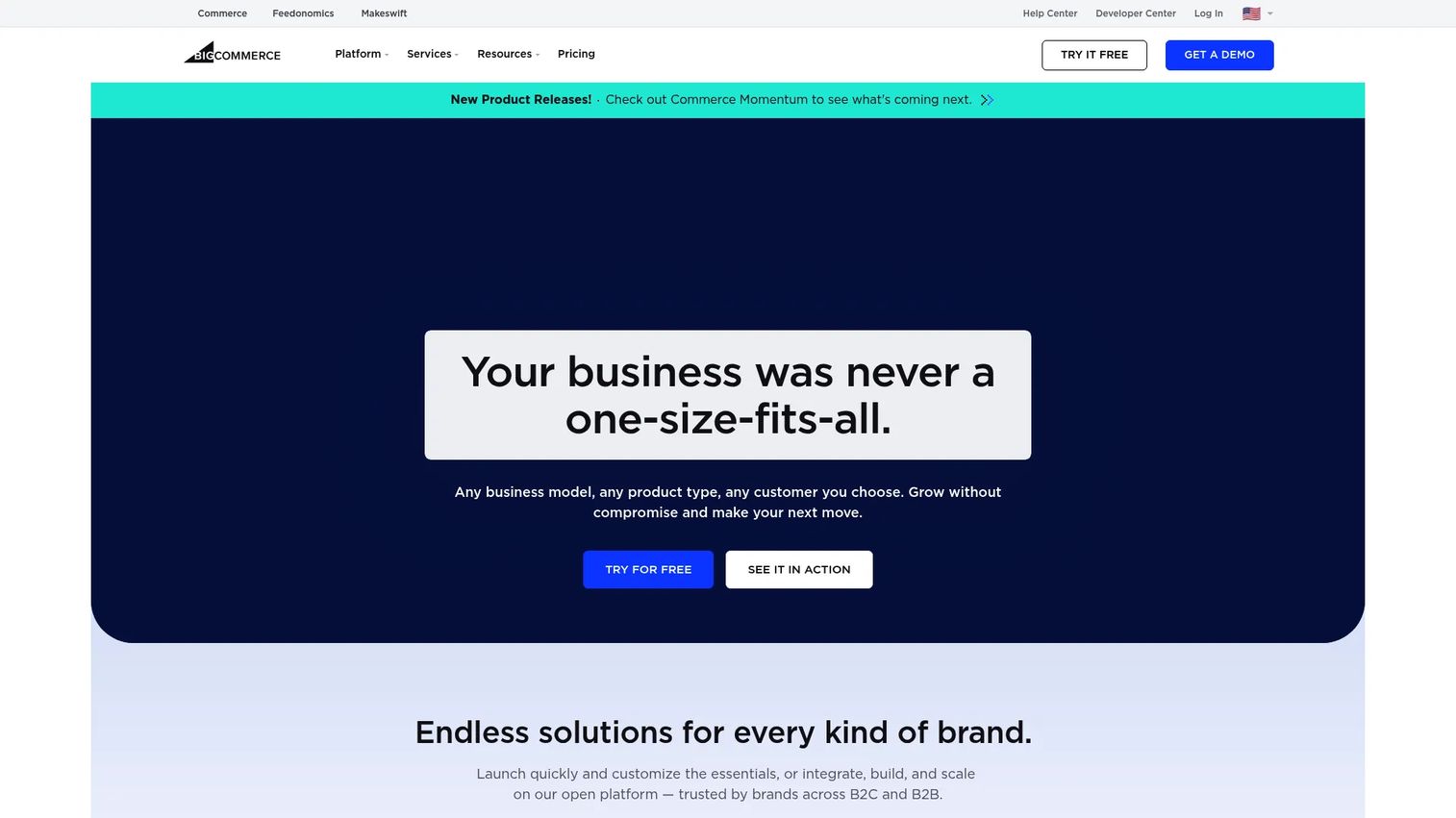
BigCommerce is a SaaS ecommerce platform for B2C and B2B businesses that supports both traditional and headless builds. Teams use its APIs to drive a custom frontend while still relying on BigCommerce for the heavy backend operations: checkout, catalog, multi-channel selling, and B2B workflows. That hybrid posture is its calling card, you can go headless where it matters without owning infrastructure everywhere.
Best for: brands that want a scalable SaaS platform with strong built-in B2B and multi-channel features, plus the option to go headless.
Key strengths
- Customizable checkout: a one-page checkout with digital wallets, one-click, and BNPL support out of the box.
- Multi-channel selling: native selling across Google, Meta, TikTok, Amazon, Walmart, and eBay from one catalog.
- B2B features: account-specific pricing, quotes, reorders, invoice payments, and approval workflows.
Why choose BigCommerce: rated 4.2/5 on G2, BigCommerce suits teams that want headless flexibility without the maintenance overhead of self-hosting. It is a pragmatic middle path for a PM who needs faster time to market than a full custom build allows but still wants frontend freedom.
BigCommerce pricing: plans start with Core at $39/month, Growth at $105/month, and Scale at $399/month, none requiring a contract. The Performance plan starts at $1,499/month billed annually and is custom or contract-based. Prices are in USD and exclude tax.
5. Shopify

Shopify is a commerce platform for online, in-person, and AI-channel selling, and on Shopify Plus it supports headless builds through its Storefront APIs. For teams that already trust Shopify's ecosystem and checkout but want a custom frontend, headless on Shopify means keeping the operational strengths while gaining the freedom to build on modern frameworks.
Best for: merchants that want one platform for ecommerce, retail, and multichannel selling, with the option to go headless on Plus.
Key strengths
- Online store and checkout: a mature, high-converting checkout and storefront foundation that headless frontends can call via API.
- In-person POS: unified inventory across online and physical retail, so one backend covers omnichannel commerce.
- AI selling channels: AI-driven channels and a commerce assistant for emerging buying surfaces.
Why choose Shopify: with a 4.4/5 G2 rating and one of the largest app ecosystems in commerce, Shopify is the fastest path to a headless build for teams that value managed convenience. Checkout customization is more constrained than fully open platforms, so verify your checkout requirements early, but the ecosystem depth is hard to match.
Shopify pricing: the public pricing page shows Basic at $29/month, Grow at $79/month, and Advanced at $299/month when billed yearly, with a 3-day free trial and introductory pricing for the first months. Shopify Plus, which enables headless, starts from $2,300/month billed yearly.
6. Adobe Commerce
Adobe Commerce (formerly Magento Commerce) is Adobe's composable ecommerce platform for B2B and B2C commerce. It carries the deep customization heritage of Magento, now positioned for headless and composable builds, and targets larger organizations with complex catalogs, multi-site needs, and demanding B2B requirements.
Best for: enterprises that need a scalable, deeply customizable B2B and B2C commerce platform.
Key strengths
- AI-powered discovery: product discovery and merchandising driven by AI to surface the right products.
- Composable storefront: storefront and extensibility tooling for building decoupled frontends.
- B2B operations: B2B commerce operations and multi-site scalability for complex enterprise structures.
Why choose Adobe Commerce: rated 4.0/5 on G2, it fits enterprises already invested in the Adobe ecosystem or those needing the customization depth Magento is known for. The flip side of that power is implementation weight, so it suits teams with the engineering and integration resources to match.
Adobe Commerce pricing: Adobe lists three offerings, Commerce as a Cloud Service (SaaS), Commerce on Cloud (PaaS), and Commerce Optimizer, all with "Get pricing" custom quotes. There is no public numeric price, so plan for an enterprise sales conversation.
7. Saleor
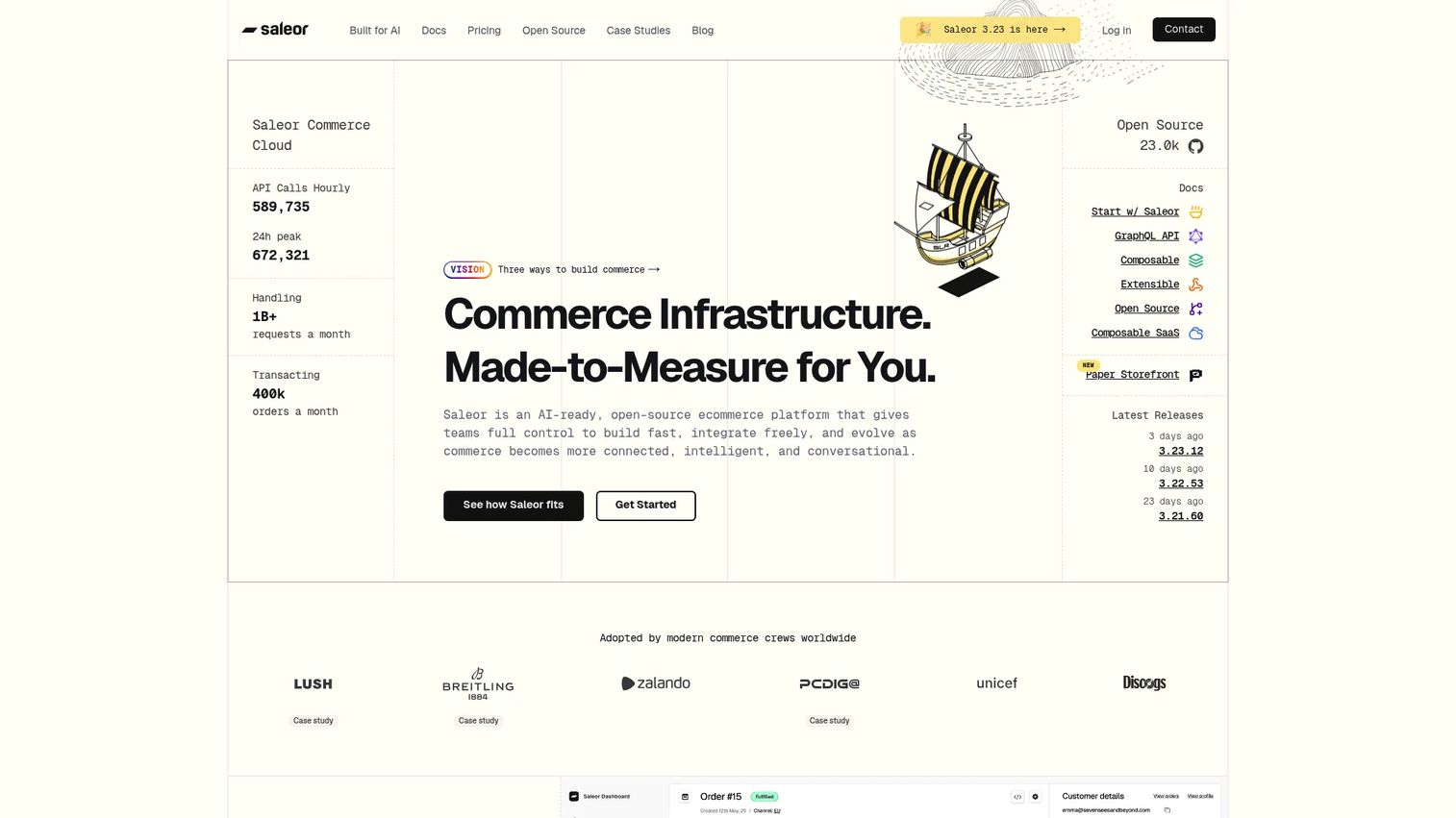
Saleor is a headless commerce platform built for custom ecommerce experiences, with a GraphQL-native API at its core. Its open source roots and GraphQL-first design make it a favorite among developer-centric teams that want a modern, typed API surface and the flexibility to build exactly the frontend they need.
Best for: teams that want a flexible, headless ecommerce core with API-first operations and a GraphQL-native approach.
Key strengths
- GraphQL-based API: a GraphQL commerce API that gives frontend developers precise, typed access to commerce data.
- Catalog and merchandising: catalog and merchandising management built for custom storefront experiences.
- Order and fulfillment: order and fulfillment operations handled through the same API-first model.
Why choose Saleor: Saleor appeals to engineering teams that prefer GraphQL and want open source headless ecommerce with a managed cloud option available. For a product manager, the upside is a clean, modern API that frontend teams enjoy building against, which can shorten frontend delivery cycles.
Saleor pricing: Saleor Cloud offers a Forever Free sandbox tier, then Select at $1,599/month and Volume at $3,999/month, with Enterprise pricing negotiable (as low as 0.2%). Add-ons include an Accelerator Plan and Forward Deployed Engineering as one-time fees.
8. Medusa
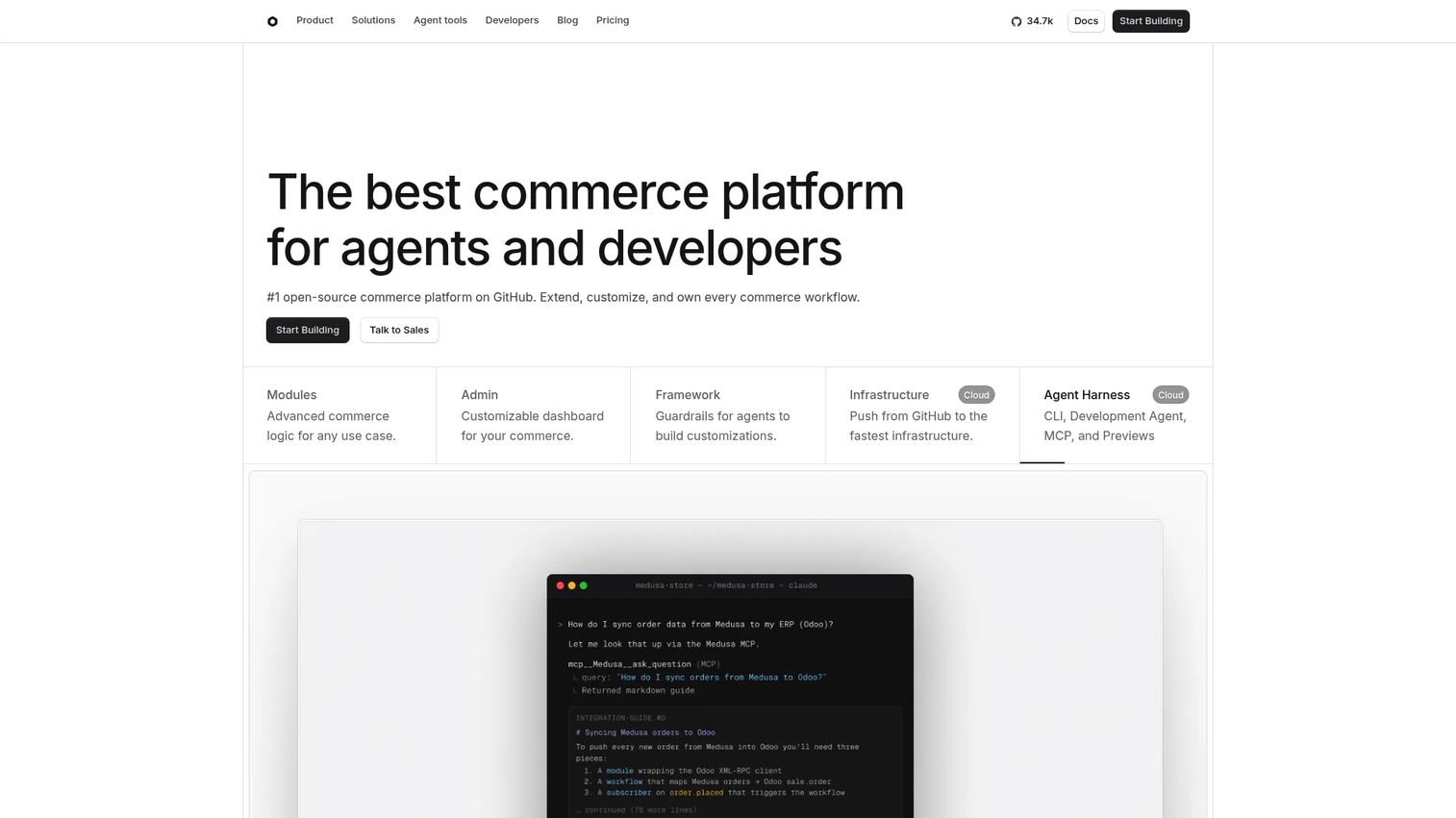
Medusa is an open source commerce platform and cloud infrastructure for building custom ecommerce applications. Its modular architecture lets engineering teams compose exactly the commerce backend they need, then deploy on Medusa Cloud with hosting, autoscaling, and backups handled. It is built for teams that want code-level control without managing all the infrastructure themselves.
Best for: teams building customizable headless commerce on a modular backend with managed cloud infrastructure.
Key strengths
- Managed cloud: Cloud plans with deploy, hosting, previews, backups, and autoscaling, removing infrastructure toil.
- No GMV platform fee: a 0.0% GMV platform fee on commerce features, so cost does not scale punitively with sales.
- AI tooling: an MCP server, a development agent, and a Cloud CLI for modern, AI-assisted development workflows.
Why choose Medusa: Medusa fits teams that want open source flexibility and a clean developer experience without giving up managed hosting. The no-GMV-fee model is a meaningful TCO advantage for high-volume stores comparing against percentage-based SaaS pricing.
Medusa pricing: Cloud pricing starts at $29/month for Develop, then $99/month for Launch, $299/month for Scale, and custom Enterprise pricing. The platform charges no additional fees on commerce features and a 0.0% GMV platform fee across plans.
9. Vendure
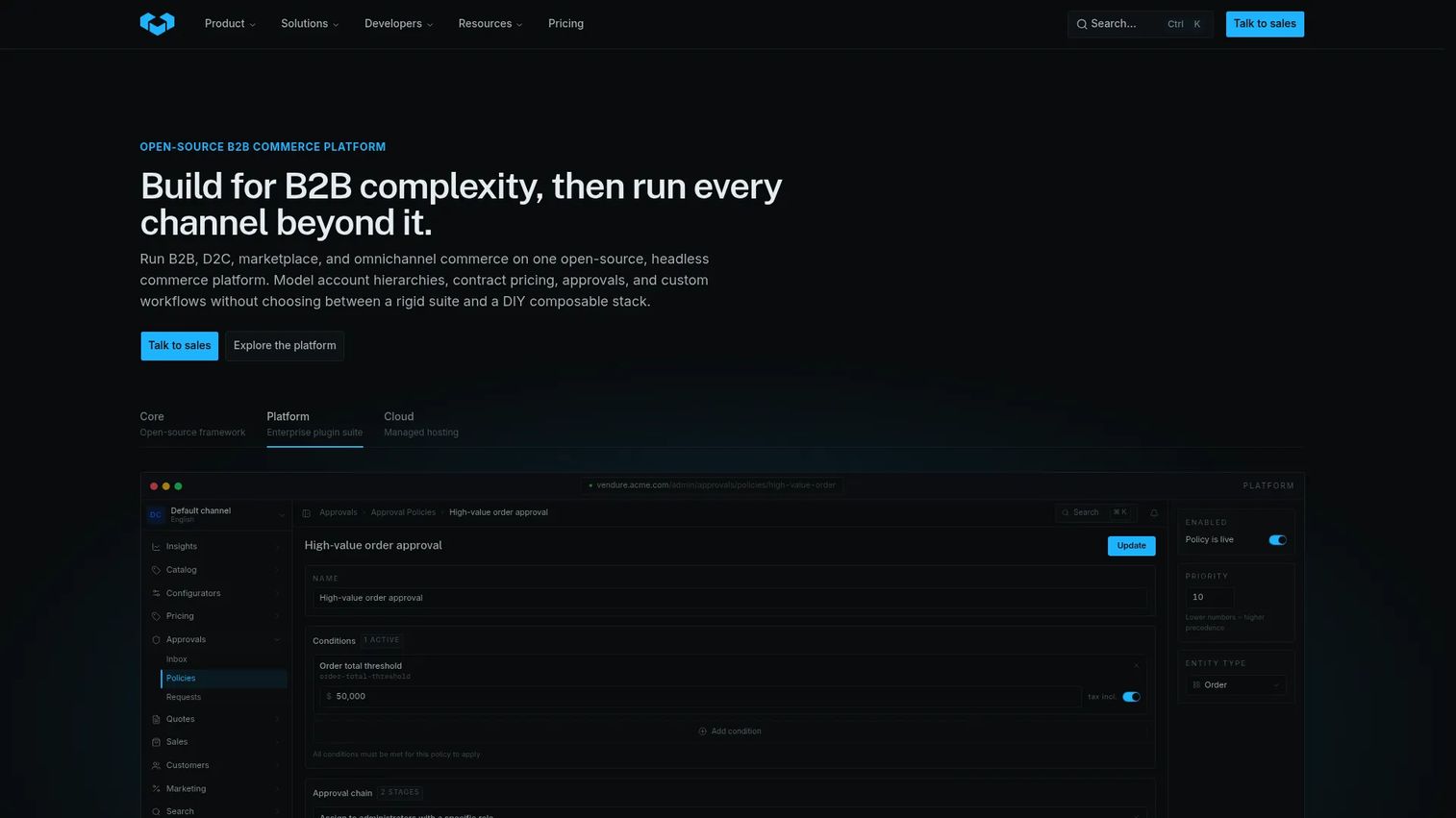
Vendure is an open source commerce framework and enterprise commerce platform built on TypeScript, NestJS, and GraphQL. Its code-first design and plugin model appeal to teams that want strong developer ergonomics and the ability to extend the backend cleanly through APIs and schema extensions rather than fighting a rigid platform.
Best for: teams building customizable B2B or multichannel commerce with a code-first, TypeScript stack.
Key strengths
- Code-first backend: a TypeScript, NestJS, and GraphQL backend that fits modern engineering teams natively.
- Plugin model: a plugin system with APIs and schema extensions for clean, maintainable customization.
- Multichannel and B2B: multi-channel, multi-currency, and B2B workflows supported out of the box.
Why choose Vendure: with a 4.9/5 G2 rating, Vendure stands out for developer experience among open source headless ecommerce options. If your engineering team works in TypeScript and values maintainable extensibility, the plugin model keeps customization from turning into technical debt.
Vendure pricing: the Core edition is open source and free forever. The Platform tier is a commercial annual subscription with flat-fee pricing and no GMV charges. Self-hosted deployment carries no extra cost beyond your capability layer, and Vendure Cloud is available now for design partners with general availability slated for Q4 2026.
Considerations
Before you shortlist, pressure-test each platform against five criteria that decide long-term fit.
API quality and frontend flexibility
Read the API docs before the marketing pages. Check whether the platform is REST, GraphQL, or both, how complete the API coverage is, and whether your preferred frontend framework has supported SDKs. The quality of the API determines how fast your frontend team moves for the next several years.
Team size and engineering bandwidth
Open source platforms like Medusa, Vendure, Saleor, and Spree reward teams with strong engineering depth. SaaS platforms like Shopify and BigCommerce trade some control for managed convenience. Be honest about how much backend work your team can sustain alongside the rest of the roadmap.
SaaS versus self-hosted preference
Decide who owns uptime, security patching, and scaling. Self-hosted gives you control and avoids platform fees but puts operations on you. SaaS headless ecommerce shifts that burden to the vendor at a recurring cost. Neither is universally better; it depends on your appetite for operational ownership.
Total cost of ownership
Look past the entry price. Factor in implementation, frontend development, integrations, hosting, and any GMV or transaction fees. A platform with no license cost can still carry a high TCO once engineering time is counted, while a paid SaaS plan can be cheaper in practice for a small team.
Ecosystem, support, and implementation speed
Check the integrations you actually need (search, payments, CMS, OMS, analytics), the size of the partner ecosystem, and the quality of support at your tier. The richer the ecosystem, the faster time to market, because you assemble rather than build from zero.
Conclusion
There is no single best headless ecommerce platform, only the best fit for your team's architecture maturity, launch speed, and appetite for control. Enterprises with complex catalogs and B2B requirements gravitate to commercetools and Adobe Commerce. Teams that want code-level ownership and modern API-first cores lean toward Medusa, Vendure, and Saleor. Spree Commerce suits self-hosted, marketplace, and multi-tenant builds, while Commerce Layer is purpose-built for distributed, international commerce. And for teams prioritizing the fastest launch with ecosystem depth, Shopify on Plus and BigCommerce keep managed convenience while opening up headless APIs.
The practical next step is simple: shortlist two or three platforms from this list, then map each against your current storefront constraints, your engineering bandwidth, and your realistic TCO over the next two to three years. Run a small proof of concept against the APIs before you commit. The platform that fits your roadmap velocity and maintainability will save you far more than the one with the most impressive feature list.
FAQs
Traditional ecommerce bundles the storefront, content, cart, checkout, and backend into one tightly coupled system, so frontend and backend changes are linked. Headless ecommerce separates the frontend from the commerce backend and connects them through APIs, letting each evolve independently. The result is more frontend flexibility and faster time to market, at the cost of more architectural complexity.
It can be, but it depends on the problem you are solving. If a small team mainly needs one straightforward storefront, a traditional or SaaS platform is often faster and cheaper to run. Headless earns its complexity when even a small team needs multiple channels, custom frontends, or rapid frontend experimentation that a monolith blocks.
For large organizations with complex catalogs, multi-region needs, and demanding B2B requirements, commercetools and Adobe Commerce are the most common enterprise picks. commercetools is built around composable, API-first primitives, while Adobe Commerce brings deep customization and Adobe ecosystem integration. The right choice depends on your existing stack and how much customization you need.
Yes. Shopify supports headless builds through its Storefront APIs, most fully on Shopify Plus, so you can build a custom frontend while keeping Shopify's backend, checkout, and app ecosystem. The main thing to verify is checkout customization scope, which is more constrained than on fully open platforms.
Neither is universally better. Open source platforms like Medusa, Vendure, Saleor, and Spree give you full code-level control, no per-transaction platform fees, and the ability to self-host, but they ask for engineering depth. SaaS headless ecommerce platforms like Shopify and BigCommerce trade some control for managed hosting, support, and faster setup. Match the model to your team's engineering bandwidth and appetite for operational ownership.
Evaluate API quality and frontend flexibility, your team's engineering bandwidth, SaaS versus self-hosted preference, total cost of ownership over a realistic horizon, and ecosystem maturity. For product managers specifically, weigh how each platform affects roadmap velocity, cross-team dependencies, and maintainability across frequent releases, not just the feature checklist.
It varies widely with catalog size, integration count, and how much custom frontend work is involved, ranging from a few weeks for a focused build to several months for a complex enterprise replatform. The frontend rebuild and integration work, not the backend setup, usually drive the timeline. A phased migration, starting with one channel or storefront, reduces risk.
The main risks are underestimating frontend development effort, integration complexity across composable services, and the total cost of ownership once engineering time is counted. Choosing a platform whose API model does not fit your team's skills can also slow delivery. Mitigate these by running a proof of concept against the APIs and scoping a realistic TCO before committing.