
You inherited a storage bill that grows every quarter and an analytics stack nobody fully understands. Your data science team wants raw event streams. Finance wants clean reporting tables. Security wants to know who can touch what. And somewhere in there, a pile of data has quietly turned into a swamp nobody can query.
Choosing data lake software is where those tensions collide. Pick storage-first and you get scale but no governance. Pick a managed platform and you trade flexibility for convenience. Get the architecture wrong and you spend the next two years re-platforming.
The global data lake market is projected to reach USD 59.89 billion by 2030, up from USD 13.62 billion in 2023, at a 23.8% CAGR, according to Grand View Research (2024). That growth means more platforms, more overlap, and more decisions that look similar until you have to defend one in an architecture review.
This guide breaks down seven platforms that anchor modern data lake architecture, so you can match storage foundation, governance, and analytics fit to what your team actually needs.
What's inside
This guide is written for technical evaluators, presales engineers, and data leads who have to explain tradeoffs to stakeholders, not just pick a logo.
Every platform here was selected against four criteria that matter when you defend a choice internally:
- Storage foundation: object storage depth, durability, and how it separates storage from compute
- Governance and access control: cataloging, permissions, and data security across sources
- Analytics and workload fit: batch, streaming, machine learning, and lakehouse support
- Ecosystem and openness: open formats, integration reach, and long-term flexibility
We cover architecture, governance, implementation reality, and buying criteria, so you leave with a defensible shortlist.
TL;DR
- Best foundational object storage: Amazon S3 anchors more lake architectures than anything else, with durability and scale as its baseline.
- Best for Microsoft-centric teams: Azure Data Lake Storage Gen2 pairs Hadoop-compatible storage with enterprise governance.
- Best for cloud-native analytics: Google Cloud Storage fits teams building lakes close to BigQuery and Vertex AI.
- Best unified lakehouse: Databricks Lakehouse Platform bridges raw storage and reliable analytics on one surface.
- Best managed analytics layer: Snowflake suits teams that want lakehouse-style architecture without managing raw storage complexity.
- Best open table formats: Delta Lake and Apache Iceberg add reliability, transactions, and schema evolution on top of your lake.
What is data lake software
Data lake software is a platform that stores large volumes of raw structured, semi-structured, and unstructured data in open formats, then helps you organize, govern, and query it for analytics, machine learning, and reporting.
Unlike a warehouse, a data lake keeps data in its native form. You load first, then apply structure when you read. That flexibility is the whole point, and also the reason governance matters so much.
Most data lake tools share a common set of capabilities:
- Object storage foundation: scalable, durable storage that separates storage from compute for cost efficiency
- Schema flexibility: schema-on-read support for structured, semi-structured, and unstructured data
- Open formats: Parquet, ORC, Avro, plus open table formats like Delta and Iceberg
- Governance and access control: cataloging, fine-grained permissions, encryption, and audit trails
- Batch and streaming support: ingestion and processing for both scheduled jobs and real-time pipelines
- Metadata and catalog: a discovery layer that tracks what data exists, where, and in what shape
Here is how the core layers stack up in a typical data lake platform:
| Layer | What it does | Example components |
|---|---|---|
| Storage | Holds raw data at scale | Object storage buckets |
| Table format | Adds transactions and schema | Delta Lake, Apache Iceberg |
| Catalog | Tracks metadata and lineage | Unity Catalog, metadata catalog services |
| Compute | Queries and processes data | Spark, SQL engines, ML frameworks |
The distinction between a data lake vs data warehouse comes down to when you apply structure. A warehouse structures on write. A lake structures on read. A lakehouse tries to give you both.
When to use data lake software
Store raw data for analytics and machine learning
Keep structured, semi-structured, and unstructured data in one place when you do not yet know every question you will ask of it. Logs, clickstreams, sensor data, and application events rarely arrive in analysis-ready shape.
A lake lets you land that data cheaply, then model it later. This matters most for teams running machine learning, where raw feature history and ad hoc exploration drive better models than pre-aggregated tables ever could.
Separate storage from compute at scale
Data volumes grow faster than the workloads that touch them. When you separate storage from compute, you scale each independently and pay for compute only when you run it.
This is the cost argument behind most cloud data lake decisions. Cloud deployment accounts for 72.3% of data lake management software revenue, and cloud adoption is growing at 21.3% annually versus 8.7% for on-premises, per MarketIntelO (2025). Elastic compute over cheap object storage is why.
Govern diverse data without locking into one warehouse
Choose a lake when data arrives from many sources and you need open formats, cataloging, and access control across all of them. A single warehouse can force every dataset into its model. A lake with strong governance keeps formats open while still enforcing who sees what.
This fits teams that want architecture flexibility, integration with a broader data stack, and the option to swap query engines without moving petabytes.
Comparison table
Here are the seven platforms ranked by relevance to modern data lake architecture. Pricing and ratings are drawn from vendor pages and G2 listings, and usage-based platforms vary widely by workload.
| # | Product | Best for | Key differentiator | Pricing | G2 rating |
|---|---|---|---|---|---|
| 1 | Amazon S3 | Foundational cloud object storage | Durable, scalable object storage that anchors lake architectures | From $0.0265 per GB, free tier eligible | 4.6/5 |
| 2 | Azure Data Lake Storage Gen2 | Microsoft-centric data lakes | Hadoop-compatible storage with enterprise governance | Usage-based, free tier available | Not listed |
| 3 | Google Cloud Storage | Cloud-native analytics teams | Object storage tied to Google analytics tooling | Always Free tier, then usage-based | 4.6/5 |
| 4 | Databricks Lakehouse Platform | Unified analytics and ML | Lakehouse model on Delta Lake with Unity Catalog | Free Edition, then usage-based | 4.6/5 |
| 5 | Snowflake | Managed analytics over raw storage | Consumption-based platform with data sharing | Consumption-based, editions vary | 4.6/5 |
| 6 | Delta Lake | Reliability on existing lakes | Open table format with ACID transactions | Open source, free | Not listed |
| 7 | Apache Iceberg | Open, multi-engine table format | Schema evolution and hidden partitioning | Open source, free | Not listed |
Best data lake software for 2026
1. Amazon S3
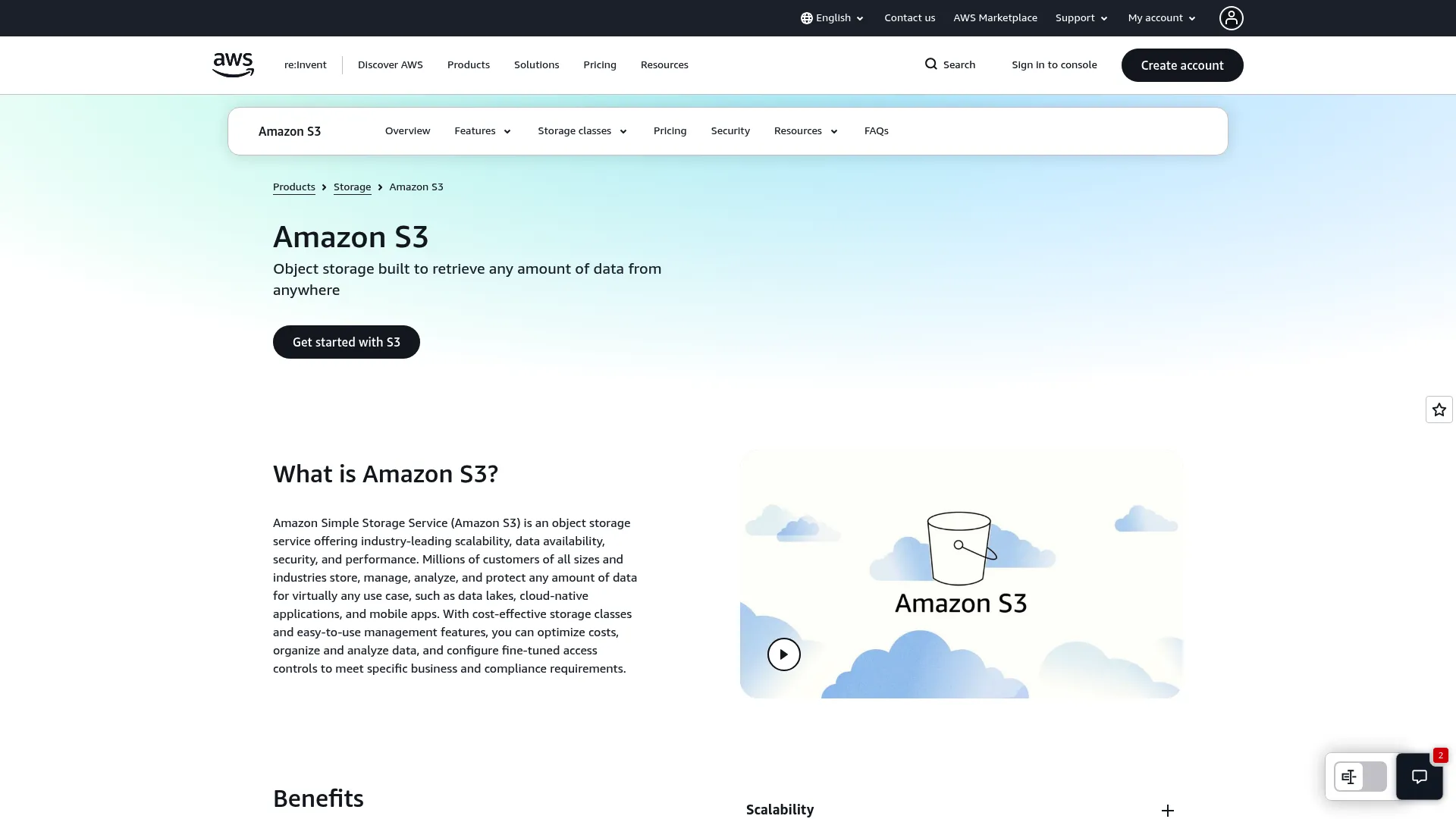
Amazon S3 is AWS's object storage service for storing and retrieving data at scale, and it anchors more data lake architectures than any other single product. Teams use it as the durable storage foundation, then layer table formats, catalogs, and query engines on top. It is storage-first by design, which is exactly why it fits as the base of a lake rather than the analytics layer.
Best for: Teams needing highly scalable, durable cloud object storage as the foundation of a lake.
Key strengths
- Object storage with buckets and objects
- Strong read-after-write consistency
- Storage classes for cost and performance tiering
- Deep security and analytics feature set
Why choose Amazon S3: If your stack lives on AWS, S3 is the default gravitational center. It gives you durable, near-infinite storage and lets you pick your own compute and table format on top, rather than locking you into one analytics engine.
Amazon S3 pricing: S3 Tables Standard storage starts at $0.0265 per GB for the first 50 TB per month. Pricing is pay-as-you-go across multiple storage classes, and new AWS customers get Free Tier eligibility.
2. Azure Data Lake Storage Gen2
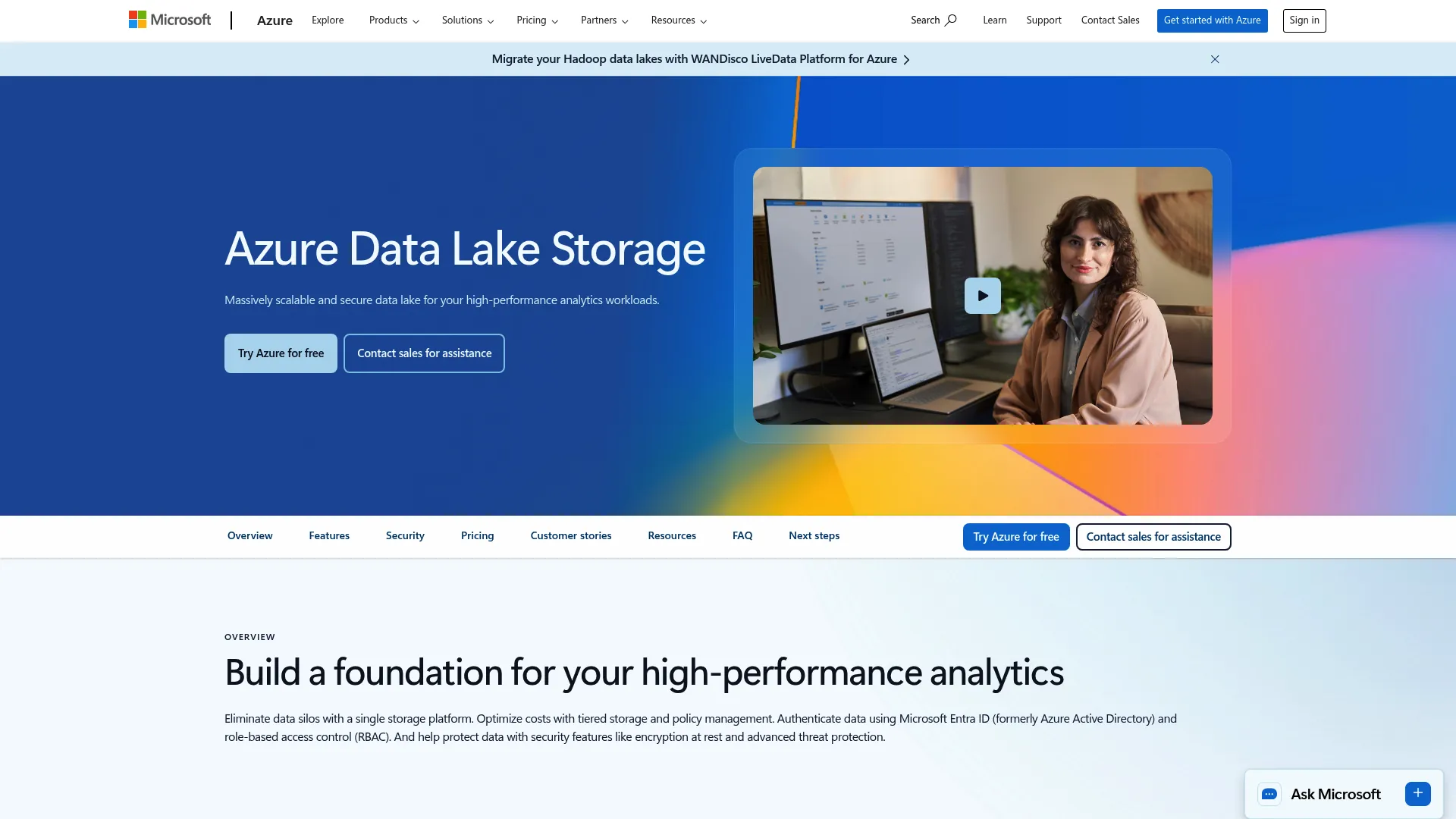
Azure Data Lake Storage Gen2 is massively scalable, secure cloud storage built for analytics workloads on Azure. It combines a hierarchical namespace with Hadoop-compatible access, which makes it a natural fit for Spark and big data engines. For Microsoft-centric teams, it slots directly into the broader Azure analytics and governance stack.
Best for: Teams building scalable Azure-based data lakes for analytics and governance.
Key strengths
- Massively scalable storage for high-performance analytics
- Security with Microsoft Entra ID, RBAC, and encryption at rest
- Advanced threat protection
- Tiered storage and lifecycle management for cost control
Why choose Azure Data Lake Storage Gen2: If your organization already runs on Azure Active Directory, Synapse, or Power BI, this keeps identity, governance, and analytics inside one control plane. The Hadoop compatibility also eases migration from existing on-premises lakes.
Azure Data Lake Storage Gen2 pricing: Microsoft prices Data Lake Storage on a usage-based model with tiering, reservations, and lifecycle management. A free tier is available, and detailed rates are published on the Azure pricing page.
3. Google Cloud Storage
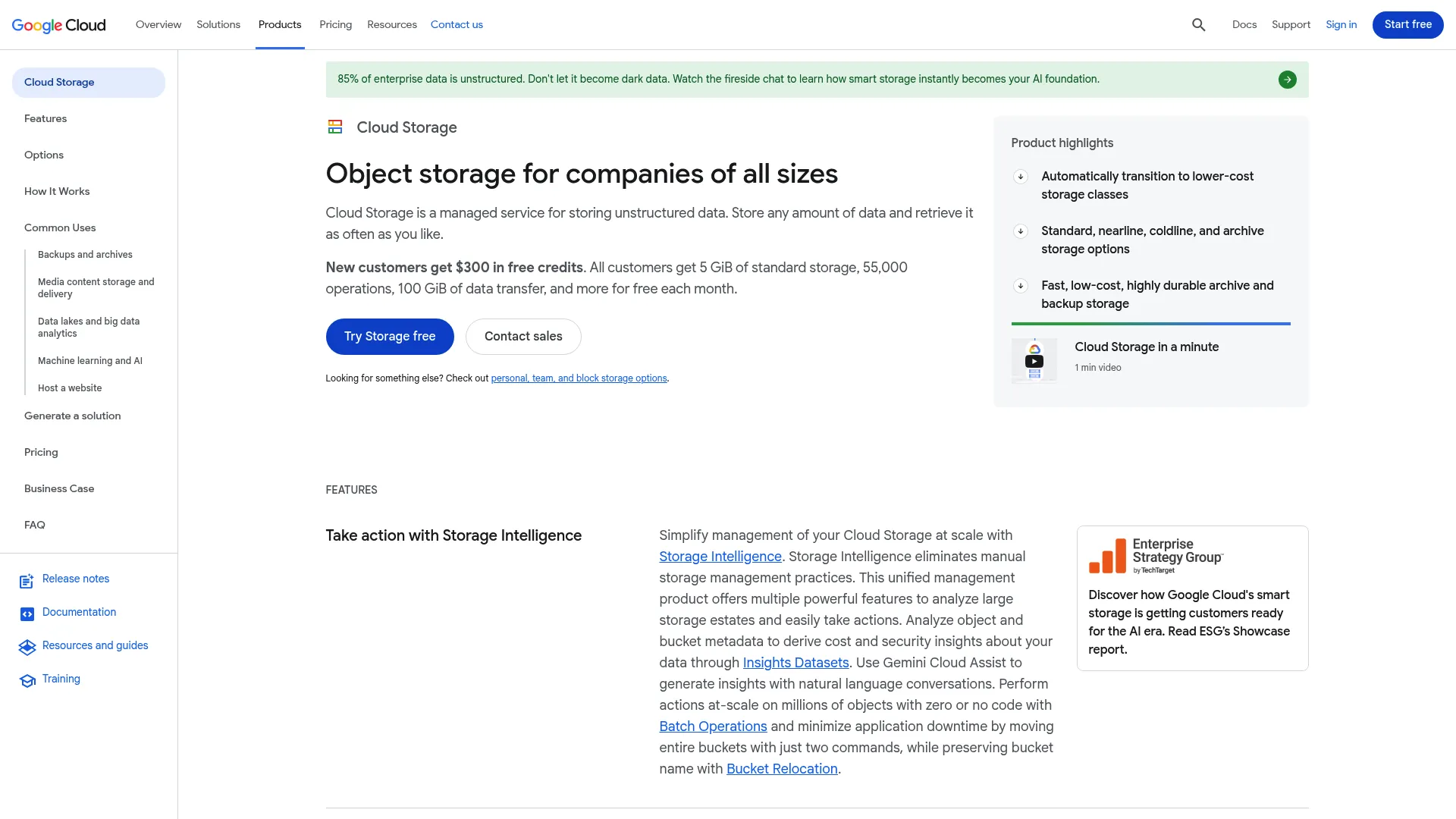
Google Cloud Storage is managed object storage for storing and retrieving unstructured data on Google Cloud. It works well as the storage layer for cloud-native lake architectures, especially when the analytics stack leans on BigQuery, Dataproc, or Vertex AI. Interoperability and lifecycle automation make it easy to run cost-efficient storage at scale.
Best for: Teams needing scalable object storage for backups, analytics data, and AI/ML workloads.
Key strengths
- Storage Intelligence for analysis and bulk actions
- Autoclass and Object Lifecycle Management
- Dual-region replication and Rapid Cache
- Strong interoperability with Google analytics tooling
Why choose Google Cloud Storage: If your analytics center of gravity is BigQuery, keeping raw data in Cloud Storage shortens the path from lake to query. Autoclass automatically moves data between storage classes, which trims cost without manual lifecycle rules.
Google Cloud Storage pricing: Cloud Storage uses pay-as-you-go pricing with an Always Free monthly tier of 5 GiB standard storage. Standard storage runs $0.02 per GiB per month, with additional usage-based charges for operations and transfer.
4. Databricks Lakehouse Platform
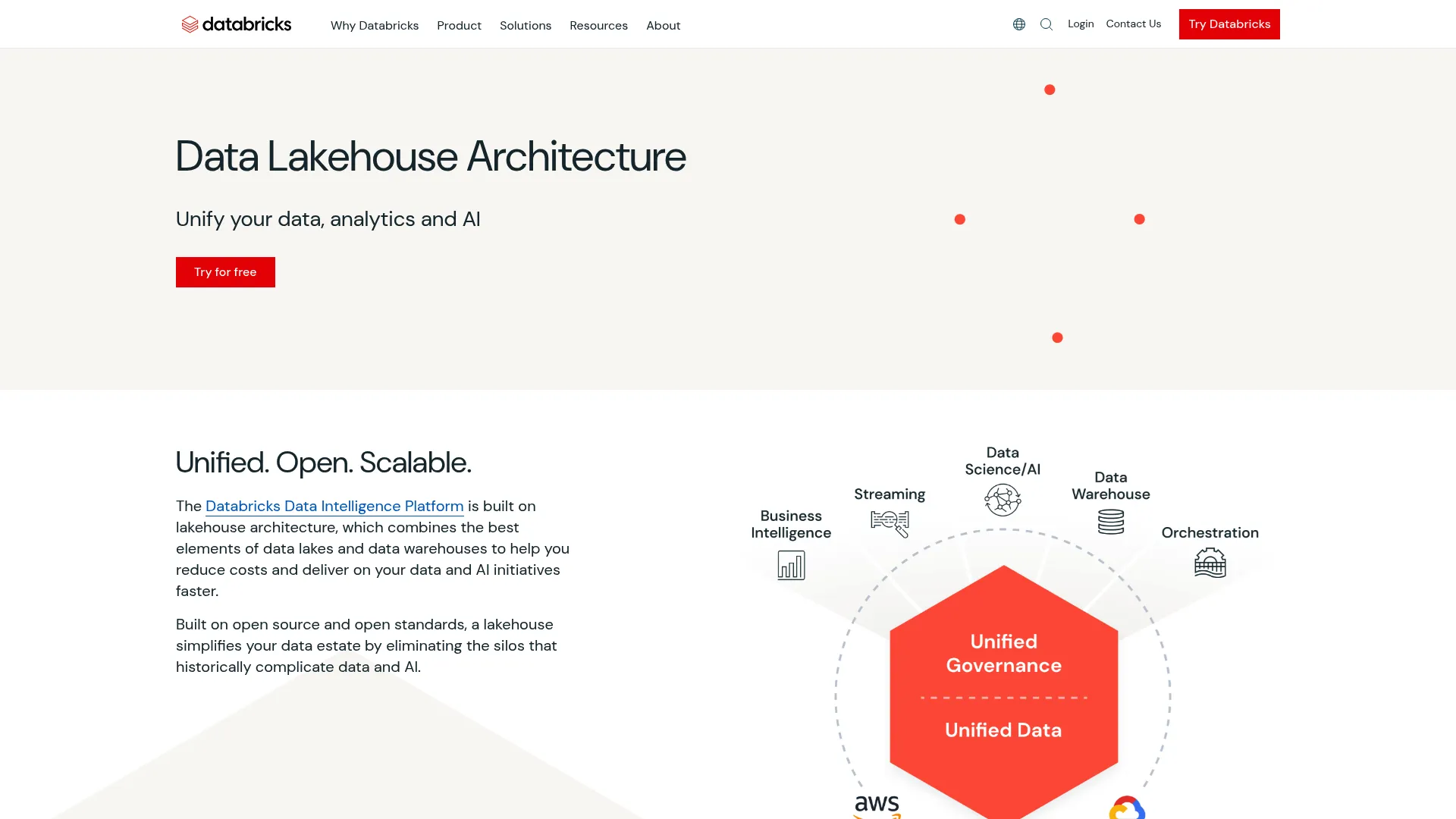
Databricks Lakehouse Platform is a lakehouse-based data and AI platform that unifies analytics, ETL, machine learning, and governance. Built on Delta Lake with Unity Catalog for governance, it bridges the gap between raw lake storage and reliable, warehouse-grade analytics. This is the platform to look at when a raw lake alone leaves your analysts fighting inconsistent data.
Best for: Teams that need a unified lakehouse platform for data engineering, analytics, and AI.
Key strengths
- Lakehouse architecture built on Databricks
- Unity Catalog for governance and lineage
- Delta Lake-based data management with ACID transactions
- Unified surface for batch, streaming, and ML workloads
Why choose Databricks Lakehouse Platform: Databricks is the strongest fit when your data engineers and data scientists work on the same datasets and you want one governed layer for both. The lakehouse model gives you warehouse reliability without abandoning open storage.
Databricks Lakehouse Platform pricing: Databricks offers a no-cost Free Edition and a 14-day free trial with up to $400 in credits. Full platform pricing is consumption-based and quoted per workload rather than published as a flat rate.
5. Snowflake
Snowflake is a cloud data platform for storage, analytics, AI, and data sharing. It fits lakehouse-style architectures and excels at data sharing across teams and organizations. Where storage-first tools give you raw scale, Snowflake gives you managed analytics over that data, so teams spend less time wrangling infrastructure.
Best for: Enterprises needing a cloud data platform for analytics, data sharing, and AI workloads.
Key strengths
- Consumption-based pricing across Standard, Enterprise, Business Critical, and VPS editions
- Snowpark, Snowsight, and REST/API access
- Data sharing, Time Travel, Fail-safe, and replication
- AI/ML features including Cortex
Why choose Snowflake: Snowflake is the pick when you want managed analytics and secure data sharing more than raw storage control. Its separation of storage and compute, plus near-zero maintenance, appeals to teams that would rather query than administer clusters.
Snowflake pricing: Snowflake uses consumption-based pricing across Standard, Enterprise, Business Critical, and Virtual Private Snowflake editions. You pay for compute and storage by usage, so cost scales with workload rather than a fixed subscription.
6. Delta Lake
Delta Lake is an open-source storage framework for building lakehouse architectures on top of your existing data lake. It is a table format, not a full platform, and that is the point. It adds reliability and transactions to raw object storage, which addresses the classic pain of inconsistent reads and half-written files in a plain lake.
Best for: Teams building open lakehouse storage on existing data lakes.
Key strengths
- ACID transactions on lake storage
- Schema evolution and enforcement
- Time travel for versioned data
- Unified batch and streaming
Why choose Delta Lake: Choose Delta Lake when you want warehouse-grade reliability on cheap object storage without buying a full managed platform. It is open source and platform agnostic, so you keep control over your storage and compute choices.
Delta Lake pricing: Delta Lake is an open-source project with no license cost. You pay only for the underlying storage and compute you run it on.
7. Apache Iceberg
Apache Iceberg is an open table format for huge analytic datasets, designed for large-scale data lakes and lakehouse architectures. It appeals to teams that want ecosystem openness and the freedom to query the same tables from multiple engines. Schema evolution and hidden partitioning solve two of the hardest problems in large lake implementations.
Best for: Teams building open, multi-engine analytical data lake tables.
Key strengths
- Schema evolution without rewriting data
- Hidden partitioning for simpler queries
- Branching and tagging for table versions
- Broad multi-engine compatibility
Why choose Apache Iceberg: Iceberg is the pick when engine independence matters most. Because it is a vendor-neutral Apache project supported across Spark, Trino, Flink, and cloud warehouses, you avoid locking your table layer to any single query engine.
Apache Iceberg pricing: Apache Iceberg is a free, open-source Apache project. There is no license fee, so your only costs are the storage and compute engines you pair with it.
Considerations
Before you commit to a data lake platform, work through this checklist so the choice survives an architecture review.
Storage and compute separation
Confirm the platform lets you scale storage and compute independently. This is what keeps cost predictable as data grows faster than query load. Ask how compute is provisioned, whether it is elastic, and how you pay for idle time.
Governance and access control
Verify fine-grained permissions, encryption at rest and in transit, and audit logging. Data lake governance is where most lakes turn into swamps, so check how the platform enforces who can read, write, and share each dataset. Confirm it integrates with your identity provider.
Metadata and catalog support
A metadata catalog is what makes a lake discoverable instead of a dumping ground. Check whether the platform ships a catalog, integrates with an external one, and tracks lineage. Without it, analysts cannot find or trust the data.
Batch, streaming, and real-time analytics
Map your actual workloads. If you run both scheduled batch jobs and streaming pipelines, confirm the platform handles both without a second system. Real-time analytics needs low-latency ingestion, so test it against your throughput.
Open formats and ecosystem compatibility
Check which open formats and table formats the platform supports. Open formats like Parquet, Delta, and Iceberg protect you from lock-in and let you swap query engines later. Confirm the integrations you already depend on are first-class, not afterthoughts.
Conclusion
The right data lake software depends on your storage foundation, governance needs, analytics stack, and how much flexibility you want to keep for the next five years.
If you need durable, scalable object storage as a foundation, Amazon S3, Azure Data Lake Storage Gen2, and Google Cloud Storage are the anchors, each strongest inside its own cloud. If you want raw storage and reliable analytics unified, Databricks Lakehouse Platform bridges both on a single governed surface. Snowflake fits teams that prefer managed analytics and data sharing over administering storage. And if you want to add reliability and openness on top of an existing lake, Delta Lake and Apache Iceberg give you transactions, schema evolution, and engine independence.
Your practical next step: shortlist two platforms that match your cloud and governance model, then run a small proof of concept with real workloads before you commit. Architecture decisions here are expensive to reverse, so validate against your own data, not a vendor benchmark.
If your team also needs to communicate technical value to non-technical stakeholders during evaluations, tools like Guideflow help you build interactive product experiences that show a workflow without exposing a live environment.
Start your journey with Guideflow today!
FAQs
A data warehouse structures data on write into predefined schemas, which makes it fast for known reporting queries. Data lake software stores raw data in open formats and structures it on read, which keeps it flexible for machine learning and ad hoc analysis. Many teams run both, or adopt a lakehouse to blend them.
Object storage that separates storage from compute, schema flexibility for structured and unstructured data, and strong governance with access control and cataloging. Support for both batch and streaming, plus open formats like Parquet, Delta, and Iceberg, keeps you from getting locked into one engine.
Choose a lakehouse when a raw data lake leaves analysts fighting inconsistent, unreliable data and you want warehouse-grade transactions without giving up open storage. A lakehouse adds ACID reliability, schema enforcement, and governance on top of the lake, so batch, streaming, and ML workloads share one governed layer.
Enforce fine-grained access control tied to your identity provider, encrypt data at rest and in transit, and keep audit logs of every read and write. Data lake security also depends on a metadata catalog that tracks lineage, so you know where sensitive data lives and who touched it.
Object storage is the foundation. It provides durable, scalable, cheap storage that holds raw structured, semi-structured, and unstructured data, and it separates storage from compute so you scale each independently. Amazon S3, Azure Data Lake Storage Gen2, and Google Cloud Storage are the common object storage layers.
Yes, in practice. Without a metadata catalog, a lake becomes an undiscoverable dumping ground where analysts cannot find or trust data. A catalog tracks what data exists, its schema, and its lineage, which is what turns raw storage into a governed, queryable data lake platform.
Yes. Modern data lake tools ingest and process scheduled batch jobs and real-time streaming pipelines, often on the same storage. Open table formats like Delta Lake and Apache Iceberg unify batch and streaming, so you avoid running two separate systems for historical and live data.
Verify storage and compute separation, governance and access control, metadata and catalog support, batch and streaming fit, and open format compatibility. Then run a proof of concept with your real workloads, because data lake implementation decisions are expensive to reverse once petabytes are in place.