You launched a configurable product line. The catalog says 40,000 possible combinations. Your product page shows three flat photos and a dropdown menu.
Buyers can't picture what they're ordering. So they email questions, abandon carts, or worse, they buy, receive something that doesn't match the mental image, and send it back. Returns climb. Support tickets pile up. The launch that was supposed to drive expansion revenue instead drives refund processing.
The problem isn't the product. It's the gap between what the buyer can configure and what the buyer can see. Static imagery can't close that gap. A visual product customization software tool can, by letting customers build, preview, and validate their exact configuration in real time before they pay.
The stakes are real. Research from Dataintelo (2025) found that 71% of consumers now expect personalized interactions, and 66% feel frustrated when companies fail to deliver. That expectation is reshaping ecommerce. The global visual product configurator software market hit $1.2B in 2024 and is forecast to reach $3.5B by 2033, a 15.5% CAGR, according to Verified Market Reports (2024).
For product marketers, this is a positioning and conversion lever, not just an ops upgrade. The right product customizer software shortens the path from interest to purchase, reduces returns, and gives you a story buyers can interact with instead of read about. If you also work on broader demo and storytelling motions, our roundup of the best interactive demo tools for product marketing covers the adjacent stack.
What's inside
This guide compares eight visual product customization software tools for ecommerce teams, product marketing managers, and operators who need real-time previews, configuration rules, and clean integrations. We did not rank on feature count alone.
We weighed each tool on five criteria that actually shape outcomes:
- 3D visualization and live preview quality for buyer trust
- No-code setup so teams can launch without an engineering queue
- Workflow automation for orders, approvals, and production output
- Integration depth across ecommerce and enterprise systems
- Measurable ROI through reviews, case studies, and adoption signals
Each tool entry below includes verified pricing where public, a G2 rating where available, and a clear best-fit recommendation.
TL;DR
- Best overall for enterprise 3D commerce: Threekit, for photorealistic configuration, virtual photography, and AR at scale.
- Best for print workflows and POD: Zakeke, for WYSIWYG customization and print-ready file generation.
- Best for guided selling and enterprise configurators: Zoovu, for AI product discovery and configuration intelligence.
- Best for fast configurators (SMB and mid-market): Kickflip, for no-code setup and live product preview at $59/month.
- Best for print and ecommerce customization workflows: DesignNBuy, for web-to-print storefronts and design tooling.
- Best for spatial, room-based visualization: Coohom, for 3D home design and rendering.
- Best for white-label visual merchandising: VividWorks, for real-time 3D configuration and Visual CPQ.
- Best for rules-driven configuration: Combeenation, for compatibility logic and automated quoting.
What is visual product customization software?
Visual product customization software is a tool that lets shoppers configure and personalize a product visually, seeing each change rendered in real time, before they buy. It replaces static photos and text dropdowns with an interactive visual configurator that reflects every option the customer selects.
A modern product configurator website combines several capabilities into one buying experience. The strongest platforms in this category share a common core:
- Real-time 3D visualization: Photorealistic or 3D product configurator software rendering that updates instantly as the buyer changes materials, colors, components, or dimensions.
- Live product preview: A WYSIWYG view so the customer sees exactly what they will receive, reducing the gap between expectation and delivery.
- Conditional logic and compatibility rules: Logic that prevents invalid combinations, enforces pricing changes, and guides buyers toward configurations that can actually be produced.
- No-code customization setup: A no-code configurator builder so merchandising and product teams can create and update experiences without developer cycles.
- Order and production output automation: Print-ready file generation, BOMs, spec sheets, and quote documents that flow into manufacturing and fulfillment.
- Ecommerce and enterprise integrations: Connections to Shopify, WooCommerce, and to ERP, CRM, CPQ, and PIM systems for pricing, inventory, and order handoff.
The distinction worth noting: a product customizer software tool typically focuses on visual personalization (adding text, art, colors), while a full ecommerce product configurator handles complex rule sets, pricing logic, and production output. Many platforms now do both.
When to use visual product customization software
Not every catalog needs a configurator. These three situations are where a visual product configurator earns its place fast.
Speed up purchase decisions for complex products
When a product has many variants, buyers hesitate because they can't visualize the outcome. Furniture, signage, apparel, eyewear, industrial equipment, and packaging all share this trait. A real-time 3D visualization lets the buyer assemble their exact version and see it before committing. That confidence shortens the decision and lifts conversion, especially on high-consideration purchases where uncertainty kills carts.
Reduce returns and order mistakes
Returns on customized goods are expensive because the product often can't be resold. A live product preview sets accurate expectations, so what arrives matches what the buyer pictured. Conditional logic prevents impossible or mismatched orders before they reach production. Together, preview plus rules cut the two biggest sources of custom-order returns: wrong expectations and invalid configurations.
Automate custom product workflows
When every custom order requires manual file prep, quoting, or back-and-forth approvals, your team becomes the bottleneck. Workflow automation turns a finished configuration into print-ready files, a bill of materials, or a quote document, then hands it off to ERP, CPQ, or a production queue. This is where configurator value compounds: faster fulfillment, fewer errors, less manual coordination per order.
Comparison table
The table below summarizes the eight tools by buyer intent, primary use case, verified pricing, and G2 rating. Use it as a shortlist filter, then read the full entry for the two or three that fit your model.
| # | Product | Intent | Key use case | Pricing | G2 rating |
|---|---|---|---|---|---|
| 1 | Threekit | Enterprise 3D commerce | Photorealistic 3D configuration, virtual photography, AR | Custom (quote-based) | 4.4/5 |
| 2 | Zakeke | Ecommerce customization and print | WYSIWYG customization, print-ready output, POD | Free trial; custom enterprise | 4.6/5 |
| 3 | Zoovu | Guided selling at enterprise scale | AI product discovery, guided selling, configuration | Custom (quote-based) | 3.8/5 |
| 4 | Kickflip | Fast SMB and mid-market configurators | No-code live preview product customization | $59/month + transaction fee | 4.6/5 |
| 5 | DesignNBuy | Web-to-print and personalization | Web-to-print storefronts, online design editor | Custom (quote-based) | 4.2/5 |
| 6 | Coohom | Spatial and room-based visualization | 3D home design, rendering, floor planning | Free tier; from $25/user/mo | 4.5/5 |
| 7 | VividWorks | White-label visual merchandising | Real-time 3D configuration, Visual CPQ | From €447/month | 4.5/5 |
| 8 | Combeenation | Rules-driven configuration | CPQ, 3D configuration, automated quoting | From €697/month | 4.7/5 |
Pricing and ratings reflect publicly available values at the time of writing. Quote-based vendors do not publish plan prices; request a quote for current figures.
1. Threekit
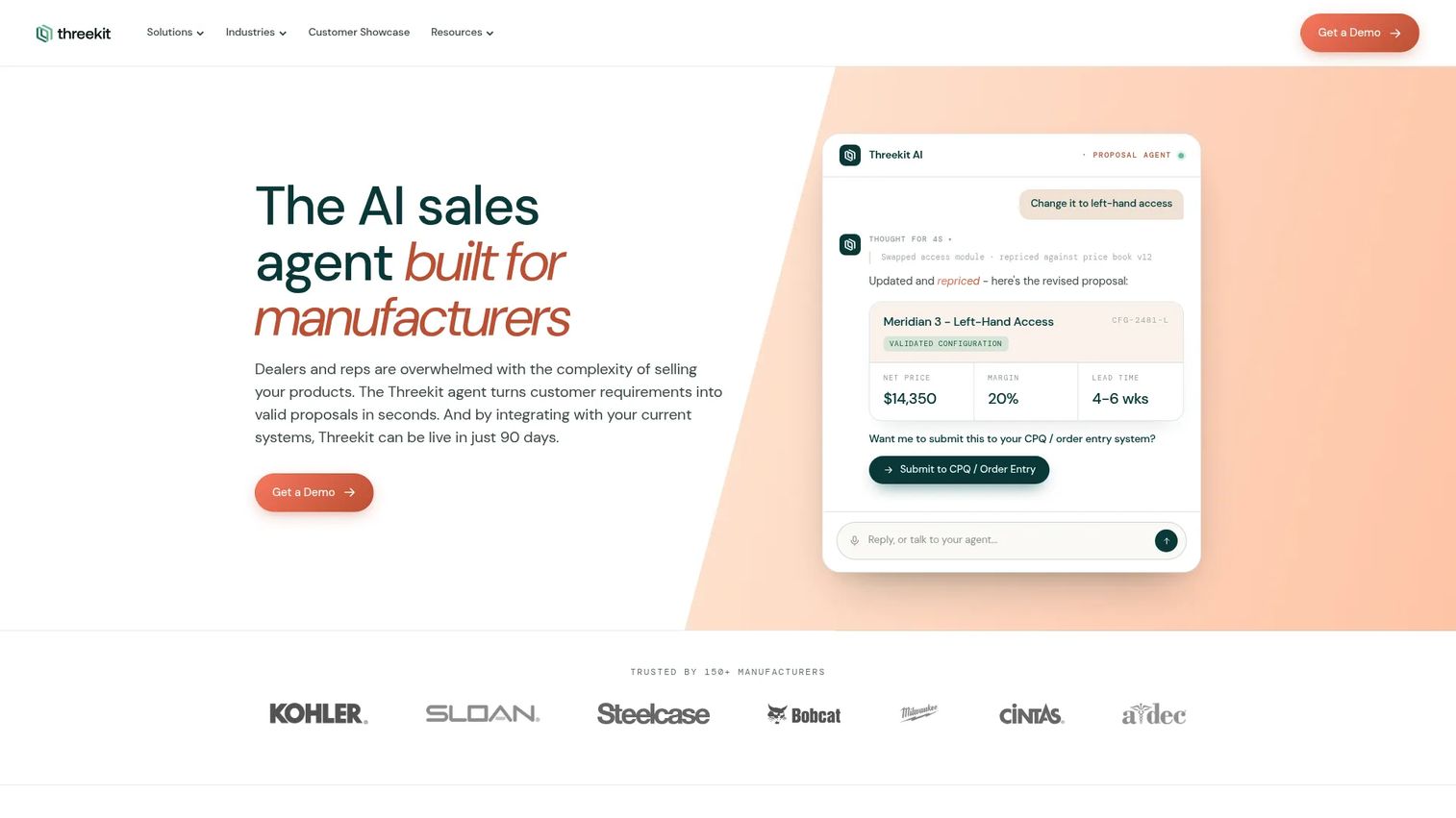
Threekit is a visual commerce platform built for 3D configuration, virtual photography, and augmented reality product experiences. It targets manufacturers and retailers selling complex configurable products online, where photorealism and accuracy directly affect buyer confidence. Threekit centralizes 3D assets so one source of truth powers configuration, rendering, and AR across every channel. For product marketers at brands with deep catalogs, it positions the product itself as the proof point.
Best for: Manufacturers and retailers selling complex, high-consideration configurable products online.
Key strengths
- 3D product configuration: Buyers assemble their exact product and see changes render in real time, raising trust on complex purchases.
- Virtual Photographer photorealistic rendering: Generate unlimited 2D product imagery from 3D assets, cutting traditional photography cost and time.
- Augmented reality visualization: Let shoppers place products in their own space, which reduces returns on size and fit uncertainty.
Why choose Threekit: If your catalog is complex and your brand depends on visual accuracy, Threekit gives you a 3D product configurator software foundation that scales across configuration, photography, and AR. It fits enterprise teams that want asset management, guided selling, and integrations under one roof rather than stitched-together point tools. The trade-off worth weighing: this is an enterprise commitment, not a weekend launch.
Threekit pricing: Threekit uses custom, quote-based pricing. The official pricing page asks you to request a quote and does not display public plan prices. For enterprise buyers, this usually means a scoped implementation tied to catalog size and integration needs. Threekit holds a 4.4/5 rating on G2.
2. Zakeke
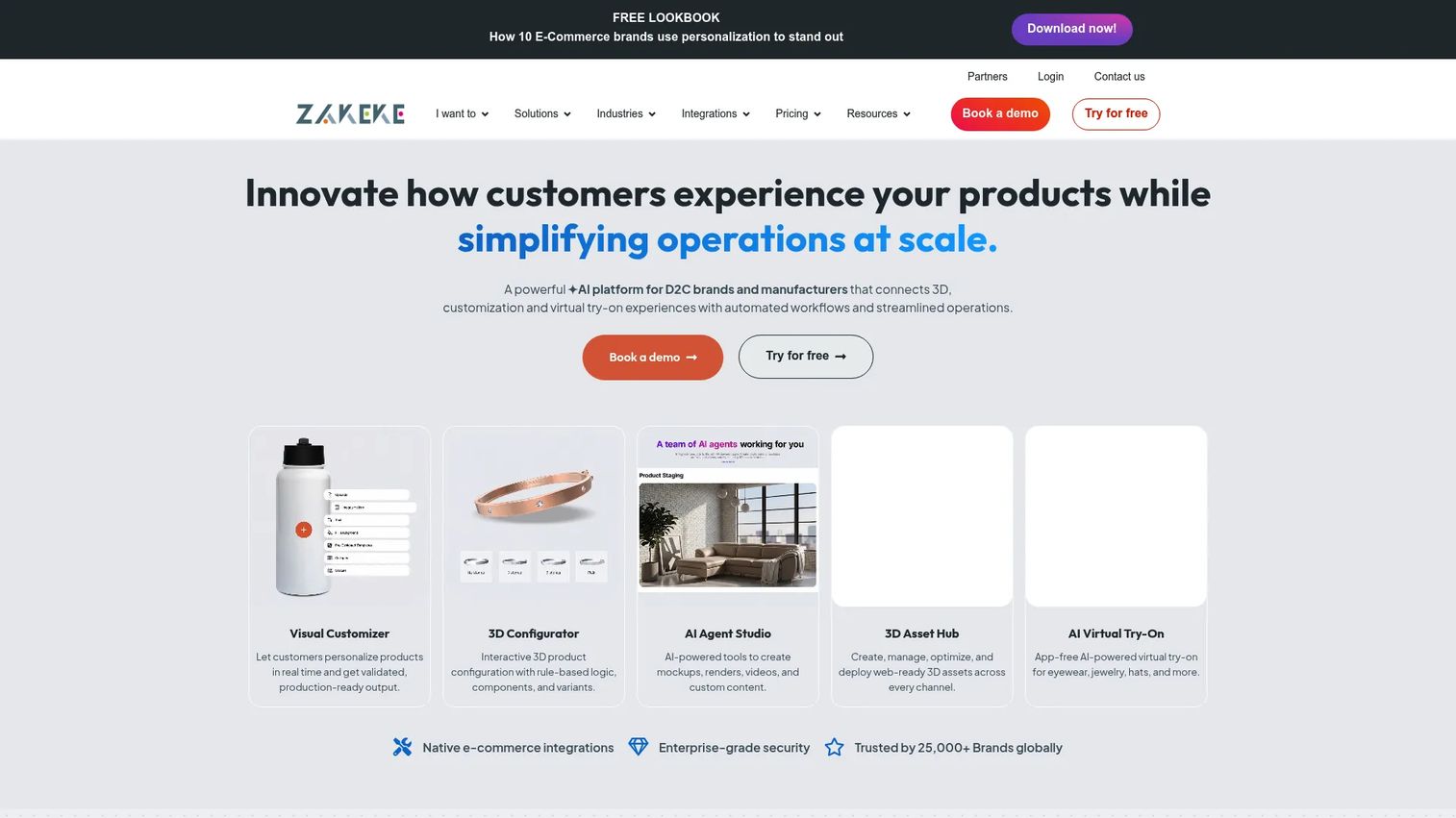
Zakeke is a visual commerce platform for product customization, 3D configuration, and virtual try-on. It is built for ecommerce brands that need customizable products with 2D, 3D, and AR experiences, and it leans hard into operational outcomes like print automation and reduced returns. Zakeke is a strong fit when your customization motion connects directly to production, especially print-on-demand and dropshipping. It plugs into major ecommerce platforms so you can launch without rebuilding your storefront.
Best for: Ecommerce brands needing customizable products with 2D, 3D, and AR experiences tied to production output.
Key strengths
- Visual product customization: WYSIWYG editing lets shoppers add text, art, and colors and see the exact result before checkout.
- 3D product configurator: Real-time 3D configuration for products where flat imagery cannot communicate the options.
- AI virtual try-on: Let customers preview wearable and lifestyle products on themselves to lift confidence and lower returns.
Why choose Zakeke: Zakeke shines when print-ready file generation and POD and dropshipping workflows matter as much as the preview itself. It turns a finished customization into production-ready output, which is exactly the handoff that slows most custom-product teams. For brands running personalized merchandise at volume, that automation is the differentiator.
Zakeke pricing: Zakeke offers a free trial and a custom enterprise plan, confirmed on its first-party pages. A specific public subscription price was not verifiable at the time of writing, so request current figures directly. Zakeke holds a 4.6/5 rating on G2, among the strongest in this category.
3. Zoovu
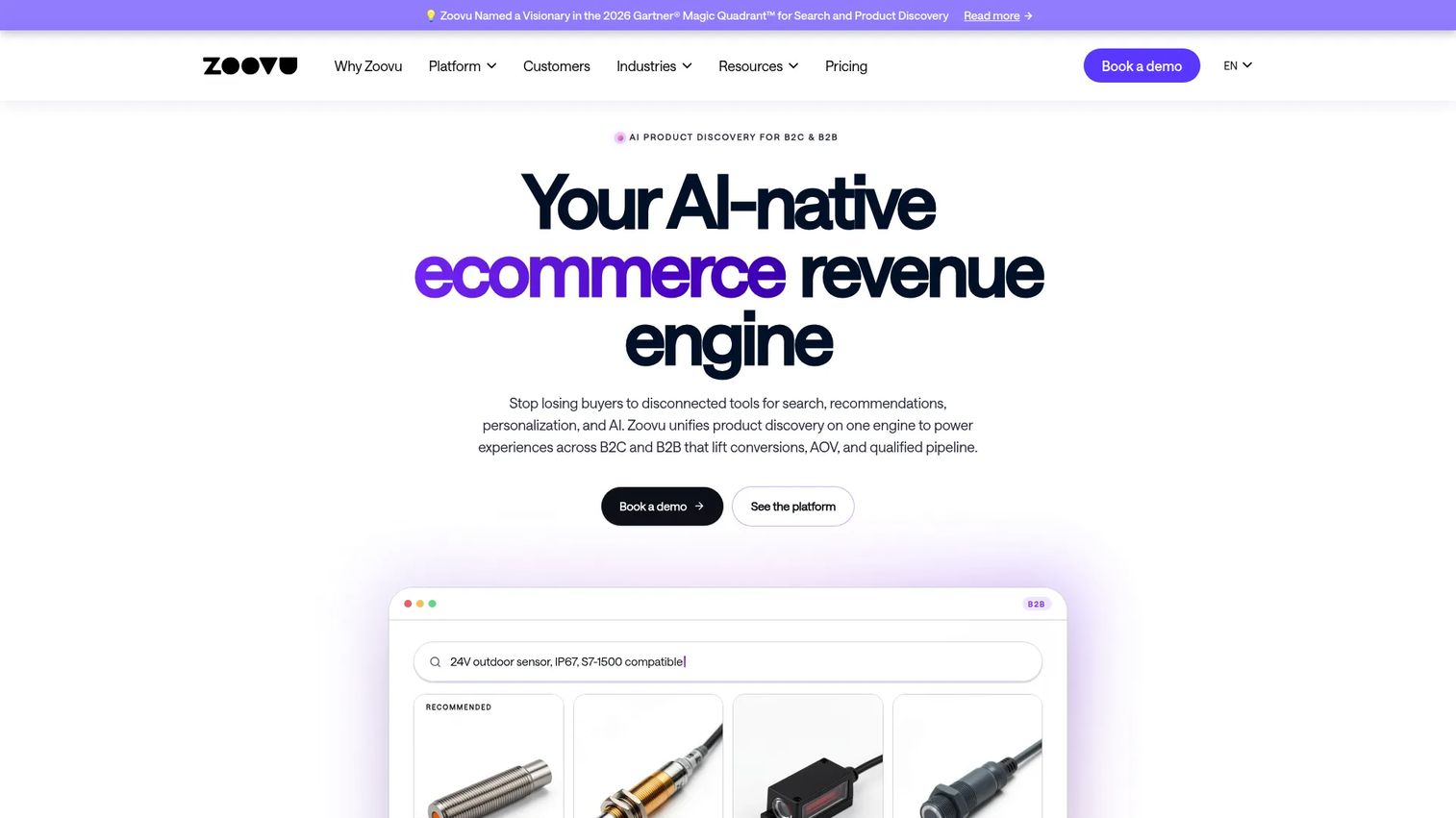
Zoovu is an AI product discovery platform for B2C and B2B commerce, combining guided selling, search and merchandising, and product configuration. It is built for enterprise teams that want to help buyers find and configure the right product through intelligent, conversational guidance. Where pure visual configurators focus on rendering, Zoovu focuses on the decision logic that leads a buyer to the correct configuration. For product marketers, that guided-selling layer is a direct conversion and qualification asset.
Best for: Enterprise teams needing AI-powered product discovery, guided selling, and ecommerce personalization.
Key strengths
- AI search and merchandising: Surface the right products and configurations based on buyer intent, improving findability and conversion.
- Guided selling and product configuration: Walk buyers through complex choices with logic that narrows options to valid, relevant builds.
- Recommendations, bundles, and analytics: Drive larger orders and measure what messaging and configurations actually convert.
Why choose Zoovu: Choose Zoovu when the challenge is helping buyers decide, not just visualize. Its configuration intelligence and pricing automation suit complex catalogs where guided selling moves the needle more than photorealism alone. The enterprise framing and data enrichment make it a fit for teams that treat product discovery as a measurable GTM motion.
Zoovu pricing: Zoovu uses quote-based pricing that combines a product fee with a usage-based fee, per its first-party pricing page. No public starting price is listed, so request a quote scoped to your catalog and traffic. Zoovu holds a 3.8/5 rating on G2.
4. Kickflip
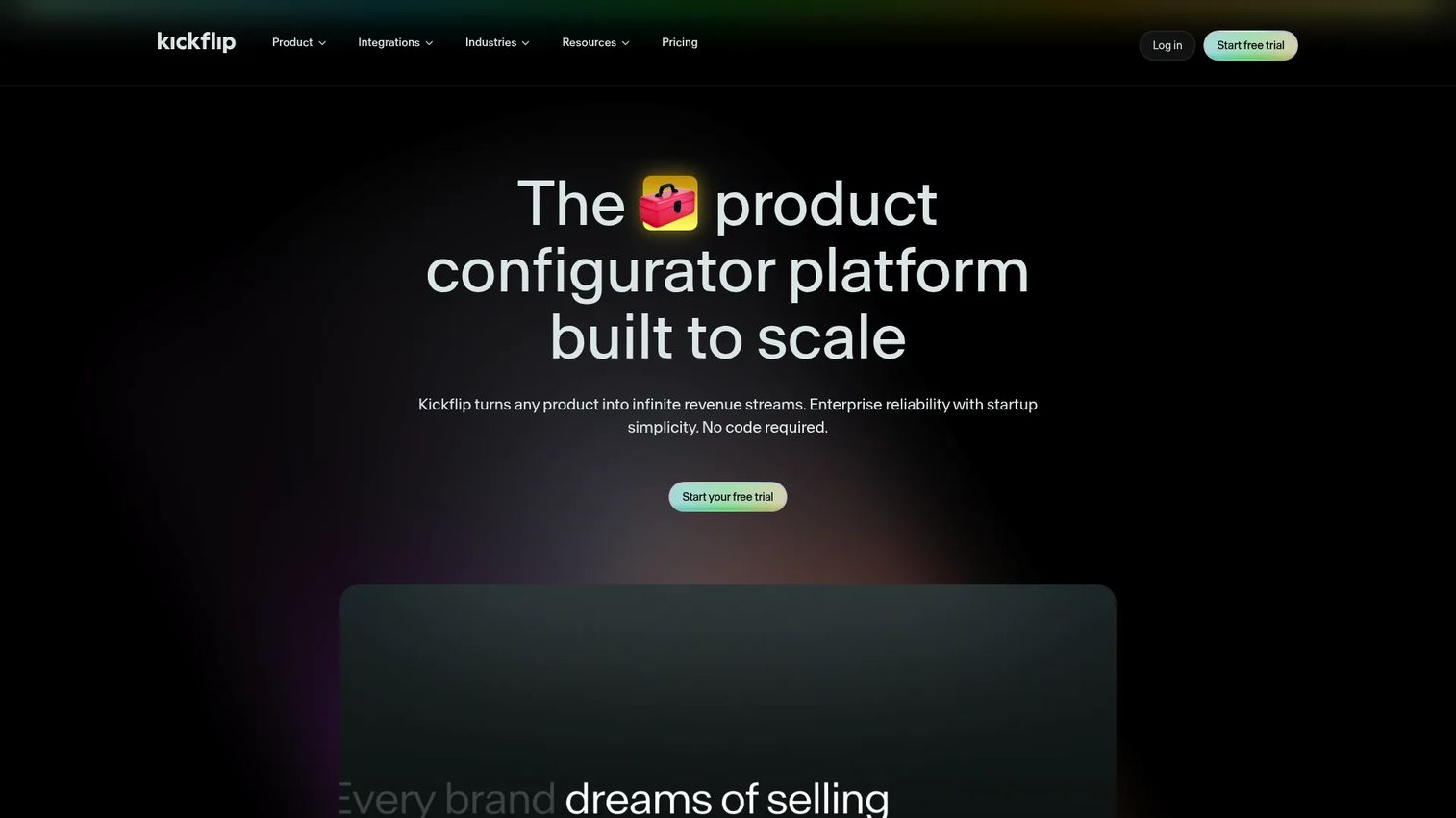
Kickflip is a no-code product configurator for ecommerce brands selling customizable products. It is built for teams that want a visual configurator live on their storefront quickly, without engineering. Kickflip emphasizes real-time previews, multiple product views, and conditional logic, so buyers see their exact build update as they customize. For SMB and mid-market product teams, the appeal is speed to launch paired with transparent, accessible pricing.
Best for: Ecommerce brands needing a no-code custom product configurator they can launch fast.
Key strengths
- Real-time product previews: Buyers see every change reflected instantly, which builds confidence and reduces pre-purchase questions.
- Multiple product views: Show the configured product from several angles so shoppers fully understand what they are ordering.
- Conditional logic and smart rules: Prevent invalid combinations and trigger dynamic pricing as customers build their product.
Why choose Kickflip: Kickflip is the practical pick when you want a live product preview and a working ecommerce product configurator without a long implementation. The no-code builder lets merchandising teams own the experience, and the published pricing removes the guesswork that surrounds enterprise quotes. It fits brands that want quick wins rather than a multi-quarter rollout.
Kickflip pricing: Kickflip publishes its pricing openly. The core plan starts at $59/month plus a per-custom-product transaction fee of 1.95% scaling down to 0%. Optional add-ons include white-label at +$49/month and configure-price-quote at +$99/month. There is no free tier. Kickflip holds a 4.6/5 rating on G2.
5. DesignNBuy
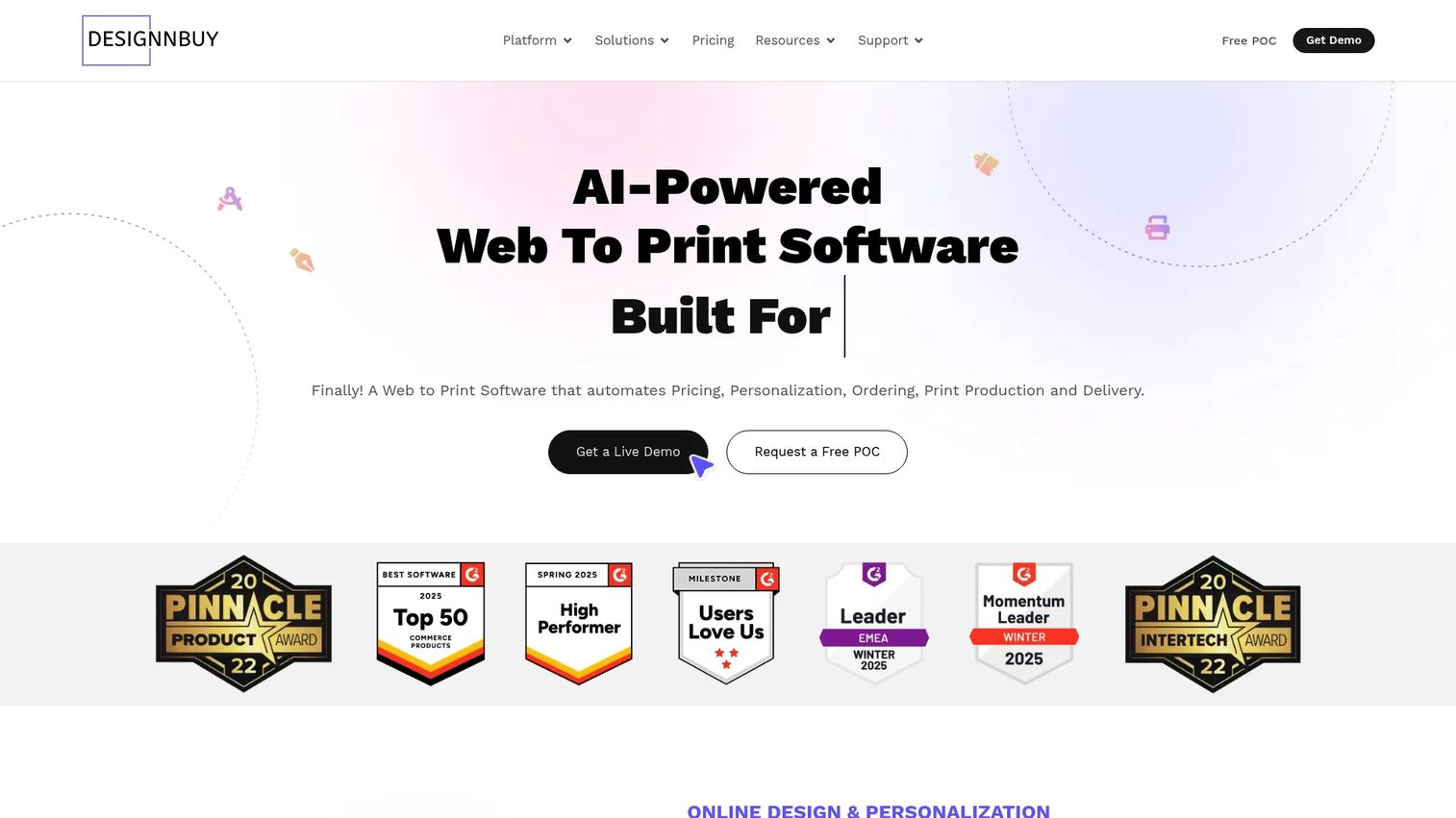
DesignNBuy is web-to-print and product personalization software built for print and packaging businesses. It centers on web-to-print storefronts, an online design tool, and production-ready output automation, which makes it a fit for print shops, packaging suppliers, and promotional product sellers. Where many tools stop at the visual preview, DesignNBuy is structured around the print production pipeline that follows. For operators, that end-to-end coverage from design to print-ready file is the draw.
Best for: Print and packaging businesses needing customizable web-to-print workflows.
Key strengths
- Web-to-print storefronts: Stand up branded storefronts where customers personalize and order print products directly.
- Online design tool and editor: A WYSIWYG editor so buyers design exactly what they want before production.
- Dynamic and product pricing automation: Pricing updates with each customization choice, keeping quotes accurate as the design changes.
Why choose DesignNBuy: DesignNBuy makes sense when print customization is the core of the business, not an add-on. Its web-to-print workflows and print-ready output automation are tailored to production handoff, which is the part of the process most generic configurators leave to manual work. For print-led ecommerce, that specialization matters.
DesignNBuy pricing: DesignNBuy does not publish a public pricing page with visible plan prices, so pricing is quote-based and scoped to your storefront and workflow needs. Request current figures directly. DesignNBuy holds a 4.2/5 rating on G2.
6. Coohom
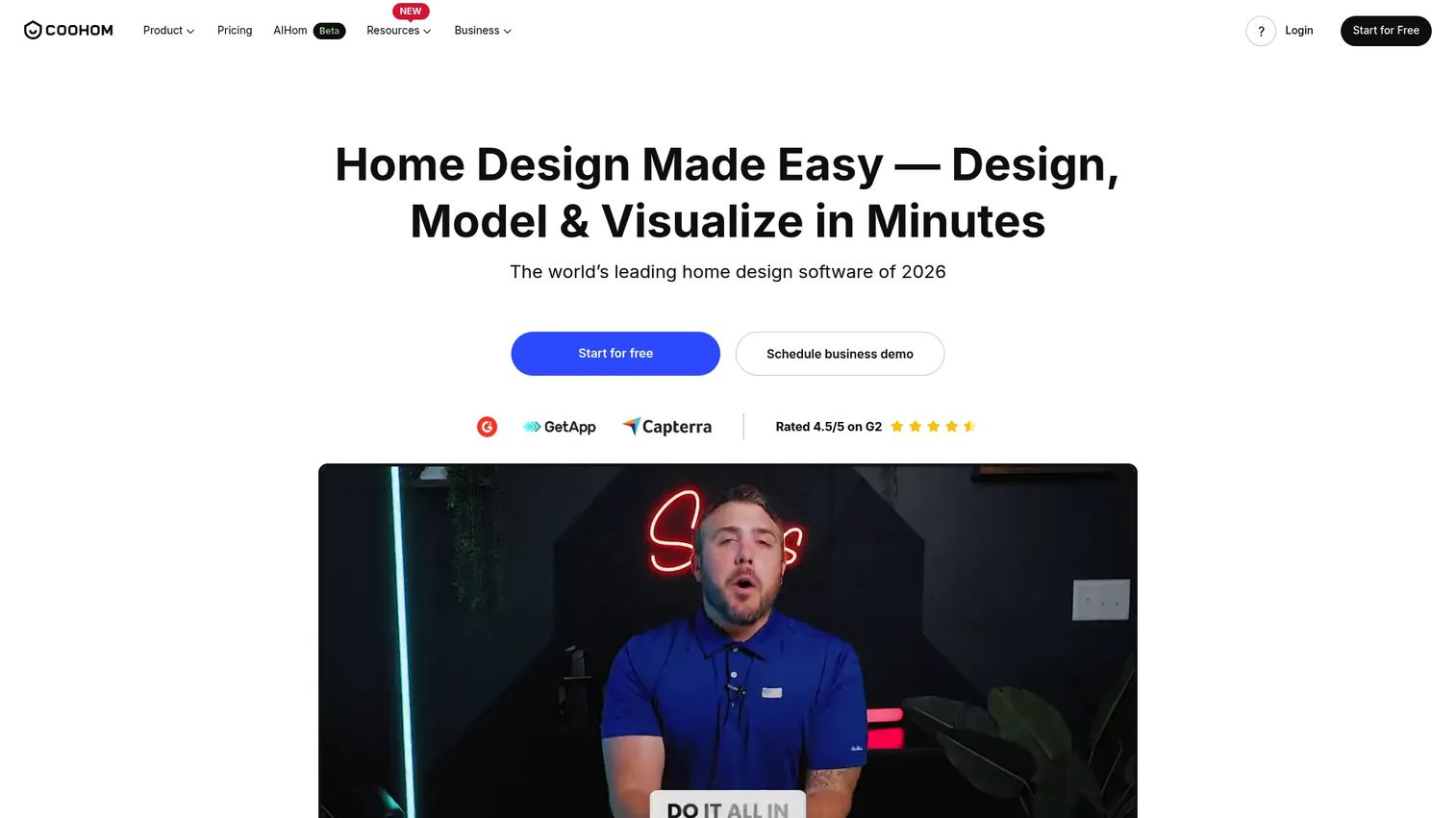
Coohom is cloud-based 3D home design, rendering, and collaboration software. It specializes in spatial visualization: 3D home design, AI rendering, floor planning, and a brand and model library with collaboration tools. For categories where the product lives inside a room, furniture, kitchens, interiors, cabinetry, Coohom lets buyers and designers visualize products in a realistic spatial context. That room-based 3D product configurator software angle sets it apart from flat-product configurators.
Best for: Interior designers and small teams needing online 3D design and rendering.
Key strengths
- 3D home design and floor planning: Place and configure products within full room layouts so buyers see them in context.
- AI home design and rendering: Generate photorealistic renders quickly, reducing the time from concept to a shareable visual.
- Brand and model library with collaboration: Reuse models and collaborate across teams to keep designs consistent and on-brand.
Why choose Coohom: Coohom is the right call when the buying decision depends on how a product looks in a space, not just on the product alone. Its spatial design and rendering make it strong for room-based purchases where context drives confidence. Designers and small teams get professional 3D visualization without a heavy desktop CAD workflow.
Coohom pricing: Coohom offers a free tier alongside paid plans. Per G2's listing, Pro pricing starts around $25 per user per month billed annually, with a monthly option and a custom Enterprise tier. Confirm current figures on Coohom's pricing page. Coohom holds a 4.5/5 rating on G2.
7. VividWorks
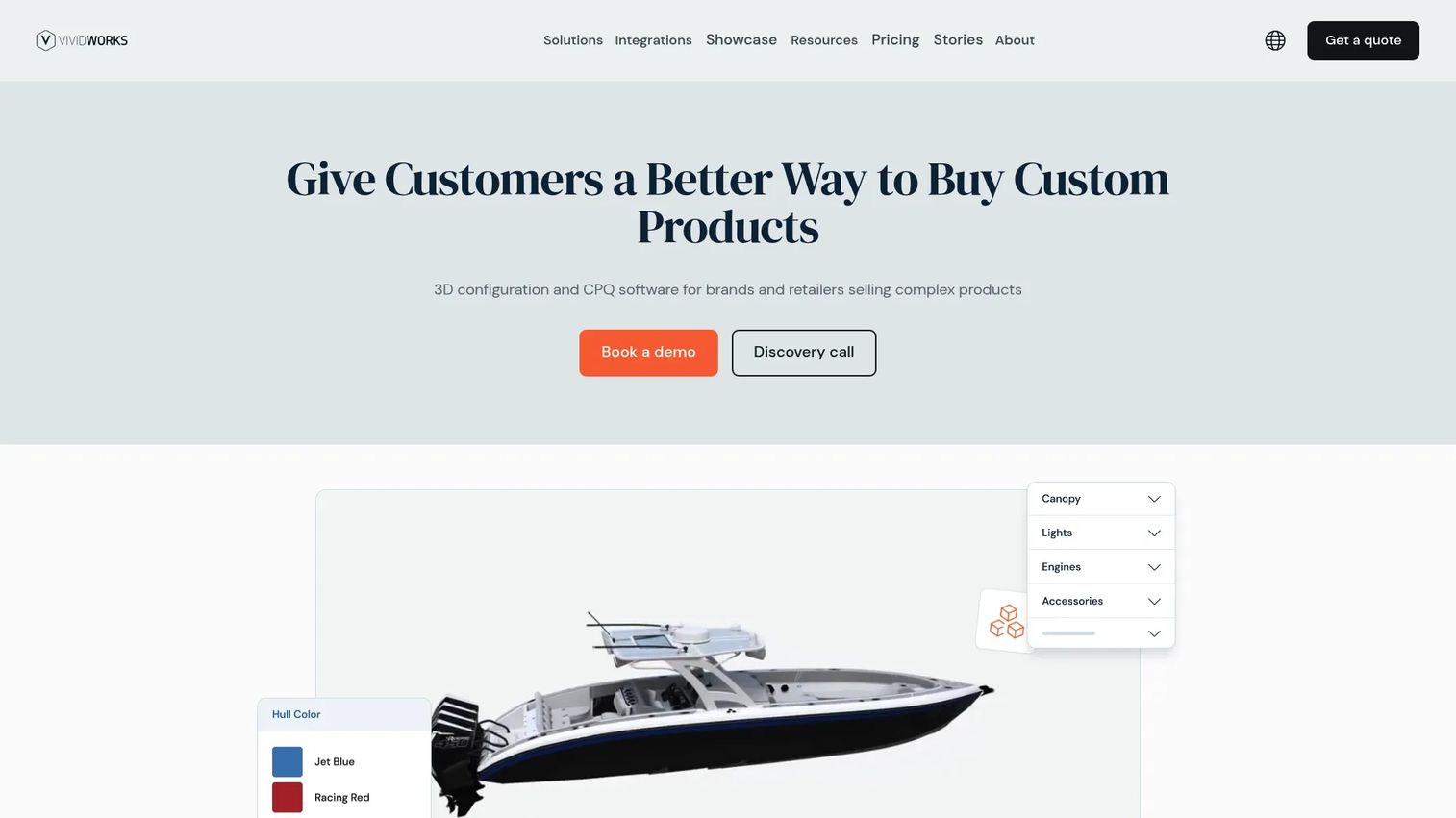
VividWorks is 3D product configuration and Visual CPQ software for customizable and modular products. It is built for B2B brands selling customizable furniture, interiors, and other complex products online, with real-time 3D configuration, modular product support, and instant quote generation. VividWorks supports white-label deployments, so manufacturers and retailers can run the configurator experience under their own brand. That white-label flexibility makes it a strong visual merchandising layer for B2B sellers.
Best for: B2B brands selling customizable furniture, interior, or other complex products online.
Key strengths
- Real-time 3D configuration: Buyers configure modular products and see accurate 3D results update as they go.
- Modular and complex product support: Handle products with many interdependent parts and configuration rules.
- Instant quote generation: Turn a finished configuration into a quote immediately, compressing the sales cycle.
Why choose VividWorks: VividWorks fits when you need a white-label visual configurator plus Visual CPQ for modular, made-to-order products. The combination of real-time 3D and instant quoting suits B2B sellers whose configurations carry directly into pricing and proposals. For brands that want the experience to feel native to their own site, the white-label option is the deciding factor.
VividWorks pricing: VividWorks publishes pricing across currencies and product lines. The first visible public price starts at €447/month for the Starter plan, with a Pro plan at €847/month and a custom Enterprise tier; equivalents are shown in USD and GBP. A free demo is offered, but there is no free tier. VividWorks holds a 4.5/5 rating on G2.
8. Combeenation
Combeenation is CPQ and 3D configurator software for complex, modular products. It targets mid-market manufacturers and sellers whose products demand serious compatibility logic, automatic pricing, and document generation. Combeenation leans into the rules engine: real-time 3D configuration, automatic pricing and discount calculation, and automated quotation. For teams where a wrong combination means a failed production run, that rules-driven foundation is the point.
Best for: Mid-market manufacturers and sellers with complex configurable products.
Key strengths
- Real-time 3D product configuration: Buyers build complex products visually with instant 3D feedback on every choice.
- Automatic pricing and discount calculation: Pricing and discounts update live as the configuration changes, keeping quotes accurate.
- Automated quotation and document generation: Produce quotes and documents automatically from a finished configuration, removing manual prep.
Why choose Combeenation: Combeenation is the pick when compatibility logic and configuration rules are the hard part of your catalog. Its CPQ depth and automated quoting suit ecommerce or manufacturing workflows where every order must be valid and priced correctly before it moves. For complex, rules-heavy products, that logic-first design carries the most weight.
Combeenation pricing: Combeenation publishes a starting price of from €697/month for its CPQ platform, with monthly license fees plus one-time implementation costs noted on its pricing page; other costs are personalized. There is no free tier. Combeenation holds a 4.7/5 rating on G2, the highest in this list.
Considerations before you buy
A configurator touches merchandising, production, and your tech stack. Pressure-test these five areas before you sign.
Integration fit
Map exactly how the tool connects to your storefront and back office. Confirm native support for Shopify and WooCommerce if you run them, and verify ERP, CRM, CPQ, and PIM integrations for pricing, inventory, and order handoff. A configurator that can't push a clean order downstream just moves the manual work to a different team.
3D and preview quality
Realism builds trust, but realism your buyers actually need depends on the category. High-consideration products often justify photorealistic or real-time 3D visualization; simpler personalization may only need 2D WYSIWYG. Test responsiveness on mobile and slower connections, since a laggy preview undermines the confidence you are trying to build.
Setup and ownership
Scrutinize no-code claims against your reality. Ask who builds the first configurator, who maintains product data as the catalog changes, and how long a typical launch takes. A true no-code configurator lets merchandising own the experience; a heavier platform may need engineering or vendor services. Match the workload to the team you actually have.
Workflow automation
Look past the preview to what happens after checkout. Evaluate output files, approval steps, manufacturing handoff, and post-order automation. The tools that compound value turn a finished configuration into print-ready files, BOMs, or quotes automatically, instead of leaving production prep to a person.
Proof and scalability
Check reviews, case studies, and whether the platform scales across categories, regions, and languages. A tool that fits one product line should also support your roadmap. Ask vendors for references in your industry and for ROI signals like conversion lift or returns reduction, not just feature lists.
Conclusion
The right visual product customization software depends on your business model, not on a leaderboard. For enterprise 3D commerce where photorealism drives trust, Threekit leads. For print-led and POD workflows, Zakeke pairs WYSIWYG customization with print-ready output. Zoovu owns guided selling and AI discovery for complex enterprise catalogs, while Kickflip gives SMB and mid-market teams a no-code configurator they can launch fast.
For print and packaging, DesignNBuy specializes in web-to-print. Coohom wins room-based and spatial visualization, VividWorks brings white-label Visual CPQ for modular B2B products, and Combeenation carries the heaviest rules-driven configuration and automated quoting.
Your next step: shortlist the two or three that match your model, then run a scoped pilot on a single product line. Measure conversion lift, returns reduction, and time-to-launch against your current static experience. The configurator that proves itself on one line is the one worth rolling out across the catalog.
FAQs
Visual product customization software lets shoppers configure and personalize a product visually, seeing every change rendered in real time before they buy. It replaces flat photos and text dropdowns with an interactive visual product configurator that reflects each option the buyer selects, which raises confidence and supports complex configurations without custom engineering.
A product configurator reduces returns in two ways. A live product preview sets accurate expectations, so what arrives matches what the buyer pictured, cutting returns driven by mismatched expectations. Conditional logic prevents invalid or impossible combinations before they reach production, eliminating returns caused by orders that could never be fulfilled correctly.
Among the tools here, Threekit, Zakeke, Zoovu, Coohom, VividWorks, and Combeenation all offer 3D product configurator software capabilities. Threekit and VividWorks emphasize photorealistic and modular 3D configuration, Coohom specializes in room-based spatial 3D, and Combeenation pairs real-time 3D with deep CPQ logic.
A product customizer software tool focuses on visual personalization, like adding text, artwork, or colors to a base product, with a WYSIWYG preview. A full product configuration platform handles complex rule sets, compatibility logic, pricing automation, and production output. Many platforms now combine both, so the line is blurring, but the distinction still guides which tool fits a given catalog.
Many visual product customization tools integrate natively with Shopify and WooCommerce, and several also connect to ERP, CRM, CPQ, and PIM systems for pricing, inventory, and order handoff. Always confirm the specific integrations you need on the vendor's site before buying, since depth of support varies by platform and plan.
Yes, several tools generate print-ready output. Zakeke is built around print-ready file generation for POD and dropshipping, and DesignNBuy centers on web-to-print storefronts with production-ready output automation. If print production is core to your business, prioritize tools whose workflow automation ends in usable files, not just an on-screen preview.
It varies widely by tool and catalog complexity. A no-code configurator like Kickflip can go live in days because merchandising teams own setup, while enterprise platforms with deep ERP, CPQ, and PIM integrations and large 3D asset libraries can take weeks or months. Scope your timeline against catalog size, integration needs, and who maintains product data internally.
Common categories include furniture and interiors, apparel and merchandise, eyewear, signage and print, packaging, promotional products, industrial and modular equipment, and home goods. Any business selling configurable, made-to-order, or personalized products where buyers need to see their exact configuration before purchase is a strong fit for a product configurator website.