You open the freezer, the reagent drawer is empty, and the shared spreadsheet still shows 3 units in stock. The reorder request is buried in an email thread from two weeks ago. Meanwhile, the experiment is on hold.
Bad inventory data costs labs more than time. According to a 2025 survey by Titian Software and Labguru, only 15% of labs reported being fully digitized, while half still relied heavily on manual processes. The same survey found that 65% of life-sciences respondents ranked reagent and supply inventory management as the technology they were most interested in adopting. The market for laboratory inventory management software is growing accordingly: Straits Research (2026) estimated the global market at $2.36 billion in 2025, forecast to reach $5.31 billion by 2034.
The challenge is not finding a tool. It is finding the right one for how your lab actually works, whether that means procurement-first, LIMS-native, chemical safety-focused, or a lightweight tracker that replaces spreadsheets.
This guide compares 12 options and helps you cut through the noise.
What's inside
This guide covers 12 lab inventory management software tools for 2026. It is written for lab managers, research operations leads, biotech ops teams, compliance and QA staff, and product or platform managers supporting internal lab software decisions.
Tools were selected based on:
- Inventory fit: Does the core workflow match how your lab tracks items?
- Procurement depth: Can the system handle requests, approvals, and orders?
- Compliance support: Are audit trails, lot tracking, and role permissions present?
- Scalability and integrations: Does it connect to your existing ELN, LIMS, ERP, or accounting stack?
Pricing and G2 ratings were verified against live vendor pages and G2 listings.
TL;DR
- Best procurement-first option: Quartzy, for labs where supply ordering and approvals are the primary workflow
- Best all-in-one lab management option: Labguru, for research teams that want ELN, LIMS, inventory, and ordering in a single platform
- Best LIMS-native inventory option: LABWORKS LIMS, for testing labs that need inventory tied directly to sample and results workflows
- Best chemical inventory option: BIOVIA CISPro, for regulated labs managing hazardous materials and SDS compliance
- Best enterprise LIMS options: LabWare or LabVantage, for complex multi-site labs standardizing inventory inside a larger informatics architecture
- Best lightweight trackers: eLabInventory or LabSuit, for smaller teams replacing spreadsheets without a full LIMS rollout
What is lab inventory management software?
Lab inventory management software is a system for tracking laboratory materials, supplies, chemicals, reagents, samples, equipment, locations, stock levels, ordering activity, and usage history.
The core job is simple: Know what you have, where it is, and when to reorder. But in practice, these systems vary significantly in scope and architecture.
Core capabilities
Most lab inventory management systems cover some combination of:
- Stock quantity tracking by item, lot, and unit
- Storage location mapping at the site, room, freezer, shelf, or drawer level
- Expiration date and lot number tracking
- Low-stock alerts and reorder triggers
- Purchase request workflows with approval routing
- Barcode, QR code, or RFID scanning (see our guide to barcode inventory software for broader context)
- SDS and hazard information for chemical items
- Audit trails for regulated labs
- Reporting by project, grant, team, vendor, or material type
- Integrations with LIMS, ELN, ERP, or accounting systems
Tool categories in this guide
Not all lab inventory tools are built the same way. The options here fall into five categories:
- Dedicated inventory systems: Focused on item tracking, location management, and reorder workflows
- LIMS platforms with inventory modules: Inventory sits inside a broader sample and workflow management system
- ELN and lab management suites: Inventory is one module alongside notebooks, equipment, and reporting
- Procurement-first platforms: Ordering, approvals, spend visibility, and supplier workflows drive the design
- Operations and safety platforms with inventory features: Inventory is part of a broader inspection or compliance workflow
The right category depends on where your lab needs inventory data to live and who owns it day to day.
When to use lab inventory management software
Replace spreadsheets before they become operational debt
A shared spreadsheet works until multiple users, multiple storage locations, or approval requirements enter the picture. Reagent quantities get updated in one file while order requests live in another, and usage history disappears entirely. By the time the audit request arrives, reconstructing that history takes days.
Track regulated chemicals and expiring materials
Labs handling hazardous chemicals, restricted reagents, or materials with short shelf lives need more than a quantity column. Lot numbers, expiration dates, SDS access, container-level tracking, and a full audit trail are the minimum for staying ahead of compliance reviews. Chemical management software in a dedicated system makes all of that searchable and reportable.
Connect inventory to purchasing and lab operations
Inventory data should trigger reorder points, approval workflows, and purchase orders automatically. Without that connection, stockouts happen because no one saw the alert, duplicated orders happen because two people placed the same request, and finance has no visibility into where lab spend is going. Good audit management software practices start with a system where every transaction is recorded.
Lab inventory management software comparison
Use this table as a first-pass filter. Validate pricing, integrations, compliance requirements, and implementation effort before committing to a shortlist.
| # | Product | Best for | Key differentiator | Pricing | G2 rating |
|---|---|---|---|---|---|
| 1 | Quartzy | Procurement and inventory in one workflow | Request and approval workflows with Quartzy Shop | From $50/mo | 4.3/5 |
| 2 | Labguru | All-in-one ELN, LIMS, and inventory | Integrated lab management with AI features | Quote-based | 4.6/5 |
| 3 | LABWORKS LIMS | LIMS-native inventory for testing labs | Sample-to-results traceability with inventory | From $20k implementation | 5.0/5 |
| 4 | Mitti | Frontline operations and asset tracking | Inspections, training, and mobile asset management | Free plan; from $24/seat/mo | 4.6/5 |
| 5 | SafetyCulture | Safety, inspection, and compliance workflows | Mobile-first inspection platform with asset tracking | Free plan; from $24/seat/mo | N/A |
| 6 | LabCollector | Modular sample and inventory tracking | Startup Pack free; add modules as needed | Free tier; from $550/user/yr | 4.2/5 |
| 7 | BIOVIA CISPro | Chemical and hazardous material management | Container-level tracking with SDS and regulatory reporting | Quote-based | 4.8/5 |
| 8 | LabWare | Enterprise LIMS with workflow automation | Configurable LIMS across SaaS and self-hosted deployments | Quote-based | 4.5/5 |
| 9 | LabVantage | Multi-site enterprise informatics | Integrated LIMS, ELN, LES, SDMS, and analytics | Quote-based | 3.8/5 |
| 10 | eLabInventory | Focused sample and storage tracking | Centralized sample database with barcode labels | 30-day free trial; paid by quote | N/A |
| 11 | Benchling | R&D inventory connected to experiments | Unified scientific data platform with AI | Quote-based | 4.5/5 |
| 12 | LabSuit | Lightweight supply and order management | Free platform with integrated lab shop | Free | 0.0/5 (no reviews) |
Best 12 lab inventory management software for 2026
1. Quartzy
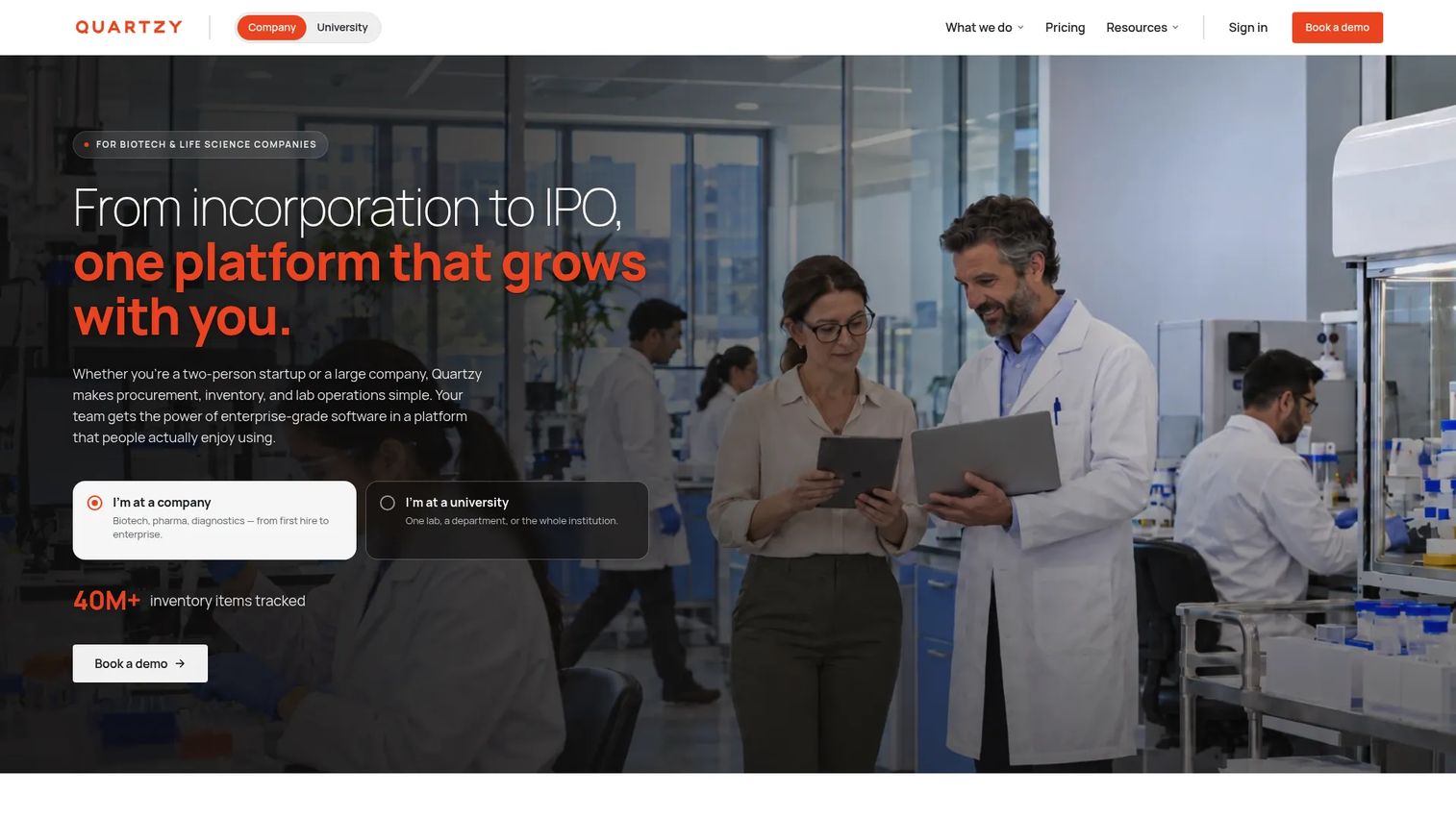
Quartzy is a lab operations platform built around the intersection of inventory tracking and lab procurement. It covers inventory by storage location, purchase request workflows, customizable approval routing, and real-time spend reporting. The integrated Quartzy Shop gives labs access to supplier catalogs with consolidated purchase orders and free standard shipping above $199.
Best for: Life-science research labs and research organizations that want inventory and purchasing to work inside the same workflow.
Key features
- Inventory by location with low-stock alerts and mobile barcode scanning
- Purchase request workflows with configurable approval routing
- Quartzy Shop with supplier catalog access and consolidated POs
- Spend visibility by team, project, or budget
- Integrations with accounting, ERP, and procurement systems via API and webhooks
Why choose Quartzy: Quartzy fits labs where the inventory problem is really a purchasing problem. If your team spends more time managing order requests and approvals than tracking freezer locations, this is where to start. It aligns research, lab ops, and finance around a single data source.
Quartzy pricing: The Academia plan starts at $50 per month (billed annually) and includes 3 users. The Industry plan is $250 per month (billed annually) with 5 users. Enterprise pricing is quote-based and includes unlimited users and custom integrations.
G2 rating: 4.3/5
2. Labguru
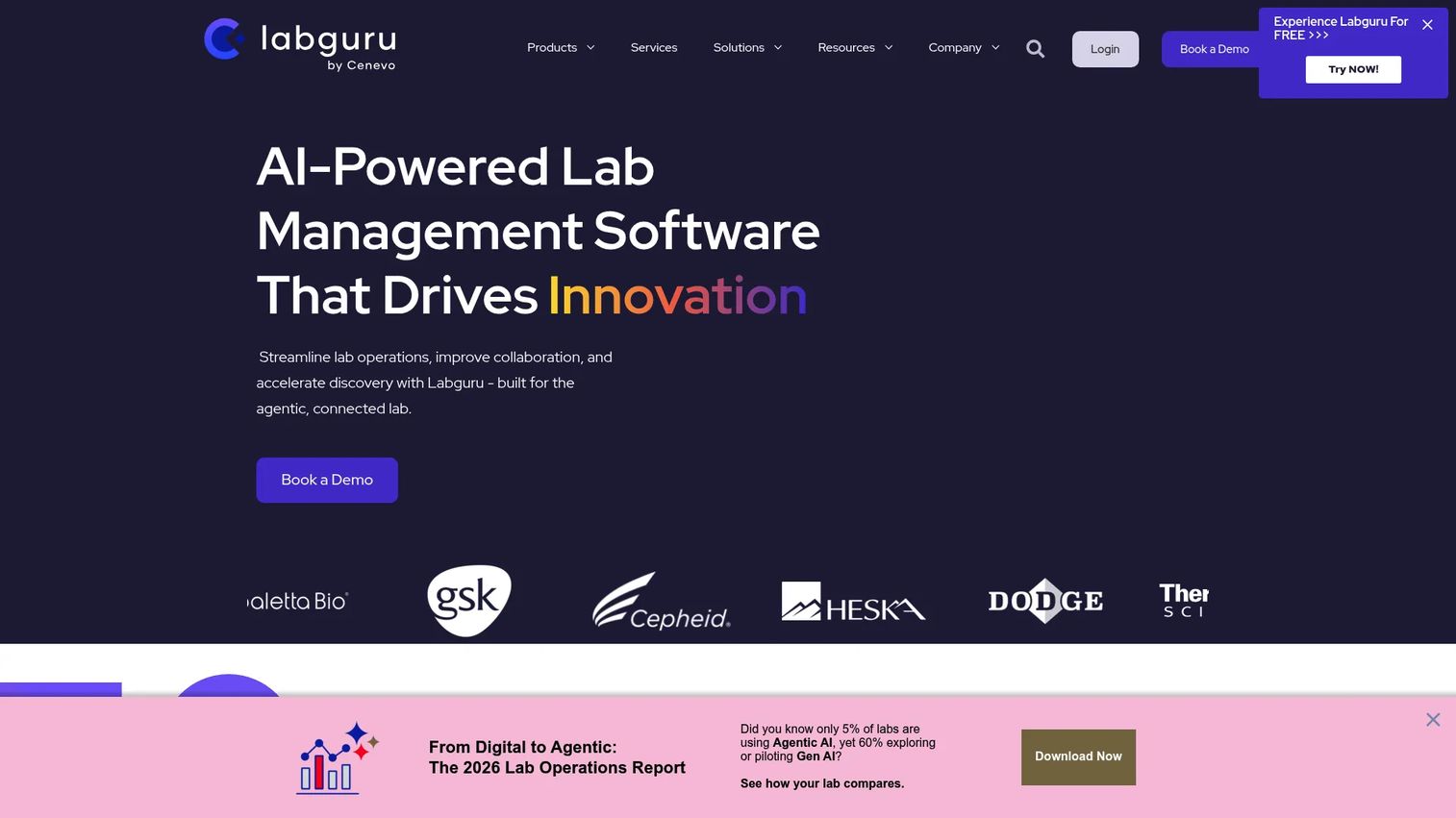
Labguru is an AI-powered, cloud-based lab management platform that combines ELN, LIMS, inventory, ordering, sample tracking, equipment management, and data visualization in a single system. It targets biotech, pharma, academic, CRO, and QC labs that want all core lab operations in one place rather than stitched across multiple tools.
Best for: Research teams that want inventory connected to experiments, protocols, and sample workflows inside a broader lab management platform.
Key features
- Electronic lab notebook with experiment planning and documentation
- Integrated inventory and sample management with ordering workflows
- LIMS for sample tracking, equipment scheduling, and compliance reporting
- Custom workflow automation with data dashboards
- Mobile app with barcode and QR labeling
Why choose Labguru: The case for Labguru is consolidation. If your team runs an ELN in one place, inventory in another, and sample records somewhere else, the operational cost of maintaining three systems adds up fast. Labguru handles that in one environment, though broader platform scope means more implementation planning upfront.
Labguru pricing: Labguru does not display pricing on its website. Contact sales for a quote; ask them to price by users, modules (ELN, LIMS, inventory), onboarding scope, and any compliance validation requirements.
G2 rating: 4.6/5
3. LABWORKS LIMS
LABWORKS LIMS is a configurable laboratory information management system that manages sample lifecycles, testing workflows, results entry, and inventory from a single platform. Its inventory module covers chemical tracking, kit readiness management, barcode labeling, hazard pictograms, vendor libraries, and full audit history from receipt through usage and reported results.
Best for: Testing labs that need inventory workflows integrated directly into sample management, QA, and regulatory reporting.
Key features
- Chemical inventory tracking with lot numbers and expiration dates
- Kit readiness management with test kit components and status
- Barcode labeling with hazard pictograms and GHS support
- Full audit history from receipt through usage to reported results
- Workflow automation with electronic signatures and approval routing
Why choose LABWORKS LIMS: If your lab's inventory question is inseparable from the sample question, LABWORKS handles both in one architecture. Traceability from the moment a reagent arrives to the moment a result is signed off is the core differentiator. Implementation costs scale with lab complexity.
LABWORKS LIMS pricing: Implementations start around $20,000 for a small lab with basic needs and can exceed $1 million for large, complex deployments. When requesting a quote, scope the LIMS module set, inventory requirements, users, migration, implementation services, and validation needs.
G2 rating: 5.0/5
4. Mitti
Mitti is a frontline workplace operations platform from SafetyCulture that covers inspections, training, issue reporting, asset management, and operational improvement. It is not a dedicated lab inventory system, but for labs where inventory checks, equipment maintenance, and safety inspections live inside a shared operational workflow, Mitti handles all of them from a mobile-first interface.
Best for: Teams managing safety, quality, compliance, training, and asset tracking across frontline or multi-site operations.
Key features
- Asset tracking and maintenance scheduling
- Inspection checklists and operational reports
- Training and onboarding workflows for frontline teams
- Issue reporting with corrective action tracking
- IoT sensor monitoring and AI-assisted issue creation
Why choose Mitti: Mitti makes sense when inventory is one part of a broader operational control layer, not the primary job. If your lab already needs structured inspection routines, equipment maintenance records, and safety reporting, Mitti handles those alongside asset visibility. For pure supply or reagent tracking, a dedicated inventory tool will go deeper.
Mitti pricing: The Free plan supports up to 10 seats. Premium plans start at $24 per seat per month (billed annually) or $29 per seat per month (billed monthly). Enterprise pricing is custom.
G2 rating: 4.6/5
5. SafetyCulture
SafetyCulture is a workplace operations platform built for digitizing inspections, managing tasks and assets, delivering training, and analyzing operational data. Labs that use it for inventory do so as part of a wider safety and compliance workflow, not as a standalone reagent or chemical tracker.
Best for: Frontline-heavy organizations that need mobile inspections, equipment checks, corrective action tracking, and safety compliance in a single system.
Key features
- Inspection checklists and digital audit forms
- Asset management with maintenance tracking
- Corrective action workflows and issue reporting
- Mobile-first forms with offline capability
- Analytics dashboards and operational reporting
Why choose SafetyCulture: Choose SafetyCulture when inventory checks are one component of a broader quality and safety management program. It is not the right fit for labs that need lot tracking, expiration date management, or reagent-level quantity control. For asset inventory software needs tied to equipment and operational compliance, it is a strong option.
SafetyCulture pricing: The Free plan covers up to 10 seats with limited data history. Premium plans start at $24 per seat per month (monthly billing; annual billing saves 17%). Lite seats can be added at $5 per seat per month (billed annually). Enterprise pricing requires contacting sales.
6. LabCollector
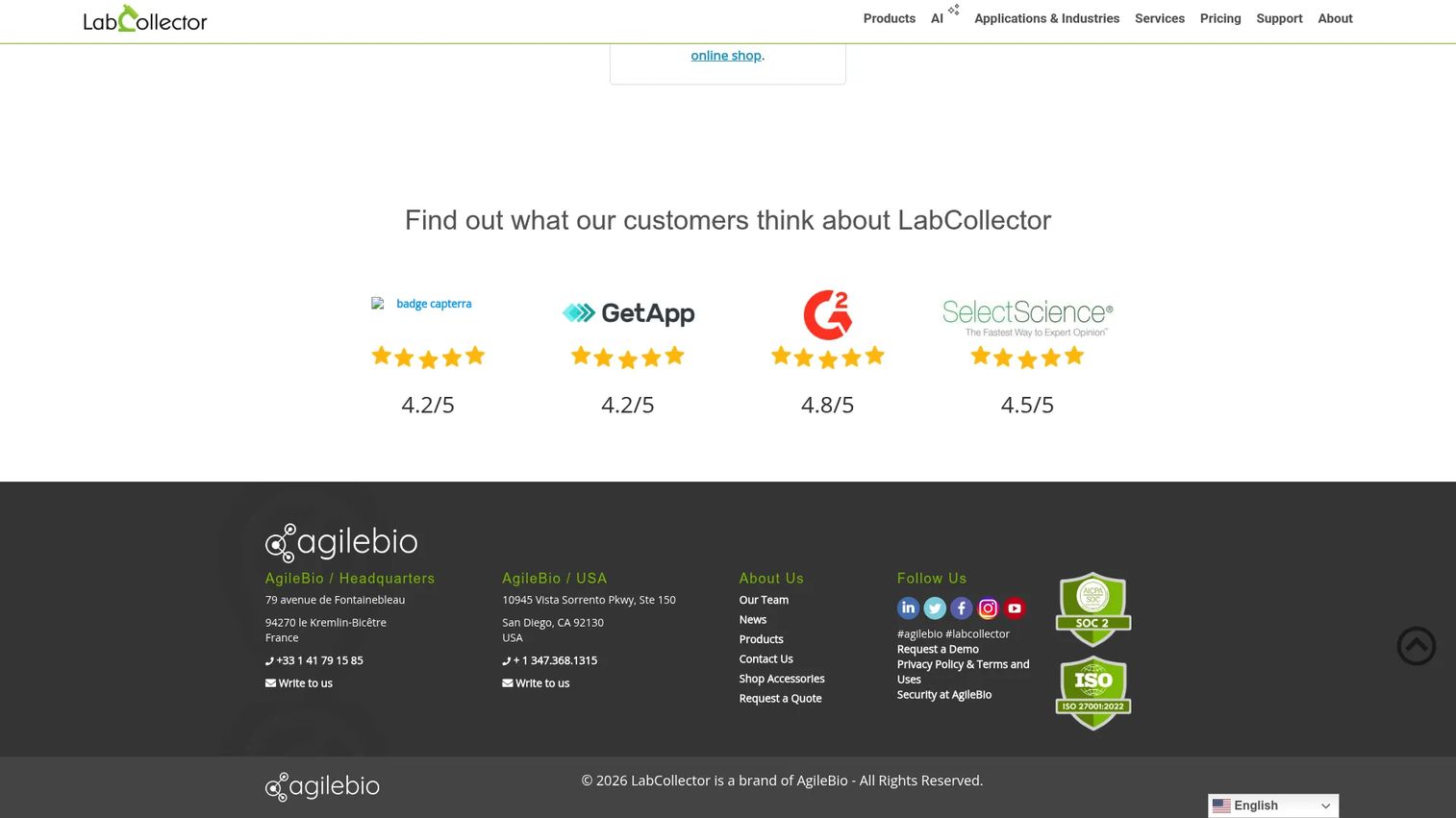
LabCollector is a modular laboratory information management platform covering sample management, reagent inventory, storage locations, equipment, and lab records. Labs can start with a free tier and add paid modules as their needs grow, making it practical for teams that want to test inventory workflows before committing to a broader LIMS rollout.
Best for: Research, biotech, pharmaceutical, and CRO labs that want modular inventory and sample tracking with the option to expand into LIMS and ELN functionality.
Key features
- Configurable inventory and sample management with custom fields
- Barcode and labeling tools for lab items and storage locations
- ELN with templates, workflows, and electronic signatures
- Equipment maintenance, reservations, and calibration tracking
- API connectivity and mobile inventory apps
Why choose LabCollector: The modular structure is the primary reason to consider LabCollector. Starting with the Inventory Pack lets a team prove the workflow before paying for LIMS or ELN capabilities. Academic pricing, multi-year options, and add-on modules are available; request a quote to confirm current rates for your lab size and configuration.
LabCollector pricing: The Startup Pack is free for up to 3 users and 1,000 records. The Inventory Pack starts at $550 per user per year (annual billing). LIMS/LIS Pack starts at $1,300 per user per year; ELN Pack starts at $900 per user per year. A limited-time ELN offer was listed at $35 per user per month.
G2 rating: 4.2/5
7. BIOVIA CISPro
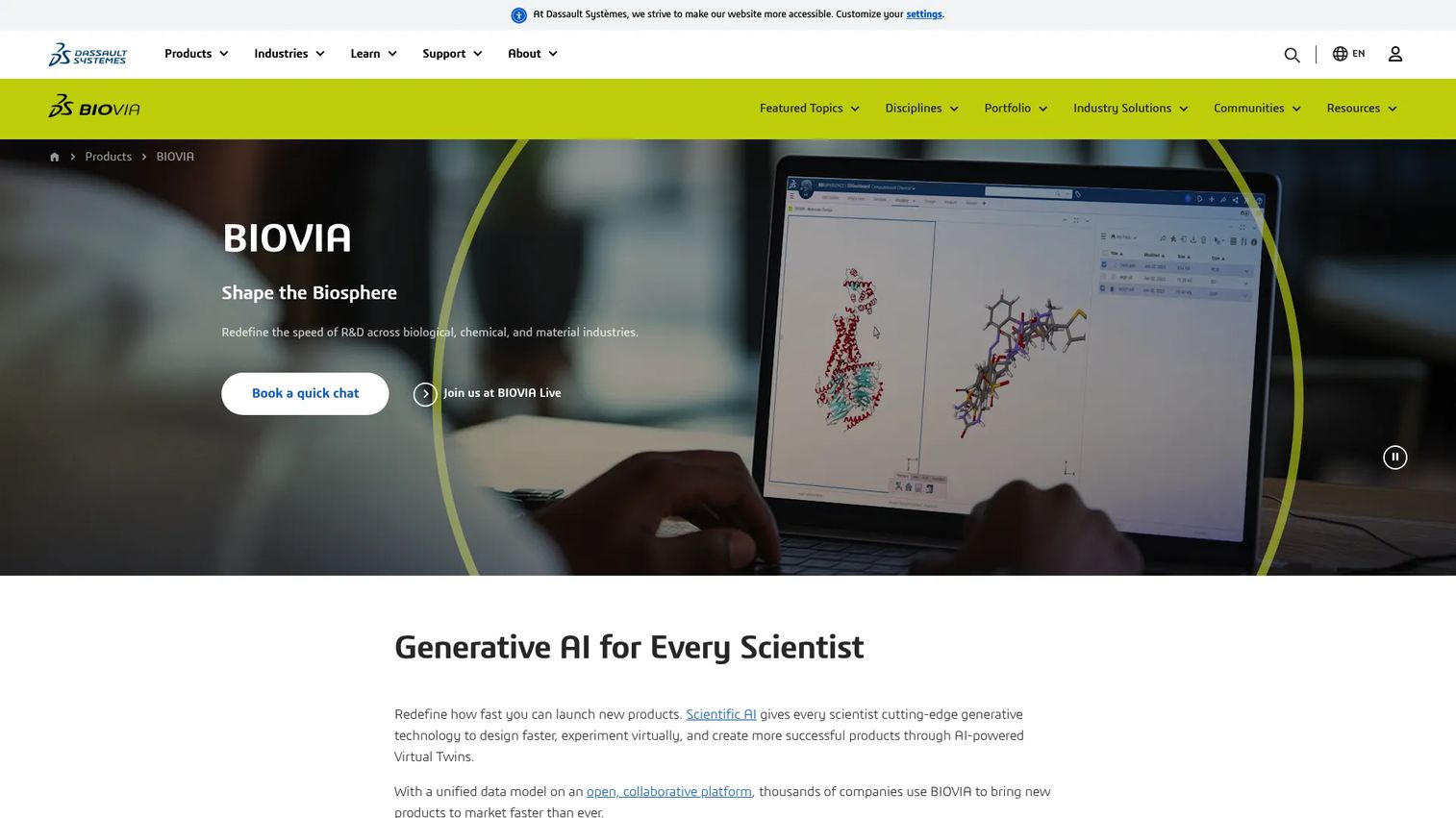
BIOVIA CISPro is chemical and material inventory management software designed for labs that need container-level tracking, Safety Data Sheet management, hazard information, and regulatory reporting. It covers multi-site and multi-tier storage hierarchies, barcode labeling, and audit trails from receipt through disposal.
Best for: Large, multi-site laboratories and regulated organizations managing chemicals, biological materials, and hazardous substances with strict traceability and compliance requirements.
Key features
- Container-level chemical and material inventory tracking
- SDS integration and hazard data management
- Barcode labeling with multi-site location hierarchy
- Regulatory reporting including Tier II and fire code compliance
- Audit trails from receipt to disposal, with cloud or on-premise deployment
Why choose BIOVIA CISPro: Put CISPro on the shortlist when chemical safety and material traceability are the primary drivers, not general supply management. The depth of its hazard and regulatory reporting is built for labs where an inspector asking for a full container history is a realistic scenario. Pricing is handled through sales; scope the deployment model, number of sites, integration requirements, and chemical inventory volume when requesting a quote.
BIOVIA CISPro pricing: Pricing is not displayed on the vendor's website. Contact Dassault Systèmes sales for a quote covering users, deployment model, sites, and required regulatory reporting modules.
G2 rating: 4.8/5
8. LabWare
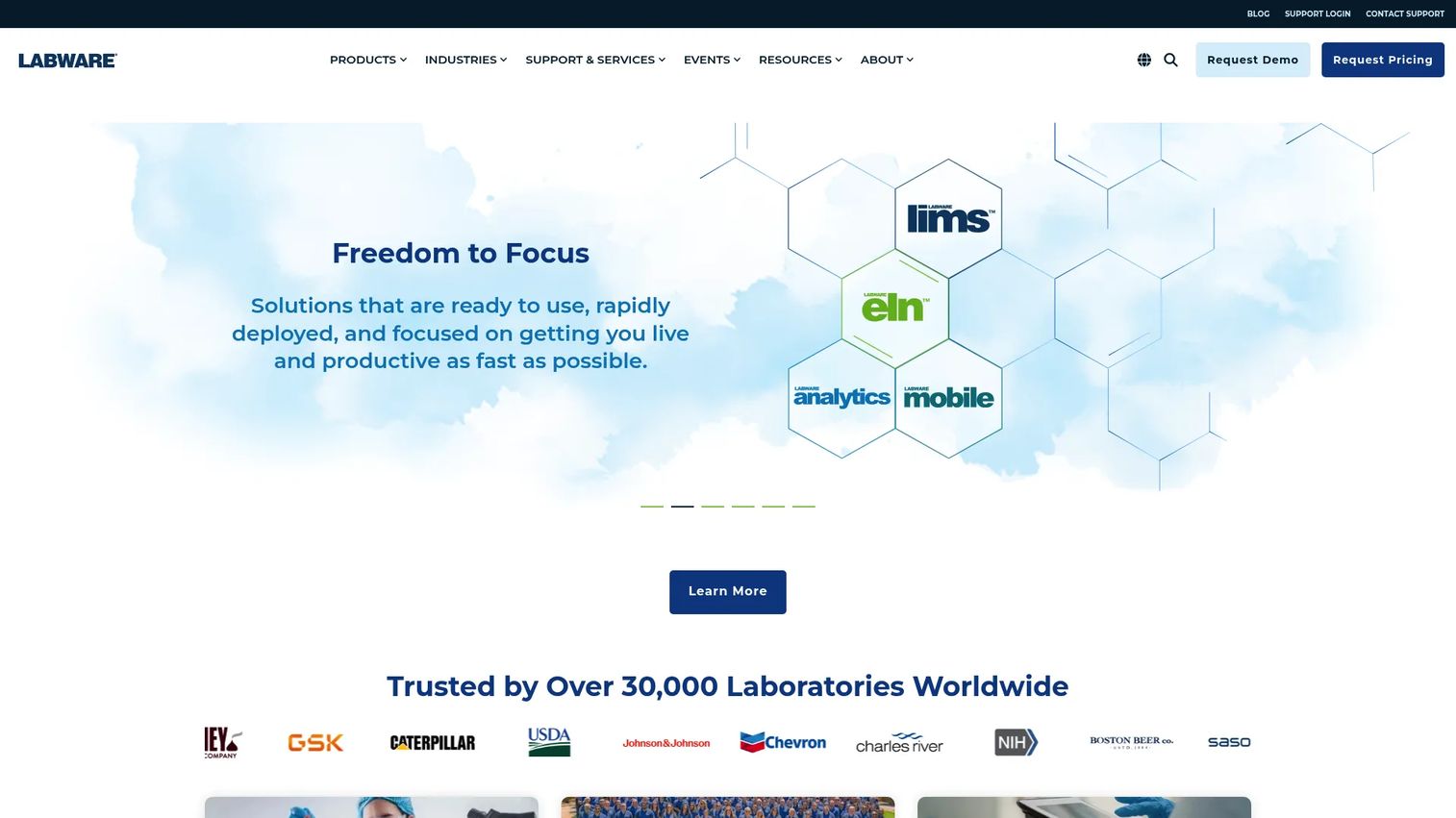
LabWare is a configurable laboratory information management system and ELN platform for regulated labs that need enterprise-scale workflow automation, sample tracking, instrument interfacing, and reporting. Inventory sits inside the broader LIMS architecture, with lot management, consumable tracking, and usage history tied directly to sample and test records.
Best for: Regulated and complex labs standardizing inventory inside an enterprise LIMS with workflow automation across multiple departments or sites.
Key features
- Sample and lot management with full traceability
- Instrument interfacing and data integration
- Workflow automation, dashboards, and analytical reporting
- Configurable deployment across SaaS, hosted cloud, or self-hosted
- Audit trails, electronic signatures, and regulatory compliance support
Why choose LabWare: LabWare is for labs where inventory is one module in a broader LIMS strategy, not a standalone purchase. The configuration depth is an asset for complex environments and a cost center for simple ones. Assess governance requirements, validation needs, and implementation timeline before engaging sales.
LabWare pricing: All pricing is quote-based. Ask sales to price the LIMS module set, inventory workflows, deployment model (SaaS or on-premise), validation requirements, implementation services, and ongoing support.
G2 rating: 4.5/5
9. LabVantage
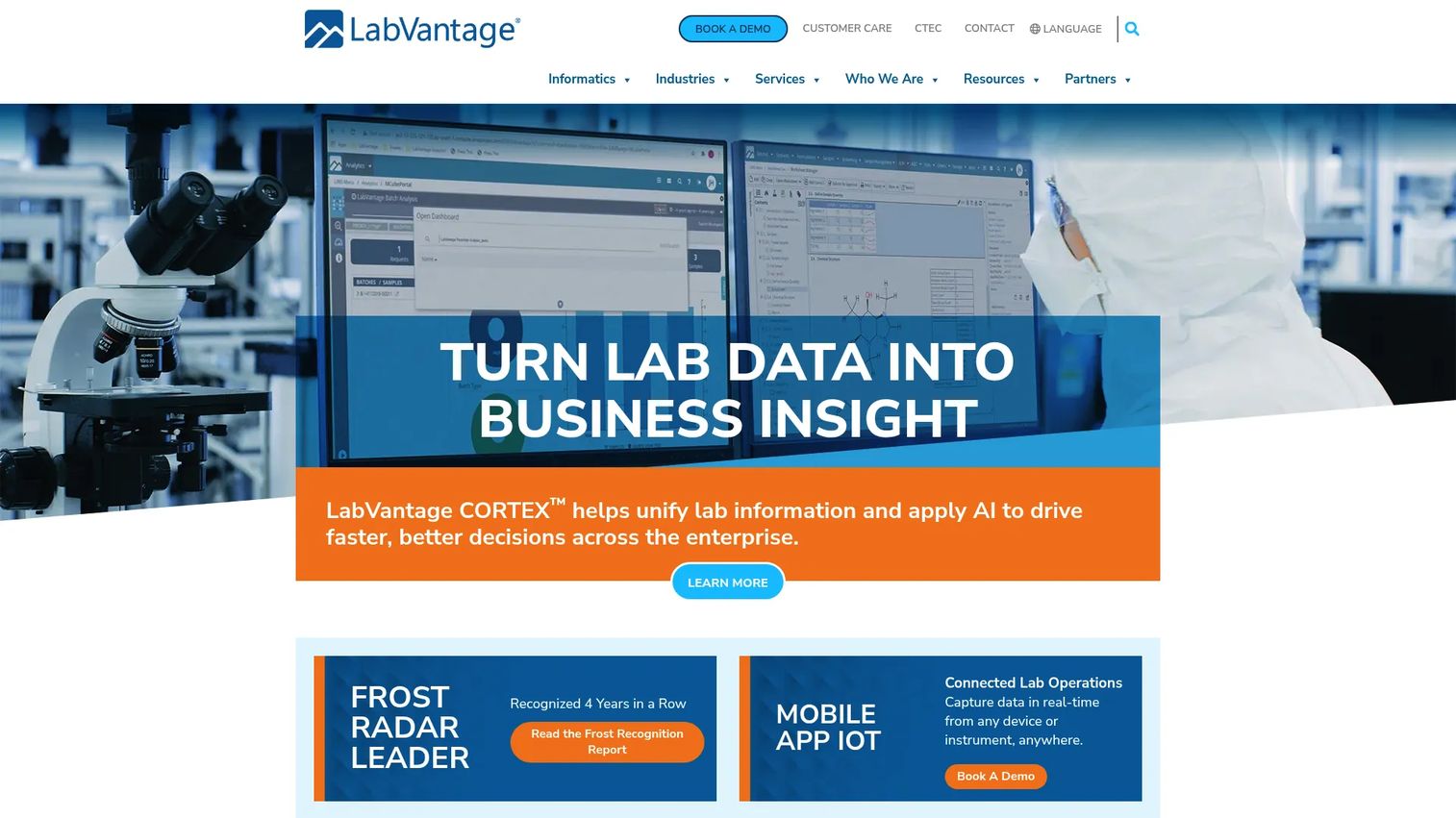
LabVantage is an enterprise laboratory informatics platform that integrates LIMS, ELN, laboratory execution, scientific data management, and AI capabilities in a browser-based, no-code-configurable environment. Inventory and consumables management are part of the sample lifecycle architecture, alongside stability studies, environmental monitoring, and instrument integration.
Best for: Medium-to-large regulated labs needing a unified informatics platform where inventory connects to sample management, audit trails, and enterprise system integrations.
Key features
- Integrated LIMS, ELN, LES, and SDMS in a single platform
- Sample lifecycle, consumables, and stability management
- Instrument and enterprise system integration via web services
- AI/ML capabilities and scientific data analytics dashboards
- Audit trails, electronic signatures, and regulatory compliance tooling
Why choose LabVantage: LabVantage suits labs where inventory data must connect to a wider regulated record system. G2 reviewers rate it at 3.8/5, lower than most tools in this list, so it is worth probing support quality, implementation timelines, and upgrade cycles during evaluation. Ask sales to price modules, user roles, validation requirements, and deployment and services scope.
LabVantage pricing: Pricing requires contacting sales. Structure the conversation around modules needed, user roles, deployment model, validation requirements, and implementation and support services.
G2 rating: 3.8/5
10. eLabInventory
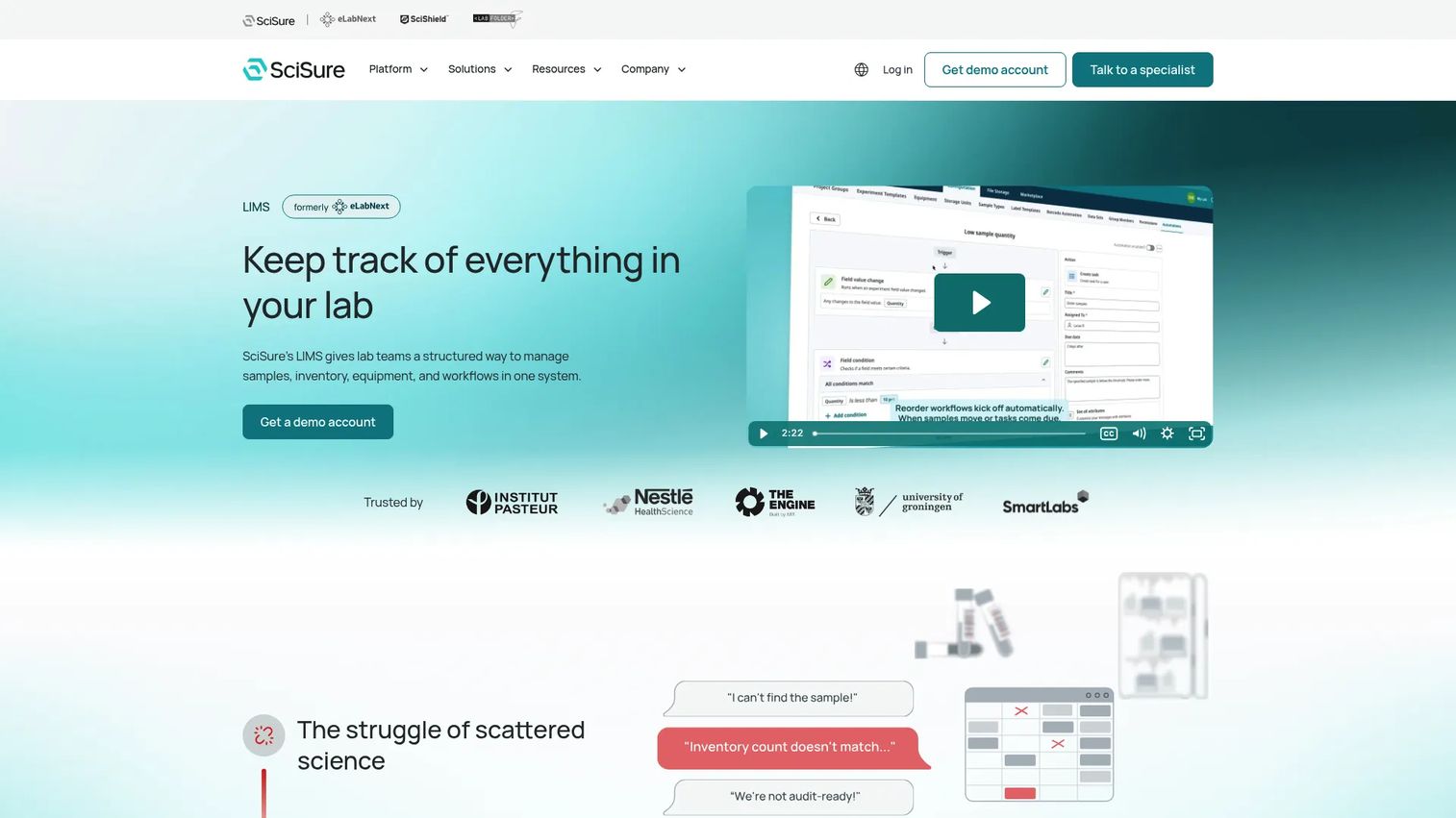
eLabInventory is laboratory information management software for tracking samples, inventory, equipment, and workflows. It is now part of SciSure, formed through the merger of eLabNext and SciShield. The platform provides a centralized sample database, storage location mapping, barcode label printing, user permissions, and calibration scheduling without requiring a full enterprise LIMS deployment.
Best for: Research and laboratory teams that need focused sample and inventory tracking with barcode workflows and user-level permissions, without committing to a broader LIMS rollout.
Key features
- Centralized sample database with real-time quantity tracking
- Storage mapping by location, freezer, box, and position
- Barcode label printing and scanning
- User roles and permissions with audit-ready access control
- Equipment tracking, calibration scheduling, and booking management
Why choose eLabInventory: eLabInventory fits teams that need structure around sample locations and consumable quantities without the implementation overhead of an enterprise system. The 30-day free trial is a practical way to test the workflow before committing. Paid pricing requires contacting SciSure directly.
eLabInventory pricing: A 30-day free trial is available. Paid plans require contacting SciSure for current pricing, which varies by lab size, user count, and required modules.
11. Benchling
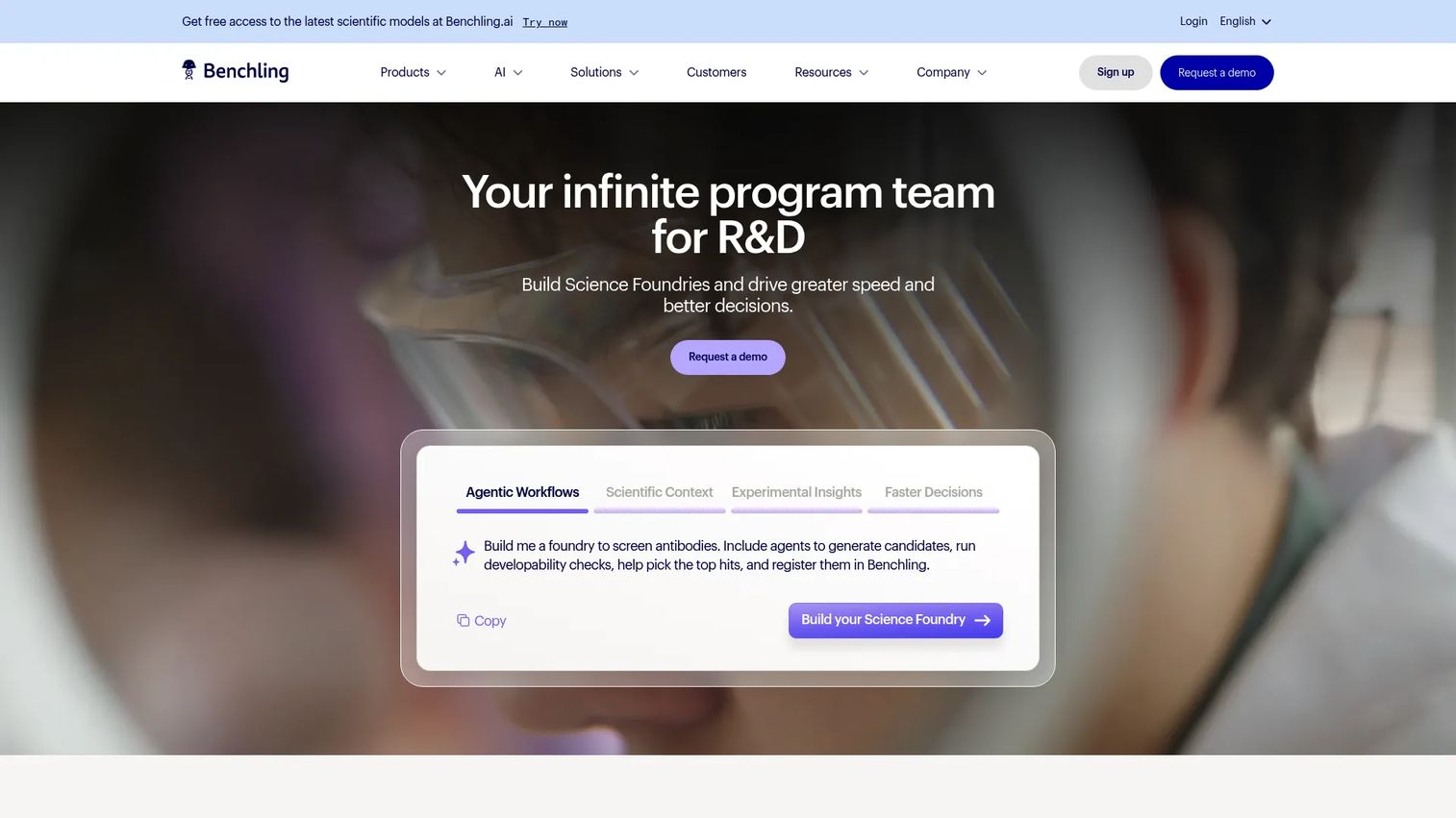
Benchling is a cloud-based R&D platform that unifies scientific data, experiment tracking, molecular design, inventory, and automation for biotechnology and life-sciences teams. Inventory sits inside a broader data model that connects reagents, samples, and materials to specific experiments, workflows, and registry entries.
Best for: Biotech and life-sciences R&D teams where inventory needs to stay connected to experimental data, molecular registries, and scientific workflows.
Key features
- Molecule, sample, and inventory management within a unified registry
- Collaborative ELN with structured data capture and templates
- AI-powered scientific capabilities with REST API and Python SDK
- Lab automation and instrument connectivity
- Scientific analytics and data warehouse integrations
Why choose Benchling: Benchling is the right call when inventory is inseparable from your research data model. It is not the right fit for smaller labs that only need supply tracking. The platform scope means a longer buying and implementation cycle; smaller teams should evaluate whether they need the full capability before entering a sales process.
Benchling pricing: Pricing is not displayed on the vendor's website. Contact Benchling sales for a quote; ask them to scope users, modules (ELN, inventory, registry, automation), data model requirements, integrations, and implementation services.
G2 rating: 4.5/5
12. LabSuit
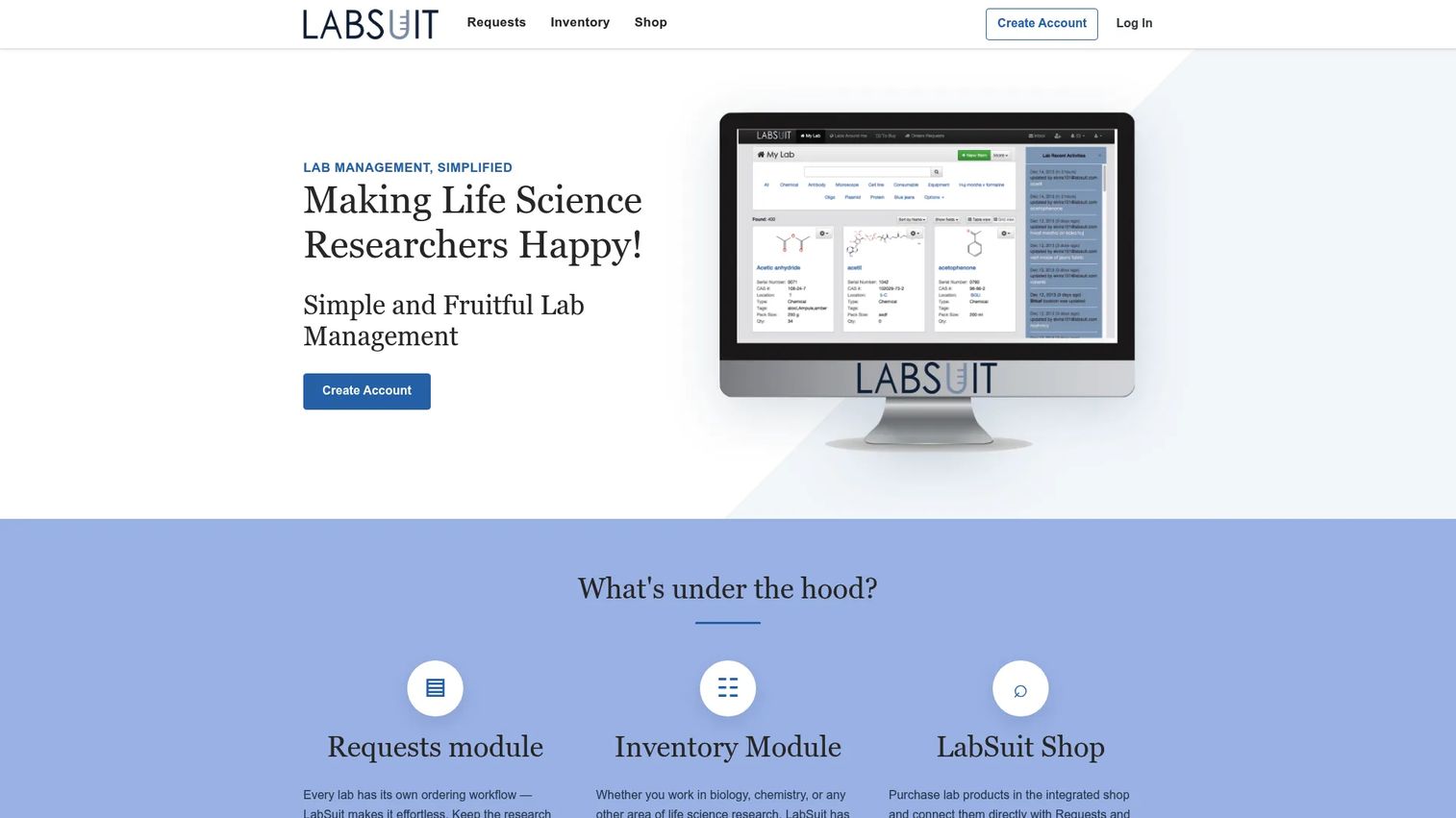
LabSuit is a lab management platform for life-science researchers covering inventory, order-request workflows, and an integrated lab products shop. The platform states it is provided free of charge; the integrated shop supports the business model and is currently available in selected locations.
Best for: Life-science research labs that need shared inventory and purchasing-request management without a software budget.
Key features
- Inventory management with custom item types, locations, tags, and MSDS attachments
- Order-request workflows with approvals, lifecycle tracking, and inventory synchronization
- Budget and grant reporting tied to order history
- Integrated LabSuit Shop with product search and quotation support
- CSV import and backup for spreadsheet migration
Why choose LabSuit: LabSuit is the practical choice for small labs replacing spreadsheets that want a structured inventory and ordering workflow without a subscription cost. The key buyer questions are adoption risk and whether the shop is available in your region. G2 shows no reviews yet, so references from similar labs are worth seeking before committing.
LabSuit pricing: LabSuit is free. The platform is supported by the integrated shop model. Shop availability varies by location.
Considerations when choosing lab inventory management software
Match the system to the lab's operating model
A small academic lab replacing a spreadsheet has different inventory needs than a multi-site biotech running regulated manufacturing workflows. Choosing a LIMS-scale platform for a three-person team creates maintenance overhead that competes directly with experiment time. Start by mapping where inventory decisions actually happen, and who owns them.
Decide where inventory data should live
Inventory data that lives in a procurement tool serves finance and purchasing. Inventory data that lives in a LIMS serves sample traceability and QA. Inventory data that lives in an ELN serves researchers connecting reagents to experiments. These are not the same system, and forcing one to do another's job creates data gaps. Decide on ownership before selecting a platform.
Check barcode, location, and lot tracking depth
Daily usability depends on how far the system goes with storage hierarchy: Site, room, freezer, shelf, drawer, box, and position. Lot numbers, expiration dates, and unit-of-measure tracking are equally important. Ask vendors to walk through a full reagent lifecycle, from receipt to low-stock alert, during evaluation.
Validate compliance and audit needs early
Regulated labs need audit trails, role-based permissions, electronic signatures, SDS access, and data retention policies before signing. Ask specifically which GxP or 21 CFR Part 11 requirements the platform addresses, and request documentation rather than accepting verbal assurances. Avoid relying on this article as compliance guidance; verify requirements with your QA team.
Price the implementation, not only the subscription
For LIMS and enterprise platforms, the subscription is rarely the largest cost. Migration from spreadsheets or legacy systems, validation, integration with existing ERP or accounting tools, label printer setup, user training, and ongoing administration add up. Request a total cost of ownership estimate alongside the annual license fee.
Conclusion
Lab inventory software fails when it tracks items but ignores the workflow around them. Picking the wrong category of tool, dedicated tracker versus LIMS module versus procurement platform, creates more friction than it removes.
Start with these shortcuts:
- Quartzy when purchasing and inventory need to work together inside a single approval workflow
- Labguru or Benchling when inventory should connect to R&D notebooks and experiment data
- LABWORKS LIMS, LabWare, or LabVantage when inventory belongs inside a broader LIMS architecture with sample traceability
- BIOVIA CISPro when chemical inventory and hazardous material compliance are the primary drivers
- eLabInventory or LabSuit when the team needs focused inventory control without overbuilding
A practical next step: Shortlist three tools based on data ownership, workflow fit, and compliance requirements. Run one reagent, one consumable, and one purchase request through a trial environment before buying. That 30-minute test surfaces more about daily usability than any feature comparison table.
FAQs
For small labs primarily tracking supplies and consumables, LabSuit (free), LabCollector's Startup Pack (free for up to 3 users), or eLabInventory (30-day trial) are the lowest-friction starting points. Labs that also need ordering workflows should evaluate Quartzy, which starts at $50 per month and includes purchase request routing. Prioritize tools with CSV import, barcode support, and minimal setup time.
A laboratory information management system (LIMS) manages samples, tests, results, workflows, and regulated lab data across the full sample lifecycle. Inventory software tracks materials, supplies, chemicals, locations, quantities, and purchasing activity. The two often overlap: Most LIMS platforms include inventory modules, and some dedicated inventory tools add sample tracking. The distinction matters when deciding which team owns the system and which workflows drive the architecture.
An ELN can help when inventory connects directly to experiments and protocols. It typically does not cover purchasing workflows, stockroom management, supplier relationships, or chemical compliance depth. The right answer depends on where daily inventory work happens. If researchers are placing orders and tracking quantities inside the ELN, evaluate whether a dedicated procurement layer would reduce friction for finance and lab ops.
Lot numbers, expiration dates, storage location to the container level, quantity and unit-of-measure tracking, SDS access, reorder alerts, and usage history are the core requirements. Regulated labs should also validate audit trail granularity, role-based permissions, and electronic signature support before selecting a reagent inventory management system.
Clean duplicates and standardize item naming conventions first. Map every storage location to the hierarchy the new system uses. Assign item owners and decide who is responsible for ongoing updates. Import a small pilot dataset, typically one freezer or one project's reagents, and run it in parallel with the spreadsheet for two to four weeks before full migration. Ask vendors whether they support CSV or Excel import and whether they offer migration assistance.
Lightweight tools like LabSuit are free, while LabCollector's Inventory Pack starts around $550 per user per year. Procurement platforms like Quartzy start at $50 per month. Enterprise LIMS platforms including LABWORKS, LabWare, LabVantage, and Benchling are all quote-based, and implementation costs for complex deployments can significantly exceed the license fee. The price varies by users, modules, deployment model, validation requirements, and services.
BIOVIA CISPro is the strongest purpose-built option for labs managing hazardous chemicals, with container-level tracking, SDS integration, hazard data, and regulatory reporting including Tier II and fire code requirements. LABWORKS LIMS also covers chemical inventory with hazard pictograms and audit history inside a broader LIMS environment. Evaluate chemical registry depth, SDS management, container tracking, and audit trail completeness. This guidance is operational, not legal or compliance advice; confirm regulatory requirements with your QA and EHS teams.
Many platforms connect to procurement, ERP, accounting, and punchout catalogs. Quartzy integrates with accounting and ERP systems via API and webhooks. LabVantage and LABWORKS support enterprise system integration through web services. Before buying, verify the exact integration, confirm which fields map between systems, and test the approval flow end-to-end. Reviewing our guide to asset lifecycle management software may also help teams thinking about longer equipment tracking workflows that extend beyond lab inventory.