You spent last quarter arguing with finance about staffing. They looked at sales. You looked at traffic. Neither of you had the same number, because nobody was counting the people walking through the door.
That gap is expensive. If you can't tie visitor volume to conversion, you're guessing at staffing, layout, and campaign impact. The global people counting system market hit USD 1.26 billion in 2024 and is projected to reach USD 3.53 billion by 2030 at a 13.7% CAGR, according to Grand View Research (2024). Retail, supermarkets, and shopping malls alone drive over 20% of that demand. The money is moving because the measurement finally works.
A good footfall counter turns door traffic into a metric you can defend in a budget meeting. It tells you how many people entered, when, how long they stayed, and whether marketing spend actually moved bodies through the door. The wrong tool gives you a sensor that overcounts strollers and staff, and a dashboard nobody trusts.
This guide compares seven footfall counting software options and helps you match one to your space, your privacy requirements, and your reporting depth.
What's inside
This guide is for retail operators, facilities teams, and growth marketers who need to measure physical foot traffic and tie it to outcomes. We selected tools based on four criteria that matter most when you're comparing vendors before a sales call:
- Counting accuracy and method: camera, ToF, thermal, or radar sensing, plus staff exclusion and bi-directional counting.
- Privacy and compliance: anonymized counting and GDPR-friendly handling for spaces with foot traffic.
- Reporting depth: dashboards, dwell time, heatmaps, and how easily data feeds your existing reports.
- Deployment fit: single store, multi-site retail, malls, offices, and mixed environments.
TL;DR
- Best for retail depth: FootfallCam covers in/out counting, staff exclusion, heatmaps, and queue counting with published retail pricing.
- Best for sensor variety: Milesight spans ToF, radar, thermopile, infrared, and AI camera counting across many verticals.
- Best for custom AI builds: Nextbrain Technologies fits teams wanting a bespoke video analytics implementation.
- Best for buyer education: MRI Software explains footfall counting clearly for teams new to the category.
- Best for camera-first sites: Axis Communications suits organizations already running Axis network cameras.
- Best for cost-conscious camera ecosystems: Hikvision offers broad surveillance and retail analytics hardware.
- Best for building occupancy: Acre Security fits offices and facilities needing occupancy and space utilization.
What is footfall counting software?
Footfall counting software is a system that measures how many people enter, exit, and move through a physical space, then turns those counts into analytics you can act on. It pairs a sensor at the entrance or in a zone with a dashboard that reports visitor count, dwell time, and traffic patterns over time.
A people counting system is the broader term for the same job. In practice, buyers use "footfall counter software" and "people counting system" interchangeably, though footfall usually implies retail context and conversion tracking.
Most platforms share a core feature set. When you evaluate customer counting software, look for:
- Bi-directional counting: separate in and out counts so you get accurate occupancy, not just a running tally.
- Staff exclusion: filter out employees so your visitor count reflects real shoppers.
- Dwell time tracking: how long people linger in a zone, useful for layout and merchandising.
- Heatmap analysis: visual maps of where people cluster and where they don't.
- Queue counting: monitor line length so you can trigger staffing before customers walk out.
- Zone analytics: counts broken down by department or area, not just the front door.
- Occupancy tracking: live headcount for capacity limits and safety.
- Reporting and integrations: day-wise reports, exports, and connections to your BI or retail stack.
The output that matters most is footfall analytics you can trust. Retail analytics only helps if the number is clean enough to sit next to sales in the same report.
When to use footfall counting software
Justify staffing with real traffic data
Schedule staff against actual visitor patterns, not gut feel. A store foot traffic counter shows peak hours by day and week, so you staff for the rush and cut hours during dead periods. This is usually the fastest payback: labor is your biggest controllable cost.
Measure conversion, not just sales
Sales alone doesn't tell you if a slow day was demand or execution. Pair a foot traffic counter with your POS and you get conversion rate: visitors who bought divided by visitors who entered. A soft sales day with high traffic is a conversion problem. A soft day with low traffic is a demand problem. Different fixes.
Prove marketing and campaign impact
Ran a promotion? A footfall counter shows whether it actually moved bodies through the door. For growth marketers, this closes an attribution gap that online-only tools can't touch: the connection between a campaign and physical visits. That's a number your CFO will believe.
Footfall counting software comparison
Here's how the seven tools compare on intent, standout capability, pricing, and rating. Use it as a shortlist starter, then read the sections below for fit.
| # | Product | Intent | Key use case | Pricing | G2 rating |
|---|---|---|---|---|---|
| 1 | FootfallCam | Retail footfall software | In/out counting, staff exclusion, heatmaps, queue counting | From $550 one-time | Not listed |
| 2 | Milesight | Multi-sensor people counting system | ToF, radar, thermopile, infrared, AI camera counting | From $1/device/year | Not listed |
| 3 | Nextbrain Technologies | Custom AI video analytics | Walk-in count, unique visitors, heatmap analysis | From $1,500/month | Not listed |
| 4 | MRI Software | Retail analytics platform | Footfall counting within property and retail operations | Custom | 4.2/5 |
| 5 | Axis Communications | Camera-based people counting | Video analytics, entry counting, occupancy | Custom | Not listed |
| 6 | Hikvision | Camera ecosystem footfall analytics | Entrance counting, queue monitoring, heatmaps | Custom | 3.8/5 |
| 7 | Acre Security | Building occupancy analytics | People counting, occupancy, space utilization | Custom | Not listed |
Best 7 footfall counting software tools
1. FootfallCam
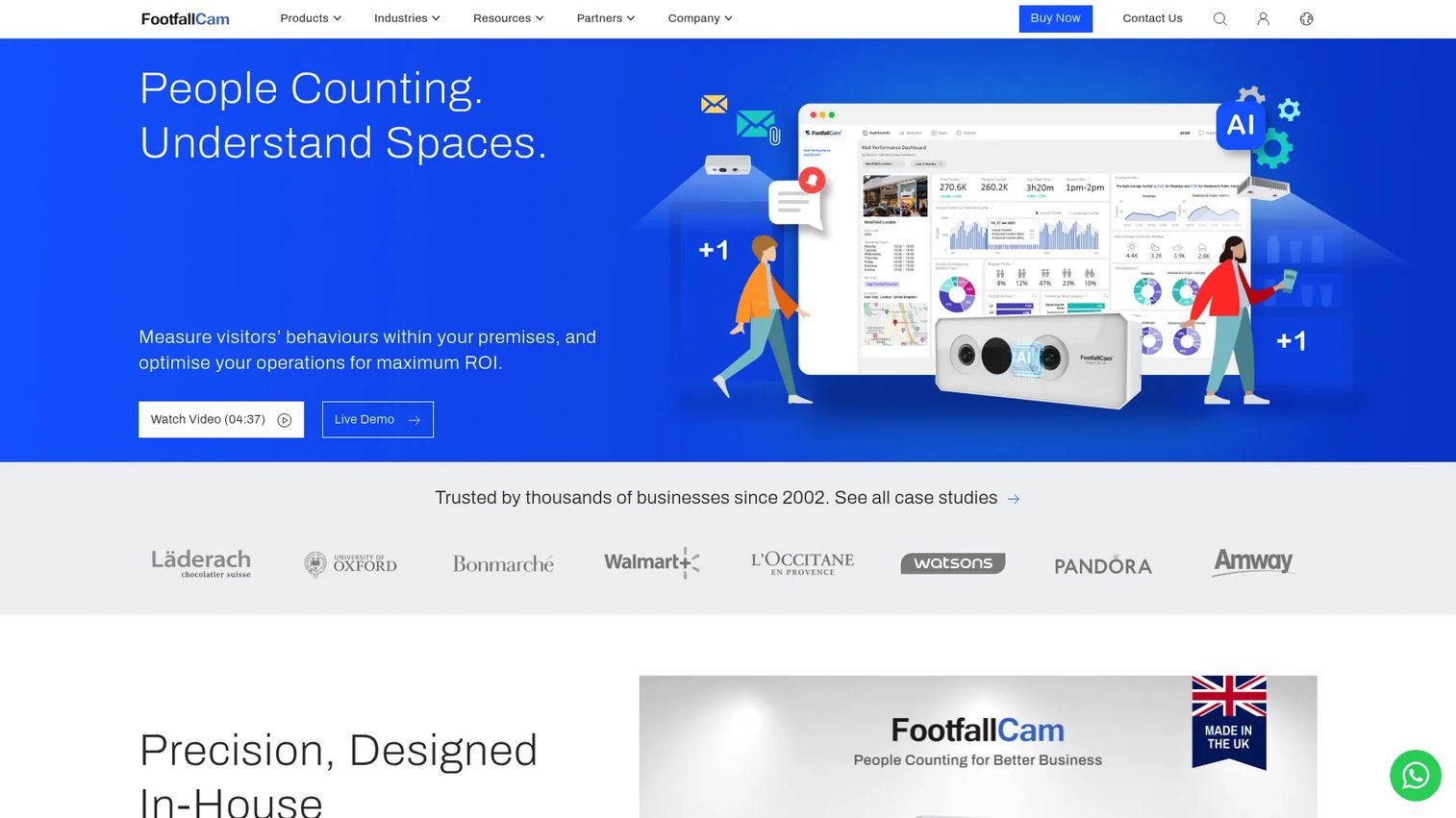
FootfallCam provides people-counting and retail analytics systems built specifically for measuring foot traffic and in-store behavior. It's the most retail-focused option here, with a feature set that maps directly to store operations. If your job is tying door traffic to conversion and staffing, this is the tool built for that conversation.
The platform covers bi-directional in/out counting, staff exclusion, group counting, occupancy, heatmaps, and queue counting. It also connects footfall to sales tracking and marketing ROI, which is where the data earns its keep. Wi-Fi analytics adds a layer for understanding repeat versus new visitors.
Best for: Retailers and multi-site retail operators who need accurate footfall measurement tied to store performance.
Key strengths
- Bi-directional in/out counting for accurate occupancy
- Wi-Fi analytics for repeat versus new visitors
- Heatmaps and queue counting for layout and staffing
- Staff exclusion so your visitor count reflects real shoppers
Why choose FootfallCam: It's the closest thing to an out-of-the-box retail footfall software here, with published pricing and a feature list aimed at store managers rather than security teams. If you want footfall analytics that speaks the language of conversion and staffing, start here.
FootfallCam pricing: Retail people-counting packages start at $550 (Essentials, one-time) and $1,100 (Standard, one-time). No free tier is offered.
2. Milesight
Milesight is an AIoT company offering video surveillance, intelligent traffic, and IoT sensing products. Its strength for footfall is sensor variety: if you have unusual entrances, mixed lighting, or privacy constraints, the range of counting methods gives you options a single-sensor vendor can't match.
The lineup spans AI camera counting, time-of-flight (ToF), radar, thermopile, and infrared sensing. That matters because a store with glass frontage behaves differently from a warehouse dock or an office lobby. Milesight supports bi-directional counting, zone analytics, and occupancy tracking, with anonymized counting for privacy by design.
Best for: Organizations that need to count across different entrances and environments, or want privacy-friendly sensing beyond cameras.
Key strengths
- AI-powered video surveillance and analytics
- Intelligent traffic and ANPR solutions
- IoT sensing, gateways, and cloud platform software
Why choose Milesight: The broad sensor taxonomy means you can match hardware to each site instead of forcing one method everywhere. For multi-site retail with varied storefronts, that flexibility keeps accuracy consistent across locations.
Milesight pricing: The Milesight Development Platform lists a Free plan, a Professional plan at $1/device/year, and a Private Cloud plan that requires contacting sales. Hardware is priced separately through distributors.
3. Nextbrain Technologies
Nextbrain Technologies is a custom software and digital transformation services company that builds AI video analytics for retail among its offerings. This is the pick when off-the-shelf doesn't fit and you want a counting system built around your exact workflow, data model, and reporting needs.
Its retail analytics work covers walk-in count, day-wise reports, unique visitors, new versus repeat detection, crowd detection, and employee exclusion. It extends into heatmap analysis and safety-oriented detection like intrusion, fire, and smoke, plus ongoing support and maintenance. Because it's a services engagement, the implementation flexes to your requirements.
Best for: Teams wanting a bespoke AI analytics implementation rather than a packaged product.
Key strengths
- AI/ML and generative AI development services
- Mobile and web app development
- Cloud, DevOps, and SaaS development
Why choose Nextbrain Technologies: If your counting needs are unusual, or you want footfall data wired directly into a custom dashboard, a build partner gives you control a fixed product can't. The trade-off is a project timeline instead of a plug-in setup.
Nextbrain Technologies pricing: Public pricing for hiring developers or a dedicated technical team starts at $1,500 to $3,999/month. Full project builds are quote-based.
4. MRI Software
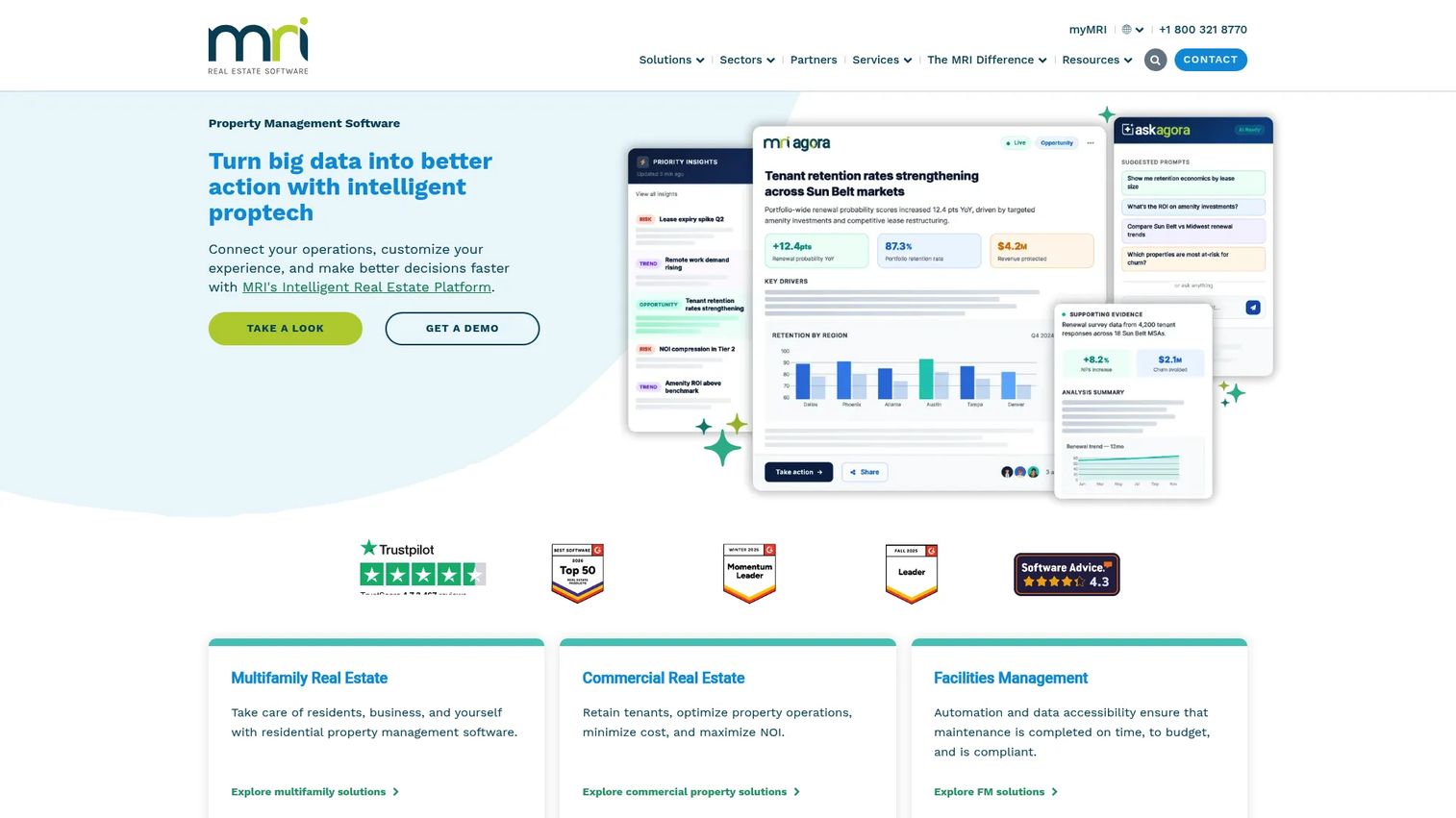
MRI Software is a real estate software platform for property management, reporting, and operational workflows, and it publishes strong educational material explaining footfall counting for retail. Use this one to get smart on the category and to connect footfall to a broader property and portfolio view.
Its guidance walks through what a footfall counter is, the sensor types available, and the benefits for staffing, layout, customer experience, and conversion. For teams new to the space, that framing helps you compare vendor features against the underlying theory before you commit budget. The platform itself brings AI-powered portfolio analytics and reporting through Rapid Reports and MRI Agora Intelligence.
Best for: Real estate operators and retail teams who want footfall data inside an enterprise property and analytics platform.
Key strengths
- Property management software for residential, commercial, and mixed-use portfolios
- AI-powered portfolio view and data management
- Reporting and analytics with Rapid Reports and MRI Agora Intelligence
Why choose MRI Software: If footfall is one input into a larger property and retail operations picture, an enterprise platform keeps everything in one reporting layer. It's less a standalone counter and more an analytics home for the data.
MRI Software pricing: MRI Software does not publish public pricing; the platform is available through a demo and request-info flow. MRI Software holds a 4.2/5 rating on G2.
5. Axis Communications
Axis Communications provides network video, access control, intercom, audio, and analytics solutions built on IP networking. For footfall, the value is camera-based people counting that layers onto surveillance hardware you may already run. If Axis cameras are in your stores, adding counting is often a software and configuration step rather than a new deployment.
The platform handles video analytics, store entry counting, and occupancy, with an integration-friendly architecture that fits security-led buyers. Because it's built for enterprise IP infrastructure, it plays well with existing VMS and networking setups.
Best for: Enterprises and public-sector teams that already use Axis network cameras and want to add counting.
Key strengths
- Network cameras and video surveillance solutions
- Access control and network intercom solutions
- Network audio and analytics solutions
Why choose Axis Communications: When you own the camera layer, counting on top avoids duplicate hardware and keeps everything under one security platform. It suits organizations where IT and security lead the buying decision.
Axis Communications pricing: Axis does not publish public pricing. Ordering and project pricing go through a local sales office or partner.
6. Hikvision
Hikvision is a global security and video surveillance brand offering hardware and software for cameras, access control, and management. For footfall, it delivers video-based entrance counting, queue monitoring, occupancy, heatmaps, and retail reporting across a broad camera ecosystem. Cost-conscious buyers comparing camera platforms often shortlist it for the hardware range.
The retail analytics feature set covers the practical basics: how many people entered, how long queues run, and where they cluster. If you're standardizing on one camera vendor across many sites, keeping counting inside the same ecosystem simplifies management.
Best for: Cost-conscious buyers comparing camera ecosystems who want footfall analytics built on the same hardware.
Key strengths
- Video surveillance products
- Access control solutions
- Security management software
Why choose Hikvision: A wide hardware range and a single-vendor camera ecosystem make it attractive when you're rolling out across many locations. As with any camera-based counting, confirm your privacy and data-handling requirements up front.
Hikvision pricing: Hikvision does not publish public pricing on its site; buyers order through distributors. Hikvision holds a 3.8/5 rating on G2.
7. Acre Security
Acre Security is a physical security platform for access control, intrusion detection, and visitor management, with people counting and occupancy analytics for building environments. Where the retail-first tools optimize for conversion, Acre optimizes for space utilization and safety across offices and facilities.
Its analytics cover people counting, occupancy, building analytics, queue monitoring, and space utilization. For facilities and multi-location environments, that combination answers a different question than retail conversion: how efficiently is the space being used, and are you within capacity limits?
Best for: Offices, facilities, and multi-location organizations needing occupancy and space utilization data.
Key strengths
- Cloud-native access control
- Intrusion detection
- Visitor management
Why choose Acre Security: If your priority is building occupancy and access control rather than retail conversion, a physical security platform brings counting into the same system as your door and visitor management. It's a facilities decision more than a merchandising one.
Acre Security pricing: Acre Security does not publish public pricing; the site routes buyers to book a demo or talk to sales, and pricing is quote-based.
Considerations before you buy
A shortlist is easy. The right pick depends on five things you should pressure-test before a sales call.
Counting accuracy and method
Ask how the sensor handles edge cases: strollers, groups, people loitering near the door, and staff walking in and out. Camera-based counting, ToF, thermal, and radar each behave differently in glass frontage, low light, and wide entrances. Get a stated accuracy figure and the conditions it was measured in.
Privacy and compliance
For any space with foot traffic, confirm how the system handles personal data. Anonymized counting that never stores identifiable images is the safest route for GDPR compliant people counting. If a tool uses facial recognition, understand exactly what it captures, stores, and for how long, then check it against your legal obligations.
Reporting depth and integrations
A count you can't act on is noise. Check whether the platform delivers dwell time, heatmaps, zone analytics, and day-wise reports, and whether it exports cleanly to your BI tool or POS. The goal is footfall data sitting next to sales in one report, not a separate dashboard nobody opens.
Deployment complexity and scale
A single store is a different project from a multi-site retail rollout. Ask about installation, calibration, and how the vendor keeps counts consistent across locations with different layouts. For camera-first buyers, confirm whether counting runs on existing hardware or needs new sensors.
Total cost over time
Look past the entry price to installation, calibration, software subscriptions, and support. A one-time hardware cost with an annual platform fee lands differently on a five-year budget than a fully quoted enterprise contract. Model the number your finance team will actually see.
Conclusion
Footfall counting software is an operational decision tool, not just a sensor. The right choice depends less on feature count and more on what question you're answering.
If you run retail and want conversion and staffing answers fast, FootfallCam is the most purpose-built pick, with published pricing and a store-manager feature set. If your entrances and environments vary, Milesight gives you the sensor range to keep counts accurate everywhere. Need a custom build? Nextbrain Technologies wires footfall into your exact workflow. Getting smart on the category first? MRI Software teaches it well and folds footfall into broader analytics.
For camera-led buyers, Axis Communications and Hikvision add counting to surveillance you may already own, with Axis leaning enterprise and Hikvision leaning cost-conscious scale. And if the question is building occupancy and space utilization rather than retail sales conversion, Acre Security fits offices and facilities.
Pick on accuracy, privacy, deployment fit, and reporting depth, in that order. Start with a shortlist of two, ask each for a stated accuracy figure and a sample report, and choose the one whose number you'd defend in a budget meeting.
FAQs
Footfall counting software measures how many people enter, exit, and move through a physical space, then turns those counts into analytics like visitor count, dwell time, and traffic patterns. It pairs an entrance or zone sensor with a dashboard so retailers, malls, offices, and facilities can act on real traffic data.
Accuracy depends on the sensor type, the entrance conditions, and calibration. Modern camera, ToF, and thermal sensors commonly report high accuracy in controlled conditions, but numbers drop with wide entrances, poor lighting, or heavy grouping. Always ask a vendor for a stated accuracy figure and the exact conditions it was measured under.
They describe the same core job of counting people in a space. "Footfall counter" usually carries a retail connotation, tied to conversion and store performance, while "people counting system" is the broader term used across offices, transport hubs, and public venues. In practice, buyers use them interchangeably.
It can be, and many platforms use anonymized counting that never stores identifiable images, which is the cleanest path to GDPR compliant people counting. Compliance depends on the specific system and how it handles data. If a tool uses facial recognition, confirm what it captures, how long it retains data, and whether that meets your legal obligations.
There is no single best sensor; it depends on the space. Camera-based counting suits stores with good lighting and adds heatmaps, ToF and thermal handle privacy-sensitive or low-light areas well, and radar works in tricky outdoor or wide entrances. Vendors with multiple sensor options let you match the method to each location.
Yes. Most modern platforms track dwell time, how long people linger in a zone, and offer queue counting to monitor line length. Dwell time informs layout and merchandising decisions, while queue data lets you trigger staffing before customers abandon a line.
Retailers pair footfall analytics with POS data to calculate conversion rate: buyers divided by visitors. A high-traffic, low-sales day signals a conversion problem, such as staffing or merchandising, rather than weak demand. That distinction changes the fix and helps prove marketing and campaign impact against actual store visits.
Compare counting accuracy and method, privacy and compliance handling, reporting depth including dwell time and heatmaps, deployment complexity across your sites, and total cost over several years. Shortlist two vendors, request a stated accuracy figure and a sample report from each, and choose the one whose data you would defend in a budget meeting.