Your national office wants one clean membership number. Your Chicago chapter wants to edit its own event page without filing a ticket. Both are reasonable. Neither is happening today.
That gap is where most multi-chapter organizations lose time. HQ pushes for consistency: one brand, one dues structure, one report. Local leaders push for autonomy: their own dashboards, their own renewals, their own communications. When the software only serves one side, the other side works around it in spreadsheets.
The association management software market keeps growing as organizations try to close that gap, driven by demand for centralized data and self-serve member tools. But growth in the category doesn't tell you which platform fits a federated structure with nested chapters, split dues, and roll-up reporting.
This guide compares four platforms built for that exact problem. Each balances central control against local flexibility differently. We'll break down where each one fits based on your hierarchy, your permissions needs, your finance model, and how much implementation help you want.
What's inside
This guide is for association leaders, membership operators, and nonprofit admins choosing a chapter management platform for a structurally complex organization.
We selected and compared tools on four criteria that matter most for multi-chapter work:
- Data model and hierarchy: whether it supports parent-child structures, nested chapters, and shared records
- Permissions and reporting: whether HQ, chapter admins, and local leaders each see the right data, with roll-up analytics on top
- Finance and dues: how it handles chapter dues, split payments, and revenue allocation
- Branding and communications: whether chapters stay locally relevant without drifting off brand
We pulled pricing and ratings from first-party pages and public review sites, and wrote around any figure a vendor keeps private.
TL;DR
- Best all-in-one association platform: MemberNova, for associations that need nested membership structures, flexible dues logic, and shared reporting in one system.
- Best for HQ control with chapter autonomy: Glue Up, for organizations that want memberships, events, and communications unified under one white-label experience.
- Best for implementation flexibility: MemberLeap, for teams that want configurable chapter accounts, a national dashboard, and hands-on setup support.
- Best for organizing and field structures: Solidarity Tech, for labor, advocacy, and geographically organized groups that run heavy local communications.
- Rule of thumb: pick based on your hierarchy and finance model first. Branding and communications are easier to adjust later than a broken data structure.
What is chapter management software
Chapter management software is a platform that centralizes data, membership, dues, and reporting for a multi-chapter organization while giving local chapters their own access, dashboards, and branded presence.
Think of it as association management software with a parent-child organization structure built in. A generic CRM or a single-tenant AMS treats every record as flat. Chapter software understands that a member belongs to both the national body and a local chapter, and that each level needs different edit rights and different views.
Core capabilities usually include:
- Hierarchy management: parent-child and nested chapter structures with shared records
- Role-based access control: distinct permissions for HQ staff, chapter admins, and local leaders
- Chapter dashboards: local views for chapter leaders, plus roll-up dashboards for executives
- Branded chapter sites: chapter website templates that stay on-brand without central bottlenecks
- Dues and payments: chapter dues, split payments, installments, and revenue allocation
- Chapter communications: local email and outreach that respects national brand rules
- Shared reporting: chapter-level analytics feeding centralized chapter data for executives
Here is how the category compares to adjacent tools:
| Capability | Generic CRM | Single-tenant AMS | Chapter management platform |
|---|---|---|---|
| Parent-child hierarchy | Manual workaround | Limited | Native |
| Chapter-level permissions | Rare | Basic | Role-based by level |
| Roll-up chapter reporting | Custom build | Partial | Built in |
| Split dues and allocation | No | Sometimes | Yes |
| Local branded sites | No | Rare | Yes |
The distinction matters most when your structure is federated. If you run one office with no local units, an AMS is fine. Once chapters need autonomy and HQ needs a single source of truth, you need software that models both.
When to use chapter management software
Not every membership organization needs this category. These three scenarios are the clearest signals that you do.
Centralize chapter data without taking away local control
You need one source of truth for membership counts, but chapters still edit their own records. Right now, national gets numbers by emailing chapter leaders and reconciling five spreadsheets a week later. Chapter management software gives HQ live, centralized chapter data while local admins keep edit rights on their own members, events, and pages. Nobody waits on anyone.
Standardize memberships and dues across locations
Your renewals fire on different dates, your pricing varies by chapter with no logic, and split payments between national and local are reconciled by hand. When inconsistent dues create month-end friction, a chapter management platform standardizes the rules: shared dues structures, consistent renewal timing, and automatic revenue allocation between HQ and chapters.
Give chapter leaders reporting they can actually use
Local leaders want to see their own chapter's growth. Executives want the national roll-up. Today both get the same static export that serves neither. Membership management for chapters solves this with chapter-level analytics for local dashboards and aggregated roll-up reporting for the executive view, from the same underlying data.
Comparison table
Here is how the four platforms compare on fit, differentiator, pricing, and rating. Tools are sorted by relevance to multi-chapter association management. Read "best for" as the scenario each tool handles most naturally, not as its only use.
| # | Product | Best for | Key differentiator | Pricing | G2 rating |
|---|---|---|---|---|---|
| 1 | MemberNova | All-in-one AMS with nested structures | Membership success platform with dues and eCommerce | Custom pricing | 4.8/5 |
| 2 | Glue Up | HQ control with chapter autonomy | Unified memberships, events, and communications | $3,000 to $6,500/yr | 4.5/5 |
| 3 | MemberLeap | Implementation and configuration flexibility | Configurable chapter accounts and national dashboard | From $120/mo | Not listed |
| 4 | Solidarity Tech | Organizing and field-based structures | Unified CRM with built-in calling, texting, email | Custom pricing | Not listed |
Use the table to shortlist, then read the sections below for the fit notes that decide the purchase.
1. MemberNova
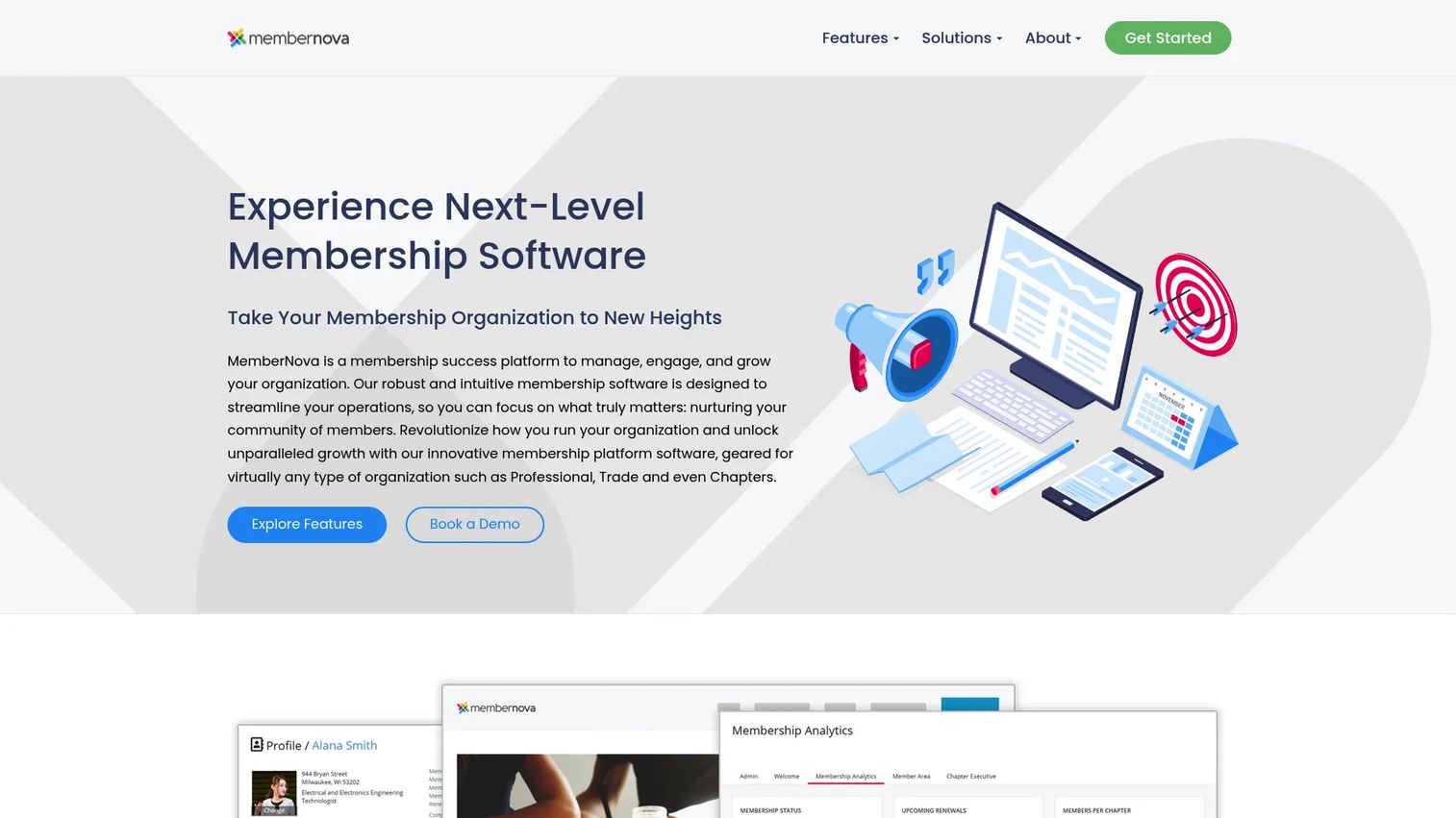
MemberNova is a membership success platform built for associations and member-based organizations that need one system for membership, engagement, events, communications, and analytics. For multi-chapter groups, its appeal is depth: nested membership structures, flexible dues logic, and shared reporting that rolls up across chapters. It fits associations that have outgrown flat member databases and need parent-child records that behave correctly at every level.
Best for: Associations and member-based organizations that need an all-in-one AMS with nested membership structures and flexible dues.
Key strengths
- Membership management for complex, multi-level structures
- Event registration across chapters
- Dues and eCommerce in one platform
- Engagement and analytics for chapter roll-up reporting
Why choose MemberNova: If your organization needs one platform to hold membership, dues, events, and reporting without stitching tools together, MemberNova consolidates the stack. It suits teams that value a single source of truth over piecing together point solutions, and that need dues logic flexible enough to model real chapter finance.
MemberNova pricing: Pricing is custom. The pricing page invites you to get in touch and describes flexible tiers, but shows no public numeric price. Budget for a scoping conversation tied to your member count and chapter structure.
2. Glue Up
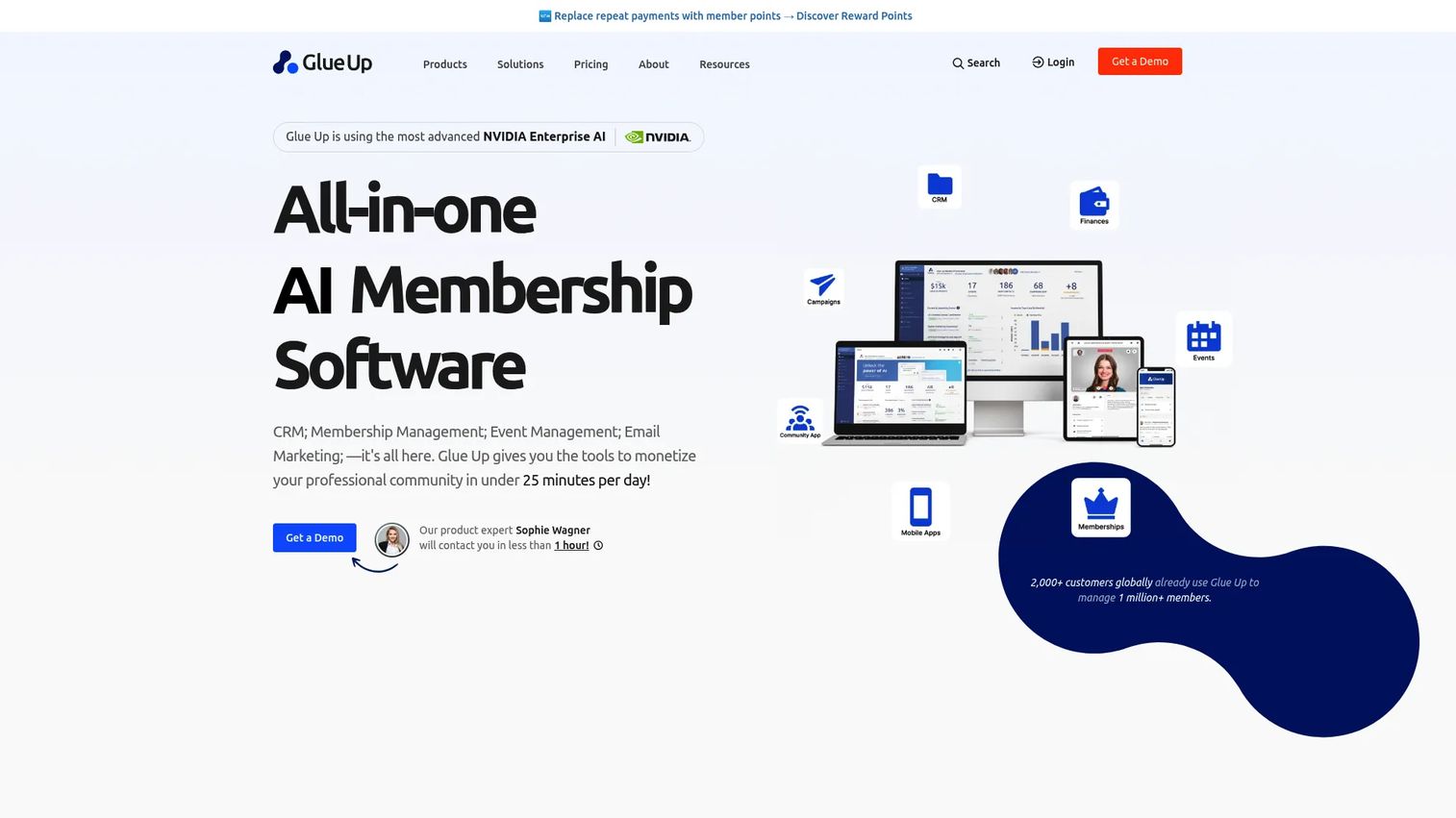
Glue Up is all-in-one association and member engagement software covering memberships, events, CRM, and communications. It frames the central problem the way most buyers do: HQ control versus local autonomy. Chapters get a white-label experience and their own operations, while national keeps finance visibility, branding consistency, and roll-up reporting. It fits associations, chambers, and nonprofits that want the whole chapter operation unified rather than spread across separate event, email, and membership tools.
Best for: Associations, chambers, and member-based organizations that want memberships and events in one platform with chapter autonomy.
Key strengths
- Membership management with chapter-level structure
- Event management across the organization
- CRM and email communications for chapter outreach
- White-label branding for local relevance
Why choose Glue Up: Glue Up suits teams that want a broad platform feel, with membership, events, and communications working together rather than bolted on. If keeping chapters on-brand while giving them room to run local events matters, its white-label layer is the draw.
Glue Up pricing: Three public tiers, all billed annually. Essential/Professional runs $3,000 to $6,500 per year, Advanced runs $8,000 to $18,500 per year, and Enterprise is custom. Pricing varies by organization size and requirements, so the range is a starting point.
3. MemberLeap
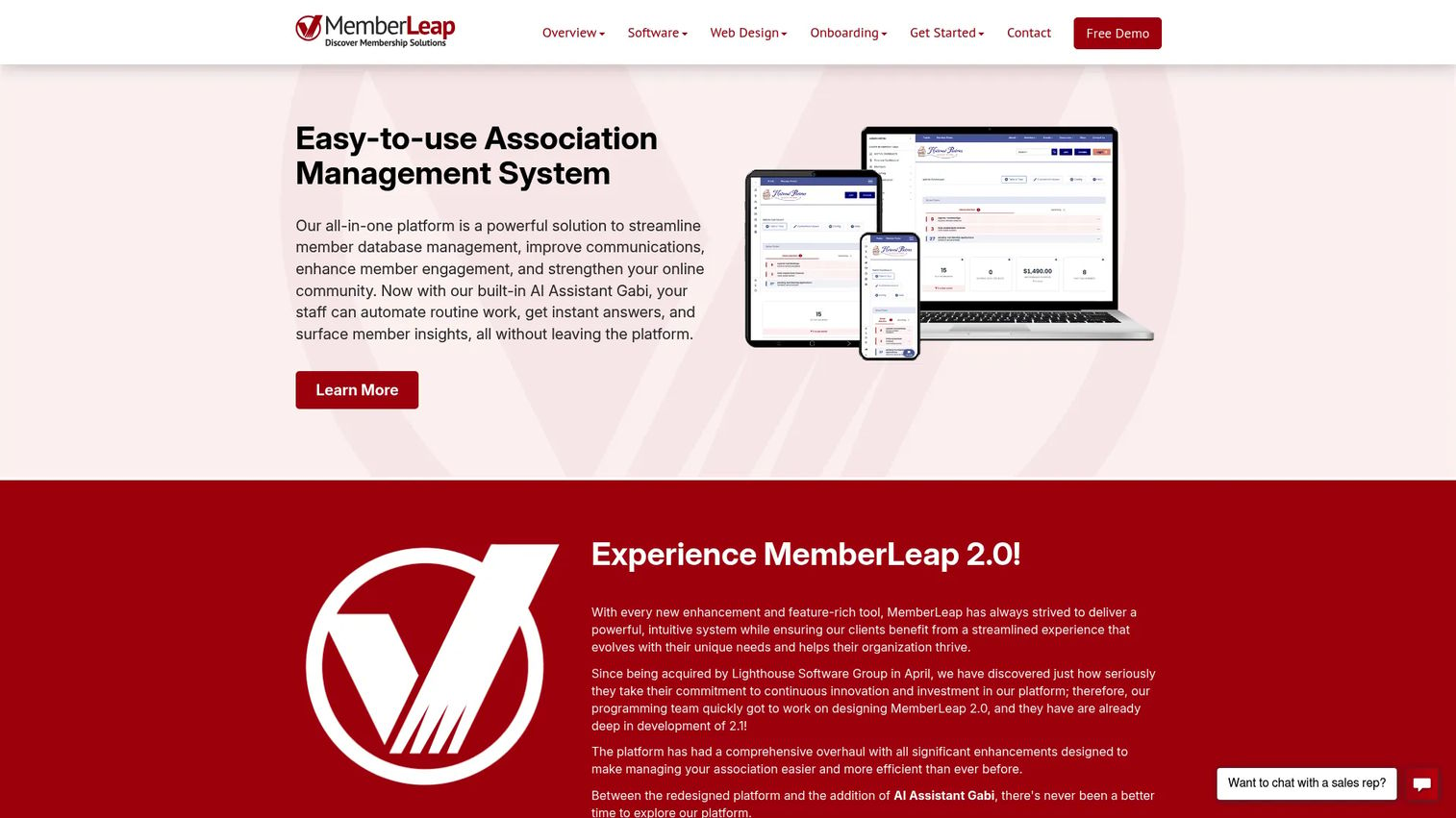
MemberLeap is association management software for member-based organizations, and it leans more implementation-oriented than the others here. It distinguishes chapter accounts from committees, gives national a dashboard for oversight, and syncs data across levels. That structure appeals to organizations that want configurable chapter accounts, hands-on setup, and training rather than a pure self-serve tool. Website integration and payment processing round out a platform built to be configured to your model.
Best for: Associations and nonprofits that want a configurable all-in-one membership platform with a national dashboard and setup support.
Key strengths
- Member database management with chapter accounts
- Event management and web hosting
- Membership billing and payment processing
- Private social network and online store
Why choose MemberLeap: MemberLeap fits teams that value configuration flexibility and implementation guidance over the fastest possible setup. If you want chapter accounts, committees, and a national dashboard mapped carefully to your structure, its setup-oriented approach earns its place.
MemberLeap pricing: Nonprofit plans are published monthly. The Startup/Economy plan starts at $120 per month for the first six months, Donations at $150 per month, and Events and Standard at $210 per month. Higher tiers are referenced but not publicly priced, so confirm those in a scoping call.
4. Solidarity Tech
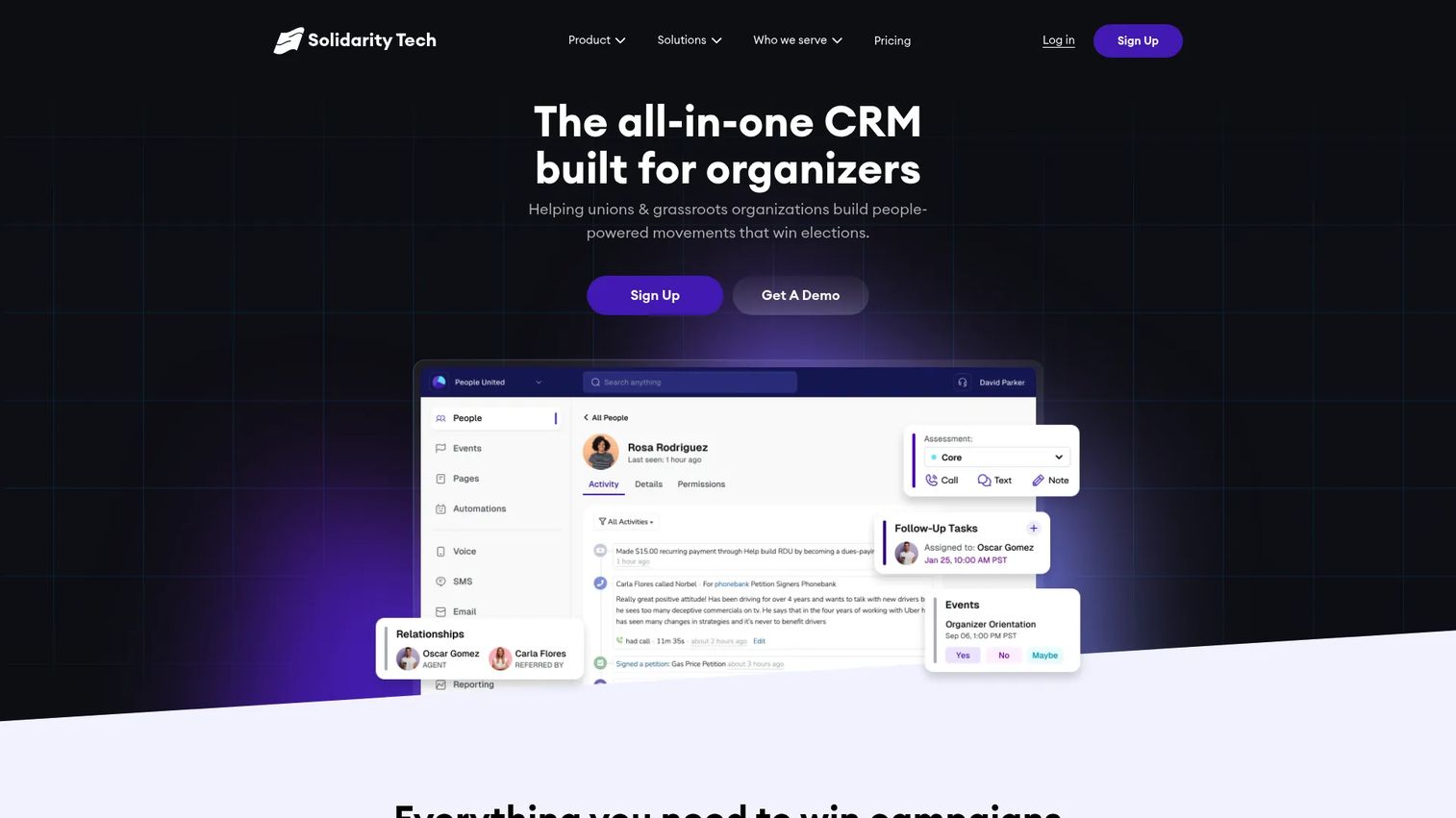
Solidarity Tech is an all-in-one CRM and organizing toolkit built for campaigns and grassroots organizations. Its chapter angle is distributed access and scope-based visibility: local chapters get their own communications, branding, and reporting, organized around geographic branches. Built-in calling, texting, and email make it strong for field-organized structures where local outreach is the core motion. It fits labor, advocacy, political, and nonprofit organizing teams more than traditional trade associations.
Best for: Labor, advocacy, political, and nonprofit organizing teams that need integrated outreach across geographic branches.
Key strengths
- Unified CRM with scope-based visibility
- Built-in calling, texting, and email
- Events, donations, and automations
- Local branding across geographic branches
Why choose Solidarity Tech: Solidarity Tech fits organizations where the chapter is a field unit running heavy local communications, not just a dues-collecting node. If your structure is regional or organizing-driven and outreach volume is high, its native calling and texting set it apart.
Solidarity Tech pricing: Four plans are listed: Essentials, Standard, Professional, and Enterprise, billed month-to-month with Enterprise on custom pricing. The public pricing page shows plan names and usage rates, but the base subscription amounts were not visible, so confirm the monthly plan prices directly.
Considerations
Before you sign, verify these five areas against your actual structure. Most buyer regret traces back to skipping one of them.
Data model and hierarchy
Confirm the system supports parent-child structures, nested chapters, and shared records. Ask whether a member can belong to national and a local chapter without duplicate records. If your structure has sub-chapters or regions, test that the hierarchy goes as deep as you need before you commit.
Permissions and access control
Verify that chapter admins, HQ staff, and local leaders each see the right things and nothing more. Role-based access control should let a chapter leader edit their own members without touching another chapter's data. Map every role you have to a permission set during the demo, not after.
Reporting and roll-up visibility
Make sure both local dashboards and executive roll-up reporting exist. Chapter leaders need chapter-level analytics for their own growth. Executives need aggregated numbers across every chapter from the same data. If reporting only serves one level, you will be back in spreadsheets within a quarter.
Finance and dues handling
Confirm the platform handles chapter dues variations, split payments, installments, and revenue allocation between HQ and chapters. If national takes a cut of local dues, the software should split payments automatically. Manual reconciliation at month-end is the friction you are trying to remove.
Branding and communications
Check whether chapters can stay locally relevant without drifting off brand. Chapter website templates and controlled communications let local units feel local while HQ protects the brand. Balance chapter autonomy against consistency here: too much lockdown frustrates chapters, too little erodes the brand.
Conclusion
The right chapter management platform balances two forces that pull against each other: HQ's need for centralized chapter data and reporting, and local chapters' need for autonomy over their own members, dues, and communications.
Match the tool to your structure first. MemberNova fits associations that need nested membership structures and flexible dues in one all-in-one system. Glue Up suits organizations that want HQ control with chapter autonomy under a unified, white-label experience. MemberLeap works for teams that value configuration flexibility, a national dashboard, and hands-on implementation. Solidarity Tech is the pick for organizing and field-based structures where local outreach volume is high.
Your next step: shortlist two of these, then run a scripted demo against your real hierarchy, permissions, and dues model. Bring a chapter leader and an HQ admin to the same demo so both sides pressure-test it. The platform that survives both perspectives is the one that will hold up in production.
FAQs
Chapter management software centralizes data, membership, dues, and reporting for a multi-chapter organization while giving local chapters their own access, dashboards, and branded presence. It models a parent-child organization structure so a member can belong to both the national body and a local chapter without duplicate records.
Association management software runs membership, dues, and events for one organization. Chapter management software adds a hierarchy layer on top: nested chapters, role-based permissions by level, and roll-up reporting across chapters. Most chapter platforms are AMS tools built to handle a federated, multi-chapter structure natively.
Four capabilities decide fit: a data model that supports parent-child and nested chapters, role-based access control so each level sees the right data, finance handling for split dues and revenue allocation, and reporting that serves both local dashboards and executive roll-up views. Branding and communications matter but are easier to adjust later.
Chapter dashboards give local leaders analytics on their own chapter's membership, events, and dues. Roll-up reporting aggregates those same numbers across every chapter for the executive view. Both draw from one dataset, so national and local always look at consistent, centralized chapter data rather than reconciled exports.
Yes. Most chapter management platforms support chapter dues variations, installments, and split payments that allocate revenue between HQ and local chapters automatically. Confirm the exact allocation logic in a demo, because how national takes its cut of local dues varies by platform.
Use chapter website templates and controlled communications. Templates let each chapter feel locally relevant while HQ protects fonts, logos, and core messaging. The goal is chapter autonomy inside guardrails: local units run their own pages and outreach without drifting off the national brand.
Map your hierarchy first: parent-child levels, nested chapters, and shared records. Confirm the new platform can model that structure natively, then verify permissions, dues logic, and reporting against your real data before migration. A clean data model in place before the move prevents duplicate records and broken roll-up reporting later.
Chapter permissions use role-based access control tied to organizational level. HQ staff see everything, chapter admins edit only their own chapter's members and events, and local leaders get a narrower view still. Good systems let you map every role to a specific permission set, so no one touches data outside their scope.