Your audit work lives in 14 spreadsheets, three shared drives, and an email thread nobody can find. A control gets missed. An evidence file points to a version that no longer exists. When the external auditor asks for the source, someone spends a day reconstructing it from memory.
That is the problem audit management software exists to solve. It pulls audit planning, fieldwork, evidence, and reporting into one workflow with a defensible audit trail behind every action. Instead of proving controls compliance by hand, you prove it from records the system kept automatically.
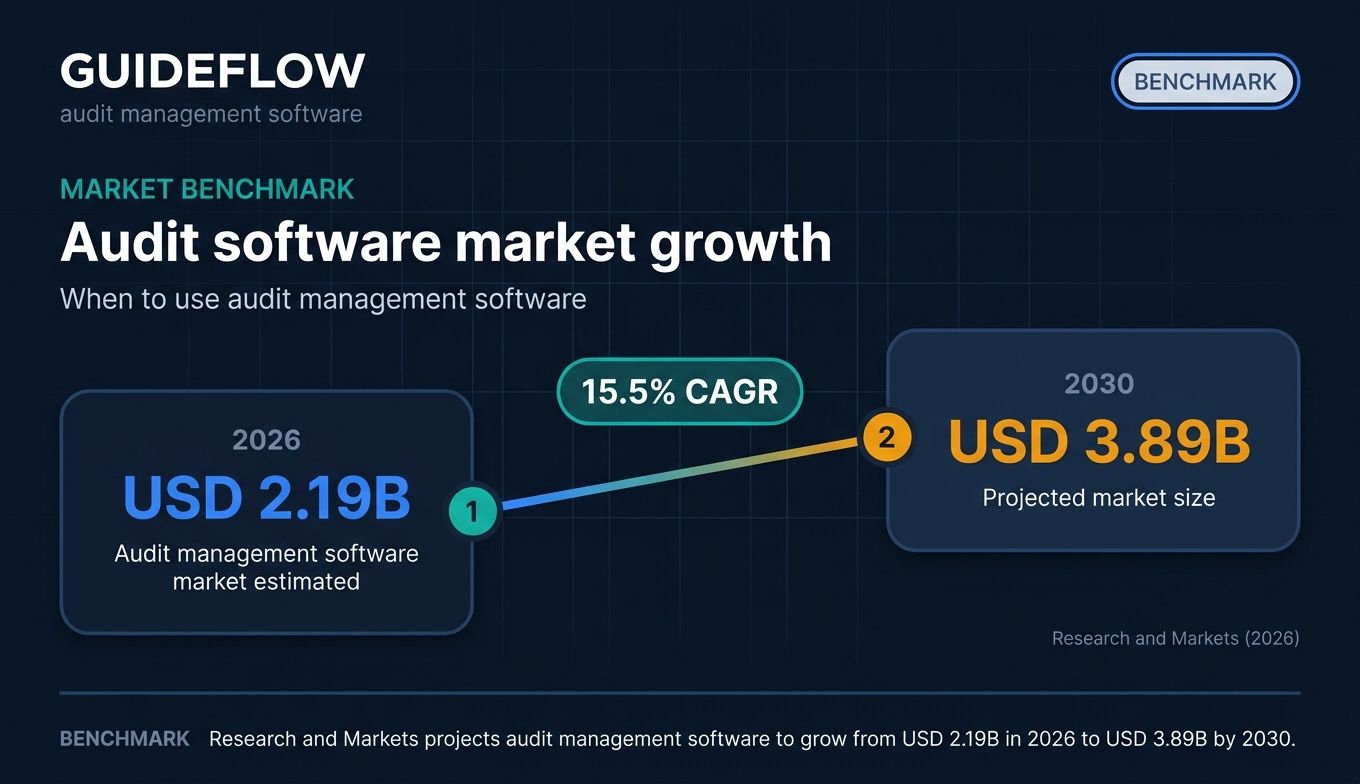
The category is growing fast because the stakes are. The audit management software market is estimated at USD 2.19 billion in 2026 and projected to reach USD 3.89 billion by 2030, a 15.5% CAGR, according to Research and Markets (2026). Regulated companies are replacing manual audit operations with systems that hold up under SOX, SOC 2, and ISO scrutiny.
For product managers and engineering leaders, this matters more than it used to. Compliance constraints now touch the product, customer data, and the release process. When auditors ask how access is granted or how a control was tested, the answer often sits in your stack. Picking the right audit management system affects how much of your team's time gets pulled into evidence requests. If you own compliance constraints inside the product, tools like a strong contract management platform often sit alongside your audit stack.
This guide ranks 12 tools so you can build a shortlist without reading 20 vendor pages.
What's inside
This guide is for internal audit leaders, risk and compliance professionals, IT audit and security teams, and the product managers who own compliance constraints inside the product. If you evaluate or influence audit tooling decisions, the picks below map to your situation.
We selected the 12 tools on four criteria:
- Audit lifecycle coverage: planning, scoping, fieldwork, evidence, reporting, and remediation in one place.
- Evidence and audit-trail depth: version history, logging, and defensible documentation.
- Integrations and deployment: fit with your data stack, identity/SSO, and cloud or on-premise needs.
- Verified pricing and G2 ratings: checked against vendor pages and live G2 listings, not memory.
Every tool below is a genuine audit management or GRC platform. No padding with unrelated software.
TL;DR
Short on time? Here are the decision shortcuts:
- Best for connected data and reporting: Workiva, where numbers and narrative link across documents.
- Best for board governance plus audit: Diligent One Platform, built for unified GRC oversight.
- Best for SOX and internal audit teams: AuditBoard (now Optro), a connected risk platform.
- Best for compliance operations across frameworks: Hyperproof, strong on SOC 2 and ISO.
- Best for large-enterprise GRC: MetricStream, Archer, or IBM OpenPages.
- Best for IT and access auditing: SolarWinds Access Rights Manager.
Read the full breakdowns below before you request demos. When you do, an interactive demo can help you test a vendor's workflow against your own process rather than a canned scenario.
What is audit management software?
Audit management software is a system that helps internal audit, risk, and compliance teams plan, execute, document, and report audits while maintaining a complete audit trail. It replaces scattered spreadsheets and email with a single workflow that tracks every step from planning to remediation.
Most internal audit software covers the full audit lifecycle. The category overlaps heavily with audit and compliance software and broader GRC suites, since risk, controls, and audit data often live together. Auditing software for auditors centralizes the work so findings stay traceable and evidence stays defensible.
A capable audit management system typically includes:
- Audit planning and scoping: define the audit universe, assess risk, and allocate resources.
- Fieldwork and testing: run control tests, document procedures, and track status.
- Workpaper and evidence management: store, version, and link supporting documentation.
- Risk and controls mapping: connect controls to risks, frameworks, and processes.
- Reporting and audit committee communication: generate findings reports and stakeholder summaries.
- Remediation and follow-up tracking: assign issues, monitor fixes, and confirm closure.
- Audit trail and logging: record who did what and when, with immutable history.
This is what separates audit management software from a folder of documents. The trail is built as you work, not reconstructed afterward. For internal audit management software buyers, that audit trail is the core of a defensible program. It is also why finance, security, and product teams increasingly share the same system: when an auditor asks for proof, the records are already there.
When to use audit management software
Not every team needs a dedicated platform on day one. These three triggers signal it is time.
Centralize audit planning and fieldwork
When your audit plan lives in one spreadsheet and the fieldwork lives in another, status updates turn into manual reconciliation. A single workflow replaces that. Planning, scoping, testing, and workpapers sit in one place, so the team sees real status without chasing files. This is the most common reason teams move off spreadsheets and email.
Prove compliance and maintain audit trails
SOX, SOC 2, ISO 27001, HIPAA, and GDPR all demand defensible evidence. You need to show not just that a control passed, but who tested it, when, and against which version of the evidence. Audit management software keeps immutable logs and version history automatically. When an external auditor or regulator asks, you produce the trail instead of rebuilding it. Teams that take this seriously often pair it with broader security and compliance practices across their tooling.
Track remediation and report to stakeholders
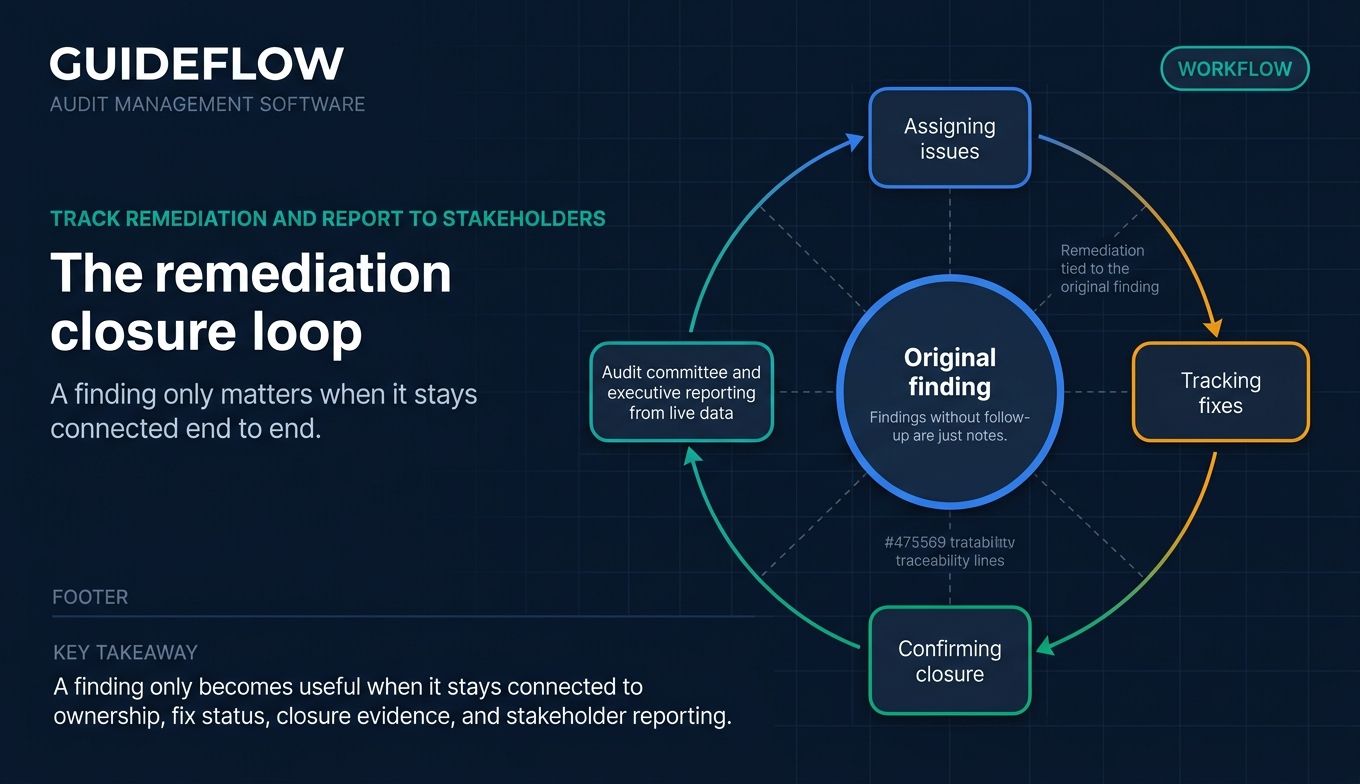
Findings without follow-up are just notes. The real value is closing the loop: assigning issues, tracking fixes, and confirming closure. Compliance audit software ties remediation to the original finding, so nothing slips. It also generates audit committee and executive reporting from live data, which cuts the manual deck-building that eats reporting cycles.
Audit management software compared
The table below ranks the 12 tools by relevance to the core internal audit and GRC use case, starting with the broadest connected platforms. Pricing and G2 ratings were checked against vendor pages and live G2 listings. Several enterprise vendors gate pricing behind sales, which is noted as custom pricing. Use this as your audit manager software shortlist, then dig into the sections that fit your situation.
| # | Product | Intent | Key use case | Pricing | G2 rating |
|---|---|---|---|---|---|
| 1 | Workiva | Connected reporting and audit | Linked data, reporting, controls, and assurance at scale | Custom pricing | 4.5/5 |
| 2 | Diligent One Platform | Board governance plus GRC | Unified board management and risk oversight | Custom pricing | 4.3/5 |
| 3 | AuditBoard (Optro) | Connected risk and SOX | Risk-based auditing and SOX assurance | Custom pricing | 4.6/5 |
| 4 | Hyperproof | Compliance operations | Multi-framework control and evidence management | Custom pricing | 4.5/5 |
| 5 | TeamMate | Internal audit suite | End-to-end audit workflow and workpapers | Custom pricing | 4.2/5 |
| 6 | MetricStream | Enterprise GRC | Connected risk, compliance, and audit | Custom pricing | 3.8/5 |
| 7 | Archer | Integrated risk management | Risk-aligned audit at enterprise scale | Custom pricing | 3.6/5 |
| 8 | SAP Audit Management | SAP-native audit | Internal audit inside SAP environments | Price upon request | Not rated |
| 9 | IBM OpenPages | AI-powered GRC | Risk, compliance, and audit in one platform | From USD 3,300 | 4.2/5 |
| 10 | Onspring | No-code GRC | Configurable audit and risk automation | Custom pricing | 4.7/5 |
| 11 | Ideagen Internal Audit | Risk-based internal audit | Audit planning and control testing | Custom pricing | 4.2/5 |
| 12 | SolarWinds Access Rights Manager | IT and access audit | Access rights auditing and reporting | From USD 1,200 | 3.5/5 |
The 12 best audit management software tools for 2026
Each tool below includes an overview, who it is best for, key strengths, why you would choose it, and verified pricing. Tools are ranked by relevance to the core audit management job, not by score.
1. Workiva
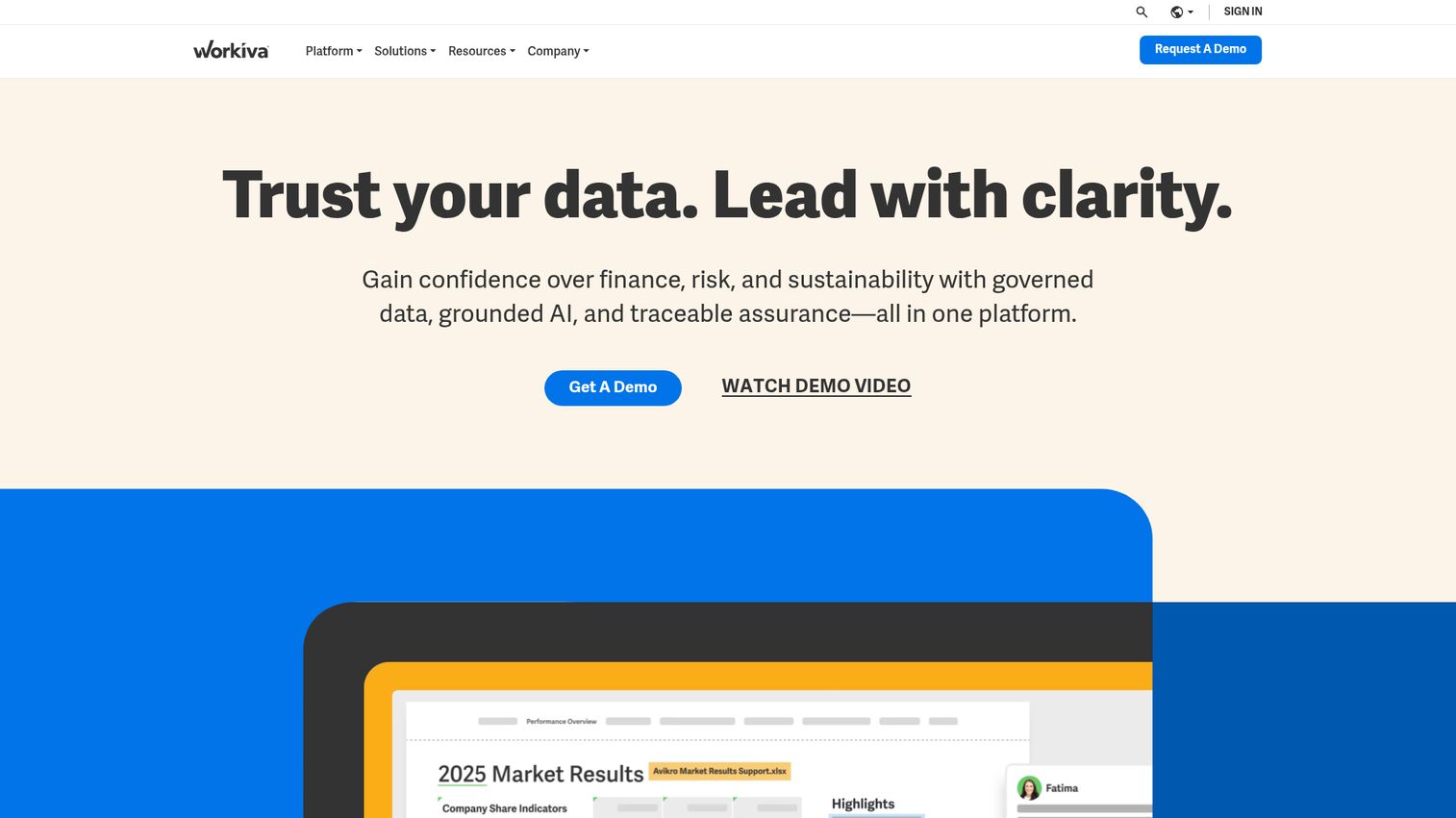
Workiva is an AI-powered cloud platform for finance, risk, audit, legal, and sustainability teams to manage trusted data, reporting, controls, and assurance workflows. Its core idea is linked data: numbers and narrative connect across documents, spreadsheets, and presentations, so a change in one place updates everywhere. That makes it a strong fit for teams that want audit, controls, and reporting on one connected platform.
Best for: Enterprise teams managing complex financial reporting, sustainability reporting, SEC filing, SOX, audit, risk, and controls workflows.
Key strengths
- Linked data across documents: numbers and narrative stay connected, cutting manual reconciliation across spreadsheets and presentations.
- Unified reporting workflows: SEC filings, audit committee presentations, and earnings scripts run in one environment.
- Real-time collaboration: in-app comments, review tools, version history, blacklines, and granular permissions keep work auditable.
Why choose Workiva: If your pain is data drifting out of sync between reporting and audit, Workiva's linked-data model is the differentiator. It suits regulated enterprises where the same numbers feed financial reporting, SOX, and assurance, and where a defensible trail matters across all three.
Workiva pricing: Workiva does not publish public pricing. The vendor says pricing reflects each organization's needs, uses tiered packaging for some solutions, and provides unlimited seats across offerings. Buyers contact sales for a quote based on specific requirements. Workiva holds a 4.5/5 rating on G2.
2. Diligent One Platform
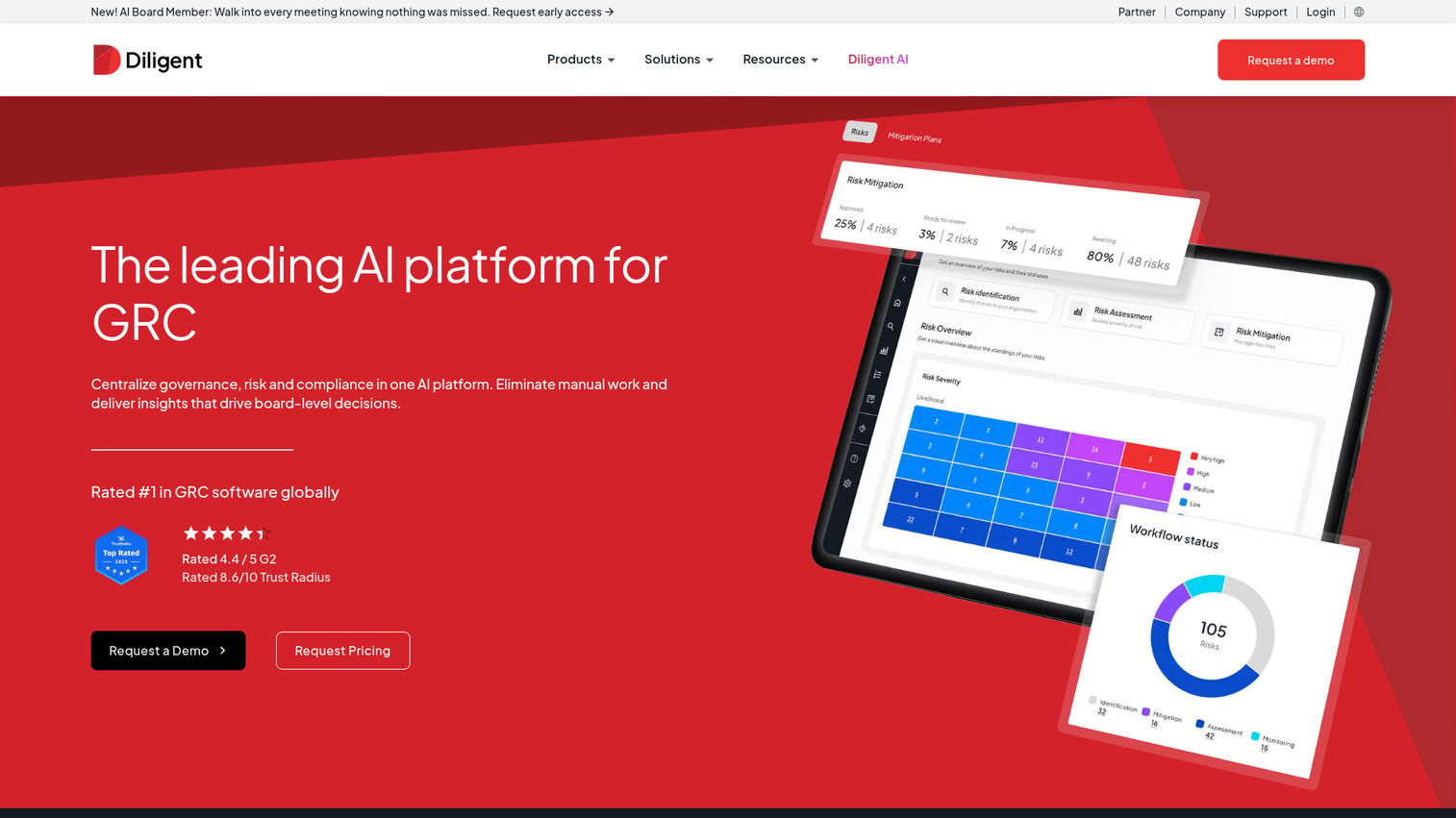
Diligent One Platform is an AI-powered governance, risk, and compliance platform that centralizes board management and GRC activities with a consolidated view of organizational risk. It is the successor to the HighBond and Galvanize lineage, now folded into Diligent's broader governance suite. The result connects board oversight with audit, risk, and compliance in one place.
Best for: Organizations that need a unified AI-powered platform for board governance, audit, risk, and compliance oversight.
Key strengths
- Unified board and GRC view: board management and GRC activities live together for a single risk picture.
- AI-powered analytics: customizable templates and dashboards surface risk data without manual assembly.
- Broad integrations: connects to 100+ third-party data providers plus other data sources.
Why choose Diligent: Choose Diligent when the audit conversation happens at the board level and you want governance and risk oversight in the same system. It fits organizations where directors, risk officers, and internal audit all need a shared, current view rather than separate tools.
Diligent One Platform pricing: Diligent does not display public pricing. The pricing page offers a request form and describes tiered pricing without numbers. No free tier is listed. Diligent One Platform holds a 4.3/5 rating on G2.
3. AuditBoard (Optro)
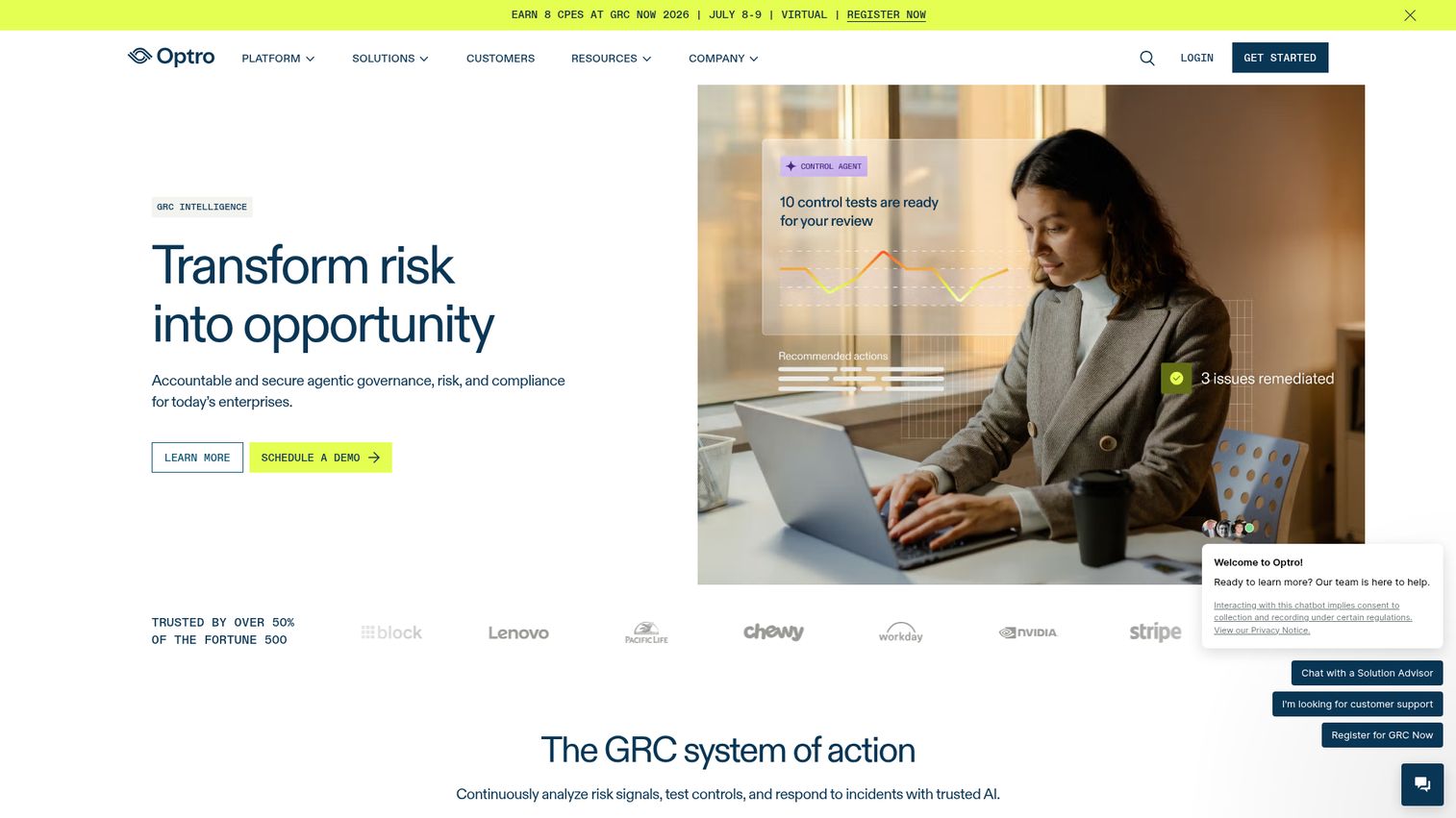
AuditBoard, now operating as Optro, is an AI-powered connected risk platform for audit, risk, and compliance teams. It is a frequent pick for SOX and internal audit programs that want workflow automation and a connected view of risk across the organization. The brand redirects to Optro.ai, and G2 lists the product as Optro, formerly AuditBoard.
Best for: Enterprise GRC, audit, SOX, compliance, IT risk, and risk management teams needing a connected risk platform.
Key strengths
- Audit and controls management: risk-based auditing and SOX assurance run in one workflow with audit trails.
- Connected risk view: risk, ESG compliance, and IT risk map together across the organization.
- AI assistance and reporting: configurable oversight, reporting dashboards, integrations, and APIs reduce manual effort.
Why choose AuditBoard: If SOX is the center of your program, AuditBoard's audit and controls focus and ease of use make it a strong fit. Its 4.6/5 G2 rating reflects how internal audit teams rate the day-to-day workflow. It suits teams that want a connected risk platform without heavy configuration.
AuditBoard pricing: AuditBoard does not publish public pricing. The pricing page describes flexible plans, unlimited stakeholder licenses, and white-glove services, but lists no figures or named tiers. Contact the vendor for a quote. The product holds a 4.6/5 rating on G2.
4. Hyperproof
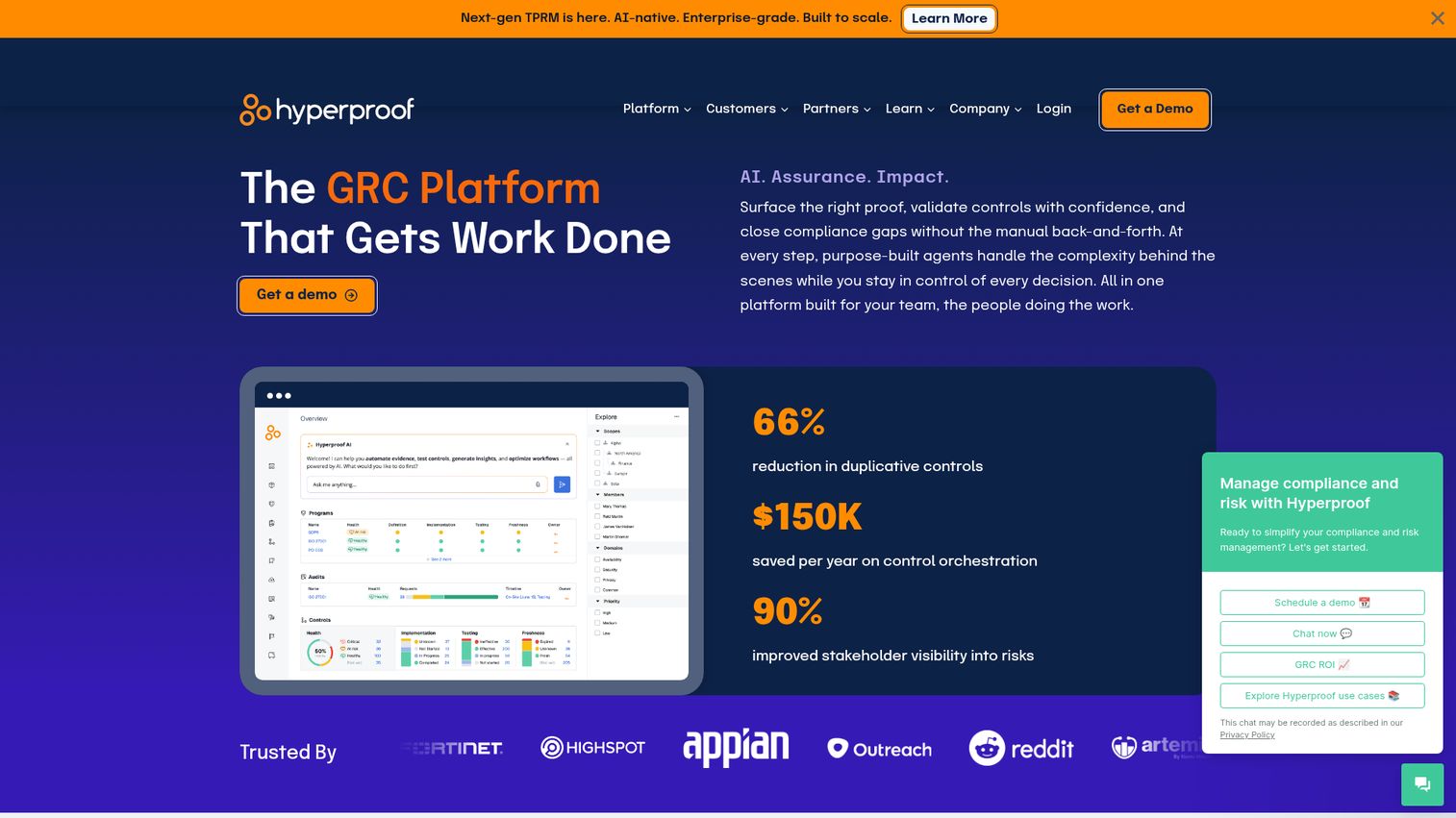
Hyperproof is an AI-powered GRC platform that centralizes compliance, risk, and security workflows. It is built for teams running compliance operations across many frameworks at once, with standardized control operations and automated evidence collection. That makes it a practical choice for SOC 2 and ISO programs that audit continuously rather than once a year.
Best for: IT, security, risk, and compliance teams managing GRC programs across multiple frameworks and audits.
Key strengths
- Multi-framework compliance management: standardized control operations map across frameworks so one control satisfies many requirements.
- Risk management: risk registers, real-time monitoring, and consolidated reporting in one view.
- Third-party risk management: vendor profiles, key documents, renewal dates, and risk tracking in one place.
Why choose Hyperproof: Choose Hyperproof when your compliance work spans SOC 2, ISO 27001, and more, and you want to reuse evidence across frameworks instead of collecting it twice. It fits security and IT teams that treat compliance as an ongoing operation, not a yearly scramble.
Hyperproof pricing: Hyperproof does not display public pricing. The pricing URL redirects to the product page, and no plan names, tiers, or free-tier details are shown. Contact the vendor for a quote. Hyperproof holds a 4.5/5 rating on G2 from 216 reviews.
5. TeamMate
TeamMate is Wolters Kluwer's audit and GRC software suite for internal audit, controls, risk, and compliance teams. TeamMate+ is a long-standing internal audit platform with deep workpaper and workflow capabilities, used by enterprise audit shops for years. It covers the audit lifecycle from planning through reporting with a preserved audit trail.
Best for: Internal audit and GRC teams that need configurable audit workflow, controls, risk, compliance, collaboration, and reporting capabilities.
Key strengths
- End-to-end audit workflow: planning, execution, fieldwork, collaboration, reporting, and audit-trail preservation in one suite.
- Resource planning and scheduling: role-specific dashboards and views keep teams allocated and on track.
- Stakeholder collaboration: document requests, issues tracking, and audit reporting in one workflow.
Why choose TeamMate: Choose TeamMate when you run a mature internal audit function and want a configurable suite that handles electronic workpapers and enterprise depth. Its heritage suits teams that need proven audit workflow over the newest interface.
TeamMate pricing: TeamMate does not publish public prices. The first-party pricing page lists three modules, TeamMate Audit, TeamMate Controls, and TeamMate Risk & Compliance, and asks buyers to request a tailored quote. TeamMate holds a 4.2/5 rating on G2.
6. MetricStream
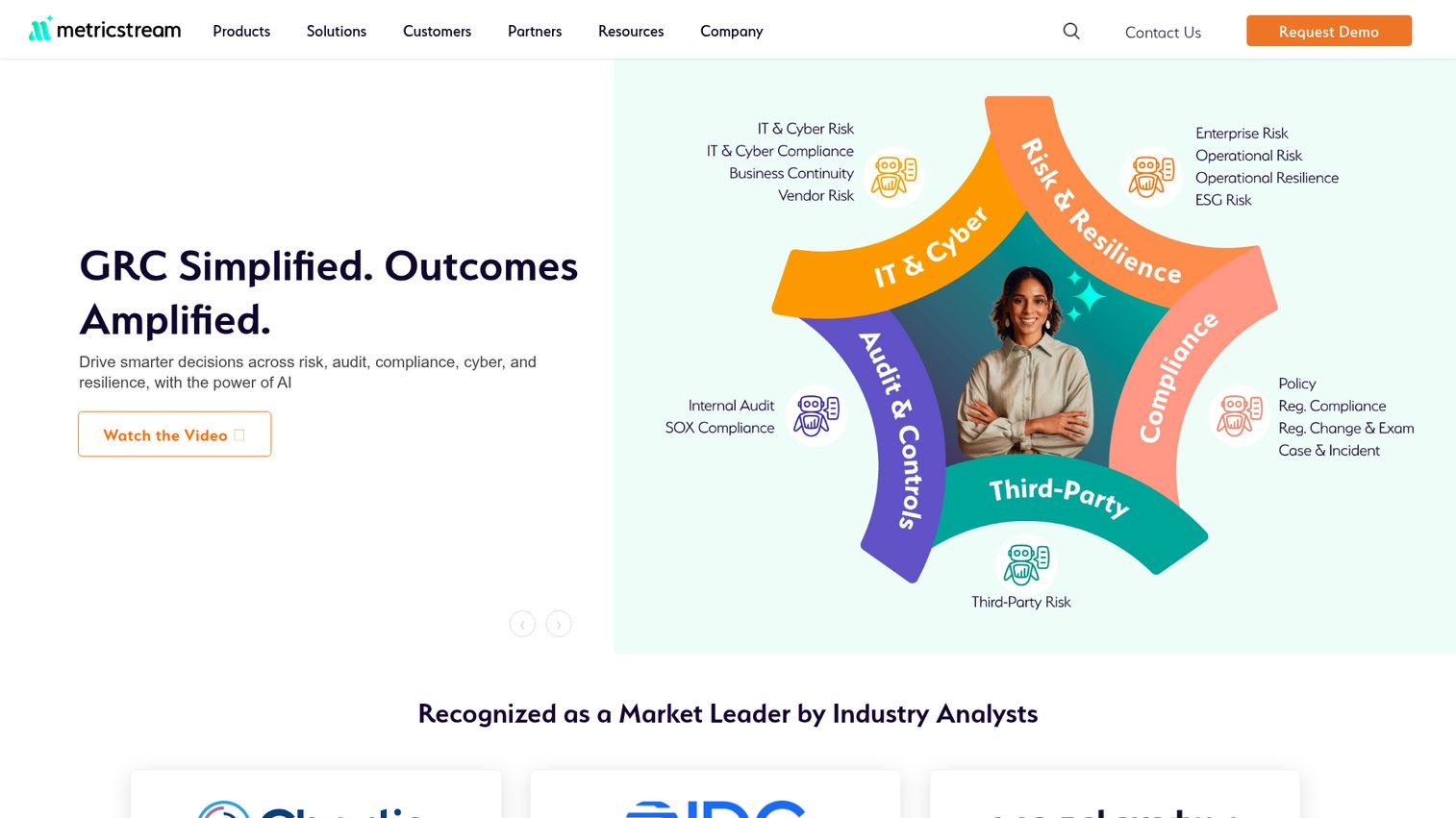
MetricStream provides AI-first connected governance, risk, compliance, audit, cyber GRC, third-party risk, and resilience software for enterprises. It is built for large organizations that need one integrated platform spanning many governance programs, with a federated data model tying risks, controls, and issues together. Audit sits inside this broader GRC fabric.
Best for: Large enterprises needing an integrated GRC platform spanning risk, compliance, audit, cybersecurity, third-party risk, and resilience programs.
Key strengths
- Federated data model: risks, regulations, assets, controls, entities, processes, and issues connect in one structure.
- Reports and analytics: dashboards deliver real-time risk and compliance insight across programs.
- Open APIs: out-of-the-box business APIs plus OpenAPI-compliant configurable APIs integrate third-party systems.
Why choose MetricStream: Choose MetricStream when audit is one of many governance programs you need to run on a single enterprise platform. Its federated model fits organizations that want risk-based auditing connected to cyber GRC and third-party risk rather than a standalone audit tool.
MetricStream pricing: MetricStream does not publish public pricing, and no first-party pricing page with figures was available. Contact the vendor for a quote. MetricStream holds a 3.8/5 rating on G2.
7. Archer
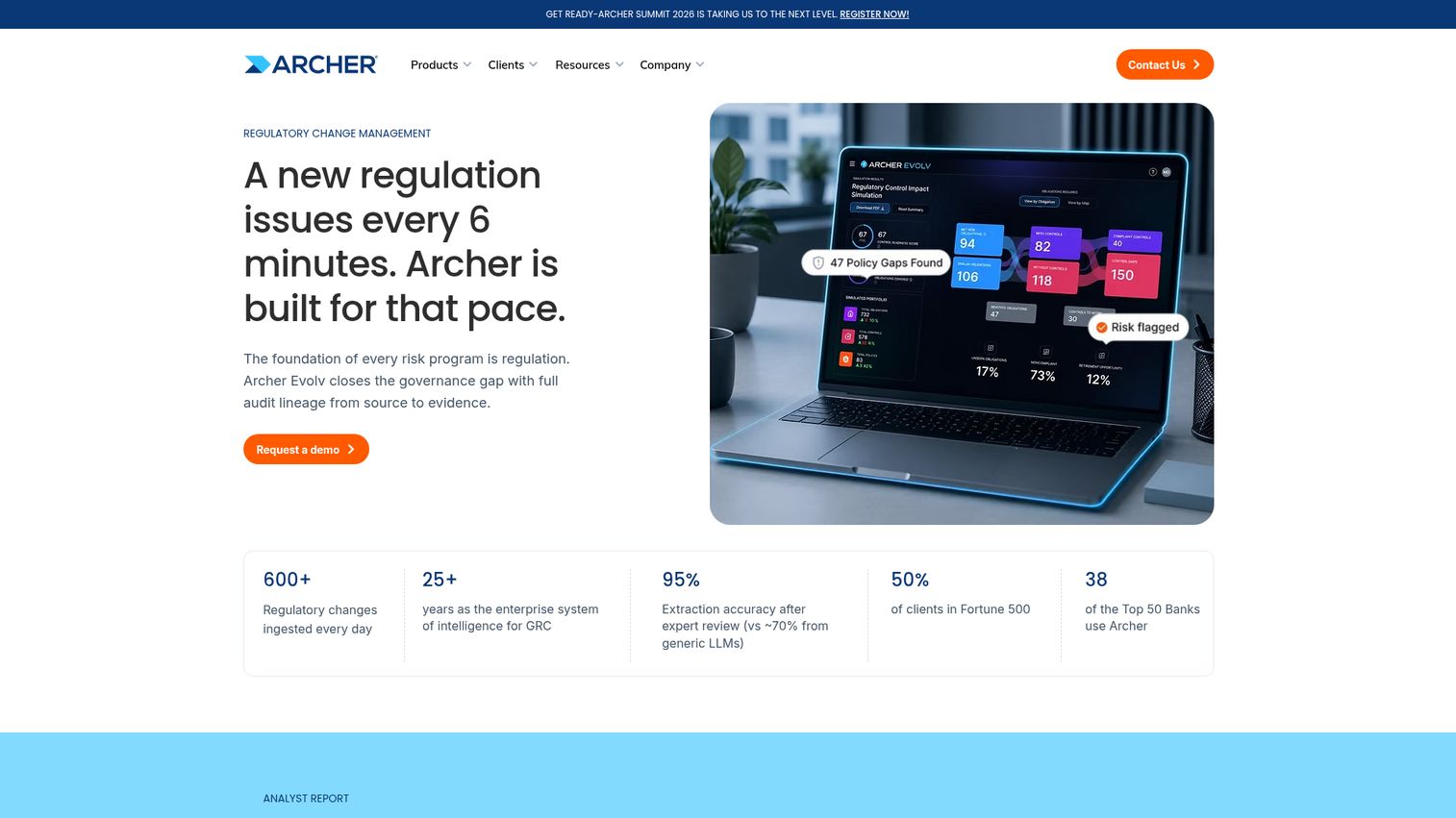
Archer helps organizations manage risk in the digital era by uniting stakeholders, integrating technologies, and transforming risk into reward. It is an enterprise integrated risk management platform with an audit module, used by large organizations that align audit to a central risk and controls library. Audit work plugs into the wider IRM program.
Best for: Large enterprises needing integrated governance, risk, compliance, audit, third-party risk, and regulatory change management.
Key strengths
- AI-powered regulatory change: monitoring, obligation extraction, control mapping, gap analysis, and audit-ready evidence in one flow.
- Unified risk management: operational, enterprise, IT, third-party, and resilience risk with AI-driven scoring.
- Scenario simulation: model regulatory and operational impact, control exposure, and risk portfolio changes.
Why choose Archer: Choose Archer when audit needs to align tightly with a central, enterprise-scale risk and controls program. It fits organizations that treat audit as one input to integrated risk management and want a shared controls library across domains.
Archer pricing: Archer does not publish public pricing, and its pages direct buyers to contact sales or request a demo. Contact the vendor for a quote. Archer holds a 3.6/5 rating on G2.
8. SAP Audit Management
SAP Audit Management is internal audit management software that helps automate internal auditing procedures and improve audit quality. It is built for enterprises already running SAP, with native integration into SAP risk and control solutions. It covers audit planning, performance, and the communication of results.
Best for: Enterprise internal audit teams using SAP environments that need audit planning, issue tracking, reporting, and integration with SAP risk and control solutions.
Key strengths
- Audit planning and performance: plan, manage, and perform audits inside the SAP environment.
- Results communication and monitoring: track and communicate audit findings to stakeholders.
- Mobile documentation capture: mobile evidence capture and drag-and-drop tools speed fieldwork.
Why choose SAP Audit Management: Choose this when your enterprise standardizes on SAP and you want audit to sit natively alongside SAP financial and risk solutions. It is part of SAP S/4HANA Cloud for financial three lines of defense, which suits teams avoiding a separate platform.
SAP Audit Management pricing: SAP lists the product as priced by users with price upon request, and no public figure is shown. The broader SAP finance pricing page shows other products, but not SAP Audit Management specifically. No current G2 rating was available for SAP Audit Management.
9. IBM OpenPages
IBM OpenPages is a scalable, AI-powered governance, risk, and compliance platform for managing risk, compliance, and audit functions in one integrated solution. It pairs no-code configuration with embedded AI to automate GRC workflows. Internal audit runs inside the same platform as risk and controls.
Best for: Large organizations needing an enterprise GRC platform to centralize risk, compliance, audit, third-party risk, policy, and related governance workflows.
Key strengths
- GRC Canvas: model processes, risks, and controls with live data in one workspace.
- Embedded AI automation: classification, issue creation, and GRC workflow automation reduce manual steps.
- No-code configuration: drag-and-drop view and workflow designers, dashboards, and REST API integrations.
Why choose IBM OpenPages: Choose OpenPages when you want enterprise GRC with watsonx-powered AI and the flexibility to configure without code. Its published pricing is also unusually transparent for this category, which helps when you need to budget before talking to sales.
IBM OpenPages pricing: IBM publishes indicative pricing. The SaaS Essentials edition starts at USD 3,300 and the SaaS Standard edition at USD 6,050. On Cloud Single Solution starts at USD 6,250 and On Cloud Enterprise at USD 9,000. On Premises is quoted on request. Prices are indicative and may vary by country. IBM OpenPages holds a 4.2/5 rating on G2 from 76 reviews.
10. Onspring
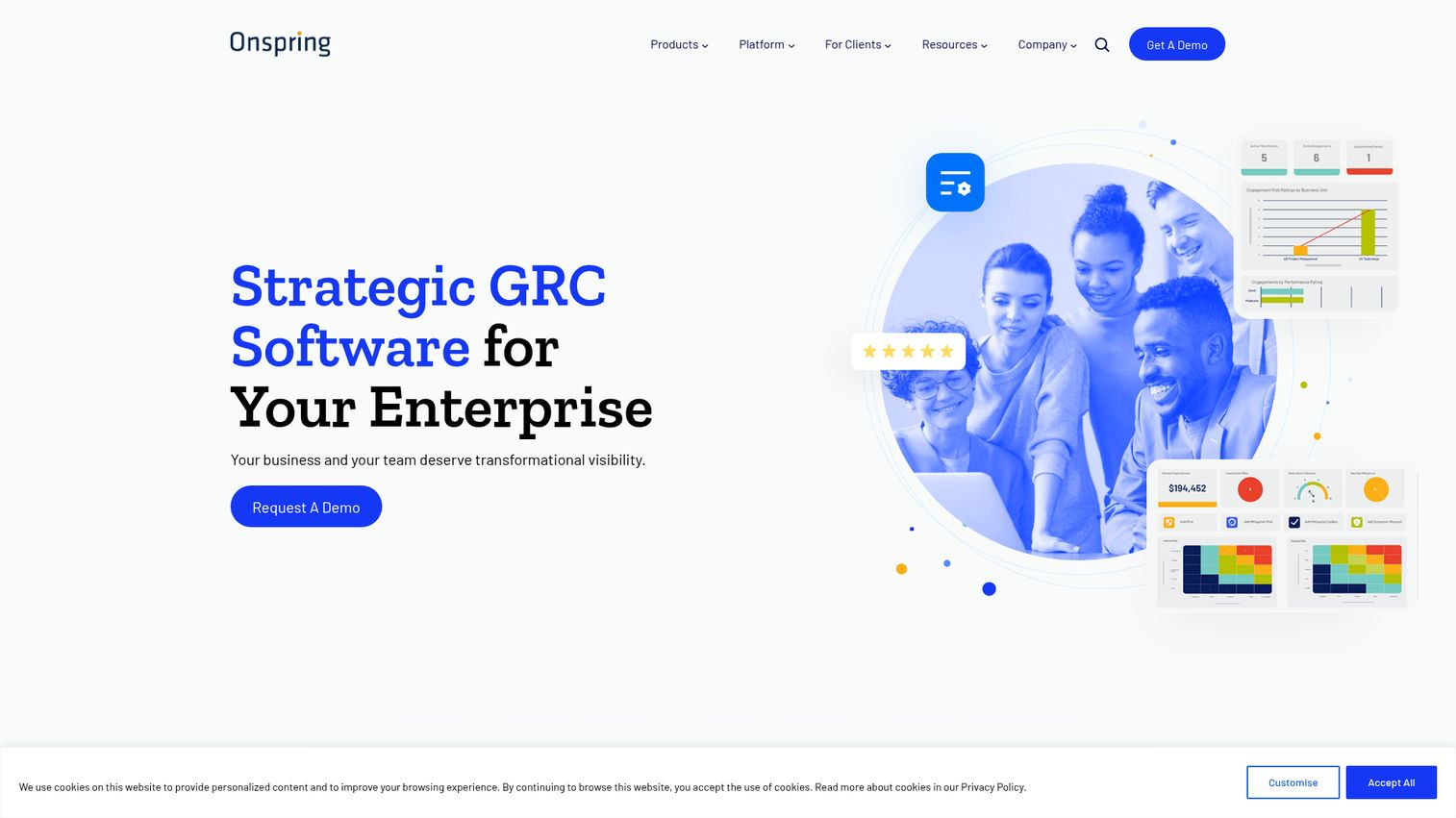
Onspring is a flexible, cloud-based GRC platform for connecting and monitoring business-critical functions, processes, and information. Its no-code design lets teams configure audit and risk workflows to fit their own processes rather than adapting to fixed templates. That configurability is its defining trait, and it shows in a strong G2 score.
Best for: Enterprises and government organizations needing configurable GRC, risk, compliance, audit, policy, and third-party risk workflows.
Key strengths
- Risk management: centralized risk registration, automated assessments, and prioritized risk analyses.
- Compliance management: control library, design and operating tests, and regulatory change tracking.
- Third-party risk management: vendor onboarding, assessments, and mitigation tracking in one place.
Why choose Onspring: Choose Onspring when you want to shape the platform to your workflow without code. Its 4.7/5 G2 rating, the highest on this list, reflects how teams value that flexibility. It fits organizations that have outgrown rigid tools but want to avoid heavy implementation.
Onspring pricing: Onspring uses quote-based pricing. The pricing page shows licensing by users, by products, or hybrid, plus platform levels Bronze, Silver, Gold, and Platinum, with no public figures. Contact the vendor for a quote. Onspring holds a 4.7/5 rating on G2.
11. Ideagen Internal Audit
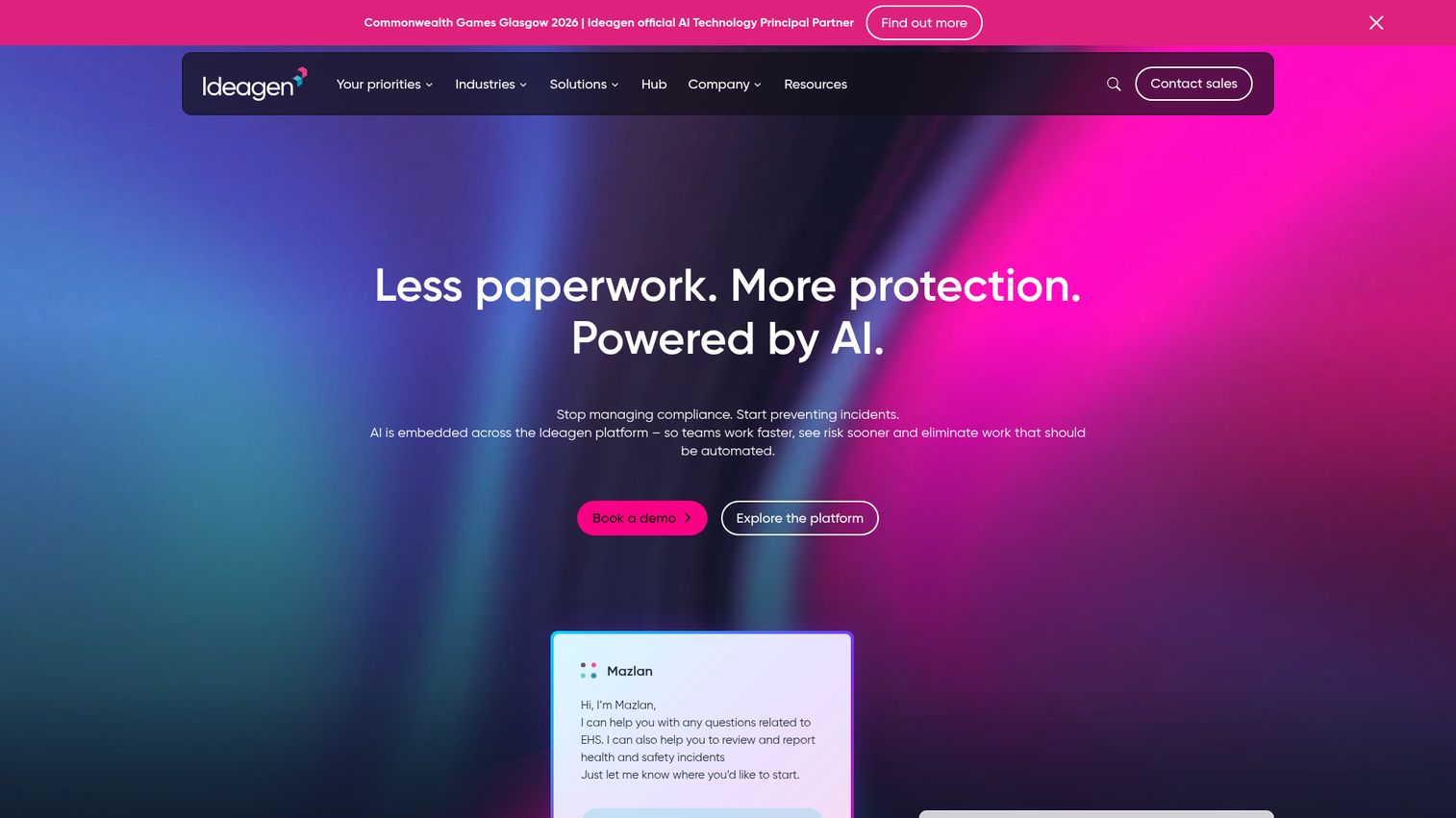
Ideagen Internal Audit, formerly Pentana, is internal audit automation software built on risk-based methodology for teams managing audit planning, control testing, reporting, and regulatory frameworks. It is purpose-built for the internal audit lifecycle in regulated industries, with mobile fieldwork and board-ready reporting. The risk-based approach drives planning and prioritization.
Best for: Internal audit teams that need risk-based planning, standardized audit workflows, control testing, and board-ready reporting in one system.
Key strengths
- Risk-based audit planning: prioritize the audit universe by risk so effort goes where it matters.
- Control testing automation: evidence collection and effectiveness tracking in one workflow.
- Stakeholder reporting automation: real-time dashboards and executive summaries for the board.
Why choose Ideagen Internal Audit: Choose Ideagen when internal audit is your core need and you work in a regulated industry that demands a risk-based methodology. Its focus on the audit lifecycle, rather than broad GRC, suits dedicated audit teams that want depth over breadth.
Ideagen Internal Audit pricing: Ideagen does not publish public pricing, and product pages direct buyers to request a demo or talk to sales. Contact the vendor for a quote. Ideagen Internal Audit holds a 4.2/5 rating on G2.
12. SolarWinds Access Rights Manager
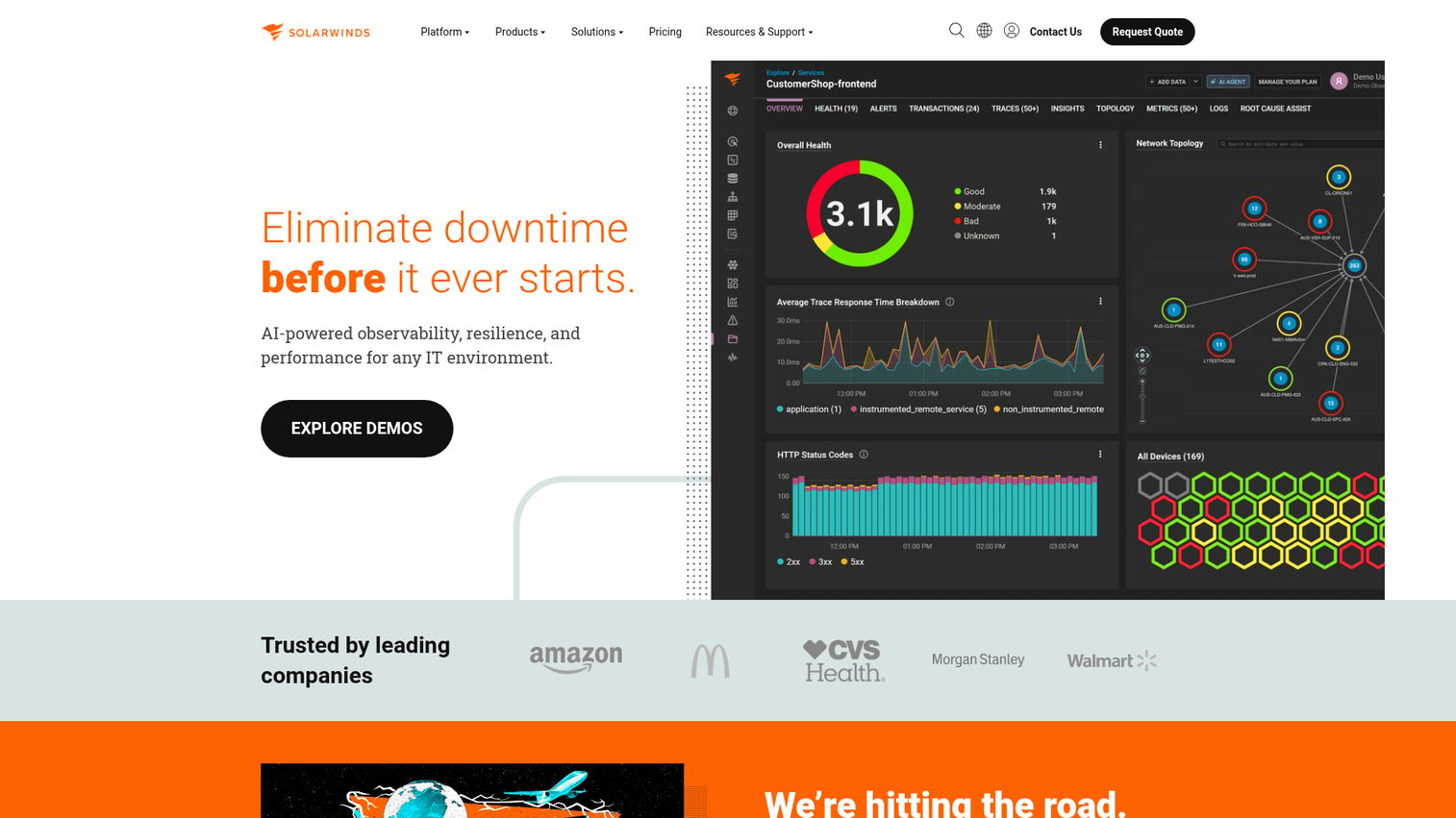
SolarWinds Access Rights Manager helps manage and audit access rights across IT infrastructure. It is the IT-audit specialist on this list, focused on who has access to what across Active Directory, Azure AD, file servers, and more. Rather than the full internal audit lifecycle, it owns the access-rights and permissions audit.
Best for: IT and security teams that need to audit, manage, and report on user access rights across Active Directory, Azure AD, file servers, SharePoint, Exchange, Teams, OneDrive, and related infrastructure.
Key strengths
- AD and Azure AD reporting: analyze permissions across directories to find who can access what.
- User provisioning and deprovisioning: role-specific templates speed access changes and offboarding.
- Compliance reporting: scheduled user activity reports support audit-ready evidence for HIPAA, GDPR, and PCI.
Why choose SolarWinds Access Rights Manager: Choose this when your audit problem is access, not the full audit lifecycle. It is the right tool for IT and security teams proving who has access during SOX, HIPAA, or GDPR reviews, and pairs well with a broader internal audit platform.
SolarWinds Access Rights Manager pricing: SolarWinds publishes pricing. ARM Audit Edition starts at USD 1,200 and includes permission analysis, auditing, and reporting. ARM Full Version starts at USD 3,448 and adds risk management, provisioning, and permission management. A 30-day free trial is available. The product holds a 3.5/5 rating on G2.
How to choose audit management software
Picking an audit management system software platform comes down to fit, not feature counts. Run every shortlisted tool through this checklist before you commit.
Audit lifecycle coverage
Confirm the tool spans planning, fieldwork, evidence, reporting, and remediation. A platform that handles testing but forces remediation back into a spreadsheet only solves half your problem. Map the tool against your actual audit process and look for gaps where work would fall out of the system.
Audit trail and evidence integrity
The audit trail is the point. Verify the platform keeps immutable logs, full version history, and defensible documentation. Ask how it records who changed what and when. If you cannot reconstruct the chain of evidence from inside the tool, it will not hold up under external scrutiny.
Integrations and deployment
Check fit with your data stack, GRC tools, and identity provider. SSO support matters for security review. Decide whether you need cloud, on-premise, or both, since some enterprise tools offer all three and others do not. Verify the specific connectors and integrations you depend on before you buy.
Framework and compliance fit
Match the tool to your frameworks: SOX, SOC 2, ISO 27001, HIPAA, GDPR, and the Global Internal Audit Standards. Tools that reuse one control across many frameworks save real effort. If you run continuous compliance, prioritize platforms built for multi-framework operations. For document-heavy programs, a strong contract analytics tool can complement your evidence workflow.
Pricing model and scalability
Most enterprise tools use custom pricing, so request quotes early. Watch for seat-based versus platform pricing, and weigh mid-market fit against enterprise depth. Factor in maintenance overhead, since a configurable no-code platform may cost less to maintain than a rigid one over time. The same scrutiny that applies to contract lifecycle management software applies here: budget before you talk to sales.
Conclusion
The best audit management software for your team depends on what you are solving. For connected data and reporting at scale, Workiva leads with its linked-data model. For board governance plus GRC oversight, Diligent One Platform unifies the view. For SOX and internal audit teams, AuditBoard earns its strong reputation, while Hyperproof fits multi-framework compliance operations. At the enterprise end, MetricStream, Archer, and IBM OpenPages run audit inside broad GRC platforms. For IT and access auditing specifically, SolarWinds Access Rights Manager owns that job.
Your next step is concrete. Shortlist two or three tools that match your frameworks, your data stack, and your audit lifecycle. Request demos and test each against your real workflow, not a canned scenario. A live demo is the fastest way to push on the audit trail, the integrations you depend on, and how remediation closes the loop. The right audit management system should make your evidence defensible without adding a maintenance burden. Start with the picks above that fit your situation, and let the demos confirm the fit.
FAQs
Audit management software is a system that helps internal audit, risk, and compliance teams plan, execute, document, and report audits while maintaining a complete audit trail. It replaces scattered spreadsheets and email with one workflow that tracks every step from planning to remediation. The audit trail it keeps automatically is what makes a program defensible under external scrutiny.
GRC software is broader. It covers governance, risk, and compliance across the whole organization, while audit management software focuses on the internal audit lifecycle: planning, fieldwork, evidence, and reporting. Many platforms overlap, since audit data, risk, and controls often live together. Several tools on this list, like MetricStream and IBM OpenPages, are full GRC suites that include audit as one module.
There is no single best pick. The right choice depends on your team size and frameworks. Connected platforms like Workiva and AuditBoard suit teams wanting audit, controls, and reporting together. Dedicated internal audit tools like TeamMate and Ideagen Internal Audit suit teams that want depth in the audit lifecycle specifically. Match the tool to your process before scoring features.
Most enterprise audit tools use custom pricing and require a sales conversation. IBM OpenPages is an exception, with indicative SaaS pricing starting at USD 3,300. SolarWinds Access Rights Manager publishes pricing from USD 1,200 for its Audit Edition. Tools like Workiva, Diligent, AuditBoard, and MetricStream gate pricing behind quotes, so request one early in your evaluation.
Compliance audit software should include control mapping across frameworks, automated evidence collection, framework templates for SOX, SOC 2, and ISO, reporting, and immutable audit trails. Reusing one control across multiple frameworks is a major time-saver. The ability to track remediation and produce audit-ready reports from live data separates strong platforms from document storage.
Yes. Most platforms on this list support SOX through control testing, evidence collection, and certification workflows. AuditBoard is especially popular with SOX teams, and Workiva connects SOX work to financial reporting. Look for SOX-specific control testing, version history, and reporting when SOX is the center of your program.
Most platforms integrate with common systems, including ERP, identity providers for SSO, other GRC tools, and data warehouses. Diligent One Platform connects to 100+ third-party data providers, and several tools offer REST APIs. Always verify the specific connectors you depend on with the vendor before purchase, since integration depth varies widely.
Neither is universally better. Cloud deployment reduces maintenance and speeds setup, which suits most teams. On-premise gives more direct control over data and may be required by certain security or regulatory needs. Some platforms, like IBM OpenPages, offer both SaaS and on-premise options, so match the deployment model to your security, control, and maintenance requirements.