A missed dispatch costs you the ride and the reputation. A booking form that stalls at the payment step costs you the customer before they ever sit in a car. Run a limo or chauffeur operation on spreadsheets and phone calls, and every one of those small failures compounds into weekend chaos, double-booked vehicles, and drivers who never got the updated pickup time.
The industry has already moved. According to Market Growth Reports (2026), 63% of global taxi and limousine operators now use digital dispatch or fleet management software, and adoption climbs above 70% in urban regions. The same research shows an 48% jump in adoption of cloud-based and AI-enabled tools, plus 81% of fleets running mobile driver apps. If you are still coordinating rides by text message, your competitors are running a tighter book.
The good news: the limo dispatch software market has matured. You can pick a platform that handles online booking, automated dispatch, driver coordination, payments, and reporting without stitching five tools together. The hard part is figuring out which limo booking software actually fits your fleet size, your budget, and the way your dispatchers already work.
This guide breaks down eight platforms operators are shortlisting in 2026. We looked at the day-to-day reality of running a fleet, not marketing claims, so you can match a tool to your operation and move off the spreadsheet for good.
What's inside
This guide is for limo, black car, chauffeur, and ground transportation operators evaluating software to replace manual booking and dispatch. We selected platforms based on four criteria that matter most to daily operations: dispatch reliability and automation, online booking and payment handling, driver app and communication features, and transparent pricing that fits a range of fleet sizes. Every tool here targets transportation operators specifically, not generic scheduling apps. We pulled pricing and feature details from each vendor's own site as of 2026, so you can compare on real numbers.
TL;DR
- Best free tier to start: Moovs and Kymark both offer a genuinely free plan, so a small fleet can test dispatch and booking before paying.
- Best for established operators: Limo Anywhere is the incumbent with the deepest reservation and dispatch suite.
- Best for AI-driven dispatch: Kymark and Ridxo lead on automated assignment and smart dispatch boards.
- Best for global and multilingual operations: LimoExpress is built mobile-first with strong international workflows.
- Best usage-based pricing: WorldLimoBiz charges per reservation with a monthly cap, no flat subscription.
- Best all-in-one growth platform: Exaltis bundles dispatch, booking, payments, and an affiliate network under one white-labeled app.
What is limo software?
Limo software is a category of transportation booking and management software that lets operators handle reservations, dispatch, driver coordination, fleet tracking, and payments from one platform. It replaces the manual mix of spreadsheets, phone calls, and paper trip sheets that break down as a fleet grows.
Most limo reservation software today is cloud-based, which means dispatchers, drivers, and customers all work from the same live data. A booking placed online updates the dispatch board instantly, the assigned driver sees it on a mobile app, and the payment reconciles against the trip automatically.
Modern chauffeur software typically includes:
- Online booking: A customer-facing widget or portal that quotes, books, and collects payment without a phone call.
- Dispatch board: A visual scheduler where dispatchers assign trips to vehicles and drivers, often with conflict detection.
- Driver app: A mobile app that pushes trip details, navigation, and status updates to drivers in real time.
- Fleet management: Vehicle records, availability, and GPS tracking for limousine companies running multiple cars.
- Payments and invoicing: Card processing, invoicing, and reconciliation tied to each reservation.
- Reporting and analytics: Revenue, trip volume, and driver performance data for weekly decisions.
- Customer portal: A self-serve account where repeat clients rebook and manage rides.
The best limo management software connects all of these so a single booking flows from the customer through dispatch to the driver and back into your books without anyone retyping data. That end-to-end connection is what separates a real platform from a booking form bolted onto a website.
When to use limo software
Not every operation needs the same thing on day one. Here is how to pattern-match your situation.
Replace manual dispatch as you scale
If your dispatchers still coordinate rides by phone and text, you are one busy Saturday away from a double-booked vehicle. Limo dispatch software gives you a single board where every trip, vehicle, and driver is visible, so assignments happen fast and conflicts surface before they become no-shows. This is the trigger for most operators moving off spreadsheets.
Capture more online bookings
When customers have to call to book, you lose the ones who search at midnight and the ones who hate phone calls. Online booking for limo services lets prospects quote and reserve directly from your site, often paying upfront. If your website drives traffic but few conversions, weak booking flow is usually the bottleneck.
Coordinate a distributed driver team
The moment you have more than a couple of drivers, verbal handoffs stop scaling. A driver app for a limo business pushes trip details, pickup changes, and navigation straight to each driver's phone, cutting the back-and-forth. If drivers miss updates or show up late because a pickup time changed, this is the fix.
Comparison table
Here is how the eight platforms compare on intent, standout capability, pricing, and rating. Pricing reflects each vendor's public page as of 2026. Where a vendor does not publish a verified rating on a major review site, we left the field blank rather than guess.
| # | Product | Intent | Key use case | Pricing | G2 rating |
|---|---|---|---|---|---|
| 1 | Moovs | Small to mid fleets | Booking, dispatch, and customer communication in one platform | Free tier; paid from $149/mo | 4.5/5 |
| 2 | Limo Anywhere | Established operators | Deep reservation and dispatch suite | From $99/mo | - |
| 3 | LimoExpress | Global operators | Mobile-first dispatch with multilingual support | From €49/mo | - |
| 4 | Kymark | Value-focused fleets | AI dispatch board with 9 pricing tiers | Free forever; paid from $19/mo | 5.0/5 |
| 5 | Exaltis | Growth-focused operators | White-labeled app with affiliate network | From $89.10/mo | - |
| 6 | Ridxo | Automation-first fleets | AI auto-dispatch and GPS tracking | From $149/mo | - |
| 7 | WorldLimoBiz | Low-volume operators | Usage-based pay-per-reservation pricing | $2/reservation, capped at $200/mo | - |
1. Moovs
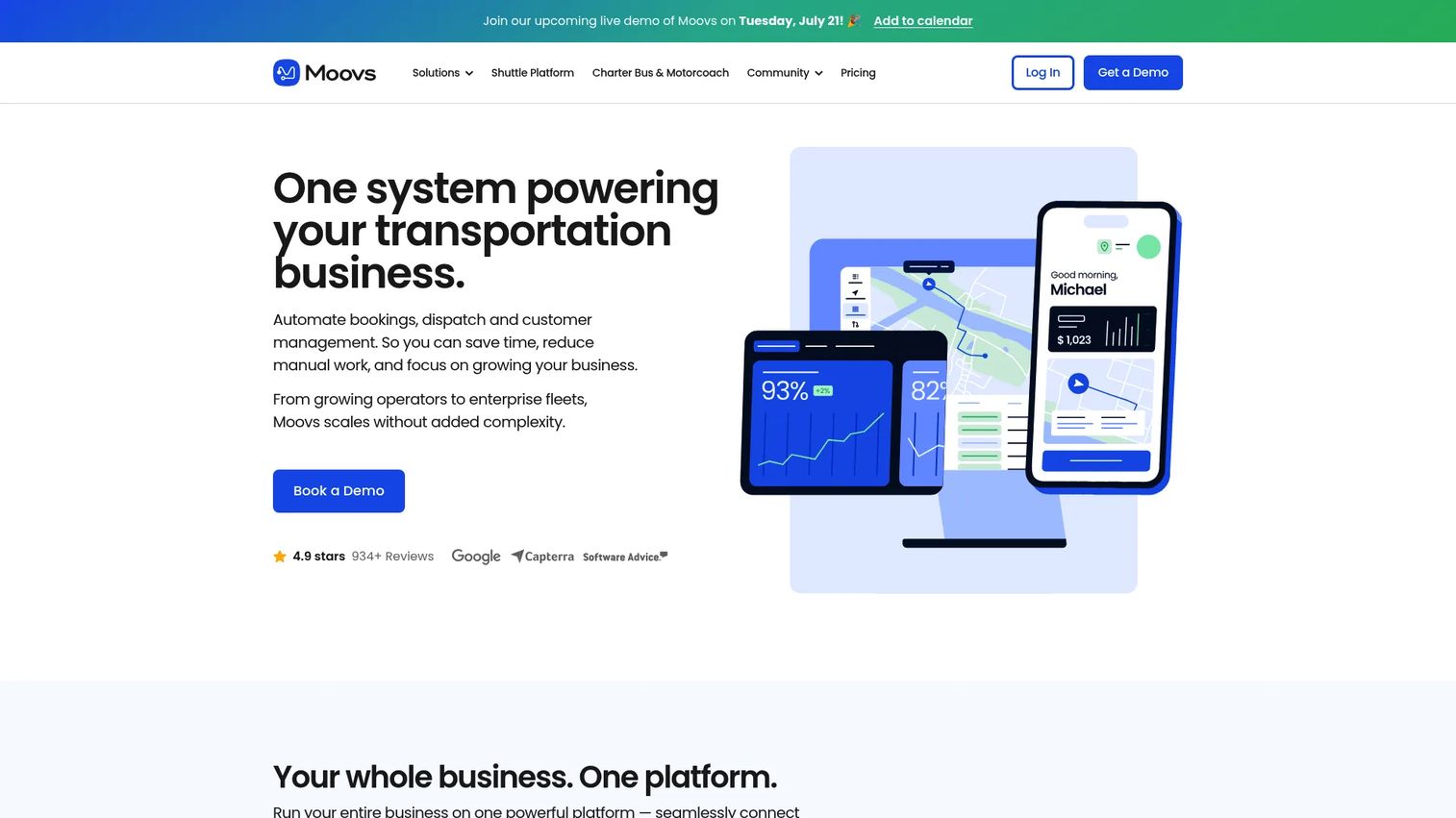
Moovs is transportation software built for operators who want booking, dispatch, customer communication, and fleet operations in one place. It targets small to mid-sized fleets that have outgrown spreadsheets but do not want an enterprise rollout. The free Test Drive tier makes it one of the easiest ways to try real dispatch and booking before committing budget.
Best for: Transportation businesses that need booking, dispatch, and customer communication together without a heavy setup.
Key strengths
- Dispatch automation: Assigns and tracks trips from a central board, cutting the manual coordination that breaks down on busy days.
- Customer portal: Gives repeat clients a self-serve account to rebook and manage rides, reducing inbound calls.
- Driver app with real-time GPS tracking: Pushes trip details to drivers and shows live vehicle location for dispatchers and customers.
Why choose Moovs: The free tier is the real differentiator here. Most limo booking software makes you commit before you see the dispatch board in action. Moovs lets a small operator validate the workflow first, then scale into paid plans as volume grows. That fits an operator who wants to prove the tool works before it earns a line in the budget.
Moovs pricing: Moovs publishes its pricing openly. There is a free Test Drive tier, then Standard at $149/month, Pro at $199/month, and Enterprise at $999/month, all billed monthly. Some add-ons carry separate pricing shown on the same page. The free tier plus a clear paid ladder makes cost easy to model as you grow. Moovs holds a 4.5/5 rating on G2.
2. Limo Anywhere
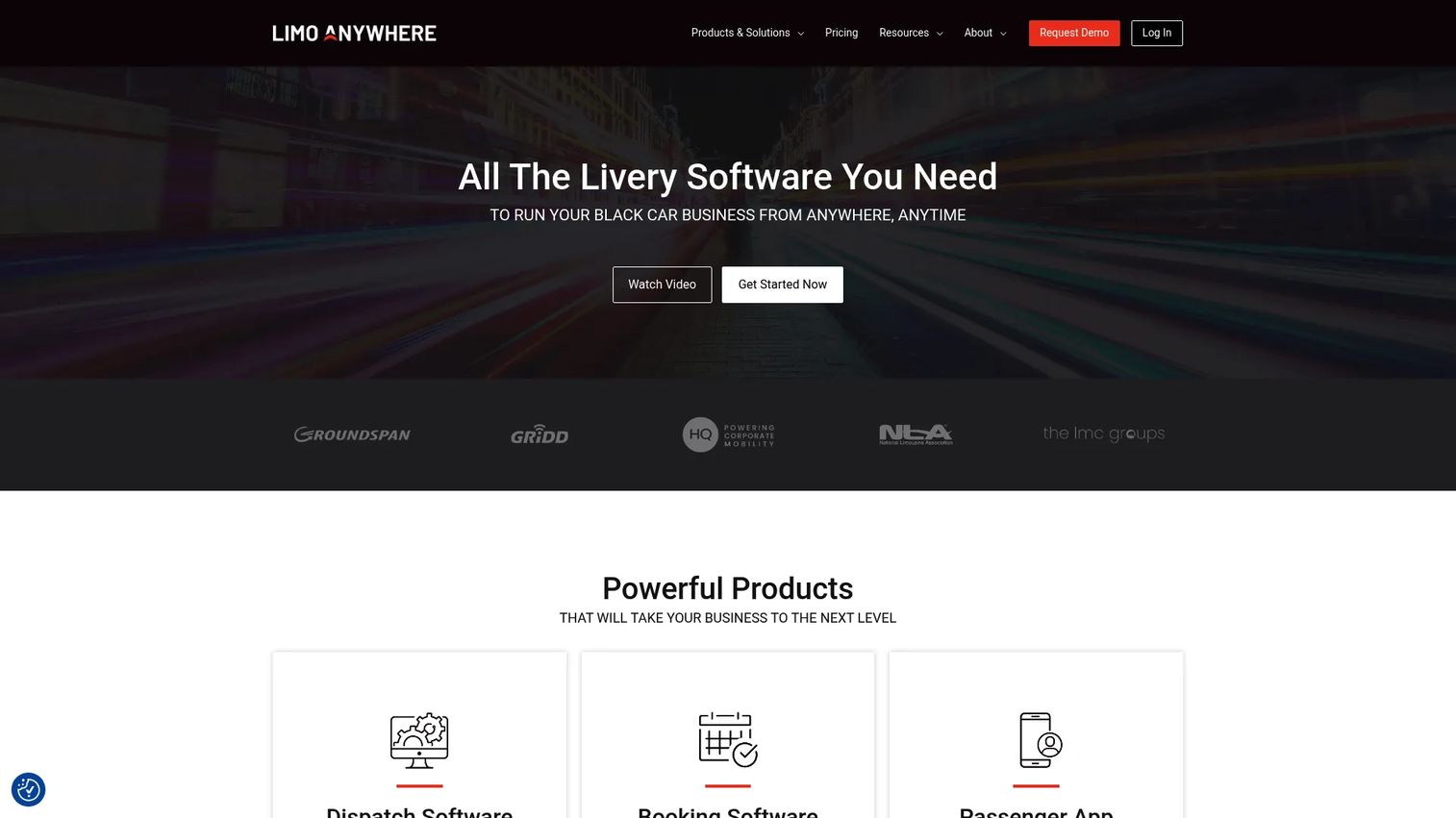
Limo Anywhere is cloud-based transportation software for limo, black car, livery, chauffeur, and ground transportation operators. It is the long-standing incumbent in this space, and many established fleets already run on it. The suite covers reservations, dispatch, and driver workflows in depth, which is why operators with complex operations tend to shortlist it first.
Best for: Limo and chauffeur operators needing a deep, proven reservation, dispatch, and driver workflow suite.
Key strengths
- Reservation management: Handles complex booking scenarios, recurring trips, and detailed trip records that larger operations rely on.
- Dispatch management: Coordinates vehicles and drivers across high trip volumes with a mature dispatch workflow.
- Driver mobile app: Delivers trip assignments and updates to drivers directly, keeping the field team in sync.
Why choose Limo Anywhere: Breadth and familiarity are the case here. If you run a larger fleet with layered booking rules and want a platform other operators already know, the incumbent depth pays off. Migration takes planning because there is a lot of data and workflow to move, so budget time for setup. This one fits operators who value a mature ecosystem over a lean, modern build.
Limo Anywhere pricing: The public pricing page shows three plans: Core at $99/month, Plus at $249/month, and Black at $549/month, all billed monthly. Usage-based trip fees and a one-time upfront fee apply on top of the plan price, so total cost depends on volume. Review the trip-fee structure closely against your monthly ride count before committing.
3. LimoExpress
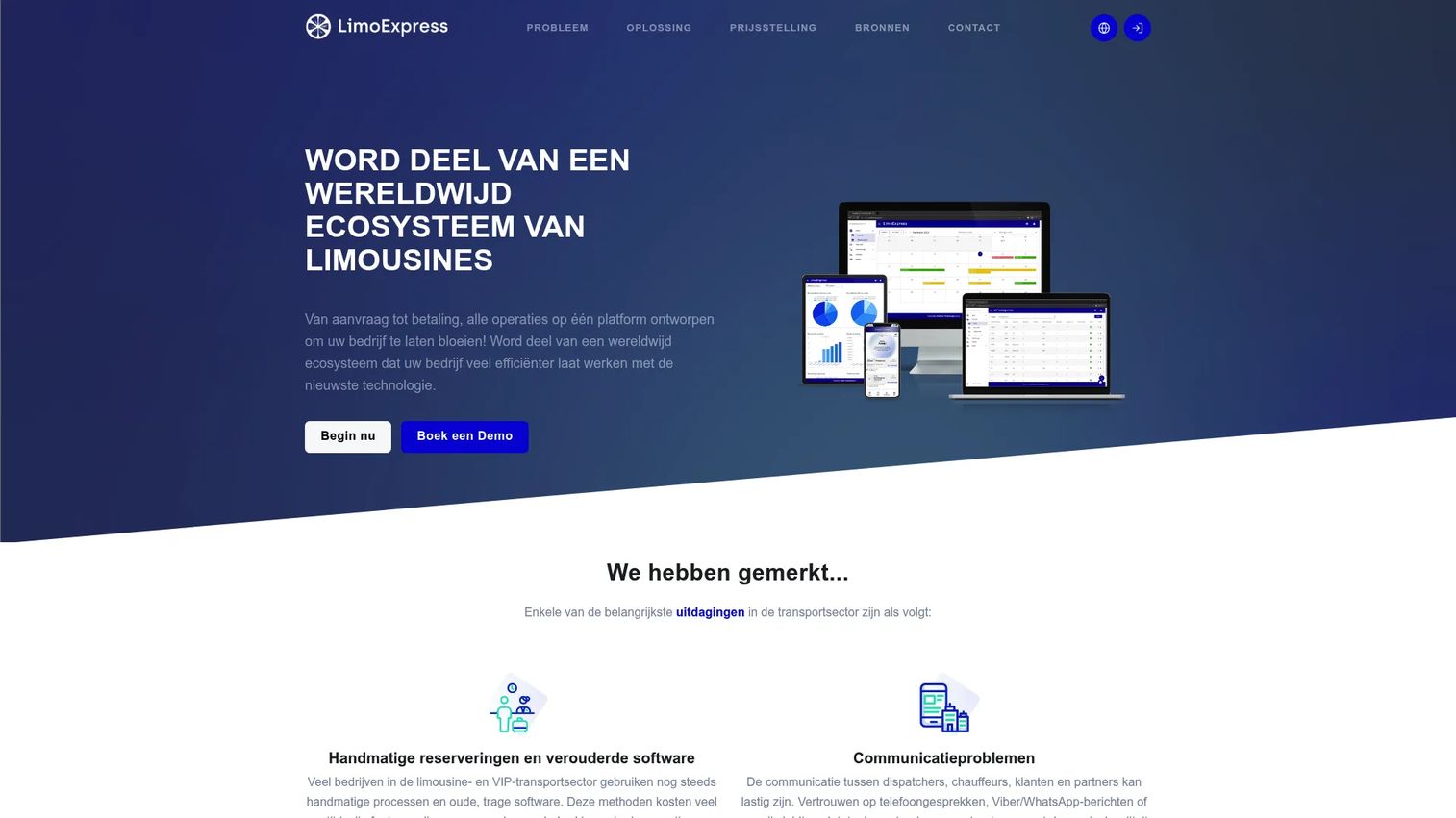
LimoExpress is limo dispatch and management software for limo and transfer agencies, with a strong mobile-first and global orientation. It leans into distributed operations, so if you run rides across regions, time zones, and languages, the platform is built for that reality. The dispatcher back office, driver apps, and public booking form all work together to keep communication tight.
Best for: Transportation companies needing limo dispatch, booking, and driver coordination with international workflows.
Key strengths
- Web and mobile applications: Gives dispatchers and drivers full functionality on both desktop and phone, so the field team is never out of the loop.
- Reservation management and AI form mapping: Handles bookings and uses AI to map incoming request forms, cutting manual data entry.
- Push notifications and API integration: Keeps drivers and customers updated in real time and connects the platform to your other tools.
Why choose LimoExpress: Global reach is the differentiator. Every plan bundles driver apps, integrations, the booking form, API access, AI features, unlimited rides and vehicles, and 24/7 support, which is a strong feature floor for multi-region operators. If your work spans multiple countries and languages, this mobile-first build fits the way your team actually operates.
LimoExpress pricing: Pricing is tiered by user accounts and shown in euros, excluding taxes. TEAM 5 is €49/month, TEAM 10 is €96/month, TEAM 25 is €229/month, and TEAM 50 is €409/month, with annual options that lower the effective rate. The page notes a 14-day trial and an optional onboarding fee. US operators should factor in currency conversion when modeling cost.
4. Kymark
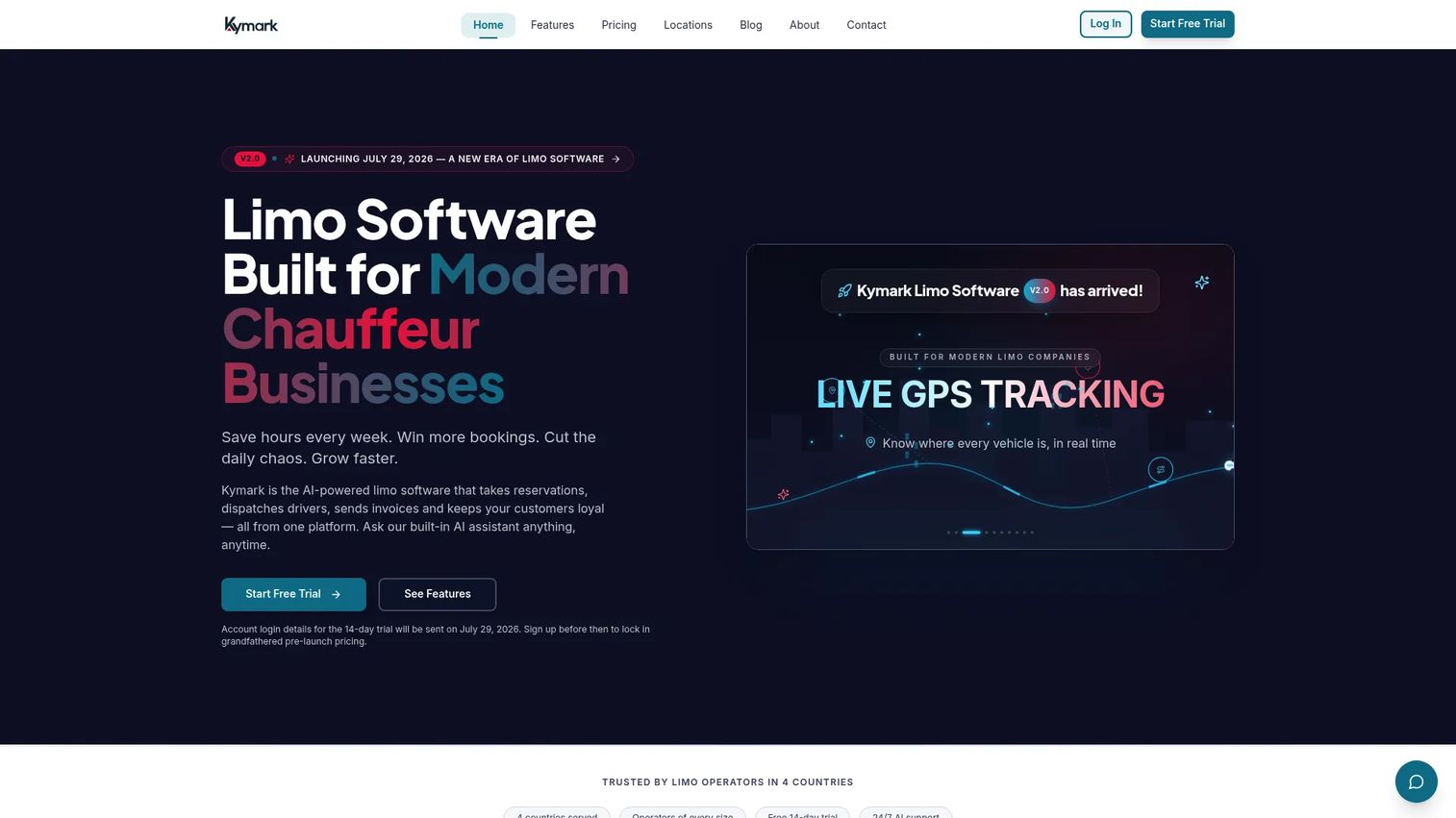
Kymark is AI-powered limo and chauffeur software covering reservations, dispatch, billing, fleet management, and customer management. It stands out on two fronts: an AI-assisted visual dispatch board and a pricing model that starts genuinely free. For operators who want automation without an enterprise price tag, it is one of the sharper options in 2026.
Best for: Limo, chauffeur, and black car operators wanting an all-in-one dispatch and booking platform at a low entry cost.
Key strengths
- Visual dispatch board: Drag-and-drop scheduling with conflict detection, so double-bookings surface before they hit the road.
- Online booking, invoicing, and Stripe payments: Handles the full booking-to-payment loop, including trip management and card processing.
- Fleet management, driver app, and analytics: Tracks vehicles, coordinates drivers, and reports on performance from one system.
Why choose Kymark: The pricing ladder is unusual and operator-friendly. Every plan includes the same software, with tiers differing only on monthly booking and vehicle limits. That means a small fleet gets the full AI dispatch feature set on the free plan and only pays more as volume grows, never for features gated behind a higher tier. If you want capability first and cost scaled to usage, this structure fits.
Kymark pricing: Kymark runs nine tiers. Starter is free forever, then Starter Plus at $19/month, Basic at $49/month, Professional at $59/month, Enterprise at $99/month, and higher tiers (Titan, Supreme, Imperial, Royal) climbing to $229/month, all billed monthly. Because every tier ships the same features, you pick a plan purely on your booking and vehicle volume. Kymark holds a 5.0/5 rating on G2 from a small number of reviews.
5. Exaltis
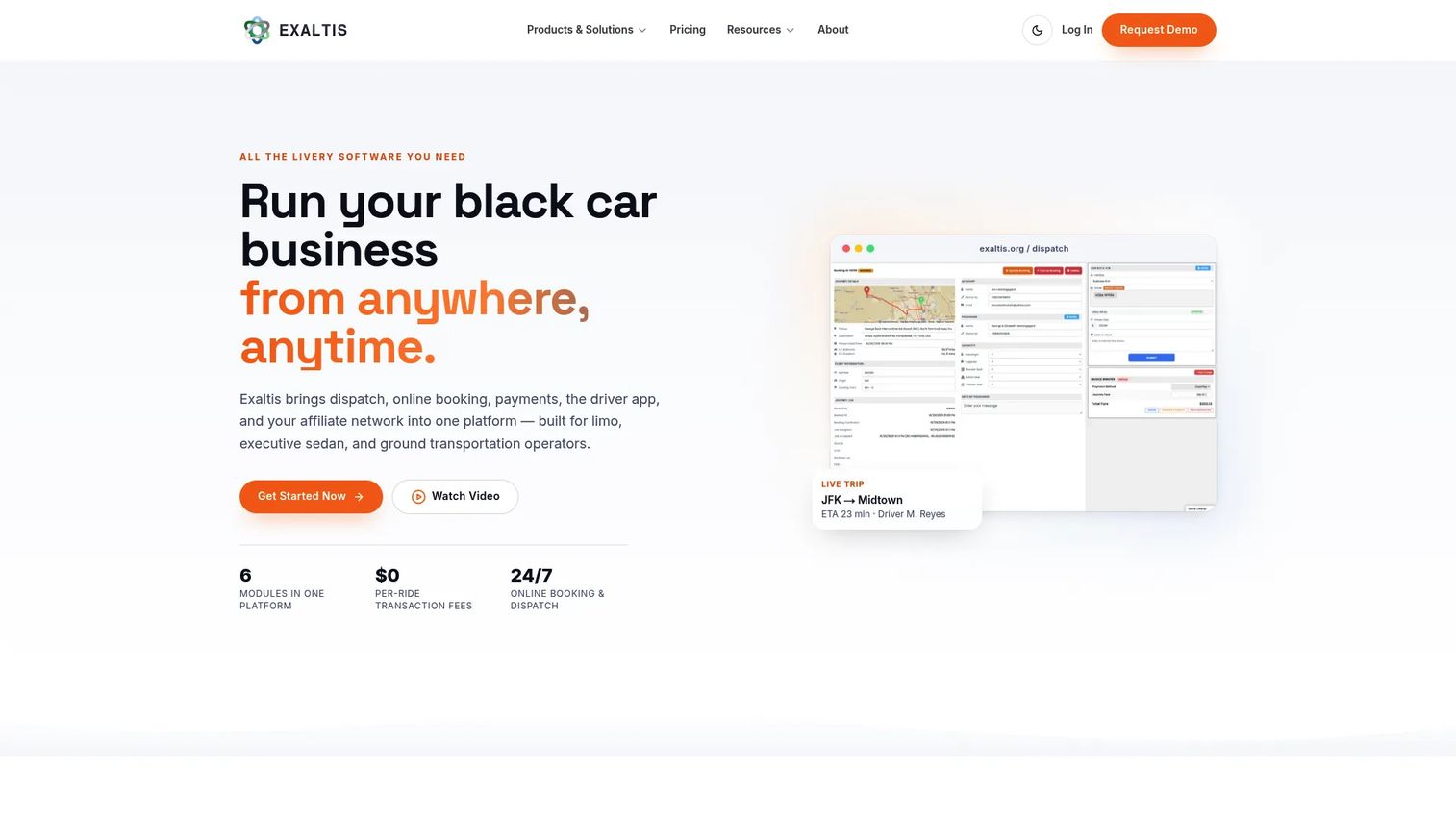
Exaltis is all-in-one limo, black car, and ground transportation management software. It bundles dispatch, online booking, payments, and mobile apps into a single white-label passenger app, with an affiliate network layer aimed at operators who want to grow through partnerships. The operator-led workflow keeps passengers, drivers, and dispatchers in one connected system.
Best for: Ground transportation operators needing dispatch, booking, payments, and mobile apps in one system.
Key strengths
- Dispatch with real-time assignment: Manages the full trip lifecycle with live driver assignment, keeping the board current as rides come in.
- Online booking portal: Quotes, books, and collects payment in one flow, so customers complete the reservation without a call.
- White-labeled app and affiliate workflows: Puts passenger, driver, and dispatcher access in one branded app, with SMS notifications and affiliate network handling.
Why choose Exaltis: The affiliate network and white-label app make this a growth play. If you subcontract rides to partners or want to hand overflow to affiliates, the built-in network workflow saves you from managing that by hand. Operators focused on expanding through partnerships, not just running their own cars, get the most from this build.
Exaltis pricing: Exaltis shows three tiers on its homepage: Core at $89.10/month, Pro at $194.65/month, and Enterprise at $366.75/month, all billed monthly. A one-time setup fee is charged on the first invoice, and every plan includes a 14-day free trial. The setup fee is worth confirming with sales before you commit so there are no surprises on the first bill.
6. Ridxo
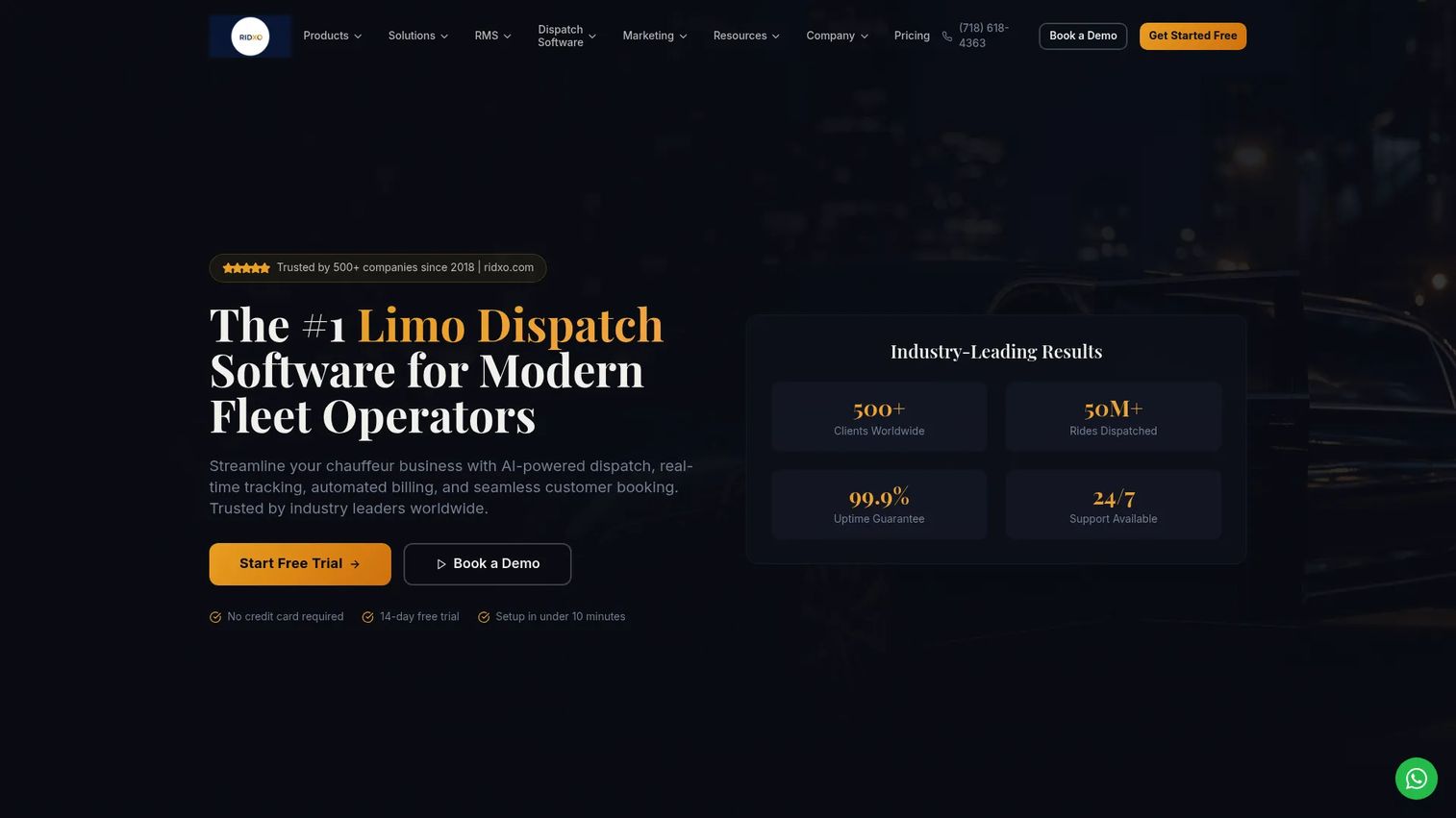
Ridxo is limo and chauffeur dispatch software for fleet operators, with a modern interface and automation at its core. The headline feature is AI-powered auto-dispatch, which assigns rides without a dispatcher manually matching every trip to a vehicle. Pair that with real-time GPS tracking and an online booking portal, and it fits operators who want to reduce manual coordination.
Best for: Small to mid-size limo and chauffeur fleets needing dispatch, booking, and fleet tracking with automation.
Key strengths
- AI-powered auto-dispatch: Automatically assigns rides to the right vehicle, cutting the manual matching that slows dispatchers on busy days.
- Real-time GPS tracking: Shows live vehicle location for dispatchers and customers, improving ETA accuracy and accountability.
- Online booking portal: Lets customers reserve and pay directly, feeding trips straight into the dispatch flow.
Why choose Ridxo: Automation and a clean modern build are the draw. If your dispatchers spend too much of the day manually assigning rides, the AI auto-dispatch removes that friction and lets a smaller team handle more volume. The 14-day free trial gives you a window to test whether the automation matches how your fleet actually runs before you pay.
Ridxo pricing: Ridxo lists a Starter plan at $149/month and a Professional plan at $299/month, both billed monthly, with a custom Enterprise tier for larger operations. A 14-day free trial is available on the public plans. Compare the Starter feature set against your volume, then step up to Professional if you need the added capacity.
7. WorldLimoBiz
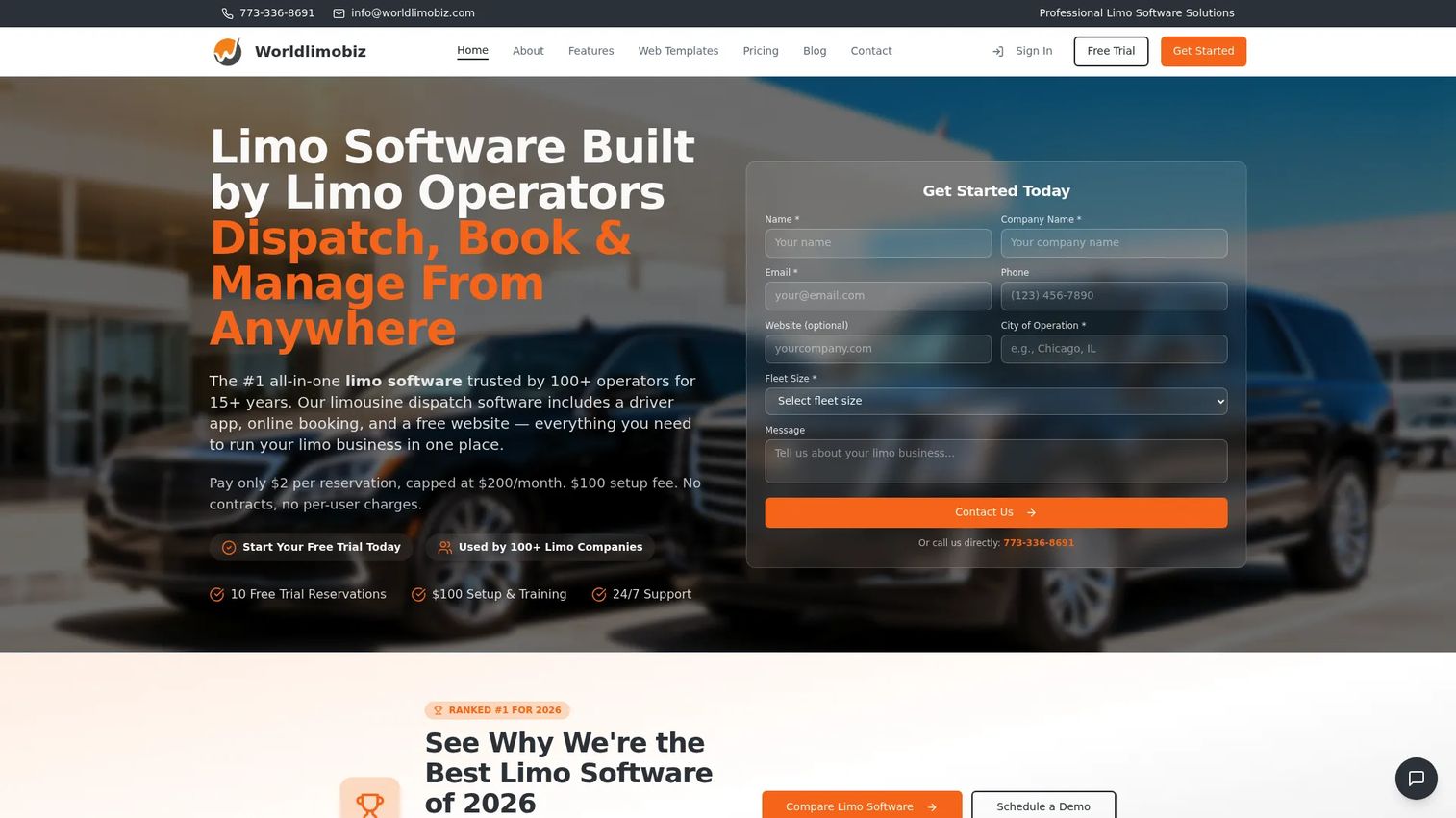
WorldLimoBiz is limo dispatch and booking software for transportation operators, pitched as an everything-in-one-place platform with a distinctive usage-based price. Instead of a flat monthly subscription, you pay per reservation with a monthly cap, which changes the math entirely for lower-volume operators. Dispatch, a driver app, and online booking come bundled.
Best for: Limo and chauffeured transportation businesses that want usage-based dispatch software pricing.
Key strengths
- Dispatch management: Coordinates trips, vehicles, and drivers from one place, with the core scheduling operators expect.
- Driver mobile app: Delivers trip details and updates to drivers so the field team stays current.
- Online booking and customer management: Lets customers book online and keeps client records for repeat business.
Why choose WorldLimoBiz: The pricing model is the whole story. If you run a low or seasonal volume of rides, paying $2 per reservation with a $200 monthly cap can cost far less than a flat subscription you pay whether you dispatch 10 rides or 500. Operators with unpredictable or light schedules get the clearest benefit from this structure.
WorldLimoBiz pricing: There is a $100 setup fee and 10 free trial reservations to start. After that, you pay $2 per reservation, capped at $200/month, with no recurring monthly base fee. The cap means high-volume months never run away from you, while slow months stay cheap. Run your typical monthly ride count against the $2 rate and the $200 cap to see where you land versus a flat plan.
Considerations before you buy
Picking limo management software is less about feature checklists and more about fit with how you already operate. Here is what to verify before you sign.
Fleet size and pricing model
Match the pricing model to your volume, not just the sticker price. A flat monthly plan makes sense for steady, high-volume fleets, while usage-based pricing like WorldLimoBiz's per-reservation cap can save money for light or seasonal operators. Model your actual monthly ride count against each plan before deciding.
Dispatch reliability and automation
The dispatch board is the heart of daily operations. Look for conflict detection, drag-and-drop assignment, and increasingly AI auto-dispatch that assigns rides without manual matching. If your dispatchers are the bottleneck on busy days, prioritize automation depth.
Driver app and communication
A driver app is not optional at scale. Confirm it pushes real-time trip updates, navigation, and status changes to drivers, and that GPS tracking feeds accurate ETAs back to dispatchers and customers. Weak driver communication is where rides go wrong.
Online booking and payments
Check that the online booking flow quotes, books, and collects payment in one uninterrupted path. Every extra step loses customers. Confirm the payments and invoicing tie back to each reservation so your books reconcile without manual work.
Setup, migration, and support
Ask how long onboarding takes and whether there is a setup fee, since several platforms charge one. If you are migrating from another system or spreadsheets, factor in data transfer time and confirm the support you get during the switch. A free trial is the cheapest way to test real fit.
Conclusion
The right limo software depends on your fleet size, your volume, and how much you want to automate. For small operators who want to test before paying, Moovs and Kymark both offer free tiers that run real dispatch and booking. Established fleets with complex booking rules lean toward Limo Anywhere's proven depth. Operators running across regions and languages fit LimoExpress's mobile-first, global build.
For automation-first teams, Ridxo and Kymark lead on AI dispatch that cuts manual assignment. Growth-minded operators who work with partners get the affiliate network in Exaltis. And if your volume is light or seasonal, WorldLimoBiz's pay-per-reservation model with a monthly cap can beat any flat subscription on cost.
Your next step: shortlist two platforms that match your pricing model and fleet size, then run each through a free trial with a real week of bookings. The dispatch board and driver app either fit how your team works or they do not, and you will know within days. Move off the spreadsheet before the next busy weekend forces the decision for you.
FAQs
Limo software is transportation booking software that lets operators manage reservations, dispatch, drivers, fleet, and payments from one platform. It replaces manual spreadsheets and phone calls with a connected system where a booking flows from the customer through dispatch to the driver automatically. Most limo reservation software today is cloud-based, so dispatchers, drivers, and customers all work from the same live data.
Good limo dispatch software should include a visual dispatch board with conflict detection, real-time driver assignment, and increasingly AI auto-dispatch. It should also connect to online booking, a driver app with GPS tracking, and payments so a single trip updates every part of the system. Reporting and analytics round it out, giving you revenue and trip data for weekly decisions.
Pricing in 2026 ranges widely by model. Flat monthly plans start around $89 to $149 per month for entry tiers and climb past $500 for larger operations. Some platforms like Kymark offer a free-forever tier, while WorldLimoBiz uses usage-based pricing at $2 per reservation capped at $200 per month. Watch for one-time setup fees and usage-based trip fees on top of the base plan.
Limo booking software handles the customer-facing side: quoting, reserving, and collecting payment for a ride online. Limo dispatch software handles the operational side: assigning trips to vehicles and drivers and coordinating them in real time. Most modern platforms combine both, so a booking placed online lands directly on the dispatch board without anyone retyping it.
Once you have more than a couple of drivers, a driver app becomes essential. Market Growth Reports (2026) found 81% of fleets use mobile driver apps, because verbal handoffs stop scaling. A driver app for a limo business pushes trip details, pickup changes, navigation, and status updates straight to each driver's phone, cutting the back-and-forth that causes late pickups and missed rides.
A small operator should prioritize a low entry cost, fast setup, and a free trial or free tier to test real fit before paying. Look for online booking, a workable dispatch board, and a driver app in the base plan rather than gated behind higher tiers. Usage-based pricing can also make sense if your ride volume is light or seasonal.
Compare on your actual monthly ride volume, not the sticker price. Flat monthly plans favor steady, high-volume fleets, while per-reservation pricing with a cap favors light or seasonal operators. Add any one-time setup fees and per-trip usage fees into the total, then model each option against a typical and a peak month to see the real difference.
Yes. Most modern limousine booking software processes card payments, generates invoices, and reconciles them against each reservation automatically. Many platforms also include a customer portal where repeat clients rebook and manage rides on their own, reducing inbound calls. Confirm the payment processor and invoicing flow tie directly to the trip record so your books reconcile without manual work.