You outsourced a batch of blog posts. The writer swears it's human. Your editor suspects otherwise. And your SEO lead is asking whether Google's spam filters can tell the difference before you hit publish.
This is the pressure content teams face right now. By 2025, 54.6% of U.S. adults ages 18 to 64 were using generative AI, up 10 percentage points in a single year, according to the Federal Reserve Bank of St. Louis. For marketers who commission, edit, or publish content at scale, that shift creates a real brand-safety problem: How do you verify what you're putting your name on?
The global AI detector market was valued at $581.3 million in 2025 and is projected to reach $5.23 billion by 2033 (Grand View Research, 2026). The category is maturing fast, but the tools inside it vary widely on accuracy, false-positive risk, and workflow fit. Some are built for education. Others are built for enterprise publishing pipelines. Picking the wrong one means either missing AI content or flagging human writers as machines, neither of which you can afford.
This guide cuts through the noise for content teams, editors, and marketing ops leads who need a detector that fits their actual workflow.
What's inside
This guide covers the 8 best AI content detection software tools for 2026. Tools were chosen based on:
- Accuracy and false-positive risk: How reliably does the detector distinguish AI from human writing without wrongly flagging clean copy?
- Workflow fit: Does it plug into existing editorial, publishing, or outsourcing review processes?
- Integrations: Browser extensions, Google Docs, LMS, API, and CRM compatibility
- Pricing transparency: Free tiers, per-word or per-scan costs, and enterprise options
TL;DR
- Best overall for teams that need broad workflow fit: GPTZero
- Best for marketers who want detection plus rewriting in one place: QuillBot
- Best for benchmark-driven buyers and mixed-media detection: Pangram Labs
- Best for mixed-content and publisher editorial workflows: Originality.ai
- Best free tier with named-model detection: Winston AI
- Best for plagiarism plus AI detection together: Copyleaks
- Best for enterprise content governance: Writer
- Best for lightweight detection inside support or ops workflows: Sapling
What is AI content detection software
AI content detection software is a category of tools that analyzes text, images, or video to determine the probability that the content was generated by an AI model rather than written by a human.
Detectors work by running text through statistical models trained on large datasets of human-written and AI-generated content. The output typically includes a probability score, sentence-level highlights marking which passages read as AI-generated, and sometimes a classification of the content as human, AI, or hybrid.
Key capabilities to look for:
- Probability scores: A document-level confidence rating (for example, 87% AI-generated) and sentence-level breakdowns
- Sentence-level highlights: Color-coded annotations that show which specific sentences or phrases triggered the detection
- Hybrid content analysis: Detection of mixed documents where AI-written and human-written passages coexist
- Model coverage: Support for detecting output from GPT-4, GPT-5, Claude, Gemini, Llama, Mistral, and other widely used models
- Multilingual support: Detection capability beyond English, relevant for teams running campaigns or content in multiple markets
- Adjacent trust features: Plagiarism checking, readability scoring, fact-checking, and content certification, which some tools bundle alongside detection
The category sits at the intersection of AI content creation tools and editorial quality control. Most marketing teams reach for it when outsourcing at scale, managing freelancers, or setting brand-safety standards for content partners.
Detectors are not perfect. False positives occur when formulaic, repetitive, or highly technical human writing scores as AI-generated. Any team using these tools at volume needs a policy for reviewing flagged content rather than auto-rejecting it.
When to use AI content detection software
Verify outsourced content before publishing
When you work with freelancers, content agencies, or offshore writing teams, an AI checker gives you a lightweight review layer before editorial time gets spent on a draft. Scan on intake, flag high-probability results for a closer human review, and you catch the problem before it costs you an editor's morning.
Screen submissions or drafts for authenticity risk
Marketing ops and content ops teams managing contributor programs, guest post queues, or internal drafts from teams using AI-assist tools need a way to audit at volume. A detection tool with API access or a browser extension lets you scan without breaking the existing submission workflow.
Reduce editorial and brand safety mistakes at scale
Publishers, SEO leads, and demand gen teams running high-volume content programs use detectors as a final quality gate alongside plagiarism checks. The goal isn't to eliminate AI assistance from the content process; it's to know exactly what you're publishing and whether it meets your editorial standards. For a broader look at how these tools fit into a modern stack, see our roundup of AI writing tools for marketers.
AI content detection software comparison
The table below summarizes the 8 tools evaluated in this guide. Rankings reflect workflow fit for content and marketing teams, not test scores from a single benchmark.
| # | Product | Best for | Key differentiator | Pricing | G2 rating |
|---|---|---|---|---|---|
| 1 | GPTZero | Teams screening content at volume | Document, sentence, and word-level detection with integrations | Free tier available; paid tiers add higher limits and features | 4.3/5 |
| 2 | QuillBot | Marketers who detect and rewrite in one tool | AI detector bundled with paraphraser, grammar checker, and humanizer | Free; Premium from $8.33/month (annual) | 4.4/5 |
| 3 | Pangram Labs | Mixed-media detection across text, image, and video | AI image and video detection alongside text; API and MCP access | From $20/month | N/A |
| 4 | Originality.ai | Publisher and agency editorial workflows | AI detection, plagiarism, readability, and fact-checking in one platform | Free; Pro from $14.95/month | 4.4/5 |
| 5 | Winston AI | Teams wanting named-model detection with a free start | Detects output from 8+ named models including DeepSeek and Grok | Free tier; Essential from $12/month (annual) | 4.4/5 |
| 6 | Copyleaks | Teams needing plagiarism and AI detection together | AI detection across 30+ languages plus cross-language plagiarism | From $13.99/month (annual) | 4.5/5 |
| 7 | Writer | Enterprise content governance teams | Full enterprise AI platform with governance, auditability, and agents | Custom pricing via sales | 4.4/5 |
| 8 | Sapling | Developers and ops teams integrating detection via API | API-first with writing assistance, detection, and language-model features | Free; Pro at $25/month | 4.2/5 |
Best 8 AI content detection software tools for 2026
1. GPTZero
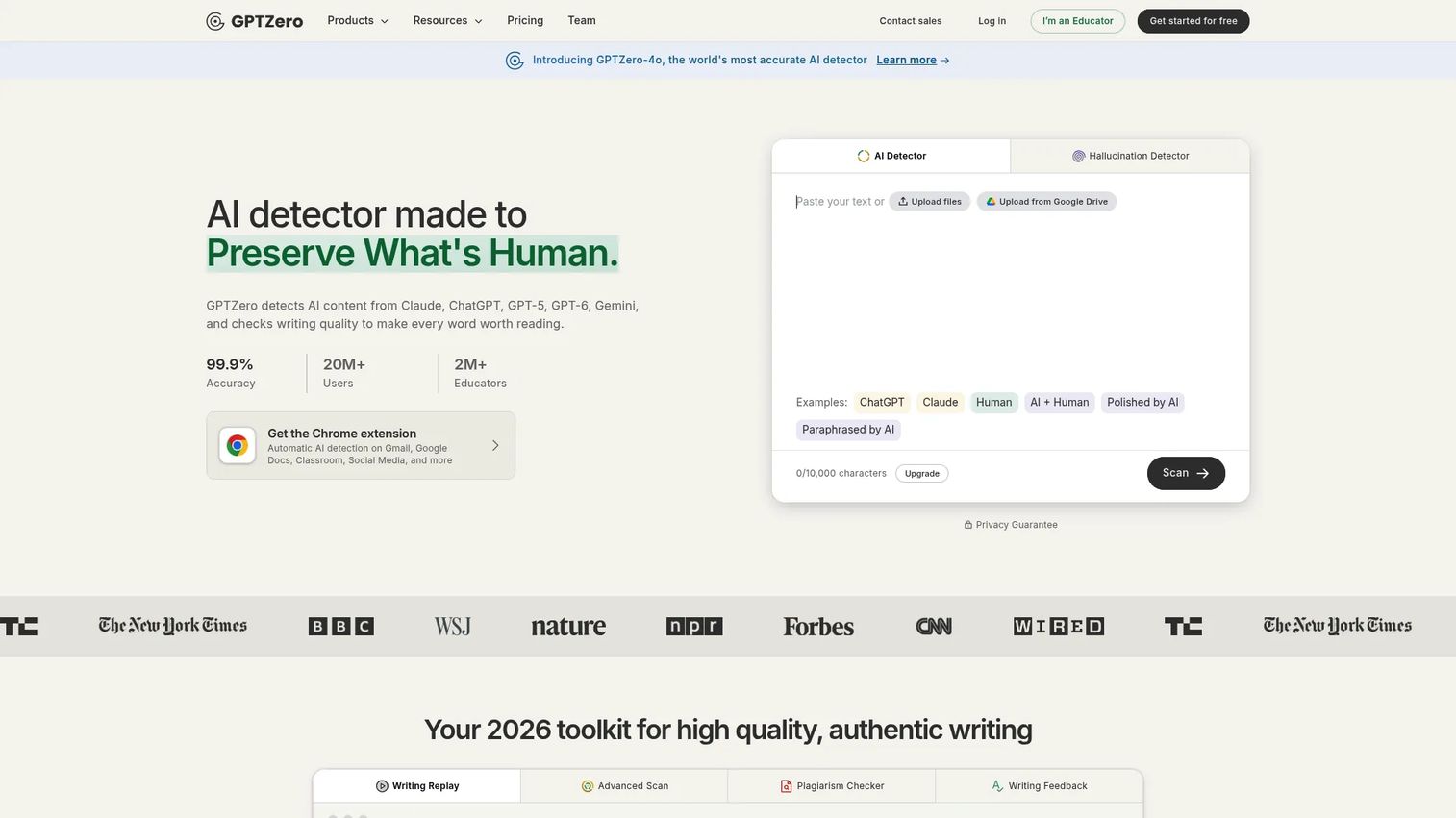
GPTZero is an AI detection platform that identifies likely AI-generated writing at document, sentence, and word levels. It was one of the first detectors built specifically for educational and professional content review and has expanded into enterprise and publishing workflows. Teams paste or upload text and get back a scored report showing overall AI probability alongside sentence-level highlights.
Best for: Educators, publishers, recruiters, and content teams screening written submissions or drafts for possible AI authorship.
Key features
- Document, sentence, and word-level detection with confidence scores
- Sentence-level highlighting showing flagged passages
- Plagiarism checking, source finding, and citation generation
- LMS integration, browser extension, and page-by-page scanning on paid tiers
- Free Advanced Scan included on the free tier
Why choose GPTZero: GPTZero works well as a default detector for teams that want clear, explainable outputs rather than a single probability number. If you manage a content review process and need something reviewers can interpret without training, the sentence-level breakdown makes it accessible.
GPTZero pricing: GPTZero has a free plan that covers 10,000 words per month and up to 10,000 characters per scan. Paid tiers (Essential, Premium, Professional) add grammar checks, browser extension access, plagiarism checking, and higher word limits. Exact tier prices are not displayed on the pricing page; contact GPTZero directly or check the pricing page for current figures.
G2 rating: 4.3/5
2. QuillBot
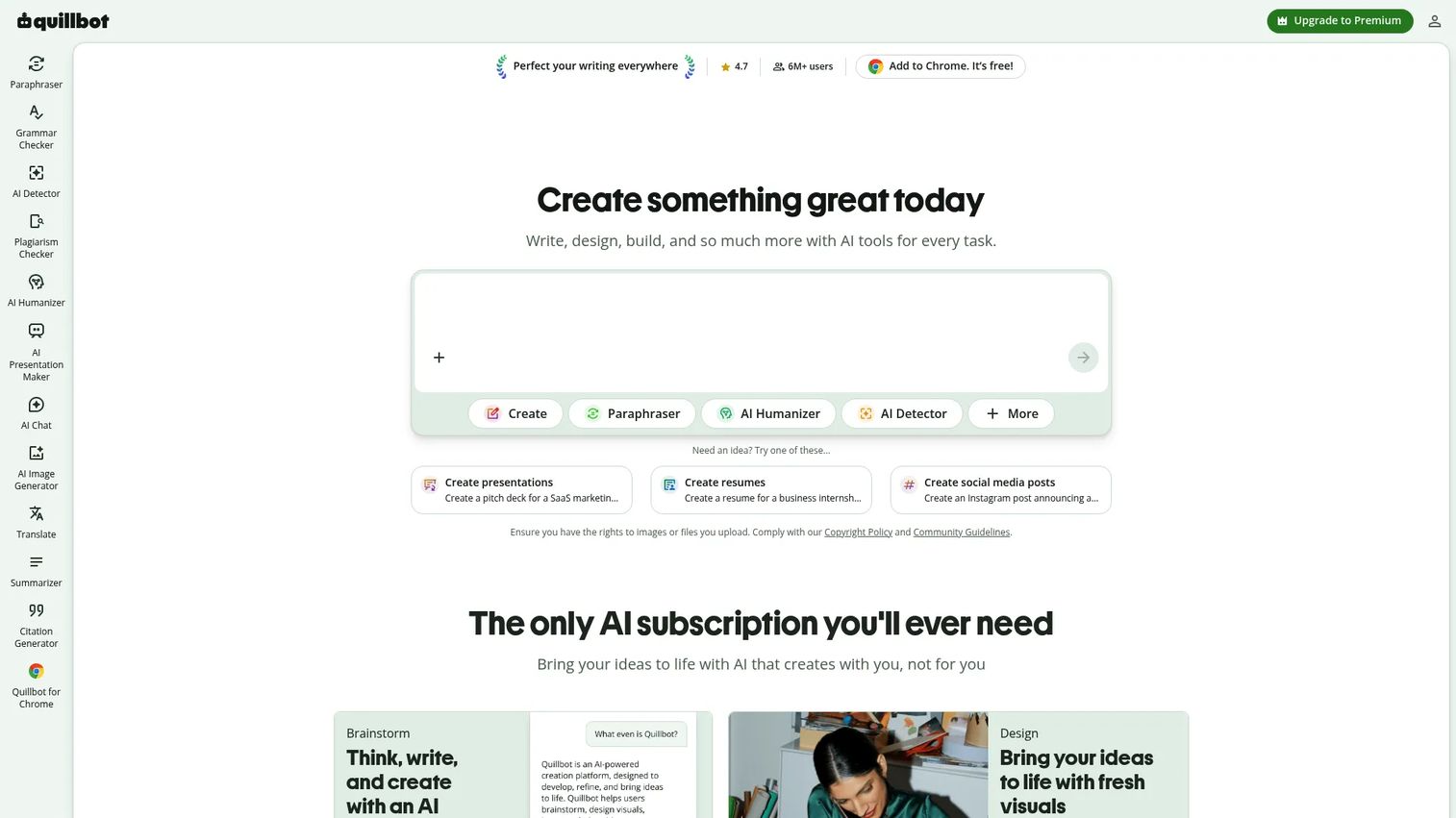
QuillBot is an AI-powered writing platform that bundles an AI detector alongside a paraphraser, grammar checker, plagiarism checker, AI humanizer, summarizer, citation generator, and translator. For marketers who want to detect AI content and then rewrite or refine it in the same tool, QuillBot compresses that workflow into a single tab. It's one of the most widely used writing-assist platforms across individual users and teams.
Best for: Individuals, students, and marketing teams who need detection plus content refinement without switching tools.
Key features
- AI Detector bundled with Paraphraser and AI Humanizer
- Grammar Checker and Plagiarism Checker in the same workspace
- Summarizer, Citation Generator, and Translator available on the same platform
- Team Plan adds centralized billing, usage metrics, and data controls
- Free tier covers basic access across most tools
Why choose QuillBot: QuillBot suits content marketers who outsource drafts and want to run a quick authenticity check before moving into editing. The detect-then-rewrite flow is built in, which removes the need to copy content across separate tools.
QuillBot pricing: Free plan available. Premium costs $8.33/month billed annually.
G2 rating: 4.4/5
3. Pangram Labs
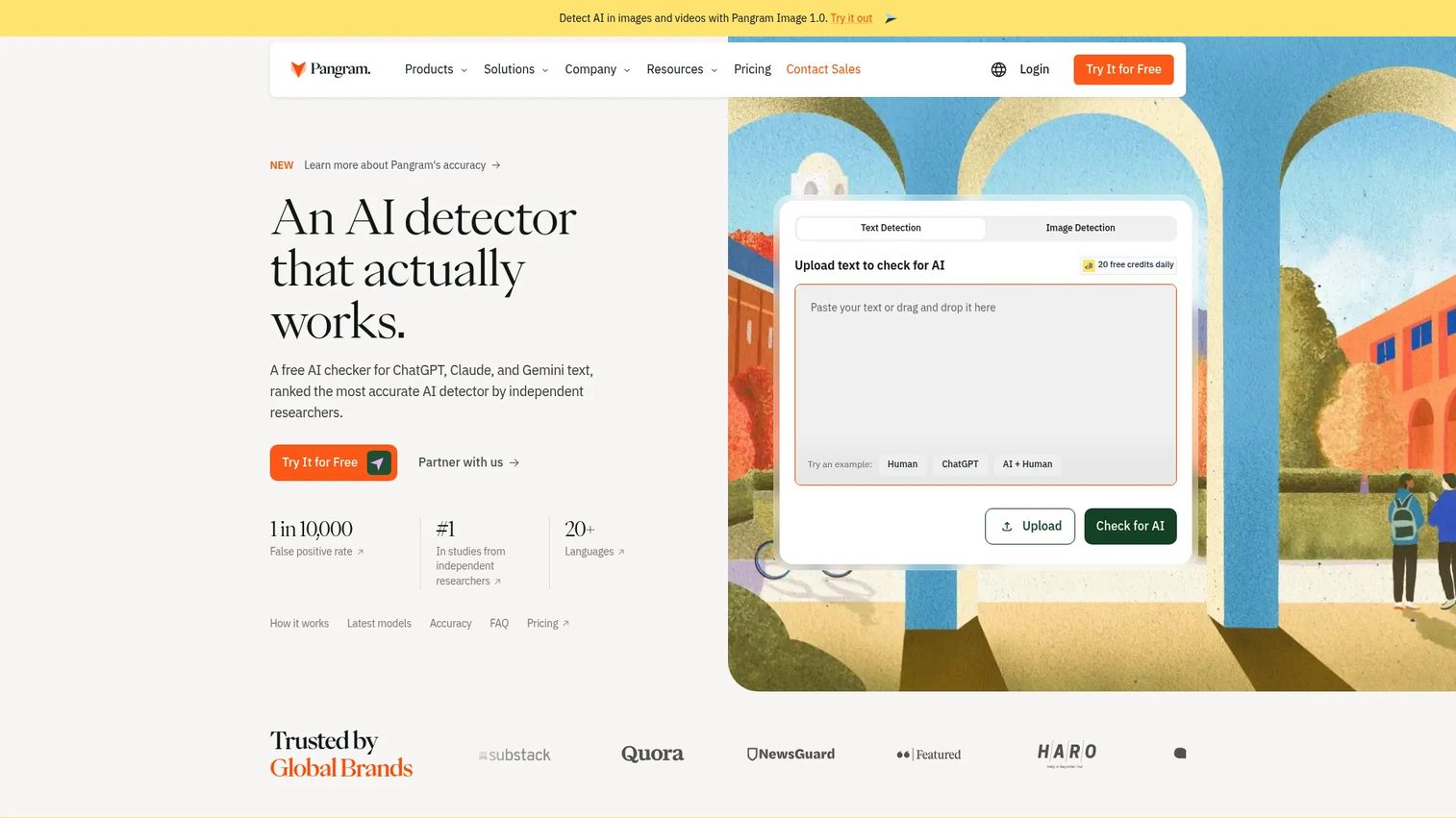
Pangram Labs is an AI detection platform built to identify AI-generated, AI-assisted, and human-written content across text, images, and video. It stands out for teams whose content operations extend beyond long-form copy: Pangram can analyze AI-generated images and video frames alongside text, which matters for social-first or multimedia publishing workflows. It also includes similarity detection, OCR for scanned documents, and direct Google Docs and Gmail integrations.
Best for: Publishers, researchers, and content teams verifying authenticity across text, image, and video formats.
Key features
- AI text detection with multilingual support
- AI image and video detection alongside text analysis
- Similarity detection and OCR for scanned documents
- Google Docs, Gmail, and browser extension integrations
- API and MCP access for teams building detection into their own tools
Why choose Pangram Labs: Pangram is the right call if your content program includes AI-generated visuals or video alongside written copy. It's also worth evaluating if you need API or MCP access to integrate detection into an existing content ops workflow.
Pangram Labs pricing: Individual plan starts at $20/month (up to 300,000 words and 100 image scans per month). Professional plan is $65/month (five times the word and image scan limits, plus $200 in monthly API credits). Developer API billing runs at $0.05 per 100 words on a pay-as-you-go basis.
4. Originality.ai
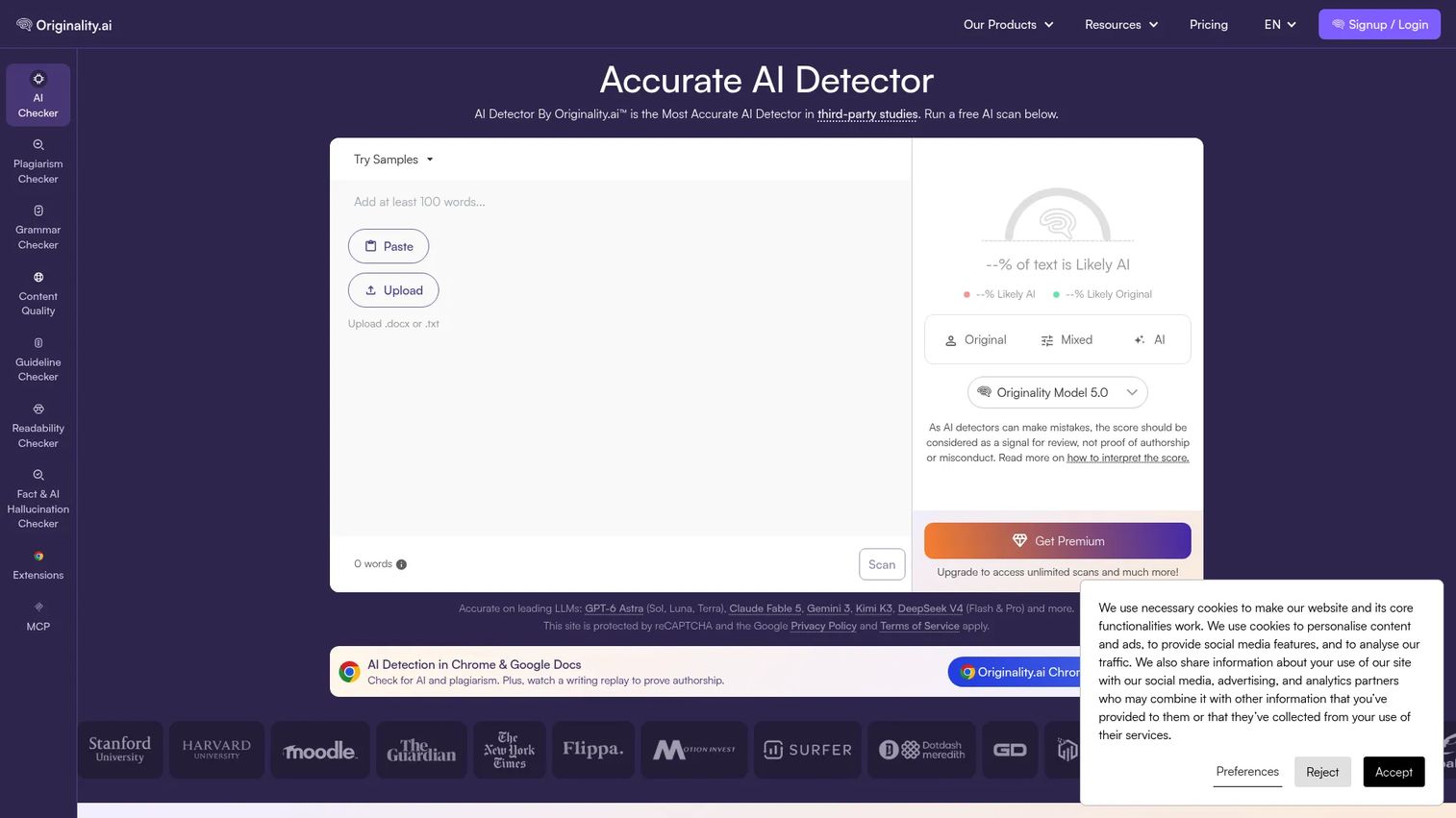
Originality.ai is an AI detection and content-quality platform that combines AI detection with plagiarism checking, grammar and spelling tools, readability scoring, and fact-checking. It's built for content publishers, agencies, and editorial teams that want a single scan to cover multiple quality dimensions rather than running separate tools for each. The platform supports website and URL scanning, which makes it useful for auditing existing content libraries, not just incoming drafts.
Best for: Content publishers, agencies, and editorial teams that need detection, plagiarism, and broader content-quality controls in one platform.
Key features
- AI detection classifying content as likely original, mixed, or AI-written
- Plagiarism checking with grammar, readability, and fact-checking tools
- Website and URL scanning for auditing live content
- Chrome and Firefox browser extensions
- API access and team management with tag-based scan organization
Why choose Originality.ai: Originality.ai makes sense for agencies managing multiple client content streams where a scan needs to answer more than one question at once. The team management and tagging system also helps ops leads organize scans by client, campaign, or content type. For more tools in this space, see our guide to best AI writing assistants.
Originality.ai pricing: Free Basic plan (3 scans per day, 2,000-word limit). Pro costs $14.95/month (or $12.95/month billed annually) and includes 2,000 monthly credits, team management, website scans, and browser extensions. Enterprise runs $179/month (or $136.58/month annually) and adds 15,000 credits, API access, 365-day scan history, and priority support.
G2 rating: 4.4/5
5. Winston AI
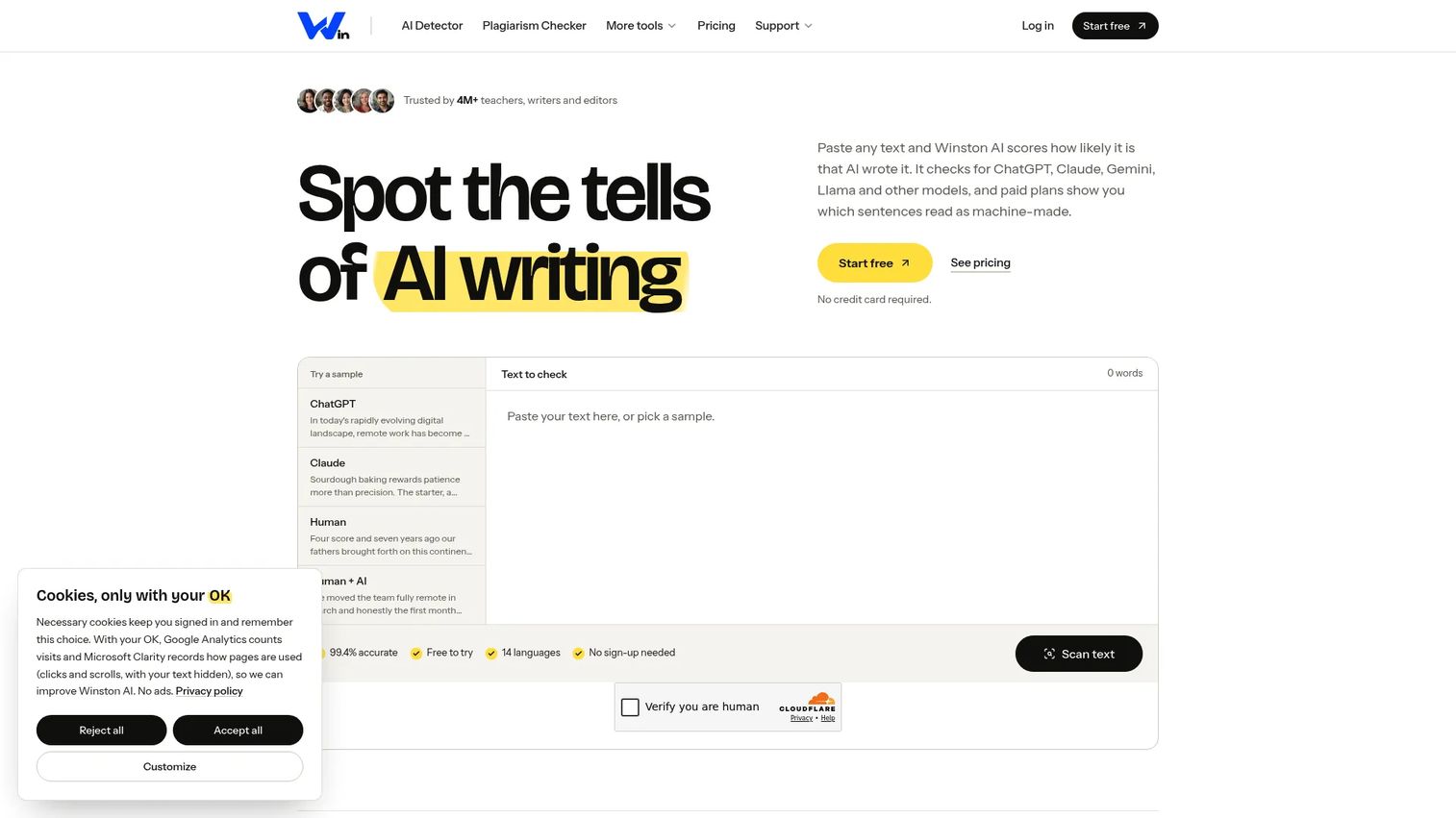
Winston AI is an AI content detector and plagiarism checker that covers output from eight named AI models: ChatGPT, Claude, Gemini, Llama, Mistral, DeepSeek, Grok, and Copilot. That explicit model coverage matters for content teams who want to know which AI system likely produced a flagged document, not just that something flagged. Winston AI also supports OCR for images and handwriting, which is useful for teams reviewing scanned submissions.
Best for: Educators, SEO teams, and publishers who want named-model detection, shareable PDF reports, and a solid free starting point.
Key features
- Sentence-level AI detection with named-model identification
- Plagiarism checking with matched sources and links
- Shareable PDF reports for stakeholder review
- OCR support for images and handwriting
- Chrome extension, Google Classroom, WordPress, and Zapier integrations; 14-language support
Why choose Winston AI: Winston AI works well for teams that need to share detection reports with clients, managers, or editorial leads. The PDF export and the breadth of named-model detection give it an edge over tools that return only a probability score. The free tier with 2,000 credits also makes it easy to evaluate before committing to a paid plan.
Winston AI pricing: Free plan includes 2,000 credits. Essential costs $12/month billed annually ($144/year). Advanced runs $20/month annually. Team plan is $36/month annually. School and enterprise pricing requires contacting sales.
G2 rating: 4.4/5
6. Copyleaks
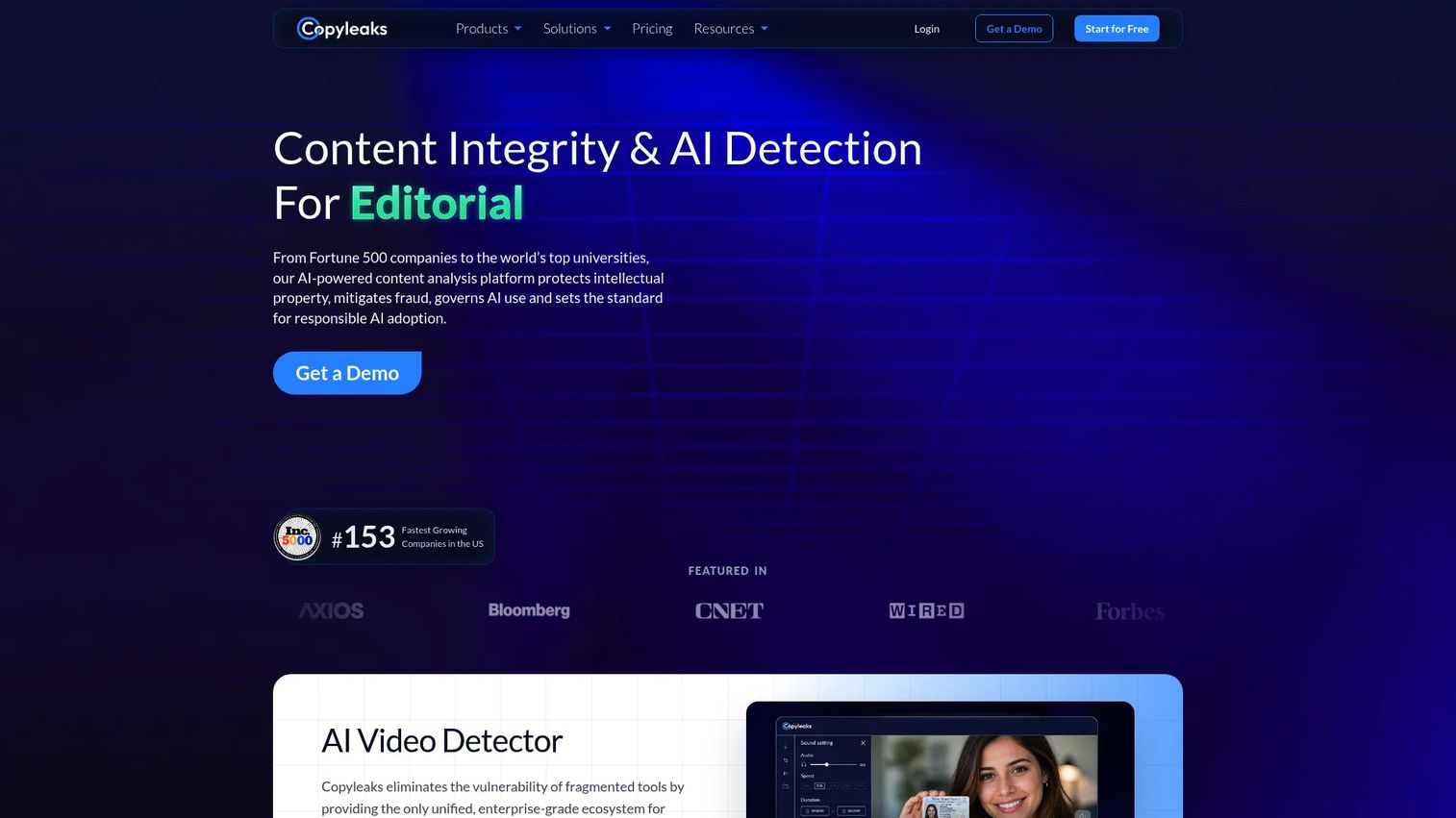
Copyleaks is an AI and plagiarism detection platform that covers text, images, video, and source code. Its core strength is breadth: AI text detection across 30+ languages, plagiarism detection (including paraphrased and cross-language matches) across 100+ languages, and AI image and video detection. That range makes it one of the few detectors that can serve both authenticity and duplicate-content workflows for teams publishing in multiple markets.
Best for: Organizations, publishers, and content teams that need both AI detection and plagiarism coverage, particularly in multilingual or cross-language contexts.
Key features
- AI text detection across 30+ languages
- Plagiarism detection including paraphrased and cross-language matches across 100+ languages
- AI image and video detection
- API, LMS, browser extension, WordPress, and Google Docs integrations
- Image plagiarism detection alongside text
Why choose Copyleaks: Copyleaks is the strongest option when you need AI detection and plagiarism protection to run from the same platform. The cross-language plagiarism detection is a differentiator for teams managing content in multiple markets. AI governance tools are becoming increasingly important for teams scaling content programs; see our guide to AI governance tools for more context.
Copyleaks pricing: Personal plan starts at $13.99/month billed annually ($16.99/month billed monthly). Pro plan costs $74.99/month annually ($99.99/month monthly) and adds team seats, advanced filters, website scanning, and cross-language detection. Enterprise pricing is custom.
G2 rating: 4.5/5
7. Writer
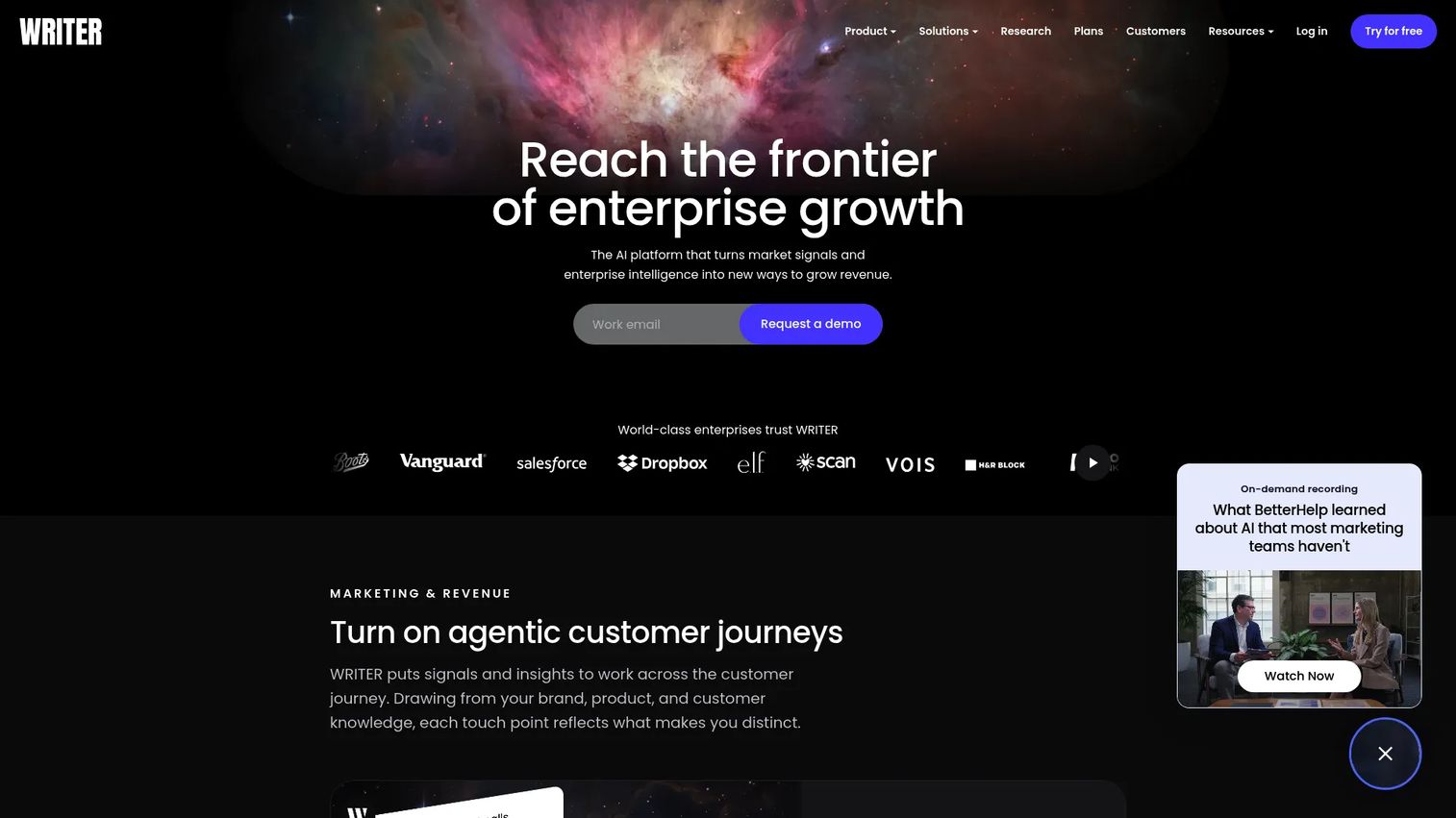
Writer is an enterprise AI platform for building, deploying, and governing AI agents and automated workflows. It sits in a different tier from the other tools in this list: Writer is not primarily an AI detector. Instead, it's a full-stack enterprise AI system that includes brand voice controls, guardrails, governance, and auditability, which makes AI-content quality and consistency a built-in operational concern rather than a separate tool you bolt on. Teams looking to manage how AI is used across their entire content program, not just detect it in incoming drafts, will find Writer's governance features relevant.
Best for: Large organizations that need to govern, monitor, and control how AI is used in content creation at an enterprise scale.
Key features
- WRITER Agent for complex multi-step content and workflow automation
- Playbooks and scheduled routines for repeatable content workflows
- Knowledge Graph grounding agents in organizational data
- Brand voice, guardrails, and content governance controls
- Observability and auditability across AI-generated outputs
Why choose Writer: Writer suits enterprise content and marketing ops teams that want to set policy around AI use, not just review outputs after the fact. If your challenge is governing how AI gets used across a large team rather than scanning individual documents, Writer fits that scope.
Writer pricing: Starter plan pricing is not displayed on the pricing page; a 14-day free trial is available. Enterprise plan requires contacting sales. Both plans are structured as per-seat subscriptions.
G2 rating: 4.4/5
8. Sapling
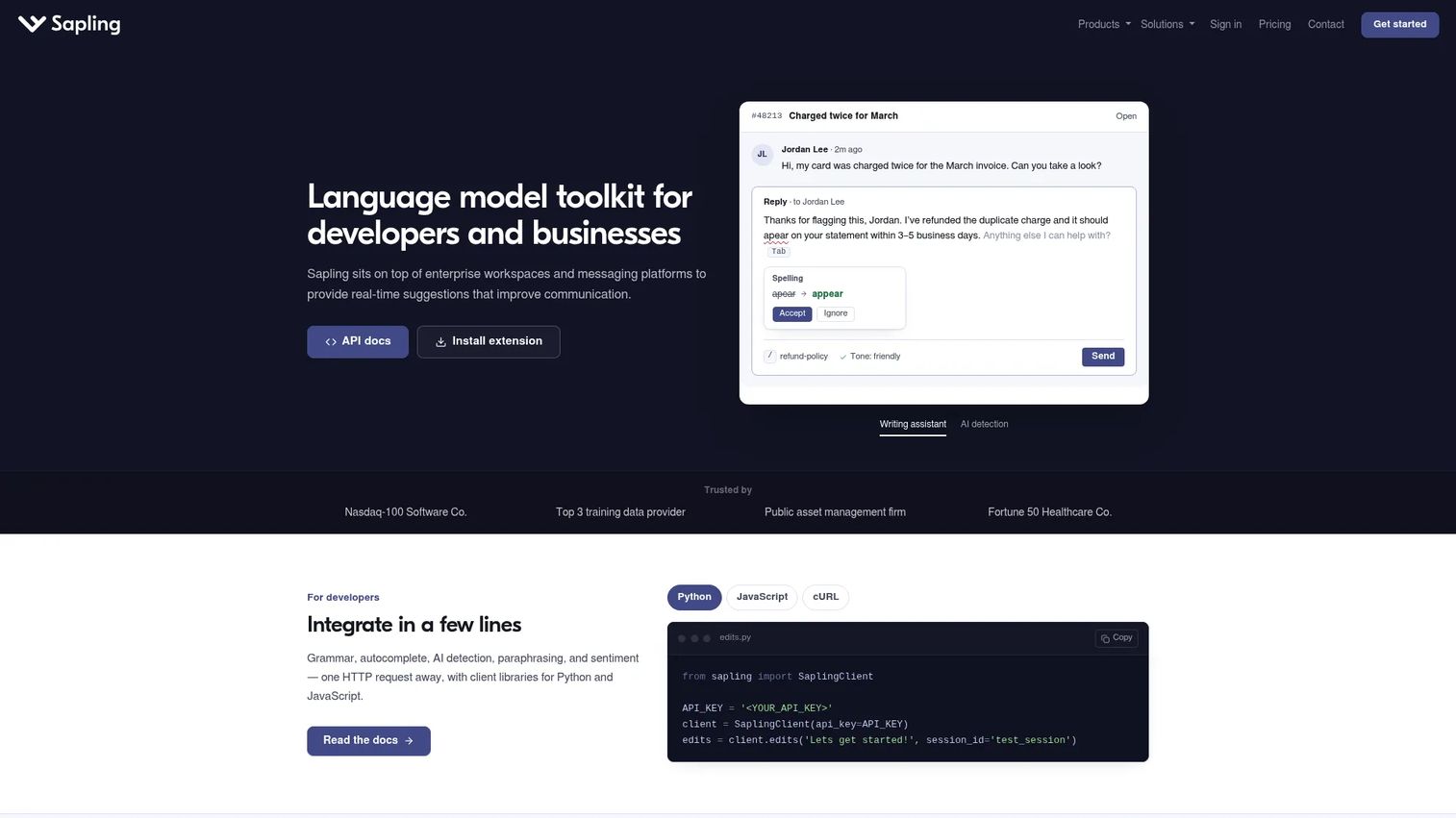
Sapling provides language-model APIs, SDKs, writing assistance, and AI detection tools aimed at developers and customer-facing teams. For marketing ops and content ops buyers, it's most relevant as a lightweight detector that can be called via API or embedded into existing tools, ticketing systems, or content workflows. The free tier covers detection up to 2,000 characters per check, which is enough to validate shorter copy or run spot checks without a subscription.
Best for: Developers and ops teams that want API-first AI detection integrated into an existing workflow or product.
Key features
- AI content detection with free and paid tiers
- Writing assistance including autocomplete, rephrase, spellcheck, and tone analysis
- PII detection, content safety, classification, and semantic search APIs
- Enterprise tier with team controls, analytics, and CRM-style integrations
- Metered API pricing for teams building detection into custom tools
Why choose Sapling: Sapling is worth considering for teams that want to call an AI detector programmatically rather than through a web interface. The API pricing model means you pay for what you actually use. For teams already using AI customer service software or ops tooling, Sapling's writing assistance and detection APIs can extend those workflows.
Sapling pricing: Free plan at $0/month covers detection up to 2,000 characters per check. Pro costs $25/month (or $12/month billed annually). Enterprise starts at 10 seats at $15/seat/month. API pricing is metered with a one-time $5 minimum.
G2 rating: 4.2/5
Considerations when choosing AI content detection software
Accuracy and false-positive risk
No detector is perfect. The bigger risk for content teams isn't missing AI-generated text; it's flagging a human writer's work as AI-generated. Before committing to a tool, run a sample of your team's known-human content through it and check the false-positive rate. Tools that offer sentence-level breakdowns help reviewers make a judgment call rather than acting on a document-level score alone.
Workflow fit
A detection tool that sits outside your existing content process won't get used consistently. Prioritize tools with browser extensions, Google Docs integration, or API access so detection can happen where your team already works. For teams managing outsourced content at volume, an API or bulk upload feature matters more than a polished web interface.
Integrations and document coverage
Check whether the tool handles the file formats your team actually uses: PDFs, Word documents, plain text, URLs. If you're scanning web pages or existing content libraries, URL scanning is essential. For multimedia teams, tools with image or video detection (like Pangram Labs or Copyleaks) cover content types that text-only detectors miss.
Pricing and usage limits
Most detectors price by word count or by scan. A tool that looks cheap per document can get expensive at scale. Map your monthly scan volume against the tier limits before choosing. Free tiers are useful for evaluation but typically cap out quickly once you're running production review workflows. For teams with AI governance tools or compliance requirements, also check whether the tool logs scan history and for how long.
Language support and model coverage
If you publish in languages other than English, verify language support before buying. Copyleaks and Pangram Labs have the strongest multilingual coverage in this list. On the model side, check whether the tool is updated to detect output from the latest AI models. Winston AI explicitly names the models it covers; others may not be as transparent about their detection scope.
Conclusion
For most marketing and content teams, the right starting point is GPTZero for general editorial screening, QuillBot if you want to detect and rewrite in one tool, or Winston AI if you want named-model detection with a free tier to test before committing.
Teams running multilingual programs or combining AI detection with plagiarism review will get more mileage from Copyleaks or Originality.ai. If you're managing image and video content alongside written copy, Pangram Labs is worth evaluating. Enterprise teams building content governance programs should look at Writer. Developers who want to integrate detection programmatically into existing workflows will find Sapling's API pricing model the most practical fit.
Pick based on the scan volume you actually run, the workflow you already have, and the false-positive tolerance your editorial process can handle. Most tools offer a free tier or trial, so test on your real content before scaling up.
For more tools to build out your content and marketing stack, see our guides to AI content creation tools and best AI writing assistants.
Start your journey with Guideflow today!
FAQs
AI content detection software analyzes text, images, or video to determine the probability that the content was generated by an AI model rather than written by a human. The output typically includes a document-level probability score, sentence-level highlights, and sometimes a classification of hybrid content that mixes AI and human writing.
Accuracy varies by tool and by the type of content being scanned. Most leading detectors perform well on clearly AI-generated text but struggle with heavily edited AI content or formulaic human writing that resembles AI output. No single detector should be treated as a final verdict; sentence-level outputs and human review of flagged content produce better outcomes than acting on a document-level score alone.
Some tools can, but most are still improving in this area. Originality.ai and GPTZero both classify content into categories that include mixed or hybrid documents, where AI-written and human-written passages coexist. If hybrid detection is a priority for your workflow, test each tool against samples that actually mix AI and human passages before committing.
For most marketing and publishing workflows, GPTZero, Originality.ai, and Winston AI offer the best combination of accuracy, sentence-level explanation, and editorial workflow fit. QuillBot suits marketers who want to detect and refine content in a single tool. Copyleaks is the strongest option when both AI detection and plagiarism coverage are required in one platform.
Most established detectors cover output from major models including GPT-4, GPT-5, Claude, and Gemini. Winston AI is the most explicit about named-model coverage, listing eight models on its feature page including DeepSeek and Grok. When evaluating any detector, check whether model coverage is documented and whether the tool is updated as new models are released.
False positives occur when human-written content shares statistical patterns with AI-generated text. This happens most often with highly technical writing, repetitive list-based content, formal or templated documents, and writing from non-native English speakers who use more predictable sentence structures. Sentence-level detection tools help reviewers identify whether a full document or only a few passages triggered the flag, reducing the risk of incorrectly rejecting genuine human work.
For spot checks and evaluation, yes. Free tiers from Winston AI, GPTZero, Originality.ai, and Sapling are sufficient to test tool fit and run occasional scans. For production content review at volume, most free tiers hit their word or scan limits quickly. If you're scanning more than a few hundred documents per month, a paid plan becomes necessary. For more tools in the broader AI grading tools and content verification space, see our related roundups.
Copyleaks, Originality.ai, Winston AI, and GPTZero all include plagiarism checking alongside AI detection. Copyleaks has the most extensive plagiarism coverage, with cross-language detection across 100+ languages and a track record in academic and enterprise publishing contexts. Originality.ai bundles plagiarism alongside readability and fact-checking, making it the strongest all-in-one option for content quality review. See our broader guide to best AI content detectors for additional context on how these tools compare.