You paid for the click. The visitor browsed a pricing page, opened a product tour, maybe added something to a cart. Then they left without converting. Most of them will never type your URL again.
That gap between traffic and conversion is the whole reason retargeting exists. Most visitors need several touches before they buy, and a single first-session conversion rate of 2 to 3 percent means 97 cents of every traffic dollar walks out the door on the first visit. Retargeting platforms are how you earn a second, third, and fourth shot at those people across search, display, social, video, and CRM-based audiences. The category is growing fast for a reason: the retargeting software market reached USD 4.41 billion in 2024 and is forecast to hit USD 13.49 billion by 2032 at a 15.0% CAGR, according to Data Bridge Market Research (2024).
Choosing among retargeting tools is less about brand familiarity and more about fit. The right platform depends on where you already spend, what audiences you can reuse, how you measure attribution, and how much operational control you need. This guide compares 9 retargeting companies and ad ecosystems so you can match a vendor to your channel mix instead of defaulting to whatever you opened first. If your stack also touches support and lifecycle automation, you may find adjacent value in roundups like ai customer service software and ai writing tools for marketers, which sit in the same growth toolkit.
What's inside
This guide compares 9 retargeting platforms for marketers who need to re-engage site visitors and known contacts without blowing up CAC. It is built for digital and growth marketers evaluating retargeting vendors across paid media, not a generic best-of dump.
We selected and ranked each platform on four criteria that actually drive the decision:
- Channel coverage: display, search, social, video, native, publisher, and connected TV reach.
- Audience flexibility: pixel-based audiences, CRM list imports, custom audiences, and segmentation depth.
- Integrations and measurement: attribution quality, analytics, and how cleanly the platform plugs into your stack.
- Pricing and ROI clarity: how spend is structured and how defensible the return is.
If you want adjacent comparison reading, see our roundups on agentic ai tools for sales and ai content creation tools.
TL;DR
Short on time? Here are the decision shortcuts by use case:
- Best default if you already spend in Google: Google Ads, for search retargeting, display, YouTube, and Customer Match in one account.
- Best for cross-channel coordination without a DSP: AdRoll, for omnichannel retargeting across display, social, and native from a single platform.
- Best for eCommerce and large catalogs: Criteo, for dynamic, commerce-oriented retargeting with AI-driven optimization.
- Best for social reach and creative testing: Meta Ads, for pixel-based custom audiences across Facebook and Instagram.
- Best for B2B pipeline and buying committees: LinkedIn Ads, for Insight Tag and account-level retargeting.
- Best for enterprise media operations: The Trade Desk and StackAdapt, for privacy-first programmatic retargeting at scale.
What are retargeting platforms?
Retargeting platforms are ad tools that re-engage people who already interacted with your brand, serving them targeted ads across channels to bring them back and convert. They turn anonymous and known traffic into reachable audiences built from website pixels, app events, video views, or CRM lists.
Retargeting vs remarketing
The retargeting vs remarketing distinction trips up a lot of marketers, mostly because the terms are used interchangeably. In practice, retargeting usually refers to paid ad re-engagement: showing display, social, or search ads to people who visited your site. Remarketing platforms, in Google's original phrasing, lean toward re-engaging known contacts, often through email or audience lists like Customer Match. Today, most retargeting ad platforms and marketers treat the two words as synonyms. The mechanics matter more than the label.
Channel types you will encounter
Retargeting services span several inventory and channel types, and most serious programs blend a few:
- Display retargeting: banner ads across the open web and ad exchanges.
- Search retargeting (RLSA): adjusting search bids and ads for prior visitors.
- Social retargeting: ads inside walled gardens like Meta and LinkedIn.
- Video remarketing: re-engaging viewers on YouTube and connected TV.
- Publisher and native retargeting: content-native placements on premium sites.
- CRM and email list retargeting: uploading known contacts as custom audiences.
Direct ad ecosystems vs cross-channel layers
One more distinction shapes your shortlist. Some platforms are direct ad ecosystems, where you buy inventory the platform owns or controls, like Google Ads, Meta Ads, or LinkedIn Ads. Others are cross-channel retargeting layers or demand-side platforms (DSPs) that buy across many exchanges and walled-garden-adjacent inventory, like The Trade Desk, StackAdapt, and AdRoll. Walled gardens give you reach where attention concentrates. Cross-channel layers give you control and breadth across the open internet.
When to use retargeting platforms
Retargeting earns its budget in specific moments. Here is how to pattern-match your situation before scanning the list.
Recover abandoned traffic
This is the classic case. Someone viewed a product, a pricing page, or a feature comparison and left without acting. Retargeting brings them back with reinforcement messaging that addresses the exact step they hesitated on. Because these visitors already showed intent, conversion lift here is typically the strongest in any paid program. Pair the ads with the same proof they saw on site, like an interactive demo or a customer story, so the message stays consistent.
Re-engage warm accounts
B2B buying cycles run long, and 8 to 15 stakeholders may touch a single enterprise decision. Retargeting keeps you visible to a buying committee over weeks or months without burning sales touches. Account-based audience logic, built from CRM lists or firmographic matching, lets you stay present across multiple decision-makers. The goal is not one click. It is staying top of mind until the committee is ready to move.
Expand into new channels
Maybe you already retarget on Meta and want to add search retargeting, YouTube, native, or publisher inventory. Treat this as a stack expansion decision, not a vendor swap. Adding a channel should answer a specific question: where does your audience spend attention that you are not currently buying? Layering a DSP or a cross-channel platform on top of your walled-garden spend is how most mid-market teams broaden reach without losing measurement.
Comparison table
Here are the 9 retargeting platforms ranked by general relevance and breadth of fit. Use this as a fast filter, then read the section that matches your channel mix and budget. Pricing across this category is overwhelmingly spend-based rather than a posted subscription, so treat the pricing column as the billing model, not a sticker price.
| # | Product | Intent | Key differentiation | Pricing | G2 rating |
|---|---|---|---|---|---|
| 1 | Google Ads | Search, display, video retargeting | One account spans search, display, YouTube, and Customer Match | Campaign-spend based, no posted plan price | 4.3/5 |
| 2 | AdRoll | Omnichannel retargeting and ABM | Cross-channel display, social, and native from one platform | Pay-as-you-go media, free to start | 4.1/5 |
| 3 | Criteo | eCommerce and commerce media | AI-driven dynamic product retargeting at catalog scale | Contact sales, commerce-spend based | Not listed |
| 4 | Meta Ads | Social retargeting | Pixel-based custom audiences across Facebook and Instagram | Auction-based, ad costs vary | 4.4/5 |
| 5 | LinkedIn Ads | B2B account retargeting | Insight Tag and professional matched audiences | Auction-based, from $10/day | 4.1/5 |
| 6 | The Trade Desk | Enterprise programmatic | Privacy-first identity and omnichannel open-internet buying | Contact for access | 4.4/5 |
| 7 | StackAdapt | Multi-channel programmatic | Native, display, CTV, and audio with AI optimization | Tiered plans, contact sales | 4.7/5 |
| 8 | ReTargeter | Managed display retargeting | Hands-on service with dynamic creative optimization | From $500/month | 1.3/5 |
| 9 | Outbrain | Publisher and native retargeting | Content-native re-engagement on premium publisher inventory | CPC-based billing | 3.4/5 |
1. Google Ads
Google Ads is Google's advertising platform for running search, video, shopping, display, and lead-generation campaigns. For retargeting specifically, it is the broadest single account in the category: you can re-engage prior visitors across the Google Display Network, YouTube, and search results, all from one place. If your team already spends in Google, retargeting here adds reach without adding a vendor.
The audience setup is where Google Ads earns its default status. You build remarketing audiences from site tags and Analytics events, then deploy them across display retargeting, video remarketing on YouTube, and search. Two features stand out for retargeting teams. RLSA (Remarketing Lists for Search Ads) lets you bid more aggressively or adjust copy when a prior visitor searches again, capturing high-intent moments at the bottom of the funnel. Customer Match lets you upload CRM lists and email contacts to re-engage known people across Google surfaces, which is the closest thing to classic dynamic remarketing in one ecosystem.
Best for: teams already running Google spend that want search retargeting, display, and YouTube re-engagement consolidated in one account.
Key strengths
- Channel breadth: Search, display, and YouTube retargeting from a single account, with audiences shared across all three.
- RLSA and Customer Match: Adjust search bids for return visitors, and re-engage CRM lists across Google surfaces.
- Measurement depth: Native conversion tracking and analytics integration give you cross-channel attribution most teams already trust.
Why choose Google Ads: It is the lowest-friction starting point for any team with existing Google spend. You get search, display, and video retargeting without onboarding a new platform, and the audience and measurement infrastructure is already wired into how you report. The trade-off is that you live inside Google's walled inventory rather than the open programmatic web.
Google Ads pricing: Google Ads uses a campaign-spend model billed on a cost per click or lead basis rather than a posted subscription. The official site describes budget control and CPC billing, but no public platform plan price is listed. You set daily budgets and pay for the media. The platform itself carries no separate software fee.
2. AdRoll

AdRoll is a multichannel advertising platform built for retargeting, brand awareness, and account-based marketing from one console. It sits between a simple ad manager and a full DSP: easier to run than enterprise programmatic, broader than any single walled garden. For teams that want omnichannel retargeting without standing up a media operation, this is the practical middle ground.
The platform coordinates display, social, native, in-app mobile, and connected TV ads, so a single audience can follow a visitor across channels with consistent creative. AdRoll supports CRM list imports and pixel-based audiences, and its cross-channel attribution helps you see how display and social touches combine rather than crediting whichever channel fired last. Frequency capping is built in, which matters because effective campaigns typically cap at 5 to 7 impressions per user per week to balance recall against ad fatigue, per ClickTrack Marketing (2026). Creative support and an AI assistant help smaller teams ship dynamic ads without a dedicated design pipeline.
Best for: mid-market brands and agencies that want coordinated retargeting across display, social, and native from a single platform.
Key strengths
- Omnichannel coordination: Display, social, native, in-app, and CTV retargeting managed from one console with shared audiences.
- Frequency control: Built-in capping keeps impressions in the effective 5 to 7 per week range to avoid fatigue.
- Audience flexibility: CRM list imports and pixel-based audiences feed both retargeting and account-based retargeting campaigns.
Why choose AdRoll: It fits the team that has outgrown single-channel retargeting but does not want the operational weight of a DSP. The cross-channel attribution and shared audiences make it easier to reason about what is working without stitching together five dashboards.
AdRoll pricing: AdRoll uses pay-as-you-go advertising with no fee to get started, and you pay primarily for media. The pricing page lists Self-Service Ads, Managed Services Ads, an Advanced Package with annual commitment, and Account-Based Retargeting that starts with no platform fee. No public numeric starting price is posted, so plan on budgeting around media spend and contacting sales for the Advanced tier.
3. Criteo
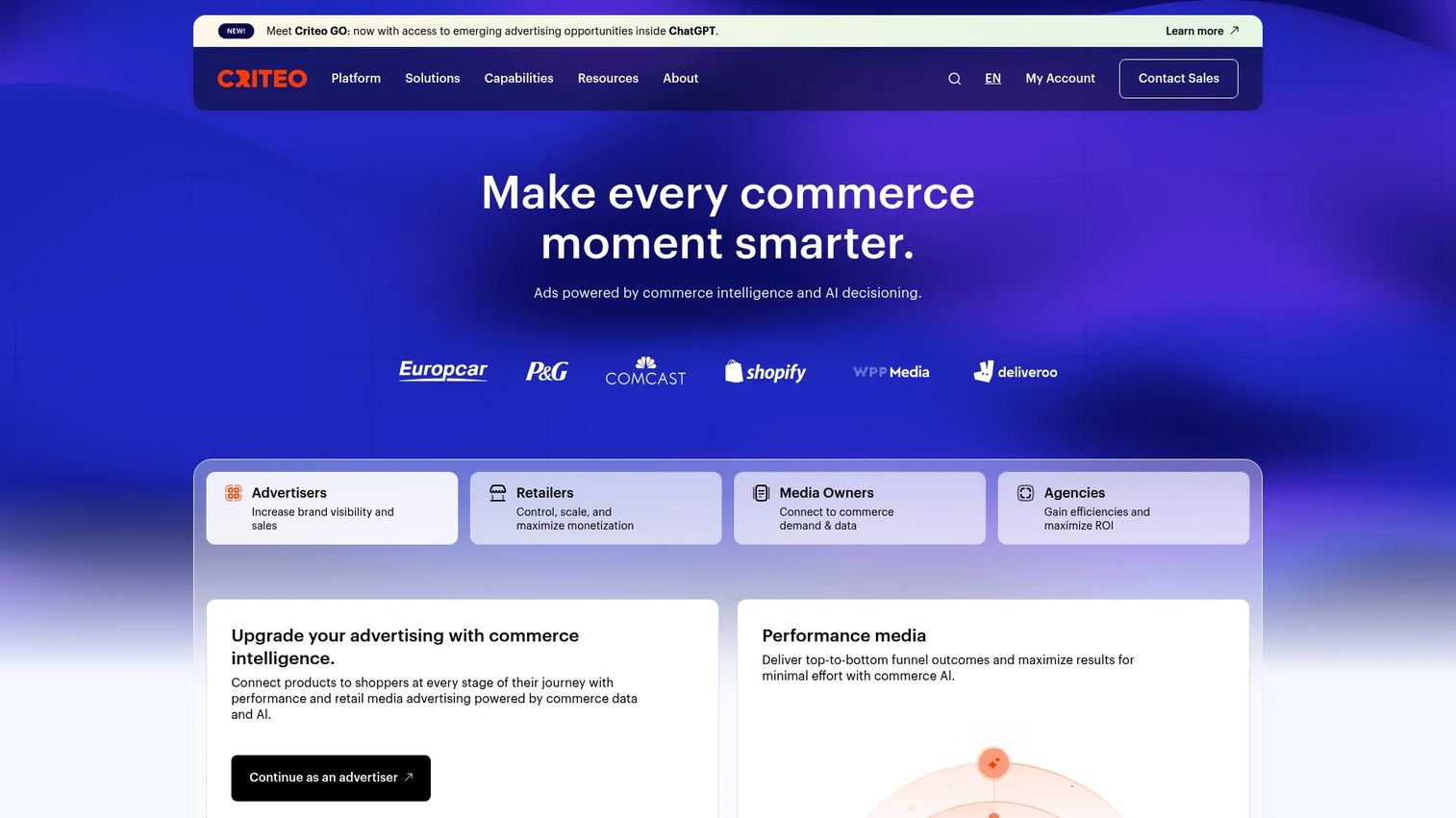
Criteo is a commerce media platform built for performance and retail media advertising, and it is the specialist pick for catalog-heavy eCommerce. Where general-purpose platforms retarget a visitor with a static banner, Criteo retargets with the exact products that person browsed, priced and optimized in real time. For retailers with thousands of SKUs, that dynamic product matching is the difference between a reminder and a relevant offer.
The platform leans on AI-driven retargeting: predictive bidding and shopper-level optimization decide which products to show, to whom, and at what bid. Its dynamic ads pull from your product feed automatically, so creative scales with your catalog instead of requiring manual builds. Criteo also reaches both onsite and offsite retail media inventory, which matters as more purchase intent moves onto retailer properties. For large advertisers, the AI optimization is the core reason to choose it over a more manual, general-purpose tool.
Best for: eCommerce brands and retailers with large product catalogs that need dynamic, AI-optimized product retargeting.
Key strengths
- Dynamic product ads: Pulls from your feed to retarget the exact items a shopper viewed, at catalog scale.
- AI-driven optimization: Predictive bidding and shopper-level modeling decide what to show and what to bid.
- Commerce and retail media reach: Onsite and offsite retail inventory where purchase intent concentrates.
Why choose Criteo: If your retargeting performance lives and dies on product relevance, Criteo's commerce-first modeling is purpose-built for it. The automation removes the manual creative work that makes catalog retargeting painful on general platforms. It is most worth it when your catalog and spend are large enough to feed the AI.
Criteo pricing: Criteo does not list public pricing on its site and directs advertisers to contact sales. Billing is commerce-spend based and structured around media. Expect a sales-led conversation rather than a self-serve signup, which fits its mid-market and enterprise retail focus.
4. Meta Ads
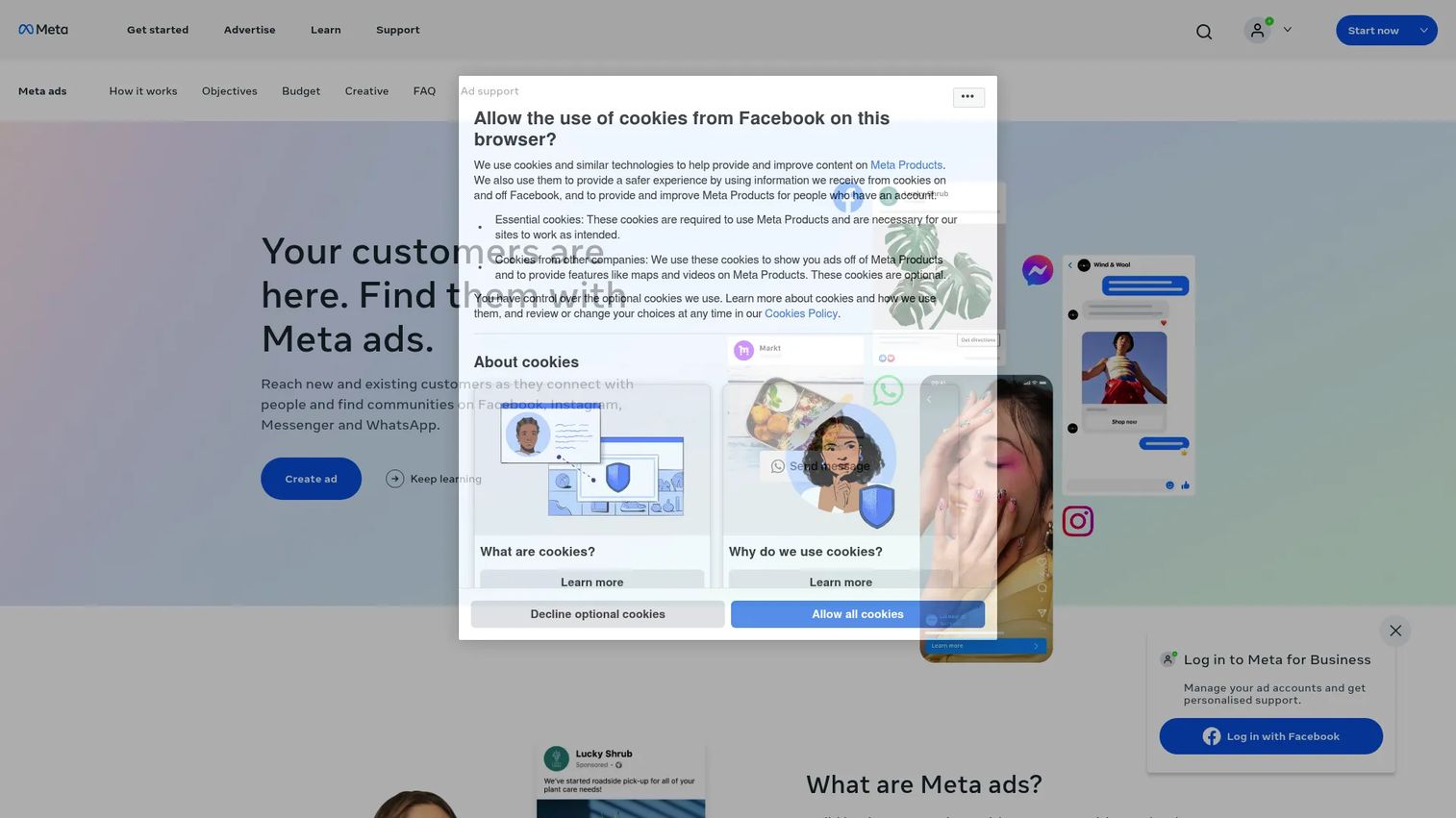
Meta Ads is Meta's advertising platform for running ads across Facebook, Instagram, Messenger, WhatsApp, Reels, and the Audience Network. For social retargeting, it is the default when your audience already spends time in those apps. Pixel-based retargeting here is mature and fast: install the Meta pixel, and you can rebuild audiences of page viewers, cart abandoners, and past purchasers within hours.
The audience tooling is the draw. Custom audiences let you retarget site visitors, app users, video viewers, and uploaded CRM lists. Exclusions keep you from wasting spend on people who already converted, and lookalike adjacency lets you expand from a high-value retargeting seed into prospecting without losing the thread. Because Meta's creative formats reward testing, segment your audiences tightly by intent (cart abandoner versus blog reader) and match the creative to that intent. Frequency discipline matters here too, since the same fatigue ceiling applies inside social feeds.
Best for: B2C and consumer-leaning brands whose audiences are active on Facebook and Instagram.
Key strengths
- Pixel-based custom audiences: Rebuild visitor, cart, and purchaser audiences quickly from the Meta pixel.
- Exclusions and lookalikes: Suppress converters and expand from high-intent seeds into adjacent prospecting.
- Creative testing depth: Rich formats reward tight audience segmentation matched to intent.
Why choose Meta Ads: When attention is concentrated on Facebook and Instagram, Meta's retargeting reach and creative flexibility are hard to beat. The custom audience and exclusion controls make it straightforward to keep spend focused on the people most likely to come back.
Meta Ads pricing: Meta uses an auction-based model where ad costs vary by audience, competition, and objective. There is no posted starting price or subscription. You set budgets and bid into the auction, paying on impressions or actions depending on your campaign objective.
5. LinkedIn Ads
LinkedIn Ads is LinkedIn's advertising platform for reaching business professionals by job title, industry, and company. For B2B retargeting, it is the strongest place to stay in front of a buying committee. The Insight Tag is the engine: drop it on your site, and you can retarget visitors with Sponsored Content, Sponsored Messaging, and Dynamic Ads, segmented by the professional attributes only LinkedIn holds.
Matched audiences let you combine site retargeting with account lists, so you can re-engage high-intent visitors and run account-level retargeting against your target list at the same time. This is where LinkedIn wins for pipeline: when 8 to 15 stakeholders influence a deal, keeping your message in front of the whole committee over a long cycle is exactly what the platform is built for. The professional targeting that makes LinkedIn expensive for broad awareness is the same targeting that makes its retargeting precise and defensible for B2B.
Best for: B2B marketers re-engaging high-intent site visitors and target accounts across long buying cycles.
Key strengths
- Insight Tag retargeting: Re-engage site visitors with professional-attribute segmentation no other platform offers.
- Matched and account audiences: Combine site retargeting with account lists for B2B account retargeting.
- Committee coverage: Stay visible to multiple stakeholders across weeks-long decision cycles.
Why choose LinkedIn Ads: For B2B, the precision of professional targeting on retargeting audiences is worth the premium. You reach the actual decision-makers, not a broad lookalike, which is what makes the spend defensible to a CFO.
LinkedIn Ads pricing: LinkedIn uses an auction-based, objective-based model with campaigns starting at a minimum daily budget of $10. There is no free tier. Effective costs run higher than most channels because of the professional inventory, so LinkedIn is best aimed at high-intent retargeting rather than broad, cheap reach.
6. The Trade Desk
The Trade Desk is an independent demand-side platform for programmatic advertising across the open internet. This is the enterprise tier of retargeting: omnichannel campaign buying across connected TV, display, video, audio, and mobile, with the audience control and identity tooling that larger media operations need. It fits teams with real budgets and dedicated traders, not solo marketers.
The platform's draw is privacy-first retargeting at scale. As third-party cookies decline, The Trade Desk's identity solutions and audience targeting are built to sustain cookieless retargeting across the open web. You get granular audience control, advanced measurement and optimization, and the brand safety controls that matter when you are buying across thousands of sites rather than one walled garden. For teams running complex, multi-channel media, the open-internet reach and identity infrastructure are the reasons to step up from a managed platform.
Best for: enterprise advertisers and agencies running sophisticated, multi-channel programmatic retargeting.
Key strengths
- Omnichannel buying: CTV, display, video, audio, and mobile retargeting from one programmatic platform.
- Privacy-first identity: Identity solutions built to sustain retargeting as cookies decline.
- Control and brand safety: Granular audience control and measurement across open-internet inventory.
Why choose The Trade Desk: When your media operation has outgrown walled gardens and managed tools, The Trade Desk gives you open-internet reach with the identity and brand safety controls enterprise teams require. It rewards teams with the budget and expertise to operate it well.
The Trade Desk pricing: The Trade Desk does not publish pricing and emphasizes requesting access or contacting the company. Billing is media-based and structured for larger advertisers and agencies. Expect a sales-led onboarding rather than self-serve, consistent with its enterprise positioning.
7. StackAdapt
StackAdapt is an AI-powered programmatic advertising platform spanning native, display, CTV, video, audio, in-game, DOOH, and email. It competes with DSP-style solutions while staying approachable for agencies and brands that want flexibility without a heavy operation. For teams that have outgrown simpler tools but want strong service and usability, StackAdapt is a frequent landing spot, reflected in its 4.7/5 G2 rating.
The platform supports first-party data activation and CRM integrations, so you can build retargeting audiences from your own data and run them across a wide channel set. AI-driven optimization, forecasting, and reporting handle the bid and budget decisions, while B2B-friendly audience controls make it usable for both demand gen and consumer campaigns. Like The Trade Desk, StackAdapt is positioned for privacy-first retargeting as the industry moves toward cookieless audiences, with first-party data and contextual signals doing more of the work. Brand safety controls round out the multi-channel orchestration.
Best for: agencies and growth teams that want multi-channel programmatic retargeting with strong service and usability.
Key strengths
- Broad channel reach: Native, display, CTV, video, audio, and more from one programmatic platform.
- First-party data activation: CRM integrations build retargeting audiences from your own data.
- AI optimization: Automated bidding, forecasting, and reporting reduce manual campaign management.
Why choose StackAdapt: It hits a sweet spot between DSP power and day-to-day usability, which is why service-conscious teams rate it highly. The native and multi-channel breadth makes it a flexible home for retargeting as you expand channels.
StackAdapt pricing: StackAdapt lists plan names (Basic, Grow, Scale, Accelerate, and Enterprise) with different billing and support terms, but does not post a public numeric platform price. There is no free tier. Billing is media-based, and you contact sales to confirm the tier and terms that fit your spend.
8. ReTargeter
ReTargeter is a programmatic display advertising and retargeting platform with a more hands-on, managed-service posture. Where the largest platforms automate nearly everything, ReTargeter leans toward transparency, impression quality, and human support on campaign setup and optimization. Some marketers prefer that hands-on model over a fully self-serve console, especially smaller teams without a dedicated programmatic specialist.
The platform offers Dynamic Creative Optimization, a Design Your Own Algorithm capability for advertisers who want control over bidding logic, and advanced audience segmentation. It also leans into contextual retargeting, pairing audience signals with the surrounding content of a placement to improve relevance. Be honest about fit: ReTargeter is a smaller, more service-oriented option, and its public G2 rating sits at 1.3/5, so weigh the managed-service appeal against current review sentiment before committing.
Best for: marketers who want managed display retargeting with hands-on setup and audience segmentation support.
Key strengths
- Dynamic Creative Optimization: Automatically tailors creative to the viewer for display retargeting.
- Design Your Own Algorithm: Gives advertisers control over bidding logic rather than a black box.
- Audience segmentation: Advanced segmentation paired with contextual retargeting signals.
Why choose ReTargeter: Teams that value a more transparent, service-led relationship over a fully automated platform may prefer the hands-on model. It suits smaller advertisers who want display retargeting without staffing a programmatic desk, though current review sentiment is worth checking against your needs.
ReTargeter pricing: G2 lists ReTargeter starting at $500 per month for 10,000 monthly unique visitors, including up to 175,000 impressions, campaign setup, analytical reporting, optimization, and support. There is no free tier. This pricing is reported via G2 rather than a public page on the brand site, so confirm current terms directly with the vendor.
9. Outbrain
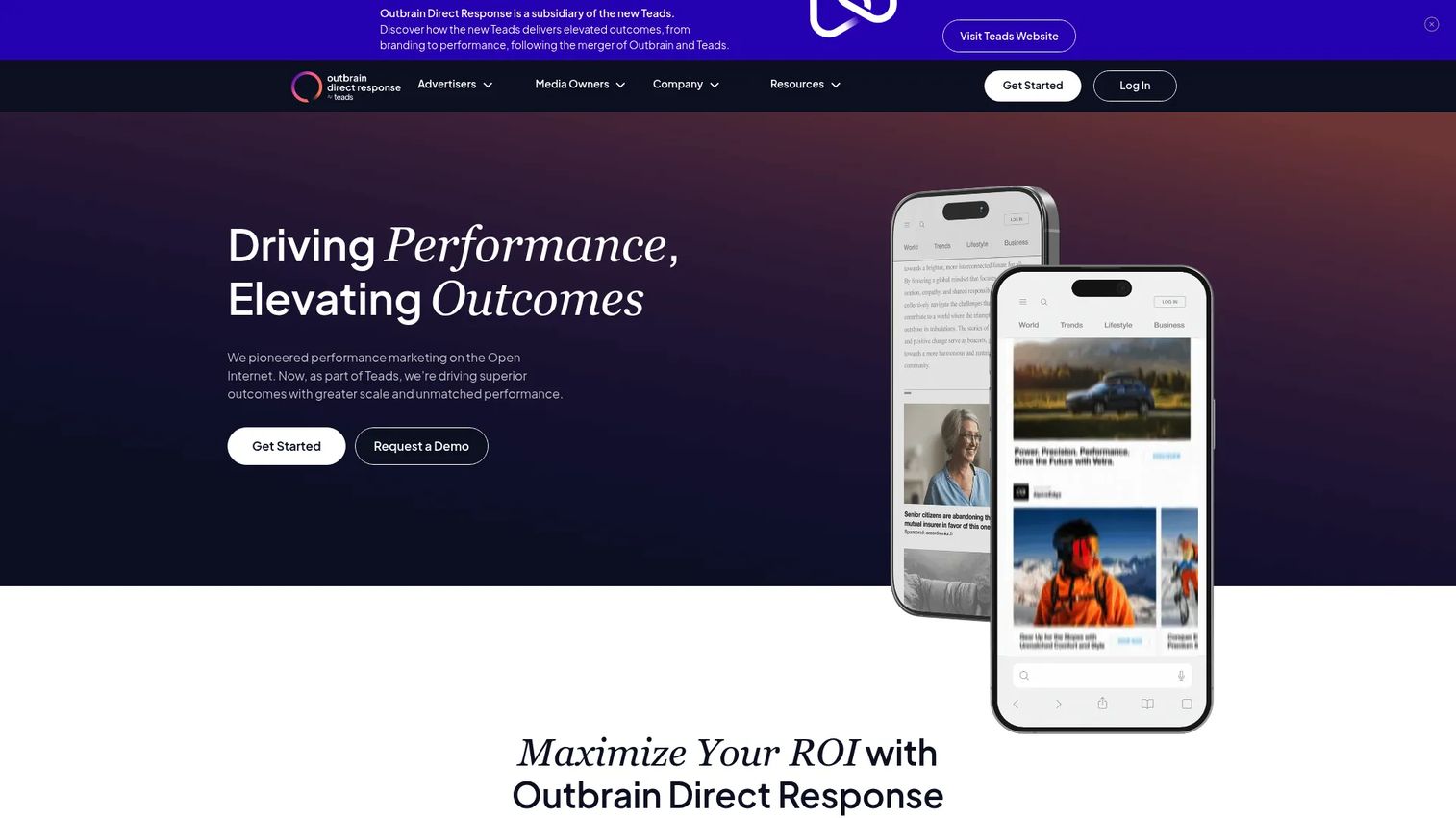
Outbrain is a performance and native advertising platform for the open internet, now operating under the Teads brand. Its specialty is publisher retargeting: re-engaging audiences through content-native placements on premium publisher sites rather than standard display banners. For content-led journeys, native and publisher placements can outperform display because they meet readers in an editorial context where they are already consuming content.
The platform bills on a CPC-based model, with targeting, contextual insights, and predictive AI deciding where your content appears and to whom. This makes it well suited to content marketers and B2B nurture programs that want to retarget prior visitors with the next relevant article, guide, or case study instead of a hard-sell banner. Contextual retargeting is the through-line: matching your content to the publisher environment improves relevance for awareness-to-consideration journeys that a generic display ad would not serve as well.
Best for: content marketers and B2B teams retargeting prior visitors with native, content-driven placements on publisher sites.
Key strengths
- Publisher and native reach: Content-native placements across premium publisher inventory.
- CPC-based billing: Pay per click with predictive AI guiding placement and targeting.
- Contextual targeting: Pairs audience signals with surrounding content for relevance.
Why choose Outbrain: When your re-engagement strategy runs on content rather than direct-response banners, Outbrain's native publisher placements fit the journey. It is the right call for nurturing prior visitors through the consideration stage with relevant editorial-style content.
Outbrain pricing: Outbrain does not list a public dollar starting price. Its help center describes a CPC pricing model, with billing based on clicks and account settings, plus automatic billing and prepayment options. You set budgets and pay per click, so plan spend around your target cost per click and volume.
Considerations before you choose a retargeting platform
The right pick depends on your channel mix, audience type, and budget, not on which brand you recognize. Run your shortlist through this checklist before committing.
Channel coverage versus your existing spend
Start where you already buy media. If most of your budget sits in Google or Meta, retargeting inside those ecosystems adds reach with the least friction. If you need open-internet breadth across display, native, CTV, and audio, a DSP or cross-channel platform earns its place. Map channels to where your audience actually pays attention.
Audience flexibility and data sources
Check how each platform builds audiences. Pixel-based retargeting, CRM list imports, custom audiences, and video-view audiences all matter differently depending on your funnel. B2B teams should weight account-level and CRM-based audiences. eCommerce teams should weight dynamic, product-feed audiences.
Measurement and cross-channel attribution
Your CFO has to believe the numbers. Favor platforms whose reporting aligns with how you already attribute pipeline, and confirm whether cross-channel attribution is native or requires a separate tool. Last-click reporting inside a single walled garden will flatter that channel.
Pricing model and ROI defensibility
Nearly every platform here bills on media spend rather than a posted subscription, using cost per click, cost per thousand impressions, or cost per acquisition. Model the pricing and ROI against your average order value or deal size, and set a frequency cap so you do not pay for impressions past the point of diminishing returns.
Conclusion
There is no single best retargeting platform, only the best fit for your channel mix, audience type, and budget. If your spend already lives in Google, start with Google Ads for consolidated search, display, and YouTube retargeting. If you want omnichannel coordination without a media operation, AdRoll is the practical middle ground. eCommerce teams with large catalogs should look hard at Criteo's dynamic, AI-driven product retargeting, while Meta Ads and LinkedIn Ads win social and B2B re-engagement respectively.
For enterprise teams running sophisticated, privacy-first programmatic, The Trade Desk and StackAdapt give you open-internet reach and identity infrastructure. ReTargeter suits smaller teams wanting managed display, and Outbrain fits content-led nurture across publisher inventory.
The cleanest path forward: start with the platform that matches your existing spend and measurement setup, prove the ROI on recovered traffic, then expand channels deliberately. Lead recovery compounds when you build on a base you can already measure rather than scattering budget across vendors you cannot yet attribute.
FAQs
The terms are used interchangeably by most marketers and platforms. Strictly, retargeting usually means serving paid ads to people who visited your site, while remarketing leaned toward re-engaging known contacts through email or audience lists like Customer Match. In practice, the mechanics matter more than the label, and most retargeting ad platforms treat the two as synonyms.
It depends on audience and budget. LinkedIn Ads is the strongest for reaching specific job titles and buying committees through the Insight Tag and account-level audiences. Google Ads adds search retargeting, display, and YouTube reach at lower cost, and AdRoll handles cross-channel account-based retargeting when you want display and social coordinated. Most B2B teams blend LinkedIn for precision with Google or AdRoll for reach.
Yes, it is often the baseline choice. Google Ads consolidates display retargeting, video remarketing on YouTube, RLSA for search, and Customer Match for CRM lists in one account. If you already spend in Google, retargeting there adds reach without onboarding a new platform, and the measurement is already wired into your reporting.
Criteo and AdRoll usually fit best. Criteo specializes in dynamic, AI-driven product retargeting that pulls from your catalog and shows shoppers the exact items they viewed, which suits large-SKU retailers. AdRoll works well for mid-market eCommerce wanting coordinated display, social, and native retargeting from one platform with built-in frequency capping.
Most charge on media spend rather than a fixed subscription, using cost per click, cost per thousand impressions, or cost per acquisition. Walled gardens like Google, Meta, and LinkedIn are auction-based, with LinkedIn starting around a $10 daily minimum. DSPs and commerce platforms like The Trade Desk and Criteo are sales-led with media-based billing, and ReTargeter is reported to start near $500 per month via G2.
Yes, but the data sources are shifting. As third-party cookies decline, retargeting increasingly relies on first-party data, CRM lists, custom audiences, and privacy-preserving identity frameworks. Platforms like The Trade Desk and StackAdapt are built around cookieless identity and contextual signals, while walled gardens retain strong first-party data on logged-in users.
At minimum, a pixel or tag installed on your site (the Meta pixel, Google tag, or LinkedIn Insight Tag) to build visitor audiences. CRM lists let you retarget known contacts through custom audiences and Customer Match. Most platforms require a minimum audience size before campaigns can run, so larger sites reach usable thresholds faster than low-traffic ones.
It comes down to reach, control, and operational complexity. Walled gardens like Google, Meta, and LinkedIn give you concentrated attention and simpler setup, with first-party data on logged-in users. DSPs like The Trade Desk and StackAdapt give you open-internet breadth, granular audience control, and identity tooling, but reward teams with the budget and expertise to run them. Smaller teams often start in walled gardens and layer in a DSP as media operations mature.