

Your dashboard says revenue looks fine. It updated four hours ago. By the time the batch job runs tonight, the fraud pattern you could have caught this morning has already cost you.
That gap between when something happens and when you can act on it is the problem streaming data platforms exist to close. But here is the trap: half the tools marketed as "streaming" are message queues with a marketing budget, or batch schedulers wearing a real-time costume.
The distinction matters more in 2026 than it did five years ago. The global streaming data platform market was valued at $7.2 billion in 2025 and is projected to reach $34.8 billion by 2034, growing at a 21.4% CAGR, according to MarketIntelo (2025). Large enterprises already generate 64.7% of that revenue, roughly $4.7 billion, which tells you where the complex, governance-heavy workloads live.
For presales engineers and platform architects, the evaluation criteria are specific. You care about latency under production load. You care about connectors and CDC coverage. You care about schema management, governance, and fault tolerance before you care about anything else. And if you demo the underlying system to prospects or stakeholders, being able to show it clearly, whether through an interactive demo or a hands-on sandbox, matters too.
This guide is a decision-ready shortlist, not a hype tour.
What's inside
This guide is for data engineers, platform architects, and technically minded presales teams evaluating real-time data infrastructure. Here is what it covers:
- What streaming data and data streaming platforms actually are, and how they differ from batch ETL
- When streaming beats batch for fraud, personalization, and monitoring
- How to compare platform architecture, governance, and fault tolerance
- A side-by-side comparison of 7 streaming data platforms with pricing and G2 ratings
- How to choose the right tool for production use in 2026
Tools were selected on four criteria: latency and throughput, connector and CDC coverage, governance and schema management, and reliability under real production load.
TL;DR
- Best for Kafka-first teams: Apache Kafka gives you the open-source event streaming standard with the largest ecosystem.
- Best for enterprise governance: Confluent adds managed clusters, stream governance, and pre-built connectors on top of Kafka.
- Best for low-latency processing: Apache Flink handles stateful, exactly-once stream processing for transformation-heavy pipelines.
- Best for cloud-native AWS teams: AWS Kinesis fits teams already committed to the AWS stack.
- Best for Azure-centric teams: Azure Stream Analytics offers SQL and no-code streaming jobs inside the Microsoft ecosystem.
- Best for Kafka-compatible performance: Redpanda delivers a single-binary, Kafka API-compatible layer with low latency.
- Best for enterprise CDC integration: Striim specializes in real-time CDC and cross-system streaming pipelines.
What is a streaming data platform
A streaming data platform is a system that captures, processes, analyzes, and delivers data continuously in real time or near-real-time, rather than in scheduled batches.
That one sentence hides a real architectural distinction. Batch ETL collects data, waits, then processes it on a schedule. Streaming processes each event as it arrives. The difference is not speed alone. It is a fundamentally different model of when computation happens relative to when data is produced.
A true platform, not just a transport layer, covers four layers:
- Ingestion: capturing events from apps, databases, IoT devices, and logs, often through CDC and connectors
- Processing: transforming, joining, filtering, and aggregating streams in flight, including stateful stream processing
- Serving and delivery: routing processed data to warehouses, lakes, dashboards, and downstream apps
- Governance: schema management, data lineage, access control, and observability across the whole pipeline
Batch processing vs streaming
Batch processing vs streaming comes down to latency tolerance. If a four-hour delay is acceptable, batch is cheaper and simpler. If decisions depend on data that is seconds old, batch fails the use case. Fraud detection, live personalization, and operational monitoring all sit firmly on the streaming side.
Where CDC, event streaming, and schema management fit
CDC (change data capture) reads the transaction log of a database and emits every insert, update, and delete as an event. That is what keeps a warehouse or search index synced with a production database in near-real-time. Event streaming is the broader pattern: systems publish events, and any number of consumers subscribe. Schema management sits underneath all of it, enforcing structure so that a producer change does not silently break every downstream consumer.
When to use streaming data platforms
Reduce decision lag
Batch is too slow when the value of a decision decays by the minute. Fraud scoring on a transaction that already settled is worthless. Personalizing a session after the visitor has left does nothing. Alerting on an outage four hours after it started is a postmortem, not a response. In each case, low latency data pipelines turn data into action while the action still matters.
Connect operational systems in real time
Most enterprises run dozens of systems that need to agree on the same facts. A CDC-driven stream keeps a data warehouse, a cache, a search index, and a downstream microservice synchronized as the source database changes. This cross-system synchronization is one of the highest-value use cases for real-time analytics platforms, because it removes the nightly reconciliation job entirely.
Support AI and real-time analytics
Models are only as current as their inputs. Streaming context feeds live features into ML scoring, keeps recommendation engines aware of the last click, and supplies fresh data to RAG pipelines so an LLM answers from current state rather than last week's snapshot. As AI moves into production decisioning, near-real-time data stops being a nice-to-have.
Comparison table
Seven platforms, sorted by relevance to teams building production streaming infrastructure. Pricing reflects publicly listed values at time of writing; several vendors use consumption-based or contact-sales models, noted where that applies.
| # | Product | Best for | Key differentiator | Pricing | G2 rating |
|---|---|---|---|---|---|
| 1 | Apache Kafka | Kafka-first, self-managed teams | Open-source event streaming standard with the largest ecosystem | Open source (free) | 4.5/5 |
| 2 | Confluent | Enterprise governance on Kafka | Managed Kafka plus stream governance and connectors | Basic $0/mo, Standard \~$385/mo | 4.4/5 |
| 3 | Apache Flink | Low-latency stateful processing | Exactly-once stateful stream processing | Open source (free) | 4.3/5 |
| 4 | AWS Kinesis | Cloud-native AWS teams | Native ingestion across the AWS stack | Pay as you go | 4.8/5 |
| 5 | Azure Stream Analytics | Azure-centric teams | SQL and no-code streaming jobs | Pay as you go | 4.46/5 |
| 6 | Redpanda | Kafka-compatible performance | Single-binary, Kafka API-compatible | Serverless from $0.10/cluster-hour | 4.7/5 |
| 7 | Striim | Enterprise CDC integration | Real-time CDC and streaming SQL | Free Developer tier, paid contact sales | 5.0/5 |
Best 7 streaming data platforms for 2026
1. Apache Kafka
Apache Kafka is the open-source distributed event streaming platform that most of this category is measured against. It handles high-throughput event streaming, durable storage, and data pipelines at scale, and it has become the default backbone for real-time data movement in a huge share of enterprise architectures.
Kafka's strength is its ecosystem and its throughput. Kafka Connect gives you hundreds of source and sink connectors. Kafka Streams and the broader tooling let you build processing on top. Durability and fault tolerance come from partitioned, replicated logs, so a broker failure does not lose your data.
Best for: Teams building self-managed event streaming and data pipeline infrastructure who want full control and the largest talent pool.
Key strengths
- High throughput, horizontally scalable event streaming
- Durable, fault-tolerant, replicated log storage
- Built-in stream processing and Kafka Connect integrations
Why choose Apache Kafka: Kafka is the right call when you want the open-source standard and have the platform engineering to run it. As raw infrastructure, it pairs naturally with a managed layer or a processing engine when you want governance and stateful compute added on top.
Apache Kafka pricing: Apache Kafka is open source and free to self-host. There is no vendor list price on the project site. Operational cost comes from the infrastructure and engineering you run it on.
2. Confluent
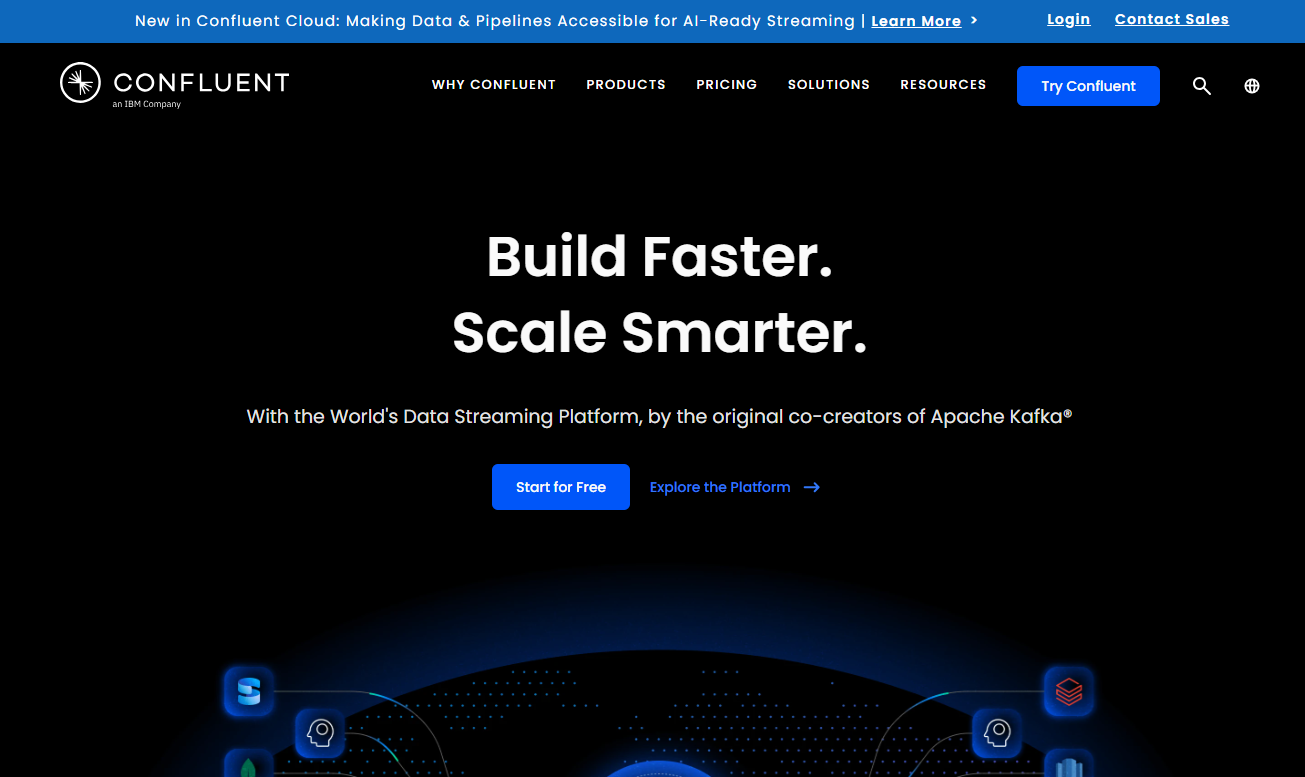
Confluent is the managed data streaming platform built by the original creators of Kafka. It wraps Kafka in fully managed clusters, adds pre-built and managed connectors, and layers on stream governance and stream processing with Apache Flink. For teams that want Kafka without running the brokers themselves, this is the path.
The platform's enterprise readiness is the differentiator. You get stream governance for schema management and data lineage, enterprise connectivity through managed connectors, and multi-cloud deployment across the major providers. That combination suits organizations where governance and reliability are non-negotiable.
Best for: Teams that need a managed Kafka-based streaming platform with enterprise governance and connector coverage.
Key strengths
- Fully managed Kafka clusters across multi-cloud
- Pre-built and managed enterprise connectors
- Stream governance and stream processing with Apache Flink
Why choose Confluent: Confluent fits when you want Kafka's ecosystem plus platform controls, and you would rather buy governance and managed operations than build them. It is the pragmatic choice for enterprise teams standardizing on Kafka semantics.
Confluent pricing: Confluent Cloud publishes a Basic tier starting at $0/month and a Standard tier starting around $385/month, per its pricing page. Billing is largely consumption-based and varies by cloud region, with additional Enterprise and Freight tiers available.
3. Apache Flink
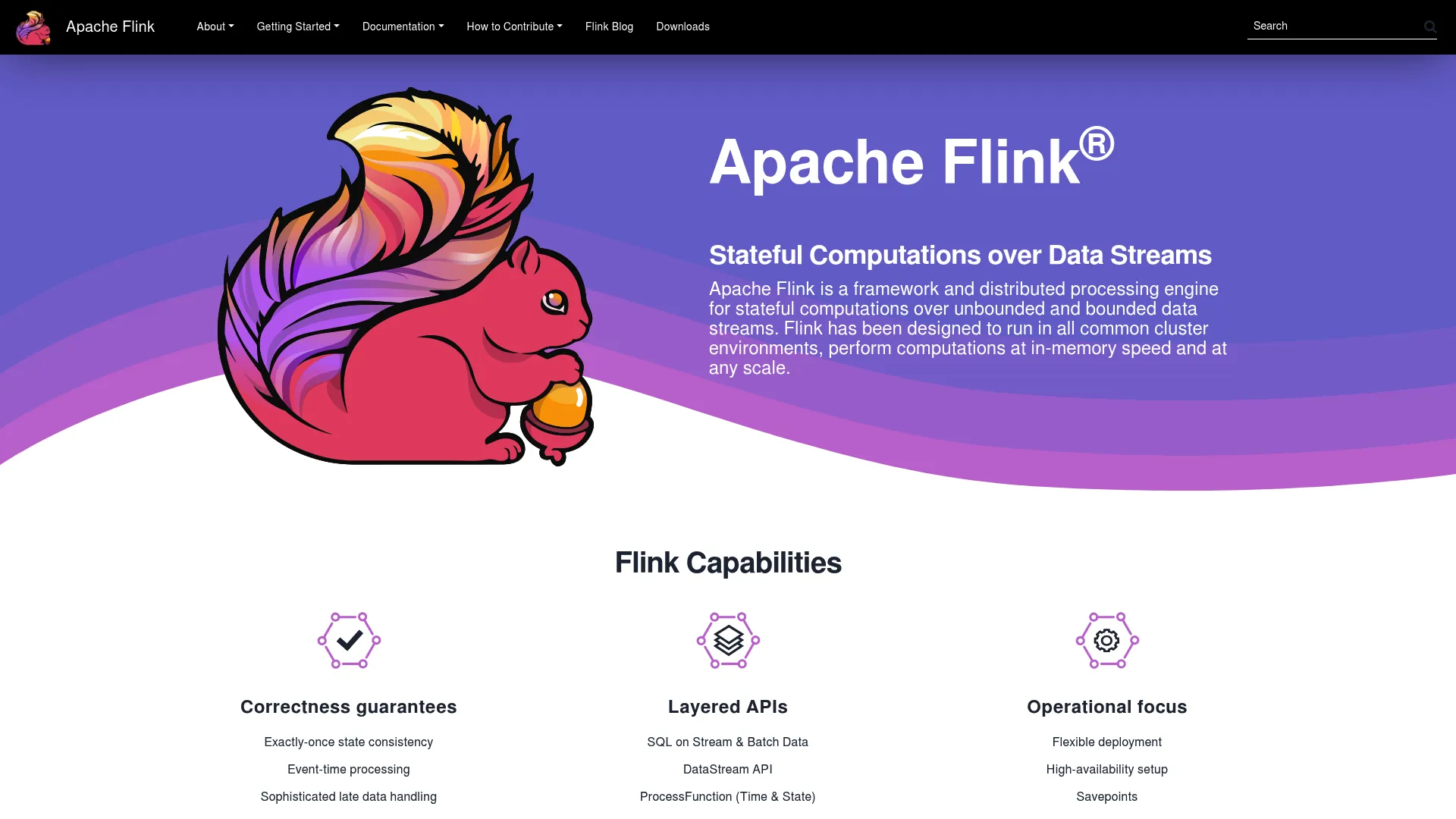
Apache Flink is the open-source framework and distributed engine for stateful stream and batch processing. Where Kafka moves and stores events, Flink is where you compute on them. It is built for low-latency, stateful transformations and complex event processing at scale.
Flink's depth shows in its guarantees. Exactly-once state consistency means an event is neither lost nor double-counted, even through failures. Event-time processing handles out-of-order data correctly. High availability, savepoints, and incremental checkpoints give you recovery and operational control that transformation-heavy pipelines require.
Best for: Teams building real-time data pipelines, streaming analytics, and stateful event-driven applications.
Key strengths
- Exactly-once state consistency
- Event-time processing for out-of-order data
- High availability, savepoints, and incremental checkpoints
Why choose Apache Flink: Flink is the pick when your workload is processing-heavy: joins, windowed aggregations, and stateful logic that has to be correct under failure. It complements a transport layer like Kafka rather than replacing it.
Apache Flink pricing: Apache Flink is open source and free to deploy. The project site lists downloads rather than paid plans. Cost is driven by the compute and operations you run it on, or by a managed provider if you choose one.
4. AWS Kinesis
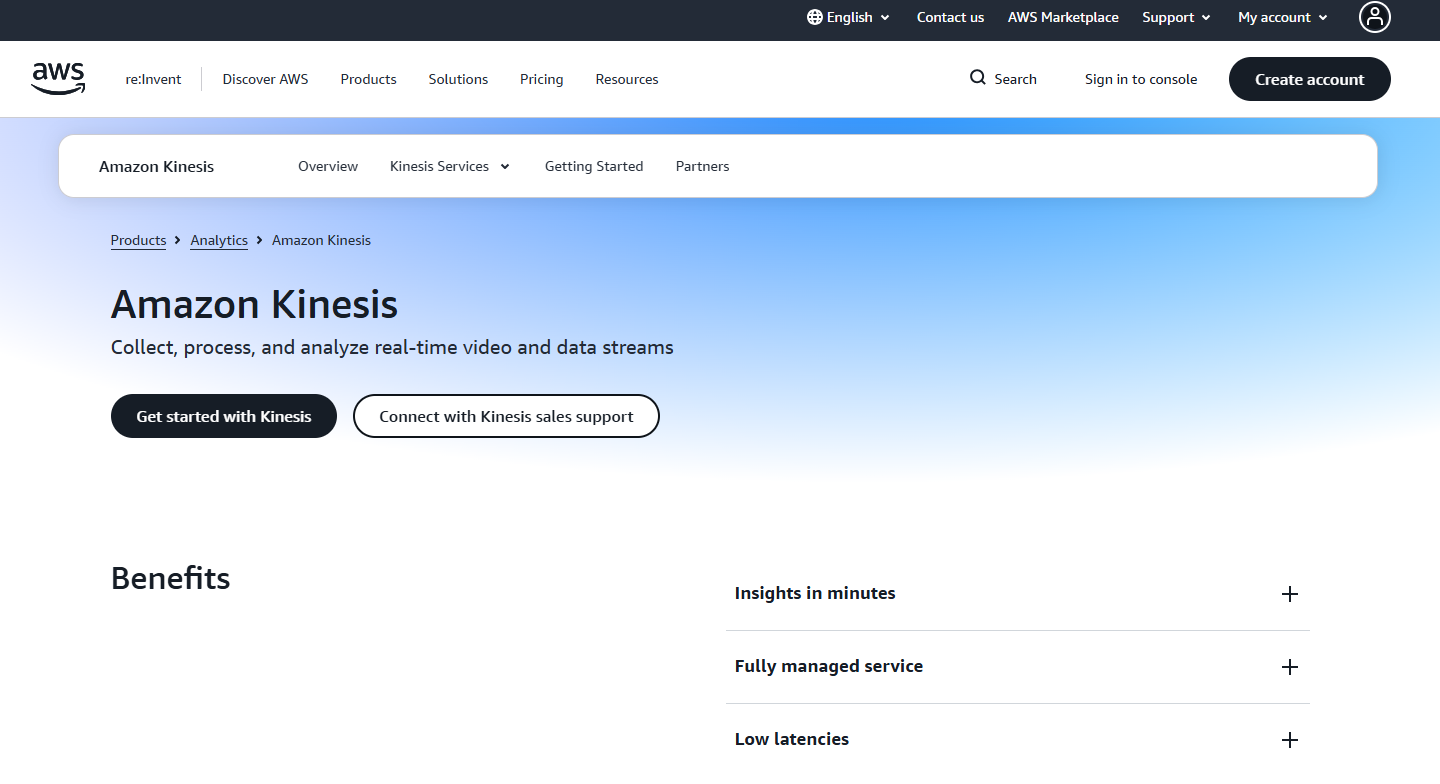
AWS Kinesis is Amazon's managed streaming data platform for ingesting, processing, and analyzing real-time data and video streams. If your stack already lives in AWS, Kinesis removes most of the operational overhead of standing up streaming infrastructure yourself.
Its advantage is native integration. Kinesis Data Streams and Kinesis Video Streams connect directly to Lambda, DynamoDB, Aurora, and Kinesis Data Firehose, so ingested data flows into processing and storage without glue code. For cloud-native teams, that tight coupling shortens the path from event to action.
Best for: Teams building real-time streaming, event-processing, or video-analytics pipelines on AWS.
Key strengths
- Real-time ingest, buffer, and processing of streaming data
- Kinesis Data Streams and Kinesis Video Streams
- Native integration with Lambda, DynamoDB, Aurora, and Firehose
Why choose AWS Kinesis: Kinesis makes sense when AWS is already your center of gravity and you value native integration over cloud portability. It handles ingestion cleanly and hands off to the rest of the AWS stack for processing and storage.
AWS Kinesis pricing: Kinesis Data Streams uses pay-as-you-go pricing across On-demand Standard, On-demand Advantage, and provisioned modes. AWS does not expose a single product-wide starting price; cost depends on the mode, shard or throughput usage, and data volume.
5. Azure Stream Analytics
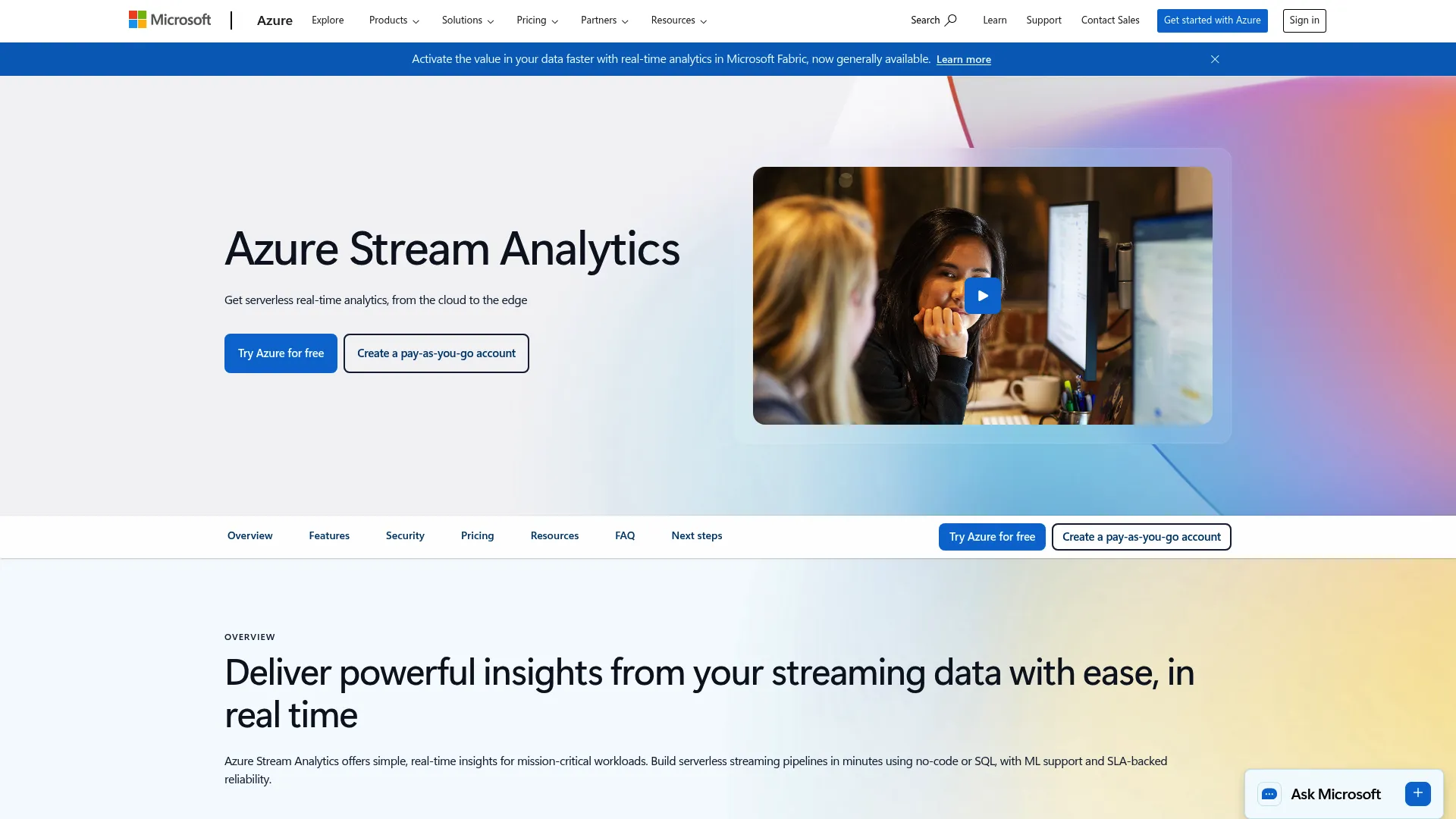
Azure Stream Analytics is Microsoft's managed, serverless stream processing service. It fits teams already invested in Azure who want to build real-time analytics pipelines without managing clusters. The SQL-based query model makes it approachable for teams that know SQL but not distributed systems internals.
The operational simplicity is the selling point. You write streaming jobs in SQL or no-code, and Azure handles the scaling. Built-in machine learning anomaly detection catches outliers without a separate model, and C# and JavaScript support cover custom logic when SQL is not enough.
Best for: Teams needing managed real-time analytics on streaming data with SQL or no-code development inside Azure.
Key strengths
- No-code or SQL-based streaming jobs
- Machine learning-based anomaly detection
- C# and JavaScript custom code support
Why choose Azure Stream Analytics: This is the natural choice for Azure-centric teams that want fast setup and low operational burden over deep control. The SQL model lowers the barrier to real-time analytics for teams without a dedicated streaming platform group.
Azure Stream Analytics pricing: Azure Stream Analytics uses pay-as-you-go pricing across Standard V2 and Dedicated V2, with a per-device monthly model for Stream Analytics on IoT Edge. The public pricing page shows placeholders for core service rates, and IoT Edge above 5,000 devices requires contacting Microsoft.
6. Redpanda
Redpanda is a Kafka API-compatible streaming data platform built as a single binary. It speaks the Kafka protocol, so existing Kafka clients and tooling work against it, but it is engineered for low-latency performance and operational simplicity. For teams that like Kafka's ecosystem but want a leaner runtime, it is a strong option.
The single-binary architecture is the headline. Schema registry, HTTP proxy, and the message broker ship together, which cuts the number of moving parts you operate. Redpanda Console gives you visibility, and 290+ pre-built connectors cover enterprise connectivity.
Best for: Teams needing Kafka-compatible, high-performance streaming with managed cloud or self-hosted deployment options.
Key strengths
- Kafka API-compatible
- Single-binary with built-in schema registry, HTTP proxy, and broker
- Redpanda Console and 290+ pre-built connectors
Why choose Redpanda: Redpanda fits teams that want Kafka compatibility with a modern, low-latency runtime and fewer components to manage. It is a natural fit when performance and operational simplicity both matter.
Redpanda pricing: Redpanda Serverless starts at $0.10 per cluster-hour on a usage-based model, with a free 14-day trial available. BYOC and Dedicated deployment options are available through contact sales, and Redpanda Connect is priced by usage that varies by cloud and region.
7. Striim
Striim is a real-time data integration and streaming platform focused on moving, processing, and delivering data across systems. Its center of gravity is CDC and streaming integration, which makes it a natural fit for enterprises that need to keep databases, warehouses, and applications synced continuously.
Striim's strength is cross-system connectivity. Change data capture reads from databases and log files in real time, streaming SQL transforms data in flight, and hundreds of connectors handle enterprise connectivity. Pipeline monitoring gives you observability across the flow, which matters for governance and reliability.
Best for: Enterprises needing real-time CDC, streaming integration, and cloud or self-managed data pipelines.
Key strengths
- Real-time data integration and streaming SQL
- Change data capture from databases and log files
- Hundreds of connectors and pipeline monitoring
Why choose Striim: Striim is the pick when CDC and cross-system integration are the core of the job, not an afterthought. It suits enterprise teams that want a platform built around continuous data movement with governance and monitoring included.
Striim pricing: Striim offers a free Striim Developer tier. Striim Cloud and Striim Platform are the paid offerings, both priced through contact sales rather than public list prices, per the Striim pricing page.
Considerations
Latency and throughput
Ask for numbers under load, not marketing figures. A platform that hits single-digit millisecond latency in a demo can behave differently at your production event volume. Test throughput at your real peak, with your real message sizes, and watch how latency changes as you scale partitions or shards. Low latency data pipelines are only useful if the latency holds when it counts.
Connectors and CDC coverage
Enterprise connectivity is where projects stall or ship. Confirm the platform has verified connectors for your specific sources and sinks, not just a generic count. If you rely on database sync, evaluate CDC support against your exact database versions and how it handles schema drift, deletes, and backfills.
Governance and security
Schema management, data lineage, access control, and auditability are what keep a streaming platform safe to run in production. Check that a producer schema change cannot silently break consumers, that you can trace where data came from, and that access control and audit logging meet your security requirements before you commit.
Reliability and fault tolerance
Fault tolerance is not optional for anything downstream of revenue. Look at checkpointing, replication, and recovery behavior. Ask what happens when a node fails mid-stream, whether processing is exactly-once or at-least-once, and how fast the system recovers. Pair that with observability so you can see failures as they happen.
Ease of use and operating model
Match the operating model to your team. A self-managed open-source stack gives control but assumes platform engineering depth. A managed cloud service trades some control for lower operational load. For presales teams validating fit, confirm the deployment model matches your team's maturity and your security review requirements before selection.
Conclusion
Pick by architecture fit, not by the loudest feature list.
Kafka-first teams should validate ecosystem depth and decide whether to self-manage or move to a managed layer like Confluent for governance and connectors. Enterprise teams should compare governance, schema management, and connector coverage closely, since that is where production streaming succeeds or stalls. Cloud-native teams should check native integrations first: AWS Kinesis if you live in AWS, Azure Stream Analytics if you live in Azure.
If processing depth is your bottleneck, Apache Flink handles stateful, exactly-once compute. If you want Kafka compatibility with a leaner runtime, Redpanda is worth a proof of concept. If continuous CDC and cross-system integration are the whole point, Striim is built around that job.
Your next step is a scoped proof of concept against your real data, your real latency targets, and your real governance requirements. Test the shortlist, not the marketing.
Start your journey with Guideflow today!
FAQs
Batch processing collects data and runs it on a schedule, so results lag behind events by minutes or hours. Streaming processes each event as it arrives, delivering near-real-time results. The choice comes down to latency tolerance: batch is cheaper when delay is acceptable, streaming is necessary when decisions depend on fresh data.
Kafka is a transport and storage layer for event streaming, not a complete platform on its own. If you only need to move events at scale and have the engineering to run it, Kafka may be enough. If you also need managed operations, governance, schema management, and connectors, a fuller platform like Confluent or Striim adds those layers so you build less yourself.
Most rely on a schema registry that enforces compatibility rules when a producer changes its data structure. The registry can reject a change that would break existing consumers, or allow backward- and forward-compatible changes to flow through. This schema management is what prevents one producer update from silently corrupting every downstream job.
CDC, or change data capture, reads a database's transaction log and emits every insert, update, and delete as a stream of events. It keeps warehouses, caches, and search indexes synced with a source database in near-real-time. CDC is the mechanism that replaces nightly batch reconciliation with continuous synchronization.
Streaming keeps model inputs current. It feeds live features into ML scoring, updates recommendation engines with the latest interaction, and pushes fresh data into RAG pipelines so an LLM answers from current state rather than a stale snapshot. For production AI, near-real-time data is what keeps decisions relevant.
Prioritize access control, encryption, and audit logging for security, plus schema management and data lineage for governance. For monitoring, look for observability into pipeline health, latency, and throughput, along with alerting on failures. Fault tolerance through checkpointing and replication rounds out what you need before running anything production-critical.
It depends on where your systems live and how portable you need to be. Confluent and Striim support multi-cloud and hybrid deployments, which suits teams spanning environments. Redpanda offers self-hosted and managed cloud options for flexibility. AWS Kinesis and Azure Stream Analytics are strongest when your workloads are concentrated in a single provider's stack.