Your product team needs an activation dashboard by Friday. Data engineering says the event model changed, the pipeline needs updates, and the existing warehouse logic lives across scripts nobody wants to touch.
This is the real cost of manual warehouse delivery. Every source change triggers a cascade: Remapping, custom SQL rewrites, documentation updates, a cautious release. Analysts spend sprint time repairing pipelines. [Product experiments lack trustworthy segmentation. Activation and retention dashboards disagree with each other.
The data warehouse automation tool market reached $636.4 million in 2025 and is forecast to grow to $925 million by 2032, according to 360iResearch (2025). That growth reflects teams actively buying their way out of this problem.
The difficult part is choosing software that automates the warehouse lifecycle instead of adding another layer of pipeline complexity. A good automation platform reduces the recurring work of designing, building, documenting, and operating warehouse assets. A poor choice adds a tool that owns one layer but leaves everything else manual.
This guide helps you separate the genuine data warehouse automation platforms from general-purpose ETL and orchestration tools, so the bottleneck you remove stays removed.
What's inside
This guide covers seven data warehouse automation tools evaluated for architecture fit, governance depth, and lifecycle coverage. It's written for Product Managers who partner with data engineering and analytics teams to improve instrumentation reliability, release cadence, and measurement credibility.
Tools were selected based on:
- Warehouse lifecycle coverage (modeling, code generation, deployment, documentation)
- Metadata-driven automation and governance capabilities
- Architecture fit across Data Vault, cloud ELT, and analytics engineering use cases
- Verified pricing and G2 ratings
TL;DR
- Best for end-to-end warehouse lifecycle automation: TimeXtender, for teams needing ingestion, modeling, data quality, and orchestration in one metadata-driven platform
- Best for Data Vault 2.0 automation: VaultSpeed, for enterprise teams building governed Data Vault pipelines across cloud platforms
- Best for analytics engineering workflows: Coalesce, for cloud data teams wanting visual development with Git-based deployment controls
- Best for warehouse code generation: WhereScape RED, for teams automating design, deployment, documentation, and lineage
- Best for Azure-native orchestration: Azure Data Factory, for organizations whose warehouse, storage, and analytics stack already runs in Azure
- Right choice depends on: whether the bottleneck is modeling, code generation, governance, or pipeline orchestration
What are data warehouse automation tools?
Data warehouse automation tools are platforms that automate the design, development, deployment, documentation, testing, and operation of a data warehouse.
Most confusion about this category comes from conflating it with adjacent software. A data warehouse stores structured data for reporting and analytics. ETL and ELT tools move and transform data between systems. Data warehouse automation coordinates the broader lifecycle around those activities, generating the modeling logic, code artifacts, documentation, and release controls that hand-coded approaches leave manual.
Some platforms cover the full lifecycle. Others specialize in Data Vault modeling, visual SQL transformation, or cloud orchestration.
Core capabilities to look for
- Metadata harvesting from source systems
- Automated logical and physical data modeling
- Generated SQL, pipelines, and deployment artifacts
- Transformation dependency orchestration
- Data lineage, documentation, and impact analysis
- Data quality checks and observability
- Version control, testing, and CI/CD support
- Cloud, hybrid, and on-premises deployment options
Data warehouse automation vs adjacent categories
| Category | Primary job | What it does not always cover |
|---|---|---|
| Data warehouse automation | Automates warehouse lifecycle work | Every source connector or BI visualization need |
| ETL or ELT platform | Moves and transforms data | Modeling, generated documentation, and full lifecycle governance |
| Data catalog | Documents and governs data assets | Pipeline generation and release automation |
| Data warehouse | Stores and processes analytics data | Automated warehouse design and operations |
| Workflow orchestrator | Schedules jobs and dependencies | Warehouse modeling and generated code |
Use this table as a filter before evaluating any tool. A PM asking "does this platform help us build reliable product data faster?" needs warehouse lifecycle automation, not a faster job scheduler.
When to use data warehouse automation tools
Modernize a brittle, hand-coded warehouse
When your warehouse logic lives across undocumented scripts, source changes cause cascading manual work. Automation reduces this maintenance burden by generating consistent code artifacts, tracking dependencies, and managing releases systematically. The case is strongest when source schemas change frequently.
Build governed product and customer data
PMs who need reliable activation, retention, and feature adoption metrics require consistent metric definitions, lineage, and access controls. Warehouse automation creates the governed foundation where measurement stays trustworthy across releases. Without it, each sprint that touches instrumentation creates dashboard drift.
Scale a Data Vault or multi-platform program
Large organizations running Data Vault need repeatable modeling patterns, generated pipelines, and controlled releases across multiple cloud warehouse targets. When your data estate spans several platforms or domains, automation reduces the per-domain overhead that slows delivery.
Use this category when:
- Source schema changes regularly break downstream pipelines
- Analysts and engineers spend release time repairing rather than analyzing
- Product experiments lack trustworthy segmentation
- Documentation and lineage are missing or perpetually out of date
A simpler managed ELT or transformation tool may be enough when the bottleneck is a single integration point or a small analytics engineering team without complex governance requirements.
Data warehouse automation tools comparison
These seven tools serve different layers of the warehouse automation problem. Compare by architecture fit before comparing feature lists. A tool optimized for Data Vault patterns adds friction to a dimensional modeling workflow, and vice versa.
Pricing and G2 ratings verified October 2026 from each vendor's pricing page and G2 listing.
| # | Product | Best for | Key differentiator | Pricing | G2 rating |
|---|---|---|---|---|---|
| 1 | TimeXtender | End-to-end metadata-driven warehouse automation | Combines ingestion, enrichment, quality, and orchestration in one platform | From $34,000/year | 4.3/5 |
| 2 | VaultSpeed | Enterprise Data Vault 2.0 automation | Active metadata and generated cloud warehouse code | Contact for quote | 4.8/5 |
| 3 | Coalesce | Analytics engineering on cloud warehouses | Visual transformation development with Git-based deployment | Free plan; Starter $150/user/month | 4.7/5 |
| 4 | WhereScape RED | Warehouse lifecycle code generation | Automates design, deployment, documentation, and lineage | Contact for quote | 3.9/5 |
| 5 | Agile Data Engine | Metadata-driven data product delivery | Model-driven automation for governed cloud pipelines | Contact for quote | Not listed on G2 |
| 6 | Datavault Builder | Data Vault modeling and warehouse automation | Data Vault 2.0 with automated ETL/ELT code generation | Contact for quote | 3.0/5 |
| 7 | Azure Data Factory | Azure-native integration and orchestration | Managed cloud pipelines with broad Azure service connectivity | Pay-as-you-go | 4.6/5 |
Best 7 data warehouse automation tools for 2026
1. TimeXtender
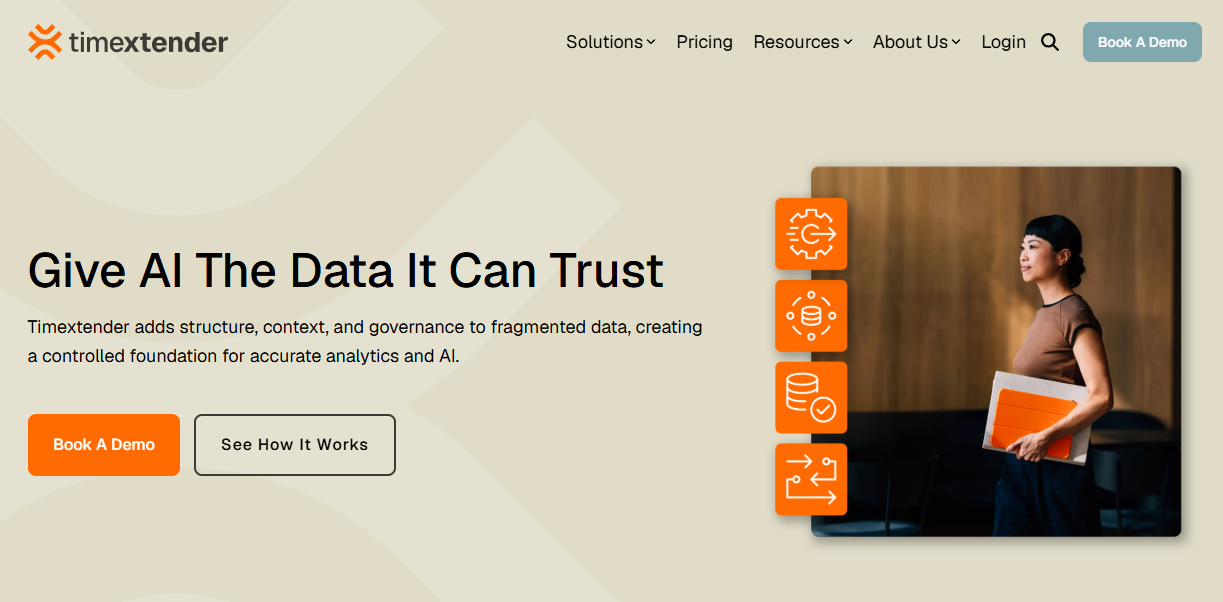
TimeXtender is a unified, metadata-driven data platform that automates the warehouse lifecycle from ingestion to delivery. It covers data integration, enrichment, quality validation, and workflow orchestration under one platform, targeting teams that need governed, AI-ready data products across cloud or on-premises environments. The platform's modular structure means teams can start with integration and add quality or orchestration modules as the program matures.
Best for: Mid-market and enterprise teams that need a broad automation layer across ingestion, transformation, governance, and operations without stitching together separate tools.
Key features
- Metadata-driven ingestion, preparation, transformation, modeling, and delivery
- Spreadsheet-like data enrichment for business-critical managed data
- Automated data quality validation, profiling, monitoring, and remediation
- Workflow orchestration with scheduling, dependency management, and alerting
- Multi-cloud and on-premises deployment with portable business logic
Why choose TimeXtender: It suits teams where product, finance, and operations all rely on a shared data foundation. The breadth of lifecycle coverage reduces the number of integration points your data engineering team has to maintain between separate tooling.
TimeXtender pricing: The platform is modular. Data Integration starts at $34,000/year (Starter), with Standard at $45,000/year, Premium at $76,000/year, and Enterprise at $150,000/year. Standalone modules for Data Enrichment, Data Quality, and Orchestration each start at $7,500/year. A free Xpilot Analytics allowance is included, with paid AI packs available monthly.
G2 rating: 4.3/5 (verified October 2026).
2. VaultSpeed
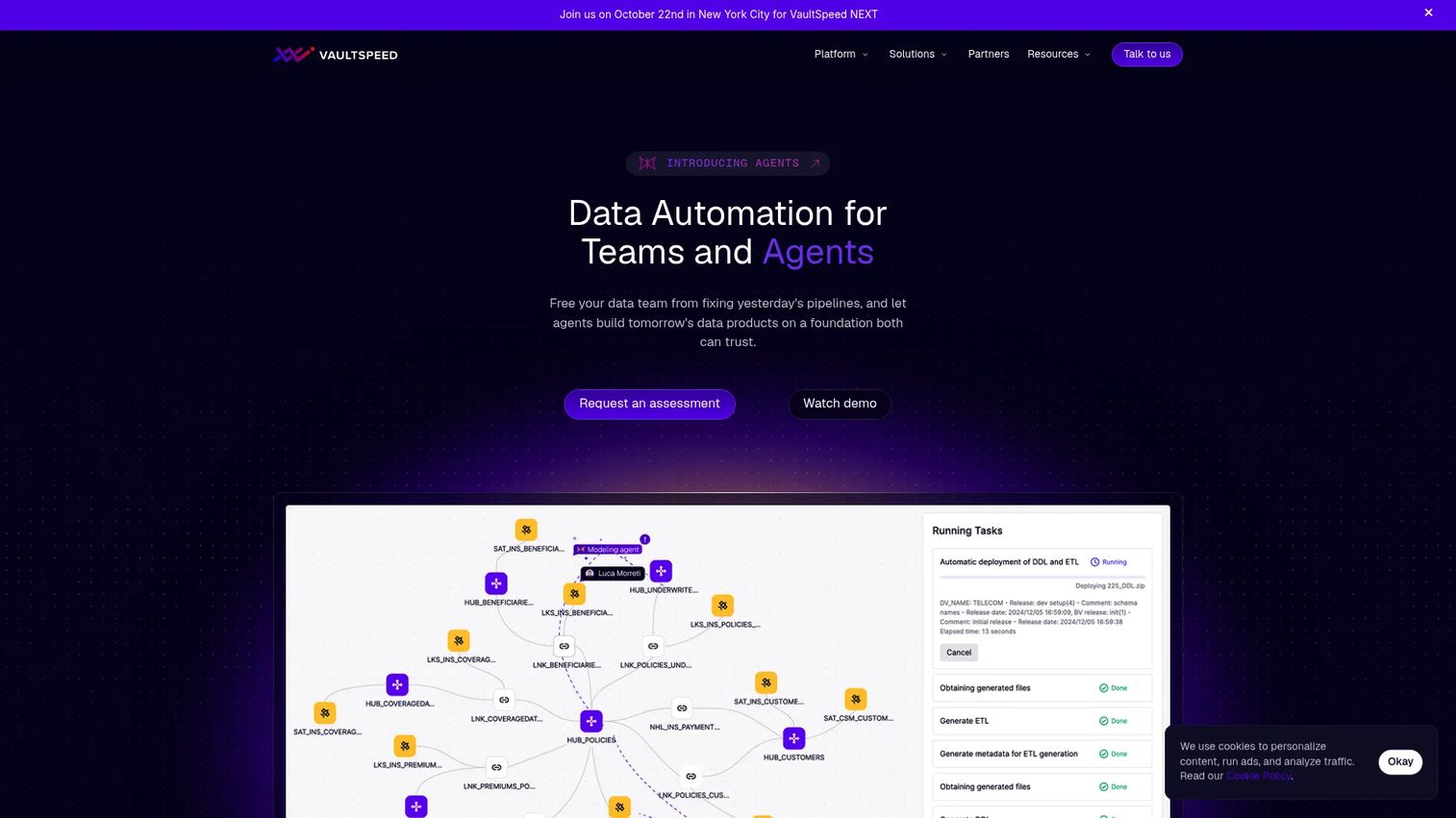
VaultSpeed is an enterprise data automation platform focused on Data Vault 2.0 methodology. It automates data modeling, integration, transformation, deployment, and governance for cloud data platforms including Snowflake, Databricks, BigQuery, Redshift, and Microsoft Fabric. The platform uses active metadata to drive code generation, historization, schema-drift handling, and CI/CD workflows without requiring hand-coded SQL for each vault object.
Best for: Enterprise data teams standardizing Data Vault 2.0 automation across complex, governed environments where historical modeling and change management are non-negotiable.
Key features
- Visual data modeling with business collaboration layer
- Data Vault 2.0 automation with historization and lineage
- Runtime-free SQL and dbt code generation
- Delta and schema-drift handling
- CI/CD deployment workflows across major cloud warehouses
Why choose VaultSpeed: It is the right choice when Data Vault is a deliberate architectural standard rather than a convenience pattern. The value compounds when the organization has the operating maturity to use metadata, standard patterns, and governed release practices consistently.
VaultSpeed pricing: Contact VaultSpeed for a quote. Cost factors include number of sources, target platforms, data domains, environments, and implementation support requirements. A 7-day free trial is available to evaluate core functionality before engaging on commercial terms.
G2 rating: 4.8/5 (verified October 2026).
3. Coalesce
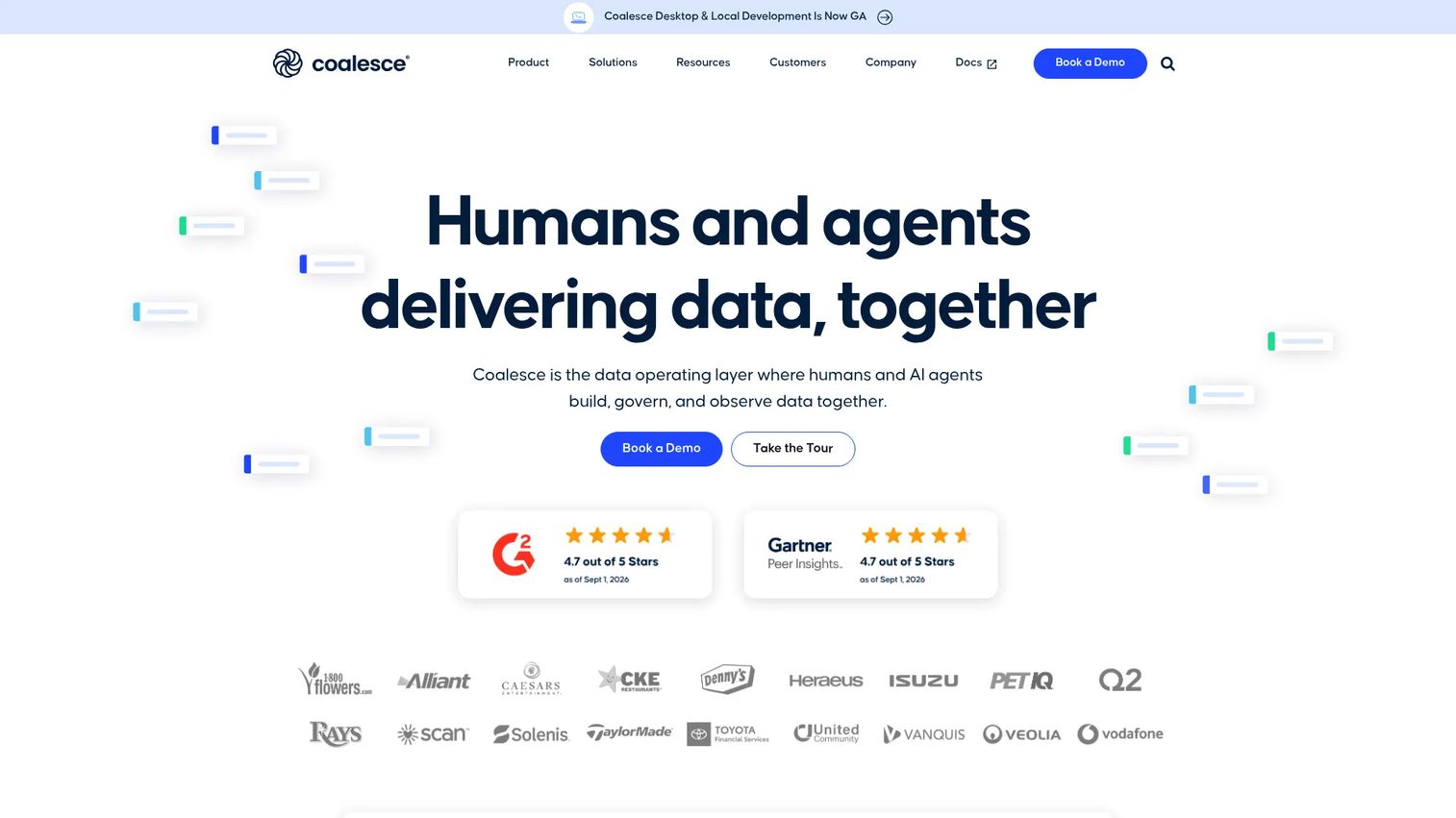
Coalesce is a governed data platform combining transformation, cataloging, and data quality monitoring for cloud warehouse environments. It gives analytics engineering teams a visual development workspace with metadata-driven transformation, column-level lineage, and Git-native deployment workflows. Teams can build SQL transformation logic visually or in code, with automatic change propagation and AI-assisted documentation generation.
Best for: Cloud data teams that want faster analytics engineering delivery with more consistency than ad hoc SQL repositories, particularly when metric definitions and release cadence directly affect product reporting.
Key features
- Visual DAG-based transformation development with code access
- Column-level lineage with automatic change propagation
- Data cataloging with AI-powered definitions and ownership tracking
- Data quality testing, monitoring, and observability
- Git-native workflows with API and CLI access
Why choose Coalesce: PMs who need reliable metric definitions and shorter iteration cycles on product data benefit from Coalesce's combination of visual development and governed deployment. It reduces the gap between an analyst writing a transformation and that transformation reaching a trusted dashboard.
Coalesce pricing: The Developer plan is free for one user. Starter is $150 per user per month, billed annually, and includes up to four Transform users and 15,000 monthly actions. Enterprise supports five or more users and 100,000 monthly actions. Business Critical adds private networks and advanced security controls. Enterprise and Business Critical are priced by quote.
G2 rating: 4.7/5 (verified October 2026).
4. WhereScape RED
WhereScape RED is a data warehouse automation tool focused on generating platform-native ELT code, orchestrating workflows, and documenting data infrastructure across cloud, hybrid, and on-premises environments. It automates the full warehouse development cycle: Design, code generation, deployment, documentation, lineage tracking, and operational support. Teams replacing manual warehouse builds and release scripts find it addresses the repeated overhead, not just a single transformation.
Best for: Teams replacing manual warehouse development and release processes across environments where documentation, lineage, and operational automation are as important as code generation.
Key features
- Native ELT code generation for target warehouse platforms
- Integrated orchestration and scheduling
- Automatic documentation and data lineage generation
- Lifecycle deployment automation
- Data warehouse operations management
Why choose WhereScape RED: Choose it when the bottleneck is the repeated cycle of designing, building, documenting, and releasing warehouse assets rather than a single transformation job. It is a warehouse development platform, so teams with lightweight analytics needs may find a narrower cloud transformation tool more aligned.
WhereScape RED pricing: Pricing is by quote. The cost structure depends on environments, target platforms, and deployment model. Contact WhereScape directly to map scope to commercial terms. G2 reviewer context suggests it is an enterprise-oriented commercial model.
G2 rating: 3.9/5 (verified October 2026).
5. Agile Data Engine
Agile Data Engine is a DataOps platform for designing, deploying, and continuously operating governed cloud data warehouses and data products. It uses metadata-driven modeling to generate pipelines, apply schema changes automatically, and maintain lineage and data quality monitoring across cloud environments. The platform targets organizations adopting data product operating models where reusable patterns across domains matter as much as single-project delivery.
Best for: Organizations moving beyond one warehouse project and requiring repeatable pipeline delivery standards across multiple business domains and data teams.
Key features
- Metadata-driven modeling and transformations
- Continuous deployment with CI/CD and automatic schema management
- Metadata-driven workflow orchestration
- Integrated data quality testing
- Multi-cloud deployment support with monitoring and lineage
Why choose Agile Data Engine: It suits teams that have committed to a data product operating model and need standards that scale across domains. The platform's value grows when reusability across products and environments is the primary driver, not speed on a single integration.
Agile Data Engine pricing: Three editions are available: Standard, Enterprise, and Business Critical. All are priced by monthly subscription with costs based on product edition, number of runtime environments, and concurrency. Contact the vendor for a quote. No numerical prices are published.
6. Datavault Builder
Datavault Builder is a model-driven data warehouse automation platform covering data integration, Data Vault modeling, ETL/ELT code generation, deployment, documentation, and lineage. It supports dimensional, 3NF, flat-table, and data product outputs alongside the core Data Vault patterns of hubs, links, and satellites. Git versioning and CI/CD deployment workflows are built in, giving teams a governed path from model design to production release.
Best for: Data engineering and analytics teams that have chosen Data Vault architecture and need a focused platform for consistent, governed model implementation across a shared team.
Key features
- Visual Data Vault 2.0 modeling with hub, link, and satellite support
- Automated ETL/ELT code generation
- Git versioning and CI/CD deployment
- Automatic data lineage and documentation
- Data integration, cleansing, harmonization, and quality controls
Why choose Datavault Builder: It reduces inconsistencies in Data Vault implementation when several developers work across shared models. The specialist focus means it is not the default choice for teams using dimensional modeling, dbt-style transformations, or a simple cloud ELT pattern.
Datavault Builder pricing: Three editions exist: Starter, Standard, and Enterprise. All are priced by custom quote based on team size, deployment model, and number of environments. Free discovery calls and hosted demo environments are available to evaluate the platform before engaging on pricing.
G2 rating: 3.0/5 from 5 reviews (verified October 2026). Capterra reports 4.7/5 from 11 reviews for additional perspective.
7. Azure Data Factory
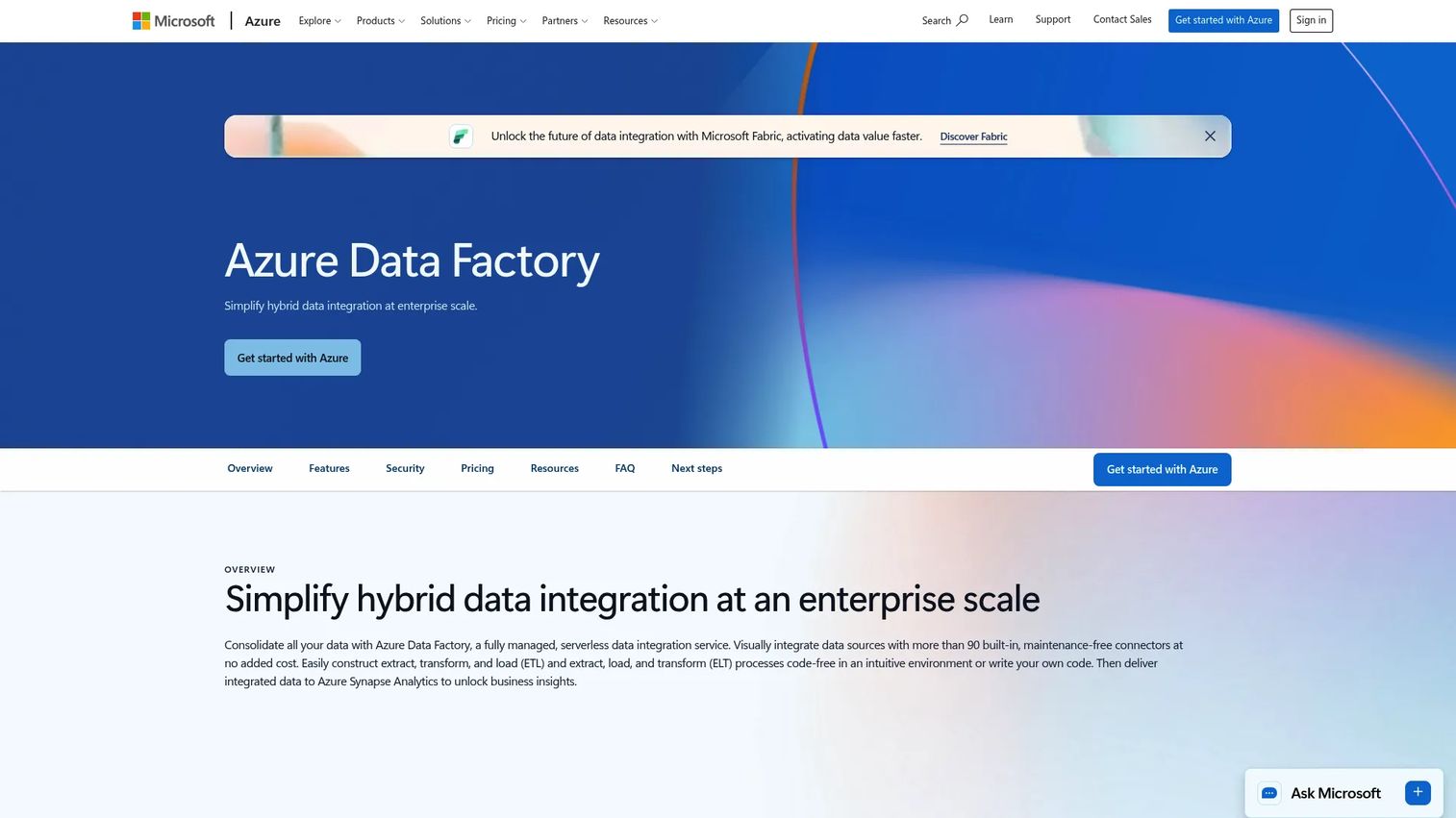
Azure Data Factory is a fully managed, serverless data integration and orchestration service for building hybrid ETL and ELT pipelines across cloud and on-premises sources. It provides more than 90 built-in connectors, code-free pipeline creation, data-flow-based transformation, and integrated monitoring. For organizations already running on Azure, it connects directly to native storage, compute, analytics, and identity services without additional infrastructure management.
Best for: Organizations whose warehouse, storage, identity, monitoring, and analytics stack already runs in Azure and need managed integration and orchestration aligned with existing cloud services.
Key features
- More than 90 built-in connectors for diverse source systems
- Code-free ETL and ELT pipeline creation
- Data-flow-based transformation with visual development
- Pipeline orchestration, scheduling, triggers, and alerts
- Hybrid connectivity and managed SSIS migration support
Why choose Azure Data Factory: Ecosystem fit is the primary driver. It makes strong sense when the adjacent stack, including warehouse, storage, identity, and analytics, already runs on Azure and teams want managed integration without separate infrastructure. Teams requiring automated modeling, generated documentation, Data Vault patterns, or extensive metadata management will typically pair it with a purpose-built warehouse automation platform.
Azure Data Factory pricing: Pay-as-you-go pricing based on pipeline orchestration runs, data movement, activity runtime, integration runtime hours, and data flow computation. Microsoft's pricing calculator at azure.microsoft.com provides current per-unit rates. There is no flat annual subscription; costs scale directly with usage volume.
G2 rating: 4.6/5 (verified October 2026).
Considerations when choosing data warehouse automation tools
Choose the right automation layer
Ask whether the team needs full warehouse lifecycle automation, transformation workflow management, ingestion and orchestration, or a Data Vault-specific platform. A category mismatch becomes expensive after implementation, when re-platforming means rebuilding the models, documentation, and release processes the first tool created.
Match the data architecture
Document current and target platforms before evaluating vendors. Include cloud warehouse, lakehouse, hybrid systems, and BI consumption layers. The automation platform must fit the architecture you plan to support for the next two years, not just the current state.
Test governance before building
Evaluate lineage, impact analysis, access controls, documentation generation, version control, and environment promotion before committing. PMs should ask specifically how a schema change becomes a traceable, auditable release. Strong governance here is what makes product metrics credible to stakeholders.
Model the maintenance burden
Automation reduces recurring work, but the platform still needs clear operating ownership. Ask who owns metadata, templates, source onboarding, and quality rules after launch. A tool without clear ownership tends to drift back toward the manual patterns it was supposed to replace.
Validate measurement reliability
Connect the purchase decision to specific product metrics. Require a plan covering event definitions, segment consistency, data freshness, and dashboard trust before claiming the platform will improve product decisions. Instrumentation quality and governance ownership determine whether the warehouse delivers reliable measurement.
Conclusion
The right platform depends on the layer of the warehouse lifecycle causing the most delay.
TimeXtender is the broadest option for teams needing end-to-end metadata-driven warehouse lifecycle automation across ingestion, quality, and orchestration. VaultSpeed and Datavault Builder serve Data Vault-oriented programs where governed modeling and generated code are the primary requirements. Coalesce fits cloud analytics engineering teams that want visual transformation development and controlled deployment. WhereScape RED addresses full warehouse development automation where documentation and lineage matter as much as code generation. Agile Data Engine suits organizations adopting data product operating models with multi-domain reusability requirements. Azure Data Factory is the practical choice for Azure-native integration and orchestration aligned with existing cloud infrastructure.
Before booking demos, map the workflow that currently causes the most delay. It may be source onboarding, model changes, release management, data quality enforcement, or reporting trust. Choose the platform that automates that bottleneck without creating a second one in a different part of the lifecycle.
For a broader look at how data infrastructure connects to product measurement, see our guides on analytics platforms, cloud migration software, and cloud data security software.
FAQs
Data warehouse automation is the use of metadata, templates, generated code, orchestration, and governance controls to automate warehouse design, development, deployment, documentation, and operations. It is broader than basic ETL: Instead of only moving data, it automates the modeling logic, release process, lineage tracking, and quality controls that ETL alone leaves manual.
ETL and ELT tools primarily move and transform data between systems. Warehouse automation handles the surrounding lifecycle: Logical and physical modeling, code generation, documentation, lineage, deployment automation, and operational management. Many organizations use both, with an ETL tool handling movement and a warehouse automation platform governing how the warehouse itself is designed and maintained.
Yes, when instrumentation quality and governance ownership are in place. These platforms help teams build reliable product event pipelines, standardized metric definitions, governed segments, and trusted activation and retention reporting. The quality of the output still depends on how well events are defined and owned upstream. Automation governs the warehouse layer; it does not replace instrumentation discipline.
Data Vault teams should look for platforms that automate hub, link, and satellite structures, handle historization and change data capture patterns, generate code, and support CI/CD workflows. VaultSpeed and Datavault Builder both focus specifically on this architecture. VaultSpeed adds active metadata management and broader cloud platform support; Datavault Builder covers the full modeling and ETL/ELT generation lifecycle with Git versioning built in.
Azure Data Factory handles managed integration, pipeline orchestration, and data movement well. It does not replace warehouse automation platforms that generate modeling artifacts, documentation, lineage, and Data Vault structures. Teams needing those capabilities typically pair Azure Data Factory with a purpose-built warehouse automation tool, using it for pipeline orchestration while the automation platform governs the warehouse design and release process.
Enterprise-oriented warehouse automation platforms typically start in the low five figures annually, with costs rising based on the number of sources, environments, data domains, and governance requirements. TimeXtender's Data Integration module starts at $34,000/year as a published reference point. Cloud-native services like Azure Data Factory use consumption-based pricing, so cost scales directly with pipeline runs, data movement volume, and processing hours. Platforms without published prices, including VaultSpeed, WhereScape RED, Agile Data Engine, and Datavault Builder, require a vendor conversation to scope commercial terms.
It depends on complexity and growth trajectory. Small teams may start with a managed ELT service and a transformation workflow tool, which cover basic movement and modeling needs at lower cost. The case for warehouse automation grows when manual releases, unclear lineage, and repeated source-change work become a persistent bottleneck. Teams planning significant growth in sources, domains, or governance requirements typically find earlier investment pays off in avoided re-platforming cost.
Run a proof of concept around one recurring workflow: Source ingestion, a model change, testing, documentation update, deployment, and rollback. Measure elapsed delivery time, manual steps required, failure risk, and lineage clarity at each stage. Compare that against your current process. A platform that cuts delivery time and makes lineage traceable without adding new manual handoffs is worth the commercial conversation.
Data warehouse lifecycle automation extends beyond individual pipeline runs to cover the full arc of warehouse work: Initial design, iterative modeling, code generation, testing, documentation, governed deployment across environments, and ongoing operations. It treats the warehouse as a managed product with version control and release management rather than a collection of scripts maintained by tribal knowledge.
Metadata-driven automation captures source schemas, business rules, and modeling decisions in a central metadata layer. The platform uses that metadata to generate consistent code artifacts, propagate changes across dependent objects, and maintain documentation and lineage without manual updates. When a source schema changes, the platform detects the delta and generates updated warehouse code rather than requiring a developer to identify and rewrite affected scripts.