You rolled out a new workload to one store. It ran fine. Then you tried to push it to 200 more, and every location behaved like a snowflake. Different connectivity. Different hardware. Different failure modes. What worked in the pilot turned into a support ticket avalanche.
That is the real problem edge computing software solves. It moves data processing closer to where data is created, at the branch, the factory floor, the clinic, the vessel, so latency drops, local operations keep running when the link to the cloud is weak, and you manage hundreds of sites from one console instead of one at a time. The global edge computing market is projected to grow from USD 658.1 billion in 2026 to USD 1,869.8 billion by 2031, a 23.2% CAGR, according to MarketsandMarkets (2024). That growth reflects a shift most distributed operations are already living through.
If you are a technical evaluator or a presales team supporting distributed infrastructure decisions, this is a validation problem before it is a purchasing one. You need to prove architecture fit, not just skim a feature list. The same discipline that makes a strong technical evaluation, hands-on proof over marketing claims, is why teams increasingly rely on interactive product experiences to test tools before committing. Adjacent buying decisions, like choosing a customer data platform or evaluating AI cybersecurity solutions, follow the same pattern: validate under real conditions first.
What's inside
This guide compares 7 edge computing software platforms built for distributed environments: branch offices, manufacturing plants, retail chains, healthcare sites, utilities, and other remote operations. We selected platforms based on four criteria that matter to technical buyers: distributed management at scale, latency and local processing behavior, security and compliance controls, and offline resilience when connectivity drops. Each entry covers deployment model, ideal buyer, and where the platform fits in an existing stack. This is written for evaluators who need to validate an edge computing platform against real architecture, not just read a datasheet.
TL;DR
- Best for enterprise cloud ecosystems: Microsoft Azure, if your organization already runs on Microsoft cloud and needs hybrid deployment with edge AI.
- Best for remote site resilience and simplicity: Scale Computing, for distributed sites that need self-healing infrastructure and centralized fleet control.
- Best for AWS-native IoT deployments: AWS IoT Greengrass, for teams running local compute and ML inference on AWS-connected devices.
- Best for edge orchestration at scale: ZEDEDA, for managing many distributed nodes with zero-touch provisioning and Zero Trust security.
- Best for industrial and OT-heavy environments: Litmus, for connecting and structuring plant-floor data for edge analytics and AI.
What is edge computing software?
Edge computing software is infrastructure software that runs data processing and applications at or near the point where data is generated, rather than sending everything to a centralized cloud or data center.
It sits between local devices and the central cloud in the distributed computing stack. Instead of hauling raw data upstream, edge software processes it locally, acts on it in real time, and sends only what matters back to the cloud. That model changes how distributed operations behave. Here are the core concepts an edge computing platform manages.
- Local processing: Compute happens on-site, close to sensors, cameras, machines, or point-of-sale systems, so decisions do not wait on a round trip to the cloud.
- Selective upstream transmission: Only aggregated results, exceptions, or summaries travel to the cloud, cutting bandwidth cost and load.
- Offline resilience: Sites keep operating during connectivity gaps because critical logic runs locally, then reconciles when the link returns.
- Security and data sovereignty: Sensitive data can be processed and kept on-site, which helps with compliance and regional data rules.
- Centralized orchestration: One control plane manages policies, updates, and monitoring across every location.
Edge vs cloud computing, and edge vs fog computing
The edge vs cloud computing distinction is about where work happens. Cloud computing centralizes compute and storage in large data centers. Computing at the edge distributes it out to where data originates. Most real deployments use both: the edge handles low-latency and offline work, the cloud handles heavy analytics, long-term storage, and global coordination. This is why edge cloud computing is usually a hybrid model, not an either-or.
Edge vs fog computing is a narrower architectural point. Fog computing describes an intermediate layer between edge devices and the cloud, often a local gateway or micro data center that aggregates and processes data from many nearby edge nodes. In practice, fog is a tier within a broader distributed edge computing architecture, not a competing category.
When to use edge computing software
Reduce latency in time-sensitive workflows
When milliseconds change the outcome, local processing wins. Camera analytics on a production line cannot wait for a cloud round trip to flag a defect. A retail checkout system cannot stall on network latency during a rush. Industrial monitoring that triggers a shutdown needs to act in real time. Edge computing solutions keep that decision logic on-site, so the response is measured in milliseconds, not seconds.
Keep sites running during connectivity gaps
Connectivity at remote sites is rarely perfect. Branch offices lose links. Stores drop connections mid-transaction. Vessels operate at sea, clinics run in areas with unreliable broadband, and industrial sites sit far from good infrastructure. Edge software gives each location local autonomy, so operations continue during outages and reconcile with the cloud once the link returns. That offline resilience is often the reason a distributed operation adopts edge in the first place.
Centralize control across many locations
One site is a project. Two hundred sites is an operating model. Distributed operations need fleet management: consistent policies, coordinated updates, health monitoring, and visibility across every node. This is where presales objections usually surface, complexity and governance, and where centralized orchestration earns its keep. The right edge management software lets a small team run a large fleet without treating each location as a one-off.
Comparison table
Here is how the 8 platforms compare on intent, differentiation, pricing, and G2 rating. Platforms are ordered by relevance to distributed edge computing, not alphabetically. Pricing reflects publicly available figures at publish time; several vendors use quote-based or usage-based models.
| # | Product | Intent | Key differentiation | Pricing | G2 rating |
|---|---|---|---|---|---|
| 1 | Microsoft Azure | Enterprise hybrid cloud with edge services | Deep edge AI plus hybrid deployment for Microsoft-standard orgs | Free account with $200 credit; pay-as-you-go | 4.3/5 |
| 2 | Scale Computing | Resilient edge HCI for distributed sites | Self-healing infrastructure with centralized fleet management | From $5,600/year (Professional Essentials, 5-year term) | Not listed |
| 3 | AWS IoT Greengrass | AWS-native edge runtime for IoT | Local compute, ML inference, and fleet deployment on AWS | Free tier; $0.16/device/month | 4.1/5 |
| 4 | ZEDEDA | Orchestration for distributed edge fleets | Zero-touch provisioning with Zero Trust security | Quote-based | 4.6/5 |
| 5 | Dell NativeEdge | Edge operations for Dell-standard stacks | Zero-touch deployment and zero-trust across edge sites | Quote-based | Not listed |
| 6 | Litmus | Industrial data platform for the edge | Connects and structures OT data for edge analytics and AI | Foundation, Growth, Scale tiers; 15-day free trial | 4.6/5 |
| 7 | HPE Edgeline | Rugged edge compute infrastructure | Modular, rugged systems for harsh remote environments | Quote-based | Not listed |
1. Microsoft Azure
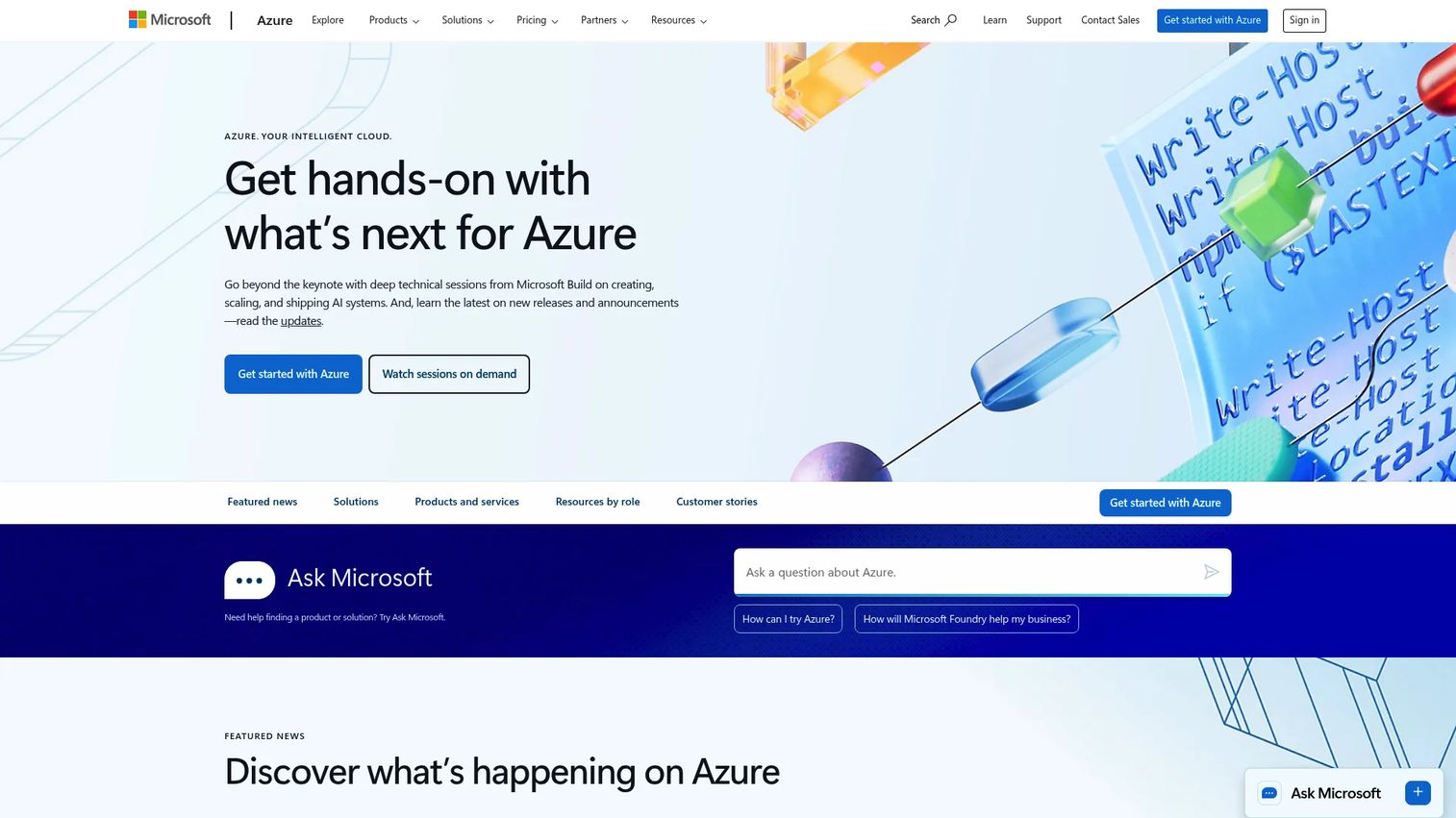
Microsoft Azure is Microsoft's cloud platform for building, deploying, and managing applications and infrastructure, and its edge services extend that reach out to distributed sites. The two concrete entry points are Azure IoT Edge, which runs containerized workloads and AI models on local devices, and Azure Stack Edge, a managed appliance that brings compute, storage, and hardware-accelerated inference to remote locations. For teams already standardized on Microsoft cloud, Azure keeps identity, security, and management consistent from data center to edge.
Azure fits enterprise scenarios where compliance and hybrid deployment matter as much as raw compute. Warehouses run local inventory analytics. Ships process sensor data at sea. Healthcare sites keep patient data on-site for data sovereignty. Hazardous industrial environments run rugged edge appliances where sending everything to the cloud is not practical. Edge AI is a recurring theme: running models close to cameras and machines so decisions happen locally.
Best for: Enterprises already invested in Microsoft cloud that need hybrid deployment, edge AI, and consistent governance from cloud to edge.
Key strengths
- Hybrid deployment consistency: Manage cloud and edge workloads under one control plane with shared identity and policy.
- Edge AI support: Run AI and ML inference locally through Azure IoT Edge and hardware-accelerated Stack Edge appliances.
- Enterprise compliance: Broad certifications and data residency options for regulated sectors and secure edge deployment.
Why choose Microsoft Azure: If your organization runs on Microsoft cloud, Azure removes the friction of stitching together separate edge and cloud tooling. The value is continuity, one identity model, one security posture, one management surface across every location, which matters more the more sites you operate.
Microsoft Azure pricing: Azure uses consumption-based pricing rather than a single subscription fee. A free account includes $200 in credit for up to 30 days, after which you pay only for what you use. Commitment options like reservations and savings plans reduce cost for predictable workloads. Because edge services combine software, appliances, and usage, model your specific configuration on the Azure pricing page. G2 rates Azure Cloud Services 4.3/5.
2. Scale Computing
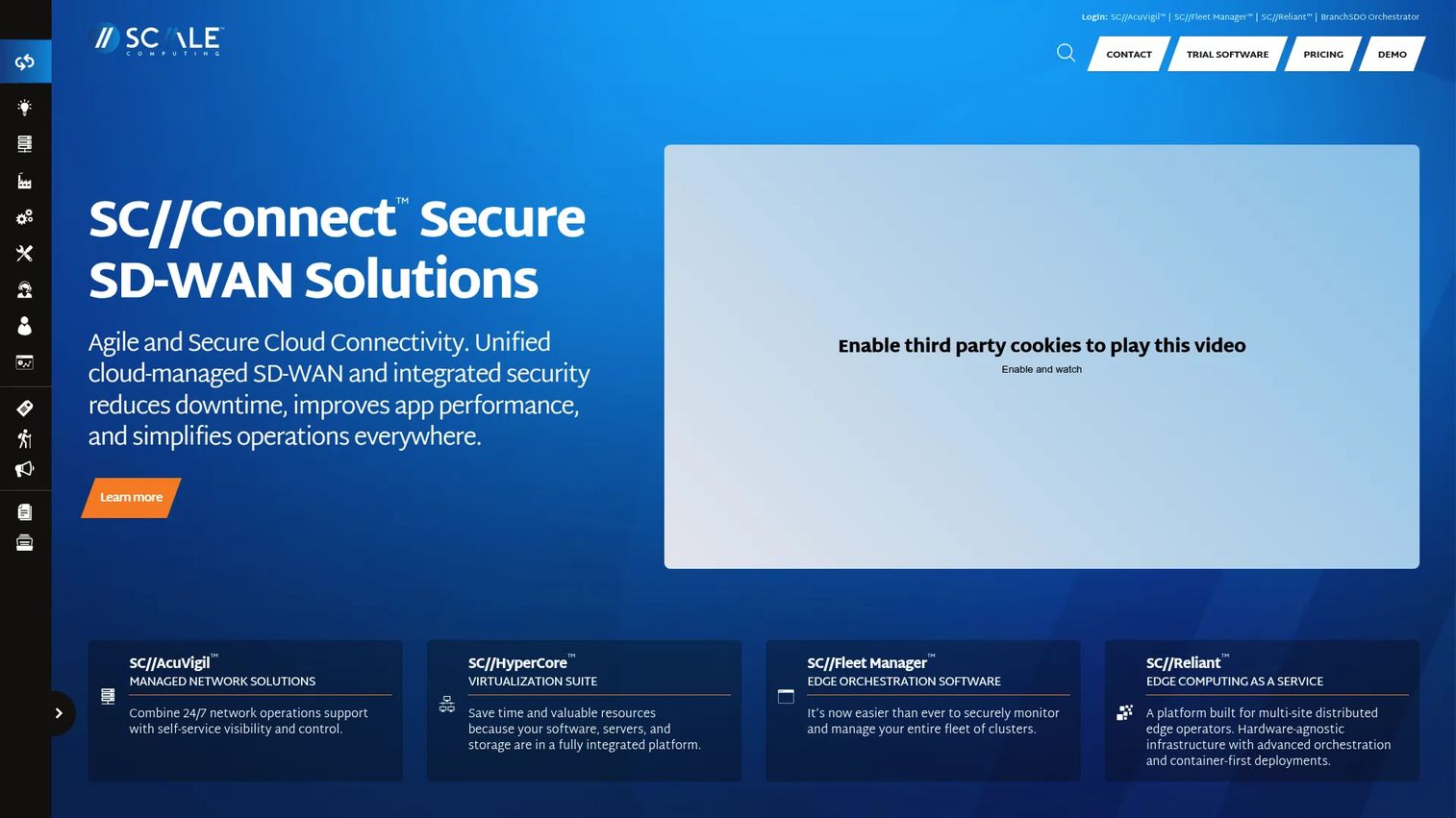
Scale Computing builds edge computing and hyperconverged infrastructure aimed squarely at distributed sites that need uptime and simplicity. The platform is modular. SC//Platform combines virtualization, servers, storage, and backup into one system for edge locations. SC//HyperCore adds high availability, resiliency, and disaster recovery. SC//Fleet Manager provides centralized management across many deployments, so a small team can run hundreds of sites from one place.
The positioning is resilience-first. Distributed operations that cannot afford on-site IT staff at every location benefit from self-healing infrastructure that detects and recovers from failures automatically. That combination, local resilience plus centralized orchestration, is why Scale Computing lands well in retail chains, distributed offices, manufacturing sites, and other environments where a failed node cannot mean a truck roll to a remote location.
Best for: Organizations running many distributed sites that need resilient local infrastructure with centralized fleet management and minimal on-site IT.
Key strengths
- Self-healing infrastructure: SC//HyperCore delivers high availability, resiliency, and disaster recovery to keep sites running.
- Centralized fleet management: SC//Fleet Manager orchestrates updates, policies, and monitoring across every deployment.
- Consolidated edge stack: SC//Platform combines virtualization, storage, and backup so each site runs on one integrated system.
Why choose Scale Computing: The pitch is operational simplicity at scale. If you are managing distributed sites where downtime is expensive and on-site expertise is thin, self-healing plus fleet management reduces the operational load of running edge infrastructure everywhere.
Scale Computing pricing: Professional Essentials is the entry point at $5,600 per year, quoted as annual contract value based on a five-year term, and includes a three-node configuration with built-in high availability, integrated storage, virtualization, and replication. There is no free tier. Pricing is documented on Scale Computing's data sheet.
3. AWS IoT Greengrass
AWS IoT Greengrass is an open-source edge runtime and cloud service for building, deploying, and managing IoT device software. It extends AWS out to the edge, letting you run local compute, messaging, machine learning inference, and containers closer to devices. For teams already building on AWS, Greengrass keeps the same tooling and services available at the edge, so a device can process data locally and still tap AWS when connectivity allows.
Greengrass performs best in IoT-heavy, AWS-centric architectures. It fits fleets of connected devices that need local processing, edge ML inference on sensor data, and remote deployment of software at scale. Where a broader infrastructure platform manages full sites, Greengrass focuses on the device and application runtime layer, which is exactly what many IoT deployments need. Note that Greengrass V1 support ended June 1, 2026, so new deployments should build on V2.
Best for: Teams building edge IoT applications on AWS that need local processing, ML inference, and fleet deployment tightly integrated with AWS services.
Key strengths
- Local resource access: Run compute and local development on devices, with access to on-device resources.
- ML inference at the edge: Deploy and run machine learning models locally, close to the data source.
- Remote fleet deployment: Push and manage device software at scale from the AWS console.
Why choose AWS IoT Greengrass: If your stack is already on AWS and your challenge is device-level compute and IoT edge processing, Greengrass is the natural fit. It brings familiar AWS services to the edge without forcing a separate operational model.
AWS IoT Greengrass pricing: AWS offers a free tier covering the first three Greengrass Core devices that connect each month, free for one year. Beyond that, pricing is $0.16 per device per month. Full details are on the AWS IoT Greengrass pricing page. G2 rates AWS Greengrass 4.1/5.
4. ZEDEDA
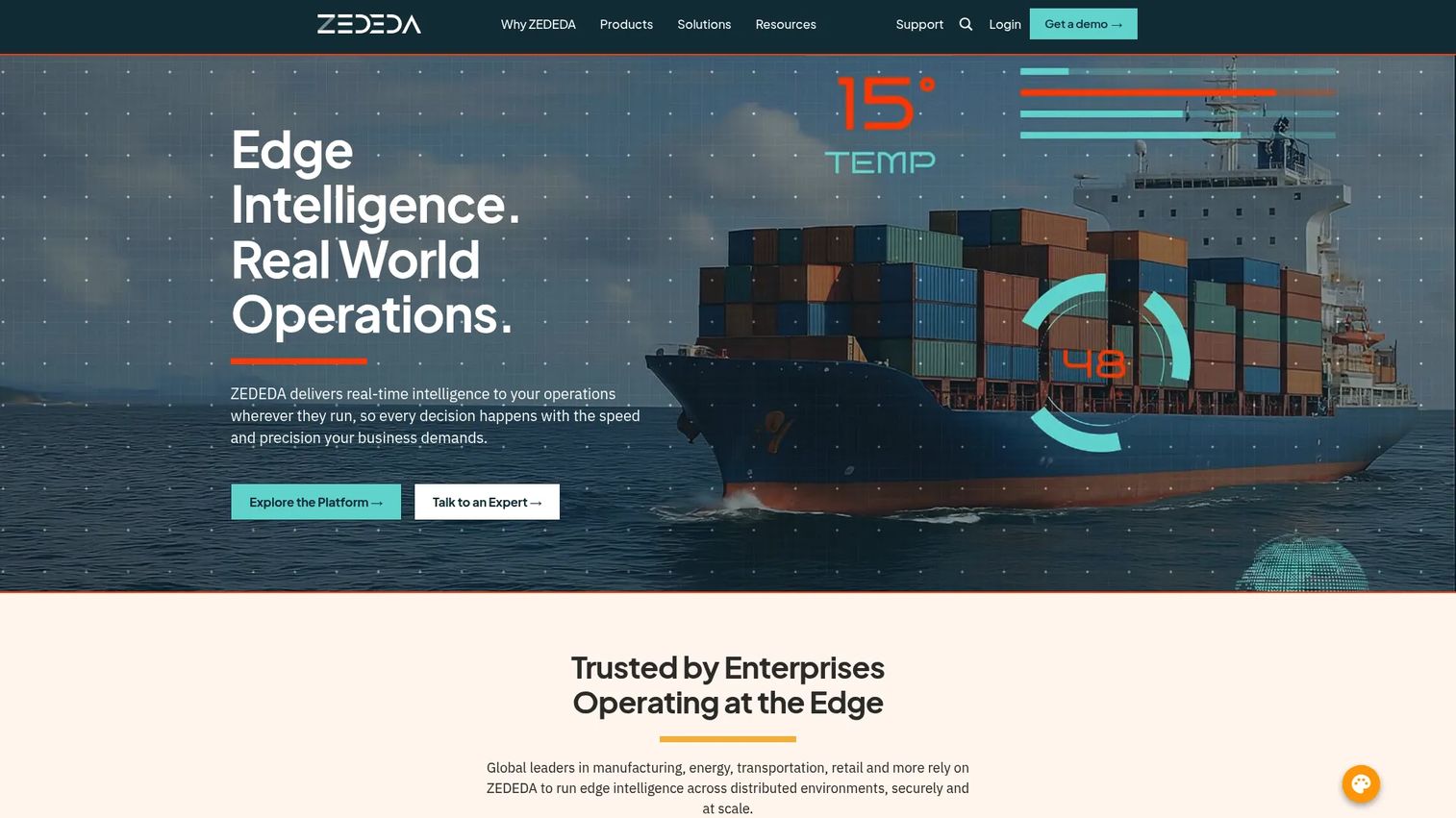
ZEDEDA is an edge intelligence and orchestration platform built to manage distributed edge workloads and devices at scale. It focuses on the operational layer that distributed operations struggle with most: provisioning, securing, and updating many nodes spread across many locations. ZEDEDA supports zero-touch provisioning, so devices come online without manual configuration on-site, and it orchestrates containers, Kubernetes, and virtual machines from a central control plane.
Where ZEDEDA earns attention is operational control across large fleets. Zero Trust security architecture protects distributed nodes, remote monitoring and updates keep them current, and app lifecycle management handles deployment across sites. For buyers who need to run many edge nodes and want strong governance without sending an engineer to every location, ZEDEDA is built for that reality. It is hardware-agnostic, which keeps procurement flexible.
Best for: Enterprises that need secure, centralized orchestration of many distributed edge nodes and workloads across sites and hardware types.
Key strengths
- Zero-touch provisioning: Bring new edge devices online without manual on-site configuration.
- Zero Trust security: A security architecture designed for distributed nodes outside the traditional perimeter.
- Workload orchestration: Manage containers, Kubernetes, and VMs across the fleet from one console.
Why choose ZEDEDA: ZEDEDA is for teams whose main problem is edge device management at scale. If you are running hundreds or thousands of nodes and need centralized orchestration with strong security, its operational focus is the differentiator.
ZEDEDA pricing: ZEDEDA does not publish pricing figures on its site; the platform is quote-based, and the vendor directs prospects to request a demo for a tailored quote. G2 rates ZEDEDA 4.6/5.
5. Dell NativeEdge
Dell NativeEdge is Dell's edge operations software platform for deploying, orchestrating, and managing distributed infrastructure and applications. It centralizes lifecycle management across edge sites and distributed data centers, so infrastructure teams can deploy and run workloads without treating each location as a separate build. Zero-touch deployment gets sites online quickly, and zero-trust security protects them once they are.
NativeEdge is the natural fit for infrastructure teams already aligned with Dell hardware and enterprise IT standards. The practical scenarios are familiar: branch offices, retail locations, healthcare environments, and industrial sites that need consistent deployment and management across many nodes. Because it supports both edge and distributed data center workloads, it suits organizations extending existing Dell infrastructure out to the edge rather than adopting a separate platform.
Best for: Enterprises managing virtualized workloads and applications across edge sites and distributed data centers, especially Dell-standard shops.
Key strengths
- Centralized lifecycle management: Deploy, orchestrate, and manage workloads across all edge sites from one platform.
- Zero-touch deployment: Bring distributed sites online without manual configuration at each location.
- Zero-trust security: Built-in security posture for distributed edge and data center workloads.
Why choose Dell NativeEdge: If your infrastructure is already Dell-centric and your enterprise IT standards favor a single vendor for hardware and edge operations, NativeEdge keeps procurement, support, and management aligned. That coherence shortens rollout and simplifies governance across sites.
Dell NativeEdge pricing: Dell does not publish public pricing for NativeEdge on its product page. Pricing is arranged through Dell sales based on scale and configuration, so factor a vendor conversation into your evaluation timeline.
6. Litmus
Litmus is an industrial data platform that connects, structures, governs, and manages edge data across plants and factory floors. It is built for OT-heavy environments where the challenge is not just compute but making sense of data from a sprawl of machines, sensors, and controllers. Litmus Edge handles device connectivity and local data processing, while Litmus Edge Manager provides centralized management across many edge instances.
Litmus fits manufacturing, utilities, and plant-floor operations where teams need to operationalize data from hundreds of edge devices. Its strength is the industrial data foundation: connectivity to diverse OT protocols, DataOps to structure and normalize that data, governance, and AI workflows that run analytics close to the source. For teams trying to turn raw machine data into usable signal at the edge, that end-to-end data path is the differentiator.
Best for: Manufacturers and industrial operators that need to connect, structure, and analyze data from many OT devices at the edge.
Key strengths
- Industrial data foundation: Connect and normalize data from diverse OT devices and protocols for AI at the edge.
- Litmus Edge and Edge Manager: Local processing on-site plus centralized management across many edge instances.
- DataOps and governance: Structure, govern, and route edge data through repeatable workflows.
Why choose Litmus: If your environment is plant-floor and OT-heavy, Litmus solves the connectivity and data-structuring problem that generic infrastructure platforms leave to you. It is purpose-built for industrial operations that want analytics and AI running on edge data.
Litmus pricing: Litmus offers Foundation, Growth, and Scale subscription tiers, plus a 15-day free trial of Litmus Edge. Public numeric pricing is not listed on its primary pages, and some product pages require login, so request a quote for figures specific to your deployment. G2 rates Litmus 4.6/5.
7. HPE Edgeline
HPE Edgeline is HPE's edge server portfolio for rugged, modular compute deployments close to where data is generated. The focus is infrastructure built for harsh conditions: rugged edge compute systems, modular chassis and blade-based configurations, and remote management with chassis health monitoring. For industrial, telecom, and remote-edge deployments, Edgeline brings enterprise-grade compute to environments that would break standard data center gear.
Edgeline is the natural fit where the physical environment is the constraint. Manufacturing floors, telecom sites, energy operations, and remote locations need hardware that tolerates temperature, vibration, and dust while still supporting real compute and remote management. HPE-standard environments benefit most, since Edgeline slots into existing HPE management and support relationships. This is edge infrastructure software paired with hardware engineered for the field.
Best for: Industrial, telecom, and remote-edge deployments that need rugged, on-premises compute in demanding physical environments.
Key strengths
- Rugged edge compute: Systems engineered to run in harsh, non-data-center conditions.
- Modular configurations: Chassis and blade-based options that scale to the deployment.
- Remote management: Chassis health monitoring and remote management for distant sites.
Why choose HPE Edgeline: When the deciding factor is the physical environment, not just the software, Edgeline is built for it. For HPE-aligned enterprises running compute in rugged remote sites, it keeps hardware, management, and support under one vendor.
HPE Edgeline pricing: HPE does not publish a public starting price for the Edgeline family. The HPE Store uses quote-based purchasing, so pricing is configured with HPE sales based on your hardware and deployment. Build a vendor quote into your procurement timeline.
Considerations
Deployment model
Verify whether the platform is software-only, software plus hardware, or a managed service. This shapes procurement and implementation timelines. A hardware-agnostic orchestration layer rolls out differently than an appliance-based system or a vendor stack tied to specific servers. Match the model to how fast you need sites live and how much infrastructure you already own.
Management at scale
Check whether the platform supports centralized policy, coordinated updates, monitoring, and fleet visibility. Distributed operations live or die on this. Managing five sites by hand is fine; managing five hundred is not. Ask how the platform handles a phased rollout, a bad update, and a node that goes dark, because those are the moments that expose whether fleet management is real or marketing.
Security and compliance
Look for segmentation, access control, data sovereignty, and auditability. Edge nodes sit outside the traditional perimeter, so Zero Trust and on-site data handling matter for regulated sectors. Presales teams should expect a security review, so confirm certifications, encryption, and data residency early rather than at the end of the deal cycle.
Offline resilience
Clarify exactly what happens when connectivity drops. Does the site keep operating on local logic? How does it reconcile when the link returns? Local autonomy and clean recovery behavior are often the whole reason for adopting edge, so make them a hands-on test, not a checkbox.
Integration fit
Evaluate how the platform integrates with your cloud, IoT, infrastructure, and observability stack. Existing stack constraints usually decide the shortlist faster than features do. A platform that aligns with your cloud provider, your hardware vendor, or your container ecosystem removes friction that a standalone tool cannot.
Conclusion
The right edge computing software depends less on a feature checklist and more on your environment. If your organization runs on Microsoft cloud, Azure gives you hybrid deployment and edge AI under one governance model. If you need resilient distributed sites with minimal on-site IT, Scale Computing leads on self-healing and fleet management. AWS IoT Greengrass fits AWS-native IoT deployments, while ZEDEDA excels at orchestrating large, hardware-agnostic edge fleets.
For industrial and OT-heavy operations, Litmus solves the data connectivity and structuring problem that generic platforms leave open. HPE Edgeline is built for rugged physical environments, and Dell NativeEdge and Red Hat Edge are the strongest picks when you are already standardized on those ecosystems.
Your next step: shortlist the two or three platforms that align with your existing stack and deployment reality, then run a real technical validation, not a slide review, against your latency, resilience, security, and fleet-management requirements. The platform that proves itself under your actual site conditions is the one to buy.
FAQs
Edge computing software is infrastructure software that processes data locally, at or near where it is created, instead of sending everything to a centralized cloud. It reduces latency, cuts bandwidth use, and keeps distributed sites like factories, stores, and clinics running during connectivity gaps. Most deployments pair it with the cloud for heavier analytics and storage.
The edge vs cloud computing difference is about location. Cloud computing centralizes compute and storage in large data centers, while edge computing distributes processing out to where data is generated. Edge handles low-latency and offline work; the cloud handles heavy analytics, long-term storage, and global coordination. Most stacks use both in a hybrid edge cloud computing model rather than choosing one.
Strong fits include manufacturing (real-time production monitoring), retail (point-of-sale and in-store analytics), healthcare (on-site patient data processing for data sovereignty), utilities (grid and equipment monitoring), agriculture (remote sensor processing), and transportation (fleet and vehicle telemetry). The common thread is low latency, offline resilience, or keeping data local for compliance.
Focus on orchestration and fleet management at scale, security and compliance controls, offline resilience behavior, deployment model (software-only versus software plus hardware), and integration depth with your existing cloud, IoT, and infrastructure stack. Run a hands-on validation against your real site conditions rather than relying on a datasheet, since edge behavior under poor connectivity is hard to judge on paper.
They rely on centralized fleet management: templated deployments, zero-touch provisioning, coordinated updates, and monitoring across every node from one console. Presales and technical evaluators should ask about operations early, how a bad update is rolled back, how a dark node is recovered, and how policies propagate, because those workflows determine whether a fleet of hundreds is manageable by a small team.
No. Some platforms, like orchestration-focused tools, are hardware-agnostic and run across mixed device fleets, which keeps procurement flexible. Others align tightly with a vendor's own infrastructure, which simplifies support and management for that vendor's shops but ties rollout to specific hardware. That distinction affects both rollout speed and procurement, so confirm it early.
Edge vs fog computing is an architectural distinction. Edge computing runs directly on or beside the devices generating data. Fog computing sits in an intermediate layer, often a local gateway or micro data center, that aggregates and processes data from many nearby edge nodes before sending results upstream. In practice, fog is a tier within a broader distributed edge computing architecture rather than a competing approach.