Your portfolio data lives in six places. Custodian statements in one system, private equity capital calls in a spreadsheet, real estate values in a partner's email, and a client asking for a consolidated view by Friday. Someone on your team spends two days a quarter stitching it together by hand. Then a number changes and you do it again.
That is the friction wealth management software exists to remove. And the market knows it: the global wealth management software market was valued at USD 12.5 billion in 2024 and is projected to reach USD 25.4 billion by 2033 at an 8.2% CAGR, according to Exactitude Consultancy (2024). Cloud-based platforms already captured 62.32% of market share in 2025 per Mordor Intelligence (2026). Money is moving toward systems that consolidate, not spreadsheets that fragment.
Choosing a wealth management platform is less about feature checklists and more about three things: how deep the reporting goes, how well it handles alternatives and illiquid assets, and whether the pricing model punishes you for growing. Family offices, RIAs, and institutional teams all evaluate wealth management software providers against those same axes, even when their portfolios look nothing alike.
If you run operations at a growing firm, the evaluation pattern here will feel familiar. You want fewer manual steps, cleaner visibility, and a wealth management solution that scales without becoming a person-dependent process. The same instinct that makes you consolidate your GTM stack applies to reporting infrastructure. If you also manage internal software rollouts, our roundups on digital adoption platforms and customer data platform tools cover the same "reduce manual work, improve signal" logic from a SaaS angle.
What's inside
This guide covers seven wealth management software platforms built for firms and teams that need serious reporting, data aggregation, a polished client experience, and workflow efficiency. It leans toward family-office and reporting-heavy use cases, because that is where the hardest evaluation decisions live.
We ranked and selected based on four criteria that map to how buyers actually shortlist:
- Reporting depth: how flexible and consolidated the output is
- Custodian connectivity and data aggregation: how much manual entry the platform removes
- Alternatives support: how well it handles private markets and illiquid assets
- Security and pricing model: access controls, and whether pricing is fixed or scales with assets
The list includes advisor-facing planning tools and family-office-heavy platforms, so you can pattern-match to your own situation.
TL;DR
- Best overall for wealth owners and family offices: Masttro, for total-wealth visibility and non-AUM pricing
- Best for scale and reporting flexibility: Addepar, for unified data across complex portfolios
- Best for planning-first advisors: eMoney Advisor, for goals-based and cash-flow planning
- Best for digital family offices: Altoo, for complexity-based pricing and multi-entity oversight
- Best for reporting and dashboard clarity: Landytech, for consolidated analytics and custodial feeds
- Best for alternatives operations: Canoe, for automated alts document and data capture
- Best broader advisor platform: SS&C Black Diamond, for portfolio accounting and client servicing
What is wealth management software?
Wealth management software is a platform that centralizes portfolio data, reporting, planning, and client communication for advisors, family offices, RIAs, and institutions managing complex financial holdings. It replaces fragmented spreadsheets and disconnected custodian statements with a single system of record.
A modern digital wealth management platform typically includes these capabilities:
- Portfolio reporting: consolidated performance, allocation, and exposure across every account and asset class
- Data aggregation and custodian feeds: automated ingestion from banks, custodians, and open-banking connections so numbers stay current without manual entry
- AI-assisted workflows: automated data extraction, anomaly detection, and drafting to cut repetitive back-office work
- Client experience tools: a secure client portal, mobile access, and branded reporting
- Security and compliance: role-based access controls, audit trails, encryption, and document storage
- Alternatives support: capture and reporting for private equity, hedge funds, real estate, and other illiquid holdings
The distinction that matters most in 2026: human-advisory platforms still accounted for 59% of the market in 2025 per Global Market Insights (2025), but hybrid and cloud-native tools are growing fastest. Investment management software that used to serve only large institutions now scales down to boutique offices, which is why the shortlist below spans both. If your firm also evaluates governance-heavy systems, the same buying discipline shows up in categories like contract lifecycle management software and audit management software.
When to use wealth management software
Not every firm needs a new platform. These are the situations where the switch pays for itself quickly.
Centralize reporting across accounts and custodians
When a client asks for a consolidated view and your team pulls from four systems to build it, you have a data problem, not a talent problem. A wealth management reporting software layer that aggregates every custodian feed into one source of truth turns a two-day exercise into a scheduled report. This is the single most common trigger for buying.
Reduce manual work in portfolio and client reporting
If someone rekeys performance numbers into a deck every quarter, that time compounds. Automated reporting cuts the manual steps and removes transcription errors that erode client trust. The goal is fewer hands touching the data before it reaches the client.
Improve visibility into alternatives and illiquid assets
Private equity, real estate, and hedge fund positions are where reporting breaks. Statements arrive as PDFs, valuations lag, and capital calls hide in inboxes. Platforms with strong alternatives reporting capture that data automatically and fold it into the total picture.
Offer clients a more polished digital experience
When your client portal looks dated next to a competitor's, it shows up in retention conversations. A modern portal with mobile access and clean reporting signals operational maturity and reduces the "where do we stand?" emails.
Comparison table
Here is a side-by-side view of all seven platforms. Pricing and ratings should be verified before you commit, since vendor terms change and several publish figures only on request.
| # | Product | Intent | Key use case | Pricing | G2 rating |
|---|---|---|---|---|---|
| 1 | Masttro | Family office | Total-wealth visibility and reporting | Custom (non-AUM) | 5.0/5 |
| 2 | Addepar | Scale and reporting | Unified data for complex portfolios | Custom | 4.1/5 |
| 3 | eMoney Advisor | Advisor planning | Goals-based and cash-flow planning | Custom (Plus, Pro, Premier, Enterprise) | 4.7/5 |
| 4 | Altoo | Digital family office | Consolidated bankable and non-bankable assets | From CHF 15,000/yr | Not listed |
| 5 | Landytech | Reporting and analytics | Multi-asset consolidated reporting | Custom (14-day trial) | 4.5/5 |
| 6 | Canoe | Alternatives operations | Alts document and data automation | Custom | 5.0/5 |
| 7 | SS&C Black Diamond | Advisor platform | Portfolio accounting and client experience | Custom | 4.0/5 |
The table surfaces the quick distinctions: Masttro and Altoo lead on family-office focus, eMoney on planning depth, Addepar and Landytech on reporting flexibility, and Canoe on alternatives operations.
1. Masttro
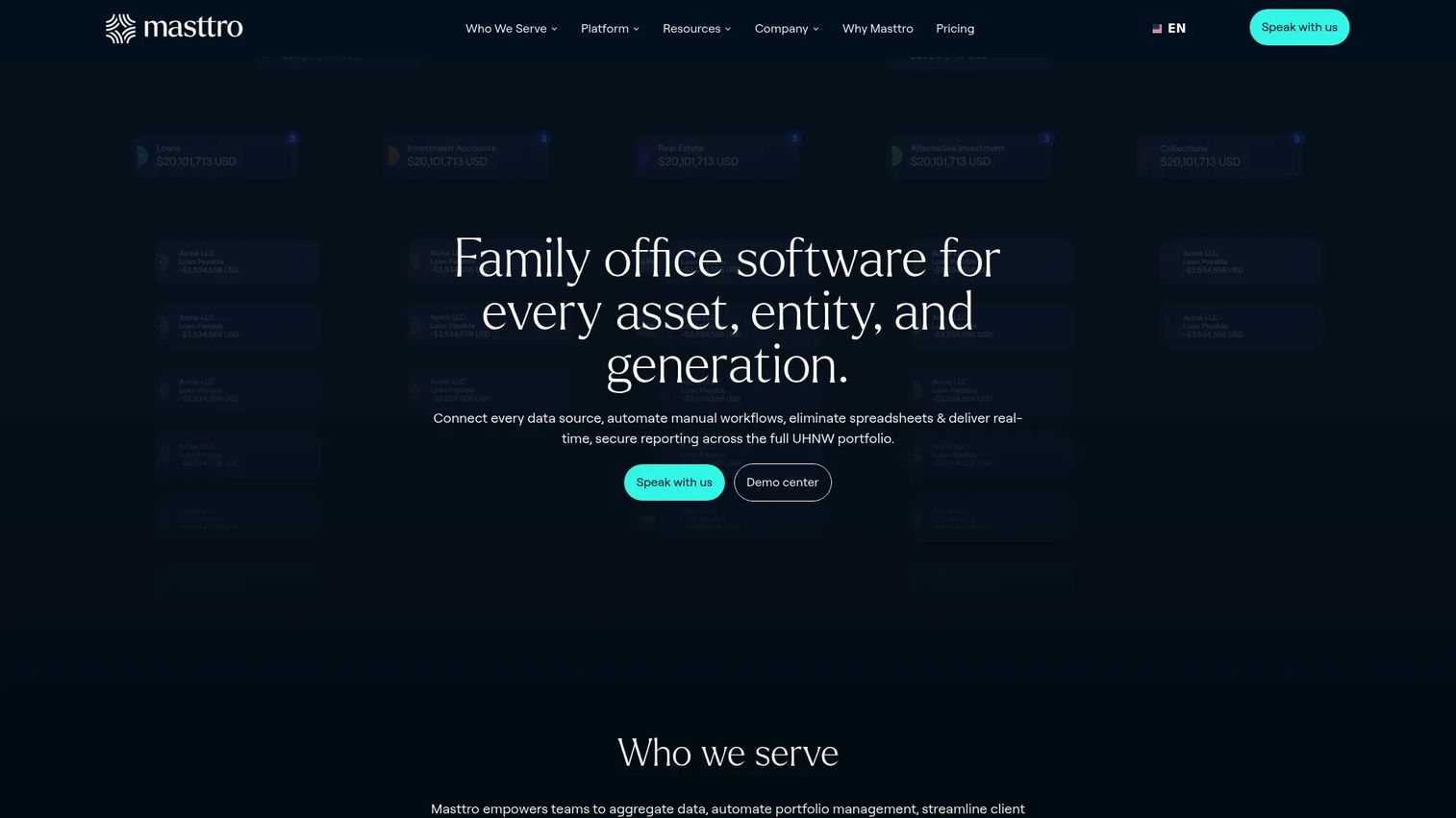
Masttro is a wealth technology platform built for family offices and wealth owners who need to centralize data, reporting, and portfolio oversight in one place. It treats total wealth as the unit of measure, aggregating bankable assets alongside private holdings, real estate, art, and other passion assets. For single- and multi-family offices, that total-wealth lens is the core reason to look here first.
Best for: Single- and multi-family offices needing a secure total-wealth platform.
Key strengths
- Data aggregation across asset classes: pulls liquid and illiquid holdings into one consolidated picture
- Secure reporting and document storage: branded reporting with a vault for sensitive documents
- Mobile app and global wealth map: portfolio oversight and geographic wealth visualization on any device
Why choose Masttro: The differentiator is the pricing model. Masttro prices on complexity and an annual license rather than a percentage of assets under management, so growing the portfolio does not automatically grow the bill. For family offices managing global, multi-currency, multi-entity wealth, that structure aligns cost with usage instead of penalizing scale. The secure client portal and total-wealth view make it a strong fit for wealth owners who want one screen for everything.
Masttro pricing: Masttro does not publish numeric pricing. The pricing page directs prospects to a conversation for personalized pricing and a demo, and the model is built around a non-AUM annual license rather than asset-based fees. G2 shows a 5.0/5 rating, though from a small number of reviews.
2. Addepar
Addepar is a global data and AI platform for investment professionals and wealth management firms handling complex portfolios. It is best known as a portfolio reporting solution that unifies fragmented data into a single foundation, then layers reporting, billing, and alternatives management on top. RIAs, advisory teams, and family offices choose it when portfolio complexity outgrows simpler tools.
Best for: Wealth management, advisory, and family office teams handling complex portfolios.
Key strengths
- Portfolio and data unification: one data foundation across accounts, custodians, and asset types
- AI-driven insights and workflows: workflow intelligence that surfaces signal and reduces manual steps
- Reporting, billing, and alternatives management: flexible reporting output plus operational tooling
Why choose Addepar: Reporting flexibility and scale are the draw. Addepar is engineered for firms whose data aggregation and reporting needs would break a lighter platform, and its client portal extends that polish to the end client. If your evaluation centers on operational efficiency at scale and the ability to slice reporting any way a client asks, Addepar belongs on the shortlist as a serious wealth management platform for larger books.
Addepar pricing: Addepar does not list public pricing on its website. The site routes prospects to a contact or demo flow, and terms are quoted based on assets, complexity, and modules. Addepar holds a 4.1/5 rating on G2.
3. eMoney Advisor

eMoney Advisor is a financial planning platform for advisors and firms, combining goals-based and cash-flow planning with a client portal, account aggregation, and collaboration tools. Where the other platforms lead with reporting, eMoney leads with planning, which makes it the natural pick for advisory firms whose value proposition is the plan itself. It is widely used financial advisor software across the RIA and independent-advisor market.
Best for: Financial advisors and firms needing a comprehensive planning and client-engagement platform.
Key strengths
- Goals-based and cash-flow planning: model scenarios and retirement paths in depth
- Client portal and premium client experience: a branded portal that keeps clients engaged between reviews
- Market-leading account aggregation: broad connectivity that keeps the plan grounded in real balances
Why choose eMoney Advisor: Planning-focused firms and RIAs evaluate eMoney when the client relationship revolves around advice, not just performance reporting. The scenario planning and interactive client portal support the kind of collaborative planning sessions that drive retention. It fits best in advisory workflows where the plan is the product and reporting is supporting evidence rather than the headline.
eMoney Advisor pricing: eMoney offers four public tiers, Plus, Pro, Premier, and Enterprise, though numeric pricing is not published on the product pages. The site directs prospects to request a demo. It carries a 4.7/5 rating on G2, among the strongest in this list.
4. Altoo
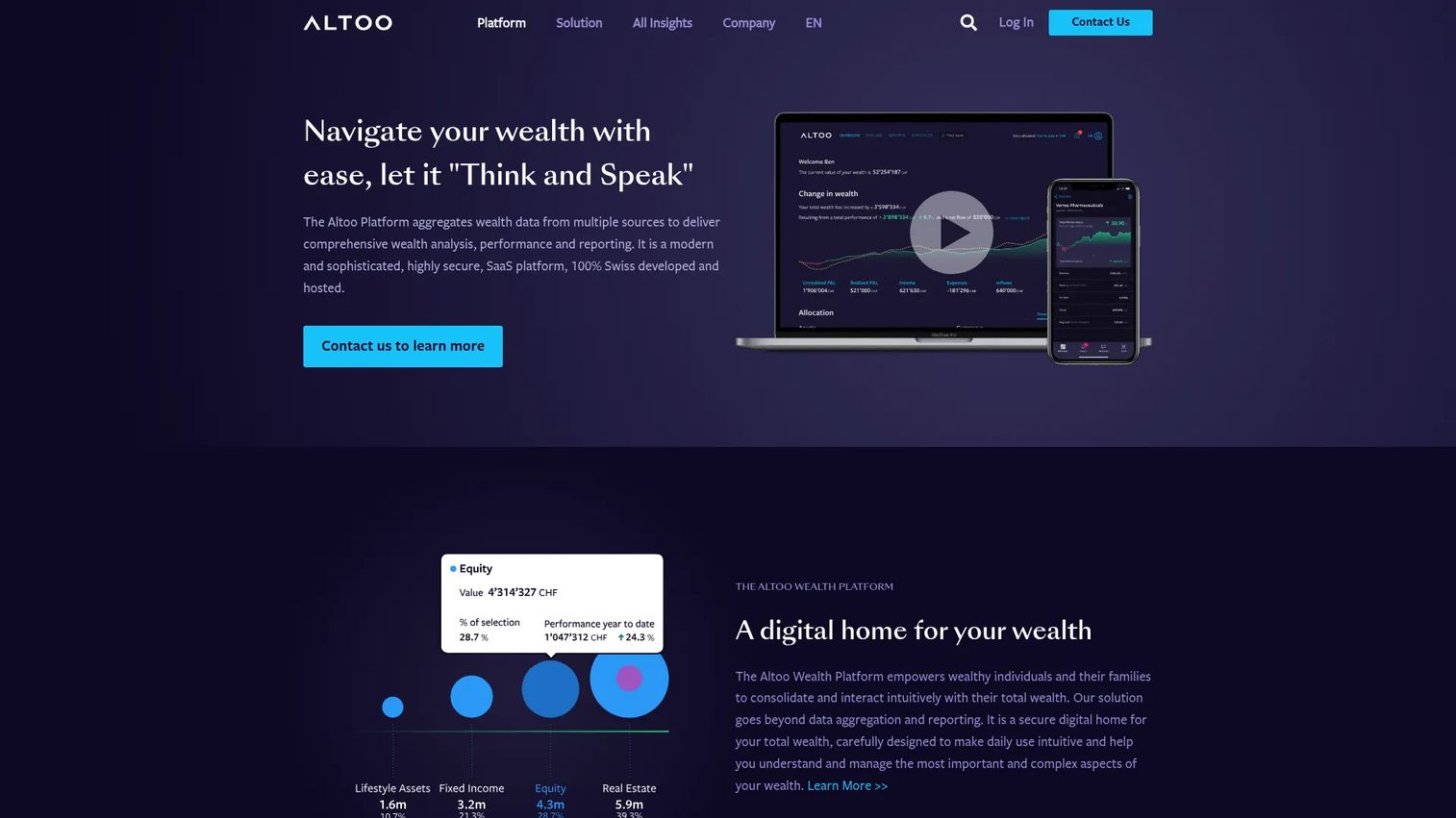
Altoo is Swiss wealth management software for consolidating and analyzing bankable and non-bankable assets, positioned as a digital family office for private wealth owners. Its pitch is clarity and simplicity: one secure interface that consolidates complex holdings without overwhelming the user. For international and private-wealth households, the Swiss data-privacy posture is a meaningful draw.
Best for: Family offices and wealth owners needing consolidated reporting across complex asset portfolios.
Key strengths
- Daily updates for bankable assets: automatic feeds from connected custodian banks keep balances current
- Full asset coverage: supports bankable, non-bankable, liquid, and illiquid assets in one view
- Access controls and secure collaboration: multi-user permissions for families and their advisors
Why choose Altoo: The transparent, complexity-based pricing is the standout. Altoo charges an annual software license based on complexity rather than asset volume, which keeps costs predictable as a portfolio grows. Combined with strong banking connectivity and multi-entity visibility, it suits private wealth owners who want a clean client portal and alternatives reporting without institutional overhead. The global, multi-currency orientation fits cross-border families well.
Altoo pricing: Altoo publishes a clear starting point. The annual software license, including all modules, is CHF 15,000, excluding banking connections, with pricing based on complexity rather than assets under management. There is no free tier.
5. Landytech
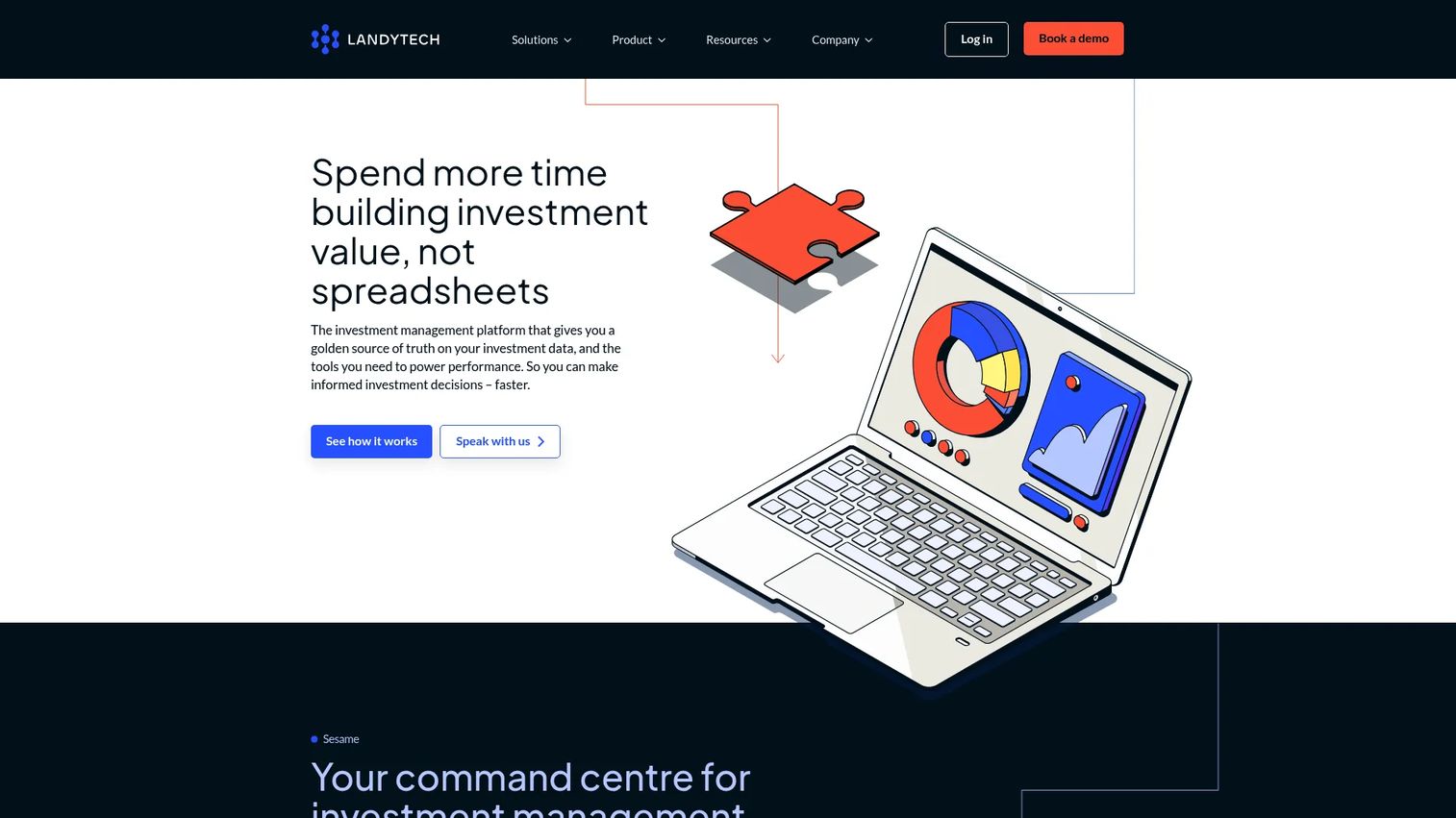
Landytech is an investment management software platform built around Sesame One, its product for multi-asset portfolio data aggregation, analytics, reporting, and workflow automation. It delivers institutional-grade reporting power that is right-sized for family offices, trust companies, private banks, and asset managers who do not want to run an enterprise implementation to get consolidated reporting.
Best for: Family offices, trust companies, private banks, and asset managers needing centralized investment reporting and analytics.
Key strengths
- Seamless data aggregation: custodian and open-banking feeds pulled into one consolidated dataset
- Deep portfolio analytics: performance, risk, exposure, liquidity, and forecasting dashboards
- Automated branded reporting: scheduled, white-labeled reports that go out without manual assembly
Why choose Landytech: Reporting speed and dashboard clarity are the reasons to evaluate Landytech. The performance, risk, and liquidity views give smaller offices the analytical depth usually reserved for large institutions, and the AI assistant helps surface answers faster. For teams whose primary pain is consolidated reporting and alternatives visibility, Sesame One is a focused, well-scoped wealth management solution.
Landytech pricing: Landytech does not publish list pricing, and frames it in enterprise terms. Sesame One Professional includes a 14-day free trial, which is rare in this category, so you can validate the reporting output before committing. It holds a 4.5/5 rating on G2.
6. Canoe
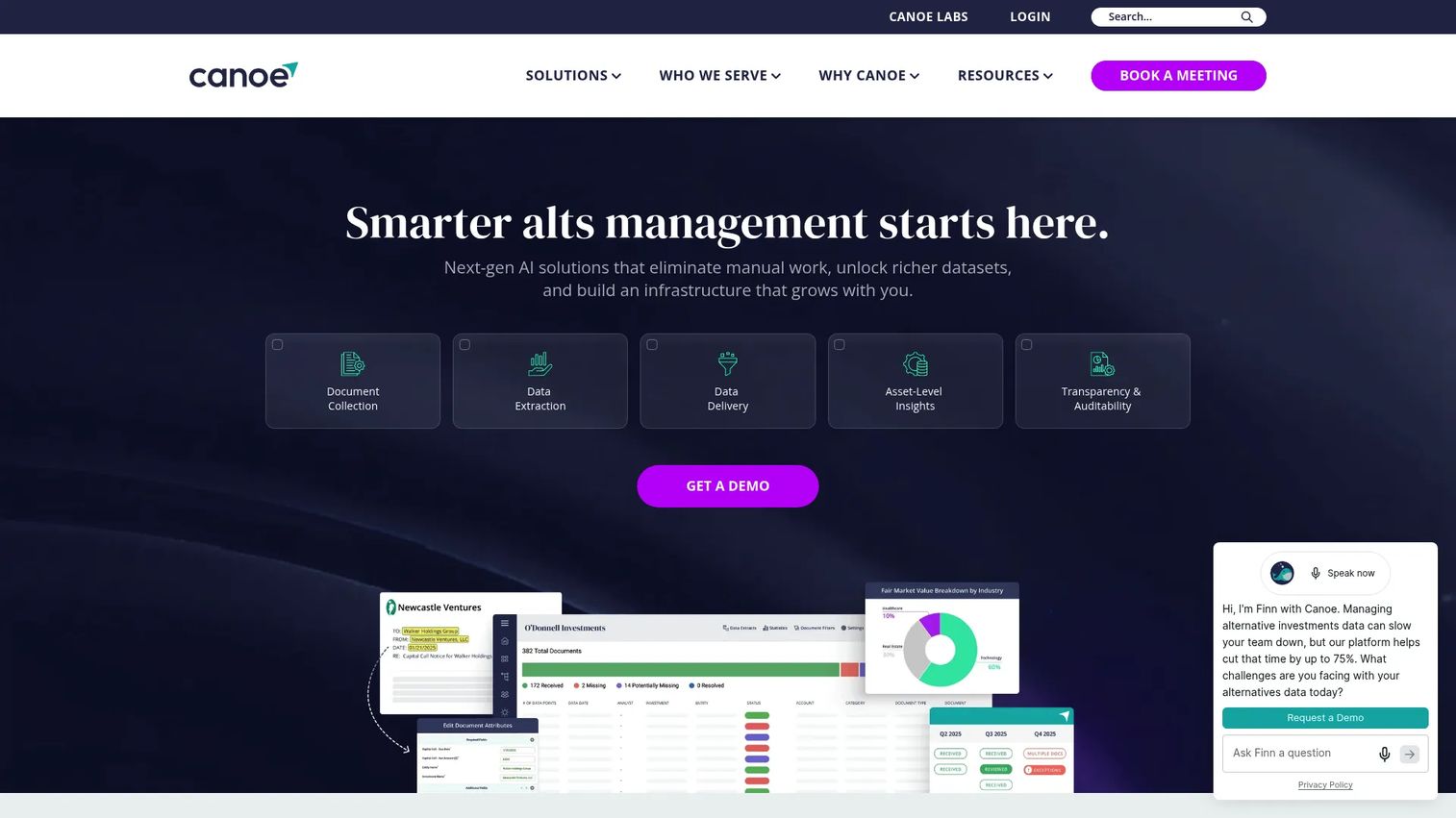
Canoe is an alternative investment data automation platform focused on document collection, data extraction, and data delivery. Rather than trying to be an all-in-one platform, Canoe specializes in the hardest part of alternatives operations: turning the flood of GP statements, capital calls, and K-1s into structured, usable data. Institutional investors and alts operations teams use it as the layer that feeds their reporting and accounting systems.
Best for: Institutional investors and alts operations teams managing alternative investment documents and data workflows.
Key strengths
- Connects to GP portals and inboxes: automated document retrieval from the sources statements actually arrive in
- Extracts and normalizes alts data: converts unstructured PDFs into structured, consistent datasets
- Delivers data downstream: pushes clean data into accounting and reporting systems
Why choose Canoe: Canoe fits as a specialist layer, not a replacement for your reporting platform. If private markets are a growing slice of the book and the back office is drowning in alternatives paperwork, Canoe automates the document and data capture that everything else depends on. Firms managing meaningful private-market exposure pair it with a reporting platform to get clean alternatives reporting without the manual keying and data aggregation burden.
Canoe pricing: Canoe does not publish public pricing; the site prompts for a demo or brochure instead, and terms are quoted based on volume and use case. It shows a 5.0/5 rating on G2, from a small review base.
7. SS&C Black Diamond
SS&C Black Diamond is a wealth management software platform for advisors and firms to manage portfolios, reporting, and client experiences. As part of SS&C's broader financial technology suite, it is a recognizable, mainstream option in the RIA and advisor market, covering portfolio accounting through client-facing servicing in one platform.
Best for: Registered investment advisors and wealth managers needing a unified client and portfolio platform.
Key strengths
- Portfolio management and accounting: reconciliation and portfolio accounting at firm scale
- Reporting and business intelligence: consolidated reporting with analytics on top
- Client portals and secure document sharing: a branded client portal with secure collaboration
Why choose SS&C Black Diamond: Black Diamond is the broad, mainstream choice for advisor-facing firms that want portfolio accounting, reporting, and client servicing under one roof rather than assembling point tools. Its role as a widely adopted platform in the advisor market means a deep bench of integrations and a familiar workflow for RIAs. It suits firms that prioritize a proven, full-stack portfolio reporting solution over a niche specialist.
SS&C Black Diamond pricing: Black Diamond does not publish public pricing on its site, and terms are quoted based on firm size and configuration. It carries a 4.0/5 rating on G2.
What to look for before you buy
Before you shortlist, pressure-test each platform against the criteria that actually determine whether it reduces manual work or just relocates it.
Reporting model and flexibility
Ask how reporting is built and how much a non-standard client request costs you in effort. Some platforms make custom reporting a configuration; others make it a project. Test the exact report a real client asks for, not the demo template.
Custodian and data connectivity
The whole value proposition collapses if feeds are patchy. Confirm which custodians, banks, and open-banking sources connect natively, and how often data refreshes. Ask what happens when a feed breaks and who fixes it.
Alternatives and illiquid asset support
If private markets are more than a rounding error in your book, this is decisive. Evaluate how the platform captures capital calls, valuations, and statements, and whether it handles that data natively or leans on a specialist layer like Canoe.
Pricing model
The difference between a fixed annual license and AUM-based pricing compounds over years. A percentage-of-assets model means growth increases your cost with no matching increase in the work the software does. Map the model to your five-year trajectory before signing.
Security and access control
Family and multi-entity setups need granular permissions. Verify role-based access, audit trails, encryption, and where data is hosted. For cross-border households, data-residency rules can be a hard requirement, not a nice-to-have.
Conclusion
The right wealth management software is the one that removes the most manual steps and gives you the cleanest view fastest. By segment:
- Masttro for wealth-owner and family-office total-wealth visibility with non-AUM pricing
- Addepar for scale and reporting flexibility across complex portfolios
- eMoney Advisor for planning-first advisors who lead with the plan
- Altoo for digital family offices wanting transparent, complexity-based pricing
- Landytech for reporting and dashboard clarity at a right-sized footprint
- Canoe for alternatives operations and automated alts data capture
- SS&C Black Diamond for firms wanting a broad, mainstream advisor platform
Your next step is simple. Shortlist two or three based on three decisions: your reporting model, your alternatives complexity, and your pricing tolerance. Then run the same real client report through each in a trial or demo. The platform that produces it with the fewest manual touches, from the most connected data, is the one worth buying. As with any infrastructure decision in your stack, from wealth tech to event management software to loyalty management software, the winner is whichever tool earns its place by making the work disappear.
FAQs
Wealth management software is a platform that consolidates portfolio data, reporting, planning, and client communication for advisors, family offices, RIAs, and institutions. It replaces disconnected spreadsheets and custodian statements with a single system that aggregates holdings, automates reporting, and gives clients a secure portal to view where they stand.
The features that separate serious platforms are reporting flexibility, custodian and data aggregation breadth, and alternatives support. Beyond those, a strong client portal, granular security and access controls, and a pricing model that does not scale punitively with assets under management determine whether the platform helps or just adds overhead.
Masttro and Altoo are built specifically for family offices, with total-wealth aggregation, alternatives coverage, and non-AUM pricing models. Addepar and Landytech also serve family offices well, particularly those with complex portfolios that demand deep reporting and analytics. The right pick depends on whether you prioritize total-wealth visualization or reporting depth.
Canoe is the specialist for alternatives operations, automating the capture and structuring of private-market documents like capital calls and K-1s. For consolidated alternatives reporting inside a broader platform, Masttro, Addepar, Altoo, and Landytech all fold illiquid assets into the total picture. Many firms pair Canoe's data capture with a reporting platform.
Two models dominate. AUM-based pricing charges a percentage of assets under management, so cost rises as the portfolio grows. Fixed or complexity-based pricing, used by platforms like Altoo and Masttro, charges an annual license tied to usage rather than asset size. Over a multi-year horizon, the difference can be substantial, so map the model to your growth trajectory.
RIAs should weigh reporting flexibility, custodian connectivity, and client portal quality most heavily, since those drive both efficiency and retention. Investment management software like Addepar and SS&C Black Diamond suits reporting-heavy RIAs, while eMoney Advisor fits firms whose value centers on financial planning rather than performance reporting alone.
Custodian integrations are foundational. If feeds are patchy or slow, the platform's reporting is only as fresh as your last manual update, which defeats the purpose. Before committing, confirm native connectivity to your specific custodians and banks, refresh frequency, and the support process when a feed breaks.
Yes, when it targets real friction rather than serving as a marketing label. The genuinely useful applications are automated data extraction from statements, anomaly detection in portfolios, and faster answers to reporting questions. Platforms like Addepar and Landytech use AI to reduce manual back-office steps, which is where it earns its place rather than as a headline feature.