In SaaS, evaluating a product happens in a series of quick hits: a fly-by website look, a forwarded deck, a few snapped screenshots. But when your sales pitch is all over the place across those touch points, messaging starts to veer, launches become nightmarish, sales cycles drag out longer than they need to, and even your enablement teams are left in the dark wondering what to do.
That's what a product marketing manager fixes. A PMM takes the reality of your product and turns it into a reliable machine that churns out clear positioning, on-brand launches, and enablement teams that actually get what they need. A product marketing manager owns the space between what your product team builds and what your market actually hears. The role combines go-to-market strategy, positioning, sales enablement, and competitive intelligence into one cross-functional position that directly impacts revenue.
This guide covers what PMMs do day to day, how the role differs from product management, the skills and tools you need, and how to break into the field.
TL;DR
- A product marketing manager bridges product development, marketing, and sales, owning go-to-market strategy and product positioning.
- Core responsibilities include crafting messaging, launching products, enabling sales teams, and conducting competitive research.
- Strong PMMs combine analytical capabilities with storytelling ability and cross-functional communication.
What is a product marketing manager?
A product marketing manager is a role that looks after getting your product out the door to a wider audience - that is, they're the ones who make sure you position your product in the right way, bring it to market at the right time, and drive adoption in a way that actually works.
For SaaS founders, having a PMM on board (or taking on the role themselves) is basically the only way to avoid "great product, no idea how to tell its story." Its the key to keeping your messaging on track, making launches actually do-able, and getting your revenue teams to explain value in a way that actually makes sense to your buyers.
What product marketing manager typically owns
- Messaging and positioning: who your ideal customer is, what makes your product special, and why it matters now.
- Go to market and launches: how you plan for a launch, what that narrative looks like, and making sure everyone is on the same page.
- Sales and customer success enablement: briefing sales teams on what to say, how to say it, and what to expect customers to object to.
- Customer and market insight: digging into customer behaviour, losing deals, testing your messaging, and keeping an eye on the competition.
- Adoption and education: helping customers get the most out of your product by making onboarding a smooth ride and teaching them the ins and outs of it.
Why product marketing managers matter in SaaS
The thing is, SaaS products aren't usually sold in a single shot. Buyers take their time evaluating different options, won't stop talking to other people about it, and expect to understand the value of what theyre buying in no more than a heartbeat. PMMs matter in SaaS because they keep the messaging and proof consistent right the way through the evaluation and adoption journey, so the right customers are flying along, moving from interest to purchase to value in no time.
| Area | Weak product marketing | Strong product marketing |
|---|---|---|
| Positioning consistency | Inconsistent positioning across touchpoints | Clear differentiation you can defend |
| Sales cycle speed | Longer sales cycles because teams re-explain the basics | Faster evaluation because buyers self-orient and self-qualify earlier |
| Pipeline quality | Lower-quality pipeline and more stalled deals | Higher-quality pipeline because the right customers understand fit earlier |
| Launch impact | Launches that ship, but do not land with the market | Smoother launches with tighter cross-functional alignment |
| Enablement adoption | Enablement that exists but gets ignored | Enablement teams actually use in real conversations |
| Time-to-value | Slower time-to-value because expectations do not match reality | Higher adoption and retention because customers reach value faster |
In short, product marketing managers turns shipping into a repeatable go-to-market system that drives revenue and adoption**.**
Product marketing vs demand (growth) marketing
Product marketing and demand (growth) marketing are complementary and work best when they share a single positioning and proof strategy.
| Area | Product marketing | Demand (growth) marketing |
|---|---|---|
| Primary focus | Positioning, differentiation, adoption, enablement | Awareness, acquisition, pipeline creation |
| Core work | Messaging and positioning, launches, competitive differentiation (battlecards), enablement, adoption education | Campaign strategy, channel execution, conversion optimization, distribution, pipeline reporting |
| Success signals | Evaluation conversion, win rate, adoption, sales cycle impact | Pipeline volume, CAC efficiency, channel ROI, conversion rates |
| Overlap (reality check) | Influences awareness through category narrative and proof points | Shapes messaging through landing pages, ads, and testing |
Understanding what a PMM owns is one thing. Seeing how the role works day-to-day is another. Here's what PMMs actually do to execute positioning, launches, and enablement.
Product marketing manager vs product manager
This distinction trips up many people, including hiring managers. Both roles have "product" in the title, but they focus on different questions entirely.
| Aspect | Product manager (PM) | Product marketing manager (PMM) |
|---|---|---|
| Focus | Building the product | Bringing product to market |
| Key question | What do we build and how? | Who wants this and why? |
| Primary stakeholders | Engineering, design | Sales, marketing, customers |
| Success metric | Product adoption, feature usage | Revenue, market share, pipeline |
Product managers own the product roadmap and work closely with engineering to ship features. Product marketing managers own the narrative and work closely with sales to win deals. The two roles collaborate constantly, but their accountability differs. In smaller companies, one person sometimes handles both. As organizations scale, the specialization becomes necessary to do either job well.
Product marketing manager responsibilities
The PMM role breaks down into five core areas. Each requires a different skill set, and most PMMs find themselves stronger in some areas than others.
1. Product positioning and messaging
Positioning defines how you want the market to perceive your product relative to competitors. Messaging translates that positioning into the actual words used across channels. PMMs create messaging frameworks that capture the value proposition for each target audience. The work involves identifying what makes the product different, why that difference matters, and how to communicate it clearly.
2. Go-to-market strategy
GTM strategy is the plan for launching products and reaching customers. It covers launch planning, channel selection, timing, and coordinating cross-functional teams.
A strong GTM plan answers questions like: Which segments do we target first? What channels will reach them? How do we sequence announcements? What does success look like at 30, 60, and 90 days?
3. Sales enablement
Sales enablement means equipping sales teams to sell effectively. The work includes:
- Pitch decks: Presentations that walk prospects through the value story
- Battle cards: Quick-reference guides for competitive positioning and objection handling
- Demo scripts: Structured talk tracks for product walkthroughs
- Training materials: Onboarding content for new reps and ongoing education
The best enablement materials get used. PMMs who build assets that sit in a folder untouched have missed the point.
Tip: Interactive demos Interactive demos can scale sales enablement by letting prospects experience the product before a call. Tools like Guideflow help PMMs create self-serve product experiences without engineering resources.
4. Product lifecycle marketing
Lifecycle marketing covers activities from launch through maturity and eventual sunset. A new product launch emphasizes awareness and trial. A mature product focuses on retention and expansion. PMMs adapt their tactics as products move through each phase.
5. Market research and competitive analysis
PMMs gather market intelligence, track competitors, conduct customer research, and translate insights into actionable recommendations. Competitive analysis goes beyond feature comparisons. Strong PMMs understand competitor positioning, pricing strategy, and sales tactics, then turn that knowledge into battle cards that help sales win head-to-head deals.
Product marketing framework that actually works
Product marketing usually goes down two paths - either it's a structured, battle-tested process that hits the mark every time or a chaotic, ad-hoc mess that leaves everyone wondering why adoption is stalling at 12%. A good product marketing framework offers a repeatable process that stops you from winging it every launch, and takes you from first customer interview all the way to month six post-launch optimization.
1. Discovery - Getting to the heart of what really matters
Most teams blow this phase - they skip the tough conversations and instead rely on assumptions about how their target customers buy. But it's real data that matters - the kind that comes from having actual conversations with 15-20 prospects who fit your ICP (Ideal Customer Profile).
Ask them about their process, what they've tried before and what would make them switch vendors. Also dig into what customers say about your competitors - not just their marketing copy, but the real deal. This stops you from building a go to market strategy on the assumption that you know what your customers are thinking. Document the language actual buyers use when comparing alternatives. You'll avoid falling into the trap of building a strategy based on guesswork.
2. Plan - A clear direction based on customer insights
With real customer insights in hand, you can build a plan that actually resonates with your target audience. This means defining your product's unique angle based on real language customers use, not internal feature lists. Pick 2-3 marketing channels that your customers actually use and set measurable objectives like "achieve 15% trial-to-paid conversion in the first quarter" instead of some vague goal like "drive awareness".
This phase forces alignment between what customers need and what your business can actually deliver profitably. It means defining how prevent message drift by creating a single narrative that works across your website, sales conversations, product UI and campaigns.
3. Define - Your messaging should be clear and useable
Create buyer personas that are based on actual customer feedback during the discovery phase, not just some demographic guesswork. Focus on the specific problems your product solves and the language customers use to describe those problems. Your value proposition should be so clear that a customer could explain it to a colleague in 30 seconds.
This means building messaging that sales teams can actually use in real deals. If your sales team is creating their own deck because your messaging isn't working, you've failed. Test your positioning against your top two competitors and make sure you can defend your unique points in a live conversation, not just on a slide.
4. Prepare - Launch is when the rubber hits the road
Three weeks before launch is when reality sets in - sales needs collateral they can customize, customer success needs onboarding materials and support needs troubleshooting guides. This is where good preparation separates successful launches from disasters. Train your sales team on common objections and competitor positioning - not just the features of your product.
Build enablement around real deal stages: discovery questions, demo talk tracks, objection handling and competitive battlecards. Make sure everyone involved with customers is on the same page and telling the same story. If your sales team is still asking "what do I say about pricing?" two days before launch, you're running behind.
Make a map of every single customer touchpoint and make sure the narrative is consistent. Your launch landing page, sales deck, demo script, email campaign and in-product messaging should all work together to reinforce the same proof points and positioning.
5. Grow - Don't just launch and forget
Most product marketers do this - they disappear after launch and forget about their work. Don't. Track the metrics that matter like trial-to-paid conversion, feature adoption and customer retention at 90 days. Gather feedback from customers who did buy and ones who didn't - both will tell you what's working and what isn't. Pay attention to how well your teams are using the enablement materials you've given them - if they're not using the battlecards or demo scripts, find out why.
Usually it's because the content doesn't map to real objections or competitive scenarios. When messaging isn't converting or a channel underperforms, you need to adjust quickly. Document what you learn for the next product launch - what proof points worked, which competitive angles resonated and where did message drift happen? Teams that make decisions based on real data see 40-60% better results on subsequent launches.
A framework like this keeps you focused on customer reality rather than internal assumptions. It forces the hard conversations early when you still have time to change course. And it gives you the data to make smart decisions rather than just going with whoever has the loudest voice in the room.
Product marketing manager skills
The role demands both hard and soft skills. Technical capabilities get you in the door, but interpersonal skills determine long-term success.
Hard skills for product marketing managers
| Hard skill | What it involves |
|---|---|
| Market research and data analysis | Gathering and interpreting customer and competitive data to inform strategy |
| Content creation | Writing compelling copy for websites, emails, sales materials, and product documentation |
| Product knowledge | Understanding features, benefits, and technical details well enough to explain them clearly |
| Project management | Coordinating launches across multiple teams and timelines |
| Marketing automation | Working with CRM, email, and analytics platforms to execute and measure campaigns |
Soft skills for product marketing managers
| Soft skill | What it involves |
|---|---|
| Cross-functional communication | Translating between technical and business stakeholders who speak different languages |
| Strategic thinking | Connecting market insights to business outcomes and prioritizing accordingly |
| Storytelling | Crafting narratives that resonate with different audiences and stick in memory |
| Influence without authority | Getting buy-in from teams you don't directly manage through persuasion and relationship building |
Tools product marketing managers use
PMMs work across a wide range of toolsPMMs work across a wide range of tools, organized by function:
- Research and analytics: Survey tools, competitive intelligence platforms, product analytics dashboards
- Content and asset creation: Presentation software, design tools, video platforms
- Collaboration: Project management tools, communication platforms, shared documentation
- Sales enablement: Content management systems, demo automation platforms, training tools
- Marketing automation: CRM systems, email platforms, attribution tools
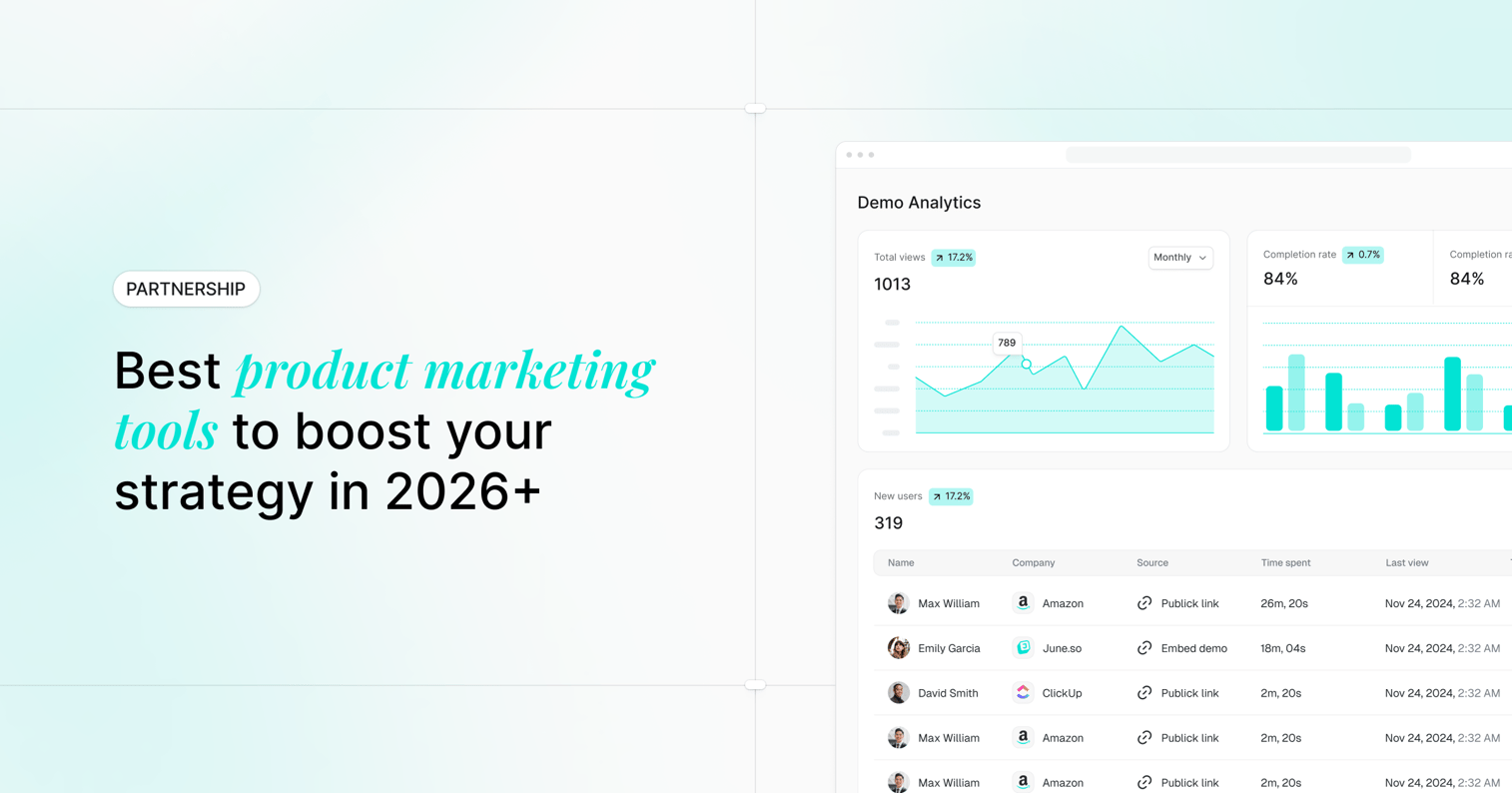
Demo automation has become increasingly important as buyers expect self-serve experiences. Platforms like Guideflow enable PMMs to build and share interactive product demos without engineering support, scaling the "show, don't tell" approach across the funnel.
Where product marketing breaks - and what to do about it
Most product marketing teams aren't brought down by a lack of content - they fall apart because the whole operation is a bit of a nightmare to run.
1. Complex products are really hard to get across
Static screenshots and a chunky PDF just don't cut it for products that involve tech or workflows.
What works
- Helping people learn about your product through interactive experiences that show them how things work - not just a list of features.
- Having a clear story that runs across your website, sales stuff and onboarding so that everything feels connected and makes sense.
2. People zone out when evaluating
If the whole evaluation process is just a passive thing - where people are left to figure it all out for themselves - they end up doing more guesswork than actual learning.
What works
- Making it interactive - giving people the chance to dive into what's really important to them.
- Giving clear next steps for people depending on where they are in the process - and what their specific problem is.
3. Sales enablement just doesn't get adopted
You can have the best content in the world, but if it's hard to find, feels outdated or just doesn't match the conversation that sales teams are having - then it's just not going to get used.
What works
- Having fewer but better assets, with a bit more control over what gets used when.
- Focusing on the things that sales teams are actually running into - like objections, competitors and the different stages of a deal.
4. You can't actually prove any impact
B2B attribution is always a bit of a mess - so it's not about getting the perfect tracking, it's about getting some decent signals to make a decision with.
What helps
- Focusing on a small number of key metrics that are actually tied to outcomes.
- Using behavioural signals - like people actually exploring your product - to figure out what's really going on.
One of the best solutions to many of these challenges is the use of interactive demos. Let’s look at what they are and how they work for product marketing.
Interactive demos in product marketing - why they matter
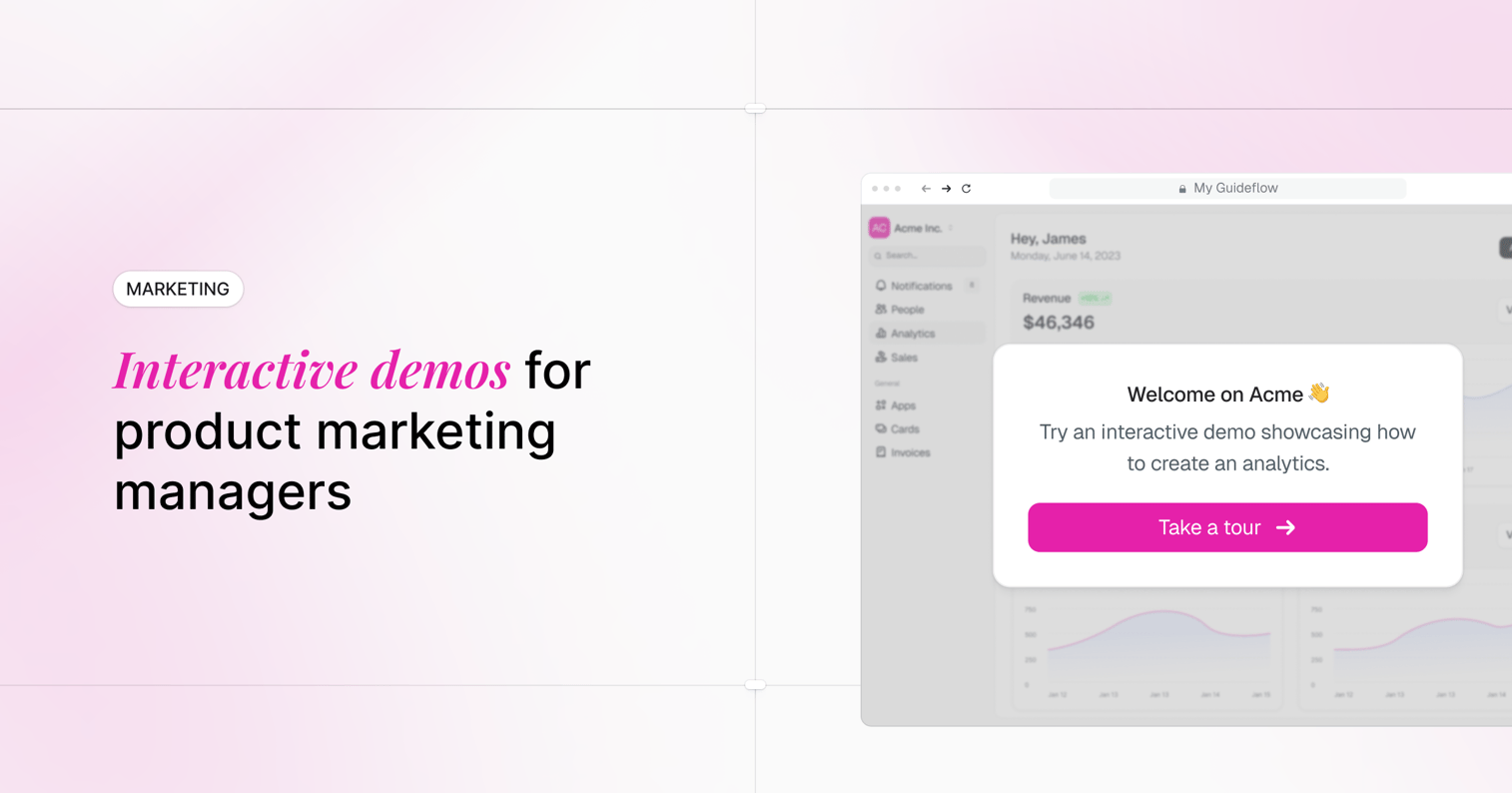
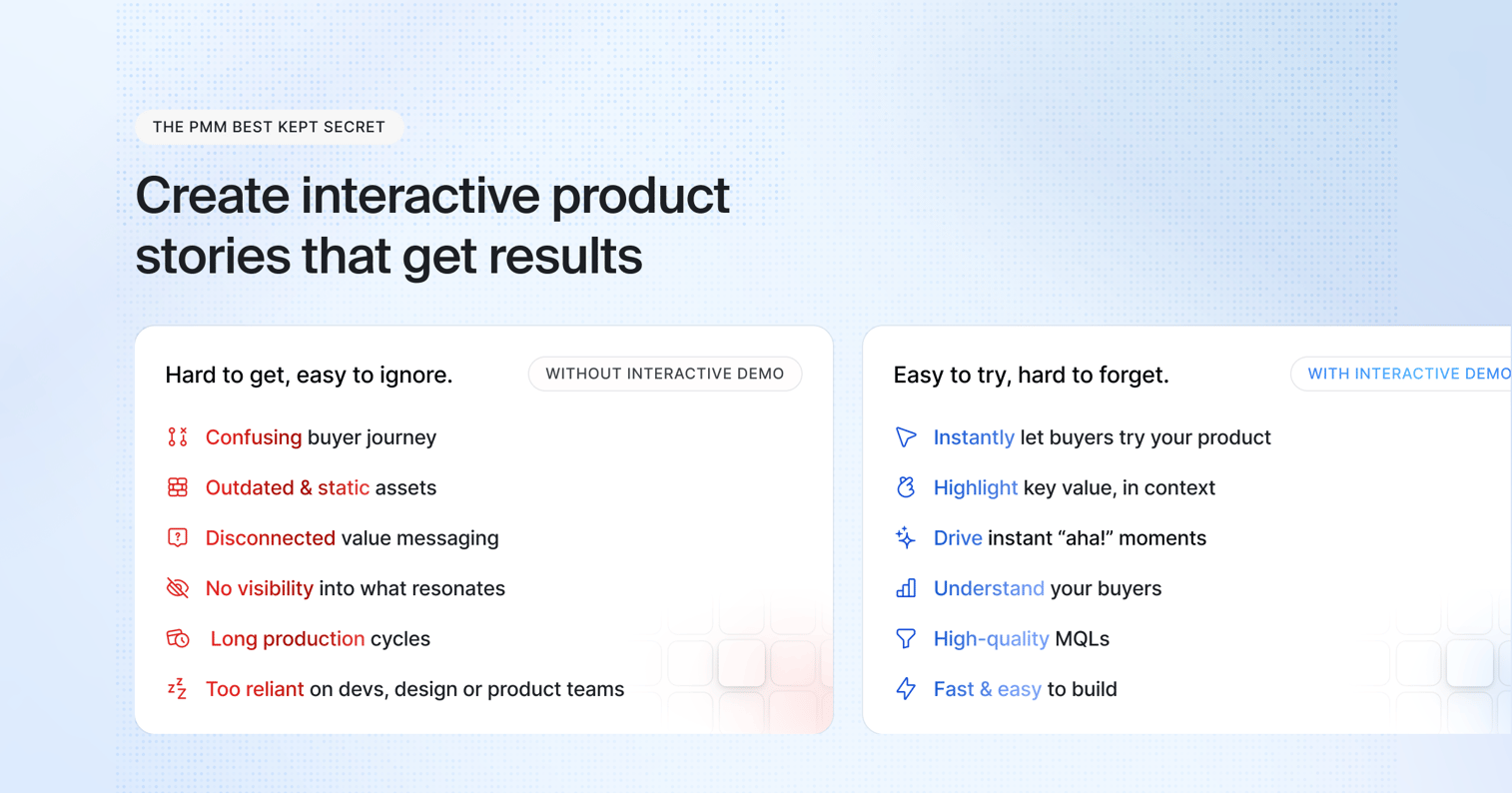
Interactive demos, will never replace the need for some good old fashioned positioning, launches and enablement - but they are an awesome way to get people educated on your product, and do it at scale so you don't have to spend all your time on one-on-one calls.
How interactive demos can help your product marketing efforts
- Quick learning for a lot of people - rather than waiting for a live call, prospects can get the lowdown on your product when it suits them.
- Prospects can prequalify themselves - they get to see if your product's a good fit for them, which can save a lot of time for everyone involved.
- Your message stays consistent - whether it's a campaign, a follow-up email or even a sales call, the same story gets told.
- You get valuable insights - you can see what people are actually interested in and where they get stuck.
When to use interactive demos
- When you've got a high-intent landing page and people are just looking to give your product a go.
- When you're sending out emails as part of a nurture sequence and want to include some evaluation-stage content.
- When you need to take out the competition - in a hurry.
- When you're launching a new product and need people to get on board fast.
Start your journey with Guideflow today
KPIs that matter to product marketers
Pick a handful of metrics that you can actually do something about. These aren't just random stats. Chief marketing officers and product marketing managers alike use these KPIs to inform strategy, gauge team performance, and fine-tune their product marketing efforts:
- Adoption metrics: think activation rates, how often features get used, how well you retain customers and get them to expand their business with you
- Pipeline impact: we're talking about the ratio of MQLs to SQLs, how many of those turn into actual sales leads, and ultimately, how much business they drive
- Sales outcomes: we care about win rates, how often you can get the competition beat out, and how long it takes to close a deal
- Launch metrics: how many people sign up for your new feature right off the bat, how often it gets used, and just how fast the adoption curve ramps up
- Enablement usage: we're looking at view rates for marketing assets, how often sales reps complete required training, and hearing back from the field is a biggie too.
Conclusion
If you are trying to explain who product marketing manager in SaaS is, the simplest definition is this: Product marketing manager turns SaaS product reality into a repeatable go-to-market system: positioning, launches, enablement, and education that drive adoption and revenue.
Interactive demos are one practical lever inside that system, especially in SaaS, because they make product education clearer, faster, and easier to scale.
FAQs
A product marketing manager is the person responsible for translating what your product does into a clear story customers understand. They own positioning, launches, enablement, and adoption - ensuring the market knows what you built and why it matters.
In SaaS, a product marketing manager makes sure prospects understand your product fast enough to convert, sales teams have what they need to close deals, and customers reach value quickly so they stick around and expand.
A product marketing manager owns:
• Messaging and positioning
• Launch strategy and execution
• Sales enablement and competitive intelligence
• Customer research and win/loss analysis
• Adoption and product education
Traditional marketing managers focus on awareness and pipeline - driving traffic and generating leads through campaigns. Product marketing managers focus on conversion and adoption - making sure prospects understand the product, sales can articulate value, and customers actually use what they bought.
Product marketing managers use interactive demos to accelerate product education during evaluation. They let prospects explore what matters to them without waiting for a call, create consistent messaging across touchpoints, and generate behavioral data that reveals what resonates and where people drop off.
Most product marketing managers use a mix of:
• Adoption metrics (activation, feature usage, retention)
• Funnel metrics (MQL-to-SQL, SQL-to-opportunity, win rate)
• Enablement usage (asset engagement, training completion)
• Evaluation signals (demo engagement, high-intent page conversion)