Your sustainability lead exports emissions data into a spreadsheet. Finance pulls a different number from a different source. By the time the board asks how you arrived at a Scope 3 figure, nobody can trace the calculation back to the raw activity data. That gap is where audit risk lives.
Emissions management software exists to close that gap. The category has moved fast: the global emission management software market was worth USD 18.83 billion in 2024 and is forecast to reach USD 78.72 billion by 2034, a 15.38% CAGR, according to Precedence Research (2024). Regulatory reporting deadlines, investor pressure, and multi-facility complexity are pulling budget toward tools that can measure, report, and defend emissions numbers.
For a founder, this is a data integrity problem before it is a sustainability problem. If your emissions reporting software cannot produce a single source of truth with a defensible audit trail, every downstream number is a liability. The right carbon emissions management software turns manual data chaos into a repeatable reporting motion that does not route through one person. This guide ranks eight tools that do exactly that, spanning air emissions, GHG, and carbon accounting workflows. If you also manage vendor and regulatory documentation, an audit management software layer often sits alongside these platforms.
What's inside
This guide is for operations, EHS, finance, and sustainability leaders (and the founders who sign off on their stack) evaluating emissions reporting software for 2026. We selected tools based on four criteria that matter most when the data has to survive scrutiny: compliance depth across air, GHG, and carbon; calculation and data integrity; workflow automation with alerts and escalation; and auditability, meaning a clear audit trail and data lineage. We excluded point solutions that only handle one narrow reporting standard without room to scale.
TL;DR
- Best for integrated air, GHG, and regulated pollutant compliance: Sphera, built for enterprises that report across multiple regulatory frameworks.
- Best for large EHS and sustainability teams: Cority, a converged platform with configurable calculations and centralized visibility.
- Best for standards-driven carbon accounting: Persefoni, strong on Scope 1, 2, and 3 with a report builder and Copilot.
- Best for broad climate workflows and easy rollout: Sweep, with audit-ready data and AI-assisted collection.
- Best for a lighter carbon accounting motion: Greenly, with dashboards, LCA, and supplier engagement.
- Best for enterprise environmental analytics: IBM Environmental Intelligence Suite. Best for audit-ready enterprise carbon reporting: Watershed. Best for governed disclosure workflows: CarbonPlus.
What is emissions management software?
Emissions management software is a system that measures, tracks, reports, and helps reduce emissions across air pollutants, greenhouse gases, and carbon, while maintaining a defensible audit trail from raw activity data to final disclosure. It replaces spreadsheets and disconnected point tools with a single source of truth that operations, finance, and sustainability teams can all work from.
The category overlaps with, but is broader than, carbon accounting software. Software solutions account for over 68% of the global emission management software market revenue as of 2023, per Market.us (2024), with manufacturing the largest end-use sector at more than 35% of the market. The adjacent carbon accounting software market is projected to grow from USD 27.51 billion in 2026 to USD 136.44 billion by 2034, according to Fortune Business Insights (2025).
Core capabilities most buyers evaluate:
- Calculation engine: configurable emission factors and methodologies for air emissions management software, GHG reporting software, and environmental accounting.
- Scope coverage: Scope 1, Scope 2, and Scope 3 measurement across facilities and the value chain.
- Compliance reporting: regulatory reporting and public disclosure aligned to frameworks like the GHG Protocol, PCAF, CSRD, and regional air permits.
- Audit trail and data lineage: traceability from source data to reported figures, the backbone of any credible emissions data management system.
- Workflow automation: alerts, escalation, and review workflows that reduce manual data entry.
- Integrations: connections to a data lake, warehouse, ERP, and utility systems.
Strong GHG reporting software and greenhouse gas software share one trait: every reported number can be traced back to its origin. That traceability is what separates a compliance-first platform from a dashboard.
When to use emissions management software
Consolidate reporting into a single source of truth
If three teams pull emissions numbers from three places, you have three versions of the truth and no way to defend any of them. Emissions tracking software centralizes activity data, emission factors, and calculations so a Scope 3 figure ties back to its inputs. This matters most before an audit, a fundraise, or a regulatory filing. A shared component content management system mindset applies here: one governed source, many outputs.
Automate compliance across air, GHG, and carbon
Manufacturing and industrial operations often report air permits and GHG inventories under separate regimes. Air emissions management software with workflow automation handles thresholds, alerts, and escalation so a permit exceedance triggers a task, not a missed deadline. This is where compliance-first platforms earn their keep. Pairing this with contract lifecycle management software keeps supplier and permit obligations in sync.
Prepare for external assurance
When a third party verifies your numbers, they follow the data lineage. Tools with strong audit trails let assurance providers trace every figure without a scramble. If you also manage recurring vendor reviews, an audit management workflow keeps evidence organized alongside the emissions data.
Comparison table
Every tool below covers emissions reporting software workflows, but they differ in whether they lead with compliance depth or carbon accounting breadth. Use this table to shortlist before reading the full sections.
| # | Product | Intent | Key use case | Pricing | G2 rating |
|---|---|---|---|---|---|
| 1 | Sphera | Compliance-first | Integrated air, GHG, and regulated pollutant reporting | Custom | Not listed |
| 2 | Cority | Compliance-first | Converged EHS with centralized emissions visibility | Custom (free trial referenced) | 4.0/5 |
| 3 | Persefoni | Carbon-first | Scope 1–3 accounting and disclosure | Free Pro; Advanced custom | 4.8/5 |
| 4 | Sweep | Carbon-first | Audit-ready sustainability data management | Custom | 4.9/5 |
| 5 | Greenly | Carbon-first | Carbon accounting, LCA, supplier engagement | Custom | 4.7/5 |
| 6 | IBM Environmental Intelligence Suite | Analytics-first | Weather, climate risk, and emissions analytics | From $500/month | 4.2/5 |
| 7 | Watershed | Carbon-first | Audit-ready carbon accounting and ESG reporting | Custom | 4.5/5 |
| 8 | CarbonPlus | Compliance-first | Governed carbon accounting and disclosure | Custom | Not listed |
1. Sphera
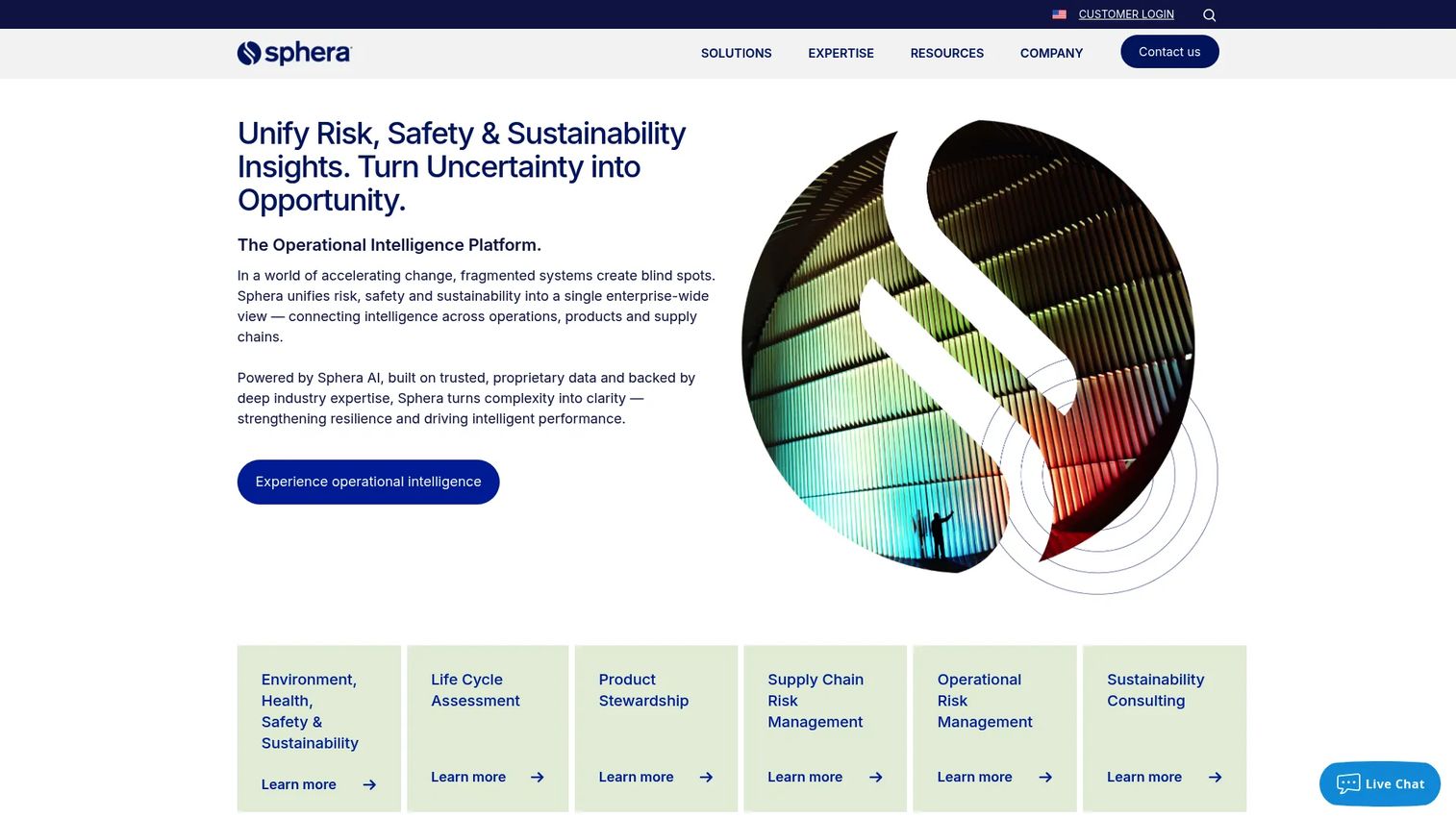
Sphera is enterprise software, data, and consulting for sustainability, operational risk, product stewardship, and EHS. Its SpheraCloud environment covers air emissions management software and GHG workflows in one platform, which makes it a fit for organizations that report regulated pollutants and carbon under multiple regimes at once. For teams juggling air permits alongside a corporate GHG inventory, that integrated coverage removes a layer of reconciliation.
Best for: Large enterprises needing integrated sustainability and risk management software across air, GHG, and regulated pollutants.
Key strengths
- EHS&S platform: Environment, health, safety, and sustainability workflows unified in one system, reducing fragmented reporting.
- Product stewardship: Chemical management and product stewardship support environmental accounting and compliance across the product lifecycle.
- Supply chain risk: Supply chain risk management and sustainability reporting tie emissions data to operational and regulatory exposure.
Why choose Sphera: Sphera fits when your reporting spans more than carbon. If you file air permits, manage chemical compliance, and report GHG inventories, keeping those in one system reduces the reconciliation work that eats analyst time. It leans toward regulated industries and enterprise-scale operations where emissions modeling and public disclosure both matter, and where a single audit trail across environmental accounting is worth the investment.
Sphera pricing: Sphera does not publish pricing on its site. Pages route to a demo or contact-sales request rather than list prices, which is typical for enterprise EHS platforms sold on scope and seat count. Expect a custom quote tied to modules, facilities, and users. Budget for an implementation and configuration phase given the breadth of the platform.
2. Cority
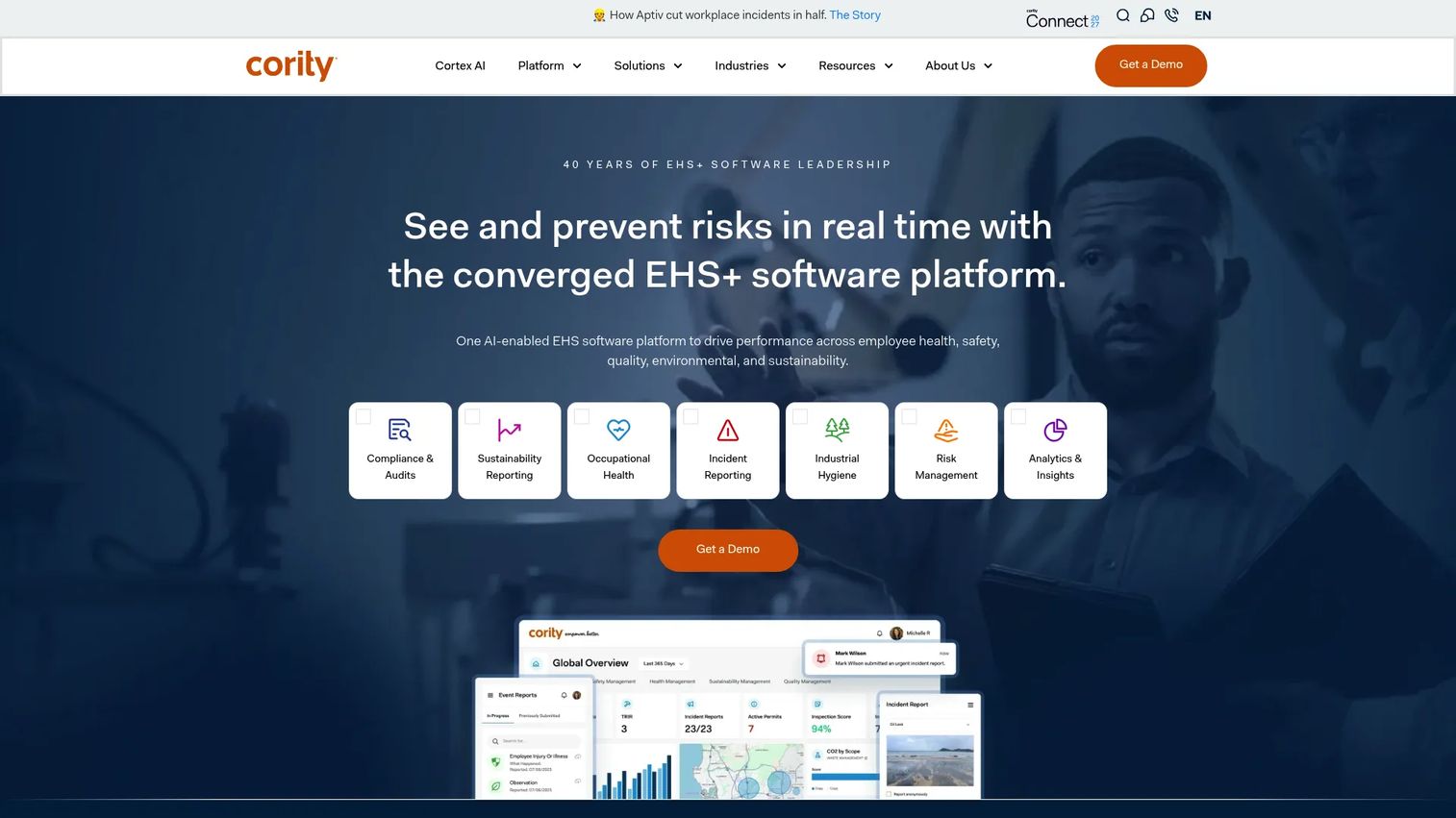
Cority is enterprise EHS+ software for managing occupational health, safety, environmental, quality, and sustainability workflows. Its converged platform gives large teams centralized visibility across facilities, with configurable calculations that support air emissions management software and GHG reporting software in the same system. For a founder standing up an EHS function, that convergence means one platform instead of a patchwork.
Best for: Large and complex organizations needing integrated EHS, health, and sustainability management with centralized emissions visibility.
Key strengths
- Converged EHS+ platform: Safety, health, environmental, quality, and sustainability data live together, creating a single source of truth.
- Occupational and employee health: Health workflows sit alongside emissions data, useful for industrial operations under overlapping regulations.
- Cortex AI: AI-enabled workflows and insights surface anomalies and speed up review cycles.
Why choose Cority: Cority suits organizations that already run a formal EHS program and want emissions folded into it rather than bolted on. The configurable calculation engine and dashboarding support compliance reporting across regions, and workflow automation with alerts and escalation keeps deadlines from slipping. It carries a 4.0/5 rating on G2, reflecting steady enterprise adoption.
Cority pricing: Cority does not display a public list price and directs visitors to request a demo or contact sales. A free trial is referenced in its trial terms, but no public plan price was found. Pricing scales with modules, facilities, and users, so expect a custom quote for a converged EHS and emissions deployment.
3. Persefoni
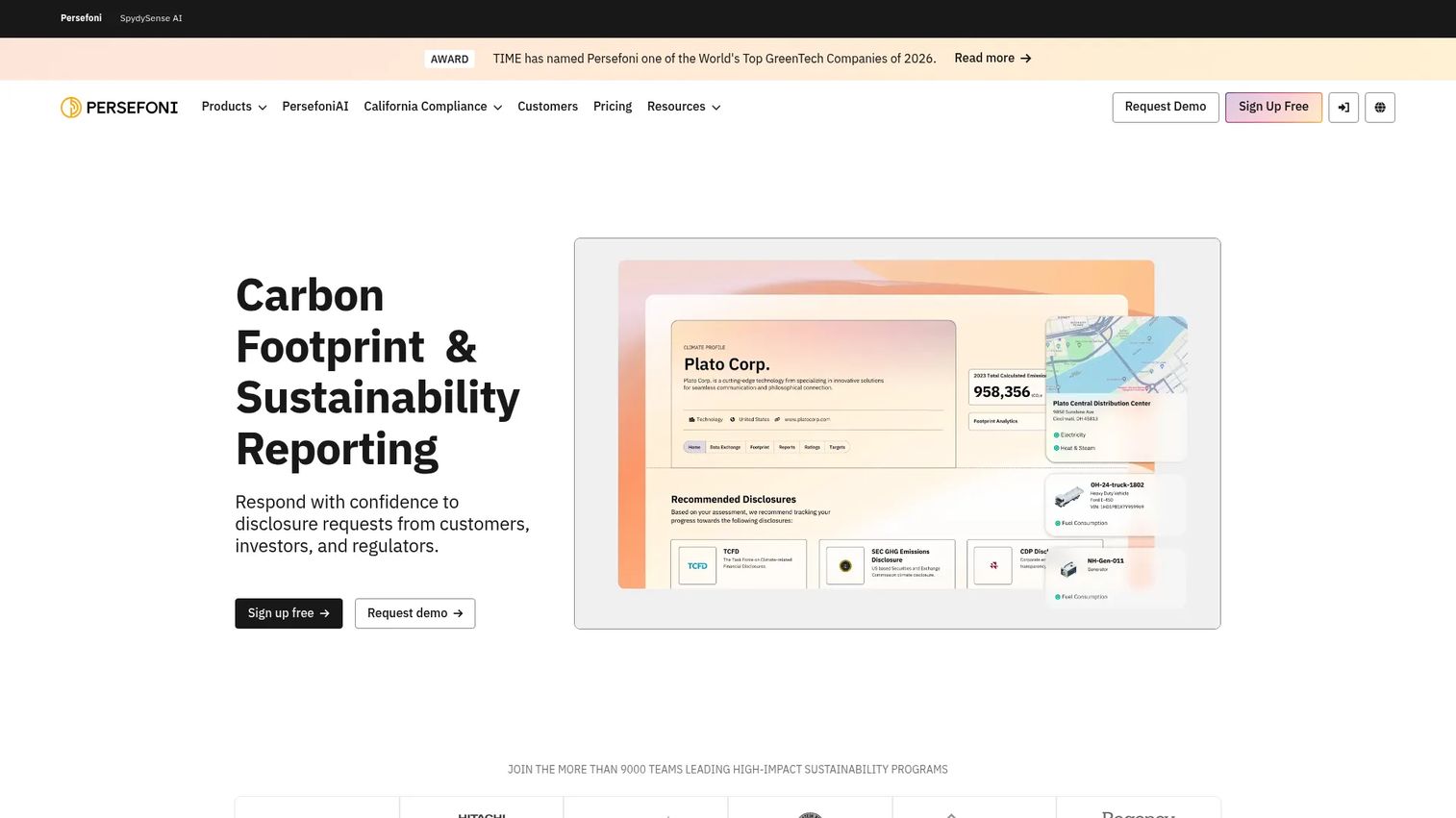
Persefoni is carbon accounting and sustainability management software built around standards-based measurement and reporting. It covers Scope 1, Scope 2, and Scope 3 footprint measurement, with a report builder and PersefoniAI Copilot to speed up regulatory reporting. Finance and sustainability teams choose it when disclosure accuracy is the priority. If you manage disclosure documents across frameworks, treating messaging like a governed contract management asset keeps versions consistent.
Best for: Teams needing carbon accounting and sustainability reporting software with strong Scope 1–3 coverage.
Key strengths
- Scope 1–3 measurement: Full carbon footprint measurement across direct, energy, and value-chain emissions.
- Report builder: Sustainability reporting workflows and a report builder map to disclosure frameworks.
- PersefoniAI Copilot: AI assistance for carbon accounting reduces manual calculation and speeds up drafting.
Why choose Persefoni: Persefoni fits finance-led teams that treat emissions like a financial reporting problem. The standards-driven approach and report builder make it strong for regulatory reporting and public disclosure, and the free Pro tier lowers the barrier to starting. It earns a 4.8/5 on G2, one of the higher marks in this list.
Persefoni pricing: Persefoni Pro is a free, self-serve plan, which is rare in this category and useful for teams validating the workflow before committing. Persefoni Advanced is positioned for enterprise-scale use with a contact-sales quote; no public numeric price is shown for the Advanced tier.
4. Sweep
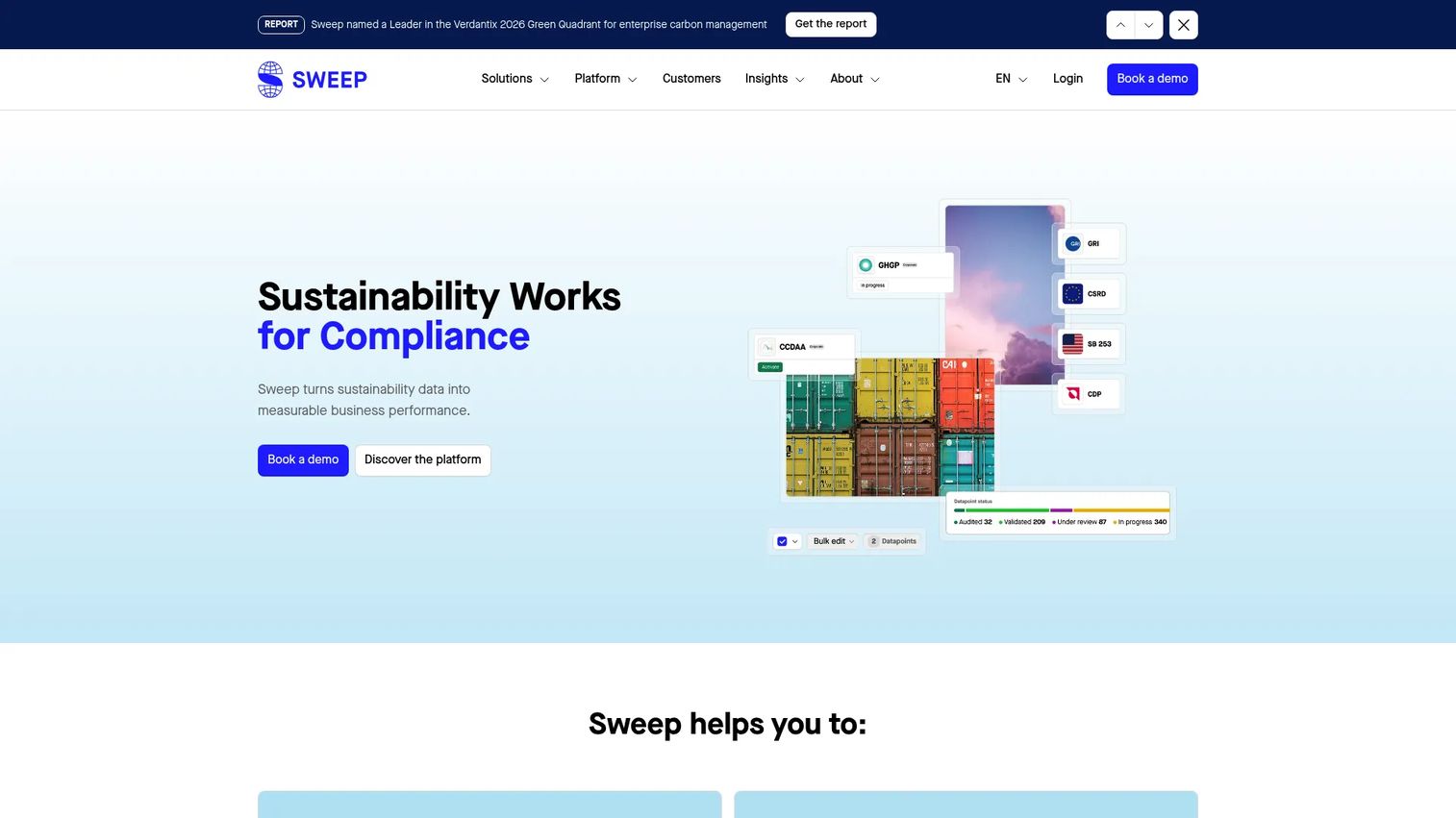
Sweep is sustainability data management software for carbon accounting, ESG reporting, and decarbonization workflows. It centralizes sustainability data across the organization and value chain, with built-in validation that produces audit-ready data. For teams that want broader climate workflows without a heavy rollout, it is a strong candidate.
Best for: Enterprises managing sustainability, carbon, and ESG reporting data across the value chain.
Key strengths
- Centralized data: Sustainability data across the organization and supply chain lives in one system, a genuine single source of truth.
- Audit-ready validation: Built-in validation and compliance reporting keep data defensible for assurance.
- AI-assisted collection: Supply chain and carbon workflows use AI to speed up data collection.
Why choose Sweep: Sweep suits teams that want carbon accounting alongside broader ESG and decarbonization workflows without a long implementation. The audit-ready data and value-chain focus make it strong for Scope 3, and the platform is built to roll out across multiple entities. It holds a 4.9/5 rating on G2, the highest in this list.
Sweep pricing: Sweep does not publish pricing on its site. The site presents a Sweep Starter option with an upgrade path to Pro, but no plan price was visible. Expect a custom quote based on scope, entities, and value-chain complexity.
5. Greenly
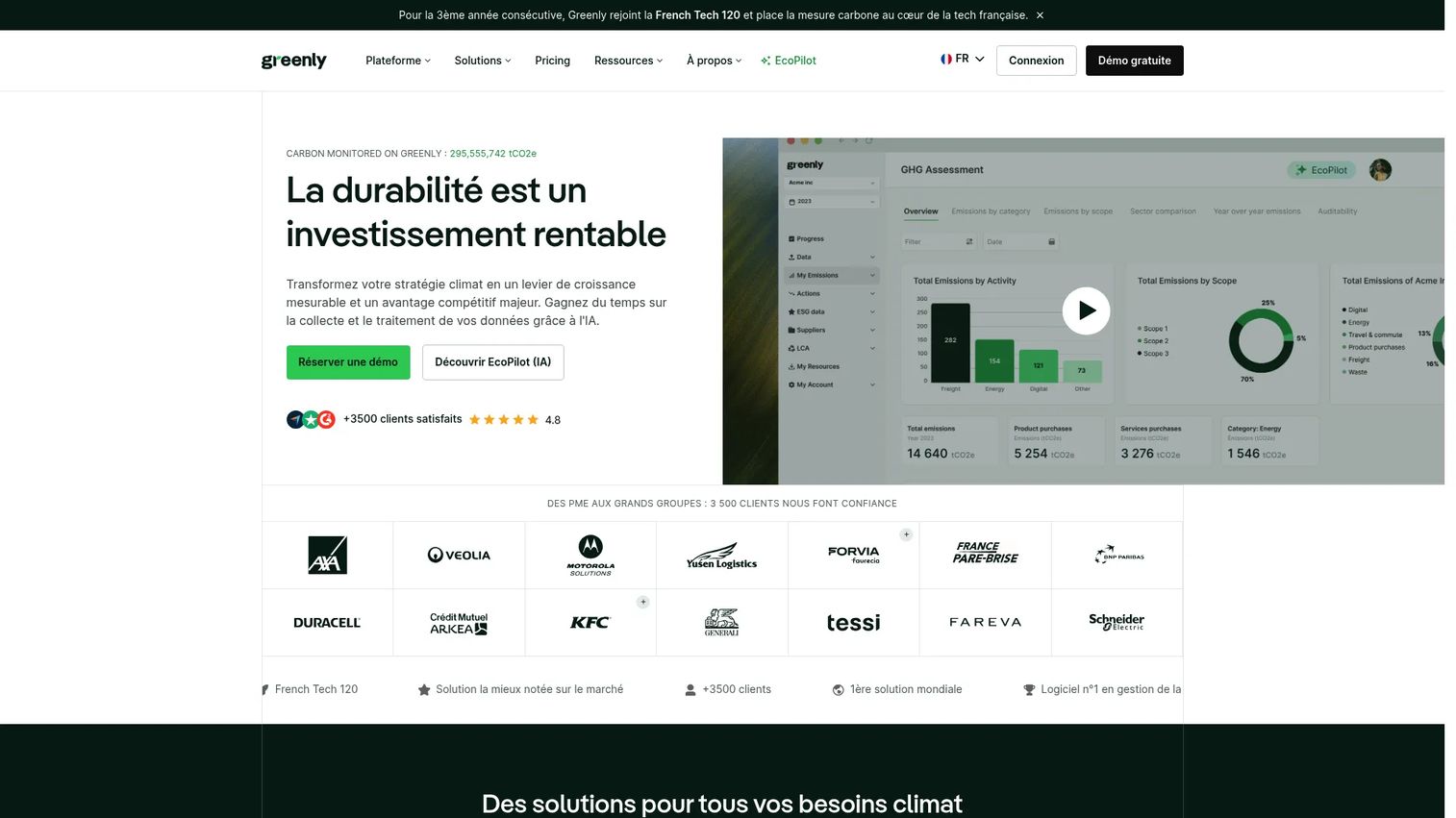
Greenly is sustainability software for carbon accounting, LCA, ESG management, and supplier engagement. It focuses on emission source tracking, dashboards, and reduction planning, which makes it a fit for teams that want a carbon accounting motion with lighter operational overhead. For a growing company standing up its first program, that simplicity shortens time to a first report.
Best for: Companies needing a carbon-management and sustainability reporting platform without heavy setup.
Key strengths
- Carbon footprint and GHG: GHG assessment covers the core measurement teams need for a first inventory.
- Life Cycle Assessment: LCA supports product-level environmental accounting and reduction planning.
- ESG management: ESG management and compliance features tie emissions data to broader reporting obligations.
Why choose Greenly: Greenly fits teams that want to start a carbon accounting program quickly and grow into deeper reporting. Its dashboards, supplier engagement, and reduction planning make it practical for companies that do not have a dedicated sustainability engineering team. It carries a 4.7/5 rating on G2.
Greenly pricing: Greenly does not expose public software subscription pricing on a first-party pricing page; its FAQ indicates tiered or contact-based pricing for many offerings. The only numeric prices visible on the site relate to partner program options, not software subscriptions, so expect a custom quote for the platform itself.
6. IBM Environmental Intelligence Suite
IBM Environmental Intelligence Suite is climate and sustainability software for monitoring environmental risks and operational impacts. It combines weather and environmental monitoring with geospatial analytics, and includes carbon accounting and emissions reporting. It fits organizations that need environmental signal plus enterprise analytics capability in one platform.
Best for: Enterprises needing weather, climate-risk, and sustainability analytics alongside emissions modeling.
Key strengths
- Environmental monitoring: Weather and environmental monitoring with alerts supports operational risk workflows.
- Geospatial analytics: Dashboards and geospatial analytics turn environmental data into decision signal.
- Carbon accounting: Emissions reporting and carbon accounting sit within a broader analytics platform.
Why choose IBM Environmental Intelligence Suite: This platform fits enterprises whose emissions work is part of a wider environmental analytics need, such as climate risk exposure across assets. If you need geospatial signal and emissions modeling together, the combined capability is the draw. It holds a 4.2/5 rating on G2.
IBM Environmental Intelligence Suite pricing: G2 lists the Essentials tier starting at $500.00 per month and the Standard tier starting at $3,750.00 per month. A first-party pricing page with visible prices could not be confirmed, so these figures come from G2. Free-tier status was not verifiable from first-party sources.
7. Watershed
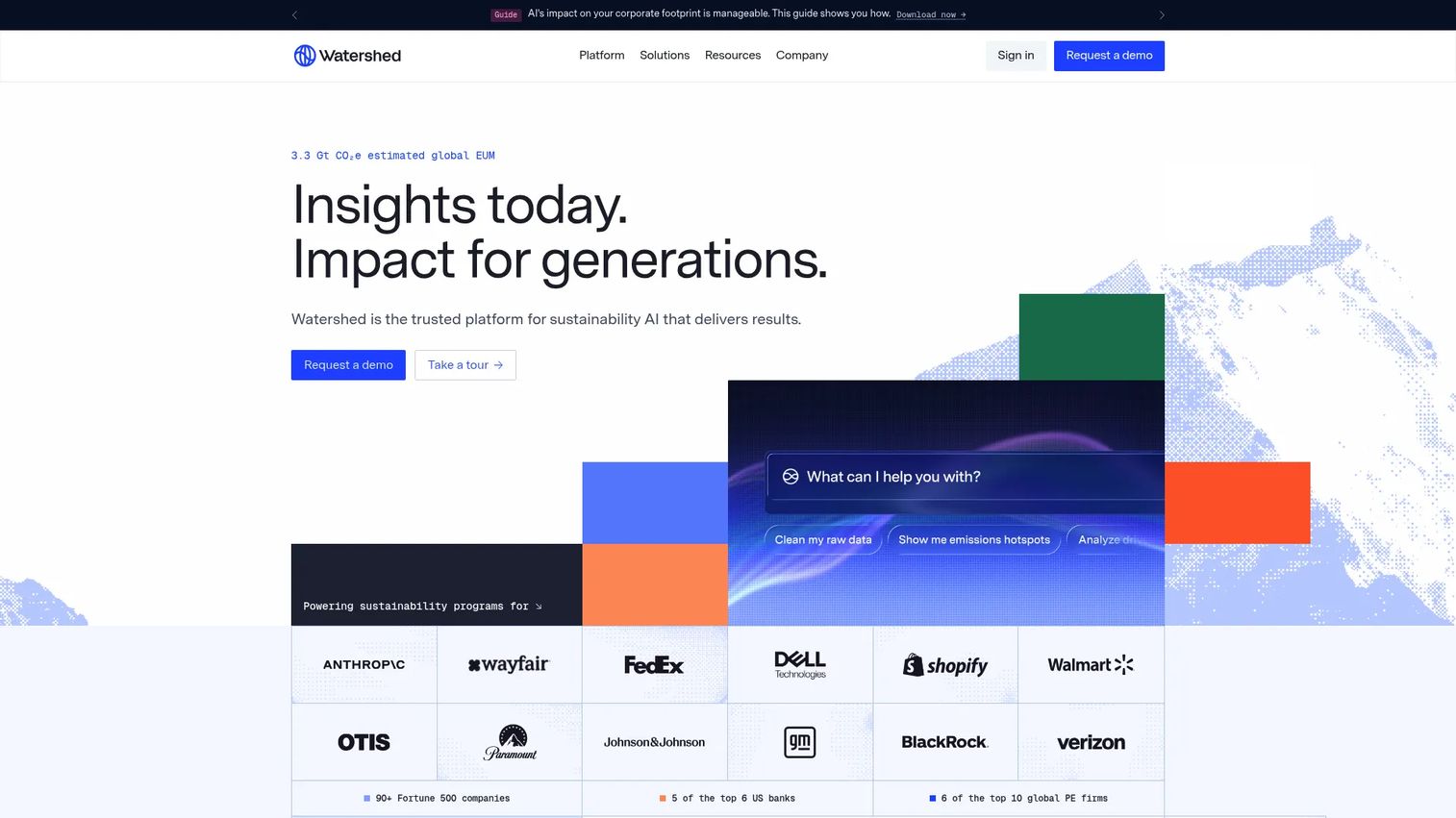
Watershed is enterprise sustainability software for measuring, reporting, and acting on environmental impact. It measures carbon, water, and land impact, with automated ESG reporting that includes data lineage and review workflows. That data lineage focus makes it a strong fit for teams that need audit-ready numbers.
Best for: Large companies needing audit-ready carbon accounting and ESG reporting with clear data lineage.
Key strengths
- Multi-impact measurement: Carbon, water, and land impact measurement in one platform.
- Data lineage and review: Automated ESG reporting with data lineage and review workflows supports assurance.
- AI-assisted reporting: AI helps with data cleaning, analysis, and report drafting to cut manual effort.
Why choose Watershed: Watershed fits enterprises that want reporting rigor and actionability together. The data lineage and review workflows make numbers defensible, and the AI-assisted drafting reduces the manual load on a small sustainability team. Relative to compliance-heavy air platforms, it leans carbon and ESG. It carries a 4.5/5 rating on G2.
Watershed pricing: Watershed does not publish public pricing on its site; pricing appears to be request-demo only. Expect a custom enterprise quote scaled to scope and reporting complexity.
8. CarbonPlus
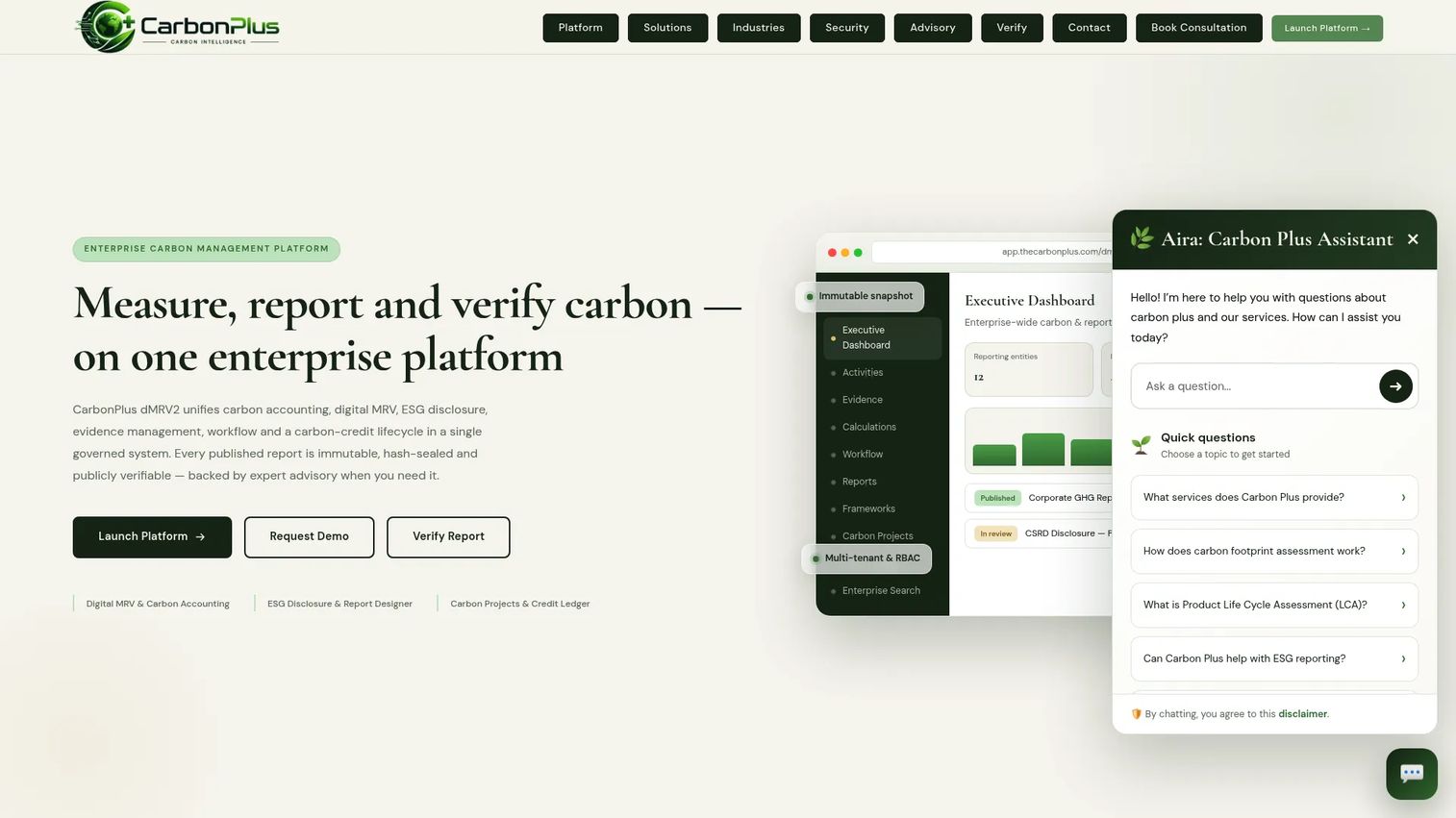
CarbonPlus is an enterprise carbon management platform and consultancy for measuring, reporting, verifying, and reducing carbon emissions. It emphasizes governed reporting, audit evidence, and workflow controls, which positions it for teams that need a single governed system with strong traceability.
Best for: Enterprises needing governed carbon accounting, disclosure, and verification workflows.
Key strengths
- Carbon accounting and MRV: Carbon accounting and digital MRV support measurement, reporting, and verification.
- ESG disclosure: A report designer and ESG disclosure features handle public disclosure requirements.
- Carbon projects and credit ledger: A credit ledger tracks carbon projects and credits with governance controls.
Why choose CarbonPlus: CarbonPlus fits teams that treat governance and audit evidence as first-class requirements. The digital MRV, disclosure designer, and credit ledger give a single governed system where every figure has traceable evidence behind it, which matters when verification is part of the reporting cycle.
CarbonPlus pricing: CarbonPlus does not publish a public pricing page or visible price on its site. Given its combined platform and consultancy model, expect a scoped, custom quote rather than a self-serve plan.
Considerations before you buy
Shortlisting emissions management software comes down to how much scrutiny your numbers will face. Use this checklist.
Compliance scope across air, GHG, and carbon
Confirm the platform covers the specific frameworks you report under, whether that is regional air permits, the GHG Protocol, PCAF, or CSRD. Compliance-first tools like Sphera and Cority lead on air and regulated pollutants; carbon-first tools lead on Scope 1–3 disclosure.
Audit trail and data lineage
Ask how a reported figure traces back to its raw activity data. A credible emissions data management system shows data lineage end to end so an assurance provider can follow it without a manual reconstruction.
Workflow automation, alerts, and escalation
Evaluate whether thresholds trigger tasks automatically. Workflow automation with alerts and escalation is what keeps a permit exceedance or a missing data point from becoming a missed deadline.
Integrations and single source of truth
Check how the platform connects to your ERP, utility data, data lake, or warehouse. The goal is one governed source of truth, not another silo that a person has to reconcile by hand.
Team fit and time to first report
Match the tool to your team. A lean team may prefer a lighter carbon motion; a formal EHS program may need a converged platform. Ask how quickly you can produce a defensible first report.
Conclusion
There is no single winner in emissions management software, only the right fit for your reporting complexity and team size. If you report air permits, chemical compliance, and GHG inventories together, Sphera and Cority lead on compliance-first depth. If carbon accounting and disclosure are the priority, Persefoni, Sweep, Watershed, and Greenly give you strong Scope 1–3 coverage with audit-ready data. IBM Environmental Intelligence Suite fits when emissions sit inside a wider environmental analytics need, and CarbonPlus fits when governed, verifiable reporting is non-negotiable.
The evaluation lens stays constant: compliance depth, data integrity, workflow automation, and a defensible audit trail. Shortlist two or three tools that match your regulatory scope, then run each through your own data to see which produces a report you can defend. Automated emissions reporting is only as valuable as the traceability behind it, so make data lineage the deciding factor. For teams standing up related governance, an audit management software or broader compliance layer often pairs well with your chosen emissions tracking software.
FAQs
Emissions management software measures, tracks, reports, and helps reduce emissions across air pollutants, greenhouse gases, and carbon. It maintains an audit trail from raw activity data to final disclosure so operations, finance, and sustainability teams work from a single source of truth instead of disconnected spreadsheets.
Carbon accounting software focuses specifically on measuring and reporting greenhouse gas emissions across Scope 1, 2, and 3. Emissions reporting software is broader and often includes air pollutants and regulated emissions alongside carbon. Many platforms do both, but compliance-first tools tend to cover air and regulated pollutants more deeply, while carbon-first tools lead on GHG disclosure.
Persefoni, Sweep, Greenly, Watershed, and CarbonPlus all provide Scope 1, 2, and 3 coverage through GHG reporting software workflows. Sphera and Cority also support GHG inventories alongside air emissions and regulated pollutant compliance, making them a fit for organizations reporting under multiple regimes.
Look for end-to-end data lineage, meaning every reported figure can be traced back to its source activity data and the emission factor applied. Strong platforms log who entered or changed data, when, and why, so an assurance provider can verify numbers without a manual reconstruction. Review workflows and version history make the audit trail defensible.
Sphera and Cority are the strongest fits for air emissions management software and air compliance software needs. Both cover regulated pollutants and permit workflows alongside GHG inventories, with configurable calculation engines and workflow automation that handle thresholds, alerts, and escalation across facilities.
They are central to keeping compliance reporting on schedule. Workflow automation routes tasks, and alerts with escalation flag threshold exceedances or missing data before they become missed deadlines. For multi-facility operations, this automation is what makes emissions tracking software repeatable rather than dependent on one person watching the calendar.
Start with your regulatory scope. If you report air permits, chemical compliance, and regulated pollutants alongside carbon, a compliance-first platform like Sphera or Cority reduces reconciliation. If your primary obligation is GHG disclosure under frameworks like the GHG Protocol or CSRD, a carbon-first platform such as Persefoni, Sweep, or Watershed gives you deeper Scope 1–3 accounting and audit-ready reporting.