


You run local marketing for more than one location. So your week looks like this: listings drifting out of sync, reviews piling up faster than anyone can respond, location pages that nobody owns, and a reporting deck stitched together from five tabs the night before the meeting.
The work multiplies with every location. So does the doubt about whether any of it is actually moving revenue.
Here is the tension. Local search is where demand starts. Websites, blogs, and SEO are the top ROI-driving channels for marketers in 2026, and 75% of marketers now run more than five channels at once, according to data summarized from HubSpot's State of Marketing research. Meanwhile, 47% of marketers report using automation to make processes more efficient. Local marketing software sits right in that gap: it should consolidate listings, reviews, local SEO, and reporting into one place, and it should let you prove ROI instead of activity.
But "all-in-one platform" is a claim, not a guarantee. Some tools nail local SEO and skip reputation. Others own reviews but barely touch rank tracking. A few are built for a single storefront, and a few only make sense at franchise scale.
This guide separates the marketing language from the actual workflow coverage, so you can pick the local marketing platform that fits the outcome your team needs.
What's inside
This list covers software across the full local marketing funnel: local SEO software, listings management software, review management software, multi-location marketing software, local reporting, and local lead generation software. If your primary lever is search visibility, it's worth pairing this guide with a broader look at the best SEO tools available today.
We selected and ranked these local marketing tools using six criteria that matter to consolidation-minded teams:
- Breadth of workflow coverage across SEO, listings, reviews, and reporting
- Local SEO depth, including rank tracking and Google Business Profile management
- Review and listings capabilities, including citation management and NAP consistency
- Fit for small business, agency, and multi-location or franchise teams
- Reporting and ROI attribution quality
- Ease of use and realistic time to value
Pricing and G2 ratings reflect publicly available data at the time of writing. Verify current figures on each vendor's site before you buy.
TL;DR
Short on time? Here is how the shortlist breaks down by buyer type.
- Best for local SEO precision: SE Ranking, for teams that lead with rank tracking, map tracking, and SEO workflows.
- Best all-in-one for small businesses: Surefire Local, for local service brands that want one vendor across visibility, reviews, ads, and leads.
- Best for franchises and dealer networks: Ansira, for enterprise brand-to-local orchestration at scale.
- Best for listings at scale: Yext, for multi-location brands that need accurate brand data everywhere.
- Best for reputation management: Birdeye, for review generation, responses, and customer messaging across locations.
- Best for multi-location social and reputation: SOCi, for enterprise teams governing local presence across hundreds of locations.
What is local marketing software?
Local marketing software is a platform that helps businesses improve visibility, reputation, and lead generation in specific geographic markets by managing local SEO, business listings, reviews, and location-level reporting from one system.
Most platforms in this category combine a recurring set of capabilities. Together they form a single local funnel: visibility brings people in, listings and reviews build trust, and reporting proves what converted.
The core feature set usually includes:
- Local search visibility: local rankings tracker, map rank tracker, and local SEO analysis to monitor where you appear in local search and on the map pack.
- Listing accuracy and citation management: listings management software that pushes consistent NAP data to directories and maintains NAP consistency across the web.
- Review monitoring and responses: reputation management software that collects, monitors, and responds to customer reviews across locations.
- Multi-location control: centralized governance for location pages, Google Business Profile management, and brand consistency across many storefronts.
- Local reporting and attribution: local marketing analytics tying calls, directions, form fills, reviews, and rankings to revenue signals. Teams that want to go deeper here often layer in a dedicated stack from the best marketing analytics software.
Some tools push further into marketing automation software, GBP posts scheduling, paid ads, and local lead generation software. The category overlaps with local SEO software but is broader: a local SEO tool tracks rankings, while a full local marketing platform manages the entire local presence.
When to use local marketing software
Not every team needs a dedicated local marketing platform. These three triggers usually signal that you do.
When you need consistent visibility across multiple locations
Manual management breaks down fast once you pass a handful of locations. Every new storefront adds another set of location pages, another business profile, and another stream of reviews to monitor.
Local marketing software standardizes this. It pushes consistent listing data everywhere, keeps location pages on-brand, and centralizes review activity so no location goes quiet. For multi-location and franchise marketing software buyers, this control is the entire point.
When local SEO is slowing down growth
If local search traffic is flat or sliding, you need to diagnose why, not guess. Rankings can drop because of inconsistent citations, a stale Google Business Profile, or missing reviews, and these failures hide in different tools.
A local rankings tracker, GBP updates, and listings fixes in one platform let you find the cause. You see which locations are losing map pack positions and what is dragging them down, then fix it from the same place.
When reporting is too fragmented
When your local marketing SEO data lives in Search Console, your reviews live in three review sites, and your call data lives in a spreadsheet, nobody can answer "what did local marketing drive last quarter?"
One platform that unifies calls, directions, forms, reviews, and rankings gives you a defensible answer. That single view is what turns local activity into ROI attribution your leadership will actually trust.
Comparison table
Here is the shortlist at a glance, sorted by relevance to local marketing software buyers. Pricing and ratings are publicly available figures at the time of writing.
| # | Product | Intent | Key differentiation | Pricing | G2 rating |
|---|---|---|---|---|---|
| 1 | SE Ranking | Local SEO precision | Rank and map tracking with full SEO workflow | From $103.20/mo | 4.8/5 |
| 2 | Surefire Local | All-in-one for SMBs | Visibility, reviews, ads, and leads in one place | Custom | 4.6/5 |
| 3 | Ansira | Enterprise brand-to-local | Franchise and dealer network orchestration | Custom | 4.8/5 |
| 4 | Yext | Listings at scale | Verified brand data across 200+ publishers | From $4/week | 4.4/5 |
| 5 | Birdeye | Reputation management | Reviews, listings, and messaging for multi-location brands | Custom | 4.7/5 |
| 6 | SOCi | Multi-location social and reputation | AI agents for local search, social, and reviews | Contact sales | 4.5/5 |
| 7 | Uberall | Distributed local presence | Location data and listings at scale with AI responses | Contact sales | 4.3/5 |
| 8 | Thryv | SMB operating platform | Marketing plus CRM, scheduling, and automation | From $244/mo | 4.3/5 |
| 9 | LocaliQ | Local lead generation | Ads, lead management, and local presence for SMBs | From $119/mo | 4.5/5 |
| 10 | MomentFeed | Multi-location brand presence | Local search, listings, and location pages at scale | Custom | - |
1. SE Ranking
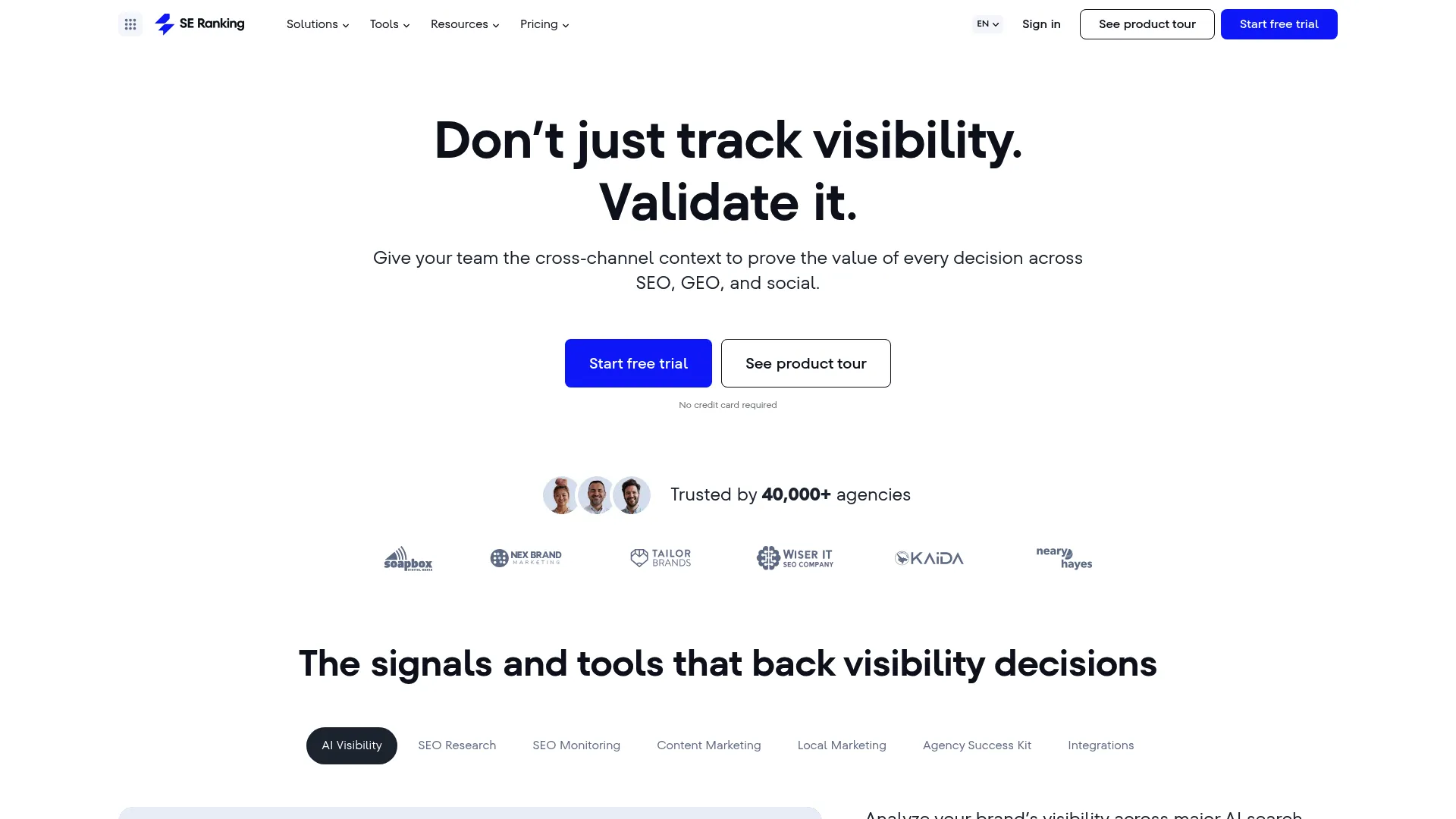
Where many all-in-one platforms treat rankings as a side feature, SE Ranking treats them as the core. You get a local rankings tracker, a map rank tracker for the local pack, on-page SEO checking, and a website audit that surfaces what is holding visibility back. For agencies running local SEO across many clients, the reporting and workflow depth do real work.
Best for: SEO-led in-house teams and agencies that want all-in-one SEO workflow tooling with strong local rank tracking.
Key strengths
- Keyword rank tracker: Monitor local and map rankings with daily precision across locations.
- Website audit: Diagnose technical and on-page issues dragging down local visibility.
- On-page SEO checker: Get concrete, page-level fixes to improve local search rankings.
Why choose SE Ranking: If your local growth problem is fundamentally a rankings problem, this is the most precise tool in the set. It is built for marketers and agencies who want to diagnose and fix local SEO directly rather than manage it through a broad presence dashboard. It is the local SEO management software pick for teams that live in rank data.
SE Ranking pricing: The Core plan starts at $103.20/month billed annually, or $129.00/month billed monthly. Growth runs $223.20/month annually, or $279.00/month monthly. Enterprise is custom pricing. SE Ranking also offers a 14-day free trial, so you can test the local rank tracking before committing. On G2, SE Ranking holds a 4.8/5 rating.
2. Surefire Local
Surefire Local is an all-in-one local marketing platform for small businesses, built especially for local service brands. It pulls visibility, reviews, listings, ads, lead generation, communications, and reporting into a single system, so a business that does not have a dedicated marketing team can still run a coherent local funnel.
The appeal is consolidation. Instead of buying a rank tracker, a review tool, a listings tool, and an ads manager separately, you get one vendor across the local marketing funnel. For a multi-location service business, that reduces tool sprawl and the manual stitching that comes with it.
Best for: Local service businesses that want an all-in-one platform for visibility, leads, and reputation management without juggling vendors.
Key strengths
- Online reviews and reputation management: Collect, monitor, and respond to reviews across locations from one inbox.
- Business listings across 70+ directories: Maintain accurate NAP data and citation consistency at scale.
- Local paid ads and lead generation: Run local ads and capture leads inside the same platform.
Why choose Surefire Local: This is the consolidation pick for SMB and local service teams that value one vendor over best-in-class point tools. The tradeoff versus an SEO-first platform is depth in any single area, but the payoff is a connected funnel where reviews, listings, ads, and leads share one view. That fits teams that want fewer logins and clearer reporting.
Surefire Local pricing: Surefire Local does not publish pricing on its site. The pricing page routes to a lead-capture form, so you will need to request a quote based on your locations and needs. On G2, Surefire Local holds a 4.6/5 rating.
3. Ansira
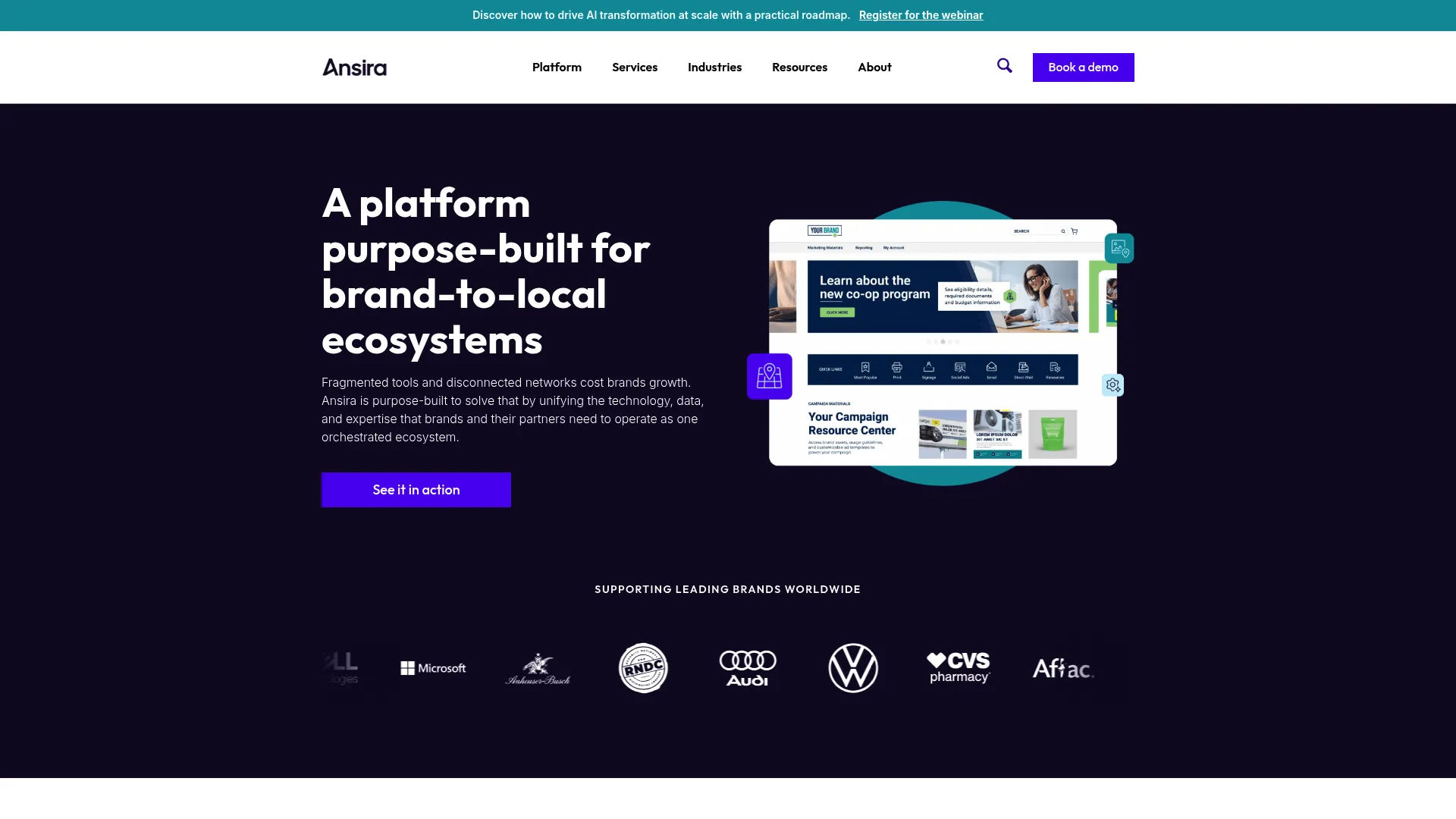
The job here is orchestration. When a national brand needs centralized control of messaging while thousands of local operators execute their own campaigns, Ansira manages that tension. It handles partner marketing, local demand generation, incentive management, and closed-loop analytics across the network, which is exactly the kind of franchise marketing software enterprise teams need. Brands building out partner-led local execution should also review the best partner ecosystem platforms when scoping this.
Best for: Enterprise brands managing complex dealer, franchise, distributor, or partner networks that need centralized governance with localized execution.
Key strengths
- AI-infused unified platform: Coordinate brand-to-local marketing across the entire network from one system.
- Partner marketing and local demand generation: Equip local operators to run compliant, on-brand campaigns.
- Incentive management and closed-loop analytics: Tie local marketing spend to measurable outcomes across locations.
Why choose Ansira: Choose Ansira when the problem is governance at scale, not running a single local funnel. It fits multi-location brand management programs where central marketing must stay aligned with hundreds or thousands of local actors. Smaller teams will find it heavier than they need; enterprise network operators will find it built for their reality.
Ansira pricing: Ansira does not list public pricing. Its model is quote-based and reflects the scope of the network and services involved, so you will work with their team to scope a plan. On G2, Ansira holds a 4.8/5 rating.
4. Yext
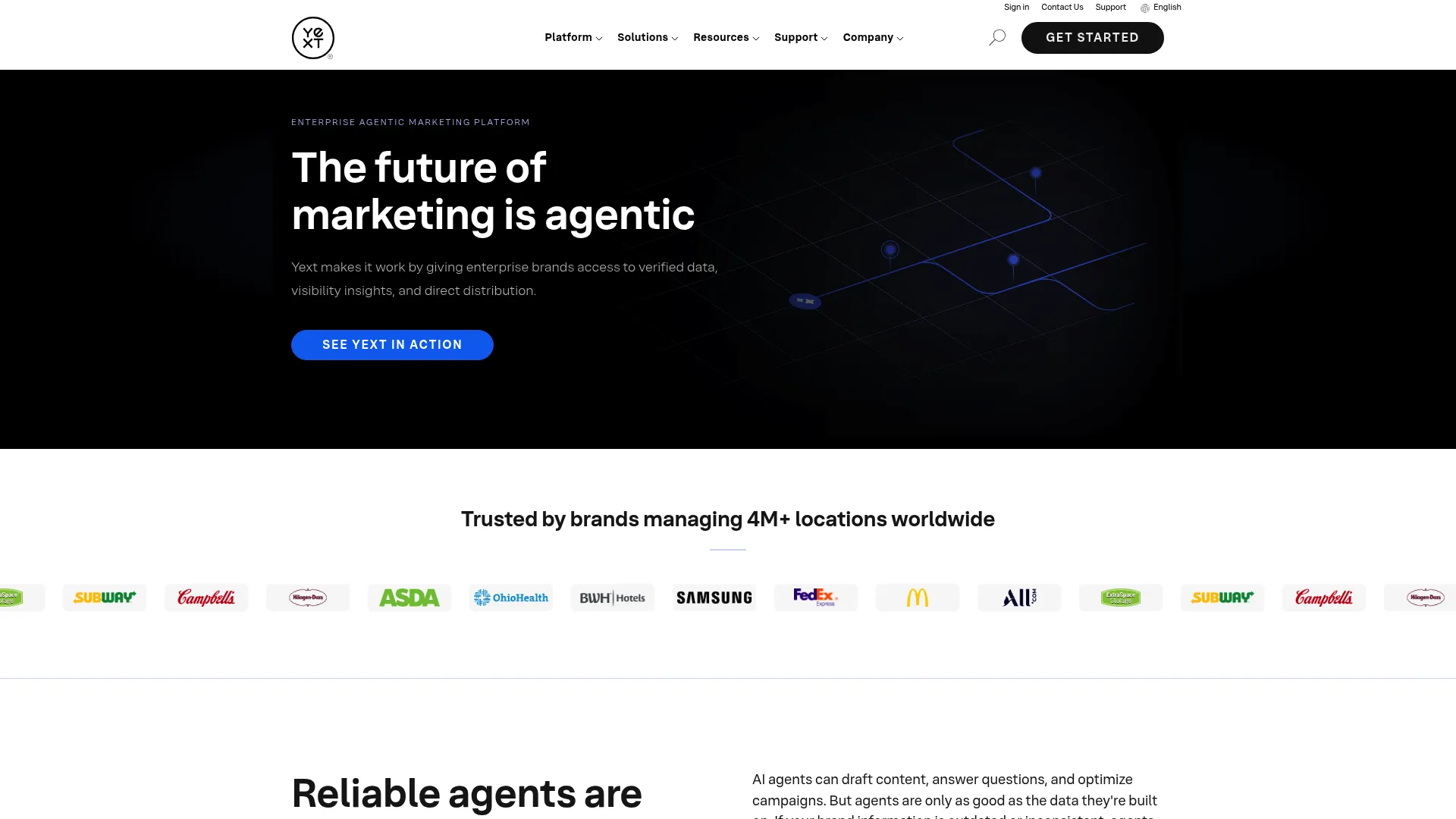
The core value is consistency at scale. When you manage hundreds or thousands of locations, a single change to hours, addresses, or services has to propagate cleanly across every directory, map, and search surface. Yext's Knowledge Graph keeps that brand data centralized and authoritative, and its AI agents extend into reputation, social, and search.
Best for: Multi-location brands that need centralized local listings, reputation, and AI-ready brand data managed from one source of truth.
Key strengths
- Knowledge Graph: Maintain a single verified source of brand data feeding every location.
- Listings distribution across 200+ publishers: Push accurate NAP data everywhere customers search.
- AI agents: Handle competitive intelligence, reputation, social, and search from one platform.
Why choose Yext: If accurate location data at scale is your priority, Yext is the most established option for it. The platform shines when NAP consistency across a huge footprint is the difference between being found and being invisible. It is heavier than a single-location tool needs, but for enterprise listings and Google Business Profile management at scale, that depth is the point.
Yext pricing: Yext's legacy listings plans show public annual pricing: Emerging at roughly $4/week (billed $199 annually), Essential at $9/week ($449 annually), Complete at $10/week ($499 annually), and Premium at $19/week ($999 annually). Enterprise deployments are scoped separately. On G2, Yext holds a 4.4/5 rating.
5. Birdeye
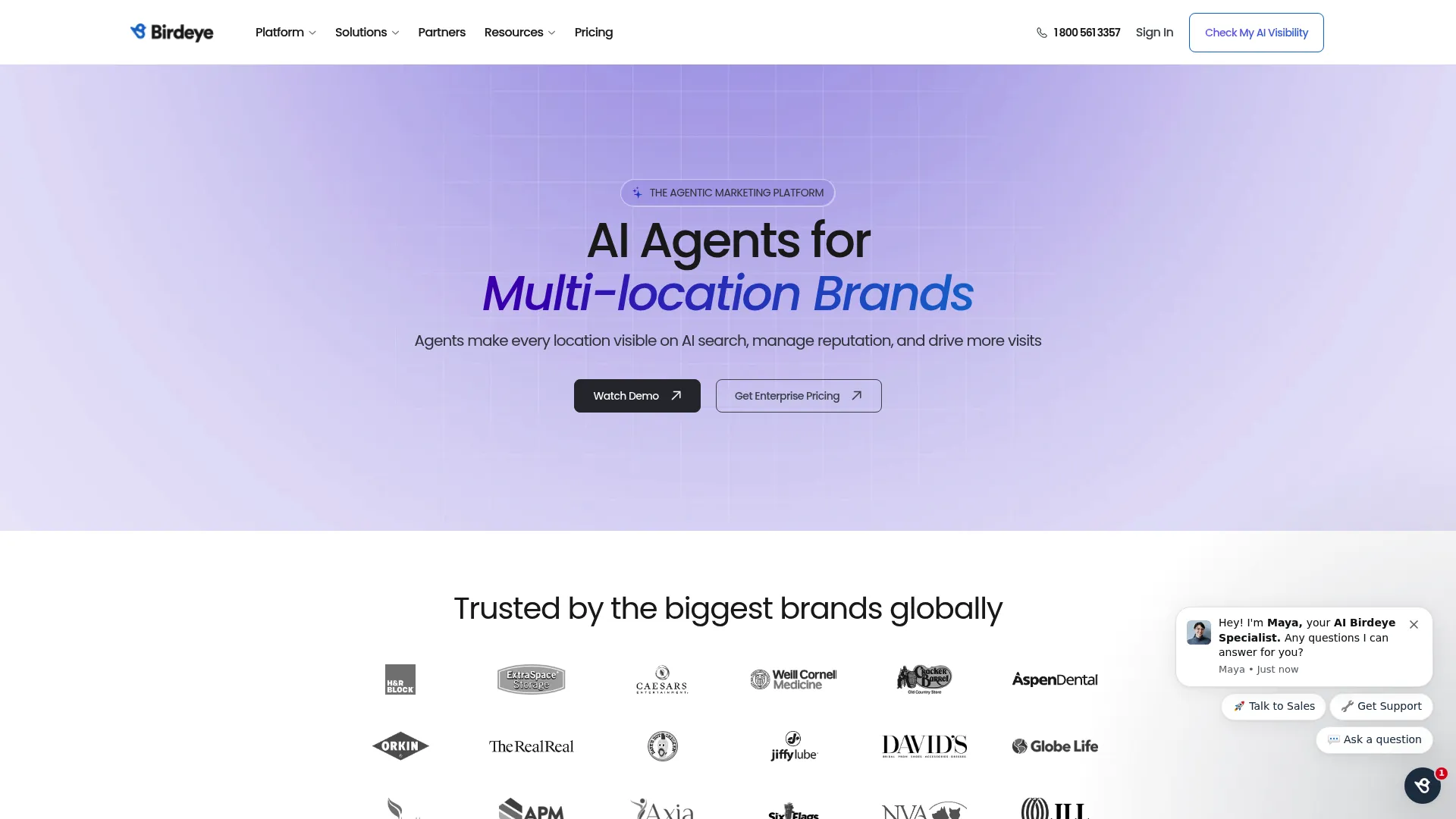
Reviews are not a vanity metric. They drive local rankings, local trust, and the conversion that happens after someone finds you. Birdeye helps teams collect more reviews, respond at scale, and monitor sentiment across every location, then ties that into listings and a unified messaging inbox so the conversation continues past the review. Teams focused on turning that trust into pipeline often pair it with tools from the best conversational marketing software.
Best for: Multi-location brands that need centralized reviews, listings, and customer messaging to manage reputation at scale.
Key strengths
- Reviews management: Generate, monitor, and respond to reviews across every location.
- Listings management: Keep location data accurate alongside reputation workflows.
- Messaging inbox: Centralize customer conversations across channels in one place.
Why choose Birdeye: Choose Birdeye when reputation is the lever that moves your local revenue. It connects review volume, sentiment, and customer messaging into one workflow, which is where review-first teams get the most leverage. Customer reviews automation is the headline, but the listings and messaging layers make it a broader local marketing platform than a pure review tool.
Birdeye pricing: Birdeye does not publish a numeric price. Its pricing page uses a configurator and states pricing is built around outcomes rather than seat counts, so you will get a custom quote based on your locations and goals. On G2, Birdeye holds a 4.7/5 rating.
6. SOCi
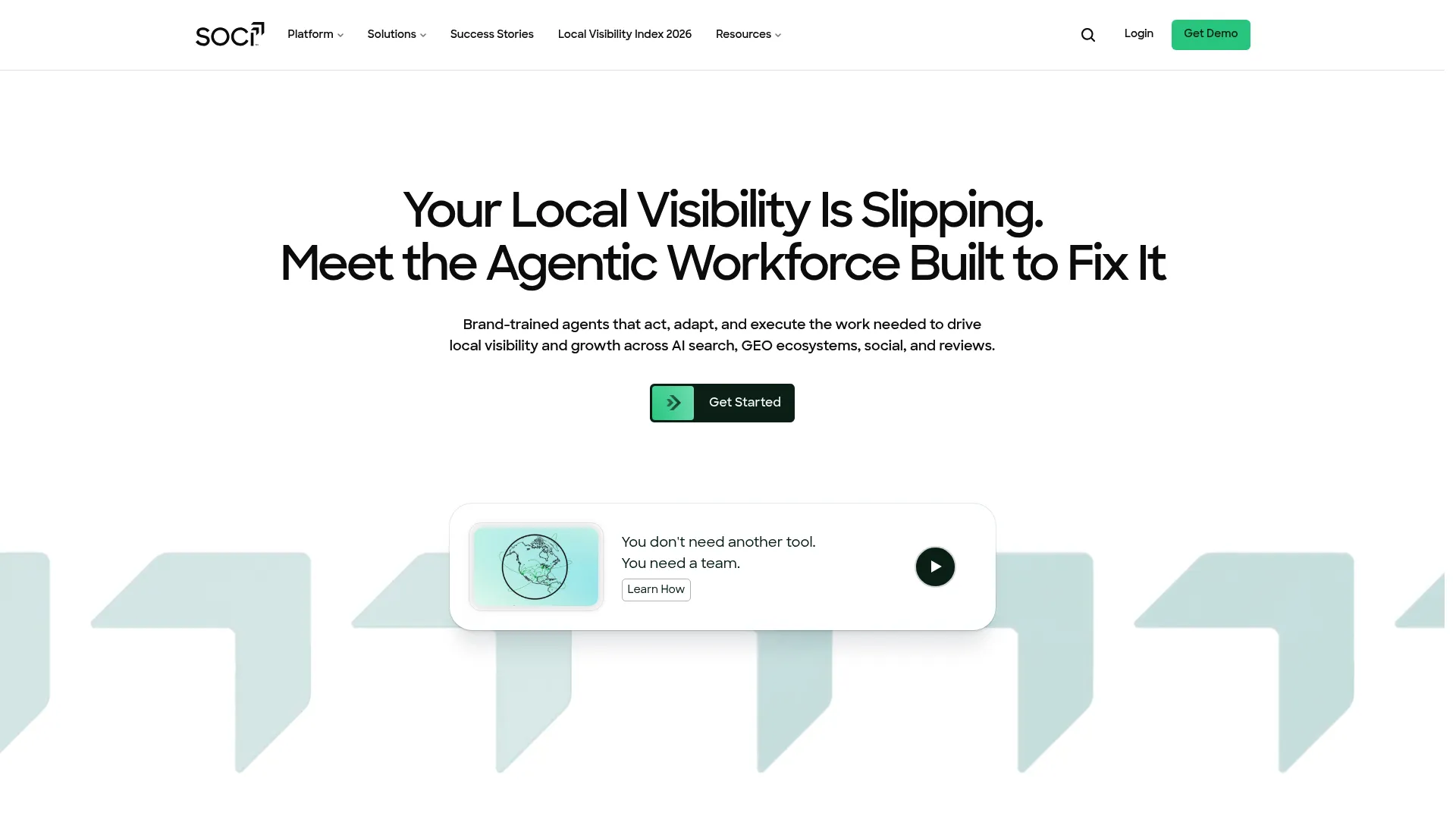
The governance angle is what sets it apart. Brands managing hundreds of locations need local relevance without losing brand control, and SOCi's agent-based approach automates a lot of the work that would otherwise require a person per region. Its Genius Search Agent targets local SEO and AI search visibility, which matters as LLM-powered search reshapes how consumers find local businesses in 2026. For the social side specifically, it's worth comparing against the best social media management tools.
Best for: Multi-location enterprises that need centralized local marketing, social, and reputation management across hundreds of locations.
Key strengths
- Genius Search Agent: Improve local SEO and AI search visibility across every location.
- Genius Social Agent: Automate local social content and engagement at scale.
- Genius Reputation Agent: Respond to reviews consistently across the full footprint.
Why choose SOCi: Choose SOCi when local social and reputation governance across a large network is the priority. It is built for enterprise teams that need scaled local presence management without a proportional headcount increase. For brands where social is a meaningful part of the local funnel, it covers ground that listings-first tools do not.
SOCi pricing: SOCi lists four product editions, including the Genius Search, Social, and Reputation agents plus SOCi Pages, but the public pricing shows "Contact Us" rather than numbers. Pricing is scoped to your location count and needs. On G2, SOCi holds a 4.5/5 rating.
7. Uberall
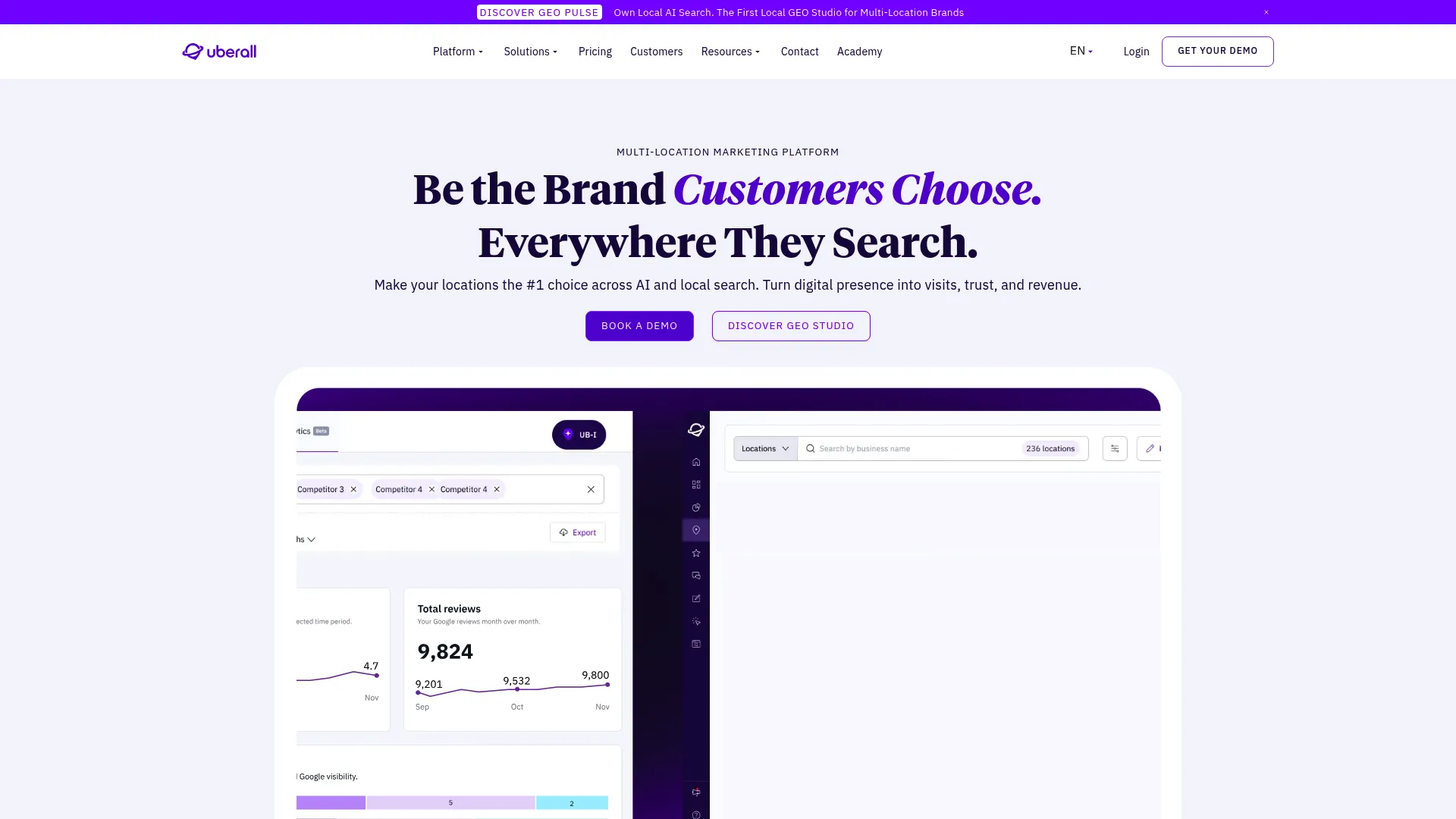
The strength is bulk operations and data integrity. When you manage many locations, you need to update data in bulk, suppress duplicate listings, and protect profiles from drift, and Uberall handles that alongside AI-assisted review responses. That combination keeps listings clean and reputation managed across a large, distributed footprint.
Best for: Multi-location brands that need centralized listings, reviews, and local social management across many storefronts.
Key strengths
- Location data management: Update data in bulk across the full location network.
- Listings management: Suppress duplicates and protect profiles from inaccurate changes.
- Reviews management: Use AI and automated responses to manage reputation at scale.
Why choose Uberall: Choose Uberall when distributed local execution is the core challenge and you need listings, reviews, and social handled together. It fits brands that want bulk control and profile protection across many locations. The focus stays on keeping a large footprint accurate and responsive rather than on deep standalone SEO tooling.
Uberall pricing: Uberall's pricing page shows three plan tiers, Show Up, Stand Out, and Connect, but no public numeric pricing for the core plans; it uses contact and request CTAs instead. You will need to request a quote based on your location count. On G2, Uberall holds a 4.3/5 rating.
8. Thryv
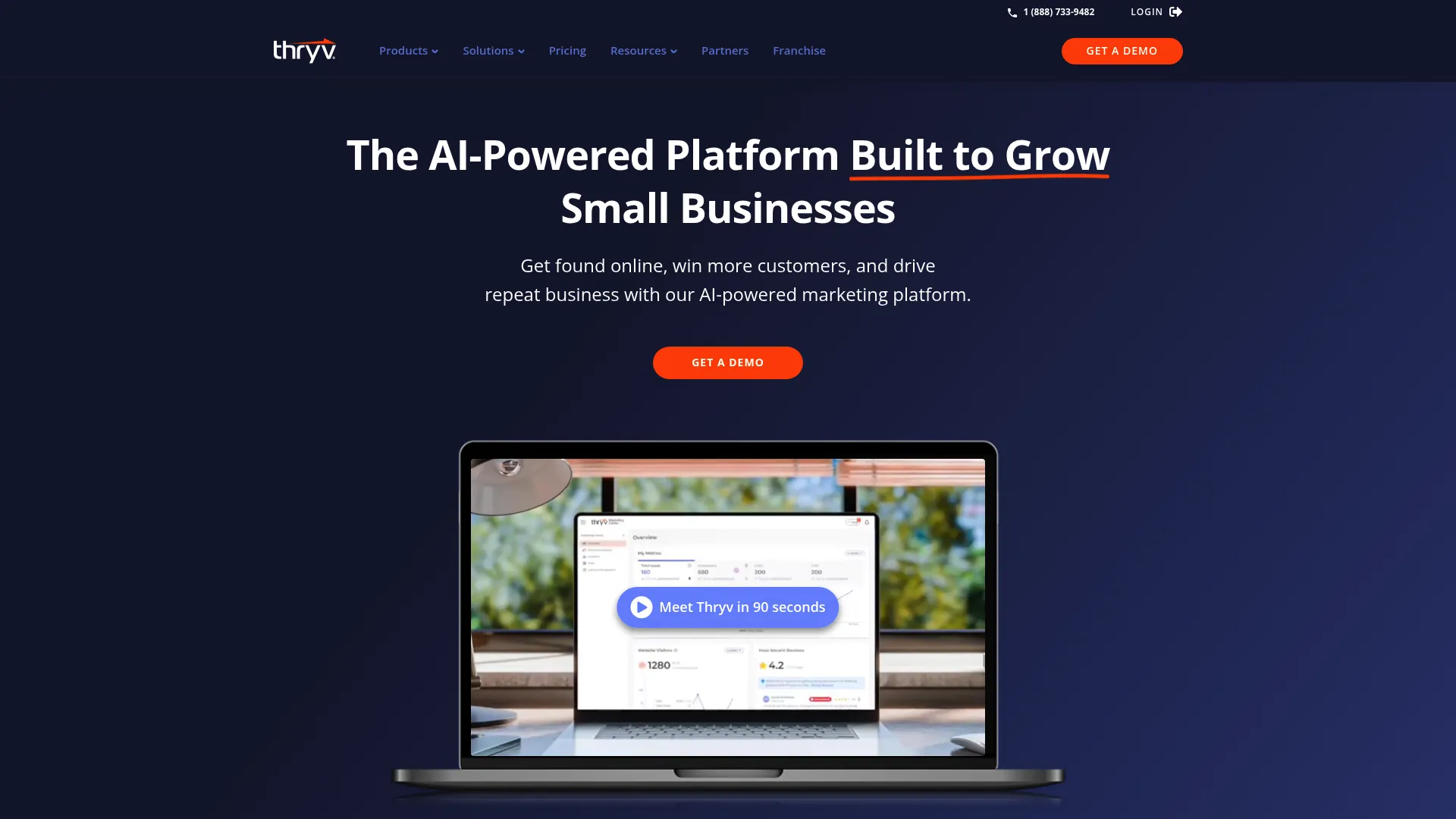
That overlap is the point. For many small businesses, local marketing is not a separate function; it is part of running the day. Thryv handles enhanced local listings and lead tracking next to appointment scheduling and online booking, so marketing and operations share one system. For owners who want fewer tools, that integration matters more than specialized depth.
Best for: Small businesses that want marketing, CRM, and automation combined in one platform.
Key strengths
- Enhanced local listings: Keep business information accurate across directories.
- CRM and lead tracking: Manage customers and follow up on leads in one place.
- Appointment scheduling and online booking: Connect local marketing directly to bookings.
Why choose Thryv: Choose Thryv when local marketing needs to live inside your broader business operations, not in a standalone marketing tool. It fits owner-operated and small-team businesses that want listings, CRM, scheduling, and automation under one roof. The marketing depth is broad rather than specialized, which suits SMBs trading point-tool power for an integrated workflow.
Thryv pricing: Thryv's public pricing page shows plans starting at $244/month for marketing, with higher tiers and bundled packages running from $299/month up through $1,475/month depending on scope. There is no free tier. On G2, Thryv holds a 4.3/5 rating.
9. LocaliQ
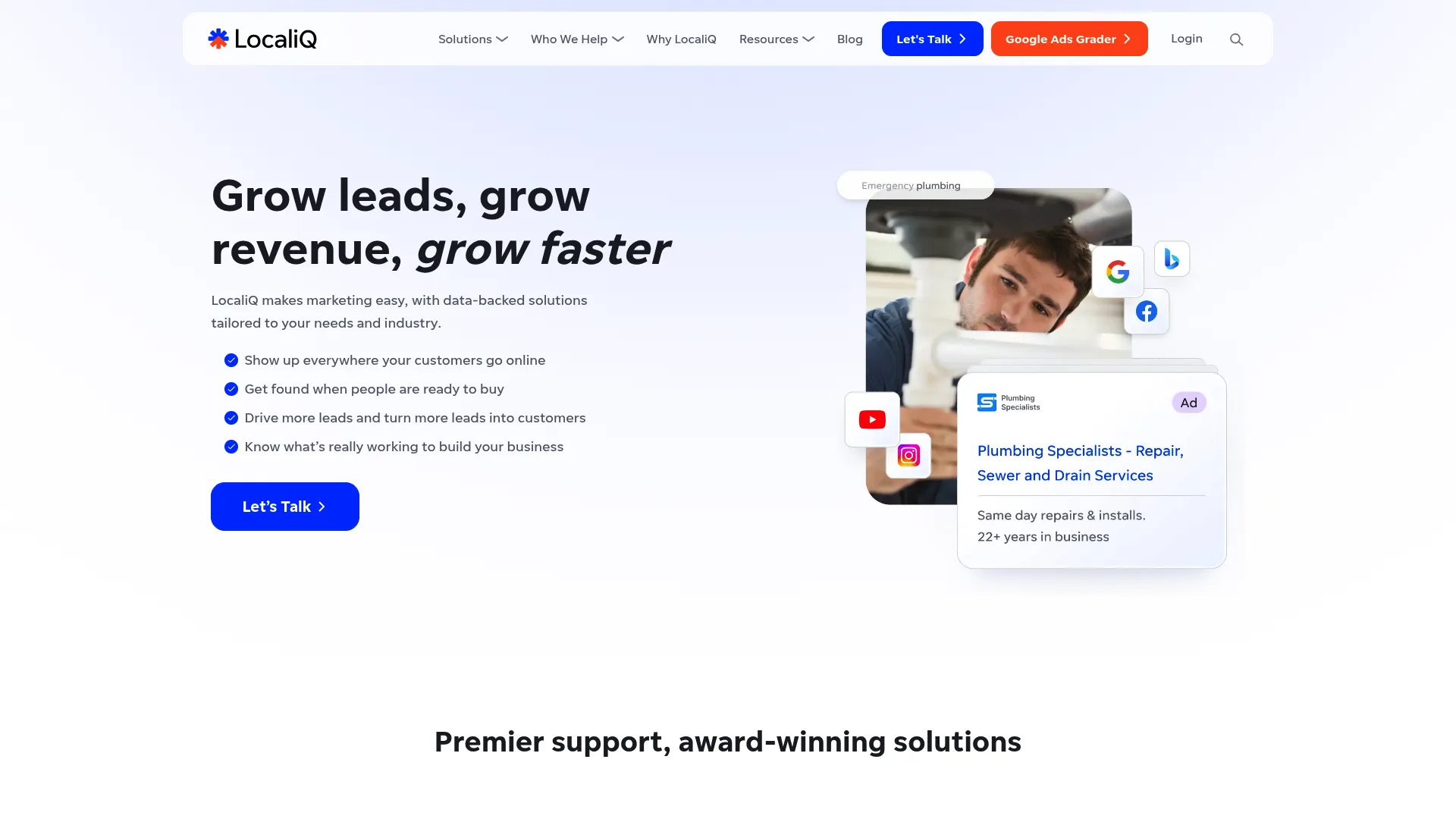
Where listings-first tools optimize for being found, LocaliQ optimizes for capturing the demand once you are. Its AI-powered lead management product, Dash, connects search and social ads, listings, and landing pages so leads flow into one place. For SMBs and midsize businesses focused on customer acquisition and ROI, that acquisition-to-attribution loop is the draw. Teams stress-testing how those captured leads get prioritized often look at the best lead scoring software alongside it.
Best for: Local businesses that want an all-in-one digital marketing and lead management solution focused on acquisition.
Key strengths
- AI-powered lead management: Capture and route local leads through Dash in one workflow.
- Search and social ads management: Drive local demand across paid channels.
- Listings, SEO, and websites: Support the full local presence behind your lead generation.
Why choose LocaliQ: Choose LocaliQ when the priority is local lead generation software with clear ROI framing, not just visibility management. It fits SMBs and midsize teams that want ads, leads, and local presence connected so they can attribute spend to outcomes. The lead-gen and reporting orientation makes it a strong acquisition pick.
LocaliQ pricing: Dash by LocaliQ lists three plans: Manage at $119/month, Convert at $199/month, and a Custom tier with custom pricing. There is no free tier, and broader platform services are quoted separately. On G2, LocaliQ holds a 4.5/5 rating.
10. MomentFeed
MomentFeed closes the list as a location marketing platform for multi-location brands. It is a hybrid customer experience platform focused on local search, listings, reviews, social, and location pages, built for chain brands that need consistent local execution across many sites.
The emphasis is brand consistency at the location level. For chains, every location landing page, listing, and review stream has to stay on-brand and accurate, and MomentFeed centralizes that work. It covers review management, local and paid social, location landing pages, and listing management, so multi-location brand teams can keep local presence coherent across the footprint. If standalone location pages are part of the build, the best landing page builders are worth a look too.
Best for: Multi-location brands that want to manage local presence and customer engagement at scale.
Key strengths
- Local listing management: Maintain location data accuracy across directories.
- Location landing pages: Keep every location page on-brand and optimized for local search.
- Review and social management: Handle reviews, local social, and paid social in one platform.
Why choose MomentFeed: Choose MomentFeed when brand consistency across many locations is the goal and you want location pages, listings, reviews, and social managed together. It fits chain brand teams that need scaled local execution with location-level reporting. The platform keeps the focus on coherent local presence across a large footprint.
MomentFeed pricing: MomentFeed does not publish public pricing or plan names on its site, so pricing is quote-based and scoped to your location count. Reach out to their team for a tailored quote.
Considerations
Feature lists blur together fast. Use this checklist to compare local marketing tools on what actually changes the outcome, not the marketing copy.
Local SEO depth
Verify how the tool tracks local and map pack rankings, and whether it tracks per location. A shallow rank widget is not the same as a real local rankings tracker. If diagnosing visibility decline is a core job, prioritize platforms with genuine local SEO analysis, not just a dashboard tile.
Listings and citation coverage
Ask how many directories the tool syncs to and how it handles duplicate suppression and NAP consistency. Citation management is only as good as its coverage and its ability to keep data accurate over time. For multi-location brands, confirm bulk update and profile protection are included, not gated.
Review management workflow
Check whether the platform can both generate and respond to reviews at scale, ideally with AI assistance and per-location routing. Reputation management software that only monitors leaves the hardest work to you. Confirm it covers the review sites your customers actually use.
Multi-location or agency controls
If you run many locations or many clients, governance matters more than features. Verify role-based access, per-location and per-client reporting, and centralized control with local execution. Agency local SEO tool buyers should confirm client management and white-label reporting before anything else.
Reporting and attribution
The point of the platform is proving impact. Confirm it unifies calls, directions, form fills, reviews, and rankings into one view, and that you can export it cleanly. Strong local marketing analytics and ROI attribution are what turn local activity into a defensible revenue story.
Implementation and support
Ask about realistic onboarding time, data migration, and ongoing support. A platform that takes a quarter to deploy delays every benefit. Fast time to value and responsive support often matter more than a longer feature list. One underrated way to compress that ramp is to build an interactive demo of the tool's core workflows so new team members can learn by doing rather than waiting on live training.
Conclusion
There is no single best local marketing platform. There is the one that fits the outcome your team needs.
Here is the quick recap by buyer type:
- Lead with local SEO precision: SE Ranking, for rank tracking and SEO workflow depth.
- Want one vendor for an SMB local funnel: Surefire Local or Thryv, depending on whether you need pure marketing or marketing plus operations.
- Run a franchise or dealer network: Ansira, for enterprise brand-to-local orchestration.
- Need listings accurate at scale: Yext, for verified brand data everywhere.
- Reputation is the lever: Birdeye, for reviews, messaging, and trust.
- Govern multi-location social and reputation: SOCi or Uberall, for distributed presence at scale.
- Focus on local lead generation: LocaliQ, for acquisition and ROI.
- Manage chain brand presence: MomentFeed, for location-level consistency.
The decision usually comes down to three paths: local SEO precision, all-in-one coverage, or enterprise scale. Pick the one that matches your real constraint, then shortlist two or three tools and run a trial or scoped demo against your own locations and reporting needs. The right fit shows up fast once you test it on your actual workflow.
FAQs
Local marketing software manages a business's visibility, reputation, and lead generation in specific geographic markets from one platform. It typically combines local SEO, listings management, review management, location-level reporting, and local lead generation, so teams can control their local presence and prove ROI without juggling separate tools.
The features that matter most are listings coverage with NAP consistency, a review management workflow that generates and responds at scale, a local and map rank tracker, location-level reporting, and multi-location controls. The right priority depends on your bottleneck: SEO-led teams weight rank tracking, while multi-location brands weight listings governance and reporting.
It is worth it when consolidation and visibility justify the cost. If a small business is manually managing listings, chasing reviews, and stitching together reports, local marketing software for small businesses saves real time and surfaces revenue you would otherwise miss. For a single location with light needs, free tools may be enough until the manual work outpaces them.
Local SEO software focuses narrowly on rankings, keywords, and content, while local marketing software manages broad local presence. A local SEO tool tells you where you rank; a local marketing platform also handles listings, reviews, location pages, and reporting across many locations. Some platforms, like SE Ranking, lead with SEO depth, while others lead with presence management.
For multi-location and franchise marketing software needs, the strongest fits are Yext for listings at scale, SOCi and Uberall for social and reputation governance, Ansira for franchise and dealer orchestration, and Birdeye for centralized reviews and messaging. The right pick depends on whether listings accuracy, reputation, or network governance is your primary challenge.
Yes, and the two are connected. Accurate listings and a steady flow of positive reviews both feed local search visibility and local trust, which drive the conversions that happen after someone finds you. Tools like Birdeye, Yext, and Uberall manage reviews and listings together, so reputation and presence stay aligned across locations.
Measure ROI by tracking the local signals that lead to revenue: calls, direction requests, form fills, rankings, and review volume, then tie those to conversions and location-level revenue. The best local marketing analytics tools unify these into one view so you can attribute outcomes to spend, instead of reporting activity that does not connect to dollars.
Agencies should prioritize client management, per-client and per-location reporting, white-label options, and the ability to scale across many accounts without manual repetition. An agency local SEO tool should make it fast to onboard a new client, run consistent local SEO and listings work, and produce reporting that proves value to each client clearly.