Registration runs on one system. Scheduling lives in another. Billing sits in a spreadsheet somebody exports every Friday. Meanwhile a patient calls to ask why their claim was denied, and nobody can answer without opening four tabs and calling two departments. That fragmentation is expensive, and it compounds every quarter.
The hospital management software market was valued at USD 28.39 billion in 2025 and is projected to reach USD 48.72 billion by 2031, according to TechSci Research (2025). That growth is not vanity spend. It reflects operators replacing manual coordination with integrated systems that connect front desk, clinical, and finance workflows in one place.
If you evaluate software the way a founder evaluates a stack, the same instincts apply here: you want fewer tools carrying more signal, a clear path to measurable ROI, and something that earns its place without a two-year rollout. This guide treats hospital management software as an operational system, not a feature catalog. The same evaluation discipline shows up in adjacent categories, whether you are shortlisting contract lifecycle management software or reviewing audit management software for compliance workflows. Buyer criteria travel well across categories.
What's inside
This guide covers 7 hospital management software options for 2026 and the criteria a serious buyer uses to separate them. We looked at how each platform handles patient registration, scheduling, billing and revenue cycle, clinical records, lab and pharmacy workflows, inventory, compliance, integrations, and reporting. Selection leaned on operational depth, integration breadth, deployment flexibility, and how well each system fits a specific buyer profile, from single-facility clinics to multi-location enterprise networks. Ratings and pricing reflect verified sources where public figures exist.
TL;DR
- Best for compliance and frontline operations: SafetyCulture, for inspection, issue, and training workflows across facilities.
- Best for CRM-adjacent patient engagement: Salesforce, when you need customer data and service coordination beyond a classic hospital management system.
- Best for custom builds and integration-heavy projects: OSP Labs, for organizations developing tailored software with EHR and revenue cycle depth.
- Best for enterprise multi-facility depth: Adroit Infosystems, with broad module coverage across hospital operations.
- Best for ambulatory care plus billing: athenaOne, combining EHR, practice management, and patient engagement.
- Best for ERP-style financials and supply chain: NetSuite, for hospitals prioritizing enterprise resource planning over a traditional patient-facing system.
What is hospital management software?
Hospital management software is an integrated platform that coordinates a hospital's clinical, administrative, and financial workflows across departments in a single system. Instead of stitching together separate tools for the front desk, wards, lab, pharmacy, and finance, a hospital management system connects them so data moves without manual re-entry.
A capable hospital management software system typically covers these core modules:
- Patient registration: Capture and manage demographics, insurance, and visit history from a single record.
- Scheduling: Coordinate appointments, provider calendars, beds, and operating rooms.
- Billing and revenue cycle management: Handle charge capture, claims, reimbursement, and denials.
- Clinical records: Store and retrieve patient charts, orders, and results.
- Laboratory management: Order tests, track samples, and return results into the patient record.
- Pharmacy management: Manage prescriptions, dispensing, and drug inventory.
- Radiology management: Schedule imaging, store studies, and link reports to records.
- Inventory management: Track supplies, consumables, and stock across locations.
- Reporting and dashboards: Surface operational, clinical, and financial metrics for decisions.
- Patient portal: Give patients self-service access to appointments, records, and payments.
- Mobile access: Let staff and patients act from phones and tablets.
- Telemedicine: Support virtual visits inside the same workflow.
- EHR and EMR integration: Connect clinical record systems so data stays consistent.
Integration is the whole point. A hospital administration software platform earns its cost when a lab result, a bed assignment, and a claim all reference the same patient record without anyone copying data by hand. That is the difference between healthcare management software that reduces coordination cost and a set of disconnected tools that quietly adds to it.
When to use hospital management software
Centralize patient, clinical, and administrative workflows
When your front desk, clinical teams, and back office run on separate tools, coordination becomes the job instead of a byproduct of it. Staff re-key the same patient data three times, and errors creep in at every handoff. A management software for hospitals fixes this by making one patient record the source of truth across registration, care, and billing. If your team spends more time reconciling systems than serving patients, that is the signal.
Improve revenue cycle and billing visibility
Denied claims, slow reimbursement, and charges that never make it onto a bill are all revenue leaks. When you cannot see where a claim is stuck or why it was rejected, the problem hides until month-end. Hospital software systems with structured revenue cycle management give you charge capture, claim status, and denial tracking in one view. If your finance team is exporting data to answer basic billing questions, you have outgrown manual coordination.
Connect staff, patients, and departments in one system
When patients cannot book online, cannot see results, and cannot pay without calling, self-service is broken and your phones are the bottleneck. A hospital patient management system with a patient portal, mobile access, and cross-department communication moves routine work off staff and onto the patient. This matters most as volume grows and your team cannot scale headcount to match.
Comparison table
The table below ranks the 7 options by how directly they map to core hospital management software needs. Pricing and ratings reflect verified public sources; where a vendor keeps pricing behind a sales conversation, that is noted.
| # | Product | Intent | Key use case | Pricing | G2 rating |
|---|---|---|---|---|---|
| 1 | SafetyCulture | Operations and compliance | Inspections, issues, and training across facilities | From $5/seat/month billed annually; free tier available | 4.6/5 |
| 2 | Salesforce | CRM-adjacent engagement | Patient data, service, and coordination | Starter Suite from $25/user/month; free tier available | 4.4/5 |
| 3 | OSP Labs | Custom development | Tailored HMS with integration and RCM depth | Quote-based | Not rated |
| 4 | Adroit Infosystems | Enterprise HMS | Multi-facility hospital operations | Quote-based | 4.6/5 |
| 5 | athenaOne | Ambulatory care plus billing | EHR, practice management, engagement | Collections-based | 3.4/5 |
| 6 | eHospital Systems | End-to-end HIS | Integrated hospital information system | Quote-based | 4.7/5 |
| 7 | NetSuite | ERP-style operations | Financials, inventory, multi-location reporting | Quote-based | Not rated |
1. SafetyCulture
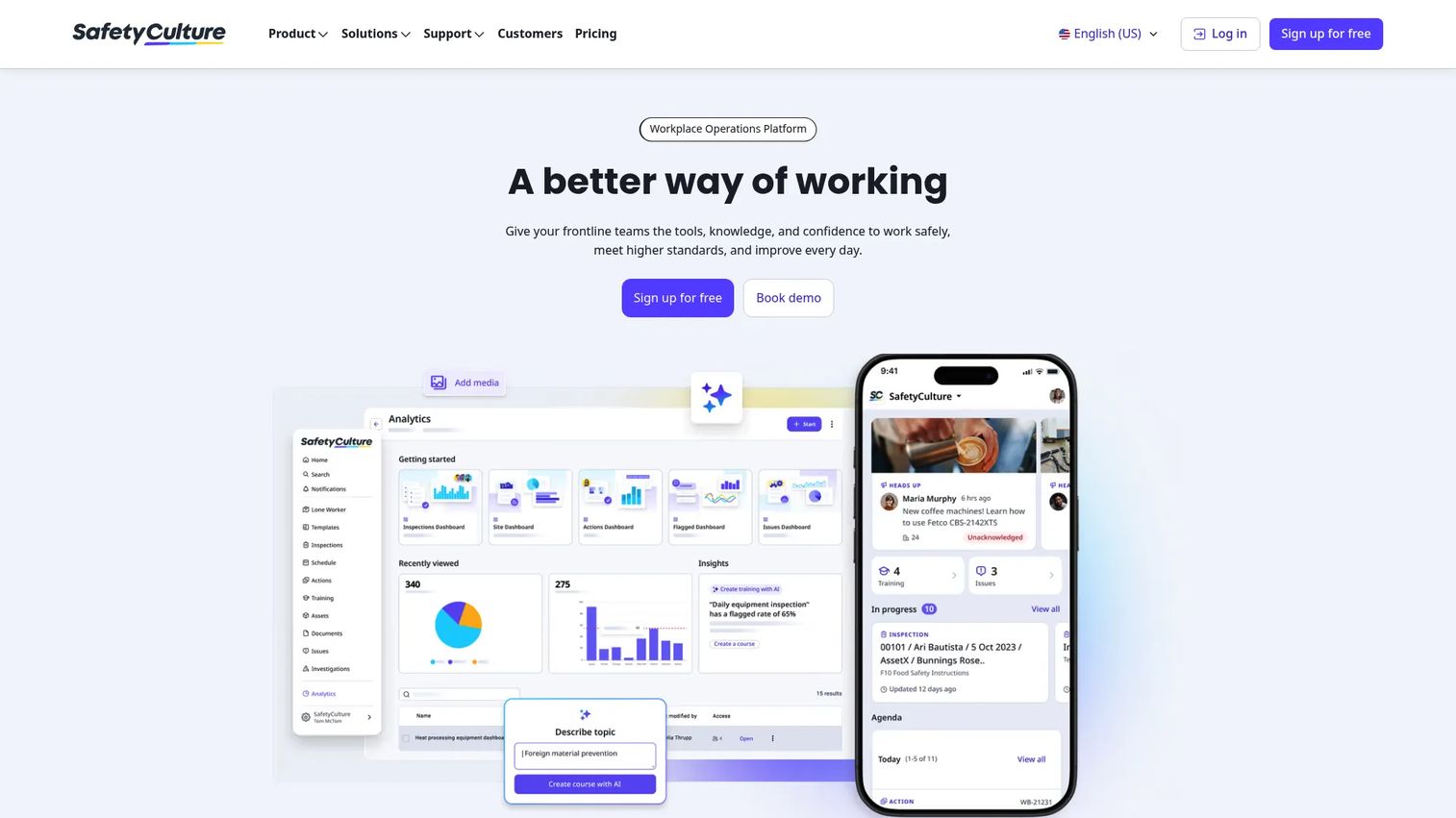
SafetyCulture is a workplace operations platform built around inspections, issue and action management, assets, training, and documents. In a hospital setting, it is the tool that keeps compliance checks, safety audits, and staff training moving on mobile devices rather than paper. It does not replace a full clinical records system, but it handles the operational discipline that keeps a facility audit-ready and consistent across sites.
Best for: Frontline hospital teams that need mobile inspections, recurring safety checks, and training workflows across one or many facilities.
Key strengths
- Inspections: Run standardized safety and compliance checks on any device, with photo evidence and timestamps.
- Issue and action management: Log a problem, assign an owner, and track it to resolution without chasing email threads.
- Training and templates: Deliver staff training and reuse checklist templates so procedures stay consistent across departments.
Why choose SafetyCulture: If your operational risk sits in inconsistent safety checks, missed maintenance, and training gaps rather than in patient billing, SafetyCulture targets exactly that. It suits multi-site operators who need frontline accountability and a clear audit trail more than a single patient database.
SafetyCulture pricing: The platform offers a free tier. Paid seat plans start with Lite at $5 per seat per month billed annually and Full at $24 per seat per month billed annually, with an Enterprise tier available on request. That structure lets a facility start small and scale seats as adoption grows.
2. Salesforce
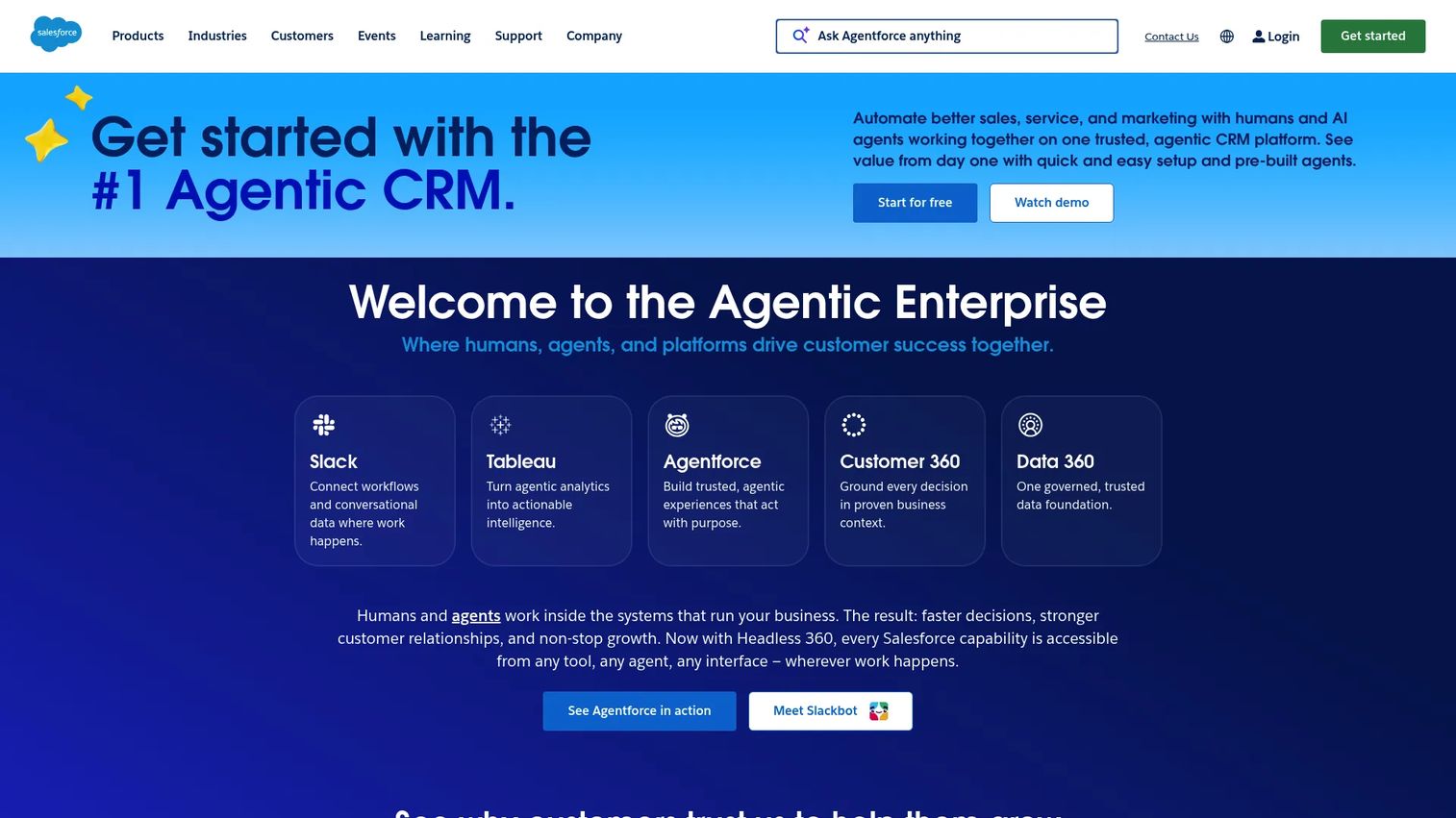
Salesforce is a cloud platform spanning CRM, sales, service, marketing, analytics, and AI-driven workflows. For hospital operations, it sits adjacent to a classic hospital management system rather than inside it. Where an HMS runs clinical and billing workflows, Salesforce excels at patient relationship management, service case handling, and coordination across the people and teams that touch a patient outside the exam room.
Best for: Health organizations that need CRM-grade patient engagement and service coordination layered on top of, or alongside, their clinical systems.
Key strengths
- Sales Cloud CRM: Manage patient and referral relationships with lead, account, contact, and opportunity records.
- Service Cloud: Handle patient inquiries and service cases with structured case management.
- AI and automation: Automate follow-ups and surface next actions across the customer suite.
Why choose Salesforce: Choose Salesforce when your gap is engagement and coordination, not core clinical workflow. It is broader than a traditional hospital administration software platform, which makes it powerful for patient communication and service, but you will pair it with a dedicated clinical system rather than replace one.
Salesforce pricing: Salesforce publishes a Free Suite at $0 and paid tiers including Starter Suite at $25 per user per month, Pro Suite at $100, Enterprise at $175, and Unlimited at $350, most billed annually. Pricing is per user, so cost scales with how many staff need access.
3. OSP Labs
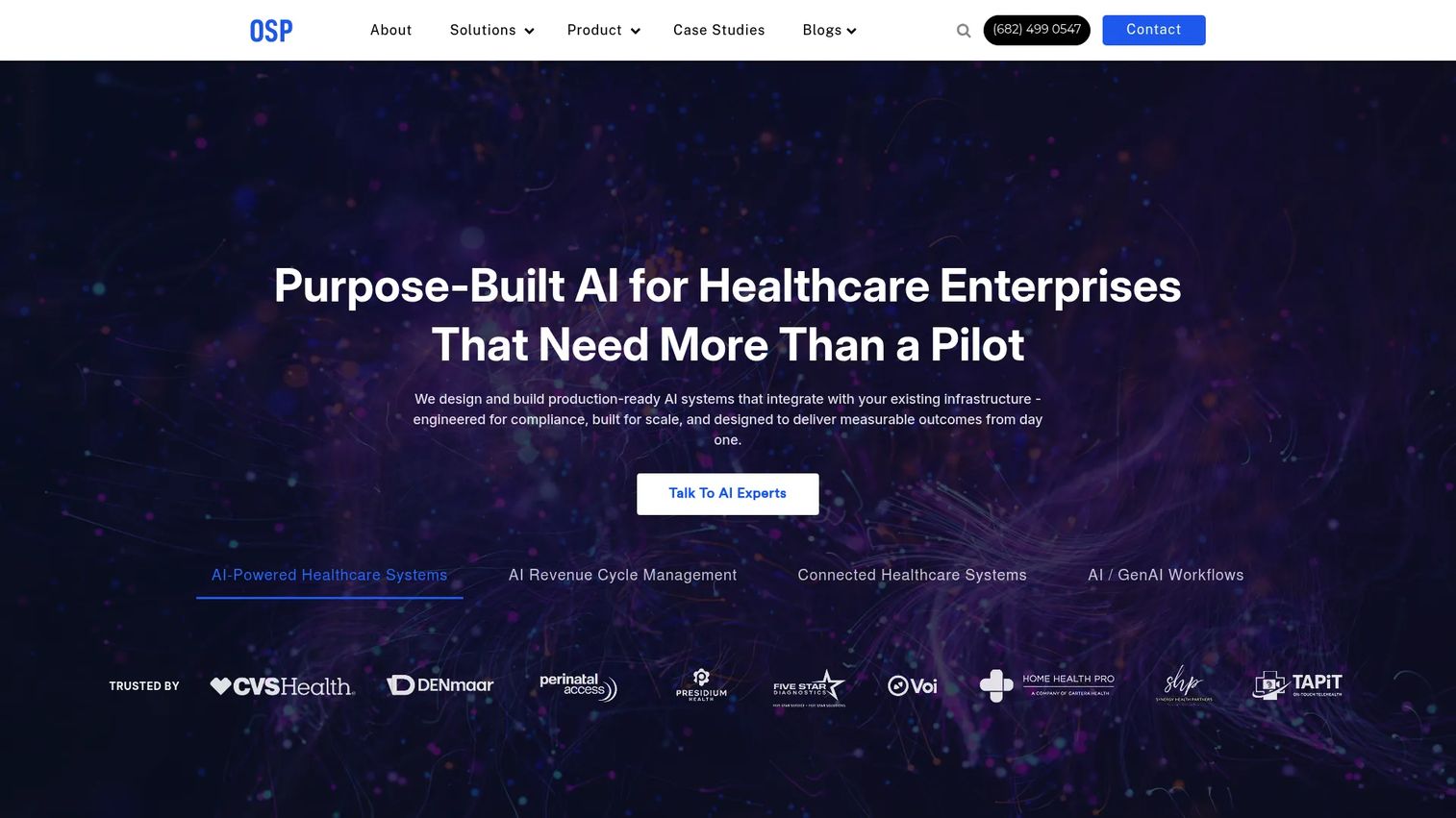
OSP Labs is a healthcare software development company that builds custom systems rather than selling a fixed product. That includes AI-powered clinical tools, EHR and EMR integrations, and revenue cycle automation tailored to how a specific organization actually works. If your requirements do not fit an off-the-shelf hospital management software system, OSP Labs is the build-it-your-way option.
Best for: Healthcare organizations with specific workflows that need custom development, deep integrations, or a system no packaged vendor covers cleanly.
Key strengths
- Custom AI-powered systems: Purpose-built clinical and operational software designed around your workflows.
- EHR and EMR integrations: Connect existing record systems so data stays consistent across tools.
- Revenue cycle management: Automate charge capture, claims, and reimbursement to reduce billing leakage.
Why choose OSP Labs: Choose OSP Labs when packaged software forces too many compromises and you have the appetite to invest in hospital management software development. The trade-off is a project rather than a subscription, which suits organizations that value fit over speed to deploy.
OSP Labs pricing: OSP Labs does not publish fixed pricing. Engagements are quote-based and scoped to the project, which is standard for custom development work. Expect a discovery and scoping conversation before any cost is set.
4. Adroit Infosystems
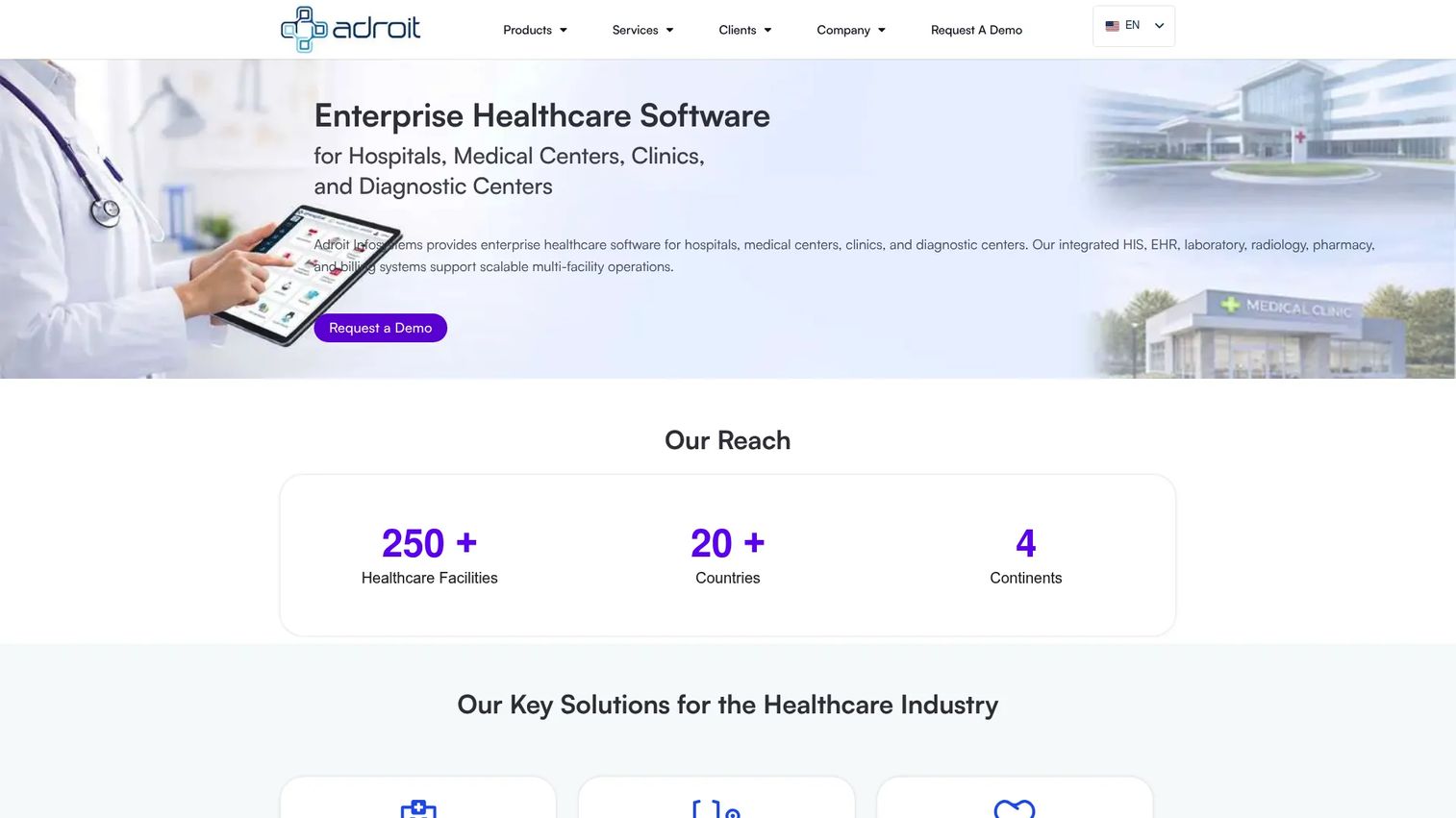
Adroit Infosystems is a healthcare software company offering enterprise systems for hospitals, clinics, labs, radiology, pharmacy, and dental practices. Its hospital product, eHospital Systems, brings integrated modules for EHR, billing, lab, radiology, pharmacy, and patient portals under one platform. This is the most enterprise-heavy option on the list, built for organizations that want broad module coverage across a facility or network.
Best for: Enterprise and multi-facility hospitals that need integration-heavy operations and wide module depth in a single hospital management systems platform.
Key strengths
- Hospital management software: The eHospital Systems product coordinates core hospital operations end to end.
- Clinic management software: eClinic Systems extends the same approach to outpatient and clinic settings.
- Integrated modules: EHR, billing, lab, radiology, pharmacy, and patient portals share one platform.
Why choose Adroit Infosystems: Choose Adroit when you are running a large or multi-site operation and want depth across every department rather than a lightweight tool. It fits buyers who prioritize comprehensive coverage and phased rollout across facilities.
Adroit Infosystems pricing: Adroit does not publish public pricing. Cost is quote-based and scoped to your facility size and module needs, so plan for a sales conversation to size the deployment.
5. athenaOne
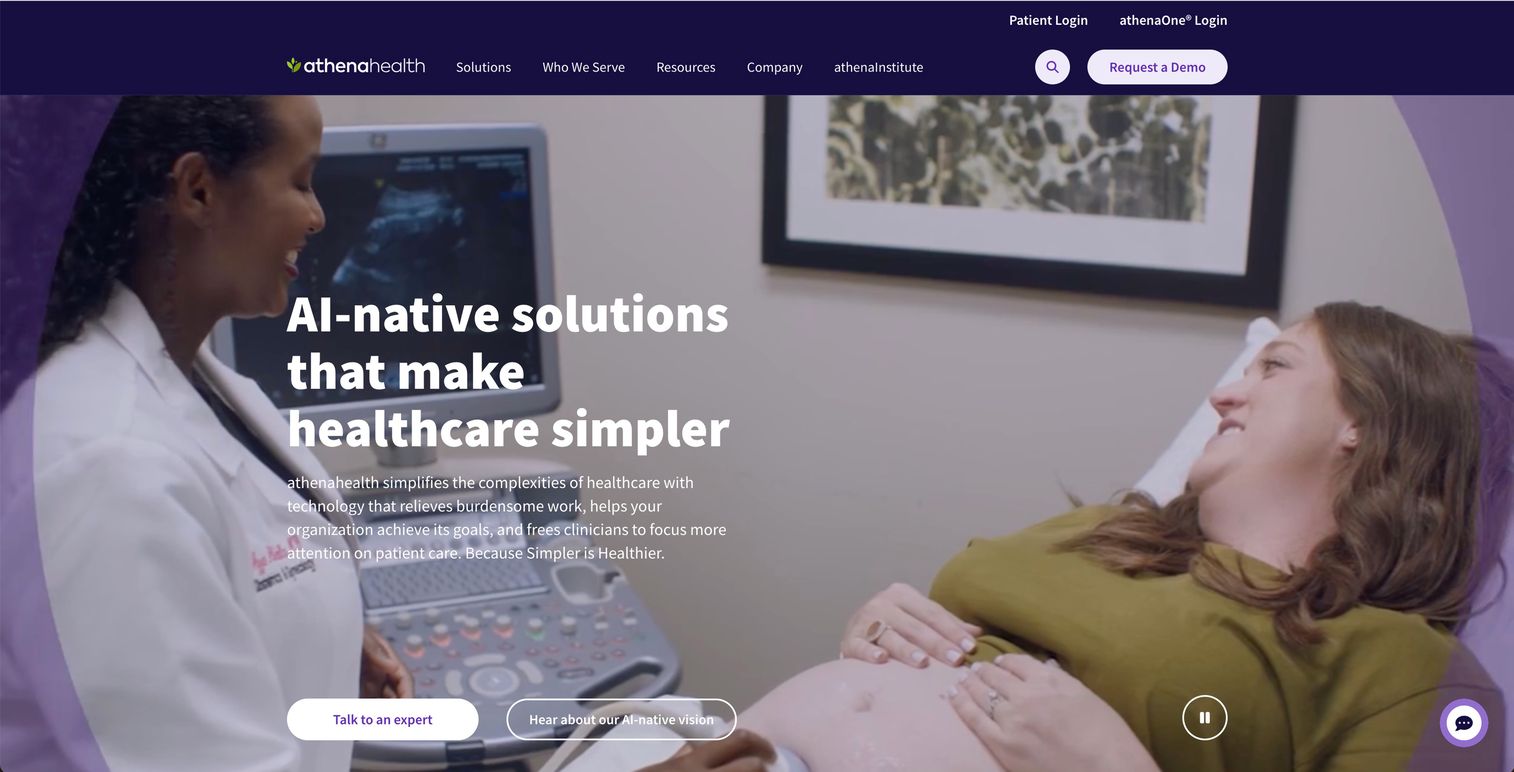
athenaOne is an AI-native, fully integrated platform combining EHR, medical billing, practice management, and patient engagement. It leans toward ambulatory and practice-based care, pairing clinical records with revenue cycle and self-service in one system. Real-time records, orders, and results sit alongside network-informed insights, which makes it a strong fit where care delivery and administrative coordination need to move together.
Best for: Ambulatory healthcare organizations that want an all-in-one EHR plus billing and patient engagement platform.
Key strengths
- Integrated EHR and billing: Clinical records, medical billing, and practice management in one connected system.
- AI-native workflows: Native AI capabilities support charting and administrative tasks.
- Real-time records and results: Charts, orders, and results update live, with network-informed insights.
Why choose athenaOne: Choose athenaOne when your priority is combining care delivery with claims and patient self-service rather than pure back-office operations. It performs best for practices that want clinical and administrative workflows in a single AI-native platform.
athenaOne pricing: athenahealth describes pricing as aligned to collections and transparent, but does not publish a fixed starting price or tier list. That collections-based model ties cost to your billing volume, so expect a quote scoped to your practice.
6. eHospital Systems
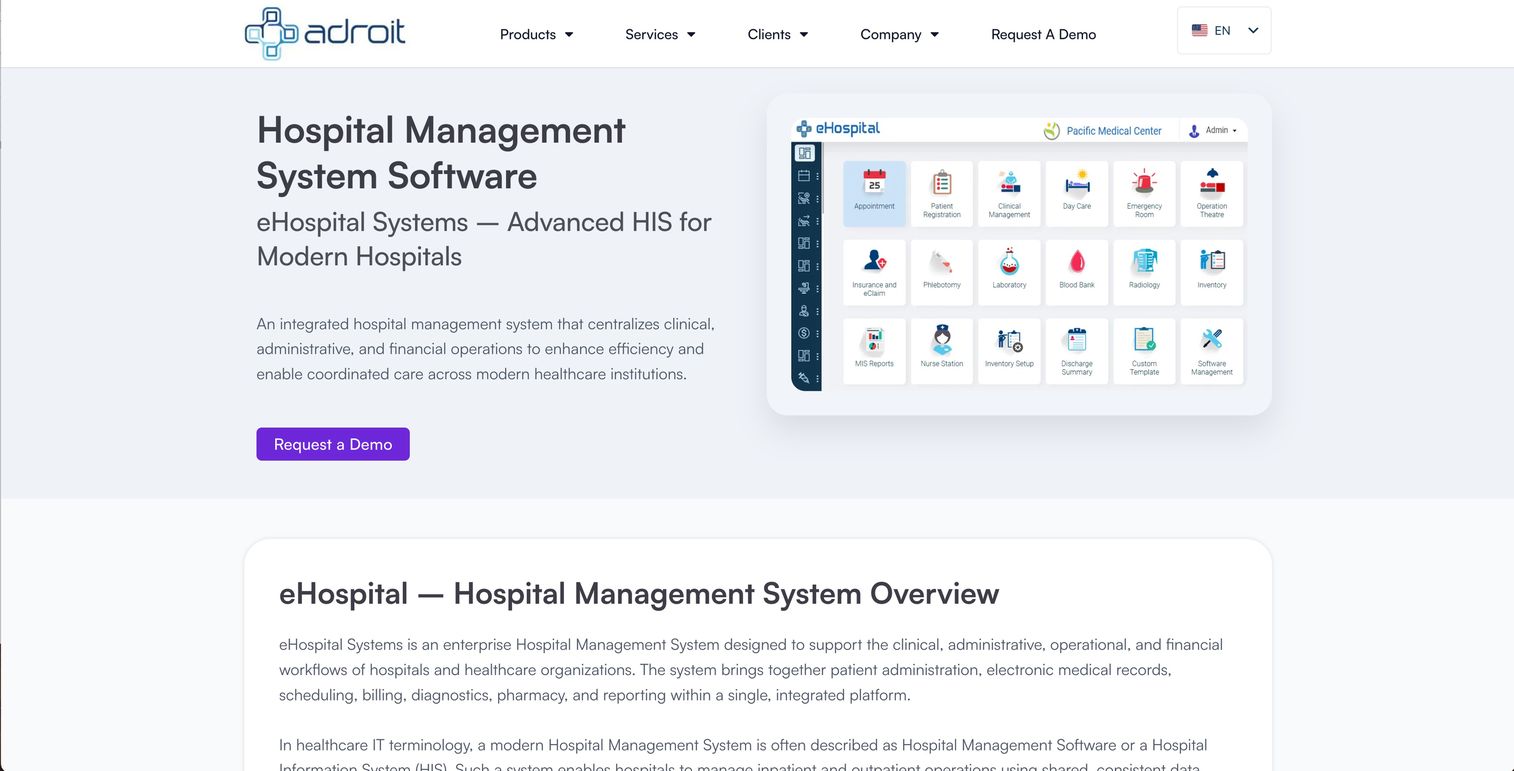
eHospital Systems is a hospital management software and hospital information system built to run a facility end to end. It covers electronic health records, outpatient and inpatient management, billing, laboratory, radiology, pharmacy, inventory, and reporting in one integrated platform. Operational coordination is the emphasis, with practical touches like SMS alerts and workflows designed to keep departments in sync.
Best for: Hospitals and healthcare organizations that need an integrated HIS and EMR platform covering both clinical and administrative workflows.
Key strengths
- Electronic health records: A unified clinical record across outpatient and inpatient care.
- Outpatient and inpatient management: Coordinate admissions, wards, and visits in one system.
- Billing, lab, radiology, pharmacy, inventory: Core operational modules integrated with reporting.
Why choose eHospital Systems: Choose eHospital Systems when you want a genuine end-to-end hospital information system rather than a single-purpose tool. It suits operators who value tight coordination across clinical and administrative departments in one platform.
eHospital Systems pricing: eHospital Systems does not publish public pricing. Cost is quote-based and depends on facility size and module scope, so a scoping conversation will set the figure.
7. NetSuite
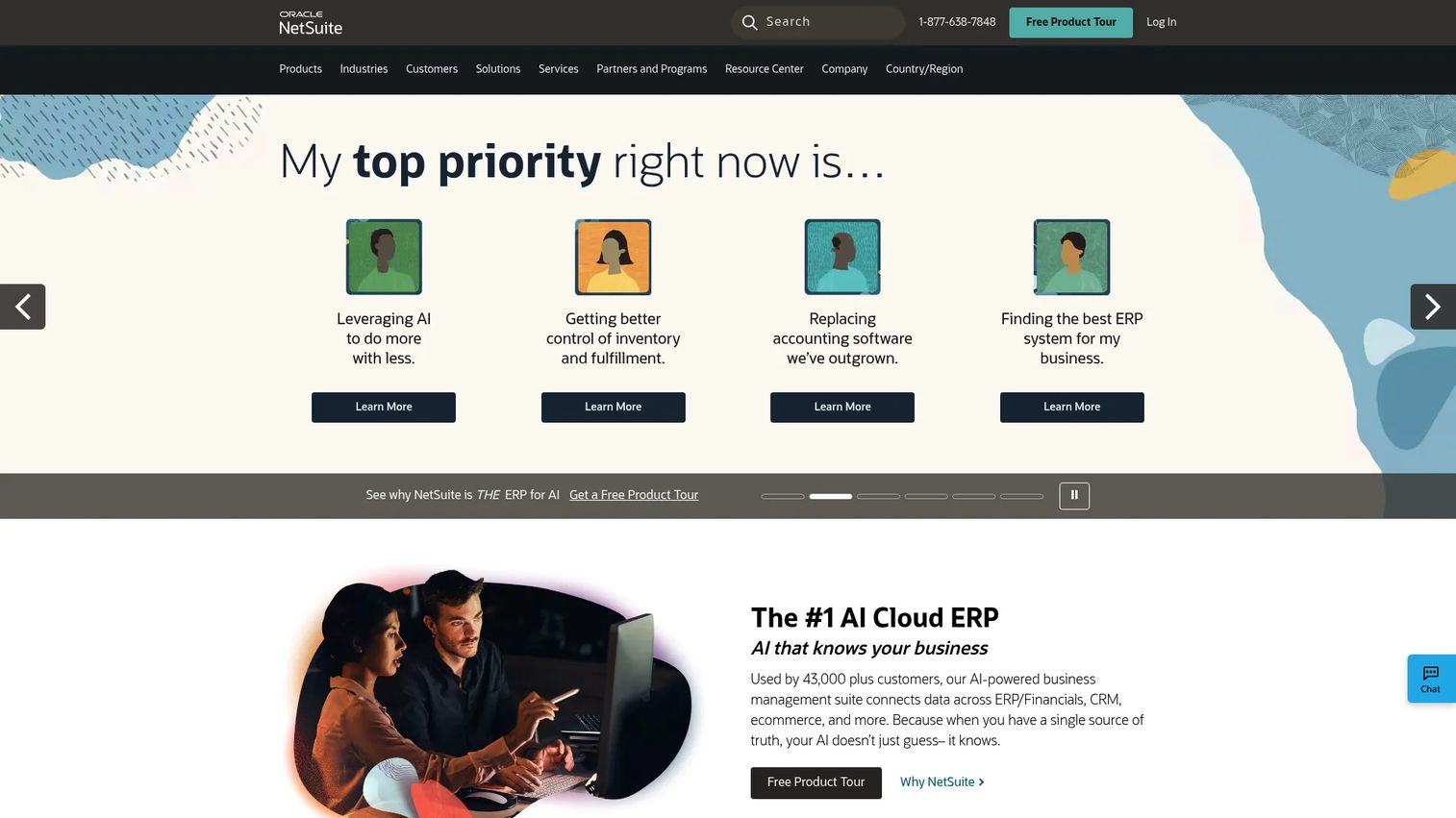
NetSuite is a cloud ERP and business management platform for finance, operations, and commerce. It is not a patient-facing hospital management system. It is the option for hospitals that treat operations as an enterprise resource planning problem: financials, inventory, supply chain, and multi-location reporting. When the priority is running the business side of a health network rather than the clinical record, NetSuite fits.
Best for: Hospital networks that prioritize ERP-style financials, inventory, and supply chain over a traditional patient management system.
Key strengths
- Core financials and ERP: Unified accounting, financial reporting, and operations management.
- Omnichannel commerce: Manage transactions and procurement across channels.
- SuiteCloud customization: Extend and tailor the platform with configurable modules.
Why choose NetSuite: Choose NetSuite when your bottleneck is financial visibility and supply chain across multiple locations, not clinical workflow. It pairs with a dedicated clinical system rather than replacing one, and it excels at consolidated reporting across a network.
NetSuite pricing: NetSuite does not publish public pricing. Cost is quote-based and scoped to modules, users, and configuration, which is standard for enterprise ERP. Plan for a sales conversation to size your deployment.
Considerations before you buy
Before you shortlist, pressure-test each option against the criteria that actually predict a good outcome.
Integration depth and interoperability
The value of any hospital management software system lives in how well it connects. Confirm EHR and EMR integration, lab and pharmacy interfaces, and whether the platform speaks common healthcare data standards. A system that cannot exchange data cleanly recreates the silos you are trying to remove.
Revenue cycle and billing capability
Ask exactly how the platform handles charge capture, claims submission, reimbursement tracking, and denial management. Billing automation is where hospitals recover leaked revenue, so verify the workflow rather than trusting a feature label. If finance cannot see claim status in one view, that is a gap.
Compliance and security
HIPAA compliance is table stakes, and GDPR matters if you handle data across borders. Confirm access controls, audit trails, and data encryption. The same diligence applies to any regulated stack, which is why buyers who evaluate audit management software or AI security posture management tools carry those instincts straight into healthcare procurement.
Deployment model and scalability
Decide between cloud hospital software and on-premise before you evaluate features, because it shapes cost, maintenance, and rollout. Cloud scales faster and shifts maintenance to the vendor. Confirm the system supports multi-facility growth if a network is on your roadmap.
Reporting, mobile, and self-service
Check that hospital reporting dashboards surface operational, clinical, and financial metrics without an analyst exporting data. Confirm mobile access for staff and a patient portal for self-service. These reduce coordination cost as volume grows.
Conclusion
The right hospital management software depends on where your bottleneck actually sits. If frontline compliance and training are the pain, SafetyCulture targets that directly. If you need patient engagement and service coordination, Salesforce fits alongside your clinical system. For custom builds, OSP Labs; for enterprise multi-facility depth, Adroit Infosystems and eHospital Systems; for ambulatory care plus billing, athenaOne; and for ERP-style financials and supply chain, NetSuite.
Do not try to solve every problem with one purchase. Name your single biggest bottleneck, whether that is billing leakage, records fragmentation, or inventory visibility, then shortlist the two or three tools that address it head-on. From there, book demos, run each against your real workflows, and confirm integration and compliance before you commit. The best hospital software systems earn their cost by removing manual coordination, so measure them on exactly that.
If you build software yourself and want to show complex workflows without a live environment, Guideflow turns your product into guided, self-serve interactive experiences. You can capture a flow in a few clicks, personalize it for different audiences, share it anywhere, and analyze engagement in real time. Start your journey with Guideflow today!
FAQs
A capable hospital management system should cover patient registration, scheduling, billing and revenue cycle management, clinical records, and lab, pharmacy, and radiology workflows. Look for inventory management, reporting dashboards, a patient portal, mobile access, and telemedicine. Integration across these modules is what separates a true system from a bundle of tools.
EHR and EMR software focus on the clinical record: patient charts, diagnoses, orders, and results. Hospital management software is broader, coordinating administrative and financial workflows like registration, scheduling, billing, and inventory alongside clinical data. Most hospitals run both, which is why EHR and EMR integration is a core buying criterion.
It depends on your priorities. Cloud hospital software scales faster, shifts maintenance to the vendor, and supports remote and multi-site access. On-premise gives you more direct control over data and infrastructure. Decide this early, because it shapes cost, compliance approach, and rollout timeline more than any single feature.
Yes. Strong hospital software systems include revenue cycle management that covers charge capture, claims submission, reimbursement tracking, and denial management. Billing automation is where hospitals recover leaked revenue, so verify the actual workflow, including how claim status and denials surface, rather than trusting a feature label.
A patient portal should let patients book and manage appointments, view records and results, and pay bills without calling. Mobile access matters, since patients act from phones. The best portals move routine work off staff, which reduces phone volume and coordination cost as patient numbers grow.
It is one of the most important criteria. Without clean EHR and EMR integration, a hospital management software system recreates the data silos you are trying to remove. Confirm the platform exchanges data with your existing record systems and supports common healthcare data standards before you commit.
Most modern hospital administration software includes mobile access for staff and patients. Staff act on schedules, records, and alerts from tablets and phones, while patients use a portal on mobile for booking and payments. Confirm what each system actually supports on mobile, since depth varies between vendors.
Effective hospital reporting dashboards surface operational, clinical, and financial metrics without an analyst exporting data manually. Evaluate whether you can see claim status, bed occupancy, and department performance in real time. If answering a basic question requires a spreadsheet export, the reporting layer is not doing its job.