Your maintenance team already has alarms, work orders, and dashboards. The hard part is deciding which warning justifies action before a failure creates downtime.
That gap is expensive. According to IFS's State of Service 2025 report, 94% of manufacturers have been impacted by unexpected equipment downtime. Yet only 21% run predictive maintenance at scale. The distance between those two numbers is where asset performance management software earns its place.
APM software closes the loop between equipment signals and maintenance decisions. It combines condition data, reliability methods, and operational context to help teams decide which asset risk deserves attention, and what to do about it.
The APM market hit $26.5 billion in 2025 and is projected to reach $67.5 billion by 2033, according to Grand View Research (2026). At that growth rate, every serious operations leader will face this software category whether they plan for it or not.
This guide is for founders evaluating APM platforms for a portfolio company or a new operations leader, and for any team ready to move past reactive maintenance.
What's inside
This guide covers seven APM platforms selected for their relevance to industrial operations, maintenance execution, and reliability programs in 2026.
- Who it's for: Founders screening APM platforms, operations leaders shortlisting options, and reliability teams evaluating pilot readiness
- Selection criteria: Verified capabilities, deployment fit, integration depth with EAM or CMMS systems, and how far each tool carries a signal from detection to a completed maintenance action
- Category boundaries covered: How APM differs from EAM, CMMS, SCADA, and data historians
- What to validate: Data readiness, integration ownership, and pilot design before committing
Pricing figures were verified against live vendor sources. G2 ratings reflect current listings.
TL;DR
- Best for sensor-led maintenance intelligence: Tractian pairs first-party industrial IoT sensors with AI diagnostics and a built-in CMMS.
- Best for large enterprise asset operations: IBM Maximo Application Suite covers the full asset lifecycle alongside APM and reliability workflows.
- Best for power and energy fleets: GE Vernova APM focuses on risk-based reliability for high-value industrial and energy assets.
- Best for industrial data environments: AVEVA APM connects to historians and operational systems for real-time predictive analytics.
- Best for SAP-centered enterprises: SAP Asset Performance Management fits organizations where maintenance already runs through SAP EAM.
- Best for machine health diagnostics: Augury monitors rotating equipment continuously and explains failure causes with AI diagnostics.
- Best for AI-driven reliability at scale: C3 AI Reliability unifies fragmented asset data to predict equipment failures across large portfolios.
What is asset performance management software?
Asset performance management software is a category of industrial software that combines asset data, condition signals, reliability methods, and maintenance workflows to improve equipment availability, reduce failure risk, and prioritize the work that protects production.
How APM software works
The operating loop follows a consistent pattern across platforms:
- Collect data from sensors, inspections, maintenance records, historians, SCADA, and enterprise systems
- Detect health changes, anomalies, patterns, or failure risk
- Apply context from asset criticality, failure modes, reliability strategy, and operating conditions
- Prioritize action across the maintenance backlog
- Route the decision into maintenance planning, work execution, or operational review
- Learn from outcomes and improve the model or strategy
Core capabilities to look for
- Asset health monitoring and condition-based maintenance workflows
- Predictive analytics and anomaly detection
- Reliability strategy and failure-mode analysis (FMEA, RCM)
- Risk and criticality prioritization
- Integration with EAM, CMMS, ERP, historians, and operational systems
- Alert, case, and work-order handoff into execution systems
- Asset performance reporting across sites and fleets
APM vs EAM, CMMS, SCADA, and data historians
One of the most common evaluation mistakes is treating these categories as interchangeable. They are not.
| System | Primary job | What it usually owns |
|---|---|---|
| APM | Predict failure risk and prioritize reliability action | Asset health, risk, analytics, reliability strategy |
| EAM | Govern enterprise assets across the lifecycle | Asset records, capital planning, maintenance governance |
| CMMS | Plan and execute maintenance work | Work orders, schedules, parts, labor history |
| SCADA | Monitor and control industrial processes | Real-time control and operational visibility |
| Data historian | Store time-series operating data | Equipment, sensor, and process data history |
APM does not replace these systems. It works alongside them, consuming data from historians and SCADA, and routing decisions into CMMS or EAM for execution. The strongest deployments treat APM as the decision layer, not another standalone dashboard.
For more context on adjacent categories, the asset lifecycle management software guide covers the broader EAM and lifecycle management landscape, and the best predictive analytics software tools guide covers analytics platforms that overlap with APM's analytics layer.
When to use asset performance management software
Reduce unplanned downtime on critical equipment
APM earns its place when equipment failures carry a material cost, a safety implication, or a service impact. Start with criticality: Not every asset needs predictive attention. Focus on the machines where failure creates real production, safety, or revenue risk. A platform that surfaces every possible alert without prioritization creates noise, not decisions.
Move from calendar-based maintenance to condition-based decisions
Preventive schedules still matter, but fixed intervals can create unnecessary work on healthy equipment while missing a developing fault on another. APM gives maintenance teams the data and decision layer to act on what equipment condition actually shows, rather than what a calendar says.
Give a new operations leader a repeatable reliability system
This is where the founder lens matters most. If your company has added sites, inherited fragmented maintenance practices, or hired a VP of Operations who needs a credible foundation on day one, APM software can provide that baseline without stitching together spreadsheets and disconnected monitoring tools. The question is whether the data already exists to support it.
Use APM when:
- Equipment failures are creating unplanned production losses
- Maintenance decisions rely on calendar intervals rather than condition evidence
- A new operations leader needs a system that works before the next board review
- Sensor or historian data exists but has no decision workflow attached to it
Asset performance management software comparison
The best APM tool depends on where your evidence starts. A company with rich sensor coverage but weak execution workflows has different needs than one with mature SAP maintenance processes but no predictive analytics layer.
| # | Product | Best for | Key differentiator | Pricing | G2 rating |
|---|---|---|---|---|---|
| 1 | Tractian | Sensor-led maintenance and industrial condition monitoring | First-party sensing paired with diagnostics and a built-in CMMS | From $60/user/month | 4.7/5 |
| 2 | IBM Maximo Application Suite | Global, asset-intensive enterprises | Broad EAM and APM coverage with enterprise asset governance | From under $40K/year | 4.4/5 |
| 3 | GE Vernova Asset Performance Management | Energy, power, and asset-intensive reliability programs | Risk-based reliability and asset strategy workflows | Custom pricing | 4.4/5 |
| 4 | AVEVA Asset Performance Management | Industrial data environments and predictive analytics | Real-time condition monitoring with historian and operational data integration | Custom pricing | 3.8/5 |
| 5 | SAP Asset Performance Management | SAP-centered enterprises | Native connection to SAP EAM and S/4HANA maintenance processes | From $1.15/month (add-on) | 4.4/5 |
| 6 | Augury | Machine health and manufacturing diagnostics | AI diagnostics for rotating equipment with turnkey sensor deployment | Custom pricing | 4.6/5 |
| 7 | C3 AI Reliability | Complex operations requiring AI-driven reliability modeling | Unified asset-health view across fragmented data sources | Custom pricing | 4.3/5 |
Best 7 asset performance management software tools for 2026
These seven tools differ most in their data source, reliability workflow depth, integration model, and the distance between an alert and a completed maintenance action. Choose based on your current operating stack, not the longest feature list.
1. Tractian
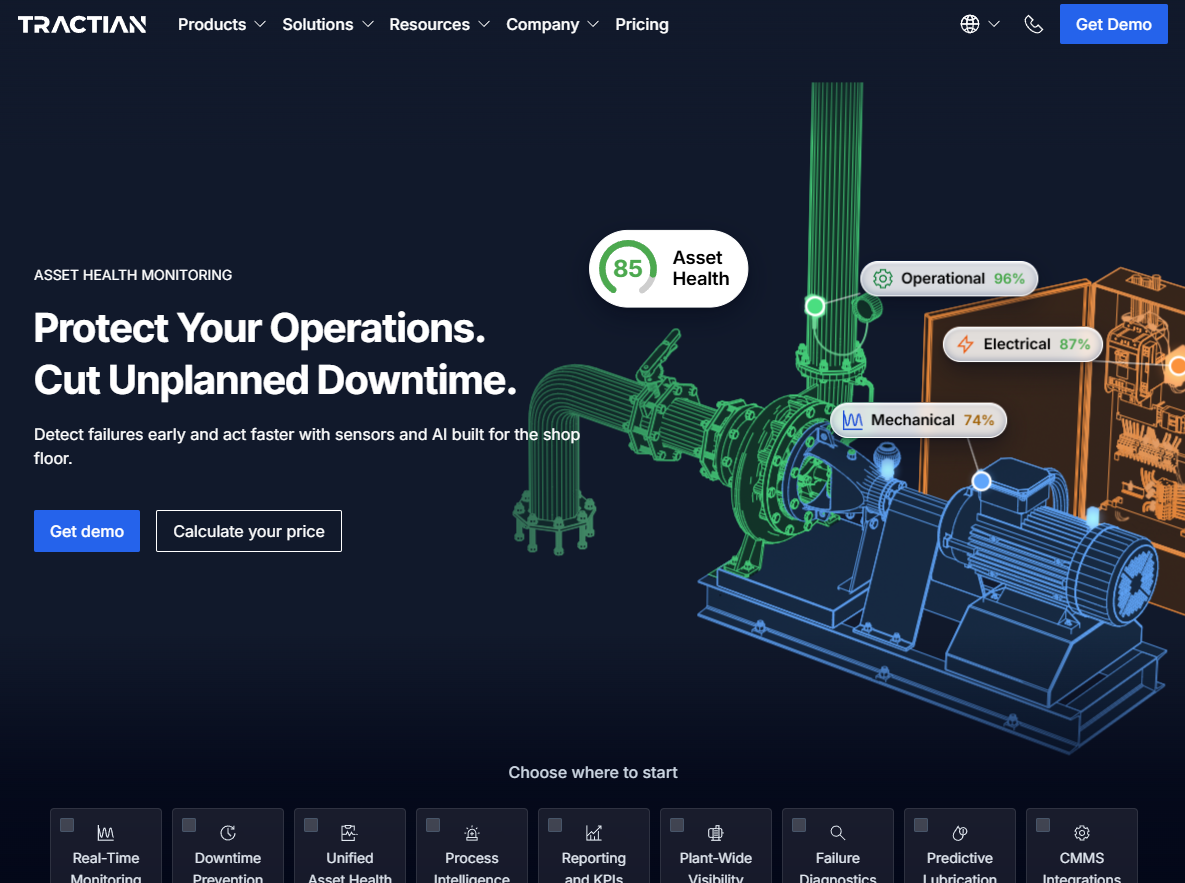
Tractian is an AI-powered industrial asset health platform that combines first-party condition monitoring sensors with diagnostics software and a built-in CMMS. It monitors vibration, ultrasound, temperature, RPM, and runtime in real time, and uses machine learning to detect failure patterns, generate root-cause analysis, and create automated failure reports. Maintenance teams can manage work orders, preventive schedules, parts inventory, and reporting inside the same platform.
Best for: Manufacturing and industrial operations teams that need a practical connection between machine condition and day-to-day maintenance decisions, without building a separate sensor infrastructure.
Key features
- Real-time vibration, ultrasound, temperature, RPM, and runtime monitoring
- AI failure detection, root-cause analysis, and automated failure reports
- CMMS work orders, preventive maintenance, and parts management
- Asset performance reporting and integrations with existing systems
Why choose Tractian: The integrated sensor-plus-software model matters when a team wants asset-health data without stitching together a separate IoT platform and a maintenance system. Validate sensor coverage for your specific asset classes, installation requirements, and the work-order handoff before committing.
Tractian pricing: Standard CMMS plans start from $60 per user per month (billed annually, minimum five users). Enterprise CMMS plans start from $100 per user per month (billed annually, minimum ten users). Bundle pricing that includes condition monitoring hardware requires a direct quote from Tractian.
G2 rating: 4.7/5
2. IBM Maximo Application Suite
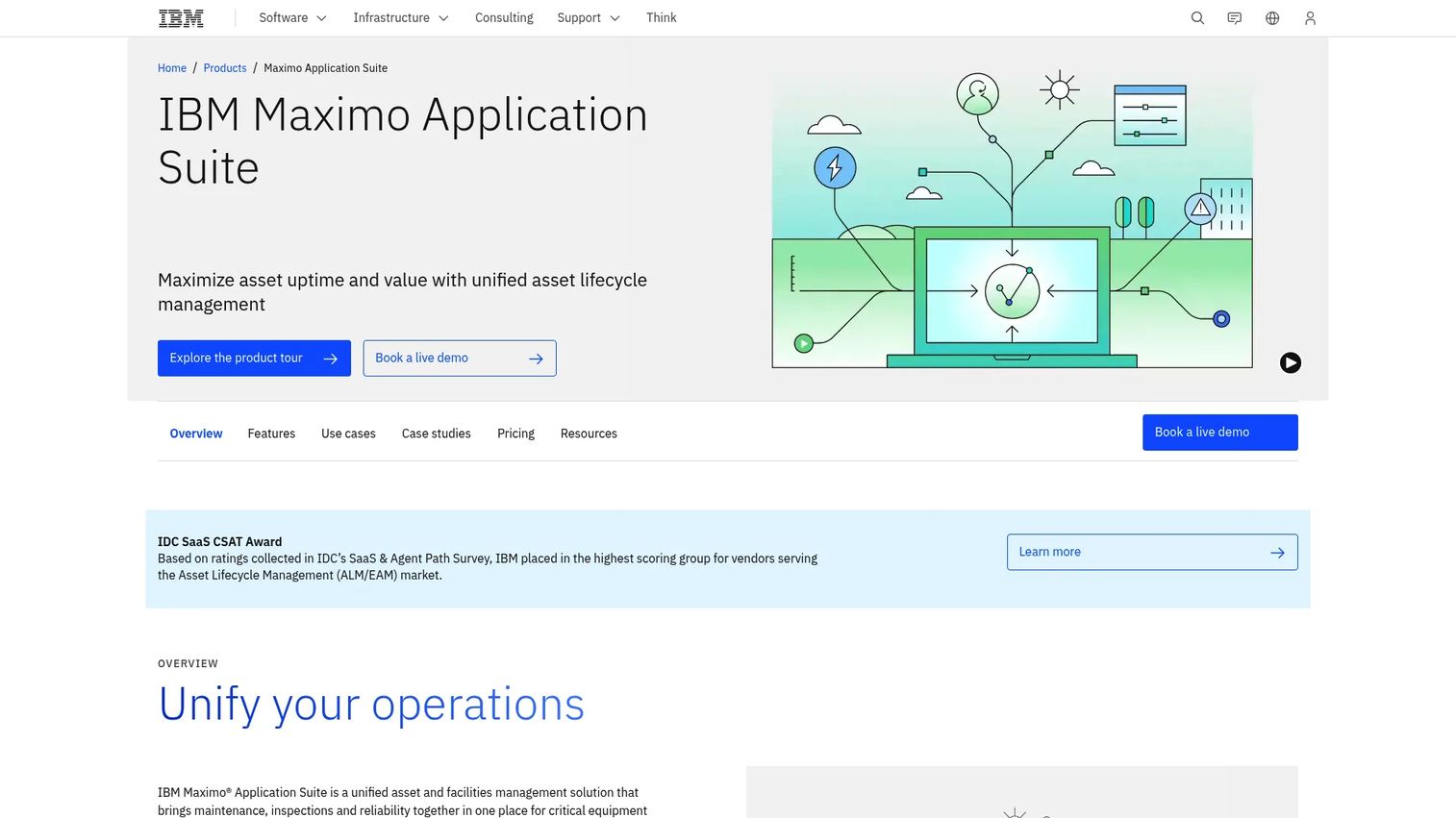
IBM Maximo Application Suite is a unified platform covering enterprise asset management, asset performance management, AI-driven maintenance and reliability, inspections, field service, inventory optimization, and asset investment planning. It serves regulated, capital-intensive, and multi-site organizations where asset governance spans the full lifecycle. The Suite is available as client-managed software and as SaaS, with Essentials, Standard, and Premium editions. IBM describes Essentials options for Maintenance, Inspection, Space Management, and related modules, with several starting under $40K per year.
Best for: Large enterprises with global operations, complex asset hierarchies, established governance requirements, and a serious integration roadmap connecting maintenance, procurement, and finance.
Key features
- Enterprise asset lifecycle management
- Asset health monitoring and AI-driven maintenance insights
- Computer vision inspections and field service management
- Inventory optimization and asset investment planning
- Broad enterprise integration capabilities
Why choose IBM Maximo Application Suite: Maximo belongs on the shortlist when functional breadth and governance matter as much as predictive analytics depth. The honest question is not whether the platform has enough capability. It is whether your organization has the data quality, operating discipline, and implementation ownership to use that breadth. Factor in professional services scope early.
IBM Maximo Application Suite pricing: Essentials editions start under $40K per year for SaaS. Standard and Premium tiers are priced upon request. IBM also offers a client-managed deployment option. Contact IBM directly for full packaging details and applicable licensing units.
G2 rating: 4.4/5
3. GE Vernova Asset Performance Management
GE Vernova Asset Performance Management is a modular APM suite focused on monitoring, maintaining, and optimizing critical industrial assets. It covers asset health and condition monitoring, risk-based asset strategy management, predictive maintenance with AI and machine learning analytics, mechanical integrity and inspection workflows, and integration with EAM or CMMS systems, ERP, historians, sensors, and IT infrastructure. GE Vernova serves energy, utilities, manufacturing, and other asset-intensive industries. Verdantix named GE Vernova among the top vendors in its 2024 Green Quadrant Asset Performance Management Solutions report.
Best for: Energy, utilities, and asset-intensive industrial teams managing critical equipment where failure risk affects safety, production, or service continuity, and where risk-based reliability is a formal operating requirement.
Key features
- Asset health and condition monitoring
- Risk-based asset strategy management
- Predictive maintenance with AI and ML analytics
- Mechanical integrity and inspection workflows
- Integration with EAM, CMMS, ERP, historians, and sensors
Why choose GE Vernova APM: The platform fits buyers who need an APM program structured around asset risk and industrial reliability strategy rather than standalone predictive alerts. Confirm which execution workflows require your existing CMMS or EAM, and plan that integration before the contract.
GE Vernova APM pricing: GE Vernova does not publish a fixed price. The cost depends on applications selected, deployment scale, deployment type (cloud or on-premises), and licensing model. Contact GE Vernova for a quote based on your specific program scope.
G2 rating: 4.4/5
4. AVEVA Asset Performance Management
AVEVA Asset Performance Management monitors industrial assets continuously in real time to identify, diagnose, and prioritize impending equipment problems. The platform applies AI and machine learning for predictive and prescriptive analytics, risk-based asset strategy optimization, production optimization, and digital twin visualization. It connects to CMMS systems, ERP platforms, and data historians, and supports mobile-enabled operations for field teams.
Best for: Process industries and industrial enterprises with significant operational data and historian infrastructure that need a predictive analytics layer to improve reliability and reduce unplanned downtime.
Key features
- Real-time condition monitoring across industrial assets
- AI and ML-powered predictive and prescriptive analytics
- Risk-based asset strategy optimization
- Digital twin visualization
- Integration with CMMS, ERP, and data historians
Why choose AVEVA APM: This platform fits when the data already exists across historians and operational systems but lacks a decision workflow. Before signing, confirm who owns the data model, who maintains data quality, and how an AVEVA alert becomes a completed work order in your existing execution system.
AVEVA APM pricing: AVEVA does not display pricing on its website. Contact AVEVA directly for commercial model details and applicable implementation terms.
G2 rating: 3.8/5
5. SAP Asset Performance Management
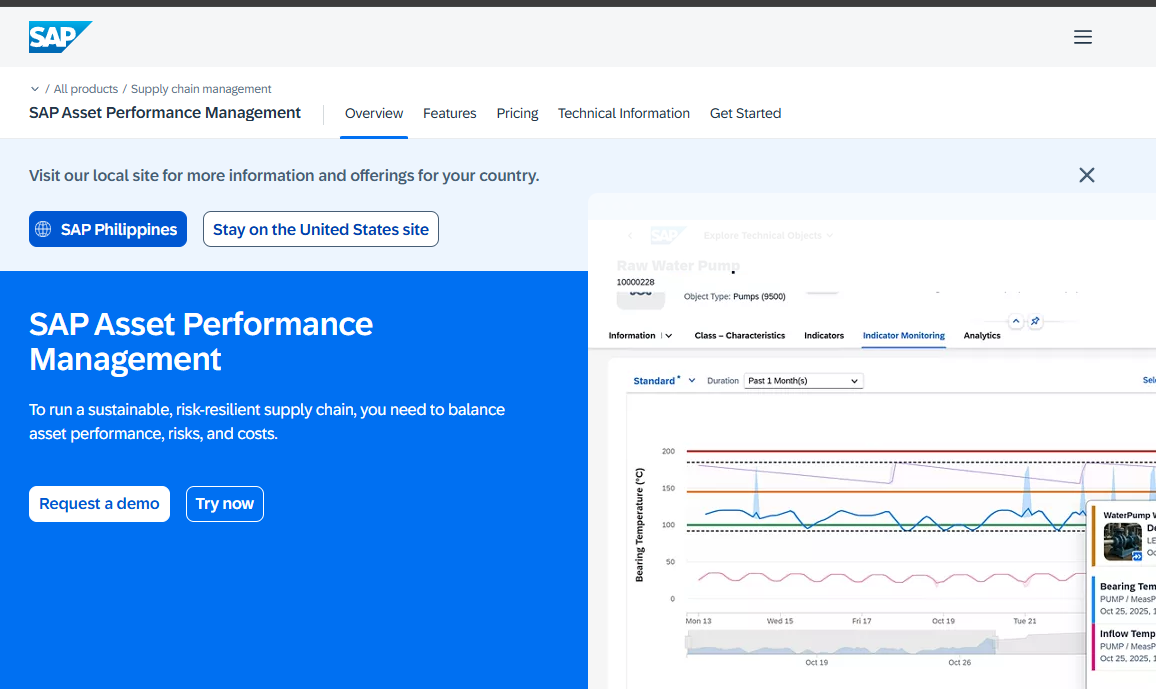
SAP Asset Performance Management is a cloud solution for asset-intensive organizations that want risk-based, predictive, and reliability-centered maintenance integrated with SAP Enterprise Asset Management and SAP S/4HANA. It covers asset risk and criticality assessment, reliability engineering using RCM and FMEA methodologies, IoT-based asset health monitoring with anomaly detection, and AI-assisted visual inspection. The platform's primary strength is architectural fit when maintenance, procurement, supply chain, and enterprise asset processes already run within SAP.
Best for: SAP-centered enterprises that want asset performance insight natively connected to established maintenance and enterprise workflows, without introducing a separate integration layer.
Key features
- Asset risk and criticality assessment
- Reliability engineering using RCM and FMEA
- IoT-based asset health monitoring and anomaly detection
- AI-assisted visual inspection
- Native integration with SAP EAM and SAP S/4HANA
Why choose SAP APM: Native ecosystem fit can matter more than standalone analytics depth when operational data and maintenance execution already live inside SAP. For organizations outside the SAP landscape, the integration case weakens significantly. Confirm whether the reliability team's operating workflow and the IT team's data governance model align with SAP's architecture before the project begins.
SAP APM pricing: The base product is priced upon request. The advanced capabilities add-on is listed at $1.15 per Capacity Unit per month. Additional productive and non-productive tenants are also priced upon request. Contact SAP for full packaging and applicable licensing terms.
G2 rating: 4.4/5
6. Augury
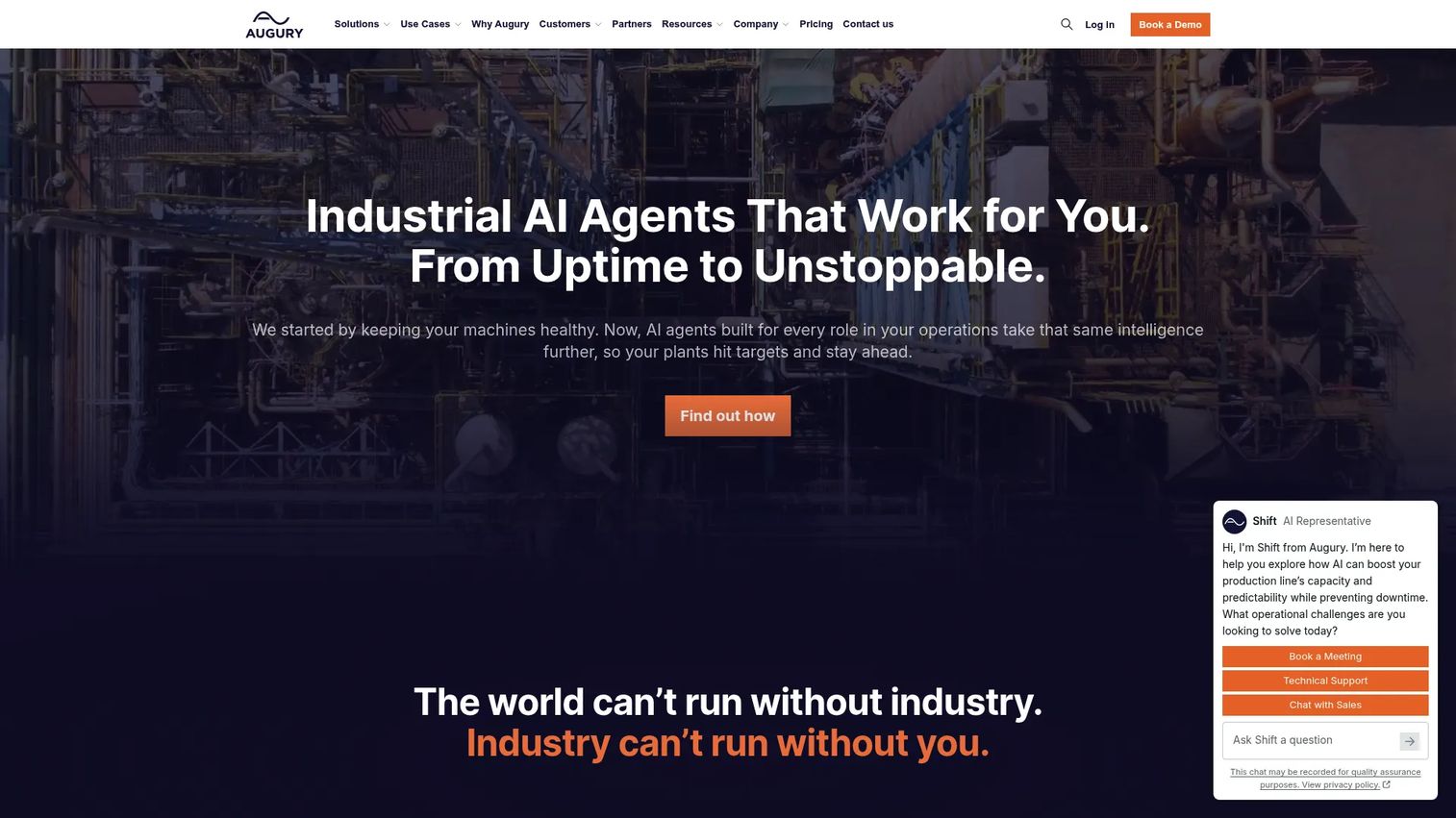
Augury provides AI-powered machine health and process health monitoring for manufacturing and industrial operations. The platform uses continuous industrial IoT sensors to monitor equipment condition, then applies AI diagnostics to detect issues, explain root causes, and prescribe maintenance actions. More than 170 global manufacturers use Augury across 40 countries, with 1.1 billion-plus hours of machine readings powering its agents and notifications. Verdantix named Augury a Leader in the 2025 Green Quadrant for Industrial AI Analytics Software. A Forrester Total Economic Impact study measured 310% ROI with a payback period under six months.
Best for: Manufacturers that need deeper visibility into rotating equipment and machine health, especially when early failure detection can prevent quality losses, capacity constraints, or unplanned downtime.
Key features
- Continuous machine health monitoring with industrial IoT sensors
- AI diagnostics that detect issues, explain causes, and prescribe actions
- Process optimization for production efficiency and sustainability
- Integration with maintenance systems and operational platforms
Why choose Augury: Choose Augury when machine health is the immediate bottleneck and the failure mode is observable through condition data. Make the implementation question specific before starting: Which assets, which failure modes, what data is available, and who acts on an alert. A machine-health deployment should begin with one business case the board can understand, such as avoiding a repeat failure on a production bottleneck.
Augury pricing: Augury uses a turnkey annual service model billed per machine per year. The per-machine fee covers sensors, software, connectivity, installation, support, updates, and unlimited diagnostics. Contact Augury for pricing based on asset count and program scope.
G2 rating: 4.6/5
7. C3 AI Reliability
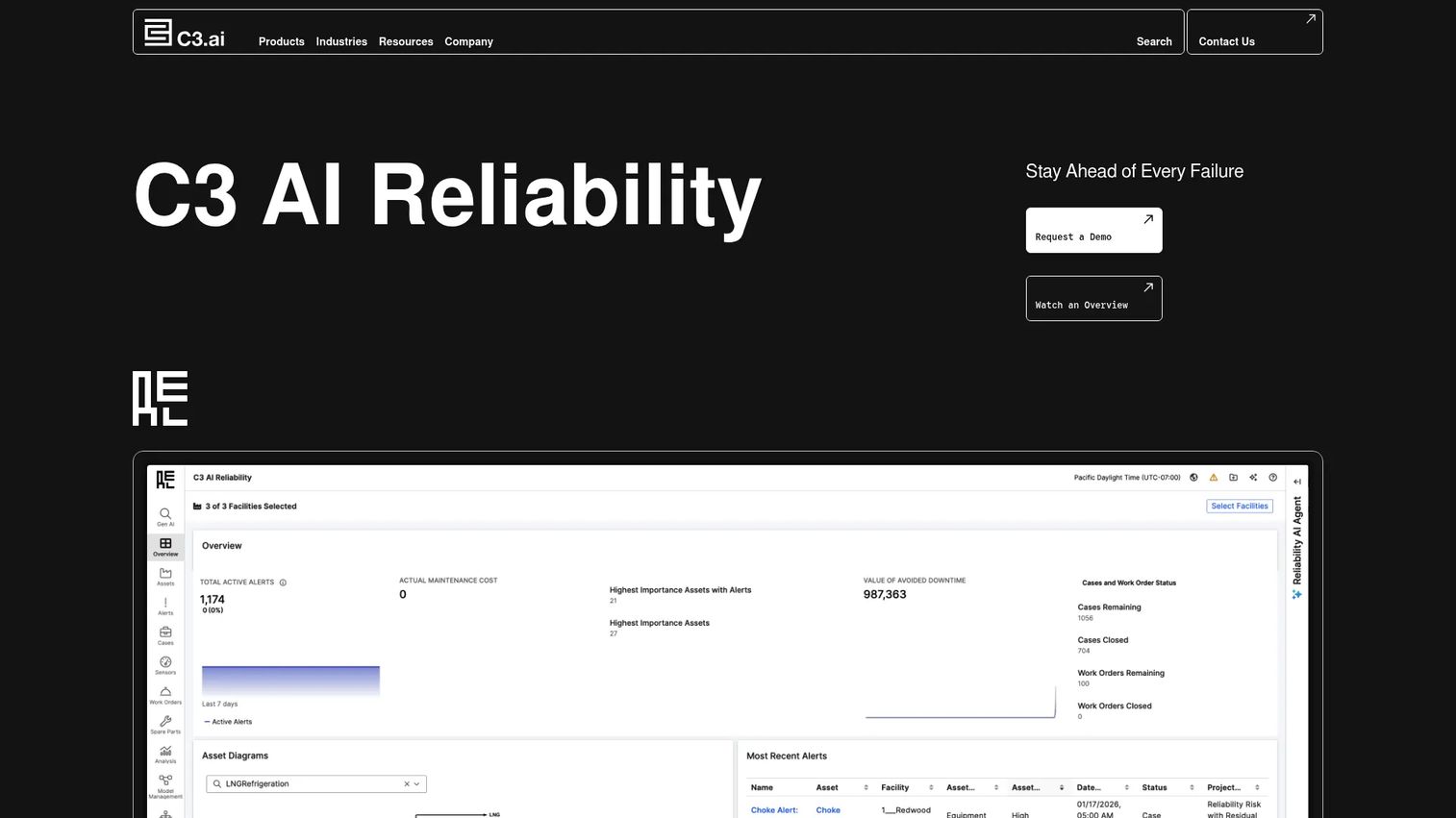
C3 AI Reliability is an AI-enabled predictive maintenance application that unifies sensor data, maintenance records, operational documents, and process data into a single asset-health view. It applies time-series and machine-learning models to predict equipment failures, automates root-cause diagnostics, generates prioritized risk scores and alerts for critical assets, and provides AI-powered search and chat for asset history and operational insights. The platform targets large enterprises in asset-intensive industries dealing with fragmented operational data and complex failure patterns.
Best for: Large organizations that need AI-driven reliability models across complex asset portfolios and multiple operational data sources, and where a cross-functional AI program already exists or is being built.
Key features
- Unified asset-health view combining sensor data, documents, maintenance records, and process data
- Predictive failure detection using time-series and machine-learning models
- Automated root-cause diagnostics and maintenance recommendations
- AI-powered search for asset history and operational insights
- Prioritized risk scoring and alerting for critical equipment
Why choose C3 AI Reliability: This platform fits organizations with meaningful data scale and a serious AI program. Counter that framing with the operational question: Does the reliability team trust the model output, and can they turn a risk score into a maintenance decision with a named owner and a work order? A pilot that measures decision quality rather than model novelty is the right proof of concept.
C3 AI Reliability pricing: C3 AI does not publish pricing. Contact C3 AI directly for commercial structure, deployment assumptions, and applicable contract terms.
G2 rating: 4.3/5
Considerations when choosing asset performance management software
Start with the asset decision, not the dashboard
Define the failure mode or operational decision the platform must improve before shortlisting vendors. Bearing degradation on a production bottleneck is a different problem than inspection prioritization across a large facility. A platform that cannot connect to your specific asset class or failure mode will produce reports that maintenance teams ignore.
Verify the data path from equipment to action
Require clarity on data sources, sensor coverage, historian access, work-order history, and asset hierarchy before the pilot begins. A strong predictive model cannot compensate for unreliable asset identifiers or poor maintenance records. Ask vendors to demonstrate the full path from raw signal to a prioritized work recommendation using your data, not a demo dataset.
Separate monitoring from execution
Ask what happens after an alert. Determine whether the platform creates a case, recommends action, pushes a work order into your CMMS, or requires someone to manually interpret data in another system. The gap between a health score and a completed maintenance action is where most APM deployments stall. This connects directly to what CMMS software handles downstream.
Test integration before rollout
Cover EAM, CMMS, ERP, historian, SCADA, identity, security, data ownership, and multi-site governance before signing. An implementation stalls most often when IT, OT, reliability, and maintenance teams do not share a clear owner for integration work. Establish that ownership before the contract.
Build a pilot around one measurable outcome
Run a limited pilot with one asset class, a known failure mode, a named owner, a baseline, and a specific success threshold. Suggested metrics include emergency work orders avoided, downtime hours, asset availability improvement, maintenance response time, and false-positive rate. A focused pilot gives you a better board-level answer than a broad implementation promise. For additional guidance on analytics pilots, see the analytics platforms and ROI guide.
Conclusion
The seven platforms in this guide cover most serious APM scenarios.
Choose Tractian for sensor-led machine condition monitoring paired with maintenance execution in manufacturing and industrial settings. Choose IBM Maximo Application Suite for large enterprise operations that need governance, asset lifecycle management, and APM in one platform. GE Vernova APM fits energy and industrial reliability programs built around risk-based asset strategy. AVEVA APM serves process industries with existing historian infrastructure and a need for real-time predictive analytics. SAP Asset Performance Management belongs on the shortlist when maintenance and enterprise processes already run inside SAP. Augury fits manufacturers where machine health is the immediate problem and early detection can prevent measurable production losses. C3 AI Reliability suits complex enterprises with fragmented data and an active AI program.
Select two or three vendors based on your current systems and operating maturity, then run a pilot structured around a specific failure mode and a measurable maintenance decision. Do not begin with a broad proof of concept and a vague success target.
For related reading, the asset lifecycle management software guide covers EAM and capital planning platforms that often work alongside APM, and the best predictive analytics software tools guide covers analytics platforms relevant to industrial and operational contexts.
Start your journey with Guideflow today!
FAQs
Asset performance management software is the decision layer that combines equipment condition, operational data, reliability methods, and maintenance context to improve asset availability and reduce failure risk. It typically works alongside EAM, CMMS, ERP, and industrial data systems rather than replacing them. The category becomes most valuable when equipment failure carries a material cost, a safety implication, or a service impact.
EAM manages assets across their full lifecycle, covering asset records, capital planning, maintenance governance, and compliance. APM focuses specifically on health, risk, performance, and reliability decisions, combining condition data with failure-mode analysis to prioritize maintenance action. Large organizations commonly use both: EAM as the system of record, APM as the analytics and decision layer feeding into it.
A CMMS organizes maintenance execution: Work orders, labor, schedules, spare parts, and maintenance history. APM determines which asset risks deserve action and why. The most effective deployments connect APM recommendations directly to CMMS work orders, so a detected failure risk becomes a planned maintenance task without manual translation between systems.
APM platforms combine sensor readings, inspection data, historian time-series, and maintenance records to detect changes in asset condition and estimate failure risk before a breakdown occurs. The quality of predictive maintenance output depends on data quality, asset context such as criticality and failure modes, and whether the reliability team adopts the recommended workflow. Sensor data alone does not create maintenance value without a decision process attached to it.
Critical integrations include EAM, CMMS, ERP, data historians, SCADA, IoT sensor platforms, identity and access management systems, and operational reporting tools. The most important integration is the one that converts a risk alert into a planned and completed maintenance action inside your execution system. Confirm that integration path with every vendor before the pilot begins.
Timelines vary based on the number of asset classes covered, data sources connected, integration complexity, sensor deployment requirements, and internal ownership clarity. A focused pilot on one asset class with existing data can show results in weeks. A multi-site rollout involving historian connections, CMMS integration, and reliability workflow changes typically runs six to eighteen months. Start with the pilot scope, then expand once the operating loop is proven.
Manufacturing, energy, utilities, mining, chemicals, oil and gas, transportation, and other asset-intensive operations are the primary adopters. The category applies wherever equipment failure carries a measurable cost, a safety implication, or a service continuity risk. As the global APM market grows toward $67.5 billion by 2033 (Grand View Research, 2026), adoption is expanding beyond traditional heavy industry into adjacent sectors.
Baseline downtime hours, emergency maintenance orders, asset availability percentages, maintenance labor costs, spare-parts exposure, and average response time before the pilot begins. Tie measurement to a specific asset class and failure mode, not a company-wide claim. A Forrester Total Economic Impact study on Augury reported 310% ROI with a payback period under six months, but that figure reflects Augury's specific deployment context. Your baseline and your failure mode determine your number.