


You closed a great customer. They love the product. Their results are exactly the proof point your next launch needs.
Six weeks later, that story is still a half-finished doc in someone's Drive.
This is the real problem case study software solves. Not writing, not design, but the system that turns scattered customer wins into a repeatable go-to-market asset your sales, marketing, and leadership teams can actually find and use. The case management software market sits at USD 9.70B in 2025 and is projected to reach USD 26.82B by 2032, according to 360iResearch (2026). That growth reflects a simple shift: teams are done managing proof in spreadsheets.
For a product marketing manager, the stakes are direct. Every stalled case study is a missing battlecard, a weaker launch, a rep who reaches for a testimonial that no longer exists. The right tool decides whether your customer proof compounds or evaporates. If your broader goal is turning customer stories into interactive experiences buyers can click through, an interactive demo sits naturally alongside a strong case study library, and both live cleaner when your analytics track what proof actually moves deals.
What's inside
This guide is for product marketing managers, content leads, and small GTM teams choosing software to create, manage, and publish case studies in 2026.
We selected tools based on four criteria that matter to a PMM workflow:
- Creation and publishing speed: how fast you go from customer data to a live, on-brand story
- Management at scale: taxonomy, filters, and governance for a growing case study library
- Distribution and reuse: how easily proof reaches your website, sales team, and campaigns
- Fit for the job: whether the tool is a dedicated software workflow or a portfolio-style hub
Some picks are productized creation tools. Others are agency-built proof hubs. We flag which is which so you match the tool to your actual need.
TL;DR
- Best AI case study generator: HubSpot pairs a CRM-driven workflow with a WYSIWYG editor and a filterable case study library, ideal for teams already in the platform.
- Best software development proof portfolio: SOLTECH shows credibility through a project-tile showcase built for agencies and dev shops.
- Best delivery-led credibility page: Seven Peaks Software leans on complex implementation stories and partner ecosystem proof.
- Best browseable case study hub: Innowise uses industry, solution, and technology filters so buyers scan breadth fast.
- The core split: you are choosing between AI-assisted creation, an agency portfolio, or a managed case study hub. Match the tool to the job.
What is case study software?
Case study software is a category of tools used to create, organize, publish, and manage customer success stories and other customer proof assets. It replaces scattered docs, slide decks, and spreadsheets with a single workflow for turning a customer win into a publishable, reusable proof point.
Some tools focus on AI-assisted creation, pulling structured input from a CRM, uploaded documents, or interview notes to draft a first version. Others focus on management and publishing: a branded case study hub with taxonomy, filters, and analytics. A third group is really an agency-built portfolio, where the case studies are the sales pitch for a service.
For a product marketing team, the important distinction is workflow versus display. A creation tool speeds up how you draft and publish case studies. A hub organizes and distributes them. A portfolio page mostly displays them.
Key features to look for in case study software:
- AI case study generator: drafts structure and copy from CRM records, documents, or interview transcripts
- WYSIWYG editor: edit and format published case studies without touching code
- Case study library: a searchable, filterable collection organized by taxonomy
- Taxonomy and filters: sort proof by industry, use case, product line, or persona
- Lead capture: gate or track engagement to turn proof consumption into pipeline signal
- Publishing controls: push case studies live to your site or hub with brand consistency
- Analytics: see which proof assets get read, shared, and tied to deals
- Integrations: connect to your CRM, CMS, and marketing automation stack
The best tool depends on whether your bottleneck is creating proof, managing it, or displaying it.
When to use case study software
Speed up how you publish case studies
If your team drafts case studies in Google Docs and hand-formats each one, an AI case study generator with a WYSIWYG editor removes most of that friction. You feed in the customer data, get a structured draft, and publish without a design ticket. This matters most when launch frequency is climbing and proof requests pile up faster than you can write.
Manage a growing case study library
Once you have more than a dozen stories, findability becomes the problem. A case study hub with taxonomy and filters lets sales and marketing pull the right proof by industry, use case, or persona in seconds. Governance features keep versions clean so no rep sends a two-year-old story with outdated metrics.
Build a credibility-first portfolio
Agencies and dev shops often need proof to be the pitch itself. A portfolio-style hub organized by service and industry shows breadth and depth to a prospect scanning for evidence you have done this before. Here the case study is the top of the sales conversation, not a supporting asset.
Case study software comparison
Here is how the four tools compare on intent, differentiation, pricing, and rating. Use it to shortlist before reading the full sections below.
| # | Product | Best for | Key differentiator | Pricing | G2 rating |
|---|---|---|---|---|---|
| 1 | HubSpot | PMM and marketing teams wanting AI creation plus a managed library | AI case study generator with CRM-driven workflow and WYSIWYG editor | Free tier; paid from $7/mo/seat | 4.4/5 |
| 2 | SOLTECH | Agencies and dev shops showcasing software project proof | Credibility-first software development portfolio | Custom pricing | Not listed |
| 3 | Seven Peaks Software | Consulting-led orgs proving complex delivery | Delivery excellence and partner ecosystem proof | Custom pricing | 4.8/5 |
| 4 | Innowise | Buyers scanning broad service proof by filter | Case studies hub with industry and technology taxonomy | Custom pricing | Not listed |
The split is clear. HubSpot is the productized creation and management tool. The other three are service portfolios where the case studies prove the firm can deliver.
Best 4 tools for case study software
1. HubSpot

HubSpot is a customer platform for marketing, sales, service, content, and data, and its case study capabilities sit inside that broader system. For a PMM, the draw is a CRM-driven workflow: customer data already in HubSpot feeds an AI case study generator, so you draft from real records instead of a blank page. You edit in a WYSIWYG editor and publish into a filterable case study library without leaving the platform.
This is the one tool on the list built as software rather than a service portfolio. If your team already lives in HubSpot for CRM, content, and marketing automation, case study creation becomes one more workflow inside a stack you govern. That single-source-of-truth setup is exactly what a PMM wants: proof points that stay consistent across your site, sales enablement, and campaigns.
Best for: PMM and marketing teams who already run on HubSpot and want AI-assisted creation plus a managed case study hub in one place.
Key strengths
- Free CRM as the data source for case studies
- AI content writer for faster drafts
- Live chat for capturing customer stories in context
- WYSIWYG editing for no-code publishing
- CRM-driven workflow keeping proof and pipeline connected
Why choose HubSpot: It is the strongest fit when you want case study creation, publishing, and management inside the same platform as your CRM and campaigns, so your customer proof and your GTM data never drift apart.
HubSpot pricing: A free tier is available. Marketing Hub Starter is shown at $7/mo/seat on monthly billing and $20/mo/seat billed annually. Professional starts at $800/mo monthly or $890/mo annually. Enterprise starts at $3,600/mo.
2. SOLTECH
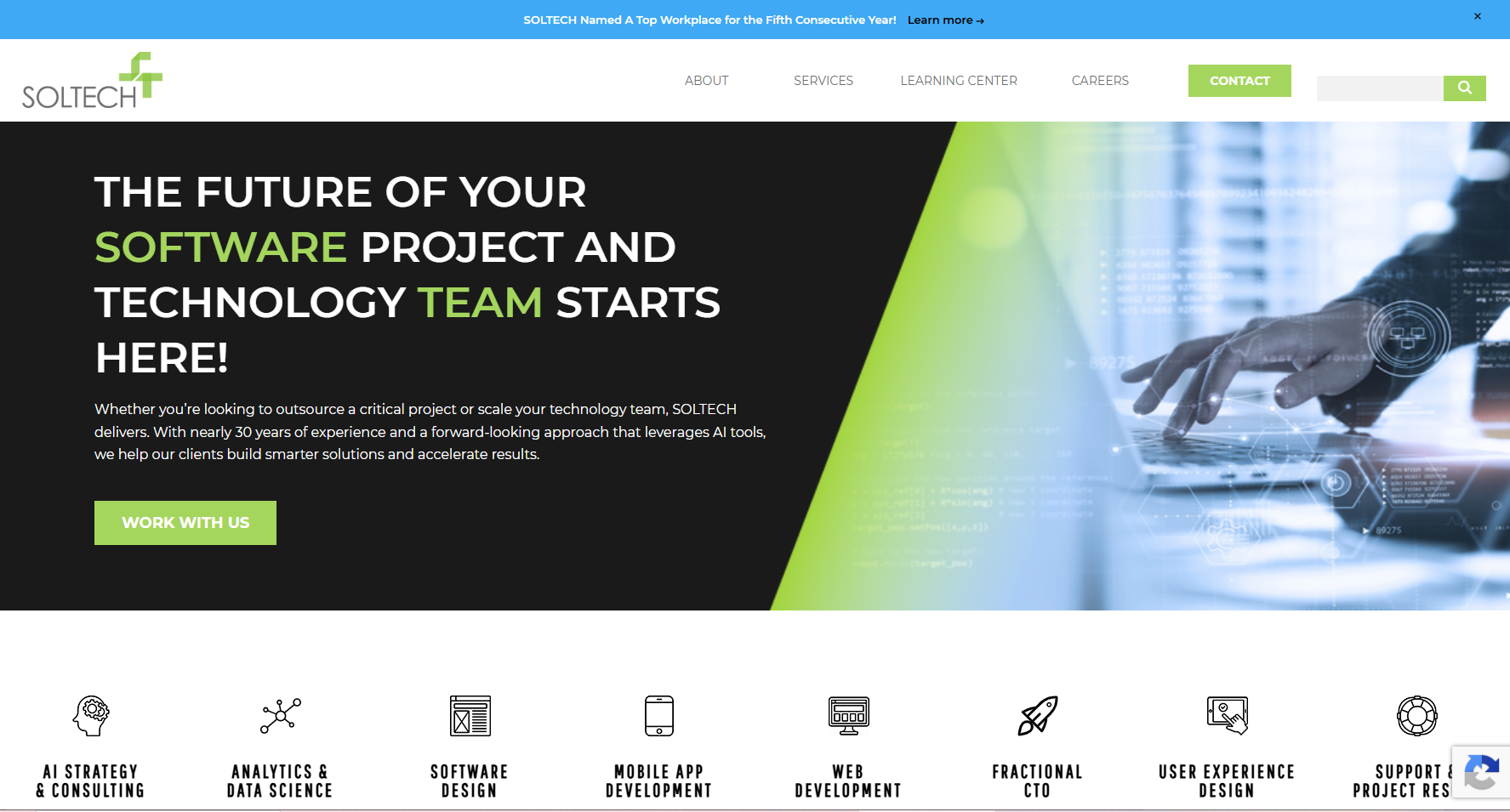
SOLTECH is a custom software development, technology consulting, IT staffing, and AI and data services firm, and its case study presence is a portfolio hub rather than a software product. The page works as a credibility-first showcase: project tiles across custom applications, AI and data work, integrations, modernization, and Salesforce, each moving a prospect from proof toward a contact CTA.
For agencies and dev shops, this is the model to study. The case studies are the sales pitch. A prospect evaluating a development partner scans the tiles for evidence the firm has shipped something like what they need, then reaches out. It is proof-heavy service positioning, not a case study management workflow you would license for your own team.
Best for: Agencies and software development shops that want a proof-heavy portfolio to build credibility and drive contact requests.
Key strengths
- Custom software development case tiles
- AI and data services proof
- Technology consulting credibility signals
Why choose SOLTECH: Choose this model when your case studies need to function as the sales pitch itself, showing breadth of delivery to prospects evaluating a services partner rather than buying software.
SOLTECH pricing: No public pricing is published. SOLTECH quotes custom engagements based on project scope.
3. Seven Peaks Software

Seven Peaks Software is a digital execution partner for complex software, data, cloud, and AI initiatives, and its case study collection reflects that positioning. The page leans on delivery excellence, product design, and a partner ecosystem, using guided browsing to walk prospects through cross-functional project proof toward an initiative discussion.
This suits consulting-led organizations selling complex implementations. The case studies here are not quick testimonials; they are evidence of senior-led delivery on hard problems. A prospect weighing a partner for a multi-stakeholder build wants exactly this kind of proof: real initiatives, real complexity, real outcomes. The conversion path points toward discussing a specific project, not a self-serve signup.
Best for: Consulting-led and implementation-focused organizations that need to prove they can deliver complex, senior-led digital initiatives.
Key strengths
- Custom software development delivery proof
- Data and analytics services stories
- Cloud and AI delivery credibility
Why choose Seven Peaks Software: Choose this approach when your proof needs to demonstrate depth on complex initiatives and a partner ecosystem, guiding buyers toward a project conversation rather than a product trial.
Seven Peaks Software pricing: No public pricing is published. Services are quote-based and scoped per engagement.
4. Innowise
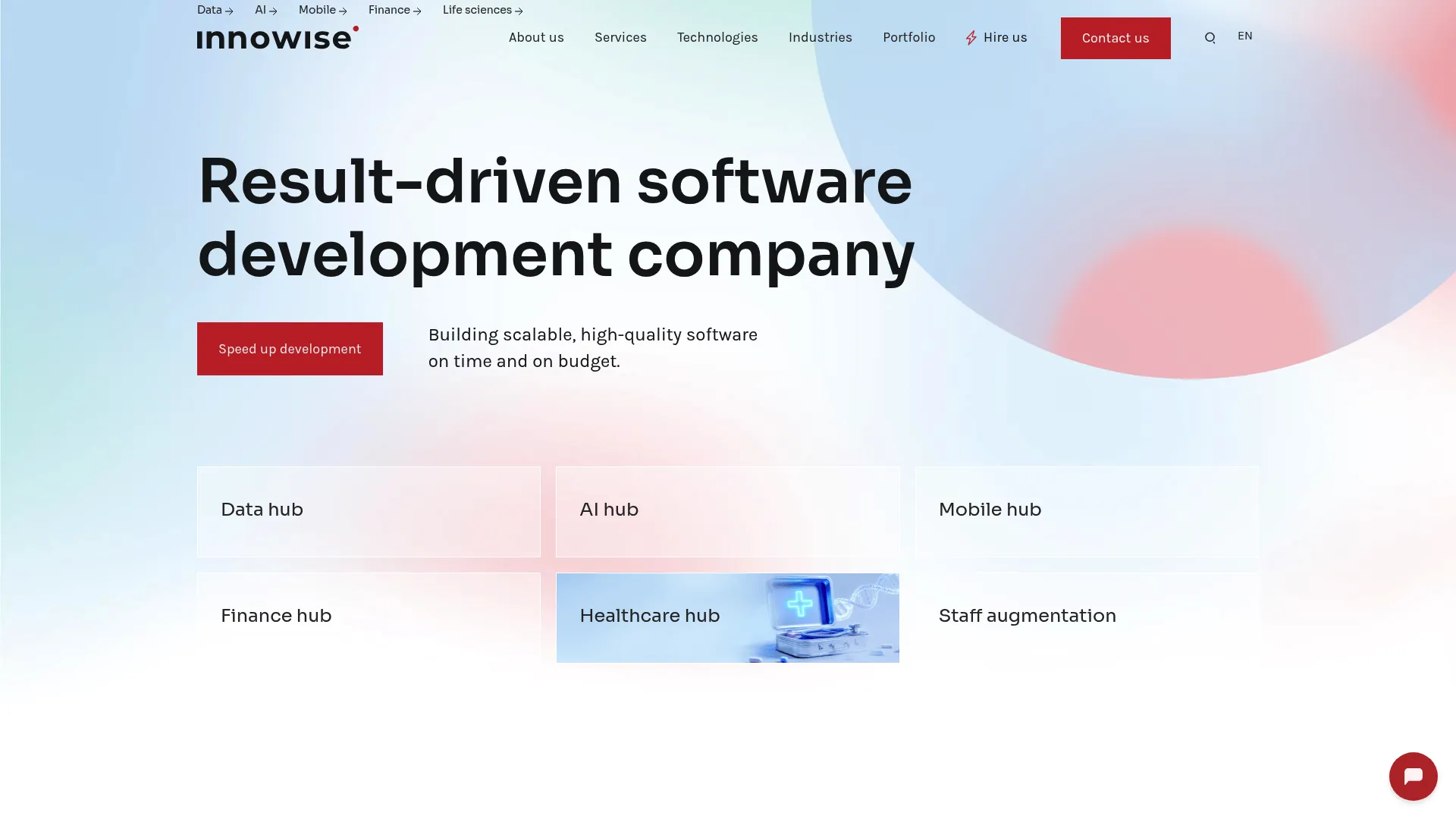
Innowise is an IT services and software development company offering custom software, outsourcing, staff augmentation, and digital transformation, and its case studies hub is built around taxonomy. Buyers filter by industry, solution, technology, and service, then scan a browseable grid to gauge breadth quickly before reaching a contact CTA.
The taxonomy is what makes this hub useful. When a prospect can slice a large body of proof by their own industry or the specific technology they care about, breadth stops feeling overwhelming and starts feeling relevant. Innowise pairs that filtering with a large service catalog and trust signals, so the hub doubles as a lead-generation asset. Like the other service portfolios here, it displays proof rather than giving you a workflow to manage your own.
Best for: Service firms with a large volume of proof that want buyers to filter and scan breadth by industry, technology, and solution.
Key strengths
- Custom software development case coverage
- IT staff augmentation and dedicated team proof
- Digital transformation and cloud or data services stories
Why choose Innowise: Choose this pattern when you have a large case study portfolio and want taxonomy and filters to help buyers self-navigate to the proof most relevant to their situation.
Innowise pricing: No public pricing is published. Engagements are quote-based, with an estimate provided on request.
Considerations before you choose
Picking case study software is less about features and more about matching the tool to your actual bottleneck. Here is what to weigh before you commit.
Creation versus display
Decide whether your problem is producing case studies or showing them. An AI case study generator like HubSpot speeds up drafting and publishing. A service portfolio displays finished proof. If you cannot write case studies fast enough, a creation tool wins. If you have proof but nowhere clean to house it, a hub wins.
Governance and versioning
Proof goes stale. Metrics change, logos churn, positioning shifts. Look for version control and clear ownership so no one publishes or sends an outdated story. A CRM-driven workflow helps here by keeping the source data current and the published asset connected to it.
Distribution and reuse
A case study that lives on one page underperforms. Evaluate how easily each tool pushes proof to your website, sales enablement, email, and campaigns. The goal is one story that works across every touchpoint, not a rebuild for each channel.
Integrations with your stack
Check the fit with your CRM, CMS, and marketing automation. For a PMM, integration is what keeps messaging consistent and lets you tie proof consumption to pipeline. A tool that silos your case studies creates exactly the fragmentation you are trying to fix.
Conclusion
The four tools here solve different jobs, so start by naming yours.
If you need to create and manage case studies as a repeatable workflow, HubSpot is the clear pick: an AI case study generator, a WYSIWYG editor, a filterable case study library, and a CRM-driven workflow that keeps your customer proof and pipeline data aligned. It is the only true software product on the list, and the best fit for a PMM building case study software for sales enablement.
If you run an agency or dev shop and your case studies are the pitch, SOLTECH, Seven Peaks Software, and Innowise show three strong portfolio models. SOLTECH leads with project-tile credibility, Seven Peaks proves complex delivery, and Innowise wins on browseable taxonomy and filters.
For most product marketing teams, the next step is deciding whether your gap is creation, management, or display, then shortlisting the one tool that closes it. Build a proof library that compounds, not another set of orphaned docs.
Start your journey with Guideflow today!
FAQs
Case study software is a category of tools for creating, organizing, publishing, and managing customer success stories and other proof assets. It replaces scattered docs and spreadsheets with a single workflow that turns a customer win into a publishable, reusable asset. Some tools focus on AI-assisted creation, others on managing and displaying a case study library.
No. A case study library is one output or feature: the searchable, filterable collection where finished stories live. Case study software usually includes more than that, spanning creation, editing, publishing, taxonomy, and analytics. Think of the library as the destination and the software as the full workflow that fills and governs it.
Prioritize speed to publish, governance and versioning, collaboration, analytics, and CRM or CMS integrations. As a PMM, you want proof points that stay consistent across your site, sales enablement, and campaigns without living in a silo. A CRM-driven workflow is a strong signal, since it keeps your customer proof connected to pipeline data.
Not entirely. An AI case study generator accelerates the draft and handles structure, pulling from CRM records, documents, or interview notes to get you past the blank page. But a PMM still needs editorial control over proof points, brand voice, and the narrative that makes a story persuasive. Treat AI as a fast first draft, not the final word.
A good case study hub combines card-based browsing, clear taxonomy, useful filters, and conversion CTAs with easy access to detail pages. Buyers should be able to slice proof by industry, use case, or technology and reach the relevant story in seconds. The best hubs also capture engagement so you can see which proof assets drive interest.
Case studies give reps concrete proof points, objection handling, and credible customer evidence they can share with prospects mid-deal. Strong case study software for sales enablement makes the right story easy to find by segment and easy to send in context. That is often the difference between a rep reaching for current proof and one improvising from memory.
Yes, once you outgrow docs and spreadsheets, especially when launches or proof requests start climbing. A small team feels the pain of scattered proof fastest, since one person often owns creation, management, and distribution at once. Even a lightweight tool that centralizes your case study hub and speeds publishing pays back quickly in consistency and time saved.