Your product team wants real-time activation signals. Engineering says the event pipeline will take a quarter. Finance asks why the warehouse bill keeps rising. Those aren't separate problems - they're big data processing decisions landing in the same backlog.
Product and data teams now depend on event streams, behavioral logs, CRM records, support activity, and third-party sources arriving simultaneously. A best product analytics software stack is only as good as the processing layer underneath it. According to Grand View Research (2026), the global big data market is projected to grow at 14.9% CAGR through 2033, driven by the explosion of cloud-native data workloads across SaaS organizations.
The decision isn't only about scale. Latency, maintainability, governance, and engineering opportunity cost all shape which platform fits your team's operating model. Choosing streaming because it sounds modern, or picking Hadoop because it's familiar, can cost quarters of engineering time before anyone catches the mismatch.
This guide helps you choose the processing model before choosing the platform.
What's inside
This guide covers nine big data processing tools for 2026, spanning open-source frameworks and managed cloud platforms. Items were chosen based on:
- Processing model coverage: Batch, streaming, interactive, and distributed compute
- Deployment approach: Open-source frameworks, managed services, and serverless options
- Governance and operational overhead: How much engineering the platform demands to stay healthy
- Pricing transparency: How costs scale as workloads grow
The guide is written for product managers and technical leads who need enough depth to align engineering, analytics, security, and finance stakeholders on a platform decision.
TL;DR
- Best for flexible distributed compute: Apache Spark handles batch workloads, SQL, machine learning, and streaming through one engine
- Best for governed lakehouse workloads: Databricks fits teams needing shared data engineering, analytics, and AI pipelines with centralized governance
- Best for serverless SQL analytics: Google BigQuery and Snowflake reduce infrastructure overhead for analytical processing at scale
- Best for AWS-native open-source workloads: Amazon EMR fits organizations running Spark, Hadoop, or Trino on AWS infrastructure
- Best for continuous event-time processing: Apache Flink and Google Cloud Dataflow fit teams with low-latency streaming requirements
- Best for existing HDFS estates: Apache Hadoop remains relevant where mature MapReduce investments still run production workloads
What is big data processing?
Big data processing is the use of distributed or highly scalable systems to ingest, transform, store, and analyze data that exceeds the practical limits of a single database server or script.
The five characteristics that shape the architecture
Five dimensions determine whether a workload qualifies and which approach fits:
- Volume: Data size and retention requirements - gigabytes handled by a database, petabytes requiring distributed storage
- Velocity: How quickly data arrives and must be processed, from daily batch files to millions of events per second
- Variety: Structured tables, semi-structured JSON logs, unstructured text, and media files
- Veracity: Data quality, reliability, lineage, and trustworthiness for downstream decisions
- Value: The specific product outcome, workflow, or business decision the data must support
The core processing models
Four models cover the majority of SaaS product requirements:
- Batch processing: Scheduled transformations over accumulated data. A daily retention cohort job is batch. Cost-efficient and predictable.
- Streaming processing: Continuous handling of events as they arrive. In-product fraud detection or activation triggers run streaming.
- Interactive processing: Fast analytical queries for users, dashboards, or operators. Most BI tools sit on top of interactive engines.
- MPP and distributed processing: Parallel execution across many compute nodes for workloads too large for a single machine.
The big data processing lifecycle
Data moves through four stages before becoming actionable:
- Gather from applications, databases, event streams, and third parties
- Load into storage, data lakes, warehouses, or operational systems
- Transform, enrich, validate, and govern
- Serve downstream products, analytics, alerts, and models
Big data processing vs. traditional data processing
| Dimension | Traditional processing | Big data processing |
|---|---|---|
| Compute model | Single server or small database | Distributed or managed elastic compute |
| Data volume | Predictable and bounded | Large, growing, or highly variable |
| Latency | Often scheduled | Batch, near-real-time, or continuous |
| Data types | Mostly structured tables | Tables, events, logs, files, text |
| Operating focus | Database administration | Data reliability, orchestration, governance, cost control |
A PM should understand this split concretely: A weekly retention dashboard may only need batch jobs, while a personalization feature that responds to in-session behavior likely needs streaming.
When to use big data processing tools
Process product events before users lose context
Activation triggers, in-product recommendations, fraud signals, usage alerts, and event-driven workflows all need data available within seconds or minutes, not the next morning. The latency requirement should come from the user experience, not from technical convention. If the feature works correctly when data is six hours old, you probably don't need streaming infrastructure.
Turn large operational datasets into decisions
Product analytics, cohort retention, support trend analysis, and customer health scoring often run fine as scheduled batch jobs. When a product team pulls weekly activation cohorts or monthly churn segments, batch processing is the right match. Streaming adds engineering complexity and cost that only pays off when the insight genuinely must be fresh.
Consolidate data across a growing SaaS stack
Product events, CRM records, support tickets, billing data, and marketing sources all need combining. Cloud data security software decisions intersect here too: Identity resolution, data ownership, retention policies, and access controls become critical once multiple systems share a pipeline. This is where governance planning separates teams that scale cleanly from teams that rebuild quarterly.
Quick routing table:
| If you need | Start by evaluating |
|---|---|
| Scheduled transformations | Spark, Databricks, BigQuery, Snowflake |
| Continuous event processing | Flink, Dataflow, Spark Structured Streaming |
| AWS-native Spark or Hadoop workloads | Amazon EMR |
| Legacy HDFS-based architecture | Hadoop |
| Flexible operational document data | MongoDB Atlas |
Big data processing tools comparison
These nine tools serve different layers of the data stack. Compare them on workload shape, cloud commitment, team skill level, governance requirements, and expected maintenance before selecting one. Prices and ratings are verified from vendor pricing pages and G2 listings as of October 2026.
| # | Product | Best for | Key differentiator | Pricing | G2 rating |
|---|---|---|---|---|---|
| 1 | Apache Spark | Flexible batch and streaming compute | Unified engine for SQL, ETL, ML, and streaming | Open source; infrastructure costs vary | 4.3/5 |
| 2 | Databricks | Lakehouse and governed data workloads | Managed Spark with Delta Lake and Unity Catalog | Usage-based, free trial available | 4.6/5 |
| 3 | Google BigQuery | Serverless SQL analytics | Fully managed warehouse; first 1 TiB/month free | From $6.25/TiB queried | 4.5/5 |
| 4 | Snowflake | Cross-cloud governed analytics | Separate storage and compute with secure data sharing | Consumption-based credits | 4.6/5 |
| 5 | Amazon EMR | AWS-native open-source workloads | Managed Spark, Hadoop, Hive, and Trino on AWS | Usage-based EC2 plus EMR charges | 4.1/5 |
| 6 | Google Cloud Dataflow | Managed batch and streaming pipelines | Apache Beam runner with autoscaling; from $0.06/unit | From $0.06/unit (batch) | 4.2/5 |
| 7 | Apache Flink | Stateful event-time stream processing | Exactly-once state, checkpoints, low-latency compute | Open source; infrastructure costs vary | 4.3/5 |
| 8 | Apache Hadoop | Existing HDFS and MapReduce environments | Distributed storage and batch processing foundation | Open source; infrastructure costs vary | 4.4/5 |
| 9 | MongoDB Atlas | Flexible operational data at scale | Managed document database with stream processing | Free tier; dedicated from $0.08/hour | 4.5/5 |
Best 9 big data processing tools for 2026
1. Apache Spark
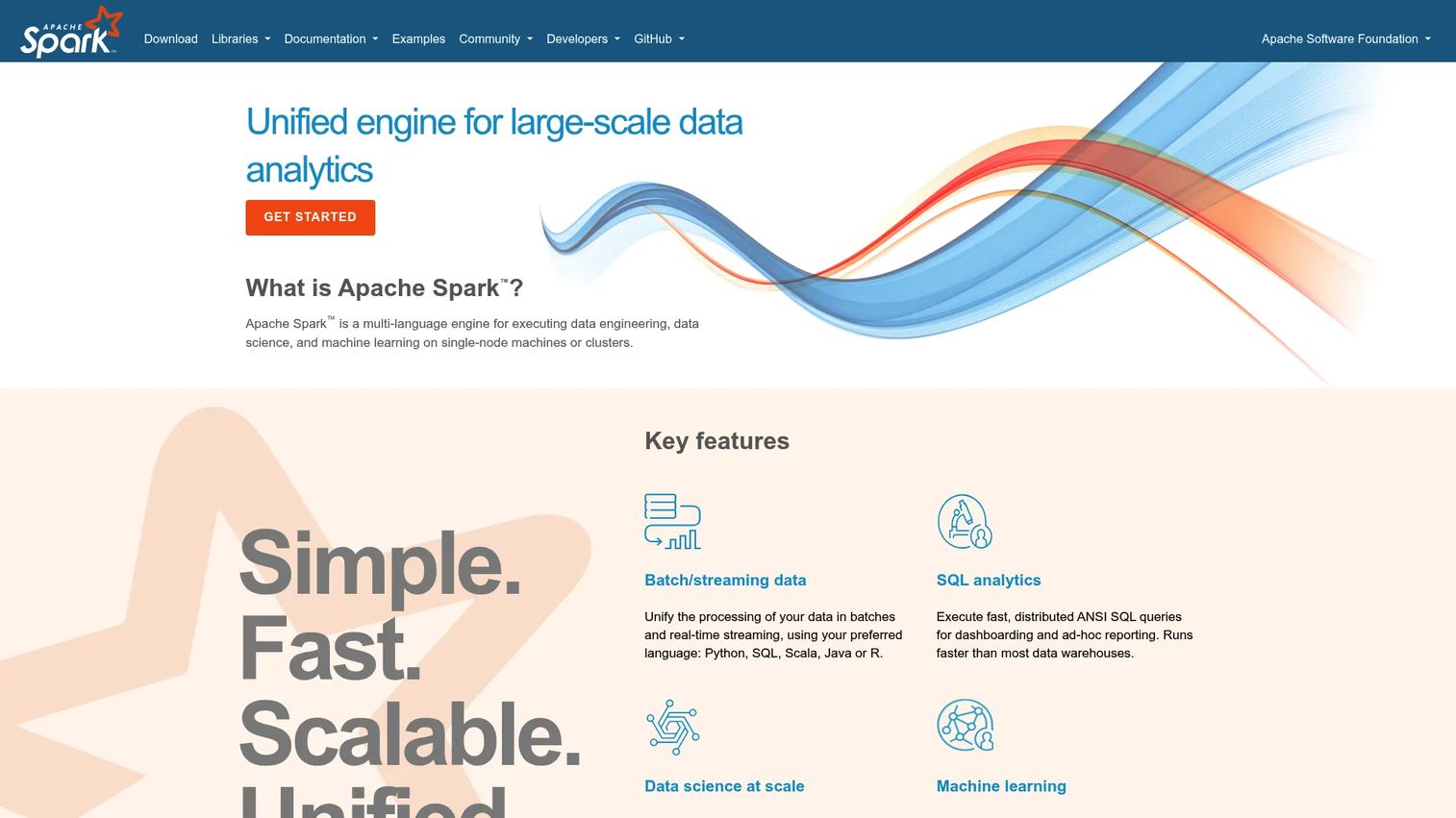
Apache Spark is an open-source distributed computing engine for large-scale batch processing, SQL analytics, machine learning pipelines, and streaming workloads. It's a framework, not a managed platform, which means your team owns or adopts a managed environment to run it. Spark is also the engine underneath several managed platforms in this list, so understanding it first helps you evaluate those services honestly.
Best for: Product and data teams that need a broad processing engine across large batch jobs, SQL transformations, and streaming-adjacent workloads, and have engineers who can operate or configure a cluster environment.
Key features
- In-memory distributed processing across large clusters
- Spark SQL query engine with DataFrame and Dataset APIs
- Structured Streaming for continuous data pipelines
- MLlib machine learning library for feature engineering and model training
- Multi-language support: Python, Scala, Java, SQL, and R
Why choose Apache Spark: Spark is the right choice when your engineering team needs flexibility and portability across cloud environments. One engine covers ETL, analytics, and feature pipelines without switching frameworks. The operating model requires platform skill, observability, and cost controls, so pair Spark with clear ownership over who monitors cluster health and spend.
Apache Spark pricing: Spark itself carries no license fee. Costs come from cloud infrastructure, managed service fees, storage, and data transfer. For teams on AWS, that typically means EC2 or EMR charges. On Google Cloud, Dataproc adds cluster pricing. Managed Spark offerings such as Databricks layer their own per-second billing on top.
G2 rating: 4.3/5
2. Databricks
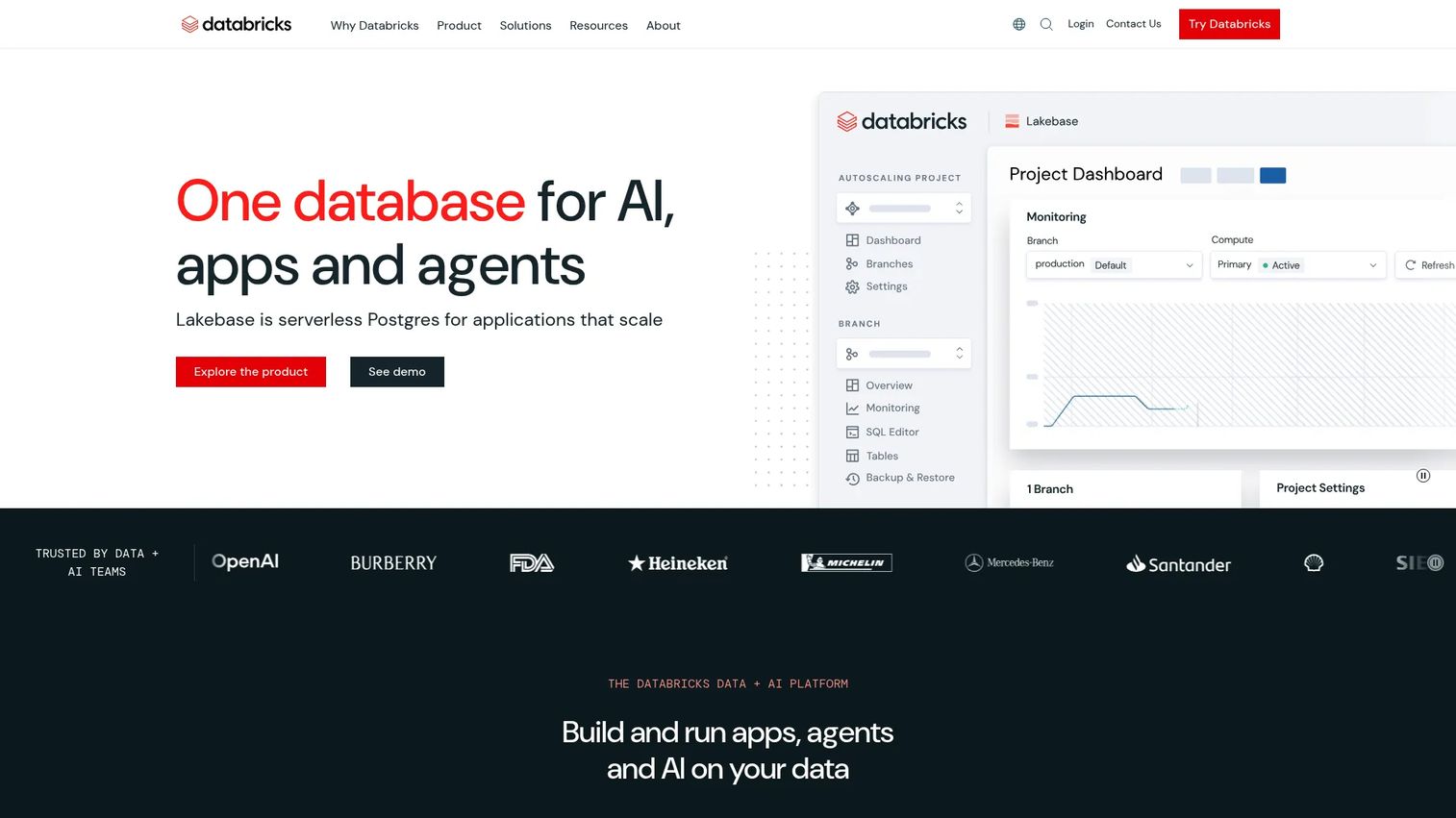
Databricks is a managed data and AI platform built around the Spark ecosystem. It gives data engineering, analytics, and machine learning teams a shared environment with centralized governance rather than requiring each team to assemble its own Spark stack. For product managers, the strongest angle is shared visibility: Product analytics, data engineering, and AI initiatives share governed datasets and pipelines rather than producing parallel, conflicting outputs.
Best for: SaaS product organizations that need to process large event and customer datasets while coordinating data engineering, analytics, and machine learning work under one governance layer.
Key features
- Managed Apache Spark with per-second billing
- Delta Lake table format for reliable, versioned data
- Unity Catalog for permissions, lineage, and auditing
- Streaming pipeline support alongside batch workflows
- Notebook and SQL editor workflows in a collaborative workspace
Why choose Databricks: It fits teams that want a managed lakehouse operating model rather than assembling infrastructure themselves. Ask engineering how they'll monitor usage and idle compute before committing. Cost governance matters here: Workload ownership and cluster auto-termination policies determine whether the bill stays predictable.
Databricks pricing: Databricks uses consumption-based, pay-as-you-go pricing with per-second billing. A 14-day free trial and a Free Edition are available. Committed-use discounts apply for larger deployments. Costs vary by cloud provider, workload type, and compute configuration, so run a workload estimate against the cloud-specific pricing page before budgeting.
G2 rating: 4.6/5
3. Google BigQuery
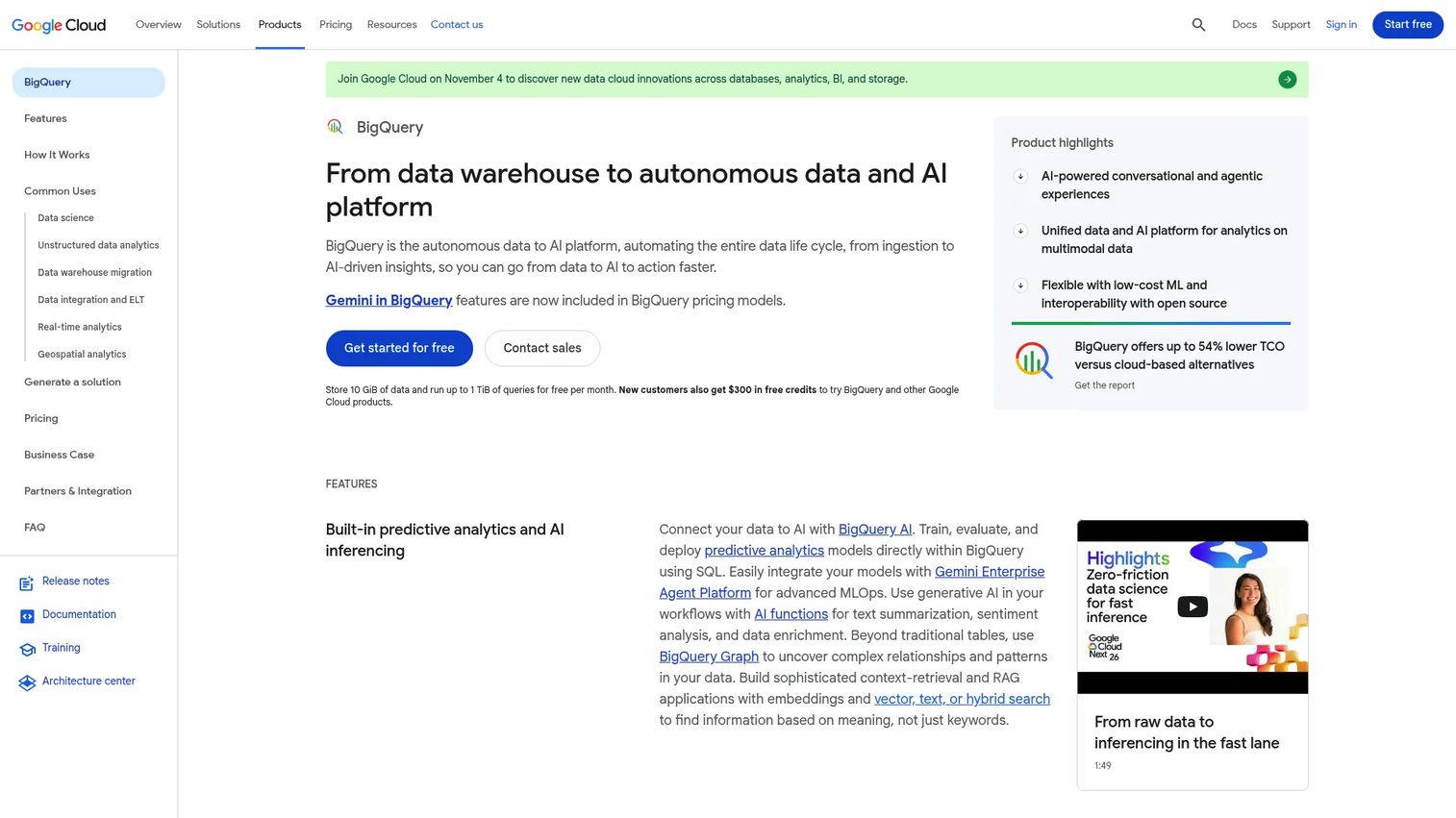
Google BigQuery is a fully managed, serverless enterprise data warehouse. Teams run large SQL queries without provisioning or managing clusters. For product analytics and reporting teams already in Google Cloud, BigQuery removes the infrastructure burden while handling petabyte-scale queries. Daily activation cohorts run as scheduled SQL transformations; rapid product questions run through interactive analysis without spinning up a cluster.
Best for: Product managers and analytics teams that need fast access to large datasets with low infrastructure overhead, particularly those already running workloads in Google Cloud.
Key features
- Serverless SQL execution at petabyte scale
- Columnar storage optimized for analytical queries
- Built-in machine learning and vector search
- Native Google Cloud integrations including Looker and Vertex AI
- Usage-based on-demand and capacity-based slot pricing
Why choose Google BigQuery: Choose BigQuery when SQL-first analysis and low operational burden matter more than framework-level control. Query design and governance still determine your spend, so teams need discipline around what queries run and how often. BigQuery doesn't replace streaming infrastructure for all real-time needs - if your product requires sub-minute event processing, you'll need a complementary streaming layer.
Google BigQuery pricing: The free tier includes 10 GiB of storage and up to 1 TiB of queries per month. On-demand query pricing starts at $6.25 per TiB of data processed above that. Capacity pricing uses slot reservations billed per slot-hour, with rates varying by BigQuery edition.
G2 rating: 4.5/5
4. Snowflake
Snowflake is a cloud data platform centered on elastic SQL analytics with storage and compute managed separately. That separation matters for PMs: A finance reporting workload and a product analytics workload run in distinct virtual warehouses, so neither slows the other during a launch or month-end close. Snowflake also supports governed data sharing across teams and external partners without data movement.
Best for: Organizations that need scalable analytics, workload isolation between product, finance, and operations teams, and governed data sharing without operating distributed infrastructure directly.
Key features
- Separate storage and compute with independent scaling
- Elastic virtual warehouses per team or workload
- Secure data sharing across accounts and cloud boundaries
- Cross-cloud deployment on AWS, Azure, and Google Cloud
- SQL-based analytics with Snowflake Cortex AI capabilities
Why choose Snowflake: Snowflake is a strong fit when teams want predictable workload isolation and strong access controls. Warehouse sizing, auto-suspend settings, and query governance all affect cost, so plan for those configurations before launch. Some advanced streaming and real-time data engineering patterns require complementary services alongside Snowflake's core warehouse.
Snowflake pricing: Snowflake uses consumption-based credits for compute, plus storage costs billed separately. Editions include Standard, Enterprise, Business Critical, and Virtual Private Snowflake. Credit costs vary by cloud provider, region, and edition. No universal starting price is displayed on the pricing page; request an estimate from Snowflake's pricing calculator.
G2 rating: 4.6/5
5. Amazon EMR
Amazon EMR is AWS's managed service for running open-source big data frameworks including Apache Spark, Hadoop, Hive, and Trino. For teams already committed to AWS, EMR removes the cluster provisioning burden while keeping framework-level flexibility. Deployment mode matters: EMR on EC2 gives the most control, EMR Serverless removes cluster management, and EMR on EKS fits Kubernetes-native platform teams.
Best for: Teams already committed to AWS that need managed deployment options for open-source big data frameworks and have engineers who can own workload tuning and cost governance.
Key features
- Managed Spark, Hadoop, Hive, and Trino cluster provisioning
- EMR Studio with collaborative Jupyter notebooks
- Amazon S3 integration as the default data lake storage layer
- EMR Serverless, EC2, and EKS deployment modes
- AWS IAM and security controls for access management
Why choose Amazon EMR: Choose EMR when AWS is already your strategic cloud and open-source framework portability matters. Before selecting a deployment mode, clarify who owns cluster tuning, which workloads need always-on capacity, and how data transfer costs between S3 and compute will be monitored. Hadoop support in EMR is available for existing estates, but it's not a reason to start a new Hadoop investment.
Amazon EMR pricing: EMR adds service charges on top of underlying EC2 and EBS costs. EMR Serverless charges for consumed vCPU, memory, and storage resources by the second. Rates vary by instance type, region, and deployment mode. No single starting price applies across configurations.
G2 rating: 4.1/5
6. Google Cloud Dataflow
Google Cloud Dataflow is a fully managed service for executing Apache Beam pipelines across batch and streaming workloads. Autoscaling handles capacity without manual intervention. For product analytics teams running high-volume event streams - mobile telemetry, user behavior logs, delayed third-party webhook data - Dataflow handles the event-time windowing that batch jobs can't. If a user's mobile session data arrives six minutes late due to connectivity, Dataflow processes it in the correct time window rather than dropping or misassigning it.
Best for: Product teams building reliable event processing, windowed aggregations, and continuous pipelines in Google Cloud, particularly where event-time correctness matters.
Key features
- Apache Beam programming model for unified batch and streaming
- Autoscaling worker capacity with serverless infrastructure option
- Event-time windowing for late-arriving and out-of-order records
- Streaming Engine and Shuffle Service for managed execution
- Native integration with BigQuery, Pub/Sub, and Google Cloud Storage
Why choose Google Cloud Dataflow: Dataflow is the right choice when event-time correctness and managed streaming operations matter more than framework portability. The Apache Beam model means pipelines can run on other runners if needed, but validate your actual deployment requirements before relying on that portability as a decision factor.
Google Cloud Dataflow pricing: Pricing is usage-based and includes worker vCPU and memory resources, Streaming Engine charges for streaming jobs, and Shuffle Service charges for batch jobs. Batch jobs start at $0.06 per unit; streaming jobs start at $0.089 per unit. New Google Cloud customers receive $300 in free credits.
G2 rating: 4.2/5
7. Apache Flink
Apache Flink is an open-source distributed processing engine built for stateful computations over both unbounded and bounded data streams. It's strongest when continuous processing is the core requirement, not an added feature. A concrete example: Calculating a customer's rolling usage threshold across an event stream, where each new event must update state that persists across time, is precisely what Flink is designed for. Stateful streaming requires operational maturity, so the goal is matching Flink to a genuine low-latency need rather than defaulting to it.
Best for: Teams building fraud signals, live personalization, telemetry pipelines, operational alerts, and other workloads where event timing, state, and exactly-once semantics matter.
Key features
- Stateful stream processing with incremental checkpoints
- Event-time calculations for accurate windowing and late data
- Exactly-once state consistency across failures
- SQL and Table API for stream and batch processing
- Scalable deployment with Web UI, metrics, and REST API
Why choose Apache Flink: Choose Flink when the product requirement depends on processing events continuously and correctly, even when records arrive late or out of order. Flink differs from batch-first Spark and warehouse-centric SQL systems: It was designed to hold state across millions of concurrent streams without sacrificing throughput. Factor in the operational investment needed for cluster management, checkpoint storage, and scaling before committing.
Apache Flink pricing: Flink itself is open source with no license fee. Costs come from the infrastructure used to run clusters, checkpoint storage, and network throughput. Managed Flink services on AWS (Amazon Managed Service for Apache Flink) and on Confluent Cloud add their own pricing on top of infrastructure.
G2 rating: 4.3/5
8. Apache Hadoop
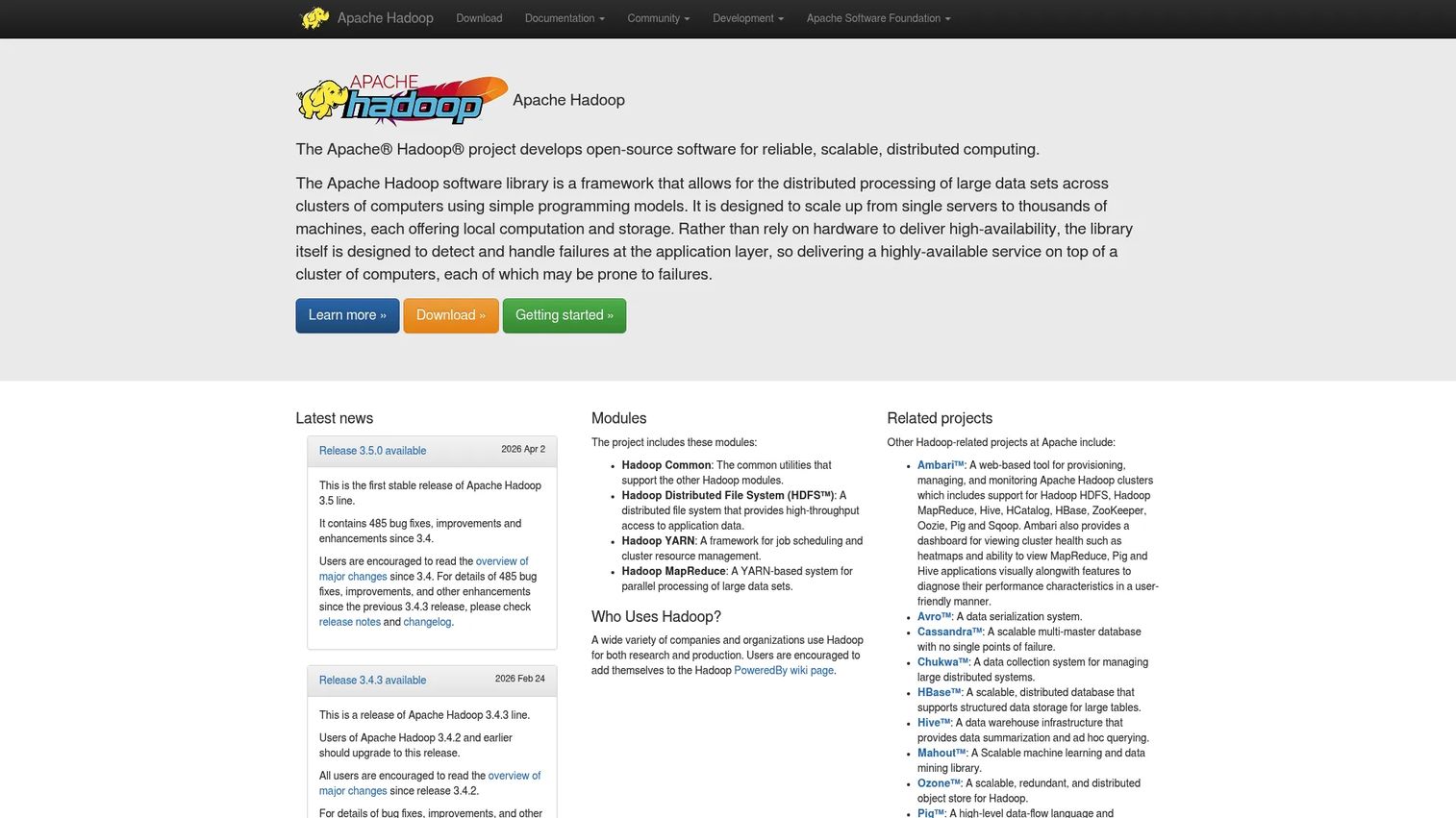
Apache Hadoop is the open-source framework that defined distributed big data processing. HDFS provides distributed storage with high-throughput access; YARN manages cluster resources; MapReduce runs parallel batch jobs across the cluster. Hadoop remains relevant where large existing investments in HDFS datasets and MapReduce ecosystems still drive production workloads. The practical question for PMs: Is maintaining the platform constraining your product roadmap, or does it still meet your latency, governance, and cost requirements?
Best for: Organizations maintaining established Hadoop environments with large HDFS datasets or workloads that rely on existing MapReduce and Hive ecosystems where migration cost outweighs the benefit of rebuilding.
Key features
- Hadoop Distributed File System (HDFS) for scalable storage
- MapReduce for parallel batch processing across the cluster
- YARN for job scheduling and cluster resource management
- Hive for SQL abstraction over MapReduce jobs
- Broad ecosystem compatibility with HBase, Pig, and Oozie
Why choose Apache Hadoop: Choose Hadoop when your organization has a mature environment and the migration cost to a modern managed platform outweighs an immediate rebuild. Hadoop carries real operational overhead: Cluster management, security configuration, and skilled administration demand ongoing engineering investment. New projects starting today should compare Hadoop's operating model against managed options before committing.
Apache Hadoop pricing: Hadoop is open source. Costs come from cluster infrastructure, storage, distribution licensing where applicable (Cloudera, for example, has its own subscription terms), and the engineering team required to operate it.
G2 rating: 4.4/5
9. MongoDB Atlas
MongoDB Atlas is a fully managed, multi-cloud document database service. It belongs in this list because many product teams process and serve high-volume application data through operational document systems, and Atlas is the managed standard for that workload. The category boundary matters: Atlas is a data store and operational platform, not a universal big data compute engine. Large-scale analytical queries typically require integration with a warehouse, lakehouse, or processing framework alongside Atlas.
Best for: Product teams that need flexible schemas for evolving product data models, globally distributed application data, and change-driven downstream workflows feeding analytics pipelines.
Key features
- Flexible document data model for evolving product schemas
- Multi-cloud and multi-region cluster deployment on AWS, Azure, and Google Cloud
- Atlas Search for full-text and vector search within the same platform
- Change streams for event-driven architectures and downstream processing
- Stream processing and real-time analytics capabilities
Why choose MongoDB Atlas: Choose Atlas when the workload starts with operational application data and schema flexibility matters more than structured SQL analytics. Change streams feed downstream processing pipelines, which makes Atlas a natural part of event-driven architectures. Plan for integration with a warehouse or lakehouse when analytical queries grow beyond what the operational tier can serve efficiently.
MongoDB Atlas pricing: Atlas offers a free tier with no time limit. The Flex tier starts at $0.011/hour (up to $30/month). Dedicated clusters start at $0.08/hour (approximately $56.94/month for the entry configuration). Atlas Infinite is available in public preview at $0.09/hour. Costs vary by cloud provider, region, storage, backup, and additional services.
G2 rating: 4.5/5
Considerations when choosing big data processing tools
Start with the product latency requirement
Define how late an insight or action can arrive before it loses value for the user or the business. Daily retention reporting, fraud prevention, and in-product personalization operate on different timescales. Don't choose streaming because it sounds modern; map the latency requirement first, then select the processing model.
Separate infrastructure costs from operational costs
Cloud pricing is one part of the decision. Include engineering time for pipeline maintenance, incident response, schema changes, backfills, access management, and data quality monitoring. A platform that looks cheap on paper can become the most expensive line in the engineering budget if it demands constant attention.
Plan for data governance before the dataset becomes critical
Evaluate cataloging, lineage, retention, access controls, and audit needs early. Once event data connects to customer records, payment information, product telemetry, or regulated data, retroactively adding governance is far more expensive than building it from the start. AI governance tools and cloud data security software discussions intersect with this decision when AI features read from the same pipelines.
Test data movement and interoperability
Data transfer between systems, duplicate storage, and repeated transformations create hidden cost and reliability risk. Prefer architectures that reduce unnecessary copies and connect naturally to the tools your team already uses. Check egress costs between cloud regions before committing to a multi-region architecture.
Match the tool to your team's operating model
A flexible open-source framework suits a platform team with dedicated engineers. A fully managed warehouse fits a smaller analytics team that needs reliable SQL access without always-on cluster management. The best customer data platform evaluation follows similar logic: The right choice is the one the team can sustain without constant specialist intervention.
Conclusion
Big data processing choices should follow workload shape, not convention. Spark covers broad distributed compute when framework flexibility and portability matter. Databricks fits governed lakehouse workflows where data engineering, analytics, and AI share one environment. BigQuery and Snowflake serve warehouse-first analytical processing with low infrastructure overhead. EMR handles AWS-native open-source workloads. Dataflow and Flink serve continuous event processing where event-time correctness is a product requirement. Hadoop remains the right choice for organizations maintaining established HDFS environments where migration cost is the constraint. MongoDB Atlas fits flexible operational data that feeds downstream pipelines.
The practical next step: Map one high-value product workflow, document its latency and data quality requirements, then bring engineering, analytics, security, and finance into a short platform evaluation. That conversation is faster and cheaper than rebuilding the wrong architecture six months in.
For teams presenting complex data platform decisions to stakeholders, Guideflow makes it straightforward to build interactive product walkthroughs that explain technical architecture choices to non-technical audiences, supporting sales enablement, onboarding, and internal alignment without scheduling live calls.
Start your journey with Guideflow today!
FAQs
Big data processing is the scalable ingestion, transformation, storage, and analysis of high-volume, high-velocity, or high-variety data using distributed or highly scalable systems. The goal is to make data usable for products, operations, analytics, and machine learning. A single database server or script can't handle the scale, so the work is distributed across many compute nodes or managed elastically in the cloud.
Batch processing handles accumulated data on a schedule, such as a nightly ETL job or a weekly cohort analysis. Stream processing handles records continuously as they arrive, such as a fraud signal evaluated within milliseconds of a transaction. The right choice depends on how quickly the business or product must respond to new information, not on which approach sounds more modern.
Yes, widely. Spark remains one of the most adopted distributed compute engines for batch workloads, SQL analytics, machine learning pipelines, and streaming. Many teams use it through managed platforms rather than operating clusters directly. Its broad language support and large ecosystem mean it's often the underlying engine even when teams don't interact with it directly.
The answer depends on event-time requirements, statefulness, cloud environment, and who owns operations. Apache Flink excels at stateful, exactly-once stream processing for continuous event flows. Google Cloud Dataflow handles managed batch and streaming pipelines with event-time windowing on Google Cloud. Spark Structured Streaming fits teams already invested in the Spark ecosystem. Start from the user-facing latency requirement, then select accordingly.
At a decision level, yes. PMs don't need to configure clusters, but they do need to understand latency, reliability, cost, and governance well enough to define requirements, evaluate engineering trade-offs, and avoid blocking the data team with underspecified tickets. Data availability directly affects activation metrics, experimentation, reporting, personalization, and customer workflows, making it a product concern, not only a platform concern. See the best product analytics software tools guide for related context on measurement.
Start from the simplest platform that meets the current workload. Managed warehouse tools such as BigQuery or Snowflake fit SQL-first analytics teams without dedicated infrastructure engineers. Managed processing services such as Dataflow or EMR Serverless fit teams with clear batch or streaming requirements who can't staff cluster operations. Avoid overbuilding a distributed system before data volume, latency requirements, or product complexity actually demand it.
Costs typically come from compute, storage, queries, data transfer, streaming throughput, and idle capacity. The less visible drivers are repeated transformations on duplicate datasets and egress fees between cloud regions. Teams that don't implement ownership tags, workload budgets, and regular architecture reviews frequently find their data platform costs growing faster than the product value it supports. For broader context, the analytics platforms drive ROI guide covers measurement approaches that connect infrastructure spend to business outcomes.
Sometimes, and for many analytical workloads, yes. A warehouse handles SQL transformations, scheduled jobs, and interactive queries without requiring distributed framework expertise. Dedicated frameworks become more useful when teams need custom distributed compute, complex stateful streaming, exactly-once event processing, or framework-level control that a managed warehouse doesn't expose. The practical test: If your queries run within the warehouse's execution model and meet your latency requirements, the warehouse is likely sufficient.