Your cash lives in too many places. One bank portal shows a balance. A spreadsheet shows a different one. The ERP export is a day old. Three subsidiaries report in three currencies, and the email thread confirming a wire is buried somewhere between finance and the CEO. By the time you reconcile it all, the number you needed for a decision has already moved.
That fragmentation is the real cost. Not the manual work itself, but the delay and doubt it introduces into every call about liquidity, spend, and runway. For a founder or finance lead trying to prove the business scales without surprises, weak cash visibility is a governance problem, not just an admin one.
Treasury management software exists to collapse that gap. It pulls balances, forecasts, payments, and risk exposures into one place so you see a real cash position in something close to real time. The category is expanding fast: the global treasury management market is projected to grow from USD 7.52 billion in 2026 to USD 18.83 billion by 2033, a 14.0% CAGR, according to Coherent Market Insights (2024). Adoption of automated treasury tools has risen roughly 25% over the past two years, per Market Research Future (2024), driven by demand for real-time cash management and forecasting.
This guide breaks down nine treasury management systems worth a shortlist in 2026. If you also evaluate adjacent finance and operations stacks, our roundups of contract lifecycle management software, audit management software, and marketing automation software tools follow the same buyer-first format.
What's inside
This guide is for finance leaders, controllers, treasurers, and founders who need a clean shortlist before they sit through vendor calls. It covers treasury management solutions built for cash visibility, cash forecasting, payments automation, risk controls, and ERP or bank connectivity.
We selected platforms on four criteria: breadth of treasury functions, depth of ERP and bank integration, level of automation, and buyer fit across company stage. Some tools are heavy enterprise systems. Others suit leaner finance teams moving off spreadsheets for the first time. Each entry lists what it does well and who it fits.
TL;DR
- Best all-around treasury platform: Kyriba, for real-time cash visibility, payments control, and liquidity management at scale.
- Best for centralized treasury operations: GTreasury, for cash forecasting, bank connectivity, and risk workflows in one place.
- Best for SAP-native finance teams: SAP Treasury and Risk Management, for tight ERP integration and enterprise process control.
- Best for modular deployment: Nomentia, for treasury operations, payments, and liquidity you can roll out in stages.
- Best for startups wanting banking plus treasury automation: Rho, for combined business banking, spend, and reconciliation automation.
- Best for global payments complexity: TIS, for multi-bank connectivity and payments across many entities.
What is treasury management software?
Treasury management software is a platform that centralizes an organization's cash, liquidity, payments, and financial risk so finance teams can see and control money movement across banks, entities, and currencies from one system.
A treasury management platform typically replaces a patchwork of bank portals, spreadsheets, and manual ERP exports. Instead of stitching data together by hand, treasury teams work from a single source of truth for the cash position.
Core capabilities most treasury management systems share:
- Cash management software functions: aggregate balances across banks and entities for real-time cash visibility.
- Liquidity management: pool, allocate, and optimize cash so idle balances shrink and working capital visibility improves.
- Cash forecasting: model expected inflows and outflows daily, weekly, and monthly.
- Payments automation: initiate, approve, and route payments with controls and audit trails.
- Risk management: track FX risk, interest rate risk, and counterparty exposure, often with hedging support.
- Compliance reporting: produce auditable records and standardized reports for internal and external review.
- Bank connectivity and ERP integration: connect to banks, market data, and finance systems so data flows without manual re-entry.
- Reconciliation automation: match transactions against bank statements to cut manual close work.
The category spans lightweight cash management tools through full enterprise treasury and risk suites. Software is projected to account for 65% of the global treasury management market share by 2025, per Coherent Market Insights, with cloud deployment becoming the dominant model.
When to use treasury management software
Not every finance team needs a full treasury suite on day one. These situations tell you the timing is right.
When cash visibility is split across systems
You log into three bank portals, export balances into a spreadsheet, and cross-check them against an ERP report that is already stale. The numbers rarely line up on the first pass. When multi-entity treasury means every subsidiary reports differently, a treasury management platform consolidates it into one live view. Real-time cash visibility stops being a Monday-morning project and becomes a dashboard.
When forecasting needs to move beyond spreadsheets
Spreadsheet forecasts break as soon as the inputs multiply. A single new entity, currency, or credit line adds rows, formulas, and error risk. Treasury software automates cash forecasting by pulling actuals directly from bank feeds and layering scenarios on top. You plan liquidity daily, weekly, and monthly without rebuilding the model every time something changes.
When payments and risk controls need tighter process
As payment volume and FX exposure grow, informal approvals stop being safe. You need enforced approval chains, segregation of duties, and an audit trail. Treasury software adds payments automation with controls baked in, plus risk management for FX risk and interest rate risk. That structure matters most when compliance reporting and fraud prevention move from nice-to-have to board-level scrutiny.
Comparison table
Here is a fast side-by-side of the nine treasury management solutions in this guide. Pricing for most enterprise treasury systems is quote-based, so we mark it as custom where no public figure is published. Ratings reflect current G2 listings where available.
| # | Product | Intent | Key differentiation | Pricing | G2 rating |
|---|---|---|---|---|---|
| 1 | Kyriba | Enterprise liquidity platform | Real-time cash, payments, and connectivity at scale | Custom | 4.5/5 |
| 2 | GTreasury | Centralized treasury operations | Cash, forecasting, and risk in one platform | Custom | 4.2/5 |
| 3 | SAP Treasury and Risk Management | SAP-native treasury | Deep ERP integration and risk workflows | Custom | 4.2/5 |
| 4 | Nomentia | Modular treasury and payments | Roll out cash, payments, and risk in stages | Custom | Not listed |
| 5 | Coupa | Spend plus treasury workflow fit | Treasury inside a broader spend platform | Custom | 4.2/5 |
| 6 | Oracle Cash and Treasury Management | Bank and enterprise treasury | Settlement and post-trade automation | Custom | Not listed |
| 7 | TIS | Global payments and connectivity | Multi-bank payments and cash visibility | Custom | 4.7/5 |
| 8 | Rho | Startup banking plus treasury | Business banking, spend, and automation combined | $0 subscription | 4.8/5 |
| 9 | FIS Treasury and Risk Manager - Integrity Edition | Enterprise treasury and risk | Cash, risk, and reporting depth for complex treasuries | Custom | Not listed |
Read the table as a starting map, not a verdict. Enterprise systems like Kyriba, SAP, Oracle, and FIS suit complex multi-entity treasuries. Nomentia and TIS shine on connectivity and payments. Rho fits earlier-stage teams. The sections below explain the fit in detail.
1. Kyriba
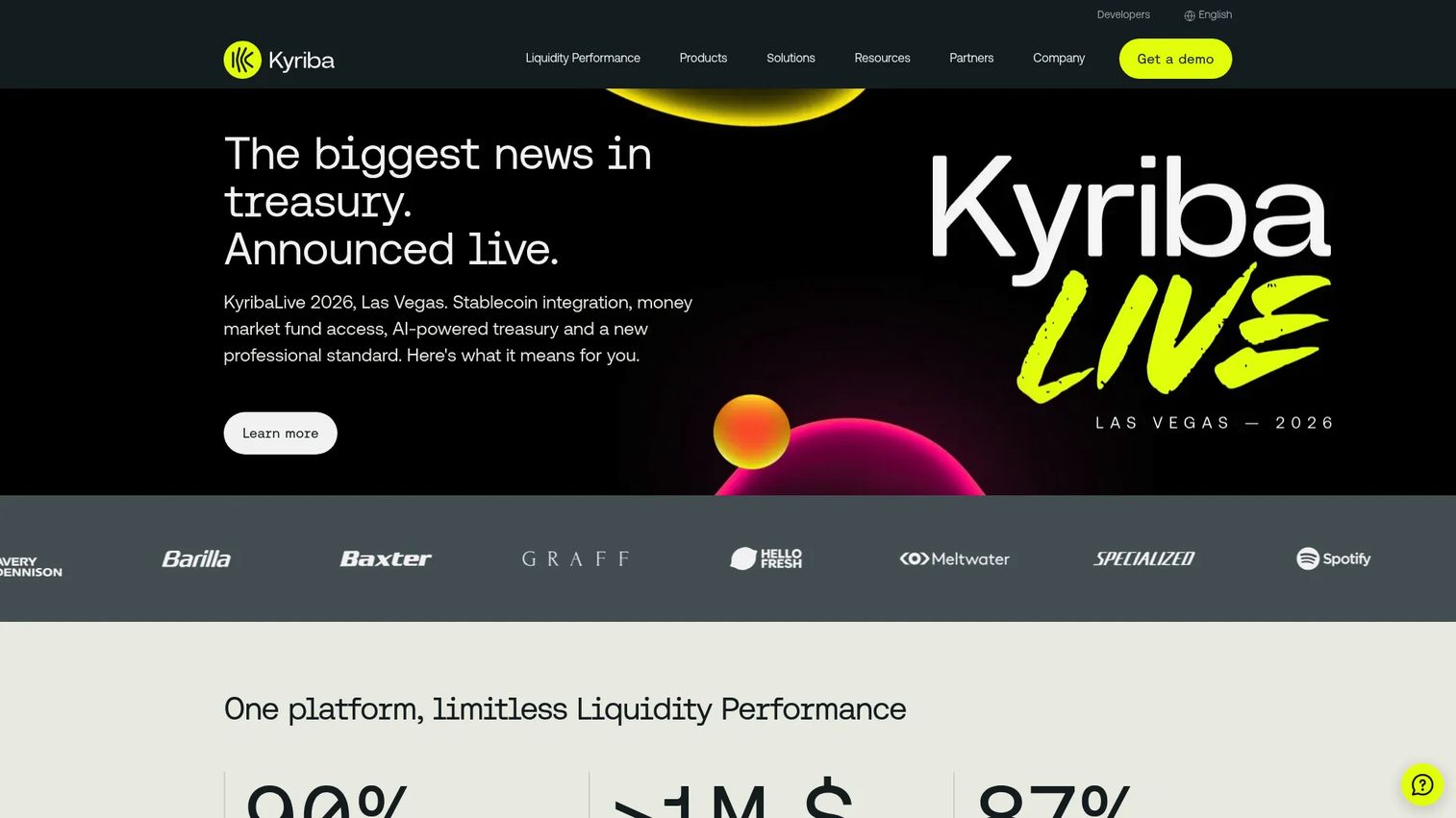
Kyriba is a cloud-based liquidity performance platform covering treasury, payments, risk, connectivity, and working capital management. It is built for enterprise finance teams that need a single view of cash across many banks, entities, and currencies. The platform is widely used by large organizations that treat treasury as a strategic control function rather than a back-office task.
Kyriba's strength is breadth combined with real-time data. It pulls balances and transactions from banks through prebuilt connectivity, then layers forecasting, payments control, and risk management on top. For a scaling company, that means fewer surprises in the cash position and faster answers when the board asks about liquidity.
Best for: Enterprise finance teams needing treasury visibility, payments control, and liquidity optimization across a complex banking footprint.
Key strengths
- Real-time cash and treasury management: Consolidate balances across banks and entities into one live cash position.
- Payments automation and control: Route, approve, and monitor payments with fraud controls and audit trails.
- Bank, ERP, and API connectivity: Connect to banks and finance systems out of the box, cutting manual data pulls.
Why choose Kyriba: Pick Kyriba when treasury complexity has outgrown spreadsheets and you need enterprise-grade liquidity management, not a light cash tool. It fits multi-entity, multi-currency organizations that want payments, forecasting, and risk in one platform. Leaner teams may find it more than they need today.
Kyriba pricing: Kyriba does not publish public pricing. The site routes visitors to request a demo, and deals are quote-based depending on modules, entities, and connectivity scope. Expect enterprise-level pricing aligned with a full treasury deployment.
2. GTreasury
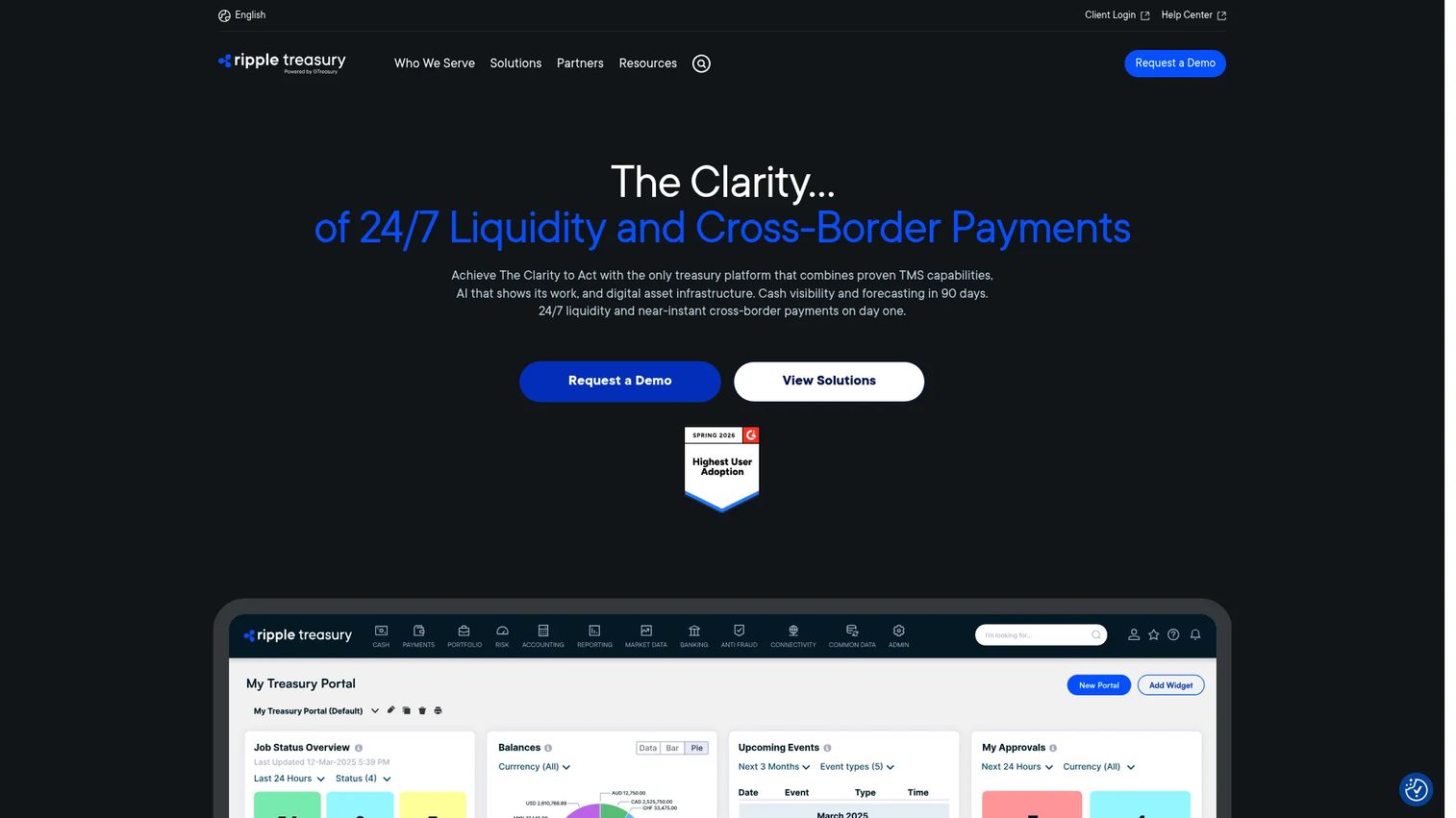
GTreasury is treasury and risk management software built for CFOs and treasury teams that want cash, forecasting, and risk operations in one platform. It targets mid-market to enterprise finance teams centralizing treasury workflows that previously lived in disconnected tools. GTreasury reports use across more than 1,000 organizations in 160 countries.
The platform centers on centralized treasury operations. It combines cash management and visibility, cash forecasting, and risk management with hedge accounting, so a team can run the full treasury cycle without switching systems. For founders formalizing finance operations, that consolidation reduces the number of tools and handoffs.
Best for: Mid-market to enterprise finance teams needing treasury, cash, and risk operations unified in a single platform.
Key strengths
- Cash management and visibility: Aggregate positions across banks and accounts for a clear real-time cash view.
- Cash forecasting: Build and update forecasts with actuals flowing from bank connectivity.
- Risk management and hedge accounting: Track exposures and support hedge accounting requirements.
Why choose GTreasury: Choose GTreasury when you want centralized treasury operations without assembling a suite from separate vendors. It suits teams that need forecasting and risk depth alongside daily cash management. The learning curve rewards teams ready to commit to a structured treasury workflow.
GTreasury pricing: GTreasury does not publicly disclose numeric pricing. Plans appear to be quote-based, scoped to modules, entities, and integration needs. Contact their team for a tailored quote.
3. SAP Treasury and Risk Management
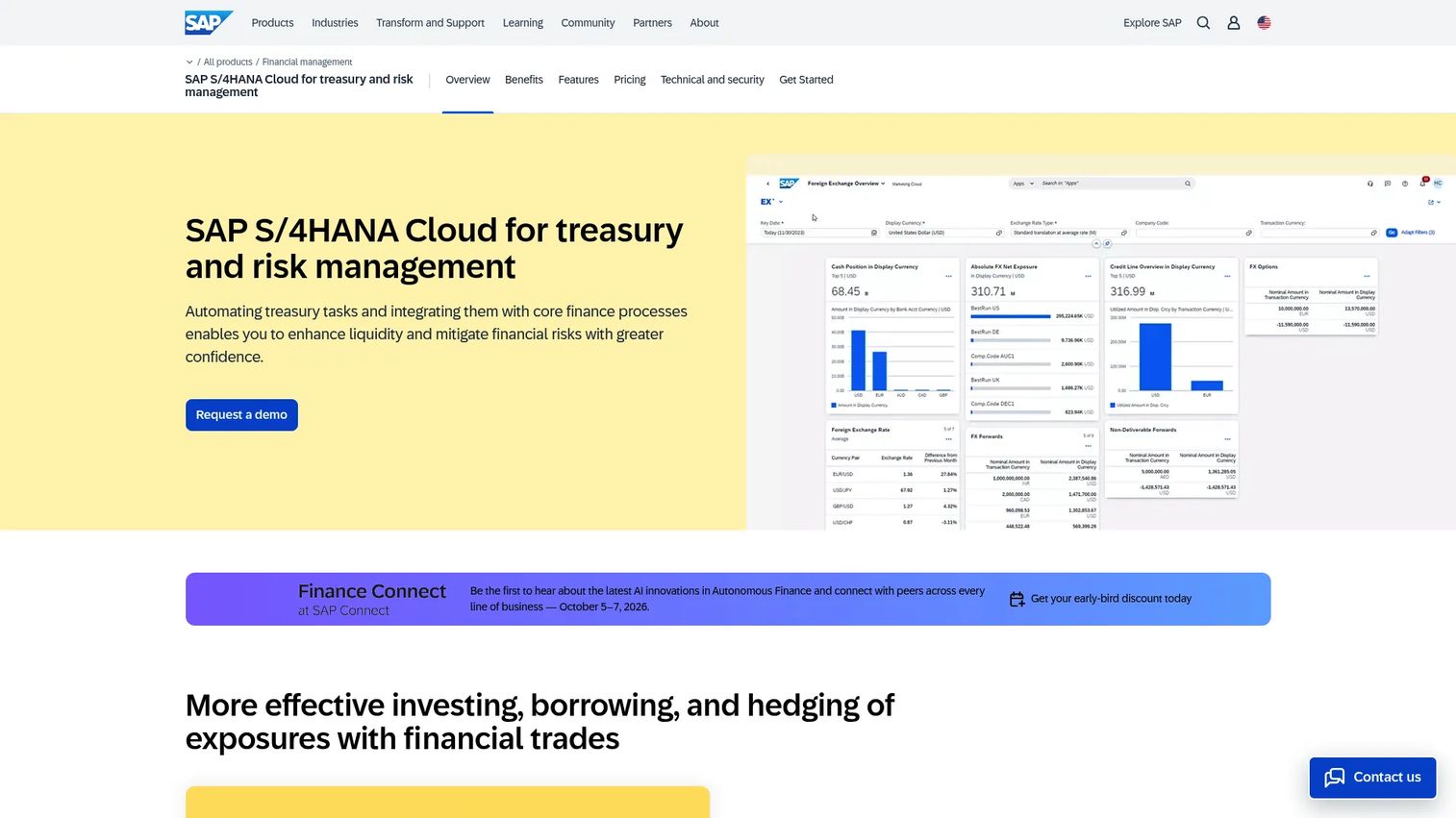
SAP Treasury and Risk Management is SAP's software for managing cash, funding, investments, and financial risk directly inside SAP finance workflows. It is the natural fit for enterprises already running SAP that want treasury to sit inside the same system as accounting and reporting. SAP was recognized in the IDC MarketScape worldwide treasury and risk management vendor assessment for 2023.
The platform's edge is ERP integration. It automates FX exposure capture from cash flow and balance sheet data, generates hedging proposals, and supports IFRS and US GAAP accounting. Because treasury, cash forecasting, payments, and financial accounting share one data layer, reconciliation and reporting stay clean.
Best for: Enterprises already invested in SAP that need integrated treasury, risk, and accounting workflows on one platform.
Key strengths
- FX exposure automation: Capture exposures automatically from cash flow and balance sheet data.
- Hedging and accounting support: Generate hedging proposals and support IFRS and US GAAP treatment.
- Native ERP integration: Connect treasury with forecasting, payments, market data, and financial accounting inside SAP.
Why choose SAP Treasury and Risk Management: Choose it when SAP is already your system of record and you want treasury to inherit that data without integration projects. The value compounds for teams that need risk and accounting tightly linked. Companies outside the SAP ecosystem will get less from it.
SAP Treasury and Risk Management pricing: SAP does not display a public price. The product page routes to a demo or request flow, and pricing is scoped to your SAP environment and modules. Expect enterprise licensing terms.
4. Nomentia

Nomentia is treasury and cash management software focused on visibility, control, forecasting, payments, and risk management. It is built for mid-market and enterprise treasury teams that want to consolidate cash, payments, and risk while deploying in modular stages. Nomentia reports use across more than 1,400 companies and holds ISO 27001 certification.
The platform's appeal is real-time control paired with modular deployment. Teams start with the pieces they need, such as bank connectivity or cash forecasting, then expand into payments and risk. That staged approach suits companies formalizing treasury operations without a single massive rollout.
Best for: Mid-market and enterprise treasury teams managing cash, payments, and risk who want to deploy in stages.
Key strengths
- Bank connectivity and system integrations: Link banks and finance systems for consolidated data flow.
- Cash flow forecasting: Model liquidity across entities with connected actuals.
- Treasury management and risk control: Run payments and risk workflows with operational oversight.
Why choose Nomentia: Choose Nomentia when you want operational consolidation and real-time control without committing to every module upfront. Its modular structure fits teams scaling treasury maturity in phases. It suits organizations that value staged rollout over a big-bang implementation.
Nomentia pricing: Nomentia does not publish public pricing. Deals are quote-based, scoped to modules, entities, and connectivity requirements. Reach out to their team for a scoped estimate.
5. Coupa

Coupa is a business spend management platform spanning procurement, invoicing, and expense management, with treasury workflows that sit inside that broader finance picture. It fits mid-market to enterprise teams that want treasury as part of a wider spend and cash story rather than a standalone treasury suite. Coupa reports that more than 400 users collaborate on its treasury capabilities.
Coupa's angle is finance team consolidation. When spend, procurement, and payments already run in one platform, adding treasury workflows keeps cash and liquidity data close to where money is committed and spent. That reduces tool sprawl for teams optimizing their finance stack.
Best for: Mid-market to enterprise finance teams that want treasury workflows connected to procurement, invoicing, and spend control.
Key strengths
- Spend management platform: Manage procurement, invoicing, and spend from one system.
- Procure-to-pay workflows: Connect purchasing and payments end to end.
- Expense management: Control and route employee and operational spend.
Why choose Coupa: Choose Coupa when consolidating finance workflows matters more than deep standalone treasury features. It fits teams that already run spend on Coupa and want cash and treasury nearby. Organizations needing the deepest dedicated treasury depth may pair it with a specialist system.
Coupa pricing: Coupa does not display public pricing on its site. Pricing appears request-based and scoped to modules and company size. Contact Coupa for a quote aligned to your spend and treasury needs.
6. Oracle Cash and Treasury Management
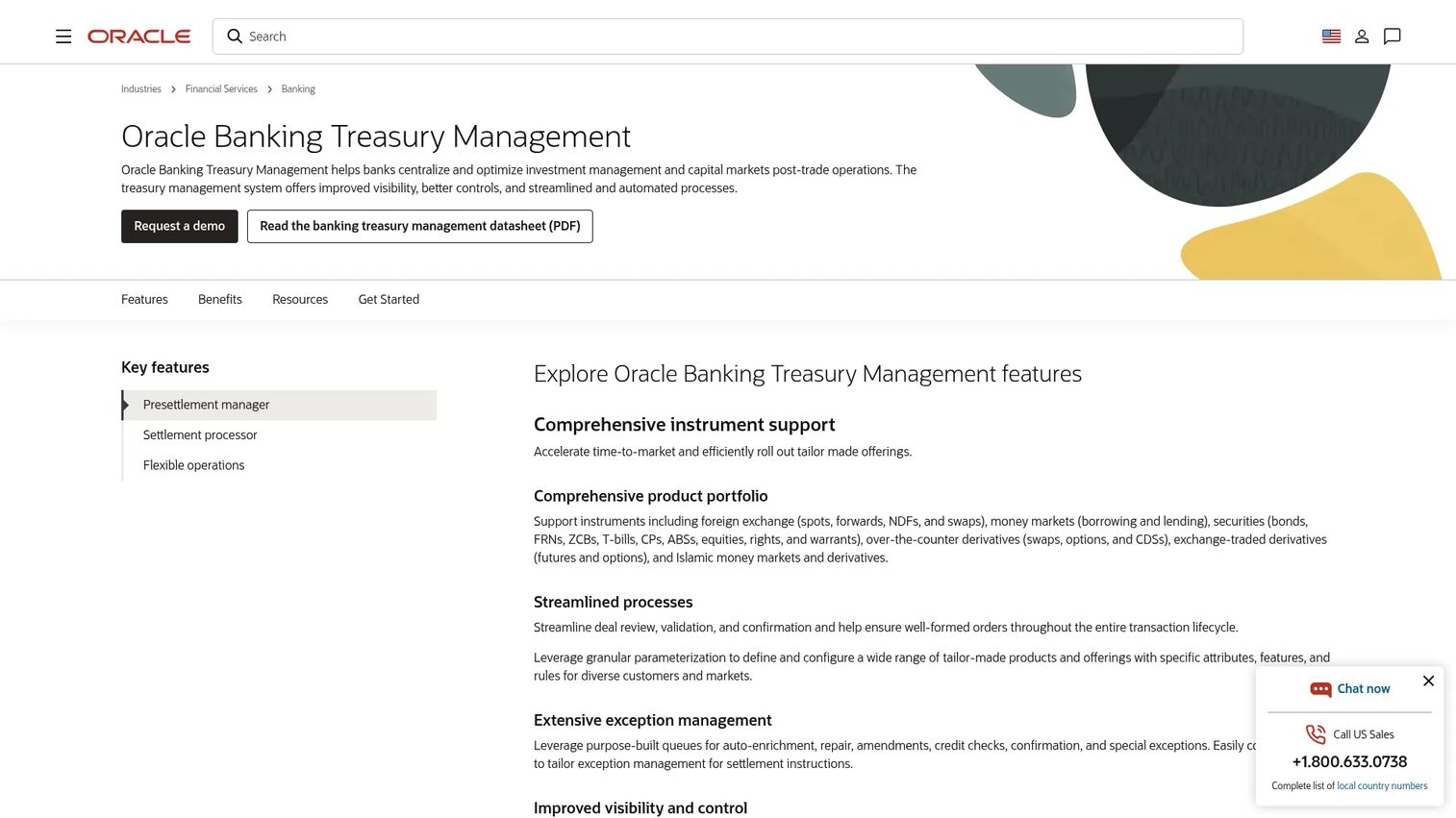
Oracle Cash and Treasury Management is Oracle's treasury software for centralizing investment management and capital markets post-trade operations, with strong fit for banks and enterprise finance environments. It suits organizations already anchored in Oracle that want treasury back-office, settlement, and cash management aligned with their broader finance systems.
The platform's strength is enterprise process alignment and ERP adjacency. Features like a presettlement manager and settlement processor support real-time treasury back-office and post-trade automation. For Oracle-centered environments, that keeps cash management and treasury operations inside one governed ecosystem.
Best for: Banks and enterprise finance teams in Oracle environments needing real-time treasury back-office, settlement, and cash management.
Key strengths
- Presettlement manager: Handle pre-trade and presettlement workflows in a controlled process.
- Settlement processor: Automate settlement and post-trade operations at scale.
- Flexible operations: Adapt treasury back-office processes to complex enterprise needs.
Why choose Oracle Cash and Treasury Management: Choose it when Oracle is your finance backbone and you want treasury and settlement to align with that stack. It fits banks and large enterprises with post-trade and back-office complexity. Smaller teams without Oracle infrastructure will find lighter options a better match.
Oracle Cash and Treasury Management pricing: Oracle does not publish a public price. The product page uses demo and contact CTAs, and pricing is scoped to your Oracle environment and modules. Contact Oracle for enterprise pricing.
7. TIS
TIS is a cloud-based payments and cashflow platform built for treasury, bank connectivity, and cash visibility. It is designed for large enterprises that need centralized global payments and a clear cash position across many banks and entities. TIS holds a strong 4.7/5 rating on G2.
TIS earns its place through multi-bank complexity. When a company runs dozens of bank relationships across regions, TIS centralizes payments, financial messaging, and cash reporting into one connectivity layer. That matters for treasury teams where payments automation and bank connectivity are the core daily challenge.
Best for: Large enterprises needing centralized global payments, bank connectivity, and cash visibility across many entities.
Key strengths
- Global payments and cash management: Centralize payments across regions and banks.
- Bank connectivity and financial messaging: Connect to many banks with standardized messaging.
- Cash forecasting and reporting: Build forecasts and reports from consolidated cash data.
Why choose TIS: Choose TIS when multi-bank payments and connectivity are your hardest problem, not general treasury breadth. It fits enterprises with sprawling banking footprints that need one payments and cash layer. Teams whose priority is deep risk or hedge accounting may pair it with a dedicated treasury suite.
TIS pricing: TIS does not publish public pricing. Sales appear demo and contact-led, with quotes scoped to entities, banks, and payment volume. Contact TIS for a tailored estimate.
8. Rho
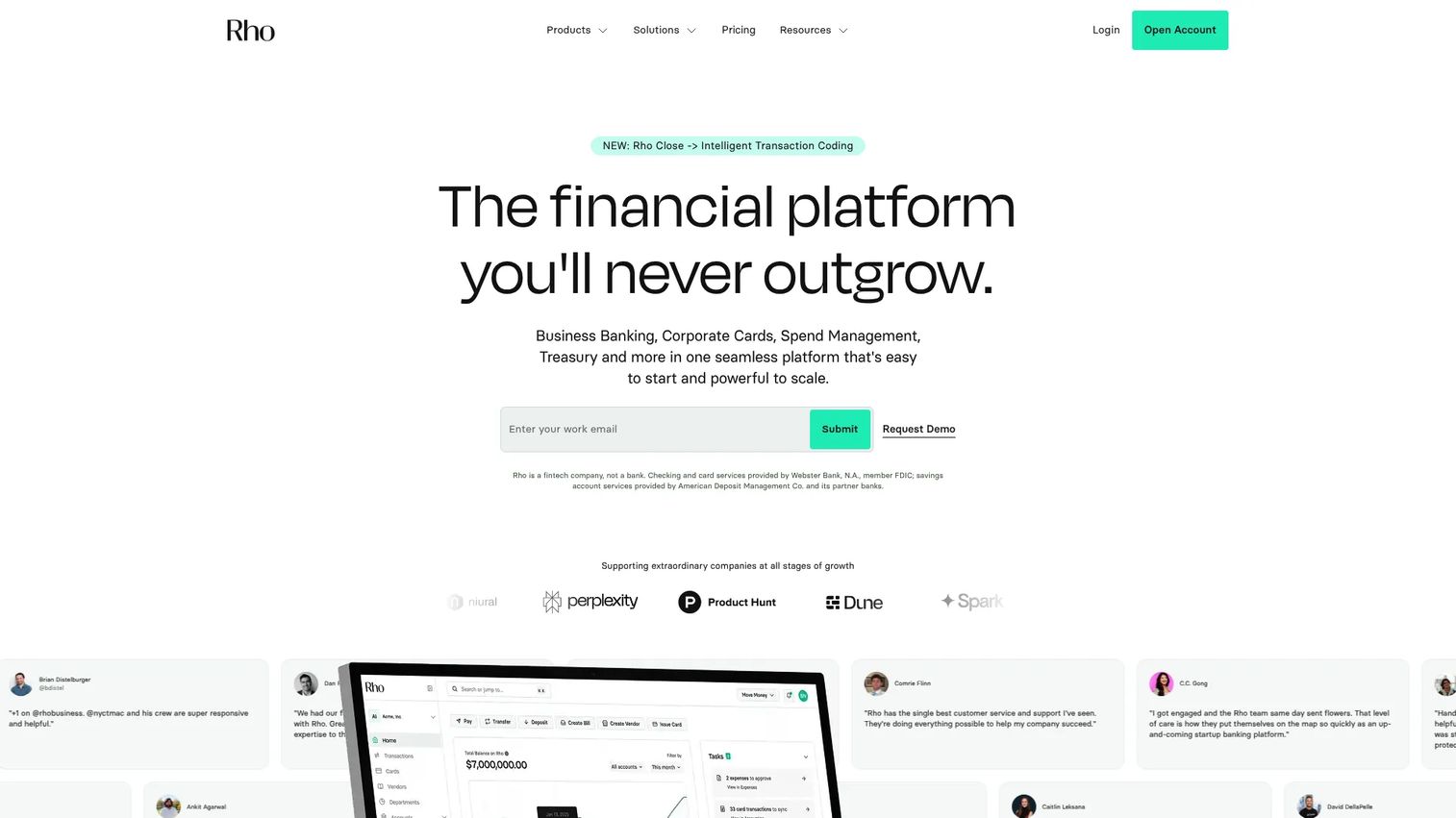
Rho is a finance platform that combines business banking, corporate cards, spend management, bill pay, and accounting automation. It fits startups and growth companies that want banking and treasury-adjacent cash management in one modern place, without stitching together separate vendors. Rho holds a 4.8/5 rating on G2.
Rho's angle is modern finance operations with treasury-adjacent cash management built in. Banking, spend controls, and reconciliation automation live together, which suits founders who want cash visibility and control before they need a heavy enterprise treasury suite. It is a practical starting point on the treasury maturity curve.
Best for: Startups and growth companies wanting all-in-one business banking, spend management, and cash automation.
Key strengths
- Business banking and cash management: Hold, move, and monitor cash from one platform.
- Corporate cards and spend controls: Manage cards and enforce spend policy.
- Bill pay, AP, and accounting automation: Automate payables and reconciliation workflows.
Why choose Rho: Choose Rho when you want banking, spend, and cash automation combined without enterprise treasury complexity. It fits earlier-stage companies building financial discipline before a full treasury system. Large multi-entity treasuries with deep FX and risk needs will eventually outgrow it.
Rho pricing: Rho publicly states $0 subscription fees, $0 per-user fees, and $0 for core banking and spend capabilities, including AP, expense, and accounting automation. Foreign currency transfers are listed at 1% per transfer. That transparent, low-cost model stands out against quote-based enterprise treasury systems.
9. FIS Treasury and Risk Manager - Integrity Edition
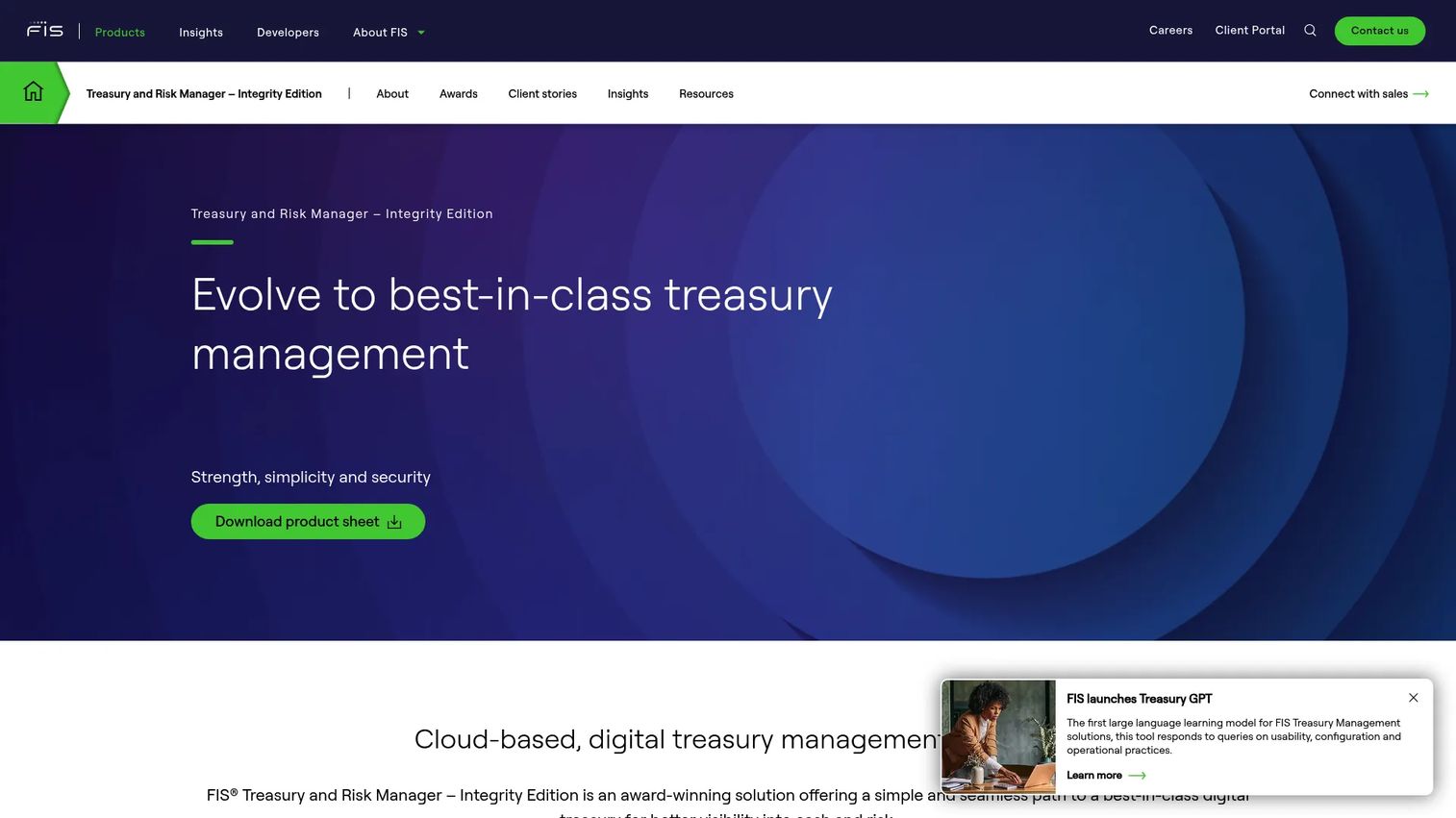
FIS Treasury and Risk Manager - Integrity Edition is cloud-based treasury management software for cash, risk, payments, reporting, and compliance. It is built for corporate treasuries that need a system covering liquidity, risk, and reporting at scale. FIS has been recognized as a Best Cash and Treasury Management Solution in the Treasury Management International Awards.
The platform's strength is enterprise treasury and risk depth. It covers cash positioning and forecasting, bank account administration, payments, FX, debt and investment management, plus standardized reporting and customizable dashboards. For complex treasury environments, that breadth handles the full operating picture in one system.
Best for: Corporate treasuries needing a cloud-based system for liquidity, risk, and reporting at scale.
Key strengths
- Cash positioning and forecasting: Maintain daily cash positions and build forward forecasts.
- Bank account management, payments, FX, debt, and investments: Administer accounts and manage payments, FX, and instruments.
- Standardized and ad hoc reporting: Produce standard reports, custom dashboards, and one-off analysis.
Why choose FIS Treasury and Risk Manager - Integrity Edition: Choose it when your treasury is large and complex enough to need deep risk, reporting, and instrument coverage. It fits corporate treasuries that treat treasury as a full operating discipline. Smaller teams may find its depth more than their current needs require.
FIS Treasury and Risk Manager - Integrity Edition pricing: FIS does not publish a public price. Pricing is presented as contact-sales and request-based, scoped to your treasury requirements. Reach out to FIS for a quote.
Considerations
Before you commit to any treasury management platform, work through this checklist. It separates a clean fit from a costly mismatch.
Check ERP and bank integration depth
Confirm the tool connects to your specific banks and your ERP without custom engineering. Ask which connections are prebuilt versus which need setup. Weak bank connectivity or shallow ERP integration undermines the entire promise of real-time cash visibility.
Confirm cash forecasting workflow fit
Look at how forecasting actually works in the tool, not just that it exists. Does it pull actuals automatically, support scenarios, and handle your forecasting cadence? A cash forecasting workflow that fits your daily, weekly, and monthly rhythm saves far more than one that looks good in a demo.
Review support for FX and interest rate risk
If you operate across currencies or carry debt, verify how the platform handles FX risk and interest rate risk. Check for exposure tracking, hedging support, and hedge accounting if you need it. Match the depth of risk management to your actual exposure, not a hypothetical one.
Verify compliance, auditability, and approval controls
Payments automation is only safe with enforced approvals and audit trails. Confirm segregation of duties, approval chains, and compliance reporting fit your governance needs. This is where treasury software earns board trust, so test it against your real controls.
Assess implementation time and internal ownership
Ask who owns the rollout internally and how long it takes. Enterprise treasury systems need dedicated finance ownership, while lighter tools go live faster. Treasury software pricing is only part of the cost; internal time to implement and maintain is the other half.
Conclusion
The right treasury management software depends on your treasury maturity, not on which vendor has the longest feature list. Enterprise treasuries with multi-entity, multi-currency complexity gravitate to Kyriba, SAP Treasury and Risk Management, Oracle Cash and Treasury Management, and FIS for breadth and risk depth. GTreasury and Nomentia fit teams centralizing treasury operations, with Nomentia adding modular, staged rollout. TIS wins when global payments and bank connectivity are the core challenge. Coupa fits teams consolidating treasury inside broader spend workflows. Rho suits earlier-stage companies wanting banking, spend, and reconciliation automation in one modern platform.
Whatever your stage, evaluate through one lens: visibility, automation, and control. The goal is a real-time cash position you trust, treasury automation that removes manual error, and controls that survive board scrutiny. Shortlist two or three that match your maturity, then pressure-test each against your banks, your ERP, and your real forecasting cadence before you sign.
FAQs
Treasury management software centralizes cash, liquidity, payments, and financial risk so finance teams see and control money movement across banks, entities, and currencies from one system. It aggregates balances, automates cash forecasting and payments, tracks risk, and produces compliance reports. The core outcome is real-time cash visibility instead of stale spreadsheet snapshots.
Accounting software records what already happened for reporting and compliance. A treasury management platform focuses forward, on live cash positions, forecasting, liquidity management, and payment and risk decisions. Accounting answers what your books say; treasury answers how much cash you have right now and what is coming next.
The features that matter most are real-time cash visibility, cash forecasting, payments automation, risk management for FX and interest rate risk, bank connectivity, and ERP integration. Reconciliation automation and compliance reporting round out a strong platform. Weight each feature by your actual complexity, not by the longest feature list.
Smaller teams often start with lighter cash management software or a banking-plus-treasury platform like Rho before adopting a full suite. The trigger is not headcount but complexity: multiple banks, entities, or currencies, and forecasting that spreadsheets can no longer handle cleanly. When manual reconciliation and cash visibility start costing real decision time, it is worth the move.
Treasury software improves cash forecasting by pulling actual balances and transactions directly from bank feeds, so forecasts start from live data rather than manual entry. It layers scenarios and updates automatically as inputs change. That lets teams plan liquidity daily, weekly, and monthly without rebuilding a spreadsheet model every time an entity or currency is added.
At minimum, treasury software should support bank connectivity to your specific banks, ERP integration with your finance system, and market data feeds for FX and rates. Deeper platforms add API connectivity for custom data flows. Confirm which connections are prebuilt before you buy, since integration depth drives how much manual work the tool actually removes.
Most enterprise treasury management systems use quote-based pricing scoped to modules, entities, and connectivity, so vendors like Kyriba, GTreasury, SAP, Oracle, TIS, and FIS publish no public figure. Rho stands out with a transparent model, listing $0 subscription and per-user fees for core capabilities. Treasury software pricing also includes implementation and internal ownership time, so factor that into the total cost.
It is time when cash data lives across too many bank portals and exports to reconcile reliably, forecasting breaks under new entities or currencies, or payment and risk controls need enforced approvals and audit trails. If reconciliation automation and real-time cash visibility would change how fast you make decisions, spreadsheets have already hit their ceiling.