The deal was moving. Then the prospect's security team sent over a 200-line questionnaire and asked for your SOC 2 report, your data flow diagrams, and proof of continuous control monitoring. Momentum stalls right there, in the gap between "we love the product" and "we cleared security review."
If you sit in presales or own a compliance program, you know this moment. The audit deadline that eats three weeks of screenshots. The spreadsheet that tracks 120 controls across four frameworks and breaks the moment someone leaves the company. The evidence request you answer manually, again, for the fifth prospect this quarter.
The cost is real. Hyperproof's compliance research puts the average global cost of maintaining compliance at $5.47 million, while the average cost of non-compliance runs about $4.0 million in revenue losses, with business disruption alone averaging $5.1 million. And Secureframe's 2026 compliance trends report found 69% of organizations say regulations are too complex or numerous, or that verifying third-party compliance is hard.
Average cost of maintaining compliance: $5.47M. Average cost of non-compliance: $4.0M. Business disruption from non-compliance: $5.1M. (Source: Hyperproof, 2025)
Security compliance software exists to close that gap. The right tool automates evidence collection, monitors controls continuously, and keeps you audit-ready so security reviews stop killing deals. This guide ranks the 10 best options for 2026.
What's inside
This guide is built for presales engineers, solutions consultants, security and GRC leads, IT compliance managers, and SaaS founders prepping for a first audit. We picked tools that handle the core compliance jobs: proving framework adherence, automating evidence, and surviving security review without spreadsheet sprawl. If buyer-facing security review is part of your motion, our roundup of presales software tools pairs well with the compliance platforms here.
We ranked all 10 against four criteria:
- Framework coverage: SOC 2, ISO 27001, HIPAA, PCI DSS, GDPR, NIST, HITRUST, and more.
- Automation depth: continuous control monitoring and auto-collected evidence versus manual upload.
- Integrations: cloud (AWS, Azure, GCP), HRIS, ticketing, CRM, and identity systems.
- Pricing transparency and scalability: from first-time SOC 2 to enterprise GRC.
TL;DR
Short on time? Here are the decision shortcuts.
- Best for fast SOC 2 and ISO 27001: Vanta. Automated evidence, broad framework library, fast time to audit-ready.
- Best for continuous control monitoring: Drata. Deep automation and an auditor network that scales startup to enterprise.
- Best for guided first-time audits: Secureframe. White-glove onboarding and automated tests.
- Best for enterprise GRC and privacy: OneTrust. Privacy (GDPR, CCPA), risk, and governance at scale.
- Best for compliance operations teams: Hyperproof. Cross-framework control reuse and workflow automation.
- Best for cloud posture monitoring: SentinelOne Singularity Cloud Security. CSPM and CNAPP with compliance dashboards.
- Best for MSPs and vCISO-led compliance: Cynomi. Multi-tenant, channel-first, built for service providers.
Background: what is security compliance software
Security compliance software automates the monitoring, evidence collection, and reporting needed to prove an organization meets security frameworks like SOC 2, ISO 27001, HIPAA, and PCI DSS. It replaces manual spreadsheets and one-off screenshots with continuous, connected workflows.
Swimlane defines security compliance automation as using automated tools to ensure regulatory requirements are met consistently, with continuous monitoring, reporting, and enforcement of security policies. That definition maps cleanly to what these platforms do day to day.
Core features you will see across most compliance software tools:
- Continuous control monitoring: automated checks that flag control drift in real time, not once a year.
- Automated evidence collection: pulls logs, access reviews, and asset inventories from connected systems.
- Framework and control mapping: maps one control to multiple frameworks so you avoid duplicate work.
- Audit management: evidence requests, auditor collaboration, and documentation in one place.
- Risk management: risk registers, scoring, heatmaps, and remediation tracking.
- Vendor and third-party risk: track supplier security posture and questionnaires.
- Questionnaire automation: answer buyer security reviews faster from a central evidence library.
- Reporting dashboards: real-time posture views for auditors, executives, and boards.
- Integrations: cloud (AWS, Azure, GCP), HRIS, ticketing, CRM, and identity providers.
The category uses overlapping labels. Here is the quick distinction so you can shop with precision.
| Term | What it focuses on |
|---|---|
| Compliance monitoring software | Continuous control checks and drift detection in real time |
| Compliance management software | The broader workflow: policies, evidence, audits, risk, and reporting |
GRC (governance, risk, and compliance) sits above both. It bundles compliance management software with enterprise risk and governance for larger, multi-framework programs. Regulatory compliance software and IT compliance software are narrower framings of the same category, weighted toward specific mandates or technical controls.
When to use security compliance software
Not every team needs the same depth. Here is how to pattern-match your situation.
Prove framework compliance without spreadsheets
If you are heading into a first SOC 2 audit framework requirements or ISO 27001 audit, manual evidence collection is the slowest path. Compliance tracking software automates evidence across connected systems, so audit prep stops consuming weeks. You map controls once, then let the platform pull proof on a schedule. This matters most when you maintain several frameworks at once and need cross-framework evidence reuse.
Monitor controls continuously, not once a year
Point-in-time audits hide drift. A misconfigured S3 bucket or a stale access grant can slip in the day after your audit closes. Compliance monitoring software runs continuous checks and flags control drift in real time. For cloud-heavy environments, this is the difference between catching a gap in hours versus discovering it in next year's audit.
Speed up security reviews in the sales cycle
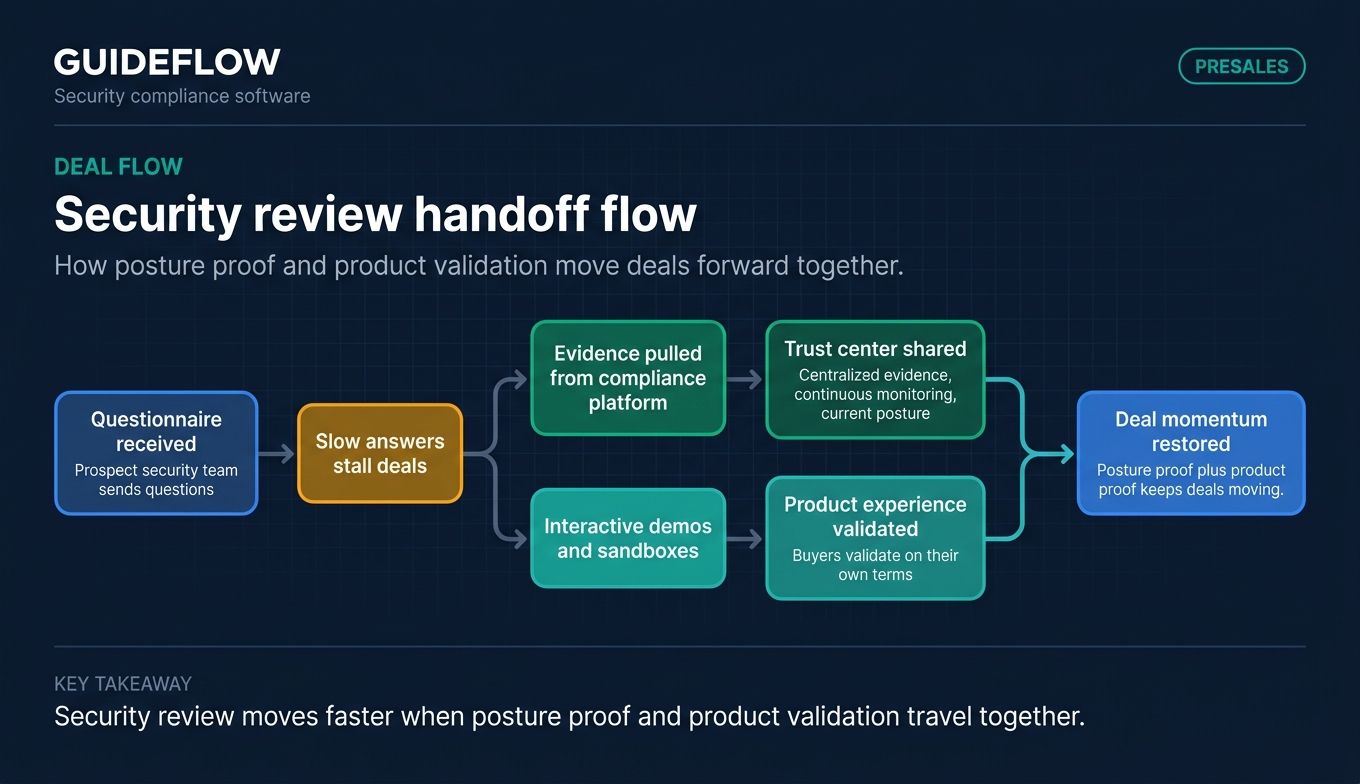
Presales teams personally own the buyer-facing side of security diligence. When a prospect's security team sends a questionnaire, you answer it, and slow answers stall deals. Centralized evidence and continuous monitoring let you respond faster and share current posture through a trust center. On the product side, presales teams show security workflows fastest when they pair that evidence with interactive demos or sandboxes that let buyers validate the experience on their own terms. Linking compliance proof to buyer enablement keeps prospects moving through diligence on their own terms. The compliance platform proves your posture. The product experience proves your value. Together they keep deals moving.
Comparison table
The list below sorts GRC and audit-automation leaders first, then cloud-posture monitoring tools. Pricing for most platforms in this category is custom and quote-based, so we note that directly rather than guess. G2 ratings reflect each tool's current listing.
| # | Product | Intent | Key use case | Pricing | G2 rating |
|---|---|---|---|---|---|
| 1 | Vanta | Fast multi-framework compliance | Automate SOC 2, ISO 27001 evidence and continuous monitoring | Custom (request demo) | 4.6/5 |
| 2 | Drata | Continuous control monitoring | Audit readiness across many frameworks, startup to enterprise | Custom (Foundation, Advanced, Enterprise) | 4.7/5 |
| 3 | Secureframe | Guided first-time audits | White-glove onboarding for SOC 2, ISO, HIPAA, PCI, FedRAMP | Custom (get a quote) | 4.7/5 |
| 4 | OneTrust | Enterprise GRC and privacy | Privacy (GDPR, CCPA), risk, and governance at scale | Custom (usage-based) | 4.3/5 |
| 5 | Hyperproof | Compliance operations | Cross-framework control reuse and audit workflows | Custom | 4.5/5 |
| 6 | AuditBoard (Optro) | Enterprise audit and SOX | Connected audit, risk, and compliance with board reporting | Custom | 4.6/5 |
| 7 | LogicGate Risk Cloud | Configurable GRC workflows | No-code risk and compliance workflow building | Custom (application-based) | 4.6/5 |
| 8 | SentinelOne Singularity Cloud Security | Cloud posture and compliance | CSPM and CNAPP with compliance assessment | From $69.99/endpoint/yr | 4.9/5 |
| 9 | Prisma Cloud | Multi-cloud compliance | CSPM and compliance reporting across AWS, Azure, GCP | Credit-based (2 to 5 credits/VM) | 4.1/5 |
| 10 | Cynomi | MSP and vCISO-led compliance | Multi-tenant compliance across 40+ frameworks | Custom (per account) | 4.9/5 |
1. Vanta
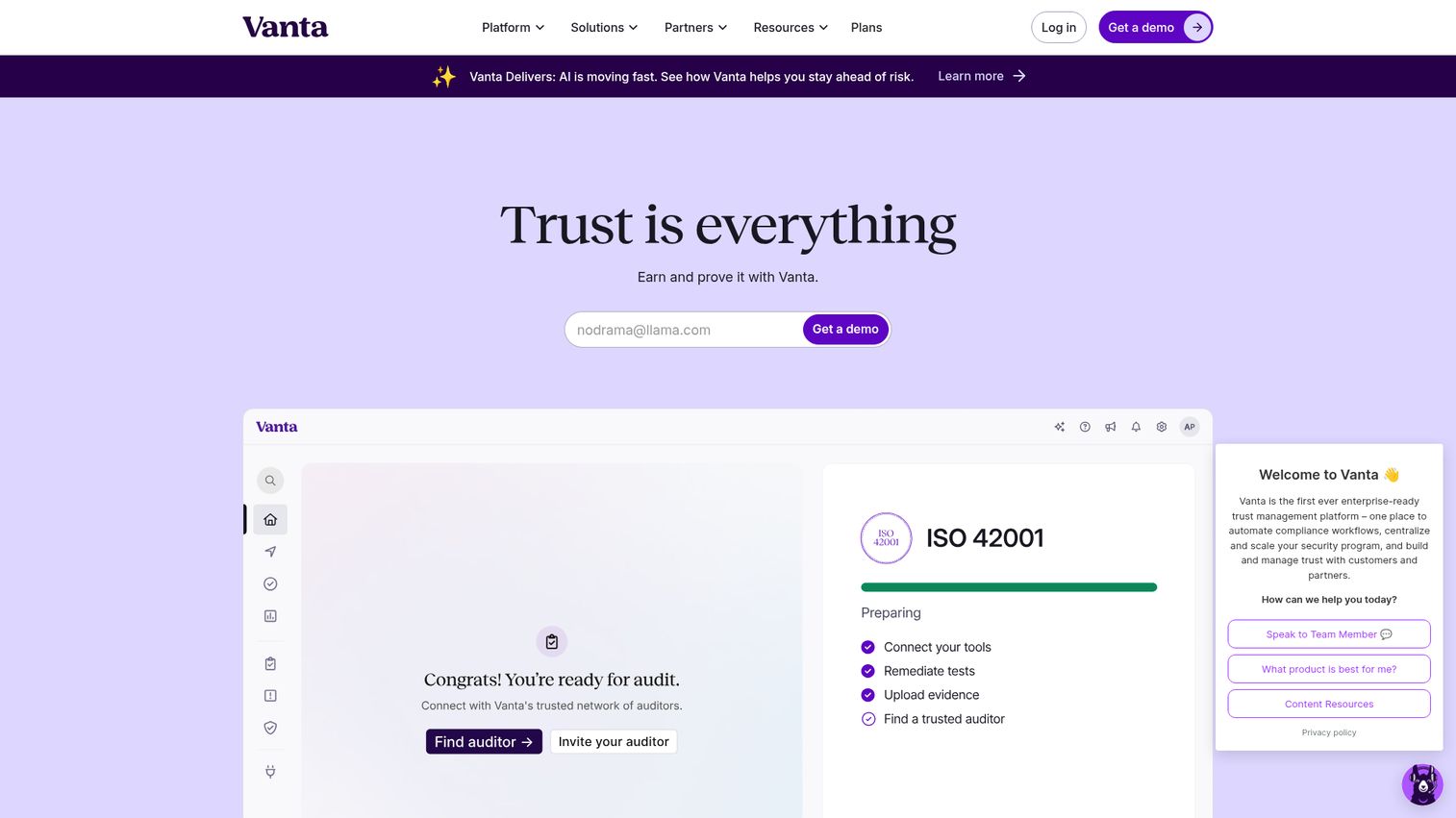
Vanta is an agentic trust platform that automates compliance, risk management, audits, trust centers, and security questionnaires. It is one of the most cited names in the category and shows up across competitor roundups for a reason: it gets companies audit-ready fast. The platform connects to your stack, collects evidence automatically, and monitors controls continuously across a broad framework library.
For presales readers, Vanta is the tool you most often see on the buyer side. When a prospect runs SOC 2 or ISO 27001 as a deal gate, there is a strong chance their evidence sits in Vanta. Its Trust Center also lets vendors publish posture publicly, which speeds up your own security reviews.
Best for: Companies that need to automate SOC 2, ISO 27001, HIPAA, GDPR, audits, vendor risk, and customer trust workflows quickly.
Key strengths
- Automated evidence collection: continuous control monitoring pulls proof from connected systems without manual screenshots.
- 300+ integrations: connects cloud, identity, HRIS, and ticketing tools for end-to-end coverage.
- Trust Center and questionnaire automation: publish posture and answer buyer security reviews faster.
Why choose Vanta: If your priority is reaching a first audit fast and maintaining many frameworks without a large compliance team, Vanta's automation breadth fits. It is a strong default for SaaS companies where security review is a recurring deal gate and speed matters.
Vanta pricing: Vanta lists Essentials, Plus, Professional, and Enterprise plans. The pricing page directs you to request a free demo for personalized pricing, and no public price figures are shown. Pricing typically scales with company size and framework count, so expect a custom quote.
2. Drata
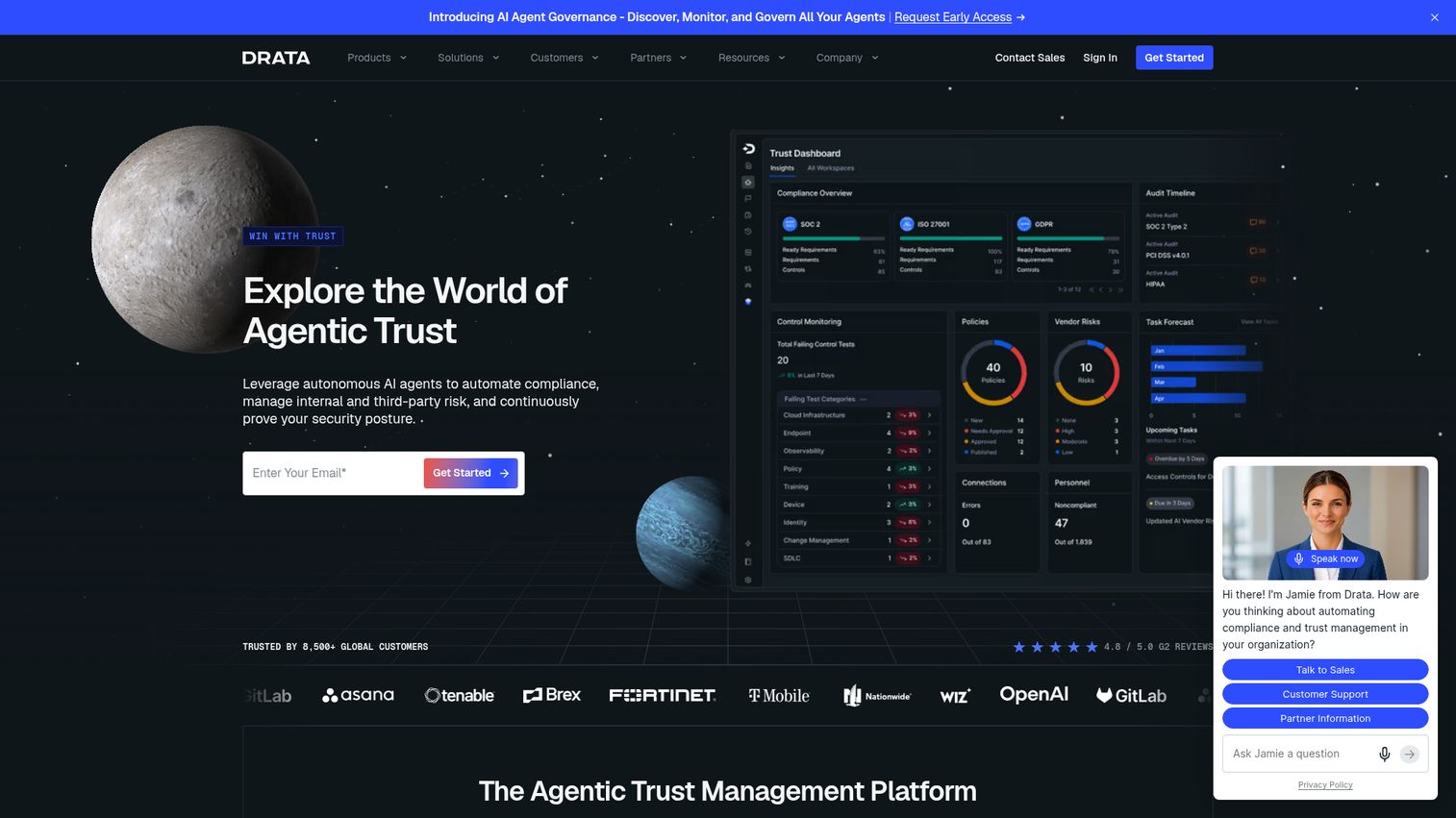
Drata is an agentic trust management platform built for governance, risk, compliance, audit readiness, and security reviews. It leans hard into continuous control monitoring, with automated evidence collection and a deep set of pre-mapped frameworks. Drata also runs an Audit Hub that lets auditors collaborate, request evidence, and review documentation directly inside the platform.
The automation depth is the headline. Drata connects to your cloud, HR, ticketing, and identity systems, then monitors controls on an ongoing basis. For teams scaling from a first SOC 2 toward a multi-framework enterprise program, that continuity reduces the manual load as you grow.
Best for: Organizations that need to automate compliance, manage GRC workflows, and maintain audit readiness across multiple frameworks.
Key strengths
- Continuous control monitoring: automated checks flag control drift between audits, not just at audit time.
- Multi-framework support: pre-mapped frameworks let you reuse controls and evidence across SOC 2, ISO 27001, and more.
- Audit Hub: auditors collaborate and request evidence inside the platform, cutting back-and-forth.
Why choose Drata: Drata is a strong pick when continuous monitoring is non-negotiable and you expect to add frameworks as the company grows. Its auditor collaboration tooling makes it especially useful for teams that want a smoother, faster audit cycle each year.
Drata pricing: Drata lists Foundation, Advanced, and Enterprise plans on its plans page. No public numeric pricing is displayed, and Enterprise is marked Contact Sales. Expect custom pricing scaled to your framework count and organization size.
3. Secureframe
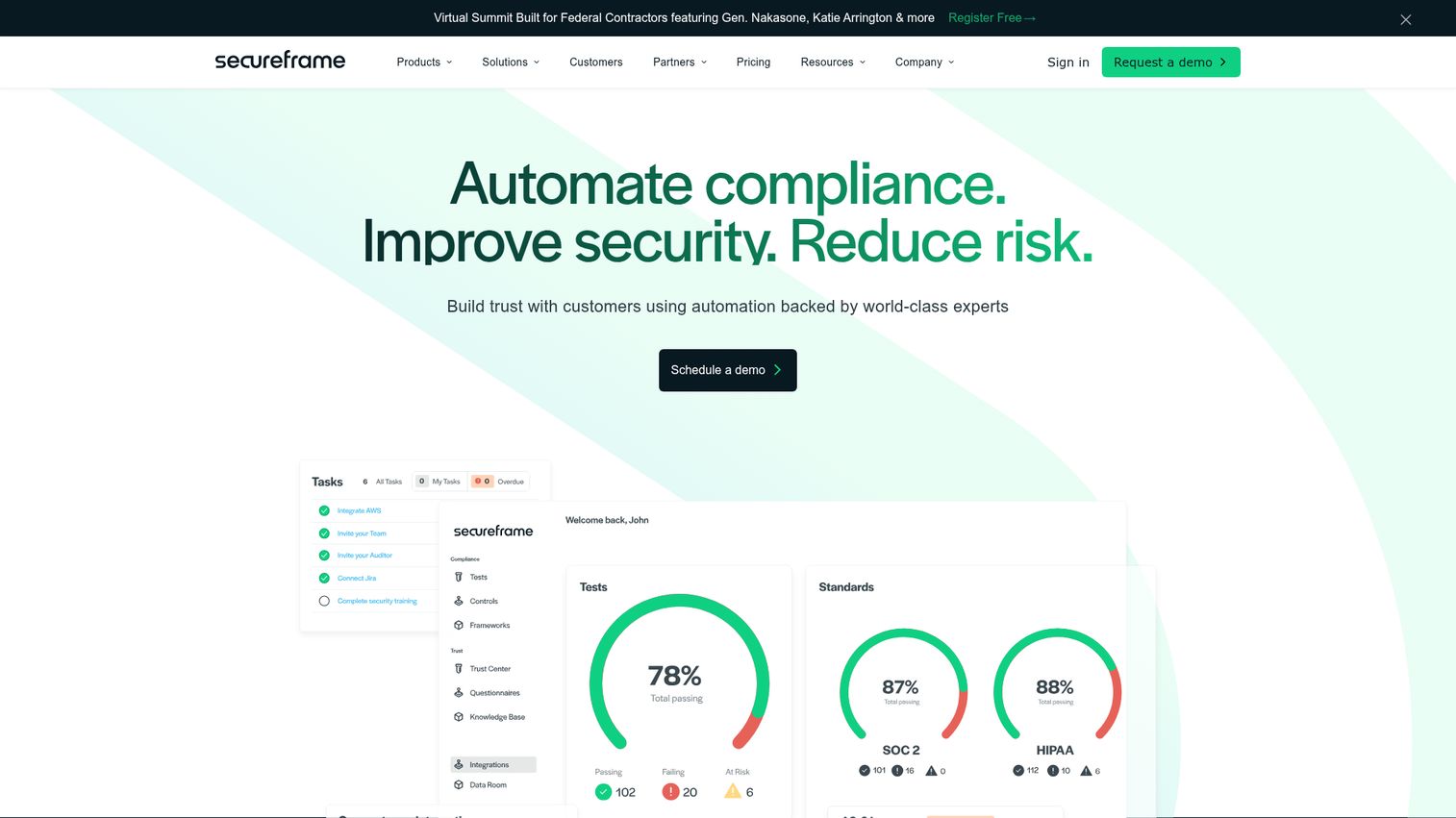
Secureframe helps organizations automate compliance, improve security, and reduce risk using automation, AI, and expert-backed workflows. It stands out for guided, first-time audit support. If your team has never been through SOC 2 or ISO 27001, Secureframe's onboarding and customer success walk you through control implementation step by step.
Framework coverage is broad: SOC 2, ISO 27001 information security standard, HIPAA, PCI DSS, GDPR, NIST, FedRAMP, and CMMC. Automated evidence collection and continuous control monitoring keep your posture current after the first audit closes, so you are not starting from scratch each year.
Best for: Companies obtaining and maintaining frameworks like SOC 2, ISO 27001, HIPAA, PCI DSS, GDPR, NIST, FedRAMP, or CMMC with automated monitoring.
Key strengths
- Automated evidence collection: pulls proof from connected systems so audit prep stops eating weeks.
- Continuous control monitoring: keeps posture current and surfaces gaps as they appear.
- Risk management: built-in risk workflows tie compliance and risk together in one place.
Why choose Secureframe: Choose Secureframe when this is your first audit and you want hands-on guidance rather than a self-serve setup. The expert-backed onboarding lowers the learning curve, which matters for lean teams without a dedicated compliance hire.
Secureframe pricing: Secureframe lists Fundamentals, Complete, and Defense tiers, each shown as "Get a quote" with no public numeric pricing. Complete adds advanced third-party risk, user access reviews, Trust Center, and questionnaire automation. Defense adds CMMC-focused capabilities for defense contractors.
4. OneTrust
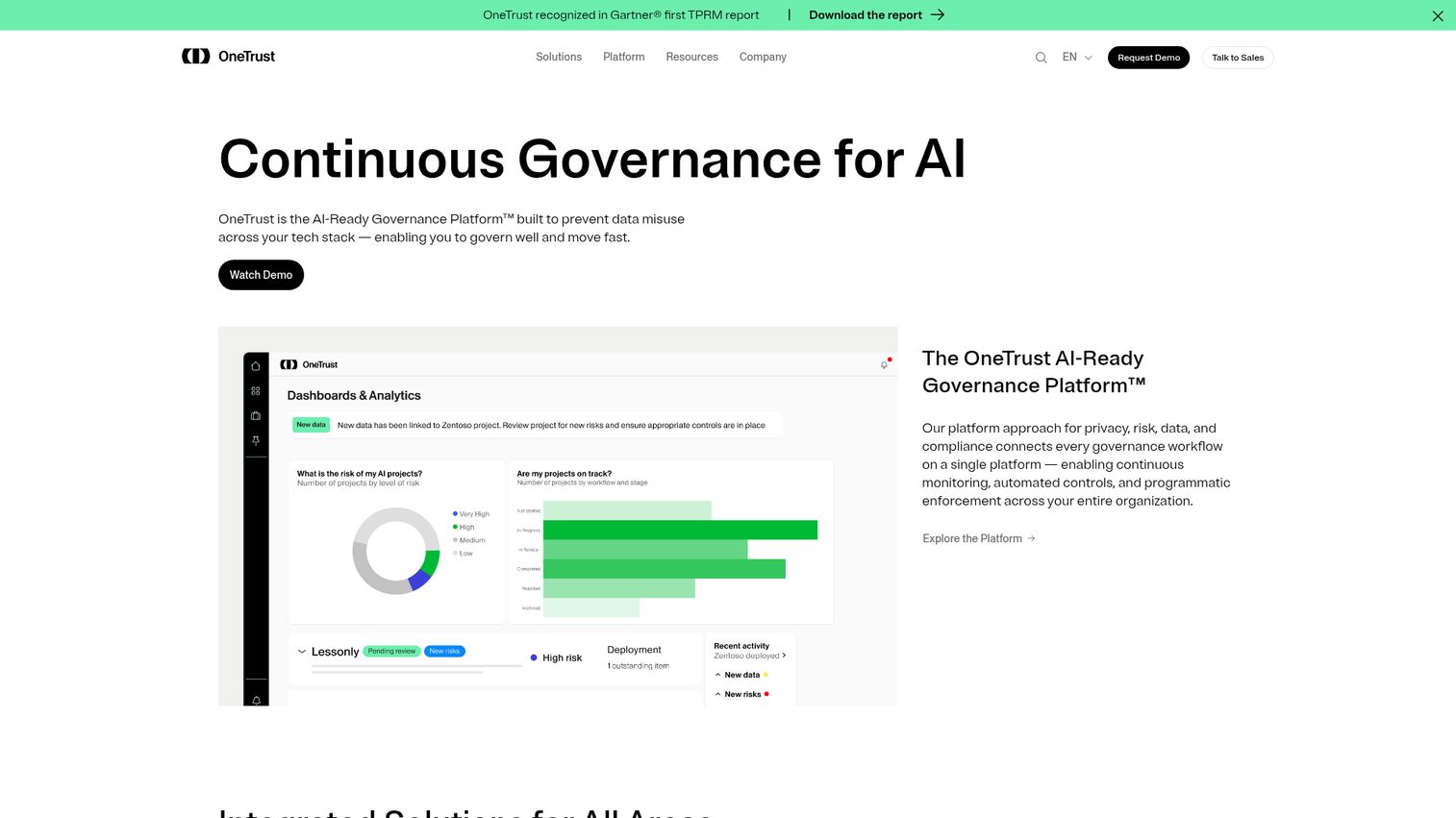
OneTrust is an AI-ready governance platform spanning privacy, risk, data, compliance, consent, and third-party management. It is the enterprise heavyweight on this list, built for large organizations that need privacy and GRC under one roof. If GDPR data protection regulation and CCPA obligations sit alongside your security frameworks, OneTrust handles both.
The platform's breadth is its differentiator. AI governance, consent and preference management, privacy automation, tech risk and compliance, and third-party risk all live in one system. For complex, multi-jurisdiction programs, that consolidation reduces tool sprawl across legal, security, and privacy teams.
Best for: Organizations needing enterprise-scale governance across privacy, AI, consent, compliance, and third-party risk.
Key strengths
- AI governance: AI inventory, risk assessments, approvals, documentation, monitoring, and runtime controls.
- Consent and preference management: web, mobile, CTV, privacy notices, and DSR automation for GDPR and CCPA.
- Tech risk and third-party risk: compliance and supplier risk workflows under one governance umbrella.
Why choose OneTrust: OneTrust fits when privacy is as central as security and you need governance at enterprise scale. It is heavier than a SaaS-focused SOC 2 tool, which is exactly the point for regulated, multi-jurisdiction organizations.
OneTrust pricing: OneTrust uses scalable solution packages with customized pricing and no public numeric prices. Pricing varies by module: AI governance scales with admin users and AI inventory, consent management scales with daily visitors, and privacy automation scales with users and asset inventory. Expect a tailored quote.
5. Hyperproof
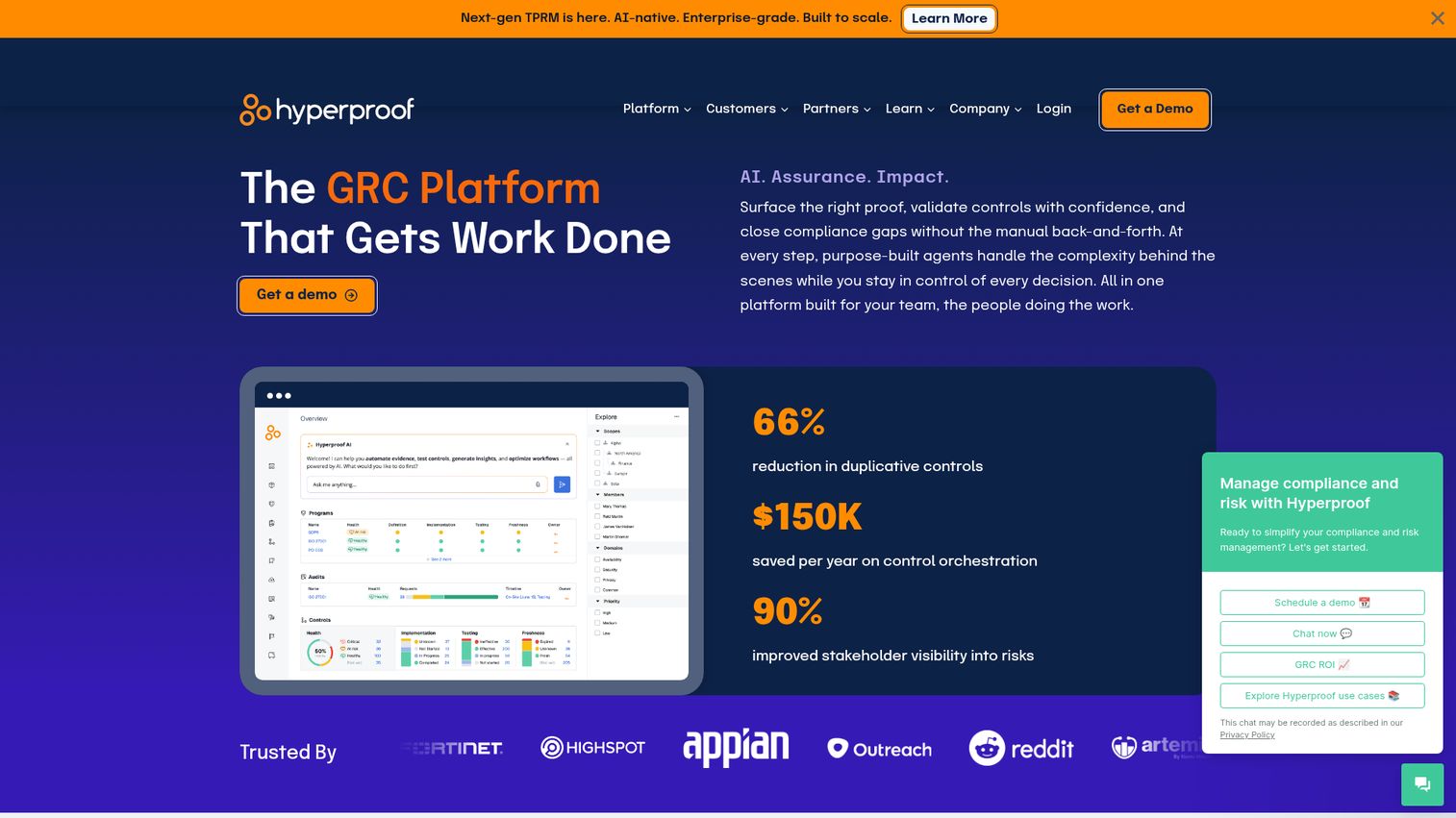
Hyperproof is an AI-powered GRC platform that centralizes compliance, risk, audit, trust, third-party risk, and governance workflows. It is built for compliance operations teams juggling many frameworks at once. The standout capability is cross-framework control reuse: map a control once and apply it everywhere it qualifies, with common control sets across frameworks.
Hyperproof pairs that with workflow automation for evidence requests and auditor collaboration, plus multiple risk registers and real-time reporting dashboards. For teams that run compliance as an ongoing operation rather than an annual scramble, the control reuse alone saves significant duplicate work.
Best for: Security, IT risk, and compliance teams needing an AI-powered GRC platform to manage controls, audits, risk, evidence, and trust at scale.
Key strengths
- Cross-framework control reuse: common control sets map one control to multiple frameworks, cutting duplicate effort.
- Risk management: multiple risk registers, vendor risk tracking, and real-time reporting dashboards.
- Audit workflows: evidence requests, auditor collaboration, and audit readiness in one hub.
Why choose Hyperproof: Hyperproof is the pick when you manage a wide framework portfolio and want to operationalize compliance rather than rebuild evidence each cycle. Its control reuse model scales well as you add frameworks.
Hyperproof pricing: Hyperproof does not display public pricing on its site. Expect a custom quote based on your framework scope, user count, and program complexity. As with most GRC platforms, pricing is annual and scales with scope.
6. AuditBoard (Optro)
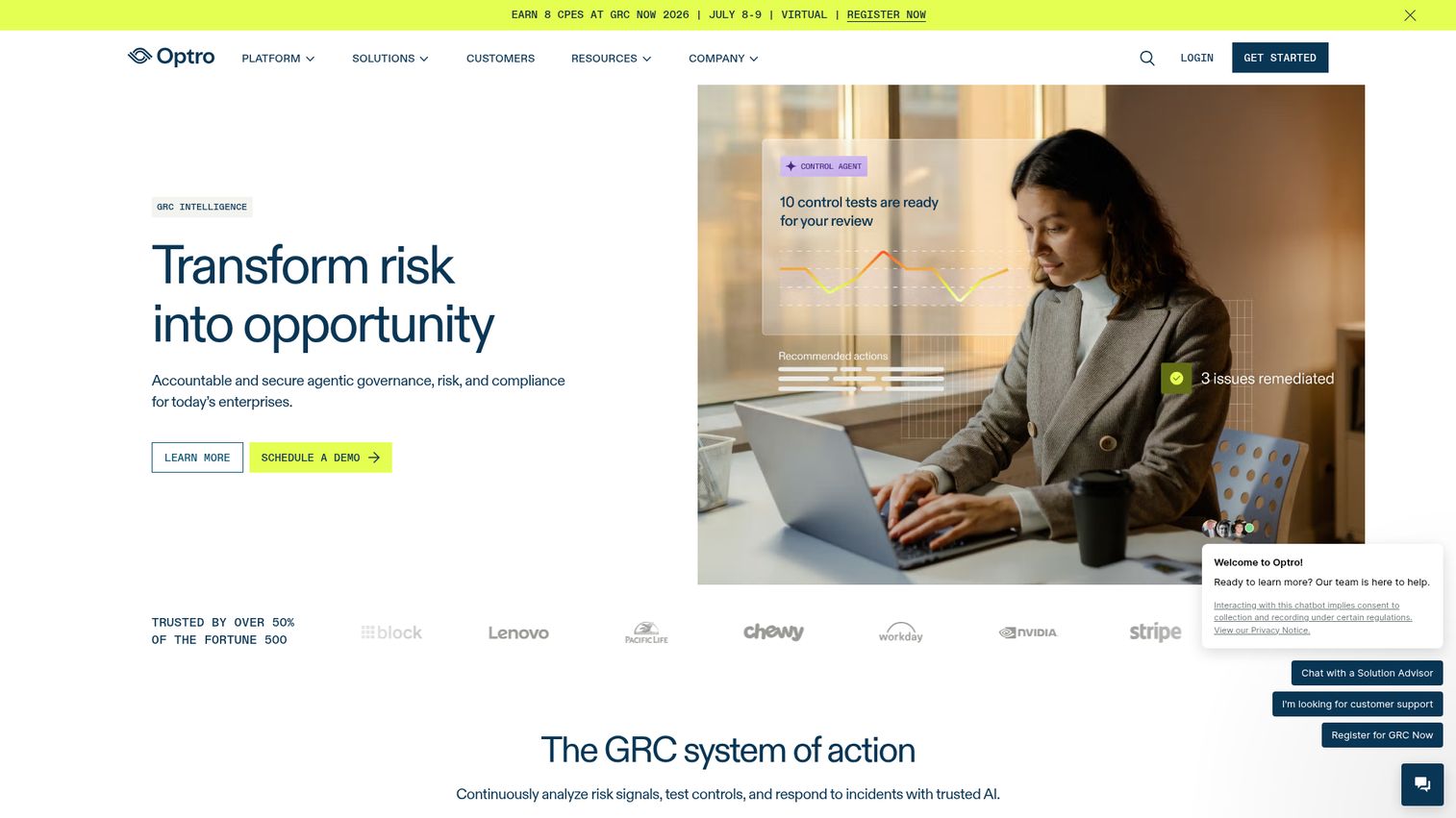
AuditBoard, now operating as Optro, is an AI-powered governance, risk, and compliance platform for enterprises. It is the strongest fit on this list for connected audit, risk, and SOX programs. AuditBoard unifies audit management, cyber risk, compliance, and AI governance, with reporting built for executives and boards.
The connected-risk approach is the differentiator. Instead of running audit, risk, and compliance in separate tools, AuditBoard ties them together so insights flow across functions. AI-assisted workflows help with evidence analysis, control testing, and risk recommendations, which reduces manual review for large internal audit teams.
Best for: Enterprise audit, risk, compliance, SOX, IT risk, third-party risk, and ESG teams needing a connected GRC platform.
Key strengths
- Unified risk management: audit, cyber risk, compliance, and AI governance in one connected platform.
- AI-assisted workflows: evidence analysis, control testing, and risk insights reduce manual effort.
- Board reporting: dashboards and reporting built for executives and audit committees.
Why choose AuditBoard: AuditBoard fits large enterprises with formal internal audit and SOX obligations. If your compliance program reports to a board and spans multiple risk domains, its connected-risk model and reporting depth are the draw.
AuditBoard pricing: AuditBoard's pricing page references flexible plans, unlimited stakeholder licenses, and services aligned to business needs, but shows no public price figures. Pricing is custom and enterprise-scale. Note the platform now operates under the Optro brand.
7. LogicGate Risk Cloud
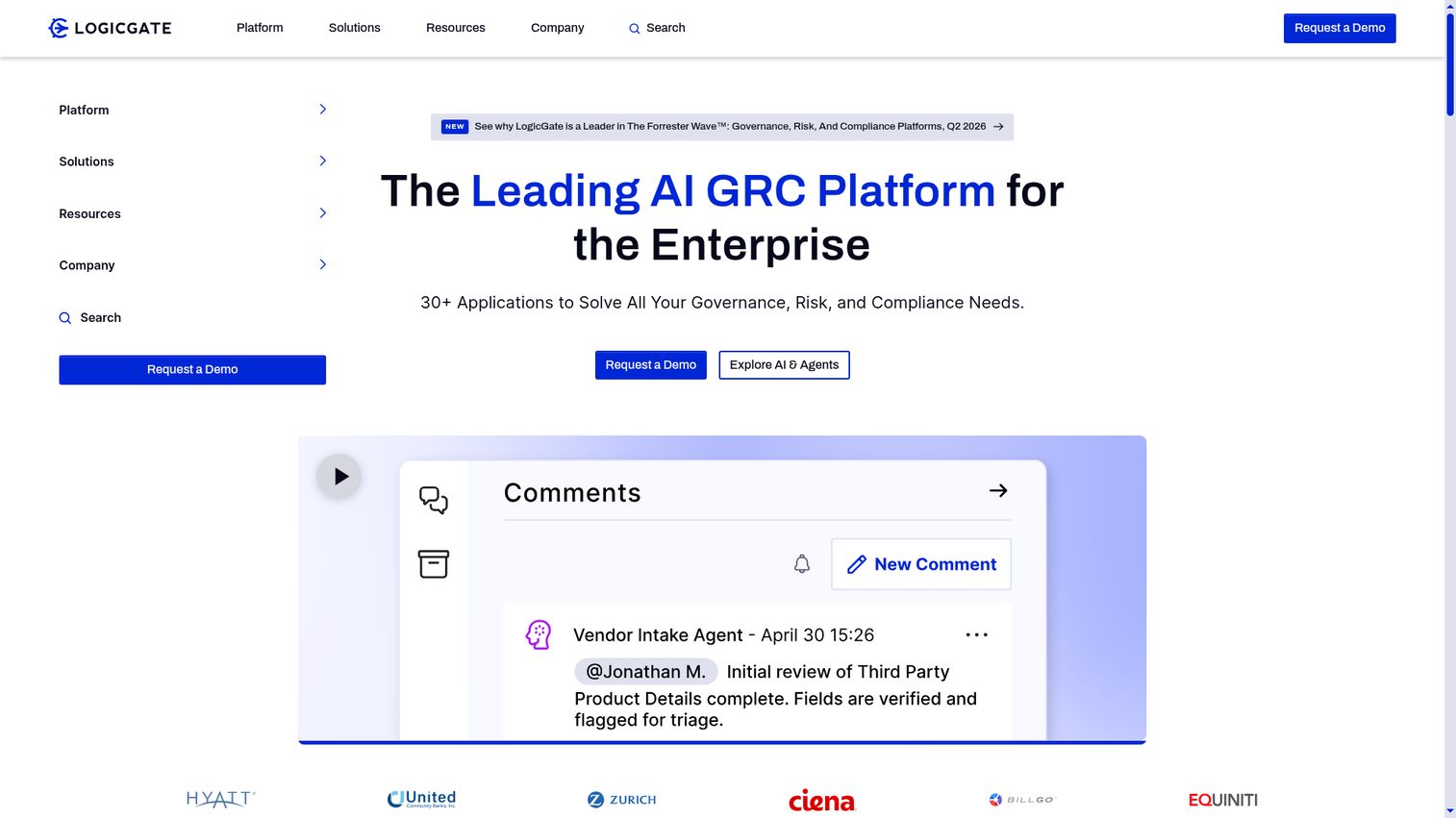
LogicGate Risk Cloud is a no-code GRC platform for managing risk, compliance, workflows, evidence collection, analytics, and related governance programs. Its differentiator is configurability. Where many platforms ship fixed workflows, Risk Cloud lets teams build custom risk and compliance processes without code, using a no-code graph database to model relationships between controls, risks, and frameworks.
That flexibility suits organizations with unusual or evolving requirements. You map frameworks and controls inside the platform, then design the exact workflow your program needs. Automated evidence collection and reporting round out the core, so the customization does not come at the cost of the basics.
Best for: Enterprise and mid-market GRC teams that need configurable, no-code workflows for risk, compliance, audit, and third-party risk.
Key strengths
- Automated evidence collection: pulls and organizes evidence across connected systems and workflows.
- No-code graph database: model relationships between controls, risks, and frameworks without engineering.
- Reporting and analytics: dashboards that surface program status and risk posture in real time.
Why choose LogicGate Risk Cloud: Choose Risk Cloud when off-the-shelf workflows do not match how your program runs. Its no-code builder lets GRC teams shape the platform to their process rather than the reverse, which matters for complex or non-standard programs.
LogicGate Risk Cloud pricing: LogicGate prices based on purchased Risk Cloud Applications, Power User licenses, and optional product features and services. No public numeric pricing or named paid tiers appear on its pricing page. Expect a custom quote tied to the applications and seats you need.
8. SentinelOne Singularity Cloud Security
SentinelOne Singularity Cloud Security is an AI-powered cloud-native application protection platform (CNAPP) that verifies exploitable cloud risk and stops runtime threats from build time to runtime. It shifts the list from GRC audit automation toward cloud posture monitoring. Its cloud security posture management (CSPM) runs agentless, eliminates misconfigurations, and includes compliance assessment against benchmarks.
For cloud-heavy environments, this is where compliance monitoring meets active threat protection. The platform checks your cloud configuration against CIS security configuration benchmarks, PCI, and NIST baselines continuously, then surfaces the misconfigurations that create both audit gaps and attack paths. That dual purpose, compliance plus runtime defense, separates it from pure GRC tools.
Best for: Enterprises needing integrated cloud posture, workload, container, identity, and runtime threat protection across multi-cloud environments.
Key strengths
- Unified CNAPP: full visibility, real-time detection and response, and no-code Hyperautomation in one platform.
- CSPM with compliance assessment: agentless deployment eliminates misconfigurations and checks compliance posture.
- CWPP: real-time AI-powered protection for containers, Kubernetes, VMs, servers, and serverless workloads.
Why choose SentinelOne Singularity Cloud Security: This is the pick when your compliance exposure lives in the cloud and you want posture monitoring tied to active threat protection. It complements a GRC platform rather than replacing it, covering the cloud configuration layer that audit tools touch only lightly.
SentinelOne Singularity Cloud Security pricing: SentinelOne's pricing page lists annual Singularity packages: Core at $69.99 per endpoint, Control at $79.99, Complete at $179.99, Commercial at $229.99, and Enterprise at call-for-pricing. Cloud Native Security pricing is based on effective workloads protected. Prices are in USD and purchased through authorized partners, so final pricing may differ.
9. Prisma Cloud
Prisma Cloud is Palo Alto Networks' cloud-native application protection platform, securing applications from code through runtime across multicloud environments. For compliance, its strength is multi-cloud posture monitoring and reporting across AWS, Azure, and GCP from a single platform. If your infrastructure spans several clouds, Prisma Cloud consolidates compliance visibility.
The platform covers the full code-to-cloud path: IaC security, CI/CD security, and software composition analysis on the build side, then CSPM, API visibility, and entitlement management for running infrastructure. Compliance posture and reporting sit inside that broader security platform, which suits enterprises that want one tool for cloud security and cloud compliance.
Best for: Enterprises needing code-to-cloud security across multicloud infrastructure, workloads, applications, identities, APIs, and runtime.
Key strengths
- Cloud infrastructure protection: CSPM, API visibility, entitlement management, and agentless workload scanning.
- Code security: IaC security, CI/CD security, secrets security, and software composition analysis.
- Runtime protection: threat detection, serverless security, host security, and web application and API security.
Why choose Prisma Cloud: Prisma Cloud fits enterprises running genuinely multi-cloud infrastructure that want compliance monitoring inside a comprehensive cloud security platform. The breadth across code, infrastructure, and runtime is the draw for security-led organizations.
Prisma Cloud pricing: Prisma Cloud Enterprise uses a credit-based model. Cloud Security Foundations runs about 2 credits per VM and includes agentless visibility and compliance, while Cloud Security Advanced runs about 5 credits per VM and adds runtime security. No public monetary price is published, so credit costs require a quote from Palo Alto Networks.
10. Cynomi
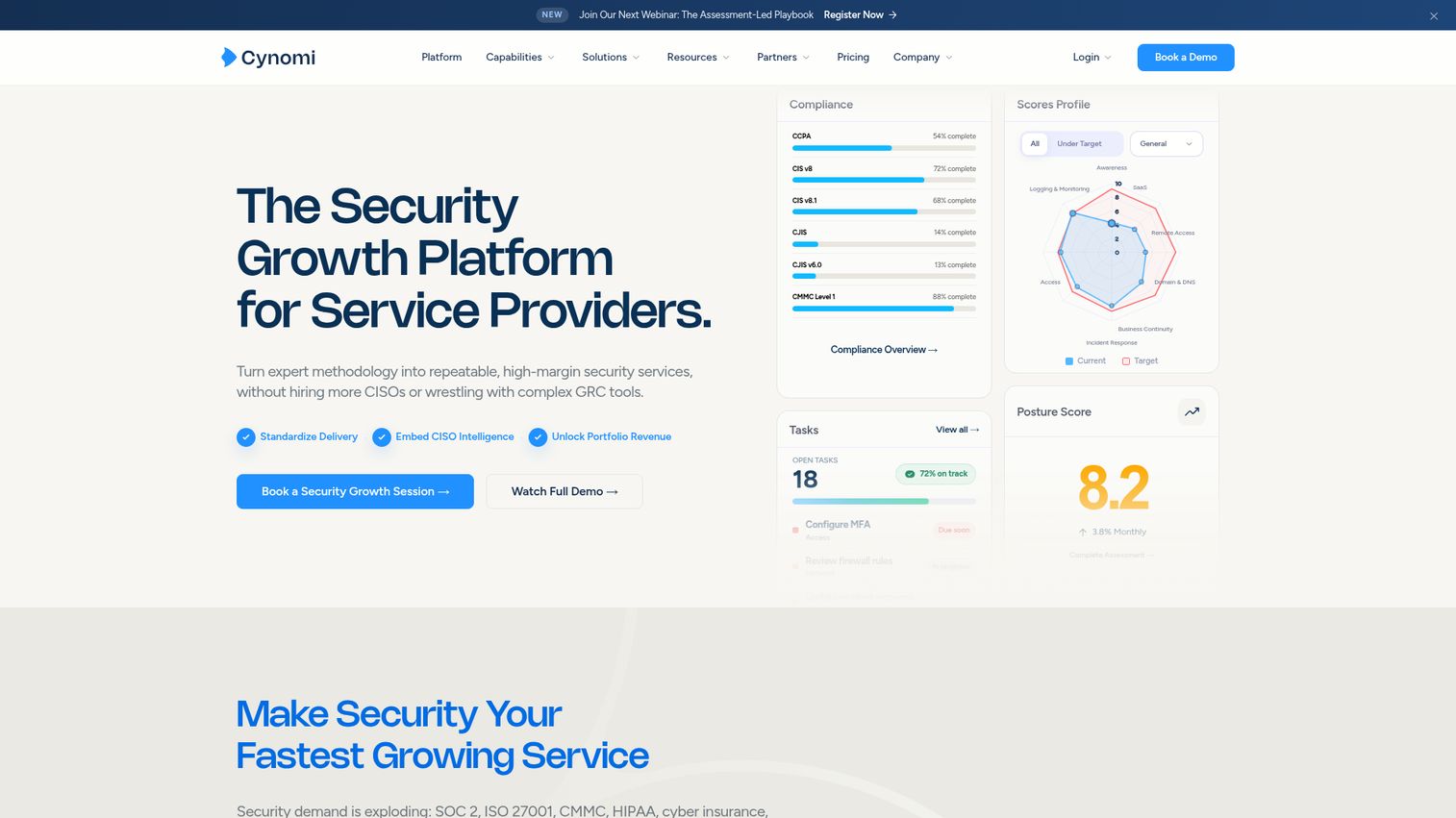
Cynomi is a Security Growth Platform for service providers that unifies security program management, GRC, vCISO delivery, risk management, and recurring security-service growth. It is the clear pick for MSPs, MSSPs, and vCISO firms. Where most tools serve a single organization, Cynomi is multi-tenant and channel-first, built to manage compliance across many client accounts at once.
Compliance coverage spans 40+ frameworks, with embedded CISO intelligence that guides security program decisions. Risk management includes risk registers, heatmaps, remediation workflows, and executive reporting, which lets service providers deliver consistent vCISO output across a client portfolio without rebuilding the work each time.
Best for: MSPs, MSSPs, and vCISO or advisory firms scaling managed cybersecurity, compliance, risk, and vCISO services across multiple clients.
Key strengths
- Security program management: embedded CISO intelligence guides decisions across client environments.
- Compliance management: coverage across 40+ frameworks for diverse client requirements.
- Risk management: risk registers, heatmaps, remediation workflows, and executive reporting.
Why choose Cynomi: Cynomi is the right tool when you deliver compliance as a service rather than running a single internal program. Its multi-tenant design and vCISO automation let service providers scale across clients, which the single-tenant platforms on this list are not built to do.
Cynomi pricing: Cynomi offers flexible packaging around one-time assessments, Cynomi Core, Cynomi Pro, and Third Party Risk Management. The pricing page states pricing is per account but shows no public numeric figures. Expect a custom quote based on your client volume and the packages you select.
Considerations: how to choose security compliance software
Use this checklist before you shortlist. The right pick depends on your frameworks, automation needs, stack, and scale.
Framework coverage
Confirm the platform covers every framework you need now and the ones on your roadmap: SOC 2, ISO 27001, HIPAA, PCI DSS, GDPR, NIST cybersecurity framework, and HITRUST as applicable. Check whether controls and evidence reuse across frameworks. Cross-framework reuse saves significant work once you maintain more than one standard.
Automation depth
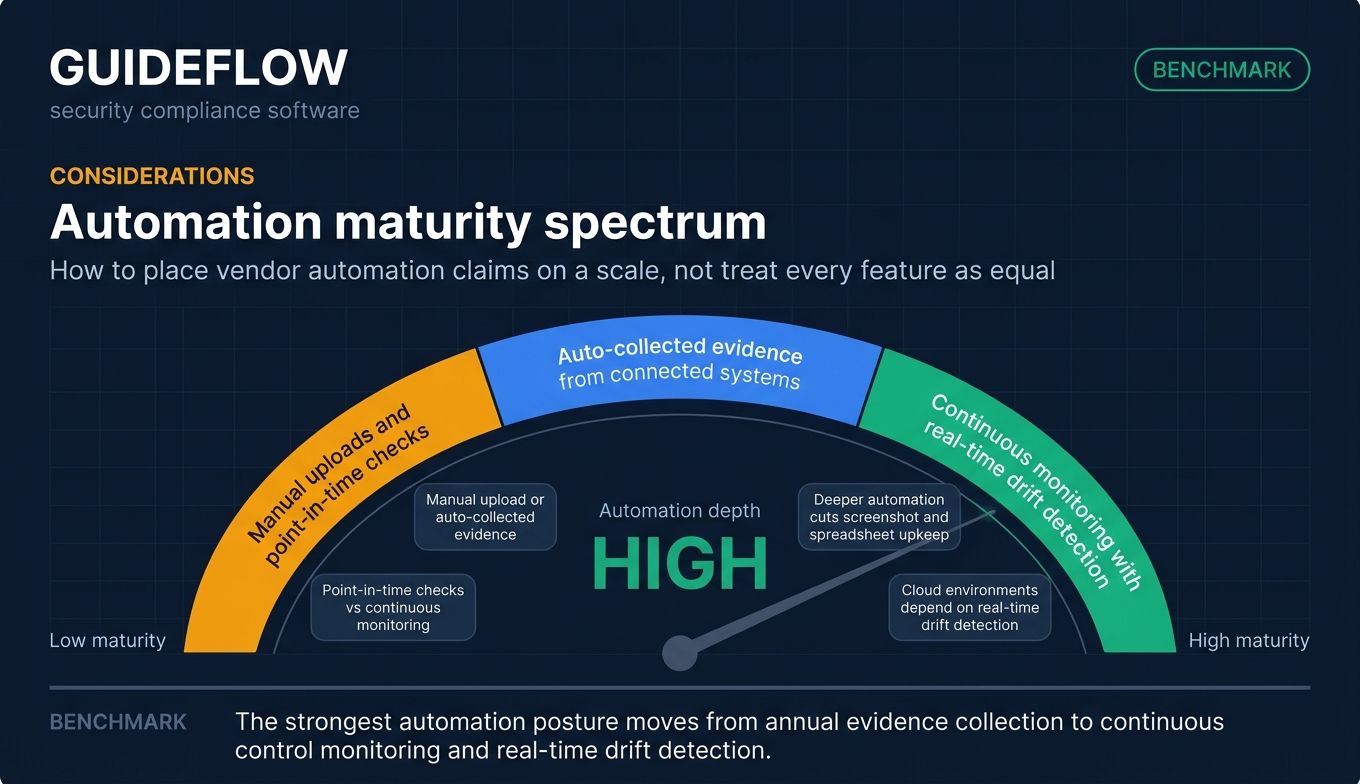
Distinguish continuous monitoring from point-in-time checks. Ask whether evidence is auto-collected from connected systems or uploaded manually. The deeper the automation, the less your team spends on screenshots and spreadsheet upkeep. For cloud environments, real-time drift detection matters most.
Integrations
Verify the platform connects to your actual stack: cloud (AWS, Azure, GCP), HRIS, ticketing, CRM, and identity providers. Integrations drive automated evidence collection, so coverage gaps mean manual work. For presales-adjacent teams, CRM and identity connections also tie compliance signals into the deal workflow.
Reporting and audit readiness
Look at dashboards, auditor access, and exportable evidence. Can auditors collaborate inside the platform? Can you export clean evidence packages on demand? Strong reporting cuts audit cycle time and makes board updates straightforward for enterprise programs.
Pricing model and scalability
Most tools here use custom, annual pricing scaled to frameworks and organization size. Confirm whether billing is seat-based or usage-based, and whether the platform scales from your current size to where you are headed. MSPs should specifically check for multi-tenant support.
Conclusion
The best security compliance software depends on the job in front of you. For fast, automated SOC 2 and ISO 27001, Vanta and Drata lead on framework breadth and continuous monitoring. For a guided first audit, Secureframe's expert-backed onboarding lowers the learning curve. For enterprise GRC and privacy, OneTrust and AuditBoard handle scale, SOX, and multi-jurisdiction requirements.
If your exposure is cloud-first, SentinelOne Singularity Cloud Security and Prisma Cloud bring CSPM and CNAPP-grade compliance monitoring across AWS, Azure, and GCP. For compliance operations teams managing many frameworks, Hyperproof's control reuse pays off. And if you deliver compliance as a service, Cynomi's multi-tenant, vCISO-focused platform is built for exactly that.
Next step: shortlist two or three tools that match your framework list and audit timeline. Request demos, run a coverage check against the frameworks gating your deals, and confirm the integrations against your actual stack before you commit. The fastest way to stop letting security review stall deals is to pick the platform that automates the evidence you already produce by hand. If you want to show buyers a secure product experience without exposing a live environment, our guide to building self-service experiences and Guideflow's own security and compliance practices are useful next reads.
FAQs
Security compliance software automates the monitoring, evidence collection, and reporting needed to prove an organization meets security frameworks like SOC 2, ISO 27001, HIPAA, and PCI DSS. It replaces manual spreadsheets and one-off screenshots with continuous, connected workflows. The goal is to keep you audit-ready year-round rather than scrambling before each audit.
Compliance monitoring software focuses on continuous control checks and drift detection, flagging when a setting deviates from its required state in real time. Compliance management software covers the broader workflow: policies, evidence, audits, risk, and reporting. Most leading platforms combine both, with GRC suites adding enterprise risk and governance on top.
Vanta, Drata, and Secureframe are the strongest picks for SOC 2 and ISO 27001. Vanta and Drata lead on framework breadth and continuous monitoring, with Drata's auditor network smoothing the audit cycle. Secureframe stands out for first-time audits thanks to its guided, expert-backed onboarding.
Pricing is almost always custom and quote-based in this category. Entry SaaS-focused tools commonly start in the low four figures annually for small companies, while enterprise GRC platforms run higher with custom contracts. Pricing is usually annual and scales with framework count, company size, and modules, so request a quote tied to your specific scope.
Yes, most leading platforms support HIPAA compliance requirements, PCI DSS, and GDPR, and many add NIST, HITRUST, and FedRAMP. Cross-framework evidence reuse lets you map a control once and apply it across multiple standards. Always confirm the exact framework list per vendor before buying, since coverage varies.
Centralized evidence and continuous monitoring let teams answer buyer security questionnaires faster and share current posture through a trust center. Instead of rebuilding evidence for every prospect, you pull from one always-current library. Pairing that posture with buyer enablement tools cuts the back-and-forth that stalls deals in security review.
Yes. Several platforms target first-time SOC 2 with guided onboarding and more accessible entry tiers, including Vanta, Drata, and Secureframe. These tools automate evidence collection so a small team without a dedicated compliance hire can still reach audit-ready status. Guided onboarding lowers the learning curve for startups new to frameworks.
A prospect's compliance tooling signals their audit maturity and which frameworks gate the deal. If they run a platform like Vanta or Drata, expect a structured questionnaire and requests for current SOC 2 or ISO 27001 evidence. Knowing this early helps you anticipate the scope of security review and prepare your responses before the deal stalls.