A failed payment does not feel like churn. There is no cancellation, no angry email, no exit survey. The card just declines, the charge silently fails, and the revenue you already earned never lands in your account. Multiply that across a customer base and the number gets ugly fast.
Failed payments cost subscription businesses $118.5 billion annually, according to Lunos AI's 2026 research. The average subscription business loses around 9% of monthly recurring revenue to failed payments and involuntary churn, per Baremetrics in 2026. That is revenue you already won, leaking out the bottom of the funnel because a payment retry never fired or a reminder never went out.
Here is the part most teams miss: dunning is not a reminder email. It is a revenue recovery workflow. Good dunning management software combines retry intelligence, multi-channel outreach, escalation logic, payment portals, and reporting into one closed loop. The difference shows up in the numbers. AI-powered retry logic with multi-channel campaigns recovers 60 to 80% of failed payments, versus 20 to 30% for basic retry-only approaches, according to Finsi AI in 2026.
The catch is that the best tool depends entirely on how you bill. A B2B team chasing overdue invoices needs structured escalation and audit trails. A SaaS subscription business needs automated retries and recovery messaging timed to the dunning cadence. A Stripe-native team may want built-in retry logic before adding a dedicated layer. This guide sorts eight tools by the workflow they actually fit, so RevOps, finance, and enablement teams can shortlist faster. If you also evaluate adjacent revenue tooling, our roundups on loyalty management and marketing resource management use the same decision-first lens.
What's inside
This guide compares eight dunning management software tools chosen for direct relevance to failed-payment recovery and overdue invoice collections. We selected each tool based on four criteria: recovery workflows (retries, messaging, escalation), integration depth (billing systems, payment processors, ERP, CRM), analytics and attribution, and business-model fit. The list deliberately separates subscription recovery from invoice-heavy collections, because a tool that excels at one is not automatically right for the other. Each section names where the tool fits best and which team should evaluate it first. Pricing and ratings reflect verified, current public sources at the time of writing.
TL;DR
- Best for subscription failed-payment recovery and cancel flows: Churn Buster combines dunning with smart cancellation offers.
- Best for reducing voluntary churn with save flows: Chargebee Retention runs no-code cancel pages and retention experiments.
- Best for payment performance optimization: Revaly (formerly FlexPay) focuses on pre-auth approval lift and post-decline recovery.
- Best for Paddle Billing users: Paddle Retain ships dunning and offboarding flows inside the billing platform.
- Best for simple subscription recovery automation: Baremetrics Recover layers email, SMS, and in-app reminders on your billing data.
- Best for Shopify subscription brands: Stay AI pairs retention, win-back, and a branded customer portal.
- Best for Stripe-native teams: Stripe Smart Retries applies machine-learning retry timing inside Stripe Billing.
- Best for billing-native dunning at scale: Recurly Dunning runs configurable campaigns with priority rules.
What dunning management software is
Dunning management software is a system that automatically recovers failed payments and overdue invoices through timed retries, multi-channel reminders, escalation rules, and payment recovery flows. Instead of a finance analyst manually chasing declined charges, the software runs the recovery process end to end and reports on what it recovered.
The category covers two related jobs. For subscription businesses, it retries failed card charges and nudges customers to update payment details before the subscription lapses. For B2B teams, it follows up on overdue invoices with structured escalation and a clean audit trail. Both share the same goal: turn earned-but-uncollected revenue into cash.
Core capabilities to expect from a modern dunning management system:
- Segmentation: group customers by value, plan, failure reason, or risk so high-value accounts get a different touch than a $9 plan.
- Multi-channel outreach: email, SMS, in-app banners, and sometimes phone or Slack, sequenced over a cadence.
- Retry logic: smart retries that pick the optimal time to re-attempt a charge instead of hammering the card on a fixed schedule.
- Payment portals: branded card-update pages so customers can fix a declined card in a couple of clicks.
- Analytics and attribution: recovered revenue, recovery rate, root-cause breakdown by decline reason, and incremental lift.
- Integrations: billing platform, payment processor, ERP, and CRM sync so recovery data flows into the systems your team already lives in.
Why dunning matters
Failed payments are the quietest revenue leak in a subscription business. The customer wanted to pay. The card just expired, hit a limit, or got flagged. Without a system, that revenue is gone and the customer churns without ever deciding to leave. That is involuntary churn, and it is fully recoverable with the right workflow.
The cash flow math is direct. Recovering even half of a 9% MRR leak puts real money back on the books every month, money you already earned. That is why automated failed payment recovery deserves a dedicated system rather than a finance analyst with a spreadsheet and a reminder calendar.
Common dunning workflows
A typical recovery flow moves through four stages. First, a retry: the software re-attempts the charge at a smart interval. Next, messaging: an email or SMS asks the customer to update their card, with a one-click portal link. Then escalation: if the charge keeps failing, the cadence tightens and the tone shifts. Finally, human follow-up: high-value accounts route to a person before the subscription cancels.
Invoice and subscription scenarios run differently. Subscription recovery is fast and automated, measured in days against a billing cycle. Overdue invoice collections stretch over weeks, with documented escalation steps and an audit trail for finance. Reporting sits across both, surfacing root-cause analysis so you can fix the decline reasons driving the leak, not just chase the symptoms.
When to use dunning management software
Recover failed subscription payments
Subscription businesses bleed revenue every billing cycle to declined cards. A dunning management system catches those failures and runs automated retries plus recovery messaging before the customer churns. Timing and cadence matter more than volume here. Retrying at the wrong moment burns an attempt; retrying when the customer's balance refreshes recovers the charge. Smart retry logic and a tight, well-sequenced cadence are what separate strong subscription recovery from background noise.
Collect overdue invoices at scale
AR and finance teams use dunning software to automate invoice follow-up instead of chasing payments by hand. The software sends scheduled reminders, escalates past-due balances through defined steps, and keeps a documented trail of every touch. That audit trail matters for B2B collections, where a single overdue invoice may involve multiple stakeholders and a procurement process. Structured escalation keeps the cash flow recovery moving without a person manually tracking who owes what.
Reduce churn and protect revenue
Dunning is a retention workflow, not just a collections one. Every failed payment you recover is a customer you kept. The smartest teams segment by value-at-risk so the recovery effort matches the revenue on the line. A $40K annual account gets a human touch and a phone call; a $12 monthly plan gets an automated sequence. Treating dunning as revenue protection, not bookkeeping, is what turns it into a retention lever.
Comparison table
This table helps you sort by business model and recovery style before you read the full sections. Scan the Intent column to find your motion, then check differentiation, pricing, and rating. Tools are ordered by fit for general dunning management, not alphabetically.
| # | Product | Intent | Key differentiation | Pricing | G2 rating |
|---|---|---|---|---|---|
| 1 | Churn Buster | Subscription dunning + cancel flows | Pairs failed-payment recovery with smart cancellation offers | From $149/mo (based on MRR) | 4.3/5 |
| 2 | Chargebee Retention | Voluntary churn reduction | No-code cancel pages and retention experiments | From USD 3,750 (50-149 sessions/mo) | 4.4/5 |
| 3 | Revaly | Payment performance optimization | Pre-auth approval lift plus post-decline recovery | Custom pricing | 5.0/5 |
| 4 | Paddle Retain | Billing-native recovery | Dunning and offboarding inside Paddle Billing | From $500/mo flat-fee | 4.8/5 |
| 5 | Baremetrics Recover | Simple subscription recovery | Email, SMS, and in-app reminders on billing data | From $499/mo (MRR-tiered) | 4.6/5 |
| 6 | Stay AI | Shopify subscription retention | Retention, win-back, and branded customer portal | From $499/mo + 1% + ¢19/txn | 4.7/5 |
| 7 | Stripe Smart Retries | Stripe-native retries | ML retry timing inside Stripe Billing | Included with Stripe Billing | 4.4/5 |
| 8 | Recurly Dunning | Billing-native dunning at scale | Configurable campaigns with priority rules | From $249/mo + 0.9% of billing | 4.0/5 |
1. Churn Buster
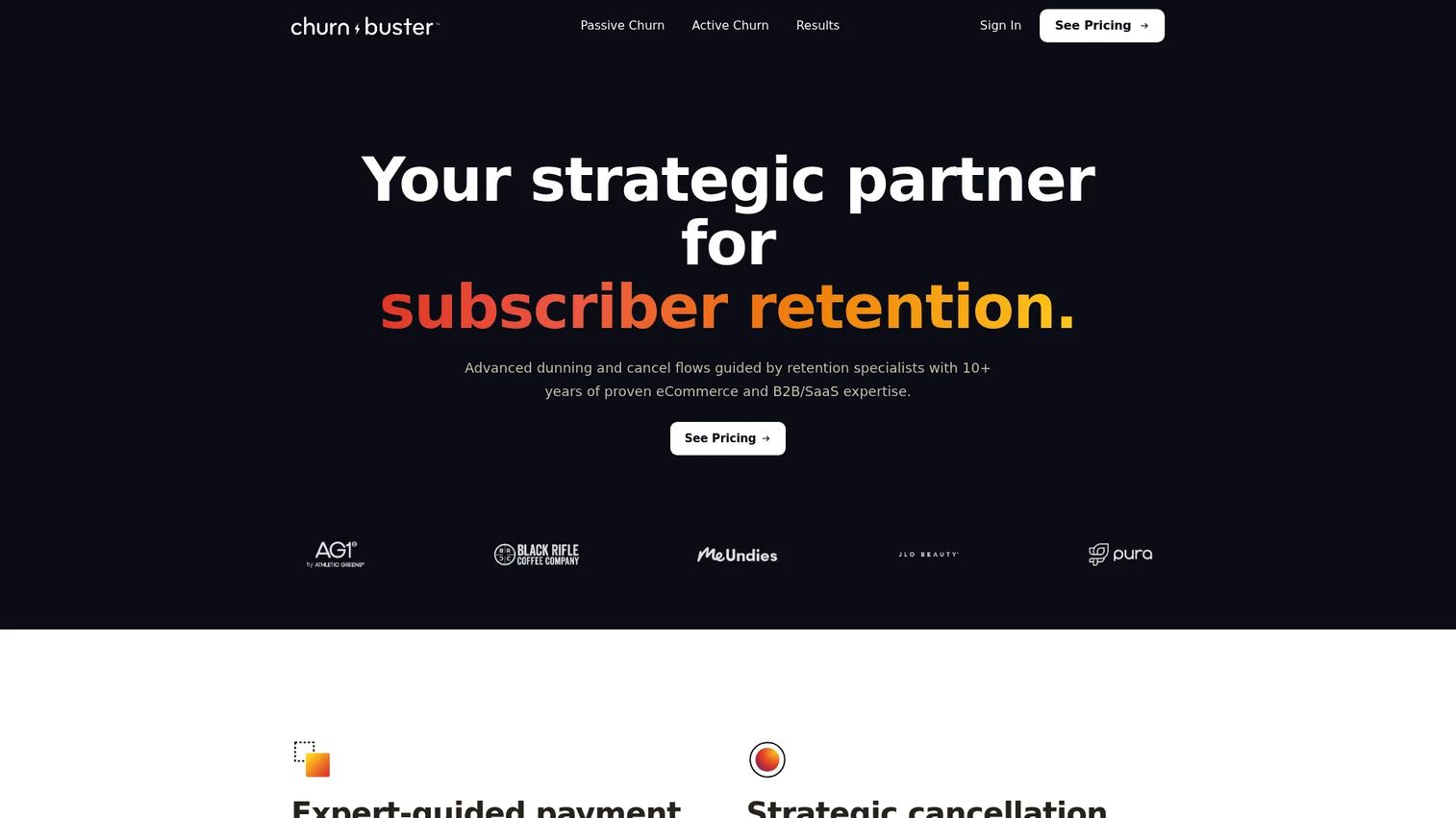
Churn Buster is subscription retention software built to cut both passive and active churn. It pairs failed-payment recovery with cancel flows, so the same platform that retries a declined card also intercepts a customer heading for the cancel button with a targeted save offer. That combination makes it a strong fit for subscription teams that want recovery and retention in one place rather than two stitched-together tools.
Best for: Subscription businesses that want to recover failed payments and reduce cancellations from a single platform.
Key strengths
- Dunning and failed-payment recovery: automated retries and recovery messaging to claw back declined charges before they become churn.
- Cancel flows with smart offers: segmented save offers that intercept customers mid-cancellation and route them by value.
- Analytics and optimization insights: reporting that shows what is recovering revenue and where the cadence can improve.
Why choose Churn Buster: If your involuntary churn and voluntary churn problems live side by side, running them through one system keeps your data clean and your messaging consistent. It fits subscription teams that treat recovery and retention as the same job, not separate departments.
Churn Buster pricing: Public pricing starts with the Complete Retention Solution from $149/mo, priced based on your MRR. An Advisory offering starts from $1,000 as a one-time fee, also based on MRR. There is no free tier shown. Churn Buster holds a 4.3/5 rating on G2.
2. Chargebee Retention
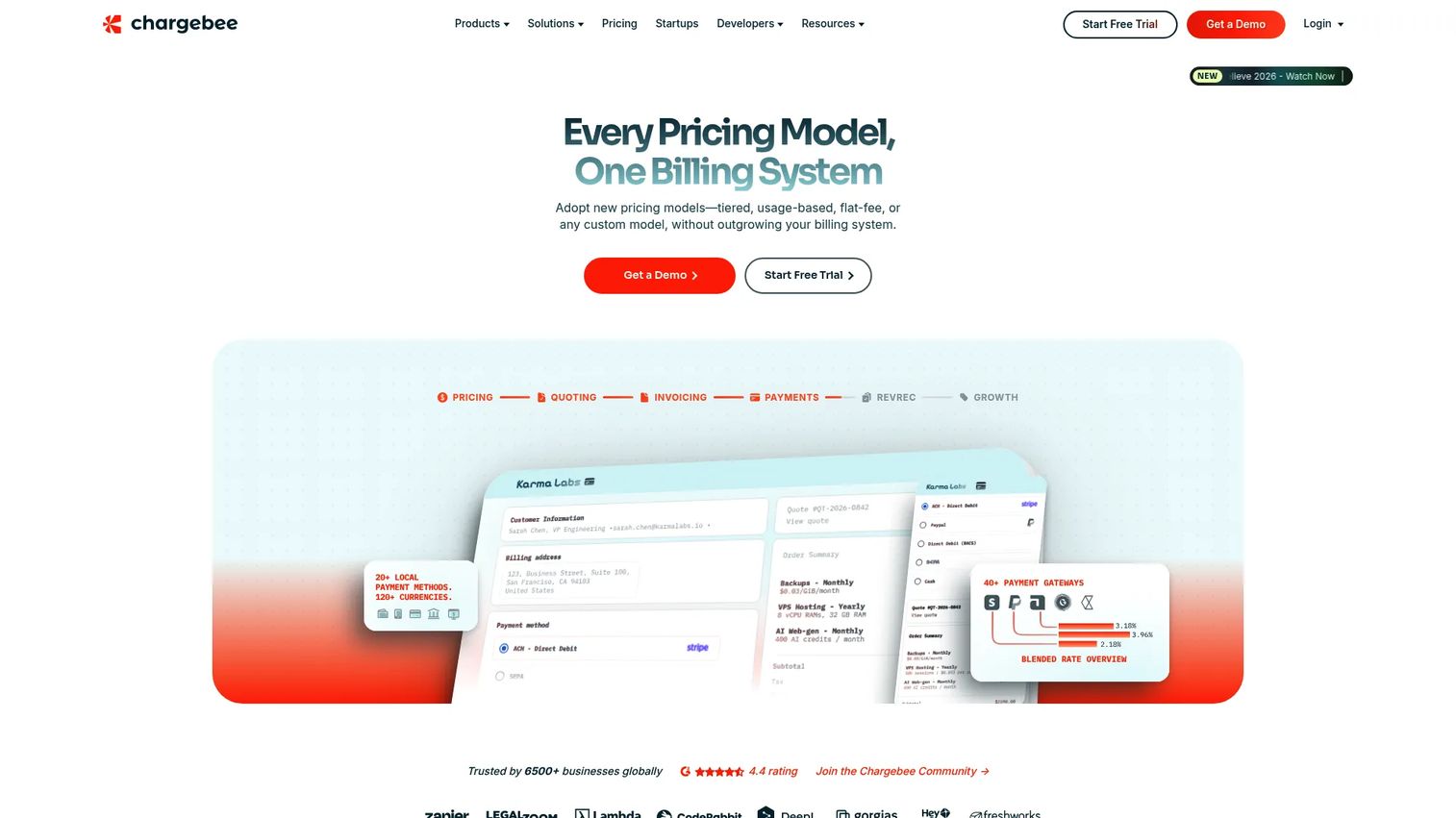
Chargebee Retention is Chargebee's churn-reduction product, focused on reducing voluntary churn through personalized cancel experiences. It leans harder on the save-flow side of retention than on raw payment retries, giving teams no-code cancel pages, A/B and multivariate testing, and retention analytics to figure out which offers actually keep customers. For businesses already in the Chargebee billing stack, the adjacency is the draw.
Best for: Subscription businesses that want to reduce voluntary churn with personalized save flows and retention experiments.
Key strengths
- No-code cancel pages: build and ship branded cancel experiences without engineering, then redirect customers with targeted offers.
- A/B and multivariate testing: test save offers and messaging to find what reduces cancellations instead of guessing.
- Retention insights and reporting: see which segments are leaving, why, and which interventions move the number.
Why choose Chargebee Retention: It fits teams whose biggest leak is active cancellation rather than failed cards, and especially those already running Chargebee for billing. The testing layer lets retention and RevOps teams treat the cancel flow as a product they optimize over time.
Chargebee Retention pricing: The Performance plan starts at USD 3,750 for 50 to 149 sessions per month, with Enterprise pricing available on a custom quote. A free Starter plan exists for Chargebee Billing, though Retention itself runs on the Performance and Enterprise tiers. Chargebee holds a 4.4/5 rating on G2.
3. Revaly (formerly FlexPay)

Revaly, formerly FlexPay, is payment performance management software that works both sides of the decline. Instead of only reacting after a charge fails, it optimizes pre-authorization to reduce false declines, then recovers the payments that still fail through post-payment optimization. For teams with complex billing operations and meaningful false-decline volume, that two-sided approach is the differentiator.
Best for: Subscription businesses that want to lift payment approval rates and recover failed revenue with a specialized recovery layer.
Key strengths
- Pre-auth optimization: reduce false declines before they happen so fewer good customers get blocked at checkout.
- Post-payment optimization: recover transactions that still fail with targeted recovery logic.
- Broad integrations: connect to CRM, billing platforms, and payment gateways so recovery fits the existing stack.
Why choose Revaly: It suits teams that see false declines as a real revenue problem, not just an edge case, and want a dedicated layer focused on approval lift plus recovery. If your billing operation is complex and payment performance is a board-level metric, the specialized focus earns its place.
Revaly pricing: Revaly uses custom pricing, structured as a flat platform fee plus a performance-based component tailored to each business. No public numeric price is published. Revaly holds a 5.0/5 seller rating on G2.
4. Paddle Retain

Paddle Retain is Paddle Billing's built-in dunning and retention toolkit. It serves SaaS and digital product teams that want automated recovery without bolting on a separate system, covering failed-payment recovery, cancellation and offboarding flows, and localized recovery messaging. For teams already running Paddle as their merchant of record, Retain is the natural recovery layer.
Best for: Subscription teams that want automated churn reduction and recovery without changing billing systems.
Key strengths
- Payment recovery for failed payments: automated recovery flows that retry and re-engage customers whose payments fail.
- Cancellation deflection flows: automated offboarding and save flows that intercept cancellations before they finalize.
- Localized recovery messaging: recovery communications adapted across languages and markets for a global subscriber base.
Why choose Paddle Retain: If Paddle already handles your payments, tax, and billing, Retain keeps recovery inside the same platform instead of adding integration overhead. That single-vendor simplicity appeals to lean teams that would rather not maintain a separate dunning tool.
Paddle Retain pricing: Retain pricing is flat-fee for smaller companies, starting at $500/month, and performance-based for larger companies. Paddle's broader platform also offers pay-as-you-go pricing at 5% + 50¢ per Checkout transaction. Paddle Retain holds a 4.8/5 rating on G2.
5. Baremetrics Recover
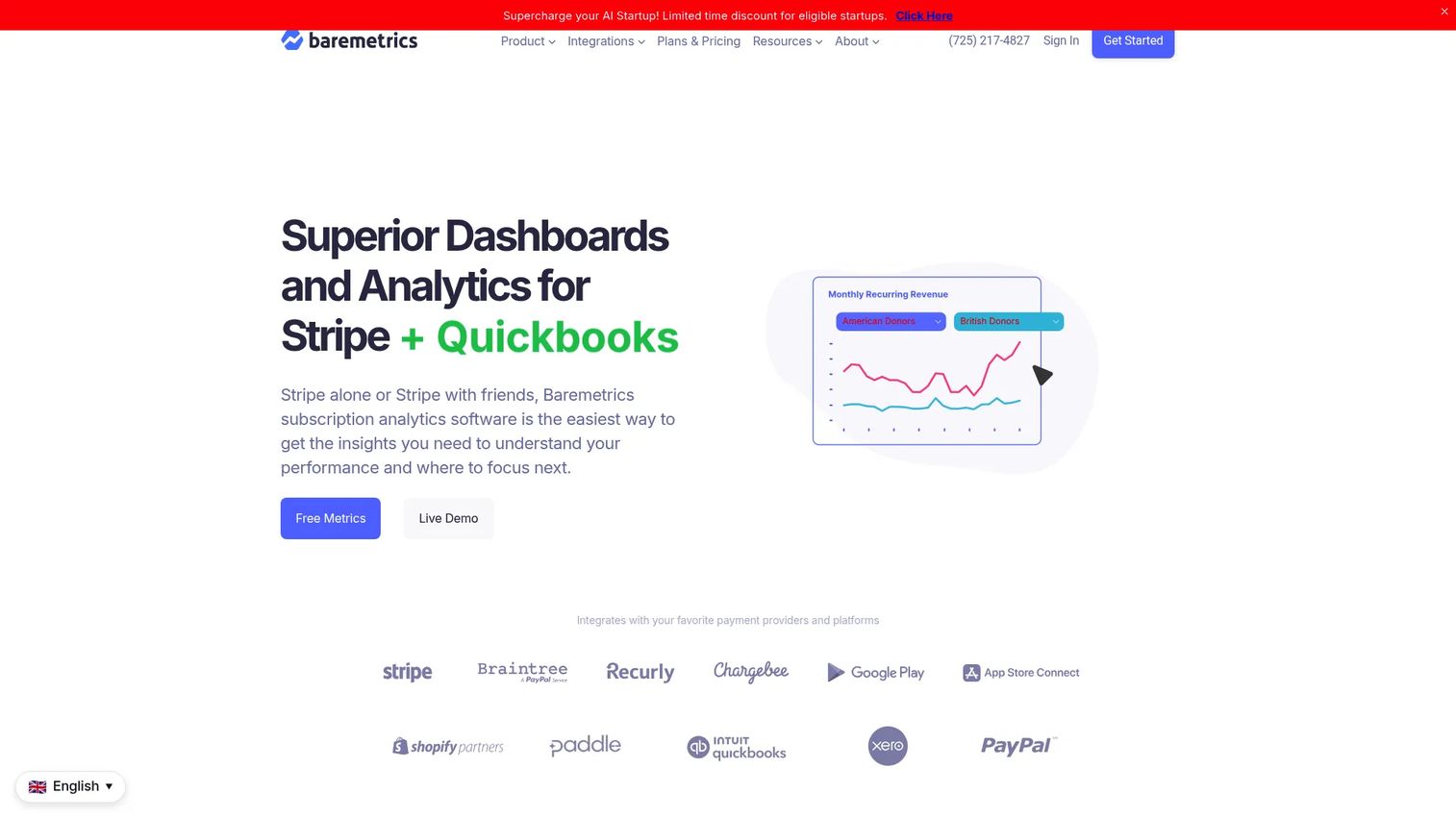
Baremetrics Recover is a dunning automation add-on for subscription businesses that layers recovery on top of your existing billing data. It runs automated email and SMS sequences for failed payments, serves a branded card-update widget, and adds in-app reminders, banners, and paywalls to nudge customers to fix a declined card. The appeal is simplicity: turn it on, connect your billing, and recovery starts running.
Best for: SaaS and subscription businesses that need to recover failed payments and reduce involuntary churn without heavy setup.
Key strengths
- Automated email and SMS sequences: timed recovery messaging that reaches customers across channels when a payment fails.
- Branded card-update widget: a clean, on-brand form so customers can update a declined card in a couple of clicks.
- In-app reminders and recovery analytics: banners, paywalls, and reporting that show recovered revenue and recovery rate.
Why choose Baremetrics Recover: It fits teams that want straightforward recovery automation alongside the subscription analytics Baremetrics is known for. Across a sample of 148 businesses, Recover pulled back more than $1.35 million in failed payments in a single month, and 82% of customers saw the tool pay for itself within month one, according to Baremetrics in 2026.
Baremetrics Recover pricing: Recover pricing is tiered on actual MRR, with a published example of $499/month at $300,000 MRR. A 14-day free trial is available. Baremetrics holds a 4.6/5 rating on G2.
6. Stay AI

Stay AI is a subscription retention and customer experience platform built for Shopify merchants. It goes beyond dunning into full subscription management, AI-powered cancellation and win-back flows, and a customizable branded customer portal with email and SMS notifications. For subscription commerce brands on Shopify, it bundles retention, recovery, and the customer-facing portal into one platform.
Best for: Shopify subscription brands that want retention, churn prevention, and a branded customer portal in one place.
Key strengths
- Subscription management tools: manage recurring orders, swaps, and customer changes from a single platform.
- AI-powered cancellation and win-back flows: intercept cancellations with intelligent offers and re-engage lapsed subscribers.
- Branded customer portal: a customizable portal with email and SMS notifications that keeps the experience on-brand.
Why choose Stay AI: If you run subscription commerce on Shopify, a platform purpose-built for that stack handles retention and recovery without forcing a generic SaaS tool to fit ecommerce workflows. The branded portal and win-back flows matter most where customer experience drives repeat revenue.
Stay AI pricing: The Pro Plan runs $499/month plus 1% + ¢19 per transaction, with an Enterprise tier on custom pricing. No free tier is shown on the public pricing page. Stay AI holds a 4.7/5 rating on G2.
7. Stripe Smart Retries
Stripe Smart Retries is Stripe's machine-learning feature for automatically retrying failed subscription payments at the optimal time. It predicts the best moment to re-attempt a declined charge using models trained on a large volume of payment data across the Stripe network, and it lives inside Stripe Billing as part of revenue recovery. For teams already billing on Stripe, it is the built-in starting point for reducing involuntary churn.
Best for: Teams using Stripe Billing that want to recover failed subscription payments with minimal code.
Key strengths
- Machine-learning retry timing: predicts the optimal retry moment instead of using a fixed schedule that wastes attempts.
- Native to Stripe Billing: part of Stripe's revenue recovery toolkit, so there is no separate integration to maintain.
- No-code dashboard setup: configure retries and recovery behavior from the dashboard, with custom retry schedules available.
Why choose Stripe Smart Retries: If Stripe is already your billing engine, Smart Retries is the fastest way to start recovering failed payments without adding a vendor. Teams often start here, then layer a dedicated dunning tool when they want richer multi-channel messaging, deeper segmentation, or invoice-side collections.
Stripe Smart Retries pricing: Smart Retries is included with Stripe Billing. Billing itself offers a pay-monthly plan starting at $620.00/month on a one-year contract, or pay-as-you-go at 0.7% of billing volume with no recurring fees. Stripe Billing holds a 4.4/5 rating on G2.
8. Recurly Dunning
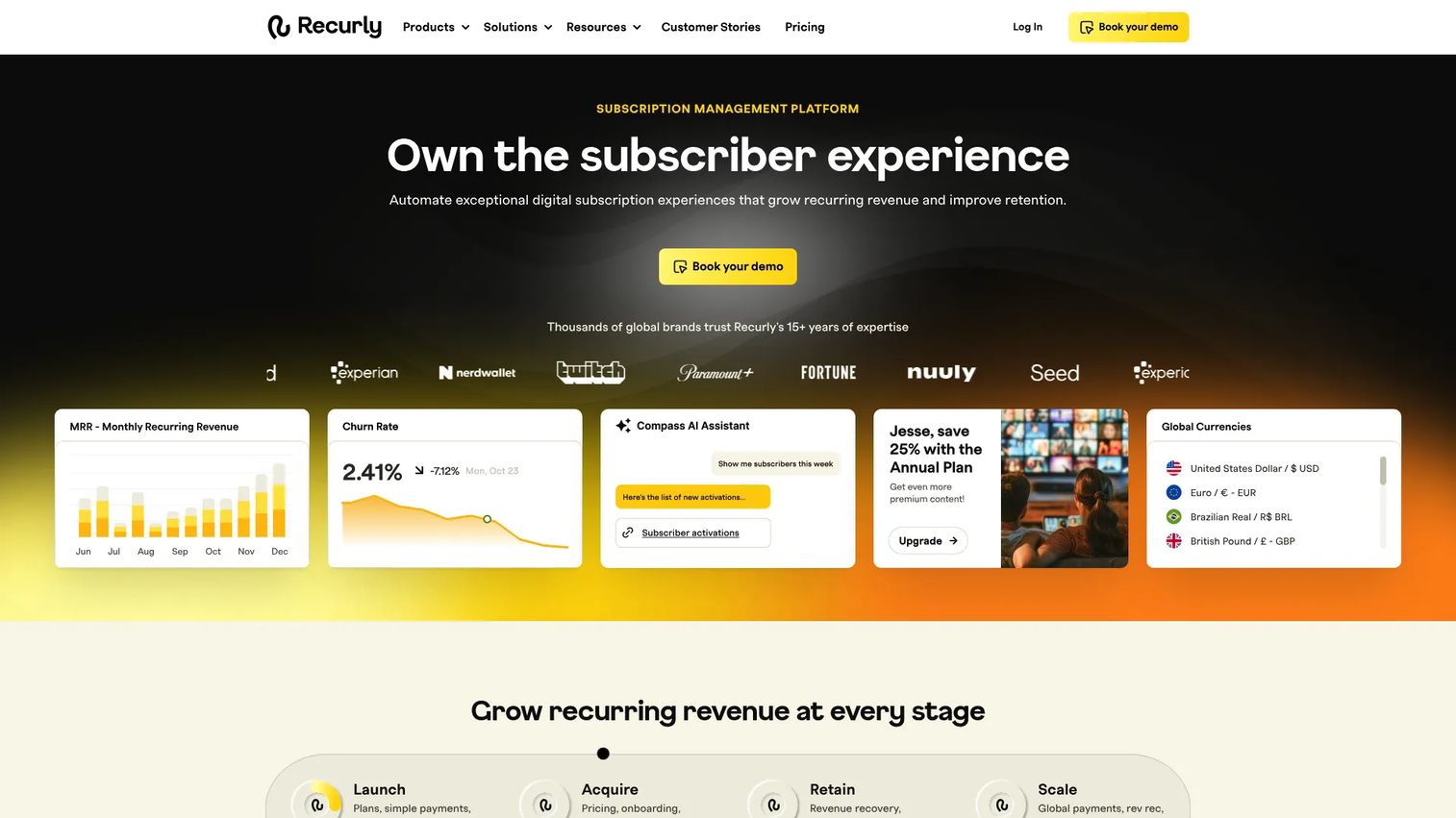
Recurly Dunning is the failed-payment recovery functionality inside Recurly's subscription management platform. It gives subscription teams a dunning recovery dashboard, multiple dunning campaigns with priority rules, and automated retries plus recovery emails. For businesses already running subscription operations on Recurly, it is the billing-native way to handle involuntary churn without leaving the platform.
Best for: Subscription businesses that need configurable failed-payment recovery and churn reduction inside their billing platform.
Key strengths
- Dunning recovery dashboard: a central view of failed payments, recovery status, and campaign performance.
- Multiple campaigns with priority rules: run different dunning campaigns by segment, with rules that decide which applies.
- Automated retries and recovery emails: timed retries and messaging that recover declined charges without manual effort.
Why choose Recurly Dunning: If Recurly already runs your subscriptions, its dunning is built in rather than bolted on, and the campaign priority rules give you control over how different segments are treated. It fits teams that want billing-native recovery with configuration depth.
Recurly Dunning pricing: Recurly's Starter plan runs $249/month plus 0.9% of billing volume, with the first $40K of billings included at no charge each month. All-Access is priced as low as under 1% of billing volume billed annually, and Engage starts as low as $1,600/month billed annually. Some volume terms require a sales conversation. Recurly holds a 4.0/5 rating on G2.
Considerations
Match the tool to the billing model
The biggest mistake in buying dunning software is picking a tool strong in the wrong workflow. Subscription recovery and B2B invoice collections are different jobs. Subscription tools optimize fast, automated retries against a billing cycle. Invoice collections need structured escalation, multi-stakeholder follow-up, and a documented trail over weeks. Decide which motion is your real problem before you shortlist, because a tool built for one rarely shines at the other.
Verify integration depth
Recovery only works if the tool sees your data. Check that it integrates with your billing platform, payment processor, ERP, CRM, and messaging channels. Then check whether the sync is real-time or delayed. A daily batch sync can mean a customer pays, then still gets a dunning email the next morning, which erodes trust. Real-time sync keeps the recovery flow accurate and the customer experience clean.
Evaluate analytics and attribution
Recovered revenue alone is not enough. You want incremental lift reporting to know what the tool actually added versus what would have recovered anyway. Look for root-cause analysis by decline reason and cohort visibility so you can fix the upstream issues driving failures. Strong recovery analytics turn dunning from a black box into a system you can optimize.
Check communication controls
Dunning is customer communication, and tone matters. Evaluate cadence control, personalization, channel mix, and escalation rules. A high-value account should not get the same blunt sequence as a trial user. Also confirm compliance and audit trail requirements, especially for B2B collections where every touch may need to be logged.
Understand pricing and implementation
Pricing models vary from flat fees to MRR-tiered to performance-based percentages, and some tools publish prices while others quote custom. Map the model to your scale before committing. Then weigh implementation lift, support quality, and contract terms. A tool that recovers more but takes a quarter to deploy may lose to one that ships in days.
Conclusion
The right dunning management software depends on three things: your billing stack, your customer motion, and how complex your recovery problem is. The clearest pattern in this list is fit by billing model. Teams on a specific billing platform usually win by starting with the native option. Stripe-first teams start with Stripe Smart Retries, Paddle teams with Paddle Retain, Recurly teams with Recurly Dunning, and Chargebee teams with Chargebee Retention.
From there, the choice sharpens by problem. If failed payments and cancellations both leak revenue, Churn Buster handles them in one place. If false declines and approval rates are the real issue, Revaly's two-sided approach earns a look. If you want simple recovery automation on top of solid analytics, Baremetrics Recover is hard to beat. And if you run subscription commerce on Shopify, Stay AI fits the stack natively.
Start with the tool that matches your billing system and your recovery workflow first. Get the foundation right, measure incremental lift, then layer on specialized recovery if the numbers justify it.
FAQs
Dunning management software automates the recovery of failed payments and overdue invoices. It runs timed payment retries, sends multi-channel reminders, escalates past-due balances, and provides a payment portal so customers can fix a declined card. The goal is to recover earned revenue that would otherwise be lost to involuntary churn or uncollected invoices.
They overlap but are not identical. Collections is the broad practice of recovering money owed, often manual and reactive. Dunning is usually the structured, automated version: a defined sequence of retries, reminders, and escalations triggered by a failed payment or overdue invoice. Modern dunning solutions systematize collections so a person is not chasing each charge by hand.
Finance and accounts receivable teams use it to automate invoice follow-up and reduce past-due balances. RevOps and subscription operations teams use it to recover failed subscription payments and protect MRR. Billing teams rely on it to keep recovery consistent. Sales enablement and revenue leaders often weigh in when the tool affects revenue reporting and process consistency across the org.
Prioritize integration depth with your billing platform, payment processor, ERP, and CRM, plus whether the sync is real-time. Check retry logic quality, channel mix for outreach, and escalation controls. Then evaluate analytics, specifically incremental lift and root-cause reporting. Above all, confirm the tool fits your billing model, whether that is subscription recovery or invoice collections.
Involuntary churn happens when a customer who wants to stay loses access because a payment failed, usually from an expired or maxed-out card. Dunning software catches that failure, retries the charge at a smart time, and prompts the customer to update their card before the subscription lapses. By recovering the payment quietly, it keeps the customer without them ever deciding to leave.
Billing-native dunning, like Stripe Smart Retries, Paddle Retain, or Recurly Dunning, lives inside your billing platform, so there is no separate integration to maintain and setup is fast. Standalone tools, like Churn Buster or Baremetrics Recover, work across billing systems and often add deeper multi-channel messaging, segmentation, or analytics. The trade-off is convenience versus specialized recovery depth.
Yes, though the workflow differs from subscription recovery. B2B invoice collections run over weeks rather than days, with structured escalation, multi-stakeholder follow-up, and a documented audit trail for finance. Some tools are built specifically for invoice-based AR, while subscription-first tools focus on card retries. If overdue invoice collections are your main problem, choose a tool whose escalation and documentation features match B2B workflows.