You just hired employee number 60. They sit in a state you have never dealt with before. Your legal counsel mentions that this jurisdiction has a supervisor training deadline. Your existing training tracks completions in a spreadsheet nobody trusts. And your board is asking, in the next meeting, whether compliance is actually handled.
That is the real problem harassment prevention training software solves. Not "teach people to be respectful." Anyone can buy a video for that. The harder job is proving, on demand, that the right people completed the right training under the right law, across every state you operate in, without a manual admin pile that grows with headcount.
The stakes are rising. The global harassment prevention training software market was valued at roughly USD 1.2 billion in 2024 and is forecast to reach USD 2.5 billion by 2033, a 9.2% CAGR, according to Verified Market Reports (2025). More states are mandating training. More of that training now has to be role-specific, recurring, and auditable.
For a growing SaaS company, the wrong tool creates two failure modes: a compliance gap that surfaces during due diligence, or an admin drag that pulls your HR lead away from work that actually scales. This guide is built to help you avoid both. If you are separately assessing tools that keep leaders honest, our roundups on feedback software, AI recruiting software, and AI governance tools cover adjacent parts of the people and risk stack.
What's inside
This guide covers eight platforms that deliver anti-harassment training software for employees and supervisors, from cinematic course libraries to institutional workshops to bite-sized mobile learning. We compare them on the criteria that actually decide fit for a scaling team:
- Compliance coverage across states, cities, and supervisor mandates
- Role-based assignment for employees versus managers, with recurring refreshers
- Scenario quality and engagement so completion means something
- Reporting and defensibility including audit trails, certificates, and exports
- Rollout effort and support for lean HR teams
We prioritized platforms with verified pricing or public tier structure, credible reviews, and real distribution controls, then sorted by relevance to buyers evaluating compliance depth first.
TL;DR
- Best overall for compliance depth: Traliant, with story-based courses, in-house legal expertise, and role-based tracks.
- Best for institutional credibility: EEOC Training Institute, the training arm of the agency that enforces the law.
- Best for lightweight, mobile-first rollout: EasyLlama, with bite-sized modules and 100+ language support.
- Best for culture measurement: Emtrain, which pairs training with sentiment analytics and risk benchmarks.
- Best for an integrated compliance stack: NAVEX, where harassment training sits inside a broader ethics and risk platform.
- Best for state-compliant simplicity: Kantola, with 50-state coverage and annual course refreshes.
What is harassment prevention training software?
Harassment prevention training software is a platform that delivers, assigns, tracks, and documents workplace anti-harassment education across an organization. It replaces one-off videos and manual sign-in sheets with a system that maps training to legal requirements, assigns the right course to the right role and location, and produces the completion records you need to prove compliance.
Most sexual harassment training software shares a common core. What separates a strong platform from a checkbox is how deeply it handles each capability.
- Employee and supervisor tracks: separate content and duration for staff versus managers, since many states require longer, distinct manager training.
- State and local compliance: versions built for California, New York, Illinois, Connecticut, and other jurisdictions with specific mandates.
- Legal update cadence: content refreshed as laws change, so you are not shipping outdated training.
- Scenario-based learning: branching situations and decision points, not just a video and a quiz.
- Bystander intervention training: modules that teach employees how to act when they witness misconduct.
- Reporting and audit trails: completion tracking, timestamps, certificates, and exports for legal defensibility.
- Rollout controls: bulk assignment, automated reminders, and recurring scheduling for annual refreshers.
That combination is why buyers treat this as compliance training software, not just a content purchase. The platform is the part that scales.
What to look for in harassment prevention training software
The feature list gets long fast. These four criteria decide whether a platform actually reduces your risk and your admin load.
Compliance coverage
Start with the map. Which states and cities does the platform cover out of the box, and does it maintain distinct versions for jurisdictions with specific rules? California, New York, Illinois, Connecticut, Delaware, and Maine all carry their own requirements, and several mandate longer supervisor training. Ask about update cadence too. Laws change, and content that was compliant in 2024 may not be in 2026. The right platform ships jurisdiction-specific versions and refreshes them without you filing a ticket.
Role-based assignment
Employees and supervisors need different training. Managers are often legally required to complete more, cover their reporting obligations, and understand retaliation rules. Good workplace harassment training software lets you assign by role, department, and location automatically, so a new supervisor in New York gets the two-hour manager course while a Texas individual contributor gets the appropriate employee track. Automated refreshers matter here: most mandates are recurring on a one or two year cycle.
Engagement and retention
Completion is not comprehension. Scenario-based learning, branching decisions, and behavior prompts drive materially higher retention than a passive video. When a learner has to choose how to respond to a realistic situation, the training moves from "watched" to "understood." For a founder, this is the difference between a defensible program and a liability you paid for. Look for interactive harassment training with real decision points, not a slideshow with a certificate at the end.
Reporting and defensibility
If you cannot prove it, it did not happen, at least not to a regulator or a plaintiff's attorney. Your platform should track completions with timestamps, issue certificates, maintain an audit trail, and export clean records on demand. Manager-level reporting helps team leads chase down stragglers without HR playing enforcer. This is the layer that turns training from a cost into a defense.
When to use harassment prevention training software
Three situations make dedicated software worth it over stitching together videos and spreadsheets.
Rolling out training across multiple states
The moment you employ people in more than one state, jurisdiction-specific versioning and location-based assignment stop being nice-to-haves. Manually tracking which California employees need what, versus New York, versus Illinois, is exactly the kind of admin that breaks as you scale. Software handles the mapping and the assignment so the right course reaches the right person automatically.
Training supervisors separately
Managers carry heavier legal obligations and need content built for them: how to receive a complaint, what retaliation looks like, and their duty to escalate. Harassment training for supervisors also often comes with a longer required duration. A platform that separates these tracks and reports on them independently keeps you compliant and gives leadership a clean view of manager readiness.
Refreshing annual compliance
Most mandates recur. New hires need training within a set window, and existing staff need refreshers on a cycle. Software automates the scheduling, the reminders, and the certificate reissuance, so annual compliance runs itself instead of becoming a quarterly fire drill for your HR lead.
Comparison table
These eight platforms differ most on where they sit on the spectrum from deep content library to full compliance infrastructure, and on how much of the rollout they automate for you. Pricing models vary widely, from per-learner annual plans to per-person workshops to custom enterprise quotes.
| # | Product | Intent | Key differentiation | Pricing | G2 rating |
|---|---|---|---|---|---|
| 1 | Traliant | Compliance depth with strong storytelling | Story-based courses, in-house legal team, role-based tracks | From $15.95 per learner/year | 4.5/5 |
| 2 | EEOC Training Institute | Institutional, agency-backed training | Official EEOC training arm, respectful workplaces framing | From $200 per person | Not listed |
| 3 | EasyLlama | Lightweight, mobile-first deployment | Bite-sized modules, 100+ languages, fast rollout | From $24.95 per course/learner/year | Not listed |
| 4 | Emtrain | Training plus culture analytics | Sentiment surveys, risk dashboards, benchmarks | From $5,000/year | 4.6/5 |
| 5 | NAVEX | Harassment training inside a GRC stack | Ethics, risk, whistleblowing, and training in one platform | Custom | 3.7/5 |
| 6 | Kantola | State-compliant, refreshed annually | 50-state coverage, annual course updates, 100+ languages | Custom | Not listed |
| 7 | EVERFI | Global prevention and bystander focus | Interactive modules, bystander intervention, English/Spanish | Custom | 3.9/5 |
| 8 | J.J. Keller | Broad compliance and format flexibility | Multiple formats, audience segmentation, catalog delivery | Product-level pricing | 4.7/5 |
Best harassment prevention training software for 2026
1. Traliant
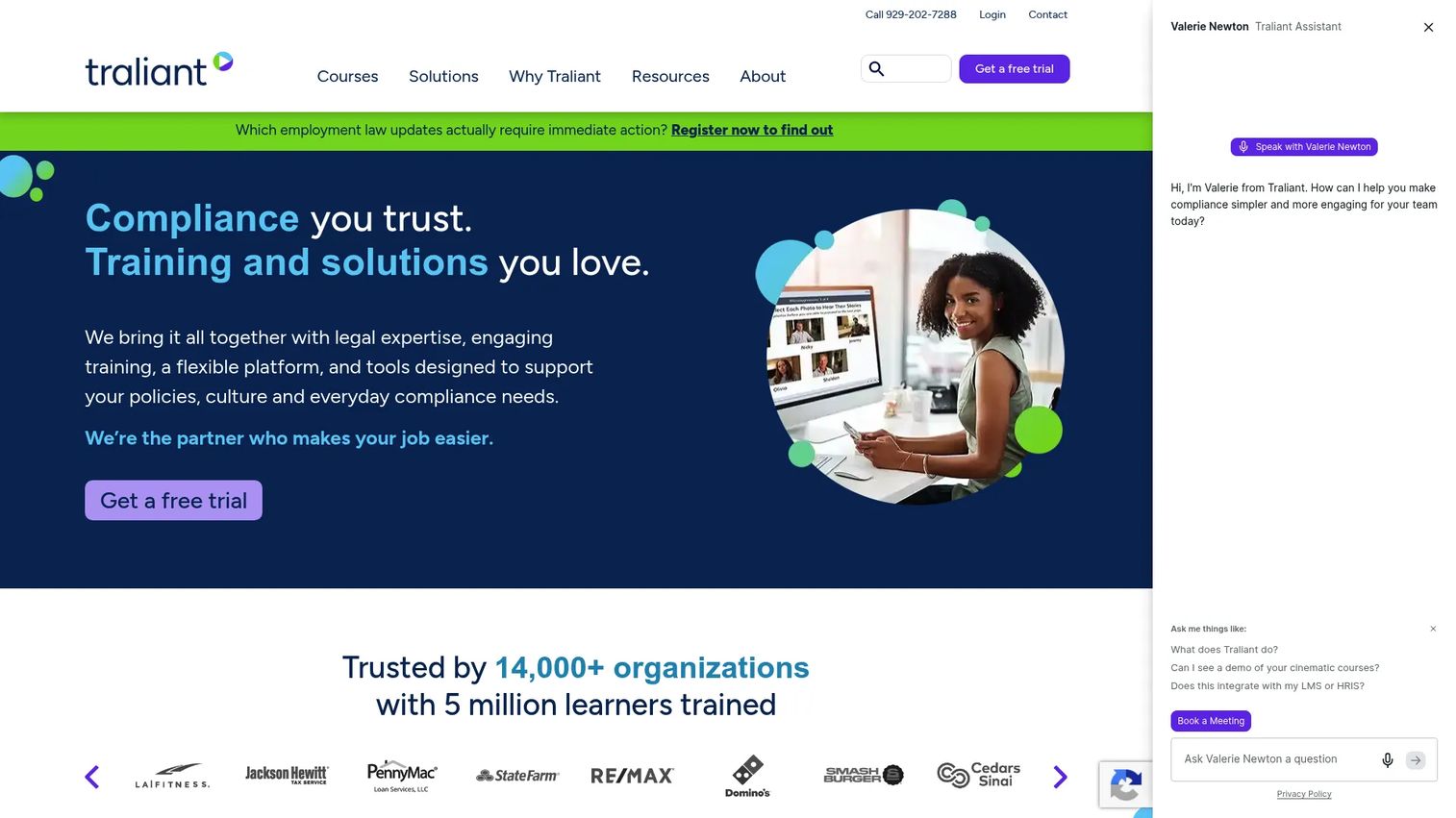
Traliant builds compliance training software around story-based, cinematic content that treats learners like adults rather than defendants. Its harassment prevention courses use realistic, TV-style scenarios and branching decisions, backed by an in-house legal and compliance team that keeps content current as laws change. For a scaling company, the appeal is depth without the dryness that kills completion rates.
Best for: Mid-market and enterprise teams that want serious compliance coverage delivered through engaging, role-based training.
Key strengths
- Story-based courses: Cinematic scenarios and branching paths drive engagement and retention over passive video.
- In-house legal expertise: A dedicated legal and compliance team keeps content aligned with changing state and federal requirements.
- Role-based tracks with customization: Separate employee and supervisor content, plus LMS integration, analytics, and multilingual translation options.
Why choose Traliant
Traliant fits the founder who wants compliance handled well, not just handled. The storytelling approach means your team actually absorbs the material, and the in-house legal function reduces the risk of shipping outdated content across multiple jurisdictions. It is a strong overall pick when compliance depth and engagement both matter.
Traliant pricing
Traliant publishes tiered per-learner pricing: Essential at $15.95 per learner annually, Pro at $24.95, and Complete at $39.95, with a Plus platform add-on starting at $3.99 per learner annually. Listed prices reflect a 3-year plan for 100 learners, so smaller teams, larger teams, and shorter terms are priced differently. Enterprise arrangements are quote-based. Traliant holds a 4.5/5 rating on G2.
2. EEOC Training Institute
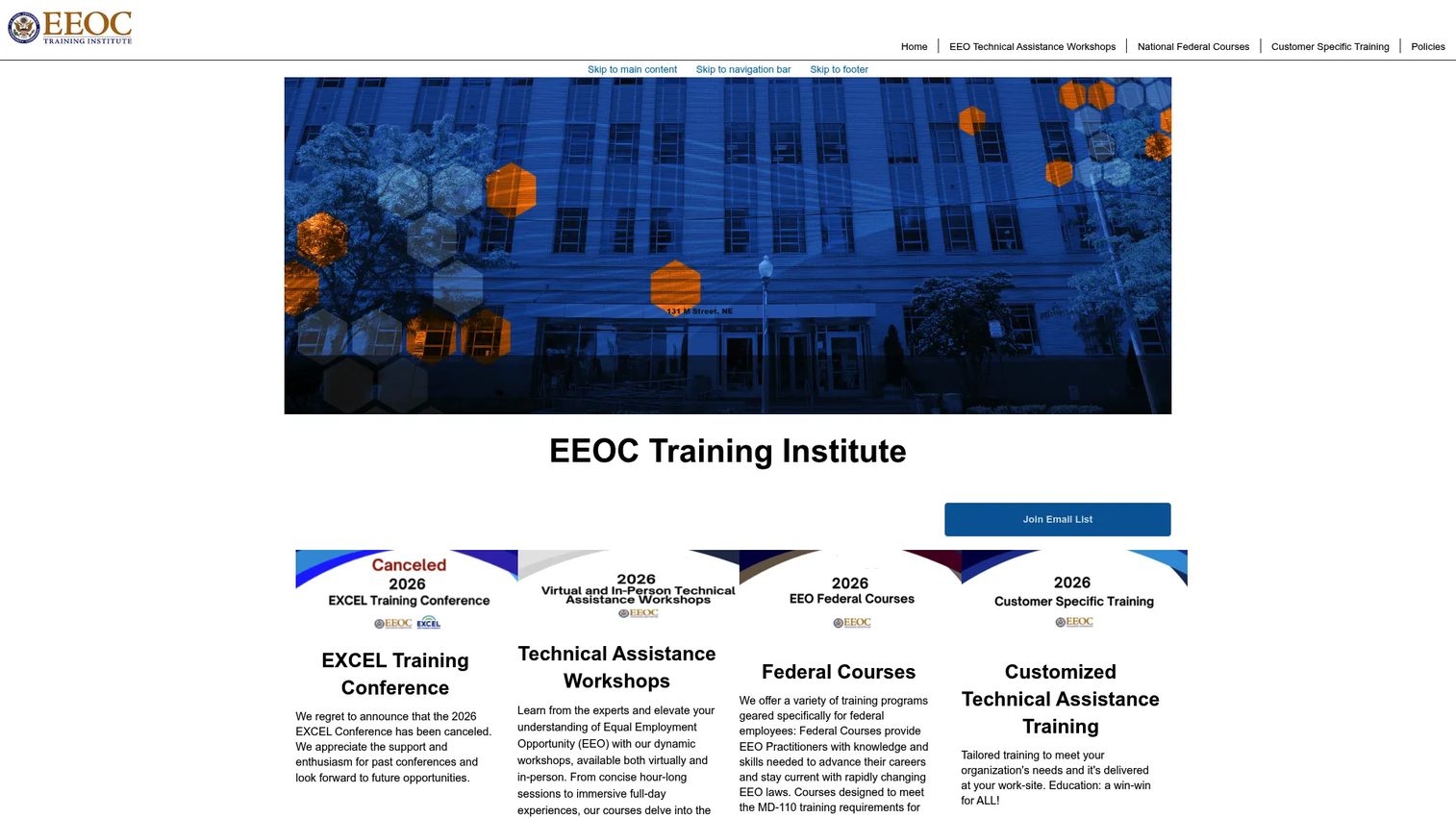
EEOC Training Institute is the training arm of the U.S. Equal Employment Opportunity Commission, the agency that enforces federal anti-discrimination law. That gives it a level of institutional credibility no private vendor can match. Its respectful workplaces training and EEO courses come straight from the source, with separate programs for employees and supervisors and customized on-site or virtual delivery.
Best for: Federal agencies and employers who want training authored and delivered by the enforcing agency itself.
Key strengths
- Agency-backed credibility: Training built and delivered by the EEOC, the authority on the underlying law.
- Respectful workplaces framing: Content that goes beyond compliance into practical, skills-based respectful workplace behavior.
- Employee and supervisor programs: Distinct offerings, including EEO basics for supervisors and managers, plus customized options.
Why choose EEOC Training Institute
The credibility case is hard to beat. If your priority is training that carries the weight of the enforcing agency, this is the most authoritative option on the list. Its catalog is more workshop-focused than a self-serve software library, so it suits organizations comfortable with a structured, scheduled training model rather than continuous automated assignment.
EEOC Training Institute pricing
Pricing is published per person by workshop length: $200 per person for a one-hour briefing, $275 for a two-hour workshop, $350 for a four-hour half-day workshop, and $425 for a full-day eight-hour session. Federal course pricing is posted separately, and 2026 workshop courses have been announced. No G2 rating is publicly listed for this brand.
3. EasyLlama
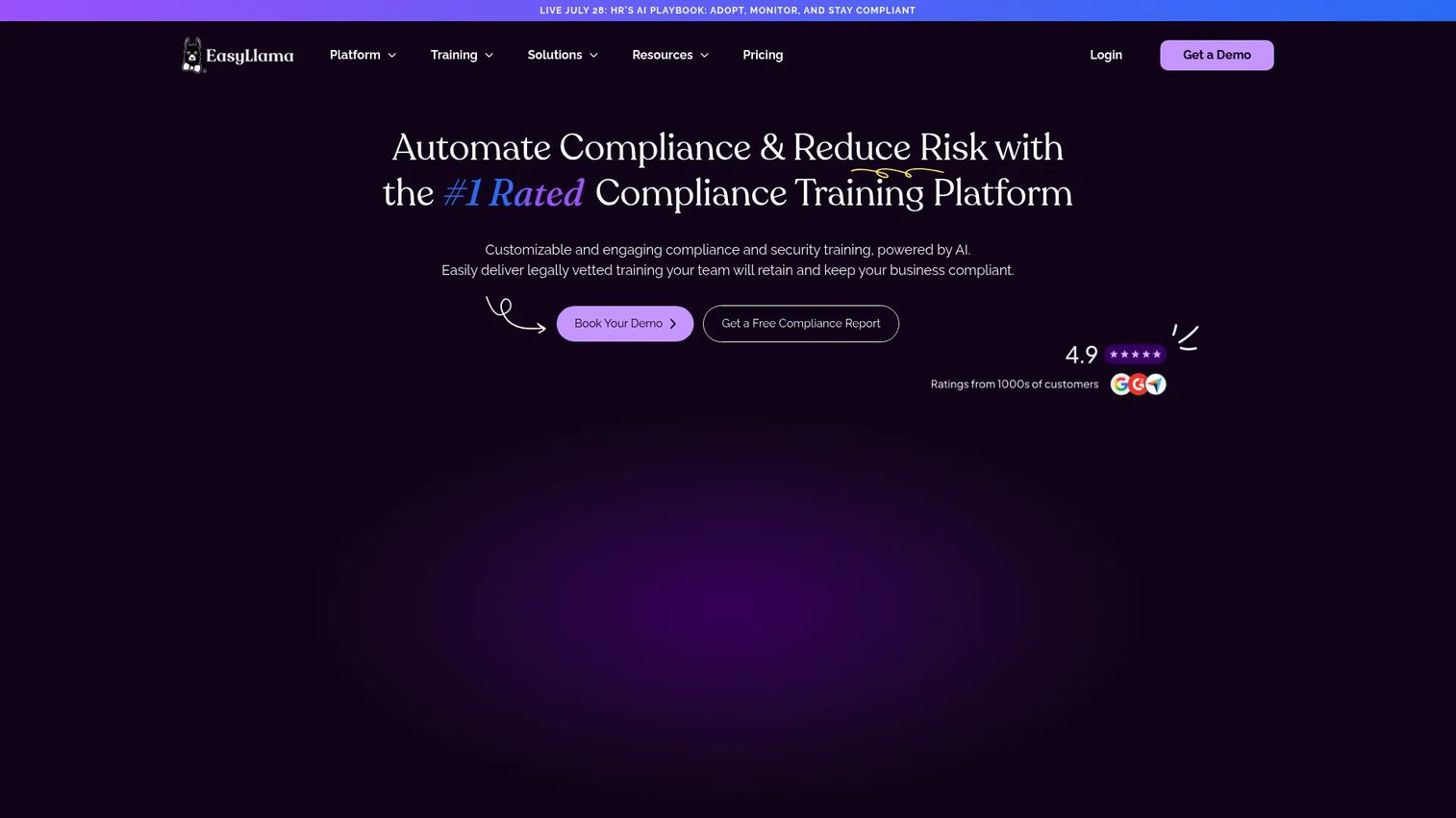
EasyLlama is built for teams that want online harassment training live fast, without a heavy implementation. It delivers bite-sized, mobile-first modules that employees can finish in one sitting, backed by a library of legally vetted courses and an AI-powered LMS. Available in over 100 languages, it suits distributed and multilingual workforces.
Best for: Lean teams and fast-scaling companies that need compliant, engaging training deployed with minimal admin overhead.
Key strengths
- Bite-sized, mobile-first modules: Short, interactive lessons employees actually complete, on any device.
- Broad course library: Hundreds of legally vetted courses spanning harassment prevention and other compliance topics.
- Multilingual and automated: 100+ language support, plus AI-assisted reporting and course authoring to cut admin work.
Why choose EasyLlama
For a founder who does not have a dedicated compliance team, EasyLlama is the low-friction path to a defensible program. The mobile-first, short-format approach lifts completion rates, and the automation reduces the manual chase. It is the strongest fit when speed of rollout and ease of administration are the priority.
EasyLlama pricing
EasyLlama publishes three tiers: Pay Per Course at $24.95 per course, per learner, per year; Core at $59.95 per user per year; and Ultimate at $89.95 per user per year. All plans require a minimum of 10 seats or courses, and EasyLlama notes it does not currently offer a free trial. Capterra reviewers rate it 4.8/5.
4. Emtrain
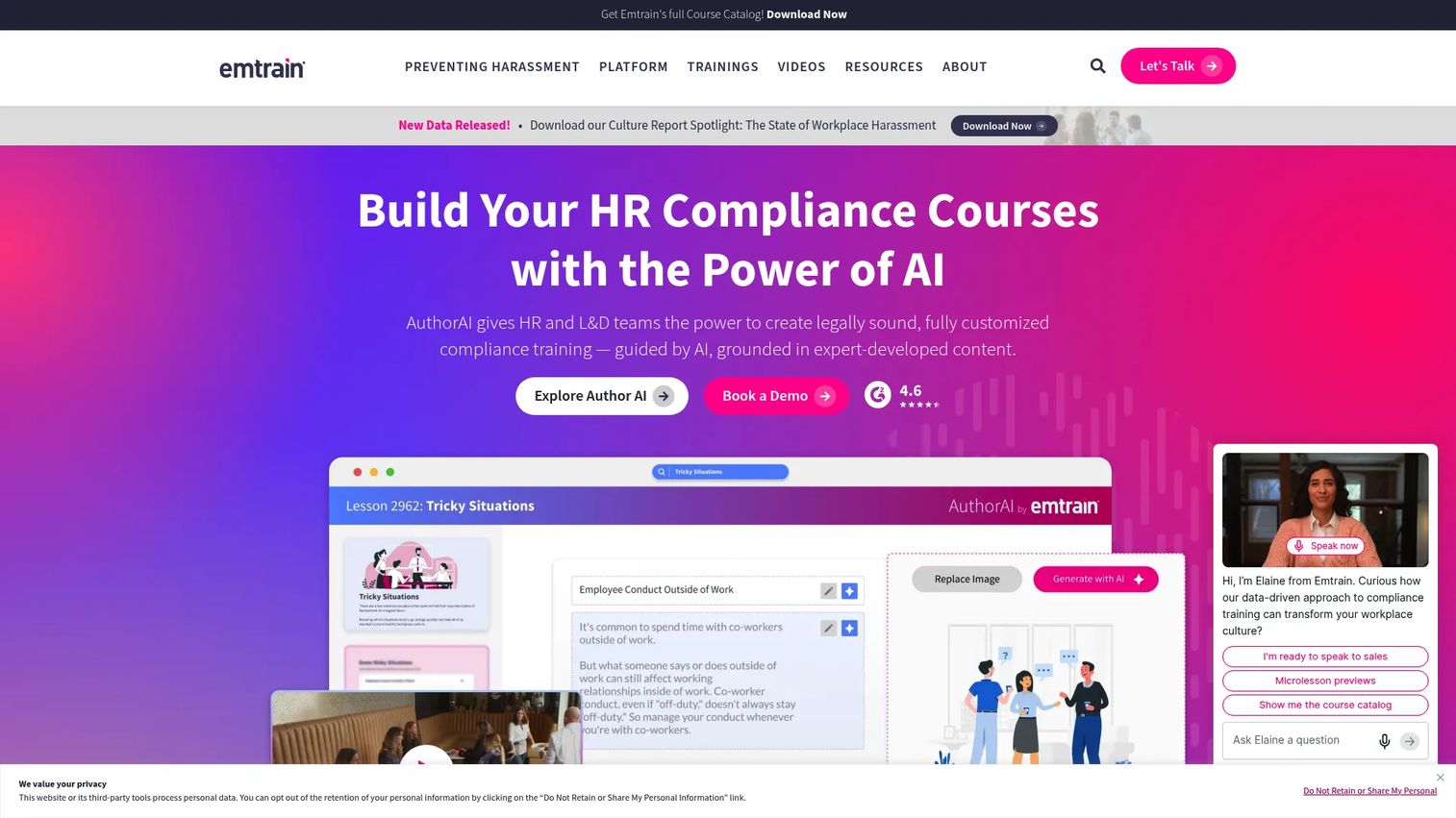
Emtrain treats harassment prevention as a data problem, not just a content problem. Alongside scenario-based compliance courses and microlessons, it layers in employee sentiment surveys, culture analytics, and risk dashboards that benchmark your organization against peers. That measurement angle turns training completion into a signal you can act on.
Best for: Organizations that want to measure culture risk and behavior change, not just document completions.
Key strengths
- Culture analytics: Sentiment surveys and behavior benchmarking that surface risk before it becomes a claim.
- Risk dashboards and recommendations: Data views that show where your organization stands and what to do next.
- Scenario-based courses and microlessons: Interactive content with annual updates to keep material current.
Why choose Emtrain
If your board or leadership wants proof that training changes behavior, Emtrain gives you the metrics. The analytics layer is the differentiator: instead of a completion percentage, you get a read on culture health and where the actual risk sits. It suits data-minded teams that treat compliance as a leading indicator, not a checkbox.
Emtrain pricing
Emtrain lists Basic, Standard, and Premium tiers, with plan details gated behind a sales conversation. Public information indicates plans start around $5,000 annually, roughly $50 per learner, with per-learner pricing varying by contract value, workforce size, and term. Emtrain holds a 4.6/5 rating on G2.
5. NAVEX
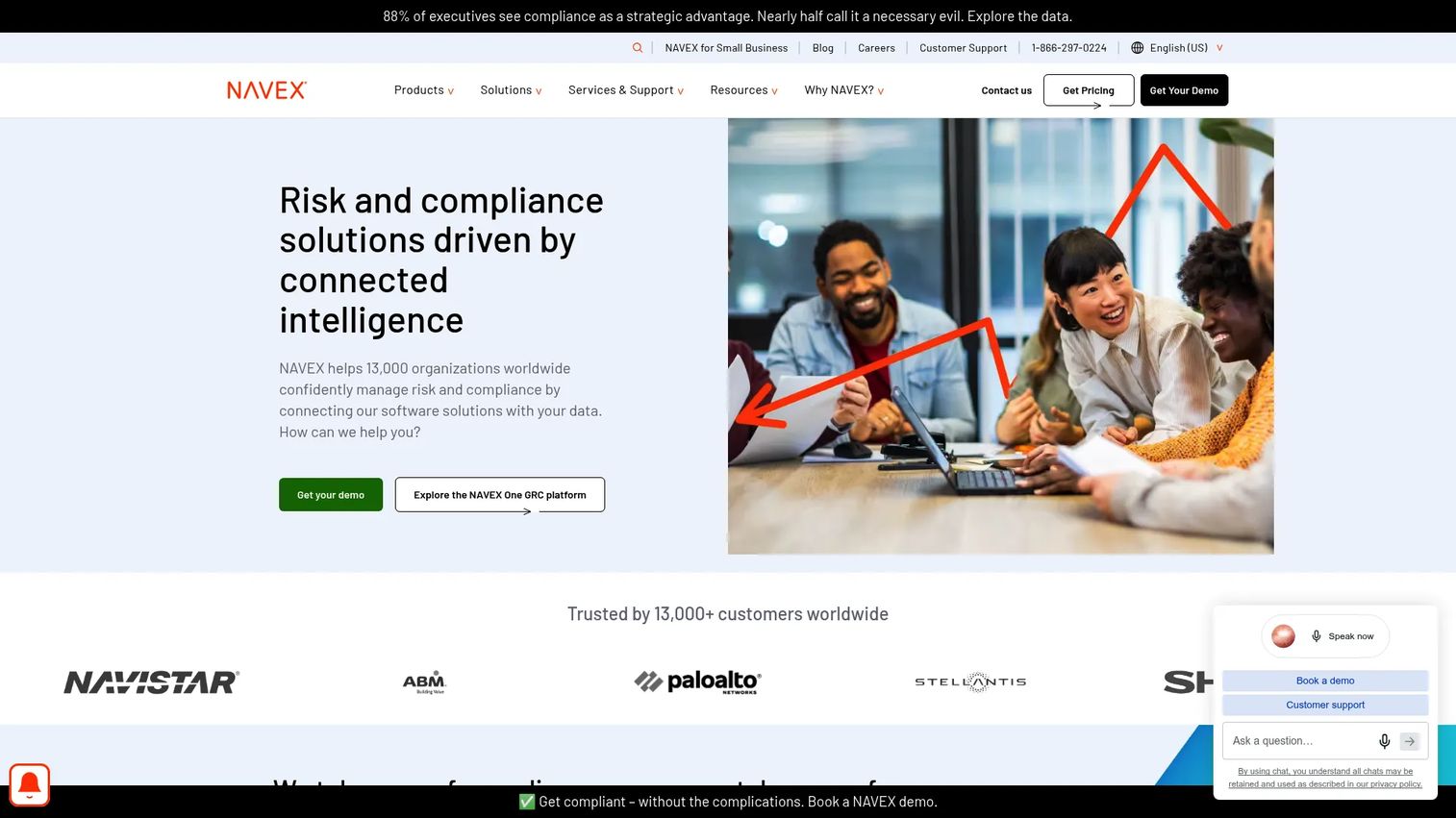
NAVEX approaches workplace harassment training software as one component of a broader governance, risk, and compliance platform. Its online harassment training includes state and city-specific versions for jurisdictions like California, Connecticut, Illinois, Chicago, Maine, New York, and New York City. Where NAVEX stands apart is the surrounding stack: whistleblowing, incident management, and policy management under one roof.
Best for: Enterprises that want harassment training integrated with a full ethics, risk, and compliance system.
Key strengths
- State and city-specific versions: Anti-harassment training built to meet requirements in specific jurisdictions.
- Integrated GRC platform: Whistleblowing, incident management, and policy management alongside training.
- Distribution and customization controls: Enterprise-grade assignment, tracking, and configuration.
Why choose NAVEX
For a company that already needs whistleblowing hotlines, policy management, and incident tracking, consolidating training into the same platform reduces tool sprawl and gives you one system of record for compliance. It is the natural pick when harassment training is one piece of a larger risk program rather than a standalone need.
NAVEX pricing
NAVEX does not publish list pricing. It tailors quotes to organization size, program needs, and the specific solutions selected, and directs prospects to request pricing. Its NAVEX One product carries a 3.7/5 rating on G2.
6. Kantola
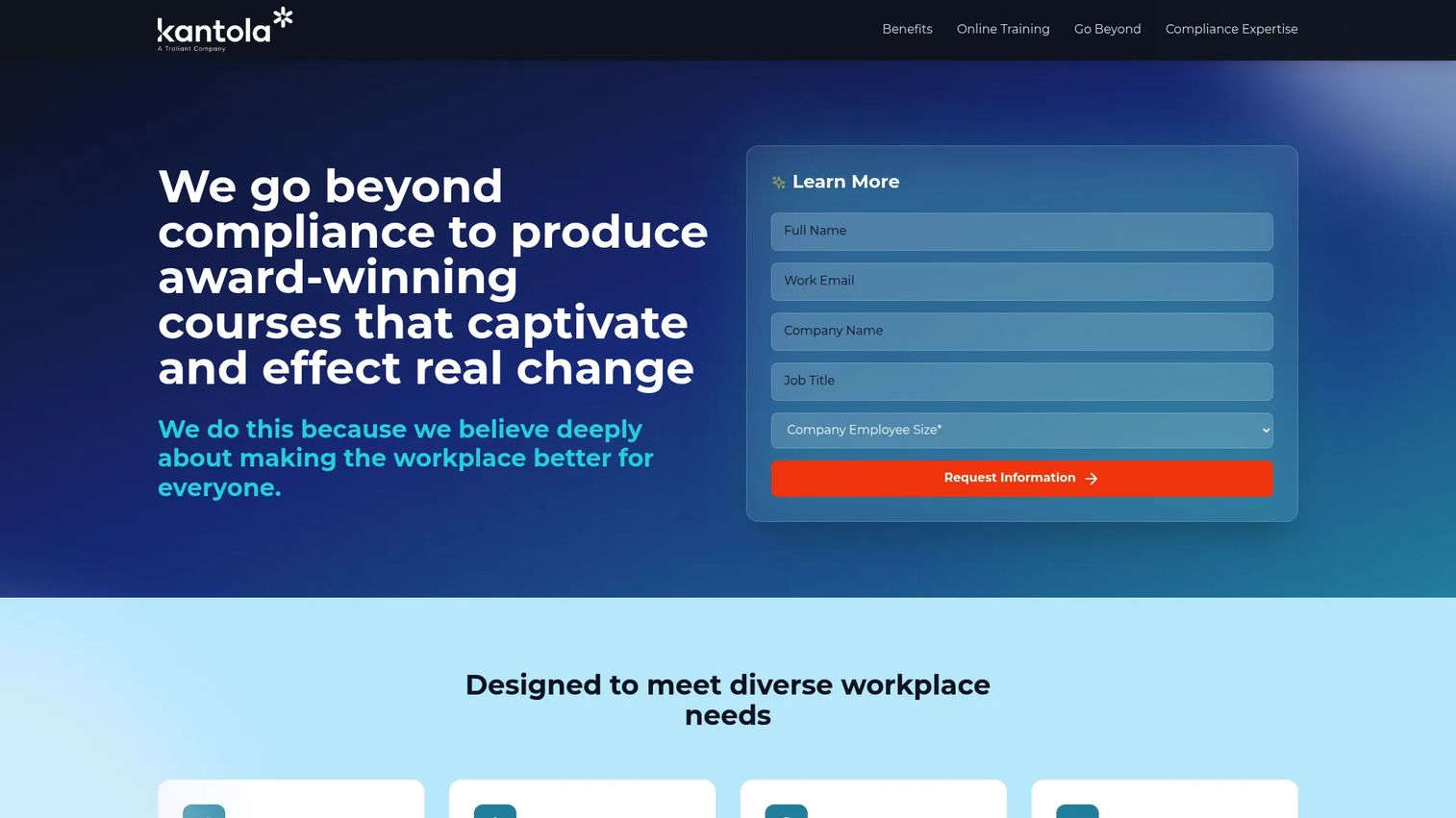
Kantola focuses squarely on anti-harassment and DEI compliance, with training built to satisfy requirements in all 50 states. Its harassment prevention course is interactive and customizable, with supervisor-specific support and translations in English, Spanish, and 100+ languages. The model is built for organizations that want state-compliant training without managing the jurisdictional detail themselves.
Best for: Organizations that want reliably state-compliant harassment prevention and DEI training with minimal maintenance.
Key strengths
- 50-state compliant training: Courses built to meet the specific mandates of every U.S. state.
- Supervisor support: Manager-focused content and reporting alongside the employee track.
- Broad language coverage: English, Spanish, and 100+ additional languages for diverse workforces.
Why choose Kantola
Kantola performs best when you want the jurisdictional complexity handled for you. The 50-state coverage and annual course refresh mean you are not tracking which state changed what, and the interactive format keeps engagement up. It is a solid fit for teams that value compliance certainty and simplicity over a sprawling feature set.
Kantola pricing
Kantola does not publish pricing on its site and uses a request-information sales flow, so figures could not be verified. A current G2 or Capterra rating for Kantola specifically was not available at the time of writing. Request a quote directly to confirm current tiers and terms.
7. EVERFI
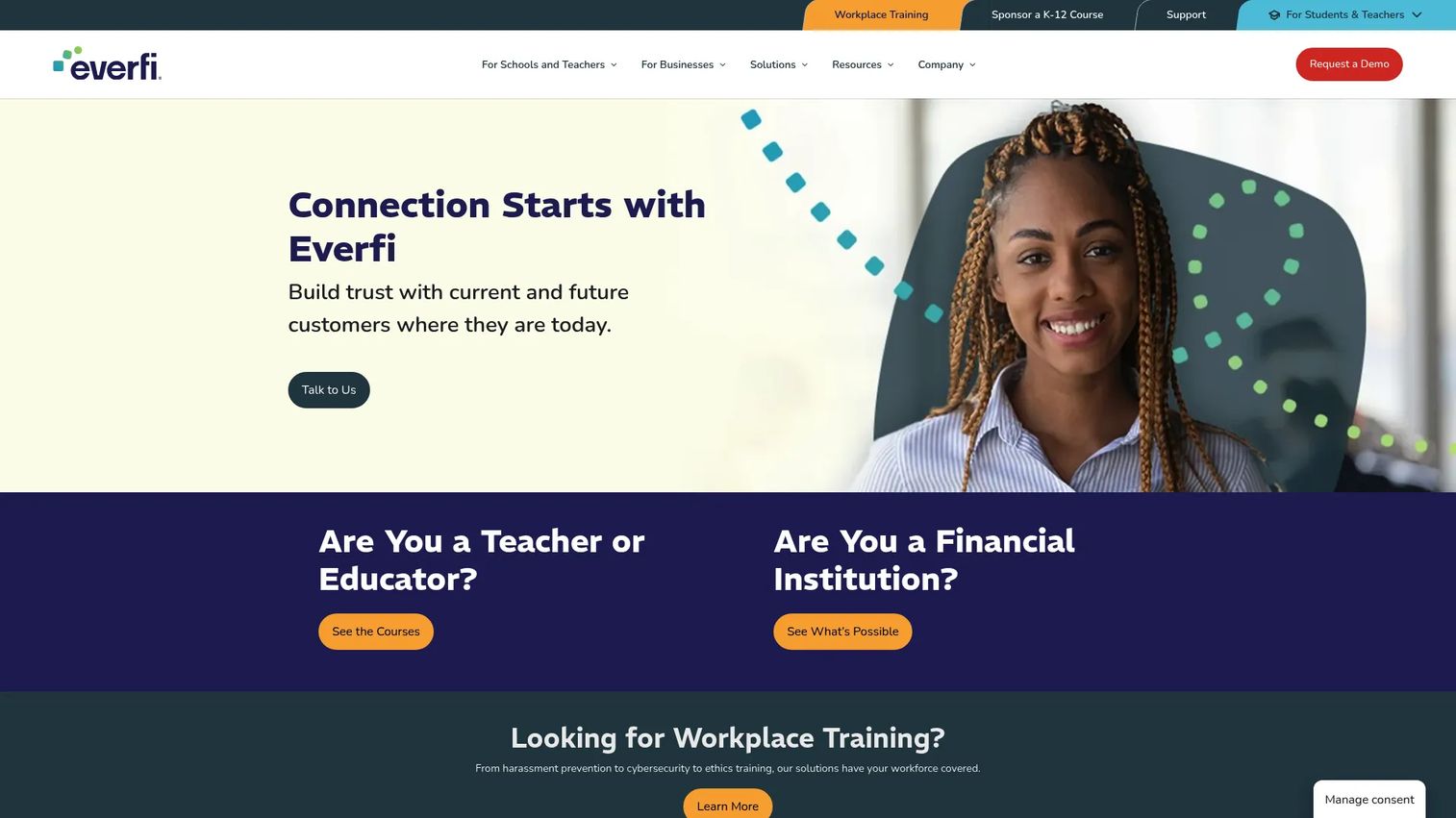
EVERFI delivers interactive workplace compliance training as part of a broader education technology platform. Its harassment and discrimination prevention content emphasizes bystander intervention training and manager-focused modules, with more than 100 bite-sized, mobile-first lessons available in English and Spanish. The bystander angle is a genuine differentiator: teaching people to act when they witness misconduct, not just recognize it.
Best for: Employers who want global harassment and discrimination prevention with a strong bystander intervention emphasis.
Key strengths
- Bystander intervention focus: Modules that train employees to intervene, not just identify, harassment.
- Interactive, bite-sized delivery: 100+ mobile-first lessons in English and Spanish.
- Manager-focused and analytics-backed: Supervisor content plus reporting and branded delivery options.
Why choose EVERFI
EVERFI suits organizations that want prevention to go beyond compliance into active intervention culture. The bystander emphasis addresses the behavior that actually stops incidents, and the interactive format supports engagement. It works well for employers building a broader culture program rather than a minimal compliance checkbox.
EVERFI pricing
EVERFI does not publish list pricing for its workplace training offerings, which are demo-based. Its K-12 lessons are described as free to schools via sponsors, but commercial pricing requires a conversation. EVERFI holds a 3.9/5 rating on G2 for its workplace training presence.
8. J.J. Keller
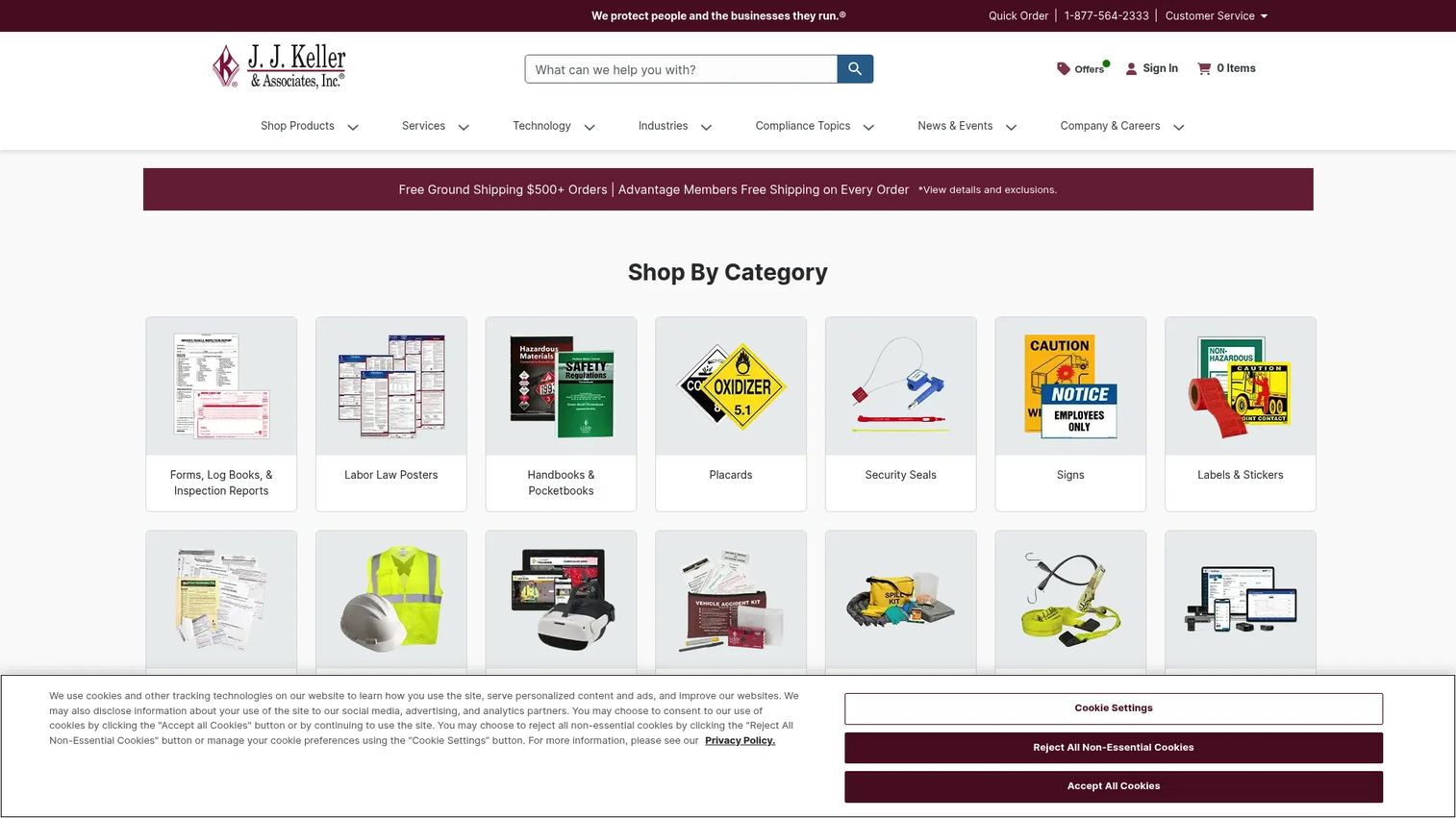
J.J. Keller brings decades of compliance and safety expertise to workplace harassment training, with a catalog-style approach that offers multiple formats and audience variants. Alongside online and cloud-based training, it provides consulting, forms, and a broad library of compliance products. The breadth is the point: harassment training sits within a wider safety and compliance offering.
Best for: Organizations that want harassment training as part of a broader compliance, safety, and fleet operation.
Key strengths
- Multiple training formats: Online, cloud-based, and other delivery options across audience types.
- Audience segmentation: Training variants by role and medium for different parts of the workforce.
- Broad compliance catalog: Consulting, forms, PPE, and safety products alongside training.
Why choose J.J. Keller
J.J. Keller fits companies that already lean on it for broader compliance and safety needs, or those in industries like transportation where fleet and workplace compliance overlap. The catalog model gives flexibility in format and audience, making it a practical choice when harassment training is one line item in a larger compliance program.
J.J. Keller pricing
J.J. Keller publishes item-level pricing for many individual products, but pricing for its flagship software and training solutions is not clearly disclosed on its public pages. Contact J.J. Keller directly for platform and course pricing. It holds a 4.7/5 rating on G2 as a seller.
Considerations
Before you commit, run each shortlisted platform through this checklist. It maps directly to the risks a founder actually carries.
Legal coverage by jurisdiction
Confirm the platform maintains distinct, current versions for every state and city where you employ people, not just a generic national course. Ask specifically about California, New York, Illinois, and Connecticut, which carry the most detailed mandates. Verify the update cadence so you know content stays compliant as laws change through 2026 and beyond.
Manager versus employee assignment
Check that the platform assigns different content by role automatically, and that supervisor training meets the longer duration and expanded scope many states require. Confirm you can assign by location and department without manual list-building, and that manager-level reporting exists so team leads can chase completions.
Analytics and audit readiness
Verify the platform produces timestamped completion records, certificates, and clean exports on demand. If your board wants proof of behavior change, look for platforms with sentiment or culture analytics. The test is simple: could you produce a defensible audit trail during due diligence or litigation without a scramble?
Format and engagement quality
Preview the actual courses. Scenario-based, interactive content with real decision points drives comprehension in a way video-only training does not. Low completion or shallow engagement undermines the entire point, so weigh format quality alongside compliance coverage.
Implementation effort and support
Assess how much rollout the platform automates: bulk assignment, automated reminders, recurring scheduling. For a lean team, this determines whether compliance runs itself or becomes a quarterly project. Confirm the support model matches your bandwidth.
Conclusion
The best harassment prevention training software depends on which pressure you feel most. If compliance depth and engaging content both matter, Traliant is the strongest all-around pick. For agency-backed credibility, EEOC Training Institute is unmatched. If you need to move fast with a lean team, EasyLlama's mobile-first, automated model is the easiest to deploy. When leadership wants proof of behavior change, Emtrain's culture analytics deliver it. And if harassment training is one piece of a larger risk program, NAVEX consolidates it into a full ethics and compliance platform, while Kantola keeps 50-state compliance simple.
The practical move: shortlist two or three tools that match your priority, then compare them head to head against your actual state requirements and your HR team's admin capacity. Book demos, preview the real courses, and confirm the reporting produces a defensible audit trail. Get that right, and compliance stops being a board-meeting anxiety and becomes a system that runs itself.
FAQs
It is a platform that delivers, assigns, tracks, and documents workplace anti-harassment training across an organization. It maps courses to legal requirements, assigns the right content by role and location, and produces the completion records needed to prove compliance during an audit or investigation.
Requirements vary by state and role. Several states, including California, New York, Illinois, and Connecticut, mandate training for employees and often require longer, separate training for supervisors. Because rules differ by jurisdiction and change over time, confirm your specific obligations with legal counsel and choose software that maintains current, state-specific versions.
Employee training covers recognizing harassment, understanding policy, and how to report it. Supervisor training adds legal obligations: how to receive and escalate complaints, prevent retaliation, and meet a manager's duty to act. Many states require supervisors to complete longer training, which is why role-based assignment matters.
Prioritize platforms that maintain distinct, current versions for each state and city where you employ people, and that assign the right version automatically by location. Confirm the update cadence so content stays compliant as laws change. Location-based auto-assignment removes the manual tracking that breaks as you scale across jurisdictions.
Most mandates recur on a one or two year cycle, and new hires typically need training within a set window after starting. The exact interval depends on your state. Good software automates recurring scheduling, reminders, and certificate reissuance so annual compliance runs without manual intervention.
Look for timestamped completion tracking, certificates, an audit trail, and clean exports available on demand. Manager-level reporting helps team leads follow up on incomplete training. The goal is being able to produce a defensible record instantly if a regulator or attorney asks for one.
Interactive, scenario-based training with branching decisions drives materially higher comprehension and retention than passive video. When a learner has to choose how to respond to a realistic situation, the material moves from watched to understood, which is what makes a program defensible rather than a checkbox.
A strong course covers what harassment and discrimination look like, how to report them, retaliation protections, and bystander intervention. Supervisor versions should add complaint handling and escalation duties. Workplace respect and inclusive behavior content strengthens the program beyond the minimum legal requirement.