
A shipment quote lives in one inbox. The booking confirmation lives in another. The rate sheet is a spreadsheet on someone's desktop. The customer wants a status update, so an operator stops what they are doing, digs through three systems, and sends a manual email. Multiply that by every shipment moving through your operation this week, and you can see where the margin goes.
Freight forwarding software exists to collapse that chaos into a single operating layer. It is not just a shipment tracker. It is the system that decides whether your team can add volume without adding headcount, whether customers get answers without chasing you, and whether you actually know which lanes and accounts make money. The global freight forwarding software market was worth roughly USD 0.57 billion in 2024 and is projected to reach USD 1.93 billion by 2033 at a 14.39% CAGR, according to Business Research Insights (2026). That growth is not marketing hype. It reflects forwarders realizing that manual coordination stops scaling long before the business does.
If you run a freight operation and you are still stitching workflows together across email, PDFs, and disconnected tools, the cost is not obvious on a spreadsheet. It shows up as slow quotes, missed follow-ups, weak visibility, and profitability you can only estimate after the fact. The right freight forwarding system fixes the underlying problem, not just the symptom. For readers who also evaluate customer-facing tooling, our guides on the best customer data platform and best contract lifecycle management software cover adjacent decisions that touch the same operations stack.
What's inside
This guide covers seven freight forwarding platforms built for teams that need a system, not a point tool. We chose each one based on shipment workflow coverage, real-time visibility, automation depth, multimodal support (air and ocean freight), integration and connectivity, and customer experience. The list spans AI-led automation, enterprise breadth, customs and compliance depth, SMB-friendly rollout, and rate management strength. Every pricing figure and rating below reflects verified first-party or review-site data at the time of writing. If a vendor does not publish a number, we say so instead of guessing.
TL;DR
- Best all-in-one for modern forwarders: GoFreight, for AI-led workflow automation and unified shipment tasks.
- Best for enterprise breadth and connectivity: Descartes, for customs, EDI, and a deep logistics network.
- Best for SMB simplicity: Logitude World, for fast rollout and strong customer visibility.
- Best for operational control and profitability: Logistaas, for multimodal workflows and branch or currency handling.
- Best for rate management and procurement: Freightos, for freight pricing, quoting, and market intelligence.
- Best for global scale and standardization: CargoWise, for complex, integrated logistics operations.
- Best for lighter regional operations: eNVOY, for cloud-based freight management at a smaller scale.
What is freight forwarding software?
Freight forwarding software is a platform that manages the full shipment lifecycle for forwarders, from quoting and booking through tracking, customs, documentation, invoicing, and customer communication, in one connected system.
The strongest freight forwarding management software shares a common set of building blocks. Understanding these helps you evaluate any platform on the same terms instead of comparing feature lists that vendors define differently.
- Shipment lifecycle management: One record follows each shipment from quote to delivery to final invoice, so nothing gets recreated across tools.
- Real-time visibility: Live shipment tracking across carriers and modes, surfaced to your team and your customers without manual updates.
- Customer portals and self-service: A branded portal where customers check status, download documents, and request quotes without emailing an operator.
- CRM and communications: Contact records, quote history, and messaging tied to the shipment, so context does not scatter across inboxes.
- Rate management, quoting, and invoicing: Stored rates, fast quote generation, and billing that flows straight into profitability reporting.
- Multimodal support: Ocean freight forwarding software, air freight management software, and land workflows in a single system.
- Integrations and connectivity: EDI, carrier APIs, accounting, and customs connections that remove re-keying.
- Cloud-based, multi-office collaboration: A shared system across branches, currencies, and time zones so teams work from the same data.
Once you know these blocks, the buying question changes. It stops being "which tool has the most features" and becomes "which tool fits how we actually operate." Teams comparing operational tooling more broadly may also find our roundups of the best marketing resource management software and audit management software useful for adjacent workflow decisions.
When to use freight forwarding software
Not every forwarder needs a full platform on day one. These three scenarios are the clearest signals that a freight forwarding system will pay for itself.
When shipments grow faster than manual coordination
If volume is climbing and your answer is to hire another coordinator, do the math first. A platform that automates documents, notifications, and task routing lets the same team handle more shipments. Manual coordination has a ceiling. Software raises it without adding payroll.
When customers need visibility without more follow-up
Every status email is an operator interrupted. A customer portal and real-time visibility let customers self-serve answers, which cuts inbound requests and makes your service feel faster. Better buyer experience and fewer interruptions come from the same feature.
When you need control over rates, billing, and profitability
If you cannot say which lanes, modes, or accounts are actually profitable until month-end, you are flying blind. Rate management, invoicing, and profitability reporting in one system give you that answer in real time, so pricing decisions stop being guesswork.
Comparison table
Here is how the seven platforms compare on intent, differentiation, pricing, and rating. Use it as a shortlist filter, then read the item sections for the detail that matters to your operation.
| # | Product | Intent | Key differentiation | Pricing | G2 rating |
|---|---|---|---|---|---|
| 1 | GoFreight | All-in-one cloud TMS for modern forwarders | AI-led workflow automation and unified tasks | Custom quote | 4.8/5 |
| 2 | Descartes | Enterprise logistics and trade platform | Customs, EDI, and logistics network breadth | From €200/month (e-Customs) | Not listed |
| 3 | Logitude World | SMB-friendly all-in-one forwarding software | Fast rollout with strong customer visibility | From $75/user/month | 4.6/5 |
| 4 | Logistaas | TMS with operational control focus | Multimodal workflows, branch and currency handling | From $45/user/month | 4.5/5 |
| 5 | Freightos | Rate and procurement platform | Freight pricing, quoting, and market intelligence | From $119/month (Terminal) | 4.3/5 |
| 6 | CargoWise | Enterprise global logistics execution | Integrated operations at global scale | From $147.39/user/month (add-on) | 4.3/5 |
| 7 | eNVOY | Lightweight cloud forwarding operations | Simpler workflows for regional operators | Not publicly listed | Not listed |
The 7 best freight forwarding software platforms
1. GoFreight
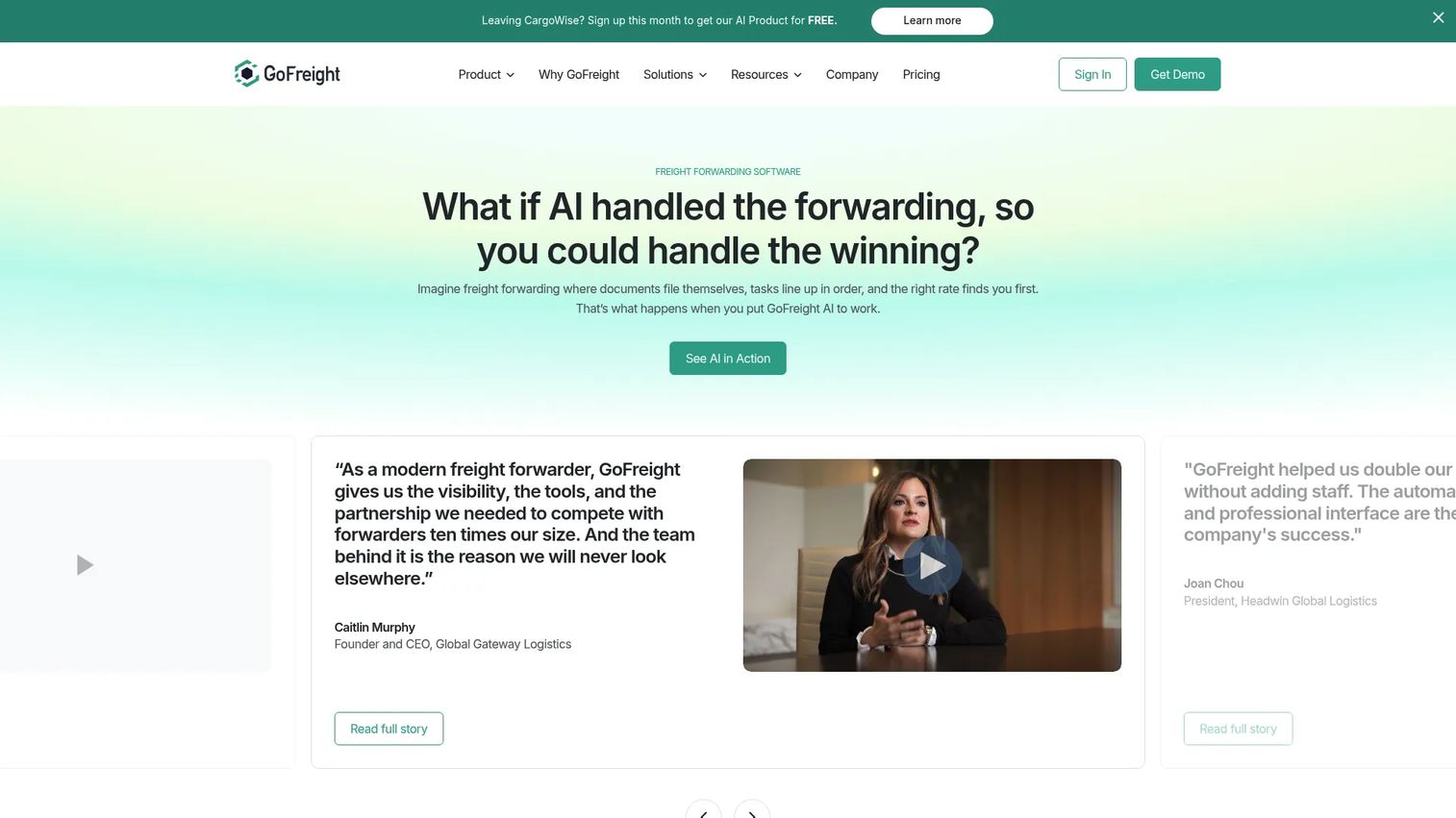
GoFreight is a cloud-based freight forwarding software built for freight forwarders and NVOCCs that want faster operations with less manual work. It leans on AI-led automation to pull shipment details out of email, generate tasks, and keep the shipment record current without an operator retyping data. If your team spends its day copying information between an inbox and a spreadsheet, this is the model that changes.
Best for: Freight forwarders and NVOCCs that want a modern cloud platform with automation at the core.
Key strengths
- Workflow automation: Turns email intake and repetitive steps into automated tasks, cutting manual coordination.
- Shipment tracking and visibility: Live status across the shipment lifecycle, surfaced to your team in one view.
- Customer portal: A self-service surface where customers check status and reduce inbound status requests.
Why choose GoFreight: For a founder or ops leader focused on doing more with the same headcount, GoFreight's automation-first design is the clearest path to operational leverage. It suits teams that see manual re-keying as the real bottleneck and want a system that removes it rather than one that simply records the work.
GoFreight pricing: GoFreight uses custom quote-based pricing. Its pricing page runs a "Get My Custom Quote" flow rather than publishing numeric tiers, so exact figures depend on your seat count and volume. There is no public free tier listed. GoFreight holds a 4.8/5 rating on G2.
2. Descartes
Descartes is a logistics and supply chain software platform covering transportation management, customs and regulatory compliance, EDI, ecommerce operations, and trade tools. It is modular by design, so large forwarders assemble the capabilities they need rather than buying a single monolithic product. That breadth is why complex, high-volume operations tend to shortlist it.
Best for: Enterprises and complex forwarders needing global logistics, customs, and trade compliance in one connected network.
Key strengths
- Customs and regulatory compliance: Deep customs filing and trade compliance tooling for cross-border operations.
- Transportation management and route optimization: Movement planning across modes and carriers at scale.
- Ecommerce and logistics network connectivity: EDI and a broad partner network that removes manual data exchange.
Why choose Descartes: Descartes fits operations where customs compliance and connectivity are non-negotiable and where scale demands a platform that other logistics partners already connect to. It is a serious infrastructure choice, not a starter tool, and it rewards teams that need enterprise breadth over quick setup.
Descartes pricing: Descartes sells multiple products with separate pricing. Its e-Customs offering starts at €200 per month for the base platform, with additional users at €66 per month each and modules ranging from €170 to €1,050 per month, plus an €800 setup fee. There is no free tier. A brand-wide G2 rating was not confirmed at the time of writing.
3. Logitude World
Logitude World is cloud-based freight forwarding software for air, ocean, and land logistics, built to get small and mid-sized forwarders operational quickly. It bundles shipment management, quoting, invoicing, automation workflows, and a digital customer portal into one platform that does not require a long implementation to start delivering value.
Best for: Small and mid-sized forwarders wanting an all-in-one cloud platform with fast rollout and customer visibility.
Key strengths
- Shipment management: End-to-end handling of quotes, bookings, and shipments in a single record.
- Digital customer portal: Branded self-service visibility that reduces status-chasing emails.
- Automation workflows: Automated documents, tasks, and notifications that lighten manual load.
Why choose Logitude World: For a lean team that needs a working system in weeks rather than quarters, Logitude World's SMB-friendly deployment and transparent pricing make it easy to justify. It trades enterprise-scale breadth for speed and simplicity, which is exactly the right call for a growing regional forwarder.
Logitude World pricing: Logitude World publishes three plans. Smart starts at $75.00 per user per month, Professional at $99.00 per user per month, and Enterprise is custom for teams of 30 or more users. The site offers a free trial to test the platform before committing. It holds a 4.6/5 rating on G2.
4. Logistaas
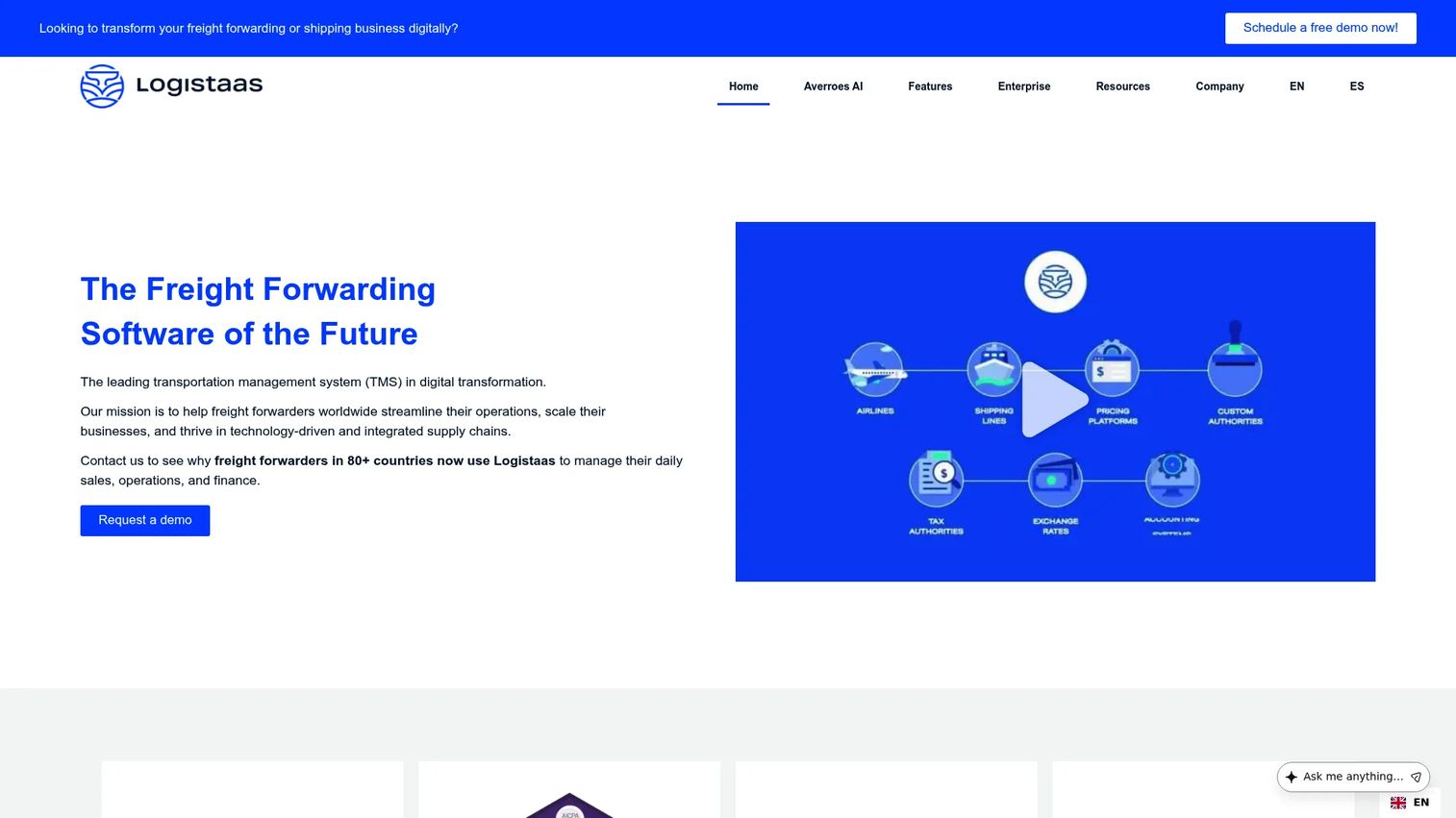
Logistaas is cloud-based transportation management software for freight forwarders and shipping businesses that want tight operational control with pricing you can see up front. It covers sales and pricing, operations, finance, and an online customer portal, with multimodal workflows and branch and currency handling built in for teams operating across markets.
Best for: Freight forwarders wanting an all-in-one TMS with strong profitability control and visible public pricing.
Key strengths
- Sales and pricing management: Rate management and quoting that feed directly into profitability tracking.
- Operations and finance management: Shipment operations and billing in one system for cleaner margin visibility.
- Online customer portal: Self-service access that improves the customer experience and cuts follow-up.
Why choose Logistaas: Logistaas earns its place with operational control and transparent, per-user pricing that a founder can model without a sales call. Branch and currency handling make it a strong fit for forwarders scaling across offices and regions that care about profitability by lane and account.
Logistaas pricing: Logistaas publishes four per-user plans. CRM Only is $45 per user per month, Professional is $65, Digital Freight Forwarder is $85, and Accounting Users is $85, with quarterly and yearly billing options. The plans do not include a one-time implementation fee, and the site offers a free trial. Logistaas holds a 4.5/5 rating on G2.
5. Freightos
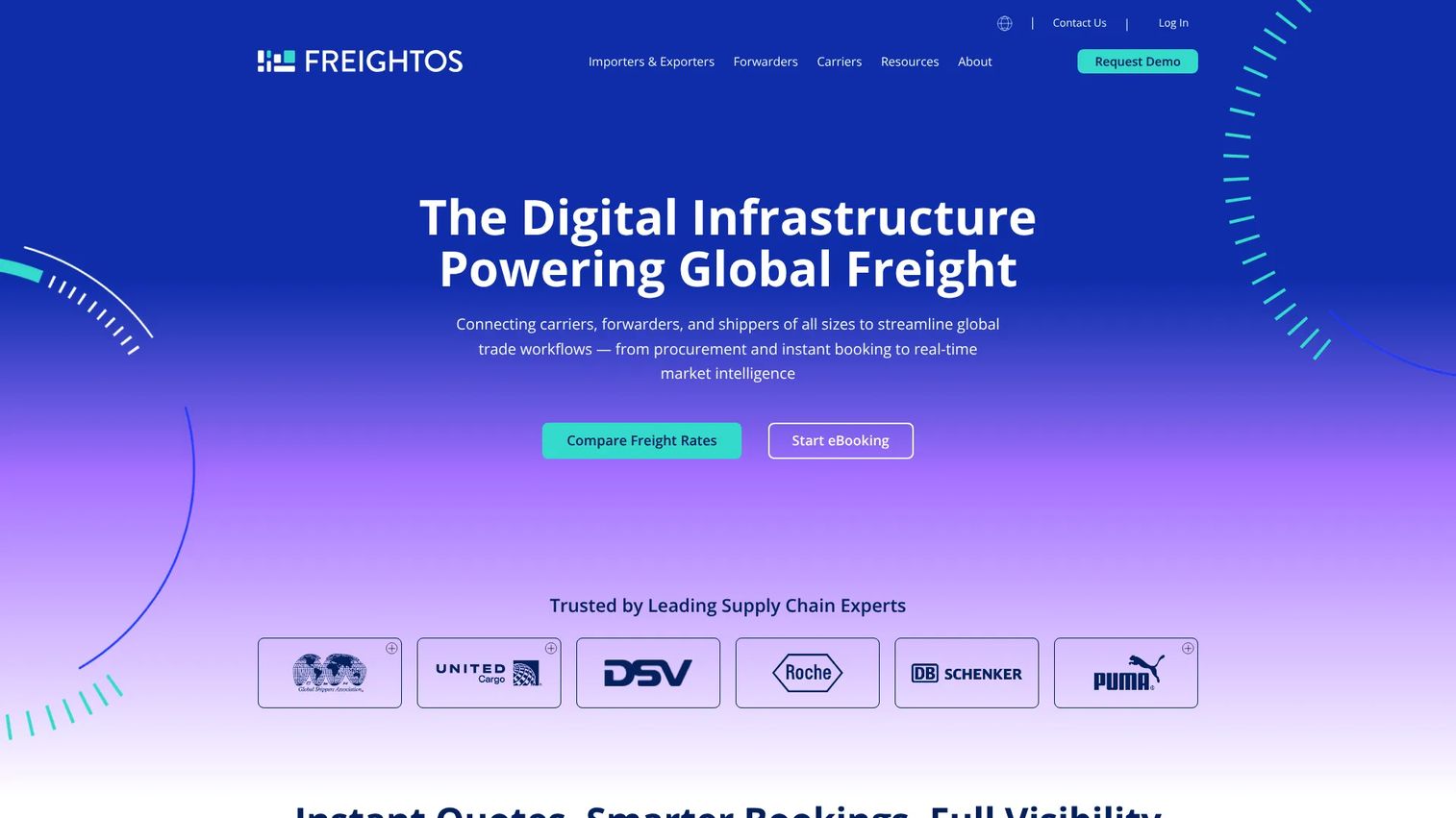
Freightos is a digital freight booking and pricing platform for air, ocean, and land shipping, aimed at importers, exporters, and forwarders who live and die by rates. Its strength is freight rate pricing and quoting, plus market intelligence and benchmarking that let you see where your rates sit against the market. If procurement and pricing are your leverage points, Freightos speaks your language.
Best for: Importers, exporters, and forwarders focused on freight pricing, quoting, and procurement intelligence.
Key strengths
- Freight rate pricing and quoting: Fast, market-connected rate management for competitive quotes.
- Freight booking and shipment management: Online booking that ties pricing directly to execution.
- Market intelligence and benchmarking: Rate data that shows how your pricing compares to the market.
Why choose Freightos: Freightos is the pick when rate control and market connectivity matter more than deep operational workflow. Teams that want to sharpen pricing, benchmark against the market, and book online will get more from it than teams looking for a full back-office operating system.
Freightos pricing: Freightos Terminal, its rate data product, offers an Individual Starter Ocean package at $119 per month and Individual Starter Air at $239 per month, both billed annually, plus a custom enterprise package. There is no free tier for Terminal. Freightos holds a 4.3/5 rating on Capterra.
6. CargoWise
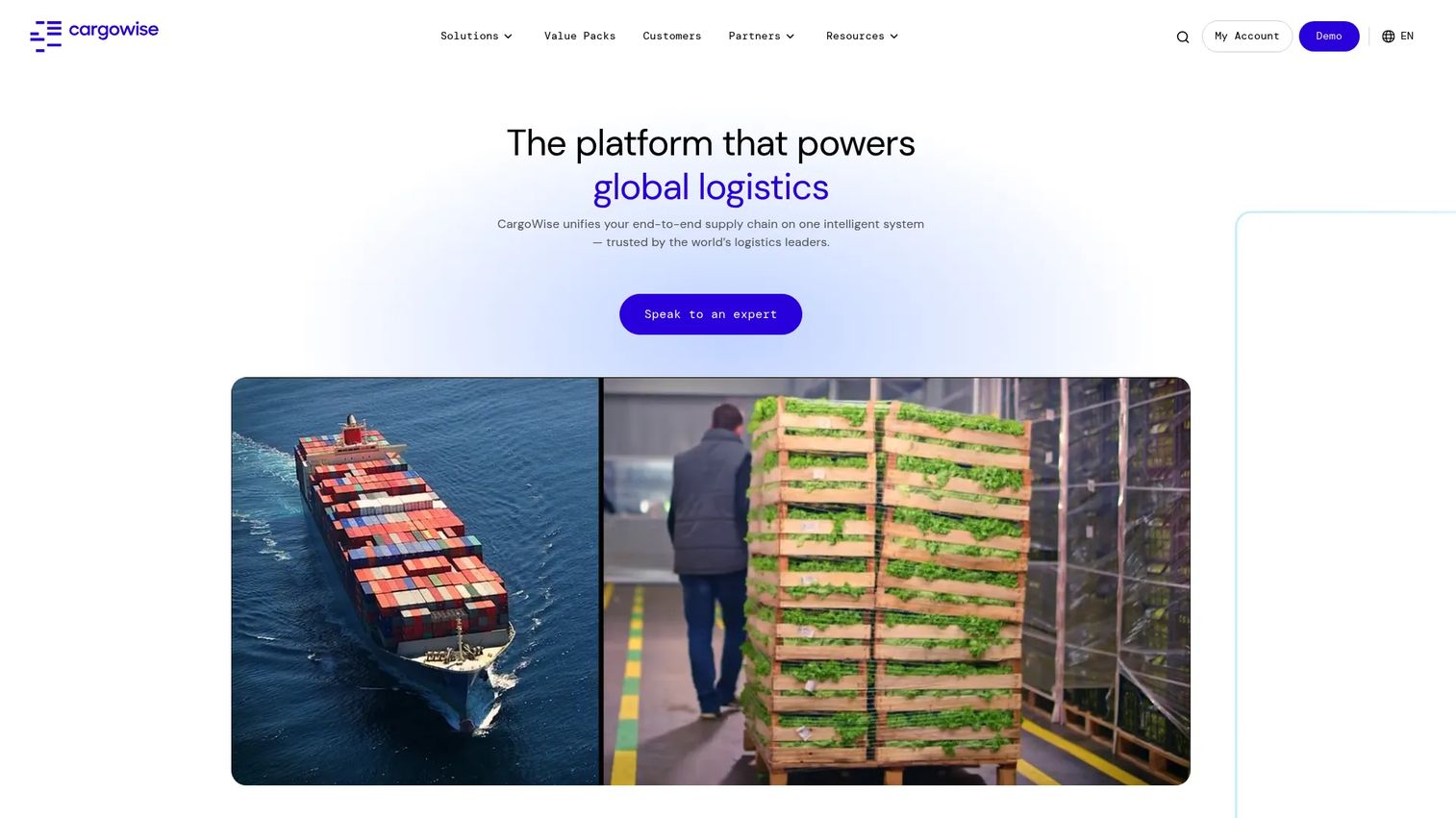
CargoWise is global logistics execution software covering international freight forwarding, customs and compliance, warehouse management, transport, and carrier connectivity. It is built for large forwarders and logistics providers that need one integrated platform running consistent operations across many countries. Standardization at scale is its core promise.
Best for: Large freight forwarders and logistics providers needing an integrated global operations platform.
Key strengths
- International freight forwarding: Multimodal shipment execution standardized across global offices.
- Customs and compliance: Cross-border filing and compliance built into the operating platform.
- Warehouse management: Warehousing and inventory tied into the same logistics system.
Why choose CargoWise: CargoWise is the choice for complex operations that need every branch running the same processes on one platform. The breadth and depth suit global providers with the scale and resources to adopt an enterprise system, where operational standardization directly protects margin and service quality.
CargoWise pricing: CargoWise pricing is largely quote-based, but it publishes some public figures through its Value Pack. BorderWise Global Entry is listed at $147.39 per registered user per month, and the page also shows a free $0.00 BorderWise Single Window base option with paid add-ons. There is no universal list price for the full platform. CargoWise holds a 4.3/5 rating on G2.
7. eNVOY
eNVOY is cloud-based freight forwarding software positioned for smaller teams and regional operators that want shipment management and visibility without the weight of an enterprise platform. It focuses on the core operating workflow for forwarders who need a functional system rather than a broad suite of modules.
Best for: Smaller teams and regional operators wanting straightforward cloud freight management.
Key strengths
- Cloud-based operations: Shipment management accessible from anywhere without on-premise infrastructure.
- Shipment visibility: Tracking that keeps teams and customers informed on status.
- Lightweight workflow fit: A simpler footprint suited to lean operations.
Why choose eNVOY: eNVOY fits forwarders who want a working cloud system without the scope or commitment of a full enterprise platform. It is worth a direct conversation to confirm feature fit for your modes and volume, since the lighter footprint is the point rather than a limitation.
eNVOY pricing: eNVOY does not publish pricing on its site, and no public price was confirmed at the time of writing. Contact the vendor directly for a quote based on your team size and requirements.
Considerations before you buy
A demo makes every platform look capable. These criteria separate the tool that fits your operation from the one that just looks good in a sales call.
Workflow and operating model fit
The best freight forwarding software matches how your team already moves shipments, not the reverse. Map your current process, then ask each vendor to run their platform through it. If the tool forces a workaround at every step, the automation savings evaporate.
Integration and connectivity depth
Check EDI support, carrier APIs, accounting connections, and CRM integration before you commit. A platform that cannot connect to your existing stack creates new re-keying work instead of removing it. Ask which specific systems they connect to today.
Multimodal and mode-specific support
If you handle both ocean and air freight, confirm the platform supports each mode natively rather than bolting one on. Mode-specific documents, milestones, and billing rules differ, and shallow support surfaces as manual cleanup later.
Total cost of ownership
Look past the per-seat headline. Factor in setup fees, module add-ons, implementation time, and how pricing scales as you add offices or users. A cheap entry tier that gates the features you need behind expensive add-ons is not actually cheap.
Implementation, onboarding, and support
Ask how long rollout takes for a team your size and what support looks like after go-live. The fastest path to value comes from a vendor that onboards you quickly and answers when you need help, not one that disappears after the contract signs.
Conclusion
The right freight forwarding software depends on what you are optimizing for. If you want operational leverage through automation, GoFreight leads on AI-driven workflow. If enterprise breadth, customs, and connectivity define your requirements, Descartes and CargoWise are built for that scale. For SMB simplicity and fast rollout, Logitude World is the practical pick. Logistaas stands out for operational control and transparent pricing, Freightos for rate management and procurement, and eNVOY for lighter regional operations.
The pattern across every strong choice is the same. Freight forwarding software is the system that decides whether your operation scales without adding chaos. Pick the one that fits how you actually work, not the one with the longest feature list. Shortlist two or three, run them against your real shipment workflow, and let the demo prove itself against your process.
FAQs
Freight forwarding software manages the full shipment workflow for forwarders: quoting, booking, tracking, customs, documentation, invoicing, and customer communication. It replaces scattered spreadsheets and email threads with one connected record per shipment. The result is faster operations, real-time visibility, and clearer control over billing and profitability.
They overlap but are not identical. A general TMS manages transportation for shippers moving their own freight, while freight forwarding software is built for the forwarder-specific workflow of arranging shipments on behalf of clients. Forwarder platforms add quoting, customs, multimodal documentation, and customer portals that a generic TMS often does not cover.
Prioritize real-time visibility, automation depth, multimodal support, integrations and connectivity, customer portals, and profitability reporting. These map directly to the operational pains forwarders feel: slow follow-ups, manual re-keying, and unclear margins. A tool strong in these areas removes work rather than recording it.
For small teams, prioritize simplicity, transparent pricing, and fast rollout over enterprise breadth. Logitude World and Logistaas both publish per-user pricing and are designed for quicker deployment, which makes them easier to justify and adopt. eNVOY is worth evaluating for lighter regional operations.
Look for native multimodal support rather than a single mode with add-ons. Logistaas, CargoWise, and Freightos all handle ocean freight forwarding and air freight management with mode-specific workflows. Confirm during the demo that documents, milestones, and billing rules are built for each mode you run.
Customer portals let clients check shipment status, download documents, and request quotes without emailing an operator. That self-service cuts inbound status requests, frees your team for higher-value work, and makes your service feel faster. Fewer interruptions and a better buyer experience come from the same feature.
Ask about implementation timelines for a team your size, which specific integrations and EDI connections they support, how reporting and analytics work, whether the platform handles multi-office and multi-currency collaboration, and what post-launch support looks like. Run the demo against your real shipment workflow, not the vendor's sample data.
Look at total cost of ownership, not the entry-tier headline. Factor in setup fees, module add-ons, implementation effort, and how pricing scales as you add users or offices. Transparent per-user pricing from vendors like Logitude World and Logistaas makes modeling easier, while quote-based platforms like GoFreight and CargoWise require a direct conversation to estimate real cost.