A missed spray window. A fertilizer order that arrived a week late. A harvest crew standing idle because nobody logged which blocks were ready. Most farm operations do not lose money on one big failure. They bleed it through dozens of small coordination gaps, and almost all of those gaps trace back to information living in the wrong place: a spreadsheet on one laptop, a note in a truck, a schedule in someone's head.
Crop management software exists to close those gaps. It pulls planting schedules, irrigation, labor, records, and field-level decisions into one operational layer instead of leaving them scattered across memory and paper. And the category is growing fast. The global crop management and production software market reached USD 2.31 billion in 2025 and is projected to hit USD 5.12 billion by 2034 at an 8.1% CAGR, according to Intel Market Research. Cloud-based farm and crop platforms already held 48.2% market share in 2025, per Mordor Intelligence, which tells you where buyers are moving: browser-first, mobile-ready, always accessible.
That growth also means noise. There are dozens of tools calling themselves farm management software, and they optimize for wildly different things. Some are built for water and nutrient decisions. Some are built for audit-ready records. Some care mostly about margin. This guide sorts the field by what each tool actually does best, so you can shortlist by fit instead of feature-list length. If you build vertical SaaS or evaluate adjacent workflow categories, the same lens applies: the winners here are the ones that turned a fragmented manual process into a repeatable system.
What's inside
This guide is for growers, farm operations leads, and anyone evaluating crop management software as a category, whether you run 40 acres of specialty crops or advise across a portfolio. We looked at seven tools that consistently show up in real buying conversations and sorted them by their center of gravity: planning, irrigation, records, profitability, or field coordination.
We chose tools on four criteria: workflow breadth (how much of the operation it touches), crop-specific fit (does it understand your crop type), analytics and decision depth (does it help you decide, not just record), and accessibility across web and mobile. Every tool below earns its spot on at least one of those dimensions.
TL;DR
- Best all-around operational platform: Tend, for farms that want planning, tasks, inventory, accounting, and traceability in one place.
- Best for irrigation and nutrient decisions: CropManage, a free science-backed tool for water and nitrogen recommendations.
- Best for profitability and margin discipline: Harvest Profit, for operators who track cost and breakeven at the field level.
- Best for produce records and traceability: Croptracker, built for fruit and vegetable growers who need audit-ready logs.
- Best for simple, all-in-one records: Farmbrite, for smaller mixed operations covering crops, livestock, and finances.
- Best for collaboration across advisors and growers: Agworld, for teams that need shared field visibility.
What is crop management software?
Crop management software is a cloud-based platform that helps growers plan, schedule, record, and analyze crop production activities across a growing season, from planting through harvest and traceability. It replaces disconnected spreadsheets and paper logs with a single system for coordinating labor, inputs, irrigation, and field data.
The category sits inside the broader farm management software market, which Mordor Intelligence projects will grow from USD 3.25 billion in 2026 to USD 5.64 billion by 2031 at an 11.66% CAGR. Crop management and precision agronomy specifically account for 40.9% of that market in 2026, per Coherent Market Insights, which makes it the largest single slice.
A modern crop management platform in 2026 is expected to cover a consistent set of capabilities:
- Crop planning software: season planning, crop rotations, planting schedules, and resource allocation
- Task and scheduling: task management for farms, labor coordination, and work order tracking
- Records and traceability: farm records software for spray logs, harvest logs, and searchable history
- Irrigation and nutrients: irrigation management software and nutrient management software for water and fertilizer decisions
- Analytics and decision support: yield planning, field-level reporting, and profitability views
- Mobile access: offline-capable field entry and a mobile farm app
- Compliance: audit readiness and traceability software for food safety standards
The line between farm management software and crop management software is thin. Broad platforms handle both crops and livestock and accounting; crop-focused tools go deeper on agronomy and production. Most growers care less about the label and more about whether the tool matches how their operation actually runs.
When to use crop management software
Not every operation needs the same tool. Match the software to the decision you are trying to make better.
Plan crop work across seasons
When planting windows, labor, and input orders keep colliding, you need crop planning software that ties schedules, tasks, and resources together. This is where you stop losing days to missed handoffs. Teams with tight rotations, multiple crops, or seasonal labor benefit most, because the plan becomes shared instead of trapped in one person's head.
Improve irrigation and nutrient decisions
When water cost, yield pressure, or compliance are squeezing you, the software should guide decisions, not just record them. Irrigation management software and nutrient management software use weather, soil, and crop-stage data to recommend how much water and fertilizer to apply and when. Growers in water-stressed regions or under nutrient regulation see the fastest payback here.
Keep records, audits, and traceability under control
When a buyer or auditor asks for a spray history and you cannot produce it in minutes, you have a records problem. Traceability software gives you structured logs, searchable history, and audit-ready reporting. Produce growers, packers, and anyone selling into food-safety-regulated channels need this as table stakes.
Track profitability by field or crop
When you care less about daily operations and more about margin, you want crop profitability software. It ties costs, revenue, and yield to specific fields or crops so you can see which acres actually make money. Grain operators and margin-focused growers lean on this to make planting and marketing decisions.
Comparison table
Here is how the seven tools compare at a glance. Pricing and ratings reflect verified figures where publicly available; where a vendor does not publish a figure, we note it rather than guess.
| # | Product | Intent | Key use case | Pricing | G2 rating |
|---|---|---|---|---|---|
| 1 | Croptracker | Records and traceability | Produce records, spray logs, audit readiness | From $27.50/user/mo (10-user min) | 4.8/5 |
| 2 | CropManage | Decision support | Irrigation and nitrogen recommendations | Free | Not listed |
| 3 | Harvest Profit | Profitability | Field-level margin, breakeven, grain marketing | From $1,600/year | 4.8/5 |
| 4 | Tend | All-around operations | Planning, tasks, inventory, traceability, sales | Free plan; Pro from $30/mo | Not yet rated |
| 5 | Syngenta Cropwise | Crop monitoring | Field monitoring, satellite and weather insight | Regional; free trial available | Not listed |
| 6 | Farmbrite | All-in-one records | Crops, livestock, records, accounting | From $29/mo | 4.7/5 |
| 7 | Agworld | Collaboration | Shared agronomic records and planning | By region; free viewer plan | 4.7/5 |
1. Croptracker
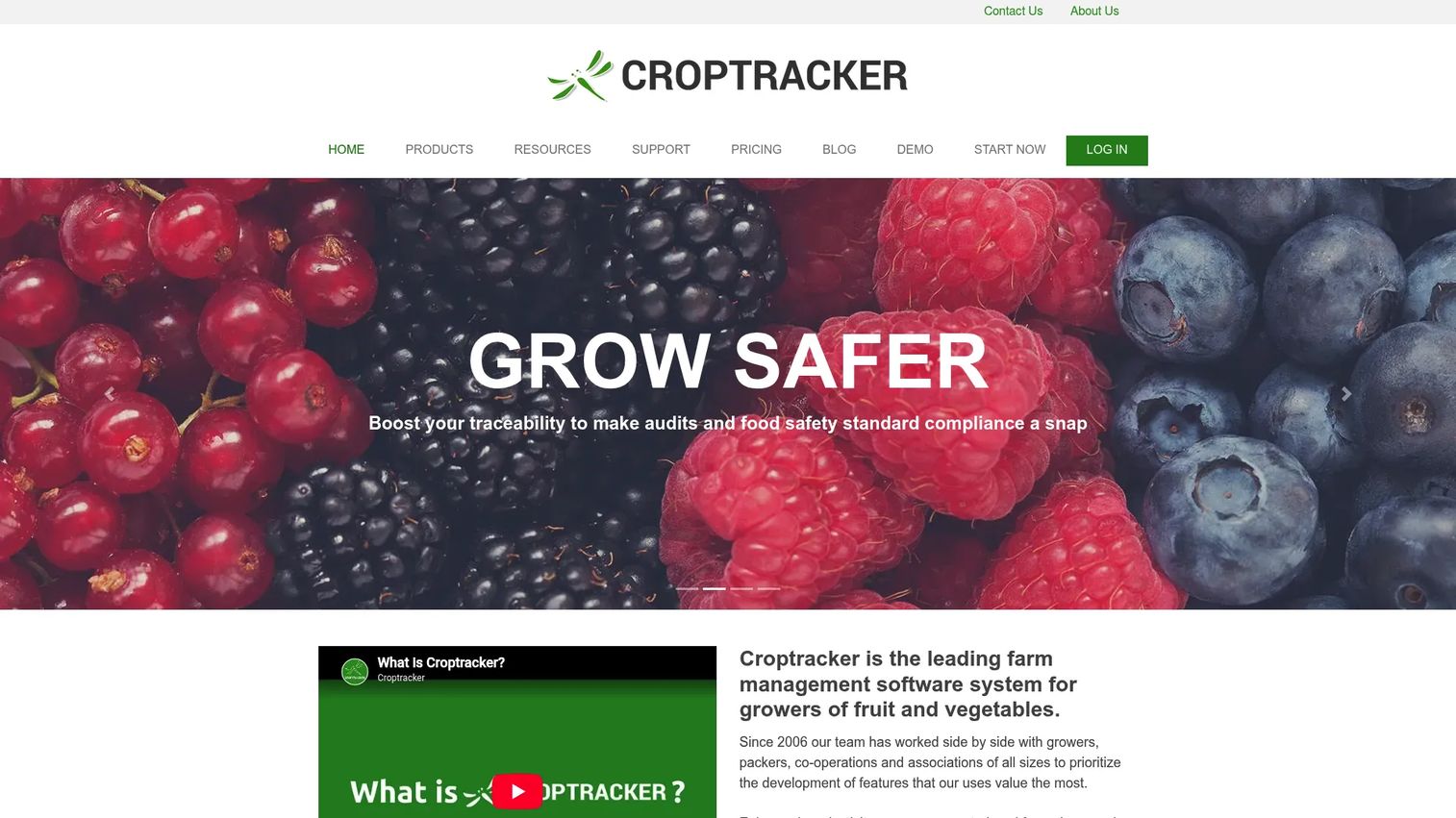
Croptracker is farm management and operations software built specifically for fruit and vegetable growers, packers, and shippers. It centers on the records and traceability workflows that produce operations live and die by. If your buyers and auditors expect a clean chain of custody from field to shipment, this is a tool built for that reality rather than retrofitted to it.
The platform covers spray record keeping, employee time tracking through a punch clock, and full harvest, packing, shipping, receiving, and traceability modules. That combination makes it a strong farm records software choice for specialty crop growers who need every spray, pick, and shipment logged in a way that stands up to a food-safety audit. Record keeping here is not an afterthought bolted onto planning; it is the core of the product.
Best for: Produce growers, packers, and shippers who need audit readiness and operational traceability software.
Key strengths
- Traceability modules: End-to-end tracking across harvest, packing, shipping, and receiving for full chain of custody.
- Spray record keeping: Structured, searchable spray logs that support compliance and audit requests.
- Punch clock and time tracking: Labor hours tied to tasks and blocks for accurate cost and payroll data.
Why choose Croptracker: If your operation sells into channels that demand traceability, generic farm software will leave gaps. Croptracker is purpose-built for produce compliance, so the audit-ready reporting is native, not an add-on. It fits growers who treat records as a business requirement, not paperwork.
Croptracker pricing: Public pricing starts at $27.50 USD per user per month with a minimum of 10 users. Enterprise pricing varies by user needs and is available through an estimate request on the pricing page. There is no free tier listed. Croptracker holds a 4.8/5 rating on G2.
2. CropManage
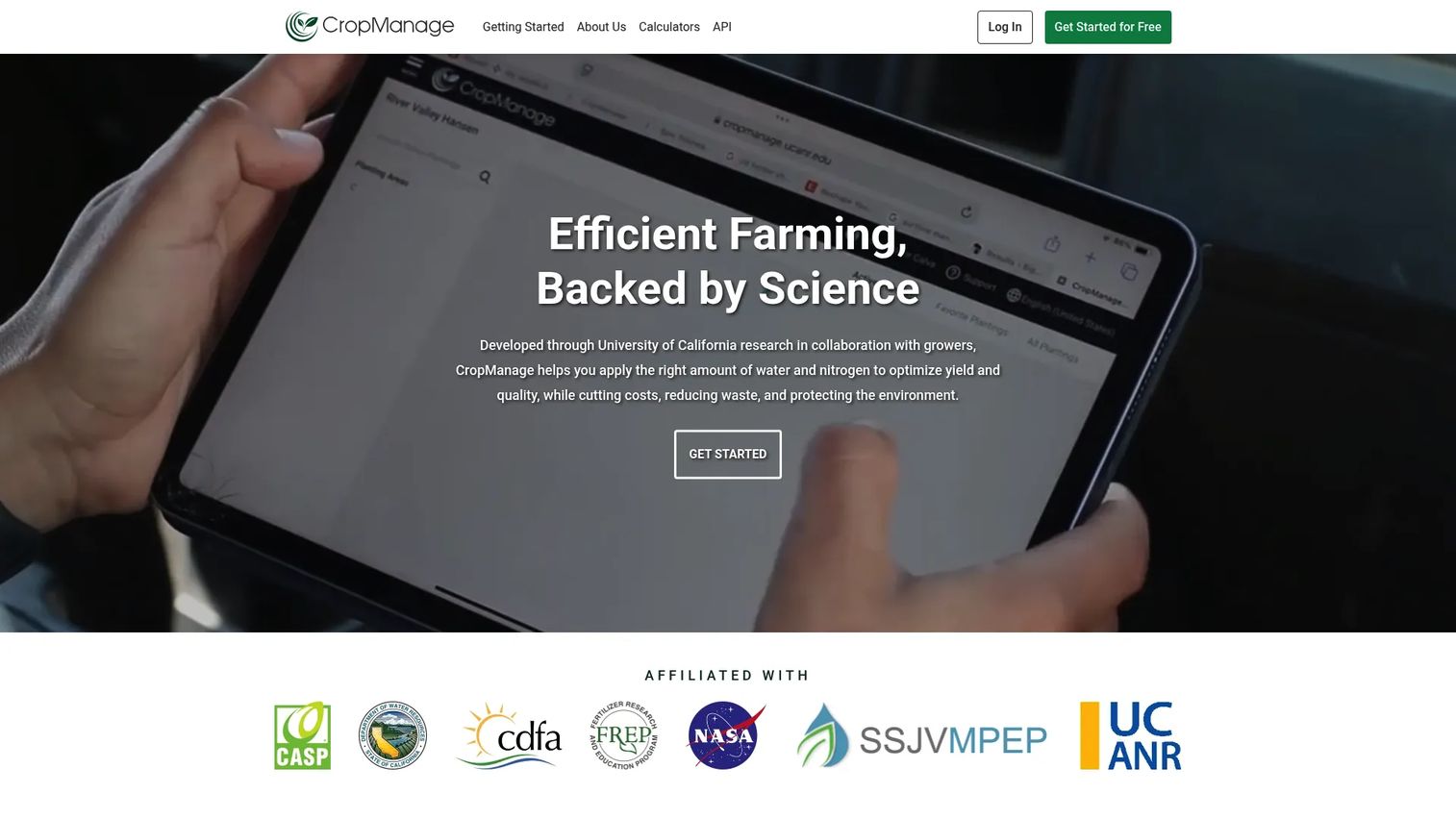
CropManage is a free, web-based decision-support tool from UC Cooperative Extension focused on irrigation and nitrogen management. It stands apart from every other tool on this list on two counts: it is science-backed by university field trials, and it costs nothing to use. For growers under water or nutrient pressure, that combination is hard to beat.
The tool delivers irrigation scheduling with water-balance recommendations and nitrogen fertilizer recommendation tools, plus record keeping for irrigation and fertilizer events. Rather than just storing what you did, it tells you how much water and nitrogen a crop needs based on weather, soil, and crop-stage data. That is the difference between irrigation management software that logs and nutrient management software that actually guides decisions. The no-install browser model means you are working from any device without setup friction.
Best for: Growers who want science-based irrigation and nitrogen decision support without a software budget.
Key strengths
- Irrigation scheduling: Water-balance recommendations that tell you when and how much to irrigate.
- Nitrogen recommendations: Fertilizer guidance grounded in university research and crop-stage data.
- Event record keeping: Logs for irrigation and fertilizer applications that support compliance.
Why choose CropManage: If water cost and nutrient regulation are your pressure points, CropManage delivers decision support that most paid tools charge for. The tradeoff is scope: it is deep on irrigation and nutrients, not a full operations platform. Pair it with a broader tool if you need planning and traceability too.
CropManage pricing: CropManage is free to use. There are no paid tiers or public pricing table on the site. A current G2 rating for the product was not available at the time of writing.
3. Harvest Profit
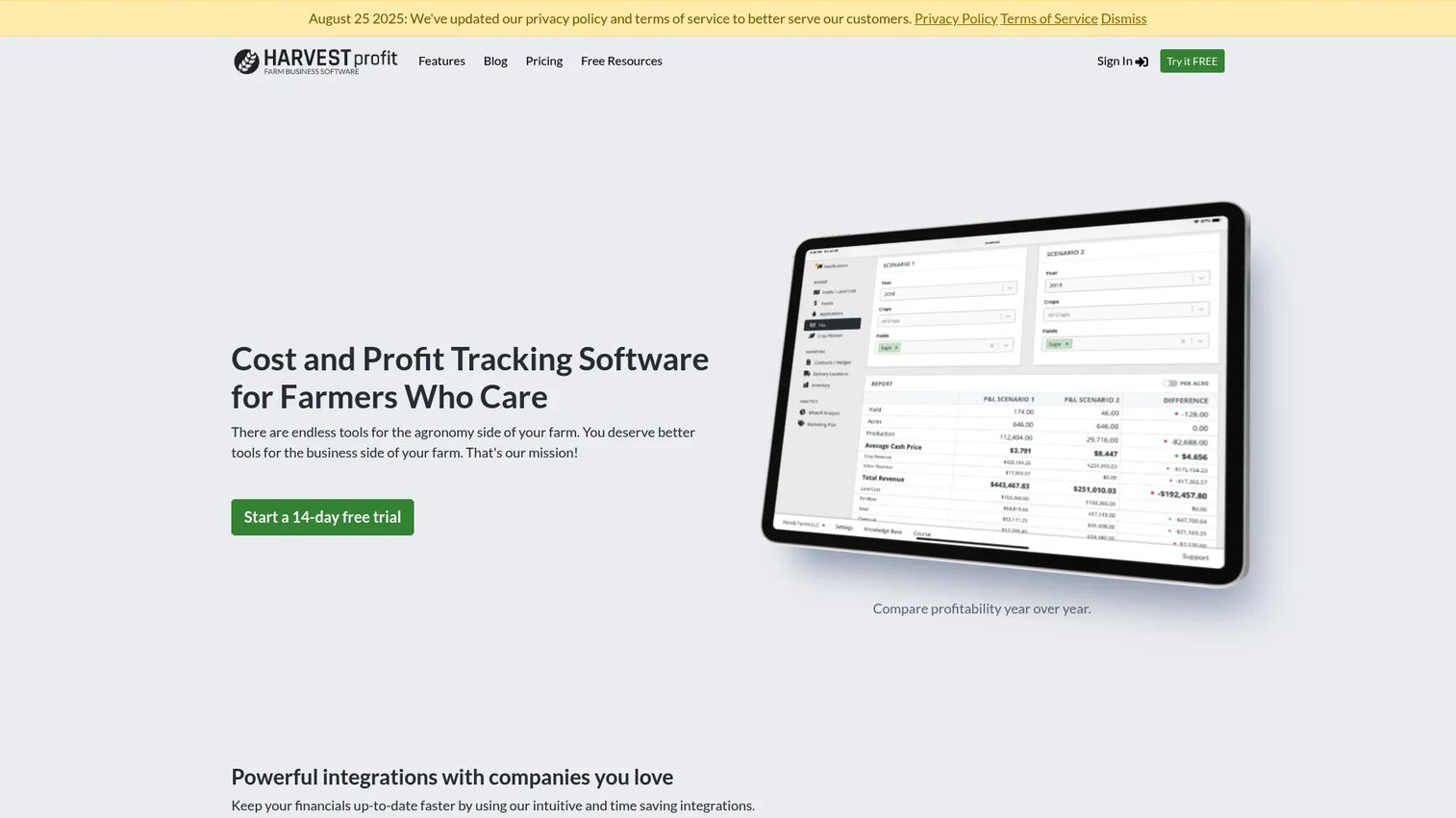
Harvest Profit is farm business management software built around one question: which acres actually make money? It is more finance-oriented than agronomy-oriented, which makes it the clearest crop profitability software pick on this list. For operators who think in margin and breakeven rather than spray schedules, this is the tool that speaks their language.
The platform delivers real-time profit and loss with live CBOT futures, Profit Maps for sub-field profitability analysis, and grain inventory and storage management. Add contract and hedge tracking, marketing plans, year-over-year analysis, and equipment cost analysis, and you get a full profit tracking system for grain operations. This is where yield planning meets financial reality: you see which fields and crops carry the margin and which quietly drag it down.
Best for: Grain and row-crop operators who need integrated financial, grain, and scenario tracking.
Key strengths
- Real-time P&L: Live CBOT futures feed profit and loss so numbers reflect the current market.
- Profit Maps: Sub-field profitability analysis that shows margin down to specific acres.
- Grain and hedge tracking: Inventory, storage, contracts, and marketing plans in one view.
Why choose Harvest Profit: If your bottleneck is financial visibility rather than field operations, Harvest Profit gives you margin discipline that operations-first tools do not. It fits farms where the planting and marketing decisions hinge on numbers. It is less about scheduling labor and more about protecting the bottom line.
Harvest Profit pricing: The Standard plan is $1,600 USD per year and includes field-by-field profit analysis, CBOT price data, John Deere Operations Center integration, and the full profit toolset. A Hands On tier at $5,000 USD adds onboarding and custom setup. A 14-day free trial is available, and Harvest Profit holds a 4.8/5 rating on G2.
4. Tend
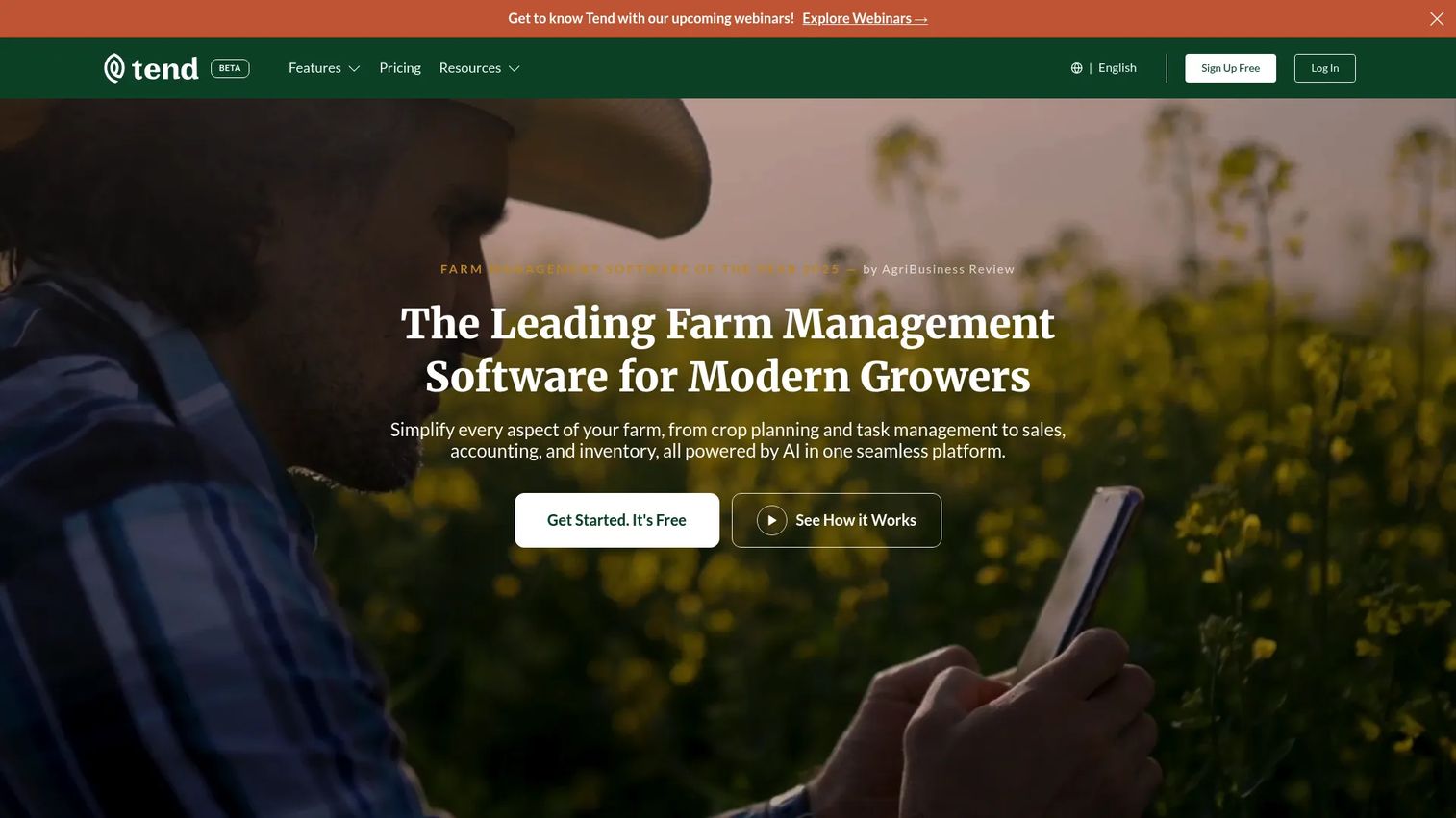
Tend is the broadest operational platform on this list. It brings crop planning, task management for farms, inventory, accounting, traceability, and sales tools into one integrated system, with mobile use and offline sync so field work does not depend on connectivity. If you want a single place where the whole operation lives, Tend is built for that.
The platform covers advanced crop and production planning, task and workflow management, and inventory, traceability, and sales in one place. That range makes it a genuine all-in-one field management software option: you can plan the season, assign tasks, track what is in the ground, log harvests for traceability, and sell the output without stitching together three tools. The mobile farm app with offline entry matters, because the people doing the work are rarely at a desk, and the tool includes crop-specific solution pages so the workflows match how your crop actually grows.
Best for: Farms that want one integrated platform for planning, operations, inventory, traceability, and sales.
Key strengths
- Crop and production planning: Advanced season planning tied to real production targets and yield planning.
- Task and workflow management: Assign, schedule, and track field work across the whole team.
- Inventory, traceability, and sales: One system from planting through logged harvest to the sale.
Why choose Tend: If you are tired of running your operation across a planning spreadsheet, a records notebook, and a separate sales tracker, Tend consolidates them. It fits diversified and direct-market farms that need breadth over deep specialization. The free plan lets you test the core before committing.
Tend pricing: Tend offers a Free Forever plan, a Pro plan at $30 USD per month, an Ultimate plan at $75 USD per month, and an Enterprise plan starting at $400 USD per month. Monthly and annual billing are available. As a newer entrant, Tend's G2 listing does not yet carry customer review ratings.
5. Syngenta Cropwise
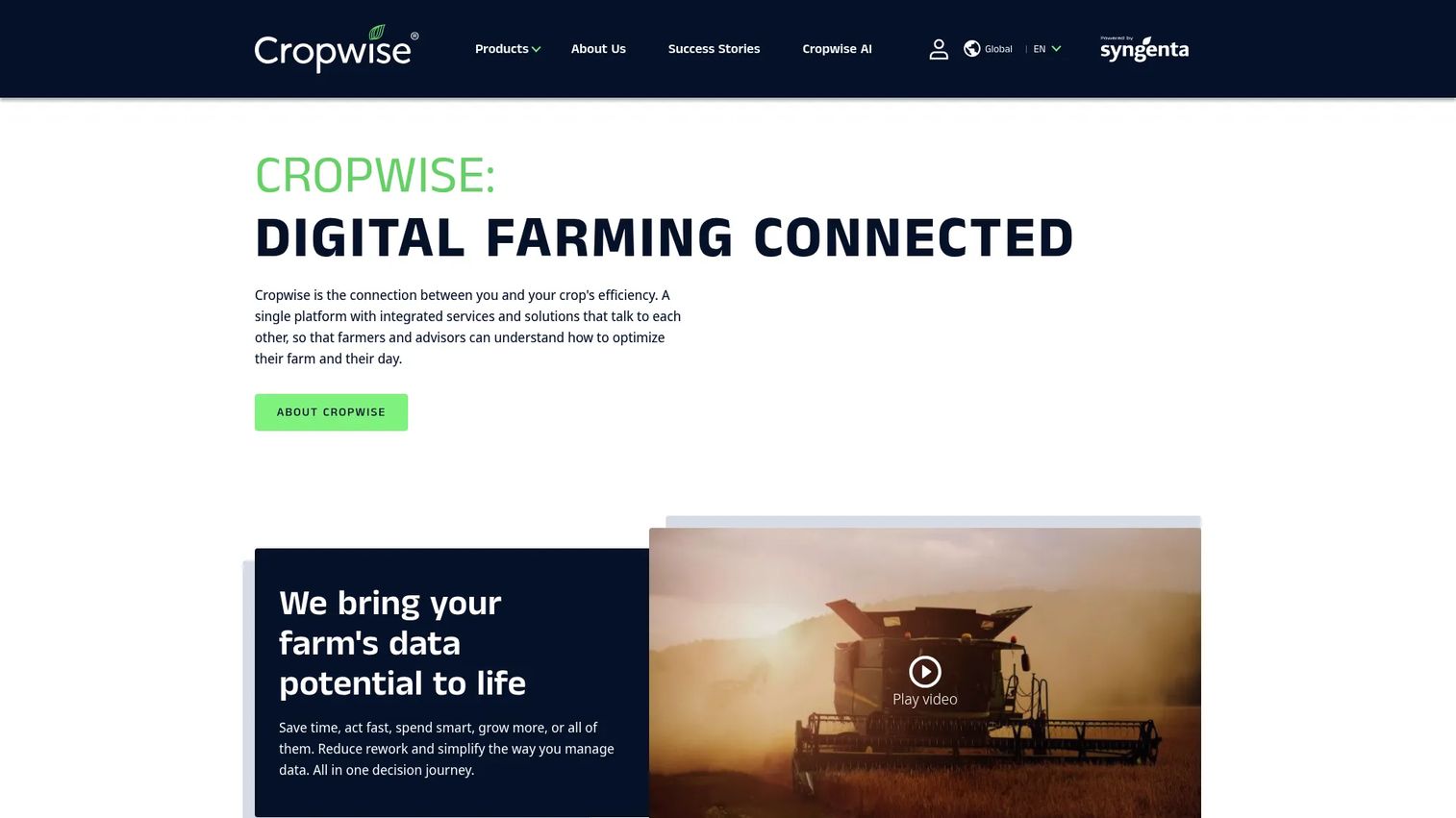
Syngenta Cropwise is Syngenta's digital farming platform, built for teams that want crop monitoring and decision support at scale. It leans on Syngenta's agronomy depth and multi-product ecosystem, which makes it a strong fit for operations and advisors managing insight across many fields rather than a single farm.
The platform delivers field and crop monitoring, weather and satellite imagery insights, and farm management and financial tools. That satellite and weather layer is what sets it apart as crop monitoring software: you get a remote-sensing view of crop health across your fields instead of relying only on scouting. Combined with the broader Cropwise ecosystem, it suits growers who want connected data feeding agronomic decisions across a larger footprint.
Best for: Farmers and advisors who need a connected digital farming platform with monitoring at scale.
Key strengths
- Field and crop monitoring: Track crop health and field conditions across the whole operation.
- Satellite and weather insight: Remote-sensing imagery and weather data feeding agronomic decisions.
- Farm management and financial tools: Operational and financial views inside one connected platform.
Why choose Syngenta Cropwise: If you manage insight across many fields and want the backing of a major agronomy ecosystem, Cropwise brings monitoring and data depth that standalone tools rarely match. It fits advisors and larger operations. Smaller single-farm growers may find lighter tools a closer match.
Syngenta Cropwise pricing: Pricing varies by region. Published South Africa pricing shows Cropwise Operations at R13.50 per hectare per year with a minimum annual subscription, and a 60-day free trial applies. Check the regional pricing for your market. A G2 rating for the product was not available at the time of writing.
6. Farmbrite
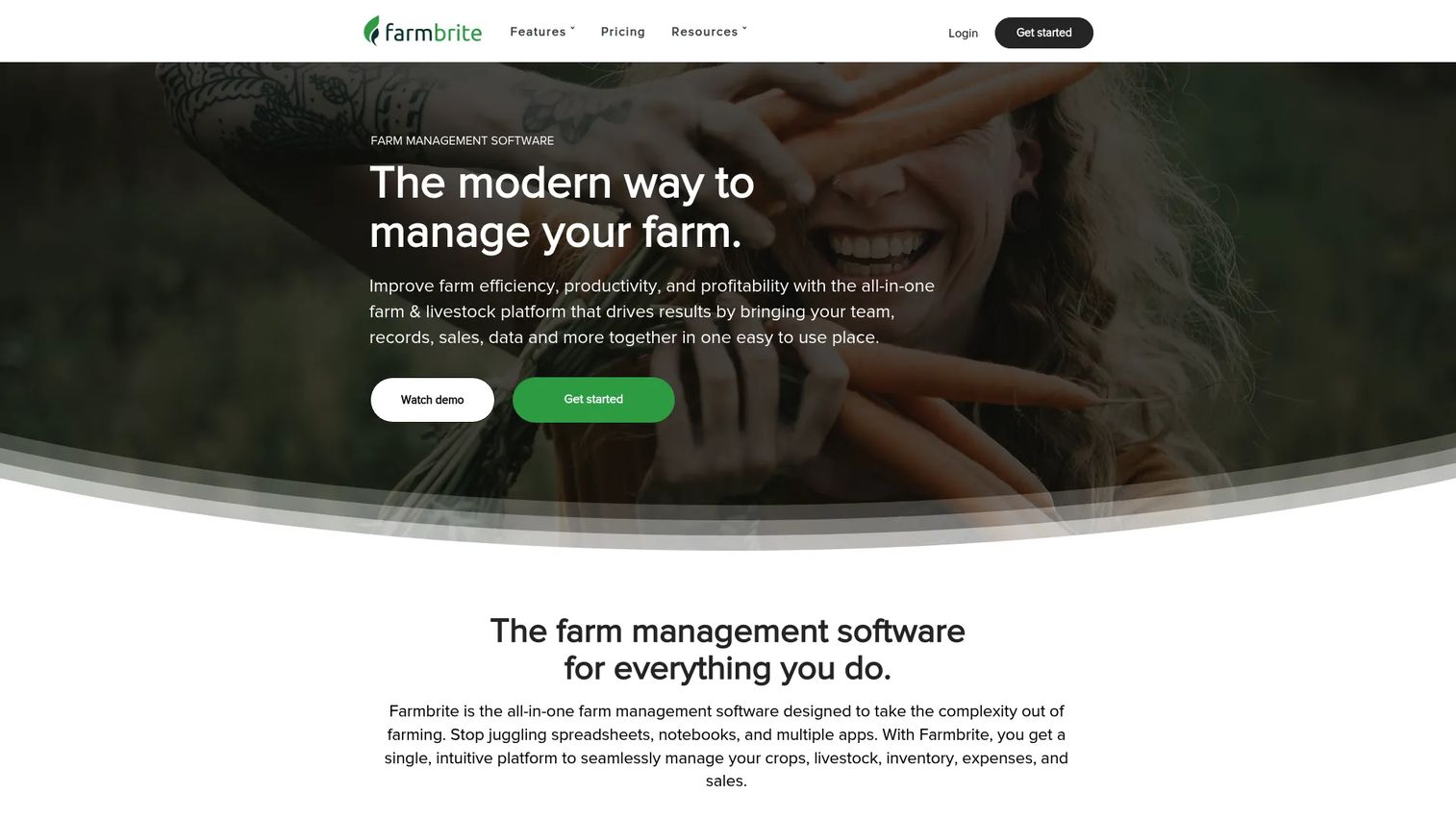
Farmbrite is farm management software that covers crops, livestock, accounting, and operational tracking in one approachable system. It is the practical pick for smaller and mixed operations that want simple, usable records without a steep learning curve or a big budget.
The platform delivers crop planning and management, livestock management, and farm accounting and reporting. That crop-plus-livestock-plus-finance range makes it a solid all-in-one choice for diversified farms and ranches that do not fit a crop-only tool. If you run a mixed operation and want one system for records, planning, and books, Farmbrite keeps it manageable rather than overwhelming.
Best for: Farm and ranch operators who need one system for crops, livestock, records, and finances.
Key strengths
- Crop planning and management: Season planning and field-level crop tracking in a simple interface.
- Livestock management: Herd, breeding, and animal records alongside crop data.
- Accounting and reporting: Farm finances and reports built into the same platform.
Why choose Farmbrite: If you run a diversified operation and want usability over depth, Farmbrite fits. It covers more ground than a crop-only tool without the complexity of an enterprise platform. It suits smaller teams that want to get organized fast rather than configure a heavy system.
Farmbrite pricing: Farmbrite starts at $29 USD per month for Essentials, with Performance at $79 and Premium at $109 per month, plus an accounting-only option at $119 per year. Plan availability depends partly on operation type, and a 14-day free trial is offered. Farmbrite holds a 4.7/5 rating on G2.
7. Agworld
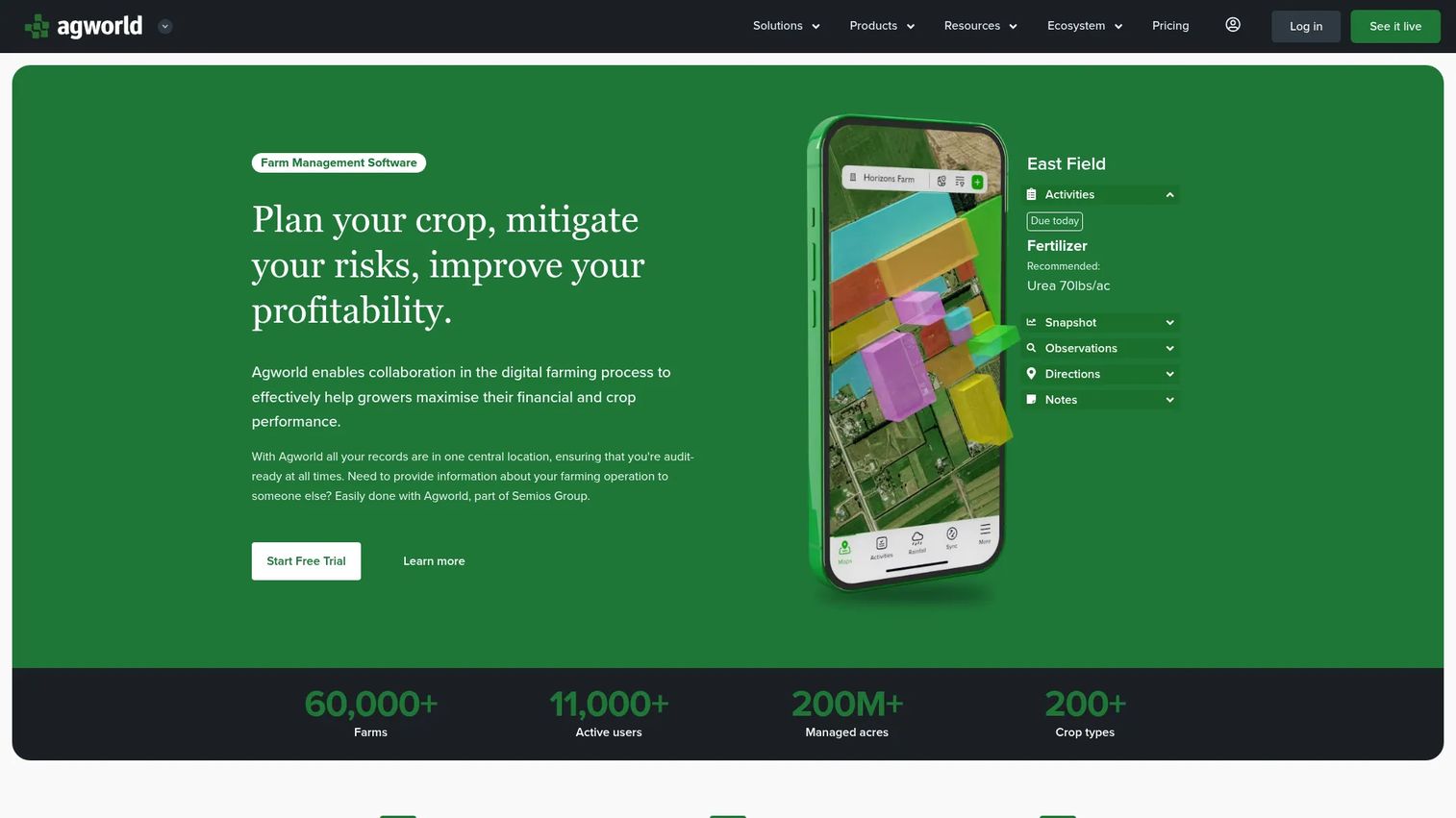
Agworld is collaborative farm management software built for growers, agronomists, and service providers who need to work from the same shared record. Its center of gravity is coordination: getting advisors and growers aligned on what happened in the field and what happens next.
The platform delivers field planning and production plans, detailed field records for spraying, seeding, harvest, rainfall, and observations, and offline mobile access with map annotations, photos, and a product library with SDS access. That combination makes it strong field management software for teams where multiple people touch the same operation. The task management for farms and shared-visibility model means an agronomist's recommendation and a grower's execution live in one place instead of in disconnected emails.
Best for: Farms and advisors who need shared agronomic records, planning, and reporting across teams.
Key strengths
- Shared field records: Spraying, seeding, harvest, rainfall, and observations in one collaborative log.
- Field planning and production plans: Season and production planning visible to growers and advisors alike.
- Offline mobile access: Map annotations, photos, and product library with SDS access from the field.
Why choose Agworld: If your operation runs on collaboration between growers and outside advisors, Agworld is built for that handoff. Shared visibility means fewer dropped recommendations and cleaner records. It fits teams and advisory relationships more than solo growers who need less coordination.
Agworld pricing: Agworld offers a free viewer subscription, and full subscription pricing is available by region rather than as a public flat rate. Contact Agworld for pricing in your market. Agworld holds a 4.7/5 rating on G2.
Considerations before you buy
The right tool depends less on feature counts and more on how your operation actually runs. Work through these criteria before you commit.
Match the tool to your primary problem
Be honest about your biggest gap. If it is water and inputs, a decision-support tool beats a broad platform. If it is audit readiness, prioritize traceability software. If it is margin, lead with crop profitability software. Buying breadth you do not need slows adoption.
Check crop and operation fit
A tool built for produce packing works differently from one built for grain marketing. Confirm the software understands your crop type, your rotations, and your sales channels. Specialty crop growers in particular should look for named crop support, not generic fields.
Test mobile and offline
The people entering data are in the field, often without signal. Verify the mobile farm app works offline and syncs cleanly. If field entry is painful, records will not get logged, and unlogged records defeat the entire purpose.
Weigh pricing against operation size
Per-user minimums, per-hectare rates, and flat annual fees scale very differently. A 10-user minimum matters for a small farm; a per-hectare rate matters for a large one. Map the pricing model to your actual size, not the sticker price.
Plan for adoption, not just purchase
Cloud-based farm software only works if the team uses it. Favor tools your crew can learn in a season, and use free trials or free tiers to test real workflows before rolling out to everyone.
Conclusion
The best crop management software depends entirely on what you are trying to fix. There is no single winner, only the right fit for your operation's biggest gap. Tend is the broadest all-around operational platform. CropManage owns irrigation and nutrient decisions and costs nothing. Harvest Profit is the margin and profitability pick. Croptracker leads on produce records and traceability. Farmbrite keeps mixed operations simple, Syngenta Cropwise brings monitoring at scale, and Agworld connects growers and advisors around shared records.
The practical move is not to pick one from a spec sheet. Shortlist two or three that match your primary problem, then run each against your real workflows during a free trial or free tier. Log a week of actual spray records, planning, or profit data and see which one your team will actually keep using. The tool that survives real field conditions is the one worth buying.
FAQs
Crop management software is used to plan, schedule, record, and analyze crop production across a season. It coordinates planting, labor, irrigation, inputs, and harvest in one place, replacing scattered spreadsheets and paper logs. Growers use it to reduce missed tasks, keep audit-ready records, and make better field-level decisions.
Look for crop planning and scheduling, task management for farms, spray and harvest record keeping, and searchable traceability. Strong tools add irrigation and nutrient decision support, yield and profit analytics, and offline mobile access. In 2026, cloud-based access and clean reporting for audits and food safety are effectively table stakes.
Yes, especially when it prevents missed work and keeps records audit-ready. Smaller operations often start with a free tool like CropManage for irrigation and nutrients, a free plan from Tend, or an affordable all-in-one like Farmbrite. The key is choosing a tool your team will actually use in the field rather than the one with the longest feature list.
CropManage is the strongest dedicated pick for irrigation management software, offering science-backed water-balance recommendations from UC Cooperative Extension at no cost. Broader platforms like Tend and Agworld log irrigation events as part of wider operations. If water cost or nutrient regulation is your main pressure, a decision-support tool built for it will outperform a general logger.
Croptracker is built for produce traceability software, with end-to-end harvest, packing, shipping, and receiving modules plus structured spray logs. Agworld is strong for shared agronomic records across growers and advisors, and Tend covers traceability inside a broader operational platform. Choose based on whether your priority is food-safety chain of custody or team coordination.
Yes. Crop profitability software like Harvest Profit ties costs, revenue, and yield to specific fields and crops so you can see which acres make money. Real-time profit and loss, breakeven analysis, and grain marketing tools turn field data into margin decisions. Operations focused on profit tracking rather than daily task coordination benefit most.
Most modern crop management platforms include a mobile farm app, and the best ones work offline. Tend and Agworld both offer mobile use with offline sync, which matters because field data is entered where there is often no signal. Reliable offline entry is what keeps records complete instead of half-logged.
Farm management software is broader, often covering crops, livestock, accounting, and whole-farm operations, while crop management software goes deeper on agronomy, planning, and production. If you run a mixed operation, a broad platform like Farmbrite or Tend fits. If your priority is crop-specific decisions, precision agriculture software or a focused tool like CropManage or Croptracker will match your workflow more closely.