Submission intake, reviewer assignment, endless reminder emails, revision tracking, decision follow-up. If you run a journal, a conference, a classroom, or a grants program, that sequence eats hours every week. Most teams start in spreadsheets and email, then watch the whole thing crack under volume.
The stakes are real. According to Market Growth Reports (2026), 55% of peer review processes are now automated, and 83% of large U.S. technology firms have moved to structured, tooled peer review workflows. Manual review does not scale, and the teams still running it feel it first in slipped deadlines and lost context.
Peer review software fixes the manual chaos of moving work through review and revision. Good tools handle submission review workflow end to end: intake, reviewer assignment, scoring, revisions, and a clean decision trail. The right platform depends on whether you need journal peer review software, conference peer review software, classroom peer feedback, or grant and awards review. This guide compares seven tools across all four, so you can shortlist by workflow fit instead of feature-list guesswork.
What's inside
This guide is for editors, program chairs, instructors, and grants administrators choosing peer review software in 2026. It also helps operators evaluating manuscript management software or reviewer management software on behalf of a publishing, community, or application workflow.
We selected tools based on four criteria:
- Workflow fit: journals, conferences, classrooms, or grants and awards
- Reviewer management depth: assignment, reminders, and late tracking
- Automation and communication: peer review workflow automation and decision letters
- Reporting and adoption: real-time analytics and how fast a team gets running
You will compare best-fit use case, differentiator, pricing, and ratings across all seven.
TL;DR
Short decision shortcuts by need:
- Best for journal editors: Scholastica, for manuscript tracking, decision letters, and real-time analytics.
- Best for conference workflows: Fourwaves or Ex Ordo, for abstract review, tracks, and reviewer allocation.
- Best for classrooms and peer feedback: Eli Review, for prompts, rubrics, and revision cycles.
- Best for grants and awards: OpenWater or Submittable, for multi-round scoring and decision reporting.
- Best overall for editorial workflow automation: Scholastica, for scholarly journals that need submission review workflow plus open access hosting.
What is peer review software?
Peer review software manages the full lifecycle of academic and application review: submission intake, reviewer assignment, feedback collection, revision cycles, and final decisions in one system.
Core capabilities to expect:
- Submission forms and metadata capture (ORCID, ROR, CRediT for journals)
- Reviewer assignment, reminders, and late-review tracking
- Review forms and structured scoring
- Decision letters, templates, and author communication
- Reporting, real-time analytics, and bottleneck identification
- Integrations with publishing, event, or application systems
Academic peer review software differs sharply by use case. Journals need manuscript management software with metadata, plagiarism screening, and a publishing handoff. Conferences need multi-track abstract review and program building. Classrooms need structured peer feedback with rubrics and revision planning. Grants and awards need multi-stage scoring, judging panels, and decision reporting. Peer review workflow automation is the common thread: every strong tool removes manual handoffs so the right work reaches the right reviewer on time.
When to use peer review software
Manage journal submissions at scale
Manuscript intake breaks down fast in spreadsheets. Reviewer assignment gets tracked in one tab, decisions in another, and reminder emails live in someone's inbox. As submission volume grows, context gets lost and turnaround slows. Journal peer review software centralizes manuscript tracking, reviewer status, and decision history so editors see the whole pipeline at once.
Run conference abstract review workflows
Program chairs juggle multiple tracks, dozens of reviewers, and hundreds of abstracts. Matching the right reviewer to each submission, collecting scores, and building the final program is not a spreadsheet job. Conference peer review software handles reviewer allocation, scoring, and track management, then feeds accepted work into the program.
Coordinate classroom peer feedback or assessment
Structured peer learning needs more than "swap papers." Students need prompts, rubrics, and a clear revision cycle to give useful feedback and act on it. Classroom peer assessment tools guide feedback, debrief, and revision so the learning actually lands.
Review grants, awards, or applications
Grant and awards review runs in stages: intake, screening, scoring rounds, and final decisions. Multiple reviewers, weighted rubrics, and clean decision reporting matter when funding or recognition is on the line. Grant review software and awards management platforms structure all of it.
Comparison table
Here is how the seven tools stack up by workflow fit, differentiator, pricing, and rating. Pricing and ratings reflect current published values; where a vendor keeps pricing quote-based, that is noted.
| # | Product | Best for | Key differentiator | Pricing | G2 rating |
|---|---|---|---|---|---|
| 1 | Scholastica | Journal editors | Manuscript management plus open access hosting | $500/year + $10/submission | Not reported |
| 2 | Fourwaves | Conference organizers | Abstracts, registration, and review in one platform | Free plan; paid from $999/year | 4.9/5 |
| 3 | Ex Ordo | Large academic conferences | End-to-end scholarly event management | Custom pricing | 4.8/5 |
| 4 | Eli Review | Writing classrooms | Real-time peer feedback and revision planning | $24.95/term per student; free for instructors | 4.5/5 |
| 5 | OpenWater | Awards and grants | Application and multi-round review at scale | Custom pricing | Not reported |
| 6 | Submittable | Grants and CSR programs | Application intake plus funds workflows | Custom pricing | 4.5/5 |
| 7 | PeerStudio | Classroom peer assessment | Rubric-based peer review concept | Not applicable | Not reported |
1. Scholastica
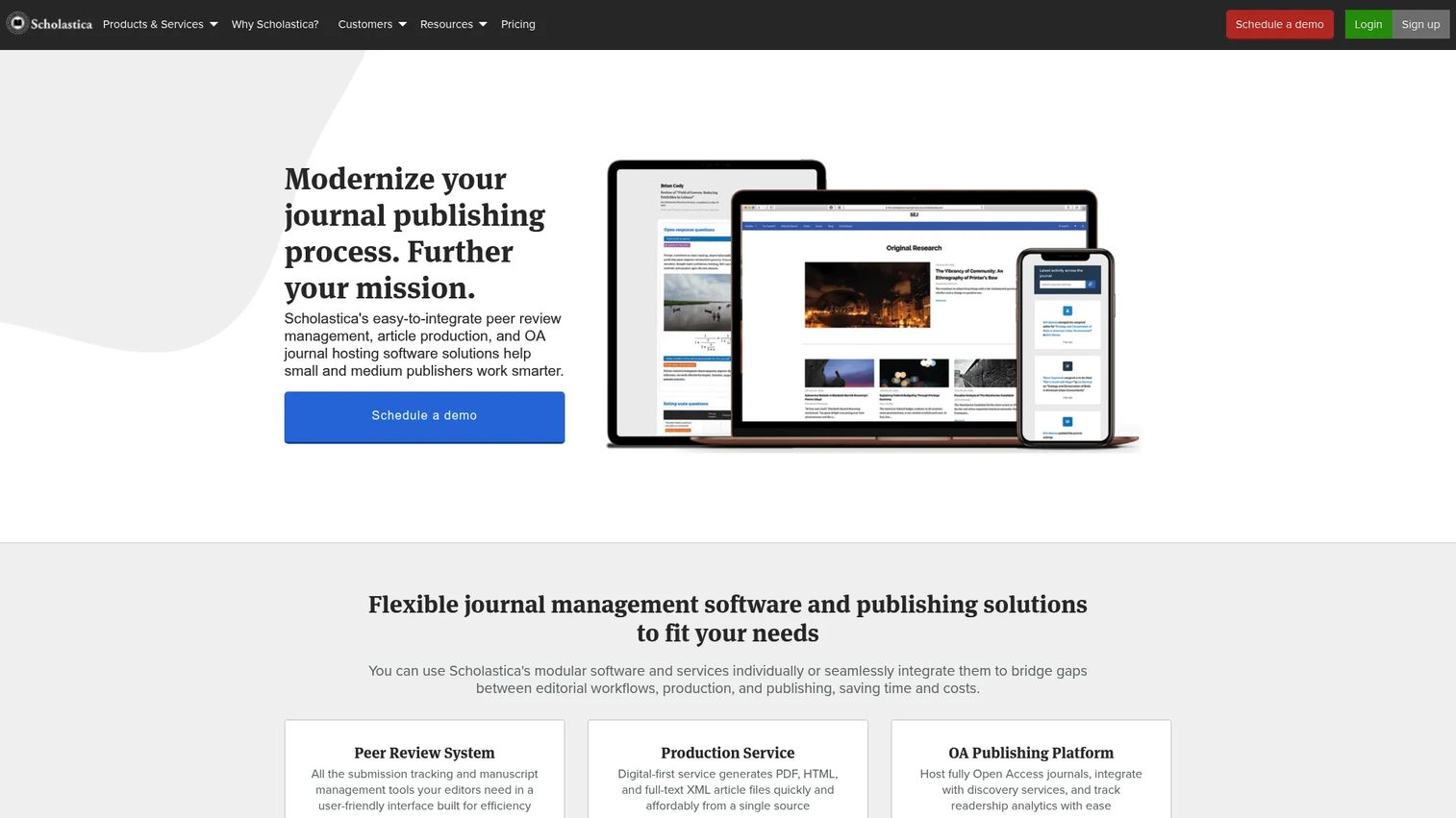
Scholastica is academic journal publishing software built for submissions, peer review, production, and open access hosting. It is purpose-built for scholarly publishers and law reviews that want journal management and OA hosting in one place. If you run a journal, this is the tool designed around your exact editor workflow.
The peer review experience is journal-specific, not a generic form builder. Submission tracking and manuscript management sit at the core, with a reviewer table you can search, tag, and filter. Editors send reminders, watch for late reviews, and see reviewer status without chasing anyone by email. That is the whole point: less manual follow-up, more visibility.
Real-time analytics surface where manuscripts stall, so bottleneck identification stops being a gut feeling. Decisions and author communication run through templates, so decision letter templates stay consistent across editors and issues. Metadata handling covers ORCID, ROR, and CRediT, and the platform connects to RightsLink, plagiarism screening, and the publishing handoff.
Best for: Scholarly journals and law reviews that need manuscript tracking, reviewer performance tracking, and a clean path from decision to publication.
Key strengths
- Journal-specific submission and manuscript management
- Reviewer table: tags, search, reminders, late tracking
- Real-time analytics for bottleneck identification
- Decision letter templates and author communication
- ORCID, ROR, CRediT metadata plus publishing handoff
Choose Scholastica when your workflow is a journal, not a conference or a grants program. It fits editors who want submission review workflow, metadata, and OA hosting under one roof rather than stitched-together tools.
Scholastica pricing: The Peer Review System costs $500 per year plus $10 per submission. Production services are usage-based at $7 per 500 words, $7 per figure or table, and $7 per block equation. The OA Publishing Platform runs $1,549 per year per journal.
2. Fourwaves
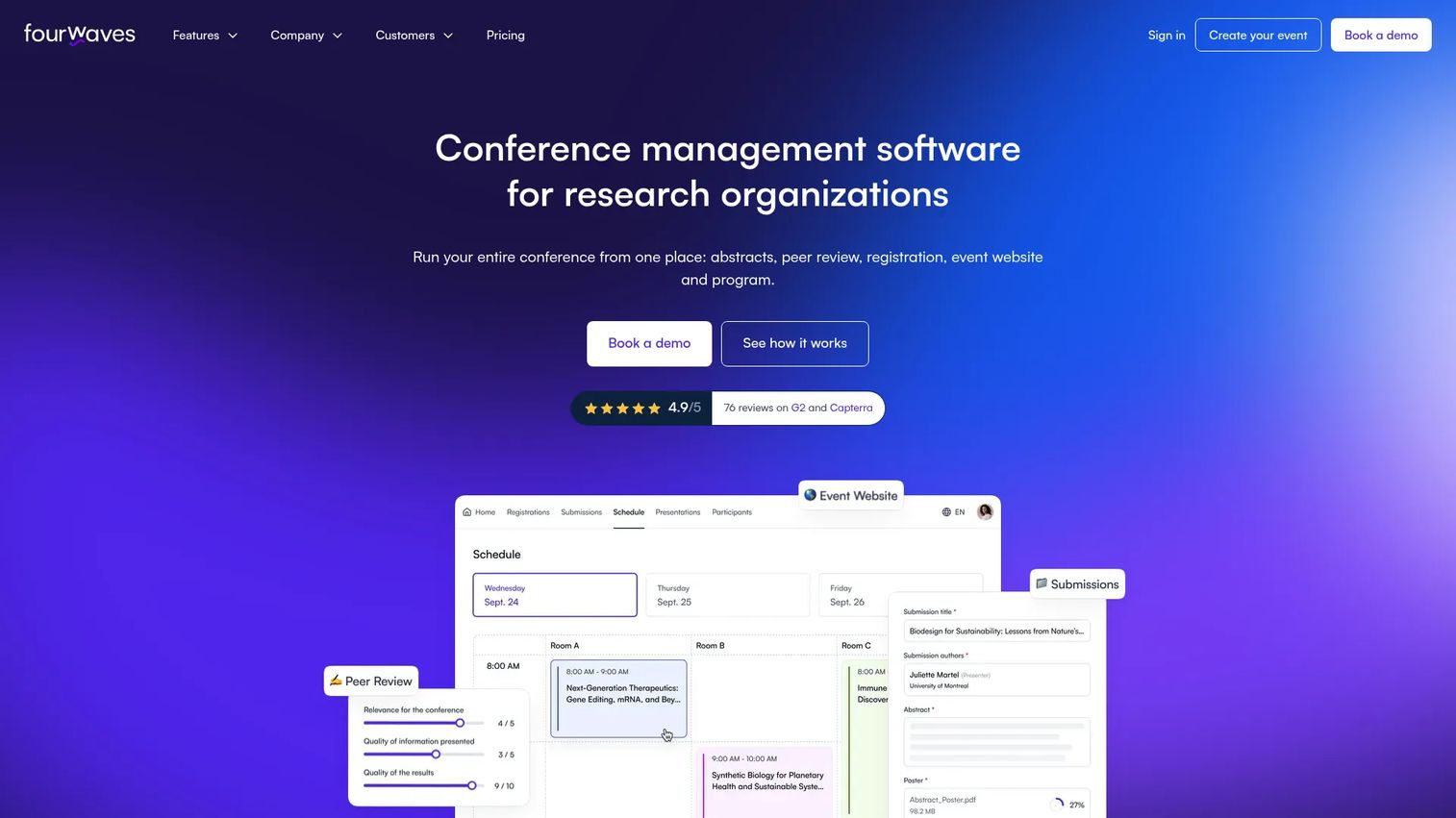
Fourwaves is conference management software for academic and scientific events, covering abstracts, registration, and peer review in one platform. It suits organizers who want the full event workflow, not just review, without gluing three tools together.
For review specifically, Fourwaves gives you editable review forms and scoring, so program committees rate abstracts against the criteria that matter for each track. Reviewer assignment and track management keep submissions flowing to the right people. Because registration, payments, and virtual poster sessions live in the same system, accepted work moves cleanly into the published program.
Best for: Academic and scientific conference organizers who want abstract management, review forms, and registration in one place.
Key strengths
- Abstract management and editable review forms
- Reviewer assignment and multi-track management
- Scoring tied to per-track criteria
- Registration and payments in the same platform
- Virtual and hybrid poster session support
Choose Fourwaves when you want conference peer review software that also handles the operational side of running an event. The free plan makes it easy to test before committing to a paid tier.
Fourwaves pricing: A free plan is available at $0 per year. Paid annual tiers are Essential at $999 per year, Advanced at $1,999 per year, and Pro at $5,299 per year, with multi-event and custom plans for higher volume.
3. Ex Ordo
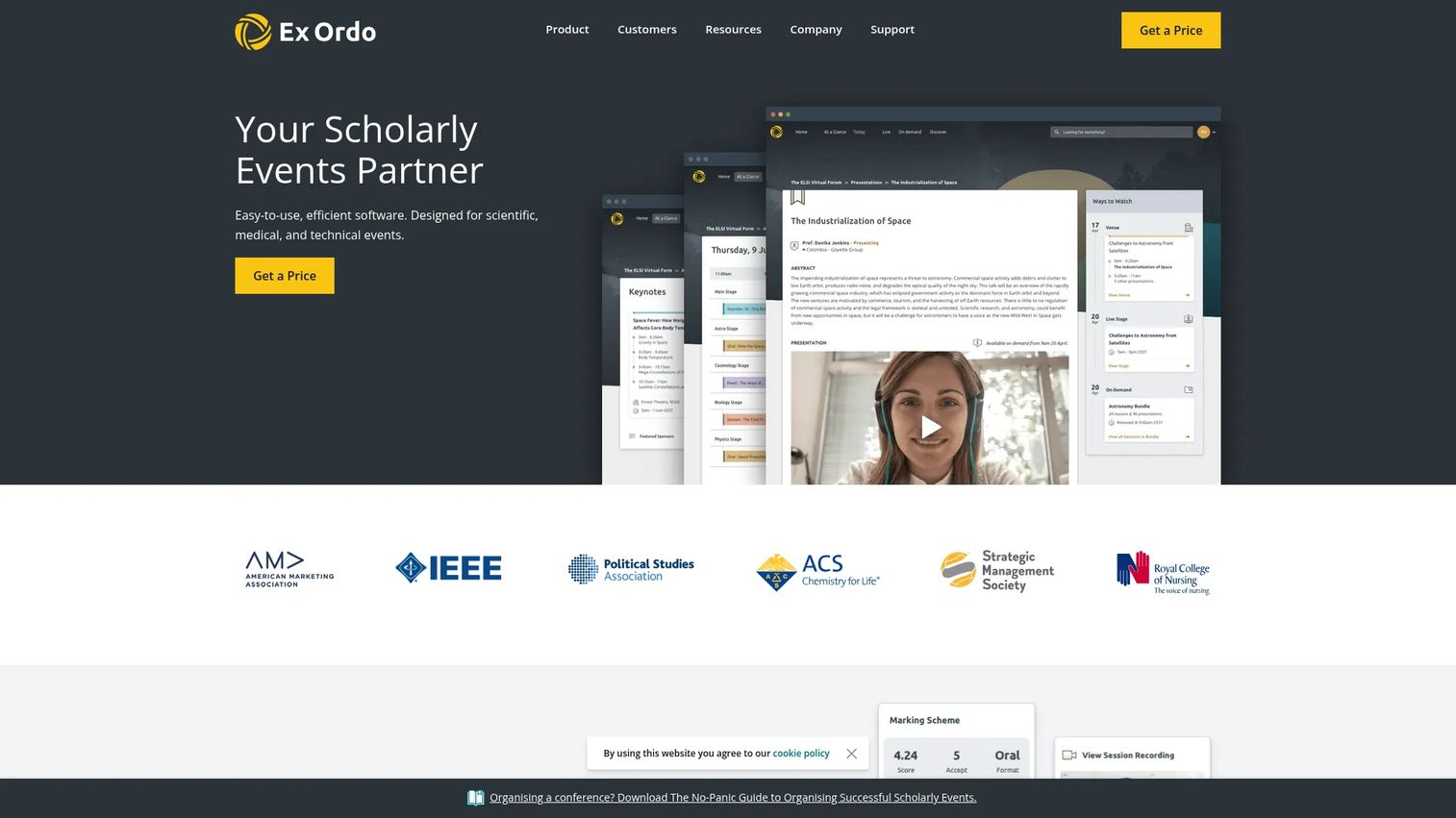
Ex Ordo is conference management software for scholarly, scientific, medical, and technical events. It handles abstract and paper submission, peer review, registration, payments, and virtual or hybrid hosting end to end. For large academic events, that breadth is the draw.
The review engine is built for scale. Abstract and paper submission feeds structured peer review workflows, and reviewer allocation matches submissions to program committee members. Multi-stage and multi-track review is where Ex Ordo fits well: big events with many parallel sessions and a committee that needs reviewer performance tracking and clear progress views. Registration, payments, and attendee communications round out the operational side.
Best for: Academic and research conference organizers running large, multi-track events that need end-to-end management.
Key strengths
- Abstract and paper submission plus peer review
- Reviewer allocation and program committee management
- Multi-stage and multi-track review support
- Registration, payments, and attendee communications
- Virtual and hybrid event hosting
Choose Ex Ordo when your event is large, multi-track, and needs one platform for review through to hosting. It fits committees that want operational depth over a lighter, faster setup.
Ex Ordo pricing: The site uses a quote-based "Get a Price" model, so cost depends on your event size and scope. Request a quote for a figure tied to your workflow.
4. Eli Review
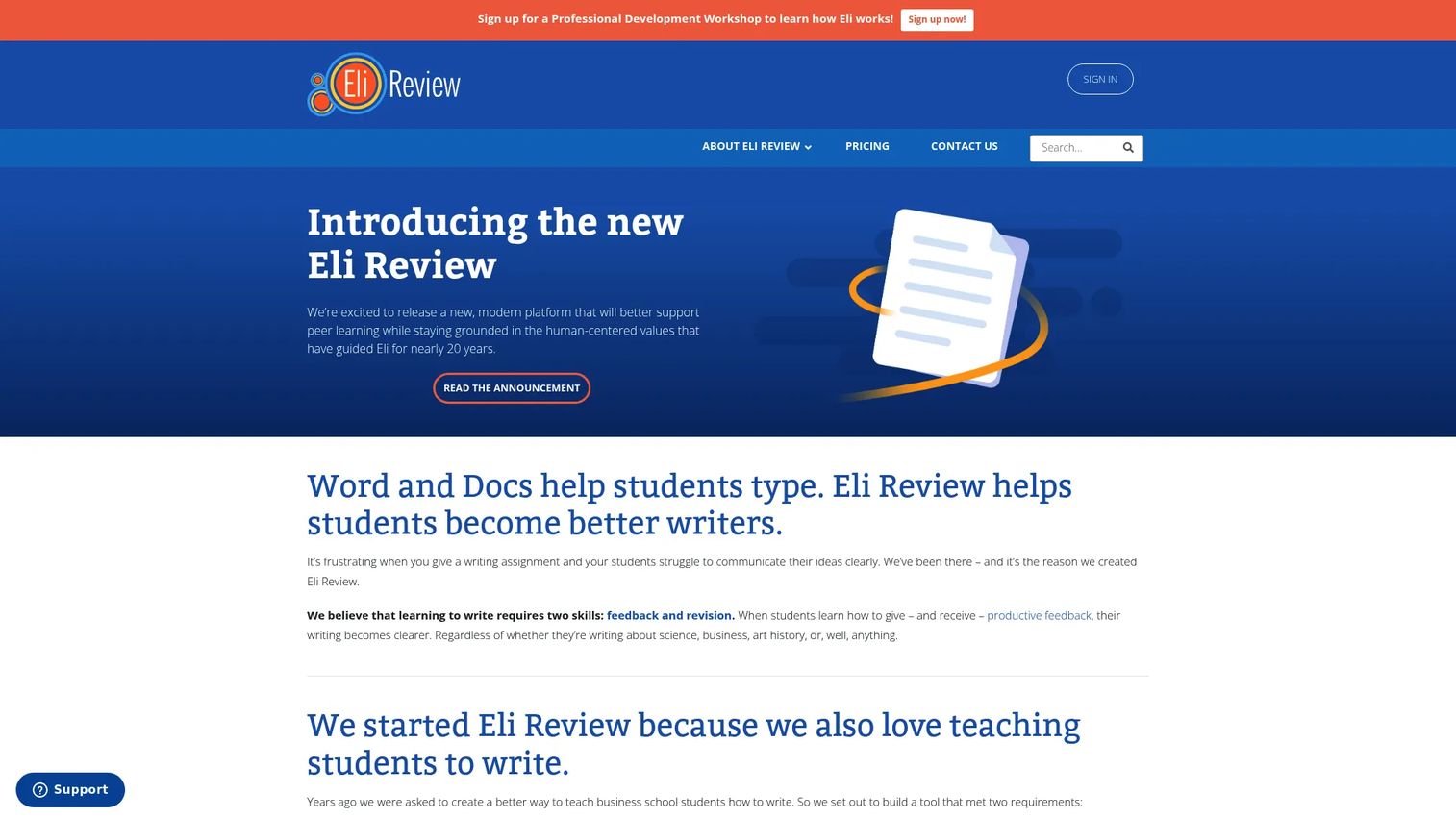
Eli Review is a peer review and feedback platform built for writing instruction, not journals or conferences. It focuses on the classroom loop: give feedback, debrief, plan revisions, then iterate. If you teach writing, this is the tool designed around how students actually improve.
The workflow is research-informed. Instructors set prompts and checklists so peer feedback stays structured and useful, not vague. Real-time review shows who is giving strong feedback and who needs coaching. Revision planning and debrief tools turn comments into concrete next steps, and downloadable course and engagement data let instructors see participation at a glance.
Best for: Higher-ed instructors and institutions teaching writing who want structured peer feedback and revision cycles.
Key strengths
- Real-time peer review and feedback workflows
- Prompts and checklists for structured peer feedback
- Revision planning and debrief tools
- Downloadable course and engagement data
- Research-informed pedagogy for writing instruction
Choose Eli Review when the goal is teaching students to give and use feedback, not managing manuscripts or abstracts. It fits writing-heavy courses where iteration is the point.
Eli Review pricing: A one-term student subscription is $24.95 net, sold directly or through bookstore access codes. Instructor use is free, so teachers can build courses and manage tasks at no cost while students pay for their subscriptions.
5. OpenWater
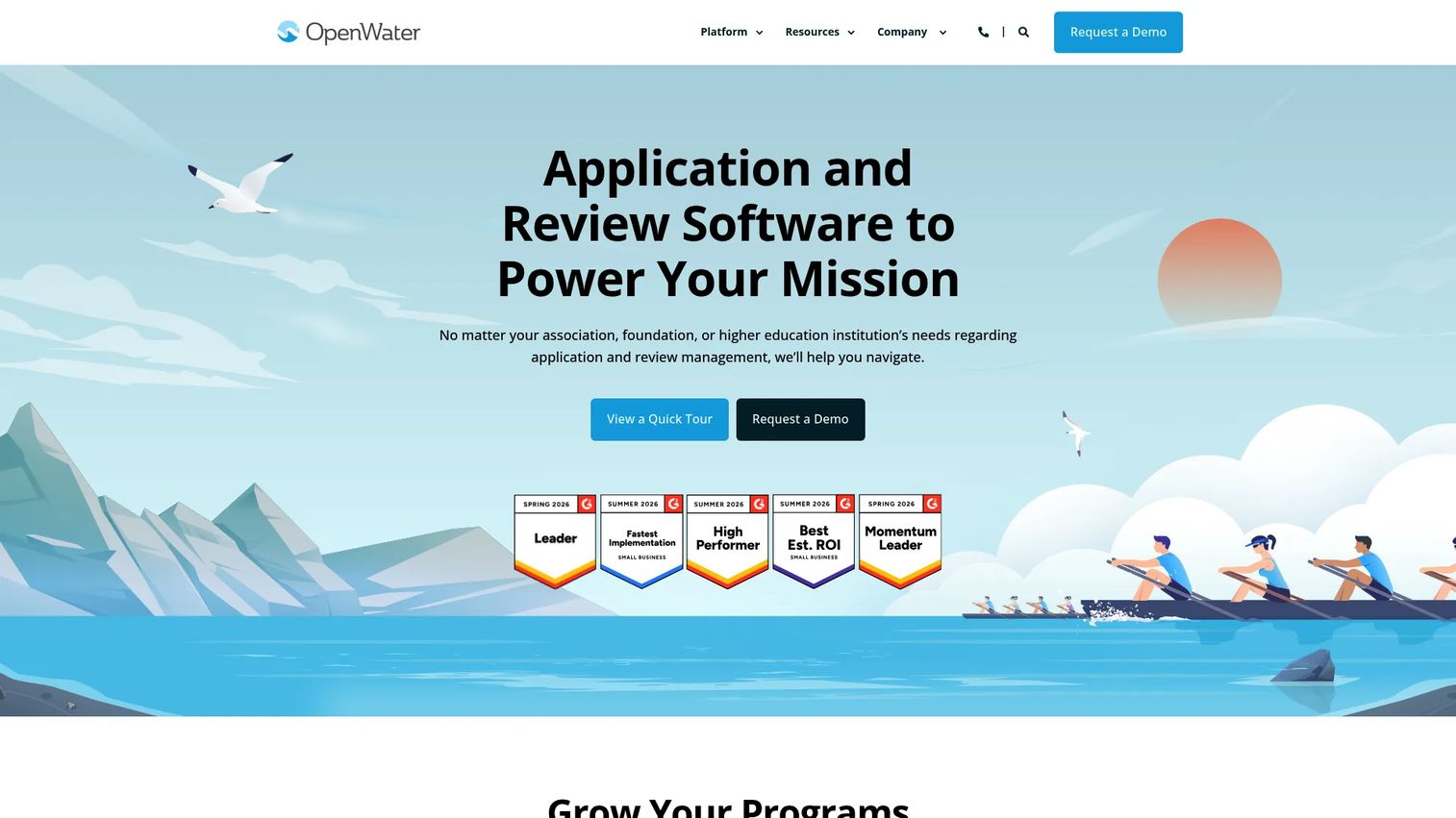
OpenWater is application and review software for awards, grants, scholarships, fellowships, abstracts, and competitions. It is built for organizations running application, review, and judging workflows at scale. If your job is collecting submissions and moving them through rounds of reviewers, OpenWater is aimed squarely at that.
You build the application website, then use a drag-and-drop form builder to shape intake. Multi-round review handles scoring across stages, so judging panels advance the strongest submissions cleanly. An integrations hub connects to the systems you already run, and reporting and analytics give administrators control over progress and outcomes. Associations and membership organizations tend to fit here.
Best for: Associations and organizations managing awards management, grant review software, and judging workflows at volume.
Key strengths
- Application website creation
- Drag-and-drop form builder
- Multi-round review and scoring
- Integrations hub for existing systems
- Reporting and analytics for administrators
Choose OpenWater when you run awards, grants, or scholarship programs and need multi-round review plus administrative control. It fits teams that value configurability and reporting depth.
OpenWater pricing: OpenWater uses subscription pricing with custom quotes, and no public numeric price is listed. Cost depends on your program scope and volume, so request a quote for your specific review workflow.
6. Submittable
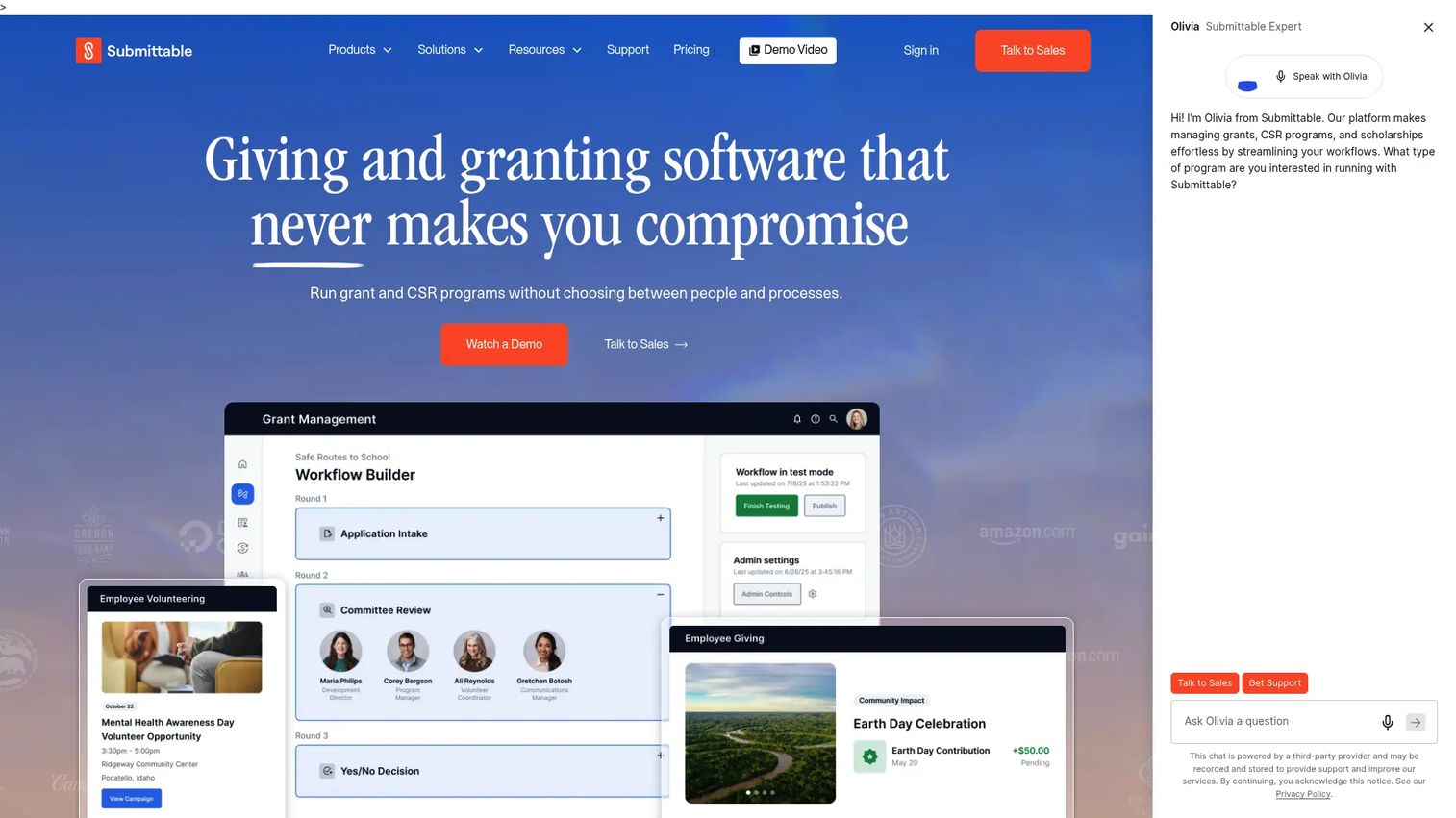
Submittable is grant management and CSR software for applications, reviews, reporting, and funding workflows. It suits organizations running grant, scholarship, or CSR programs that need application intake and workflow management in one system. The platform reaches beyond review into the money side of the process.
Intake starts with a drag-and-drop form builder, then automated multi-stage review workflows route submissions to reviewers and advance them through rounds. Financial tracking, reporting, and funds distribution close the loop, which matters for funders who need to report on where money went. Higher education and program management teams use it for structured submission review workflow at scale.
Best for: Organizations running grant, scholarship, or CSR programs that need application intake plus reporting and funds distribution.
Key strengths
- Drag-and-drop application form builder
- Automated multi-stage review workflows
- Financial tracking and reporting
- Funds distribution for grant programs
- Program management for higher education and CSR
Choose Submittable when your review process ends in funding decisions and you need reporting and distribution alongside intake and review. It fits teams that want a broad platform, not a review-only tool.
Submittable pricing: Pricing is quote-based. Submittable says cost depends on organization size, scope, and product needs, and directs prospects to book a meeting or request a quote. Contact the vendor for a figure matched to your program.
7. PeerStudio
PeerStudio began as a classroom peer assessment concept: rubric-based review and structured feedback for small groups and instructional use, with comparison-style peer grading to speed up assessment. The idea maps well to courses that need fast, structured peer grading at scale.
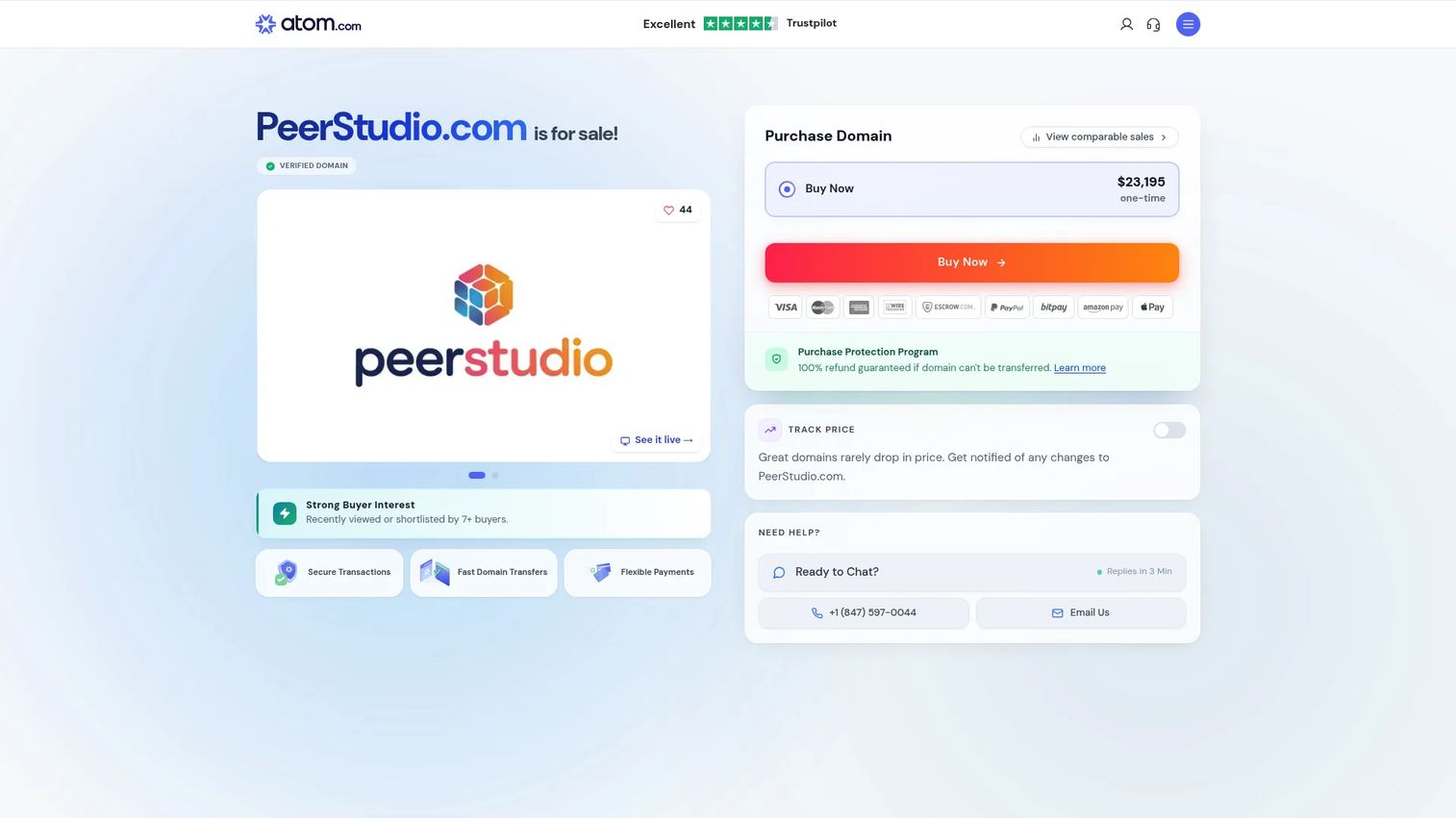
That said, verify current status before you plan around it. At the time of writing, the peerstudio.com domain resolves to a domain-for-sale listing rather than an active product, and no live SaaS pricing page or feature set is published on the brand domain. If you are drawn to the comparison-based peer grading model, confirm availability directly before committing a course or term to it.
Best for: Instructors interested in rubric-based, comparison-style classroom peer assessment, pending confirmation the product is active.
Key strengths
- Rubric-based peer review concept
- Comparison-style peer grading approach
- Designed for small groups and instructional use
- Structured feedback for classroom assessment
- Fast assessment for high-volume courses
Choose PeerStudio only after confirming the product is live and supported. If comparison-based peer grading is your priority and it is unavailable, Eli Review covers structured classroom peer feedback today.
PeerStudio pricing: No active SaaS subscription pricing is published. The brand domain currently shows a one-time domain purchase listing rather than a software plan, so confirm product availability with the source before evaluating cost.
Considerations
Before you buy, run through this checklist so the tool matches your actual workflow, not a demo-day impression.
Match the workflow first
Peer review software is not one category. Journals, conferences, classrooms, and grants have different shapes. Pick a tool built for your use case: Scholastica for journals, Fourwaves or Ex Ordo for conferences, Eli Review for classrooms, OpenWater or Submittable for grants and awards. A journal tool will fight you as a conference platform, and vice versa.
Check reviewer management depth
Look at how the tool handles reviewer assignment, reminders, and late tracking. Can you tag reviewers, search by expertise, and see who is behind without emailing anyone? Reviewer management software lives or dies here. Thin reviewer tooling means you are back to spreadsheets within a term.
Verify automation and communication tools
Peer review workflow automation should remove manual steps, not add clicks. Check whether the tool sends reminders automatically, uses decision letter templates, and keeps author communication in one thread. The editor workflow should feel lighter after adoption, not heavier.
Review reporting and analytics
Real-time analytics turn a black-box process into something you can manage. You want to see where submissions stall, how long reviews take, and which stages create backlogs. Bottleneck identification and reviewer performance tracking are what separate a system from a fancier inbox.
Confirm integrations and adoption fit
Check that the tool connects to the systems you already run: publishing platforms, payment processors, or application systems. Then check adoption: how fast can reviewers and editors learn it? A powerful tool nobody uses is worse than a simple one everybody does.
Conclusion
Peer review software earns its place by removing manual handoffs from a process that punishes them. The best fit depends on your workflow, not a feature count.
For journals, Scholastica is the clear pick: manuscript management, decision letter templates, real-time analytics, and open access hosting in one system. For conferences, choose Fourwaves for a fast, all-in-one setup with a free tier, or Ex Ordo for large, multi-track events that need operational depth. For classrooms, Eli Review handles structured peer feedback and revision cycles built for writing instruction. For grants and awards, OpenWater fits associations running multi-round judging, while Submittable adds reporting and funds distribution on top of review.
Choose based on three things: workflow complexity, reviewer volume, and reporting needs. Match those to the tool built for your use case, verify pricing and integrations against your stack, and shortlist two options for a hands-on trial before you commit a season, a term, or an issue to any one platform.
FAQs
Peer review software manages submission intake, reviewer assignment, feedback collection, revision cycles, and final decisions in one system. Journals, conferences, classrooms, and grants programs use it to move work through review without spreadsheets and inbox chaos. It centralizes tracking, automates reminders, and gives editors or chairs visibility into the whole pipeline.
Look for submission forms with metadata, reviewer assignment with reminders and late tracking, structured review forms and scoring, decision letters, and reporting with bottleneck identification. Integrations with your publishing, event, or application systems matter too. The best tools automate the manual steps and keep author communication in one place.
For scholarly journals, Scholastica is the strongest fit. It offers journal-specific manuscript management, a reviewer table with reminders and late tracking, real-time analytics, decision letter templates, and metadata support for ORCID, ROR, and CRediT. It also handles plagiarism screening and open access publishing handoff, so the workflow runs from submission to publication.
Fourwaves and Ex Ordo lead for conferences. Fourwaves combines abstract management, review forms, registration, and payments with a free plan to start. Ex Ordo suits large, multi-track academic events that need reviewer allocation, program committee management, and end-to-end event hosting. Choose based on event size and how much operational depth you need.
Yes. OpenWater and Submittable are built for application and review workflows across awards, grants, scholarships, and competitions. Both support multi-round scoring, judging panels, and decision reporting. Submittable adds financial tracking and funds distribution, which matters when the review process ends in funding decisions.
It removes manual handoffs. Automated reminders replace chasing reviewers by email, reviewer assignment routes work to the right people, and real-time analytics surface bottlenecks before they slow everything down. According to Market Growth Reports (2026), 55% of peer review processes are now automated, reflecting how far teams have moved from spreadsheet-driven review.
They overlap heavily for journals. Manuscript management software focuses on tracking submissions, revisions, and versions through the editorial pipeline. Peer review software includes that manuscript tracking but extends to reviewer assignment, scoring, and decision workflows. For a journal, the strongest tools like Scholastica combine both, so manuscript management and peer review live in one editor workflow.