You can issue a virtual card quickly in a product demo. Running a card program is harder.
The real work starts after the API call: Sponsor-bank relationships, authorization controls, settlement, disputes, compliance operations, and the systems that keep cards usable at scale. According to The Business Research Company (2026), the global payment card issuance software market sits at $2.07 billion in 2025 and is forecast to reach $3.26 billion by 2030. Card programs are real infrastructure decisions, not feature additions.
A founder evaluating card issuing infrastructure faces a question that most vendor pages avoid answering directly: Are you selecting an API layer, an issuer processor, a program-management partner, or a full-stack card-processing system? Each requires different internal capabilities, different vendor relationships, and different operating models.
Which platform gives you the right operating layer without turning card issuance into a multi-quarter detour?
What's inside
This guide covers 11 payment card issuance software platforms for fintechs, SaaS companies, banks, and marketplaces in 2026. Items were selected based on:
- Verified product capability and documented issuing focus
- Fit across card types: Virtual, physical, debit, prepaid, and credit
- Deployment model: API-first, issuer processor, embedded finance, or enterprise processing
- Transparency of pricing approach where vendors provide it
- Geographic and network coverage breadth
TL;DR
- Best for configurable modern card programs: Marqeta offers real-time authorization controls and open APIs for fintechs building card products as a core feature
- Best for Stripe-native teams: Stripe Issuing keeps card issuance inside the payments stack you already operate
- Best for developer-led custom infrastructure: Lithic provides granular APIs and a free sandbox for teams that want to own card behavior from the ground up
- Best for global issuer-processing scale: Paymentology and Thredd cover multi-region programs with configurable processing depth
- Best for European embedded finance: Wallester and Solaris serve European program operators with market-specific infrastructure
- Best for enterprise and institutional card operations: Fiserv, FirstVision, and VisionPLUS address banks and large issuers with established card portfolios
What is payment card issuance software?
Payment card issuance software is infrastructure that lets a financial institution, fintech, or embedded-finance provider create, manage, authorize, personalize, and service payment cards across their lifecycle.
The category covers a wide range of capabilities:
- Card creation: Virtual, physical, tokenized, debit, prepaid, credit, commercial, and branded programs
- Cardholder onboarding: Account linking, KYC and KYB identity verification, and program eligibility checks
- Authorization controls: Spend rules, velocity limits, merchant-category restrictions, and real-time decisioning
- Card lifecycle actions: Activation, replacement, freeze, unfreeze, renewal, and card data management
- Wallet provisioning: Apple Pay and Google Pay support where available by market and network
- Operations and reporting: Settlement, reconciliation, dispute handling, transaction monitoring, and analytics
- Integration surface: APIs, webhooks, CRM connectivity, and ledger or accounting system exports
The layers founders must separate
Most card issuing discussions conflate layers of the stack that carry different costs and accountability:
| Layer | What it does | Founder question |
|---|---|---|
| Card network | Routes transactions globally | Which networks and markets do you need? |
| Sponsor bank or issuer | Holds the regulated issuing authority | Who carries the licensed issuing relationship? |
| Issuer processor | Manages authorization and card lifecycle | Can it handle your volumes, card types, and controls? |
| Card issuing platform | Provides APIs and program tools | How much product logic will you own? |
| Program operations | Fraud, disputes, support, reconciliation | Who runs this after launch? |
No single platform eliminates regulatory responsibility. The program operator and its issuing partners retain accountability for compliance, regardless of which vendor powers the infrastructure.
When to use payment card issuance software
Launch an embedded-finance feature
A vertical SaaS company may want a card to make its workflow stickier: Expense controls for field teams, contractor payouts, or marketplace purchasing. The key question is whether cards create repeatable customer value or add operational complexity that your current team cannot absorb. Virtual card issuance is often the right starting point for these programs.
Build a corporate spend or expense-card program
Employee expense cards, department budgets, and vendor spend programs need card controls, virtual cards, reconciliation, and integration with finance systems. Card issuing APIs and configurable spend limits are the primary evaluation criteria here. The program can often launch faster than a consumer card because the cardholder base is smaller and more controlled.
Operate a high-volume or regulated card program
Fintechs, banks, and lenders that need credit logic, instant physical issuance, country expansion, or enterprise-grade processing require a deeper evaluation. Look beyond the API at resilience, support model, settlement operations, reporting, and implementation resources. Physical card issuance and card program management at scale demand operational readiness that a developer portal alone cannot signal.
Payment card issuance software comparison
The platforms below serve different parts of the issuance stack. Shortlist based on your program model, geography, card type, and whether you need a developer-first API or enterprise issuer-processing depth. Pricing for most platforms in this category requires a direct quote because fee structures depend on volume, card type, markets, and implementation scope.
| # | Product | Best for | Key differentiator | Pricing | G2 rating |
|---|---|---|---|---|---|
| 1 | Marqeta | Configurable modern card programs | Real-time authorization and open card APIs | Quote-based | 4.4/5 |
| 2 | Stripe Issuing | Stripe-native teams | Card issuing inside the Stripe payments stack | Quote-based | 4.3/5 |
| 3 | Lithic | Developer-led custom card products | API-first issuing with free sandbox access | Custom (sandbox free) | 4.5/5 |
| 4 | Galileo | Fintechs needing broader platform infrastructure | Payments, accounts, and card programs in one API layer | Quote-based | 4.7/5 |
| 5 | Paymentology | Global issuer-processing programs | Multi-region processing with a configurable decision engine | Quote-based | Not listed |
| 6 | Thredd | International card programs | Configurable issuer processing across markets | Quote-based | Not listed |
| 7 | Fiserv | Banks and large institutions | Broad payments infrastructure and processing depth | Quote-based | 4.3/5 |
| 8 | Wallester | European virtual and business card programs | Published tiered pricing and fast program configuration | From €0/month | 4.7/5 |
| 9 | Solaris | European embedded-finance programs | Banking and card infrastructure for regulated European markets | Quote-based | 5.0/5 |
| 10 | FirstVision | Credit-card program operations | Credit-card processing and account servicing | Quote-based | Not listed |
| 11 | VisionPLUS | Large-scale card portfolio management | Enterprise issuer processing and portfolio modernization | Quote-based | 4.3/5 |
Best 11 payment card issuance software platforms for 2026
1. Marqeta

Marqeta is an API-driven platform for issuing and processing debit, credit, prepaid, and flexible-credential cards. It is built for fintechs, enterprises, and brands that need card issuing as a core product capability, not a bolt-on. The platform provides real-time authorization decisioning, Just-in-Time funding, and open APIs that let teams control card behavior at the transaction level.
Best for: Founders building a configurable card product where real-time controls and programmatic spend rules shape the core customer experience.
Key features
- Physical, virtual, and tokenized card issuing
- Real-time Just-in-Time funding and transaction authorization
- Dynamic spend controls and merchant-category rules
- Open APIs, webhooks, and transaction event data
- 3DS authentication, fraud controls, and disputes tools
Why choose Marqeta: Marqeta suits companies that want to differentiate on card behavior, such as expense platforms, marketplace payout cards, or embedded debit products. You will need internal payments expertise and a defined sponsor-bank and operating model before the platform delivers its full value.
Marqeta pricing: Marqeta operates on a quote-based commercial model. Pricing reflects program volume, card type, processing services, geographic scope, and implementation requirements. Contact Marqeta directly for current fee structures.
G2 rating: 4.4/5
2. Stripe Issuing
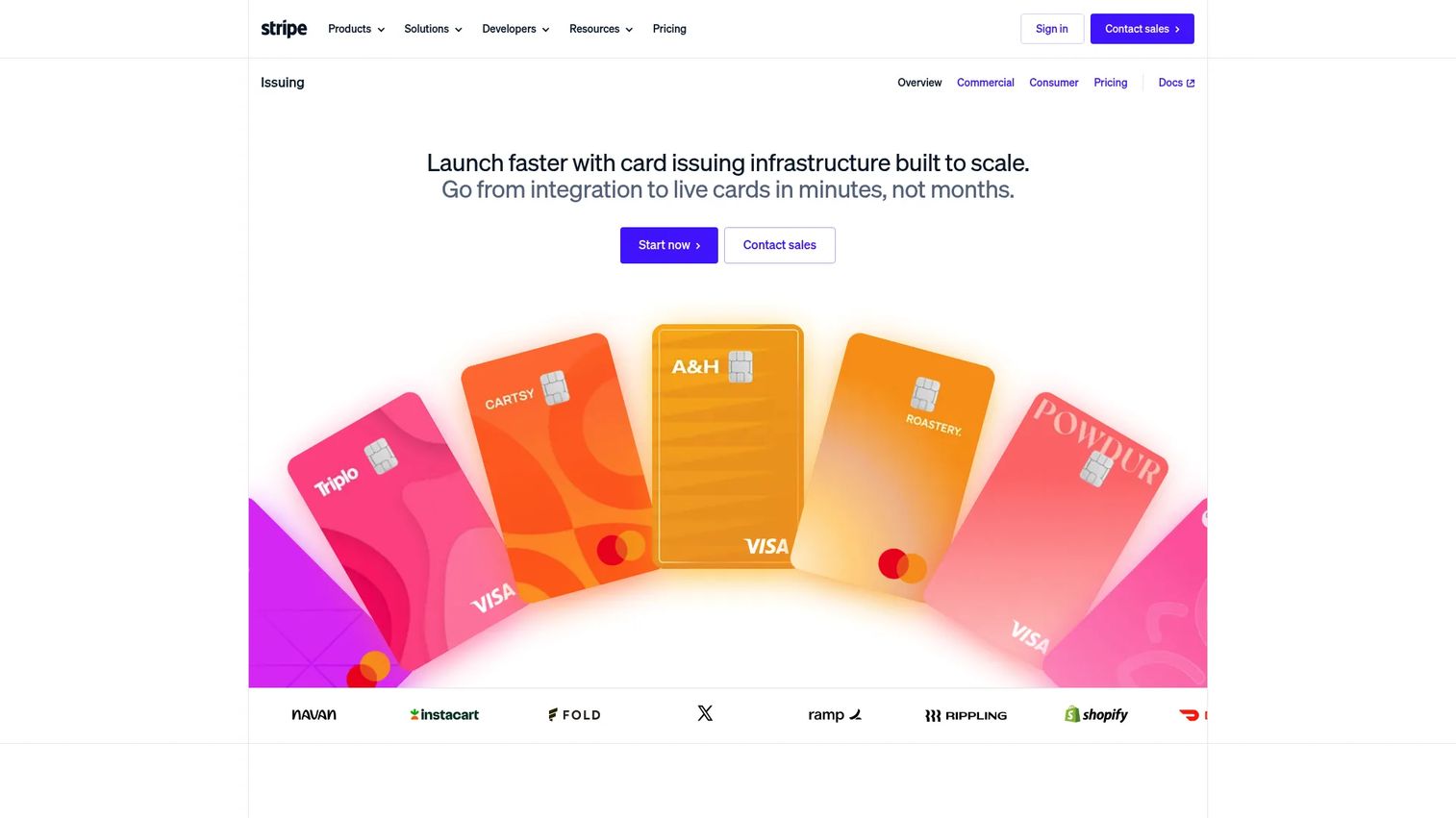
Stripe Issuing is a card-issuing module inside the Stripe payments platform. Teams already using Stripe for payments can add virtual and physical card programs through the same developer environment, dashboard, and API key structure. Stripe Issuing covers commercial and consumer card programs with real-time controls, custom card design, and digital wallet support.
Best for: SaaS companies and platforms that already run major payment flows through Stripe and want a lower-friction path to card issuance without adding a separate vendor.
Key features
- Virtual and physical card creation via API
- Real-time authorization and dynamic spend controls
- Custom card design and physical-card fulfillment
- Digital wallet provisioning support
- Multi-market card program capabilities
Why choose Stripe Issuing: Stack consolidation is the primary case. If your team is already deep in Stripe's API surface, adding card issuing avoids a separate integration, separate data model, and separate vendor relationship. Validate country availability, program eligibility, and card-program economics early.
Stripe Issuing pricing: Stripe's current pricing page directs prospective customers to contact Stripe for Issuing-specific fees. Pricing reflects usage patterns and program structure. Reach out directly for current rates.
G2 rating: 4.3/5
3. Lithic

Lithic is developer-focused infrastructure for programmable card issuing, processing, and money movement. It supports debit, prepaid, charge, and credit card programs, with granular APIs for authorization rules, card states, spend controls, and transaction visibility. The platform includes KYC and KYB identity verification and ledger, ACH, wire, and settlement APIs alongside core card functionality.
Best for: Technical founding teams building differentiated card experiences that depend on custom authorization logic, dynamic card states, or specialized payment workflows.
Key features
- Virtual and physical card issuance across multiple program types
- Real-time webhooks and transaction-level event data
- Authorization rules, spend controls, and velocity limits
- Mobile and web wallet provisioning
- KYC and KYB identity verification APIs
Why choose Lithic: Lithic fits teams that want to build their own card experience rather than adopt a packaged program layer. The free sandbox removes early testing cost. Production pricing is custom; assess your target launch markets and sponsor-bank arrangements during diligence.
Lithic pricing: Sandbox access is free. Production pricing is custom and requires contacting Lithic's sales team. Fee structure reflects transaction volume and the features required for your program.
G2 rating: 4.5/5
4. Galileo
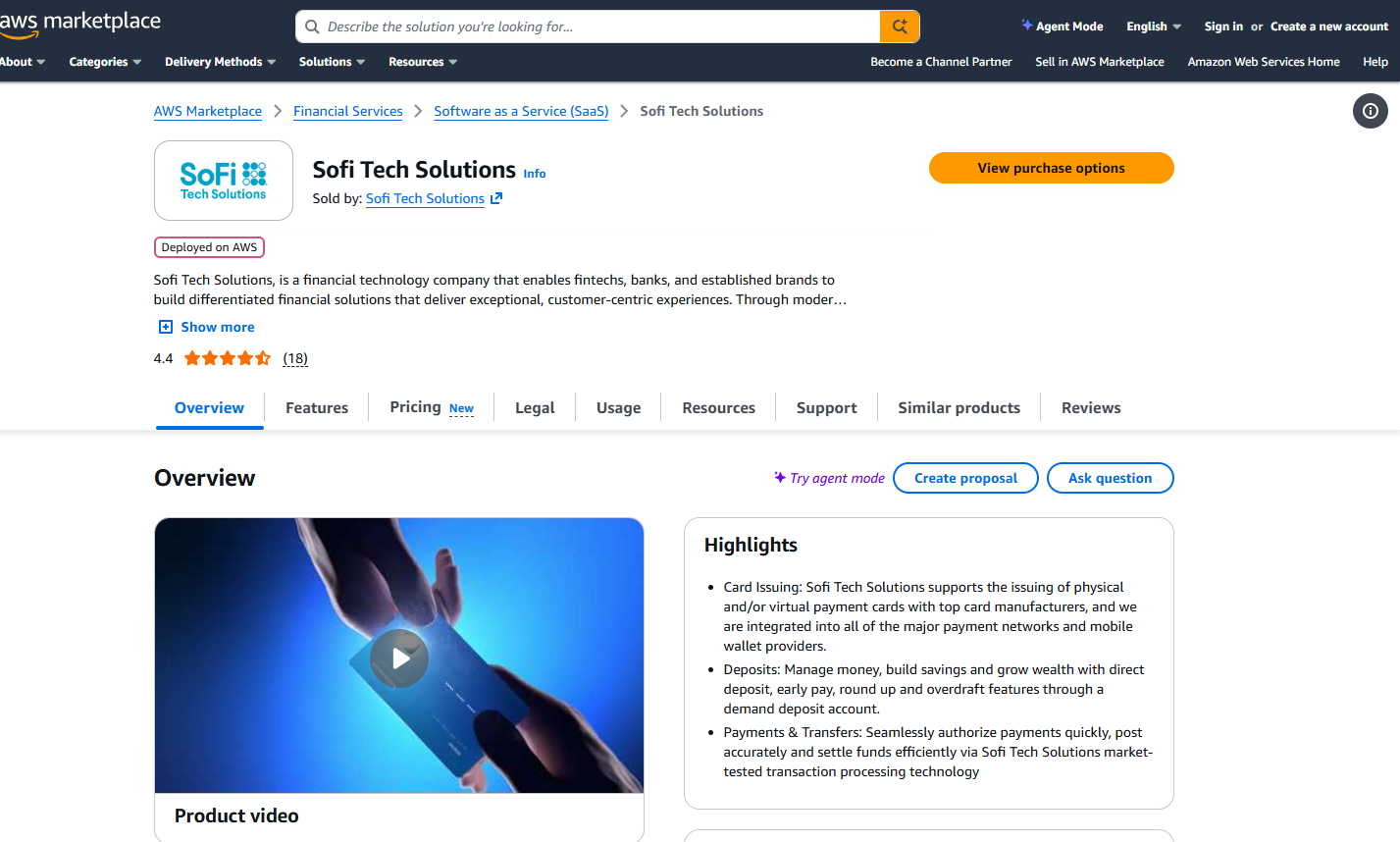
Galileo is a cloud-native financial technology platform that provides API-based infrastructure for banking, payments, card issuing, deposits, lending, and risk management. Originally built as a standalone fintech platform, it now operates under SoFi's technology division. Galileo serves banks, fintechs, and brands that need card issuing alongside a broader account and payment infrastructure.
Best for: Fintechs that need card issuing alongside digital banking capabilities, account infrastructure, or a broader financial product roadmap.
Key features
- Card issuing and payment processing via API
- Deposits, banking accounts, and digital banking capabilities
- Lending and secured credit support
- Risk and fraud management
- Developer-friendly APIs across the full product suite
Why choose Galileo: Galileo may suit founders who want fewer disconnected financial infrastructure vendors. The trade-off is a broader platform evaluation and potentially more complex implementation planning compared to a narrower card-only API.
Galileo pricing: Galileo operates on a custom commercial model. Contact the team directly; fee structures reflect program scope, transaction volume, and the specific product modules required.
G2 rating: 4.7/5
5. Paymentology

Paymentology is a cloud-native card issuing and payment processing platform for banks, fintechs, and digital banks launching or scaling card programs across multiple markets. The platform includes a configurable decision engine, real-time transaction processing, multi-currency support, and digital wallet tokenization. Paymentology directs prospective customers to its sales team for all pricing.
Best for: Companies with international card program ambitions that need multi-region issuer processing, cross-border card capabilities, and configurable transaction rules.
Key features
- Physical and virtual card issuing across markets
- Real-time transaction processing and a configurable decision engine
- Multi-currency and cross-border issuing support
- Digital wallet tokenization
- Real-time transaction data and program analytics
Why choose Paymentology: The platform suits founders preparing for multi-market card issuing where a single issuer-processing partner with regional reach matters. Verify specific country coverage and network partnerships during diligence before assuming a market is supported.
Paymentology pricing: Paymentology uses a quote-based commercial model. Contracts reflect supported markets, transaction volume, card portfolio size, and implementation requirements.
6. Thredd
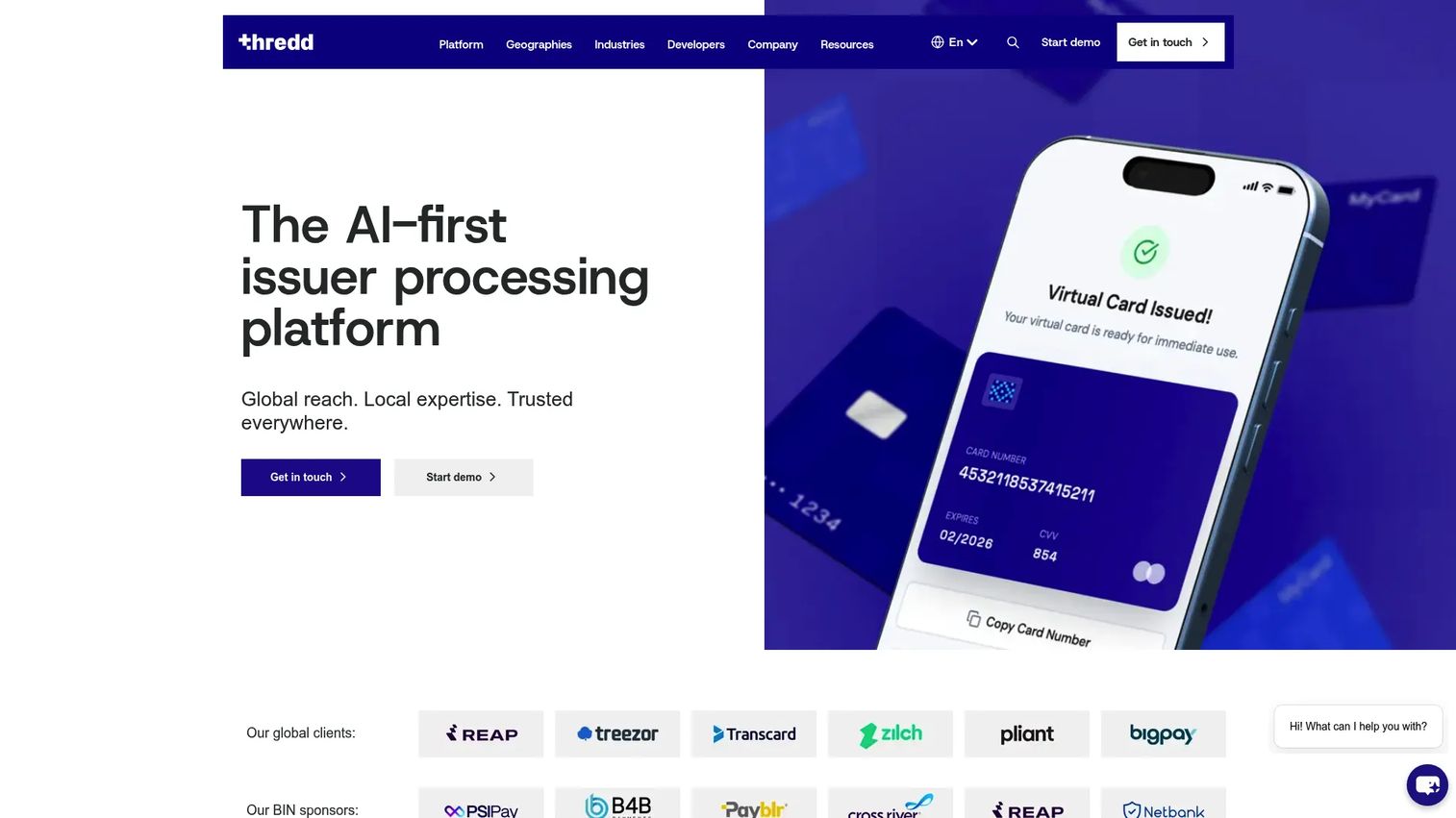
Thredd is an issuer-processor providing card payment processing and digital payment program infrastructure. The platform supports card issuing and management via APIs, real-time payment processing, card controls, fraud monitoring, and digital-wallet tokenisation. Thredd serves banks, fintechs, and businesses managing branded card programs across multiple regions.
Best for: Fintechs and program managers that need configurable issuing infrastructure across multiple regions and want API-based card and transaction management.
Key features
- Card issuing and management via APIs
- Real-time payment processing and transaction reporting
- Configurable card controls and usage groups
- Fraud monitoring and 3D Secure authentication
- Digital-wallet tokenisation support
Why choose Thredd: Thredd fits founders preparing for multi-market issuing or complex program operations where a purpose-built issuer processor matters more than a bundled fintech platform. Map the provider's regional coverage to your immediate launch market and 18-month expansion plan before signing.
Thredd pricing: Thredd does not display pricing on its site. Commercial terms require contacting an account manager. Fee structures reflect program scope, card volumes, and regional deployment.
7. Fiserv
Fiserv is an established financial services technology provider with capabilities spanning banking, payments, commerce, embedded finance, data analytics, and risk management. Its card-related infrastructure covers digital payments, embedded finance, branded cards, cloud-native API-first banking platforms, and fraud and compliance tools.
Best for: Banks, established fintechs, and large organizations that need card issuing within a wider financial infrastructure environment and require institutional-grade processing depth.
Key features
- Digital payments and payment-network connectivity
- Embedded finance, branded cards, and account infrastructure
- Cloud-native, API-first banking and card-issuance capabilities
- Data analytics and reporting
- Fraud detection, risk mitigation, and compliance tools
Why choose Fiserv: Fiserv suits buyers who need card issuing alongside a broader financial technology platform, particularly established institutions or scale-stage fintechs. A founder should assess implementation scope and the level of internal payments expertise required before entering a commercial conversation.
Fiserv pricing: Fiserv operates on a quote-based model. Pricing reflects the specific modules selected, transaction volume, deployment approach, implementation services, and ongoing support requirements.
G2 rating: 4.3/5
8. Wallester
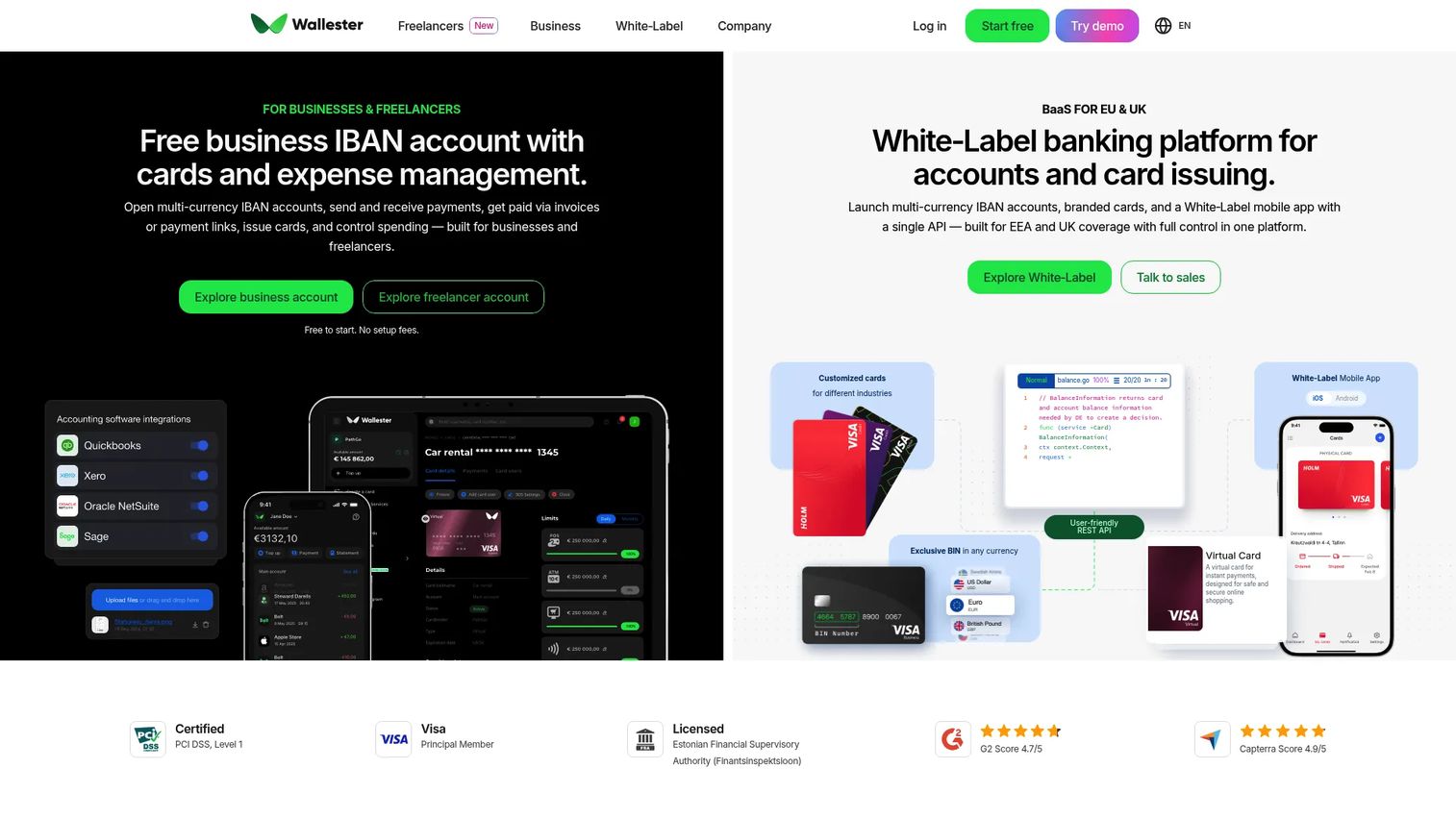
Wallester provides business accounts, physical and virtual Visa cards, expense management, payment processing, and white-label card-issuing infrastructure. It is one of the few platforms in this category that publishes tiered pricing, making early commercial modeling more straightforward for founders evaluating European card programs.
Best for: European companies launching employee spending, expense management, or virtual-card programs where configuration speed, card controls, and transparent pricing matter.
Key features
- Physical and virtual Visa card issuance
- Spending limits, transaction controls, and real-time notifications
- Expense tracking and receipt scanning
- Accounting integrations and open developer API
- White-label card-program options
Why choose Wallester: Wallester is well suited to a founder who needs a more packaged business-card motion rather than a deeply custom issuer-processing build. The tiered pricing model makes it easier to model costs before a sales conversation.
Wallester pricing: Wallester publishes pricing in EUR. The Free plan covers 300 virtual cards at no monthly cost. Premium runs €199/month and includes 3,000 virtual cards. Platinum is €999/month and covers 18,000 virtual cards. Enterprise Suite is custom.
G2 rating: 4.7/5
9. Solaris
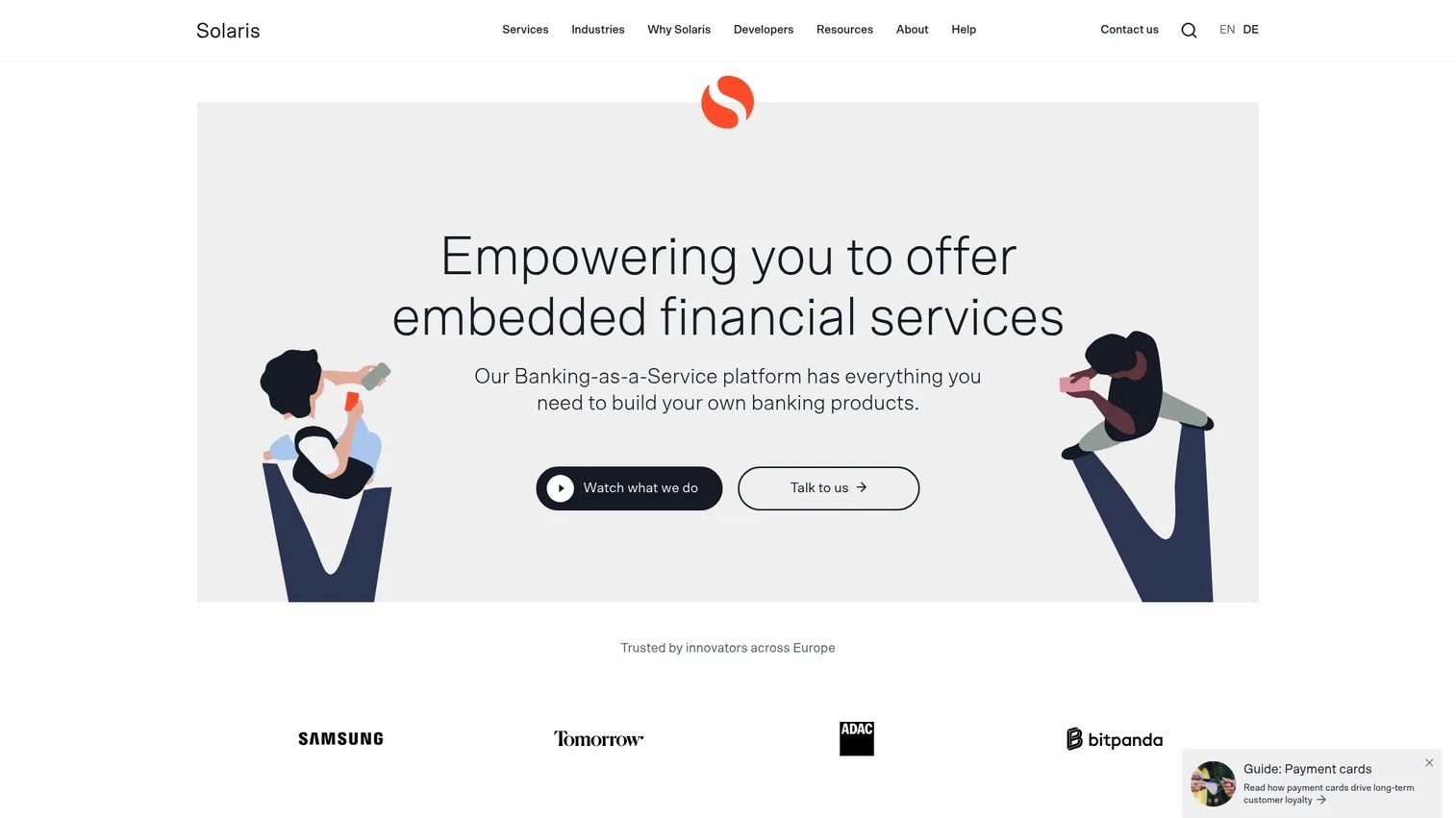
Solaris is a Banking-as-a-Service and embedded-finance platform providing API-based digital banking, cards, lending, identity verification, and related financial infrastructure. The platform supports branded Visa or Mastercard physical and virtual cards, SEPA payments, KYC, consumer lending, Open Banking integrations, and AI-powered risk management for companies operating in its supported European markets.
Best for: Founders building regulated embedded-finance products in Europe who want banking and card-program infrastructure from a platform built for that regulatory environment.
Key features
- Branded Visa or Mastercard physical and virtual cards
- SEPA, SEPA Instant, direct debit, and batch payments
- Digital bank accounts with local and virtual IBANs
- KYC and identity verification
- Real-time fraud monitoring and AI-powered risk management
Why choose Solaris: Solaris suits a founder building a regulated financial product in Europe who needs both card and banking infrastructure from a single API-based provider. Validate supported countries, licensing model, and program eligibility early in the process.
Solaris pricing: Solaris directs prospects to contact the company for pricing. Fee structures reflect the financial products embedded and program scope.
G2 rating: 5.0/5
10. FirstVision
FirstVision is a credit-card processing and servicing platform. It is designed for organizations building or operating credit-card portfolios that need processing alongside account servicing, billing, payment allocation, and portfolio management. FirstVision's homepage was not publicly accessible during research; capabilities below reflect what is documented in the payments industry context for credit-card processing platforms in this segment.
Best for: Lenders, credit-card issuers, and financial institutions that need card-program support alongside account servicing, billing, and credit operations.
Key features
- Credit-card processing and authorization
- Account servicing and lifecycle management
- Billing, statement generation, and payment allocation
- Portfolio management and reporting tools
- Operational controls for credit programs
Why choose FirstVision: Credit card issuance introduces a different layer of complexity compared to debit or prepaid programs: Underwriting, account management, servicing, collections, and consumer-credit compliance all require dedicated operational ownership. FirstVision belongs on a shortlist when credit is central to the product, not an add-on.
FirstVision pricing: Commercial terms are quote-based. Pricing reflects implementation scope, servicing requirements, portfolio size, and credit-program complexity.
11. VisionPLUS

VisionPLUS is a financial-services card-processing platform supported by Capgemini implementation, testing, migration, and data-conversion services. It is used by large financial institutions for card-processing modernization, portfolio migration, integration testing, and business-function validation across VisionPLUS releases.
Best for: Banks and large issuers managing significant card portfolios where issuer processing, servicing, portfolio management, and operational resilience are the primary requirements.
Key features
- Enterprise card-processing and authorization infrastructure
- Card portfolio management and migration support
- Business-function test-case frameworks
- VisionPLUS code-base customization and integration testing
- Billing and account servicing capabilities
Why choose VisionPLUS: VisionPLUS is a long-horizon infrastructure choice. It fits companies with serious card-program scale or institutional complexity, backed by Capgemini's implementation capability. This is not a lightweight prototype path for a Series B fintech.
VisionPLUS pricing: Commercial terms are enterprise quote-based. Total cost reflects deployment scope, card portfolio size, integration requirements, migration complexity, and service arrangements.
G2 rating: 4.3/5
Considerations when choosing payment card issuance software
Choose the correct layer of the payments stack
Identify whether you need an issuer processor, an API platform, a sponsor-bank route, a banking infrastructure provider, or a credit-card servicing stack. Buying the wrong layer creates integration debt and unclear accountability. A card issuing API and a full issuer processor serve fundamentally different needs.
Model the full cost of the card program
Direct platform fees are one input. A complete cost model includes implementation, monthly minimums, card manufacturing, network fees, sponsor-bank costs, transaction processing, fraud operations, chargebacks, customer support, and reconciliation. Gross margin on a card program can look very different when all of these are included.
Match the provider to the program type
A corporate expense-card workflow differs from a credit-card portfolio. Virtual-card controls differ from instant physical issuance. Map your card type, user type, transaction volume, target countries, and risk model to the shortlist before scheduling vendor calls. See our related guides on banking as a service software and best payment processing software for adjacent infrastructure context.
Validate geography and network coverage early
Country support, currencies, card networks, BIN sponsorship, settlement models, and local regulatory requirements can change the shortlist quickly. Geography is one of the first diligence questions to ask, not one of the last. Many providers operate in specific regions only.
Assign operational ownership before launch
Card issuance touches Product, Engineering, Finance, Risk, Support, Legal, and Operations. Define owners for disputes, fraud escalation, ledger reconciliation, support workflows, and card lifecycle events before building. A platform that handles authorization does not automatically handle the operations that surround it.
Which payment card issuance platform should you choose?
Choose Marqeta when card behavior is part of your product differentiation. Fintech and SaaS platforms where real-time controls, funding logic, or transaction rules shape the core experience will get the most value here.
Choose Stripe Issuing if your team already runs major payment flows through Stripe and wants to add card issuance without introducing a separate vendor, separate integration, and separate operational layer.
Choose Lithic when your technical team wants deeper API-level control and is willing to own more product and operations design. The free sandbox is a genuine advantage during early exploration.
Choose Paymentology, Thredd, or Galileo when international expansion, issuer-processor depth, or broader payments and account infrastructure matters more than a narrow card API. These platforms serve programs that need more operational breadth than a developer-first issuing tool provides.
Choose Fiserv, FirstVision, or VisionPLUS for institutional-scale card operations. Banks, credit-card issuers, and larger programs with enterprise processing, servicing, and portfolio-management requirements belong in this tier.
Choose Wallester or Solaris for European program fit. Wallester's published pricing makes early cost modeling straightforward. Solaris suits founders building a regulated embedded-finance product who need banking and card infrastructure together. Confirm country coverage, licensing structure, and program eligibility during diligence for both.
Conclusion
The best payment card issuance software depends on the card program you are trying to operate. A virtual corporate-card product, a credit-card portfolio, and an embedded-finance launch each require different infrastructure, different vendor relationships, and different operational ownership.
Marqeta and Lithic fit developer-forward teams that want programmatic card control. Stripe Issuing suits companies already committed to the Stripe stack. Galileo, Paymentology, and Thredd handle broader program infrastructure needs. Fiserv, FirstVision, and VisionPLUS address established financial institutions and large-scale issuers. Wallester and Solaris serve specific European program requirements.
Before your first vendor call, map your card type, target geography, sponsor-bank route, and who inside your company owns disputes, fraud, reconciliation, and customer support. Those answers will do more to narrow the shortlist than any feature comparison.
For SaaS teams that eventually need to explain a complex card product to buyers, partners, or internal stakeholders, Guideflow lets you create interactive product demos that show card controls, cardholder workflows, and program logic without a live environment or scheduled call.
Start your journey with Guideflow today!
FAQs about payment card issuance software
Payment card issuance software is infrastructure used to create, manage, authorize, service, and analyze payment card programs. The term covers a range of platform types, from developer-focused card issuing APIs to full-stack issuer processors and enterprise card-management systems. A single provider may cover only part of the stack, with the remaining layers handled by a sponsor bank, card network, or program operator.
A card issuing platform typically exposes APIs and program management tools that let a company create and control cards. An issuer processor manages the core authorization, transaction, settlement, and card lifecycle workflows that sit beneath those tools. Some vendors cover both functions, while others partner across the stack. Understanding which layer you are buying is one of the most important diligence questions.
A SaaS company can issue both virtual and physical cards by working through the appropriate issuing, sponsor-bank, and card-network structure. Eligibility, supported markets, compliance requirements, and program design all affect the path. Virtual card issuance is typically the faster starting point because it removes card manufacturing and physical fulfillment from the initial launch.
Most platforms in this category require a quote rather than publishing standard rates. Cost drivers include implementation fees, monthly platform minimums, card creation and manufacturing, active-card fees, transaction processing, card-network costs, sponsor-bank charges, fraud and dispute operations, and customer support infrastructure. Wallester is an exception, publishing tiered pricing from €0 to €999 per month for its standard plans.
Focus on launch geography, card type coverage, API quality, integration scope, sponsor-bank route, program controls, support model, and the true operational burden. An early-stage team should avoid a platform that requires more internal payments expertise than it can currently staff. The free sandbox that Lithic offers is an example of a feature that reduces early risk.
Many platforms support multiple card types, but credit cards add meaningful complexity. Credit card issuing requires underwriting, credit limits, billing cycles, payment allocation, collections, servicing workflows, and consumer-credit regulatory compliance. Platforms like FirstVision are built specifically for credit-card program operations, while API-first platforms like Marqeta and Lithic also support credit programs.
Many providers support wallet provisioning or tokenized card capabilities for digital wallets. Availability varies by market, card network, issuer relationship, and program type. Confirm wallet support for your specific target countries during vendor diligence rather than assuming it is included.
Timeline depends on launch jurisdiction, sponsor-bank and card-network approval steps, product integration, risk and fraud controls, card design and manufacturing, operational readiness, and testing. A virtual-card program on an established API platform in a supported market can move faster than a physical card program in a new country that requires new banking relationships. Avoid committing to a fixed launch date before completing sponsor-bank and network diligence.
A BIN (Bank Identification Number) is the first six to eight digits of a card number, assigned to an issuing bank. BIN sponsorship means a licensed bank sponsors your card program and provides the regulated issuing authority you need to operate on a card network. Most fintechs and SaaS companies cannot directly obtain a BIN; they partner with a sponsor bank or work through a platform that has existing BIN sponsorship arrangements in place.
Card issuance creates real value when cards add measurable retention, transaction revenue, or customer lock-in that outweighs the operational cost of running a card program. It is not a universal product addition. A founder should model the operational burden, ongoing cost, and regulatory responsibility before treating card issuing as a feature rather than a product line. For additional context on adjacent financial infrastructure decisions, see our guides on banking as a service software and best payment processing software.