Your board reviews the retention numbers and asks why gross retention softened. The dashboard says churn. But dig into the billing export and you find something different: A pile of failed recurring charges that nobody owns, sitting between "still a customer" and "canceled."
This is involuntary churn. A subscriber's card expires, an issuer declines a charge, or a bank flags a transaction, and the customer never chooses to leave. They just stop paying because the payment stack lets them slip through. Recurly and Forrester found in 2024 that 100% of surveyed subscription businesses reported negative impacts from failed payments, and 61% said it led to direct revenue loss.
The practical question is whether to improve native retries, add targeted dunning, or deploy a dedicated recovery layer. Each approach fits a different billing architecture and recovery volume. This guide covers 12 tools so you can match the right one to your stack before the next board review.
What's inside
This guide is for Series B SaaS founders, finance leads, and RevOps owners who suspect failed payments are quietly eroding NRR. Tools were selected based on four criteria:
- Recovery approach: Smart retries, dunning, account updater, or a combination
- Billing compatibility: Which processors and subscription platforms each tool connects to natively
- Pricing model: Fixed monthly fee, performance-based fee, or percentage of billing volume
- Reporting clarity: Whether the tool can separate incremental recovery from what your stack already recovers
TL;DR
- Best dedicated recovery layer: FlyCode, for subscription teams that want outcome-based recovery without adding billing platform complexity
- Best native baseline for Stripe users: Stripe Billing, for businesses that want Smart Retries inside their existing stack before evaluating a specialist
- Best pay-on-performance model: Redux Payments, for teams that want vendor economics tied to incremental lift above their current baseline
- Best for dunning plus retention: Churnkey and Churn Buster, for SaaS teams combining failed-payment recovery with cancellation workflows
- Best for broader billing operations: Chargebee and Recurly, for founders who need subscription billing beyond recovery alone
- Founder takeaway: Measure incremental recovered MRR against your existing retry baseline. Gross recovered revenue from a vendor dashboard is not the same number.
What is failed payment recovery software?
Failed payment recovery software helps subscription businesses recover declined or overdue recurring payments through automated retries, customer payment-update flows, account updater data, and dunning communications.
How failed payments become involuntary churn
Soft declines can succeed on a later retry because of issuer timing rules, temporary insufficient funds, or network conditions. Hard declines require a new payment method or direct customer action. Left unmanaged, failed payments move into past-due, canceled, or uncollectible states, making them look identical to voluntary churn in most reporting tools.
Core capabilities to look for
- Smart retry timing with decline-code classification
- Branded payment-update pages (no-login flows convert better)
- Email and SMS dunning with real-time recovery detection
- Account updater and card-on-file tokenization
- Integration with your current billing platform and processor
- Recovery analytics: Recovered MRR, time to recovery, hard-decline rate
- Holdout or cohort testing to measure incremental lift
Native billing retries versus dedicated recovery tools
| Dimension | Native billing recovery | Dedicated recovery platform |
|---|---|---|
| Setup effort | None, already running | Integration required |
| Retry intelligence | Basic or machine-learning | Specialized ML, often deeper |
| Dunning control | Limited customization | Full campaign control |
| Payment update UX | Generic hosted page | Branded, no-login flows |
| Incrementality proof | Hard to separate | Holdout/cohort testing available |
| Best for | Early-stage, low volume | Material recovery MRR, board scrutiny |
Native billing features work well as a first baseline, particularly for teams under $2M ARR. Dedicated tools become relevant when recovery is large enough to justify vendor fees and when leadership needs clear attribution of incremental lift.
When to use failed payment recovery software
Recover recurring revenue before it becomes churn
Failed payments create a growing past-due cohort that finance cannot easily separate from customers who chose to cancel. A structured recovery path, combining automated retries with targeted outreach, gives teams a defined window to collect before writing off the subscriber. Without it, the billing export and the CRM tell two different stories.
Replace generic dunning emails with a controlled customer journey
Standard billing notices underperform because they go to the wrong customer segment at the wrong moment. Branded payment-update pages with no-login flows, localized messaging, and immediate suppression after recovery convert materially better than a generic "update your card" email sent three days after a charge fails.
Prove whether a recovery vendor creates incremental value
Before signing with any vendor, set a measurement baseline. The right method is a holdout group, a pre-and-post cohort comparison, or a split test where volume allows. A vendor that cannot explain how they separate their recoveries from what your native stack already handles is not one worth paying a performance fee to.
Failed payment recovery software comparison
Pricing and recovery mechanics vary more than feature pages suggest. Some tools here are billing platforms with recovery included. Others specialize in recovery and charge against performance. The right choice depends on payment volume, existing billing stack, and how much control you need over customer outreach.
| # | Product | Best for | Key differentiator | Pricing | G2 rating |
|---|---|---|---|---|---|
| 1 | FlyCode | Subscription recovery with outcome-based pricing | ML-powered retries plus outcome-based fee | Contact for quote | 4.8/5 |
| 2 | Stripe Billing | Stripe-native billing and retry automation | Smart Retries inside Stripe stack | 0.7% of billing volume or $620/mo | 4.4/5 |
| 3 | Redux Payments | Pay-on-performance B2C recovery | 25% fee on lift above baseline only | 25% on incremental lift | 5.0/5 |
| 4 | Butter Payments | ML-based recovery across multiple processors | Revenue-share, no fixed monthly fee | Revenue-share (contact for rate) | 4.4/5 |
| 5 | Churnkey | Dunning plus cancellation retention workflows | Failed-payment recovery with retention controls | From $250/mo (Starter) | 4.6/5 |
| 6 | Churn Buster | Branded dunning and payment-update campaigns | Adaptive recovery with SMS and decline-aware sequencing | From $269/mo | 4.3/5 |
| 7 | Paddle Retain | Businesses running on Paddle's billing model | Recovery inside Paddle's billing infrastructure | From $500/mo | 4.8/5 |
| 8 | Chargebee | Subscription billing teams needing broader operations | Billing, revenue ops, and dunning combined | Free Starter; Performance by quote | 4.4/5 |
| 9 | Recurly | Complex subscription billing with dunning controls | Recurring billing and churn management combined | From $249/mo + 0.9% of volume | 4.1/5 |
| 10 | Zuora | Enterprise monetization with collections workflows | Enterprise billing, revenue recognition, collections | Contact sales | 3.9/5 |
| 11 | Recharge | Ecommerce brands running subscription commerce | Subscription recovery for storefront platforms | From $99/mo | 4.4/5 |
| 12 | Stunning | Smaller Stripe teams needing dunning quickly | Flat monthly fee, full features, 15-day trial | From $120/mo | 4.5/5 |
Best 12 failed payment recovery software tools for 2026
1. FlyCode
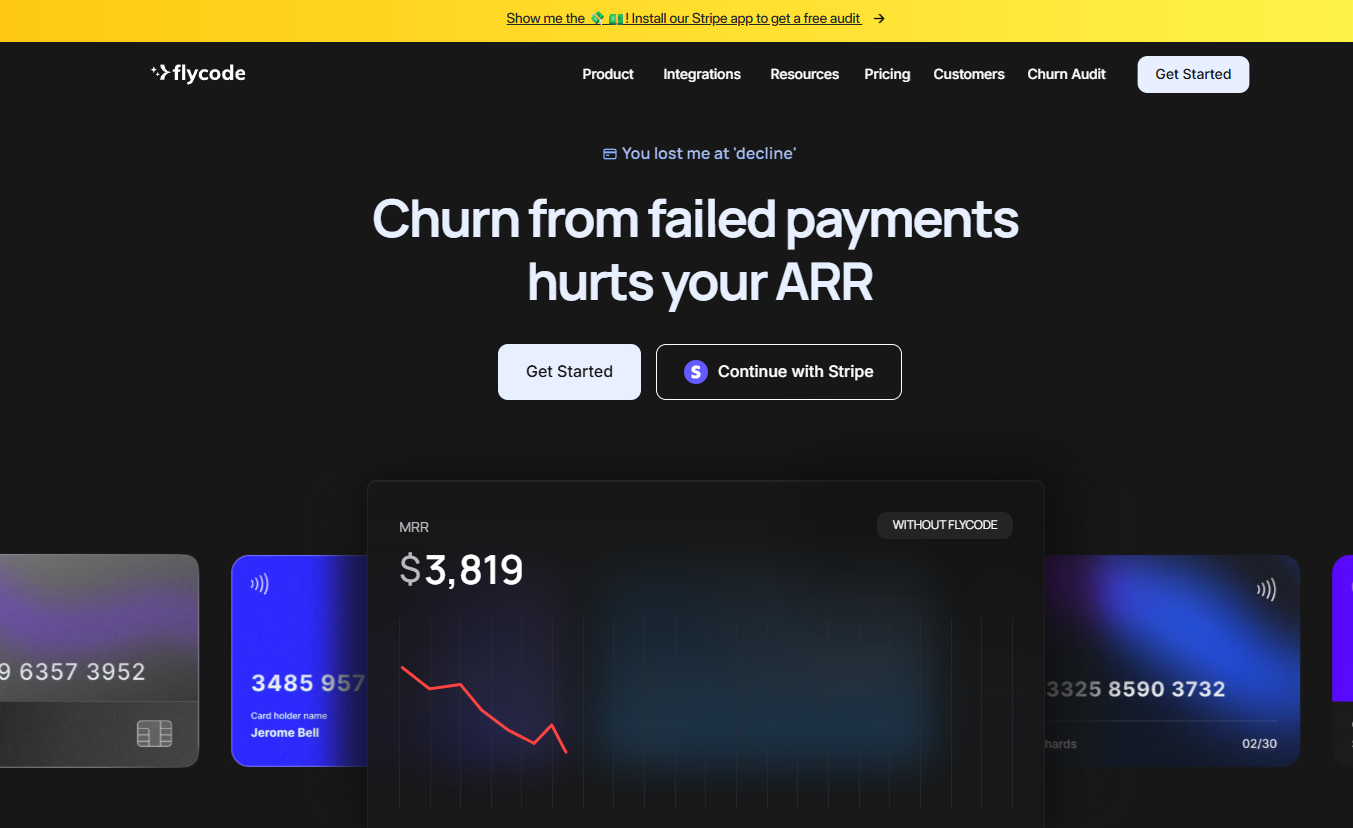
FlyCode is a dedicated payment-recovery and revenue-intelligence platform for SaaS and ecommerce subscription businesses. It uses machine learning and AI-powered retry logic to recover failed payments, including trial-to-paid conversions and alternate-card-on-file scenarios, without requiring engineering work from the buyer's team.
Best for: Subscription businesses with meaningful failed-payment volume that want an outcome-based recovery layer separate from their billing platform.
Key features
- ML-powered retry scheduling with payment anomaly detection
- Failed trial-to-paid conversion recovery
- Coordinated failed-payment email outreach
- Alternate-card-on-file and custom recovery schedules
- Reporting and audit dashboard with recovery tracking
Why choose FlyCode: FlyCode is worth evaluating when your priority is recovery depth and you want vendor economics linked to results rather than a flat monthly commitment. Verify integration coverage against your specific processor and billing platform before proceeding.
FlyCode pricing: FlyCode charges only against revenue recovered above your baseline. The pricing is outcome-based with no public fixed subscription price or fee percentage shown. Contact FlyCode directly for a quote tied to your current recovery rate and monthly billing volume.
G2 rating: 4.8/5
2. Stripe Billing
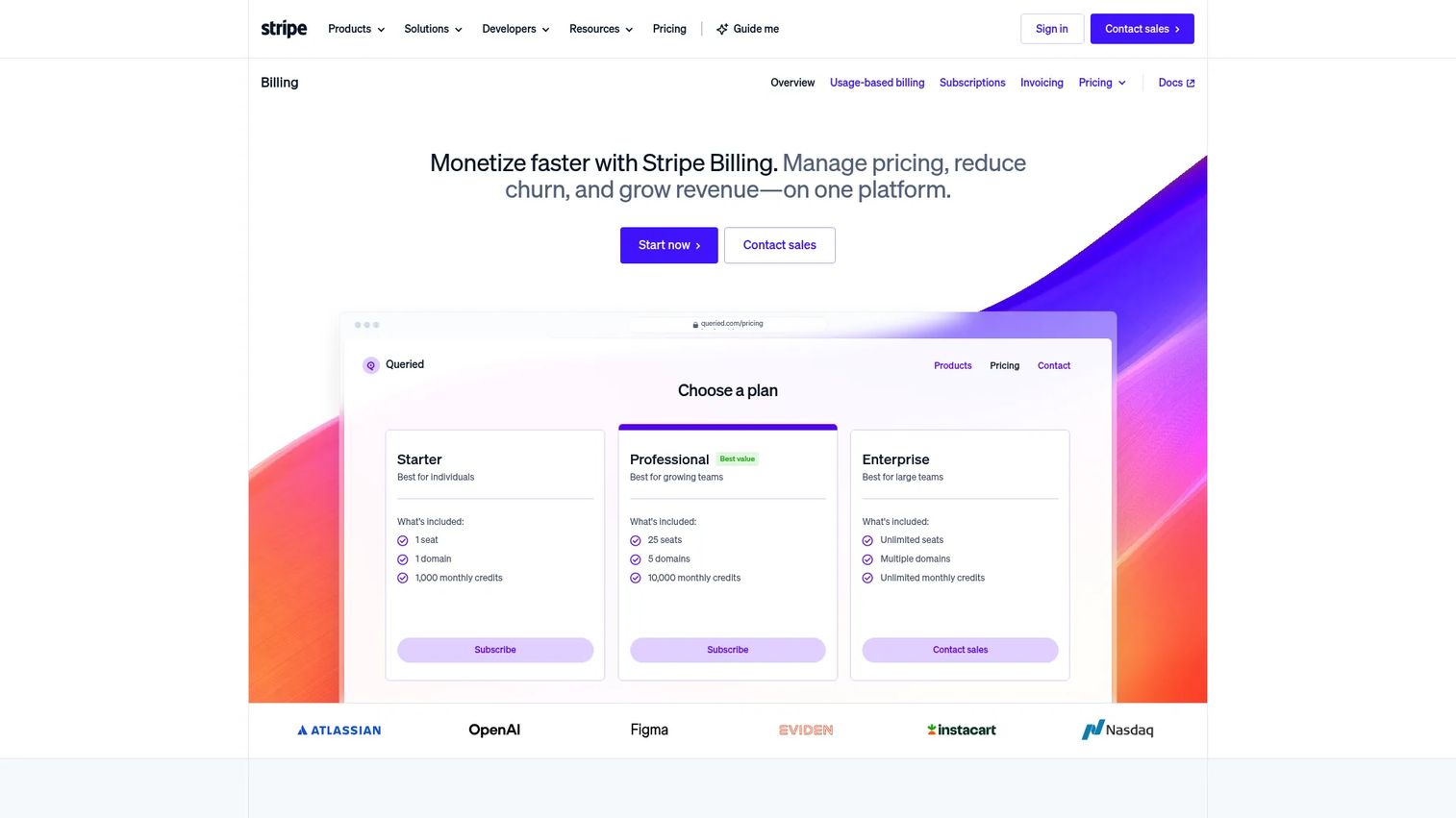
Stripe Billing is the native subscription and recurring billing layer for businesses already using Stripe. Smart Retries, which uses machine-learning signals to time retry attempts, is included within Stripe Billing and serves as the baseline recovery mechanism for most Stripe-based SaaS companies. It also covers subscription management, invoicing, and a customer portal.
Best for: Early-stage and mid-market SaaS companies already committed to Stripe that want recovery without adding a new vendor.
Key features
- Smart Retries with ML-driven retry timing
- Subscription dunning settings and billing schedules
- Payment-method update flows via customer portal
- Invoicing and credit notes
- Stripe-native revenue reporting
Why choose Stripe Billing: It is the right control group before paying any specialist. Measure what Stripe recovers for your specific customer mix over a defined period, then evaluate whether a dedicated tool produces incremental lift above that number.
Stripe Billing pricing: Pay-as-you-go billing costs 0.7% of billing volume. Pay-monthly plans start at $620 per month on a one-year contract, with custom pricing available for higher volumes. Clarify which Smart Retries features are included at each tier before committing.
G2 rating: 4.4/5
3. Redux Payments

Redux Payments is an AI-powered failed-payment recovery platform built specifically for B2C subscription businesses using Stripe Billing. Its Autopilot plan charges 25% on the lift it generates above your current recovery baseline, which means you pay nothing until Redux beats your existing results. The platform also offers a one-time $2,000 Payment Health Audit as an entry point.
Best for: Consumer subscription businesses facing high board scrutiny on billing efficiency, where vendor economics need to be tied directly to incremental results.
Key features
- AI recovery engine trained on consumer transaction data
- Smart customer outreach via targeted recovery emails
- Frictionless payment-update pages with no login required
- Recovery of soft declines, hard declines, and trial-to-paid failures
- No-code Stripe installation with no engineering required
Why choose Redux Payments: The pay-on-performance structure addresses the incrementality question directly. Redux only earns when it beats your baseline, and its 4x ROI guarantee on the Autopilot plan makes the economics easier to defend to a finance or RevOps lead. The Enterprise tier adds dedicated support and custom recovery tuning.
Redux Payments pricing: The Autopilot plan charges 25% on lift above your baseline, with no SaaS fee or contract requirement. Enterprise pricing is custom. A $2,000 one-time Payment Health Audit is available as a pre-commitment step.
G2 rating: 5.0/5
4. Butter Payments
Butter Payments uses machine learning to recover failed subscription payments across multiple processors and billing systems, including Stripe Billing, Braintree, Recharge, and custom subscription setups. Its revenue-share pricing model means Butter takes a percentage of what it recovers rather than charging a flat monthly fee, which aligns vendor incentives with recovery outcomes.
Best for: Higher-volume subscription businesses with enough recovery MRR to make a revenue-share model attractive, particularly those running across more than one payment processor.
Key features
- ML-powered retry optimization across multiple processors
- Integrations with Stripe, Braintree, Recharge, and custom systems
- Dispute and chargeback management
- Recovery performance reporting
- Subscription revenue focus with involuntary churn reduction
Why choose Butter Payments: Butter is a fit for teams that have outgrown their processor's default retry settings and need deeper optimization across a mixed billing environment. Confirm integration compatibility with your specific processor stack before the sales process.
Butter Payments pricing: Butter charges a revenue-share fee rather than a fixed monthly subscription. The exact percentage is confirmed after a payment health analysis. Contact Butter directly for a rate specific to your billing volume and processor mix.
G2 rating: 4.4/5
5. Churnkey

Churnkey sits at the intersection of failed-payment recovery and subscription retention. It combines automated dunning workflows and precision payment retries with cancellation flow controls, reactivation campaigns, and feedback analytics. For SaaS teams whose churn work spans both billing failures and voluntary cancellations, Churnkey covers both in one platform.
Best for: SaaS companies that want dunning and payment recovery alongside cancellation-prevention workflows, without managing two separate tools.
Key features
- Precision payment retries and automated dunning
- Personalized cancel flows with targeted save offers
- Reactivation email campaigns
- Retention metrics with customer timelines
- Feedback AI and adaptive offers
Why choose Churnkey: Churnkey is worth evaluating when your churn reduction work is broader than retry optimization alone. Keep recovery reporting separate from save-offer reporting in the dashboard, otherwise NRR improvements become difficult to attribute cleanly when reporting to the board.
Churnkey pricing: The Starter plan costs $250 per month billed yearly, designed for teams with under $5k monthly churn volume. Core and Intelligence plans for $10k-plus monthly churn volume are priced by quote. Enterprise pricing is custom. A free trial is available.
G2 rating: 4.6/5
6. Churn Buster

Churn Buster is a subscription retention platform known for its adaptive dunning campaigns and customer-facing payment-update experiences. Recovery campaigns combine retries, email, SMS, and decline-aware sequencing, stopping immediately when payment succeeds. Its cancellation flows layer in exit-reason capture, A/B testing, and targeted save offers for teams addressing both billing failure and voluntary churn.
Best for: Subscription ecommerce and SaaS businesses whose primary recovery gap is the customer experience around payment updates, not retry timing alone.
Key features
- Adaptive dunning with email, SMS, and decline-aware sequencing
- Branded payment-update pages with real-time recovery detection
- Cancellation flows with exit reasons and targeted save offers
- Churn analytics with segmentation and AI-powered sentiment analysis
- A/B testing on recovery and retention campaigns
Why choose Churn Buster: If your biggest recovery gap is getting customers to update payment details quickly, Churn Buster's communication controls are strong. Factor in support ticket volume before launching: A multi-step recovery email sequence generates customer replies that someone must own.
Churn Buster pricing: A free Measure plan is available. Dunning Only or Cancel Flows Only plans start at $269 per month, priced on MRR tiers. The Complete Retention Solution covering both starts at $430 per month. Advisory services are a $2,500 one-time fee.
G2 rating: 4.3/5
7. Paddle Retain

Paddle Retain is a retention platform for subscription businesses operating through Paddle's billing and merchant-of-record model. It handles failed-payment recovery through automated dunning, payment-method update flows, and alternative payment options, and adds no-code cancellation flows and subscriber reactivation campaigns. Its primary advantage is stack consolidation for Paddle customers.
Best for: SaaS companies that use Paddle as their billing platform and want recovery and retention in the same environment.
Key features
- Automated payment recovery with dunning and smart retries
- No-code cancellation flows with pause, swap, and discount options
- Payment-detail update flows with wallet payment support
- Subscriber reactivation campaigns
- Term optimization tools
Why choose Paddle Retain: Stack consolidation is the core case. If you are not running Paddle as your billing infrastructure, Retain is less relevant. Verify that recovery data lands cleanly in your finance and revenue reporting before committing, particularly if the board trusts a different system as the source of billing truth.
Paddle Retain pricing: Flat-fee pricing starts at $500 per month for smaller companies. Larger companies move to performance-based pricing. Contact Paddle for a quote at higher revenue volumes.
G2 rating: 4.8/5
8. Chargebee
Chargebee is a subscription billing, payments, and revenue operations platform. Its dunning and failed-payment recovery features are part of a broader system that also covers usage-based billing, revenue recognition under ASC 606, CPQ quoting, and more than 40 payment-gateway integrations. Recovery is one capability within a larger monetization suite.
Best for: SaaS founders consolidating billing operations who need dunning, invoicing, revenue recognition, and retention workflows in one platform.
Key features
- Subscription billing with usage-based, seat-based, and outcome-based pricing models
- Dunning workflows and revenue recovery
- 40-plus payment-gateway integrations
- Revenue recognition under ASC 606 and IFRS 15
- CPQ quoting, multi-product quotes, and approval workflows
Why choose Chargebee: Chargebee makes sense when failed-payment recovery is one part of a broader billing operations problem. If Stripe covers your current billing needs and the only gap is retry optimization, Chargebee may be more than you need.
Chargebee pricing: A Starter plan is free for Chargebee Billing customers. Performance and Enterprise plans are priced by quote. CPQ Lite includes the first 50 quotes at no cost. Contact Chargebee for plan pricing specific to your billing volume and feature requirements.
G2 rating: 4.4/5
9. Recurly
Recurly is an established subscription management and recurring billing platform with built-in dunning, churn management, and payment orchestration. It connects to multiple payment gateways, manages subscriber lifecycles, and provides revenue recovery reporting as part of its core billing layer. Recurly published research showing $1.2B in subscription revenue recovered through churn-management solutions in 2023.
Best for: Subscription businesses with complex recurring billing requirements that need dunning, billing controls, and payment orchestration in the same system.
Key features
- Subscription billing, plans, pricing, and promotions
- Dunning management and churn reduction
- Payment orchestration across multiple gateways
- Subscriber management and account controls
- Revenue reporting and churn analytics
Why choose Recurly: Recurly fits mature subscription businesses with billing complexity beyond Stripe's native capabilities. Evaluate it as a billing platform decision, not a recovery-only decision. Migrating billing infrastructure carries a different ROI calculation than adding a recovery layer on top of an existing stack.
Recurly pricing: The Starter plan costs $249 per month plus 0.9% of billing volume, billed monthly. All-Access plans are billed annually at under 1% of billing volume. An Engage plan starts at $1,600 per month, billed annually. A 90-day free trial is available on Starter.
G2 rating: 4.1/5
10. Zuora

Zuora is an enterprise quote-to-cash and monetization platform covering recurring, usage-based, and hybrid revenue models. Its collections and dunning workflows sit inside a broader system that includes revenue recognition, payments orchestration across 40-plus gateways, and multi-entity billing support. Zuora targets complex enterprise monetization architectures.
Best for: Larger SaaS companies with enterprise billing operations, multiple product lines, or regulatory requirements around revenue recognition.
Key features
- Recurring, usage-based, and one-time billing
- Revenue recognition and compliance automation
- Collections workflows and dunning configuration
- Payments orchestration with 40-plus payment gateways
- Multi-entity billing and global tax support
Why choose Zuora: Choose Zuora when billing complexity is itself creating revenue risk, not when the only problem is card retry timing. Implementation requirements are significant, and the platform is positioned well beyond the needs of a straightforward Series B SaaS billing stack.
Zuora pricing: Custom pricing. Zuora directs all buyers to contact sales. Pricing depends on products selected, transaction volume, and implementation scope.
G2 rating: 3.9/5
11. Recharge

Recharge is a subscription payments and management platform built for ecommerce brands running recurring orders through storefront platforms. Its failed-payment handling, customer payment-update flows, and cancellation-prevention tools are designed for the commerce subscription context, including prepaid subscriptions, bundles, and loyalty programs.
Best for: Ecommerce subscription brands running recurring orders who need payment recovery within their commerce billing stack.
Key features
- Failed payment recovery and customer payment-update flows
- Subscription-first product page widgets
- Customer portal for self-serve subscription management
- Cancellation prevention and win-back campaigns
- Subscription analytics and ecommerce platform integrations
Why choose Recharge: Recharge is the category-specific fit for subscription merchants. If your business sells SaaS subscriptions rather than physical recurring orders, the billing architecture assumptions differ enough that B2B SaaS-focused tools will serve you better.
Recharge pricing: The Starter plan costs $99 per month, including a 1.49% + 19 cents per transaction fee. The Plus plan costs $499 per month with a 1.34% + 19 cents per transaction fee and additional capabilities including bundles and loyalty. A 60-day free trial is available.
G2 rating: 4.4/5
12. Stunning
Stunning is a failed-payment recovery and dunning platform for subscription businesses using Stripe, Foxy, or Subbly. It covers automated recovery via customizable email and SMS, smart retry scheduling, backup payment methods, and branded hosted payment-update pages with Apple Pay and Google Pay support. A Managed Recovery service is also available for teams that want a handled approach.
Best for: Smaller Stripe-based SaaS businesses that want a full-featured dunning workflow up and running quickly on a flat monthly fee.
Key features
- Automated failed-payment recovery via email and SMS
- Branded hosted payment-update pages with Apple Pay and Google Pay
- Smart retry scheduling and backup payment methods
- Subscription management, billing history, and self-serve receipts
- Recovery analytics and Slack notifications
Why choose Stunning: Stunning covers the recovery basics without requiring a long implementation cycle. A 15-day free trial lets you validate performance before committing. Check how pricing scales as your MRR and failed-payment volume grow, since the flat-fee model changes at higher tiers.
Stunning pricing: Software plans are flat monthly fees based on MRR. Pricing starts at $120 per month at $40k MRR. A 15-day free trial is included on all software plans. Managed Recovery pricing is confirmed after an audit and is also MRR-based.
G2 rating: 4.5/5
Considerations when choosing failed payment recovery software
Measure incremental recovered MRR, not gross recovery
A vendor dashboard that reports total recovered revenue is not the same as incremental lift. Ask what the tool counts as recovered, what your native billing stack would have collected anyway, and whether the vendor supports holdout testing or a defensible baseline methodology. A 4x ROI guarantee means nothing if the baseline calculation is opaque.
Match the tool to your existing billing architecture
List your current billing platform, payment processor, and subscription model before taking any demo. An otherwise strong recovery tool creates more problems than it solves if integration requires a billing migration or creates reconciliation gaps in your finance reporting.
Balance silent recovery with customer outreach
Smart retries can recover a meaningful portion of payments without sending a single message. Other customers need a clear path to update their card. Evaluate how each tool decides when to retry silently, when to notify the customer, and how quickly it suppresses outreach after payment succeeds. Aggressive messaging generates support tickets.
Understand the commercial model before comparing costs
Compare fixed monthly fees, performance-based fees, and revenue-share pricing using net recovered MRR as the denominator. A 25% performance fee is defensible when lift is measurable and auditable. It becomes expensive when the vendor claims credit for recoveries your stack already handles.
Assign an internal owner before signing
A billing recovery workflow needs a named person accountable for dashboards, message updates, support escalation, and monthly reporting. That owner may sit in finance, RevOps, or customer success. Without a clear owner, even the best tool produces results nobody acts on.
Conclusion
Failed payments are not a billing problem. They are a revenue operations problem that shows up as churn if nobody builds a system around it.
For Stripe-based teams, Stripe Billing is the right starting point. Measure what Smart Retries recovers over 90 days, then evaluate whether FlyCode, Redux Payments, Butter Payments, Churnkey, Churn Buster, or Stunning generates incremental lift above that baseline. Redux Payments is the clearest option for teams that need a board-defensible answer to "what did this vendor actually recover?"
For businesses running on Paddle, Chargebee, Recurly, or Zuora, the recovery question is inseparable from the billing platform decision. Recurly and Chargebee both include dunning as part of a broader billing system. Zuora fits when billing architecture is complex enough to warrant enterprise infrastructure. Recharge is the right fit for ecommerce subscription commerce, not B2B SaaS.
Start by calculating the last 90 days of failed-payment MRR. Establish a recovery baseline from your current stack. Then shortlist only vendors that can prove incremental results against that number.
For other tools across your revenue stack, the best payment processing software guide covers the broader processing landscape, and the best pricing software guide covers monetization strategy tools.
Start your journey with Guideflow today!
FAQs
Failed payment recovery software helps subscription businesses recover declined or overdue recurring payments through automated retries, dunning communications, customer payment-method update flows, and billing integrations. It targets involuntary churn, which occurs when a customer's payment fails without any decision to cancel, rather than addressing voluntary cancellations.
Smart retries attempt the charge again at a better time, using decline-code signals and issuer behavior patterns to improve timing. Dunning communicates directly with the customer and provides a path to update payment details. Most recovery programs use both: Retries for soft declines that may resolve on their own, and dunning outreach when customer action is required.
Yes. Stripe Billing includes Smart Retries for eligible failed payments, using machine-learning signals to optimize retry timing. The right question is how much it recovers for your specific customer mix over a defined period. A specialized recovery tool may produce incremental lift above that baseline, but Stripe's native capability is the correct measurement starting point.
Start with recovered MRR net of vendor fees. Compare that figure against a native retry baseline to identify the incremental amount attributable to the vendor. Include follow-on retention from recovered subscribers, since a recovered customer who stays for two more quarters is worth considerably more than the recovered charge. Also factor in support workload and any engineering time required for integration.
Common causes include expired cards, insufficient funds at the time of charge, issuer declines triggered by fraud controls, changed card details after a reissue, network timeouts, and customers switching payment methods without updating billing information. Decline reason determines the best recovery action: A temporary insufficient-funds decline responds to retry timing, while a hard decline from a closed account requires a new payment method.
A billing platform makes sense when the company also needs subscription management, invoicing, revenue recognition, or catalog operations. A dedicated recovery tool makes sense when the current billing stack is otherwise working and the specific gap is retry depth, dunning quality, or payment-update conversion. Do not turn a failed-payment problem into a full billing migration unless the rest of your billing stack is also blocking scale.
Ask which billing systems and processors they integrate with natively, how they calculate and attribute recovery lift, what retry logic and decline-code handling looks like, which messaging channels they support, how pricing is calculated and what the baseline methodology is, whether holdout testing is available, and what the data ownership terms are if you exit the contract.
Timing depends on integration type, existing billing complexity, and whether customer-facing communication setup requires review or localization. Tools with native Stripe integrations and no-code setup can be live within a week. Broader billing platforms with multi-gateway connections and custom dunning flows take longer. Ask each vendor for a documented implementation plan that identifies engineering touchpoints, billing configuration steps, and a measurement timeline so you know when the first recovery data becomes meaningful.